



Community hub
Recent from talks
Contribute something
Nothing was collected or created yet.
Ganz Works
View on WikipediaThe Ganz Machinery Works Holding is a Hungarian holding company. Its products are related to rail transport, power generation, and water supply, among other industries.[2]
Key Information


The original Ganz Works or Ganz (Hungarian: Ganz vállalatok or Ganz Művek, Ganz companies, formerly Ganz and Partner Iron Mill and Machine Factory) operated between 1845 and 1949 in Budapest, Hungary. It was named after Ábrahám Ganz, the founder and manager of the company. Ganz is probably best known for the manufacture of tramcars, but was also a pioneer in the application of three-phase alternating current to electric railways.
Ganz also made ships (through its Ganz Danubius division), bridge steel structures (Ganz Acélszerkezet) and high-voltage equipment (Ganz Transelektro). In the early 20th century the company experienced its heyday and became the third-largest industrial enterprise in the Kingdom of Hungary after the Manfréd Weiss Steel and Metal Works and the MÁVAG company.
Since 1989, various parts of Ganz have been taken over by other companies.
History
[edit]
The company was founded by Ábrahám Ganz in 1844. He was invited to Pest, Hungary, by Count István Széchenyi and became the casting master at the Roller Mill Plant (referred to as Hengermalom in Hungarian). In 1854 he began manufacturing hard cast railroad wheels in his own plant founded in 1844. The management of the steam mill paid a share of the profit to Ganz. This enabled him to buy, in 1844, land and a house for 4500 Forints in Víziváros, Buda castle district. Abraham Ganz built his own foundry on this site and started to work there with seven assistants. They made mostly casting products for the needs of the people of the city.[3] In 1845, he bought the neighbouring site and expanded his foundry with a cupola furnace. He gave his brother, Henrik a job as a clerk, because of the growing administration work. He made a profit in the first year, and his factory grew, even though he had not yet engaged in mass production. In 1846, at the third Hungarian Industrywork Exhibition (Magyar Iparmű Kiállítás), he introduced his stoves to the public. He won the silver medal of the exhibition committee and the bronze medaille from Archduke Joseph, Palatine of Hungary.
During the Hungarian Revolution of 1848 the foundry made ten cannons and many cannonballs for the Hungarian army. Because of this, the Military Court of Austria impeached him. He got seven weeks in prison as penalty, but because of his Swiss citizenship he was acquitted of the charge.[3]

Ganz recognized that, to develop his factory, he had to make products that were mass-produced. In 1846 the Pest-Vác railway line was built. At that time, European foundries made wrought iron rims for spoked wagon wheels by pouring the casts in shapes in sand, and leaving them to cool down. He successfully developed a railway wheel casting technology; it was the new method of "crust-casting" to produce cheap yet sturdy iron railway wheels, which greatly contributed to the rapid railway development in Central Europe. 86,074 pieces of hard cast wheels had been sold to 59 European railway companies until 1866. Consequently, this factory played an important role in building the infrastructure of the Hungarian Kingdom and the Austro-Hungarian Empire.[citation needed] At this time the agricultural machines, steam locomotives, pumps and the railway carriages were the main products. At the beginning of the 20th century, 60 to 80% of the factory's products were sold for export.
After the death of Abraham Ganz, the heirs entrusted the management of the factory to his direct colleagues at Ganz Művek: Antal Eichleter, Ulrik Keller and Andreas Mechwart, which then took the name Ganz & Co. The Ganz family sold the company, which consisted of five departments, and in April 1869 it was transformed into a joint-stock company, and continued its operations under the name of "Ganz és Társa vasontöde és Gépgyár Rt." (Ganz & Partners Iron Foundry and Machine Factory Co.) The technical director was András Mechwart, under whose direction Ganz became one of the most important groups of machine building companies in the Austro-Hungarian Monarchy after 1869.
At the end of the 19th century, the products of the Ganz and Partner Iron Mill and Machine Factory (hereinafter referred to as Ganz Works) promoted the expansion of alternating-current power transmissions.
Prominent engineers
[edit]
_2.jpg)


Prominent engineers at Ganz works included András Mechwart, Károly Zipernowsky, Miksa Déri, Ottó Titusz Bláthy, Kálmán Kandó, György Jendrassik and Ernő Wilczek.
Revolution in the milling industry
[edit]The invention of the modern industrial mill (the roller mill) – by András Mechwart in 1874 – guaranteed a solid technological superiority and revolutionized the world's milling industry. Budapest's milling industry grow the second largest in the world, behind the American Minneapolis. The Hungarian grain export increased by 66% within some years.[3]
Power plants, generators turbines and transformers
[edit]
In 1878, the company's general manager András Mechwart founded the Department of Electrical Engineering headed by Károly Zipernowsky. Engineers Miksa Déri and Ottó Bláthy also worked at the department producing direct-current machines and arc lamps.
In 1878, the company began producing equipment for electric lighting and, by 1883, had installed over fifty systems in Austria-Hungary. Their AC systems used arc and incandescent lamps, generators, and other equipment.[4][5]
Generators
[edit]The first turbo generators were water turbines which drove electric generators. The first Hungarian water turbine was designed by engineers of the Ganz Works in 1866. Mass production of dynamo generators started in 1883.[6]
The missing link of a full Voltage Sensitive/Voltage Intensive (VSVI) system was the reliable alternating current constant voltage generator. Therefore, the invention of the constant voltage generator by the Ganz Works in 1883[7] had a crucial role in the beginnings of industrial scale AC power generation, because only these types of generators can produce a stable output voltage, regardless of the actual load.[8]
Transformers
[edit]
In cooperation, Zipernovsky, Bláthy and Déri (known as the ZBD team) constructed and patented the transformer. The "transformer" was named by Ottó Titusz Bláthy. The three invented the first high efficiency, closed core shunt connection transformer. They also invented the modern power distribution system: Instead of a series of connections they connected supply transformers in parallel to the main line.[9]
The transformer patents described two basic principles. Loads were to be connected in parallel, not in series as had been the general practice until 1885. Additionally, the inventors described the closed armature as an essential part of the transformer. Both factors assisted the stabilisation of voltage under varying load, and allowed definition of standard voltages for distribution and loads. The parallel connection and efficient closed core made construction of electrical distribution systems technically and economically feasible.
The Ganz Works built the first transformers using iron plating of enamelled mild iron wire, and started to use laminated cores to eliminate eddy currents[10]
AC Power stations
[edit]In 1886, the ZBD engineers designed, and the company supplied, electrical equipment for the world's first power station to use AC generators to power a parallel connected common electrical network. This was the Italian steam-powered Rome-Cerchi power plant.[11]
Following the introduction of the transformer, the Ganz Works changed over to production of alternating-current equipment. For instance, Rome's electricity was supplied by hydroelectric plant and long-distance energy transfer.[12]
- Ganz Transelektro power plant and power distribution products
-
 Ganz Transformers in december 1886
 -
 construction of a Ganz water turbo generator (1886)
 -
 PSM V56 D0433 direct connected electric railway generator (1899)
 -

-
 Ganz 21.000 kW Transformer (1911, weight: 38t)
 -
 A generator assembly hall of the Ganz Works (1922)
 -

-


_Fortepan_95160.jpg)


Electricity meters
[edit]The first mass-produced kilowatt-hour meter (electricity meter), based on Hungarian Ottó Bláthy's patent and named after him, was presented by the Ganz Works at the Frankfurt Fair in the autumn of 1889, and the company was marketing the first induction kilowatt-hour meter by the end of the year. These were the first alternating-current wattmeters, known by the name of Bláthy-meters.[13]
Industrial refrigerators and air conditioners
[edit]In 1894, Hungarian inventor and industrialist István Röck started to manufacture a large industrial ammonia refrigerator (together with the Esslingen Machine Works) which was powered by Ganz electric compressors. At the 1896 Millennium Exhibition, Röck and the Esslingen Machine Works presented a 6-tonne capacity artificial ice producing plant. In 1906, the first large Hungarian cold store (with a capacity of 3,000 tonnes, the largest in Europe) opened in Tóth Kálmán Street, Budapest, the machine was manufactured by the Ganz Works. Until nationalisation after the Second World War, large-scale industrial refrigerator production in Hungary was in the hands of Röck and Ganz Works.[14]
The contract between Ganz and Egypt in the 1930s played a key role in the development of cooling equipment: railcars delivered to Egypt were equipped with air-conditioning cooling systems. The collective of the Ganz factory (machine designers: Gábor Hollerung, Rezső Oláh, István Pfeifer, Prónai) designed and built the 3-cylinder, 20 kW compressors with freon refrigerant, air condenser and evaporator. The machine could also be converted to heat pump operation.[15]
ICE engines and vehicles
[edit]The beginning of gas engine manufacturing in Hungary is linked to Donát Bánki and János Csonka but it is not clear that they ever worked for Ganz.
Ganz produced engines whose designs were licensed to Western European partners, notably in the United Kingdom and Italy.


- Timeline
- 1889 the first four-stroke gas engine was built by the Ganz factory
- 1893 the manufacture of paraffin and petrol fuelled engine with carburetor
- 1898 the manufacture of engines with the Bánki water injection system
- 1908 the introduction of a new petrol engine type, the series Am
- 1913 the manufacture of Büssing petrol engines for trucks
- 1914–18 the manufacture of fighter plane engines
- 1916 the manufacture of petrol engines, type Fiat
- 1920 the modification of petrol engines for suction gas operation
- 1924 György Jendrassik started his engine development activity
- 1928 the first railway diesel engine was completed, according to the plans of Ganz-Jendrassik
- 1929 the first export delivery of a railway engine using the system of Ganz-Jendrassik
- 1934 there was an engine reliability World Competition in the USSR where the Ganz engine achieved the best fuel consumption in its category
- 1939 Scale model of Ganz Ac Electric locomotive exhibited at the Italy Pavilion of the New York World's Fair
- 1939–42 construction of the Jendrassik Cs-1 turboprop engine
- 1944 the first application of the engine type XII JV 170/240 in a motor-train set
- 1953 modernisationon of the diesel engine system Ganz-Jendrassik
- 1959 the union of the Ganz factory and the MÁVAG company, establishing Ganz-MÁVAG
Railways
[edit]Steam motors
[edit],_Andr%C3%A1ssy_%C3%BAt.png)
The Ganz Company started to construct steam locomotives and steam railcars from the 1860s. Between 1901 and 1908, Ganz Works of Budapest and de Dion-Bouton of Paris collaborated to build a number of railcars for the Hungarian State Railways together with units with de Dion-Bouton boilers, Ganz steam motors and equipments, and Raba carriages built by the Raba Hungarian Wagon and Machine Factory in Győr. In 1908, the Borzsavölgyi Gazdasági Vasút (BGV), a narrow-gauge railway in Carpathian Ruthenia (today's Ukraine), purchased five railcars from Ganz and four railcars from the Hungarian Royal State Railway Machine Factory with de Dion-Bouton boilers. The Ganz company started to export steam motor railcars to the United Kingdom, Italy, Canada, Japan, Russia and Bulgaria.[16][17][18]
The World's first electrified main railway line in Italy
[edit]The Ganz Works, having identified the significance of induction motors and synchronous motors, commissioned Kálmán Kandó to develop them. In 1894, Hungarian engineer Kálmán Kandó developed high-voltage three-phase AC motors and generators for electric locomotives. The first-ever electric rail vehicle manufactured by Ganz Works was a 6 HP pit locomotive with direct current traction system. The first Ganz made asynchronous rail vehicles (altogether 2 pieces) were supplied in 1898 to Évian-les-Bains (France) with a 37 HP asynchronous traction system. The Ganz Works won the tender for electrification of the Valtellina Railway in Italy in 1897. Under the management, and on the basis of plans from Kálmán Kandó, three phase electric power at 3 kV and 15 Hz was fed through two upper wires and the rails.

The electricity was produced in a dedicated power station and the system operated for thirty years from 1902. Italian railways were the first in the world to introduce electric traction for the entire length of a main line rather than just a short stretch. The 106 km Valtellina line was opened on 4 September 1902, designed by Kandó and a team from the Ganz works.[19][20] The voltage was significantly higher than used earlier and it required new designs for electric motors and switching devices.[21][22] The three-phase two-wire system was used on several railways in Northern Italy and became known as "the Italian system". Kandó was invited in 1905 to undertake the management of Società Italiana Westinghouse and led the development of several Italian electric locomotives.[21]
Invention of the Phase Converter
[edit]In 1918,[23] Kandó invented and developed the rotary phase converter, enabling electric locomotives to use three-phase motors whilst supplied via a single overhead wire, carrying the simple industrial frequency (50 Hz) single phase AC of the high-voltage national networks.[20] After World War I, at the Ganz Works, Kálmán Kandó constructed a single-phase electric railway system using 16 kV at 50 Hz. A similar system, but using 15 kV at 16.7 Hz, later became widely used in Europe. The main attribute of Kandó's 50 Hz system was that it was fed by the normal power network, so dedicated railway power stations became unnecessary. Because of the early death of Kálmán Kandó, László Verebélÿ continued the work for the Hungarian State Railways (MÁV).[24]
- Ganz Rail rolling stock
-
 The first steam railcar built by Ganz and de Dion-Bouton
 -
 Ganz AC electric locomotive prototype (1901 Valtellina, Italy)
 -
 Electric locomotive RA 361 (later FS Class E.360) by Ganz for the Valtellina line, 1904
 -
 The first locomotive with a phase converter was Kando's V50 locomotive (only for demonstration and testing purposes)
 -
 Árpád Diesel railbus in 1937
 -
 Ganz train on the Ferrocarriles Patagónicos railway in Argentina (1945)
 -

-
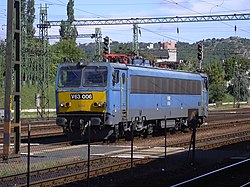 A series V63 Ganz-MÁVAG electric locomotive of Hungarian State Railways
 -

-

-


_s%C3%ADnaut%C3%B3busz._Fortepan_23230.jpg)


Ganz-MÁVAG rail rolling stock
[edit]
In 1959 Ganz merged with the MÁVAG company and was renamed Ganz-MÁVAG. In 1976 Ganz-Mávag supplied ten standard gauge 3-car diesel trainset to the Hellenic Railways Organisation (OSE), designated as Class AA-91 and four metre gauge 4-car trainsets, designated as Class A-6451. In 1981/82 Ganz-Mávag supplied to OSE 11 B-B diesel-hydraulic DHM7-9 locomotives, designated as class A-251. Finally, in 1983, OSE bought eleven 3-car metre gauge trainsets, designated as Class A-6461. All these locomotives and trainsets have been withdrawn with the exception of one standard and one metre gauge trainset.[citation needed]
In 1982/83 Ganz-Mávag supplied an order for electric multiple units to New Zealand Railways Corporation for Wellington suburban services. The order was made in 1979, and was for 44 powered units and 44 trailer units, see New Zealand EM class electric multiple unit.[citation needed]
Ganz-MÁVAG Trams
[edit]Ganz-MÁVAG delivered 29 trams (2 car sets) to Alexandria, Egypt from 1985 to 1986.[25]
Shipbuilding, Ganz - Danubius
[edit]In 1911, the Ganz Company merged with the Danubius shipbuilding company, which was the largest shipbuilding company in Hungary. From 1911, the unified company adopted the "Ganz–Danubius" brand name. In the beginning of the 20th century the company had 19 shipyards on the Danube and the Adriatic Sea in the city of Rijeka and Pula.[26] As Ganz Danubius, the company became involved in shipbuilding before, and during, World War I. Ganz was responsible for building the dreadnought SMS Szent István, all of the Novara-class cruisers, and built diesel-electric U-boats at its shipyard in Budapest, for final assembly at Fiume. Several U-boats of the U-XXIX class, U-XXX class, U-XXXI class and U-XXXII class were completed,[27] A number of other types were laid down, but remained incomplete at the war's end.[28] By the end of the First World War, 116 naval vessels had been built by The Ganz-Danubius company. The company also produces transatlantic ocean liners for passenger lines Trieste - New York, Trieste - Montevideo, as a reflection of already formed wave of mass migration from Central Europe to America.
- Ganz–Danubius ships and submarines
-

-
 The battle-damaged SMS Novara (1913) after a victorious naval battle
 -

-


Aircraft
[edit]The first Hungarian "aeroplane factory" (UFAG) was founded by the Ganz Company and Weiss-Manfréd Works in 1912. During World War I, the company made many types of Albatros and Fokker fighter planes.
Before 1919, the company built ocean liners, dreadnought type battleships and submarines, power plants, automobiles[29][30] and many types of fighter aircraft.[31]
The world's first turboprop engine was the Jendrassik Cs-1 designed by the Hungarian mechanical engineer György Jendrassik. It was built and tested in the Ganz factory in Budapest between 1939 and 1942. It was planned to be fitted to the Varga RMI-1 X/H twin-engined reconnaissance bomber designed by László Varga in 1940, but the program was cancelled. Jendrassik had also designed a small-scale 75 kW turboprop in 1937.[citation needed]
After World War II
[edit]In 1947, the Ganz Works was nationalised and in 1949 it became independent and six big companies came into existence, including the Ganz Transformer Factory. In 1959, Ganz Wagon and Machine Factory merged with the MÁVAG Locomotive and Machine Factory under the name of Ganz-MÁVAG Locomotive, Wagon and Machine Works. Of the products of the Works, outstanding results were shown in the field of the manufacture of diesel railcars and multiple units. Traditional products included tramcars as well, and customers included the tramway network of Budapest. In the meantime the Foundry workshop was closed down.
In 1974, the locomotive and wagon Works were merged under the name of Railway Vehicle Factory and then the machine construction branch went through significant development. The production of industrial and apartment house lifts became a new branch. Ganz-MÁVAG took over a lot of smaller plants in the 1960s and 1970s and their product range was extended. Among other things, they increased their bridge-building capacity. They made iron structures for several Tisza bridges, for the Erzsébet Bridge in Budapest, for public road bridges in Yugoslavia and for several industrial halls.
The Ganz Shipyard experienced its most productive times during the four decades following nationalisation. In the course of this period 1100 ship units were produced, the number of completed seagoing ships was 240 and that of floating cranes was 663. As a result of the great economic and social crises of the 1980s, Ganz-MÁVAG had to be reorganised. The company was transformed into seven independent Works and three joint ventures.
Ganz since 1989
[edit]In 1989, the British company Telfos Holdings gained a majority of the shares in Ganz Railway Vehicle Factory Co. Ltd. and the name of the company was changed to Ganz-Hunslet Co. Ltd. In the course of 1991 and 1992, the Austrian company Jenbacher Werke obtained 100% of the company's shares and consequently the railway vehicle factory is now a member of the international railway vehicle manufacturing group, Jenbacher Transport Systeme. At present, the Ganz Electric Works, under the name of Ganz-Ansaldo is a member of the Italian industrial giant, AnsaldoBreda. The Ganz Works were transformed into holdings. Ganz-Danubius was wound up in 1994. The Ganz Electric Meter Factory in Gödöllő became the member of the international Schlumberger group.
In 2006, the power transmission and distribution sectors of Ganz Transelektro were acquired by Crompton Greaves,[32] but still doing business under the Ganz brand name, while the unit dealing with electric traction (propulsion and control systems for electric vehicles) was acquired by Škoda Transportation and is now a part of Škoda Electric.[33]
Now the plant is operated by a new investor as a tenant, Ganz Transformer Motor and Manufacturing Ltd., after the previous owner was unable to finance the production.[34]
Timeline[35]
1991: Joint Venture with Italian Ansaldo named Ganz Ansaldo Ltd.
1994: Air-cooled turbogenerator from 20 up to 70MVA
1998: Development of double-cage induction motor for twin-drives first on the world
2000: Acquisition by Tranelektro Group under name of Ganz-Transelektro
2001: Developed 1MW ExN Non-sparking gasturbine starter motors for GE
2002: First transformer in the world for 123 kV with ester liquid
2006: Became a Part of Crompton Greaves Ltd as CG Electric Systerms Hungary
2010: Start of manufacturing Safety Class 3&4 motors for Nuclear Power Plants
2018: Developing VFD-driven Increased Safety LVAC motors for driving OEM pumps used in Oil&gas fields
2020: Establishment of Ganz Transformer Motor and Generator Ltd., Ganz brand back in Hungarian ownership
Divisions
[edit]Source:[36]
Transformer division[37]
The Transformer division specializes in the design, manufacture and testing of substation transformers, generation transformers, auxiliary transformers, mobile transformers and traction transformers from 20 to 600 MVA (1000 MVA for autotransformers) from 52 to 800 kV.
Rotating machines division[38]
The production of three-phase, alternating current induction motors began in the factory in 1894. Through the 90's Ganz has developed more advanced motors with decreased total weight, increased efficiency and low noise levels in order to satisfy the actual needs of the market and all conditions of the industrial application and to conform to IEC, NEMA, ATEX and EAC standards.
GIS Service Division[39]
GIS Service division performs onsite works like maintenance, inspection, modification, overhaul, extensions on former GANZ and other brands of switchgears. The activity is mainly focused on the existing substations and equipment.
References
[edit]- ^ About us at Ganz Holding (19 Mar 2023)
- ^ About us, Ganz-holding.hu
- ^ Mikulas Teich; Roy Porter; Bo Gustafsson (1996). The Industrial Revolution in National Context: Europe and the USA. Cambridge University Press. p. 280. ISBN 9780521409407.
- ^ Guarnieri, M. (2013). "Who Invented the Transformer?". IEEE Industrial Electronics Magazine. 7 (4): 56–59. doi:10.1109/MIE.2013.2283834. S2CID 27936000.
- ^ Hughes, Thomas P. (1993). Networks of Power: Electrification in Western Society, 1880-1930. Baltimore: The Johns Hopkins University Press. pp. 95–96. ISBN 978-0-8018-2873-7. Retrieved Sep 9, 2009.
- ^ http://www.sze.hu/~mgergo/EnergiatudatosEpulettervezes/2013_1_feladat/ErosErika/V%EDzenergia%20hasznos%EDt%E1s%20szigetk%F6zi%20szemmel%20EL%D5AD%C1SANYAG.pdf[permanent dead link]
- ^ American Society for Engineering Education (1995). Proceedings, Part 2. p. 1848.
- ^ Robert L. Libbey (1991). A Handbook of Circuit Math for Technical Engineers. CRC Press. p. 22. ISBN 9780849374005.
- ^ "Bláthy, Ottó Titusz". Retrieved 20 December 2016.
- ^ Electrical Society of Cornell University (1896). Proceedings of the Electrical Society of Cornell University. Andrus & Church. p. 39.
- ^ "Ottó Bláthy, Miksa Déri, Károly Zipernowsky". IEC Techline. Archived from the original on September 30, 2007. Retrieved Apr 16, 2010.
- ^ Hungarian Inventors and their Inventions Archived 2012-03-22 at the Wayback Machine
- ^ Eugenii Katz. "Blathy". Clarkson University. Archived from the original on June 25, 2008. Retrieved 2009-08-04.
- ^ The development and heyday of mechanical science (Hungarian) Link
- ^ The development and heyday of mechanical science (Hungarian) Link
- ^ Railroad Gazette – Volume 37 – Page 296 (printed in 1904)
- ^ Modern Machinery – Volumes 19–20 – Page 206 (Printed in 1906)
- ^ John Robertson Dunlap, Arthur Van Vlissingen, John Michael Carmody: Factory and Industrial Management – Volume 33 – Page 1003 (printed in 1907
- ^ Duffy (2003), p. 120-121.
- ^ a b Hungarian Patent Office. "Kálmán Kandó (1869–1931)". www.mszh.hu. Archived from the original on 2010-10-08. Retrieved 2008-08-10.
- ^ a b "Kalman Kando". Retrieved 2011-10-26.
- ^ "Kalman Kando". Archived from the original on 2012-07-12. Retrieved 2009-12-05.
- ^ Duffy, Michael C. (2003). Electric Railways 1880–1990. IET. p. 137. ISBN 9780852968055.
- ^ "Ganz and Tungsram – the 20th century". Electric History. EnergoSolar.com. 2007. Archived from the original on 6 January 2009. Retrieved 20 December 2016.
- ^ "Archived copy" (PDF). Archived from the original (PDF) on 2015-01-10. Retrieved 2015-01-10.
{{cite web}}: CS1 maint: archived copy as title (link) - ^ History of Ganz Danubius
- ^ R.H. Gibson, Maurice Prendergast (2002). The German Submarine War 1914–1918. Periscope Publishing Ltd. p. 386. ISBN 9781904381082.
- ^ http://www.gwpda.org/naval/ahsubs.htm Sieche article on KuK U-Boats
- ^ Iván Boldizsár: NHQ; the New Hungarian Quarterly, Volume 16, Issue 2; Volume 16, Issues 59–60, p. 128
- ^ Hungarian Technical Abstracts: Magyar Műszaki Lapszemle, Volumes 10–13, p. 41
- ^ Iván T. Berend: Case Studies on Modern European Economy: Entrepreneurship, Inventions, and Institutions, p. 151
- ^ Ganz is now CG Archived 2011-03-10 at the Wayback Machine Retrieved 2009-11-28.
- ^ info@lundegaard.cz, Lundegaard – e-business solutions provider, www.lundegaard.cz. "Česká verze – ŠKODA TRANSPORTATION a.s." Archived from the original on 13 April 2008. Retrieved 20 December 2016.
{{cite web}}:|first=has generic name (help)CS1 maint: multiple names: authors list (link) - ^ "Production resumes at the Ganz factory – Ganz Group". 8 September 2020. Retrieved 2021-03-23.
- ^ "About us – Ganz Group". Retrieved 2021-03-23.
- ^ "Ganz Group". Retrieved 2021-03-23.
- ^ "Transformer Division – Ganz Group". Retrieved 2021-03-23.
- ^ "Rotating Machines Division – Ganz Group". Retrieved 2021-03-23.
- ^ "GIS Service Division – Ganz Group". Retrieved 2021-03-23.
External links
[edit]
- Official website
 – Ganz Machinery Works Holding, current company
 - A photo of a Ganz railcar of Hungarian State Railways c1936
- A withdrawn Ganz-Mavag DMU at Mendoza, Argentina
- Ganz Transelektro Ltd's page in English Archived 2011-03-10 at the Wayback Machine
- Ganz Danubius homepage

Ganz Works
View on GrokipediaGanz Works, initially established as the Ganz Iron Foundry, was a Hungarian engineering and manufacturing company founded in 1844 by Swiss-born entrepreneur Ábrahám Ganz in Pest (now Budapest), specializing in cast-iron products such as railway wheels produced via the first European application of the hard-casting method, which enabled safer and larger-scale rail traffic.[1][2] Following Ganz's suicide in 1867, director András Mechwart reorganized the firm as Ganz & Co., expanding it from 370 to over 6,000 employees by 1899 and diversifying into machinery, milling equipment, and electrical engineering.[2] The company pioneered key electrical innovations, including the 1882 invention of an AC generator by Károly Zipernowsky and Miksa Déri for applications like theater lighting, and in 1885, the patenting of the world's first closed-iron-core transformer by Zipernowsky, Déri, and Ottó Bláthy, facilitating efficient long-distance power transmission.[3][4] Ganz Works achieved prominence in heavy engineering, producing over 30,000 rolling mills exported globally by 1907, developing hydraulic turbines like the Bánki model for low-head rivers, and inventing the Bánki-Csonka carburettor in 1893.[2][1] In transportation, it constructed the world's first large-scale electric traction railway in Italy's Valtellina Valley in 1902, advanced three-phase AC railway systems under Kálmán Kandó, and manufactured railcars, trams, and components for Budapest's metro.[2][1] The firm's generators and transformers powered early hydroelectric plants, such as Rome's Tivoli station, underscoring its role in the global shift to alternating current and industrial modernization.[3] Successive engineers like Donát Bánki and Gyula Gulden furthered hydraulic and combustion innovations, establishing Ganz as a cornerstone of Hungarian industry until its fragmentation post-World War II, with remnants persisting in modern entities focused on electrical equipment.[1]
Founding and Early Development (1844–1880s)
Abraham Ganz and the Establishment of the Foundry
Ábrahám Ganz (1815–1867), a Swiss-born iron founder and engineer, immigrated to Hungary in 1841 after gaining experience in foundries across Switzerland, France, Italy, and Austria. [5] In 1843, while working in Vienna, he suffered an injury losing an eye due to molten metal splash, prompting his decision to establish an independent operation.[5] In 1844, Ganz founded his own iron foundry in Buda, the western part of Budapest, starting with seven foundrymen and focusing on castings for mill machinery and agricultural equipment.[5] [6] The following year, in 1845, he acquired property on Királyhegy Street (now Bem József Street) to house and expand the workshop, marking the formal establishment of what would become the Ganz Works.[6] Under Ganz's management, the foundry rapidly grew by addressing local demand for reliable iron components amid Hungary's industrializing economy, employing innovative techniques in casting to produce durable mill wheels and other machinery parts.[5] By the mid-1850s, the facility had expanded to include machine shops, laying the groundwork for broader engineering production despite Ganz's death by suicide on December 15, 1867.[7]Innovations in Iron Processing and Milling Technology
Abraham Ganz pioneered the use of chilled cast-iron in industrial applications at his foundry established in 1844, focusing on components requiring high surface hardness and durability. In 1856, he obtained a patent for casting railway wheels in molds lined with a sand-loam mixture, enabling rapid cooling of the wheel tread to form a hard, wear-resistant white cast-iron layer while maintaining a tougher interior.[5] This chilling process addressed the limitations of earlier all-gray cast-iron wheels, which suffered from rapid wear under rail traffic, and positioned Ganz Works as a leading supplier to expanding European railway networks. By November 1867, the foundry celebrated production of its 100,000th such wheel, underscoring the method's scalability and reliability.[8] Concurrently, Ganz adapted the chilling technique to produce grooved and smooth cast-iron rollers for grain milling, supplanting brittle porcelain alternatives that cracked under operational stresses. These rollers, with their hardened surfaces, facilitated more efficient breakage of wheat kernels and reduction of middlings to flour, enhancing milling throughput and flour quality.[5] [9] Introduced in the 1850s, they contributed to the shift from stone grinding to roller systems, a key advancement in flour production technology that spread across Hungary and beyond.[10] Ganz's innovations in iron processing thus stemmed from empirical refinements in casting and alloy treatment, prioritizing mechanical performance over prior artisanal methods.Electrical Engineering Pioneering (1880s–1914)
Invention and Patenting of the Transformer
In the mid-1880s, engineers at Ganz Works in Budapest developed the first practical closed-core transformer for alternating current power distribution. Károly Zipernowsky, the chief engineer, along with Miksa Déri and Ottó Titusz Bláthy, addressed limitations in prior open-core designs, such as those by Lucien Gaulard, which suffered from high hysteresis and eddy current losses due to incomplete magnetic circuits. Bláthy proposed encasing the iron core in a closed loop to enhance efficiency, leading to the ZBD transformer—named for the inventors' initials—which utilized a shunt connection and laminated core construction.[11][12] The invention stemmed from Ganz Works' experiments with AC systems, initiated to compete in electrical engineering amid the "War of Currents." Zipernowsky oversaw the theoretical framework, Déri handled practical wiring including parallel connections of multiple transformers, and Bláthy focused on core design and efficiency calculations, performing over 1,000 tests to optimize parameters. The resulting device achieved significantly lower no-load losses compared to contemporaries, enabling reliable voltage transformation for transmission lines. Bláthy also coined the term "transformer" to describe the apparatus.[13][11] Patents for the ZBD transformer were filed beginning in early 1885. Ganz engineers submitted applications on January 2 in Austria and March 3 in Hungary for core-type transformers, followed by March 6 filings for shell-type variants. These Hungarian and Austrian patents, granted later that year, covered the closed magnetic circuit, insulation methods, and parallel operation techniques essential for distribution networks. International filings ensued, including in Germany and the United States, solidifying Ganz's priority despite concurrent developments elsewhere, such as William Stanley's 1885 patent. The invention was publicly demonstrated at the Budapest National General Exhibition in 1885, showcasing its viability for commercial power systems.[14][3][13]Development of Generators, Turbines, and AC Systems
Ganz Works engineers designed the first Hungarian water turbine in 1866, marking an early advancement in hydraulic power generation.[15] Mass production of dynamo generators paired with these turbines commenced in 1883, enabling industrial-scale hydroelectric applications.[16] Concurrently, the company pioneered self-excited AC generators, with small commercial installations in Budapest utilizing single-phase AC systems by the late 1870s.[17] In 1883, Ganz introduced the constant voltage generator, a self-regulating device that maintained stable output despite load variations, facilitating reliable AC power distribution.[16] This innovation underpinned the company's first major AC demonstration at the 1885 Budapest National Exposition, where 70-cycle AC at 1,350 volts illuminated the entire venue.[18] Building on transformer technology, Ganz integrated these generators into polyphase AC networks, exemplified by the 1886 Rome electrification project, which powered much of the city and validated AC's scalability over DC.[19] Transitioning to steam-driven systems, Ganz developed turbo generators in the early 1900s, ahead of many competitors, with Ottó Bláthy contributing to armature designs as shown in a 1904 assembly.[20] By 1899, the firm produced direct-connected electric railway generators, supporting traction applications.[18] These advancements extended to large-scale hydroelectric alternators, such as those installed in the Murghab River station, emphasizing robust, high-capacity AC generation for remote power plants.[18] Ganz's focus on empirical testing and iterative engineering ensured durability, with generator halls in Budapest facilitating assembly of units up to several megawatts by the 1910s.[3]Production of Electricity Meters and Early Appliances
In 1883, engineer Ottó Bláthy, employed at Ganz Works, developed the prototype of the first practical electricity meter capable of accurately measuring alternating current (AC) consumption, utilizing a mercury-based mechanism to register power usage proportional to the circuit's load. This innovation addressed a critical need for AC systems, enabling reliable energy billing as electrical distribution expanded. Ganz Works subsequently manufactured the first commercial AC kilowatt-hour meter based on Bláthy's patent, with the initial specimen—named the Bláthy meter—presented at the 1889 Frankfurt International Electrotechnical Exhibition.[21] The device proved commercially viable, incorporating an induction principle that made it suitable for widespread adoption in European power networks, and production at Ganz's facilities marked the establishment of dedicated meter manufacturing lines by late 1889.[22] Parallel to meter development, Ganz Works' electrical department, founded in 1878 under director Károly Zipernowsky, initiated production of early electrical appliances and devices to support nascent electrification efforts. These included arc lamps for industrial illumination and incandescent lamps for more versatile lighting applications, both produced starting in the late 1870s and demonstrated at international exhibitions such as the 1884 Turin World Exhibition.[3] Complementing these were DC dynamos, small-scale generators designed for powering early electrical setups in factories, public spaces, and experimental installations across Europe.[23] These products represented Ganz's initial foray into consumer- and industrial-oriented electrical apparatus, facilitating the practical deployment of electricity beyond large-scale power generation and contributing to the company's reputation for reliable, exportable technology during the 1880s. By integrating such devices with their AC innovations, Ganz enabled integrated systems for lighting and basic power distribution, though production volumes remained modest amid the era's technological transitions.[3]Industrial Expansion and Diversification (1900–1945)
Internal Combustion Engines and Automotive Ventures
Ganz Works entered internal combustion engine production in the late 19th century, completing unfinished imported gas engines in 1887 under the direction of János Csonka, who served as managing director from that year.[24] Csonka, a key figure in early Hungarian engine development, had constructed the country's first gas engine in 1879 prior to his Ganz role.[25] Alongside Donát Bánki, another Ganz engineer, Csonka patented a carburetor on February 11, 1893, enabling efficient fuel-air mixing in spark-ignition engines.[26] By the early 1900s, Ganz applied these capabilities to automotive ventures, manufacturing buses such as the 1914 model powered by internal combustion engines for urban and intercity transport.[27] These efforts marked an extension of the company's engineering expertise beyond stationary and rail applications into road vehicles, though production volumes remained modest compared to core sectors like electrical equipment. In 1927, engineer György Jendrassik joined Ganz and spearheaded diesel engine development, yielding the first Ganz-Jendrassik prototypes that year with single- and double-cylinder configurations.[28] Jendrassik's designs emphasized reliability and efficiency, culminating in the VI JaR 153 model introduced in 1933, which powered railcars and contributed to the dieselization of Hungarian transport.[18] By 1931, Ganz produced a 70 horsepower Jendrassik diesel variant specifically for buses and trucks, operating at 1,650 RPM and integrated with friction clutches and gearboxes for heavy-duty road use.[29] These engines facilitated Ganz's limited but notable involvement in commercial vehicle propulsion, prioritizing durable, high-torque outputs suited to industrial demands rather than mass-market passenger cars.[30]Railway and Tram Manufacturing Achievements
Ganz Works entered railway vehicle production in the late 19th century, initially focusing on components like durable cast-iron wheels introduced in 1854, which were supplied to numerous European railways. By 1866, the company had sold over 86,000 such wheels to 59 railway operators, demonstrating early expertise in rail infrastructure.[31] In 1902, Ganz established a dedicated railcar plant, marking a shift toward full vehicle assembly amid growing demand for motorized transport.[31] A key early achievement was the collaboration with de Dion-Bouton from 1901 to 1908, producing steam railcars for Hungarian State Railways featuring compact vertical boilers and sprung axle-mounted engines for improved efficiency on secondary lines.[32] These units, with outputs around 35-55 HP and speeds up to 55 km/h, represented an innovative lightweight alternative to full locomotives.[33] Ganz also constructed steam locomotives, including the MÁV Class 424 introduced in 1924, noted for its reliability in mixed traffic.[31] In electric railway technology, Ganz pioneered three-phase alternating current (AC) systems under engineer Kálmán Kandó. The company built the first three-phase locomotive in 1898 for testing near Lake Geneva.[31] A landmark project was the 1902 electrification of Italy's Valtellina Railway, a 106 km high-voltage (3 kV, 15 Hz) three-phase AC line, where Ganz supplied FS Class E.430 locomotives with 440 kW output, hauling up to 300 tons at 50 km/h—the world's first commercial high-voltage AC electric railway.[31][15] These locomotives featured asynchronous motors and phase converters, setting standards for mountain rail operations.[18] Advancing into diesel propulsion, Ganz developed the first 220 HP diesel engine for railcars in 1927, with serial production commencing in 1928 under György Jendrassik's designs.[31] By the 1930s, innovations like the Árpád bogie motor car enabled high-speed services, such as Budapest to Vienna in under 3 hours. Pre-World War II exports reached 550 modern rail units. Ganz also manufactured tramcars, becoming a primary supplier for Budapest's expanding urban network, though specific pre-1945 series emphasized robust electric motors integrated with local bodywork.[31][15]Shipbuilding through Ganz-Danubius
In 1911, Ganz Works merged with the Danubius shipbuilding company to form Ganz & Co. Danubius Gép-, Waggon- és Hajógyár Rt., thereby entering the shipbuilding sector and establishing one of Hungary's largest industrial entities at the time.[34][35] The new entity operated multiple facilities, including yards in Budapest-Újpest for river vessels, Fiume (modern Rijeka) for larger warships and ocean-going ships, and Porto Ré (near Pula) for additional naval construction, enabling diversified production across inland and maritime applications.[35] Ganz-Danubius specialized in both commercial and military vessels, with warship construction commencing as early as 1906 under Danubius and expanding post-merger to support the Austro-Hungarian Navy.[35] Key outputs included torpedo boats such as the 250-ton Tb 93 F class, launched in 1915 at the Fiume yard, and submarines like SM U-29, completed in 1917 at the same facility.[36] The yard also contributed to larger naval projects, including elements of pre-dreadnought battleships like SMS Zrínyi, laid down in 1910 and launched in 1912 from Fiume, reflecting the integration of Ganz's engineering expertise in propulsion and machinery. Commercial production featured Danube steamships, transatlantic liners for routes like Trieste to New York, and by 1934, pioneering river-sea cargo and passenger vessels capable of navigating both inland waterways and coastal seas.[37] During World War I, the facilities ramped up output for imperial naval needs, producing cruisers, corvettes, and auxiliary vessels amid heightened demand, though exact production figures remain limited in records.[37] Post-war, despite territorial losses affecting Adriatic yards, the Budapest operations sustained riverine shipbuilding, including tugs and barges essential for Central European trade. By the interwar period and into World War II, Ganz-Danubius adapted to produce specialized craft like floating cranes and maintained export activities, solidifying its role in regional maritime infrastructure until nationalization in 1948.[37][36]Aircraft Production and Contributions
In 1912, Ganz Works, in partnership with Weiss Manfréd Works and the Hungarian General Credit Bank, established the Hungarian Aircraft Factory Ltd. (Magyar Repülőgépgyár Rt.), marking the inception of organized aircraft manufacturing in Hungary.[35] This venture, also known as UFAG (Ungarische Flugzeugfabrik), operated as a Ganz subsidiary and focused initially on licensed production to support the Austro-Hungarian Empire's expanding air capabilities ahead of World War I.[38] During World War I, the factory ramped up output, producing reconnaissance aircraft such as the Brandenburg series and twin-engine bombers based on the German Gotha G.V design under license.[38] It also manufactured Albatros fighters and other types, contributing to the Empire's wartime aviation needs amid shortages in domestic production capacity.[15] By war's end, UFAG had assembled over 1,200 aircraft, representing a substantial portion of the approximately 5,000 planes built across Austro-Hungarian facilities, though exact attribution to Ganz-led efforts varies due to collaborative licensing. These efforts underscored Ganz's role in diversifying into high-precision aerospace components, leveraging its existing expertise in metalworking and engineering from foundry and machinery operations. The factory's contributions extended to indigenous design, culminating in the UFAG C.I, a two-seat biplane reconnaissance fighter powered by a 230 hp Hiero inline engine, which entered limited service in April 1918.[39] Featuring a wingspan of 10.69 meters and emphasizing maneuverability for escort duties, the C.I addressed frontline demands for versatile observation platforms amid escalating aerial warfare.[40] Despite the Armistice halting further scaling, this early involvement laid foundational industrial competencies in Hungary's aviation sector, influencing post-war technical knowledge transfer despite Treaty of Trianon restrictions on military aviation. Ganz's aircraft endeavors highlighted its adaptive expansion into strategic defense manufacturing, though production ceased with the Empire's dissolution in 1918.World War II and Post-War Transition (1939–1948)
Wartime Production Shifts and Adaptations
As Hungary aligned with the Axis powers through the Tripartite Pact on November 20, 1940, Ganz Works reoriented significant portions of its machinery and wagon divisions toward military output to meet national rearmament demands. The company's rail vehicle and heavy engineering facilities, previously focused on locomotives and civilian wagons, adapted production lines for armored fighting vehicles, including contributions to the assembly of the 40M Turán I medium tank starting in August 1941 alongside other firms like MÁVAG and Manfred Weisz.[41] This shift leveraged Ganz's expertise in metalworking and chassis fabrication, with output scaled to wartime quotas despite material shortages. By 1944, amid escalating Allied air campaigns, Ganz factories in Budapest prioritized lighter, more rapidly producible designs such as the 43M Toldi III light tank upgrade, completing 12 units before operations were curtailed by bombings and resource disruptions on July 2, 1944.[42] The Ganz Wagon and Machine Works further expanded into assault artillery, manufacturing 10 of the 41M Zrínyi self-propelled howitzers by late 1944, adapting existing gun mounting techniques from peacetime rail and artillery components.[43] Meanwhile, the Ganz Electricity Works supported indirect wartime efforts through repairs of military electrical systems and generators, minimizing downtime for Axis-aligned forces without fully halting civilian power equipment output.[35] These adaptations reflected Ganz's strategic flexibility under government directives, though production remained constrained by Allied bombings of Budapest facilities and reliance on imported alloys, resulting in lower yields compared to pre-war civilian volumes.[44] The company's diversified structure allowed partial compartmentalization, preserving some non-military lines like transformers amid the push for war materiel.[45]Immediate Post-War Disruptions and Reconstructions
The Ganz Works facilities in Budapest's X district sustained severe damage during Allied air raids in 1944, including a major bombing on September 1 that targeted industrial sites, exacerbating disruptions from the ongoing Siege of Budapest.[46] Overall, the war destroyed approximately 35% of the company's buildings and 60% of its production areas, halting operations and complicating evacuations of equipment, such as locomotives moved to Csapod, which were later damaged in further raids and seized by advancing Soviet forces.[47] Soviet occupation of the Ganz Works began on January 8, 1945, as Red Army units entered Budapest, with factory management and workers compelled to prioritize immediate repairs and production for military needs, including bridge components and thermos containers.[47] Production tentatively resumed in February 1945 amid acute material shortages and labor disruptions from the war's aftermath, shifting focus from pre-war exports to domestic repairs and reparations obligations imposed by the Allied Control Commission.[47] By mid-1945, the company had restored hundreds of freight cars for the Hungarian State Railways (MÁV), demonstrating initial reconstruction capacity despite ongoing Soviet requisitions of machinery and raw materials.[47] Reparations demands intensified reconstruction efforts, with Ganz tasked by spring 1947 to produce 4,640 freight cars and 800 tank cars for delivery to the Soviet Union, alongside other rolling stock, under strict quotas that diverted resources from civilian output and strained facilities still under repair.[47] These obligations, coupled with Hungary's broader industrial devastation—where factories operated at 20-30% pre-war capacity—limited diversification, though diesel motor train assembly, such as the Hargita series (with prototypes completed by late 1944 but delayed by conflict), recommenced post-1945 for Eastern Bloc needs.[47] Partial facility rebuilding progressed through 1948, enabling modest output growth, but persistent shortages and political pressures foreshadowed full nationalization later that year.[47]Nationalization and Communist Era (1948–1989)
State Takeover and Ideological Reorientation
In 1948, as the Hungarian government under communist influence accelerated the nationalization of industry, Ganz Works was subjected to state seizure as part of a decree issued on March 25 that expropriated without compensation all factories employing 100 or more workers.[48][49] This measure targeted major enterprises like Ganz, whose pre-war operations in machinery, electrical equipment, and transport manufacturing made it a cornerstone of Hungarian heavy industry. Specific divisions, including the Ganz Machine, Wagon, and Shipyard operations in Budapest, were formally nationalized by December 1948, ending private ownership and integrating the facilities into the state apparatus.[50] The process reflected the broader communist strategy of consolidating economic control, building on earlier 1946-1947 seizures of mines and key sectors to dismantle capitalist structures.[51] Post-takeover reorganization in 1949 fragmented Ganz into six independent state enterprises, including a forced merger of its core operations with the MÁVAG (Hungarian Royal State Iron, Steel and Machine Works) to form Ganz-MÁVAG, aimed at streamlining production under central authority.[52] This restructuring eliminated autonomous decision-making, replacing it with directives from the Ministry of Heavy Industry and the Hungarian Working People's Party, which enforced alignment with Marxist-Leninist principles of collective ownership and class-based production priorities.[45] Engineering staff, previously numbering in the thousands and drawn from international expertise, faced vetting for ideological reliability, with many pre-1945 managers sidelined in favor of party-appointed cadres loyal to Soviet-oriented policies.[45] The ideological reorientation shifted Ganz's focus from market-driven innovation and exports to Western clients toward fulfilling five-year plans emphasizing socialist reconstruction, heavy machinery for domestic infrastructure, and contributions to the Council for Mutual Economic Assistance (COMECON).[51] Production goals were redefined to prioritize proletarian self-management rhetoric, though in practice controlled by state quotas that subordinated technical expertise to political imperatives, such as rapid industrialization to support the Eastern Bloc's military-industrial needs.[53] This transition marked a departure from Ganz's historical emphasis on pioneering electrical and transport technologies, redirecting resources to ideologically sanctioned outputs like standardized generators and locomotives for planned economies, often at the expense of efficiency and pre-war quality standards.[54]Continued Operations Amid Economic Planning Constraints
Following nationalization in 1948, the Ganz Works were subsumed into Hungary's centrally planned economy, where production priorities were dictated by state five-year plans emphasizing heavy industry, reparations to the Soviet Union, and exports to the Council for Mutual Economic Assistance (COMECON) bloc. Initial post-war reconstruction addressed extensive war damage—35% of buildings and 60% of production facilities destroyed by 1944—but operations remained hampered by material shortages, bureaucratic allocation of resources, and mandatory fulfillment of reparations quotas, such as the delivery of 4,640 freight cars to the USSR by 1947 under the 1947–1949 three-year plan.[55][47] These constraints often prioritized quantity over quality and innovation, with factories like Ganz directed to produce for Soviet demands at the expense of domestic market needs, resulting in partial fulfillment of internal five-year plan targets for civilian goods.[55] The 1959 merger of Ganz with the nationalized MÁVAG (Hungarian Royal State Railways' Machine Factory) created Ganz-MÁVAG, a consolidated entity employing approximately 20,000 workers focused on rail and power equipment, yet still bound by rigid production directives that stifled technological upgrades and exposed the enterprise to inefficiencies inherent in central allocation, such as delays in sourcing components and overemphasis on standardized outputs for bloc exports.[47] For instance, early diesel locomotive prototypes like the DVM-1 suffered failures in 1957 due to substandard materials mandated by planners, reflecting broader systemic issues where enterprises lacked incentives for quality control amid fixed quotas. Despite these limitations, Ganz-MÁVAG sustained output in core sectors, manufacturing 926 M44 (Dízelhidraulikus Mozdony) locomotives between 1954 and 1986, including 310 units exported to the USSR, and initiating production of electric locomotives such as the V43 series (372 units starting in 1963) for domestic Hungarian State Railways and COMECON partners.[47] The 1956 Hungarian Revolution briefly disrupted operations, with workers at Ganz and MÁVAG forming councils to demand greater control over production amid grievances over planning-imposed hardships, but suppression by Soviet forces reinstated state directives, channeling the factories back into plan fulfillment without addressing underlying allocative rigidities.[56] Subsequent five-year plans, such as those in the 1960s, continued to drive rail-focused industrialization, yielding 541 diesel locomotives overall (with 41% exported) and 572 electric locomotives post-war, though chronic underinvestment in R&D—stemming from planners' aversion to risk and preference for imitating Soviet designs—limited competitiveness against Western technologies.[47][55] Hungary's New Economic Mechanism (NEM), introduced in 1968, mitigated some constraints by decentralizing pricing, introducing profit retention, and reducing mandatory quotas, enabling Ganz-MÁVAG to pursue limited contracts beyond state directives and improve efficiency in transformer and generator production for export.[57] However, the reforms fell short of full market liberalization, as political oversight and COMECON integration persisted, compelling adherence to bloc standards and exposing the enterprise to external shocks like oil crises, which strained resource-dependent planning. By the 1980s, cumulative inefficiencies—evident in stagnating productivity and mounting debts—underscored the limits of the model, with Ganz-MÁVAG's dissolution in 1988 marking the prelude to post-communist fragmentation.[58][47]Key Outputs in Power and Rail Under Central Control
Under central planning, Ganz Works, integrated into the state-owned heavy machinery sector, prioritized standardized electrical equipment for domestic electrification and exports to Council for Mutual Economic Assistance (Comecon) countries. The power generation division manufactured turbo-generators and high-voltage transformers essential for expanding Hungary's industrial and utility infrastructure, including units for thermal and hydroelectric plants aligned with five-year plans emphasizing heavy industry. Production emphasized reliability over innovation, with transformers scaled for voltages up to 220 kV to support grid interconnections with Soviet and Eastern Bloc networks.[45] In rail manufacturing, Ganz-MÁVAG focused on electric locomotives to electrify Hungarian State Railways (MÁV) lines, culminating in the V43 series (later redesignated 431/432/433). Developed in collaboration with the European 50 Hz consortium, the first seven prototypes were built in 1963, followed by series production totaling 379 units through 1982, featuring 4,800 kW power output from thyristor-controlled traction motors for mixed freight and passenger service. These locomotives formed the backbone of MÁV's electrified network, with many remaining operational into the 21st century due to robust design and upgrades. Diesel production included the M63 series (1970–1975 and 1987–1990), yielding approximately 50 heavy freight units with 2,942 kW V12 engines under Soviet-influenced licensing, though limited compared to electric output.[59][60] Export-oriented rail components, such as traction motors and generators for electric locomotives, supported allied socialist railways, while shunting locomotives like the DVM-4 diesel-electric series from the mid-1950s aided industrial sidings. Central directives constrained R&D to incremental improvements, yet Ganz maintained technical competence, producing over 400 rail vehicles in the era, contributing to Hungary's role as a Comecon supplier of rolling stock.[45]Privatization and Fragmentation (1989–2010)
Breakup into Successor Entities
Following the collapse of communist central planning in Hungary, the state-owned Ganz enterprises, which had operated as fragmented state factories since the post-1949 nationalizations, underwent further restructuring in the late 1980s to enable privatization and market adaptation. In 1988, Ganz-MÁVAG, the primary wagon and machinery production arm formed in 1959 from earlier Ganz mergers, was split into multiple successor entities, distributing its manufacturing capabilities, technical expertise, and intellectual property among specialized firms to improve viability amid economic liberalization.[30] This division reflected broader efforts to dismantle monolithic state conglomerates, allowing individual units to pursue independent operations or attract investors.[61] The shipbuilding and crane division, Ganz Danubius, similarly fragmented in 1988 into a holding structure comprising 14 independent companies overseen by a central property management entity, aiming to isolate viable segments from unprofitable ones without immediate full privatization.[62] This transformation preserved core assets while exposing subunits to competitive pressures, though it ultimately led to challenges in sustaining integrated operations. By 1993, Ganz Danubius Víztároló Ltd. emerged as a direct successor to the original shipyards and crane works, focusing on limited hydraulic and storage-related activities.[36] Electrical and transformer divisions, such as the Ganz Transformer Factory, retained more continuity as standalone entities but faced partial divestitures; for example, joint ventures and share sales to foreign partners like British Telfos Holding in 1989 targeted specific works, resulting in seven independent factories and three collaborative ventures by the early 1990s.[15] These breakups, driven by Hungary's 1988 Companies Act and spontaneous privatization trends, prioritized asset separation over holistic sales, yielding specialized successors like Ganz Motor for engine production and Ganz Electric components, though many later encountered foreign acquisitions or insolvency amid market shocks.[63] Overall, the process reduced the integrated Ganz footprint, with successor firms inheriting niche legacies but struggling under transitional economic strains until reconsolidation efforts post-2010.[30]Challenges from Foreign Investments and Market Transitions
Following the collapse of communist rule in 1989, the Ganz Works underwent rapid privatization as part of Hungary's broader economic liberalization, resulting in the fragmentation of its operations into multiple successor entities, many of which attracted foreign investors seeking access to established manufacturing capabilities in rail, electrical equipment, and heavy engineering. One early example occurred in August 1989, when British firm Hunslet Holdings P.L.C. acquired a 51 percent stake in the railroad car manufacturing division of Ganz-MÁVAG, marking one of the first major foreign takeovers in Hungary's engineering sector.[64] Similarly, the electrical and transformer divisions saw partnerships leading to entities like Ganz Ansaldo, where Italian firm Ansaldo gained majority control, imposing significant organizational restructuring including workforce reductions of approximately 50 percent—from around 400 employees to half that number—to align with global standards.[65] These foreign investments provided initial capital inflows and technology transfers but often prioritized cost-cutting over long-term local development, exacerbating tensions in a workforce accustomed to state protections. Market transitions compounded these issues, as the dissolution of the Council for Mutual Economic Assistance (COMECON) in 1991 severed Ganz's traditional export markets in the Soviet bloc, which had accounted for a substantial portion of output in locomotives, generators, and transformers prior to 1989. Domestic demand also plummeted amid Hungary's GDP contraction of over 20 percent between 1989 and 1993, forcing successor firms like Ganz-Hunslet to pivot toward exports while grappling with uncompetitive pricing due to outdated facilities and high legacy costs from the planned economy era.[66] By the mid-1990s, the rail division under Hunslet-Oakdale ownership faced a near-total collapse in Hungarian orders, leading to plant closures and the eventual shutdown of locomotive production as global competitors, bolstered by superior supply chains, undercut Ganz-derived products.[67] Foreign owners, such as Cyprus-based Oakdale Ltd. acquiring Ganz-Hunslet in the late 1990s, implemented further consolidations but struggled with market access barriers in Western Europe, where Ganz's post-communist products faced skepticism over quality and reliability.[68] In the electrical sector, privatization contracts imposed additional strains, including requirements for Ganz Ansaldo to relocate production away from central Budapest sites, disrupting supply chains and incurring relocation costs amid ongoing trading losses from mismatched inventory and currency fluctuations during Hungary's stabilization efforts.[69] These moves, while aimed at efficiency, contributed to labor shortages, prompting reliance on imported guest workers from Poland by the early 2000s, highlighting integration challenges in a fragmented industry.[70] Overall, the influx of foreign capital—estimated to have facilitated modernization in select areas—failed to fully offset the synergies lost through breakup, as independent successors competed internally rather than collaboratively, leading to diminished market share against multinational rivals like Siemens and ABB by the early 2000s. This period underscored causal tensions between short-term foreign-driven efficiencies and the long-term erosion of domestic industrial capacity, with unemployment in engineering hubs rising sharply as restructuring displaced thousands.[65]Initial Revivals in Core Sectors
Following the 1989-1990 privatization wave, successor companies in Ganz's core electrical and machinery sectors initiated modernization to compete in open markets, despite initial economic disruptions from lost state subsidies and Comecon ties. Ganz Electric Works prioritized upgrading rotating electrical machines, developing new motor designs in the 1990s with reduced overall weight, enhanced efficiency, and minimized noise emissions to meet evolving industrial standards and attract Western buyers.[71] The power transformer division, inheriting Ganz's 19th-century legacy, recommenced and expanded production from 1990 onward, manufacturing high-voltage units for domestic utilities and exports, which helped stabilize operations amid Hungary's macroeconomic adjustments.[72] In rail-related core activities, fragmented entities like Ganz MÁVAG pursued refurbishments of existing tram and locomotive fleets while securing niche export contracts for vehicles to non-Eastern Bloc markets, sustaining limited assembly lines through the mid-1990s before fuller market integration challenges intensified.[67]Modern Ganz Holding and Revival (2010–Present)
Reconsolidation Under Ganz Machinery Works Holding
Ganz Machinery Works Holding Zrt. functions as the central entity overseeing the revival of Ganz Works' legacy through the integration of successor firms specializing in electrical and mechanical engineering. Tracing its legal predecessors to the mid-19th-century origins of Hungarian industrialization, the holding coordinates operations across subsidiaries focused on high-voltage equipment and heavy machinery.[73] By 2008, it had initiated strategic partnerships, including a joint venture with a Russian state-owned firm to enhance rail production capabilities.[74] In the post-2010 period, the holding emphasized reconsolidation by prioritizing core historical strengths in power generation and rail systems, amid Hungary's transition to market-driven industry. This involved streamlining fragmented post-privatization assets into cohesive production lines, with exports comprising 50-90% of output to international markets.[73] Investments targeted modernization, such as the 2023 commemoration of 145 years in transformer manufacturing, underscoring continuity in electrotechnical expertise originally developed in 1878.[23] Key reconsolidation milestones include the 2024 Rotating Machine 2.0 program, a €12 million initiative to upgrade tools, equipment, and machinery for enhanced efficiency in generator and motor production.[75] This was followed in 2025 by a major capacity expansion at the Tápiószele facility, doubling output to support growing demand for custom high-voltage transformers, motors, and generators.[76] These efforts, backed by Hungarian ownership, have positioned the holding as a key exporter in sectors vital to energy infrastructure and transport.[77] Quality certifications like ISO 9001 ensure alignment with global standards, facilitating the reintegration of Ganz's technological heritage into contemporary supply chains.[73]Focus on Transformers, Generators, and Rail Products
Under Ganz Machinery Works Holding, the production of transformers, generators, and rail products has been revitalized through specialized subsidiaries, emphasizing custom high-voltage equipment and railway components for export markets, with 50-90% of output shipped internationally annually.[73] Ganz Transformers and Electric Rotating Machines Ltd. focuses on power transformers up to high-voltage specifications, synchronous generators, and motors tailored for industrial and renewable applications, while Ganz Motor Kft. supplies diesel engines, transmissions, bogies, and axle drives for railway rolling stock.[78][79] This orientation leverages historical expertise in electrical engineering while adapting to modern demands like renewable integration and emission-compliant rail propulsion.[80] In transformer manufacturing, Ganz Electric delivered Hungary's largest unit to the Szabolcsbáka substation in September 2024, a record-sized model enhancing regional energy interconnectivity within the European Union.[81] The company achieved a net turnover of €71.55 million in 2023, a 1.5-fold increase from prior years, driven by demand for custom high-voltage units and related services.[82] Investments include a €12 million (4.6 billion HUF) upgrade in February 2024 to modernize facilities for rotating machines suited to renewables, alongside a €52 million program announced in 2025 featuring a new 6,500 m² plant in Tápiószele operational by late 2026 to expand capacity.[83][84] Worldwide service extends to maintenance of medium- and high-voltage transformers, underscoring operational reliability.[85] Generator production centers on synchronous units for hydropower and power plants, with Ganz Electric pursuing contracts in Kyrgyzstan for major installations and resuming steel structure output at its Szolnok facility to support assembly.[86][87] The rotating machines division reentered international markets post-2010 fragmentation, producing equipment for co-generation and standalone sets, often integrated with diesel variants from Ganz Motor.[88] Rail products from Ganz Motor include the PA4V 185 VG diesel engine family, designed for locomotives, generating sets, and compliant with emission standards via reengineering of legacy Pielstick models.[89] Bogies such as the heavy-duty 225.1-10 model incorporate asynchronous traction motors for freight and infrastructure vehicles, with recent applications in maintenance fleets.[90] Ganz MaVag complements this with custom passenger and freight rail vehicles exceeding industry safety norms, while power transmission components like axle drives support global rolling stock needs.[91] These efforts position the holding as a supplier of high-quality, small-series railway engineering units amid post-2010 market recovery.[92]Recent Investments: GANZ 2030 and Sustainability Initiatives
In June 2025, Ganz Transformers and Electric Rotating Machines Ltd., a key entity under Ganz Holding, announced the GANZ 2030 investment program, a €52 million initiative aimed at doubling production capacity by the end of the decade through targeted expansions in transformer manufacturing.[93][94] The program, launched in April 2025, emphasizes modernization of facilities, development of new production lines for small- and medium-power transformers, enhancement of intellectual property, and workflow optimization, driven by rising global demand for electrification infrastructure.[93][84] The centerpiece is a new 6,500-square-meter transformer manufacturing plant in Tápiószele, scheduled for completion by the end of 2026, alongside upgrades to storage halls, an insulation factory, a testing facility, and a dedicated transformer servicing section to support refurbishment and reduce reliance on new builds.[94][93] Implementation occurs in phases: Phase 1 focuses on infrastructure expansion by late 2025, while Phase 2 addresses sustainability and further modernization from 2026 to mid-2027, with full rollout by 2030.[93] The Hungarian government provided HUF 6 billion in support for the program in July 2025.[95] It is projected to create at least 200 new jobs by 2030, including apprenticeships to build skilled labor.[94][93] Sustainability efforts under GANZ 2030 incorporate brownfield redevelopment, repurposing of existing structures, and eco-friendly manufacturing practices to minimize environmental impact.[93] A key component is a 2 MVA solar power plant at the Tápiószele site, commissioned to generate 2,830 MWh annually—covering a portion of the facility's 3,500–3,600 MWh yearly electricity demand—paired with a 5.2 MWh hybrid energy storage system using lithium-ion and sodium-sulfur batteries for efficient energy management.[96] These measures support a 40% reduction in CO2 emissions at the site and align with broader goals to cut fossil fuel consumption by 30% by 2030 and eliminate it entirely by 2050.[96] Ganz's overarching sustainability policy, formalized in 2023, commits to resource minimization, increased recycling of materials, and ongoing reductions in energy and waste through monitoring and supplier engagement, with annual reviews and employee training.[97] The company received a Bureau Veritas Sustainability Award in 2023 for these practices, reflecting integration with renewable-focused production like hydroelectric generators.[98] In September 2025, Ganz joined the International Hydropower Association to advance sustainable hydro energy equipment manufacturing in the EU.[99]Key Innovations and Personnel
Prominent Engineers and Their Contributions
Károly Zipernowsky, Miksa Déri, and Ottó Bláthy, working at Ganz Works, patented the first closed iron-core transformer in 1885, enabling efficient alternating current distribution and powering early electrification projects worldwide.[3][11] Zipernowsky, as head of the electrical department established in 1878, oversaw the development of over 60 power stations, while Bláthy contributed designs for precise voltage regulation and metering instruments, including the first exact electricity meter in 1889.[15][100] Déri focused on practical implementation, leading to the ZBD transformer's commercialization, which by 1886 supplied Hungary's first public lighting networks and influenced global AC systems.[3] András Mechwart, serving as technical director from 1871, transformed Ganz Works into a leading machinery producer by introducing precision manufacturing techniques, such as interchangeable parts, and expanding into steam engines and turbines; under his leadership, the firm designed Hungary's first water turbine in 1866 and diversified into electrical engineering.[2] Kálmán Kandó advanced railway electrification at Ganz, inventing the phase converter in 1895 for single-phase AC motors, which enabled the first commercial single-phase electric locomotives on the Valtellina line in Italy in 1902, and later contributed to high-efficiency generators and transformers critical for interurban rail systems.[20] Donát Bánki, employed at Ganz from the 1890s, co-developed the spray carburetor in 1893 with János Csonka, improving internal combustion engine efficiency through atomized fuel-air mixing, and designed turbines and hydraulic machinery that enhanced the company's power generation capabilities.[101]Enduring Technological Legacies
The closed iron-core transformer, patented by Ganz Works engineers Károly Zipernowsky, Ottó Bláthy, and Miksa Déri in 1884 and first produced in 1885, established the foundational design for efficient voltage transformation in alternating current systems, minimizing magnetic leakage and enabling practical power distribution over long distances.[102][3] This ZBD transformer powered over 1,000 incandescent lamps at the 1885 Hungarian National Exposition, demonstrating scalability for widespread electrification.[103] The core-shell configuration persists in contemporary power transformers, forming the basis for global high-voltage transmission networks that support modern energy infrastructure.[104] Ganz's early implementation of self-excited AC generators and dynamos facilitated the transition from direct current to alternating current dominance, with the 1886 electrification of Rome showcasing reliable urban-scale AC distribution that influenced the "War of Currents" outcome in favor of AC systems.[105][106] These innovations, including arc and incandescent lighting production from the late 1870s, contributed to the foundational spread of electrical power generation and utilization across Europe.[23] In railway electrification, Ganz pioneered three-phase AC application, with Kálmán Kandó's 1901 Valtellina line prototype introducing asynchronous motors and rotary phase converters that synchronized locomotives with industrial grid frequencies, reducing infrastructure complexity and paving the way for standardized single-phase systems operational by the 1920s.[107][20] These designs enhanced efficiency in heavy traction, influencing enduring European rail electrification practices and enabling direct integration with 50 Hz utility power.[108] Ganz's legacy in turbogenerators, initiated in 1903, further endures in hydroelectric applications, with production continuing to support sustainable power generation.[107]Economic and Societal Impact
Contributions to Hungary's Industrialization
Ábrahám Ganz established an iron foundry in Buda in early 1845, initially employing seven workers and focusing on cast iron products such as railway wheels using innovative antimony-coated molds for enhanced durability.[7] By 1867, the operation had expanded to 370 employees and produced its 100,000th railway wheel, supplying gear parts and wheels to 59 European railway companies, thereby supporting the expansion of rail infrastructure critical to Hungary's emerging industrial transport network.[7] This early specialization in heavy castings positioned Ganz Works as a pioneer in Hungary's nascent heavy industry, transitioning the economy from agrarian dominance toward mechanized manufacturing amid the post-1848 stabilization efforts.[109] Following Ganz's death in 1867, engineer András Mechwart assumed technical direction in 1869, renaming the firm Ganz and Co. Iron Foundry and Machine Factory PLC and driving rapid diversification into rolling mills, turbines, and electrical equipment, with an electrical department founded in 1878.[2] Under Mechwart's leadership, which included 27 patents for innovations like cast-iron steel roller mills and railway components, employment surged from 370 in 1867 to 6,000 by 1899, accompanied by worker welfare measures such as pension funds and housing.[2] The factory exported extensively, delivering over 30,000 rolling mills by 1907—including 200 to Australia—and products to markets across Europe, Austria, and Croatia, establishing Ganz as a global exporter and bolstering Hungary's trade balance during the Austro-Hungarian Monarchy's industrial phase.[2] Ganz Works' scale and technological advancements catalyzed Hungary's industrialization by fostering skilled labor pools in Budapest, enabling downstream sectors like shipbuilding and power generation, and exemplifying private enterprise's role in infrastructure development over state-led initiatives.[109] By the late 19th century, its contributions to railway, milling, and electrical machinery helped integrate Hungary into European supply chains, with 60-80% of output exported by the early 20th century, underscoring its outsized influence relative to the kingdom's predominantly agricultural base.[15] This growth model, rooted in entrepreneurial innovation rather than protected markets, provided a template for industrial clustering in the capital, though later nationalizations disrupted continuity.[2]Ownership Models: Private Enterprise vs. State Control Effects
Under private enterprise from its founding in 1844 until nationalization in 1947, Ganz Works expanded rapidly through entrepreneurial innovation and market responsiveness, achieving breakthroughs such as Ábrahám Ganz's pearlitic cast iron process in 1847, which improved malleability for machinery components, and the development of the first closed alternating current transformer system in 1885 by engineers like Ottó Bláthy, enabling efficient power distribution.[3][11] This period saw employment grow from seven workers to over 10,000 by the early 20th century, with exports of generators, locomotives, and railcars driving revenue and technological leadership in Europe, as private incentives aligned ownership with profit-driven R&D and efficiency.[15][110] Nationalization in 1947, followed by restructuring into state-owned entities by 1949 amid Hungary's communist consolidation, shifted Ganz's operations toward centrally planned production for the Council for Mutual Economic Assistance (Comecon), prioritizing volume output of heavy machinery, transformers, and ships over competitive innovation.[15][51] The Ganz Shipyard, for instance, built over 1,100 vessels in the subsequent decades, contributing to export quotas, but overall productivity suffered from bureaucratic norms that neglected minor components and fostered overstaffing, as documented in communist-era management practices where fulfillment of plan targets trumped cost control or quality improvements.[111][112] Empirical analyses of state-owned firms indicate that such control reduced incentives for technological advancement, with Hungarian heavy industry exhibiting stagnation in proprietary innovations compared to pre-war private dynamism.[113] Post-1989 privatization fragmented Ganz into specialized firms sold via case-by-case tenders, enabling adaptation to global markets but exposing vulnerabilities to ownership instability and economic shocks, such as the 2006-2010 bankruptcies of rail and transformer divisions amid post-communist restructuring.[30][114] Reconsolidation under private Ganz Holding since the 2010s has restored focus on niche exports like high-voltage transformers and sustainable rail products, with investments exceeding €100 million by 2023 yielding renewed contracts in Europe and Asia, underscoring private ownership's role in fostering agility absent under state monopolies.[115] Comparative studies affirm that privatization in transition economies like Hungary boosted firm efficiency by 20-30% through subsidy cuts and labor rationalization, though initial disruptions highlighted the causal trade-offs of shifting from state paternalism to market discipline.[116][117]| Ownership Model | Key Effects on Ganz Works |
|---|---|
| Private (1844-1947) | High innovation (e.g., patents in metallurgy, electrical systems); market-driven growth; export competitiveness.[3] |
| State Control (1947-1989) | Scaled production for bloc needs (e.g., 1,100+ ships); inefficiencies from planning (overemployment, norm biases); reduced R&D dynamism.[15][111] |
| Private (post-1989) | Adaptation to global niches; investment revival (e.g., GANZ 2030); ownership flux but efficiency gains via competition.[30][116] |
References
- https://commons.wikimedia.org/wiki/File:Ganz_autobus_from_1914.jpg
- https://commons.wikimedia.org/wiki/File:Hansa-Brandenburg_G.I%28U%29.png