Hubbry Logo
Producer gasProducer gasMain
Open search
Producer gas
Community hub
Producer gas
logo
8 pages, 0 posts
0 subscribers
Be the first to start a discussion here.
Producer gas
Producer gas
from Wikipedia
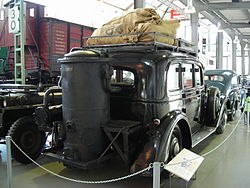
Adler Diplomat in WW II with wood gas generator

Producer gas is a fuel gas manufactured by blowing air and steam simultaneously through a coke or coal fire.[1] It mainly consists of carbon monoxide (CO), hydrogen (H2), as well as substantial amounts of nitrogen (N2). The caloric value of the producer gas is low (mainly because of its high nitrogen content), and the technology is obsolete. Improvements over producer gas, also obsolete, include water gas, where the solid fuel is treated intermittently with air and steam, and, far more efficiently, synthesis gas, where the solid fuel is replaced with methane.

In the US, producer gas may also be referred to by other names based on the fuel used for production, such as wood gas. Producer gas may also be referred to as suction gas, referring to the way the air was drawn into the gas generator by an internal combustion engine.

Etymology

[edit]

The names for this combustible gas across different European languages reflect either the mechanical apparatus used for its creation or the specific chemical process of its generation.

English: Producer gas

[edit]

The term Producer gas is derived from the industrial equipment used to manufacture it: the "gas producer". In the 19th century, a "producer" referred to a furnace—typically a shaft furnace—designed to "produce" a combustible gas through the incomplete combustion of solid fuel (such as coal or coke). Unlike "coal gas," which was distilled in a retort, this gas was the direct result of a continuous industrial production cycle within the unit.

German: Generatorgas

[edit]

In German-speaking regions, the gas is known as Generatorgas, referencing the generator. This term describes the shaft furnace where air is passed through a deep bed of incandescent fuel. The etymology emphasizes that the gas is "generated" by the chemical reduction of carbon dioxide into carbon monoxide within the unit.[2]

Other European Names

[edit]

The nomenclature across Europe often varies based on the specific patent or chemical additive involved:

  • French (Gaz de gazogène / Gaz pauvre): In French, the term gaz de gazogène refers to the gazogène (gas producer) apparatus. It is also historically known as gaz pauvre ("poor gas" or "lean gas") because of its low calorific value compared to lighting gas (town gas), due to the high concentration of atmospheric nitrogen.
  • Russian (Генераторный газ): Similar to the German naming convention, the Russian generatornyy gaz literally translates to "generator gas," focusing on the device used for the gasification process.
  • Mond gas: A common European variant of producer gas, named after the chemist Ludwig Mond. This version utilized a steam-air blast to recover ammonia as a byproduct, leading to its identification as a distinct chemical "brand" in late 19th-century industrial centers.
  • Halbwassergas (Semi-water gas): A technical term used in German and English contexts to describe a hybrid gas produced by a "generator" using both air and steam. This name combines the etymologies of air-based "producer gas" and steam-based "water gas".[3]
Producer Gas (Generatorgas) Semi-Water Gas (Halbwassergas)
Input Air Air + Steam
Reaction Type Exothermic Thermally balanced
Combustibles CO (approx. 33%) CO + H2 (max. 50%)

Production

[edit]

Producer gas is generally made from coke, or other carbonaceous material[4] such as anthracite coal. Air is passed over the red-hot carbonaceous fuel and carbon monoxide is produced. The reaction is exothermic.

Formation of producer gas from air and carbon:

C + O2 → CO2, +97,600 calories/mol
CO2 + C → 2CO, –38,800 calories/mol (mol of the reaction formula)
2C + O2 → 2CO, +58,800 calories/mol (per mol of O2 i.e. per mol of the reaction formula)

Reactions between steam and carbon:

H2O + C → H2 + CO, –28,800 calories/mol (presumably mol of the reaction formula)
2H2O + C → 2H2 + CO2, –18,800 calories/mol (presumably mol of the reaction formula)

Reaction between steam and carbon monoxide:

H2O + CO → CO2 + H2, +10,000 calories/mol (presumably mol of the reaction formula)
CO2 + H2 → CO + H2O, –10,000 calories/mol (presumably mol of the reaction formula)

The average composition of ordinary producer gas according to Latta was: CO2: 5.8%; O2: 1.3%; CO: 19.8%; H2: 15.1%; CH4: 1.3%; N2: 56.7%; B.T.U. gross per cu.ft 136 [5][6] The concentration of carbon monoxide in the "ideal" producer gas was considered to be 34.7% carbon monoxide (carbonic oxide) and 65.3% nitrogen.[7]

After "scrubbing", to remove tar, the gas may be used to power gas turbines (which are well-suited to fuels of low calorific value), spark ignited engines (where 100% petrol fuel replacement is possible) or diesel internal combustion engines (where 15% to 40% of the original diesel fuel requirement is still used to ignite the gas [8]).

During World War II in Britain, plants were built in the form of trailers for towing behind commercial vehicles, especially buses, to supply gas as a replacement for petrol (gasoline) fuel.[9] A range of about 80 miles for every charge of anthracite was achieved.[10]

In old movies and stories, when there is a description of suicide by "turning on the gas" and leaving an oven door open without lighting the flame, the reference was to coal gas or town gas. As this gas contained a significant amount of carbon monoxide it was quite toxic. Most town gas was also odorized, if it did not have its own odor. Modern 'natural gas' used in homes is far less toxic, and has a mercaptan added to it for odor for identifying leaks.


Alternative names

[edit]

Various names are used for producer gas, air gas and water gas generally depending on the fuel source, process or end use including:

  • Air gas: also called "power gas", "generator gas", or "Siemens' producer gas". Produced from various fuels by partial combustion with air. Air gas consists principally of carbon monoxide with nitrogen from the air used and a small amount of hydrogen. This term is not commonly used, and tends to be used synonymously with wood gas.
  • Producer gas: Air gas modified by simultaneous injection of water or steam to maintain a constant temperature and obtain a higher heat content gas by enrichment of air gas with H2. Current usage often includes air gas.
  • Semi-water gas: Producer gas.
  • Blue water-gas: Air, water or producer gas produced from clean fuels such as coke, charcoal and anthracite which contain insufficient hydrocarbon impurities for use as illuminating gas. Blue gas burns with a blue flame and does not produce light except when used with a Welsbach gas mantle.
  • Lowe's Water Gas: Water gas with a secondary pyrolysis reactor to introduce hydrocarbon gasses for illuminating purposes.[11][12]
  • Carburetted gas: Any gas produced by a process similar to Lowe's in which hydrocarbons are added for illumination purposes.
  • Wood gas: produced from wood by partial combustion. Sometimes used in a gasifier to power cars with ordinary internal combustion engines.

Other similar fuel gasses

  • Coal gas or illuminating gas: Produced from coal by distillation.
  • Water gas: Produced by injection of steam into fuel preheated by combustion with air. The reaction is endothermic so the fuel must be continually re-heated to keep the reaction going. This was usually done by alternating the steam with an air stream. This name is sometimes used incorrectly when describing carburetted blue water gas simply as blue water gas.
  • Coke oven gas: Coke ovens give off a gas exactly similar to illuminating gas, part of which is used to heat the coal. There may be a large excess, however, which is used for industrial purposes after it has been purified.
  • Syngas, or synthesis gas: (from synthetic gas or synthesis gas) can be applied to any of the above gasses, but generally refers to modern industrial processes, such as natural gas reforming, hydrogen production, and processes for synthetic production of methane and other hydrocarbons.
  • City (Town) gas: any of the above-manufactured gases including producer gas containing sufficient hydrocarbons to produce a bright flame for illumination purposes, originally produced from coal, for sale to consumers and municipalities.

Advantages

[edit]
  • There is no loss due to smoke and convection current.
  • Quantity of air required for the combustion of producer gas is not much above the theoretical quantity; when burning solid fuel, far more than the theoretical quantity is required. With solid fuels, the larger quantity of exhaust takes away considerable heat with it.
  • Producer gas is more easily transmitted than solid fuel.
  • Gas-fired furnaces can be maintained at a constant temperature.
  • With gas, an oxidising and reducing flame can be obtained.
  • Heat loss due to converting solid fuel into producer gas can be made in an economic way.
  • Smoke nuisance can be avoided.
  • Producer gas can be produced even by the poorest quality of fuel.
  • When used in a large furnace no scrubbing is required.

Scrubbing is necessary in a small furnace to avoid choking small burners, and for using internal combustion engines.

See also

[edit]

References

[edit]
[edit]
Revisions and contributorsEdit on WikipediaRead on Wikipedia
from Grokipedia
Producer gas is a low-calorific-value produced by the of carbonaceous materials such as , coke, or in a gasifier using air as the , resulting in a mixture primarily composed of (20-30%), (10-20%), (50-60%), and (5-15%), along with trace amounts of and other hydrocarbons, yielding a heating value of 4-6 MJ/m³ (110-170 Btu/ft³). This gas, distinct from higher-energy synthesis gas () due to its nitrogen dilution from air-blown rather than oxygen-blown processes, has been utilized since the mid-19th century, with early developments including the first gas producers built by Bischof in (1839), Ebelman in (1840), and Ekman in (1845). Its production involves passing air through an incandescent bed of at temperatures of 700-1000°C, promoting reactions like 2C + O₂ → 2CO and C + H₂O → CO + H₂, typically in fixed-bed, fluidized-bed, or downdraft gasifiers. Historically, producer gas powered early internal combustion engines and provided fuel during periods of petroleum scarcity, such as , when it was adapted for vehicles and stationary engines, though its use declined post-war with the rise of cheap liquid fuels. In modern applications, it serves as a source from for in combined heat and power (CHP) systems, industrial heating in boilers, and potential feedstock for , with efficiencies up to 90% in integrated setups. Despite challenges like tar formation and the need for gas cleaning to remove impurities, ongoing research emphasizes its role in sustainable energy transitions, particularly for decentralized power from agricultural residues.

Fundamentals

Definition and Nomenclature

Producer gas is a low-calorific-value generated through the of carbonaceous materials, such as or coke, by passing air and a limited amount of over the hot material, yielding a gaseous primarily composed of , , and . This process results in a fuel with reduced heating value due to the incorporation of inert from the air. Unlike , which is typically produced via oxygen or steam gasification and features higher concentrations of combustible gases like and without significant dilution, producer gas is distinguished by its substantial content that lowers its overall . Historically, producer gas has been known by various alternative names reflecting its production methods and applications, including air gas (also termed power gas or ' producer gas), generator gas, semi-water gas, blue water-gas, town gas (particularly for early urban variants), and (when derived from feedstocks). The "producer gas" derives from the 19th-century industrial apparatus known as gas producers, which were designed specifically to generate this fuel on-site for power and heating purposes.

Composition

Producer gas typically consists of 20-30% (CO), 10-20% hydrogen (H₂), 50-60% nitrogen (N₂), 5-15% (CO₂), and trace amounts of methane (CH₄) and oxygen (O₂) by volume. These proportions can vary depending on the feedstock used and the specific conditions, such as , , and air-to-fuel ratio. The calorific value of producer gas ranges from approximately 1,100-1,500 kcal/m³ (4.6-6.3 MJ/m³), which is relatively low primarily due to dilution by from the air used in production. This low renders it unsuitable for long-distance transport, limiting its use to on-site applications near the facility. Physically, producer gas is colorless and odorless in its pure form, though impurities may impart a noticeable smell. Its is around 0.95-1.0 kg/m³ at . The gas has wide flammable limits in air, approximately 15-75% by volume, allowing for flexible combustion mixtures but requiring careful handling to avoid risks. Chemically, producer gas is highly toxic owing to its significant CO content; concentrations of 0.1% CO can be lethal to humans upon prolonged exposure. During combustion, it reacts exothermically with oxygen to generate heat and primarily (CO₂) as a product. Common impurities in producer gas include , , and compounds, which can condense or cause in downstream equipment and thus affect its practical usability.

Production Methods

Traditional Gasification Process

The traditional process for producer gas production relies on the partial of or coke in a controlled environment to generate a combustible gas , achieved by limiting oxygen supply through air and introduction in a gasifier. This method, typically conducted in fixed-bed reactors such as or downdraft designs, prevents complete burnout and promotes the formation of and alongside inert components. The process operates by passing air and upward or downward through a hot bed of , with the limited oxygen ensuring incomplete oxidation while enhances gas yield through secondary reactions. In an updraft fixed-bed gasifier, commonly used for coke due to its uniformity, the fuel bed is ignited and maintained at high temperatures, with air and steam introduced at the base via blowers to sustain partial combustion. The key stages begin with ignition of the fuel bed to establish the combustion zone, followed by continuous introduction of air and steam from the bottom, which rises through the bed; the resulting gas is collected at the top after passing through successive zones. Operating temperatures reach 900–1,200°C in the combustion zone near the base, where oxidation occurs, dropping to 200–400°C in the upper reduction zone as the gas cools while interacting with the fuel. Downdraft producers, more suitable for coal with higher volatility, reverse the flow by introducing air and steam at the top, directing gas downward through the hot bed for collection at the base, which helps minimize tar entrapment in the product. Both types incorporate ancillary equipment like blowers for regulated air supply and scrubbers or cyclones for cleaning the gas of particulates and condensables before use. Output yields from the typically range from 2–3 m³ of gas per kg of coke, varying with quality and addition, while efficiency for recovery stands at around 70–80%. is maintained by precisely regulating the equivalence ratio to 0.2-0.4 (supplying 20-40% of stoichiometric air), to minimize excessive formation and reduce production that could foul downstream equipment. injection, at rates of 0.4–0.5 kg per kg of carbon, further aids in controlling gas composition and preventing clinkering in the bed. The resulting producer gas is high in due to air use, contributing to its dilute calorific value.

Feedstocks and Variations

The primary feedstocks for producer gas production are solid carbonaceous materials, predominantly , , and coke, selected for their suitability in the gasification process. , particularly high-volatile varieties, yields a richer gas containing and , while low-volatile non-coking produces cleaner output with less reactivity. Coke, derived from , serves as a preferred feedstock due to its high stability and lack of tar formation, resulting in poorer but more consistent gas quality. These feedstocks must meet specific criteria to ensure efficient operation and minimize operational issues: particle sizes graded to 20-30 mm to promote uniform airflow, low dust content to prevent blockages, non-caking properties to avoid agglomeration, high reactivity (especially for low-temperature cokes), and low content (typically under 1-2% depending on end-use applications). content is kept low—generally under 10%—to reduce clinker formation and buildup in the gasifier, while fixed carbon content exceeds 80% to maximize combustible yield and energy efficiency. In modern applications, alternative feedstocks such as —including wood chips, agricultural residues like rice husks or , and crop wastes—have been adapted for producer gas generation, offering renewable options amid traditional 's environmental constraints. However, is less emphasized historically due to its variable composition and lower compared to coal-based materials, with remaining the standard for reliable, high-volume production. Process variations in producer gas generation primarily distinguish between dry and wet methods, altering the gasifying agent's composition to influence product quality. The dry process employs air alone, promoting primarily oxidation and reduction to yield gas high in (CO) but low in (H₂), with significant (N₂) dilution from the air. In contrast, the wet process incorporates alongside air (typically 0.4-0.5 kg H₂O per kg carbon), enhancing through additional reforming reactions; optimal conditions involve saturating the blast air to 60-65°C for integration. These variations rely on key chemical reactions in the gasification zones: in the zone, where carbon reacts exothermically with oxygen, C+O2CO2\mathrm{C + O_2 \rightarrow CO_2} followed by reduction in the subsequent zone, including the Boudouard reaction, CO2+C2CO\mathrm{CO_2 + C \rightarrow 2CO} (endothermic), and steam reforming (water-gas reaction) in the wet process, C+H2OCO+H2\mathrm{C + H_2O \rightarrow CO + H_2} . The exothermic oxidation provides heat to drive the endothermic steps, maintaining thermal balance. Steam addition in the wet process significantly impacts gas composition and performance: it elevates the H₂/CO ratio via the water-gas reaction and water-gas shift (H₂O + CO ⇌ CO₂ + H₂), reduces N₂ content by displacing some air volume, and boosts the overall calorific value by 20-30% through decreased dilution and increased combustible fractions. These modifications yield a more versatile suitable for downstream applications, though they require precise control to avoid excessive cooling from steam's endothermic effects. In biomass variants, however, higher tar production—reaching up to 100 g/Nm³ in updraft configurations—poses challenges, necessitating downstream or catalytic cracking to prevent in engines or pipes. Fluidized-bed gasifiers, another variation, are used for finer particles, providing better mixing and , with operating temperatures of 800-900°C and typically lower tar contents (10-20 g/Nm³) compared to fixed-bed updraft designs, though they may require more complex gas cleaning due to higher particulates.

Historical Development

Origins and Early Adoption

The concept of producer gas, a low-calorific derived from the partial of carbonaceous materials like or with air, traces its roots to early 19th-century developments in . The first gas producers were built by Bischof in (1839), Ebelmen in (1840), and Ekman in (1845). These efforts built upon earlier demonstrations of by in the 1790s, who illuminated factories with distilled coal vapors, though producer gas specifically emphasized air-blown processes for on-site power rather than purified illuminating gas. The invention of the modern producer gas system is credited to (William Siemens) in during the 1860s, who developed the first successful commercial gas producer in 1861 as part of his regenerative furnace innovations. This apparatus generated producer gas from low-grade coal via air gasification in a separate unit, enabling efficient heating without direct fuel combustion in furnaces. By the 1870s, these producers saw initial commercial deployment in European steelworks, where they supplied gas for the Siemens-Martin open-hearth process, revolutionizing steel production by allowing precise control over melting and scrap. Adoption accelerated across Europe in the 1880s, particularly in metallurgical industries in , , and Britain, where producer gas replaced direct coal burning in furnaces, reducing fuel waste and improving operational efficiency. In the United States, producer gas technology gained traction around the , with early tests documented as far back as and the installation of the first suction-type producer in 1903, often integrated into and power plants. By 1900, usage peaked in the British steel industry, where hundreds of producers operated to meet surging demand during the , driven by the need for reliable, on-site heating in expanding factories. Economically, producer gas offered significant advantages due to its utilization of abundant low-grade feedstocks like , making it ideal for large-scale industrial heating. However, its prominence began waning in the 1920s with the widespread availability of cheaper pipelines, though it persisted in developing regions into the pre-World War II era for cost-sensitive applications.

Wartime and Mid-20th Century Uses

During , producer gas played a critical role in amid severe fuel shortages, particularly in countries like and Britain where imports were disrupted by naval blockades and wartime demands. In , approximately 500,000 vehicles were converted to run on producer gas by the war's end, utilizing or gasifiers to sustain civilian and military transport. These systems, often fed with coal for higher , enabled ranges of around 80 miles per charge in adapted trucks, though overall vehicle performance was constrained by the gas's lower calorific value. Technical adaptations focused on integrating onboard gasifiers into existing trucks and cars, with the Imbert downdraft design becoming a standard for on-demand gas production from solid fuels. This involved retrofitting engines to handle the gas's composition, including filters to remove and particulates, allowing vehicles to operate without liquid fuels. Efficiency was notably reduced compared to , with producer gas engines delivering 20-30% less power due to the fuel's lower heating value and characteristics. In , adoption peaked in 1942 when producer gas vehicles, known as "gasogen" systems, comprised about 30% of the national fleet, with over 70,000 units supporting essential transport amid oil . In Britain during the , producer gas was adapted for , including experimental tractors that reduced fuel costs by over 70% during harvesting operations, helping maintain production under wartime constraints. However, use remained limited, as the country's abundant domestic oil production—accounting for 60% of global output—mitigated shortages and prioritized for military needs. Post-war, producer gas continued in rural European areas into the , particularly for stationary engines and low-mileage vehicles where wood or was readily available, but its viability waned with the restoration of supplies. This era spurred research into cleaner variants to address and emission issues, yet widespread adoption of piped infrastructure ultimately phased out producer gas systems by the mid-century, rendering them obsolete for most applications.

Applications

Power Generation and Engines

Producer gas finds significant application in internal combustion for motive power and , particularly in off-grid and rural settings where feedstocks are abundant. In diesel operated in dual-fuel mode, producer gas can substitute 20-60% of the , depending on load conditions and gas quality, with optimal replacement occurring at 50-80% engine load to maintain stable . Spark-ignition , modified from designs, can run on 100% producer gas, offering a straightforward adaptation for full replacement without pilot , though output derates by 20-30% due to the gas's lower calorific value. Effective engine operation requires rigorous gas to reduce content to below 50 mg/m³, preventing deposits on valves, pistons, and injectors that could lead to and reduced lifespan. For power generation, producer gas powers reciprocating engines in small-scale, off-grid systems, with electrical efficiencies typically ranging from 20-35% in biomass-fed plants under 100 kW, influenced by gasifier and . While gas turbines have been explored for larger installations, reciprocating engines dominate due to better tolerance of producer gas's variable composition and lower pressure requirements, enabling reliable operation in decentralized setups. Integration challenges include managing flame stability and emissions; staged combustion techniques, such as air staging in the , can reduce formation by up to 50% by limiting peak temperatures in the primary zone. Modern deployments emphasize , with 10-100 kW gasifier-engine systems installed in and to provide reliable power to remote villages using local agricultural residues. These systems often incorporate hybrid configurations, blending producer gas for baseload operation with diesel for peak loads, achieving up to 70% substitution while enhancing overall flexibility and reducing diesel dependency. Performance metrics highlight trade-offs: specific fuel consumption in producer gas engines is approximately 1.1 kg per kWh, 4-5 times higher in mass terms than natural gas engines (around 0.25 kg/kWh) due to the lower of producer gas (4-6 MJ/Nm³ versus 35-40 MJ/Nm³ for ), necessitating larger feedstocks but enabling biomass utilization where conventional fuels are costly.

Industrial Processes

Producer gas finds extensive application in industrial heating processes, particularly in furnaces for , , and production. In manufacturing, it is utilized in reheating and furnaces, including regenerative designs that preheat air to temperatures exceeding 1,000°C, enabling efficient operation at overall process temperatures around 1,200°C or higher for rolling ingots. This replaces direct , centralizing ash production in the gasifier and simplifying handling within the furnace itself. In , coal-derived producer gas serves as a substitute for in melting furnaces operating continuously at approximately 1,650°C, supporting the high thermal demands of batch melting while maintaining flame stability due to the gas's composition of , , and . For kilns, early rotary designs employed producer gas for clinkering, though its lower calorific value limited peak temperatures compared to later oil or firing, with exhaust gases reaching up to 600°C in some historical setups. Beyond heating, producer gas acts as a precursor in , particularly for and production through the water-gas shift reaction, where reacts with to yield additional : CO + H₂O ⇌ CO₂ + H₂. This process adjusts the H₂/CO ratio in the syngas-like mixture from producer gas, making it suitable for downstream synthesis. Historically, gases akin to producer gas, derived from coke or , supplied in early implementations of the Haber-Bosch process for fixation, contributing to the scalability of nitrogen-based fertilizers before dominance. Integration of producer gas into industrial operations often involves on-site production via dedicated "producer stations" equipped with gasifiers and cleaning systems, ensuring a continuous supply tailored to process needs. In large-scale plants, these stations support furnace operations with gas flows derived from multi-unit producers, enhancing reliability and fuel flexibility. For instance, in 19th-century iron , producer gas provided a substantial share of the —facilitating up to half the total input in some facilities—driving the expansion of the iron and sector by leveraging abundant resources efficiently. In contemporary settings, particularly in developing countries, producer gas generated from sees niche use in brick kilns, offering a renewable alternative to direct firing for sustainable heating in resource-constrained regions. In recent years (as of 2025), -derived producer gas has been explored for industrial heating in waste conversion processes, supporting initiatives. Efficiency in these applications benefits from direct firing, where producer gas achieves rates of 74-77% in hot gas configurations, approaching 80-90% with optimized air mixing to ensure complete oxidation and minimize unburned losses. The steady, non-luminous flame from producer gas's composition further aids uniform heating in regenerative systems, though and particulate removal remains essential for long-term equipment integrity.

Performance Characteristics

Advantages

Producer gas offers significant efficiency advantages in processes due to the absence of loss and convection waste associated with direct burning, enabling up to 90% heat utilization in furnaces compared to approximately 60% for traditional solid fuels like . This improved thermal performance arises from the gaseous nature of producer gas, which allows for more controlled and complete without the inefficiencies of handling or uneven burning in solid forms. A key benefit is its fuel flexibility, as producer gas can be generated from low-grade coals, biomass residues such as , or other inexpensive feedstocks, potentially reducing fuel costs by 30-50% relative to premium solid or liquid fuels. This capability democratizes access to energy production by valorizing otherwise underutilized or low-value materials, enhancing economic viability in resource-constrained settings. The process provides a steady supply of gas at consistent temperatures ranging from 700 to 1,000°C, making it particularly suitable for industrial heating and metallurgical applications that require stable thermal inputs. Additionally, the air requirement for combustion is close to stoichiometric, typically 1.1-1.2 times the theoretical amount, which minimizes excess air usage and further boosts combustion efficiency. In modern biomass combined heat and power (CHP) systems, overall efficiencies reach 30–40% as of 2023. Economically, producer gas systems are attractive for small-scale producers due to of $3,000–4,000 per kW as of 2023, especially for fixed-bed gasifiers, and the decentralized nature of production eliminates transportation expenses for raw fuels. These factors lower for rural or off-grid applications, where on-site generation from local feedstocks can achieve rapid . Producer gas demonstrates versatility in handling intermittent or variable feedstocks, such as seasonal , with quick startup times of 15-30 minutes for certain gasifier designs like cross-draft types, enabling responsive operation to fluctuating demands. In steam-blown variants, the lower content further enhances stability without diluting the calorific value significantly.

Disadvantages

Producer gas exhibits a significantly low due to the dilution effect of from the air used in the process, resulting in a calorific value of approximately 1,200–1,400 kcal/m³ compared to at around 9,000 kcal/m³. This dilution, primarily from N₂ comprising 45–60% of the gas composition, effectively reduces the heating value to about one-seventh that of , necessitating roughly seven times the volume of producer gas to deliver equivalent . The production and use of producer gas involve substantial operational complexity, particularly in managing tar and ash accumulation, which demands frequent cleaning and high maintenance demands. formation during condenses in downstream equipment, leading to and blockages that require regular intervention, often every few hours in small-scale systems, to maintain flow and prevent . Additionally, handling adds to the burden, as varying feedstock properties like and exacerbate buildup, contributing to startup and shutdown inefficiencies estimated at 10–20% of operational energy due to purging and reheating cycles. Toxicity poses a critical safety concern with producer gas, as its typical composition includes 18–23% (CO), far exceeding the 1% threshold where poisoning risks become acute even with short exposures. CO binds to , impairing oxygen transport and causing symptoms from headaches to fatality at concentrations above 0.1%, thus mandating fully enclosed handling systems, continuous monitoring, and ventilation to mitigate exposure hazards. Transport and storage of producer gas are highly inefficient owing to its low calorific value and poor , rendering it unsuitable for pipeline distribution under standard high-pressure conditions. Unlike , which pipelines efficiently over long distances, producer gas's low energy content limits pressure tolerance, often requiring on-site generation or specialized low-pressure lines, while compression for storage incurs an additional 20% energy penalty relative to its inherent low yield. Producer gas has declined in widespread use in modern applications, particularly large-scale ones, superseded by higher-energy (with calorific values of 3,000–5,000 kcal/m³) produced via oxygen-blown and the widespread availability of , which offers superior efficiency and ease of use. Its scalability is constrained to small installations below 1–5 MW due to escalating maintenance and inefficiency challenges at larger capacities, limiting economic viability beyond niche or scenarios, such as wartime substitutions during shortages in the mid-20th century.

Environmental and Safety Considerations

Emissions and Impacts

The production and combustion of producer gas, particularly from coal feedstocks, generate significant , with (CO₂) outputs typically ranging from 0.08 to 0.10 kg per MJ of energy released during , comparable to direct burning due to the retained carbon content in the . oxides () emissions arise primarily from the high content in air-blown processes, often reaching 200-500 ppm in exhaust gases under standard conditions, though values can vary with load and air-fuel ratios. oxides () depend on the sulfur impurities in the feedstock, potentially exceeding 1,000 mg/m³ in untreated exhaust from sulfur-rich coals, contributing to formation. During producer gas production via , environmental impacts include the release of tars and particulates, with raw gas often containing 50-200 mg/Nm³ of these contaminants, which can condense and deposit in downstream or the environment if not captured. Ash residues from pose risks of groundwater contamination through , as heavy metals like , mercury, and can mobilize in wet conditions and infiltrate aquifers, as observed in sites with improper management. On a lifecycle basis, coal-derived producer gas systems emit 80-100% more greenhouse gases than natural gas-fired power generation, factoring in upstream mining, , and downstream , though (IGCC) mitigate some impacts compared to conventional coal boilers. In contrast, biomass-based producer gas can approach carbon neutrality if sourced from sustainably managed feedstocks, as the CO₂ released during offsets biogenic uptake, with net emissions near zero excluding and processing losses. Incomplete combustion of producer gas elevates risks of volatile organic compounds (VOCs) and polycyclic aromatic hydrocarbons (PAHs) in emissions, stemming from tar decomposition and low flame temperatures that hinder full oxidation. Historically, widespread urban use of producer gas in early 20th-century industrial areas, such as in Europe and North America for heating and power, exacerbated smog formation through soot and particulate releases, contributing to events like London's dense fogs in the 1900s alongside coal smoke. In developing regions, reliance on outdated producer gas technologies for off-grid power often amplifies emissions, such as 0.02 g/kWh from inefficient small-scale gasifiers, worsening regional air quality and accelerating melt via atmospheric transport.

Mitigation Strategies

Gas cleaning systems are essential for mitigating the environmental and safety risks associated with producer gas by removing contaminants such as , particulates, and compounds. Cyclones, filters, and are commonly employed to achieve high removal efficiencies, with these methods capable of eliminating up to 90% of and particulate matter from the gas stream. Wet electrostatic precipitators further enhance removal of , particularly in processes using sulfur-containing feedstocks, by charging particles and collecting them on oppositely charged plates. Process upgrades in producer gas production help reduce nitrogen content and associated NOx emissions during downstream combustion. Oxygen enrichment replaces part of the air in the gasification process, lowering the nitrogen dilution in the gas and thereby reducing potential NOx formation by up to 40%. Similarly, steam addition during gasification enhances hydrogen yield while diluting nitrogen levels, contributing to NOx reductions of comparable magnitude in engine applications. Fluidized-bed gasifiers minimize ash-related issues by operating at lower temperatures that prevent ash melting and agglomeration, allowing for efficient separation and reduced slagging. To promote sustainability, producer gas production has shifted toward biomass feedstocks, which are renewable and carbon-neutral when sourced responsibly, thereby lowering the overall lifecycle greenhouse gas footprint compared to fossil-based alternatives. Carbon capture technologies, such as amine scrubbing, can be integrated post-gasification to capture approximately 85% of CO2 from the producer gas stream, enabling its sequestration or reuse. Regulatory frameworks enforce strict limits on producer gas emissions to protect air quality and worker safety. In the , combustion plants utilizing producer gas must comply with dust emission limits of less than 50 mg/Nm³ under the Industrial Emissions Directive for certain installations. For safety, the (OSHA) sets a of 50 ppm for (CO) over an 8-hour workday, with continuous monitoring required in operational environments to prevent risks. Emerging technologies further advance mitigation by integrating (CCS) with producer gas systems, significantly curbing CO2 emissions from gasification processes. Hybrid systems combining biomass-derived producer gas with renewable sources, such as solar or , can achieve net emissions below 100 g CO₂/kWh, particularly in configurations optimized for power generation.

References

Add your contribution
Related Hubs
User Avatar
No comments yet.