


Community hub
Recent from talks
Contribute something
Nothing was collected or created yet.
Gayndah
View on Wikipedia
Key Information


Gayndah (/ɡeɪndə/)[3] is a town and locality in the North Burnett Region, Queensland, Australia.[4][5] It is the administrative centre for the North Burnett Region. In the 2021 census, the locality of Gayndah had a population of 1,949 people.[2]
Geography
[edit]
Gayndah is on the Burnett River and the Burnett Highway passes through the town. Apart from the town in the western part of the locality, the land is used for cropping and grazing. The Mungar Junction to Monto Branch railway line once passed through the town, but it has since been closed and now lies abandoned.[6]
Duchess Mountain is immediately to the south-west of the town (25°38′00″S 151°36′47″E / 25.63333°S 151.61306°E) and at 190 metres (620 ft) provides excellent views over the town (100 metres (330 ft) above sea level).[6][7]
Gayndah is 366 kilometres (227 mi) north of the state capital, Brisbane, and 145 kilometres (90 mi) west of the regional city of Maryborough.
Agriculture and grazing have been the dominant industries of the area. The town is the centre of Queensland's largest citrus-growing area.
History
[edit]The name Gayndah is of Aboriginal origin but the derivative is unclear. It may derive either from Gu-in-dah (or Gi-un-dah), meaning thunder, or from Ngainta meaning place of scrub.[8] Alternatively it may be derived from Waka language kunda meaning range or ridge, or ga-een-ta meaning bushy land.[4] Wakka Wakka (Waka Waka, Wocca Wocca, Wakawaka) is an Australian Aboriginal language spoken in the Burnett River catchment. The Wakka Wakka language region includes the landscape within the local government boundaries of the North and South Burnett Regional Council, particularly the towns of Gayndah, Cherbourg, Murgon, Kingaroy, Eidsvold and Mundubbera.[9]
The well-known "Wetheron" property, 12 miles from Gayndah, was taken up by William Humphrey in 1845, and from him it passed to the Hons. Berkeley Basil and Seymour Moreton, sons of the Earl of Ducie. When the foundations of Gayndah were being laid there were only a few squatters on the Burnett River, and these were nearly all educated men of good families with command of money and the confidence of the banks and financial institutions.
Exploration of the Gayndah area began in 1847 by explorer Thomas Archer and Surveyor James Charles Burnett (1815–1854).[10] The first European settlers arrived in 1848, and the town was established in the following year. A post office was established at Gayndah in 1850.[11] This suggests that Gayndah may be the oldest officially gazetted town in Queensland, although the Moreton Bay penal colony of 47 people was established at Redcliffe on Moreton Bay in 1824 but relocated in 1825 to a site on the Brisbane River (now Brisbane's central business district).
Brisbane's population by 1856 was only an estimated 3,840. Gayndah and Ipswich were regional towns of similar size and competed with Brisbane to become the capital of Queensland when it became a separate colony from New South Wales in 1859. The main impetus to the growth of Brisbane and the development of a distinctive city centre came through the introduction of self-government, hand-in-hand with immigration and general economic expansion. By 1868 Brisbane was the largest town in Queensland with a population of 15,240.[12]
Gayndah was a centre of early sheep properties in southern Queensland (then NSW) and where many Chinese men travelled via Amoy and then Marybourough to work as shepherds. As early as 1851 it was declared that: "Almost every station in the two districts of Wide Bay and Burnett is supplied with Chinese or Coolie labourers, ..." The same writer also acknowledged that their "wages are so small they have nothing to lay out."[13] However as their indentured where for five years only once free to seek employment at more equitable rates many of these men remained in the area and often applied for naturalisation as British subjects to allow them to take up land. These included men such a Thomas Ashney who among other things was a Guyndah hotelkeeper.[14]
This is a population that was added to by the arrival of people from the more southern Cantonese Pearl River Delta area so that by the late 1860s in a discussion about Police Magistrates in the Queensland Legislative Assembly it was declared that: "There was a large Chinese population settled at Gayndah, and they were bound to protect those people ...".[15]
In 1857, Tom White came to Gayndah and started the newspaper, The Burnett Argus in April 1861.[16][17]
Gayndah State School opened on 12 October 1863.[18]
In 1870, the first Catholic church opened in Gayndah. In 1912 Father Patrick Brady decided a new church was needed. On 18 April 1915 Archbishop James Duhig blessed and opened the new church before a crowd of 800 people. The new church was built at 46 Meson Street (25°37′24″S 151°36′22″E / 25.6232°S 151.6061°E) on the south bank of the Burnett River and was 60 by 32 feet (18.3 by 9.8 m) with walls 15 feet (4.6 m) high and constructed of ferro-concrete with asbestos roof tiles. The architects were R. Cook & Sons and it was built by contractor H.G. Millar. The total cost of the building and furnishings was about £1500.[19]
The railway was opened to Gayndah on 16 December 1907. Historian Matt J Fox spoke of Gayndah in 1923: "The Gazette now represents the Press in Gayndah, which is a very prosperous town of nearly a thousand people, the centre of a thriving district of farmers and fruit-growers and squatters, with a rural population of over 4,000 people".[20]
In 1872, the town was the location where the hoax fish Ompax spatuloides was supposedly procured.[21]
Gayndah North State School opened on 14 February 1918. It closed on 24 August 1931.[18]
Gayndah Aboriginal Provisional School opened on 8 August 1918. It became Gayndah Aboriginal State School in 1942. It closed in 1949.[18]

On 8 September 1919 the Gayndah War Memorial was dedicated by the Member of the Queensland Legislative Assembly for Burnett, Bernard Corser.[22]
St Joseph's Catholic School opened on 6 October 1919.[18]
During World War II, Gayndah was the location of RAAF No.8 Inland Aircraft Fuel Depot (IAFD), completed in 1942 and closed on 29 August 1944. Usually consisting of 4 tanks, 31 fuel depots were built across Australia for the storage and supply of aircraft fuel for the RAAF and the US Army Air Forces at a total cost of £900,000 ($1,800,000).[23]
Gayndah State High School opened on 29 January 1963. On 3 March 2006 it became Burnett State College.[18]
The foundation stone of the Gayndah Methodist Church was laid on 28 October 1967 by Reverend Ivan Wells Alcorn. With the amalgamation of the Methodist Church into the Uniting Church in Australia in 1977, it became Gayndah Uniting Church.[24] It is now known as Central Burnett Uniting Church.[25]

In 1969 the Catholic Church of the Sacred Heart at Byrnestown was moved to Gayndah to serve as the church hall for St Joseph's Catholic Church. To reduce the risk of future cyclone damage, the roof was lowered by reducing the height of the walls and reducing the pitch of the roof.[26]
The Mango Tree is a 1977 Australian drama film based on the novel The Mango Tree by Ronald McKie and directed by Kevin Dobson and starring Geraldine Fitzgerald and Sir Robert Helpmann.[27] Filming took place in the town of Gayndah, Mount Perry and Cordalba as well as Bundaberg. The shoot went for seven weeks starting April and ending in June.[28] The streets of Gayndah were closed for filming and a street-scape was created to emulate the 19th century period of the screenplay. Gayndah was chosen because much of its early, country town architecture was intact and reflected the period effectively. Lead actor Christopher Pate is the son of actor Michael Pate who also produced the film.[29]
Demographics
[edit]In the 2006 census, the town of Gayndah had a population of 1,745 people.[30]
In the 2011 census, the locality of Gayndah had a population of 1,789 people.[31]
In the 2016 census, the locality of Gayndah had a population of 1,981 people.[32]
In the 2021 census, the locality of Gayndah had a population of 1,949 people.[2]
Heritage listings
[edit]Gayndah has a number of heritage-listed sites, including:
- Gayndah Bridge Remnants, off Bridge Street[33]
- Gayndah War Memorial (also known as Rawbelle Shire War Memorial), Capper Street (25°37′36″S 151°36′37″E / 25.6266°S 151.6102°E)[34][33]
- Gayndah Court House, 20 Capper Street[35][33]
- Mellors Drapery and Haberdashery (also known as Overells), 28 Capper Street[36][37]
- Gayndah Shire Hall (also known as Gayndah Soldiers' Memorial Hall), 32–34 Capper Street[38][33]
- Gayndah Racecourse, Fisher Avenue[39][33]
- Gayndah District Hospital Complex, corner of Gordon & Pineapple Streets[33]
- Gayndah State School, 33 Meson Street[40][33]
- St Joseph's Catholic Convent and Church Grounds, 38 Meson Street[33]
- Gayndah Cemetery, Meyer, Porter & Downing Street[33]
- Gayndah Railway Station Goods Shed and Crane, on National, Elliot and Cordelia Streets[33]
- Brick Cottage (now Gayndah Museum), 8 Simon Street[41][33]
- Zig Zag Road, Wall Road[33]
-
 Court house
 -
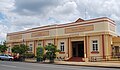 Town hall


Climate
[edit]Gayndah experiences a humid subtropical climate (Köppen: Cfa, Trewartha: Cfal), with hot, humid summers and mild, dry, brief winters with cool nights.[42]
| Climate data for Gayndah (25º37'48"S, 152º36'36"E, 106 m AMSL) (1879–2012 normals, extremes 1893–2009) | |||||||||||||
|---|---|---|---|---|---|---|---|---|---|---|---|---|---|
| Month | Jan | Feb | Mar | Apr | May | Jun | Jul | Aug | Sep | Oct | Nov | Dec | Year |
| Record high °C (°F) | 44.6 (112.3) |
41.7 (107.1) |
40.7 (105.3) |
39.1 (102.4) |
33.3 (91.9) |
31.7 (89.1) |
30.1 (86.2) |
33.9 (93.0) |
39.4 (102.9) |
41.8 (107.2) |
42.8 (109.0) |
44.8 (112.6) |
44.8 (112.6) |
| Mean daily maximum °C (°F) | 32.8 (91.0) |
32.0 (89.6) |
30.9 (87.6) |
28.6 (83.5) |
25.2 (77.4) |
22.4 (72.3) |
21.9 (71.4) |
23.8 (74.8) |
26.9 (80.4) |
29.6 (85.3) |
31.5 (88.7) |
32.8 (91.0) |
28.2 (82.8) |
| Mean daily minimum °C (°F) | 20.1 (68.2) |
19.9 (67.8) |
18.1 (64.6) |
14.3 (57.7) |
10.3 (50.5) |
7.5 (45.5) |
5.9 (42.6) |
6.8 (44.2) |
10.2 (50.4) |
14.1 (57.4) |
17.0 (62.6) |
19.1 (66.4) |
13.6 (56.5) |
| Record low °C (°F) | 11.7 (53.1) |
10.0 (50.0) |
6.1 (43.0) |
1.1 (34.0) |
−1.1 (30.0) |
−3.9 (25.0) |
−6.0 (21.2) |
−4.9 (23.2) |
−2.8 (27.0) |
1.0 (33.8) |
6.0 (42.8) |
8.3 (46.9) |
−6.0 (21.2) |
| Average precipitation mm (inches) | 112.6 (4.43) |
105.7 (4.16) |
73.3 (2.89) |
37.7 (1.48) |
41.2 (1.62) |
40.0 (1.57) |
38.4 (1.51) |
28.8 (1.13) |
34.8 (1.37) |
65.7 (2.59) |
79.9 (3.15) |
103.7 (4.08) |
760.7 (29.95) |
| Average precipitation days (≥ 1.0 mm) | 5.9 | 5.6 | 4.6 | 3.0 | 3.0 | 2.8 | 2.9 | 2.4 | 2.7 | 4.2 | 4.9 | 5.7 | 47.7 |
| Average afternoon relative humidity (%) | 48 | 51 | 50 | 48 | 48 | 48 | 45 | 40 | 38 | 40 | 41 | 44 | 45 |
| Average dew point °C (°F) | 18.1 (64.6) |
18.5 (65.3) |
17.2 (63.0) |
14.3 (57.7) |
11.4 (52.5) |
9.2 (48.6) |
7.5 (45.5) |
7.3 (45.1) |
9.1 (48.4) |
12.1 (53.8) |
14.5 (58.1) |
16.7 (62.1) |
13.0 (55.4) |
| Source: Bureau of Meteorology (1879–2012 normals, extremes 1893–2009)[43] | |||||||||||||
Amenities
[edit]The North Burnett Regional Council operates Gayndah Library on Capper Street.[44][45] The library offers publicly accessible Wi-Fi.[46]
The former St Joseph's Convent in Meson Street was in 2011 converted into an arts and cultural centre, The Gayndah Arts & Cultural Centre which also houses the Gaynah Art Gallery.[citation needed]
The Gayndah branch of the Queensland Country Women's Association meets at 5 Pineapple Street. The branch was founded in 1923 making it one of the longest operating branches.[47]
Central Burnett Uniting Church (also known as Gayndah Uniting Church) is at 41 Meson Street (25°37′26″S 151°36′19″E / 25.6239°S 151.6052°E).[25][24][48] It is part of the Mary Burnett Presbytery of the Uniting Church in Australia.[49]
Gayndah Wesleyan Methodist Church is at 6 Dalgangal Road (corner of Bridge Street, 25°37′11″S 151°36′37″E / 25.6198°S 151.6103°E).[50][51] It is part of the Wesleyan Methodist Church of Australia.[52]
Claude Wharton Weir is owned and managed by Sunwater. North Burnett Regional Council own and manage the boat ramps, facilities and recreation areas. Public access is permitted in designated areas only.[53] Facilities include two boat ramps, picnic shelters, barbecues, public toilets and parking. Camping is prohibited at Claude Wharton Weir.[54] The weir is stocked by the Gayndah Anglers and Fish Stocking Association Inc.[55]
Education
[edit]
Gayndah State School is a government primary (Prep–6) school for boys and girls at 33 Meson Street (25°37′26″S 151°36′21″E / 25.6238°S 151.6059°E).[56][57] In 2017, the school had an enrolment of 145 students with 10 teachers (8 full-time equivalent) and 14 non-teaching staff (7 full-time equivalent).[58]
St Joseph's School is a Catholic primary (Prep–6) school for boys and girls at 38 Meson Street (25°37′24″S 151°36′19″E / 25.6233°S 151.6054°E).[56][59] In 2017, the school had an enrolment of 86 students with 10 teachers (8 full-time equivalent) and 10 non-teaching staff (5 full-time equivalent).[58]
Burnett State College is a government secondary (7–12) school for boys and girls at 65 Pineapple Street (25°37′54″S 151°36′23″E / 25.6318°S 151.6063°E).[56][60] In 2017, the school had an enrolment of 249 students with 26 teachers (25 full-time equivalent) and 22 non-teaching staff (15 full-time equivalent).[58]
Visitor attractions
[edit]The town's information centre is located inside a man-made orange, known as The Big Orange.[61]
The Gayndah Orange Festival is held every two years to celebrate this industry.[62][63]
Notable residents
[edit]- Jessica Anderson, who won the Miles Franklin Literary Award in 1978 and 1980, was born in Gayndah.
- Jacob Moerland, the 12th Australian casualty of Operation Slipper, was from Gayndah.[64]
- John Plath, rugby league player, was born in Gayndah.
Sister city
[edit]Gayndah has one sister city, signed in 1989, according to Sister Cities Australia Inc. (SCA).[65]
 Zonhoven, Belgium

References
[edit]- ^ Australian Bureau of Statistics (28 June 2022). "Gayndah (urban centre and locality)". Australian Census 2021.
- ^ a b c Australian Bureau of Statistics (28 June 2022). "Gayndah (SAL)". 2021 Census QuickStats. Retrieved 28 February 2023.
- ^ Macquarie Dictionary, Fourth Edition (2005). Melbourne, The Macquarie Library Pty Ltd. ISBN 1-876429-14-3
- ^ a b "Gayndah – town in North Burnett Region (entry 13515)". Queensland Place Names. Queensland Government. Retrieved 2 August 2019.
- ^ "Gayndah – locality in North Burnett Region (entry 45349)". Queensland Place Names. Queensland Government. Retrieved 2 August 2019.
- ^ a b "Queensland Globe". State of Queensland. Retrieved 12 October 2015.
- ^ "Duchess Mountain (entry 10653)". Queensland Place Names. Queensland Government. Retrieved 13 October 2015.
- ^ Reed, A. W. (1973). Place Names of Australia, p. 102. Sydney: A. H. & A. W. Reed. ISBN 0-589-07115-7
- ^
 This Wikipedia article incorporates CC BY 4.0 licensed text from: "Queensland's Aboriginal and Torres Strait Islander Languages map". State Library of Queensland. Retrieved 6 June 2020.
- ^ Don Dignan, 'Burnett, James Charles (1815–1854)', Australian Dictionary of Biography, National Centre of Biography, Australian National University, published in hardcopy 1969, accessed online 25 September 2014
- ^ New South Wales Government Gazette, 19 January 1850, cited by Frew, Joan (1981). Queensland Post Offices 1842–1980 and Receiving Offices 1869–1927, p. 277. Fortitude Valley, Queensland: published by the author, ISBN 0-9593973-0-2.
- ^ Marsden, Susan; Urban Heritage; the rise and post-war development of Australia's capital city centres, Australian Council of National Trusts and Australian Heritage Commission, Ausdoc on Demand, Fyshwick ACT, 2000, p22
- ^ The Sydney Morning Herald, 24 April 1851, p.3.
- ^ "Thomas Ashney of Gayndah: A Personal Story". 13 August 2013.
- ^ The Brisbane Courier, 15 January 1868, p.3.
- ^ "New Journal". Maryborough Chronicle, Wide Bay and Burnett Advertiser. Qld. 2 May 1861. p. 2. Archived from the original on 26 August 2021. Retrieved 26 September 2014 – via National Library of Australia.
- ^ Morrison, Allan Arthur (1952). "Some aspects of Queensland provincial journalism" (PDF). Journal of the Royal Historical Society of Queensland. 4 (5). Brisbane: Royal Historical Society of Queensland: 702–708. ISSN 1837-8366. Retrieved 25 September 2014.
- ^ a b c d e Queensland Family History Society (2010), Queensland schools past and present (Version 1.01 ed.), Queensland Family History Society, ISBN 978-1-921171-26-0
- ^ "NEW CHURCH OPENED". The Brisbane Courier. No. 17, 864. Queensland, Australia. 19 April 1915. p. 10. Archived from the original on 26 August 2021. Retrieved 1 July 2020 – via National Library of Australia.
- ^ Fox, Matt J. (Matt Joseph), History of Queensland, its people and industries,...; States Publishing Company, Brisbane, Qld; 1919-1923, p824
- ^ "A Mythical Fish". The Advocate. Burnie, Tas. 17 January 1934. p. 5. Archived from the original on 26 August 2021. Retrieved 19 September 2013 – via National Library of Australia.
- ^ "Gayndah War Memorial". Monument Australia. Archived from the original on 7 April 2014. Retrieved 5 April 2014.
- ^ Australia. Royal Australian Air Force. Historical Section (1995), Logistics units, AGPS Press, ISBN 978-0-644-42798-2
- ^ a b "Gayndah Uniting Church". Churches Australia. Archived from the original on 3 October 2021. Retrieved 3 October 2021.
- ^ a b "Find a Church". Uniting Church in Australia, Queensland Synod. Archived from the original on 24 October 2020. Retrieved 22 November 2020.
- ^ "Byrnestown St Peter's Catholic Church c 1914 – Opposite 8 Fielding St, Gayndah, QLD". POI Australia. Archived from the original on 1 July 2020. Retrieved 1 July 2020.
- ^ "The Mango Tree (1977)". IMDb. Archived from the original on 7 March 2016. Retrieved 22 August 2016.
- ^ Pike, Andrew and Cooper, Ross; Australian Film 1900–1977: A Guide to Feature Film Production, Melbourne: Oxford University Press, 1998 p320
- ^ Wikipedia: The Mango Tree
- ^ Australian Bureau of Statistics (25 October 2007). "Gayndah (Urban Centre/Locality)". 2006 Census QuickStats. Retrieved 25 October 2007.
- ^ Australian Bureau of Statistics (31 October 2012). "Gayndah". 2011 Census QuickStats. Retrieved 12 October 2015.
- ^ Australian Bureau of Statistics (27 June 2017). "Gayndah (SSC)". 2016 Census QuickStats. Retrieved 20 October 2018.
- ^ a b c d e f g h i j k l "North Burnett Local Heritage Register" (PDF). North Burnett Regional Council. Archived (PDF) from the original on 16 August 2019. Retrieved 16 August 2019.
- ^ "Gayndah War Memorial (entry 600517)". Queensland Heritage Register. Queensland Heritage Council. Retrieved 12 July 2013.
- ^ "Court House, Gayndah (entry 601294)". Queensland Heritage Register. Queensland Heritage Council. Retrieved 12 July 2013.
- ^ "Mellors Drapery and Haberdashery (entry 601470)". Queensland Heritage Register. Queensland Heritage Council. Retrieved 12 July 2013.
- ^ "North Burnett Local Heritage Register" (PDF). North Burnett Regional Council. Archived (PDF) from the original on 16 August 2019. Retrieved 16 August 2019.
- ^ "Gayndah Shire Hall (entry 602124)". Queensland Heritage Register. Queensland Heritage Council. Retrieved 12 July 2013.
- ^ "Gayndah Racecourse (entry 602514)". Queensland Heritage Register. Queensland Heritage Council. Retrieved 12 July 2013.
- ^ "Gayndah State School (entry 600516)". Queensland Heritage Register. Queensland Heritage Council. Retrieved 12 July 2013.
- ^ "Brick Cottage (entry 602185)". Queensland Heritage Register. Queensland Heritage Council. Retrieved 12 July 2013.
- ^ "Gayndah climate: Average Temperature, weather by month, Gayndah weather averages – Climate-Data.org". en.climate-data.org. Archived from the original on 19 May 2022. Retrieved 19 May 2022.
- ^ "Gayndah Post Office Climate Statistics (1879-2012)". Bureau of Meteorology. Archived from the original on 13 June 2021. Retrieved 9 July 2024.
- ^ "Gayndah Library". Public Libraries Connect. 14 February 2017. Archived from the original on 29 January 2018. Retrieved 29 January 2018.
- ^ "Gayndah Library Webpage". Gayndah Library. Archived from the original on 22 April 2011. Retrieved 16 June 2011.
- ^ "Queensland Public Libraries Statistical Bulletin 2016-17" (PDF). Public Libraries Connect. 14 February 2017. Archived (PDF) from the original on 30 January 2018. Retrieved 29 January 2018.
- ^ "Branch Locations". Queensland Country Women's Association. Archived from the original on 26 December 2018. Retrieved 26 December 2018.
- ^ "Central Burnett Uniting Church" (Map). Google Maps. Retrieved 3 October 2021.
- ^ "Welcome". Central Burnett Uniting Church. Archived from the original on 20 September 2021. Retrieved 3 October 2021.
- ^ "Gayndah Wesleyan Methodist Church". Gayndah Wesleyan Methodist Church. Archived from the original on 24 August 2021. Retrieved 25 August 2021.
- ^ "Gayndah". Wesleyan Methodist Church Australia. Archived from the original on 24 August 2021. Retrieved 25 August 2021.
- ^ "South Queensland". Wesleyan Methodist Church Australia. Archived from the original on 21 August 2021. Retrieved 25 August 2021.
- ^ "Upper Burnett Weirs & Barrages". SunWater. Archived from the original on 29 October 2022. Retrieved 9 October 2022.
- ^ "Water Sports and Recreation". North Burnett Regional Council. Archived from the original on 9 October 2022. Retrieved 9 October 2022.
- ^ Queensland Government, Fish stocked dams and weirs search (10 December 2020). "Claude Wharton Weir". daf.qld.gov.au. Archived from the original on 9 October 2022. Retrieved 9 October 2022.
- ^ a b c "State and non-state school details". Queensland Government. 9 July 2018. Archived from the original on 21 November 2018. Retrieved 21 November 2018.
- ^ "Gayndah State School". Archived from the original on 26 March 2020. Retrieved 21 November 2018.
- ^ a b c "ACARA School Profile 2017". Archived from the original on 22 November 2018. Retrieved 22 November 2018.
- ^ "St Joseph's School". Archived from the original on 7 March 2014. Retrieved 21 November 2018.
- ^ "Burnett State College". Archived from the original on 16 August 2019. Retrieved 21 November 2018.
- ^ "Gaynah's Big Orange". Queensland. Tourism and Events Queensland. Archived from the original on 25 July 2021. Retrieved 25 July 2021.
- ^ Treacy, Alex (7 May 2019). "Orange Festival fan recalls event's history". Central and North Burnett Times. Archived from the original on 25 July 2021. Retrieved 25 July 2021.
- ^ Cormack, Holly (29 June 2021). "Thousands flock to Gayndah for three days of family fun at 2021 Orange Festival". South Burnett Times. Archived from the original on 26 August 2021. Retrieved 25 July 2021.
- ^ Queensland school children holding guns a sign of 'special' relationship with Australian Army Archived 28 July 2021 at the Wayback Machine, ABC News Online, 2021-07-28
- ^ "2021 DIRECTORY OF AUSTRALIAN SISTER CITY AFFILIATION" (PDF). Sister Cities Australia Inc. August 2021. p. 18. Archived (PDF) from the original on 12 October 2022. Retrieved 12 October 2022.


External links
[edit]
- "Gayndah". Queensland Places. Centre for the Government of Queensland, University of Queensland.
- Town map (sheet 1, 1973)
- Town map (sheet 2, 1980)


Gayndah
View on GrokipediaGeography
Location and Surroundings
Gayndah is situated in the North Burnett Region of Queensland, Australia, with geographical coordinates of approximately 25°37′S 151°37′E.[8] The town lies along the banks of the Burnett River and is traversed by the Burnett Highway, placing it within a fertile valley that forms part of the broader Wide Bay–Burnett district.[8] This positioning establishes Gayndah's regional context as an inland rural hub, approximately 360 kilometres northwest of Brisbane and 149 kilometres west of Maryborough, facilitating connectivity to coastal ports and the state capital.[9] The locality encompasses an area of 68.1 square kilometres within the larger North Burnett Region, which spans over 19,700 square kilometres.[10][11] Gayndah serves as the administrative seat of the North Burnett Regional Council, hosting key government facilities including the council's main administration building at 34 Capper Street.[12] This role underscores its centrality in regional governance, supporting services across six primary townships in the area.[12] Transportation infrastructure bolsters Gayndah's accessibility, with the Burnett Highway providing a vital sealed route for road travel to nearby centres like Mundubbera and Eidsvold.[8] Additionally, Gayndah Airport (GAH), a small facility dedicated to general aviation, accommodates light aircraft operations for local and regional flights.[13] The Burnett River, integral to the town's layout, also supports agricultural activities such as irrigation for citrus production.[11]Physical Features
Gayndah lies at an elevation of approximately 104 meters above sea level within the Burnett Valley, a region defined by undulating terrain featuring river valleys and low hills formed from porous geologies such as alluvium and basalt.[14][15] This topography supports a landscape interspersed with fertile flats and gentle rises, contributing to the area's visual character of broad cultivated expanses framed by subtle elevations.[16] The Burnett River flows directly through the town, bisecting the valley and exerting a significant influence on local hydrology through processes like groundwater recharge in the lower, permeable soils.[15][17] Joined by tributaries such as Oaky Creek near the town, the river creates a network of riparian zones that shape the immediate surroundings, with weirs upstream, including the Claude Wharton Weir, modifying flow patterns and contributing to the valley's dynamic water regime.[5][1] Prominent among the local landforms are the twin hills known as Duke and Duchess Mountains, located just south of Gayndah. Duchess Mountain rises to 190 meters, providing elevated vantage points over the town and valley.[18] Archers Lookout, perched on Duke Mountain at a maximum elevation of 204 meters, offers 360-degree panoramas encompassing the Burnett River and adjacent low hills.[19][20] To the northwest, McConnell Lookout atop Mount Gayndah reaches 356 meters above sea level, delivering expansive views of the riverine terrain, valleys, and rolling countryside.[21]History
Early Exploration and Settlement
The Gayndah region, part of the traditional lands of the Wakka Wakka people, had been inhabited and utilized by Indigenous Australians for millennia prior to European arrival, with evidence of long-term occupation in the Burnett River valley for hunting, gathering, and cultural practices.[22] European exploration of the area commenced in 1847, when pastoralist Thomas Archer and government surveyor James Charles Burnett conducted surveys along the Burnett River, identifying fertile lands suitable for grazing amid the push for inland expansion in what was then New South Wales.[23] Their expeditions paved the way for pastoral leases, marking the initial European incursion into the fertile Burnett Valley.[24] Settlement followed swiftly, with the first European pastoralists arriving in 1848 to establish sheep stations on large land holdings such as Ideraway and Ban Ban, drawn by the region's rich black soils and reliable water sources.[14] In 1852, Gayndah was gazetted as a town, becoming one of Queensland's earliest inland settlements and a key node in the pastoral frontier, initially focused on wool production rather than closer coastal hubs.[5] The name "Gayndah" derives from the Wakka Wakka language, likely from "Gu-in-dah" or "Gi-un-dah," meaning "thunder," reflecting local environmental phenomena, though alternative interpretations suggest "Ngainta," or "place of scrub."[24] Basic infrastructure emerged rapidly to support the growing settler population; a post office opened on January 1, 1850, facilitating communication and mail services in the remote outpost, which at the time operated under New South Wales administration before Queensland's separation later that year.[25] This early development underscored Gayndah's role as a foundational inland center, with rudimentary courts and inns also appearing by mid-century to administer the pastoral economy.[26]19th and 20th Century Development
In the mid-19th century, Gayndah emerged as a significant pastoral center in the Burnett District, positioning it as a contender for Queensland's capital during discussions around separation from New South Wales in the 1850s. The town's strategic location along the Burnett River and its role as an administrative hub, with a courthouse and post office established by the decade's end, fueled rivalry with larger settlements like Brisbane and Ipswich. Although Brisbane ultimately secured the status due to its coastal access and growing population, Gayndah's early prominence highlighted its importance in regional governance and economy.[27][28] Infrastructure development accelerated in the early 20th century, with the opening of the railway line from Maryborough to Gayndah on 16 December 1907, connecting the town to broader Queensland networks and facilitating trade in agricultural goods. This extension of the Mungar Junction to Monto line spurred economic activity, including the establishment of a cooperative dairy factory in 1911, and marked a shift toward diversified transport beyond river-based limitations. Socially, the period saw the dedication of the Gayndah War Memorial on 8 September 1919 by Member of the Queensland Legislative Assembly Bernard Corser, honoring local contributions to World War I and symbolizing community resilience in the interwar years. Chinese immigrants played a vital role during this era, arriving via ports like Maryborough to labor in the sheep grazing industry from the 1850s onward and later contributing expertise to the emerging citrus sector.[5][29][30][31] The 20th century brought economic transformation, as sheep grazing, dominant until the late 19th century when cattle largely supplanted it by 1880, gave way to citrus cultivation's rise after initial plantings in 1892. Post-World War II, citrus became the area's economic mainstay, bolstered by improved transport and marketing, while dairying declined sharply—butter production halving between 1939 and 1949—leading to population fluctuations reflective of these shifts. Gayndah's population grew to 1,708 by 1981 and 1,797 by 2001 amid agricultural booms before declining to 1,745 by 2006. Administratively, the town integrated into the larger North Burnett Region on 15 March 2008 through the amalgamation of Gayndah Shire with neighboring shires including Biggenden, Eidsvold, Monto, Mundubbera, and Perry, enhancing regional service delivery while preserving local heritage.[6][5][5][32]Economy
Agriculture and Citrus Industry
Gayndah is renowned as the self-proclaimed citrus capital of Queensland, serving as the center of the state's largest citrus-growing region, where high-quality oranges, mandarins, lemons, limes, and grapefruit are cultivated on fertile soils along the Burnett River floodplain.[4][33] The area's agricultural economy underwent a significant historical shift beginning in the 1840s, when large sheep stations dominated the landscape as the primary pastoral activity, but by the late 19th century, citrus orchards began to flourish alongside a transition to cattle grazing, marking the decline of sheep farming.[34] The first commercial citrus orchard was established in 1892 by William Seeney, with Gayndah oranges reaching Brisbane markets by 1898, and the formation of the Citrus Growers Association in 1920 solidified the industry's growth.[5] Citrus production in Gayndah has scaled considerably, contributing substantially to Queensland's output, with the biennial Gayndah Orange Festival—first held in 1957—celebrating the region's abundant harvest and drawing attention to its role in supplying fresh fruit nationwide.[33][4] Farming practices rely on irrigation drawn from the Burnett River through the Claude Wharton Weir, part of the Upper Burnett Water Supply Scheme, which supports intensive cultivation but exposes growers to challenges such as periodic droughts that strain water resources and increase vulnerability to pests like fruit flies.[3][35][36] The citrus sector drives Gayndah's economy, employing a majority of the local workforce in growing, packing, and processing activities, with cooperative facilities near the railway station handling fresh exports to national and international markets while producing juice concentrate for major beverage companies.[5][37] The broader Burnett region's citrus industry, centered around Gayndah, was valued at $183 million in 2020, underscoring its pivotal role in regional income and export revenues.[38]Other Economic Activities
In addition to its prominent citrus sector, Gayndah's economy encompasses grazing and livestock activities on surrounding properties, where beef cattle farming predominates. The North Burnett region, including areas around Gayndah, supports extensive cattle operations that contribute significantly to regional agricultural output, with agriculture, forestry, and fishing generating $770 million in output in 2023/24. These activities involve rotational grazing on native and improved pastures, often integrated with research initiatives like the nearby Brian Pastures Research Facility, which focuses on enhancing beef production through better nutrition and husbandry practices.[39][40] Mining represents a historical and ongoing component of the local economy, with Gayndah benefiting from its proximity to North Burnett's resource areas. Gold extraction occurred in the late 19th century in nearby districts such as Paradise and Mount Shamrock, where alluvial and reef mining supported short-lived settlements until the early 20th century. In 2023/24, the sector contributed $106.5 million in value added (14.7% of regional GRP), driven by operations including the Mt Rawdon gold mine near Mount Perry, which ceased mining in 2024 and is transitioning to a pumped hydro energy project, and a siltstone quarry at Eidsvold, though employment remains limited with only a few businesses involved.[7][41][42][43] Services and retail form essential pillars of Gayndah's non-agricultural economy, supporting daily needs and regional administration through the North Burnett Regional Council. Retail trade accounts for around 4% of local businesses. Health care and social assistance services contributed $36.4 million in value added (5.0% of GRP) in 2023/24, bolstered by council facilities, while tourism-related services supported $11.8 million in wages and salaries (3.9% of total) in recent years across hospitality and support roles.[42][44][37] Infrastructure plays a vital role in facilitating logistics and connectivity, with the Burnett Highway serving as a key artery linking Gayndah to Brisbane and Bundaberg for freight and travel. The town's airport, featuring a sealed runway, supports general aviation and emergency services, with upgrades completed in 2021 including animal-proof fencing to enhance safety and operational reliability. Small-scale manufacturing and administrative functions tied to council operations further aid economic flow, though these remain modest in scale.[45][46] Despite these elements, Gayndah's economy faces challenges from heavy reliance on agriculture, though the regional GRP has shown growth, increasing by approximately $96 million since 2018/19 to an estimated $722 million in 2023/24, with population growth of 0.73% recorded in 2024. Diversification efforts continue to target growth in sectors like financial services and information media, aiming to build resilience amid fluctuating commodity prices and environmental pressures.[42][47]Demographics
Population Trends
Gayndah's population has exhibited stability characteristic of many rural Queensland towns, with gradual fluctuations tied to agricultural prosperity and broader urbanization trends. Historical records indicate a peak in the mid-20th century, reaching approximately 1,644 residents in 1954, driven by booms in the citrus and dairy industries that attracted settlers and supported local employment.[5] By the late 20th century, the population hovered around 1,700, reflecting a post-war stabilization after earlier growth from railway development in 1907.[5] Recent census data from the Australian Bureau of Statistics underscores a slight overall decline amid ongoing urbanization pressures, where younger residents migrate to larger centers like Brisbane for opportunities. In 2006, Gayndah recorded 1,745 residents; this rose modestly to 1,789 in 2011 and 1,981 in 2016, before dipping to 1,949 in 2021.[48][49][50][51] As of January 2025, the estimated resident population of the North Burnett region is approximately 10,220.[52] This pattern aligns with regional rural depopulation, though the town's role as an administrative hub for the North Burnett Region has helped mitigate sharper losses.[53] Projections from the Queensland Government Statistician's Office (2023 medium series) indicate a slight decline for the broader North Burnett area, potentially reaching around 9,700 by 2036, influenced by regional migration patterns including retirees and internal moves from urban areas.[54][55] The 2008 amalgamation forming the North Burnett Regional Council from prior shires, including Gayndah, had limited direct impact on local numbers but enhanced administrative efficiency, indirectly supporting stability through improved services.[32] Gayndah itself functions primarily as an urban locality, with its core town area surrounded by extensive rural lands dedicated to farming, comprising the bulk of the North Burnett's agricultural output.[51]| Census Year | Population |
|---|---|
| 2006 | 1,745 |
| 2011 | 1,789 |
| 2016 | 1,981 |
| 2021 | 1,949 |