Hubbry Logo
Ger districtGer districtMain
Open search
Ger district
Community hub
Ger district
logo
8 pages, 0 posts
0 subscribers
Be the first to start a discussion here.
Ger district
Ger district
from Wikipedia
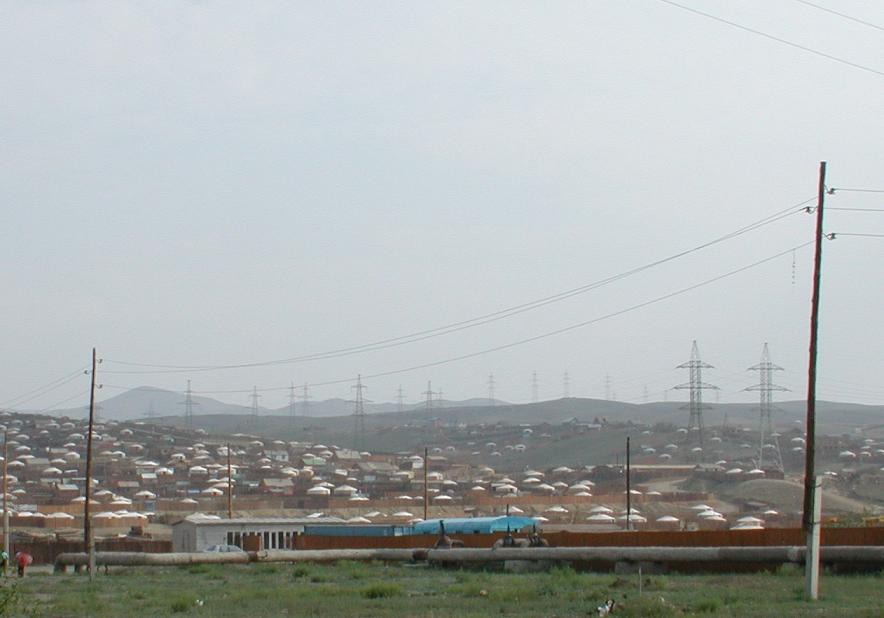
A ger district on the outskirts of Ulaanbaatar
A ger district in Govi-Altai Province

A Ger district (Mongolian: гэр хороолол, Ger khoroolol) is a form of residential district in Mongolian settlements. They usually consist of parcels with one or more detached traditional mobile dwellings or gers (hence the name), surrounded by two-metre high wooden fences. In other countries, gers are known as yurts.

Most Ger districts are not connected to water supplies, so people get their drinking water from public wells. For a warm shower or a bath, there are bathhouses. Since there is no sewer system, Ger district parcels usually have a pit toilet.[1]

Small settlements, like sum centers, may consist almost exclusively of ger districts. Even in Mongolia's capital Ulaanbaatar, around 62% of the population live in such districts. However, only about 43% of the Ger district residents in Ulaanbaatar actually live in gers.[2] Some of the districts in Ulaanbaatar have existed for more than 100 years, for example the one around Gandan, but many of those farther away from the city centre are the result of recent migration and the high price of other housing in Ulaanbaatar.

An oft-cited problem of Ger districts in Ulaanbaatar and a number of other larger Mongolian cities is the air pollution (especially in winter) caused by the burning of raw coal in simple iron stoves for cooking and heating.

Citizen groups in Ger districts

[edit]

Ulaanbaatar's Ger district is evolving and is marked by swift change over the past three decades since 1990, coupled with rising inequality. The Citizen Groups (CGs), semi-formal civil society organizations mainly led by women, work in ger suburbs surrounding Ulaanbaatar.

These CGs engage in small-scale projects, demonstrating resource management skills. Despite government recognition of state-civil society partnership, there's a gap in practice, particularly in ger districts.

Challenges include high staff turnover, limited local government authority, and unclear legal status for CGs. The article advocates for empowering CGs to amplify their contributions, aligning with local needs, and enhancing community development.[3]

References

[edit]
Revisions and contributorsEdit on WikipediaRead on Wikipedia
from Grokipedia
Ger districts, known in Mongolian as ger khoroolol, are informal peri-urban settlements encircling , the capital of , where the majority of the city's approximately 1.5 million residents reside in traditional portable felt tents called alongside makeshift shanties and rudimentary homes. These sprawling areas, which cover vast swaths of the city's northern and eastern hillsides, emerged prominently after the 1990s transition from , driven by mass rural-to-urban migration amid economic collapse in the countryside. Characterized by severe infrastructural deficits—including limited access to piped , centralized heating, systems, and paved roads—ger districts impose harsh living conditions, particularly during Mongolia's extreme winters when temperatures plummet below -30°C, forcing residents to burn raw in inefficient stoves that exacerbate chronic . Despite these challenges, the districts reflect cultural persistence, as —portable, circular dwellings ideally suited to nomadic heritage—remain preferred by many for their affordability, mobility, and thermal efficiency when properly maintained. and international efforts, such as community-led upgrading projects by UN-Habitat, aim to install basic utilities and formalize , yet rapid influx continues to outpace improvements, perpetuating cycles and . Notable for housing over 60% of Ulaanbaatar's populace without proportional , these districts underscore 's stark disparities, blending nomadic tradition with modern slum-like realities.

Definition and Characteristics

Overview and Terminology

Ger districts are informal peri-urban settlements predominantly found around , Mongolia's capital, consisting mainly of traditional ger dwellings alongside rudimentary houses constructed from bricks, wood, or other basic materials. These areas emerged as rural migrants settled on the city's outskirts, particularly following the economic transitions after 1990, and now accommodate roughly 60% of Ulaanbaatar's residents, numbering approximately 800,000 individuals as of 2018 data. Distinct from planned urban zones, ger districts are marked by irregular parcel divisions, often on hilly terrain, and a general absence of centralized such as piped , sewage systems, and paved roads. The term "ger district" derives from "ger," the Mongolian word for the portable, circular tent traditionally used by nomadic herders, featuring a collapsible wooden lattice frame, insulating felt walls, and a central roof opening for ventilation and light. This contrasts with the Russian-influenced "," a term more commonly used internationally but less precise in Mongolian contexts, as "ger" specifically denotes the culturally adapted structure suited to the region's extreme . In these districts, households are typically enclosed by fences known as khashaa, which delineate private plots and sometimes include outbuildings or areas, reflecting a semi-nomadic to urban life. While "ger district" is the standard Mongolian designation for these unplanned expansions, they are occasionally described in English sources as shantytowns or informal settlements due to their developmental challenges, though this framing overlooks the cultural continuity of ger usage. Ger districts represent a hybrid of nomadic heritage and modern pressures, where traditional portability meets static settlement patterns driven by economic necessity. Spatially, they exhibit distinct growth trajectories, with expansions into flood-prone valleys and steep slopes, as documented in spatiotemporal analyses showing accelerated informal development since the post-Soviet era. This terminology and overview underscore the districts' role as adaptive responses to Mongolia's rapid , housing a significant portion of the urban poor without formal .

Housing and Settlement Patterns

Ger districts in Ulaanbaatar consist primarily of self-built housing, including traditional gers—portable, circular dwellings made from felt and wooden frames—and bashins, which are immobile structures constructed from locally available materials such as , , or wood. While the term "ger district" derives from the prevalence of gers, these areas also incorporate detached houses and other semi-permanent units, reflecting incremental upgrades by residents over time. Households often begin with a ger as the core dwelling and expand with annexes or replace it with bashins as resources allow, based on strategic decisions influenced by location, family size, and economic factors. Settlement patterns in ger districts are characterized by low-density, unplanned sprawl on the city's periphery, typically on hillsides, valleys, and undeveloped land unsuitable for formal apartment developments. These areas exhibit distinct spatial evolution, from initial "infancy" stages dominated by scattered amid vegetation to maturing phases with denser clusters of mixed housing types. Density varies by proximity to the city center: central ger areas show higher integration of permanent structures, while fringe districts maintain lower densities tied to greater distances and terrain challenges. This low overall —often impeding efficient service provision—results from large parcel sizes for detached units and the semi-formal, compound-like layouts where multiple generations or related families share enclosed plots. The of these settlements follows topographic contours rather than grid-based , leading to fragmented road networks and irregular plot boundaries adapted to nomadic migrants' rural building practices. from surveys of over 800 households settling between 1942 and 2020 indicate that location choices prioritize accessibility to in the core while minimizing costs on outskirts, perpetuating radial expansion patterns. Despite comprising up to 60% of Ulaanbaatar's residential , ger districts house a disproportionate share of the urban poor due to their informal nature and exclusion from zoned utilities.

Historical Development

Pre-Modern Origins

The ger districts of trace their origins to the establishment of the city, originally known as Urga or Da Khüree, in 1639 as a mobile Buddhist monastic founded by the Jebtsundamba Khutughtu, the spiritual leader of Mongolian . This initial settlement integrated traditional ger dwellings—portable, felt-covered tents used by nomadic herders—to house a growing semi-sedentary population of , lay attendants, and surrounding pastoralists who provided support through herding and trade. Unlike fully nomadic camps, these early ger clusters formed stable outskirts around the transient monastic core, reflecting a hybrid lifestyle where mobility persisted but proximity to religious and administrative functions encouraged longer-term encampments. During the Qing dynasty's oversight of (1691–1911), Urga evolved into a key administrative and commercial hub, with ger settlements expanding to accommodate influxes of traders, artisans, and herders drawn by markets and monastic patronage. These districts, often arranged in circular patterns echoing nomadic khuree (encampments), housed clusters of that served as primary residences for the city's non-monastic populace, numbering in the tens of thousands by the late . The permanence of these areas increased after Urga's final relocation and settlement near its current site around 1771, as seasonal migrations gave way to year-round habitation amid growing economic ties to and . This pre-modern configuration laid the foundational pattern for ger districts as peripheral zones of informal, low-density housing, distinct from the central monastic and elite timber structures. Herders maintained traditional ger use for its adaptability to Mongolia's harsh , with walls of latticewood frames, felt insulation, and central hearths enabling survival in temperatures ranging from -40°C in winter to over 30°C in summer. Such settlements embodied causal adaptations to ecology and social structures, where land was communally accessed without formal titles, prefiguring later informal expansions while prioritizing empirical functionality over fixed architecture.

Soviet Era and Early Urbanization

During the period of the (1924–1990), under heavy Soviet influence, experienced controlled urbanization driven by state-led industrialization, collectivization of nomadic herding, and centralization of education and administrative functions. Rural-to-urban migration, though regulated to align with five-year plans, accelerated after the as the government promoted sedentarization and urban employment in factories, mines, and services. The urban share rose from approximately 36% in to nearly 60% by 1990, with absorbing much of this growth; its increased from around 180,000 in to 400,000 by 1980 and over 535,000 by 1990. Wait, no Wiki, skip that. Use [web:10] for pop, [web:52] for urban share. Soviet-assisted from the 1950s emphasized replacing traditional ger encampments with multi-story apartment blocks (khoroolol) modeled on Khrushchev-era designs, prioritizing central districts for workers and elites. Projects like the Soviet-funded 3rd and 4th microdistricts in Bayangol district exemplified this, providing standardized with basic utilities to support the socialist economy. However, central planning could not fully match migration inflows, as allocation favored party loyalists and skilled laborers, leaving shortages for others. Consequently, traditional portable remained a common urban sight, particularly on the city's hilly outskirts where land was less viable for formal construction or utilities. These early ger settlements functioned as informal overflow housing for recent migrants, often herders displaced by collectivization or seekers of urban jobs, lacking piped water, sewers, or electricity—features reserved for planned zones. While not yet the sprawling, unregulated districts of later decades, these peripheral areas marked the onset of unplanned , with state tolerance as long as they did not disrupt core development; by the , infrastructure strains highlighted limits of the socialist model.

Post-1990 Expansion

The and a in 1990, following the collapse of Soviet influence, triggered economic shocks in , including the end of subsidies, state enterprise closures, and of livestock, which devastated rural livelihoods. Harsh winters known as dzud, exacerbated by post-privatization, further drove herders from the countryside to in search of employment and stability. This rural-urban migration accelerated dramatically, with net inflows peaking in the 1990s and continuing into the 2000s as the city's pull strengthened amid limited rural alternatives. Ger districts, initially peripheral informal settlements, expanded unchecked on hillsides and outskirts due to the portability and affordability of traditional gers, enabling rapid, unplanned replication without formal infrastructure. The area of ger districts grew from 32 km² in 1990 to 221 km² by 2013, reflecting a more than sixfold increase driven by migrant influxes. Ulaanbaatar's overall rose from 426,960 in 1990 to 633,616 by 2001 at an average annual rate of 3.6%, then accelerated to 4.1% yearly through 2014, reaching 1.07 million, with ger areas absorbing the bulk of this growth. By the early 2000s, ger districts housed approximately 50-60% of Ulaanbaatar's residents, often through illegal land occupation lacking zoning or services, as municipal capacity lagged behind the boom. Government responses included sporadic resettlement efforts, but these were limited; for instance, between 2009 and 2014, only modest apartment conversions occurred, insufficient to curb peripheral sprawl. The expansion pattern shifted toward outer valleys and steeper terrains, prioritizing proximity to the city center despite environmental risks.

Demographics and Geography

Population Statistics

Ger districts in Ulaanbaatar accommodate an estimated 800,000 to 840,000 residents, representing approximately 50 to 60 percent of the city's total population of around 1.7 million as of 2024-2025. This share has remained consistently high over the past decade, driven by ongoing rural-to-urban migration amid economic disruptions in pastoral regions and severe weather events such as dzud, which displace herders toward the capital. Population growth in these districts outpaces the city's core apartment areas, with informal expansions adding tens of thousands annually through successive migration waves since the . New migrants constitute nearly one-third of ger district residents, many of whom settle in peripheral zones lacking formal planning, contributing to densities that vary widely but average lower than central urban zones due to sprawling, low-rise settlements. Over 80,000 ger households were recorded in select sub-districts alone during the 2020 , underscoring the scale of traditional dwelling use amid limited housing alternatives. Demographically, ger district populations skew toward working-age adults and families from rural aimags, with 64 percent of residents overall born outside the city, a figure likely higher in peripheral ger zones due to migration patterns. Household sizes tend to be larger than in formal apartments, often exceeding four members, reflecting units and economic pressures that favor shared over individual units. Rural origins predominate, with migrants typically younger and from herding backgrounds, though is increasing as second-generation residents remain.

Spatial Distribution in Ulaanbaatar

Ger districts encircle the central planned core of , concentrating in peripheral zones that extend northward along mountain ranges and riversides, while southern expansion is limited by the and Uul mountain. These informal settlements sprawl across hilly and valley terrains unsuitable for high-density construction, forming a ring around the Soviet-era districts in the flatter Tuul Valley. The districts span all nine of 's administrative districts but are most extensive in Bayangol, Bayanzürkh, Songinokhairkhan, Sükhbaatar, Khan-Uul, and Chingeltei, where they dominate the outer khoroos (subdistricts). In terms of coverage, ger districts occupy approximately 75% of the city's land area, accommodating about 60% of Ulaanbaatar's , estimated at over 1.5 million residents as of the early 2020s; this reflects their low-density layout compared to the compact zones. Bayanzürkh District hosts the largest share of the urban at 26%, followed by Songinokhairkhan at 22% and Bayangol at 15%, with ger areas comprising the bulk of their peripheral extents. The spatial footprint expanded dramatically post-1990 due to rural-to-urban migration, growing from roughly 32 km² in 1990 to 221 km² by 2013, primarily through radial outward sprawl. Recent patterns show stabilization and partial contraction, with ger numbers holding at around 83,000 households from 2020 to 2022 amid restrictions on migration, followed by modest increases and redevelopment-driven declines; for instance, satellite-detected ger expansion added only 1,575 units in 2022–2023. Districts like Songinokhairkhan exhibit particularly dense ger clustering on western and southern slopes, contributing to localized environmental pressures, while eastern Bayanzürkh sees continued fringe growth. Overall, the distribution underscores a monocentric urban form, with ger districts buffering the core from surrounding steppes but challenging integrated planning.

Living Conditions and Infrastructure

Access to Utilities and Services

Residents of Ulaanbaatar's ger districts generally have partial access to , with most households connected to the grid but facing frequent outages and high costs due to informal extensions from central areas. Piped is severely limited, as ger areas lack centralized networks, forcing approximately 60% of the city's in these zones to rely on communal kiosks, trucked deliveries, or unregulated wells, often resulting in intermittent availability and contamination risks. Sanitation infrastructure is inadequate across ger districts, with no widespread sewage systems and reliance on pit latrines or , exacerbating health hazards in densely packed settlements spanning about 100 square kilometers. Heating depends almost entirely on individual coal stoves within gers, as central does not extend to these peripheral areas, leading to inefficient energy use and severe winter . Efforts under programs like the Asian Development Bank's Urban Services initiative have raised improved access to water, , and heating for some residents to around 50%, though coverage remains uneven due to unplanned expansion and issues. Public services such as are inconsistent, with limited municipal collection prompting informal dumping or small-scale by local businesses, contributing to and . Public transport access is hindered by poor road networks and reliance on minibuses or private vehicles, isolating ger district residents from central and amenities, though recent planning emphasizes inclusive routes. Healthcare and education services are similarly constrained, with limited facilities nearby and quality care often requiring travel to the city core.

Daily Life and Adaptations

Residents of Ulaanbaatar's ger districts typically begin their days by fetching water from communal kiosks or delivery services, as direct piped access is absent in most areas. Average daily water consumption stands at approximately 7.3 liters per person, far below the 291 liters used by apartment dwellers, necessitating careful rationing for cooking, hygiene, and drinking. Families often purchase water in bulk using cash or digital payments at these points, which operate extended hours to accommodate varying schedules. Heating and cooking dominate winter routines, with temperatures dropping to -40°C from to , prompting reliance on - or wood-burning stoves that consume up to 40% of household income for fuel. Stoves are lit early for warmth inside the felt-covered gers, which insulate effectively due to traditional materials like and animal but require constant tending to maintain habitable conditions. Meals, prepared over the same stoves, feature staples like boiled mutton or dairy products, reflecting nomadic heritage adapted to urban scarcity. Employment pursuits involve informal labor, with many residents—predominantly rural migrants—engaging in low-wage jobs such as vending, , or on city fringes, often walking or using overcrowded transport due to unpaved roads. interactions occur through neighborhood networks or emerging hubs that facilitate shared resources and social support, fostering resilience amid isolation from central services. Adaptations include retrofitting gers with improved insulation or efficient stoves to reduce fuel needs, though adoption remains limited without subsidies. Some households incorporate solar panels for basic , supplementing irregular grid connections, while kiosk-based systems mitigate risks from distant sourcing. These measures, driven by necessity, highlight causal trade-offs between affordability and health, as persists despite hazards.

Environmental and Health Challenges

Air Pollution from Coal Use

In Ulaanbaatar's ger districts, where over 200,000 households rely on traditional stoves for heating during the harsh winter months, the combustion of raw is the predominant source of severe , accounting for approximately 80% of the city's total wintertime emissions. These districts, encompassing informal settlements on the city's periphery, burn more than 600,000 tons of unprocessed annually for domestic heating, releasing high concentrations of fine particulate matter (PM2.5), , and other pollutants due to inefficient in poorly insulated and low-pressure boilers. The extreme cold, often dropping below -30°C, necessitates continuous stove operation, exacerbating emissions as incomplete burning of low-quality produces dense smoke that traps in the valley topography surrounding . Ambient PM2.5 concentrations in ger areas routinely exceed 1,000 μg/m³ during peak winter periods, far surpassing the World Health Organization's guideline of 15 μg/m³ for 24-hour averages and rendering the air quality among the world's most hazardous. Indoor levels within are similarly acute, with studies recording average PM2.5 concentrations exceeding 500 μg/m³ from -fired stoves, where 95% of households depend on solid fuels like and wood, leading to direct exposure for residents confined indoors. This pollution plume extends citywide, as ger district emissions contribute disproportionately to the urban , with identified as the primary driver over vehicular or industrial sources during the heating season from October to April. Health consequences from this coal-derived pollution are profound, with elevated risks of respiratory infections, , exacerbations, and cardiovascular diseases documented among ger district residents, particularly children and the elderly. Exposure equates to the equivalent of smoking 4-5 packs of cigarettes daily for urban dwellers, correlating with increased admissions for pollutant-linked illnesses and higher rates of premature births and developmental issues in infants. Long-term studies link winter air pollution peaks to cyclic declines in fecundity and broader ecological risks from heavy metal deposition, underscoring the causal role of unchecked burning in perpetuating a crisis amid limited ventilation and insulation in ger dwellings.

Water, Sanitation, and Other Risks

In ger districts of , access to piped water is minimal, with residents primarily relying on communal kiosks or private vendors for supply, often queuing for hours daily and incurring costs equivalent to 10-20% of household income. This fragmented system results in per capita water consumption as low as 10-20 liters per day, far below WHO standards, exacerbating risks and deficits during harsh winters when kiosks may freeze or limit operations. Unsafe storage practices, such as using uncovered containers, further heighten contamination from dust, animals, or vectors, as documented in peri-urban assessments. Sanitation infrastructure remains rudimentary, with approximately 95% of ger households using unlined pit latrines or outhouses that lack proper ventilation or emptying services, leading to frequent overflows and soil percolation in densely packed settlements. These facilities, often shared among multiple families, pose direct threats to shallow aquifers, which serve as a backup water source for many, with levels exceeding safe thresholds in sampled wells. Sewerage connections cover less than 10% of ger areas, and centralized systems are infeasible due to hilly topography and , perpetuating in remote pockets during peak migration seasons. Efforts like ADB-funded community-led projects have raised access to around 50% in targeted subdistricts by 2023, though coverage lags in outer peripheries. These deficiencies drive elevated health risks, including waterborne illnesses such as , , and , with ger residents reporting infection rates 2-3 times higher than central urban zones due to via contaminated transport vessels and inadequate handwashing facilities. Other associated hazards include chemical leaching from unmanaged household waste dumped near water points, contributing to heavy metal accumulation in soils and potential in food chains, alongside vector proliferation (e.g., flies, ) that amplifies disease vectors in uncollected refuse piles. Seasonal flooding from poor drainage exacerbates sanitation breaches, mixing latrine effluent with and elevating cholera-like outbreak potentials during thaws, as evidenced in post-2020 vulnerability mappings.

Socioeconomic Dynamics

Poverty, Migration, and Employment

Ger districts in Ulaanbaatar primarily emerged from rapid rural-to-urban migration, driven by recurrent dzud events—severe winters that decimate livestock herds—and rural economic stagnation. Between 2000 and 2018, internal migration contributed to Ulaanbaatar absorbing nearly half of Mongolia's urban population growth, with many newcomers settling in ger areas due to unaffordable formal housing. As of recent estimates, ger districts house approximately 50% of the city's population, including a significant proportion of recent migrants who comprise nearly one-third of residents in these informal settlements. Around 40% of these migrants require external support for basic integration, highlighting the causal link between rural livelihood failures and urban peri-urban expansion. Poverty in ger districts exceeds national averages, with 42% of Mongolia's poor concentrated in these outskirts despite Ulaanbaatar's overall lower poverty rate of 21.6%. The national poverty headcount stood at 27.1% in 2022, but ger residents face multidimensional deprivations including substandard housing and limited services, positioning these areas as de facto urban slums. World Bank analyses using small-area estimation link higher district-level to ger prevalence, exacerbated by migrants' transition from to precarious urban conditions. Employment in ger districts is dominated by informal sector activities, with residents often engaged in low-skill, seasonal labor such as , vending, and petty trade, reflecting a mismatch between rural skills and urban demands. Informal employment accounts for 18% of jobs in broadly, but rises in ger areas due to limited formal opportunities and skill shortages. Dependence on perpetuates vulnerability, as migrants lack access to training or stable wages, sustaining cycles amid urban labor market rigidities.

Community Organizations and Citizen Groups

Citizens' groups in ger districts consist primarily of semi-formal, organizations, often comprising women, that engage in initiatives for and addressing . These groups, emerging since the early , facilitate local problem-solving through informal associations that receive small grants from district administrations to support activities like improvements and economic opportunities. Research highlights their role in advocating for residents' "right to the city," including political and economic recognition amid rapid urbanization, though they face barriers such as limited formal legal status compared to registered NGOs. GerHub, a founded to tackle ger area challenges, operates the Ger Innovation Hub, a community center constructed between 2018 and 2020 in Songinokhairkhan District through partnership with Rural Urban Framework. The hub provides educational programs, a , art activities, and a gardening club that distributes seedlings and teaches to residents lacking access to green spaces. GerHub's initiatives emphasize , youth education, and policy advocacy, serving over 800,000 ger district residents who face inadequate utilities. The Ger Community Mapping Center (GCMC), established in 2012, promotes participatory by conducting community mapping workshops and street meetings to identify needs and eco-friendly solutions in Ulaanbaatar's ger districts. These efforts empower residents in decision-making for , focusing on equal access to services. Other initiatives include the Uuliin Nuur Community Project, launched to enhance livability in select ger areas through local-led transformations as of 2022, and PADEM-supported programs in Sukhbaatar District that foster community participation for better living conditions. These groups collectively bridge gaps in state services, though their effectiveness depends on sustained collaboration and funding.

Government Responses and Policies

Urban Planning and Relocation Efforts

The Mongolian government has implemented strategies aimed at redeveloping ger districts in , primarily through relocation of residents to apartment complexes and infrastructure enhancements to address informal settlements spanning approximately 75 ger blocks or 1,500 hectares. These efforts, echoing earlier socialist-era policies, seek to modernize housing by transitioning nomadic-style ger dwellings to multi-story buildings, particularly targeting central and mid-rise ger areas near the city core. A key component involves land readjustment and road network upgrades to enable "gentle densification," preserving some cultural elements of ger living while improving connectivity and services. International partnerships have supported these initiatives, including the Asian Development Bank's Ulaanbaatar Urban Services and Ger Areas Development Sector Project (approved in 2018), which focuses on subcenter infrastructure in ger areas to facilitate redevelopment and integration with the broader city grid. Similarly, the Ulaanbaatar Green and Resilient Project includes resettlement plans to provide climate-responsive urban renewal, bridging gaps in housing affordability and environmental resilience for relocated families. UN-Habitat contributed guidelines in 2010 for redeveloping central ger areas, developed in consultation with Mongolia's Ministry of Road and Transportation, emphasizing phased upgrades to utilities and community amenities. Implementation has faced delays, notably post-COVID-19, with satellite imagery analysis indicating slower reduction in ger densities and some relocation pushing settlements to Ulaanbaatar's outskirts rather than fully integrating residents into core urban zones. Government policies prioritize apartment construction in ger vicinities to modernize without wholesale displacement, but resident skepticism persists due to concerns over maintenance costs, loss of livestock space, and cultural disconnection from traditional ger lifestyles. Alternative approaches, such as incremental urbanism, advocate community-led densification and collective funding for amenities over rapid relocation, aiming to avoid top-down failures observed in prior efforts.

Recent Initiatives and Innovations

The Asian Development Bank's Ulaanbaatar Urban Services and Ger Areas Development Investment Program, spanning multiple tranches since 2018 with ongoing implementation through 2025, has introduced subcenter developments featuring enhanced engineering infrastructure, public spaces, and connectivity to central Ulaanbaatar, aiming to catalyze redevelopment in ger peripheries without full-scale relocation. Tranche 3 specifically targets six new subcenters over nine years, integrating socioeconomic facilities to support approximately 300,000 residents in over 30 ger subdistricts. Energy innovation efforts have prioritized solar alternatives to dependency, with China's International Development Cooperation Agency (CIDCA) and the (UNDP) launching a 2025 project to deploy solar-powered heating systems in ger districts, enabling cleaner winter heating for vulnerable households. Complementing this, a 2024 pilot under the Joint SDG Fund installed solar PV-powered heating in 69 households across and , reducing emissions and costs as part of Mongolia's just energy transition strategy. Architectural and community innovations include the Ger Innovation Hub by Rural Urban Framework, operational by mid-2024, which functions as a hybrid community center incorporating ger-inspired modular designs for education, skill-building, and infrastructure prototyping to aid urban adaptation. Similarly, World Vision's "Innovative Ger" initiative, active from September 2024 to September 2025, retrofits traditional gers with pollution-mitigating features like improved insulation and ventilation, directly benefiting 250 urban and rural households. UN-Habitat's community-led upgrading projects, expanded in recent years, empower ger residents through participatory assessments and action plans for improvements, such as road networks and basic services, fostering localized resilience without disrupting cultural practices. World Bank-backed concepts like "gentle densification," promoted in 2024 analyses, advocate land readjustment and incremental road upgrades to modernize ger layouts while preserving affordability and traditional spacing.

Controversies and Debates

Slum Designation and Cultural Narratives

Ger districts in Ulaanbaatar are frequently classified as slums according to UN-Habitat criteria, which define slums by the absence of at least one of five conditions: access to improved water, improved sanitation, sufficient living area, durable housing, or secure tenure. Studies applying these standards estimate that up to 97.6% of urban ger households lack adequate sanitation, primarily due to ineffective pit latrines during harsh winters, while nearly all fail on secure tenure amid redevelopment pressures. However, ger households generally meet criteria for improved water access (with only 1% deficient), adequate living space (typically under seven residents per unit), and housing durability, as traditional gers provide effective insulation against Mongolia's extreme temperatures ranging from -40°C to over 30°C. Overall, these districts account for approximately 21% of Mongolia's urban slum population as of 2020, with ger dwellings comprising 22% of Ulaanbaatar households. This slum designation sparks debate among researchers, who note that ger districts diverge from prototypical urban slums in developing megacities, such as those in Mumbai or Rio de Janeiro, due to residents' partial legal land tenure, which mitigates widespread eviction threats. Scholars argue against equating ger areas with informal shantytowns, emphasizing their evolution from rural-to-urban migration rather than spontaneous urban poverty, and caution that the "slum" label may stigmatize communities while ignoring viable upgrading paths over demolition. Proponents of classification, drawing on satellite-based AI detection, highlight persistent substandard conditions post-COVID-19, with ger expansion delaying formalization efforts and perpetuating vulnerabilities like disaster risk. Culturally, ger districts sustain narratives of Mongolian nomadic resilience, with the portable ger (yurt) embodying centuries-old traditions of mobility, self-sufficiency, and harmony with the steppe environment, adapted to peri-urban life by over 60% of Ulaanbaatar's residents. Yet, dominant urban and policy discourses frame them as emblems of backwardness, attributing societal ills like air pollution from coal stoves, alcoholism, and crime to these areas, thereby justifying relocation to high-rise apartments as a path to modernization. Counter-narratives promote cultural preservation through initiatives like gentle densification, which upgrades infrastructure while allowing low-rise, land-based housing to maintain residents' ties to traditional living patterns, as evidenced by affordable green retrofits costing around $8,000 per unit. This tension reflects broader causal dynamics: rapid post-1990s urbanization from nomadic herding to city labor, where gers serve as pragmatic, climate-resilient shelters amid economic transitions, rather than inherent failure.

Effectiveness of Interventions

Interventions aimed at mitigating challenges in Ulaanbaatar's ger districts, such as reduction through replacements and bans, have yielded partial successes but limited overall impact. A ban on raw sales in ger areas, coupled with distribution of refined fuels and improved stoves, initially reduced fine particulate matter (PM2.5) concentrations by approximately 45% during the subsequent winter heating season, as measured by citywide monitoring stations. However, adoption rates remained incomplete, with 70% of ger households still relying on coal-based stoves by 2021, leading to persistent high levels and rebound effects due to briquette quality issues and higher costs exacerbating fuel poverty. Peer-reviewed assessments confirm that while ambient air quality improved marginally in targeted zones, indoor in gers—driven by traditional heating practices—continues to exceed safe thresholds, contributing to elevated rates among residents aged 1-59. Relocation and urban upgrading programs have faced significant hurdles, with slow progress in transitioning residents to formal housing. Government-led efforts since the 2010s, supported by international partners like the , have relocated thousands from high-risk ger zones to apartment blocks, yet ger district populations persist at around 50% of Ulaanbaatar's total, fueled by ongoing rural migration and post-pandemic delays in informal settlement mapping and enforcement. Evaluations indicate that relocated households often face affordability barriers, loss of cultural ties to portable , and inadequate in new sites, resulting in high return migration rates and incomplete tenure security. World Bank analyses highlight that while community-led upgrading pilots have enhanced local like roads and water access in select khoroos (sub-districts), systemic issues such as and limited integration undermine long-term , with poverty levels remaining elevated per small-area estimations. Targeted initiatives for , flood resilience, and have shown localized effectiveness but struggle with scalability. For instance, small-scale flood protection projects in seven vulnerable ger khoroos, funded by programs, have reduced seasonal inundation risks through community-driven barriers and drainage, yet broader climate vulnerabilities like dust storms persist without comprehensive grid connections. Human-centered redesigns have improved road safety and accessibility for ger residents via better bus routing and lighting, decreasing commute times and enhancing mobility equity. Nonetheless, reports from organizations like the World Bank emphasize that fragmented interventions fail to address root causes like densification resistance and energy inefficiency, with ger housing retrofits for demonstrating potential reductions in heating fuel use but requiring subsidies to achieve widespread uptake amid economic constraints. Overall, while measurable gains exist in metrics and service delivery, the persistence of ger expansion—evident in AI-assisted mapping showing resumed growth post-2020—signals insufficient integration of cultural, economic, and enforcement factors for transformative outcomes.

Future Outlook

Urban Densification and Modernization

The Ulaanbaatar City Master Plan 2040 outlines strategies for redeveloping ger districts through staged urban densification, emphasizing the integration of multi-story apartment complexes to replace low-density yurt settlements while preserving some traditional elements. This approach aims to accommodate projected —estimated at 25% by 2040—by increasing in central, mid-, and fringe ger areas, supported by incremental upgrades such as expanded road networks and extensions. Government-led relocation efforts since 2012 have targeted pollution reduction and poverty alleviation by transitioning residents to energy-efficient apartments, with initiatives like the Asian Development Bank's Ulaanbaatar Urban Services and Ger Areas Development Project facilitating higher-density changes to improve , sanitation, and heating access. Modernization proposals incorporate green frameworks, such as the European Bank for Reconstruction and Development's program, which prioritizes climate-resilient, low-cost apartments for low-income ger residents lacking formal land titles, potentially densifying neighborhoods to meet standards. However, implementation faces causal barriers including high relocation costs that exclude many poor households, reliance on international loans from entities like the —which strain Mongolia's fiscal capacity—and cultural preferences for among residents, with only about 60% expressing willingness to relocate if adequately compensated. Prospects for success hinge on "gentle densification" models advocated by the World Bank, which promote land readjustment and gradual infrastructure enhancements over abrupt clearances to mitigate displacement risks and align with nomadic heritage, though post-pandemic satellite data indicates delayed reductions in ger sprawl due to ongoing rural-urban migration. Despite these hurdles, targeted innovations like solar-heating transitions in pilot communities suggest potential for hybrid modernization, blending densified modern housing with resilient, low-emission features to address air quality crises without fully eradicating informal settlements. from prior relocations shows mixed outcomes, with some families gaining safer housing but others facing affordability gaps, underscoring the need for verifiable economic incentives to realize densification goals by 2040.

Potential for Sustainable Development

The ger districts of Ulaanbaatar hold significant potential for sustainable development through the integration of , leveraging Mongolia's abundant solar resources to transition from -dependent heating. Projects such as the UNDP's Solar Facility, in partnership with CIDCA, have piloted solar-powered heating with heat storage and smart meters in ger households, replacing inefficient stoves and reducing winter by up to 90% in targeted areas as of September 2025. Similarly, the URECA initiative by has retrofitted gers with insulation and electric heaters powered by rooftop solar panels, enabling families to cut energy costs by 50-70% while maintaining traditional living structures, demonstrating scalability for over 100,000 households in peripheral districts. These efforts capitalize on Ulaanbaatar's average annual solar irradiation of 2,800 kWh/m², far exceeding many urban centers, to foster and lower without necessitating full relocation. Eco-friendly housing and urban densification further enhance this potential by combining cultural preservation with modern resilience. The Asian Development Bank's (ADB) eco-district program plans to redevelop 100 hectares of ger areas into 20 sustainable neighborhoods housing 100,000 residents, incorporating insulated modular homes, district solar heating, and green spaces to achieve 30-40% savings per unit. World Bank-supported gentle densification strategies employ land readjustment to upgrade like roads and water systems while retaining ger-compatible plots, potentially accommodating denser populations with reduced vulnerability to extreme winters (-40°C temperatures). Innovations like the Ger Innovation Hub, constructed with local recycled materials, serve as prototypes for low-cost, adaptable community centers that promote skills training in green construction, yielding employment in solar installation and insulation markets. Economically, these developments could stimulate local industries, with retrofitting programs creating jobs in renewable supply chains and reducing household rates, which exceed 30% in ger areas. Geres' energy renovation initiatives, targeting ger districts since 2021, have trained over 500 installers for certified insulation, fostering a market-driven shift toward durable, low-emission habitats. Overall, sustained investment in such pilots—backed by international funding totaling millions in recent years—positions ger districts as models for climate-adaptive in arid, nomadic-influenced contexts, provided prioritizes incremental, resident-led implementation over top-down displacement.

References

Add your contribution
Related Hubs
User Avatar
No comments yet.