Hubbry Logo
QuinzheeQuinzheeMain
Open search
Quinzhee
Community hub
Quinzhee
logo
8 pages, 0 posts
0 subscribers
Be the first to start a discussion here.
Quinzhee
Quinzhee
from Wikipedia
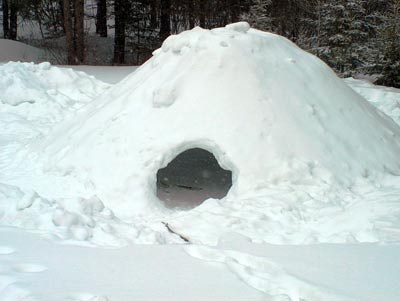
Exterior of a quinzhee, facing the entrance

A quinzhee or quinzee (/ˈkwɪnz/ ) is a Canadian snow shelter made from a large pile of loose snow that is shaped, then hollowed. This is in contrast to an igloo, which is built up from blocks of hard snow, and a snow cave, constructed by digging into the snow. The word is of Athabaskan origin[1][2] and entered the English language by 1984.[3] A quinzhee can be made for winter camping and survival purposes, or for fun.

A similar, but more elaborate snow house is called a lumitalo.[4]

Differences between a quinzhee and an igloo

[edit]

Quinzhees typically have an inside height after excavation which allows for sitting or crouching but not standing.

The snow for a quinzhee does not need to be of the same quality as required for an igloo. Quinzhees are not usually meant to be long-term shelters, while igloos can be used for seasonal habitation. Constructing quinzhees is much easier than igloos, although the overall result is somewhat less sturdy and more prone to collapsing in harsh weather conditions. Quinzhees are normally constructed in times of necessity for survival, so aesthetic and long-term dwelling considerations are normally exchanged for economy of time and materials.

Construction

[edit]

Quinzhees are typically built in flat areas where snow is abundant, on days colder than −4 °C (25 °F). Builders break up layers of naturally fallen snow into powder and thoroughly mix bottom and top layers of snow to increase sintering, thus strengthening the eventual structure. Snow is typically piled 1.5 to 2 metres (5 to 7 ft) high in a dome 3 to 4 metres (10 to 13 ft) in diameter. It is then left for at least 2 hours to sinter, allowing both temperature and moisture in the snow to homogenize and the snow crystals to bond with each other. Packing can speed the bonding process and strengthen the structure. Small sticks, approximately 30 to 35 centimetres (12 to 14 in) are pushed into the structure to act as thickness guides when the interior is hollowed out. According to Halfpenny and Ozane (1989), the wall at the base should be at least 30 centimetres (12 in) wide and at the top about 20 centimetres (8 in) thick, though wall-base thicknesses of more than 60 centimetres (2.0 ft) are possible.[5]

Excavation may be accomplished more quickly if large blocks of interior snow are carved and slid out through a large, temporary "excavation door." Structural strength increases when all interior wall and ceiling surfaces follow an arched curve, with no flat sections. Once excavation is complete the excavation door can be permanently blocked using previously excavated blocks, and a smaller permanent door can be cut in the most desirable spot.[citation needed] Time and effort are required to hollow out the center of a quinzhee, though these can be reduced by piling snow around a hollow structure, such as a tarp-covered pile of packs or a makeshift tent or dome.[6]

Melting and refreezing the inner surface of the quinzhee can strengthen it, as it does an igloo; this can be done rapidly with a lamp [1] or candle,[7] but body heat is also adequate.[8]

Allowing the interior temperature to rise above freezing point risks weakening the shelter significantly, especially if the outside air temperature is near freezing. A small hole for air circulation should be poked through the ceiling. To avoid dripping melt-water, irregular or bumpy surfaces can be smoothed to direct the flow of water down the walls to gather around the edges. A non-airtight fabric door cover will minimize the amount of cold air coming into the quinzhee. An empty, well built snow structure, 16 or more hours old, in weather below −12 °C (10 °F) may be strong enough to support a group of adults standing on top of it.[citation needed]

Dangers

[edit]

All snow shelters eventually collapse or melt. Quinzhees can collapse from poor snow conditions, warm weather, blowing rain, construction problems (hitting a supporting wall), failure to let the snow sinter long enough, or from people climbing on them. Collapse poses a danger of suffocation for occupants.

Quinzhees should not be used when temperatures are warmer than −4 °C (25 °F) due to risk of collapse. The greatest risk of collapse occurs during the excavation process. Longer sintering time generally reduces risk of excavation collapse. To reduce undue loading on the roof of the quinzhee, the interior ceiling should be excavated first, then the interior walls and floor. One person should be outside the quinzhee while another is digging inside. Place a shovel, branch, hiking pole, or such near the head of a sleeping person for roof support, to break a falling roof to create an air gap, and/or as a tool to dig out. One shovel should be left outside to mark the door and aid rescuers in digging occupants out. Some users prefer a marker to be left outside the quinzhee nearest the heads of sleeping occupants to indicate where rescuers should start digging.

Lumitalos

[edit]

A lumitalo is a more elaborate snow-house or building made out of snow in a manner similar to a quinzhee. The term is Finnish in origin, and literally means “snow house”.[9]

The city of Houghton, Michigan, builds a lumitalo as part of its annual Winter Carnival held by Michigan Technological University.[10]

See also

[edit]

Bibliography

[edit]

References

[edit]
[edit]
Revisions and contributorsEdit on WikipediaRead on Wikipedia
from Grokipedia
A quinzhee (pronounced "kwin-zee") is a temporary constructed by piling loose into a large , allowing it to sinter or harden through changes, and then hollowing out the interior to form a habitable space. It provides effective insulation, maintaining interior temperatures around 30°F (–1°C) even in subzero conditions outside, making it suitable for winter camping, backcountry travel, or survival scenarios. The term "quinzhee" originates from of . Unlike an , which requires cutting and stacking hard-packed blocks into a structured dome, a quinzhee uses any type of —wet or dry—without needing specialized tools or wind-sculpted surfaces, allowing for quicker assembly in varied terrains. This versatility has made it a staple in modern programs, such as those from organizations and trail associations, emphasizing its role in emergency preparedness and multi-night expeditions.

Overview

Definition

A quinzhee is a free-standing constructed by piling loose into a dome-shaped and then hollowing out the interior to create a habitable space. This design relies on the insulating properties of , forming a structure that can maintain an internal significantly warmer than the outside environment during cold weather. Typical quinzhees measure 3 to 4 meters in diameter and 1.5 to 2 meters in height, providing enough space to accommodate 2 to 4 people comfortably when properly hollowed. The walls are generally left 30 to 60 centimeters thick to ensure structural integrity and . Quinzhees serve as temporary shelters for winter , in harsh cold environments, or recreational snow building activities. They are typically built using powdery or loose that can be easily piled and allowed to sinter, or harden naturally through compression and temperature changes, though various snow types can be used. The term originates from indigenous Athabaskan practices in .

Etymology and Origins

The term "quinzhee" (also spelled "quinzee") originates from , possibly from the South Slavey word kǫ́ézhii, meaning "in the shelter", though this remains unverified in modern dictionaries. This borrowing reflects the linguistic influence of Na-Dene language families spoken by in northern , with the word entering by 1975 and broader English usage by 1984. The adaptation into English likely occurred post-World War II through interactions in regions, where such shelters were part of traditional practices. The quinzhee technique traces its indigenous roots to the Athabaskan (Dene) peoples of , who employed it as a temporary winter survival shelter in harsh environments. Unlike more permanent structures such as lean-tos, the quinzhee served as an expedient refuge during or travel, utilizing piled and hollowed for insulation against extreme cold. This method embodies adaptive knowledge honed over generations for transient needs, distinct from fixed dwellings and tailored to regions with abundant loose rather than hard-packed drifts. Historical records of the quinzhee prior to the 20th century are scarce, with much of the early documentation emerging from oral traditions rather than written accounts. It gained prominence in modern contexts through Canadian outdoor literature and survival guides starting in the , including references in alpine journals and educational materials that highlighted its practicality for . Early mentions appear in regional publications from the Canadian Rockies describing it as a Dene-inspired shelter for winter expeditions. Culturally, the quinzhee signifies the ingenuity of Dene communities in leveraging natural materials for survival in unforgiving climates, underscoring a legacy of environmental resilience passed down through indigenous practices. Its integration into contemporary preserves this heritage while emphasizing its role as a non-permanent, resource-efficient .

Comparisons with Other Snow Shelters

Igloo

The igloo is constructed from precisely cut blocks of hard, wind-packed , typically measuring about 24 inches long, 18 inches high, and 6 inches thick, which are stacked in an ascending spiral pattern to form a self-supporting dome shape. This method begins with a circular base layer, where each subsequent row of blocks is leaned slightly inward, creating the characteristic curved that distributes weight evenly and enhances stability. The process requires a saw or specialized tool to cut uniform blocks from compacted drifts, ensuring the dome seals tightly at the top with a final keystone block. In contrast to the quinzhee, which relies on piling loose snow into a mound that sinters and hardens over time through natural compaction, the uses pre-compacted blocks for immediate structural integrity, making it less dependent on prolonged settling. This material difference allows igloos to achieve thicker, more rigid walls that better resist deformation, whereas quinzhees depend on the gradual fusion of softer snow layers, which can limit their load-bearing capacity. Igloos offer superior durability for extended use, particularly in exposed, windy environments, where their low-profile dome and solid block construction provide excellent wind resistance and can withstand multi-day occupation or even persist through an entire winter season in conditions. Quinzhees, while functional for shorter stays, are more susceptible to collapse in warmer temperatures or under melting influences, as their less rigid structure may sag or fail without ongoing reinforcement. Consequently, igloos are preferred in open, blustery terrains for prolonged , whereas quinzhees suit quicker setups in milder or sheltered spots. Building an demands significant expertise in block cutting, placement, and spiral alignment, often taking 2-3 hours for two skilled individuals working with ideal snow conditions. This contrasts with the quinzhee's simpler approach, accessible to beginners and completable in about 3-4 hours total (including 1-2 hours of passive settling time), with active piling and excavation taking 1-2 hours, due to its reliance on basic shoveling rather than precise techniques.

Snow Cave

A is constructed by digging horizontally into a deep or slope, utilizing existing natural accumulation rather than artificially piling it. This method involves selecting a stable snowbank or hillside, probing the for layers and weaknesses to ensure structural integrity, and excavating a entrance that slopes upward to trap warm air inside while preventing cold drafts. The sleeping platform is typically raised above the entrance level, with walls and ceiling left at least 30-45 cm thick for support and insulation. Snow caves are particularly suited to forested or hilly environments where wind naturally creates deep drifts under trees or along slopes, providing readily available material without the need for extensive gathering. In contrast, quinzhees excel in flat, open spaces lacking such drifts, where loose powder can be easily gathered and piled into a dome shape. This environmental distinction allows snow caves to leverage natural formations in varied terrain, while quinzhees offer versatility in more uniform, drift-free landscapes. Structurally, snow caves provide effective through the packed snow walls and floor, which trap body heat similarly to freestanding designs, though a raised platform is often used to mitigate cold conduction from the ground; this proximity to slopes introduces risks that require careful site assessment. Quinzhees, as freestanding domes, avoid such terrain hazards but may offer simpler ventilation via easily poked ceiling holes, reducing the chance of moisture buildup from rising warm air. Both shelters rely on 's insulating properties, but the cave's enhances stability in consolidated snow. Building a snow cave demands 1-3 hours of effort for one or two people, including probing for stability and extensive digging, making it more labor-intensive in hard-packed snow but feasible with good tools. Quinzhees can be assembled faster in powder snow—often under an hour for piling—but require 1-2 hours of time for the snow to bond and harden before hollowing. This trade-off highlights the 's reliance on pre-existing conditions versus the quinzhee's preparatory wait.

Construction

Site Selection and Materials

Selecting an appropriate site is crucial for constructing a quinzhee, as it ensures and safety during and after building. Ideal locations include flat, open areas on frozen surfaces like lakes or packed ground, which facilitate easy shoveling and minimize the risk of uneven . A slight can be beneficial to allow cold air to drain from the entrance, but the site should be sheltered from extreme wind, such as in wooded areas away from avalanche-prone slopes or overhanging hazards. depth on the ground can be as minimal as 4 inches, provided there is sufficient loose nearby to pile into a at least 6 to 8 feet high. is best in temperatures below freezing (0°C) to promote , the process where snow particles bond without melting, though extreme cold like -25°C is manageable with proper layering. The quality of snow significantly affects the quinzhee's stability, with dry, powdery snow preferred for easy piling and effective , as it compacts well when mixed from varying depths or temperatures. Wet or icy snow should be avoided, as it resists bonding and can lead to weak walls; however, quinzhees can be built with nearly any snow type by breaking up chunks and incorporating for better cohesion. Essential tools for a quinzhee include a sturdy —such as a collapsible or long-handled model—for piling and excavating , along with auxiliary items like a , pot, or for fine shaping. Sturdy sticks, approximately 12 to 24 inches long, serve as critical depth markers to maintain wall and ceiling thickness of 10 to 24 inches during hollowing. Backpacks, gear, or branches can be placed inside the initial to reserve interior space and prevent collapse during early stages. Preparation begins by clearing the base site of , rocks, or crusty through stomping or packing to create a firm foundation, typically outlining a circle 10 to 20 feet in diameter depending on group size. For a group of four, estimate a mound volume equivalent to 10 to 15 cubic meters by piling to form a dome 7 to 8 feet high and 10 to 12 feet wide, allowing space for sleeping platforms and airflow after hollowing. This initial piling should incorporate mixed layers to enhance , which requires 1 to 3 hours of settling time before proceeding.

Step-by-Step Process

The of a quinzhee begins with the piling phase, where loose is shoveled into a large approximately 2 to 2.5 meters high and 2.5 to 3 meters in to accommodate two people, ensuring the base is wide enough for comfort once hollowed. The should be shaped into a smooth, rounded dome using shovels to promote even , with of varying temperatures mixed and periodically flipped during piling to encourage bonding of crystals. Following piling, the sintering wait allows the snow's weight to compact and harden the structure, typically requiring 2 to 3 hours, though up to 4 hours is ideal in colder conditions; during this time, the exterior can optionally be packed further with shovels or by walking on it to enhance stability. In the hollowing phase, a small entry is dug into the side of the mound, preferably on the downhill side, and the interior is excavated starting from the downward to avoid collapse, using tools like small shovels or snowshoes to remove . To maintain structural , sticks equal to the desired wall thickness (e.g., 30 cm long for 30 cm walls) are inserted radially around the exterior, protruding slightly inside and spaced 60 centimeters apart before hollowing; excavation stops when the inner ends of these sticks are exposed from inside, aiming for 25- to 45-centimeter (10- to 18-inch) walls overall, which may be slightly thinner near the top where stress is lower. Interior shaping follows, where the removed snow is packed to form an elevated sleeping platform about 30 centimeters high, often with a narrow dug beneath to direct cold air downward and improve warmth. A low entry tunnel is extended outward from the door to block wind, and a ventilation hole of 5 to 10 centimeters in is punched near the top of the dome, ideally by removing one of the measuring sticks, to allow circulation while minimizing heat loss. For final strengthening, the inner walls are gently melted using , a , or a small to create a thin layer of that refreezes for added and smoothness, with a brief 15- to 20-minute wait allowing the glaze to set; the entire process, including the period, typically takes 3 to 5 hours.

Safety and Risks

Potential Dangers

One of the primary hazards associated with quinzhees is structural , which can occur due to inadequate of the pile, where ice crystals fail to bond properly without sufficient time (at least 1-2 hours) for compaction under pressure and temperature. This risk is exacerbated in warmer temperatures near or above freezing (0°C/32°F), as the may become slushy and prone to sagging, or during , which weakens the overall by introducing that prevents proper bonding. Uneven walls or ceilings thinner than 30 cm (12 inches) further increase vulnerability, particularly during the hollowing phase when the structure is most unstable and most collapses happen. Suffocation poses another critical physiological risk inside a quinzhee, often resulting from blocked ventilation holes due to snow buildup during storms or melting caused by occupant body heat, which can lead to accumulation in the enclosed space. Without adequate , oxygen levels deplete rapidly, especially in sealed or poorly ventilated interiors, turning the shelter into a potential asphyxiation trap. Environmental factors amplify these dangers; for instance, the physical of can cause sweating, leading to wet that accelerates as moisture conducts heat away from the body. Building near slopes introduces risk, though quinzhees pose a lower than snow caves since they are freestanding mounds rather than excavations into unstable snowpacks. Additionally, can occur during frequent entry and exit through air tunnels, exposing to extreme low temperatures. Other issues include from prolonged wind exposure, which can erode the exterior and cause partial structural failure after 1-2 days, even in a well-built quinzhee, as sustained gusts undermine the sintered . within the may also melt inner walls if sleeping platforms lack insulation, creating drips and further weakening the structure over time.

Mitigation Strategies

To mitigate risks during quinzhee construction, it is essential to maintain constant supervision and avoid solo building, particularly for larger structures that could pose hazards if someone becomes trapped inside. Designate at least one person as a spotter to remain outside the snow mound while others excavate from within, ensuring rapid assistance in case of . Begin hollowing by carefully removing from the downward to minimize the chance of under falling , and equip those inside with marked or identifiable shovels for swift self-excavation if needed. Additionally, cordon off the mound with or similar material to prevent accidental trampling by others, which could trigger a . Effective ventilation management is critical to prevent buildup and asphyxiation. After hollowing, create at least two ventilation holes—ideally snorkel-sized, around 2-4 inches in depending on (larger in milder conditions, smaller in extreme cold)—with one positioned low near head level for intake and another higher near the apex to exhaust stale air and fumes. These can be formed by removing select sticks used earlier for gauging; periodically crack open the entrance to enhance , and monitor for signs of poor ventilation such as stuffiness, headaches, or excessive yawning. Regularly inspect and clear any ice buildup around these openings to maintain patency. For ongoing stability, probe the walls and periodically with sticks or a pole to verify a minimum thickness of 8-12 inches (ideally 12-18 inches for added safety), avoiding thinning that could lead to failure. Refrain from sleeping directly beneath any identified thin spots, and if melting occurs—particularly around the entry tunnel—rebuild or reinforce the affected areas promptly to prevent sagging or collapse. Glazing the interior walls with a flame can further enhance structural integrity by creating a smooth, hardened surface. General safety practices include changing into dry clothing immediately after construction to reduce risk from sweat-soaked layers, and limiting occupancy to 1-2 nights to avoid cumulative weakening from internal moisture. For larger quinzhees, never attempt construction without a , as the increased volume heightens potential; always keep a inside for and mark the occupied entrance with a visible pole or . If sleeping inside, position bodies to create an air pocket beneath the chest by digging slightly on knees, facilitating breathing in the event of a partial .

Variations

Lumitalo

The lumitalo, a Finnish term literally translating to "snow house," represents an elaborate and decorative variant of the quinzhee snow shelter, emphasizing artistic expression over basic survival needs. Of Finnish origin, it draws from traditional northern building techniques adapted for temporary, visually striking edifices. Unlike the utilitarian quinzhee, the lumitalo prioritizes aesthetic details, often incorporating sculpted elements that highlight communal creativity during winter festivities. Key features of the lumitalo include its larger scale, typically reaching diameters of 5-6 meters or more, allowing for spacious interiors that accommodate groups for events such as carnivals or festivals. Intricate interior designs, such as carved motifs and furniture crafted from blocks harvested from frozen lakes, create an immersive environment, while exterior decorations enhance its ornamental appeal. Windows formed from translucent blocks provide natural illumination, adding to the structure's enchanting, lantern-like quality during evening gatherings. These elements make the lumitalo suitable for celebratory purposes rather than prolonged habitation, blending functionality with festive artistry. Construction of a lumitalo follows a similar foundational process to the basic quinzhee—piling and settling before hollowing—but incorporates significant enhancements for durability and decoration. Builders use arched molds to shape the snow pile, filling them with compacted snow delivered via snow blowers in multiple layers to achieve thick walls (up to 1.5 at the base), ensuring stability against and melt. After the mold is removed, the interior is hollowed and refined, with additional time devoted to decorative motifs and installing ice-block features, often requiring 4-6 hours of coordinated group effort depending on scale. This method, reinforced by layered compaction, allows the structure to endure for weeks, far outlasting simpler quinzhees. Notable examples of lumitalo construction appear in Finnish-American communities, particularly during winter events in 's Upper Peninsula. In 2001, Finnish architect Seppo Mäkinen introduced the first documented lumitalo in the United States to , as part of the Heikinpäivä festival, measuring approximately 5 by 9 meters with ice art installations. Subsequent builds, including a 2002 project in nearby Houghton spanning approximately 5 by 18 meters and standing 5 meters tall internally, have been integrated into Michigan Technological University's Winter traditions, where student groups create these elaborate shelters alongside snow sculptures to celebrate the region's harsh winters since the event's inception in the 1920s.

Modern Adaptations

In contemporary recreational contexts, the quinzhee has gained popularity as a practical for winter , particularly through guides and programs emphasizing hands-on outdoor skills. Since the 1990s, organizations like the Boy Scouts of America have incorporated quinzhee construction into their cold weather curricula, such as the Okpik program, which teaches participants to build these shelters for multi-night stays in sub-zero conditions. Similarly, promotes quinzhee as a core activity for youth groups, highlighting its accessibility for beginners compared to more labor-intensive igloos. Adaptations for comfort include carving insulated sleeping benches from packed snow to elevate occupants off the cold floor and incorporating tarps as ground covers to prevent moisture buildup, enhancing thermal efficiency during overnight use. Educational applications of the quinzhee extend its traditional role into structured learning environments, fostering skills in and interdisciplinary studies. In school programs, group quinzhee builds serve as team-building exercises, encouraging collaboration among students while demonstrating principles of construction in natural settings. These activities are integrated into STEM curricula to illustrate concepts like the physics of snow , where loose snow particles bond through temperature gradients and to form a stable structure, providing a tangible example of material in action. For survival training, the quinzhee remains a staple in modern military programs, particularly those focused on arctic operations. The Canadian Armed Forces include quinzhee construction in their Cold Weather Instructor Course, training personnel to erect these dome-shaped shelters from any snow type for rapid protection against extreme cold, with features like ventilation holes and low entrances to retain heat. Regional variations reflect local environmental needs; in Scandinavia, smaller solo quinzhees are favored for individual winter bushcraft expeditions, allowing quick setup in forested or mountainous terrain. In milder climates like the Canadian Rockies, hybrids combine quinzhees with tarps draped over partial snow mounds to create semi-enclosed spaces suitable for variable weather, reducing construction time while maintaining insulation.

References

Add your contribution
Related Hubs
User Avatar
No comments yet.