


Community hub
Recent from talks
Contribute something
Nothing was collected or created yet.
Geranium
View on Wikipedia
| Geranium | |
|---|---|

| |
| Geranium dissectum, Cut-leaved Crane's-bill | |
Scientific classification 
| |
| Kingdom: | Plantae |
| Clade: | Tracheophytes |
| Clade: | Angiosperms |
| Clade: | Eudicots |
| Clade: | Rosids |
| Order: | Geraniales |
| Family: | Geraniaceae |
| Genus: | Geranium L. |
| Species | |
Geranium is a genus of 422 species of annual, biennial, and perennial plants that are commonly known as geraniums or cranesbills. They are found throughout the temperate regions of the world and the mountains of the tropics, with the greatest diversity in the eastern part of the Mediterranean region.[1]
The palmately cleft leaves are broadly circular in form. The flowers have five petals and are coloured white, pink, purple, or blue, often with distinctive veining.[1] Geraniums will grow in any soil as long as it is not waterlogged.[2] Propagation is by semiripe cuttings in summer, by seed, or by division in autumn or spring.[3]
Geraniums are eaten by the larvae of some Lepidoptera species including brown-tail, ghost moth, and mouse moth. At least several species of Geranium are gynodioecious.[4][5][6] The species Geranium viscosissimum (sticky geranium) is considered to be protocarnivorous.[7]
Name
[edit]
The genus name is derived from Ancient Greek γέρανος (géranos) 'crane'. The English name 'cranesbill' derives from the resemblance of the fruit capsule of some of the species to a crane's head and bill. The ovary portion forms the head and the prolonged stigma creates the appearance of a beak.[8][9]
Description
[edit]The flowers are typically five-petaled and white to purple. The leaves are palmate divided into narrow, pointed segments.[8]
The fruit capsule consists of five cells joined to a column produced from the centre of the flower. The cells form lobes which eventually separate, each containing one seed.[8] When the fruit is ripe, the beak-like stigma springs open and casts the ovoid, streamlined seeds some distance, dispersing the seeds.[10]
Confusion with Pelargonium
[edit]
Confusingly, "geranium" is also the common name of members of the genus Pelargonium, which are also in the family Geraniaceae and are widely grown as horticultural bedding plants. Linnaeus originally included all the species in one genus, Geranium, but they were later separated into two genera by Charles L’Héritier in 1789.[11] Other former members of the genus are now classified in Erodium, including the plants known as filarees in North America.[12]
The term "hardy geranium" is often applied to horticultural Geraniums to distinguish them from the Pelargoniums, which are not winter-hardy in temperate horticulture.[13][14] However, not all Geranium species are winter-hardy (see below).[15]
The shape of the flowers offers one way of distinguishing between the two genera Geranium and Pelargonium. Geranium flowers have five very similar petals, and are thus radially symmetrical (actinomorphic), whereas Pelargonium (and also Erodium) flowers have two upper petals which are different from the three lower petals, so the flowers have a single plane of symmetry (zygomorphic).[16][17]
Cultivation
[edit]A number of geranium species are cultivated for horticultural use and for pharmaceutical products. Some of the more commonly grown species include:
- Geranium albanum (crested cranesbill)
- Geranium cinereum
- Geranium clarkei (Clarke's geranium)
- Geranium dalmaticum
- Geranium endressii (Endres's cranesbill)
- Geranium erianthum (woolly geranium)
- Geranium fremontii (Fremont's geranium)
- Geranium himalayense, often sold under Geranium grandiflorum
- Geranium ibericum (Caucasus geranium),
- Geranium macrorrhizum (bigroot cranesbill or bigroot geranium)
- Geranium maculatum (wild geranium)
- Geranium maderense (giant herb robert)
- Geranium × magnificum (showy geranium)
- Geranium phaeum (dusky cranesbill)
- Geranium platypetalum (broad-petaled geranium)
- Geranium pratense (meadow cranesbill)
- Geranium psilostemon (Armenian cranesbill)
- Geranium renardii (Renard geranium)
- Geranium sanguineum (bloody cranesbill)
- Geranium subcaulescens (grey cranesbill)
- Geranium sylvaticum (wood cranesbill)
All the above species are perennials and generally winter-hardy plants, grown for their attractive flowers and foliage. They are long-lived and most have a mounding habit, with palmately lobed foliage. Some species have spreading rhizomes. They are normally grown in part shade to full sun, in well-draining but moisture retentive soils, rich in humus.[18] Other perennial species grown for their flowers and foliage include: Geranium argenteum, G. eriostemon, G. farreri, G. nodosum, G. procurrens, G. pylzowianum, G. renardii, G. traversii, G. tuberosum, G. versicolor, G. wallichianum, and G. wlassovianum. Some of these are not winter-hardy in cold areas and are grown in specialized gardens like rock gardens.[19] Geranium 'Johnson's Blue' is a hybrid between G. himalayense (southwestern China), with G. pratense (European meadow cranesbill).[20]
Cultivars
[edit].jpg)
The following hybrid cultivars have gained the Royal Horticultural Society's Award of Garden Merit (other cultivars are dealt with under their species name - see above):-[21]
- 'Ann Folkard'[22]
- 'A. T. Johnson' (G. × oxonianum)[23]
- 'Ballerina' [24]
- 'Blue Cloud'[25]
- Blue Sunrise='Blogold' (PBR) [26]
- 'Brookside' [27]
- 'Danny Boy'[28]
- 'Dilys'[29]
- 'Gypsy' (G. × lindavicum)[30]
- 'Ivan' [31]
- 'Mavis Simpson'[32]
- 'Nimbus' [33]
- 'Orion'[34]
- Patricia='Brempat'[35]
- Rothbury Gem='Gerfos'[36]
- Rozanne='Gerwat'[37]
- 'Russell Prichard'[38]
- 'Sirak'[39]
- 'Wageningen'[40]
- 'Wargrave Pink' (G. × oxonianum)[41]
Gallery
[edit]-
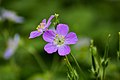
 Geranium maculatum, wild cranesbill
 -
-
 Geranium phaeum - from Thomé Flora von Deutschland, Österreich und der Schweiz 1885
 -

-
-
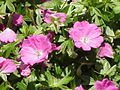
 Geranium pratense (meadow cranesbill)
 -
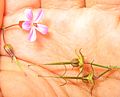 Geranium robertianum (herb robert)
 -

-
-
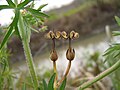

.jpg)


.jpg)
.jpg)


See also
[edit]References
[edit]- ^ a b Allaby, Michael (26 August 2015). The Dictionary of Science for Gardeners: 6000 Scientific Terms Explored and Explained. Timber Press. ISBN 978-1-60469-483-3. Retrieved 5 April 2024.
- ^ Tibballs, Geoff (2017-03-09). 100 Plants That Won't Die in Your Garden. Little, Brown Book Group. ISBN 978-1-4721-3800-2.
- ^ Brickell, Christopher (2011-08-15). American Horticultural Society Encyclopedia of Plants and Flowers. Penguin. ISBN 978-0-7566-7508-0.
- ^ Hessing, M.B. 1989. Variation in self-fertility and floral characters of Geranium caespitosum (Geraniaceae) along an elevational gradient. Plant Systematics and Evolution 166:225-241.
- ^ Van Etten and Chang 2014. Frequency-dependent pollinator discrimination acts against female plants in the gynodioecious Geranium maculatum Annals of Botany 114:1769–1778
- ^ Elzinga, Jelmer A.; Varga, Sandra (2017). "Prolonged stigma and flower lifespan in females of the gynodioecious plant Geranium sylvaticum" (PDF). Flora. 226: 72–81. Bibcode:2017FMDFE.226...72E. doi:10.1016/j.flora.2016.11.007. S2CID 85558947.
- ^ Spomer, George G. (1999). "Evidence of Protocarnivorous Capabilities in Geranium viscosissimum and Potentilla arguta and Other Sticky Plants". International Journal of Plant Sciences. 160 (1): 98–101. doi:10.1086/314109. ISSN 1058-5893.
- ^ a b c Taylor, Ronald J. (1994) [1992]. Sagebrush Country: A Wildflower Sanctuary (rev. ed.). Missoula, MT: Mountain Press Pub. Co. p. 62. ISBN 0-87842-280-3. OCLC 25708726.
- ^ "Geranium homeanum". Australian Plants Society. 17 January 2024. Retrieved 5 April 2024.
- ^ Stamp, Nancy E.; Lucas, Jeffrey R. (1983). "Ecological Correlates of Explosive Seed Dispersal". Oecologia. 59 (2/3): 272–278. Bibcode:1983Oecol..59..272S. doi:10.1007/BF00378848. ISSN 0029-8549. JSTOR 4217097. PMID 28310244.
- ^ Lis-Balchin, Maria (2002-10-03). Geranium and Pelargonium: History of Nomenclature, Usage and Cultivation. CRC Press. ISBN 978-0-203-21653-8.
- ^ Armitage, Allan M. (2008-05-01). Herbaceous Perennial Plants: A Treatise on their Identification, Culture, and Garden Attributes. Quarto Publishing Group USA. ISBN 978-1-61058-380-0.
- ^ Parer, Robin (20 April 2016). The Plant Lover's Guide to Hardy Geraniums. Timber Press. ISBN 978-1-60469-418-5.
- ^ "Geranium or Pelargonium? Let's Stop the Confusion". Laidback Gardener. Retrieved 2024-04-05.
- ^ "Geranium Climate: Sun and Temperature". geraniumpage.com.
- ^ Chris (2015-11-28). "Pelargonium incarnatum - Is it a Geranium? No it's a Pelargonium". Phillipskop Mountain Reserve. Retrieved 2024-04-05.
- ^ "Tom Karwin, On Gardening | Visiting the Geranium family". Santa Cruz Sentinel. 2022-11-24. Retrieved 2024-04-05.
- ^ Phillips, Ellen; Colston Burrell, C. (1993), Rodale's illustrated encyclopedia of perennials, Emmaus, Pa.: Rodale Press, pp. 373–76, ISBN 978-0-87596-570-3
- ^ Jelitto, Leo; Schacht, Wilhelm; Epp, Michael E.; Baumgardt (ed. and transl.), John Philip (1990), Hardy herbaceous perennials, vol. 1, Portland, OR: Timber Press, pp. 260–64, ISBN 978-0-88192-159-5
- ^ "Paghat's Garden". Paghat.com. Retrieved 2013-09-17.
- ^ "AGM Plants - Ornamental" (PDF). Royal Horticultural Society. July 2017. p. 39. Retrieved 27 February 2018.
- ^ "RHS Plant Selector Geranium 'Ann Folkard' AGM / RHS Gardening". Apps.rhs.org.uk. Retrieved 5 April 2020.
- ^ "RHS Plant Selector Geranium × oxonianum 'A.T. Johnson' AGM / RHS Gardening". Apps.rhs.org.uk. Retrieved 5 April 2020.
- ^ "Geranium (Cinereum Group) 'Ballerina'". RHS. Retrieved 11 July 2020.
- ^ "RHS Plantfinder - Geranium 'Blue Cloud'". Retrieved 1 March 2018.
- ^ "Geranium Blue Sunrise='Blogold' (PBR)". RHS. Retrieved 11 July 2020.
- ^ "Geranium 'Brookside'". RHS. Retrieved 11 July 2020.
- ^ "RHS Plantfinder - Geranium 'Danny Boy'". Retrieved 2 March 2018.
- ^ "RHS Plant Selector Geranium 'Dilys' AGM / RHS Gardening". Apps.rhs.org.uk. Retrieved 2013-09-17.
- ^ "RHS Plantfinder - G. × lindavicum 'Gypsy'". Retrieved 1 March 2018.
- ^ "Geranium 'Ivan'". RHS. Retrieved 11 July 2020.
- ^ "RHS Plant Selector Geranium 'Mavis Simpson' AGM / RHS Gardening". Apps.rhs.org.uk. Retrieved 2013-09-17.
- ^ "Geranium 'Nimbus'". RHS. Retrieved 11 July 2020.
- ^ "RHS Plant Selector Geranium 'Orion' AGM / RHS Gardening". Apps.rhs.org.uk. Retrieved 2013-09-17.
- ^ "RHS Plantfinder - Geranium Pattricia = 'Brempat'". Retrieved 2 March 2018.
- ^ "Geranium Rothbury Gem = 'Gerfos'". RHS. Retrieved 14 July 2020.
- ^ "RHS Plant Selector Geranium ROZANNE= 'Gerwat' PBR AGM / RHS Gardening". Apps.rhs.org.uk. Retrieved 5 April 2020.
- ^ "RHS Plantfinder - Geranium × riversleainum 'Russell Prichard'". Retrieved 2 March 2018.
- ^ "Geranium 'Sirak'". RHS. Retrieved 14 July 2020.
- ^ "Geranium × oxonianum 'Wageningen'". RHS. Retrieved 11 July 2020.
- ^ "RHS Plant Selector Results / RHS Gardening". Apps.rhs.org.uk. Retrieved 5 April 2020.
Bibliography
[edit]- Aedo, Carlos; Garmendia, Felix Munoz (February 1996). "Some Notes on the Sectional Nomenclature of Geranium (Geraniaceae)". Taxon. 45 (1): 104. doi:10.2307/1222593. JSTOR 1222593.
- Genus Geranium in North America: the Perennials
External links
[edit]
| International | |
|---|---|
| National | |
| Other | |

Geranium
View on GrokipediaNomenclature and Taxonomy
Etymology
The genus name Geranium derives from the Ancient Greek word geranion, a diminutive form of géranos (γέρανος), meaning "crane," in reference to the long, beak-like fruit capsule of the plant that resembles the head and bill of a crane.[6][7] This nomenclature was adopted by Carl Linnaeus in his Species Plantarum (1753), where he formally established Geranium as a genus encompassing species with this characteristic seed structure. Pre-Linnaean references to the plant appear in ancient Greek texts, where it was known as geranion for the same morphological analogy, highlighting early recognition of the crane-like appearance among classical botanists.[7] The English common name "cranesbill" directly translates this Greek etymology, emphasizing the distinctive elongated beak of the dehiscent fruit.[6] Etymological variations in other languages reflect similar roots or adaptations of the crane motif; for instance, in German, the genus is termed Geranie, borrowed from the Latinized Greek form, while some species bear names like Storchschnabel ("stork's bill"), evoking a related avian comparison.[8] In French, it is géranium, preserving the Greek-derived pronunciation and meaning.Taxonomic Classification
The genus Geranium is classified within the family Geraniaceae Juss., order Geraniales Dumort., class Magnoliopsida, phylum Tracheophyta, and kingdom Plantae. It belongs specifically to the subfamily Geranioideae Link, which encompasses genera characterized by actinomorphic flowers and schizocarpic fruits with elastic dehiscence.[9] Historically, Carl Linnaeus established the genus Geranium in his Species Plantarum (1753), encompassing a broad assemblage of species based primarily on fruit morphology resembling a crane's bill. This initial circumscription included taxa now recognized in the related genus Pelargonium, which was segregated by Charles Louis L'Héritier de Brutelle in 1789 due to differences in floral symmetry and nectary structure. Subsequent taxonomic refinements in the 19th and 20th centuries focused on fruit discharge mechanisms and leaf dissections to delineate generic boundaries within Geraniaceae.[10] Phylogenetic analyses based on molecular data, including chloroplast and nuclear DNA sequencing, have clarified relationships within Geraniaceae, positioning Geranium as sister to Erodium L'Hér., with both forming a clade distinct from Pelargonium L'Hér. These studies, incorporating markers like trnL-trnF and ITS, support the monophyly of Geranium and highlight convergent evolution in fruit dispersal traits across the family.[11] Geranium includes 307 accepted species according to Carlos Aedo's 2023 monograph, with Plants of the World Online recognizing 351 (as of 2024), though broader estimates reach around 400.[2][12] The genus is divided into three subgenera—Geranium, Erodioidea (Picard) P.F.Yeo, and Robertium (Picard) P.F.Yeo—comprising 18 sections, such as sect. Geranium (perennials with explosive seed discharge) and sect. Neurophyllodes Boiss. (endemic to the eastern Mediterranean with distinctive veined leaves). Ongoing debates center on sectional delimitations, as molecular phylogenies challenge some traditional groupings based on morphology alone, prompting calls for further integrative revisions; Aedo's 2023 monograph advances this by providing detailed species-level treatments and distributions.[13][14][12]Morphology and Reproduction
Physical Description
Geranium plants are primarily annual, biennial, or perennial herbs, ranging in height from 10 cm to 1.5 m, with root systems that are often rhizomatous or taproot-like, supporting erect, solitary, or clustered stems that arise from a caudex or rootstock.[15][16] Stems are typically erect or ascending to sprawling, and they exhibit varying degrees of pubescence, including retrorse appressed eglandular hairs or patent glandular hairs, which contribute to adaptations in different species.[16] Leaves are arranged alternately or oppositely on the stems, with basal rosettes often persistent; they are palmately divided or cleft into 5-7 lobes or segments, forming a broadly circular to polygonal lamina that is cordate at the base and pilose with appressed eglandular or glandular hairs.[16] Stipules are present, paired and adnate to the petioles, which can reach up to 38 cm in length in larger species. The segments are rhombic to obtriangular, further lobed distally, providing a characteristic dissected appearance.[16] Flowers are actinomorphic and borne in dichasial or monochasial cymes, typically with 1-2 flowers per cymule; each has five free sepals (2.5-12 mm long, often mucronate) and five petals (4.5-21 mm long, erect-patent, entire or notched, glabrous or basally hairy) in shades of white, pink, purple, or blue.[16] The androecium consists of ten stamens in two whorls (the outer whorl sometimes sterile), surrounding a superior ovary. The fruit is a schizocarpic capsule, 13-52 mm long, comprising five valves or mericarps (2-6 mm long), each topped by a beak-like style column that splits at maturity and coils elastically outward, flinging seeds away in a mechanism reminiscent of a crane's bill—hence the common name.[3][16] Mericarps are smooth, ribbed, or reticulate, with basal callosities and varying hairiness.[16] Species exhibit notable variations in overall size and pubescence, with smaller, more compact forms (around 10-30 cm) often featuring denser glandular hairs, while taller specimens (up to 1.5 m) may have sparser, eglandular coverings, reflecting adaptive diversity within the genus.[16]Reproductive Biology
Geranium species exhibit a seasonal flowering phenology, typically blooming from spring to summer in temperate zones, with inflorescences arranged as dichasial cymes or umbelliform clusters bearing solitary or paired flowers.[17] This timing aligns with peak insect activity, optimizing reproductive success in their native habitats.[18] Pollination in the genus is primarily entomophilous, facilitated by insects such as bees and hoverflies, with larger species attracting bumblebees through prominent floral displays.[19] The staggered dehiscence of stamens before stigma receptivity promotes outcrossing, though self-pollination occurs in isolated populations of certain species like Geranium pusillum.[20][21] Following pollination, double fertilization occurs, leading to endosperm development and the formation of schizocarp fruits with five mericarps, each containing one seed.[22] Seeds exhibit physical dormancy due to an impermeable seed coat, with viability maintained for 1–5 years under dry storage conditions, and dormancy release triggered by scarification or prolonged after-ripening.[23][24] Seed dispersal is achieved through hygroscopic coiling of the persistent styles upon drying, which explosively flings mericarps up to 2–3 meters from the parent plant, enhancing spatial distribution.[17][18] Asexual reproduction occurs occasionally in perennial species via rhizomatous growth, allowing vegetative spread and colony formation, as seen in Geranium maculatum and Geranium macrorrhizum.[25][26] Outcrossing rates in Geranium vary widely (0.1–1.0 across populations), fostering genetic diversity and hybrid vigor that supports adaptability in diverse environments.[27][28]Biogeography and Ecology
Distribution and Habitat
Geranium species are primarily native to the temperate zones of the Northern Hemisphere, including Europe, Asia, and North Africa, with additional occurrences in montane regions of the tropics such as the Andes and Himalayas. The genus exhibits a cosmopolitan distribution across all continents except Antarctica, avoiding lowland tropical areas, polar regions, and extreme deserts. Highest species diversity is concentrated in the eastern Mediterranean region, where over 100 species occur, reflecting the genus's evolutionary center in this area. These plants inhabit a variety of environments, including meadows, open woodlands, rocky slopes, and grasslands, often in disturbed sites such as clearings, roadsides, and riparian zones. They occupy an altitudinal range from sea level to approximately 4,500 meters, thriving in both lowland temperate settings and high-elevation subalpine zones. Biogeographically, Geranium shows Holarctic dominance, with many species centered in the Palearctic realm and extensions into the Nearctic; notable endemism occurs in regions like the Caucasus and Pyrenees, where localized adaptations have led to unique taxa. Geranium species prefer cool temperate to subalpine climates, with adaptations such as deep root systems or sclerophyllous leaves enabling tolerance of periodic drought in Mediterranean and semi-arid habitats. However, many face threats from habitat loss due to agricultural expansion and urbanization, particularly in fragmented temperate landscapes. Several rare species, such as Geranium dolomiticum, are assessed as critically endangered by the IUCN, highlighting the need for conservation in biodiversity hotspots.Ecological Interactions
Geranium species play a significant role in pollinator networks, providing nectar and pollen as key resources for a diverse array of insects. Many species, such as Geranium viscosissimum, attract native bees, butterflies, and flies, which effectively transfer pollen between flowers.[29] Bumblebees (Bombus spp.) are primary pollinators for species like G. sylvaticum, often showing preferences for certain floral morphs that enhance pollination efficiency.[30] Other visitors include empidine dance flies, which pollinate woodland geraniums (G. sylvaticum) as effectively as bees, and ants or beetles in some woodland habitats.[31] These interactions support native pollinator populations, particularly in grasslands and meadows where Geranium blooms coincide with peak insect activity. Herbivory on Geranium involves both defensive adaptations and ecological roles as host plants. Species like G. sylvaticum produce water-soluble tannins, flavonoids, and phenolic acids that deter herbivores by reducing digestibility and palatability, with organ-specific concentrations highest in leaves and flowers.[32] Glandular trichomes on stems and leaves provide sticky defenses against small insects, though they can occasionally trap pollinators, creating a trade-off in biotic interactions.[33] Despite these mechanisms, Geranium serves as a food source for specialist herbivores, including the caterpillars of the Geranium Argus butterfly (Eumedonia eumedon), which feed on leaves of Geranium and related genera in Eurasian habitats.[34] A wide range of generalist insects also consume G. robertianum, highlighting its position in food webs.[35] Geranium interacts with soil biota through symbiotic associations that enhance nutrient cycling and stability. Most species form mutualistic relationships with arbuscular mycorrhizal fungi (AMF), which improve phosphorus and water uptake in nutrient-poor soils, particularly for forest understory herbs like G. maculatum.[36] These associations vary by soil origin and nutrient gradients, boosting plant growth while contributing to soil aggregation via fungal hyphae.[37] The fibrous root systems of many species, such as G. maculatum, further stabilize grasslands and slopes, preventing erosion in disturbed or moist environments.[38] In community dynamics, Geranium often acts as a pioneer in succession, colonizing disturbed habitats and facilitating later stages. Species like G. robertianum establish rapidly in gaps or bare soil, alongside other early successional plants, due to its biennial habit and prolific seeding.[39] Fire-adapted taxa, including G. bohemicum and G. lanuginosum, germinate via heat-triggered cues post-wildfire, aiding recovery in boreal forests by stabilizing soil and providing early cover.[40] However, invasive congeners like G. robertianum can outcompete natives in non-native ranges, altering succession by suppressing understory diversity.[41] Conservation efforts for Geranium highlight vulnerabilities in biodiversity hotspots and responses to global change. Endemic Hawaiian species, such as G. arboreum and G. hanaense, face high extinction risk from habitat loss and altered precipitation patterns driven by climate change, with vulnerability scores indicating severe threats by mid-century.[42] In temperate regions, G. maculatum shows phenological shifts, blooming 1.3 days later on average from 1986–2015 due to warming, potentially disrupting synchrony with pollinators.[43] Invasive G. robertianum impacts conservation by diverting pollinators from rare natives and increasing competition in woodlands.[41] Geranium contributes ecosystem services through habitat stabilization and biogeochemical cycles. Its root networks, as in G. maculatum, mitigate erosion on slopes by binding soil, supporting watershed health in prairies and forests.[44] In grassland communities, perennial species enhance carbon sequestration by accumulating biomass belowground, where native prairies store more soil carbon than many forests, aiding climate mitigation.[45]Species Diversity
Overview of Species
The genus Geranium L. (Geraniaceae) comprises approximately 400 species worldwide. Recent taxonomic revisions, such as Aedo's 2023 monograph recognizing 307 species and POWO estimating 351 accepted species as of 2024, highlight ongoing refinements in counts, with estimates ranging from 300 to 422 across sources.[2][46] These herbaceous plants exhibit diverse growth forms, with perennials predominating. The genus demonstrates remarkable biodiversity patterns, with species adapted to temperate and subtropical environments, often in mountainous or disturbed areas.[47] Evolutionary analyses trace major diversification of Geranium during the Miocene epoch (18–5 million years ago) amid cooling climates and habitat shifts in Eurasia. Cladistic and molecular phylogenetic studies confirm the monophyly of the genus, supporting its distinct evolutionary lineage within Geraniaceae based on shared morphological and genetic traits such as fruit structure and chromosome number. Infrageneric classification divides Geranium into three subgenera and 18 sections, the largest being section Geranium, which includes over 150 species characterized by explosive seed dispersal mechanisms.[9] Globally, some Geranium species face threats, primarily from habitat fragmentation due to urbanization, agriculture, and climate change, affecting populations in biodiversity hotspots like the Mediterranean and Himalayas. Recent taxonomic updates include the description of new species, such as G. janakianum from India in 2023, underscoring the need for continued field surveys to refine species counts and conservation priorities. These patterns highlight Geranium's role as a model for studying plant adaptation and resilience in changing environments.[48]Notable Species
Geranium robertianum, commonly known as herb-robert, is a weedy annual to short-lived perennial herb reaching 10-60 cm in height, characterized by its branching habit, deeply dissected light green leaves, and pungent odor that facilitates its identification.[49] Native to Europe but widely naturalized, it has become a widespread invasive species in North America, particularly in the Pacific Northwest, where it forms dense monocultures that displace native vegetation in forests and disturbed areas. In folk medicine, G. robertianum has been traditionally used across various cultures for its antimicrobial and anti-inflammatory properties, including treatments for hard-to-heal wounds, gastrointestinal disorders, and even as a potential anticancer remedy due to its polyphenolic compounds.[50] Geranium pratense, or meadow cranesbill, is a robust Eurasian perennial native to Europe and western Asia, growing up to 60-90 cm tall with a spread of 60-75 cm, featuring palmate leaves and striking violet-blue flowers that bloom from June to August.[51] It thrives in meadows, grasslands, and woodland edges, contributing to pollinator habitats by attracting bees with its nectar-rich blooms, and is commonly found in both wild meadows and cultivated gardens across its range.[52] Geranium maculatum, known as wild geranium or spotted geranium, is a North American native perennial endemic to eastern woodlands and forests from Quebec to Georgia, forming dense clumps up to 60 cm tall with deeply lobed leaves and pale pink to lavender flowers in spring.[5] Indigenous peoples, including various Native American tribes, have utilized its roots and flowers for medicinal purposes such as treating diarrhea and sore throats due to their astringent tannins, and the plant yields a brown dye from its flowers for traditional coloring applications.[53][54] Geranium wallichianum, a Himalayan species endemic to high-altitude regions from Afghanistan to China, exhibits a trailing or mat-forming habit up to 60 cm tall, with toothed, kidney-shaped leaves and vivid cobalt-blue flowers featuring white centers that appear in summer.[55] Adapted to montane grasslands and rocky slopes at elevations of 2,500-4,000 meters, it specializes in cool, moist conditions typical of alpine environments, showcasing resilience in nutrient-poor, well-drained soils.[56] Geranium pyrenaicum, the Pyrenean cranesbill, is an annual or biennial herb native to the Pyrenees and western Europe, growing 30-60 cm tall with rounded leaves and purplish-pink flowers veined in deeper purple that bloom from May to July.[57] It serves as an ecological indicator of base-rich, calcareous soils, with Ellenberg reaction values indicating a preference for neutral to alkaline conditions (R=3-4), often appearing in hedgerows, grasslands, and disturbed sites where soil pH is moderately high.[58] Regional endemics within the genus include Geranium yesoense, a perennial restricted to subalpine and alpine zones of Japan, particularly in Hokkaido and Honshu, where it forms low rosettes with pinkish-purple flowers adapted to cold, rocky habitats.[59] Conservation efforts for G. yesoense focus on genetic diversity preservation amid habitat fragmentation from climate change and land use, with phylogeographic studies highlighting refugia in mountainous areas to support population viability in semi-natural grasslands.[60]Human Uses
Ornamental Cultivation
Hardy geraniums (Geranium spp.), also known as cranesbills, thrive in a range of ornamental garden settings, preferring full sun to partial shade depending on the species, with many performing best in part to full sun for optimal flowering. They require well-drained soils that are neutral to slightly acidic and enriched with organic matter, tolerating a variety of soil types but excelling in moist yet free-draining conditions to prevent root rot. Most species are hardy in USDA zones 3 to 9, making them suitable for temperate climates across much of North America and Europe, where they exhibit strong resilience to cold winters once established.[61][25][62] Propagation of hardy geraniums can be achieved through several methods, including sowing seeds that often require cold stratification to break dormancy—typically by sowing outdoors in fall for natural exposure to winter conditions—or by dividing established rhizomatous clumps in early spring or autumn to encourage vigorous regrowth. Basal cuttings taken in spring or summer also root readily in a moist, well-drained medium, providing a quick way to multiply desirable plants. These techniques allow gardeners to expand plantings economically, as hardy geraniums respond well to division without significant setback.[25][62] When planting, space hardy geraniums 30 to 45 cm (12 to 18 inches) apart to accommodate their spreading habit and ensure good air circulation, planting at the same depth as their nursery containers in prepared beds. Ongoing care involves mulching with organic materials like compost or leaf mold in autumn to protect roots from winter heaving and conserve soil moisture during dry spells, while pruning or shearing back spent flower stems after the initial bloom encourages a potential second flush of flowers and tidies the foliage. These low-maintenance perennials generally need minimal intervention beyond occasional watering during establishment, with many species demonstrating increasing drought tolerance once rooted.[62][61][63] Among the most popular species for garden cultivation are Geranium sanguineum, valued for its vibrant magenta flowers and compact form suitable for borders, and Geranium himalayense, prized for its large blue-violet blooms and ability to naturalize in woodland edges. In 2025, there is a growing trend toward selecting drought-tolerant varieties of these and similar species, such as those with deep rhizomes like G. macrorrhizum, to support sustainable landscaping amid increasing climate variability.[61][64][63] Common pests affecting hardy geraniums include aphids, which cluster on new growth and can be managed with organic sprays like neem oil, while diseases such as powdery mildew may appear in humid conditions and are best prevented through good spacing and air flow. Slugs and sawfly larvae can also pose issues, controlled by hand removal or soil cultivation to disrupt their life cycles.[25][62] In landscape design, hardy geraniums serve effectively as groundcovers in sunny or shady areas, forming dense mats that suppress weeds, or as border plants to soften edges with their mounding foliage and prolonged blooms. They integrate well into rock gardens, where their low stature and tolerance for poorer soils shine, and are increasingly incorporated into pollinator-friendly designs due to their nectar-rich flowers that attract bees and butterflies throughout the season.[61][62][65]Medicinal and Other Uses
Geranium species have been utilized in traditional medicine primarily for their astringent properties, attributed to high tannin content, which helps contract tissues and reduce inflammation. For instance, the roots of Geranium maculatum, known as spotted geranium or wild geranium, were employed by Native American tribes, such as the Cherokee and Ojibwe, to treat diarrhea, dysentery, and wounds through preparations like root teas or poultices that promote healing and staunch bleeding.[66][67][68] These uses stem from the plant's ability to dry and tighten mucous membranes, making it effective against gastrointestinal issues and external sores.[69] In folk medicine, certain true Geranium species, distinct from the commonly referenced Pelargonium-derived "geranium oil," have been applied as antiseptics. Geranium robertianum, or herb Robert, yields essential oils from its aerial parts that exhibit antimicrobial activity, traditionally used in Europe for treating minor infections, nosebleeds, and skin ulcers due to compounds like geraniol and citronellol.[50][70] Recent studies confirm these oils' antibacterial effects against pathogens such as Staphylococcus aureus and Escherichia coli.[71] However, high doses of Geranium extracts can cause stomach upset or irritation, and excessive internal use is cautioned against due to potential tannin overload.[66][72] Culinary applications of Geranium are limited but include the edible leaves of species like G. robertianum and G. dissectum, which add a mild, slightly bitter flavor to herbal teas or salads in traditional European and foraging practices. These leaves have been historically infused for digestive teas, though consumption is typically small to avoid bitterness.[73][74] Beyond medicine and food, Geranium roots, particularly from G. robertianum, have provided red pigments for natural dyes in folk crafts, yielding shades used in textiles. Foliage oils from these plants also serve as insect repellents; crushed leaves of G. robertianum rubbed on skin deter mosquitoes and ticks due to volatile compounds like geraniol.[73] Culturally, Geranium holds symbolic value representing resilience and determination in various traditions.[75]Distinctions and Misconceptions
Confusion with Pelargonium
The confusion between the genus Geranium and Pelargonium originated in the 17th and 18th centuries when European botanists imported plants from South Africa, primarily species now classified under Pelargonium, and grouped them together with temperate Geranium species under the single genus Geranium due to superficial similarities in fruit structure resembling a crane's bill.[76] This taxonomic lumping persisted until 1789, when French botanist Charles Louis L'Héritier de Brutelle formally separated the genera based on distinct floral characteristics, establishing Pelargonium as a distinct entity within the family Geraniaceae.[76] Morphologically, Geranium species feature actinomorphic flowers with radial symmetry and five petals of similar size and shape, while Pelargonium exhibits zygomorphic flowers with bilateral symmetry, typically two larger upper petals and three smaller lower ones, often accompanied by scented, lobed leaves.[76] These differences extend to fruit and growth habits, with Geranium producing beaked seeds that aid in temperate dispersal and Pelargonium showing adaptations suited to arid origins, such as succulent stems in some species.[11] In horticulture, true Geranium species are valued as hardy perennials that withstand cold winters in temperate zones (USDA zones 3-9), forming low mounds ideal for ground cover, whereas Pelargonium cultivars, including zonal and ivy-leaved types, are tender and typically grown as annuals or potted plants requiring frost protection, often overwintered indoors in cooler climates.[77] This distinction influences cultivation practices, with Geranium thriving in moist, well-drained garden soils and Pelargonium preferring warmer, drier conditions in containers.[77] Genetic analyses confirm Geranium and Pelargonium as separate monophyletic clades within Geraniaceae, with Geranium showing chromosome numbers ranging from 2n=14 to 128 due to polyploidy and dysploidy, contrasted by Pelargonium's basic numbers of x=9–11 with polyploidy and extensive genomic rearrangements.[78][79][80] Phylogenetic studies using chloroplast and nuclear DNA sequences underscore their divergence, tracing Pelargonium to southern African ancestors and Geranium to northern temperate origins around 40-50 million years ago.[11] Common nomenclature perpetuates the mix-up, with Geranium often called "hardy geranium" or "cranesbill" to denote its resilience, while Pelargonium is colloquially termed "tender geranium," "zonal geranium," or "storksbill" in reference to its elongated beak-like fruit.[77] As of 2025, ongoing molecular studies in Geraniaceae continue to affirm the genetic and phylogenetic separation between Geranium and Pelargonium without prompting reclassifications, reinforcing the 1789 distinction amid broader Geraniaceae research.Other Common Confusions
Geranium species are occasionally confused with those in the genus Erodium, also known as storksbills, due to their shared membership in the Geraniaceae family and superficially similar crane's-bill-shaped fruits. However, Erodium fruits feature distinctly longer, spiraling beaks that aid in seed dispersal by twisting as they dry, contrasting with the shorter, less elongated beaks of Geranium. This distinction is most evident during fruiting stages, helping botanists and foragers differentiate the two genera in the field.[81] Misidentifications of Geranium with other wildflowers often arise from foliar similarities, particularly in species like G. carolinianum (Carolina cranesbill), whose palmately lobed leaves can resemble those of violets (Viola spp.) during early growth or from a distance. In regional habitats, such as woodland edges in eastern North America, G. carolinianum may also be mistaken for plants like Heuchera (alumroot or coral bells), which share rounded, lobed foliage and grow in similar moist, shaded environments. Accurate identification relies on floral details: G. carolinianum produces small, pale pink to white flowers in pairs per leaf axil, unlike the more solitary blooms of violets or the bell-shaped flowers of Heuchera.[82][83] Contrary to myths portraying Geranium as highly poisonous, most species in the genus are not toxic upon ingestion and pose minimal risk to humans or pets, though some, such as G. robertianum, can cause mild allergic contact dermatitis characterized by skin irritation or rash upon handling. This reaction stems from irritant compounds in the plant's sap, but it is far less severe than the cardiac glycosides in truly toxic plants like foxglove (Digitalis purpurea), which can cause life-threatening heart arrhythmias even in small amounts. Such misconceptions likely arise from conflating true Geranium with more irritating Pelargonium species, emphasizing the need for precise identification in gardening and foraging contexts.[84][85] The invasive potential of G. robertianum (herb Robert or stinky Bob) in regions like the Pacific Northwest leads to confusion with native look-alikes, such as Pacific bleeding heart (Dicentra formosa), due to their similar fern-like foliage and low-growing habits. While G. robertianum is a non-native annual or biennial that forms dense mats, outcompeting natives in forests and woodlands, bleeding heart is a beneficial perennial that supports pollinators without aggressive spread. This misidentification can result in unintended removal of valuable natives during weed control efforts.[86][87] A common cultural misconception equates all "geraniums" with tropical, tender plants requiring warm climates, overlooking the hardy, perennial nature of true Geranium species native to temperate zones across Europe, Asia, and North America. These perennials thrive in USDA zones 3–9, offering reliable ground cover and cold tolerance down to -20°F (-29°C), in stark contrast to the frost-sensitive annuals often mislabeled as geraniums. Recent gardening trends in 2025, including a surge in native plant advocacy and biodiversity-focused designs, are addressing this through educational campaigns by horticultural societies, promoting hardy Geranium for sustainable landscapes.[88][89] Claims of successful intergeneric hybrids between Geranium and Pelargonium are largely dismissed as myths, given their distinct evolutionary lineages within Geraniaceae, differing chromosome structures, and reproductive barriers that prevent viable crosses. Botanical records show no verified examples of such hybrids, with any reported "crosses" typically resulting from misidentification or within-genus breeding in Pelargonium. This reinforces the importance of taxonomic clarity in horticulture to avoid propagating unfounded notions.[88]References
- https://en.wiktionary.org/wiki/geranium