Hubbry Logo
Solidago giganteaSolidago giganteaMain
Open search
Solidago gigantea
Community hub
Solidago gigantea
logo
8 pages, 0 posts
0 subscribers
Be the first to start a discussion here.
Solidago gigantea
Solidago gigantea
from Wikipedia

Solidago gigantea
Secure
Secure  (NatureServe)[1]
Scientific classification Edit this classification
Kingdom: Plantae
Clade: Tracheophytes
Clade: Angiosperms
Clade: Eudicots
Clade: Asterids
Order: Asterales
Family: Asteraceae
Genus: Solidago
Species:
S. gigantea
Binomial name
Solidago gigantea
Synonyms[2]
Synonymy
    • Aster latissimifolius var. serotinus Kuntze
    • Doria dumerorum (Lunell) Lunell
    • Doria pitcheri (Nutt.) Lunell
    • Solidago cleliae DC.
    • Solidago deflexa Moench
    • Solidago dumetorum Lunell
    • Solidago fragrans A.Gray
    • Solidago gigantea var. leiophylla Fernald
    • Solidago gigantea var. pitcheri (Nutt.) Shinners
    • Solidago gigantea var. serotina (Kuntze) Cronquist
    • Solidago gigantea subsp. serotina (Kuntze) McNeill
    • Solidago gigantea var. shinnersii Beaudry
    • Solidago glabra Desf.
    • Solidago pitcheri Nutt.
    • Solidago sera J.F.Gmel.
    • Solidago serotina Aiton
    • Solidago serotina var. dumertorum (Aiton) A.Gray
    • Solidago serotina var. gigantea (Aiton) A.Gray
    • Solidago serotina f. huntingdonensis Beaudry
    • Solidago serotina var. minor Hook.
    • Solidago serotinoides Á.Löve & D.Löve
    • Solidago shinnersii (Beaudry) Beaudry
    • Solidago somesii Rydb.

Solidago gigantea is a North American plant species in the family Asteraceae.[3]: 211  Its common names include tall goldenrod[4] and giant goldenrod,[5] among others.

Goldenrod is the state flower of Kentucky[6] and of Nebraska.[7]

Description

[edit]

Solidago gigantea is a perennial herb that reaches heights of up to 2 m (6.6 ft) tall, sometimes spreading by means of underground rhizomes. It often grows in clumps with no leaves at the base but numerous leaves on the stem. At the top, each stem produces a sizable array of many small flower heads, sometimes several hundred. Each head is yellow, containing both disc florets and ray florets.[4]

Habitat

[edit]

Solidago gigantea is found in a wide variety of natural habitats, although it is restricted to areas with at least seasonally moist soils.[4][8]

Distribution

[edit]

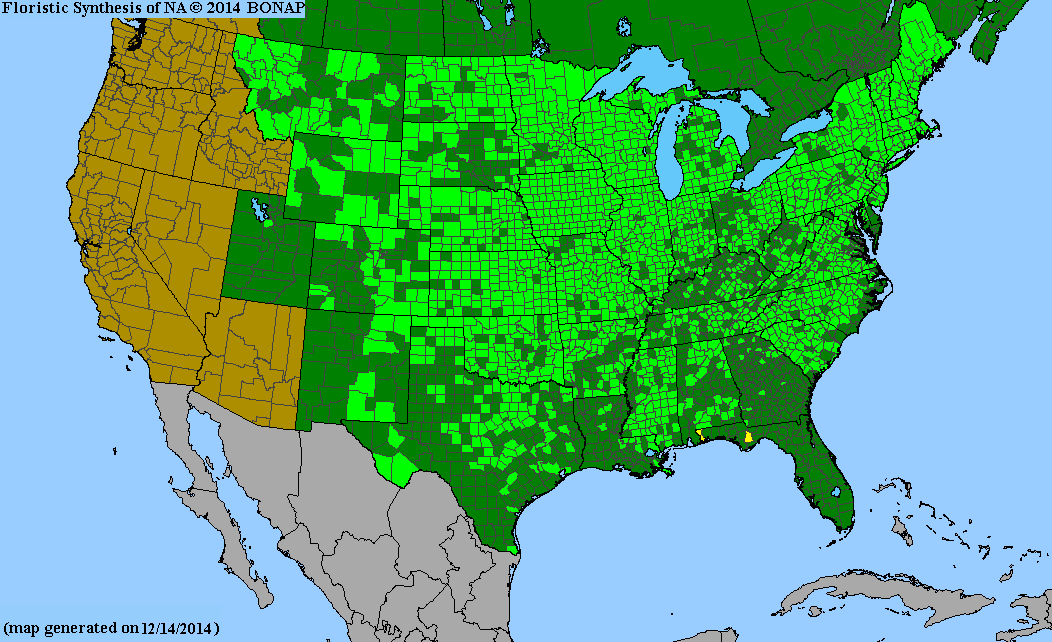
It is a widespread species known from most of non-arctic North America east of the Rocky Mountains. It has been reported from every state and province from Alberta to Nova Scotia to Florida to Texas, and also from the state of Nuevo León in northeastern Mexico.[9][10]

Environmental impact

[edit]

Solidago gigantea is highly invasive throughout Europe and Asia.[11] In its non-native range, it exerts a negative impact on native communities by decreasing species richness and diversity, apparently due to its intense competitive effects,[12] rapid growth,[13] or polyploidization.[14] In the non-native European range, several management options are applied, such as periodical flooding, mowing, mulching, grazing, or herbicide to reduce the negative impact of the species on native biodiversity.[15]

Diseases

[edit]

Parasitized by the Basidiomycete Coleosporium asterum.[16]

Galls

[edit]

This species is host to the following insect induced galls:

References

[edit]
[edit]
Revisions and contributorsEdit on WikipediaRead on Wikipedia
from Grokipedia
Solidago gigantea, commonly known as giant goldenrod or smooth goldenrod, is a tall in the family, characterized by smooth, hairless stems that can reach heights of 0.6 to 2 meters, lanceolate leaves with toothed margins, and dense, arching panicles of small flower heads composed of 6–25 ray florets and disk florets, blooming from to October. This rhizomatous species reproduces both vegetatively through underground stems and by wind-dispersed seeds, often forming extensive colonies in suitable environments. Native to , S. gigantea is widely distributed across much of the continent, from and southward to , , and , occupying a range exceeding 2.5 million square kilometers, though it is less common in the western mountains and absent from parts of the coastal areas. It has been introduced to and , where it can exhibit invasive tendencies in some regions. The is classified as globally secure (G5) by conservation assessments, with stable populations in most of its native range, though it faces localized threats from alteration. Ecologically, S. gigantea thrives in moist to wet soils across a variety of open and semi-open habitats, including floodplains, marshes, swamps, stream banks, meadows, woodland edges, roadsides, and disturbed areas, typically in full sun to partial shade and at elevations from sea level to over 1,500 meters. It plays a key role in wetland and riparian ecosystems as a wetland indicator species (FACW), providing food and habitat for wildlife; birds consume its seeds and foliage, while native bees and other pollinators visit its flowers, and it supports gall-forming insects. The species tolerates moderate disturbance but requires adequate moisture for optimal growth. Distinguishing features include its glabrous (smooth) stems, often with a waxy bloom, which differentiate it from similar goldenrods like S. canadensis that have hairy stems. In cultivation, S. gigantea is valued for its ornamental yellow blooms and ecological benefits in native plant gardens, though it can spread aggressively via rhizomes in favorable conditions.

Taxonomy and nomenclature

Etymology

The genus name Solidago is derived from the Latin words solidus, meaning "whole," and ago, meaning "to make" or "to do," in reference to the historical medicinal use of plants in this genus for healing wounds. The species epithet gigantea originates from the Latin giganteus, signifying "giant," which reflects the plant's impressive height of up to 2 meters. Common names for Solidago gigantea include giant , tall , smooth , and late , with regional variations such as early in parts of .

Synonyms and varieties

The accepted binomial name for this is Solidago gigantea Aiton, first published in 1789 in Hortus Kewensis. This name has undergone taxonomic revisions, with the species placed in the family and the subgenus , specifically within the canadensis complex characterized by triple-nerved leaves. Early descriptions noted its distinction from related taxa, though confusion persisted due to morphological similarities. Key synonyms include Solidago serotina Ait., Solidago serotina var. gigantea (Aiton) Fernald, and Solidago gigantea var. serotina (Kuntze) Cronquist, reflecting historical classifications that sometimes merged it with other goldenrods. Other heterotypic synonyms encompass Doria pitcheri (Nutt.) Lunell and Solidago dumetorum Lunell, now considered invalid or superseded. No infraspecific varieties or subspecies are widely recognized in current taxonomy, as previous designations like var. leiophylla Fernald and var. pitcheri (Nutt.) Shinners have been synonymized under the species level. However, occasional misidentifications occur with the closely related Solidago altissima L., which shares a similar habit but features pubescent stems and rougher leaves.

Description

Morphology

Solidago gigantea is a that grows from short- to long-creeping rhizomes, forming solitary or clustered stems that reach heights of 50–200 cm (0.5–2 m). The stems are erect, typically glabrous or sparsely strigose, often bearing a or waxy coating, and remain smooth without hairs between the nodes. The leaves are cauline, arranged alternately along the stem, and sessile or clasping at the base. They are lanceolate in shape, measuring 5–10 cm in length and 0.7–1.4 cm in width, with sharply serrate or toothed margins and three prominent veins; the mid-stem leaves are the largest, gradually decreasing in size toward the apex, and may be sparsely pilose along the veins abaxially. The is a large, broadly pyramidal paniculiform array, often secund with branches divergent and recurved, comprising 40–600 small capitula up to 40 cm long. Each flower head is 3–5 mm across, featuring 7–15 ray florets with laminae 1–3 mm long and 7–12 bisexual disc florets with corollas 3–3.5 mm long; these structures facilitate through production. The rhizomatous enables vegetative spread, allowing the plant to form dense clumps or extensive colonies. Flowering occurs from late summer to early fall, typically August through October in its native range.

Reproduction

Solidago gigantea primarily reproduces sexually through insect-pollinated flowers that produce numerous small achenes equipped with a pappus for dispersal. The species is self-incompatible, necessitating cross-pollination by such as honeybees (Apis mellifera) and bumblebees (Bombus spp.) for successful seed set; isolated inflorescences fail to produce seeds. Each can generate thousands of achenes, which are lightweight and facilitate long-distance dispersal by , contributing to the species' ability to colonize new areas rapidly. Seed viability is high, with germination rates reaching up to 98% under suitable conditions, and achenes often germinate rapidly without pronounced dormancy when exposed to moisture. typically occurs in moist, disturbed soils, where the seeds require light exposure and adequate water availability to establish seedlings effectively. This strategy supports the plant's invasive potential by enabling quick exploitation of open habitats. In addition to , S. gigantea employs vegetative via extensive, long-creeping rhizomes that form dense clonal colonies. These plagiotropic rhizomes allow the to spread laterally and regenerate new shoots from buds, facilitating rapid expansion even in the absence of seed production. This dual reproductive mode—combining high seed output with clonal growth—enhances the species' resilience and competitive advantage in varied environments.

Distribution and habitat

Native range

Solidago gigantea is native to central and eastern , ranging from the provinces of , , , , , , , and in , southward through the central and eastern to , and extending into northeastern as far as , primarily east of the . This distribution encompasses a broad latitudinal span from approximately 25°N to 60°N, reflecting its adaptability to temperate climates across diverse ecoregions. Within its native range, Solidago gigantea thrives in habitats characterized by seasonal , including moist meadows, wet prairies, riverbanks, wetlands, marshes, and open woodlands, often along floodplains, margins, and low-lying areas. It favors sites with fertile, seasonally wet soils that support its rhizomatous growth and tall stature, avoiding persistently dry or shaded environments. The species prefers neutral to slightly acidic soils ( 6.0–7.5) with loamy or sandy textures that retain moisture while providing good drainage, typically in full sun exposure to maximize its and flowering potential. Its historical presence across this range has been well-documented through extensive specimens and ecological surveys, confirming its longstanding role in pre-colonial North American ecosystems.

Introduced range

Solidago gigantea was first introduced to in the mid-18th century as an , with the earliest record from in 1758. It subsequently escaped cultivation and established wild populations, beginning in the first half of the in and spreading to central and eastern regions by the mid-19th century, including (first spontaneous occurrence in 1832) and (1857). Today, it is naturalized across much of , from northern to and from to southern (latitudes 42°N to 63°N), primarily at elevations below 1200 m, often forming expansive populations in human-disturbed landscapes. In Asia, the species has been introduced to temperate regions, becoming naturalized in , Korea, the , and parts of through ornamental trade and accidental transport via garden debris. Initial introductions likely occurred in the 19th or early , similar to European pathways, with subsequent spread facilitated by long-distance . In these areas, it occupies disturbed sites and has become widespread in some locales, though less dominantly than in . The plant is established to a lesser extent in other continents, including parts of , (notably as a declared pest in ), , , the , and . Pathways here mirror those elsewhere, primarily ornamental planting in botanical gardens and nurseries, with local spread via wind- and bird-dispersed (endozoochory by frugivorous birds). In introduced regions globally, S. gigantea commonly forms dense stands in abandoned fields, roadsides, riverbanks, and other disturbed, moist to mesic habitats, expanding at rates up to approximately 910 km² per year in favorable conditions.

Ecology

Interactions with pollinators and wildlife

Solidago gigantea serves as a vital and source for a diverse array of pollinators, particularly during its late-season blooming period from to . Primary visitors include native bees such as bumblebees and specialist species that rely on goldenrods, as well as honeybees, , moths, wasps, syrphid flies, and beetles, which are drawn to the plant's abundant floral resources in the large, branching panicles of yellow flowers. The plant's seeds, foliage, and stems provide food for various wildlife, enhancing its role in local food webs. Birds such as American goldfinches, rose-breasted grosbeaks, and white-breasted nuthatches consume the seeds, while other species feed on leaves and flower heads. Small mammals browse on the stems and leaves, and the dense foliage offers shelter and cover for insects and rodents during winter. As a late-blooming perennial, S. gigantea is especially important for sustaining pollinator populations into the fall, when many other plants have ceased flowering, providing essential energy for overwintering bees and migrating butterflies like monarchs. Solidago gigantea hosts symbiotic relationships with beneficial insects, acting as a reservoir for predators and parasitoids that support conservation biological control, including parasitoid wasps that target herbivore larvae within plant galls.

Invasiveness and environmental impact

Solidago gigantea is classified as an in parts of and temperate , where it forms dense monocultures that outcompete native vegetation through resource dominance and allelopathic effects from root exudates and leaf litter, inhibiting the growth of surrounding plants. In invaded grasslands, this species significantly reduces native plant species diversity, with studies reporting declines of up to 50% in species richness due to its competitive exclusion and alteration of habitat structure. Additionally, invasion alters soil chemistry, with variable effects on pH depending on habitat, decreasing organic carbon and moisture content in many invaded sites, while shifting microbial communities toward those favoring decomposers and reducing overall enzymatic activity like urease. Management strategies in affected regions include mechanical methods such as repeated mowing to prevent production and flooding to drown , which can reduce cover by over 70% when applied consistently. Chemical controls, particularly foliar applications of in late summer, effectively suppress growth and reserves, though repeated treatments are often necessary. Biological control options remain limited, with experimental approaches like introducing hemiparasitic plants showing promise in suppressing but not yet widely implemented. In its native North American range, S. gigantea exerts no significant invasive impacts, as co-evolved herbivores and pathogens maintain population balance and prevent dominance.

Cultivation and uses

Horticultural cultivation

Solidago gigantea, commonly known as giant , is hardy in USDA zones 3 through 8 and thrives in full sun to , making it suitable for a variety of temperate settings. It prefers moist to wet, well-drained soils with a range of 5.5 to 7.5, adapting well to y, clay-loam, or silty loam textures while tolerating temporary flooding. These conditions mimic its native and habitats, ensuring robust growth and vibrant late-season blooms. Propagation of S. gigantea can be achieved through seeds or division. Seeds require cold stratification for 30 to 60 days at around 4°C (39°F) to break and promote under optimal light and temperature conditions (20-25°C or 68-77°F). Division is performed in early spring by separating the fibrous, rhizomatous root clumps and replanting them immediately at the same depth, allowing for quick establishment of new colonies. This method is preferred for maintaining genetic fidelity in ornamental ings. In , S. gigantea is valued for its tall stature (up to 2 meters or 6 feet) and showy, plume-like yellow inflorescences that provide late summer to fall interest, attracting pollinators while adding vertical structure to landscapes. It is commonly used in native gardens, rain gardens, and along streambanks for , where its deep stabilize in damp areas. However, its aggressive rhizomatous spread can lead to dense colonies, necessitating strategies such as barriers or regular division to prevent it from overtaking neighboring .

Medicinal and other uses

Solidago gigantea, commonly known as giant goldenrod, has been utilized in , with many uses documented for the genus and varying evidence for this species specifically. Native American communities, such as the Forest , have used teas from its leaves and flowers as a febrifuge for fevers and as a ; the plant is also noted for and styptic properties to staunch and treat hemorrhages, as well as acting as a purgative or . In modern herbal applications, extracts of S. gigantea demonstrate properties, with in its leaves and inflorescences exhibiting significant free radical scavenging activity, potentially aiding in oxidative stress-related conditions. Bioactive clerodane diterpenes isolated from the roots show inhibitory activity against α- and β-glucosidases and α-amylase, suggesting potential anti-hyperglycemic effects. Goldenrod species, including S. gigantea, have been studied for properties that may support , though specific evidence for this species is limited. Beyond medicinal purposes, S. gigantea holds cultural significance as the state flower of , adopted in 1926, and , designated in 1895, symbolizing resilience and the pioneering spirit due to its ability to thrive in challenging conditions. It serves as occasional forage for , particularly , though it is generally of low palatability and nutritional value for and other grazers. In folklore, , including S. gigantea, is regarded as a symbol of strength, prosperity, and good fortune, often associated with revealing hidden treasures or springs.

Pests and diseases

Insect pests and galls

Solidago gigantea is susceptible to several insect pests, primarily sap-feeding and gall-inducing species that can reduce plant vigor without typically causing mortality. Aphids in the genus Uroleucon, such as Uroleucon ambrosiae and Uroleucon gravicornis, colonize stems and leaves, extracting phloem sap and potentially transmitting plant viruses, though their impact is moderated by natural predators like lady beetles. Leafhoppers, including Homalodisca coagulata and Oncometopia nigricans, also feed on leaf sap, causing stippling and minor distortion, with nymphs occasionally targeted by parasitic wasps. The most characteristic damage comes from gall-forming insects, particularly the tephritid fly Eurosta solidaginis, which lays eggs in developing stems, prompting the plant to form spherical up to several centimeters in diameter around the feeding larvae. The fly's saliva mimics plant growth hormones, directing resources to the gall for larval protection against predators like birds and woodpeckers. Distinct host races of E. solidaginis have evolved on S. gigantea versus related species like , producing morphologically different galls adapted to stem architecture. Another prominent gall inducer is the cecidomyiid Rhopalomyia capitata, whose larvae stimulate rosette-like or bunch on flower heads and apical buds, deforming them into globular clusters of leaflets that house the developing . These similarly shelter larvae from environmental stresses and parasitoids. Occasional foliar damage occurs from chewing caterpillars, such as those of moths in the genus Sparganothis, which skeletonize leaves but seldom defoliate entire plants due to the species' chemical defenses. Overall, these pests weaken stems and reduce reproductive output— alone can decrease ramet propagule production by up to 45%—yet S. gigantea rarely succumbs, as integrate into native food webs, supporting higher trophic levels like parasitoids and birds. In introduced ranges, lower pest may contribute to the plant's invasiveness by alleviating herbivory.

Fungal diseases

Solidago gigantea is susceptible to several fungal diseases, with rust being one of the primary concerns in its native North American range. The rust fungus Puccinia dioicae produces yellow-orange pustules on the undersides of leaves and stems, which can reduce photosynthesis by impairing leaf function and leading to premature defoliation. Other notable fungal pathogens include powdery mildew caused by Erysiphe cichoracearum in North America, manifesting as white, powdery patches on upper leaf surfaces that cause yellowing, curling, and eventual leaf drop. In introduced ranges such as Korea, Golovinomyces asterum var. solidaginis has been reported, producing circular to irregular white patches with hyphal growth on both leaf sides, confirmed through morphological and molecular analyses. Leaf spot diseases, often attributed to Septoria or similar fungi like Cercospora and Colletotrichum, appear as small, dark spots on lower leaves, potentially causing yellowing and withering if numerous. Occasional root rots occur in poorly drained, overly wet soils, though specific pathogens such as Phytophthora are not uniquely associated with this species. These diseases typically overwinter as spores or on plant , with infection cycles initiated by spore dispersal in humid, warm conditions during the growing season, favoring spread through wind or splash. in cultivated settings involves cultural practices such as proper plant spacing to improve , avoiding overhead watering to keep foliage dry, and removing infected to reduce inoculum; fungicides are rarely necessary for wild or naturalized populations of S. gigantea, as infections are often not severe enough to warrant intervention.

References

Add your contribution
Related Hubs
User Avatar
No comments yet.