


Community hub
Recent from talks
Contribute something
Nothing was collected or created yet.
Giant cuttlefish
View on Wikipedia
| Giant cuttlefish | |
|---|---|

| |
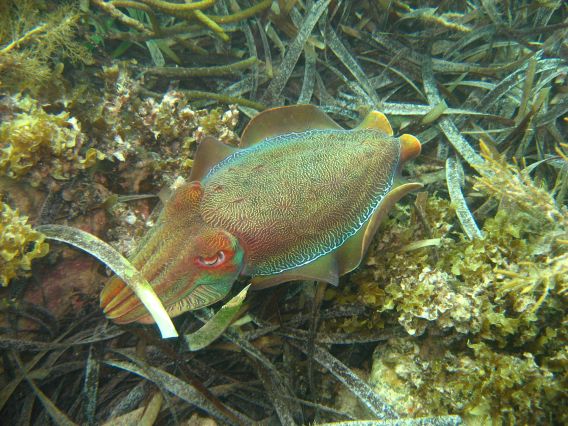
| Giant cuttlefish from Whyalla, South Australia | |
Scientific classification 
| |
| Kingdom: | Animalia |
| Phylum: | Mollusca |
| Class: | Cephalopoda |
| Order: | Sepiida |
| Family: | Sepiidae |
| Genus: | Ascarosepion |
| Species: | A. apama
|
| Binomial name | |
| Ascarosepion apama | |

| |
| Distribution of Ascarosepion apama | |
| Synonyms | |
| |

The giant cuttlefish (Ascarosepion apama), also known as the Australian giant cuttlefish, is the world's largest cuttlefish species, growing to 50 cm (20 in) in mantle length and up to 100 cm (39 in) in total length (that is, including outstretched tentacles). They can weigh over 10.5 kg (23 lb). Like all cuttlefish species, the giant cuttlefish has eight arms and two feeding tentacles, as well as blue blood and three hearts. Using cells known as chromatophores, the cuttlefish can put on spectacular displays, changing colour in an instant. The giant cuttlefish is native to temperate and subtropical waters of Australia, from Brisbane in Queensland to Shark Bay in Western Australia and Tasmania to the south. It occurs on rocky reefs, seagrass beds, and sand and mud seafloor to a depth of 100 m (330 ft). The genetically distinct population in the Upper Spencer Gulf is the most studied population, and has become a tourist attraction.
Physiology and biochemistry
[edit]
Ascarosepion apama, commonly known as giant cuttlefish or Australian giant cuttlefish,[4] is the largest species of cuttlefish in the world, reaching 50 cm (20 in) in mantle length and up to 100 cm (39 in) in total length (total length meaning the whole length of the body including outstretched tentacles). Giant cuttlefish can weigh over 10.5 kg (23 lb).[5][6] They have eight arms and two feeding tentacles, as well as blue blood and three hearts, as do all species of cuttlefish.[7]
Genetic studies have shown that little, if any, interbreeding occurs between giant cuttlefish populations. While some genetic divergence is seen, the various populations are not considered taxonomically distinct and are commonly referred to by their location, e.g. Sepia apama upper Spencer Gulf population.[8] The upper Spencer Gulf population is unique in that a permanent salinity gradient in the Spencer Gulf may physiologically exclude other populations from the zone occupied by the upper Spencer Gulf population.[8] This population may in fact be a separate species, as it does show some hallmarks, such as genetic separation, differences in morphology, and different patterns of sexual dimorphism from adjacent populations.[9][10]

Giant cuttlefish are a neritic demersal species. They are carnivorous, opportunistic, and voracious predators that feed predominantly on crustaceans and fish.[9] Using neurally controlled cells known as chromatophore organs (red to yellow), iridophores (iridescent: spans the entire visible spectrum from blue to near-IR) and leucophores (white), the cuttlefish can put on spectacular displays, changing colour and patterns in a fraction of a second. Located in three layers under the skin, leucophores make up the bottom layer, with chromatophores the outermost. By selective blocking, the three layers work together to produce polarised patterns. Unlike those in most animals, cuttlefish iridophores are physiologically active; they can change their reflectivity, and the degree of polarisation can also be controlled. Cuttlefish are colourblind; however, the photoreceptors of cuttlefish eyes are arranged in a way that gives them the ability to see the linear polarisation of light. While the mantis shrimp is the only known creature to have true polarisation vision, cephalopods may also.[11] Because the optic lobes of cuttlefish are larger than any other region of the brain and their skin produces polarised reflective patterns, they may communicate through this visual system.[12] By raising elaborate papillae on their skin, S. apama squid can change the shape and the texture of their skin to imitate rock, sand, or seaweed.[13] A bioenergetics study found that the giant cuttlefish is primarily diurnal and has a small home range (90–550 m or 300–1,800 ft) over short recording periods while travelling large distances to breed. They are able to channel most of their energy directly into growth because they spend 95% of the day resting, suggesting bioenergetics more like that of an octopus than a squid. Very little time is spent foraging (3.7% during the day and 2.1% at night); most of their time is spent resting and hiding in crevices from predators. The exception to this behavioral routine is the mass spawning aggregation, where cuttlefish are far more active during the days or weeks that they spend there.[14][15]
Habitat
[edit]The giant cuttlefish is native to temperate and subtropical waters of Australia, from Brisbane in Queensland to Shark Bay in Western Australia and Tasmania to the south. It occurs on rocky reefs, seagrass beds, and sand and mud seafloor to a depth of 100 m (330 ft).[16]
Lifecycle and reproduction
[edit]Giant cuttlefish live for one to two years. Breeding takes place with the onset of the southern winter. Males abandon their normal cryptic colouring and set out to dazzle the females by adopting rapidly changing bright colours and striking patterns. Females are polyandrous, and collaborative research indicates the tendency for females to reproduce using male genetic material deposited in spermatangia more favorably than in sperm receptacles directly. Females then attach their eggs to the undersides of rocks in caves or crevices, where they hatch within three to five months. A. apama is semelparous, and death follows shortly after a single mating cycle and laying of eggs that will spawn the next generation.[8] A. apama has poor anaerobic capability compared to most aquatic invertebrates and a lack of food leads to catabolism. Stomach-content analysis indicates fasting during the breeding season, and as A. apama can catabolise no more than 50% of its body weight, it slowly loses physical condition as the season progresses and eventually dies. Throughout their range, these cephalopods breed in pairs or small groups, laying eggs in suitable caves or rock crevices. Loose spawning aggregations can form, but rarely exceed 10 animals in any one location,[9] with one known exception; hundreds of thousands aggregate along rocky reefs between Whyalla and Point Lowly in the Upper Spencer Gulf.[17] While surveys suggest that juveniles leave these spawning grounds after hatching, nothing is known of their subsequent movement or lifestyle strategies as a juvenile. Adults return to the aggregation site the following winter, or may delay their return by an additional year.[18]
Predators
[edit]The Australian giant cuttlefish is eaten by Indo-Pacific bottlenose dolphins, which have been observed (in South Australia's Spencer Gulf) to have developed a technique for removing the ink and cuttlebone from a cuttlefish before eating it.[19] They are also eaten by Long-nosed fur seals. Yellowtail kingfish are also known to eat cephalopods.[20] This has raised concerns about Yellowtail kingfish escapees from commercial fish farms impacting other species in Spencer Gulf[21] including eating emergent Giant Australian cuttlefish or their eggs.[22]
Conservation status
[edit]In 2009 the species was listed as Near Threatened on the IUCN Red List of Threatened Species due to an observed declining trend at that time.[23]
Upper Spencer Gulf population
[edit]

Unpublished scientific data indicated that several genetically distinct populations of giant cuttlefish are living in Australian waters. Discovered by divers in the late 1990s, the upper Spencer Gulf population is the best studied, largely because it is the world's only known mass cuttlefish-spawning aggregation. It has also become a popular ecotourism attraction for divers and snorkelers.
Hundreds of thousands of giant cuttlefish gather on subtidal reefs around Point Lowly near Whyalla between May and August. While outside of the breeding season, the sex ratio is one to one, Spencer Gulf males outnumber females by up to 11 to one in the spawning aggregation. If this is due to fewer females taking part or to males breeding for a longer period of time than females is not known. With densities of one cuttlefish per square metre (0.093 cuttlefish per square foot), covering about 61 hectares (150 acres), the sheer numbers of giant cuttlefish make this breeding aggregation unique in the world. As the cuttlefish are oblivious to divers while spawning, they are now a major regional tourist attraction for divers from around the world.[9] Professor Roger Hanlon of the Woods Hole Oceanographic Institution has called the breeding aggregation "the premier marine attraction on the planet."[10]
The upper Spencer Gulf population displays two alternative lifecycles in both sexes (growth pattern polymorphism). The first involves rapid growth with maturity reached in seven to eight months with small adults returning to spawn in the first year. The second involves slow growth with maturity reached in two years, with large adults returning to spawn in the second year.[8] The upper Spencer Gulf population displays reproductive behaviours unique to this population, possibly as a result of the high spawning densities. Large males defend females and egg-laying sites, while small males, "sneakers"[24] mimic female colouring and form to gain access to the females being protected by the dominant males, which are extremely territorial. Male genetic material is deposited in sperm receptacles directly. The females, which potentially lay hundreds of eggs, extract one egg at a time and fertilise it by passing it over the sperm receptacle before attaching it to the underside of a rock at depths of 2 to 5 m (6 ft 7 in to 16 ft 5 in).[9]
Conservation
[edit]An unsuccessful application to list this population of giant cuttlefish as a threatened species under Australian law was made during the government's consideration of BHP Billiton's Olympic Dam mine expansion project. The application was made following an observed and unexplained population decline and public concerns about future risks posed by industrial pollution. On 2 February 2011, the Australian government's Threatened Species Scientific Committee ruled that the species was not eligible for listing, as the affected population was not taxonomically distinct from the rest of the species for the purposes of the act.[25] Further scientific work has determined the cuttlefish of northern Spencer Gulf to be genetically distinct from other giant cuttlefish populations in Australian waters, although the results remain unpublished.
The Upper Spencer Gulf Marine Park covers a large area, within which lies several sanctuary zones, including the Cuttlefish Coast Sanctuary Zone,[26] which was inscribed on the National Heritage List on 24 February 2023.[27]
Commercial fishing
[edit]Prior to the mid-1990s, the upper Spencer Gulf population was fished for snapper bait, with annual catches of around 4 tonnes (4,000 cuttlefish). During the 1995 and 1996 spawning seasons, commercial fishing of the spawning grounds harvested around 200 tonnes annually. Overexploitation was recognised after 245 tonnes were harvested in 1997, leading to 50% of the grounds being closed to commercial fishing in 1998. Despite half of the grounds being closed, commercial fishers took 109 tonnes in 1998 (about half of the estimated biomass) before dropping to 3.7 tonnes in 1999. The catch data for 2000 to 2005 were initially withheld citing commercial confidentiality.[28]
Catch data for the South Australian cuttlefish fishery are reported in annual reports of the Marine Scalefish Fishery, published by SARDI. The pre-2014 data are graphed below. From its establishment in 1987 to the financial year ending June 1992, the fishery caught less than 3 tonnes per annum.[29]
| Financial Year | Tonnes caught |
|---|---|
| 1992–93 | |
| 1993–94 | |
| 1994–95 | |
| 1995–96 | |
| 1996–97 | |
| 1997–98 | |
| 1998–99 | |
| 1999–00 | |
| 2000–01 | |
| 2001–02 | |
| 2002–03 | |
| 2003–04 | |
| 2004–05 | |
| 2005–06 | |
| 2006–07 | |
| 2007–08 | |
| 2008–09 | |
| 2009–10 | |
| 2010–11 | |
| 2011–12 | |
| 2012–13 | |
| 2013–14 |
Population decline
[edit]Surveys indicated that the cuttlefish biomass remained stable from 1998 to 2001 as commercial fishing pressure was reduced by regulation. A survey in 2005 revealed a 34% decrease in biomass since 2001 that was attributed to natural variability and illegal fishing during the peak spawning period.[28] The closure was subsequently expanded to the entire spawning grounds, and anecdotal observations suggested increased numbers in 2006 and 2007; however, a new survey in 2008 found the biomass had decreased a further 17%.[8][9]
In 2011, an estimated 33% of the 2010 population had returned to breed, fewer than 80,000 cuttlefish. Beginning in May, the cuttlefish leave deep water and migrate along coastal reefs to reach their spawning grounds. Local fishermen claimed that a small "finger of land" near Point Lowly extends outside the exclusion zone and that commercial fishers have been targeting the area, intercepting the squid before they can reach the spawning grounds. Being semelparous breeders, ecologist Bronwyn Gillanders believed the cuttlefish were in danger, stating that determining whether this is a natural phenomenon or something else is difficult, and that the cause requires more research.[30]
In 2012, the number of cuttlefish that returned to the spawning ground again dropped again. A cross-government Cuttlefish Working Group was established and recommended investigating broader ecological factors.[citation needed] Tour guide Tony Bramley, who had been taking divers to view the spawning grounds since they were discovered, stated, "It's heartbreaking, when you look at what's left ... [once] there were so many animals you couldn't land on the bottom, you had to push them aside."[31]
The Conservation Council of South Australia, which believes the population to be a separate species based on unpublished scientific data, warned that the Spencer Gulf cuttlefish faced possible extinction within two or three years if nothing was done to better protect them. The state government working group recommended an immediate ban on fishing for the cuttlefish; however, this was rejected by the state cabinet on 3 September with Fisheries Minister Gail Gago stating, "There is no strong evidence to suggest that fishing is impacting on the giant cuttlefish, therefore, further closures would be ineffective."[10]
On 28 March 2013, the state government introduced a temporary ban on fishing for cuttlefish in the northern Spencer Gulf for the 2013 breeding season. Fisheries Minister Gago announced that research into the reasons behind the 90% decline in the cuttlefish population had ruled out commercial fishing as a cause, but was otherwise inconclusive, and that further areas of Spencer Gulf would be closed in 2014.[32][33] The population continued its decline, reaching the lowest numbers on record in 2013.
In 2014, the cuttlefish population showed first signs of potential recovery, after 15 years of an overall trend of decline.[citation needed] Numbers increased again in 2015[34] confirming this trend. As of 2021, the population has recovered to an estimated population exceeding 240,000 animals.[35]
The fishing ban for the whole of northern Spencer Gulf was extended until 2020, prohibiting their capture in all Spencer Gulf waters north of Wallaroo and Arno Bay.[36] In 2020 the closed area rolled back to the same limited spatial closure that was in place in 2012, encompassing the waters of False Bay, from Whyalla to Point Lowly and extending northwards towards the Point Lowly North marina.
Population estimates
[edit]| Year | Population estimate |
|---|---|
| 1999 | |
| 2000 | |
| 2001 | |
| 2002 | |
| 2003 | |
| 2004 | |
| 2005 | |
| 2006 | |
| 2007 | |
| 2008 | |
| 2009 | |
| 2010 | |
| 2011 | |
| 2012 | |
| 2013 | |
| 2014 | |
| 2015 | |
| 2016 | |
| 2017 |
- Figure '0' is used to represent years in which surveys did not occur, and no estimation was made.
- 1999–2017 data sourced from SARDI
- Approximate 2016 population estimate was published in the Whyalla News[37] and approximate 2017 numbers were first published by PIRSA.[38] A slightly larger estimate for the 2017 season was published in 2018 by the ABC (reflected in the graph).[39]
Effect of local industrialisation
[edit]The mass aggregation sites of Upper Spencer Gulf are proximate to a number of industrial pollution sources, and prospective sites for further development. As of 2021, operations that publicly report their pollution discharges to the sea in a controlled and measured manner include the Whyalla Steelworks, the Port Pirie lead smelter owned and operated by Nyrstar. The pollutants of primary concern to cuttlefish recruitment are changes of salinity (due to discharges from desalination plants) and nutrient enrichment, discharged by the steelworks, lead smelter, municipal wastewater treatment plants and farming of yellowtail kingfish.
Nutrient enrichment
[edit]Northern Spencer Gulf is an oligotrophic inverse estuary with naturally low levels of nutrients cycling through it. A potential exists for anthropogenic nutrient pollution to cause eutrophication in the region with associated ecological impacts to the cuttlefish and wider ecology. A long-term industrial nutrient pollution source exists to the west of the cuttlefish breeding reef at the Whyalla Steelworks. There, ammonia, a byproduct of its coking process for steel-making, and is discharged into Spencer Gulf via reed-beds and settling ponds. North of the cuttlefish aggregation, sea cage farming of yellowtail kingfish occurred commercially from the late 1990s until 2011. Fish farming is another nutrient pollution source, as uneaten feed and fish waste enter the water column and sediment. Concerns have been raised about an observed correlation between fish farming intensification, fish mortalities and the decline and eventual recovery of the giant Australian cuttlefish after fish farming ceased in upper Spencer Gulf.
Hydrocarbon pollution
[edit]In 1984, before the spawning grounds were discovered, Santos built a hydrocarbon processing plant at adjoining Port Bonython. Some concern exists over the possible impact of the plant on the cuttlefish population and two major contamination events have happened at the associated port and refinery.[40][41] Santos denies that groundwater contamination detected in the late 2000s spread off-site, but the SA EPA said hydrocarbons had migrated through the rock strata beyond the plant and the barrier trench built by Santos. Santos now provides funding for cuttlefish research.[42] The other incident was the 1992 Port Bonython oil spill, whereby 300 tonnes of bunker C crude oil spilled into the sea after a tugboat pierced its hull during berthing. The effects of these events on the local population of A. apama are unknown.
Seawater desalination
[edit]The dispersal of brine from seawater desalination plant effluent streams has concerned scientists and the Whyalla community. During the mid-to-late 2000s, mining and energy company BHP Billiton developed plans to build a seawater desalination plant at Point Lowly to supply fresh water to the Olympic Dam mine. The plant, located within 200 m (660 ft) of the breeding grounds, would release around 120 ML (32,000,000 US gal) of brine (46–60 ppt) into the area each day. As cuttlefish embryos underdevelop and die off as salinity levels rise (optimal range 28–38 ppt, 100% mortality at 50 ppt), public opposition to the proposed plant was considerable because of the possible environmental impacts.[42][43][25] The plan was approved in 2011, but was not constructed and was later officially abandoned. Since that time, two new, smaller scale seawater desalination plants have been commissioned and discharge brine into the gulf: one at the Whyalla Steelworks and another at Sundrop Farms, south of Port Augusta.
In 2022, BHP sought to increase its water supply via the Northern Water Supply Project, led by SA Water, which intends to build a similar-sized desalination plant to that originally proposed by the company. Prospective sites are all located within the upper Spencer Gulf, renewing the threat posed to the aggregation. An environmental impact statement is anticipated mid-2024.[44]
Port proposals
[edit]Due to its proximity to the ore deposits of the Middleback Ranges, several mining companies have indicated they might use a bulk commodities port, should it be developed at Port Bonython, adjacent to Point Lowly. A new wharf for the loading of iron ore, and possibly copper concentrates, has been proposed but not constructed. A community action group called the Cuttlefish Coast Coalition and Alternative Port Working Party were formed in opposition to new desalination and port developments near the cuttlefish breeding habitat.[42] In 2021, a new port development was approved for the site of the former Playford power stations,[45] which were decommissioned and demolished in the mid 2010s. Increasing shipping traffic in the upper Spencer Gulf has the potential to impact cuttlefish behavior due to cephalopod sensitivity to high intensity, low frequency sound.[46]
In popular culture
[edit]The upper Spencer Gulf cuttlefish aggregation is celebrated each year by Cuttlefest, an event hosted by the City of Whyalla.[47]
In May 2009, D'Faces of Youth Arts and Snuff Puppets produced a live theatre performance for Come Out Festival. It featured several large cuttlefish puppets and appeared in Adelaide's Victoria Square, at the Adelaide Airport and at a Whyalla performance. Some controversy surrounded the performances after a participant in the project was openly critical of the plan to build a desalination plant at Point Lowly.[48] The major sponsor of Come Out Festival in 2009 was the BHP Billiton Youth Fund, the same company which proposed to construct the desalination plant. The overarching theme of the festival that year was 'Colliding Worlds'.[49] BHP Billiton has not sponsored the Come Out Festival since the 2009 event.

During the Adelaide Fringe Festival in March 2012, the Royal Institution of Australia presented Sepia, an original work by Welsh playwright, Emily Steel.[50] Set in Whyalla, the play told the story of the fictitious character Neil, the proprietor of a caravan park who was struggling to come to terms with the cuttlefish decline whilst trying to keep his family together. The play also featured at the Melbourne Fringe Festival.[51] Presenting partner the Royal Institution of Australia is sponsored by the oil and gas company Santos. Santos was responsible for hydrocarbon groundwater contamination at Port Bonython, adjacent to the cuttlefish breeding grounds, first discovered in 2008.
In 2014, the Adelaide Fringe Festival launched Stobie the Disco Cuttlefish, a 13-metre-long (43 ft) electrified cuttlefish puppet, equipped with strobing, coloured lighting and a sound system. Stobie the Disco Cuttlefish first appeared during the Adelaide Fringe Opening Parade, then performed with a troupe of dancers each Saturday night during the festival.[52] The soundtrack to the performance included samples from the Bee Gees hit "Stayin' Alive"[53] and the entire theme song from the movie Fame.
In 2016, underwater photographer Scott Portelli's image Cuttlefish aggregation won the national first prize (Australia) in the 2015 Sony World Photography Awards—the world's biggest photography competition.[34]
The mass aggregation of giant cuttlefish at Point Lowly inspired the development of a retro computer game called Cuttle Scuttle.[54][55]
See also
[edit]References
[edit]- ^ Barratt, I.; Allcock, L. (2012). "Sepia apama". IUCN Red List of Threatened Species. 2012 e.T162627A931625. doi:10.2305/IUCN.UK.2012-1.RLTS.T162627A931625.en. Retrieved 19 November 2021.
- ^ Auffenberg, Kurt (2024). " Ascarosepion apama (J. E. Gray, 1849)". World Register of Marine Species. Flanders Marine Institute. Retrieved 12 March 2025.
- ^ Rochebrune, A T (1884). Etude monographique de la famille des Sepiadae (8 (7) ed.). Paris: Bulletin de la Société philomathique de Paris. pp. 92–93. Retrieved 5 May 2025.
- ^ "Giant Cuttlefish - Sepia apama". Australian Museum. Retrieved 27 August 2014.
- ^ Reid, A., P. Jereb, & C.F.E. Roper 2005. Family Sepiidae. In: P. Jereb & C.F.E. Roper, eds. Cephalopods of the world. An annotated and illustrated catalogue of species known to date. Volume 1. Chambered nautiluses and sepioids (Nautilidae, Sepiidae, Sepiolidae, Sepiadariidae, Idiosepiidae and Spirulidae). FAO Species Catalogue for Fishery Purposes. No. 4, Vol. 1. Rome, FAO. pp. 57–152.
- ^ Poulsen, Adam (10 May 2017). "WA fisherman bags whopper cuttlefish". WAtoday. Retrieved 10 May 2017.
- ^ "Giant Cuttlefish".
- ^ a b c d e Amendment to the list of Threatened Population under the Environment Protection and Biodiversity Conservation Act 1999 (EPBC Act). Threatened Species Scientific Committee.
- ^ a b c d e f "Appendix 5: Australian Giant Cuttlefish" (PDF). Olympic Dam Expansion Draft Environmental Impact Statement. BHP. 2009. pp. 70–82. Archived from the original (PDF) on 29 March 2022. Retrieved 3 October 2025.
[includes] Estimated abundance and biomass of giant Australian cuttlefish Sepia apama at the spawning aggregation area in northern Spencer Gulf, South Australia, [by] Karina C. Hall, August 2008
- ^ a b c Clare Peddie, Heather Kennett The cuttle scuttle The Advertiser 29 September 2012 Pg 67
- ^ Mäthger, Lydia M.; Shashar, Nadav; Hanlon, Roger T. (21 April 2009). "Do cephalopods communicate using polarized light reflections from their skin?" (PDF). Journal of Experimental Biology. 212 (14). The Company of Biologists: 2133–2140. Bibcode:2009JExpB.212.2133M. doi:10.1242/jeb.020800. PMID 19561202. S2CID 10216731. Archived from the original (PDF) on 28 May 2010. Retrieved 4 November 2011.
Silvery fish reflect polarised light; they reflect the same amount of light in the same direction as the light they are viewed against, making them almost invisible in water. If the polarisation is reduced, the fish become easily visible. Cuttlefish ignore fish with reduced polarisation and preferentially attack fish emitting polarised light.
- ^ Mäthger; et al. (21 April 2009). "Do cephalopods communicate using polarized light reflections from their skin?" (PDF). Journal of Experimental Biology 212, 2133-2140. Archived from the original (PDF) on 28 May 2010. Retrieved 4 November 2011.
- ^ Alison King The Colourful World of Cephalopods - Cephalopod body patterning II. The Cephalopod Page.
- ^ Hanlon, R.T. 2008. Australian Giant Cuttlefish - Physiology and Biochemistry Archived 24 June 2008 at the Wayback Machine. Encyclopedia of Life.
- ^ Aitken, J.P.; O'Dor, R.K.; Jackson, G.D. (2005). "The secret life of the giant Australian cuttlefish Sepia apama (Cephalopoda): Behaviour and energetics in nature revealed through radio acoustic positioning and telemetry (RAPT)". Journal of Experimental Marine Biology and Ecology. 320 (1): 77–91. Bibcode:2005JEMBE.320...77A. doi:10.1016/j.jembe.2004.12.040.
- ^ Norman, M.D. 2000. Cephalopods: A World Guide. ConchBooks.
- ^ "Students' 'CuttleCam' streams congregation of giant cuttlefish". ABC News. 12 July 2021. Retrieved 12 July 2021.
- ^ Steer, M.A. (1 March 2015). "Surveying, Searching and Promoting Giant Australian Cuttlefish Spawning Activity in Northern Spencer Gulf" (PDF). Final Report to the Fisheries Research & Development Corporation, South Australia. Retrieved 12 July 2021.
- ^ Catch cuttlefish, drain off the ink, then fillet. Serves five (dolphins): Scientists stunned by mammals' elaborate culinary preparations
- ^ de Jong, M; Tanner, Jason (2004). Environmental risk assessment of marine finfish aquaculture in South Australia (PDF). South Australia: SARDI. p. 70.
- ^ Gillanders, Bronwyn M.; Joyce, Tanya C. (2005). "Distinguishing aquaculture and wild yellowtail kingfish via natural elemental signatures in otoliths". Marine and Freshwater Research. 56 (5): 693. Bibcode:2005MFRes..56..693G. doi:10.1071/MF04133. ISSN 1323-1650.
- ^ Mayfield, Louis (18 March 2020). "Cuttlefish concerns over Clean Seas". Whyalla News. Retrieved 29 May 2021.
- ^ Barratt (SRLI), Iain; Allcock (SRLI), Louise (11 March 2009). "IUCN Red List of Threatened Species: Sepia apama". IUCN Red List of Threatened Species. Retrieved 29 May 2021.
- ^ Life. Extraordinary Animals, Extreme Behaviour by BBC Books, Martha Holmes & Michael Gunton, 2009 ISBN 978-1-84607-642-8, pg 28.
- ^ a b Conservation Assessment. Advice to the Minister for Sustainability, Environment, Water, Population and Communities from the Threatened Species Scientific Committee (the Committee) on Amendment to the list of Threatened Population under the Environment Protection and Biodiversity Conservation Act 1999 (EPBC Act) 2 February 2011.
- ^ "Upper Spencer Gulf". National Parks and Wildlife Service South Australia. Archived from the original on 7 July 2025. Retrieved 4 October 2025.
- ^ "Cuttlefish Coast Sanctuary Zone". DCCEEW. 5 September 2024. Archived from the original on 5 May 2025. Retrieved 4 October 2025.
- ^ a b MA Steer and KC Hall Estimated Abundance and Biomass of the Unique Spawning Aggregation of the Giant Australian Cuttlefish (Sepia apama) in Northern Spencer Gulf, South Australia.[permanent dead link] Primary Industries and Regions SA October 2005
- ^ Fowler, A. J.; McGarvey, R.; Steer, M. A.; Feenstra, J. E. (2014). The South Australian Marine Scalefish Fishery Status Report - Analysis of Fishery Statistics for 2013/14 (PDF). Adelaide, South Australia: South Australian Research and Development Institute. p. 42.
- ^ Mystery of the Missing Cuttlefish. The Advertiser, 24 July 2011. p. 7.
- ^ Drastic loss in giant colony. The Advertiser, 25 September 2012. p. 24.
- ^ "Cuttlefish update" (PDF). Primary Industries and Regions SA. Archived from the original (PDF) on 4 April 2022. Retrieved 25 June 2013.
- ^ "Giant cuttlefish decline prompts catch ban parts of South Australia's Spencer Gulf". The Advertiser. 27 March 2013. Retrieved 25 June 2013.
- ^ a b Broadstock, Amelia (15 March 2016). "Wildlife photographer captures amazing photo of breeding SA giant cuttlefish". The Advertiser. Retrieved 16 March 2016.
- ^ Department of Primary Industries and Regions, South Australia (6 August 2020). "Giant Australian Cuttlefish". www.pir.sa.gov.au. Retrieved 27 May 2021.
- ^ "Fishing closures". pir.sa.gov.au. Department of Primary Industries and Regions, South Australia. Retrieved 16 March 2016.
- ^ Mayfield, Louis (17 August 2016). "Cuttlefish opportunity". Whyalla News. Retrieved 29 April 2018.
- ^ "Giant Cuttlefish survey". www.pir.sa.gov.au. Department of Primary Industries and Regions, South Australia. 7 November 2017. Archived from the original on 29 April 2018. Retrieved 29 April 2018.
- ^ "Giant Australian cuttlefish put on vibrant breeding display as numbers soar". ABC News. 11 July 2018. Retrieved 13 September 2018.
- ^ "Major Oil Spills - Era". Archived from the original on 28 March 2012. Retrieved 7 October 2012.
- ^ "EPA fears bigger Santos oil spill - ABC News". Australian Broadcasting Corporation. 22 March 2010.
- ^ a b c Cuttlefish chaos at Whyalla. Archived from Dive Pacific Issue No. 116, Feb/Mar 2010.
- ^ Desalination and South Australia's Gulfs ecosystems Archived 7 September 2011 at the Wayback Machine. Fishers For Conservation Inc.
- ^ "Premier keen to get cracking on SA desalination plant". Yahoo News. Retrieved 30 March 2023.
- ^ "SA approves Port Playford bulk export development - Daily Cargo News". The DCN. 19 January 2021. Retrieved 29 May 2021.
- ^ Samson, Julia E.; Mooney, T. Aran; Gussekloo, Sander W. S.; Hanlon, Roger T. (15 December 2014). "Graded behavioral responses and habituation to sound in the common cuttlefish Sepia officinalis". Journal of Experimental Biology. 217 (Pt 24): 4347–4355. doi:10.1242/jeb.113365. ISSN 1477-9145. PMID 25394634. S2CID 15772018.
- ^ "Cuttlefest 2020". Whyalla. Retrieved 29 May 2021.
- ^ McDonald, Patrick "Fun with a serious message as Come Out'09 launched" The Advertiser, South Australia (17 May 2009). Retrieved 2014-01-22.
- ^ 2009.pdf Come Out Festival 2009 Program[permanent dead link] Come Out Festival, South Australia (2009). Accessed 22 January 2014.
- ^ Fuss, Eloise "Cuttlefish controversy takes centre stage" ABC North & West SA, South Australia (17 February 2012). Retrieved 2014-02-20.
- ^ Sepiatheplay.com Archived 15 May 2013 at the Wayback Machine Accessed 21 January 2014.
- ^ Keen, Suzie "Record line-up for 2014 Adelaide Fringe" InDaily (29 November 2013)
- ^ Disco Cuttlefish Archived 18 February 2014 at the Wayback Machine - Adelaide Fringe Festival (2014). Accessed 20 February 2014.
- ^ "Cuttle Scuttle by Dan Monceaux, bilby". itch.io. 4 June 2018. Archived from the original on 2 August 2025. Retrieved 3 October 2025.
- ^ "Cuttle Scuttle". Kotaku. 31 July 2025. Retrieved 3 October 2025.
Further reading
[edit]- Kassahn, K.S.; Donnellan, S.C.; Fowler, A.J.; Hall, K.C.; Adams, M.; Shaw, P.W. (2003). "Molecular and morphological analyses of the cuttlefish Sepia apama indicate a complex population structure". Marine Biology. 143 (5): 947–962. Bibcode:2003MarBi.143..947K. doi:10.1007/s00227-003-1141-5. S2CID 85359163.
External links
[edit]

- Graham, Debbie (5 January 2024). "10 cuttlefish facts you may not know". www.discoverwildlife.com. Retrieved 25 April 2024.
- Spencer Gulf in South Australia hosts the world's largest cuttlefish mass spawning event NASA Earth Observatory, 16 October 202
- BBC: Giant cuttlefish
- "CephBase: Giant cuttlefish". Archived from the original on 17 August 2005.
- Video of Sepia apama at YouTube
Giant cuttlefish
View on GrokipediaThe giant Australian cuttlefish (Sepia apama) is the largest species of cuttlefish, endemic to the temperate and subtropical coastal waters of southern Australia from southern Queensland to Western Australia.[1] Adults typically reach mantle lengths of up to 56 cm, with males attaining total lengths of around 1 m and weights up to 13 kg.[2] It inhabits a range of benthic environments including rocky reefs, kelp forests, seagrass meadows, and sandy or muddy substrates, primarily in shallow waters but extending to depths of up to 100 m.[3] This cephalopod is distinguished by its sophisticated camouflage mechanisms, enabling rapid alterations in skin coloration, texture, and patterning—such as disruptive patterns that break up its outline against backgrounds—for predation, evasion, and display.[4] A defining characteristic is its semelparous life cycle, culminating in dense annual spawning aggregations, most notably in the intertidal and shallow subtidal zones of northern Spencer Gulf near Whyalla, South Australia, where up to hundreds of thousands of individuals congregate from May to August, exhibiting intense mating behaviors including male-male combat and female guarding.[2] These aggregations represent one of the few known mass breeding events among cephalopods and have drawn scientific attention for studying population dynamics, though surveys indicate fluctuations and potential declines in abundance linked to environmental pressures.[5] Classified as Near Threatened by the IUCN, S. apama faces risks from habitat alteration, fishing, and climate variability, underscoring the need for ongoing monitoring of its unique reproductive strategy.[5]
Taxonomy and description
Physical characteristics
, the giant Australian cuttlefish, represents the largest species within the family Sepiidae, distinguished by its substantial size relative to other cuttlefish. Males typically achieve a mantle length of up to 50 cm, with total body length reaching 1 m including tentacles, while females are marginally smaller in overall dimensions. Verified specimens have recorded weights exceeding 10 kg, underscoring the species' robust build compared to congeners like Sepia officinalis, which seldom surpass 25 cm in mantle length.[4][6][7] The mantle forms a broad, flattened, oval-shaped structure that encases the internal cuttlebone, a calcified, porous internal shell essential for buoyancy regulation via adjustable gas and liquid volumes within its chambers. Cuttlebone length in mature individuals can extend to 50-52 cm, providing structural support and enabling neutral buoyancy in the water column. This adaptation supports the species' demersal lifestyle while allowing vertical adjustments without excessive energy expenditure.[4][7] Anteriorly, the head bears eight short, muscular arms and two elongate tentacles, all lined with numerous suckers featuring chitinous rings for secure prey grasp. These appendages surround a strong, parrot-like beak composed of chitin, adapted for shearing and crushing molluscan shells and crustacean exoskeletons. The eyes are large and well-developed, equipped with distinctive W-shaped pupils that enhance light detection in low-visibility aquatic environments. Sexual dimorphism manifests primarily in body size, with males exhibiting greater mantle and overall length, facilitating competitive advantages in reproductive contexts.[3][6][4]Classification and etymology
The giant cuttlefish bears the binomial name Sepia apama Gray, 1849, and is placed in the family Sepiidae within the order Sepiida of the class Cephalopoda.[3][8] This classification reflects shared morphological traits such as the internal cuttlebone for buoyancy and the basket-like chromatophore system, distinguishing cuttlefishes from squid (Teuthida) and octopuses (Octopoda) through first-principles evolutionary divergence in body plan and locomotion.[4] No subspecies are currently recognized, with the species treated as monotypic based on consistent diagnostic features across its range.[9] The genus name Sepia originates from the ancient Greek σήπια (sēpía), denoting the cuttlefish and its ink, a term adopted into Latin and later English to describe the cephalopod's characteristic secretion used historically for writing and pigmentation.[10] The specific epithet apama was assigned by British zoologist John Edward Gray upon describing the species from preserved specimens in 1849, likely alluding to Apama, a figure in Greek mythology associated with rivers or nymphs, though the precise rationale remains undocumented in primary sources.[6] Phylogenetically, S. apama clusters within the Sepiidae clade, with molecular studies using mitochondrial and nuclear markers revealing close affinity to other large Sepia species like S. latimanus, supported by shared genetic haplotypes and morphological synapomorphies such as expanded dermal papillae.[11][12] Allozyme and microsatellite analyses indicate structured populations across southern Australia, confirming endemism without evidence of cryptic speciation, aligning with fossil records of Sepiida from the Eocene onward that underscore the order's Gondwanan origins in austral-temperate waters.[13]Distribution and habitat
Geographic range
The giant cuttlefish (Sepia apama) is endemic to the coastal waters of southern Australia, with verified sightings spanning the east coast from Moreton Bay in Queensland southward to the Victorian coastline, and westward along the southern mainland to Shark Bay in Western Australia.[14][15] The species exhibits highest densities in South Australian waters, particularly around the Gulf regions, based on fishery surveys and diver observations.[16] Individuals primarily occupy shallow coastal zones at depths of 5 to 30 meters, though trawl captures document occurrences down to 100 meters.[15][9] Despite the close proximity of Tasmanian waters to southern Victoria, empirical records indicate an absence of established populations in Tasmania, potentially attributable to cooler water temperatures or insufficient prey resources acting as barriers to dispersal.[14]Environmental preferences
The giant cuttlefish (Sepia apama) associates with structured benthic habitats including rocky reefs, algal beds, urchin-dominated barrens, and boulder fields, where crevices, ledges, and quartzite bedrock facilitate camouflage and egg attachment.[17] Observational surveys in northern Spencer Gulf document peak densities over subtidal reefs at 2-8 m depth during spawning, with preferences for high-relief substrates like broken bedrock and caves over adjacent sandy or muddy expanses.[17] These environments often adjoin seagrass meadows, supporting an epibenthic lifestyle characterized by demersal resting and foraging directly on or near the seafloor.[7][17] Water temperatures in occupied habitats range from 12°C during mid-winter spawning peaks (May-August) to 28°C in mid-summer, with ambient conditions at aggregation sites like Black Point varying from 12.4°C in July to 25.7°C in late February.[17] Breeding aligns with cooler phases around 12-18°C, when adults migrate inshore to reefs, while egg incubation tolerates 12-24°C over 2-5 months until hatching in September-November as temperatures rise.[17] Juveniles, reared experimentally at 16-22°C, exhibit growth responsive to thermal variation within these bounds.[17] Salinity tolerances encompass coastal embayments with hypersaline gradients, including up to 44‰ (g/L) in upper Spencer Gulf breeding grounds and extremes to 48‰ in late summer near the gulf head.[7][17] Adults display seasonal migration to shallow, structured reefs for reproduction, aggregating at densities up to 85 individuals per 100 m², whereas post-hatching juveniles (~12 mm mantle length) disperse locally from reefs in early November before returning to similar sites the next winter, indicating relatively sedentary phases interspersed with philopatric movements.[7][17]Physiology and sensory adaptations
Anatomical features
The giant cuttlefish (Sepia apama) has a robust, elongated mantle enclosing major organs, flanked by paired lateral fins for locomotion, eight shorter arms, and two elongate tentacles armed with suckers and terminal clubs for prey seizure. Males reach mantle lengths of 50 cm and total lengths up to 1 m, exceeding females in size.[3][14] Buoyancy control is achieved via the dorsal cuttlebone, an internal biomineralized shell of aragonite with a highly porous (∼93 vol.%) chambered architecture of thin vertical walls (4–7 µm) and horizontal septa (7–15 µm), which the animal fills variably with gas or liquid through osmotic regulation in the siphuncular zone. This structure, up to 60 cm long in S. apama, provides neutral buoyancy while withstanding hydrostatic pressures.[18][14] The integument features three principal reflector and pigment cell layers: radially innervated chromatophores containing red, yellow, or brown pigments; iridophores with stacked reflectin platelets generating iridescent hues via thin-film interference and reflecting polarized light at oblique angles; and leucophores scattering white light across wavelengths. Cuttlefish iridophores exhibit physiological tunability, shifting reflectance spectra (e.g., by ∼100 nm) in response to neural or chemical signals like acetylcholine.[19][3] An ink sac stores melanin-laden fluid for rapid expulsion during predator evasion, clouding water and disrupting pursuit. The centralized brain emphasizes optic lobes for sensory integration, paired with camera-type eyes boasting spherical lenses, dynamic pupils, and retinas optimized for motion detection and polarization sensitivity, though lacking cone-based color discrimination.[20][21] Digestion commences with a ventral chitinous beak that pulverizes prey exoskeletons, augmented by a rasping radula and salivary glands secreting enzymes, channeling material through a short esophagus to the stomach and caecum for swift breakdown and absorption of proteins from crustaceans and fishes.[3]Camouflage mechanisms
Giant cuttlefish (Sepia apama) achieve adaptive coloration through direct neural innervation of dermal chromatophores, iridophores, and reflector cells, enabling millisecond-scale expansions and contractions that generate dynamic body patterns matching substrate textures and colors.[22] This decentralized control originates from the optic lobe and basal lobes in the brain, processing visual input to produce disruptive, mottle, or uniform patterns as needed for crypsis.[23] Empirical assessments in controlled aquaria confirm that these neural-driven changes reduce detection by visual predators, with S. apama exhibiting high-fidelity matches to gravel or sand backgrounds, quantified by reduced contrast metrics against substrates.[24] Polarization vision enhances the sensory basis for these adaptations, as cuttlefish detect e-vector orientations differing by as little as 1°, aiding identification of prey silhouettes or predator outlines in scattering light environments.[25] In S. apama, this capability supports precise background assessment, particularly in turbid coastal waters, where polarized cues from submerged objects inform pattern selection beyond luminance alone.[26] Behavioral experiments demonstrate improved object detection under polarized conditions, correlating with camouflage efficacy in evading visually oriented threats like fish predators.[27] Three-dimensional texture is modulated via muscular papillae—erectile skin flaps under neural command—that protrude to replicate rocky or algal contours, disrupting outlines for enhanced blending.[6] Observations of S. apama in natural habitats show papillae deployment coinciding with substrate complexity, with empirical video analyses verifying reduced predation risk through mimetic form.[28] Neural circuits homologous to those in other cephalopods govern papillae actuation, allowing independent control across body regions for asymmetric patterning.[29] While maintaining camouflage imposes metabolic demands via sustained chromatophore tension and visual processing, respirometry studies on cuttlefish indicate minimal differential energy costs across common patterns, favoring persistent use for net survival benefits in predator-rich foraging grounds.[30] Field estimates for S. apama link accelerometry-derived activity to baseline metabolism, suggesting camouflage sustains evasion without prohibitive expenditure relative to hunting gains.[31] Nocturnal trials further validate effectiveness, as S. apama transitions to seafloor-matching patterns at dusk, evading diurnal threats with verified low detection rates.[32]Reproduction and lifecycle
Mating strategies
Giant cuttlefish (Sepia apama) are semelparous, reaching sexual maturity at 1–2 years of age and participating in a single breeding season during the Australian winter (typically May to August) before death ensues post-spawning.[7][13] In the prominent spawning aggregation at Point Lowly in northern Spencer Gulf, South Australia, where thousands to hundreds of thousands of individuals converge on a restricted rocky reef area, males compete intensely for access to females using distinct strategies differentiated by size and dominance.[33][13] Larger, dominant males (often 2 years old) adopt a mate-guarding tactic, physically defending receptive females against rivals through aggressive encounters involving rapid arm grappling and pushing with tentacles while displaying bold color patterns to signal territory.[33] These contests can escalate to physical injury, with winners securing prolonged access for spermatophore transfer. Smaller males (typically 1 year old), facing disadvantage in direct combat, employ an alternative reproductive tactic of female impersonation, adopting mottled brown-and-white camouflage, undulating body postures, and trailing arm movements to mimic non-receptive females, thereby evading guards and opportunistically mating with guarded females.[34] Field observations indicate this mimicry enables sneaker males to achieve up to one-third of matings despite their size disadvantage.[34] Mating occurs in a head-to-head embrace lasting an average of 2.4 minutes, during which the male uses a specialized hectocotylus arm to deposit multiple large spermatophores (up to 20 per copulation) into the female's mantle cavity or buccal membrane for storage.[33][35] Females exhibit polyandry, mating repeatedly with numerous partners over the aggregation period, which promotes sperm competition; genetic analyses of broods reveal multiple paternity within clutches, with evidence of biased sperm utilization favoring certain males' contributions, potentially influenced by mating order or spermatophore characteristics.[36][37] This system underscores high reproductive skew, where alternative male tactics mitigate the costs of polygynous competition in dense aggregations.[34][37]Spawning and development
Females of Sepia apama deposit eggs intermittently during the spawning season from May to August, attaching them individually or in clusters to hard substrates such as rocks, ledges, crevices, or under slabs in shallow reef habitats at depths of 3-5 meters.[17][38] Each female produces an estimated 340-370 eggs over multiple batches, with deposition rates observed up to 50 eggs per 100 cm² in dense clumps and up to 453 eggs per individual rock in aggregation sites.[38] Egg laying requires approximately 7.6 minutes per egg under undisturbed conditions, and clusters may receive contributions from multiple females.[17][38] Egg incubation lasts 2-5 months, varying inversely with water temperature; at 12°C, development takes about 160 days, while warmer conditions (16-18°C) can reduce it to around 31 days in laboratory settings, though field conditions in winter typically extend the period.[17][38] Hatching occurs from mid-September to early November as temperatures rise to 12-22°C, yielding juveniles of 10-13 mm mantle length that resemble miniature adults with fully formed cuttlebones and exhibit direct development without a pelagic larval phase.[17][38] Hatchlings display cryptic behavior, immediately seeking refuge in crevices or under overhangs and commencing exogenous feeding within 3-7 days on prey such as shrimp.[17] Post-hatching growth is rapid and plastic, influenced by temperature, food availability, and cohort timing, with juveniles reaching 50-100 mm mantle length by February or April.[38] Two life history variants exist: an annual cycle maturing in 7-8 months at smaller sizes and a biennial cycle requiring 18-20 months to reach larger adult dimensions (males up to 365 mm mantle length, females up to 270 mm).[17][38] In aggregation areas like the Whyalla reefs (including Black Point and Point Lowly), seasonal egg deposition by tens to hundreds of thousands of adults results in millions of eggs across the site, supporting high reproductive output despite variable hatching success due to predation and environmental factors.[38][17]Ecology
Diet and foraging behavior
The giant cuttlefish (Sepia apama) is carnivorous, with its diet consisting primarily of crustaceans such as prawns, crabs, shrimp, and mysids, alongside small fish.[3][6][17] Juveniles preferentially consume small crustaceans and mysids, which are abundant in spring swarms coinciding with hatching periods, while maturing and adult individuals shift to larger prey items including fish species like striped perch (Pelates octolineatus) and yellow-eye mullet (Aldrichetta forsteri).[17] This ontogenetic dietary progression reflects increasing body size and predatory capability, enabling exploitation of more mobile and robust prey.[17] Foraging employs an ambush strategy, with individuals spending over 95% of their time resting in camouflaged positions on reefs or substrates before brief, opportunistic hunts.[3] They approach prey stealthily using jet propulsion for precise maneuvering, followed by a rapid strike with two extensible tentacles to seize victims, which are then processed via beak-crushing of shells and radular scraping of tissues.[3] Camouflage via chromatophore-mediated color and texture changes enhances hunting efficiency by concealing the predator until the final lunge, potentially augmented by hypnotic color displays to disorient targets.[6] Activity is predominantly diurnal or crepuscular, though field telemetry indicates low overall foraging rates, around 3.7% of daily activity, conserving energy for growth outside breeding periods.[3][39] Stomach content assessments reveal low fullness indices (1-2 on a qualitative scale) during spawning aggregations, suggesting fasting or minimal intake as somatic condition declines, contrasted with higher fullness and active feeding in non-breeding summer populations away from aggregation sites.[17] Captive trials confirm efficient prey consumption, with juveniles ingesting rations equivalent to 5.3-10.7% of body weight daily without residue, underscoring high digestive efficiency under ad libitum conditions.[17] These patterns indicate a lie-and-wait predation mode optimized for energy conservation, with hunting success tied to camouflage proficiency and prey proximity rather than prolonged pursuit.[3][6]Natural predators
The giant cuttlefish (Sepia apama) is preyed upon by apex marine predators including Indo-Pacific bottlenose dolphins (Tursiops aduncus), which have been observed handling and consuming them through sequential stages of prey manipulation involving beak crushing and tissue extraction.[40] Seals (pinnipeds) and sharks also consume S. apama, with fecal analysis from seals near breeding aggregations in South Australia indicating cuttlefish remains in their diet, underscoring their role as a seasonal food source.[41] Larger reef fish and seabirds target adults and juveniles, respectively, positioning S. apama as a mid-trophic-level cephalopod in coastal food webs where it links benthic crustacean and fish prey to higher predators.[3] Predation events on S. apama are infrequently documented, attributable to effective anti-predator defenses such as rapid jet-propelled escapes, ink ejection to disorient pursuers, and dynamic camouflage via chromatophore-mediated pattern disruption that mimics reef substrates.[3] Juveniles, being smaller and less mobile post-hatching, face heightened vulnerability to avian predators like seabirds during early dispersal from egg masses.[3] These adaptations contribute to S. apama's ecological persistence as a mesopredator, balancing predation pressure with its own foraging on crustaceans and small fish in temperate Australian reefs.[3]Upper Spencer Gulf aggregation
Historical observations
The aggregation of Sepia apama in upper Spencer Gulf was sparsely documented prior to the 1990s, with limited records indicating low-level exploitation primarily as bait for snapper fisheries, yielding annual catches of approximately 4 tonnes (equivalent to roughly 4,000 individuals based on average weights).[42] A 1975 survey by the South Australian Fisheries Department sampled cuttlefish mantles from Douglas Bank in Spencer Gulf, but no evidence of mass aggregations was reported, consistent with natural variability in cephalopod populations known for episodic fluctuations in abundance.[42] In the 1990s, fishers observed unusually high densities during winter spawning periods, prompting increased targeted harvesting of 1–10 tonnes from sites like Wallaroo, which highlighted the scale of the phenomenon for the first time.[42] Divers and local operators began documenting the event through informal logs around this period, noting dense congregations along rocky reefs near Point Lowly and False Bay, which attracted initial interest for ecotourism.[43] Systematic diver-based surveys commenced in 1998 under South Australian Research and Development Institute (SARDI) protocols, using transect counts to quantify spawning adults.[16] These early surveys recorded peak densities of 0.8 individuals per square meter at Black Point in 1999, with an estimated total abundance of 182,585 adults across the aggregation area, representing a biomass of 211.1 tonnes.[16] The visibility of these booms spurred the emergence of organized dive tourism by the late 1990s, with operators promoting the site for observing mating behaviors, though fishing pressures led to a temporary closure in 1999 to sustain the population.[42] Such records underscore the aggregation's prior under-recognition, likely due to its pulsed nature rather than absence.[44]Population dynamics
Standardized surveys of the giant Australian cuttlefish (Sepia apama) breeding aggregation in the upper Spencer Gulf, primarily conducted by the South Australian Research and Development Institute (SARDI), have documented significant fluctuations in abundance. In 1999, estimates indicated approximately 183,000 individuals across the aggregation site spanning rocky reefs near Whyalla and Point Lowly.[43][41] By 2012, abundance had declined to around 18,500 individuals, reflecting a sharp reduction in density from prior peaks.[41] Surveys in 2013 further recorded a low of about 13,500 individuals, marking the documented nadir for the aggregation.[43][45] Following the 2013 low, population estimates showed partial recoveries, with numbers rebounding to exceed 240,000 by 2020, surpassing the 1999 estimate.[46] In 2021, abundance remained elevated, aligning closely with the 1998–2019 mean of 110,271 individuals, though subsequent years exhibited ongoing variability consistent with survey data through 2015.[47][16] These trends underscore density-dependent dynamics within the aggregation, where high local densities during winter spawning—often exceeding 100 individuals per 100 m²—may modulate recruitment and cohort strength.[15] Tagging and otolith microchemistry studies reveal genetic structuring and limited dispersal in the upper Spencer Gulf population, supporting the persistence of distinct cohorts amid fluctuations.[17] Otolith analyses indicate the presence of multiple year classes, typically two for both sexes, contributing to population resilience through overlapping generations.[48] In contrast, S. apama populations elsewhere in southern Australia, distributed from Queensland to Western Australia on reefs and seagrass beds, exhibit relative stability without equivalent large-scale aggregations or reported abundance crashes.[44][49]Population decline and causal investigations
Timeline of fluctuations
Surveys of the giant Australian cuttlefish (Sepia apama) aggregation in northern Spencer Gulf began in the late 1990s, revealing a peak abundance estimated at approximately 182,000 individuals in 1999 using belt-transect methods along rocky reef habitats during the winter spawning season.[16] Earlier estimates from 1998, under partial fishing pressure, recorded around 89,000 individuals, suggesting a possible increase into the late 1990s, though pre-1998 data are limited due to inconsistent monitoring.[15] These underwater visual counts face empirical challenges, including the species' cryptic camouflage, aggregation density variability, and weather-dependent survey conditions, leading to estimates with standard errors often exceeding 10-20% of the mean.[16] Abundance fluctuated downward through the 2000s, with surveys recording 171,000 in 2000, 177,000 in 2001, 128,000 in 2005, 75,000 in 2008, and 123,000 in 2009, reflecting a progressive decline from the 1999 peak.[15] By 2013, counts dropped to a record low of about 13,000 individuals, prompting a commercial and recreational fishing ban implemented that year to restrict harvest during spawning.[16] Post-ban surveys showed initial recovery, with 57,000 in 2014 and 131,000 in 2015, though citizen-science auxiliaries diverged by up to 67% from professional transects due to methodological inconsistencies.[16] Further monitoring indicated stabilization with fluctuations, reaching an estimated 247,000 by 2020 before declining 56% to 108,000 in 2021 following partial reopening of fishing.[47] In July 2025, preliminary counts reported large numbers persisting in the aggregation despite an ongoing toxic algal bloom threat in Spencer Gulf, with no immediate impacts observed on mating or egg-laying activities, though long-term monitoring continues amid survey limitations like bloom interference with visibility.[50] Overall, the aggregation's dynamics highlight measurement uncertainties, as transect-based estimates capture only visible adults and may undercount due to habitat complexity and behavioral evasion.[16]| Year | Estimated Abundance | Notes |
|---|---|---|
| 1998 | 88,634 ± 13,945 | Partial fishing; belt-transects.[15] |
| 1999 | 182,642 ± 34,422 | Peak; full spawning closure.[15] |
| 2000 | 171,106 ± 36,505 | Slight decline.[15] |
| 2001 | 177,161 ± 21,318 | Stable from prior.[15] |
| 2005 | 127,785 ± 25,322 | Continued downward trend.[15] |
| 2008 | 75,295 ± 15,921 | Sharp drop.[15] |
| 2009 | 123,139 ± 19,042 | Partial rebound.[15] |
| 2013 | ~13,000 | Crash low; ban enacted.[16] |
| 2020 | ~247,000 | Recovery peak.[47] |
| 2021 | 107,847 | 56% decline post-reopening.[47] |