Hubbry Logo
Entrance HallEntrance HallMain
Open search
Entrance Hall
Community hub
Entrance Hall
logo
8 pages, 0 posts
0 subscribers
Be the first to start a discussion here.
Entrance Hall
Entrance Hall
from Wikipedia
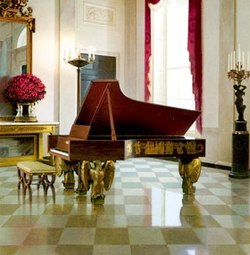
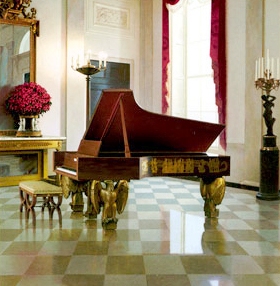
The Entrance Hall looking northwest during the administration of George W. Bush.
White House State Floor showing the location of the Entrance Room.
The Entrance Hall looking north
Maquette by Lorenzo Simmons Winslow showing the reorientation of the Grand Stair to the Entrance Hall during the Truman reconstruction.
McKim, Mead, and White renovation of the Entrance Hall in 1924 during the administration of Calvin Coolidge.
An 1882 photograph shows the Tiffany screen, Brumidi frescos, and encaustic tile floor.

The Entrance Hall (also called the Grand Foyer) is the primary and formal entrance to the White House, the official residence of the president of the United States. The room is rectilinear in shape and measures approximately 31 by 44 feet. Located on the State Floor, the room is entered from outdoors through the North Portico, which faces the North Lawn and Pennsylvania Avenue. The south side of the room opens to the Cross Hall through a screen of paired Roman Doric columns. The east wall opens to the Grand Staircase.

Hoban's 1792 and 1817 designs

[edit]

Architect James Hoban's original floor plans show a similar room, but with single columns separating the Entrance Hall and Cross Hall, and with the Grand Stair entering into the Cross Hall.[1] Mid-19th century photographs show the room as rebuilt by Hoban following the 1814 White House fire. In these photographs two Ionic columns support a series of shallow arches, and a frieze of bas-relief anthemion encircling the room. The shafts of Hoban's columns are recorded as being a blue marble.

With the north entrance to the White House used frequently in this period, it was not uncommon for cold air to push into the Entrance Hall and then pass through the spaciously separated columns into the Cross Hall beyond. To remedy the draft problem, President Martin Van Buren had floor-to-ceiling glass partitions installed between the Hoban columns.[2]

Changes by Walter and Brumidi

[edit]

In 1853 Thomas U. Walter installed a cast iron and clear glass screen between the Entrance Hall and Cross Hall to reduce drafts, and a complexly patterned Minton encaustic tile floor.[3] In 1869 Constantino Brumidi, the fresco painter who had recently painted The Apotheosis of Washington in the ceiling of the new rotunda and Senate wing of the Capitol,[4] applied highly ornamental painted decoration to the walls and ceilings including profile portraits of George Washington and Abraham Lincoln. On the ceiling Brumidi painted allegorical figures of Union and Liberty. They have survived and are displayed in the ground floor of the White House in the Palm Room.[5]

Tiffany and the Aesthetic Movement

[edit]

In 1882 President Chester A. Arthur commissioned Louis Comfort Tiffany to replace Walter's clear glass panels in the screen and the front door with fashionable colored art glass. The patterns included American eagles, and a shield with stripes, stars, and the initials "U.S." A high example of the Aesthetic Movement, Tiffany's glass would remain into the early 20th century. A recreation of the Tiffany screen was painted by artist Peter Waddell in 2004.

McKim's return to Neoclassicism

[edit]

In 1902, soon after taking office and occupying the White House, President Theodore Roosevelt engaged architect Charles Follen McKim in the redesign of the White House. McKim reconfigured the house, adding wings, demolishing the greenhouses, and sweeping away the ornate late 19th century interiors. McKim attempted to make the White House interiors appear closer to how they had near the time of construction, during the period of the early republic. McKim's office McKim, Mead, and White researched the house's history, and where no clear documentation was available created rooms in the then popular Colonial Revival and Beaux Arts styles.

In the Entrance Hall, McKim removed the Tiffany screen,[a] Hoban's Ionic columns, and the ornamental painting. In its place he created a far simpler neoclassical interior. On the south side of the room is a screen of single and paired Roman Doric columns. Doric pilasters are used on the east, north and west wall. A robust entablature of triglyphs, garlanded bureaucrania, ornamental cuirass, and spread Roman eagles integrate the frieze and ceiling. A simple color palette of soft ochres, gray and white contrasted dramatically with the Victorian era interior. The presidential arms were cast in bronze and installed in the center of the room's floor. Bronze torchères, still in use, and a simple lantern with a cylindrical glass chimney lit the room. McKim's new finishes though robust in form were made of plaster and stucco over wood frames hastily added to Hoban's original surfaces. While the response to McKim's interiors were positive, the Entrance Hall has been criticized for being more appropriate to a public building than a home.[9]

Truman reconstruction

[edit]

By 1948 the White House had become physically unstable, and the house was temporarily vacated while a major reconstruction took place. The building's interior was dismantled, the furnishings and decorative items were stored, and a new steel frame was built within the exterior walls. Truman used this opportunity to reposition the entrance to the Grand Stair. Architect Lorenzo Simmons Winslow explored several options for the reorientation of the Grand Stair before convincing President Truman of the present configuration where it opens to the center of the east wall of the Entrance Hall.[10] Except for the new stair opening, most of McKim's design was followed but now reinterpreted in light gray Joliet marble instead of warm hued Sienna stone and painted plaster. Cut into the stone casement around the opening to the Grand Staircase are the seals of the thirteen original American states.[11] The Truman era floor is laid in a tessellated pattern of Westbury cream and Vermont marble. Truman thought it inappropriate to walk across the seal of the president that McKim had placed in the floor,[12] and had the bronze seal moved to the ground floor above the entrance to the Diplomatic Reception Room. In place of the bronze seal in the floor, Truman had a polychrome painted plaster seal installed above the entrance to the Blue Room.

Kennedy restoration

[edit]

During the John F. Kennedy administration, the Entrance Hall (like most of the White House) underwent an extensive historic redecoration. The redecoration of the State Floor rooms, including the Entrance Hall, was overseen by American antiques autodidact Henry Francis du Pont and French interior designer Stéphane Boudin. Du Pont wanted a more historic approach to the White House, while Boudin preferred a French design aesthetic.[13] Du Pont originally redecorated the Entrance Hall with two French pier tables, a settee, a card table, and two tables by Charles-Honoré Lannuier. Boudin had all but the pier tables removed, and his style is the one which remained over the next several decades.[14]

Use over time

[edit]

When the White House interiors were first completed during the administration of John Adams the house was primarily entered from a temporary wooden piazza on the south. President Thomas Jefferson used the Entrance Hall as a "Cabinet of Natural History" displaying finds from the Lewis and Clark Expedition.

In the 20th century the Entrance Hall has been used for official welcomes, receiving lines, small concerts, and dancing. Actor John Travolta danced with Diana, Princess of Wales in 1985; in 1998 First Lady Hillary Clinton danced here with Czech President Václav Havel.

Furnishings

[edit]

On the west wall of the room is a gilded beech French Empire pier table (c. 1812) by cabinetmaker Pierre-Antoine Bellange purchased for the Blue Room by President James Monroe. On the pier table is an ormolu French Empire mantel clock featuring a sculpture of Minerva. This clock was manufactured by the bronzier Pierre-Philippe Thomire and also bought by Monroe, it was previously located in the Blue Room.

In the southeast and southwest corners of the Entrance Hall are crimson and gold upholstered French Empire banquettes acquired by interior designer Stéphane Boudin of Maison Jansen during the John F. Kennedy administration. The McKim era bronze torchères remain in the room. A pair of Louis XVI torchères flank the door leading to the North Portico. A pair of armchairs commissioned for the Blue Room in 1902 and based on a suite of chairs designed by Jacob-Desmalter in the Salon des Fleurs of the Château de Compiègne are placed on the North wall.

References

[edit]

Bibliography

[edit]

Further reading

[edit]
[edit]
Revisions and contributorsEdit on WikipediaRead on Wikipedia
from Grokipedia
The Entrance Hall is the primary and formal entrance to the , the and principal workplace of the , located on the State Floor. It serves as a transitional space connecting the North Portico entrance to the Cross Hall and other state rooms, functioning as a central reception area for visitors, state guests, and ceremonial events. Designed as part of James Hoban's original plan for the State Floor, the Entrance Hall has remained a key architectural feature despite subsequent renovations and stylistic updates, including major reconstructions in the 19th and 20th centuries. It originally included two main staircases and niches for heating, evolving over time to accommodate formal functions while preserving its role in welcoming dignitaries and the public.

Overview and Description

Location and Architectural Role

The Entrance Hall serves as the formal north entrance to the White House , situated on the State Floor and accessible via the North Portico. This central space forms a key component of the building's layout, directly connecting to the adjacent Cross Hall to the south and the Grand Staircase, which provides access to the upper floors. Architecturally, the Entrance Hall functions as a transitional area bridging the public exterior with the private interior state rooms, such as the and the parlors along the Cross Hall. Its expansive design underscores the grandeur and symbolic authority of the , welcoming dignitaries and visitors into a neoclassical environment that reflects the nation's executive power. The hall's proportions—approximately 44 feet long (north-south) by 31 feet wide (east-west), with a of 19 feet—allow for ceremonial processions and gatherings, emphasizing openness and formality. As part of James Hoban's original 1792 design for the President's House, the Entrance Hall was envisioned as an integral vestibule in the symmetrical plan of the State Floor, establishing the White House's role as a dignified from its inception.

Current Layout and Features

The Entrance Hall occupies a rectangular space on the State Floor of the White House, measuring approximately 44 feet long (north-south) by 31 feet wide (east-west), and serves as the primary formal entryway from the . Paired Roman Doric columns constructed of plaster and painted in a crisp white finish divide the area into distinct bays, creating a structured neoclassical progression toward the Cross Hall and Grand Staircase. The floor consists of pink and white laid in a tessellated pattern, providing a durable and elegant surface that was installed during the 1902 McKim renovation and has been retained since, including through the Truman reconstruction. Walls are finished in white adorned with neoclassical motifs, complemented by large built-in mirrors that enhance the sense of spaciousness and . The features intricate neoclassical , originally introduced during the 1902 redesign and preserved through subsequent renovations. Illumination is provided by crystal chandeliers, including an English cut-glass fixture to around 1810–1815 that hangs above the Grand Staircase landing, with additional wall sconces and standards contributing to the formal ambiance; these elements have been conserved through various restorations. The north-facing windows along the entrance allow natural light while being controlled by heavy draperies that manage visibility and bolster security measures. In 1997, during the Clinton administration, the Entrance Hall was refurbished as part of a broader refurbishment of the State Floor public areas.

Historical Development

Original and Early Designs (Hoban Era)

The Entrance Hall formed a central element of James Hoban's 1792 design for the State Floor, conceived as a simple rectangular vestibule intended to serve as a modest yet functional primary entry point for visitors. This expansive space, measuring approximately 31 by 44 feet, featured basic architectural elements including single columns supporting shallow arches along the walls, creating an unpretentious welcome that aligned with the neoclassical restraint of the overall plan. Hoban positioned the hall adjacent to the Cross Hall to facilitate movement toward the principal reception rooms, emphasizing practicality over ornamentation in the young republic's . The 1814 burning of the by British forces during the necessitated a full reconstruction, with Hoban returning to supervise the effort completed in 1817 under President . In this rebuild, the Entrance Hall was elevated in scale and elegance through the addition of paired Ionic columns and semi-circular arches, which lent a sense of classical grandeur while maintaining the room's rectangular footprint. These enhancements transformed the vestibule from a utilitarian passage into a more imposing ceremonial threshold, better suited to the growing prestige of the presidency. During the administrations of (1797–1801) and (1801–1809), the Entrance Hall functioned primarily as a receiving area for official visitors and dignitaries, where guests would assemble before proceeding to formal audiences. Jefferson, in particular, adapted the space practically by installing niches in the south wall to accommodate iron stoves for heating, addressing the hall's exposure to drafts in the unfinished building. This early usage underscored the room's role as a transitional and social hub, hosting initial greetings and small gatherings that reflected the informal yet dignified protocols of the era. To mitigate persistent drafts in the open vestibule, President commissioned the installation of glass partitions between 1837 and 1841, enclosing the space with a wall-to-wall, floor-to-ceiling screen of iron-framed . This modification not only improved but also created a more intimate and protected enclosure, marking an early step toward refining the hall's environmental functionality without altering its core layout.

19th-Century Modifications (Walter, Brumidi, and Tiffany)

In 1853, during the administration of President , architect Thomas U. Walter oversaw significant alterations to the Entrance Hall as part of broader expansions and improvements to the executive mansion. Walter replaced an earlier temporary wind barrier with a more permanent cast-iron screen featuring Gothic tracery, positioned between the Entrance Hall and the adjacent Cross Hall to mitigate drafts while enhancing aesthetic separation and visual interest. This screen, constructed of iron and clear glass, introduced a Victorian-era ornamental element that aligned with the period's emphasis on intricate metalwork. Concurrently, Walter directed the installation of a complexly patterned encaustic tile floor, manufactured by the English firm Minton, which added durability and decorative appeal through its inlaid geometric designs, transforming the hall's flooring from simpler materials to a sophisticated, multicolored surface. Further embellishments came in 1869 under President , when Italian-born artist , renowned for his fresco work in the U.S. Capitol, decorated the Entrance Hall's ceiling. Drawing from his training in the tradition at Rome's , Brumidi executed allegorical oil paintings on canvas mounted as fresco-like panels, including and Union—symbolic representations of national unity featuring ethereal female figures amid classical motifs. These decorations infused the hall with vibrant, thematic opulence reflective of post-Civil War reconciliation. The Aesthetic Movement's influence peaked in 1882 during President Chester A. Arthur's tenure, when Louis Comfort Tiffany led a comprehensive refurbishment of the Entrance Hall. Tiffany replaced Walter's clear glass partitions with an elaborate colored art glass transom screen, incorporating opulent materials like topaz, ruby, and amethyst jewels in designs featuring soaring eagles, the U.S. shield, and seals of the presidency, which diffused light dramatically while blocking drafts more effectively. This update, guided by Aesthetic principles prioritizing beauty in everyday utility, complemented the existing encaustic tiles and Brumidi frescoes, creating a jewel-toned, eclectic interior. The screen was dismantled in 1902 during renovations and sold; portions were repurposed at Maryland's Belvedere Hotel, where they were destroyed in a 1923 fire, as documented in historical accounts of White House artifacts.

Early 20th-Century Neoclassicism (McKim)

In 1902, during President Theodore Roosevelt's administration, the architectural firm , led by , undertook a major renovation of the that significantly transformed the Entrance Hall by stripping away Victorian-era embellishments accumulated over previous decades. This included the removal of Louis Comfort Tiffany's 1882 stained-glass screen, which had divided the hall from the Cross Hall, along with the colored tile floor, ornamental frescoed walls and ceiling, and single marble columns installed in the mid-19th century. These elements, remnants of the Aesthetic Movement's ornate style, were dismantled to eliminate the space's cluttered, multicolored appearance and restore a sense of classical dignity. McKim's redesign introduced paired Roman Doric columns crafted in —a polished plaster mimicking —for a clean, white aesthetic, alongside a new white floor that unified the hall's surface. Large built-in mirrors replaced the former east and west fireplaces, enhancing the illusion of spaciousness, while the overall layout opened direct sightlines to the adjacent Cross Hall, promoting fluid circulation. These changes were executed with precision, using materials like Joliet for durability and neoclassical motifs to evoke grandeur without excess. The design philosophy drew directly from James Hoban's original neoclassical vision for the , prioritizing symmetry, proportion, and Roman architectural influences to create a restrained, harmonious environment that contrasted with the prior era's decorative overload. Integrated into the broader 1902 expansion—which enlarged the State Dining Room and reconstructed the for improved public access—the Entrance Hall became a more open and stately vestibule, aligning with values of efficiency and moral simplicity in public architecture. This reconfiguration not only facilitated the daily influx of visitors but also elevated the hall's role as a formal gateway, setting a template for future restorations.

Mid-20th-Century Reconstructions (Truman and Kennedy)

The Truman administration's reconstruction of the from 1948 to 1952 addressed severe structural deterioration, including in the Entrance Hall, by gutting the interior and installing a new and support columns extending 25 feet deep to stabilize the building. This overhaul reinforced the hall's existing marble columns, which were removed and reinstalled atop the new framework, while preserving the exterior walls. The project architect, Lorenzo Winslow, advocated for retaining Charles McKim's 1902 neoclassical design elements in the space. Key modifications to the Entrance Hall included repositioning the Grand Staircase to open directly into the hall from the east wall, replacing a full-length mirror and improving visibility for ceremonial arrivals and photographs. The original floor was removed and replaced with pink and white laid in a checkered geometric , providing and a formal aesthetic. Additionally, the presidential seal embedded in the floor was relocated above the Blue Room doorway, with a new seal installed in the updated flooring. The Kennedy administration's restoration from 1961 to 1963, spearheaded by Jacqueline Kennedy in collaboration with French interior designer Stéphane Boudin and collector , aimed to return the state rooms to their historical grandeur through research and acquisitions. While the Entrance Hall largely retained McKim's neoclassical framework, the effort incorporated subtle redecorative updates, such as refreshed wall treatments and enhanced lighting fixtures, to align with the period's emphasis on elegance and cohesion across the public spaces. This work complemented broader stylistic influences like French Empire in adjacent rooms without altering the hall's core architecture. In 1997, the Committee for the Preservation of the oversaw a minor refurbishment of the Entrance Hall, coordinating it with updates to the adjacent Cross Hall to improve overall visual and functional harmony, though no structural changes were made. Since the Kennedy era, the Entrance Hall has seen no major reconstructions or alterations through 2025, maintaining its configuration as a key transitional space.

Usage and Significance

Ceremonial and Formal Functions

The Entrance Hall primarily serves as the formal for greeting arriving dignitaries and hosting state visits at the , where foreign heads of state and government are welcomed following initial ceremonies on the . It functions as a key processional space, directing official guests through the adjacent Cross Hall toward the state rooms for subsequent receptions and meetings. This role underscores its centrality in diplomatic protocol, providing a dignified transition from arrival to formal engagements. In daily operations, the Entrance Hall accommodates entry for White House staff and facilitates informal movements by the president and first family, though public tours primarily accessed the building via the until August 2025, when they were paused due to demolition for construction; as of November 2025, tours are scheduled to resume on December 2, 2025, with an updated route. While its use for routine staff access has diminished over time in favor of security-focused entrances, it remains an integral pathway for internal presidential activities. Official protocols during state arrivals emphasize ceremonial precision, including the rollout of a red carpet at the North Portico to honor visiting leaders, accompanied by performances from the and the presentation of an honor guard. The greets dignitaries at the Entrance Hall on behalf of the president, forming a receiving line before escorting them inward. These elements, drawn from established State Department guidelines, ensure a structured and respectful welcome that aligns with international diplomatic standards. Historically, the Entrance Hall evolved from a drafty 19th-century vestibule open to public visitors into a modern, secure, and climate-controlled space optimized for formal functions. Early designs allowed casual public entry until the 1902 renovation by , which restricted access to enhance security and ceremonial staging. Subsequent mid-20th-century reconstructions, including the Truman-era project from 1948 to 1952, further refined its role by preserving neoclassical aesthetics while incorporating advanced environmental controls.

Notable Events and Evolutions

During the Civil War era, the Entrance Hall served as a key passage for the of President on April 19, 1865, after his body lay in state in the adjacent ; the casket was carried through the hall to the North Portico amid national mourning, with thousands paying respects outside the gates. This somber occasion highlighted the space's function in state funerals, drawing crowds that waited hours for access. In the early , a specially designed reviewing stand was erected outside at the North overlooking for President Woodrow Wilson's 1913 inauguration, allowing the president and dignitaries to review the inaugural . The Entrance Hall facilitated the transition from the parade to White House receptions. Wilson, opting against a traditional inaugural ball due to economic concerns, emphasized simpler public engagements. A highlight of the occurred on , 1985, during a state dinner for Prince Charles and Princess Diana, when Nancy Reagan arranged for actress John Travolta to lead Princess Diana in a series of dances in the Entrance Hall, evoking scenes from and capturing global attention as a moment of diplomatic warmth. This event, part of broader inaugural celebrations for President Ronald Reagan's second term, transformed the hall into an impromptu dance floor for nearly 15 minutes, symbolizing cultural exchange. The Truman reconstruction of 1948–1952, which stabilized the White House structure, enabled expanded post-war ceremonial use of the Entrance Hall for state events. However, security measures intensified after the September 11, 2001, attacks, leading to the immediate suspension of public tours and the imposition of stricter access protocols, including reduced group sizes and enhanced screening, which limited unguided visits through the hall until partial resumption in 2003. The further evolved access, with public tours suspended in March 2020 to mitigate health risks, prompting the introduction of virtual 360-degree tours by the to allow remote exploration of the Entrance Hall and State Floor rooms. Tours partially resumed in April 2022 with capacity limits and requirements, such as spaced queuing and mandatory masking in some periods, reflecting ongoing adaptations to guidelines. From 2020 to 2025, these measures, combined with renovations elsewhere in the —including a major East Wing ballroom construction project that began in September 2025 with demolition of the in October 2025—have resulted in no large-scale events in the Entrance Hall, prioritizing limited, controlled access over traditional gatherings. As of November 2025, public tours remain paused since August 2025 and are scheduled to resume on December 2, 2025, with an updated route.

Furnishings and Artistic Elements

Major Furniture and Decorative Items

The principal furniture in the Entrance Hall consists of a carved and gilded beechwood pier table in the French Empire style, manufactured by Pierre-Antoine Bellangé of around 1817 as part of a suite purchased by President for the . This piece, featuring a top and mounts depicting classical motifs, has remained a key element of the room's decor since its acquisition and exemplifies the neoclassical influences of the early . Seating is provided by red settees positioned along the walls, offering functional elegance for visitors and guests while harmonizing with the room's formal aesthetic; these were introduced during the Kennedy administration to improve reception flow. A notable timepiece is the gilt-bronze clock by Pierre-Philippe Thomire, dating to 1817, which stands on the pier table and adds to the Empire-era ambiance with its mythological figure and intricate detailing. Decorative elements include presidential portraits lining the walls and , primarily of recent presidents, contributing to the hall's role in evoking American leadership . Additional accents feature and vases in neoclassical designs, providing visual balance and selected to reflect the hall's ceremonial purpose. Most furnishings trace their provenance to the comprehensive Kennedy restoration of 1961–1963, which prioritized authentic historical pieces while establishing protocols for preservation. The curator oversees periodic rotations, ensuring a mix of longstanding artifacts and temporary displays. In the , under the Obama administration, contemporary American artworks by diverse modern artists were integrated into the collection to balance traditional elements with broader cultural representation. As of 2025, no major changes to the Entrance Hall furnishings have been reported under the Biden administration.

Floor, Walls, and Structural Details

The floor of the Entrance Hall consists of pink and white tiles arranged in a geometric pattern, installed as part of the comprehensive Truman renovation from 1948 to 1952 to replace the earlier Joliet flooring that had deteriorated over time. This durable material choice reflects the neoclassical emphasis on simplicity and longevity, with the tessellated design providing a subtle visual that complements the hall's formal . As a historical precursor detailed in earlier modifications, the 19th-century encaustic tiles influenced subsequent patterns but were fully supplanted by this installation. The walls are finished in smooth white plaster, accented by neoclassical entablatures and shallow niches that frame portraits and architectural details, originating from the 1902 redesign by Charles McKim, Mead & White to evoke classical grandeur. These elements create a clean, luminous backdrop that enhances the hall's role as a transitional space, with the plaster surface allowing for subtle decorative overlays without overwhelming the overall restraint. During the Kennedy administration's redecoration in the early 1960s, minor refinements such as updated torchieres were introduced to refine the lighting integration, preserving McKim's framework while adding contemporary polish. Structurally, the hall features paired Doric columns of plaster—employing techniques to imitate veining—and complementary pilasters along the east, north, and west walls, forming a that visually divides the space from the adjacent Cross Hall. The north doors, serving as the primary formal entrance for state arrivals, incorporate robust bronze hardware that underscores the portal's ceremonial importance, with their design dating to post-McKim adjustments for enhanced durability. Artistic elements include overdoor panels with motifs inspired by Constantino Brumidi's 19th-century allegorical works, such as his removed paintings Liberty and Union, which once adorned the ceiling and influenced later restorations to retain thematic echoes of national symbolism. Crystal sconces mounted on the walls provide soft ambient lighting, balancing the central chandelier to illuminate the space evenly during events.

References

Add your contribution
Related Hubs
User Avatar
No comments yet.