Hubbry Logo
HafeiHafeiMain
Open search
Hafei
Community hub
Hafei
logo
7 pages, 0 posts
0 subscribers
Be the first to start a discussion here.
Hafei
Hafei
from Wikipedia

Hafei, officially Hafei Motor Co., Ltd. (Chinese: 哈飞汽车), is a Chinese automaker currently operating as a subsidiary of Changan Ford, and manufacturing passenger vehicles.[2][3]

Key Information

It previously independently manufactured sedans, MPVs, mini vehicles, small trucks, and vans for commercial use.

History

[edit]
Hafei centre in Chile

Hafei was formerly owned by Aviation Industry Corporation of China.[4] The earliest Hafei products were Suzuki Carry-based microvans and trucks sold under the Songhuajiang brand, named after the Songhua River, but by 2002 they were sold directly under the Hafei brand. Their vehicles have always carried the "HFJ" identity code, no matter the brand.[5]

As of 2009, the company had exported products to a total of 40 nations.[6]

In 2009, the Chang'an Automobile Group purchased most Hafei-related assets[4] prompted by a Chinese State policy aimed at consolidating the domestic automobile manufacturing industry.[7]

In 2015, Changan announced it would discontinue all Hafei production and convert existing lines to serve Changan Ford.[8][2][3]

Production bases

[edit]

Hafei has production facilities in Northern China.[9]

Historical Models

[edit]

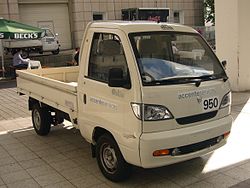
Hafei produced small cars and MPVs in addition to small trucks and commercial vans. These so-called mini vehicles made up the majority of the Hafei model line. Many Hafei consumer offerings were designed by Pininfarina.

Model list

[edit]
[edit]

References

[edit]
[edit]
Revisions and contributorsEdit on WikipediaRead on Wikipedia
from Grokipedia
Hafei, officially Hafei Motor Co., Ltd. (Chinese: 哈飞汽车; : Hāfēi Qìchē), was a Chinese automaker based in , province, that manufactured mini vehicles, light trucks, vans, and passenger cars from the 1980s until 2013. Originally a subsidiary of the state-owned Harbin Aircraft Manufacturing Corporation (now part of ), Hafei focused on licensed production of Japanese designs, particularly from and , targeting domestic and export markets in developing regions. By 2009, it had exported vehicles to over 40 countries, with annual production peaking at around 150,000 units in the mid-2000s. Hafei's product lineup emphasized affordable, compact vehicles for urban and commercial use. Early models included Suzuki Carry-based microvans like the Hafei Xiaofeixing ("Little Flying Saucer," introduced 1992) and the Hafei Huaxiang ("Splendid Voyage"). In 1997, it entered the passenger car market with the Hafei Saima, a rebadged Suzuki Wagon R. Subsequent offerings featured the Hafei Minyi (2000, based on Daihatsu Atrai van), Hafei Saibao (2002, licensed Daihatsu Charade sedan), and Hafei Junyi (2005, based on Daihatsu YRV crossover). The company also produced MPVs and small trucks, such as the Hafei Ruiying and Hafei Luo Bao. In line with China's automotive industry consolidation policy, Changan Automobile Group acquired Hafei's assets in 2009 for approximately 680 million yuan (about US$100 million), integrating its operations and ending independent vehicle development. Production of Hafei-branded models ceased by 2013, with facilities repurposed for joint venture output. As of 2025, the Hafei name survives only in legacy references, while its former plant in supports Changan's light vehicle assembly.

Overview

Founding and Corporate Identity

Hafei originated in 1980 as an automotive division of the , a subsidiary of the (AVIC), initially concentrating on the production of components. This establishment aligned with China's post-1978 economic reforms, which encouraged military-industrial enterprises to diversify into civilian manufacturing to support national development. Leveraging the expertise from , Hafei transitioned into vehicle production during the early , marking a strategic pivot from parts to ground transportation. The name "Hafei" is derived from "Harbin Aircraft," reflecting its roots in the Harbin Aircraft Manufacturing Corporation and the intent to apply technologies to automobile design and manufacturing. This identity underscored Hafei's corporate ethos of integrating high-tech methods—such as and processes—into automotive assembly, positioning it as a bridge between defense and consumer industries. The company was structured under AVIC's oversight, ensuring alignment with state priorities for technological self-reliance in both sectors. Headquartered in , Province, Hafei's early operations capitalized on the region's industrial base to develop mini vehicles, beginning with licensed designs from in 1982. This partnership enabled the production of compact vans and trucks, adapting Japanese engineering for local needs while building domestic capabilities. The initial focus remained on small-scale, utilitarian vehicles suited to 's emerging market, establishing Hafei's niche in affordable mobility.

Product Focus and Market Niche

Hafei specialized in a core product lineup consisting of small , multi-purpose vehicles (MPVs), microvans, small trucks, and commercial , with production primarily focused on vehicles under 3.6 tons in gross vehicle weight. These compact offerings were designed to meet the demands of China's burgeoning low-cost mobility sector, where over 80% of Hafei's output comprised such lightweight vehicles suited for light-duty transport. The company's market niche centered on providing affordable transportation options for urban commuters and rural users, with most models priced under 50,000 RMB to ensure in price-sensitive segments. This strategy emphasized fuel-efficient engines and compact designs that facilitated easy maneuverability in congested city streets or narrow rural roads, positioning Hafei as a key player in China's budget vehicle market. Historical models like the Baili and Lobo exemplified this niche by offering basic, economical sedans tailored for everyday use. Hafei's design philosophy prioritized simple, reliable engineering, drawing from its heritage as a of the Aircraft Manufacturing Corporation to apply rigorous standards in vehicle durability and efficiency. To enhance aesthetics in select models, the company collaborated with Italian design firm , as seen in vehicles like the Zhongyi , blending functional simplicity with improved visual appeal. Production volumes reached a peak of approximately 67,000 units annually in the mid-2000s, reflecting strong demand in this segment, before declining sharply to near zero by 2015 amid industry consolidation.

History

Early Development and Initial Production (1980-2000)

Hafei Aviation Industry Co., Ltd. traces its origins to 1952, when it was established as the Harbin Aircraft Manufacturing Corporation, one of China's earliest facilities focused on repair and assembly. Initially concentrating on and reverse-engineering of Soviet-era designs, the company transitioned to in the 1970s. A pivotal shift occurred in the early amid China's economic reforms, when Hafei began full-scale manufacturing of helicopters, starting with the licensed assembly of the Z-5, a variant of the Soviet Mi-4. This marked Hafei's emergence as a key player in development, leveraging AVIC's resources to localize production technologies. In 1982, Hafei signed a agreement with France's (now part of ) for the Dauphin SA365, leading to the development of the Z-9 series. The first Z-9 flew in 1981, with serial production commencing in 1990 after extensive adaptations for high-altitude performance and multi-role capabilities, including and transport. By the mid-1990s, Hafei had established a comprehensive industrial chain for , producing over 100 Z-9 variants annually and integrating advanced . The company also expanded into , notably the Y-12 utility plane, certified in 1985 and exported to over 30 countries by 2000. These efforts positioned Hafei as China's largest producer, with annual output exceeding 50 rotorcraft by the late 1990s. During this period, Hafei's engineering expertise from extended to diversification, including a for civilian vehicles under the automotive division, which assembled light trucks in the . However, the core focus remained on , with technological localization reducing import dependency to under 20% for key components like rotor systems and engines by 2000. This era solidified Hafei's role in supporting the while building export capabilities.

Growth, Exports, and Challenges (2000-2009)

Entering the , Hafei accelerated international partnerships to enhance design and manufacturing capabilities. In 2002, the company delivered its first batch of eight H410A light utility helicopters and had produced over 300 Z-9 units, establishing a strong domestic market presence. A major milestone came in 2003 with an agreement to manufacture airframes for the helicopter in collaboration with Bell Helicopter Textron Canada, resulting in 136 units produced by 2008. This highlighted Hafei's growing expertise in composite materials and precision assembly. Exports expanded significantly, with Z-9 and Y-12 aircraft delivered to more than 30 countries, including and . In 2004-2005, Hafei secured contracts with for components on the 787 Dreamliner, valued at US$600 million, marking China's first major deal for wide-body airliners. Challenges arose from technological gaps and , prompting investments in R&D; by 2006, Hafei had localized 90% of Z-9 production. The 2008 Beijing Olympics showcased Hafei's capabilities, with Z-9 variants used in security operations. Annual production reached 150 aircraft and components, but competition from global leaders like and Bell required ongoing innovation. In 2009, as part of China's aviation industry consolidation, AVIC restructured its subsidiaries, including Hafei, to streamline operations under the . This integration enhanced resource sharing but also led to the divestiture of non-core assets, such as the automotive subsidiary Hafei Motor, which was acquired by Group to focus on core competencies.

Acquisition, Integration, and Shutdown (2009-2018)

Following the 2009 restructuring, Hafei deepened its integration within AVIC, emphasizing advanced and international collaborations. The divestiture of the automotive division allowed reallocation of resources to aviation projects, including the establishment of the Hafei Airbus Composite Manufacturing Centre in 2009, a with to produce composite parts for the A320 and A350 programs. This facility became a of Hafei's global role, delivering components worth billions. From 2010 onward, Hafei advanced indigenous designs, co-developing the AC352 (Z-15) medium utility helicopter with , with the first flight in 2016. Production of the Z-9 continued to grow, surpassing 600 units by 2018, while the Y-12 series achieved over 100 exports. Challenges included disruptions and technological hurdles, but integration with AVIC bolstered R&D, leading to milestones like the certification of the Z-9WE armed variant for export. No "shutdown" occurred; instead, Hafei expanded facilities, reaching an annual capacity of 200 helicopters and components by 2018. The automotive legacy was fully separated, with its operations absorbed by , allowing Hafei to focus on self-reliance. Financially stable under AVIC, Hafei contributed to military and civilian aviation, with platforms integrated into the PLA and exports supporting regional markets. By 2018, the company had delivered over 2,000 , solidifying its position as the birthplace of China's industry.

Post-2018 Status and Legacy

Since 2018, Hafei has continued operations as a core AVIC , advancing projects like the AC352/Z-15 in 2023 and production ramp-up. The company maintains active facilities in , including the joint venture, which in November 2025 signed a long-term agreement with FDH Aero for critical fasteners on the A350 program, underscoring its role in global supply chains as of 2025. No divestitures or shutdowns have affected the aviation division; instead, Hafei pursues concepts and next-generation . Hafei's legacy spans over 70 years as China's pioneering , delivering more than 2,500 to over 30 countries. Its early localization of foreign technologies laid the foundation for indigenous designs like the Z-20, while partnerships with , , and Bell have integrated Hafei into international programs. The 2009 divestiture of the automotive subsidiary marked a strategic refocus on , enhancing self-reliance amid China's ambitions. As of 2025, Hafei supports nearly 1,000 active worldwide, contributing to military modernization and civilian exports.

Operations

Production Bases and Facilities

Hafei's primary production base was located in , province, where the company established its main manufacturing facility in 1980 as part of its origins under the (AVIC). This plant served as the core of Hafei's operations, focusing on the assembly of mini-vehicles, small cars, MPVs, and commercial vans, with integrated lines for stamping, , painting, and final assembly. At its peak, the facility contributed to the company's overall annual production capacity of approximately 300,000 vehicles, leveraging technology transfers from AVIC for specialized processes such as mini-vehicle body . The site spanned a total area of about 1.05 million square meters, including dedicated zones for engine production and component fabrication. In addition to the Harbin plant, Hafei expanded its infrastructure in the to support growing demand for commercial vehicles, including a secondary facility in , province, established in 2004 with an annual capacity of 100,000 units primarily for sedans and vans. This southern site complemented the northern expansions around , enhancing Hafei's ability to produce trucks and mini-vans tailored for domestic and export markets. These facilities incorporated advanced manufacturing techniques derived from AVIC partnerships, enabling efficient production of lightweight, compact vehicles. Following Hafei's acquisition by Chongqing Changan Automobile in 2009 and subsequent integration into , the Harbin plant underwent significant repurposing after 2015, when purchased the assembly operations to boost its capacity by 200,000 vehicles annually. Production of Hafei models ceased, and the site was renovated for Ford vehicle assembly, with production commencing in late 2016, beginning with the redesigned in early 2017 and later including models such as the . By 2025, no Hafei-specific production lines remain active at the facility, which now operates fully under for passenger car .

Manufacturing Partnerships and Exports

Hafei established its initial manufacturing partnerships in the automotive sector through licensing agreements with Motor Corporation, beginning in the mid-1990s, which enabled the production of Carry-based microvans and minibuses under the Songhuajiang brand. This collaboration provided Hafei with access to proven Japanese engineering for lightweight commercial vehicles, forming the backbone of its early product lineup through the 2000s. In the early 2000s, Hafei expanded its design capabilities via contracts with the Italian firm , starting with the development of the Zhongyi in 1999, which featured a more aerodynamic and modern aesthetic compared to typical derivatives. This partnership continued with the Lobo city car, a five-door platform engineered specifically by and introduced to production in 2002, marking Hafei's push toward passenger vehicle styling influenced by European design principles. As a of the (AVIC), Hafei benefited from internal engineering ties within the AVIC group, leveraging aviation-derived expertise in materials and precision manufacturing for automotive applications during its operational years. Additionally, Hafei pursued international expansion through an attempted partnership with Miles Automotive Group in 2006, aiming to distribute rebadged Hafei electric hatchbacks , though the deal ultimately remained unrealized due to market and regulatory hurdles. Hafei's export strategy focused on emerging markets, with shipments reaching and by the mid-2000s, alongside preparations for European entry exemplified by the Saibao sedan's compliance with Euro 3 emissions standards in 2004. By 2009, exports constituted a notable portion of output, supporting distribution in dozens of countries through these channels. However, following Group's acquisition of Hafei's assets from AVIC in late 2009, export activities were curtailed as part of integration into Changan's operations, with no independent Hafei-branded exports recorded by 2025.

Products

Helicopters

Hafei Aviation specializes in the development and production of multi-role , primarily for utility, transport, and applications. The company's helicopter lineup draws on licensed foreign designs adapted for Chinese needs, particularly high-altitude performance, and includes indigenous developments through international partnerships. The Z-9 series, Hafei's flagship helicopter, is a licensed variant of the , first produced in 1981 under technology transfer from . Over 600 units have been manufactured, serving the (PLA) and export markets. The baseline Z-9 is a medium with twin 1C engines, each providing 986 hp, enabling a maximum takeoff weight of 4,100 kg, a cruising speed of 270 km/h, and a range of 1,000 km. It accommodates up to 10 troops or equivalent cargo, with variants like the Z-9W armed version featuring anti-tank missiles and the Z-9EH maritime patrol model equipped with radar and sonobuoys. Another key product is the AC352 (also designated Z-15 or ), a medium twin-engine co-developed with since 2009. Certified by the (CAAC) in July 2022, mass production began in 2023, with deliveries starting in 2024. Powered by two WZ16 (Arriel 2C derivative) turboshafts each rated at 1,731 hp, the AC352 has a of 7,500 kg, can carry 16 passengers, and achieves a maximum speed of 295 km/h with a range of 850 km. It supports roles including , offshore transport, and , with enhanced hot-and-high capabilities for China's diverse terrain. As of 2025, Hafei continues certification and testing for international markets. Earlier models like the Z-5, a licensed Soviet Mi-4 produced from 1969 to 1983, laid the foundation for Hafei's expertise, with over 500 units built for and training.

Fixed-Wing Aircraft and Utility

Hafei produces light utility designed for short-field operations, regional connectivity, and multi-role missions in remote areas. These complement its helicopter portfolio, emphasizing ruggedness and versatility. The Y-12 series is Hafei's primary fixed-wing product, a twin-turboprop developed since 1980. The current Y-12E variant, certified in 2010, features PT6A-65B engines each delivering 950 shp, a of 5,700 kg, and seating for up to 19 passengers. It has a maximum speed of 328 km/h, a range of 1,340 km, and short takeoff/landing () performance with a takeoff run of 320 m on rough fields. Used for passenger transport, , and agricultural spraying, over 100 Y-12s operate worldwide, including in and . The aircraft's high-wing design and fixed tricycle landing gear enhance its suitability for unpaved runways. As of 2025, production continues with upgrades for and efficiency.

Key Model Specifications and Innovations

Hafei's products incorporate and technologies, leveraging its heritage for lightweight composites and integrated systems. Innovations include localization of key components, such as the WZ16 engine for the AC352, reducing reliance on imports. For the Z-9, innovations focus on modular and systems, with recent upgrades improving night vision and data links for PLA integration. The helicopter's tail rotor enhances safety in confined areas. Specifications include a service ceiling of 4,500 m and endurance of 4 hours. The AC352 features a five-blade main and full-authority digital engine control (), achieving a 20% improvement in hot-and-high performance over predecessors. Its maximum range is 850 km with auxiliary fuel, and it supports sling loads up to 2,500 kg. The Y-12 employs composite materials in wings and for a 15% weight reduction, paired with Apex digital . Fuel efficiency is approximately 0.45 kg/km per passenger, with a service ceiling of 9,000 m. Beyond airframes, Hafei manufactures components through joint ventures, including composite structures for A320 and A350 programs via the Hafei Airbus Composite Manufacturing Centre, established in 2009. As of November 2025, this facility supplies tail sections and other parts, supporting global supply chains. Hafei is also advancing next-generation projects, including concepts for enhanced speed and range, aligning with China's self-reliance goals.

References

Add your contribution
Related Hubs
User Avatar
No comments yet.