Hubbry Logo
Hayashi limitHayashi limitMain
Open search
Hayashi limit
Community hub
Hayashi limit
logo
8 pages, 0 posts
0 subscribers
Be the first to start a discussion here.
Hayashi limit
Hayashi limit
from Wikipedia
This HR diagram illustrates pre-main-sequence tracks for various stellar masses and ages. To the right is the Hayashi "forbidden zone".

The Hayashi limit is a theoretical constraint upon the maximum radius of a star for a given mass. When a star is fully within hydrostatic equilibrium—a condition where the inward force of gravity is matched by the outward pressure of the gas—the star can not exceed the radius defined by the Hayashi limit. This has important implications for the evolution of a star, both during the formulative contraction period and later when the star has consumed most of its hydrogen supply through nuclear fusion.[1]

A Hertzsprung-Russell diagram displays a plot of a star's surface temperature against the luminosity. On this diagram, the Hayashi limit forms a nearly vertical line at about 2,500 K. The outer layers of low temperature stars are always convective, and models of stellar structure for fully convective stars do not provide a solution to the right of this line. Thus in theory, stars are constrained to remain to the left of this limit during all periods when they are in hydrostatic equilibrium, and the region to the right of the line forms a type of "forbidden zone". Note, however, that there are exceptions to the Hayashi limit. These include collapsing protostars, as well as stars with magnetic fields that interfere with the internal transport of energy through convection.[2]

Red giants are stars that have expanded their outer envelope in order to support the nuclear fusion of helium. This moves them up and to the right on the H-R diagram. However, they are constrained by the Hayashi limit not to expand beyond a certain radius. Stars that find themselves across the Hayashi limit have large convection currents in their interior driven by massive temperature gradients. Additionally, those stars states are unstable so the stars rapidly adjust their states, moving in the Hertzprung-Russel diagram until they reach the Hayashi limit.[3]

When lower mass stars in the main sequence start expanding and becoming a red giant the stars revisit the Hayashi track. The Hayashi limit constrains the asymptotic giant branch evolution of stars which is important in the late evolution of stars and can be observed, for example, in the ascending branches of the Hertzsprung–Russell diagrams of globular clusters, which have stars of approximately the same age and composition.[4]

The Hayashi limit is named after Chūshirō Hayashi, a Japanese astrophysicist.[5]

Despite its importance to protostars and late stage main sequence stars, the Hayashi limit was only recognized in Hayashi’s paper in 1961. This late recognition may be because the properties of the Hayashi track required numerical calculations that were not fully developed before.[4]

Derivation of the limit

[edit]

We can derive the relation between the luminosity, temperature and pressure for a simple model for a fully convective star and from the form of this relation we can infer the Hayashi limit. This is an extremely crude model of what occurs in convective stars, but it has good qualitative agreement with the full model with less complications. We follow the derivation in Kippenhahn, Weigert, and Weiss in Stellar Structure and Evolution.[4]

Nearly all of the interior part of convective stars has an adiabatic stratification (corrections to this are small for fully convective regions), such that

, which holds for an adiabatic expansion of an ideal gas.


We assume that this relation holds from the interior to the surface of the star—the surface is called photosphere. We assume to be constant throughout the interior of the star with value 0.4. However, we obtain the correct distinctive behavior.

For the interior we consider a simple polytropic relation between P and T:
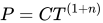
With the index .

We assume the relation above to hold until the photosphere where we assume to have a simple absorption law

Then, we use the hydrostatic equilibrium equation and integrate it with respect to the radius to give us

For the solution in the interior we set  ; in the P-T relation and then eliminate pressure of this equation. Luminosity is given by the Stephan-Boltzmann law applied to a perfect black body:

.

Thus, any value of R corresponds to a certain point in the Hertzsprung–Russell diagram.

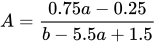
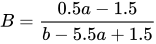
Finally, after some algebra this is the equation for the Hayashi limit in the Hertzsprung–Russell diagram:

[4]

With coefficients

,


Takeaways from plugin in and for a cool hydrogen ion dominated atmosphere opacity model ():

  • The Hayashi limit must be far to the right in the Hertzsprung–Russell diagram which means temperatures have to be low.
  • The Hayashi limit must be very steep. The gradient of Luminosity with respect to temperature has to be large.
  • The Hayashi limit shifts slightly to the left in the Hertzsprung–Russell diagram for increasing M.

These predictions are supported by numerical simulations of stars. [4]

What happens when stars cross the limit

[edit]

Until now we have made no claims on the stability of locale to the left, right or at the Hayashi limit in the Hertzsprung–Russell diagram. To the left of the Hayashi limit, we have and some part of the model is radiative. The model is fully convective at the Hayashi limit with . Models to the right of the Hayashi limit should have .

If a star is formed such that some region in its deep interior has large large convective fluxes with velocities . The convective fluxes of energy cooldown the interior rapidly until and the star has moved to the Hayashi limit. In fact, it can be shown from the mixing length model that even a small excess can transport energy from the deep interior to the surface by convective fluxes. This will happen within the short timescale for the adjustment of convection which is still larger than timescales for non-equilibrium processes in the star such as hydrodynamic adjustment associated with the thermal time scale. Hence, the limit between an “allowed” stable region (left) and a “forbidden” unstable region (right) for stars of given M and composition that are in hydrostatic equilibrium and have a fully adjusted convection is the Hayashi limit. [4]

See also

[edit]

References

[edit]
Revisions and contributorsEdit on WikipediaRead on Wikipedia
from Grokipedia
The Hayashi limit is a theoretical boundary in the Hertzsprung-Russell (HR) diagram representing the minimum effective temperature that low-mass stars in hydrostatic equilibrium can achieve, typically around 3,500–4,000 K depending on mass, luminosity, and metallicity, beyond which no stable stellar configurations exist due to atmospheric opacity effects. This limit arises from the dominance of H⁻ opacity in cool stellar atmospheres, where, below this temperature threshold, the ionization of hydrogen decreases sharply, reducing the number of free electrons and thus the opacity; this causes the outer layers to become unstable, contract inward, and reheat, preventing further cooling. Named after Japanese astrophysicist Chūshirō Hayashi, the limit is derived from models assuming fully convective envelopes (polytropic index n=1.5) extending from the photosphere to the stellar core, under hydrostatic equilibrium (dP/dτ = g/κ, where τ is optical depth, g is surface gravity, and κ is opacity) and radiative-convective boundary conditions. A key relation approximating the limit is T_eff ≈ 2 × 10³ (M/M_⊙)^{0.15} (L/L_⊙)^{0.01} (Z/0.02)^{-0.04} K, highlighting its weak dependence on luminosity and metallicity while scaling mildly with mass. In stellar evolution, the Hayashi limit delineates the "forbidden zone" to the cooler side of the HR diagram, where protostars and evolving low-mass stars (<0.3 M_⊙ fully convective; up to ~1–2 M_⊙ with convective envelopes) cannot reside in equilibrium, instead following vertical contraction tracks parallel to the limit during pre-main-sequence phases. For post-main-sequence evolution, stars ascending the red giant branch (RGB) encounter this limit, halting radial cooling and instead expanding dramatically to increase luminosity while maintaining near-constant temperature, a process driven by hydrogen shell burning, with core helium exhaustion playing a role in later phases like the asymptotic giant branch for higher-mass stars. This behavior is crucial for understanding the rapid luminosity evolution of red giants and the structure of fully convective objects like brown dwarfs, as exceeding the limit would violate energy transport assumptions, leading to dynamical instability on Kelvin-Helmholtz timescales. Hayashi's foundational 1961 analysis of gravitational contraction phases first formalized this constraint, integrating atmospheric physics with interior models to explain observed HR diagram features in young clusters.

Background Concepts

Pre-Main-Sequence Stellar Evolution

Pre-main-sequence (PMS) stellar evolution commences with the gravitational collapse of dense cores within molecular clouds, where self-gravity overcomes supporting pressures from thermal motions, turbulence, and magnetic fields, leading to rapid contraction and the formation of protostars. During this phase, the collapsing fragment accretes additional material from the surrounding envelope, growing in mass while heating up due to the release of gravitational potential energy. As density and temperature increase, the protostar approaches hydrostatic equilibrium, in which inward gravitational forces are balanced by outward pressure gradients, marking the transition from free-fall collapse to more stable contraction. The evolutionary sequence includes distinct phases: the embedded protostar stage, where the young star remains obscured by its dense natal material and derives luminosity primarily from accretion and contraction; for low-mass stars (typically below about 2 solar masses), this evolves into the T Tauri phase, featuring active accretion from circumstellar disks, powerful bipolar outflows, and photometric variability due to disk interactions. These T Tauri stars exhibit lithium absorption lines and strong chromospheric activity, reflecting their youth and ongoing contraction toward the main sequence. The final approach to the zero-age main sequence (ZAMS) occurs as the core temperature rises sufficiently for hydrogen fusion to begin, stabilizing the star on the main sequence. A crucial aspect of PMS evolution in low-mass stars is the presence of fully convective interiors during much of the contraction phase, driven by high opacities in the outer layers that promote efficient energy transport via convection rather than radiation. This convective structure influences the star's luminosity and effective temperature evolution, leading to characteristic contraction paths. Early theoretical models by Henyey, Lelevier, and Levee (1955) described the PMS phase for higher-mass stars under assumptions of radiative equilibrium throughout the interior. In contrast, Hayashi (1961) developed models for lower-mass stars, incorporating deep convective envelopes that better matched observations of young, cool objects. This contraction path for low-mass stars follows the .

Hertzsprung-Russell Diagram and Tracks

The Hertzsprung-Russell (HR) diagram is a fundamental tool in stellar astrophysics, consisting of a scatter plot that relates a star's luminosity to its effective surface temperature. Developed independently by in 1911 and in 1913, it provides a visual framework for classifying stars and tracing their evolutionary paths. The vertical axis typically plots luminosity on a logarithmic scale, increasing upward, while the horizontal axis plots effective temperature, also on a logarithmic scale but decreasing from left to right, often labeled by spectral type (O through M) for convenience. This arrangement highlights key stellar populations: the main sequence, a prominent diagonal band running from hot, luminous stars (upper left) to cool, dim ones (lower right), where most stars spend the majority of their lives fusing hydrogen in their cores; the giant branch, a horizontal extension to the right for evolved, larger stars with expanded envelopes; and the supergiant branch, an even more luminous vertical extension above the giants. Evolutionary tracks on the HR diagram represent the trajectories that stars follow as they change in luminosity and temperature during different life stages, calculated from theoretical models of stellar structure. These tracks are particularly illustrative during the pre-main-sequence phase, when protostars contract under gravity toward the main sequence, releasing gravitational energy that powers their luminosity. The shape of a track depends on the star's mass and internal energy transport mechanisms, with lower-mass stars exhibiting steeper paths due to their fully convective interiors, while higher-mass stars show more gradual changes. For stars with masses below approximately 0.5 solar masses, the contraction phase follows a Hayashi track, named after Chūichi Hayashi's 1961 seminal work, characterized by a nearly vertical descent on the HR diagram at nearly constant temperature, as the star's luminosity decreases rapidly while remaining fully convective. In contrast, more massive pre-main-sequence stars (above ~0.5 solar masses) initially follow a short Hayashi track but soon develop radiative cores, transitioning to a Henyey track—after Louis G. Henyey et al.'s 1955 models—where evolution proceeds nearly horizontally, with temperature increasing at roughly constant luminosity due to radiative energy transport dominating the core. This mass-dependent distinction arises because lower-mass stars lack a radiative zone, maintaining convective dominance throughout contraction and thus steeper tracks toward the main sequence.

The Hayashi Track

The Hayashi track refers to the evolutionary path followed by low-mass pre-main-sequence stars during their fully convective contraction phase, as first proposed by Chūshirō Hayashi in 1961. These stars begin this phase after the end of significant protostellar accretion, starting at relatively high luminosities and low effective temperatures on the Hertzsprung-Russell diagram. On the HR diagram, the Hayashi track appears as a nearly vertical line, characterized by a nearly constant effective temperature while the luminosity decreases gradually as the star contracts. This shape arises from the efficient convection throughout the star and high opacity in the outer layers, which maintain a stable photospheric temperature during the contraction. The track's steepness increases for lower stellar masses, making it more vertical for stars below about 1 solar mass compared to those approaching 2 solar masses. This phase applies primarily to stars with masses below approximately 2 solar masses, where full convection dominates the energy transport. The track terminates when the star reaches the main sequence, at which point nuclear fusion ignites and stabilizes the luminosity. The duration of the scales inversely with mass, lasting about 30 million years for a 1 solar mass star but up to about 1 billion years for a 0.2 solar mass star.

Physical Basis

Definition of the Limit

The Hayashi limit represents the theoretical upper bound on the stellar radius RmaxR_{\max} for a given mass MM, beyond which a star cannot achieve stable hydrostatic equilibrium under the assumption of an ideal gas equation of state. This constraint ensures that the inward gravitational force balances the outward thermal pressure without leading to dynamical instability. Named after the Japanese astrophysicist Chūshirō Hayashi, who first derived it in 1961 while studying the early gravitational contraction phases of low-mass stars, the limit delineates the physical boundary for cool, fully convective objects. Equivalently, the can be expressed as a minimum effective temperature Teff,minT_{\mathrm{eff, min}} for specified values of luminosity LL and mass MM, since stellar radius relates to these parameters via the Stefan-Boltzmann law: RL/Teff4R \propto \sqrt{L / T_{\mathrm{eff}}^4}
Add your contribution
Related Hubs
User Avatar
No comments yet.