Hubbry Logo
Intergalactic starIntergalactic starMain
Open search
Intergalactic star
Community hub
Intergalactic star
logo
8 pages, 0 posts
0 subscribers
Be the first to start a discussion here.
Contribute something
Intergalactic star
Intergalactic star
from Wikipedia

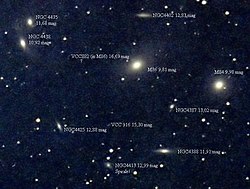
The Virgo cluster of galaxies, where the phenomenon known as intergalactic stars was discovered

An intergalactic star, also known as an intracluster star or a rogue star, is a star not gravitationally bound to any galaxy. Although a source of much discussion in the scientific community during the late 1990s, intergalactic stars are now generally thought to have originated in galaxies, like other stars, before being expelled as the result of either galaxies colliding or of a multiple-star system traveling too close to a supermassive black hole, which are found at the center of many galaxies.

Collectively, intergalactic stars are referred to as the intracluster stellar population, or IC population for short, in the scientific literature.[1]

Discovery

[edit]

The hypothesis that stars exist only in galaxies was disproven in January 1997 with the discovery of intergalactic stars.[2] The first to be discovered were in the Virgo Cluster of galaxies, where some one trillion are now surmised to exist.[2]

Formation

[edit]
Collisions between galaxies are commonly thought to be a source of intergalactic stars.
Proposed mechanisms for the ejection of intergalactic stars by supermassive black holes

The way these stars arise is still a mystery, but several scientifically credible hypotheses have been suggested and published by astrophysicists.

The most common hypothesis is that the collision of two or more galaxies can toss some stars out into the vast empty regions of intergalactic space. Although stars normally reside within galaxies, they can be expelled by gravitational forces when galaxies collide. It is commonly believed that intergalactic stars may primarily have originated from extremely small galaxies, since it is easier for stars to escape a smaller galaxy's gravitational pull, than that of a large galaxy.[3] However, when large galaxies collide, some of the gravitational disturbances might also expel stars. Published in August 2015, a study of supernovae in intergalactic space suggested that the progenitor stars had been expelled from their host galaxies during a galactic collision between two giant ellipticals, as their supermassive black hole centres merged.[4]

Another hypothesis, that is not mutually exclusive to the galactic collisions hypothesis, is that intergalactic stars were ejected from their galaxy of origin by a close encounter with the supermassive black hole in the galaxy center, should there be one. In such a scenario, it is likely that the intergalactic star(s) was originally part of a multiple star system where the other stars were pulled into the supermassive black hole and the soon-to-be intergalactic star was accelerated and ejected away at very high speeds. Such an event could theoretically accelerate a star to such high speeds that it becomes a hypervelocity star, thereby escaping the gravitational well of the entire galaxy.[5] In this respect, model calculations (from 1988) predict the supermassive black hole in the center of our Milky Way galaxy to expel one star every 100,000 years on average.[6]

Observation history

[edit]

In January 1997, the Hubble Space Telescope discovered a large number of intergalactic stars in the Virgo Cluster of galaxies. Another study, published later in January 1997, confirmed that astronomers had discovered a group of intergalactic planetary nebulae in the Fornax Cluster of galaxies in 1992 and 1993.[7]

In 2005, at the Smithsonian Center for Astrophysics, Warren Brown and his team attempted to measure the speeds of hypervelocity stars by using the Doppler Technique, by which light is observed for the similar changes that occur in sound when an object is moving away or toward something. But the speeds found are only estimated minimums, as in reality their speeds may be larger than the speeds found by the researchers. "One of the newfound exiles is moving in the direction of the constellation Ursa Major at about 1.25 million mph with respect to the galaxy. It is 240,000 light-years away. The other is headed toward the constellation Cancer, outbound at 1.43 million miles per hour and 180,000 light-years away."[5]

In the late 2000s, a diffuse glow from the intergalactic medium, but of unknown origin, was discovered. In 2012, it was suggested and shown that it might originate from intergalactic stars. Subsequent observations and studies have elaborated on the issue and described the diffuse extragalactic background radiation in more detail.[8][9]

Some Vanderbilt astronomers report that they have identified more than 675 stars at the edge of the Milky Way, between the Andromeda Galaxy and the Milky Way. They argue that these stars are hypervelocity (intergalactic) stars that were ejected from the Milky Way's Galactic Center. These stars are red giants with a high metallicity (a measure of the proportion of chemical elements other than hydrogen and helium within a star) indicating an inner galactic origin, since stars outside the disks of galaxies tend to have low metallicity and are older.[10]

Some recently discovered supernovae have been confirmed to have exploded hundreds of thousands of light-years from the nearest star or galaxy.[11][4] Most intergalactic star candidates found in the neighborhood of the Milky Way seem not to have an origin in the Galactic Center but in the Milky Way disk or elsewhere.[12][13]

Mass

[edit]

In 2005, the Spitzer Space Telescope revealed a hitherto unknown infrared component in the background from the cosmos. Since then, several other anisotropies at other wavelengths – including blue and x-ray – have been detected with other space telescopes and they are now collectively described as the diffuse extragalactic background radiation. Several explanations have been discussed by scientists, but in 2012, it was suggested and shown how for the first time this diffuse radiation might originate from intergalactic stars. If that is the case, they might collectively comprise as much mass as that found in the galaxies. A population of such magnitude was at one point thought to explain the photon underproduction crisis, and may explain a significant part of the dark matter problem.[8][9][14][15]

Known locations

[edit]

The first intergalactic stars were discovered in the Virgo Cluster of galaxies. These stars are notable for their isolation, residing approximately 300,000 light-years away from the nearest galaxy. Despite the difficulty in determining their exact mass, it is estimated that intergalactic stars constitute around 10 percent of the mass of the Virgo cluster, potentially outweighing any of its 2,500 galaxies [10]

In 2012, astronomers identified approximately 675 rogue stars at the edge of the Milky Way, towards the Andromeda Galaxy. These stars were likely ejected from the Milky Way's core by interactions with the central supermassive black hole. The study led by Kelly Holley-Bockelmann and Lauren Palladino from Vanderbilt University highlighted the unusual red coloration and high velocities of these stars, indicating their dramatic journey from the galactic center.[10]

See also

[edit]
  • Blue straggler – Main sequence star that is more luminous and bluer than expected
  • HE 0437-5439 – Hypervelocity star in the constellation Dorado
  • Intergalactic dust – Cosmic dust in between galaxies in intergalactic space
  • Intracluster medium – Superheated plasma that permeates a galaxy cluster
  • Rogue planet – Planets not gravitationally bound to a star, or interstellar planet
  • Rogue black hole – Interstellar or intergalactic object
  • Stellar kinematics – Study of the movement of stars

References

[edit]

Sources

[edit]
Revisions and contributorsEdit on WikipediaRead on Wikipedia
from Grokipedia
An intergalactic star is a stellar object that exists outside the gravitational bounds of any individual , typically residing in the intergalactic medium or as part of the diffuse intracluster light (ICL) within galaxy clusters. These stars are primarily ancient, metal-rich remnants stripped from their parent galaxies through dynamical processes, contributing a significant fraction—often 5–50%—of the total light in massive clusters. The existence of intergalactic stars was first proposed by in 1937 while studying the Coma Cluster, where he inferred a population of unbound stars to explain the cluster's surface brightness profile. Observations confirmed their presence in the 1990s using the , which detected hundreds of such stars in the , isolated and orbiting the cluster's overall gravitational potential rather than any single galaxy. Intergalactic stars form mainly through tidal stripping during galaxy-galaxy interactions and mergers, as well as the disruption of galaxies and dwarf galaxies within clusters. Other mechanisms include the ejection of hypervelocity stars by supermassive black holes via the Hills mechanism and, less commonly, in-situ from cooling intracluster gas. Their properties reflect this violent history: they are predominantly old (>10 billion years), with colors bluer than typical cluster galaxies due to gradients in age and , and they trace the distribution out to hundreds of kiloparsecs. In terms of abundance, intergalactic stars constitute a small but crucial component of the universe's , with their fraction increasing in more massive and dynamically evolved clusters. Recent simulations and deep imaging surveys, such as those from the and upcoming facilities like the , suggest that the ICL fraction has grown by a factor of 2–4 since z=1, linking these stars directly to the hierarchical assembly of clusters and the growth of brightest cluster galaxies. This diffuse stellar component provides key insights into galaxy evolution, profiles, and the baryonic content of the .

Definition and Characteristics

Definition

An intergalactic star is a star not gravitationally bound to any single , instead drifting freely through the space between galaxies. These objects, also known as rogue stars, represent a distinct unbound from typical galactic structures. In the context of galaxy clusters, intergalactic stars are often referred to as intracluster stars and are located within the intracluster medium, the diffuse gas and plasma filling the space between member galaxies. Hypervelocity stars form a subset of intergalactic stars, having been ejected from their host galaxies at speeds exceeding the galactic escape velocity, propelling them into intergalactic space. In some galaxy clusters, such as the Virgo Cluster, intergalactic stars account for up to 10% of the total stellar mass.

Physical Properties

Intergalactic stars are predominantly old (>10 billion years) and form the bulk of the intracluster light (ICL) in galaxy clusters. They exhibit a mass range dominated by low-mass stars, typically 0.1–1 MM_\odot, with observations focusing on red-giant-branch stars from progenitors of ~0.8–2 MM_\odot. Due to the longevity of lower-mass stars and the dynamical processes leading to ejection, older, low-mass stars dominate the observed populations, as evidenced by simulations and detections assuming initial mass functions like the Salpeter IMF. The subset frequently possesses ejection speeds exceeding 1000 km/s, arising from mechanisms such as binary disruptions near supermassive black holes. Observed velocities for confirmed examples in the range from about 500 to 830 km/s relative to the Galactic . In terms of composition, intergalactic stars ejected early from their hosts tend to be metal-poor, with metallicities around [Fe/H] = -0.7 or lower, reflecting the chemical conditions of ancient stellar populations; more recent ejections retain compositions matching their parent galaxies, often near solar abundances. Spectral classifications in cluster environments primarily feature late-type stars, including G- and K-type dwarfs and giants, as well as red-giant-branch stars, consistent with an aged, low-mass-dominated ensemble. Their luminosities and effective temperatures align closely with those of analogous field stars in the observed populations, varying from L103LL \approx 10^{-3} L_\odot and Teff3000T_{\rm eff} \approx 3000 K for cool dwarfs to L103LL \approx 10^3 L_\odot and Teff40005000T_{\rm eff} \approx 4000{-}5000 K for red-giant-branch stars, though the sparse distribution in intergalactic voids significantly hampers detection, with surface brightnesses often below 30 mag arcsec2^{-2} in optical bands. In the , for instance, resolved red-giant-branch stars display I-band surface brightnesses around 31 mag arcsec2^{-2}, underscoring their faint, isolated nature.

History and Discovery

Initial Discovery

The presence of diffuse luminous intergalactic matter, interpreted as unbound stars, was first reported by in 1951 during his study of the Coma Cluster using the 48-inch Schmidt telescope at . Zwicky noted an extended mass of light surrounding the cluster galaxies, suggesting a population of stars not bound to individual galaxies but to the cluster potential. This observation laid the groundwork for later searches for intergalactic stellar components. The initial identification of intergalactic stars, also known as intracluster stars, occurred serendipitously during a spectroscopic survey of planetary nebulae in the halo of the Virgo cluster galaxy NGC 4406 (M86). In 1996, Arnaboldi et al. reported the discovery of three planetary nebulae with radial velocities matching the systemic velocity of the Virgo cluster rather than that of NGC 4406, indicating they were unbound to any individual galaxy and instead orbited within the cluster potential. These objects served as tracers of an underlying population of diffuse, intergalactic stars, providing the first direct kinematic evidence for such a stellar component in a galaxy cluster. This finding built on prior observations of faint, diffuse intracluster light detected in the Virgo cluster, which had suggested the presence of unbound stars but lacked confirmation of their stellar nature amid searches for other intracluster medium components like hot gas. Follow-up narrow-band imaging in 1997 by Méndez et al., including Arnaboldi as a co-author, surveyed a 50 arcmin² region in the core and identified 11 additional candidates consistent with an intracluster origin based on their fluxes and positions. The luminosity function of these candidates aligned with expectations for an old , reinforcing the interpretation of a significant reservoir of unbound stars contributing to the observed diffuse light. This work established as reliable probes for mapping the kinematics and distribution of intergalactic stars, distinct from the hot previously studied through emissions. Concurrently, in early 1997, observations provided the first direct imaging evidence of intergalactic stars through deep Wide Field Planetary Camera 2 exposures of a blank field near M87 in the Virgo core. Ferguson et al. detected approximately 600 stars, extrapolating to a total population of about 10 million stars brighter than the , and estimated the overall intergalactic at roughly 10% of the cluster's total, equivalent to ~1 trillion solar masses or Sun-like stars. These results interpreted the diffuse intracluster light primarily as arising from this unbound stellar component, likely stripped from galaxies during interactions. Similar techniques were later extended briefly to the Fornax cluster, confirming intergalactic stars there as well.

Key Milestones

In 2005, astronomers discovered the first star, SDSS J090745.0+024507, in the Milky Way's halo, exhibiting a heliocentric of 853 ± 12 km/s, indicating it is unbound from the galaxy and likely ejected from the galactic center through a with the Sgr A*. This detection marked a key advancement in recognizing hypervelocity stars as potential intergalactic wanderers, with subsequent studies confirming their trajectories could lead them into intergalactic space. Building on this, a 2012 analysis identified approximately 675 rogue stars in intergalactic space toward the , selected from data based on their characteristics and high , suggesting ejection from the Milky Way's core via interactions with the central . These stars, located about 50,000 light-years from the galactic disk, provided the first substantial population of candidate intergalactic stars, highlighting dynamical processes that strip stars from galaxies. In 2015, a study explained the occurrence of intergalactic in merging galaxies, such as those observed in the systems hosting SN 2010al and a 2011 event, as remnants of binary stars ejected during mergers. In this scenario, the black holes' gravitational interactions slingshot binary systems out of their host galaxies at speeds exceeding , allowing one star to evolve and explode as a far from any galactic disk, thus linking stellar ejections to merger dynamics. Following these developments, no major new detections or confirmations of intergalactic star populations have been reported through 2025, though the James Webb Space Telescope's infrared capabilities offer significant potential for identifying distant, dust-obscured examples in high-redshift environments.

Formation Mechanisms

Ejection from Galaxies

The primary mechanism for the formation of most intergalactic stars involves dynamical ejection from their host galaxies during interactions or mergers, where gravitational tidal forces strip stars from the outer regions and hurl them into intergalactic space. In such events, close encounters between galaxies distort their structures, leading to the formation of long tidal tails composed of stars, gas, and dust that extend far beyond the parent systems. Simulations of galaxy clusters indicate that approximately 40% of the resulting intracluster light—largely from unbound stars—originates from these massive, dynamically cold tidal streams produced during mergers. These ejected stars typically acquire velocities sufficient to escape the galactic potential, depending on the mass and interaction dynamics of the involved galaxies. A significant subset of intergalactic stars arises from ejections triggered by interactions with supermassive s (SMBHs) at galactic centers, particularly through encounters known as the Hills mechanism. In this process, a system approaches the SMBH closely enough for tidal forces to disrupt the pair; one star becomes bound to the black hole on a highly eccentric , while the other is flung outward at speeds exceeding the local , often reaching 1000 km/s or more relative to the galactic . Observations and models confirm that such ejections from the Milky Way's central SMBH, Sgr A*, produce stars that populate the and, in some cases, escape entirely to become intergalactic wanderers. This mechanism is particularly efficient in dense stellar environments near SMBHs, contributing to a steady outflow of stars over cosmic time. Globular clusters also play a key role in populating intergalactic through their tidal disruption, which releases into the surrounding medium where they can escape galactic binding. These compact stellar systems, orbiting within galaxies or clusters, experience gradual mass loss via two-body relaxation, where and encounters eject individual at velocities of 10–50 km/s relative to the cluster; in low-density environments like galaxy outskirts or clusters, these escapers can achieve the additional boost needed to become unbound from the host . Disruptions are accelerated during galaxy mergers or close passages through cluster potentials, stripping outer and contributing to the diffuse population of intergalactic . This enriches the intergalactic stellar field with ancient, metal-poor characteristic of globular clusters.

Alternative Origins

One proposed alternative pathway for the origin of intergalactic stars involves primordial formation in the early , where first-generation Population III stars could have formed from pristine hydrogen and helium gas in small minihalos that escaped incorporation into larger proto-galactic structures. These massive, metal-poor stars, theorized to have masses exceeding 100 solar masses, would have arisen around redshift z > 20, approximately 100-200 million years after the , and any surviving low-mass remnants or disrupted clusters might contribute to the intergalactic if their host halos were dispersed by early cosmic processes. Another mechanism links intergalactic stars to violent feedback processes in low-mass systems, such as supernova-driven outflows in dwarf galaxies, which can unbind and eject stars due to the galaxies' shallow gravitational potentials. In dwarf disk galaxies with masses around 10^8-10^9 solar masses, repeated supernova explosions from bursts create expanding superbubbles that drive gas outflows and potentially disrupt stellar components, propelling stars into intergalactic space with velocities exceeding 100 km/s. Similarly, during black hole mergers in dwarf galaxies, the dynamical interactions associated with binary hardening can eject stars at high speeds. A more exotic possibility is in-situ formation within the intracluster medium (ICM), where diffuse gas accretion onto cooling filaments or stripped clouds enables star birth far from galactic potentials, despite the ICM's low density of roughly 10^{-3} particles per cm³. Cosmological simulations indicate that 8-28% of intracluster light in massive clusters (virial masses ~10^{14} solar masses) originates from such in-situ processes, primarily through the cooling and collapse of metal-enriched gas from infalling galaxies, forming stars directly in the ICM over cosmic time. This pathway remains rare, as the tenuous ICM environment suppresses efficient collapse compared to galactic disks, requiring specific conditions like shocks or magnetic fields to concentrate gas. Overall, these alternative origins represent minor contributions to the intergalactic compared to dynamical ejections from galaxies, with limited direct observational evidence due to the faintness and diffuse nature of such stars. Future high-resolution simulations, incorporating and multi-phase gas dynamics, are essential to quantify their fractional impact and distinguish them from dominant mechanisms.

Detection Methods

Observational Techniques

One primary method for detecting intergalactic stars involves using planetary nebulae (PNe) as tracers through imaging, which targets their strong emission lines such as [O III] at 5007 Å. This technique isolates the faint emission from PNe against the background sky by comparing images taken in filters centered on the line with adjacent filters, allowing identification of point-like sources consistent with PNe luminosities. For instance, in the , [O III] imaging has revealed hundreds of intracluster PNe, serving as proxies for the underlying due to their predictable luminosity function and long lifetimes. Similarly, combining [O III] and Hα imaging helps distinguish true PNe from contaminating high-redshift galaxies or other emission-line objects. Spectroscopic confirmation of PN velocities, essential for verifying intergalactic origins, often employs multi-object spectrographs on large ground-based telescopes like the (VLT). Instruments such as on the VLT have measured radial velocities of intracluster PNe by targeting the [O III] line shifts, revealing dispersions indicative of cluster membership and distinguishing them from galactic foreground or background sources. More recently, integral field units (IFUs) like those on the VLT enable spatially resolved , providing kinematic maps of PN populations and confirming velocities through line profile analysis, though applications to diffuse intergalactic fields remain limited to targeted cluster cores. Diffuse light photometry resolves the integrated stellar light from intergalactic populations using high-resolution imaging from space telescopes. The (HST) has been instrumental in subtracting galaxy light to isolate intracluster light (ICL), employing deep broad- and narrowband exposures to model and remove foreground contributions, thus quantifying the faint, extended halos of orphaned stars. The (JWST), with its superior near-infrared sensitivity, enhances this by probing older, redder stellar components in ICL through multiwavelength photometry, enabling decomposition of ICL fractions in clusters like Abell 2744. Recent JWST observations, including spectra of ICL in RX J2129.7+0005 (2024) and deep imaging in SMACS J0723 (2025), have provided further insights into the spectral properties and distribution of intracluster light. Gravitational lensing offers potential for magnifying the light of faint intergalactic stars in lensed cluster fields, where cluster mass acts as a natural to boost and resolve individual sources otherwise below detection limits. While theoretical models suggest this could reveal resolved stellar populations in high-magnification arcs, no confirmed implementations for intergalactic stars post-2023 have been reported, pending deeper surveys with facilities like JWST.

Identification Challenges

Identifying intergalactic stars poses significant observational hurdles due to their intrinsic faintness and the diffuse nature of their populations. These stars typically exhibit apparent magnitudes ranging from 30 to 35 in the SDSS r-band, necessitating extremely deep imaging with long exposure times to achieve sufficient signal-to-noise ratios. For instance, early detections in the required over 33,500 seconds of exposure using the Hubble Space Telescope's Wide Field Planetary Camera 2 to resolve stars down to I = 27.9 mag, highlighting the need for prolonged observations to overcome the low of approximately 30.6–31.1 mag arcsec⁻². Contamination from foreground Galactic stars and background galaxies further complicates identification, as these interlopers can mimic the photometric signatures of intergalactic populations in crowded fields. In fields, foreground stars are estimated to contribute fewer than 20 contaminants to depths of I = 27.9 mag, but the primary uncertainty arises from field-to-field variations in background galaxy counts, which can exceed 80 sources per field and require careful morphological separation. Identifying intergalactic wandering stars at greater distances demands even more rigorous decontamination efforts, given their low spatial densities, often relying on multi-band photometry and resolved color-magnitude diagrams to distinguish them. Determining the unbound status of candidate intergalactic stars is challenged by the overlap in velocity dispersions between these stars and the gas, which share similar kinematic profiles within clusters. This overlap makes it difficult to kinematically separate stars ejected from galaxies from those still bound to cluster-scale potentials or influenced by hot gas motions, often requiring integral field spectroscopy to measure gradients. The observed increase in dispersion with radius in intracluster light provides a key diagnostic for confirming unbound populations, but sparse sampling limits its application beyond nearby clusters. Beyond the local universe, resolution limits prevent the detection of individual intergalactic stars, as current telescopes struggle to resolve point sources at distances exceeding a few megaparsecs amid the diffuse stellar halos. The (JWST), with its superior sensitivity and of approximately 0.03 arcseconds at near- wavelengths, offers potential to address these challenges through deeper penetration of dust-obscured regions and extension of resolved stellar mapping to about 10 Mpc, enabling better characterization of faint, redder populations in post-2023 observations. However, even JWST faces constraints for sparse intergalactic stars outside nearby structures like the at 16 Mpc.

Known Populations

In Galaxy Clusters

Intergalactic stars in galaxy clusters, often manifesting as intracluster light (ICL), represent a significant fraction of the stellar content in these dense environments, where gravitational interactions strip stars from galaxies over . In rich clusters, older stellar populations dominate the ICL, primarily consisting of low-mass, long-lived stars such as red giants and stars that contribute to the diffuse glow observed between galaxies. These populations are typically metal-poor to moderately enriched, reflecting stripping from early-type galaxies during cluster assembly. In the , the nearest major cluster at approximately 16.5 Mpc, intracluster stars account for about 10% of the total stellar mass, estimated at around 10^{12} solar masses, with this fraction first quantified through deep imaging of resolved stars. This ICL is particularly prominent in the cluster core, where planetary nebulae surveys have confirmed the presence of unbound stars tracing the diffuse component. Similar properties are observed in the , where surveys of planetary nebulae between 1998 and 2000 revealed a comparable fraction of intracluster stars, around 20%, highlighting the role of dynamical ejection in populating the intergalactic medium. These detections underscore the ubiquity of ICL in nearby clusters, with Fornax's lower mass compared to Virgo yielding a proportionally similar stellar escape fraction. For more massive systems like the Cluster, estimates suggest that up to 20% of the total stellar content may reside in intergalactic stars, as derived from recent deep photometric analyses of the ICL across optical bands. This higher fraction in rich clusters like illustrates how repeated mergers and tidal stripping amplify the intergalactic stellar population, contributing substantially to the overall baryonic mass budget.

In the Local Universe

In the local universe, intergalactic stars are primarily identified through their high velocities and positions outside galactic structures, with notable examples including approximately 675 candidate rogue stars detected along the trajectory between the and the . These stars, identified as high-metallicity M giants using data from the (SDSS), exhibit properties consistent with ejection from the 's galactic core and are located at distances suggesting they occupy intergalactic space between the two galaxies. Their red colors and rapid outward motion, exceeding 2 million miles per hour, support the interpretation that they are hypervelocity stars transitioning to unbound intergalactic wanderers. Potential hypervelocity stars ejected by the 's , Sagittarius A*, represent another key population destined for intergalactic space. These stars, typically B-type main-sequence objects, achieve escape velocities greater than 500 km/s through the Hills mechanism, where disruptions near the impart extreme speeds, propelling them on radial trajectories away from the galactic disk. Observations confirm over 25 such unbound stars in the halo as of 2025, with trajectories indicating they will eventually enter the intergalactic medium of the , including recent spectroscopic confirmations of 7 additional hypervelocity stars. Detections of intergalactic stars in the voids of the Local Group remain sparse, reflecting the low densities and faint luminosities of these regions, but cosmological simulations predict dozens of such wandering stars within 1 Mpc. These models, incorporating ejection histories from galactic centers and , estimate that most intergalactic wandering stars reside within 3 Mpc, with current surveys detecting only a handful due to their apparent magnitudes fainter than 25 in optical bands. The scarcity of confirmed examples highlights observational challenges, though ongoing astrometric surveys like continue to identify additional candidates through analysis of proper motions and velocities.

Significance

Cosmological Implications

Intergalactic stars contribute significantly to the intracluster light (ICL) in galaxy clusters, which serves as a luminous tracer for the distribution of . The diffuse stellar component known as ICL, composed primarily of stars stripped from galaxies through tidal interactions, follows the of the cluster and can map the underlying with high fidelity. Observations indicate that ICL traces the global distribution, enabling precise measurements of dark matter profiles in clusters and refining models of gravitational lensing and cluster dynamics. However, recent simulations reveal that ICL is a biased tracer, with its density profile steeper than that of dark matter in cluster outskirts due to dynamical processes like tidal stripping. The presence of intergalactic stars also impacts the cosmic budget, particularly in clusters where they account for a substantial fraction of the . Studies of cluster content show that the combined in cluster galaxies and ICL represents approximately 10-20% of the total mass, with the ICL alone contributing up to several percent in massive systems. This stellar component outside galaxies necessitates adjustments in formation simulations, as it alters the partitioning of between gas, stars, and , influencing feedback processes and the efficiency of in cosmological hydrodynamical models. Despite these insights, the integration of intergalactic stars into the Lambda-CDM model remains incomplete, as current cosmological simulations often underpredict the ICL fraction and its evolution across cosmic time. The global stellar mass fraction in intergalactic stars is poorly constrained beyond cluster environments, highlighting gaps in understanding large-scale structure formation and baryon cycling. Observations with facilities like the James Webb Space Telescope, including analysis of intracluster light in clusters such as SMACS J0723, have begun to quantify this fraction and refine Lambda-CDM predictions for the diffuse stellar component of the universe.

Relation to Galaxy Evolution

Intergalactic stars arise primarily through dynamical ejections during galaxy mergers and interactions, leading to a loss of stellar mass from the participating galaxies. This mass loss alters the structure and evolution of merger remnants by depleting peripheral stellar populations and redistributing material into diffuse components like the intracluster light (ICL), which influences the final morphology and dynamical stability of the resulting galaxy. In cluster environments, repeated such ejections over cosmic time contribute to the overall baryonic budget, shaping the long-term assembly of massive systems. The presence of intergalactic stars also provides feedback mechanisms that affect processes across galactic scales. As these stripped stars evolve, they contribute to the enrichment of the surrounding gas in the intergalactic or . This enrichment process is particularly pronounced in non-relaxed clusters, where feedback can drive gas outflows, increasing the of the . In turn, the metal-laden medium may facilitate the formation of new, low-mass systems by providing enriched material for . Age distributions of intergalactic stars, often inferred from the stellar populations in the ICL, serve as key tracers of past merger histories in galaxy clusters. Simulations demonstrate that the spatial extent and color gradients of the ICL encode information about major accretion events, with "stellar splashback radii" correlating strongly with merger timings within the last dynamical timescale (~1 Gyr for typical clusters). Older stellar components in the ICL, typically >5-10 Gyr, reflect early merger epochs, while younger fractions highlight recent interactions, allowing reconstruction of a cluster's assembly sequence more effectively than traditional halo concentration measures. Despite advances, modeling the long-term evolutionary impacts of intergalactic star formation on dwarf galaxies remains limited, with current simulations indicating negligible contributions from dwarfs (<10^9 M⊙) to the ICL due to their low stripping efficiencies. Post-2023 hydrodynamic simulations, such as those from the Horizon-AGN suite, are beginning to address these gaps by tracking multi-Gyr stripping and pre-processing effects, though resolution constraints still hinder precise predictions for isolated dwarf systems.

References

Add your contribution
Related Hubs
Contribute something
User Avatar
No comments yet.