Hubbry Logo
HerodiumHerodiumMain
Open search
Herodium
Community hub
Herodium
logo
8 pages, 0 posts
0 subscribers
Be the first to start a discussion here.
Herodium
Herodium
from Wikipedia

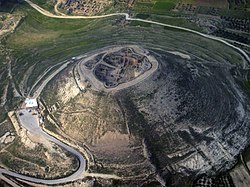
The Herodeion (Ancient Greek: Ἡρώδειον), in Latin: Herodium, in Modern Hebrew: הרודיון Herodion, known in Arabic as Jabal al-Fureidis (Arabic: جبل فريديس, lit.'"Mountain of the Little Paradise"') is a fortified desert palace built by Herod the Great, king of Judaea, in the first century BCE. The complex stands atop a hill in the Judaean Desert, approximately 12 kilometres (7.5 mi) south of Jerusalem and 5 kilometres (3.1 mi) southeast of Bethlehem, between Beit Ta'mir, Za'atara to the east and Jannatah, Tekoa and Nokdim to the west. The site is located at an elevation of 758 meters (2,487 ft) above sea level.[2]

Key Information

Herodium was originally built by Herod to commemorate his victory in 40 BCE over the Hasmonean ruler Antigonus II Mattathias during their struggle for control of Judaea. The site stands atop an artificial, cone-shaped hill that dominates the surrounding landscape and can be seen from Jerusalem. At its summit, Herod's engineers built a fortified palace with double walls, towers, a Roman-style bathhouse, banquet halls, and residential quarters. At the base, a lower palace complex was built complete with gardens, courtyards, and a large pool fed by aqueducts. According to the historian Josephus, Herod was buried at the site following his death in 4 BCE.

Herodium remained active during the Jewish–Roman wars. Jewish rebels occupied the site during the First Jewish–Roman War (66–73 CE), repurposing the dining hall into a synagogue before it was captured by the Romans in 71 CE. The fort was again used as a rebel base during the Bar Kokhba revolt (132–135 CE), after which it was abandoned. From 1972 onward, intermittent excavations were carried out by Prof. Ehud Netzer, working on behalf of the Hebrew University of Jerusalem. In 2007, he found and identified the long sought-after tomb of King Herod on the northern slope of the hill. Netzer excavated mostly the lower palace, at the base of the hill; he fell to his death at the site in 2010.[3][circular reference]

The site is in Area C of the West Bank, formally under the jurisdiction of the Israeli Civil Administration, a body of military officers, and in practice it is administered jointly with the Israel Nature and Parks Authority.[4][5] Israel asserts that it is entitled to work in the area under the Oslo Accords, but the Palestinian authorities say Israel has no right to undertake digs there or remove artifacts that Israel discovered in excavations there.[6]

Etymology

[edit]
Upper Herodium, looking south. The columns to the left near the wall belong to the peristyle hall.

Herodium is the only site that is named after King Herod the Great. It was known by the Crusaders as the "Mountain of Franks". Palestinian locals historically called it Jabal al-Firdous or Jabal al-Fureidis (Arabic: جبل فريديس, lit. "Mountain of the Little Paradise");[7] Edward Robinson in 1838 described it as "Frank Mountain", in reference to the Crusaders.[8]

In 1841, Edward Robinson identified the site in Biblical Researches in Palestine as Herodium based on the description found in Josephus.[9][10] Josephus described a palace fortress and a small town, named after Herod the Great, built between 23 and 15 BCE. A sarcophagus discovered in 2007 was claimed to belong to Herod as it was more ornate than others found in the area.[11][12][13]

The modern English name is a transliteration of the Greek spelling (Ancient Greek: Ἡρώδειον). This is followed by the Modern Arabic (Arabic: هيروديون) and the Modern Hebrew (Herodion Hebrew: הרודיון). The name Herodis (Hebrew: הרודיס) was found in the 1960s inscribed in one of the Bar Kokhba letters recovered from the Muraba’at Caves in the Judaean desert,[14] and is thought to represent the original Hebrew name for the site.

History

[edit]

Construction

[edit]

In 40 BCE, after the Parthian conquest of Syria, Herod fled to Masada. On the way, at the location of Herodion, Herod clashed with Jews loyal to his enemy Antigonus, and emerged victorious. According to the Roman Jewish historian Josephus, he "built a town on that spot in commemoration of his victory, and enhanced it with wonderful palaces... and he called it Herodion after himself".[15]

Josephus describes Herodium as follows:

This fortress, which is some sixty stadia[16] distant from Jerusalem, is naturally strong and very suitable for such a structure, for reasonably nearby is a hill, raised to a (greater) height by the hand of man and rounded off in the shape of a breast. At intervals it has round towers, and it has a steep ascent formed of two hundred steps of hewn stone. Within it are costly royal apartments made for security and for ornament at the same time. At the base of the hill there are pleasure grounds built in such a way as to be worth seeing, among other things because of the way in which water, which is lacking in that place, is brought in from a distance and at great expense. The surrounding plain was built up as a city second to none, with the hill serving as an acropolis for the other dwellings.[17]

Archaeologists believe that the palace was designed by architects and built by slaves and paid workers (contractors). [citation needed] Herod was considered one of the greatest builders of his time and was not daunted by geography—his palace was built on the edge of the desert and was situated atop an artificial hill.[18] The largest of the four towers was built on a stone base 18 meters in diameter. This was most likely where Herod lived; he decorated his rooms with mosaic floors and elaborate frescoes. The other three towers, which consisted of living spaces and storage, were 16 meters in diameter. Outside, several cisterns were built to collect water that was channeled into the palace.

The city of Herodium served as a capital of a toparchy.[19][20]

Great Jewish Revolt

[edit]

During the First Jewish–Roman War (66–73 CE), Herodium was held by Jewish rebels. At some point during the revolt, the fort's defenders transformed Herod's triclinium into a synagogue.[21][22] In 68 CE, rebel leader Simon bar Giora, then operating from nearby Teqoa, attempted to seize Herodium. He sent an emissary, Eleazar, to persuade the garrison to surrender, but the defenders uncovered the plot and expelled him. Eleazar then threw himself from the fortress ramparts.[23][24][25]

After the fall of Jerusalem in 70 CE, Herodium remained one of three major fortresses (alongside Machaerus and Masada) still under rebel control, though the specific faction holding it is uncertain.[25] By this time, the site appears to have been defended by a relatively small force, likely joined by refugees fleeing Jerusalem.[25] Herodium was ultimately captured, likely in early 72 CE, by the Roman legate Sextus Lucilius Bassus.[22][25] The fortress seems to have fallen rapidly, as Josephus provides only a brief mention of its surrender.[26][25]

Bar Kokhba revolt

[edit]

At the beginning of the Bar Kokhba revolt sixty years later, Simon bar Kokhba declared Herodium as his secondary headquarters. The fortress was commanded by Yeshua ben Galgula, who was likely in Bar Kokhba's second or third line of command. Archaeological evidence for the revolt was found all over the site, from the outside buildings to the water system under the mountain. Inside the water system, supporting walls built by the rebels were discovered, and another system of caves was found. Inside one of the caves, burned wood was found which was dated to the time of the revolt.

As in other parts of Judea during the final stages of the Bar Kokhba revolt, the rebels active in Herodium likely sought shelter in nearby refuge caves, including the cave of El Matzia.[27]

Excavation history

[edit]
"Tel Hordos" area in 1943, in the Survey of Palestine
Remains of the eastern round tower

Upper Herodium

[edit]

The archaeological excavation of Herodium was begun in 1962 by Virgilio Canio Corbo and Stanislao Loffreda, from the Studium Biblicum Franciscanum of Jerusalem, and it continued until 1967: they discovered the upper citadel, at the top of the hill.[28]

Lower Herodium

[edit]

From 1972, excavations were carried out by Ehud Netzer, working on behalf of the Hebrew University of Jerusalem, and they were intermittent until the archaeologist's death in 2010. Netzer excavated mostly the lower palace, at the base of the hill.

Description

[edit]
Palace garden, the northern exedra

Herod's hilltop palace

[edit]

Herod the Great built a palace within the fortress of Herodium. Herod himself commissioned a lavish palace to be built between 23 and 15 BCE atop Herodium for all to see. The palace itself consisted of four towers of seven stories, a bathhouse, courtyards, a Roman theatre, banquet rooms, a large walkway ("the course"), as well as extravagant living quarters for himself and guests. Once Herod died and the Great Revolt started, Herodium was abandoned. The Jews eventually had a base at Herodium where they built a synagogue which can still be seen today, unlike much of Herod's Palace.[29]

Section of mosaic floor unearthed at Herodion

Bathhouse

[edit]

The Roman bathhouse consisted of three areas, the caldarium, the tepidarium, and the frigidarium. It also had a very impressive dome which is still in good condition today despite thousands of years of earthquakes and wars. The caldarium had vaulted ceilings, raised floors, and channels in the walls to conduct heat. The tepidarium had mosaic floors and frescoes just like the living quarters of the palace. The frigidarium, the last stop in the bathhouse, was where guests would cool off in a large pool.

Synagogue

[edit]

During the First Jewish–Roman War, the defenders of Herodium repurposed an existing structure within the upper palace as a synagogue,[21] considered one of the earliest in the Levant. The original space, formerly Herod's triclinium, underwent renovations that involved installing benches along the walls and constructing a mikveh outside the entrance. There is minimal evidence regarding any alterations made by the defenders to the existing decor or furnishings, and the space essentially functioned as a simple communal hall. The entrance faced eastward, while Jerusalem lay almost due north. The repurposed synagogue lacked specialized features commonly found in synagogues, such as a niche for housing the Torah scrolls and a reading desk.[21]

Theatre

[edit]

Netzer discovered the Roman Theatre just before his death in late 2010. The royal theatre was uncovered near the base of Herod's tomb. The theatre contained an elaborately decorated loggia, or a theatre box, was discovered. This means that when Herod or other notable officials went to see a play, they would receive luxury treatment. The rest of the audience would be seated below on benches that could accommodate about 450–650 people. What is quite unique about this find is that frescoes of landscapes were discovered, of a kind suggesting that the painters were well travelled; they depict scenes of Italy and even the Nile River in Egypt. It is also assumed that the painters were on loan to Herod from Caesar in Rome.[30][31][32]

Pilate ring

[edit]

In 1968–1969, during excavations directed by archaeologist Gideon Foerster, at a section of Herod's burial tomb[dubiousdiscuss] and palace hundreds of artifacts were found, including a copper alloy ring. The ring was overlooked but in 2018 it was given a thorough laboratory cleaning and scholarly examination. At the center of the ring is an engraved krater, or amphora similar in style to the monumental urn (handleless amphorae or acroteria) of Herodium[33] which is encircled by "partly deformed" Greek letters spelling out "of Pilates" in Greek. Although scientists were not sure about who is the "Pilates" mentioned on the ring, media published that it could have possibly belonged to Pontius Pilate. Archaeologist Roi Porat said that all explanations are equally possible for the owner of the ring: "It was important to publish a careful scientific article, but in practice we have a ring inscribed with the name Pilate and the personal connection just cries out."[34][35][36] While much of the debate has focused on the Greek name inscribed on the ring, the image is of equal significance and may further support that this was the ring used by Pilate's administrative assistant for sealing documents for Pilate. The image on the ring is possibly associated with Roman religious ceremonies (i.e., suovetaurilia, bacchanalia) and the imperial cult that were characteristic of the images on the coins that Pilate had minted during his term as governor.[33]

[edit]
The area in a United Nations OCHA map of the West Bank; the Herodium national park is the diagonal hashed area shown west of Za'atara, east of the Jannatah checkpoint, and north of the Sdeh Bar Farm settlement. The Palestinian village of Al Orentellah is within the confines of the national park.

In February 2013 an exhibit dedicated to Herod at the Israel Museum featured finds from among some 30 tons of material transferred from the Herodium site back into Israel.[37] The Palestinian National Authority protested,[38] and Rula Maayah, the Palestinian tourism and antiquities minister said that according to international law Israelis have no right to excavate Herodium, which is in the occupied West Bank, or to take any antiquities from it. Palestinian officials compared the exhibition to the historical plunder of archaeological treasures by former colonial powers.[39] Some Israeli commentators have argued that, such excavations of, and removal of material from, sites in the Palestinian territories go beyond what is permitted to an occupying power such as Israel.[40] One Israeli archaeologist, Yonathan Mizrachi, in an article co-written with Yigal Bronner, stated that, 'Since Herodion and Herod's palaces in Jericho are located in the territories that Israel occupied in 1967, they are—according to international law, the codes of ethics for the preservation of antiquities, and even the Oslo Accords—supposedly under Palestinian control and responsibility.'[37] The Israel Museum's director, James S. Snyder initially stated that the items from Herodium would be returned to the West Bank after the exhibition, "in better condition than before",[41] but later clarified that this did not mean the artifacts would be returned to the Palestinians after the exhibition.[42] The site is in Area C of the West Bank, under full Israeli control.[41][43] The Israel Museum cited the Oslo Accords as giving Israel a right to perform archaeology in the territories and said they will return it to the West Bank when the exhibition has ended.[44] In analyzing the controversy, Morag Kersel states that the site is regulated by Israeli military orders, the Jordanian Temporary Law no. 51, 1966, and the Oslo Accords. According to the provisions of the Oslo II Accord, archaeological issues of common interest would be handled by a joint Israeli–Palestinian committee. Few if any of these agreements have been implemented, and Palestinians have not been consulted or asked to collaborate in the work at the site.[45]

Films

[edit]
  • Herod's Lost Tomb (2008; National Geographic Society), in addition to examining Netzer's purported find of Herod's tomb, the palace and most of Herod's other large projects are reconstructed in CGI.
  • "Finding Jesus: Faith, Fact, Forgery: Season 2, Episode 4: The tomb of Herod" (2017; CNN), the episode unpacks the epic story of the client king of Judea.
  • Jesus Christ Superstar (1973), the song "Then We Are Decided" was filmed here.

See also

[edit]

References

[edit]

Bibliography

[edit]
[edit]
Revisions and contributorsEdit on WikipediaRead on Wikipedia
from Grokipedia
Herodium is a fortress-palace complex and artificial hill constructed by King Herod the Great in the Judean Desert, approximately 12 kilometers south of Jerusalem and 5 kilometers southeast of Bethlehem, to commemorate his military victory over the Hasmonean ruler Antigonus II Mattathias in 40 BCE. Built in the late 20s BCE through extensive engineering that enlarged a natural hill into a truncated cone visible from afar, the site featured a circular palace-fortress at the summit with Roman-influenced architecture including luxurious residences, defensive towers, water cisterns, and panoramic views, alongside a lower complex with administrative buildings, pools, and a hippodrome-like structure. Serving as both a strategic desert refuge and opulent retreat, Herodium later housed Herod's mausoleum, whose remains—including a monumental sarcophagus—were excavated in 2007 by archaeologist Ehud Netzer on the northeastern slope, confirming ancient accounts of his burial there despite some scholarly debate over the site's identification. The complex exemplifies Herod's ambitious building program blending Hellenistic, Roman, and local elements, and it remained significant in subsequent Jewish revolts against Rome, with fortifications reused during the Bar Kokhba uprising around 132–136 CE before eventual abandonment and partial Byzantine monastic occupation.

Location and Topography

Geographical Setting

Herodium is located in the Judean Desert, approximately 12 kilometers south of and 5 kilometers southeast of . The site's coordinates are 31°39′58″N 35°14′49″E. The complex occupies a truncated cone-shaped artificial hill that rises to 758 meters above , marking the highest peak in the Judean Desert. This elevation, achieved through engineering enhancements to the natural mound, dominates the surrounding semi-arid terrain characterized by rocky hills and sparse vegetation. Positioned amid wadis and near ancient roads connecting to the Dead Sea, the site's underscores its relative isolation in the desert landscape while offering natural vantage points for oversight of approaching routes.

Strategic and Environmental Context

Herodium occupies an elevated hill in the Judean Desert, situated approximately 12 kilometers south of and 5 kilometers southeast of at 759 meters above sea level, the highest point in the region offering panoramic oversight of the Dead Sea to the east and the Judean hills. This enabled effective surveillance against potential invasions from eastern or southern directions, such as Parthian incursions or Nabatean movements, while the site's proximity to ancient roads connecting to the Dead Sea supported monitoring of trade and without compromising isolation. The location's defensibility stemmed from Herod's engineering enhancements, including the artificial extension of the natural hill into a steep conical mound topped by a fortress with concentric walls up to 100 feet high and towers reaching 55 feet in diameter, creating a formidable barrier in an otherwise peripheral desert setting. Chosen partly to memorialize Herod's 40 BCE victory over the Hasmonean ruler Antigonus II Mattathias along a nearby key route, the site balanced strategic fortification needs with provisions for a luxurious palace complex, reflecting Herod's prioritization of both security and personal grandeur amid regional threats. Arid environmental conditions posed significant resource challenges, particularly , which was addressed through rainwater-harvesting integrated into the hilltop structures—one large central fed by collection from roofs and slopes, supplemented by others beneath palace chambers and towers—and an aqueduct channeling water from south of to lower Herodium during dry periods. These adaptations underscored the logistical ingenuity required to sustain a fortified residence in the desert, enabling for gardens and pools despite limited natural .

Etymology and Naming

Origins of the Name

Herod the Great named the site Herodium after himself, employing the Greek form Hērōdeion (Ἡρώδειον), a practice emblematic of Hellenistic rulers who inscribed their legacies on monumental architecture through eponymous designations. This naming underscored Herod's self-aggrandizement, aligning with his adoption of Greco-Roman architectural and commemorative traditions despite his Idumean-Jewish origins. The designation commemorated Herod's decisive victory over , the last Hasmonean king backed by Parthian forces, in a battle fought nearby in 40 BCE; this triumph marked a pivotal step in Herod's consolidation of power under Roman patronage. Flavius, the primary ancient source, explicitly links the site's selection and naming to this event, noting Herod's intent to honor the location of his success against Hasmonean and Parthian adversaries. The name's earliest attestation appears in Josephus's (Book XIV, sections 352–360) and , where he records Herod's construction of the artificial mound and fortress, confirming its contemporary usage during Herod's reign (37–4 BCE) as a marker of personal and military achievement. These accounts, drawn from Josephus's access to Herodian records and eyewitness traditions, provide the foundational historical record, though filtered through his pro-Roman perspective.

Historical Designations

Following Herod's death in 4 BCE, the site retained its designation as Herodium in Roman administrative records, as evidenced by its listing as a toparchy in Pliny the Elder's (c. 77 CE), where it appears among Judean districts alongside and others. This continuity reflects the site's enduring identification as a fortified administrative center under Roman oversight, corroborated by later references in Dio Cassius's (c. 229 CE), which notes its role in regional governance without altering the nomenclature. During the Byzantine and early Islamic periods, the site's prominence waned, but local Arabic usage shifted to Jabal al-Fureidis (جبل فريديس), translating to "Mountain of the Little Paradise," a likely phonetic corruption of the Latin Herodis or Greek Herodeion. This name persisted through medieval times, with Crusader-era accounts additionally dubbing it the "Mountain of Franks" due to Frankish (European Christian) occupation in the 12th-13th centuries CE, underscoring its strategic reuse as a vantage point without erasure of underlying topographic familiarity. The designation al-Fureidis maintained a folk etymological link to the ancient form, as noted in Bar Kokhba-era documents (c. 132-135 CE) that already used Herodis, bridging Roman and vernacular traditions. The site's explicit re-identification as Herodium occurred in the 19th century through biblical topography surveys, with American scholar Edward Robinson confirming its location in 1838 by cross-referencing Josephus Flavius's descriptions in Jewish War and Antiquities of the Jews (c. 75-94 CE) against the mound's artificial cone shape and proximity to Bethlehem, approximately 12 kilometers south. Robinson's Biblical Researches in Palestine (1841 edition) solidified this linkage, distinguishing it from vague medieval toponyms and enabling systematic mapping that aligned archaeological features with historical texts. Subsequent surveys, such as those by Conrad Schick in 1879, further validated the identification through on-site documentation, establishing Herodium as the standard scholarly term thereafter.

Construction under Herod the Great

Engineering and Design Innovations

Herodium's upper palace-fortress was built between circa 23 and 15 BCE, when laborers raised the existing hill by piling layers of earth and gravel to add approximately 20 meters in height, creating a truncated cone-shaped mound reaching a total elevation of about 35 meters. This conical form, with steep slopes maintaining a 32-degree gradient, ensured structural stability and defensibility without relying on large-scale retaining walls, as the natural compaction of the fill material distributed weight effectively. Quarrying for the mound's core materials occurred locally, minimizing transport while integrating the structure seamlessly with the terrain. The engineering employed hewn local for foundational and exterior elements, combined with earth and gravel fill to encase lower stories and cellars within the mound. Adaptations of Roman techniques included barrel vaults for roofing interior spaces and frescoed wall decorations, executed using regional stones rather than imported on a grand scale, though white was reserved for the 200-step monumental ascent to the summit. coated surfaces in water-related features, enhancing in the dry . Water management innovations addressed the site's location through an aqueduct drawing from sources near Urtas, roughly 5 kilometers away, which supplied three primary cisterns with a total capacity of approximately 2,500 cubic meters, augmented by additional smaller cisterns. A large pool, measuring 69 by 45 meters and 3 meters deep, functioned as both a and aesthetic element within the complex, demonstrating foresight in sustaining habitation and amid aridity. These systems relied on gravity-fed channels and plastered linings to minimize evaporation and leakage, reflecting practical integration of suited to the Judean landscape.

Purpose and Strategic Role

Herodium was constructed by around 23–15 BCE on the site of his military victory over the Hasmonean king and Parthian forces in 40 BCE, transforming a former battlefield into a monumental assertion of dominance over his rivals. This choice of location underscored Herod's intent to embed his rule into the landscape, erecting an artificial visible from afar to symbolize enduring power. The complex served a dual function as a luxurious retreat for administrative and recreational purposes and a fortified refuge, strategically positioned in the Judean Desert to provide security amid regional threats. In his testament, as recorded by the historian , Herod designated Herodium as his , directing that his body be interred there to ensure a prominent legacy atop the man-made . This provision reflected Herod's focus on posthumous commemoration, with the site's elevated design facilitating visibility and accessibility for funerary rites. The fortress's provisions for defense, including water cisterns and storage facilities, aligned with its role as a self-sustaining capable of withstanding prolonged isolation, prioritizing security in Herod's volatile political environment.

Architectural Description

Upper Herodium Palace-Fortress

The Upper Herodium Palace-Fortress occupies the summit of an artificially enhanced hill, forming a circular with an external of 63 meters and double concentric walls rising approximately 30 meters above the surrounding landscape. These fortifications incorporate four towers at cardinal points, with three semi-circular towers measuring about 14 meters in and the eastern tower fully circular at 17 meters in , enhancing both defensive capabilities and panoramic observation. The interior layout centers on a partially enclosed by colonnades with Corinthian capitals on three sides, facilitating movement to key areas such as triclinia serving as formal dining halls and private quarters featuring mosaic-paved floors in geometric and floral patterns. This spatial organization balances military utility with palatial comfort, directing access from the courtyard to residential and reception spaces while maintaining the site's elevated, insular design. Integrated into the complex is a Roman-style bathhouse exemplifying Herod's adoption of imported architectural luxuries within a fortified setting, complete with a system that circulates heated air beneath floors elevated on stone pillars and through wall flues, alongside pools, an for changing, and interiors adorned with painted wall frescoes mimicking marble and colorful flooring. These elements underscore the fortress's dual role as a secure retreat and a showcase of opulence, with systems supporting such amenities despite the arid locale.

Lower Herodium Complex

The Lower Herodium Complex, encompassing the expansive base settlement at the foot of the artificial hill, featured a range of civilian-oriented structures including administrative facilities, guest dwellings, and leisure amenities, reflecting Herod the Great's vision for a luxurious royal retreat integrated with practical elements. This area, spanning gardens, courtyards, and service buildings, supported the operations of the site as a administrative center while providing accommodations for visitors, officials, and family members. Excavations have revealed plastered walls adorned with frescoes and moldings in various palace rooms, indicative of high-end decorative techniques akin to those in contemporary Roman-influenced architecture. Central to the complex was the monumental pool, measuring 70 meters in length, 45 meters in width, and 3 meters in depth, with a capacity of approximately 10,000 cubic meters, fed by an aqueduct system that demonstrated advanced to sustain water in the arid environment. Adjacent to this was a large bathhouse at the southwest corner of the pool area, constructed in at least two phases and equipped with facilities typical of Roman-style , including areas for changing, warming, and immersion, further enhanced by mosaic floors in and geometric patterns. These recreational features, including the pool's role as a centerpiece for elite gatherings, underscored the site's function as a venue for spectacles and relaxation, separate from the upper fortress's defensive architecture. Residential and administrative structures included a large rectangular palace complex, approximately 130 meters long and 50 to 60 meters wide, aligned symmetrically with the upper hill's circular building, which housed living quarters, storage areas, and stables alongside official spaces for district management. Evidence of Jewish inhabitants is provided by ritual baths (mikva'ot) within the complex, such as the large one associated with the funeral hall or monumental structure, used for purification rites consistent with Second Temple-period practices. A theater-like structure carved into the hillside slopes featured a (skene), semicircular seating rows (cavea), and multiple entrances, optimized for acoustics and designed to host performances or royal events for a select . Monumental stairways originating from this lower area facilitated access toward the hillside approach, integrating the settlement with ceremonial pathways while emphasizing the site's layered functionality.

Defensive and Residential Features

The upper Herodium's defensive system incorporated a circular outer casing with an external diameter of 63 meters, formed by two parallel walls— the outer 2 meters thick and the inner 1 meter thick, separated by 3.4 meters—rising approximately 30 meters high to deter assaults. Four protruding towers enhanced this perimeter: a solid round tower on the east reaching about 20 meters, flanked by three semicircular hollow towers at cardinal points, providing elevated vantage points for surveillance and counterattacks. These elements formed a unified geometrical integrating fortress defenses with the site's artificial , constructed during Herod's reign from around 23 BCE to 15 BCE. Residential quarters in the upper Herodium centered on a royal mansion divided into an eastern wing and a western residential wing, the latter containing private living spaces adapted for prolonged occupancy. A central measuring 40 by 17.5 meters, surrounded by colonnades, facilitated daily activities and airflow in the arid environment. Lower Herodium complemented this with northern, southern, and western wings housing additional residences, including vaulted storerooms 5 meters wide for food and supplies, alongside ring-shaped halls and two subterranean cellar levels beneath the upper mansion for secure storage of provisions and , underscoring the complex's for self-sufficiency via rainwater cisterns totaling about 2,500 cubic meters and an aqueduct channeling water from Urtas, 5 kilometers distant. A synagogue within the fortified upper complex reflects integration of Jewish ritual spaces amid Roman-style architecture, consistent with Herod's Idumean origins and enforced adherence to following conversion under the Hasmoneans. This structure, oriented toward , featured benches and a niche for scrolls, enabling communal worship for residents and personnel without reliance on external temples.

Historical Usage and Events

Herodian Era Operations

Herodium served as a luxurious seasonal palace and retreat for during his reign from 37 BCE to 4 BCE, where he resided amid the Judean desert's rugged terrain, utilizing its facilities for extended stays away from . The complex's upper palace featured opulent private quarters with imported frescoes, marble decorations, and sophisticated engineering like rainwater cisterns and aqueducts, supporting self-sufficient operations for the king and his court. Lower enclosures provided spaces for entertainment, including a monumental and Roman-style bathhouses, enabling Herod to host Roman dignitaries and local elites in a setting blending Hellenistic luxury with defensive architecture. In its administrative capacity, Herodium functioned as a regional outpost for governance over surrounding Idumean territories, facilitating oversight of local resources, taxation, and security. Excavations have uncovered Herodian-era bronze coins, such as prutah denominations bearing Herod's name or symbols like anchors and caducei, evidencing on-site economic transactions, payments to workers, and trade activities during construction and occupancy phases. These artifacts, dated to Herod's rule, underscore the site's active role in fiscal operations rather than mere fortification. The complex's operational scale culminated in early 4 BCE with the arrival of Herod's from , approximately 25 miles distant, marking a major logistical event managed at Herodium. details the cortege's composition, comprising thousands of soldiers in battle array, musicians, and bearers transporting the king's body on a adorned with and precious stones, proceeding at a deliberate pace over several days to honor the deceased ruler. This event highlighted the site's infrastructure for accommodating large-scale assemblies and rituals, drawing on its reservoirs, stables, and assembly areas sustained by permanent staff.

Involvement in the Great Jewish Revolt

At the outset of the Great Jewish Revolt in 66 CE, Jewish seized Herodium, transforming Herod's former palace-fortress into a rebel stronghold south of . The site was occupied by Idumean fighters from the Daroma region and possibly extremists allied with , who repurposed structures for defensive purposes, including the potential conversion of a hall into a equipped with ritual baths. This occupation enabled rebels to maintain resistance operations in , serving as one of several fortified bases amid the broader uprising against Roman rule. Following the Roman destruction of the Second Temple in Jerusalem in 70 CE, Herodium emerged as one of three key fortresses—alongside Masada and Machaerus—where remnants of the rebel forces entrenched themselves against the imperial advance. In 71 CE, Roman forces, primarily Legio X Fretensis, recaptured the site under the command of Lucilius Bassus, resulting in its conquest either through surrender or combat, as recorded by Flavius Josephus. The operation culminated in the fortress's partial ruin, exemplifying Roman military strategy of systematic siege and suppression that dismantled organized Jewish resistance across Judean strongholds. Archaeological evidence, including militaria such as weapons and armor attributable to the period, corroborates the site's active role as a rebel outpost and the intensity of the Roman assault. These finds, documented in studies of Herodium's artifacts, link directly to the revolt's dynamics, underscoring how Roman tactical dominance—through legionary encirclement and overwhelming force—contributed to the failure of prolonged insurgent holdouts.

Role in the Bar Kokhba Revolt

During the of 132–135 CE, Jewish rebels occupied the ruins of Herodium's upper fortress-palace, transforming it into a key administrative and military center as well as a secondary command post for . The site, already partly ruined from prior conflicts, was repurposed under local commanders such as Yehoshua ben Galgula and Hillel ben Geris, who oversaw operations there. Archaeological evidence includes an extensive subterranean complex hewn by the rebels, linking existing Herodian cisterns to hidden surface openings near the royal for strategic offensive purposes. Unlike narrower hiding s from other revolt sites, these broad passages with high ceilings facilitated rapid movement of fighters, enabling surprise attacks on Roman forces ascending the hill while utilizing spoil from excavation dumped into disused cisterns. This system differed from earlier First adaptations, emphasizing guerrilla tactics over mere evasion or water supply. A hoard of 837 Bar Kokhba coins, discovered primarily in one room of the fortress, represents nearly all types minted during the revolt, featuring symbols such as palm trees, branches, harps, and vine leaves. These were overstruck on preexisting currency, underscoring Herodium's function as a rebel mint and hub for economic transactions amid the uprising. Corroborating documents from the Wadi Muraba'at caves in the Judean Desert include letters addressed to "Shimon bar Kosiba" referencing the "Camp at Herodis," confirming active rebel administration and coordination at the site. After the Roman forces under Julius Severus crushed the in 135 CE, Herodium's upper complex was destroyed and subsequently abandoned, with no significant reoccupation until centuries later.

Herod's Tomb

Location and Design

The presumed tomb of is located midway along the northeastern slope of the artificial cone-shaped mountain at Herodium, positioned between the upper palace-fortress and the lower complex to serve as a visible focal point from multiple vantage points across the site. This placement capitalized on the site's elevated terrain, approximately 758 meters above , enhancing its prominence as an eternal monument aligned with Herod's self-commemorative architecture. The mausoleum's design featured a free-standing, multi-story structure on a square base roughly 10 meters by 10 meters, originally rising to about 25 meters in height across three levels, with architectural fragments indicating elaborate including potential decorative elements for grandeur. Access was via a ceremonial pathway adjacent to a large monumental stairway linking the upper and lower areas, possibly incorporating a colonnaded plaza for processional approach, emphasizing and symbolic over the Judean . Reconstructions by Ehud Netzer posit internal features such as two burial vaults, designed to underscore the site's role as Herod's intended while integrating with the fortress's defensive for perpetual oversight. This configuration reflects Herod's engineering innovations, blending mausoleum with the hill's strategic height to ensure lasting prominence amid the desert environs.

Discovery and Confirmation

In 2007, archaeologist Ehud Netzer's expedition at Herodium uncovered fragments of a large, ornate within a complex on the northeastern slope of the site's artificial mountain, following observations of rockfalls that exposed colorful remnants and scattered debris in burial caves. The shards, numbering in the hundreds and reassembled to form a structure approximately 2.5 meters long, featured intricate carvings of rosettes and plant motifs typical of Herodian-era luxury stonework, distinguishing it from simpler local burials due to its scale and embellishment. The find's location—integrated into the mountainside below a monumental platform—corresponded directly to Flavius Josephus's account in (17.8.3), which describes Herod's tomb as housed in an elevated structure at Herodium, accessible via a descending pathway. Although no inscriptions identified the occupant and skeletal remains were absent (attributed to deliberate destruction during the First Jewish-Roman War in 66–73 CE), two similar sarcophagi fragments suggested a high-status interment, with the primary one's grandeur aligning with expectations for a client king's . Stratigraphic profiling of the layers, including construction fills and associated artifacts like imported , dated the primary deposition to the late period (circa 4 BCE), ruling out subsequent reuse through undisturbed Herodian-phase deposits overlying the smashed remains and lacking Byzantine or later intrusions in the core chamber. Netzer's team cross-verified this via comparative analysis of the site's theater and palace phases, confirming the tomb's integration into Herod's original build rather than post-Herodian modifications. This empirical sequencing, combined with the site's historical designation as Herod's chosen , supported the attribution despite interpretive debates over absolute proof.

Archaeological Excavations

Initial Surveys and Early Digs

Initial surveys of Herodium began in the 18th and 19th centuries, conducted primarily by European and American travelers seeking to identify biblical and historical sites in . In 1738, British traveler Richard Pococke provided early descriptions and sketches of the artificial mountain, noting features such as a large pool and a prominent building he interpreted as a church. American biblical scholar Edward Robinson positively identified the site as Herodium in during his expeditions, describing its ruins and attributing them to Roman-era construction while linking it to Herod the Great's fortress-palace complex mentioned by . Subsequent visitors, including French scholar Félix de Saulcy in 1850 and 1863, produced detailed plans and conducted limited probing excavations, such as in the circular structure within the lower pool, which de Saulcy speculated might be Herod's . Further surveys in the late advanced mapping efforts. French priest Victor Guérin, visiting after , proposed that the royal tomb lay atop the mountain rather than in the lower complex. British officers Claude Reignier Conder and Herbert Kitchener, working for the between 1873 and 1883, created comprehensive plans of the site, including the large palace and surrounding features. German architect Conrad Schick in 1879 contributed detailed sectional drawings that first clarified the relationship between the hill's artificial fill, structures, and natural contours. These pre-20th-century efforts established Herodium's identification and basic topography but yielded no systematic stratigraphic data due to their exploratory nature and lack of modern techniques. Systematic archaeological excavations commenced in the under the direction of Franciscan archaeologists Virgilio C. Corbo and Stanislao Loffreda from the Studium Biblicum Franciscanum in . From 1962 to 1967, across four seasons, they focused on the upper Herodium mountaintop, mapping the palace complex, including its and associated , while clearing architectural remains and establishing initial . Their work uncovered sherds spanning the period through the Byzantine , indicating continuous occupation and reuse of the site post-Herod. Limited by funding and interrupted by the 1967 , these digs provided foundational plans and ceramic chronologies but did not extend to extensive lower complex exploration or later revolutionary contexts. In 1968, Foerster conducted brief supplementary probes on the mountain for the National Parks Authority to prepare the site for tourism, building on Corbo's groundwork without major new revelations.

Ehud Netzer Expeditions and Ongoing Work

Ehud Netzer, an and architect affiliated with the Hebrew University of Jerusalem's Institute of , initiated systematic excavations at Herodium in 1972, establishing a long-term project focused on the site's and surrounding complexes. His team employed integrated architectural analysis to map construction techniques and spatial relationships, revealing elements such as the lower palace theater and associated pools through phased stratigraphic work that distinguished Herodian building sequences from later modifications. This methodological emphasis on three-dimensional reconstruction advanced understanding of the site's multifunctional design as a palace-fortress. Excavations intensified in the mid-2000s, culminating in the 2007 identification of the tomb precinct, after which Netzer's team shifted toward comprehensive site documentation and conservation efforts to preserve exposed structures amid ongoing fieldwork. Following Netzer's death in October 2010 from injuries sustained at the site, the Herodium Expedition in Memory of Ehud Netzer—directed by successors including Yakov Kalman and Roi Porat—continued operations under Hebrew University auspices, prioritizing publication of stratigraphic data and structural phasing. These efforts integrated conservation protocols to stabilize masonry and mitigate erosion, enabling sustained analysis of construction layers from Herod's era. In 2014, the expedition targeted the approach to the mountain palace-fortress, uncovering a monumental entry complex with terraced structures and access pathways that illuminated connectivity between lower and upper Herodium. This work revealed evidence of later interventions, including Bar Kokhba revolt-era tunnels incorporated into the terrain, with subsequent publications detailing their strategic function and associated numismatic finds. Ongoing research incorporates geophysical surveys to refine models of construction phases, correlating architectural features with historical timelines while advancing conservation to support interpretive frameworks for the site's evolution.

Key Discoveries and Artifacts

A seal ring unearthed from the lower Herodium digs in 1968–1969 bears a Greek inscription reading "ΠΙΛΑΤΟ" (of Pilatus), dating to the CE through stratigraphic context and artifact typology. Initially interpreted as linked to Pontius Pilate's administration, reexamination in 2018 and 2023 confirmed its association with Roman officials in , though debate persists on whether it denotes Pilate directly or a subordinate with a similar name; its authenticity is undisputed, providing material evidence of Roman bureaucratic presence at the site. Fragments of painted plaster from Herodian frescoes, recovered from the palace-fortress bath-house and other areas, depict motifs such as Nilotic scenes, battle ships, and geometric patterns, reflecting Hellenistic-Roman artistic influences adopted by Herod. These shards, assigned to the late 1st century BCE via excavation layers and comparative stylistics with sites like , illustrate the site's opulent interior decoration without signs of later alteration. A of 831 coins from the (132–136 CE), primarily overstruck bronzes bearing Simon bar Kokhba's motifs like stars and lulavim, was found in the fortress, authenticated through numismatic analysis distinguishing them from earlier Roman prototypes. These artifacts corroborate Herodium's role as a rebel stronghold, with their minting patterns and die links empirically tying them to the uprising's final years, absent any authenticity disputes.

Cultural and Historical Significance

Architectural Legacy and Innovations

Herodium's construction featured an artificial conical mound formed by layering approximately 400,000 cubic meters of earth and stone atop a natural hill, raising the summit to about 758 meters above and creating a dominant fortified silhouette visible from . This engineering feat, executed between 23 and 15 BCE, integrated a multi-functional palace-fortress with double walls up to 5 meters thick, towers, and residential quarters, demonstrating Herod's capacity to reshape arid terrain for strategic elevation and aesthetic impact. The complex incorporated advanced water infrastructure, including a network of large cisterns hewn into the rock—three primary ones on the upper hill alone—designed to collect and store scarce rainfall, thereby sustaining a population and agricultural terraces in the environment where natural sources were insufficient. These systems, lined with hydraulic for impermeability, reflected practical adaptations to local while drawing on Roman for efficiency, allowing for extended habitation independent of seasonal rains. Architecturally, Herodium fused Hellenistic symmetry with Roman opulence and regional , evident in the grid-based layout of banquet halls, a Roman-style bathhouse with heating, and frescoed interiors, all executed under a unified master plan that prioritized both grandeur and defensibility. The site's enduring structural integrity stems from this over-engineering, including massive fill volumes and reinforced foundations that withstood erosive desert conditions and structural stresses, preserving substantial portions of the mound and upper fortifications millennia later.

Role in Jewish and Roman History

Herodium, constructed by between approximately 23 and 15 BCE, exemplified the Roman client kingdom's mechanisms for regional stability in , serving as a fortified palace complex that bolstered Herod's control amid internal threats from Hasmonean remnants and external Roman oversight. As one of several desert fortresses—including and —Herodium enabled Herod to project power, store supplies, and house troops, reflecting his strategic alignment with to secure his throne following the defeat of in 40 BCE. This architecture of consolidation masked underlying resentments among Jewish populations wary of Herod's heavy taxation, grandiose building projects, and perceived concessions to Hellenistic and Roman cultural influences, which prioritized imperial loyalty over traditional autonomy. The site's subsequent occupation by Jewish rebels during the First Jewish-Roman War (66–73 CE) highlighted its role as a flashpoint in resistance against , where insurgents repurposed Herod's own fortifications against the empire that had propped up his rule, illustrating the fragility of client-king arrangements in fostering long-term Jewish-Roman coexistence. Numismatic evidence from excavations confirms sustained activity at Herodium between the First Revolt and the Bar Kokhba uprising, underscoring its utility as a base for bids at independence that ultimately failed due to Roman military superiority. Roman forces under captured the fortress in 71 CE, integrating it into the broader suppression that dismantled rebel strongholds and signaled the collapse of localized autonomy efforts. Post-revolt, Herodium's abandonment aligned with documented regional depopulation in , as Roman punitive measures and economic disruption following the wars curtailed settlement and agricultural viability in former rebel areas, per accounts of widespread devastation preserved in contemporary . This causal link between revolt suppression and site desolation underscored the power dynamics' imbalance, where Herod's era of engineered stability gave way to cycles of uprising and imperial reassertion, leaving Herodium as a relic of unfulfilled aspirations for self-rule within the Roman orbit.

Symbolic Importance of Herod's Burial Site

Herod the Great selected Herodium as his burial site following his victory over Antigonus II Mattathias in 40 BCE, constructing the artificial mountain to commemorate the battle and ensure his tomb's prominence as an eternal testament to his rule. The fortress-palace, uniquely named after himself among his constructions, was designed with the tomb facing Jerusalem, visible from afar to assert his legacy against detractors who questioned his legitimacy as an Idumean convert to Judaism. This choice reflected Herod's strategy to counter perceptions of transience in his power by embedding a monumental marker in the Judean landscape, perpetuating his memory through architecture rather than bloodline. The 2007 discovery of the tomb by archaeologist Ehud Netzer validated Flavius Josephus's account in (17.8.3), which detailed Herod's elaborate on the northeastern slope, including a broken consistent with reports of desecration during the First Jewish-Roman . Prior skepticism regarding the site's centrality and Josephus's reliability—stemming from the tomb's long absence—was dispelled by the find, which matched descriptions of a 250-ton structure approached via monumental stairs, affirming Herodium's role in Herod's self-commemoration. This archaeological confirmation underscores the intentional visibility of the burial complex, engineered to dominate the horizon and symbolize enduring sovereignty. Symbolically, the tomb encapsulates the paradox of Herod's reign: a ruler reviled for tyrannical acts, such as family executions and suppression of dissent, yet whose architectural genius produced enduring monuments that outlasted his short-lived dynasty. Despite Josephus's portrayal of Herod as a volatile despot whose death in 4 BCE prompted relief among subjects, the Herodium tomb stands as a physical rebuttal to ephemeral power critiques, its survival through revolts and centuries embodying the resilience of imposed grandeur over organic legitimacy. This fusion of despotic ambition and masterful engineering highlights causal realities of patronage under Rome, where monumental legacy served as prophylaxis against historical erasure.

Preservation and Modern Context

Herodium is administered as a by the Israel Nature and Parks Authority (INPA), with preservation efforts coordinated alongside the (IAA) for archaeological oversight. The park designation, formalized in the 1980s following initial post-1967 surveys, encompasses the hilltop fortress and lower complex to protect Herodian structures from degradation and unauthorized development. The site's inclusion on the State of Palestine's Tentative List as part of "El-Bariyah: wilderness with monasteries" (submitted February 4, 2012) reflects competing heritage claims, though it lacks full World Heritage designation or binding international protection mechanisms. Ownership disputes arise from the site's position in the , under Israeli control since the 1967 displacement of Jordanian administration. The Palestinian Authority argues that Israeli-led excavations and artifact transfers violate the 1954 Hague Convention on cultural property and the 1949 , citing instances like the 2013 exhibition of Herodium artifacts as unauthorized extraction from occupied territory. asserts administrative rights under military orders and references the ' provisions for antiquities management, emphasizing the site's ancient Jewish provenance—constructed by as a fortified around 23–15 BCE—and continuous scholarly engagement tracing to British Mandate-era surveys and limited Jordanian-period probes in the by Franciscan archaeologists. Post-1967 Israeli efforts, including Ehud Netzer's expeditions, have produced verifiable data such as the 2007 identification of Herod's , contrasting with sparse pre-1967 documentation that yielded few structural insights despite early soundings. In April 2024, Israel's Civil Administration declared 170 dunams (42 acres) around Herodium as state land to buffer the site from private encroachments, a move decried by Palestinian landowners and organizations like as facilitating annexation by curtailing local access and land use. Such measures prioritize empirical preservation of —evident in the artificial hill's 758-meter and concentric fortifications—over contested modern territorial narratives, with Israeli sources highlighting reduced site integrity risks compared to prior eras of minimal oversight.

Tourism Development and Access

Herodium , administered by the Nature and Parks Authority, includes a with a of the hilltop complex, an introductory presented with , and amenities such as a and shop to support tourist needs. Scenic observation points from the lobby provide initial overviews of the site. Infrastructure enhancements followed archaeologist Ehud Netzer's 2007 discovery of Herod's mausoleum, incorporating dedicated access paths that enable close examination of the tomb structure integrated into the artificial cone-shaped hill. In 2020, additional developments unveiled previously restricted sections of the lower palace, including arched structures and a 300-seat theater, expanding explorable areas for visitors. Visitors navigate the site via guided trails, such as a 1.5 km path linking the upper fortress and lower complexes, with organized tours conducted every Friday and Saturday at noon. Access occurs primarily through roads in the region, via an entrance and parking facility located off Route 356 near the Tekoa junction. Herodium is approximately 5 km southeast of Bethlehem; while no official trail connects the sites, the distance is walkable for fit hikers experienced in off-trail navigation through rugged desert terrain, though the area is remote and arid. Educational materials, including films on Netzer's excavations, emphasize verifiable archaeological findings such as structural remains and artifacts, directing focus to empirical site features rather than unsubstantiated historical narratives. In the site's contested location within the , routine patrols by park authorities address potential threats like vandalism, ensuring sustained preservation amid geopolitical tensions.

References

Add your contribution
Related Hubs
User Avatar
No comments yet.