Hubbry Logo
SlackliningSlackliningMain
Open search
Slacklining
Community hub
Slacklining
logo
8 pages, 0 posts
0 subscribers
Be the first to start a discussion here.
Slacklining
Slacklining
from Wikipedia
Slacklining

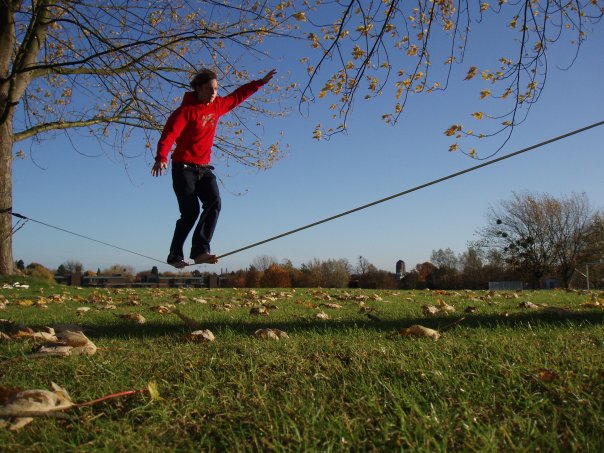
Slacklining is walking, running or balancing along a suspended length of flat webbing that is tensioned between two anchors. Slacklining is similar to slack rope walking and tightrope walking. Slacklines differ from tightwires and tightropes in the type of material used and the amount of tension applied during use. Slacklines are tensioned significantly less than tightropes or tightwires in order to create a dynamic line which will stretch and bounce like a long and narrow trampoline. Tension can be adjusted to suit the user, and different webbing may be used in various circumstances.

Styles of slacklining

[edit]
Slacklining on a beach

Tricklining

[edit]

Tricklining has become the most common form of slacklining because of the easy setup of 2-inch (5 cm) slackline kits. Tricklining is often done low to the ground but can be done on highlines as well. A great number of tricks can be done on the line, and because the sport is fairly new, there is plenty of room for new tricks. Some of the basic tricks done today are walking,[1] walking backwards, turns, dropping knee, running and jumping onto the slackline to start walking, and bounce walking. Some intermediate tricks include: Buddha sit, sitting down, lying down, cross-legged knee drop, surfing forward, surfing sideways, and jumping turns, or "180s". Some of the advanced tricks are: jumps,[2] tree plants, jumping from line-to-line, 360s, butt bounces, and chest bounces. With advancements in webbing technology and tensioning systems, the limits of what can be done on a slackline are being pushed constantly. It is not uncommon to see expert slackliners incorporating flips and twists into slackline trick combinations.

Highlining

[edit]
Man highlining at Taft Point in Yosemite National Park with El Capitan in the background.

Highlining is slacklining at an elevation above the ground or water. Many slackliners consider highlining to be the pinnacle of the sport. Highlines are commonly set up in locations that have been used or are still used for Tyrolean traverse. When rigging highlines, experienced slackers take measures to ensure that solid, redundant and equalized anchors are used to secure the line into position. Modern highline rigging typically entails a mainline of webbing, backup webbing, and either climbing rope or ultra-high-molecular-weight polyethylene rope for redundancy. However, many highlines are rigged with a mainline and backup only, especially if the highline is low tension (less than 4,000 N (900 lbf)), or rigged with high quality webbing like Type 18[3] or MKII Spider Silk.[4] It is also common to pad all areas of the rigging which might come into contact with abrasive surfaces. To ensure safety, most highliners wear a climbing harness or swami belt with a leash attached to the slackline itself.[5] Leash-less, or "free-solo" slacklining – a term loosely taken from rockclimbing ("free" refers to free of aid equipment vs free from the slackline) – is not unheard of, however, with proponents such as Dean Potter and Andy Lewis.[6]

Rodeo lines

[edit]

Rodeo slacklining is the art and practice of cultivating balance on a piece of rope or webbing draped in slack between two anchor points, typically about 15 to 30 feet (455 to 915 cm) apart and 2 to 3 feet (60 to 90 cm) off the ground in the center. This type of very "slack" slackline provides a wide array of opportunities for both swinging and static maneuvers. A rodeo line has no tension in it, while both traditional slacklines and tightropes are tensioned. This slackness in the rope or webbing allows it to swing at large amplitudes and adds a different dynamic. This form of slacklining first came into popularity in 1999, through a group of students from Colby College in Waterville, Maine. It was first written about on a website called the "Vultures Peak Center for Freestyle and Rodeo Slackline Research" in 2004. The article "Old Revolution—New Recognition - 3-10-04" describes these early developments in detail.

Urbanlining

[edit]

Urbanlining or urban slacklining combines all the different styles of slacklining. It is practiced in urban areas, for example in city parks and on the streets. Most urban slackliners prefer wide 2-inch (5 cm) lines for tricklining on the streets, but some may use narrow (58 or 1 inch, 1.6 or 2.5 cm) lines for longline purposes or for waterlining. Also see the other sections of slackline styles below.

One type of urbanlining is timelining, where one tries to stay on a slackline for as long as possible without falling down. This takes tremendous concentration and focus of will, and is great endurance training for postural muscles.

Slackline handstand

Another type of urbanlining is streetlining, which combines street workout power moves with the slackline's dynamic, shaky, bouncy feeling. The main aspects include static handstands, super splits—hands and feet together, planche, front lever, back lever, one arm handstand and other unusual extreme moves that are evolving in street workout culture.

History

[edit]

While rope walking has been around in one manner or another for thousands of years, the origins of modern-day slacklining are generally attributed to a rock climber named Adam Grosowsky from southern Illinois in 1976 when he was 16.[7] In 2012 a slackline performance by Andy Lewis was featured as part of the halftime show by Madonna.[8] It got attention during the 2016 Rio Olympics when slackliner Giovanna Petrucci performed on the beach at Ipanema, attracting the attention of The New York Times.[9]

A professional slackliner was credited with climbing a ski lift tower in Colorado and shimmying across a cable to save a man caught by a ski lift in January 2017.[10]

Highlining history

[edit]

Highlining was inspired by highwire artists. The first successful highline walk is credited to 20-year-old Scott Balcom and 17-year-old Chris Carpenter, who performed the first documented walk on a nylon webbing highline. This highline, now referred to as 'The Arches', was approximately 30 feet (9 m) long and 120 feet (35 m) high located in Pasadena, California.[11][12][13] On July 13, 1985, Scott Balcom successfully crossed the Lost Arrow Spire highline.[14][15] In 1995, Darrin Carter performed unprotected crossings of the Lost Arrow Spire in Yosemite and The Fins, in Tucson, Arizona, on Mt. Lemmon highway.[11] On July 16, 2007, Libby Sauter became the first woman to successfully cross the Lost Arrow Spire.[16] In 2008, Dean Potter became the first person to BASE jump from a highline at Hell Roaring Canyon [d] in Utah.[17]

World records

[edit]

Longest highline

[edit]

The record was set by four athletes between July 4 and July 6, 2021. Friedi Kühne, Lukas Irmler, Quirin Herterich and Ruben Langer (all from Germany) crossed a 2.1-kilometre (1.3 mi) slackline suspended more than 500 metres (1,600 ft) high between the Lapporten mountains near Abisko, Sweden.[18] All of them walked this line from beginning to end without falling, taking times from approximately 70–180 minutes.[19]

Longest free solo highline

[edit]

At a length of 110 m and a height of 200 m, the longest free solo highline was walked at the Verdon Gorge in Southern France by German Slackliner Friedi Kühne.[20] The longest free solo highline by a female is held by Lucia Bryn,[21] who walked a 33-meter-long highline in Yosemite, California, USA, on 7 July 2022. The line was 80 meters high.[22]

Highest slackline

[edit]

The highest slackline on record was walked by Christian Schou on August 3, 2006, at Kjerag in Rogaland, Norway. The slackline was 1,000 metres (3,281 ft) high. The project was repeated by Aleksander Mork in September 2007. Rafael Zugno Bridi currently holds the world record who walked a slackline between two hot air balloons.[23]

In 2015, Stephan Siegrist performed a slackline walk in the summit area of Mount Kilimanjaro at an altitude exceeding 5,500 meters above sea level. [24]

The current world record for the highest urban highline is held by Friedi Kühne, Mia Noblet, Gennady Skripko, Vladimir Murzaev, Maksim Kagin, Alexander Gribanov, and Nathan Paulin. All seven athletes managed to walk a 220 m-long, 350 m-high slackline between Oko Tower and Neva Tower 2 in Moscow, on September 7, 2019.[25]

Longest slackline (longline)

[edit]

The longest slackline walked by a woman, with a length of 305 metres (1,001 ft), was walked by Annalisa Casiraghi across a field in Schüpberg near Bern, Switzerland. The previous record had been set in September 2014 by Laetitia Gonnon, who walked 230 m (754 ft 7.1 in) in Lausanne, Switzerland.[26]

Longest blindfolded slackline walk

[edit]

On 28 April 2019 in Kislovodsk, Russia, Friedi Kühne and Lukas Irmler from Germany walked a 975 m-long, 200 m-high slackline entirely with their eyes closed, ensuring this with a blindfold strapped over their eyes. Thus they broke the world record for the longest blindfolded slackline walk.[27]

Incidents and risks

[edit]

The International Slackline Association (ISA) began tracking accidents and incidents of the sport in 2009. As with other extreme sports, slacklining carries risks, and participants have experienced injuries and death as a result. As of 2025, the ISA has recorded 10 highline deaths and 3 trickline deaths. Two of the trickline fatalities were suffered by bystanders. Longline, waterline and Starter kit accidents have resulted in one death per activity.[28] Other risks are associated with slacklining that are not tracked by the organization. They include deaths that have occurred while scouting routes, or falls while approaching highline anchors. Slacklines have been banned in some municipalities for their propensity to damage trees and structures.[29][30][31] Some notable slacklining incidents include:

  • 16 May 2025 – a 22-year-old Canadian highliner died after falling 80 m at a highline gathering near Squamish, B.C. She reportedly had untied herself from her highline and forgot to re-tie her leash.[32]
  • 15 July 2022 – a 4-year-old child died when the tree that he was slacklining from fell on top of him in Jefferson County, Colorado.[33]
  • 25 August 2013 – a 24-year-old cyclist died when they ran into an unattended slackline on the campus of Utah State University.[34] In 2015, California Polytechnic State University, San Luis Obispo regulated slacklining on campus in an effort to protect trees and students in response to this incident.[35]

See also

[edit]

References

[edit]
[edit]
Revisions and contributorsEdit on WikipediaRead on Wikipedia
from Grokipedia
Slacklining is a dynamic balancing sport in which participants walk, run, or perform tricks on a narrow band of synthetic webbing, typically 2–5 cm wide, that is tensioned between two fixed anchors such as trees or poles, creating a sagging and elastic line that requires constant neuromuscular adjustments to maintain stability. Unlike traditional tightrope walking, which uses rigid wire, slacklining's inherent bounce and stretch demand proprioceptive feedback and core engagement for balance. The sport originated in the early 1980s among rock climbers in , , where Adam Grosowsky and Jeff Ellington innovated the practice using climbing webbing and gear as a recreational and training activity to mimic balance challenges faced on rock faces. It evolved from earlier informal rope-walking traditions dating back thousands of years but gained modern distinction through its accessibility and low equipment needs, spreading globally from Yosemite's climbing community in the 1970s–1980s. By the mid-2000s, slacklining surged in popularity in with the commercialization of beginner-friendly kits, leading to organized events and the formation of the International Slackline Association in 2015 to standardize rules and safety. Slacklining encompasses diverse styles tailored to skill levels and environments, including low-ground tricklines for on taut, bouncy setups; longlines exceeding 30 meters for ; and highlines at elevated heights, often over cliffs or between balloons, with safety leashes to mitigate fall risks. Freestyle variants emphasize flips and mounts, while speedlines focus on rapid traversal, as seen in annual world championships since 2008. The sport's growth is evident in recent records, such as the highest slackline walk at 2,500 meters between hot-air balloons in on November 9, 2024, and ongoing international rankings for disciplines like freestyle highline. Beyond recreation, slacklining serves therapeutic purposes by enhancing balance, core strength, and neuromuscular coordination, with studies showing benefits for rehabilitation in conditions like , knee injuries, and neurological disorders such as . Its low-impact nature makes it suitable for diverse populations, including seniors and athletes, though participants must prioritize proper to avoid injuries from falls or failure. Today, slacklining communities thrive worldwide, blending adventure, , and fitness in urban parks, festivals, and extreme terrains.

Fundamentals

Definition

Slacklining is the practice of balancing, walking, running, or performing on a suspended length of flat tensioned between two anchors. The is typically 2 to 5 cm wide and constructed from synthetic fibers such as or , enabling dynamic sag and bounce that contrasts with the rigid stability of traditional tightropes. This activity centers on core principles of for body position awareness, core to control equilibrium, and mental focus to manage instability through cognitive strategies. Slacklining evolved from practices as a balance method but has developed into a distinct standalone emphasizing dynamic neuromuscular control. The term "slacklining" was coined in the early 1980s by climbers Adam Grosowsky and Jeff Ellington to describe the deliberate slack in the tensioned line, differentiating it from high-wire performances.

Equipment and Setup

Slacklining requires specific equipment designed for safety, durability, and adjustability, with core components centered around high-strength flat webbing, secure anchors, and effective tensioning mechanisms. The primary material is tubular nylon webbing, typically 1 to 2 inches (25 to 50 mm) wide to provide a stable walking surface while minimizing bounce for beginners. For novice setups, webbing lengths of 30 to 100 feet (10 to 30 meters) are recommended, allowing for lines spanning 10 to 30 meters between anchors after accounting for attachment points. This webbing must have a high breaking strength, typically 5,000 to 11,000 pounds (2,300 to 5,000 kg), to handle tensions up to several thousand pounds without risk of failure. Anchors form the foundation of any slackline setup and are selected for their stability and ability to withstand lateral forces, such as sturdy trees with diameters of at least 12 inches (30 cm), metal posts, or rock bolts in more permanent installations. To prevent damage to natural anchors like trees, protective padding such as rubber mats or specialized tree protectors—thick, wide sleeves of or carpet—are wrapped around the bark before securing the . In urban environments lacking trees, ground pads made of dense or rubber are used beneath anchors to distribute and protect surfaces like pavement. Tensioning systems enable the line to be pulled taut while allowing for adjustments, with primitive setups commonly using ratchet straps similar to those for securing cargo, providing up to 2,000 pounds (900 kg) of tension. For more advanced or longer lines, primitive line-lockers constructed from carabiners, prusik cords, and pulleys create a 3:1 , reducing the effort needed to achieve desired tension. Weather-resistant materials, such as UV-stabilized blends for the and corrosion-resistant hardware like aluminum carabiners, are essential for outdoor use in varied conditions to prevent degradation from sun exposure or moisture. The setup process begins with selecting anchor points 33 to 100 feet (10 to 30 meters) apart at the same height to ensure line, ideally in a flat, open area free of obstacles. The is then threaded through the tensioning system at one end and secured to the anchors using loops or shackles, with backups like secondary ropes or additional attached in parallel to provide against failure. Tension is applied gradually using the ratchet or locker until the line achieves the desired sag—approximately 1.5 to 3 meters (5 to ) for a 30-meter line—creating the characteristic bounce essential for balance without excessive instability. Final checks include testing the anchors for movement and ensuring all connections are double-secured before use.

Basic Techniques

Beginners typically mount the slackline from one end using either a "butt scoot" method, where they sit on the line and propel themselves forward with hands and feet while keeping the body low, or a side step approach, stepping sideways onto the line with one foot while the other remains on the ground for support. Once mounted, practitioners engage their core muscles to stabilize the body and extend their arms outward or slightly upward as a counterbalance to the line's natural sag and oscillation. Core skills revolve around heel-to-toe walking, where the of the leading foot is placed directly in front of the toes of the trailing foot to maintain a narrow base of support and minimize wobbling. Maintaining forward momentum is essential to counteract the line's sag, as stopping abruptly increases instability; practitioners focus their on a fixed point ahead to aid balance through gaze fixation rather than looking down at their feet. Safe dismounting involves either sitting back down on the line and scooting off or jumping lightly to the ground while keeping knees bent to absorb impact. For progression, beginners should start on shorter lines under 15 meters that are tensioned tightly to reduce sag and bounce, allowing for easier balance. Building endurance comes from repeated short walks, gradually increasing duration and distance as confidence grows, rather than attempting full traverses immediately. Common beginner errors include over-gripping the line with toes or hands, which tenses the body and hinders fluid movement, and leaning too far forward or sideways, which exacerbates falls.

Styles

Tricklining

Tricklining is a dynamic style of slacklining that emphasizes acrobatic maneuvers and aerial tricks performed on low-to-the-ground lines, typically set between 0.3 and 2 meters above the surface to minimize risk while allowing for safe falls. These lines are usually 15 to 25 meters in length and tensioned tightly to produce minimal sag, creating a responsive bounce that facilitates flips, spins, and other high-energy movements without excessive . The setup contrasts with static walking by prioritizing from bounces, enabling performers to execute sequences of tricks rather than maintaining balance over distance. Key tricks in tricklining progress from foundational balance adjustments to complex aerial feats, building on basic walking skills as a prerequisite. Basic tricks include backward walking, which involves facing away from the direction of travel while stepping heel-to-toe; turns, such as pivoting 180 degrees on the line; and bounce walking, where practitioners use small jumps to maintain rhythm and forward progress. Intermediate maneuvers incorporate body positions like the Buddha sit, a cross-legged perch achieved by dropping to the line and crossing the ankles; lying down, transitioning to a supine position while keeping the body centered; and knee drops, landing on one or both knees after a brief dismount. Advanced tricks demand precise timing and strength, such as the front flip, a forward somersault initiated from a bounce; side flip, rotating laterally in the air before landing; and double-knee landings, where both knees impact the line simultaneously after an aerial twist. Training for tricklining focuses on progressive skill-building with safety measures to handle frequent falls, starting with spotters—assistants who provide physical support or cushion impacts—and padded surfaces like mats or foam under the line to protect against hard landings. Practitioners emphasize timing bounces for momentum, beginning with simple rebounds like the butt bounce (landing seated after jumping off the line) before chaining tricks into fluid combinations. This progression is often showcased in competitions, such as freestyle events organized by the International Slackline Association, where athletes perform judged routines or battle in team formats, earning points for creativity, difficulty, and execution on lines up to 34 meters long.

Highlining

Highlining is a specialized form of slacklining conducted at elevations exceeding 10 meters above the ground or over natural voids, such as cliffs or canyons, introducing profound exposure and environmental variables like wind that demand advanced balance and focus. These setups typically span 50 to 300 meters in length, utilizing tubular nylon webbing tensioned between anchors on rock formations to create a dynamic, sagging line that amplifies the physical and mental challenges compared to ground-level slacklining. Safety is paramount, with all rigging components requiring redundancy—such as a backup rope or secondary webbing alongside the primary line—and participants secured via a dynamic leash, a 3-4 meter rope tethered to a climbing harness, to arrest falls without ground impact. Techniques in highlining emphasize deliberate, controlled movements to mitigate the line's pronounced sag and external perturbations; walkers progress slowly, often mounting via sit-starts or from the edges, and prioritize steady breathing to maintain equilibrium amid gusts and vertigo-inducing drops. Falls, known as "leash falls," involve the participant being caught by the harness while the line rebounds dramatically, necessitating prior ground-based practice to acclimate to the jolt and recovery process. Rigging draws from standard slackline principles but adapts with edge protection, doubled anchors, and prusik loops for self-rescue, ensuring the system withstands dynamic loads up to several kilonewtons. Prominent environments for highlining include dramatic natural landscapes, such as the sandstone arches and canyons near , where lines are strung across expansive voids for heights up to 100 meters, and Yosemite National Park's , a 60-meter detached pillar offering a historic venue at over 900 meters above the valley floor. The practice evolved from low-level slacklining in the , with the inaugural successful crossing achieved by Scott Balcom on July 13, 1985, at using a basic strap with a safety leash, marking the shift toward elevated risk. By the early , figures like advanced the discipline through untethered walks and BASE-integrated variants, catalyzing global interest and technical refinements around 2003. Psychological demands are acute, requiring extensive mental conditioning to override fear responses, often through progressive exposure on progressively higher practice lines before attempting exposed walks.

Rodeolining

Rodeolining is a dynamic style of slacklining characterized by extremely low or no tension in the line, resulting in a highly saggy setup that behaves like a bouncy, unstable surface akin to a . The line typically features a sag of around 20-30% of its length, often rigged with minimal anchoring to form a pronounced U-shape, with the only tension provided by the slackliner's body weight. Common setups use short lines measuring 10-20 meters, positioned at ground level or low heights to emphasize vertical movement and instability without the risks of elevation. This configuration allows for extreme bounces and rapid oscillations, demanding strong leg muscles and quick reflexes to maintain balance amid the constant motion. Techniques in rodeolining focus on adapting to the line's wild instability through mounting methods like jumping onto the center, where the deep sag absorbs impact and launches the practitioner upward. Once mounted, performers engage in surfing motions—shifting weight side-to-side to ride the waves of bounce—or execute rolls such as front rolls, back rolls, and side rolls to transition positions and recover equilibrium. Side bounces involve lateral pushes against the line to generate horizontal propulsion while managing vertical rebounds, often requiring practitioners to brace for sudden snaps or shifts in the webbing. Drops, typically initiated from low platforms or the line itself, exploit the sag for controlled descents that build into larger bounces, enhancing recovery skills from off-balance states. Rodeolining serves primarily as a tool for developing dynamic balance and , often practiced in parks, gyms, or flat outdoor spaces to simulate unpredictable conditions. Unlike tricklining, which relies on moderate tension for precise horizontal like flips, rodeolining prioritizes vertical and raw instability to hone reflexes and leg strength in a trampoline-like environment. This approach aids in preparing for more advanced styles by improving adaptation to extreme line movement.

Longlining and Other Variations

Longlining involves walking slacklines exceeding to 40 meters in length, often extending to several hundred in remote or open terrains, which demands heightened and sustained mental focus compared to shorter setups. Practitioners must gradually build stamina through repeated walks without breaks, starting on lines around meters and progressing to longer spans while maintaining steady pacing to conserve energy and prevent fatigue. Techniques emphasize controlled mounting, such as swinging onto the line or using a seated start, followed by deliberate steps that prioritize balance over speed, with hydration and physical warm-ups essential to sustain sessions that can last hours. Wind interference poses a significant challenge on extended lines, mitigated by attaching dampeners—short pieces of taped at intervals along the line—to reduce vibrations and oscillations caused by gusts. Higher tension, often achieved through systems as referenced in basic setups, is required for spans over 50 meters to minimize excessive sag and support walker stability. Urbanlining adapts slacklining to city environments, rigging lines between structures like lampposts, buildings, or park fixtures to integrate the practice into public spaces. This variation blends elements of walking and dynamic movement, often performed for audiences in urban parks or streets, fostering while navigating permissions and urban constraints such as traffic or crowds. Setup requires assessing points for and , with lines typically shorter than longlines but elevated to avoid pedestrians, enhancing the performative aspect in bustling settings. Speedlining emphasizes the fastest possible traversal of a line, often on long or high setups, with competitions timing completions since , requiring explosive power and precise footwork. Other variations expand slacklining's adaptability to unique contexts. Waterlining positions the line over bodies of , providing soft landings that encourage experimentation with balance and movement without fear of hard impacts, suitable for both walking and dynamic styles on beaches or lakes. Yogalining incorporates poses, such as or warrior, directly on the line to cultivate , core strength, and , transforming the practice into a meditative flow that holds positions for extended durations. Wind slacklining, common in outdoor exposures, involves real-time adjustments like leaning into gusts or relying on dampeners to counteract line sway, allowing sessions in variable weather while building resilience to environmental perturbations. These variations enhance accessibility by leveraging basic techniques in diverse settings, from urban festivals where urbanlining draws crowds to coastal beaches ideal for waterlining, enabling participants to progress from foundational skills to specialized practices without specialized venues.

History

Origins and Early Development

Slacklining traces its conceptual roots to ancient practices of funambulism, or tightrope walking, which date back to approximately 20,000 BC in regions including pre-ancient Greece, China, and Korea, with documented evidence in Cycladic pottery from around 3000 BC and inclusion in the Greek Olympic Games by 776 BC. These early rope-walking activities, often performed for entertainment or practical purposes like crossing gorges, involved balancing on suspended lines and laid the groundwork for modern balance sports. In the and , rock climbers in began experimenting with similar balance practices as a form of training and recreation during downtime from climbing. Pioneers such as Pat Ament and Van Freeman introduced slack chains—50- to 60-foot lengths of chain suspended between anchors—to Yosemite around 1968 or 1969, allowing climbers to practice equilibrium on low-to-the-ground setups in Camp 4. Climber Chuck Pratt also participated in these early sessions, demonstrating advanced balance by while standing on the chain. These experiments evolved from using climbing ropes to more elastic materials, providing a safer alternative for honing focus and stability essential to big-wall climbing. The founding moment of modern slacklining occurred in the early at Camp 4 in Yosemite, where climbers Adam Grosowsky (also known as Sky) and Jeff Ellington innovated by rigging tubular climbing between trees, creating a dynamic line for fun and physical recovery after strenuous ascents. This setup marked a shift from rigid chains to flexible , which offered greater bounce and required constant micro-adjustments for balance. Grosowsky coined the term "slackline" during this period, distinguishing it from tighter wire-walking traditions, with the first documented uses appearing around 1981. Early spreading of the activity in the late and early involved grassroots experiments by Yosemite climbers like Jeff Ellington, who refined techniques using primitive gear such as carabiners for tensioning the between anchors. These low-tech methods, often involving just four carabiners and anchor slings, allowed for quick setups and contributed to the sport's initial popularity within the climbing community.

Evolution and Popularization

During the 1990s and early 2000s, slacklining evolved from its roots among Yosemite climbers to a more accessible practice, with a key technological shift toward wider flat , typically 2 inches (5 cm) in width, which allowed for greater stability and enabled the development of tricklining and highlining variations. This transition from earlier tubular climbing improved the line's elasticity and forgiveness, facilitating broader adoption. Communities began forming in the United States, centered around , and in , particularly in , , and , where enthusiasts organized informal gatherings and shared techniques. Highlining gained traction in during this period, with early setups in mountainous regions like the , building on the sport's American origins. The popularization of slacklining accelerated in the mid-2000s through and commercial innovations. The launch of in 2005 enabled the rapid sharing of instructional and trick videos starting around 2006, exposing the sport to a global audience and inspiring amateur participation. In 2007, Robert Kaeding and Stefan Lippert founded Gibbon Slacklines, introducing the first commercial slackline kits with user-friendly ratchet systems, which democratized setup and contributed to widespread recreational use. The sport's inclusion in extreme sports festivals, such as the UK's inaugural Slackline Masters competition in 2008, further boosted visibility and competitive interest. Slacklining's global development expanded significantly in the , with notable growth in influenced by traditional practices like Korea's Jultagi , which shares elements of balance and performance and inspired adaptive techniques in regions like . In , the formation of the International Slackline Association (ISA) in 2015 by national federations from , , , and the U.S. standardized safety guidelines and organized international events, fostering structured growth. During this decade, digital tools like mobile apps for setup guidance and online tutorials proliferated, making learning more accessible and supporting the sport's integration into fitness and wellness communities worldwide.

Achievements and Records

Longest Slacklines

The pursuit of the longest slacklines represents a pinnacle of in slacklining, where athletes push the limits of physical and mental stamina over extreme horizontal distances, often spanning kilometers. These feats distinguish between low-level longlines, typically rigged near the ground in controlled environments, and highlines, which combine with significant . As of 2025, official verified for complete sends have exceeded 3 kilometers, particularly in highline contexts, while ambitious attempts have tested even longer lines. The current verified record for the longest slackline walk, ratified by the International Slackline Association (ISA), stands at 2,710 meters, achieved in August 2022 by Julien Roux, Augustin Moinat, and a team in the region of . This low-altitude longline, rigged across a at minimal height, required over two hours of continuous balancing and marked a significant in controlled, ground-proximate setups. Such longlines demand rigorous , including progressive distance practice and core strengthening, to manage the line's pronounced sag and bounce over extended periods. In contrast, the longest sent highline record was set on October 25, 2024, by American slackliner Danny Schlitt, who completed a 3,042-meter walk at approximately 200 meters above the ground in Thacker Pass, . This send, executed during a brief of calm winds after days of challenges, highlights the added complexities of highlines, such as amplified sway from elevation and environmental factors like gusts, necessitating advanced wind management techniques and harness backups for . The walk took several hours, underscoring the multi-hour commitments typical of kilometer-scale efforts. Notable attempts have pushed boundaries further, including Estonian athlete Jaan Roose's July 2024 challenge across the Strait of Messina, where he traversed a 3,646-meter line over water— the longest ever rigged—but fell 80 meters short of a complete send before resuming and reaching the endpoint after a rest. This unsanctioned feat, starting from a 265-meter tower and battling winds and heat for nearly three hours, surpassed prior distances but did not qualify as an official record due to the interruption. Historical progression in longlining has evolved rapidly: early 1990s lines rarely exceeded 100 meters in amateur setups, advancing to sub-kilometer marks by the early 2000s through improved rigging materials like Dyneema webbing, and reaching multi-kilometer scales by the 2020s with team-supported projects emphasizing fatigue resistance and psychological focus.

Highest Slacklines

The highest slackline walk ever recorded stands at an altitude of 2,500 m (8,202 ft), achieved by German slackliners Lukas Irmler and Friedi Kühne on , 2024, when they traversed a line suspended between two hot-air balloons over Riedering, . This Guinness World Record feat involved a 20 m (66 ft) slackline rigged at a stable height above the ground, marking a pioneering aerial experiment in the sport. The walk demanded precise coordination with balloon pilots to maintain tension amid wind and thermal currents, highlighting advancements in mobile rigging systems for elevated setups. Fixed highlines in mountainous terrain represent another pinnacle of elevation-focused achievements, often exceeding 3,000 m above sea level despite varying drops below the line. For instance, in 2016, slackliners Pablo Signoret, Rafael Bridi, and Guilherme Coury completed a 200 m highline at approximately 3,000 m altitude in the , navigating exposed ridges and unpredictable weather to establish one of the longest such walks at that elevation. Similarly, Monte Brento in serves as a renowned site for highlines around 1,500 m altitude with drops up to 160 m, where athletes like Simon Vaccari have combined slacklining with for added complexity. These setups underscore the blend of and balancing, with lines anchored to natural features like cliffs or spires. At elevations above 3,000 m, participants contend with , diminished oxygen levels affecting cognitive function and equilibrium, and extreme cold that stiffens material. The progression of highest slacklines has evolved from modest cliff drops in the early —typically around 100 m over accessible terrain—to ambitious aerial and ultra-high-altitude ventures today. Early experiments in the , like the iconic 1985 Lost Arrow Spire crossing at about 900 m drop in Yosemite, laid foundational techniques, but it was the that saw systematic pushes toward taller exposures using anchors and backup leashes. By the , innovators adapted equipment for extreme environments, including weather-resistant and dynamic tensioning for mountain setups. Recent aerial innovations, such as hot-air balloon rigging with onboard stabilizers, have enabled unprecedented elevations without fixed terrain, expanding possibilities while amplifying risks from instability and hypoxia.

Specialized Records

Specialized records in slacklining encompass niche feats that modify the standard walking technique, such as blindfolded crossings or leash-free highlines, emphasizing mental acuity and trust over mere physical endurance. These achievements push the boundaries of balance under altered conditions, often verified by the International Slackline Association (ISA) or Guinness World Records. One prominent category involves blindfolded walks, which deprive participants of visual cues and force reliance on proprioception and line tension. The current ISA-verified record for the longest blindfolded slackline walk is 1,712 m (5,615 ft), achieved by Alexander Schulz (Germany) on November 30, 2021, over Cañón del Sumidero in Chiapas, Mexico, at approximately 800 m height. Earlier, in 2017, French slackliner Pablo Signoret achieved a Guinness-recognized 422.82-meter blindfolded highline in China, taking 25 minutes and 6.7 seconds amid strong winds. These records highlight the progression in distance for such sensory-challenged walks. Free-solo highlines represent another extreme, where athletes walk without a leash, amplifying the psychological risk of an unprotected fall. The current ISA-verified male record stands at 300 meters, set by French slackliner Philippe Soubies in 2021 over a line suspended 55 meters above the ground in Basque Country, . This feat surpasses earlier marks, such as Friedi Kühne's 110-meter free-solo highline in the , , in 2017, which was conducted at 250 meters high. The absence of a tether demands absolute focus and commitment, turning each step into a high-stakes gamble. Speed records test rapid traversal under controlled conditions, prioritizing velocity while maintaining balance. In 2023, Chinese Shi Hailin established the for the fastest 100-meter slackline walk, completing it in 1 minute and 14.198 seconds on a standard urban setup. Such achievements require explosive yet precise movements, contrasting the deliberate pace of longer traverses. records push the limits of sustained presence on the line. On May 2–3, 2025, a team including Antoine Mesnage () set a new ISA-recognized for the longest highline, maintaining balance for 24 hours on a line in . This caritative project involved multiple s and highlighted extreme fatigue management in elevated conditions. These specialized endeavors present unique challenges: blindfolded walks induce disorientation from , compelling athletes to interpret subtle vibrations and body feedback alone, while free-solo efforts cultivate profound psychological trust in one's abilities without fallback safety. Verification typically involves ISA oversight for equipment standards and video documentation, or Guinness adjudication for global recognition, ensuring claims meet rigorous criteria like no falls and proper . The evolution of specialized records traces back to the , when integrations from tricklining began influencing high-risk variations, such as early blindfolded attempts around 400 meters. By the , feats expanded to extreme conditions, including illuminated night walks like Jaan Roose's 2023 crossing of a 150-meter LED-lit slackline between Qatar's at 195 meters high, blending visibility challenges with urban spectacle. This progression reflects growing technical innovation and athlete daring, verified through established bodies.

Safety and Risks

Common Injuries and Incidents

Slacklining, while generally considered a low-risk activity compared to many extreme sports, is associated with a range of injuries primarily resulting from falls, line interactions, and equipment issues. Common injuries include fractures, which accounted for 25% of reported cases in a 2015 analysis of 64 injuries, often occurring in ankles or wrists from direct impacts during falls. Sprains and dislocations, comprising 25% of incidents (12.5% each), frequently affect fingers, wrists, and knees due to awkward landings or catches on backup systems. Friction-related injuries, such as slackrash—abrasions and burns from skin contact with the taut —are prevalent in lighter cases, alongside contusions and bruises to legs, arms, and the area. Whip injuries from line rebounds during leash falls can cause severe trauma, including ruptures and broken bones in extremities like fingers, feet, arms, legs, collarbones, and ribs. Notable incidents highlight the potential severity, particularly in highlining. Fatalities are rare but have occurred, with the International Slackline Association (ISA) documenting 11 highline deaths between 2009 and 2025, all attributed to such as failure to attach the , including gear failures such as misuse in a 2011 Slovenian incident and not tied to the harness in a 2025 Canadian highline fall. Near-misses from anchor slips and UV-degraded have been reported, though gear failures remain uncommon overall. Tricklining represented 34.7% of cases in 2015 data despite comprising only 17.8% of participation, showing the highest rates among disciplines due to dynamic movements. Additional fatalities include a 2025 Brazilian and a 22-year-old in a Vancouver-area fall, underscoring risks in elevated setups. The primary causes of accidents stem from human factors and environmental conditions. Falling off the line was responsible for 43.5% of injuries in the 2015 ISA report, often exacerbated by overestimation of ability or inadequate skills in handling falls. Improper setup, including errors, contributed to 13% of incidents, such as insufficient tension or instability. Environmental factors like and unfavorable also play a role, particularly in highlining, where they can lead to uncontrolled leash falls. Overall, the death risk in slacklining is low; for longlining, it stands at 0.003 per 1,000 participants over 18 years, comparable to mountain biking's 0.0035 rate and lower than skydiving's 0.009.

Safety Practices and Mitigation

Slackliners adhere to rigorous rigging standards established by the International Slackline Association (ISA) to ensure structural integrity and prevent equipment failure. The ISA:21 Highline System Standard specifies minimum breaking strengths, recommending 48 kN for the mainline and 24 kN for backup anchors, effectively providing a 2:1 safety factor to accommodate dynamic loads. Backups, such as static or dynamic ropes tied with knots around metal components, are mandatory to create redundancies in the system. Regular inspections are essential, focusing on signs of wear from UV exposure, abrasion, or cyclic loading, with the ISA Safety Commission noting significant strength reductions in exposed webbing. For highlines exceeding 5 meters, personal protective equipment like harnesses and leashes is required to arrest falls, connected via certified carabiners and anchors. Training protocols emphasize progressive skill development to build balance and confidence safely. Practitioners begin on low, ground-level lines before advancing to elevated setups, with spotters positioned on either side for beginners to provide immediate support during falls. Environmental assessments are critical prior to rigging, including limits on wind speeds below 10 km/h and avoidance of stormy conditions to prevent instability or anchor shifts. Following the 2015 ISA Slackline Accident and Incident Report (SAIR), which analyzed low but notable injury rates from rigging errors and gear issues, recommendations include mandatory incident reporting via the SAIR form to inform ongoing safety improvements. Mitigation tools extend beyond rigging to encompass on-site preparedness and legal compliance. Primitive setups incorporate multiple redundancies, such as secondary anchor points and backup kits securing ratchets to trees or bolts. First-aid kits stocked for common fall-related issues, including splints for potential fractures, must be readily available at all sessions. Legal considerations involve obtaining permits for installations on public lands, as regulations in many areas restrict heights to under 2 meters without authorization to ensure public safety and liability coverage. These practices, informed by past incidents like anchor failures, collectively reduce risks in both recreational and advanced slacklining.

Community and Culture

Organizations and Competitions

The International Slackline Association (ISA), founded in August 2015 by national federations from , , , and the , operates as a non-profit, volunteer-based organization dedicated to promoting slacklining worldwide through enhanced communication, informational resources, safety standards, and education initiatives. As a federation, the ISA coordinates with member organizations to develop ranking lists, manage world records via its Sport Commission, and support community growth across disciplines like tricklining and highlining. In , Slackline U.S. functions as a key advocacy body, focusing on sustainable development of the slackline community by managing access to sites, promoting conservation efforts, and encouraging safe rigging and participation practices. National organizations like the Australian Slacklining Association (ASA) similarly represent regional interests, providing support for local communities, access protection, and development of slacklining activities throughout . Prominent competitions under these organizations include the annual Trickline World Cup in , , which has featured high-level events in tricklining and speed disciplines since 2012, drawing top athletes for individual and team battles at venues like Königsplatz. The ISA contributes to global competition oversight through its ranking system, which aggregates results from multiple events to determine annual winners in categories such as freestyle trickline. Highline-specific contests, such as the Highline World Championships organized by Swiss Slackline, emphasize elevated setups; the 2024 edition occurred in /Laax, , at an altitude of 2,250 meters on the Crap Sogn Gion summit, marking the second such event following the inaugural in 2022. Competition formats vary by discipline but commonly include team trick battles where athletes perform sequences judged on creativity and execution, speed events measuring the fastest full crossings, and highline sends evaluated primarily on successful completion with additional points for freestyle elements like one-footed maneuvers or drops. These events often integrate with ISA programs, including rigger training certifications that equip experienced participants with standardized skills for safe setup, permissions, and management in competitive and contexts.

Festivals and Events

Slacklining festivals and events serve as vital gatherings for enthusiasts worldwide, emphasizing through informal workshops, shared experiences, and celebratory performances rather than structured competitions. These events, often hosted by organizations like the International Slackline Association (ISA), promote skill-sharing and innovation in a relaxed atmosphere, drawing participants from diverse backgrounds to urban parks, natural landscapes, and cultural venues. With over 60 such festivals documented globally, they span continents and cater to all levels, from novices to experts, fostering a sense of global unity in the . One prominent example is the Urban Highline Festival in , , which began in 2009 and has since become the oldest highline event in , featuring urban rigs between historic buildings during the annual Carnaval Sztukmistrzów arts festival. Held each July, it attracts hundreds of slackliners for multi-day sessions focused on highline setups in city environments, blending the sport with street performances and cultural exhibitions. In , Gibbon Days at the company's headquarters transforms into a testing ground for gear, with workshops on tricklining and longlining techniques, scheduled from June 30 to July 6 in 2025 to encourage hands-on experimentation among attendees. In the United States, events like the Breathe – A Slackline & Discovery Festival in , exemplify regional gatherings that integrate slacklining with activities, held annually in July to support beginner progression through guided sessions. Typical activities at these festivals include beginner workshops teaching basic balancing and , communal group lines for collaborative practice, and impromptu performances that showcase creative flows on low or water lines. For instance, the 2025 ISA Safety Event in , , on August 18-19, highlighted gear innovations through seminars on webbing durability and rescue protocols, allowing participants to test advanced in a supportive setting. These hands-on elements ensure accessibility, with many events providing rental gear to lower barriers for newcomers. Beyond technical skill-building, festivals play a key cultural role in promoting inclusivity by welcoming diverse participants and integrating slacklining with artistic expressions, such as and . Initiatives like the Slackline October 2024 Photo Challenge encouraged community members to share images of their lines, boosting engagement and creativity through spotlights on everyday achievements. Events sponsored by , such as in Nashville in 2021, further exemplify this fusion by setting lines amid live scenes, turning slacklining into a performative art form that enhances urban cultural landscapes.

References

Add your contribution
Related Hubs
User Avatar
No comments yet.