Hubbry Logo
RoustaboutRoustaboutMain
Open search
Roustabout
Community hub
Roustabout
logo
8 pages, 0 posts
0 subscribers
Be the first to start a discussion here.
Roustabout
Roustabout
from Wikipedia
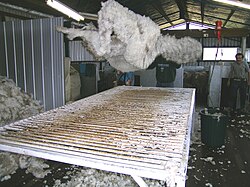
A roustabout throwing a freshly shorn fleece onto a wool table for skirting and classing.
Roustabouts unloading cotton from steamboat ca. 1900.

Roustabout (Australia/New Zealand English: rouseabout) is an occupational term. Traditionally, it referred to a worker with broad-based, non-specific skills. In particular, it was used to describe show or circus workers who put up tents and booths on fairgrounds. In modern times it is applied to rural employment, such as those assisting sheep shearing, and oil field work.[citation needed]

Oil industry in the U.S.

[edit]

Oil roustabout refers to a worker who maintains all things in the oil field. Roustabout is an official classification of natural gas and oil rig personnel.[citation needed] Roustabouts working in oil fields typically perform various jobs requiring little training. Drillers start off as roustabouts until they gain enough hands-on experience to move up to a roughneck or floorhand position, then to driller and rig supervisor.[1] Roustabouts will set up oil well heads, maintain saltwater disposal pumps, lease roads, lease mowing, create dikes around tank batteries on a lease, etc. An oil roustabout has no limits in the oil industry and can, and will do any and all oil field work, including roughneck drilling, oil well completion and well service, and even chemical work. An oil field roustabout will also do all things that an oil field pumper would have to do. However, they frequently turn out to be long-term employees and take on more difficult and sometimes dangerous jobs as they gain experience. Most go on to at least become “roughnecks” if they work for the rig company for more than a few months.

An early 2010 survey by Careercast.com of the best and worst jobs based on five criteria—environment, income, employment outlook, physical demands and stress—rated 'roustabout' as the worst job.[2] Nonetheless, the anecdotal and subjective experience of an actual roustabout suggests that for some, it can be a challenging, adventurous job.[3]

Australia and New Zealand

[edit]

In Australia and New Zealand a "rouseabout" can be any worker with broad-based, non-specific skills, in any industry. However, rouseabouts or "rousies" most commonly work in rural employment, especially sheep farming, as in the film The Sundowners, where they leave town before the sun goes down.

[edit]

The term was used in Disney's 1941 animated film Dumbo, during a musical scene in which depicted a group of African-American laborers pulling circus materials off the train for construction.

Roustabout was a 1964 musical movie starring Elvis Presley, Barbara Stanwyck, and Joan Freeman, in a story set in a traveling carnival — for which Presley recorded the song titled "Roustabout".

Farley Granger's character, Arthur "Bowie" Bowers, in Nicholas Ray's 1948 film noir They Live By Night, tells Catherine "Keeetchie" Mobley (Cathy O'Donnell) that he was a roustabout with a circus.

The term is used in the song "The Mariner's Revenge Song", by The Decemberists.

The term is also used by Beats Antique for two songs on their album Collide.

The Slamball team Rousties is named after a roustabout.

Roughnecks and Roustabouts is the second album by Pete Williams, formerly bassist and vocalist with Dexys Midnight Runners, and currently performing as The Pete Williams Band.[4]

See also

[edit]

References

[edit]
Revisions and contributorsEdit on WikipediaRead on Wikipedia
from Grokipedia
A roustabout is an unskilled or semiskilled who performs demanding manual tasks requiring but minimal specialized training, commonly in sectors such as and gas extraction, maritime shipping, and circus operations. The term originated in the mid-19th century, with its first known use around 1860, derived from "roust," an alteration of the verb "" meaning to awaken or drive roughly, reflecting the worker's role in rousing equipment, animals, or crews into action. In the oil and gas industry, roustabouts serve as entry-level workers on drilling rigs and production sites, where they assemble and repair using hand and power tools, conduct inspections during extraction activities, load and unload materials, and handle general maintenance to support skilled personnel without interrupting operations. These roles often involve hazardous conditions, including exposure to heavy machinery and remote fieldwork, making protocols a critical aspect of the job. Historically and traditionally, the occupation also encompasses maritime duties as a deckhand or longshoreman, involving handling, deck , and waterfront labor on ships or docks. In the entertainment industry, particularly with traveling circuses, roustabouts are responsible for erecting and dismantling tents, caring for animals, preparing grounds, and managing equipment transport, often as part of a nomadic . Across these contexts, roustabouts embody versatile, broad-based labor that supports more technical roles, though the position has evolved with mechanization, particularly in oilfields where it remains an essential starting point for career advancement in the energy sector.

Etymology and Definition

Etymology

The term "roustabout" derives from the verb "roust," an alteration of "," which in meant to shake or disturb, often in the sense of rousing someone from sleep or inactivity. This root reflects the word's association with rough, itinerant labor involving agitation or hasty movement. The noun form first appeared in around 1860, initially spelled "roust-about," denoting a common deck hand or wharf laborer engaged in menial, physically demanding tasks. Influenced by early 19th-century nautical and slang, the term evolved from British expressions like "rouse about," referring to general duties such as rousing members or handling on deck. By the mid-19th century, it gained traction in American contexts, including operations on the , where workers loaded and unloaded freight under grueling conditions, as evidenced in period literature. The word also entered circus vernacular around the same era, describing laborers who erected tents and managed equipment, marking its shift toward broader unskilled roles in traveling shows. Documented spelling variations emerged regionally; for instance, "rouseabout" appeared in by the mid-19th century (first known use in 1861), retaining a similar meaning for an unskilled hand in shearing sheds or rural labor, distinct yet parallel to the American form. This adaptation highlights the term's transatlantic migration and localization in colonial settings.

Definition

A roustabout is an entry-level manual laborer who performs a wide range of physically demanding, unskilled tasks across various industries, including oil and gas extraction, where they handle maintenance, cleaning, and general support duties on rigs or fields. This role emphasizes versatility, with workers often assisting in equipment handling, site preparation, and basic repairs without requiring specialized training. Unlike more specialized positions such as roughnecks or drillers, who focus on direct operations and require technical expertise in handling drilling equipment, roustabouts serve as generalist helpers supporting the broader workforce through labor-intensive, non-technical activities. Their contributions are foundational, ensuring operational efficiency without involvement in core extraction processes. In contemporary contexts, the term encompasses traditional applications like oil field upkeep alongside variants in , such as erecting and dismantling circus tents or caring for grounds and equipment, and in , particularly as farmhands or shearing shed assistants in regions like . This adaptability highlights the role's lack of formal qualifications, relying instead on physical stamina and willingness to undertake diverse manual work.

Historical Development

Origins in Labor and Entertainment

The term "roustabout" originated in mid-19th-century , denoting an unskilled itinerant who roamed in search of work, with early uses tied to wharf and deck hands in port cities like New Orleans. In the context of , it became synonymous with the rough-and-tumble workforce of traveling circuses across the and during the 1800s. These workers, often young men from rural backgrounds who ran away to join the shows, formed the backbone of circus operations, providing manual labor for the mobile "tented cities" that brought spectacles to small towns. Roustabouts erected massive tents by hammering stakes and raising poles—a process that could involve teams of up to 150 canvasmen dismantling and reloading the big top onto railcars in under 30 minutes after performances—while also unloading caged animals such as and lions from train cars, harnessing beasts to pull structures, and maintaining menageries with over 100 exhibits. Their duties extended to managing crowds during gratis parades and lot setups, where the unloading of exotic animals served as a public draw, though the work was transient, underpaid, and fraught with exploitation, including practices like "red-lighting" workers without wages. Parallel to circus labor, roustabouts played a pivotal role in the steamboat era on the from the mid-1800s onward, embodying the era's demand for brute-force deckhands amid the river's booming . These laborers, predominantly African American—both enslaved and free—handled the unloading of heavy like bales, , and at docks and levees, often working around the clock in teams of thousands across riverports. The job demanded relentless physical exertion, including hoisting massive loads under captains' oversight, with workers exposed to perilous conditions such as slippery decks, sudden floods, and the constant risk of drowning or injury from shifting freight. By the late , over 5,000 such roustabouts operated on the and its tributaries, their toil fueling the transport of Southern goods to Northern markets and underscoring the racial dynamics of antebellum and post-emancipation river labor. In agricultural settings, the roustabout tradition is more prominently associated with and during the , where the term evolved into "rouseabout" by the . These unskilled hands on vast sheep stations performed odd jobs like mustering , repairing fences, and assisting in shearing sheds—essential for the industry's expansion across the . This labor was grueling and nomadic, with rouseabouts often enduring isolation on remote properties, their work supporting the economy before altered rural hierarchies. Such early ties to laid the groundwork for the term's later adaptation in mechanized industries.

Evolution in Industrial Contexts

The role of the roustabout emerged prominently during the early 20th-century in the United States, particularly following the 1901 discovery at in , which marked the onset of large-scale production and rapid field expansion. At and subsequent fields, roustabouts served as unskilled laborers responsible for essential manual tasks such as ditch digging, pipeline laying to transport crude , and setting up drilling equipment amid chaotic growth that saw production surge from negligible levels to over 17 million barrels annually by 1902. This period transformed roustabouts from transient workers—often recruited from rural areas or prior industries—into a core component of the oil workforce, handling the physical demands of infrastructure development in environments that attracted thousands of laborers within months. Following , the roustabout role adapted to technological advancements and shifting operational demands, with mechanization in drilling rigs and support equipment reducing the intensity of purely manual tasks like heavy lifting and basic assembly. Innovations such as mobile jack-up rigs introduced in the 1950s and the widespread use of helicopters for offshore transport from 1954 onward streamlined , allowing roustabouts to focus more on technical maintenance and supply handling rather than exhaustive physical labor. Concurrently, the expansion of drilling to remote sites, including offshore platforms in the starting with Kerr-McGee's 1947 operation, heightened demand for versatile roustabout support in isolated environments, where crews managed equipment in challenging conditions far from shore. By the mid-20th century, the roustabout model spread globally as Western oil companies extended operations to new frontiers, influencing labor patterns through the integration of local and expatriate workers in regions like the and Canadian . In the , where production escalated from 1.1 million to over 18 million barrels per day between 1948 and 1972, American firms recruited diverse labor forces—including locals for manual field support akin to roustabout duties—blending U.S. practices with regional workforces to build pipelines and rigs under harsh desert conditions. Similarly, in Canada's postwar oil boom initiated by the 1947 Leduc discovery and accelerating into the by the 1960s, the role adapted to heavy extraction challenges, drawing mobile workers for equipment setup and site preparation in remote northern terrains, thereby standardizing semiskilled labor hierarchies across international operations.

Role in the Oil Industry

Duties and Responsibilities

Roustabouts in the oil industry perform a range of essential manual labor tasks to support drilling and production operations, primarily focused on equipment upkeep and site readiness. Their primary duties include cleaning and maintaining drilling equipment to prevent malfunctions and ensure operational efficiency, repairing pumps and valves using hand and power tools to address wear and tear, handling hoses and pipes by connecting, disconnecting, and transporting them across sites, and assisting in well site preparation through tasks such as digging drainage ditches and assembling basic structures. These activities demand close coordination with senior crew members to maintain workflow on rigs or production facilities. In daily operations, roustabouts perform well site construction, remediation, and cleanup, maintain site grounds and buildings, and install or repair oil tanks, , valves, pumps, motors, and pipelines. They also haul pipe and rods, inspect flow lines, and repair leaks. These responsibilities often involve working in hazardous environments, requiring constant vigilance to support uninterrupted operations. The role requires significant physical stamina, including heavy lifting and the ability to handle materials weighing 50 pounds or more, often with team assistance, as part of heavy labor demands. Roustabouts must proficiently operate basic tools like wrenches, , and shovels to execute tasks effectively. Adherence to safety protocols, such as lockout-tagout procedures during maintenance to isolate hazardous energy sources, is mandatory to mitigate risks from equipment and environmental hazards. These protocols align with U.S. (OSHA) standards for controlling hazardous energy in industrial settings.

Career Progression and Training

Roustabouts serve as entry-level positions in the oil and gas industry, often requiring no prior experience for hire. Most employers prefer candidates with a or equivalent, and applicants must typically be at least 18 years old to meet physical and safety demands. Training for roustabouts emphasizes on-the-job learning, where new hires shadow experienced workers to master basic tasks such as equipment maintenance and site cleanup. Essential preparations include safety certifications like OSHA 10-hour or 30-hour courses, which cover recognition and prevention in oilfield environments, often completed before or shortly after starting. Additional requirements frequently involve H2S training to handle exposure risks and basic certification for emergency response. Modern vocational programs and apprenticeships, such as the Roustabout Drilling Technician course at Houston Community College, provide structured education in mechanical skills, , and energy sector basics to accelerate readiness. Career advancement from roustabout typically begins with promotion to after demonstrating reliability and skill acquisition, involving more direct involvement in operations. Further progression may lead to roles like , driller, or toolpusher, the latter serving as a supervisory position overseeing rig crews. Employment in oil and gas extraction roles, including roustabouts, is projected to grow 1 percent from 2024 to 2034, slower than the average for all occupations, according to the U.S. . These paths rely on ongoing training, safety records, and company-sponsored development programs, enabling roustabouts to reach leadership roles over time.

Regional Variations

United States

In the United States, roustabout positions are most prevalent in oil-producing states such as , , and , where they support upstream operations in active drilling and production fields. These roles have proliferated alongside the shale fracking booms since 2010, particularly in the Permian Basin of and southeast , which has driven more than half of the nation's production growth during this period. In 's and 's , similar expansions in hydraulic fracturing have sustained demand for entry-level laborers to handle rig maintenance and site preparation. Roustabout work in the U.S. oil industry, especially offshore, falls under the regulatory oversight of the Bureau of Safety and Environmental Enforcement (BSEE), which enforces standards for safe operations on the through inspections, equipment requirements, and environmental protections. Onshore and offshore roustabouts, as non-exempt employees, are also protected by the Fair Labor Standards Act (FLSA), mandating a standard 40-hour workweek with overtime pay at one-and-one-half times the regular rate for hours exceeding that threshold. These regulations ensure compliance with safety protocols during duties like equipment handling and site cleanup, reducing risks in high-hazard environments. As of 2025, the U.S. oil sector experiences high demand for roustabouts amid sustained production levels and the broader toward diversified sources, though technologies are increasingly reducing the need for entry-level manual roles. Average annual salaries for these positions range from $35,000 to $64,000 as of May 2024, reflecting variability by location and experience in booming regions like the Permian Basin. Despite record oil output, industry hiring remains mixed, with some firms prioritizing skilled integration over traditional labor.

Australia and New Zealand

In and , the term "rouseabout" (often shortened to "rousie") primarily refers to a general or farmhand on rural properties, particularly sheep stations, where duties include mustering , assisting with shearing by penning sheep and collecting fleeces, cleaning shearing sheds, and performing maintenance tasks such as fence repairs. These roles emphasize versatile, hands-on work in remote areas, supporting the seasonal demands of wool production and management. In , rouseabouts similarly contribute to woolshed operations, handling tasks like skirting fleeces and ensuring efficient workflow during shearing seasons, with wages and conditions aligned to Australian pastoral equivalents under current awards. In the resource sector, particularly Western Australia's offshore oil and gas fields, roustabouts undertake entry-level duties akin to those in other regions, such as general deck maintenance, cargo handling, and assisting rig crews, but roles are structured around (FIFO) rosters, often involving two-week shifts followed by equal time off to accommodate the isolation of platforms in the and North West Shelf. This FIFO model integrates roustabout work with broader and gas operations, distinguishing it from more stationary land-based positions elsewhere. The rouseabout archetype holds cultural significance in Australian literature and media, portraying itinerant workers navigating the hardships of outback life, as depicted in Jon Cleary's 1952 novel The Sundowners, where a character takes a shearing shed rouseabout job amid family travels for droving and shearing work, later adapted into a 1960 film emphasizing nomadic resilience in rural . Such representations highlight the remote, self-reliant existence of these laborers, often earning annual wages between AUD 50,000 and 70,000 depending on sector and experience, with FIFO oil roles at the higher end due to premiums for offshore conditions.

Working Conditions

Safety and Health Risks

Roustabout work in the oil industry involves significant physical hazards, including falls from elevated rigs and platforms, which are among the leading causes of and fatalities due to the heights involved in and maintenance tasks. Chemical exposures, particularly to (H2S) gas, pose acute risks of poisoning, as the toxic gas can accumulate in confined spaces and cause rapid loss of or even at low concentrations. Equipment-related accidents, such as being struck by or caught between heavy machinery like and tools, further contribute to the dangers, often resulting from the fast-paced handling of materials on active sites. As of 2023, the nonfatal and illness incidence rate in oil and gas extraction is 0.9 per 100 full-time workers, below the private industry average of 2.7, according to data; however, the sector remains high-risk due to the severity of potential incidents such as falls and equipment accidents. Recent safety enhancements, including advanced and adoption, have contributed to a decline in rates since the early . Long-term health impacts on roustabouts include musculoskeletal disorders, primarily from repetitive heavy lifting and manual handling of equipment weighing hundreds of pounds, leading to strains, sprains, and chronic . Noise exposure from machinery and operations frequently causes , with studies showing that up to 28% of noise-exposed workers in oil and gas extraction suffer impaired hearing due to prolonged exposure above 85 decibels. Additionally, the mental stress associated with 12-hour rotating shifts disrupts patterns and increases , contributing to heightened anxiety and reduced cognitive performance during high-stakes tasks. Mitigation efforts emphasize (PPE), with requirements for hard hats to prevent from falling objects and gloves to protect against cuts and chemical contact, as mandated by OSHA standards for oilfield operations. Following the 2010 disaster, regulatory reforms by the Bureau of Safety and Environmental Enforcement (BSEE) introduced stricter (BOP) testing and maintenance protocols, including on-site inspections and third-party certifications, to reduce catastrophic failures and associated risks.

Economic and Social Aspects

Roustabout positions in the oil industry offer variable compensation that fluctuates with global oil prices and market conditions, typically ranging from a annual wage of $47,730 as of May 2023, equivalent to about $22.28 per hour, with entry-level hourly rates often between $16.90 (10th ) and $25.76 (75th ) depending on location and experience. Additional earnings come from , which can add thousands annually, and performance bonuses during high-production periods, though pay can decline sharply during downturns when rigs idle or lay off workers. In , the role was ranked as the worst job in America by CareerCast due to high physical demands, stress, and employment tied to cycles. The job outlook for roustabouts has shown modest improvement by 2025, with projected employment growth of 1% from 2024 to 2034, about as fast as the average for all occupations, adding about 500 jobs, driven by steady domestic production despite efficiencies. This stability is bolstered by the green energy transition, where roustabout skills in manual labor and rig maintenance transfer to offshore farms, creating new opportunities in renewable sectors amid global decarbonization efforts. Socially, the roustabout workforce remains predominantly male, with women comprising only about 4% to 5% of roles, though industry-wide gender diversity in and gas has edged up to 23% since through targeted initiatives like programs and inclusive policies. Post-2020 efforts, including diversity training and mentorship by major operators, aim to address this imbalance, but progress is slow in field positions due to cultural and logistical barriers. Remote work sites exacerbate social challenges, fostering isolation that contributes to relatively high turnover rates among entry-level roustabouts, often exceeding industry averages as workers endure extended rotations away from family. This dynamic leads to annual attrition influenced by strains and better onshore opportunities, though exact rates vary by operator and region. Roustabouts play a key role in bolstering local economies in oil-dependent regions, injecting wages into communities during production booms that spur ancillary spending on housing, services, and retail. However, the occupation's vulnerability to market volatility was starkly evident in the 2020 downturn, when plummeting demand caused widespread layoffs and halved activity in U.S. fields, amplifying in affected towns.

Film and Television

Depictions of roustabouts in film and television often portray them as itinerant laborers in demanding environments like circuses or oil fields, emphasizing their physical toil and transient lifestyles. In the 1941 animated feature , directed by , the "Song of the Roustabouts" sequence illustrates circus workers erecting the big top during a storm, depicted as shadowy, faceless figures whose labor is romanticized through upbeat music but critiqued for perpetuating racial stereotypes of African-American workers as simplistic and expendable. The lyrics, such as "We work all day, we work all night / We never learned to read or write," underscore a narrative of uneducated, joyful drudgery that ignores the harsh realities and racial dynamics of early 20th-century labor. The 1948 film noir They Live by Night, Nicholas Ray's directorial debut, features protagonist Bowie Bowers () as a young escaped convict who reflects on his past as an oil field roustabout, highlighting the character's roots in rugged, low-wage manual labor amid a story of crime and doomed romance. Adapted from Edward Anderson's novel Thieves Like Us, the film uses Bowie's background to evoke the instability of such work, portraying roustabouts as vulnerable outsiders drawn into desperation. This selective focus contributes to a broader of early Hollywood depictions that romanticize white working-class adventurers while marginalizing racial minorities in similar roles. In the 1964 musical Roustabout, stars as Charlie Rogers, a rebellious singer who joins a struggling as a roustabout after losing his job, embodying the of the charismatic, tough who brings energy and romance to the troupe's gritty world. The film glamorizes the physical demands of setting up carnival tents and rides, presenting roustabout life as an adventurous escape for the protagonist, complete with musical numbers and flirtations, but it sidesteps deeper explorations of exploitation or diversity among the workers. Television has similarly showcased roustabouts within oil industry narratives, often as background figures symbolizing the boom-and-bust cycles of extraction work. More recently, the 2024 Paramount+ series Landman, inspired by the Boomtown podcast on Permian Basin oil booms, explores modern workers akin to roustabouts through the lens of crisis consultant Tommy Norris (), emphasizing their rugged resilience amid economic volatility and environmental risks. These portrayals collectively reinforce the roustabout as a symbol of , yet they have been faulted for glossing over racial inequities in labor histories.

Music and Literature

In music, the term "roustabout" has been invoked to evoke the itinerant laborer's life of movement and toil, often in contexts of or oilfield work. Elvis Presley's 1964 title track "Roustabout," from the of the same name, portrays the as a wandering finding purpose amid hardship, with emphasizing freedom under vast skies. Similarly, Beats Antique's track "Roustabout" on their 2008 Collide captures rhythmic intensity suggestive of physical labor and transient energy, blending electronic and elements to reflect modern nomadic struggles. In indie folk, The reference a "rake and a roustabout" in their 2005 song "The Mariner's Revenge Song" from the Picaresque, using the term to symbolize a charming yet destructive drifter whose actions lead to familial ruin and vengeful pursuit. Literature has long depicted roustabouts—often spelled "rouseabouts" in Australian contexts—as emblematic of resilience and isolation. Ion L. Idriess, in his 1940 memoir Lightning Ridge: The Land of Black Opals, draws from his early 20th-century experiences as a rouseabout in rural and , describing the role's demands in opal mining and stock work as a marked by endurance and makeshift camaraderie among transient workers. Pete Williams' 2015 album Roughnecks and Roustabouts incorporates folk-inspired songs that narrate oilfield life in the American Southwest, highlighting the rough bonds and existential drift of laborers in tracks like the title song, which explores daily perils and fleeting connections. These portrayals consistently theme the roustabout's existence around transient hardship—grueling physical demands and rootless wandering—juxtaposed with camaraderie forged in shared adversity, from camps to rig sites. Post-2000 indie works, such as those by and , extend this to address modern alienation, where economic instability amplifies the archetype's sense of disconnection in a globalized .

References

Add your contribution
Related Hubs
User Avatar
No comments yet.