


Community hub
Recent from talks
Contribute something
Nothing was collected or created yet.
Hot swapping
View on Wikipedia | This article needs additional citations for verification. (December 2008) |

Hot swapping is the replacement or addition of components to a computer system without stopping, shutting down, or rebooting the system.[1] Hot plugging describes only the addition of components to a running computer system.[2] Components which have such functionality are said to be hot-swappable or hot-pluggable; likewise, components which do not are cold-swappable or cold-pluggable. Although the broader concept of hot swapping can apply to electrical or mechanical systems, it is usually mentioned in the context of computer systems.
An example of hot swapping is the express ability to pull a Universal Serial Bus (USB) peripheral device, such as a thumb drive, mouse, keyboard, or printer out of a computer's USB slot without powering down the computer first.
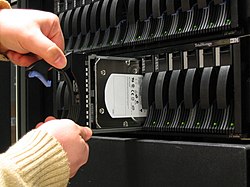
Most desktop computer hardware, such as CPUs and memory, are only cold-pluggable. However, it is common for mid to high-end servers and mainframes to feature hot-swappable capability for hardware components, such as CPU, memory, PCIe, SATA and SAS drives.
Most smartphones and tablets with tray-loading holders can interchange SIM cards without powering down the system.
Dedicated digital cameras and camcorders usually have readily accessible memory card and battery compartments for quick changing with only minimal interruption of operation. Batteries can be cycled through by recharging reserve batteries externally while unused. Many cameras and camcorders feature an internal memory to allow capturing when no memory card is inserted.
Rationale
[edit]Hot swapping is primarily used whenever it is desirable to change the configuration or repair a working system without interrupting its operation.[3] A typical example of needing to keep a system running at all times is in the case of a server, a computer that provides access to essential data and applications needed by other computers called clients. At other times, hot swapping is implemented simply to avoid the delay and nuisance of shutting down and then restarting a device, such as in the case of charging a smartphone.
Hot swapping is used to add or remove peripherals or components and to replace faulty modules without interrupting equipment operation. For example, a machine may have dual hot-swappable power supplies, each adequate enough to power the machine on its own. If one of those power supplies breaks and shuts down, the machine will not shut down, as it will draw power from the other, functional power supply. The faulty power supply can be replaced during operation of the machine, eventually bringing the machine back to a state of redundancy. In the context of servers, important expansion cards, such as disk controllers or host adapters, may be designed with specialized redundancy features in order for these to be replaceable without necessitating interruption of server operation.
Another use case of hot swapping is to enable faster data synchronization between two devices by not having to power down either device before connecting them together. For example, plugging an iPhone to a Mac computer via a USB cable to synchronize data between them does not require powering down either the iPhone or the Mac and waiting for them to restart.[4] For even more convenience, data synchronization can be configured to start automatically without user input. It is also possible to interrupt the data synchronization at any time simply through unplugging the devices, although it's not recommended to do so until instructed to avoid data corruption.
Mechanical and electrical design considerations
[edit]Machines that support hot swapping need to be able to modify their operation for the changed configuration, either automatically on detecting the change, or by user intervention. All electrical and mechanical connections associated with hot-swapping must be designed so that neither the equipment nor the user can be harmed while hot-swapping. Other components in the system must be designed so that the removal of a hot-swappable component does not interrupt operation.
Protection against electrostatic damage
[edit]Protective covering plates, shields, or bezels may be used on either the removable components or the main device itself to prevent operator contact with live powered circuitry, to provide antistatic protection for components being added or removed, or to prevent the removable components from accidentally touching and shorting out the powered components in the operating device.
Additional guide slots, pins, notches, or holes may be used to aid in proper insertion of a component between other live components, while mechanical engagement latches, handles, or levers may be used to assist in proper insertion and removal of devices that either require large amounts of force to connect or disconnect, or to assist in the proper mating and holding together of power and communications connectors.
Component shutdown procedure before unplugging
[edit]Some implementations require a component shutdown procedure prior to removal. This usually results in a simpler design, but such devices are not robust in the case of component failure. In such cases, if a component is removed while it is being used, the operations to that device fail and the user is responsible for retrying if necessary. In practice, this can be an advantageous trade-off for certain designs where cost matters more than reliability.
More complex implementations may recommend but do not require that the component be shut down. In the suboptimal case a component is removed without being shut down, these implementations usually have sufficient redundancy to allow essential operation to continue. In these systems hot swap is normally used for regular maintenance to the computer, or to replace a broken component.
Many devices have functions to eject connected hot-swappable devices to help decrease the chance of data corruption. If a device should not be ejected an error message will appear explaining where the device is being used and how to shut it down safely.
Connectors
[edit]
Most modern hot-swap methods use a specialized connector with staggered pins, so that certain pins are certain to be connected before others. Most staggered-pin designs have ground pins longer than the others, ensuring that no sensitive circuitry is connected before there is a reliable system ground. The other pins may all be the same length, but in some cases three pin lengths are used so that the incoming device is grounded first, data lines connected second, and power applied third, in rapid succession as the device is inserted. Pins of the same nominal length do not necessarily make contact at exactly the same time due to mechanical tolerances, and angling of the connector when inserted.
At one time staggered pins were thought to be an expensive solution,[citation needed] but many contemporary connector families now come with staggered pins as standard; for example, they are used on all modern serial SCSI disk-drives. Specialized hot-plug power connector pins are now commercially available with repeatable DC current interruption ratings of up to 16 A. Printed circuit boards are made with staggered edge-fingers for direct hot-plugging into a backplane connector.
Although the speed of plugging cannot be controlled precisely, practical considerations will provide limits that can be used to determine worst-case conditions. For a typical staggered pin design where the length difference is 0.5 mm, the elapsed time between long and short pin contact is between 25 ms and 250 ms. It is quite practical to design hot-swap circuits that can operate at that speed.

As long as the hot-swap connector is sufficiently rigid, one of the four corner pins will always be the first to engage. For a typical two-row connector arrangement this provides four first-to-make corner pins that are usually used for grounds. Other pins near the corners can be used for functions that would also benefit from this effect, for example sensing when the connector is fully seated. This diagram illustrates good practice where the grounds are in the corners and the power pins are near the center. Two sense pins are located in opposite corners so that fully seated detection is confirmed only when both of them are in contact with the slot. The remaining pins are used for all the other data signals.
Power electronics
[edit]The DC power supplies to a hot-swap component are usually pre-charged by dedicated long pins that make contact before the main power pins. These pre-charge pins are protected by a circuit that limits the inrush current to an acceptable value that cannot damage the pins nor disturb the supply voltage to adjacent slots. The pre-charge circuit might be a simple series resistor, a negative temperature coefficient (NTC) resistor, or a current-limiter circuit. Further protection can be provided by a "soft-start" circuit that provides a managed ramp-up of the internal DC supply voltages within the component.
A typical sequence for a hot-swap component being plugged into a slot could be as follows:
- Long ground pins make contact; basic electrical safety and ESD protection becomes available.
- Long (or medium) pre-charge pins make contact; decoupling capacitors start to charge up.
- Real time delay of tens of milliseconds.
- Short power/signal pins make contact.
- Connector becomes fully seated; power-on reset signal asserted within component
- Soft-start circuit starts to apply power to the component.
- Real time delay of tens of milliseconds.
- Soft-start circuit completes sequence; power-on reset circuit deasserted
- Component begins normal operation.
Hot-swap power circuits can now be purchased commercially in specially designed ASICs called hot-swap power managers (HSPMs).
Signal electronics
[edit]Circuitry attached to signal pins in a hot-swap component should include some protection against electrostatic discharge (ESD). This usually takes the form of clamp diodes to ground and to the DC power supply voltage. ESD effects can be reduced by careful design of the mechanical package around the hot-swap component, perhaps by coating it with a thin film of conductive material.
Particular care must be taken when designing systems with bussed signals which are wired to more than one hot-swap component. When a hot-swap component is inserted its input and output signal pins will represent a temporary short-circuit to ground. This can cause unwanted ground-level pulses on the signals which can disturb the operation of other hot-swap components in the system. This was a problem for early parallel SCSI disk-drives. One common design solution is to protect bussed signal pins with series diodes or resistors. CMOS buffer devices are now available with specialized inputs and outputs that minimize disturbance of bussed signals during the hot-swap operation. If all else fails, another solution is to quiesce the operation of all components during the hot-swap operation.
Applications
[edit]![[icon]](https://en.wikipedia.org/wiki/File:Wiki_letter_w_cropped.svg) | This section needs expansion with: Major uses including server components and USB peripherals (currently mentioned in lead but not discussed in body). Other uses (not currently mentioned but shouldn't be hard to find reliable sources) include uninterruptible power supply batteries, electric car batteries.. You can help by adding to it. (April 2022) |
Radio transmitters
[edit]Modern day radio transmitters (and some TV transmitters as well) use high power RF transistor power modules instead of vacuum tubes. Hot swapping power modules is not a new technology, as many of the radio transmitters manufactured in the 1930s were capable of having power tubes swapped out while the transmitter was running—but this feature was not universally adopted due to the introduction of more reliable high power tubes.
In the mid-1990s, several radio transmitter manufactures in the US started offering swappable high power RF transistor modules.
- There was no industry standard for the design of the swappable power modules at the time.
- Early module designs had only limited patent restrictions.
- By the early 2000s, many transmitter models were available that used many different kinds of power modules.
The reintroduction of power modules has been good for the radio transmitter industry, as it has fostered innovation. Modular transmitters have proven to be more reliable than tube transmitters, when the transmitter is properly chosen for the conditions at the transmitting site.
Power limitations:
- Lowest power modular transmitter: generally 1.0 kW, using 600 W modules.
- Highest power modular transmitter: 1.0 MW (for LW, MW).
- Highest power modular transmitter: 45 kW (FM, TV).
Gaming
[edit]Although most contemporary video game systems can interchange games and multimedia (e.g. Blu-rays) without powering down the system, older generations of systems varied in their support of hot-swapping capabilities. For example, whereas the Sony PlayStation and PlayStation 2 could eject a game disc with the system powered on, the Nintendo Game Boy Advance and the Nintendo 64 would freeze up and could potentially become corrupt if the game cartridge was removed with the power on. Manufacturers specifically warned against such practices in the owner's manual or on the game cartridge.[5] It was supposedly for this reason that Stop 'N' Swop was taken out of the Banjo-Kazooie series and Donkey Kong 64. With the Sega Genesis/Mega Drive system, it was sometimes possible to apply cheats (such as a player having infinite lives) and other temporary software alterations to games by hot swapping cartridges, even though the cartridges were not designed to be hot swappable.[6]
Keyboards
[edit]Hot-swappable keyboards enable changing the switches without having to disassemble the keyboard.[7] On standard mechanical-switch keyboards, the switch is directly soldered to the PCB. Hot-swappable keyboards instead have a socket in its place that allows the switch to be freely replaced without re-soldering.[8]
Hot-swappable keyboards are becoming increasingly common[citation needed], and it has become somewhat of a standard[citation needed] in most enthusiast keyboards as well as keyboard components to support hot swapping.[7] They can be found in a variety of sizes and layouts, including more specialized ergonomic layouts.
Software development
[edit]Hot swapping can also refer to the ability to alter the running code of a program without needing to interrupt its execution. Interactive programming is a programming paradigm that makes extensive use of hot swapping, so the programming activity becomes part of the program flow itself.
Only a few programming languages support hot swapping natively, including Pike, Lisp, Erlang, Smalltalk, Visual Basic 6 (not VB.NET), Java and most recently Elm[9] and Elixir. Microsoft Visual Studio supports a kind of hot swapping called Edit and Continue, which is supported by C#, VB.NET and C/C++ when running under a debugger.[10]
Hot swapping is the central method in live coding, where programming is an integral part of the runtime process. In general, all programming languages used in live coding, such as SuperCollider, TidalCycles, or Extempore support hot swapping.
Some web-based frameworks, such as Django, support detecting module changes and reloading them on the fly. However, although the same as hotswapping for most intents and purposes, this is technically just a cache purge, triggered by a new file. This does not apply to markup and programming languages such as HTML and PHP respectively, in the general case, as these files are normally reinterpreted on each use by default. There are a few CMSes and other PHP-based frameworks (such as Drupal) that employ caching, however. In these cases, similar abilities and exceptions apply.
Hot swapping also facilitates developing systems where large amounts of data are being processed, as in entire genomes in bioinformatics algorithms.[11]
Trademarks
[edit]The term "HOT PLUG" was registered as a trademark in the United States in November 1992 to Core International, Inc., and cancelled in May 1999.[12]
See also
[edit]References
[edit]- ^ Hennessy, John L.; Patterson, David A. (2002). Computer Architecture: A Quantitative Approach. The Morgan Kaufmann Series in Computer Architecture and Design. Morgan Kaufmann. p. 707. ISBN 9780080502526.
- ^ "Hot Swap and Hot Plug". Searchstorage.techtarget.com. TechTarget. Retrieved 2013-08-18.
- ^ Tabisz, W.A.; Jovanovic, M.M.; Lee, F.C. (23–27 February 1992). Present and future of distributed power systems. Seventh Annual Applied Power Electronics Conference and Exposition, 1992. APEC '92. Conference Proceedings 1992. IEEE. pp. 11–12. doi:10.1109/APEC.1992.228437. ISBN 0-7803-0485-3.
A properly designed parallel configuration allows the on-line replacement (hot-swapping) of defective modules. This provides means for non-interrupting maintenance and repair, a very desirable feature in high-reliability systems operating in a continuous fashion.
- ^ "Use the Finder to sync your iPhone, iPad, or iPod touch with your Mac". Apple Support. Retrieved 7 April 2025.
- ^ "Health & Safety Precautions for Cartridge-Based Consoles". nintendo.com. Nintendo. Retrieved 2014-04-22.
- ^ The editors of GamePro magazine (1994). Sega Genesis Games Secrets Greatest Tips (2nd ed.). Prima Publishing. p. 217. ISBN 9781559584012. Retrieved 2014-05-12.
{{cite book}}:|author=has generic name (help) - ^ a b "What are hot-swappable keyboard switches?". Digital Trends. 2022-09-15. Retrieved 2022-12-02.
- ^ "The 8 Best Hot Swappable Mechanical Keyboards – Review Geek". www.reviewgeek.com. 9 February 2020. Retrieved 2022-12-02.
- ^ "Interactive programming – Hot-swapping in Elm". elm-lang.org. Archived from the original on 2013-10-06. Retrieved 2015-02-15.
- ^ "MSDN Article for Edit and Continue". Msdn.microsoft.com. Archived from the original on 2010-07-31. Retrieved 2013-08-18.
- ^ Gille, Christoph; Robinson, Peter N. (2006). "HotSwap for bioinformatics: A STRAP tutorial". BMC Bioinformatics. 7. Biomedcentral.com: 64. doi:10.1186/1471-2105-7-64. PMC 1386713. PMID 16469097. S2CID 18283272.
- ^ "Trademark Status & Document Retrieval (TSDR); Mark: HOT PLUG; US Serial Number: 74140414; Application Filing Date: Feb. 19, 1991; US Registration Number: 1732038; Registration Date: Nov. 10, 1992". USPTO. Retrieved 27 November 2016.
Hot swapping
View on GrokipediaFundamentals
Definition and Scope
Hot swapping refers to the process of replacing, adding, or removing components within a live computer system without powering down, rebooting, or interrupting the overall operation of the system.[1] This capability ensures continuous functionality, particularly in environments requiring high availability, by allowing seamless transitions during maintenance or upgrades.[9] It is distinct from hot plugging, which involves only the addition or attachment of new components to a running system without removal or replacement, and from cold swapping, which necessitates shutting down the system before any component changes can occur.[10][11] While hot plugging focuses on expansion, hot swapping encompasses bidirectional actions—insertion and extraction—to maintain or restore system integrity without downtime.[12] The scope of hot swapping extends across both hardware and software domains. In hardware contexts, it applies to physical components such as modules, storage drives, or power supplies, enabling their exchange in operational systems. In software, it involves the dynamic replacement of code modules or programs at runtime, often to update functionality or fix issues without halting execution.[13] For instance, in redundant setups like N+1 power configurations, hot swapping facilitates full system-level replacements by leveraging backup components to avoid service disruption, whereas in non-redundant environments, it typically supports partial component changes, such as individual drive insertions, provided the system architecture permits uninterrupted operation.[14]Historical Development
In the mid-20th century, hot swapping gained prominence in military and telecommunications systems where system reliability was paramount. These designs emphasized fault-tolerant architectures in telecom infrastructure and military communications gear, where downtime could have operational consequences. The 1990s marked a significant expansion of hot swapping into computing, driven by the server boom and the need for high-availability storage. SCSI interfaces enabled hot-swappable hard drives in enterprise servers, allowing administrators to replace failing disks in RAID configurations without system shutdown; this capability became standard in mid-1990s server deployments for improved uptime in business environments. Concurrently, Intel announced its PCI Hot Plug specification in 1997, standardizing the addition and removal of PCI adapter cards, such as network interfaces and RAID controllers, in running systems to support scalable server architectures.[15][5] Key milestones in the late 1990s further propelled hot swapping into consumer and enterprise peripherals. The release of USB 1.0 in 1996 introduced hot-swappable connectivity for devices like keyboards, mice, and external storage, simplifying plug-and-play operations without rebooting personal computers.[4] In software realms, Sun Microsystems enhanced the Java Virtual Machine (JVM) with experimental HotSwap capabilities starting in Java 1.4 (2002), allowing limited class redefinition during debugging sessions to accelerate development without full restarts, building on foundational JVM support from the language's 1996 debut.[16] Entering the 2000s, hot swapping became integral to data center operations, particularly with RAID arrays in server farms. Widespread adoption of hot-swappable drive bays in RAID systems facilitated rapid replacement of components in large-scale storage setups, minimizing downtime in hyperscale environments managed by providers like those emerging in cloud computing. The PCI Express (PCIe) 1.0 specification, ratified in 2003, natively incorporated hot-plug support, enabling dynamic reconfiguration of high-speed interconnects for graphics, storage, and networking in enterprise servers and workstations.[17]Rationale and Advantages
Enhancing System Availability
Hot swapping enables the replacement of hardware components in mission-critical environments, such as enterprise servers, without interrupting ongoing operations, thereby significantly reducing the risk of outages due to hardware failures.[18] This capability supports zero-downtime maintenance, allowing systems to remain operational during component swaps and minimizing the impact of faults on overall performance.[19] In data centers and high-reliability setups, this feature is essential for sustaining continuous service, as it prevents the cascading effects of a single failure from propagating to the entire system.[7] A key aspect of hot swapping's role in availability is its integration with redundancy architectures, particularly N+1 configurations, where an extra component provides backup capacity. For instance, in dual power supply setups, if one unit fails, the redundant unit seamlessly takes over the load, and the faulty supply can be hot-swapped without any service interruption.[20] This approach ensures that the system maintains full functionality even during maintenance, as the hot-swap process allows for immediate replacement while the redundant elements handle operations.[21] Such redundancy-enhanced hot swapping is widely employed in power systems and modular hardware to bolster fault tolerance.[22] By facilitating proactive maintenance and rapid recovery from failures, hot swapping contributes to achieving high uptime levels, such as 99.999% availability—commonly known as "five nines"—in enterprise systems, where downtime is limited to just minutes per year.[23] This metric underscores the technology's value in environments demanding near-constant accessibility, as it enables upgrades and repairs without the need for scheduled outages.[24] In contrast to cold swapping, which requires powering down and rebooting the system—potentially leading to data loss or service disruptions—hot swapping preserves system state and avoids these interruptions entirely.[11] This distinction makes hot swapping indispensable for applications where even brief downtime is unacceptable.[25]Economic and Operational Benefits
Hot swapping significantly lowers maintenance expenses by enabling the replacement of faulty components without requiring full system shutdowns, thereby avoiding the high costs associated with downtime in data centers. For instance, the average cost of data center downtime is estimated at $540,000 per hour, encompassing lost revenue, productivity impacts, and recovery efforts.[26] By minimizing these interruptions, hot swapping can reduce overall system costs by 30% to 50% through enhanced reliability and fewer service disruptions.[27] In terms of operational efficiency, hot swapping accelerates repair processes compared to traditional cold swaps, which necessitate powering down the entire system and can take hours, whereas hot swaps often complete in minutes without halting operations. This capability allows for modular upgrades and maintenance during normal business hours, eliminating the need to schedule costly outages and improving workflow continuity.[28] Hot swapping supports scalability in cloud environments by facilitating on-demand hardware expansion, such as adding storage or processing units, which reduces the capital expenditure required for redundant full-system purchases. Organizations can thus scale resources incrementally, optimizing utilization and deferring major investments until demand justifies them.[11] Over the long term, hot swapping enhances return on investment by extending hardware lifespan through straightforward part replacements, leading to lower total cost of ownership. In telecommunications, for example, the use of hot-swappable modules streamlines maintenance and compatibility, contributing to reduced operational expenses and overall TCO reductions.[29]Design Principles
Mechanical Considerations
Mechanical considerations in hot swapping focus on ensuring safe, precise, and reliable physical integration of components into live systems, minimizing the risk of damage from misalignment or vibration. Guide mechanisms, such as rails and slots, play a critical role in facilitating proper insertion. In server environments, hot-swappable drives and modules are typically mounted on carriers that engage with chassis-mounted guide rails, allowing smooth sliding and alignment without requiring visual confirmation in confined spaces.[30] These rails often incorporate alignment features like beveled edges or keying pins to prevent incorrect orientation, as seen in designs for memory carriers in rack servers where front and rear guide slots ensure precise seating.[31] Blind-mate connectors further enhance this by providing self-aligning capabilities, with extended guides that tolerate several millimeters of misalignment to capture and mate the connector reliably during insertion.[32][33] Thermal management is essential to maintain system cooling during hot swaps, as temporary removal of a module can disrupt airflow paths and create localized hot spots. Ventilation designs in hot-swappable chassis prioritize continuity of airflow, often using perforated panels or modular baffles that redirect air around empty bays without significant pressure drops.[34] For instance, heat sink fins in server modules are oriented parallel to the primary airflow direction to sustain efficient heat dissipation even when adjacent slots are unoccupied during a swap.[34] This approach helps prevent overheating of neighboring components, supporting uninterrupted operation in high-density environments like data centers. Mechanical interlocks provide safeguards against unintended removal or insertion under operational stress, reducing the potential for physical damage. Latches and ejector mechanisms on module carriers secure the component in place once fully seated, often requiring deliberate manual release to initiate extraction.[30] These interlocks may integrate sensors to detect engagement status, ensuring the module is locked before allowing system acknowledgment of the swap, though the mechanical elements alone enforce physical restraint.[30] In enterprise server designs, such features prevent vibration-induced dislodging during transport or operation. Durability standards emphasize materials and construction capable of withstanding repeated insertions in demanding environments. Connectors and carriers for hot-swappable modules are typically rated for thousands of mating cycles, with high-reliability variants achieving 10,000 or more connect-disconnect operations while maintaining alignment integrity. Materials like reinforced polymers or hardened metals are selected for rails and latches to endure 5,000+ insertion cycles in enterprise applications, ensuring long-term reliability without degradation in tolerance or fit.[32][35]Electrical and Power Management
Effective electrical and power management is essential in hot swapping to ensure safe insertion and removal of modules without disrupting the power bus or causing damage to components. Inrush current control is a primary concern, as the sudden connection of a board's bulk capacitors to a live supply can draw excessive current, leading to voltage droops or bus faults. Pre-charge circuits address this by gradually charging these capacitors using techniques such as resistors or current-limited sources to limit the initial power draw. For example, in designs from Texas Instruments, dv/dt control with a capacitor (e.g., 10 nF) can achieve slew rates of 2 V/ms, extending startup to around 30 ms for a 20-A system, thereby mitigating inrush while protecting the main bus.[8] Similarly, Analog Devices' LTC4240 controller employs a 65 μA current source to charge the external FET gate, resulting in a controlled voltage ramp determined by load capacitance, typically in the millisecond range to isolate bypass capacitors during insertion.[36] Soft-start mechanisms further enhance this by linearly ramping current from zero to full scale over programmable periods, often set by external capacitors on the controller.[37] Power sequencing coordinates the activation of multiple voltage rails to prevent conflicts, such as reverse currents or insufficient supply for dependent circuits, during hot swap events. This staged approach, typically managed by dedicated controllers within power management ICs (PMICs), ensures rails like +5 V are established before higher voltages such as +12 V, avoiding latch-up in digital systems. The Analog Devices LTC1645 dual-channel hot-swap controller exemplifies this capability, offering programmable sequencing for supplies from 1.2 V to 12 V, where channels can ramp up or down separately or simultaneously to track specific orders, as demonstrated in applications sequencing 5 V/5 A before 3.3 V/7 A.[38] Such sequencing is integrated into PMICs to provide precise timing, often with electronic circuit breakers to interrupt if deviations occur, maintaining system integrity across telecom and server environments.[39] Hot-swap controllers are specialized integrated circuits that oversee power delivery by continuously monitoring voltage, current, and fault conditions to enable safe operation. These ICs from manufacturers like Analog Devices and Texas Instruments incorporate features such as undervoltage lockout, overvoltage protection, and fault detection to isolate issues without system-wide shutdowns. For instance, the Analog Devices LT4239 controller monitors MOSFET V_GS and V_DS for health, provides a current monitor output with 100x gain, and includes fault protection with an overcurrent circuit breaker threshold of 10 mV (corresponding to limits like 10 A with a 1 mΩ sense resistor), triggering alerts via dedicated pins.[40] Texas Instruments' portfolio, including eFuses and controllers like the LM5066, similarly offers programmable current limits and rapid fault response to handle overcurrent events up to 20 A or more, ensuring the module integrates seamlessly while protecting the backplane. Recent advancements include Texas Instruments' TPS1685, introduced in 2025, the industry's first 48 V integrated hot-swap eFuse with power-path protection supporting data center applications exceeding 6 kW.[41][42] In systems requiring high availability, redundant power supplies incorporate circuitry for seamless failover, preventing downtime from single-supply failures during hot swaps. Traditional OR-ing diodes connect parallel supplies but suffer from forward voltage drops and heat generation; modern ideal diode controllers using N-channel MOSFETs provide a low-loss alternative with integrated hot-swap functions. The Analog Devices LTC4225, for example, combines ideal diode operation with inrush current limiting and overcurrent protection (5% accuracy), enabling fault isolation and prioritized power paths, such as 5 V primary with 12 V backup, in redundant µTCA systems.[43] For -48 V telecom applications, Texas Instruments' TPS23525 integrates dual OR-ing control with hot-swap features, regulating forward drops to 25 mV and providing soft-start for capacitor charging, supporting redundant supplies from -10 V to -80 V with programmable UV/OV thresholds.[44]Signal Integrity and Software Support
Maintaining signal integrity during hot swapping is critical to prevent data corruption or bus interruptions when components are inserted or removed while the system is operational. Specialized hardware such as buffers and isolators protect communication buses by isolating segments and precharging lines to avoid glitches. For instance, in I²C systems, hot-insertion buffers like the PCA9513A from NXP Semiconductors enable safe addition of devices to a live bus by isolating the downstream bus during power-up transients and preventing data and clock corruption.[45] Similarly, isolated I²C devices with hot-swap circuitry, such as Texas Instruments' ISO164x family, incorporate electrostatic discharge protection and maintain bidirectional communication across isolated grounds, ensuring reliable signal transmission during plug-in events.[46] Software layers play a pivotal role in enabling hot swapping by detecting hardware changes and dynamically reconfiguring resources. Enumeration protocols in systems like the Advanced Configuration and Power Interface (ACPI) facilitate device detection through methods such as_STA for status reporting and _CRS for current resource settings, allowing the operating system present manager (OSPM) to identify insertions or removals via general-purpose events (GPEs) and notifications like Bus Check (0x00).[47] Resource reallocation, including dynamic interrupt request (IRQ) assignment, is handled by ACPI objects such as _PRT for PCI interrupt mapping and Interrupt Resource Descriptors, which support sharing and polarity configurations to adapt to new devices without conflicts.[47] The Unified Extensible Firmware Interface (UEFI) complements this with protocols like the PCI Hot Plug Request, which triggers re-enumeration upon Notify events, ensuring seamless integration of swapped components.[48]
Firmware routines in BIOS or UEFI environments initialize swapped components by powering slots via control methods like _PS0 and allocating resources through the PCI Host Bridge protocol, often completing within 15 seconds for standard hot-plug controllers.[48] These routines invoke device-specific methods such as _INI for initialization and leverage the EFI driver model to load option ROMs or bus drivers without a full system reboot, using asynchronous notifications to update the device tree.[48] For example, upon insertion, UEFI's Hot Plug PCI Initialization Protocol enumerates the new device, assigns memory and I/O spaces, and prepares it for OS handover via ACPI extensions.[48]
Beyond hardware-level support, software hot swapping allows runtime code replacement while preserving system state, enhancing availability in long-running applications. In Erlang, hot code loading operates at the module level, where updated beam files are loaded via the code:load_file/1 function, enabling seamless upgrades without interrupting processes due to the actor model's isolation of state in lightweight processes.[49] This technique supports backward-compatible changes, with old code purged only after all references are released, as detailed in the Erlang/OTP documentation.[49] Similarly, the Java Virtual Machine (JVM) in HotSpot supports class redefinition through the Java Debug Wire Protocol (JDWP) HotSwap feature, allowing method body replacements during debugging sessions while maintaining instance state via instrumentation APIs. Tools like HotSwapAgent extend this for production by patching the JVM to reload classes with preserved object graphs, though limited to non-structural changes to avoid breaking invariants.[16]
Safety and Protection Mechanisms
Electrostatic Discharge Prevention
Electrostatic discharge (ESD) poses a significant risk during hot swapping, as the physical handling and insertion of modules can transfer static charges to sensitive components, potentially causing latent damage or immediate failure. To mitigate this, grounding techniques are essential for both operators and equipment. Operators typically wear conductive wrist straps connected to a grounded point, ensuring that any accumulated static charge is safely dissipated before handling modules; these straps maintain a low-resistance path to ground, typically less than 1 megohm, in compliance with ESD control standards.[50][51] Chassis shields, formed by metallic enclosures or frames, provide a Faraday cage-like barrier that routes ESD currents away from internal circuits to ground, often integrated with the system's earth ground to equalize potentials during insertion.[52] Additionally, ESD-safe materials such as dissipative plastics are used for module housings and handling tools; these materials exhibit surface resistivity in the range of 10^6 to 10^9 ohms, allowing controlled charge dissipation without rapid discharge that could generate sparks.[53] At the circuit level, protection devices safeguard input/output (I/O) pins against ESD events during hot swaps. Transient voltage suppressor (TVS) diodes are commonly employed to clamp transient voltages, shunting excess energy to ground; for instance, bidirectional TVS arrays can limit voltage spikes on signal lines to safe levels, such as clamping to approximately 15 V during an 8 kV contact discharge as specified in IEC 61000-4-2 Level 4 testing.[54] Capacitors, often paired with TVS diodes in low-pass filter configurations at I/O pins, further attenuate high-frequency ESD pulses while maintaining signal integrity; these RC networks provide additional impedance to divert currents away from sensitive ICs.[55] Design integration plays a critical role in ESD prevention by sequencing electrical contacts during module insertion. Guide slots or keyed connectors ensure that ground paths are established before signal or power contacts engage; this "ground-first" approach, achieved through longer ground pins or beveled slots, equalizes potentials and creates a low-impedance discharge path, reducing the risk of arcing or voltage differentials across sensitive interfaces.[56] Hot-swap modules must comply with established ESD testing standards to verify robustness. System-level testing follows IEC 61000-4-2, which simulates human-generated ESD with contact discharges up to 8 kV and air discharges up to 15 kV, ensuring the module withstands real-world handling scenarios without functional disruption.[57] At the component level, the human body model (HBM) per JEDEC JESD22-A114 requires survival at 2-4 kV, classifying devices as ESD Class 2 or higher, which is standard for hot-swappable electronics to prevent damage from operator-induced discharges.Insertion and Removal Procedures
Hot swapping requires meticulous step-by-step protocols to ensure system stability and prevent data loss or hardware damage. Prior to any insertion or removal, operators must verify that the system maintains sufficient redundancy, such as RAID configurations for storage or N+1 setups for power supplies, to sustain operations during the swap.[58] Additionally, during handling, ESD precautions like wearing a grounded wrist strap must be observed to avoid static damage.[59] For component removal, the process begins with software quiescing to halt all activity on the device. This involves stopping applications that access the component, flushing buffers with commands likesync in Linux environments, and unmounting file systems using umount to ensure no pending writes.[60] Next, a graceful shutdown is initiated via system APIs or management tools; for example, in Solaris systems, the cfgadm -x unconfigure command unconfigures the device and illuminates an OK-to-Remove LED, while in SCSI environments, the hot plug manager powers off the slot to spin down the drive.[60][58] In Linux, the equivalent SCSI eject procedure uses echo 1 > /sys/block/sdX/device/delete to park heads and remove the device from the kernel.[61] Operators then wait for confirmation, such as 30 seconds for drive spin-down or LED status changes, before physically extracting the component by unlocking latches, pulling handles, and sliding it out slowly.[60][59]
Insertion follows a similarly controlled sequence to minimize disruptions. After a brief wait—typically 1 minute post-removal for management module stabilization—the new component is aligned with the slot, ensuring guides or ejectors are properly positioned.[59] It is then inserted slowly to allow initial ground engagement and avoid signal glitches, with operators monitoring for resistance and stopping if any occurs.[58] Once seated and latched, the system detects the insertion automatically; software reconfiguration follows using commands like cfgadm -x configure in Solaris or the hot plug manager's configure option in SCSI setups, enabling mounting of file systems and restarting applications.[60][58] System logs should be monitored for detection events and any integration issues, such as LED indicators confirming power-up within seconds.[59]
Error handling in hot swap procedures emphasizes verification and recovery, particularly in redundant systems. If a removal or insertion fails—indicated by persistent error LEDs or log alerts—operators must abort and reverse the action, such as reinserting the original component if possible. In redundant configurations like RAID arrays, the system automatically falls back to backup paths or mirrors, maintaining availability without manual intervention, and initiates rebuilds upon successful swap completion.[58][60] Failed swaps trigger alerts for further diagnostics, ensuring no permanent data corruption occurs.[59]