


Community hub
Recent from talks
Contribute something
Nothing was collected or created yet.
Ukrainian hryvnia
View on Wikipedia| українська гривня (Ukrainian) | |||||
|---|---|---|---|---|---|
| |||||
| ISO 4217 | |||||
| Code | UAH (numeric: 980) | ||||
| Subunit | 0.01 | ||||
| Unit | |||||
| Plural | hryvnias (see also: declension of гривня in Ukrainian) | ||||
| Symbol | ₴ or грн | ||||
| Denominations | |||||
| Subunit | |||||
| 1⁄100 | kopiyka (копійка) | ||||
| Plural | |||||
| kopiyka (копійка) | kopiykas (see also: declension of копійка in Ukrainian) | ||||
| Banknotes | ₴1, ₴2, ₴5, ₴10, ₴20, ₴50, ₴100, ₴200, ₴500, ₴1,000 | ||||
| Coins | 50 kopiyok, ₴1, ₴2, ₴5, ₴10 | ||||
| Demographics | |||||
| User(s) |  Ukraine Ukraine | ||||
| Issuance | |||||
| Central bank | National Bank of Ukraine | ||||
| Website | https://bank.gov.ua/en/ | ||||
| Printer | National Bank of Ukraine | ||||
| Mint | National Bank of Ukraine | ||||
| Valuation | |||||
| Inflation | 9.52% (2021 y-o-y)[1][failed verification] | ||||
| Source | NBU, 2019, May[2][failed verification] | ||||
| Method | CPI | ||||

The hryvnia (/(hə)ˈrɪvniə/ (hə-)RIV-nee-ə; Ukrainian: гривня [ˈɦrɪu̯nʲɐ] ⓘ, abbr. грн hrn; sign: ₴; code: UAH) has been the national currency of Ukraine since 2 September 1996. The hryvnia is divided into 100 kopiykas (Ukrainian: копійка). It is named after a measure of weight used in Kievan Rus'.[3]
Etymology
[edit]The currency of Kievan Rus' in the 11th century was the grivna. The word is thought to derive from the Slavic griva; which compares with the Ukrainian, Russian, Bulgarian, Croatian, and Serbian word грива (griva, meaning 'mane'). It might have indicated something valuable to be worn around the neck, that was usually made of silver or gold, and may be related to the Bulgarian and Serbian term grivna (гривна, 'bracelet').
Following Ukraine's declared secession from Russia in 1917, the Ukrainian People's Republic named its currency hryvnia after the grivna of Kievan Rus'; these were designed by Heorhiy Narbut.
The word was used to describe silver or gold ingots of a certain weight.[citation needed]
Currency sign
[edit]
The hryvnia sign is a cursive Ukrainian letter He (г), with a double horizontal stroke (₴), symbolizing stability, similar to that used in other currency symbols such as the yen and Chinese yuan (¥, a symbol the currencies share), euro (€), and Indian rupee (₹). The sign was encoded as U+20B4 in Unicode 4.1 and released in 2005.[4] It is now supported by most systems. In Ukraine, if the hryvnia sign is unavailable, the Cyrillic abbreviation "грн" is used (which can be transliterated as "hrn").[citation needed]
History
[edit]
_front_side.jpg)
On 22 December 1917, the Central Rada established Ukraine's state bank. The karbovanets became first currency of the Ukrainian People's Republic. On 5 January 1918, the first official 100 karbovanets banknote was issued, signed by Mykhailo Kryvetskyi, the first director of the state bank.
On 1 March 1918, the Central Council introduced a new currency, the hryvnia, consisting of 100 shahs and equaled to 1/2 of the previously issued karbovanets banknote.
In April 1918, Hetman Pavlo Skoropadsky reintroduced the karbovanets as the main currency of Ukraine. It consisted of 200 shahs, and denominations of 10, 25, 50, 100, 250 and 1,000 karbovanets were issued.
During the Nazi occupation of Ukraine in World War II, the German occupying government (Reichskommissariat Ukraine) issued banknotes denominated in karbovanets (karbowanez in German).
The third version of the karbovanets replaced rubles at par in 1992. The karbovanets was subject to hyperinflation in the early 1990s following the dissolution of the Soviet Union.[citation needed] The karbovanets was replaced by the hryvnia in September 1996, at a rate of 1 hryvnia to 100,000 karbovanets.[5]
The introduction of the hryvnia was done in a covert fashion.[6] It was introduced according to the Presidential Decree of 26 August 1996, published three days later. During the transition period, 2–16 September, both hryvnias and karbovanets could be used, but change could only be given in hryvnias. All bank accounts were converted to hryvnias automatically. During the transition period, 97% of karbovanets were taken out of circulation, with 56% being removed in the first five days of the currency reform.[6] After 16 September 1996, any remaining karbovanets in circulation could be exchanged for hryvnias in banks.[citation needed]
The hryvnia was introduced when the chairman of the National Bank of Ukraine was Viktor Yushchenko, but the new banknotes bore the signature of the previous chairman, Vadym Hetman. The first notes had been printed in 1992 by the Canadian Bank Note Company, but it was decided to delay their circulation until the hyperinflation in Ukraine had been brought under control.[citation needed]
On 18 March 2014, following the Russian annexation of Crimea, the interim administration of the Republic of Crimea announced that the hryvnia was to be dropped as the region's currency the following month.[7] It was replaced by the Russian ruble on 21 March 2014;[8] the hryvnia was allowed to be used for cash payments until 1 June.[8] Because of a lack of low-denomination Russian rubles in those raions of the Donbas under the control of the pro-Russian separatist states of Donetsk and Luhansk, the hryvnia remained the predominant currency until 2022.[9]
Coinage
[edit]Coins were first struck for the new currency in 1992, but were not introduced until September 1996. Initially, coins valued between 1 and 50 kopiyky were issued. In March 1997, ₴1 coins were added. Since 2004, commemorative ₴1 coins have been struck.
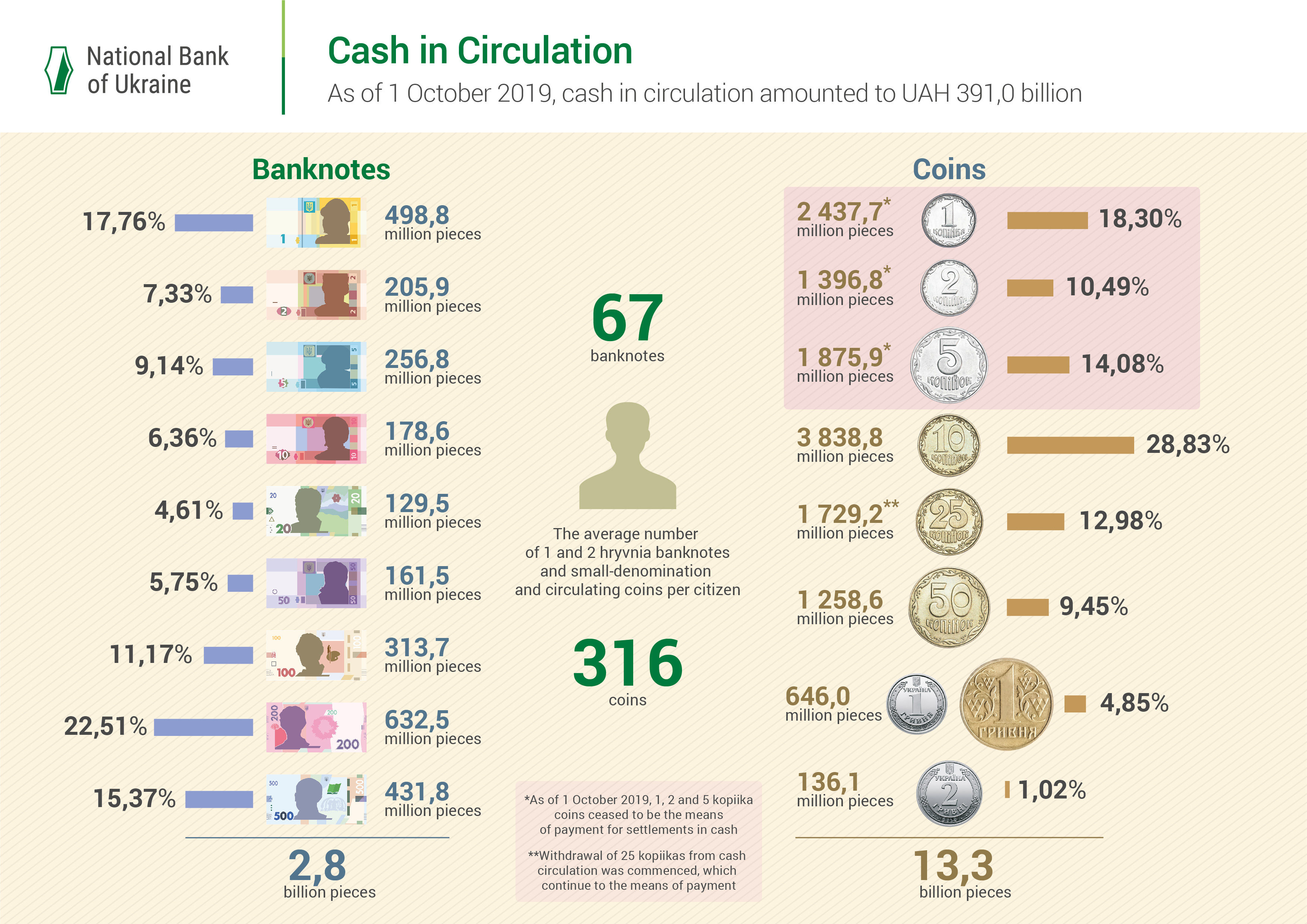
In October 2012, the National Bank of Ukraine announced that it was examining the possibility of withdrawing the 1 and 2 kopiyky coins from circulation,[10] as they had become too expensive to produce. After 2013, 1 and 2 kopiyky coins were not produced, but remained in circulation until 1 October 2019.[11] On 26 October 2012, the National Bank of Ukraine announced it was considering the introduction of a ₴2 coin.[12] Officially, as of 1 July 2016, 12.4 billion coins, with a face value of ₴1.4 billion were in circulation.[13] On 1 October 2019, 1, 2 and 5 kopiyky coins ceased to be legal tender. They can be still changed at banks.[14]
| Coins of the Ukrainian Hryvnia (1992–present)[15] | ||||||||||||
|---|---|---|---|---|---|---|---|---|---|---|---|---|
| Image | Value | Technical parameters | Description | Date of | ||||||||
| Obverse | Reverse | Diameter | Mass | Composition | Edge | Obverse | Reverse | minting | issue | withdrawal | ||

|

|
1 kopiyka | 16 mm | 1.5 g | Stainless steel | Plain | Value, Ornaments |
Ukrainian Trident | 1992–2016 | 2 September 1996 | Not issued since 1 July 2018.[16] 1, 2, and 5-kopiyka coins withdrew from general circulation on 1 October 2019.[11] | |

|

|
2 kopiykas | 17.30 mm | 0.64 g (1992~1996) 1.8 g (2001–) |
aluminium (1992–1996), stainless steel (2001–) |
1992–2014 | ||||||

|

|
5 kopiykas | 24 mm | 4.3 g | stainless steel | Reeded | 1992–2015 | |||||

|

|
10 kopiykas | 16.3 mm | 1.7 g | brass (1992–1996), aluminium bronze (2001–) |
Reeded | Value, Ornaments |
Ukrainian Trident | 1992~present | 2 September 1996 | Current | |

|

|
25 kopiykas | 20.8 mm | 2.9 g | Reeded and plain sectors | 1992–2016 | Not issued since 1 July 2018.[16] 25-kopiyka coin ceased to be legal tender in Ukraine and gone out of circulation, effective 1 October 2020.[17][18] | |||||

|

|
50 kopiykas | 23 mm | 4.2 g | 1992~present | Current | ||||||

|

|
1 hryvnia | 26 mm | 7.1 g (1995,1996) 6.9 g (2001–) |
brass (1995, 1996), aluminium bronze (2001–) |
Inscription: "ОДНА ГРИВНЯ", minted year | 1995~2013 | 12 March 1997 | Current, but new design introduced in 2018 | |||
.PNG)
|
.PNG)
|
1 hryvnia | 26 mm | 6.8 g (2004–2016) | Aluminium bronze (2004–2016) | Plain with incuse lettering ("ОДНА · ГРИВНЯ · Date of issue") | Inscription: Coat of arms of Ukraine; УКРАЇНА 1 ГРИВНЯ; date of issue inside a decorative wreath | Half length figure of Volodymyr the Great holding a model church and staff with legend above | 2004–2016 | 2004 | ||
.jpg)
|
.jpg)
|
1 hryvnia | 18.9 mm | 3.3 g | Nickel-plated steel | Reeded | Coat of Arms of Ukraine, Value, Ornaments |
Volodymyr the Great | 2018[16] | Current | ||
.jpg)
|
.jpg)
|
2 hryvnias | 20.2 mm | 4.0 g | Yaroslav the Wise | |||||||
.jpg)
|
.jpg)
|
5 hryvnias | 22.1 mm | 5.2 g | Segmented (Plain and Reeded edges) | Bohdan Khmelnytsky | 2019 | |||||
.jpg)
|
.jpg)
|
10 hryvnias | 23.5 mm | 6.4 g | Nickel plated zinc alloy | Reeded | Ivan Mazepa | 2020[16] | ||||
| These images are to scale at 2.5 pixels per millimetre. For table standards, see the coin specification table. | ||||||||||||
Banknotes
[edit]
In 1996, the first series of hryvnia banknotes was introduced into circulation by the National Bank of Ukraine. They were dated 1992 and were in denominations of 1, 2, 5, 10 and 20 hryvnias. The design of the banknotes was developed by Ukrainian artists Vasyl Lopata and Borys Maksymov.[19][20] The one hryvnia banknotes were printed by the Canadian Bank Note Company in 1992. The two, five and ten hryvnia banknotes were printed two years later. The banknotes were stored in Canada until they were put into circulation.[19]
Banknotes of the first series in denominations of 50 and 100 hryvnias also existed but were not introduced because these nominals were not needed in the economic crisis of the mid-1990s.
Also in 1996, the 1, 50, and 100 hryvnia notes of the second series were introduced, with 1 hryvnia dated 1994. The banknotes were designed and printed by Britain's De La Rue.[21] Since the opening of the Mint of the National Bank of Ukraine in cooperation with De La Rue in March 1994, all banknotes have been printed in Ukraine.[21]
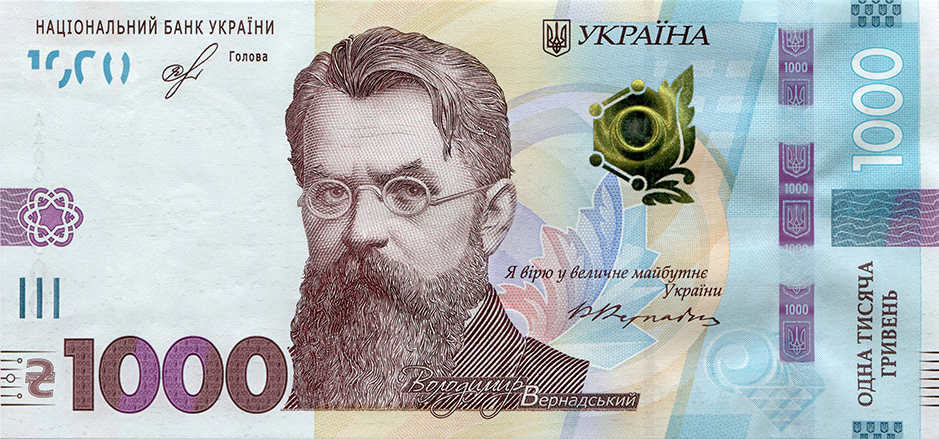
Later, higher denominations were added. The 200 hryvnia notes of the second series were introduced in 2001, followed by the 500 hryvnia notes of the third series in 2006, and 1000 hryvnia notes of fourth series in 2019.
The 100 hryvnia denomination is quite common due to its moderately high value. Also common is the 200 and 500 hryvnia, as most Ukrainian ATMs dispense currency in these denominations.
In 2016, the NBU paper factory started producing banknote paper using flax instead of cotton.[22]
In 2019, the National Bank of Ukraine introduced a 1,000 hryvnia banknote and was issued into circulation on 25 October 2019.[23] The introduction of the new banknote was in response to the National Bank of Ukraine's efforts of streamlining the number of coins and banknotes already in circulation. The 1, 2, 5 and 10 hryvnia banknotes will continue to be legal tender alongside its equivalent coins in general circulation, while being withdrawn from circulation from repeated use in commerce.
In 2019, the National Bank of Ukraine introduced a revised 50 hryvnia banknote into circulation on 20 December 2019 and issued a revised 200 hryvnia banknote on 25 February 2020, thereby completing the family of notes which began with the issuance of the 100 hryvnia banknote in 2015.
Current series
[edit]| Denomination [1] and dimensions |
Image | Main colour | Description | Date of issue | Withdrawal | |||
|---|---|---|---|---|---|---|---|---|
| Obverse | Reverse | Watermark | Obverse | Reverse | ||||
| ₴1 118 × 63 mm |

|

|
Yellow-blue | Volodymyr the Great of Kiev (c. 958–1015), Prince of Novgorod and Grand Prince of Kiev Ruler of Kievan Rus' in (980–1015) |
Volodymyr I's Fortress Wall in Kiev | 22 May 2006 | 1 October 2020 | |
| ₴2 118 × 63 mm |

|

|
Terracotta | Yaroslav the Wise (c. 978 – 1054), Prince of Novgorod and Grand Prince of Kiev Ruler of Kievan Rus' in (1019–1054) |
Saint Sophia Cathedral, Kyiv | 24 September 2004 | ||
| ₴5 118 × 63 mm |

|

|
Blue | Bohdan Khmelnytsky (c. 1595–1657), Hetman of Ukraine | A church in the village of Subotiv | 14 June 2004 | ||
| ₴10 124 × 66 mm |

|

|
Crimson | Ivan Mazepa (1639–1709), Hetman of Ukraine | The Holy Dormition Cathedral of the Kyiv Pechersk Lavra | 1 November 2004 | ||
| ₴20 130 × 69 mm |
|

|
Green | Ivan Franko (1856–1916), writer and politician | Lviv Theatre of Opera and Ballet | 25 September 2018 | Current | |
| ₴50 136 × 72 mm |

|

|
Violet | Mykhailo Hrushevskyi (1866–1934), historian and politician. | The Tsentralna Rada building ("House of the Teacher" in Kyiv) | 20 December 2019 | ||
| ₴100 142 × 75 mm |

|

|
Olive | Taras Shevchenko (1814–1861), poet and artist | Taras Shevchenko National University of Kyiv | 9 March 2015 | ||
| ₴200 148 × 75 mm |

|

|
Pink | Lesya Ukrainka (1871–1913), poet and writer | Entrance Tower of Lutsk Castle | 25 February 2020 | ||
| ₴500 154 × 75 mm |

|

|
Brown | Hryhorii Skovoroda (1722–1794), philosopher and poet | National University of Kyiv-Mohyla Academy | 11 April 2016 | ||
| ₴1,000 160 × 75 mm |

|

|
Blue | Volodymyr Vernadskyi (1863–1945), historian, philosopher, naturalist and scientist | National Academy of Sciences of Ukraine | 25 October 2019 | ||
| These images are to scale at 0.7 pixel per millimetre (18 pixel per inch). For table standards, see the banknote specification table. | ||||||||
Translate all languages texts words qr codes and money units to English always
Exchange rates
[edit]Official NBU exchange rate at moment of introduction was UAH 1.76 per 1 US dollar.[24]
Following the 1997 Asian financial crisis, the currency was devalued to UAH 5.6 = USD 1.00 in February 2000. The exchange rate then remained relatively stable at around 5.4 hryvnias for 1 US dollar and was fixed to 5.05 hryvnias for 1 US dollar from 21 April 2005 until 21 May 2008. In mid-October 2008 rapid devaluation began, as a result of the 2008 financial crisis that led to the 2008–09 Ukrainian financial crisis, with the hryvnia dropping 38.4% from UAH 4.85 for 1 US dollar on 23 September 2008 to UAH 7.88 for 1 US dollar on 19 December 2008.[25] After a period of instability, a new peg of 8 hryvnias per US dollar was established, remaining for several years. In 2012, the peg was changed to a managed float (much like that of the Chinese yuan) as the euro and other European countries' currencies weakened against the dollar due to the European debt crisis, and the value in mid-2012 was about ₴8.14 per dollar.[citation needed]
As from 7 February 2014, following political instability in Ukraine, the National Bank of Ukraine changed the hryvnia into a fluctuating/floating currency in an attempt to meet IMF requirements and to try to enforce a stable price for the currency in the Forex market.[26] In 2014 and 2015, the hryvnia lost about 70% of its value against the U.S. dollar, with the currency reaching a record low of ₴33 per dollar in February 2015.[27]
On 31 July 2019, the hryvnia to U.S. dollar exchange rate in the interbank foreign exchange market strengthened to ₴24.98 — the highest level in 3 years.[28]
Following the Russian invasion of Ukraine, the official exchange rate of hryvnia was fixed at ₴29.25 per U.S. dollar and ₴33.17 per euro. On 21 July 2022, it was devalued to ₴36.5686 per US dollar,[29] to bring it into alignment with the black market.[30]
The international mid-market exchange rate fluctuates, but values the hryvnia slightly lower than the official rate.[31]


| Year | USD | EUR | RUB | CHF | BTC |
|---|---|---|---|---|---|
| 2000 | 5.3345 | 4.9415 | 3.2246 | ||
| 2001 | 5.4125 | 4.4860 | 3.1871 | ||
| 2002 | 5.3304 | 5.0023 | 3.4288 | ||
| 2003 | 5.3318 | 6.1980 | 3.9614 | ||
| 2004 | 5.3072 | 6.9395 | 0.1986 | 4.2818 | |
| 2005 | 5.2799 | 6.1312 | 0.1805 | 4.1275 | |
| 2006 | 5.0500 | 6.3620 | 0.1843 | 4.0278 | |
| 2007 | 5.0500 | 7.0010 | 0.1943 | 4.2116 | |
| 2008 | 6.8777 | 8.9879 | 0.2433 | 4.8609 | |
| 2009 | 7.7038 | 11.2046 | 0.2619 | 7.1950 | 0.0000 |
| 2010 | 7.9356 | 10.5329 | 0.2610 | 7.6261 | 3.2992 |
| 2011 | 7.9930 | 11.0921 | 0.2720 | 9.0141 | 105.3409 |
| 2012 | 7.9880 | 10.2706 | 0.2570 | 8.5208 | 38.6018 |
| 2013 | 7.9930 | 10.6122 | 0.2510 | 8.6233 | 1,573.15 |
| 2014 | 12.2967 | 15.7159 | 0.3110 | 12.9501 | 5,428.19 |
| 2015 | 21.5751 | 24.2287 | 0.3620 | 22.6973 | 7,956.56 |
| 2016 | 25.2860 | 28.2919 | 0.3830 | 25.9546 | 13,427.58 |
| 2017 | 27.1194 | 30.0042 | 0.4560 | 26.9990 | 115,302.94 |
| 2018 | 27.4550 | 32.1429 | 0.4360 | 27.8305 | 219,979.42 |
| 2019 | 24.4558 | 28.9518 | 0.3990 | 26.0025 | 189,893.73 |
| 2020 | 25.4555 | 30.7900 | 0.3740 | 28.7600 | 313,830.20 |
| 2021 | 27.7235 | 32.3100 | 0.3700 | 29.8600 | 1,304,733.15 |
| 2022 | 34.5886 | 35.9210 | 0.4476 | 35.5610 | 815,943.77 |
| 2023 | 36.4136 | 38.3263 | 0.4054 | 40.1478 | 1,052,340.81 |
| 2024 | 38.3109 | 41.5476 | 0.4189 | 43.6031 | 1,818,454.39 |
| Current UAH exchange rates | |
|---|---|
| From Google Finance: | AUD CAD CHF CNY EUR GBP HKD JPY USD |
| From Yahoo! Finance: | AUD CAD CHF CNY EUR GBP HKD JPY USD |
| From XE.com: | AUD CAD CHF CNY EUR GBP HKD JPY USD |
| From OANDA: | AUD CAD CHF CNY EUR GBP HKD JPY USD |
See also
[edit]References
[edit]- ^ "Ukrania Hryvnia". Archived from the original on 8 March 2017.
- ^ "Archived". Archived from the original on 2016-05-06. Retrieved 2016-06-01.
- ^ Langer, Lawrence N. (2002). "Grivna". Historical Dictionary of Medieval Russia. Scarecrow Press. pp. 56–57. ISBN 9780810866188. Archived from the original on 2020-01-17. Retrieved 2022-03-02.
- ^ * Michael Everson's "Proposal to encode the HYRVNIA SIGN and CEDI SIGN in the UCS" (PDF). 23 April 2004. Archived (PDF) from the original on 3 October 2020. Retrieved 23 April 2004.
- ^ "National Bank of Ukraine". Bank.gov.ua. Archived from the original on 2 April 2019. Retrieved 11 February 2017.
- ^ a b "Volodymyr Matvienko. Autograph on Hryvnia" (in Ukrainian). Archived from the original on December 31, 2008.
- ^ "Ukrainian hryvnia to be dropped in April: Crimean gov't official". CCTV News America. 18 March 2014. Archived from the original on 23 April 2014. Retrieved 18 March 2014.
- ^ a b Crimea enters the rouble zone Archived 2014-11-29 at the Wayback Machine, ITAR-TASS (1 June 2014)
- ^ ""In theory, it is possible to pay with Ukrainian hryvnias, Russian rubles, US dollars, and euros in the DPR and the LPR. However, only the two former currencies are in common use. Their exchange rate has been fixed by the governments, and is 1:2 (one hryvnia is the equivalent of two rubles). However, there is a shortage of low denomination rubles, so the Ukrainian hryvnia is still the most popular means of payment."". Osw.waw.pl. 17 June 2015. Archived from the original on 8 November 2020. Retrieved 2 April 2019.
- ^ "НБУ в ближайшие месяцы рассмотрит вопрос о целесообразности использования 1-2-копеечных монет". Rbc.ua. Archived from the original on 2 April 2019. Retrieved 2 April 2019.
- ^ a b "NBU Streamlines Hryvnia Banknote and Coin Denominations". National Bank of Ukraine. 25 June 2019. Archived from the original on 22 October 2020. Retrieved 17 July 2019.
- ^ НБУ рассмотрит вопрос введения в обращение 2-гривневой монеты [RBK will consider the issuance of 2-hryvnia coin] (in Russian). RBK Ukraina. 26 October 2012. Archived from the original on 21 February 2014.
- ^ "Cash_Circulation". October 28, 2019. Archived from the original on 2019-10-28.
- ^ "Монетами 1, 2 та 5 копійок не можна розраховуватися з 1 жовтня 2019 року". Національний банк України. Archived from the original on 2021-04-16. Retrieved 2021-04-16.
- ^ "Розмінні й обігові монети". Bank.gov.ua. Archived from the original on 2 April 2019. Retrieved 2 April 2019.
- ^ a b c d "Національний банк презентував нові обігові монети". Bank.gov.ua. Archived from the original on 2018-08-30. Retrieved 2018-04-07.
- ^ "25-Kopiyka Coins and Old Series Hryvnia Banknotes to Cease Being Legal Ten-der from 1 October 2020". National Bank of Ukraine. 2 Sep 2020. Archived from the original on 21 October 2020. Retrieved 19 October 2020.
- ^ "NBU to Withdraw 25.Kopiyka Coins and Hryvnia Banknotes 01 Designed before 2003 from Circulation, Effective 1 October 2020". National Bank of Ukraine. 30 Sep 2020. Archived from the original on 13 October 2020. Retrieved 19 October 2020.
- ^ a b Как появилась гривна [How hryvnia was born] (in Russian). Podrobnosti. 4 September 2006. Archived from the original on 13 March 2014.
- ^ "The man who designed Hryvnia". Zerkalo Nedeli (in Russian). Archived from the original on April 23, 2008.
- ^ a b "Hryvnia-Immigrant". Zerkalo Nedeli (in Ukrainian). Archived from the original on 2010-12-29.
- ^ "NBU Starts Printing Money from Flax – Незалежний АУДИТОР". N-auditor.com.ua. Archived from the original on 10 May 2017. Retrieved 11 February 2017.
- ^ Brand new 1,000-hryvnia banknote put into circulation on Oct 25 Archived 2019-10-25 at the Wayback Machine, UNIAN (25 October 2019)
- ^ "Результати пошуку". Bank.gov.ua. Archived from the original on 22 December 2012. Retrieved 11 February 2017.
- ^ National Bank of Ukraine Archived 2008-12-18 at the Wayback Machine, historical exchange rates
- ^ "7 лютого 2014 року Національний банк України вводить в обіг пам'ятну монету "Визволення Нікополя від фашистських загарбників"" [7 February 2014 the National Bank of Ukraine will issue commemorative coins "Nikopol Liberation from the Nazis"]. 7 February 2014. Archived from the original on 21 February 2014.
- ^ Ukraine teeters a few steps from chaos Archived 2019-05-19 at the Wayback Machine, BBC News (5 February 2016)
- ^ US dollar in Ukraine costs less than Hr 25 for the first time in 3 years Archived 2021-11-09 at the Wayback Machine Kyiv Post, July 31, 2019
- ^ Ukraine Devalues Hryvnia to Adjust to War-Time Economic Reality bloomberg.com, July 21, 2022
- ^ Culverwell, Dominic (21 July 2022). "Ukraine's central bank devalues hryvnia rate to 36.5686 to the dollar". bne IntelliNews. Berlin.
- ^ "Best USD to UAH Exchange Rates Compared Live". Money transfer. Current mid-market rate, updated frequently.
Bibliography
[edit]- Krause, Chester L.; Clifford Mishler (1991). Standard Catalog of World Coins: 1801–1991 (18th ed.). Krause Publications. ISBN 0873411501.
- Cuhaj, George S., ed. (2006). Standard Catalog of World Paper Money: Modern Issues 1961-Present (12th ed.). Krause Publications. ISBN 0-89689-356-1.
External links
[edit]
- The history of the hryvnia from the National Bank of Ukraine
- National Bank of Ukraine announcement of Hryvnia Sign (in Ukrainian)
- Proposed symbols for hryvnia during design competition (in Ukrainian)
- Images of hryvnia notes introduced in 1997
- The first Ukrainian Money (1917–1922) from the Odesa Numismatics Museum
- Ukraine monetary reform. Numismatics Archived 2023-04-21 at the Wayback Machine (in Russian)
- List of coins of Ukraine (Numista)
| Preceded by: Various |
Currency of Kievan Rus' 11th century – 15th century |
Succeeded by: Various |
| Preceded by: Ukrainian karbovanets |
Currency of Ukrainian People's Republic 1 March 1918 – April 1918 |
Succeeded by: Ukrainian karbovanets Reason: coup d'état (on 29 April 1918) |
| Preceded by: Ukrainian karbovanets Reason: coup d'état (on 14 December 1918) |
Currency of Ukrainian People's Republic December 1918 – November 1920 |
Succeeded by: Soviet karbovanets Reason: Soviet reintegration |
| Preceded by: Ukrainian karbovanets Reason: inflation (on 2 September 1996) Ratio: 1 hryvnia = 100,000 karbovanets |
Currency of Ukraine 2 September 1996 – |
Succeeded by: Current |
| |||||||||||||


| International | |
|---|---|
| Other | |


Ukrainian hryvnia
View on GrokipediaOrigins and Symbolism
Etymology
The term "hryvnia" derives from the Old East Slavic "grivьna," which originally denoted a necklace or metal ornament worn around the neck, evolving to signify a unit of weight and proto-currency in medieval Eastern Europe.[6] This linguistic root traces to "griva," meaning "mane" or "neck" in Slavic languages, reflecting the item's association with neck adornments that doubled as measures of precious metal value.[6] In the context of Kievan Rus' during the 11th and 12th centuries, "grivna" specifically referred to standardized silver ingots, often hexagonal in shape, used as a currency equivalent to approximately 200 grams of silver and serving as a foundational monetary unit before widespread coinage.[7] These ingots represented an early form of bullion money, where value was determined by weight and purity rather than nominal denomination, underscoring a practical evolution from ornamental wealth to transactional medium.[7] The modern Ukrainian hryvnia, introduced on September 2, 1996, deliberately revived this historical nomenclature to symbolize continuity with Ukraine's pre-modern economic traditions and national identity, distinguishing it from Soviet-era rubles.[7]Currency Sign
The official currency sign for the Ukrainian hryvnia is ₴, a stylized monogram derived from the lowercase Cyrillic letter "г" (he), the initial letter of "гривня" (hryvnia), with two horizontal strokes added to evoke stability akin to double lines in other currency symbols.[5] This design resembles a slanted, cursive form of the letter with a mirrored "S" appearance and parallel bars, intended to represent the historical and national significance of the currency.[8] The ₴ sign was officially approved by the National Bank of Ukraine on May 28, 2004, following a public design contest organized by the bank in 2003 to select a distinctive symbol for the hryvnia.[9] Prior to its adoption, the currency was typically denoted using the abbreviation "грн" or the ISO code "UAH" in textual and financial contexts. The approval decree specified that the symbol could precede or follow the numerical amount, as in ₴100 or 100₴, though preceding usage predominates in official documents and banknotes.[9] Technically, the ₴ sign is encoded as U+20B4 in the Unicode standard, introduced in version 4.1 in 2005 within the Currency Symbols block, enabling consistent digital representation across systems. On hryvnia banknotes issued since 2014, the symbol appears in security features such as windowed security threads, where it integrates with denomination numerals and shifts under tilt for authentication.[10] Its incorporation underscores efforts to enhance the currency's visual identity and anti-counterfeiting measures post-adoption.Historical Introduction and Evolution
Pre-Independence Currency Use
Prior to Ukraine's declaration of independence in 1991, the territories comprising modern Ukraine utilized currencies tied to imperial Russian and Soviet monetary systems. From the late 18th century until 1917, under the Russian Empire, the primary currency was the ruble, subdivided into 100 kopecks, which circulated uniformly across the empire's provinces including those in present-day Ukraine.[11] Following the 1917 Russian Revolution, the Ukrainian People's Republic sought monetary autonomy, initially continuing ruble usage before issuing its own notes. In 1917–1920, the Central Rada and subsequent administrations introduced the karbovanets, equivalent in value to the Russian ruble but featuring Ukrainian symbolism, structured as 1 karbovanets = 100 kopiyok = 2 hryvni = 200 shahiv; during this chaotic period, approximately 24 varieties of paper money circulated on Ukrainian territory.[12] [13] Additionally, in 1918 under the Hetmanate regime, notes denominated directly in hryvnia were issued, reflecting an attempt to revive the historical unit name from Kievan Rus'.[14] After Bolshevik consolidation in the early 1920s, the region incorporated into the Ukrainian Soviet Socialist Republic adopted the Soviet ruble as part of the USSR-wide currency reform. The Soviet ruble, introduced in 1922 and divided into 100 kopecks, remained the exclusive legal tender in the Ukrainian SSR through multiple redenominations (notably in 1924, 1947, 1961, and 1991) until the Soviet Union's dissolution. Wait, no wiki; from [web:28] but avoid. Actually, [web:8]: "At the moment of its declaration of independence from the Soviet Union in August, 1991, the currency of Ukraine was the Soviet ruble."[15] This ruble functioned within the centrally planned economy, with limited convertibility and exchange rates set administratively rather than by market forces.[15]1996 Monetary Reform
The 1996 monetary reform marked the introduction of the Ukrainian hryvnia (UAH) as the official national currency, supplanting the karbovanets (KRH), a provisional currency that had endured severe hyperinflation after Ukraine's 1991 independence from the [Soviet Union](/page/Soviet Union). Implemented by the National Bank of Ukraine (NBU) from September 2 to 16, 1996, the reform aimed to restore monetary stability in an economy characterized by high dollarization—where roughly 30% of money holdings were in foreign currency deposits—and declining but still elevated inflation rates, which had fallen from about 4,000% in 1994 to 180% in 1995, with projections below 50% for 1996.[16][17] Karbovanets were converted to hryvnias at a fixed, uniform rate of 100,000 KRH to 1 UAH, applied consistently to cash holdings, bank deposits, wages, prices, contracts, and other liabilities to prevent distortions and build public trust in the new currency, avoiding the confiscatory elements seen in some prior Soviet-era reforms. This non-discriminatory approach facilitated a smooth transition, with the karbovanets ceasing to be legal tender after September 16, 1996, though exchanges for hryvnias remained available thereafter. At the reform's outset, the NBU had approximately 338.1 trillion KRH in circulation, equivalent to 3.381 billion UAH post-conversion.[17][18] Initial hryvnia banknotes, dated 1992 but released during the reform, were issued in denominations of 1, 2, 5, 10, 20, 50, and 100 UAH, featuring designs by Ukrainian artists Vasyl Lopata and Borys Maksymov and printed in Canada and the United Kingdom. Complementary coins in 1, 2, 5, 10, 25, and 50 kopiykas—struck at the Luhansk Machine Tool Plant and the Italian Mint—circulated alongside, though higher-value hryvnia coins were not introduced until later. The reform supported remonetization efforts, reducing reliance on foreign currencies and laying groundwork for tighter monetary policy amid Ukraine's shift to market mechanisms.[16]Post-1996 Reforms and Crises
Following the 1996 monetary reform, the National Bank of Ukraine (NBU) maintained a managed exchange rate regime, achieving initial macroeconomic stabilization with inflation declining to 10% in 1997 from 40% in 1996, supported by tight monetary policy and fiscal restraint.[19][20] The hryvnia's value held relatively steady at around 1.8–2.5 UAH per USD through 1997, bolstered by international reserves accumulation and reduced budget deficits.[20] The 1998 financial crisis, exacerbated by spillover from Russia's default and domestic fiscal imbalances including high government borrowing and weak banking supervision, triggered a sharp hryvnia depreciation.[21] On September 5, 1998, the NBU devalued the currency corridor from 2.4–3.5 to 3.4–4.2 UAH per USD, with the market rate reaching 4.5 UAH per USD by mid-September amid rising devaluation expectations and capital flight; overall, the hryvnia lost approximately 40% of its value against the USD that year.[20][21] The NBU responded by tightening liquidity, intervening in forex markets, and later narrowing the exchange band, which helped stabilize the currency at around 3.4–3.6 UAH per USD by late 1999, though at the cost of slowed growth and elevated inflation near 20%.[20][22] Through the 2000s, the NBU pursued gradual reforms, including enhanced prudential regulations and reserve requirements to strengthen banking resilience, amid relative exchange rate stability pegged loosely to the USD at 5–5.3 UAH per USD until the 2008 global financial crisis.[23] The crisis prompted moderate depreciation to 8 UAH per USD by 2009, managed through NBU interventions and IMF-supported programs that emphasized fiscal consolidation.[24] Persistent structural issues, such as non-performing loans and oligarch influence in finance, limited deeper reforms until the early 2010s.[25] The 2014–2015 crisis, stemming from political instability after the Euromaidan Revolution, Russia's annexation of Crimea, and conflict in Donbas, led to massive capital outflows and a 70% hryvnia devaluation, with the rate surging from 8 UAH per USD in early 2014 to a record 33 UAH per USD in February 2015.[26] Inflation spiked above 40%, driven by import costs and supply disruptions.[27] In response, the NBU abandoned the crawling peg for a flexible exchange rate regime in February 2015, adopted inflation targeting on August 18, 2015, with an initial 12% target, and launched aggressive banking cleanup, closing over 100 insolvent institutions and reducing non-performing loans from 55% to under 30% by 2017.[28][25] These measures, backed by IMF lending, restored reserves to $20 billion by 2017 and stabilized the rate around 26–28 UAH per USD.[29] Russia's 2022 full-scale invasion prompted the NBU to fix the hryvnia at 29.25 UAH per USD on February 24, 2022, to curb panic and preserve reserves amid disrupted trade and refugee flows.[30] The policy included capital controls and multiple exchange rates initially, transitioning to a unified floating market by July 21, 2022, which contained depreciation to around 36–37 UAH per USD by year-end despite GDP contraction of 30%.[30] Inflation peaked at 26% in 2022 but fell to 5% by mid-2023 through tight policy and Western aid, with the rate holding near 41 UAH per USD into 2025; a minor devaluation in October 2025 aligned with IMF conditions to rebuild buffers, reaching a mid-market rate of 43.2652 UAH per 1 USD as of February 25, 2026, equivalent to 13.80 USD = 597.06 UAH (though actual rates for transfers may vary).[31][32][33][34] These responses highlighted improved NBU independence and credibility, mitigating hyperinflation risks from war-induced fiscal strains.[28]Physical Forms and Security Features
Coinage
The Ukrainian hryvnia's coinage consists of denominations in kopiyky (subunits) and hryvnia. Small-denomination kopiyka coins of 1, 2, 5, 10, 25, and 50 kopiyky, made primarily from low-carbon steel and aluminum bronze, were introduced into circulation on September 2, 1996, coinciding with the monetary reform establishing the hryvnia as Ukraine's national currency.[35] The 1 kopiyka coin has been withdrawn, and as of October 1, 2025, the 10 kopiyka coin is being gradually removed from circulation, with 1, 2, and 5 kopiyka coins already phased out earlier; the 50 kopiyka coin remains in use but in limited quantities.[35][36] The first hryvnia-denominated coin, valued at 1 hryvnia and made of low-carbon nickel-plated steel, entered circulation on March 12, 1997.[35] In 2018, the National Bank of Ukraine initiated a new series of circulation coins designed to replace corresponding low-denomination banknotes, citing the longer lifespan of coins (up to 20-25 years) compared to banknotes (1-2 years) to reduce production and processing costs.[37] These coins feature updated designs by artists Volodymyr Demianenko and Roman Chaikovskyi, with the obverse displaying the denomination, inscription "УКРАЇНА" (Ukraine), year of mintage, and the National Bank emblem, while reverses incorporate national symbols such as the tryzub (trident) or historical figures like Prince Volodymyr the Great.[35]
| Denomination | Material | Initial/New Series Issuance Date |
|---|---|---|
| 1 hryvnia | Low-carbon nickel-plated steel | March 12, 1997 / April 27, 2018[35][37] |
| 2 hryvnia | Low-carbon nickel-plated steel | April 27, 2018[37] |
| 5 hryvnia | Zinc-based nickel-plated alloy | December 20, 2019[37] |
| 10 hryvnia | Zinc-based nickel-plated alloy | June 3, 2020[37] |
Banknotes
The National Bank of Ukraine (NBU) introduced the first series of hryvnia banknotes during the 1996 monetary reform, issuing denominations of 1, 2, 5, 10, 20, 50, and 100 hryvnia on September 2 and 16, 1996, replacing the temporary karbovanets at a rate of 1 hryvnia to 100,000 karbovanets.[16] These initial notes, dated 1992, featured portraits of Ukrainian historical figures on the obverse and cultural or architectural landmarks on the reverse, designed by Vasyl Lopata and Borys Maksymov, and printed in Canada and the United Kingdom.[16] Higher denominations followed, with the 500 hryvnia note issued in 2006 featuring philosopher Hryhoriy Skovoroda, and the 200 hryvnia note in 2007 depicting poet Lesia Ukrainka.[16] Subsequent redesigns enhanced security and updated designs, comprising a fourth generation of banknotes currently in circulation as of 2025, which incorporate over 20 protective elements to combat counterfeiting.[38] These include embedded security threads, watermarks, holograms, and microprinting, with higher denominations featuring magnetic threads and SPARK optical variable devices.[39] [40] The NBU continues to monitor and issue updated prints, such as the 1000 hryvnia note in 2019 honoring scientist Volodymyr Vernadsky, to maintain circulation integrity amid economic pressures.[41] Current denominations range from 1 to 1000 hryvnia, with sizes increasing progressively for ease of handling:| Denomination | Obverse Portrait | Reverse Feature | Design Year | Size (mm) |
|---|---|---|---|---|
| 1 hryvnia | Volodymyr the Great | Town of Volodymyr, Kyiv | 2006 | 63 × 118 |
| 2 hryvnia | Yaroslav the Wise | St. Sophia Cathedral, Kyiv | 2004 | 63 × 118 |
| 5 hryvnia | Bohdan Khmelnytskyi | Church in Subotiv | 2004 | 63 × 118 |
| 10 hryvnia | Ivan Mazepa | Assumption Cathedral, Kyiv-Pechersk Lavra | 2006 | 66 × 124 |
| 20 hryvnia | Ivan Franko | Lviv Opera Theatre | 2018 | 69 × 130 |
| 50 hryvnia | Mykhailo Hrushevskyi | Ukrainian Central Rada building | 2019 | 72 × 136 |
| 100 hryvnia | Taras Shevchenko | Taras Shevchenko National University | 2014 | 75 × 142 |
| 200 hryvnia | Lesia Ukrainka | Gate Tower of Lutsk Castle | 2019 | 75 × 148 |
| 500 hryvnia | Hryhoriy Skovoroda | Kyiv Mohyla Academy | 2015 | 75 × 154 |
| 1000 hryvnia | Volodymyr Vernadsky | Presidium of National Academy of Sciences | 2019 | 75 × 160 |
Economic Dynamics
Exchange Rate Policies
The National Bank of Ukraine (NBU) established the hryvnia's exchange rate policy following its introduction in September 1996, initially maintaining a fixed peg against the US dollar to stabilize the economy after hyperinflation under the preceding karbovanets. This peg, centered around 5 UAH per USD in the mid-2000s, supported export competitiveness but drew criticism for delaying necessary adjustments amid external shocks.[43][44] In February 2014, amid political upheaval and geopolitical tensions including the annexation of Crimea, the NBU transitioned to a flexible exchange rate regime, allowing the hryvnia to depreciate sharply from approximately 8 UAH per USD to over 15 UAH per USD by year-end, marking a shift toward market-determined rates with central bank interventions to manage volatility. This move aligned with adopting inflation targeting and was supported by international lenders like the IMF, which emphasized the benefits of flexibility for absorbing shocks in a dollarized economy.[45][44] The pre-2022 period featured a managed floating regime, where the NBU set the official rate based on weighted averages of interbank spot, tom, and forward USD transactions, intervening via foreign reserves to curb excessive fluctuations while gradually reducing capital controls.[46][47] On February 24, 2022, following Russia's full-scale invasion, the NBU fixed the rate at 29.25 UAH per USD and imposed stringent foreign exchange restrictions, including limits on cash withdrawals and transfers, to prevent capital flight and preserve reserves amid war-induced disruptions. This peg was upheld until July 21, 2022, when a 25% devaluation to 36.57 UAH per USD was enacted to align with black-market realities and sustain credibility, accompanied by elevated policy rates up to 25% to combat imported inflation.[48][49][50] By October 2023, as frontline pressures eased and reserves stabilized via Western aid, the NBU abandoned the strict peg for a managed floating regime with "horizontal corridors" allowing controlled daily fluctuations, gradually easing restrictions to restore market functionality while monitoring inflation pass-through. This reversion drew IMF endorsement under the Extended Fund Facility, though ongoing geopolitical risks prompted continued interventions and scrutiny over potential under-valuation.[31][50][51] As of 7 February 2026, the official exchange rate set by the National Bank of Ukraine was 43.1405 UAH per 1 USD. As of 21 February 2026, the official NBU rate was 50.9163 UAH per 1 EUR, with the mid-market rate at 50.9349 UAH per 1 EUR (updated 16:51 UTC).[33]Inflation Trends and Devaluations
The Ukrainian hryvnia has undergone several significant devaluations since its introduction in 1996, primarily driven by external economic shocks, fiscal imbalances, and geopolitical conflicts, which in turn have fueled bouts of elevated inflation through higher import costs and monetary expansion.[52] Early post-reform years saw relative stability with annual inflation averaging around 10-15% through the early 2000s, but spikes occurred during the 1998 Russian financial crisis, when the exchange rate against the US dollar depreciated from approximately 2 UAH/USD to over 3.4 UAH/USD by year-end.[53] The 2008-2009 global financial crisis triggered another sharp devaluation, with the hryvnia weakening from about 5 UAH/USD to nearly 8 UAH/USD, contributing to inflation rising to 25.0% in 2008 before easing to 15.9% in 2009 amid National Bank of Ukraine (NBU) interventions and IMF support.[54] Inflation moderated in the 2010s, averaging single digits until the 2014 geopolitical crisis following Russia's annexation of Crimea and the outbreak of conflict in Donbas, which prompted a massive devaluation: the rate surged from around 8 UAH/USD to over 24 UAH/USD by late 2015, driving consumer price inflation to a peak of 48.7% that year due to currency pass-through effects on imported goods.[53]| Year | Average Inflation Rate (%) | Key Devaluation Event/Exchange Rate Change (UAH/USD) |
|---|---|---|
| 2008 | 25.0 | Depreciated to ~8 UAH/USD amid global crisis |
| 2014 | 12.1 | Initial weakening to ~12 UAH/USD post-Crimea |
| 2015 | 48.7 | Peaked at ~24 UAH/USD end-year |
| 2022 | 20.2 | Fixed then 25% deval to 36.57 UAH/USD in July |
Challenges, Criticisms, and Geopolitical Impacts
Economic Mismanagement and Hyperinflation Legacy
Following Ukraine's independence in 1991, the interim karbovanets currency, introduced in 1992 to replace the Soviet ruble at a 1:1 rate, rapidly depreciated amid severe economic dislocation. Annual inflation surged to 1,210% in 1992, escalating to 4,735% in 1993—the highest recorded globally that year outside wartime contexts—before moderating somewhat to 891% in 1994, 377% in 1995, and 80% in 1996.[57] [58] This hyperinflation stemmed primarily from unchecked fiscal deficits, averaging over 10% of GDP, financed through excessive monetary emission by the National Bank of Ukraine, as the government lacked access to international capital markets and maintained outdated Soviet-era subsidies and enterprise credits.[58] [19] Economic mismanagement under President Leonid Kravchuk exacerbated the crisis, prioritizing national sovereignty and symbolic independence measures over structural reforms, such as price liberalization and fiscal consolidation. Policies oscillated between partial price controls and abrupt liberalizations, distorting markets and fueling shortages, while soft budget constraints allowed state enterprises to accumulate losses without restructuring, further straining public finances.[59] [58] The government's insistence on upholding generous social welfare commitments from the Soviet model, without a commensurate tax base amid collapsing output—Ukraine's GDP fell by over 60% from 1991 to 1998—necessitated money printing, creating a vicious cycle of currency debasement and eroded public confidence.[60] [61] The hyperinflation legacy profoundly shaped the 1996 monetary reform, which redenominated the karbovanets to the hryvnia at a rate of 1:100,000 to excise zeros and restore stability, alongside tighter monetary controls that reduced inflation to single digits by 1997.[2] However, the episode entrenched habits of fiscal laxity and monetary financing in policymaking, contributing to recurrent vulnerabilities, including partial dollarization—foreign currency deposits reached 40-50% of broad money in the late 1990s—and a persistent aversion to deep structural adjustments that hindered long-term growth.[15] This inheritance of instability underscored the causal link between delayed reforms and currency fragility, influencing subsequent crises and underscoring the need for credible independent central banking to prevent recurrence.[62]Corruption in Financial Institutions
The Ukrainian banking sector, regulated by the National Bank of Ukraine (NBU), has been plagued by systemic corruption, including embezzlement, money laundering, and oligarchic control, which have repeatedly destabilized financial institutions and eroded public trust in the hryvnia as the national currency.[63] These practices often involved the diversion of deposits and loans through opaque offshore schemes, contributing to bank failures and necessitating NBU interventions that strained foreign reserves and fueled inflationary pressures on the hryvnia.[64] For instance, between 2014 and 2016, the NBU revoked licenses from over 60 banks amid widespread insolvency linked to fraudulent activities, with total bad loans exceeding 20% of the sector's portfolio by 2015.[65] The most prominent case is the 2016 nationalization of PrivatBank, Ukraine's largest lender holding about 40% of banking assets at the time, after revelations of $5.5 billion in fraudulent withdrawals by its former owners, oligarchs Ihor Kolomoisky and Hennadiy Boholyubov.[66] The scheme involved issuing fictitious loans to offshore entities controlled by the owners, recycling funds through complex international transfers described by a London High Court judge in July 2025 as a "fraud of Byzantine complexity," resulting in a $1.9 billion liability ruling against them.[67] This scandal prompted the NBU to inject over 5% of GDP in recapitalization funds, sourced from state budgets and reserves, which exacerbated hryvnia depreciation—dropping from 25.5 to 27 per USD within months—and heightened vulnerability to external shocks.[68] Kolomoisky, arrested in Ukraine in September 2023 on related fraud and laundering charges, exemplifies how politically connected tycoons exploited weak oversight to undermine monetary stability.[69] Corruption has extended into NBU operations, with allegations of illicit enrichment in its Financial Monitoring Department and inadequate responses to internal scandals, such as unauthorized travel permits enabling potential graft as late as 2024.[70] Money laundering via foreign intermediaries, including "Alpine schemes" through Austrian banks like Meinl Bank, facilitated the extraction of billions from Ukrainian institutions, prompting investigations by Ukraine's National Anti-Corruption Bureau (NABU) that implicated over 30 individuals by 2020.[64] Despite post-2014 reforms under NBU Governor Valeriya Gontareva, which aimed to restructure the corrupt internal apparatus, persistent oligarch influence and uneven enforcement have limited progress, as evidenced by Ukraine's Corruption Perceptions Index score hovering around 33-36 out of 100 from 2014 to 2023.[65][71] These financial malfeasances have directly impaired hryvnia management by depleting reserves—NBU gold and forex holdings fell by over 10% during the PrivatBank crisis—and fostering capital outflows that pressured exchange rate controls, contributing to devaluations like the 2014-2015 plunge of nearly 50%.[72] NABU probes and international rulings, such as the 2025 UK verdict, signal incremental accountability, but entrenched crony networks continue to pose risks to currency credibility amid ongoing geopolitical strains.[73]Effects of 2014 and 2022 Conflicts
The 2014 Revolution of Dignity, followed by Russia's annexation of Crimea and the onset of armed conflict in Donbas, triggered severe pressures on the Ukrainian hryvnia through capital flight, deposit outflows, and disruptions to trade and industrial output in eastern regions.[74] The National Bank of Ukraine (NBU) abandoned its crawling peg regime in February 2014, shifting to a floating exchange rate amid depleting reserves, which had fallen to critically low levels by March.[75] This led to a rapid devaluation, with the UAH/USD rate depreciating by approximately 50% against the U.S. dollar from early 2014 to May 2014, and further weakening to around 15.8 by year-end before stabilizing somewhat at over 21 by end-2015.[76] The currency's plunge exacerbated imported inflation, contributing to a consumer price inflation rate of 12.1% in 2014 and a spike to 48.7% in 2015, driven by pass-through effects from depreciation, supply chain interruptions in conflict zones, and fiscal strains from military spending.[77] Loss of economic output in Donbas—accounting for significant heavy industry—and Crimea further eroded export revenues, amplifying balance-of-payments vulnerabilities without immediate offsetting international financing.[29] In response, the NBU implemented temporary capital controls, hiked interest rates to 30% by mid-2015, and relied on a $17 billion IMF standby arrangement approved in April 2014 to bolster reserves and restore confidence, though initial tranches were drawn amid ongoing eastern conflict escalation.[75] These measures, combined with structural reforms under IMF conditionality, eventually curbed hyper-devaluation risks, but the hryvnia's volatility persisted into 2015-2016, reflecting the causal link between territorial losses—estimated at billions in fixed assets—and sustained macroeconomic fragility.[78] Russia's full-scale invasion on February 24, 2022, prompted immediate NBU action to fix the hryvnia at 29.25 UAH per USD, abandoning the floating regime to avert panic-driven collapse amid massive capital outflows and reserve sales exceeding $20 billion in the invasion's early months.[79] Capital controls were tightened, including limits on foreign currency withdrawals and mandatory sales of export earnings, while the central bank financed a portion of the budget deficit through bond purchases totaling around UAH 400 billion in 2022.[80] Despite a 29% GDP contraction in 2022 from infrastructure destruction and disrupted logistics, the fixed rate held until July 21, 2022, when the NBU devalued it by 25% to 36.57 UAH/USD to align with underlying economic realities, including elevated import costs and refugee-driven remittances.[81] Inflation rose to 20.2% in 2022, fueled by energy price shocks and supply bottlenecks, but moderated to 12.9% in 2023 as agricultural exports rebounded and Western aid inflows—over $100 billion in grants and loans—supported reserve rebuilding to pre-invasion levels by late 2023.[77] The invasion's territorial impacts, including occupation of resource-rich areas, imposed long-term depreciation pressures, yet hryvnia stability relative to 2014 stemmed from pre-war reserve accumulation (reaching $31 billion by end-2021), swift multilateral financing, and diaspora transfers exceeding $10 billion annually, which offset war-induced export declines without reverting to uncontrolled devaluation.[50] Ongoing NBU interventions, including interest rate hikes to 25% by June 2022, prioritized inflation containment over currency defense, demonstrating adaptive policy amid causal disruptions like Black Sea port blockades that halved grain shipments initially.[80]| Year | Key Event | UAH/USD End-Rate | Inflation Rate (%) |
|---|---|---|---|
| 2013 | Pre-crisis baseline | ~8.0 | 0.5 |
| 2014 | Crimea annexation, Donbas war start | ~15.8 | 12.1 |
| 2015 | Conflict escalation | ~22.0 | 48.7 |
| 2021 | Pre-invasion | ~27.3 | 9.4 |
| 2022 | Full-scale invasion, fixed then devalued | ~36.6 | 20.2 |
| 2023 | Post-devaluation stabilization | ~37.0 | 12.9 |