


Community hub
Hycan
View on WikipediaHycan Automobile Technology (Chinese: 合创汽车科技有限公司) is a defunct Chinese electric vehicle manufacturer headquartered in Guangzhou, China.
Key Information


History
[edit]
On 10 April 2018, GAC Group, GAC New Energy Technology (now GAC Aion) and Nio Inc. established a joint venture called GAC-Nio New Energy Technology Co., Ltd., and almost a year later, on 1 April 2019, GAC and Nio announced the upcoming revealing of a new brand Hycan and electric SUV under this joint venture.[3]
In early 2021, Guangdong Pearl River Investment Management Group has become GAC-Nio's largest shareholder, while Nio's stake in Hycan was diluted to 4.5%.[4][5] Later that year, GAC-Nio changed its name to Hycan.[6] In 2022, Nio withdrew as a shareholder of Hycan.[7]
On January 11, 2025, GAC Group disclosed that as the shareholder, it is solving the employee placement issue of Hycan in accordance with its investment ratio. GAC Aion will take over the after-sales service of Hycan products. Hycan has been confirmed as substantially defunct.[8]
Models
[edit]Hycan 007
[edit]The Hycan 007 is a mid-size electric sport utility vehicle produced since April 2020.
On 20 May 2019, Hycan revealed the 007 concept, an Aion LX (produced by GAC New Energy) with a redesigned front and rear end, interior, and wheel design.[9] The production model was yet to be revealed and multiple teasers were shown before the upcoming revealing.[10]
On 27 December 2019, the largely unchanged production Hycan 007 was revealed and went on pre-sale before being officially listed for sale in the Chinese market in April 2020 at a starting price of 262,000 Chinese yuan (US$37,343).[11][12]
The 007 is available in three trim levels, Base, Plus, and Top. The Base trim level has a 73 kWh (260 MJ) battery pack with a NEDC range of 523 km (325 mi) and a 0–100 km/h acceleration time of 8.2 seconds, while the higher-level Plus and Top trims both have a 93 kWh (330 MJ) battery with a NEDC range of up to 643 km (400 mi) and a 0–100 km/h acceleration time of 7.9 seconds.[13]
-
 Hycan 007 front
 -
 Hycan 007 rear


Hycan Z03
[edit]The Hycan Z03 is a subcompact electric crossover sport utility vehicle produced in China since April 2021. It is an Aion Y with a redesigned front and rear end, interior, and wheel design.[14]
-
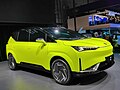 Hycan Z03 front
 -
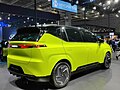 Hycan Z03 rear


Hycan A06
[edit]The Hycan A06 is a mid-size electric sedan launched in 2022.
-
 Hycan A06 front
 -
 Hycan A06 rear


Hycan V09
[edit]The Hycan V09 is an electric MPV launched in 2023.
-
 Hycan V09 front
 -
 Hycan V09 rear


Technologies
[edit]'Little Can' AI
[edit]Hycan vehicles feature a smart assistant similar to Nio's Nomi smart assistant. The assistant, named 'Little Can' (in Chinese, 小CAN, pronounced Xiǎo Cān), can pull up the car's navigation, control the music, adjust the cabin temperature, open or close windows, and take a selfie of the passengers in the cabin.[citation needed]
Sales
[edit]References
[edit]- ^ Andrews, Mark (2024-06-24). "Is former Nio JV Chinese EV brand Hycan about to go bust?". CarNewsChina.com. Retrieved 2024-11-20.
- ^ Andrews, Mark (2024-11-18). "Former Nio EV venture Hycan in death throes with few remaining employees and increasing debts". CarNewsChina.com. Retrieved 2024-11-20.
- ^ "GAC-NIO Established a Joint-Venture to Release a New Brand and New EV". ChinaPEV.com. 20 May 2019. Retrieved 2 November 2020.
- ^ "China's GAC Nio Is Set for Name Change After Ownership Shakeup".
- ^ "GAC Group and Pearl River Investment Management Group Reached Strategic Cooperation to Jointly Create New Development Modes of Intelligent Automobiles". GAC Group. 2021-01-05. Retrieved 2023-09-17.
- ^ Bai, Haotian (2022-05-12). "广汽蔚来已成过去式 凭"EDG"破圈的朱一航能否挽救合创汽车". The Beijing News. Archived from the original on 2022-06-14. Retrieved 2023-04-23 – via chinanews.com.
- ^ "蔚来退出合创汽车,退出前持股比例约4.46%". Sina Tech. 2022-08-24. Archived from the original on 2023-01-02. Retrieved 2023-04-23.
- ^ 虎嗅 (2025-01-15). "广汽集团证实:合创汽车"终于倒下"". finance.sina.com.cn. Retrieved 2025-01-16.
- ^ "GAC-NIO Introduces Hycan Brand And Concept Electric SUV". InsideEVs.com. 28 May 2019. Retrieved 2 November 2020.
- ^ "Teaser Images of Hycan's First EV, Features Triple Screens". ChinaPEV.com. 14 August 2019. Retrieved 2 November 2020.
- ^ "Named HYCAN 007, GAC-NIO's First Pure Electric SUV Started Pre-Sale in Chinese Market, Range of 399miles". ChinaPEV.com. 27 December 2019. Retrieved 2 November 2020.
- ^ "HYCAN 007, GAC-NIO's First Pure EV Officially Listed in the Chinese market with price started at 262,000 yuan". ChinaPEV.com. 11 April 2020. Retrieved 2 November 2020.
- ^ "GAC-Nio launch the first BEV in the Hycan brand". Electrive.com. 15 April 2020. Retrieved 2 November 2020.
- ^ "The Weirdest Tuned Cars From The 2021 Chengdu Auto Show". Carscoops. 2021-09-05. Retrieved 2022-08-12.
- ^ "没有汽车行业从业背景的原科大讯飞副总裁杜兰,能给合创汽车带来什么?". www.sohu.com. Retrieved 2023-10-02.
- ^ "合创汽车 2021销量 - Google 搜索". www.google.com.hk. Retrieved 2023-10-02.
- ^ "合创汽车销量查询,合创汽车销量排名,合创汽车历史销量查询 - 车主之家". xl.16888.com. Retrieved 2024-01-11.
A subsidiary of Guangzhou Automobile Industry Group | |||||
| Marques | |||||
| Subsidiaries |
| ||||
| Joint ventures and shareholdings |
| ||||

| Marques |  | ||||||
|---|---|---|---|---|---|---|---|
| Current vehicles |
| ||||||
| Future vehicles | |||||||
| Concept vehicles | |||||||
| Joint ventures |
| ||||||
| Racing |
| ||||||

Hycan
View on GrokipediaBackground
Founding and ownership
Hycan was established on April 10, 2018, as GAC-NIO New Energy Automobile Technology Co., Ltd., a joint venture between Guangzhou Automobile Group (GAC Group) and NIO Inc., with GAC New Energy Automobile (now GAC Aion) also participating, aimed at developing premium electric vehicles with a focus on intelligent mobility solutions.[1][2] The partnership was formalized following a strategic cooperation agreement signed on December 28, 2017, with GAC and its affiliates holding 45% ownership and NIO and its affiliates holding 45%.[6] The initial registered capital was RMB 500 million, supported by a total planned investment of RMB 1.28 billion (approximately $198 million USD at the time), directed toward research, development, production, and sales of new energy vehicles.[7] In early 2021, the joint venture received additional funding of RMB 2.405 billion from Pearl River Investment Management Group, which became the largest shareholder and diluted NIO's stake to approximately 4.5%.[8] This investment strengthened the company's position in smart vehicle projects. On May 25, 2021, the company rebranded to Hycan Automotive Technology Co., Ltd., emphasizing its commitment to advanced electric vehicle innovation.[1] NIO fully exited the joint venture in August 2022, transferring its remaining shares. As of 2024, ownership is held by Pearl River Investment Management Group (68.56%), GAC Aion (20.54%), and GAC Group (4.46%).[9][2] Under this structure, Hycan continued to prioritize the creation of a premium brand targeting intelligent and sustainable mobility ecosystems.[1]Headquarters and production facilities
Hycan Automobile Technology Co., Ltd. is headquartered in the Nansha District of Guangzhou, Guangdong Province, China, specifically at Room 1201, No. 37 Jinlong Street, Xiangjiang Financial Business Center.[10] This location serves as the central hub for the company's operations, including administrative functions and strategic oversight. The headquarters is situated in the Greater Bay Area, facilitating proximity to key automotive industry clusters and supply chains.[1] The company's primary production base is in Hangzhou, Zhejiang Province, where Hycan holds a 49% stake in GAC Motor (Hangzhou) Co., Ltd., acquired in January 2022 to support electric vehicle assembly.[1] This facility, retooled for Hycan models, has an annual production capacity of 400,000 units and emphasizes high-efficiency, eco-friendly manufacturing processes.[1] A secondary production facility in Guangzhou handles assembly with a capacity of 200,000 units per year, contributing to Hycan's overall target of 600,000 units during the 14th Five-Year Plan period.[1] Additionally, the Guangzhou site includes R&D operations, such as the former GAC Nio R&D Center in Nansha, focused on vehicle integration and technology development.[11] Hycan collaborates with international suppliers to enhance its manufacturing capabilities, notably partnering with Comau to implement automated welding lines for body-in-white assembly at the Hangzhou plant.[12] This system supports flexible, multi-model production through intelligent robotics and framing technology, improving efficiency for new energy vehicles.[13] Overall, Hycan's facilities prioritize intelligent manufacturing under a Smart 4.0 framework, integrating automation, digitalization, and ecological management to ensure high-quality output for electric vehicles.[1]History
Establishment and early development
Hycan, initially established as GAC NIO New Energy Automotive Technology Co., Ltd. on April 10, 2018, focused on the research, development, production, and sales of pure electric vehicles as a joint venture between Guangzhou Automobile Group (GAC) and NIO Inc.[14][15] The company aimed to integrate NIO's expertise in battery technology and software systems to create intelligent EVs, with an initial investment of RMB 1.28 billion and registered capital of RMB 500 million, split equally between the partners.[16][17] In 2019, Hycan advanced its early development by officially releasing its brand name and identity on May 20, unveiling the Hycan 007 concept as its first prototype at the event.[18][19] This concept emphasized smart electric mobility, with the prototype showcased to highlight the company's vision for integrated vehicle ecosystems. Later that year, on December 27, Hycan debuted further details on its inaugural production model, signaling progress toward market entry.[1] The venture faced challenges around 2020 when NIO's involvement diminished, culminating in a restructuring that diluted NIO's stake to approximately 4.46% by early 2021 and led to full withdrawal as a shareholder in August 2022, prompting Hycan to pursue independent development under GAC's primary control.[20][21] During this period, Hycan invested heavily in R&D for smart ecosystems, establishing three research institutes and four centers to self-develop core technologies in AI, Internet of Things (IoT), and intelligent driving, while aiming to create a "third space" mobility concept that combines sustainable travel with shared services and living ecosystems.[1][22]Key milestones and model launches
Hycan launched its first model, the Hycan 007 electric SUV, in December 2019 with pre-sales beginning immediately, followed by an official market listing in China in April 2020.[23][24] The vehicle's production commenced shortly after, marking Hycan's entry into the competitive electric vehicle sector as a joint venture between GAC Group and Nio.[25] In May 2021, the company rebranded from GAC Nio to Hycan to emphasize its independent identity in the new energy vehicle market.[26] Later that year, on October 22, Hycan debuted its second model, the Z03 compact crossover SUV, targeting younger urban consumers with affordable pricing starting around $20,000.[27][1] Early 2022 saw strategic expansion in production capabilities, with Hycan acquiring a 49% stake in GAC Hangzhou Company on January 26 to bolster manufacturing capacity.[1] In August, the company introduced the A06 mid-size electric sedan, featuring advanced aerodynamic design and rapid acceleration, priced from 179,800 yuan to appeal to the sedan segment.[28] Hycan continued its model diversification in October 2023 with the launch of the V09 all-electric MPV, a seven-seater luxury vehicle offering up to 762 km of range under CLTC standards and priced starting at 318,800 yuan, aimed at family-oriented buyers.[4][1] Concurrently, the company announced plans for international expansion, including a planned entry into the Malaysian market in the first quarter of 2025 through local distributor Concept Fields Sdn Bhd, with initial models comprising the Z03, A06, and V09, though these did not materialize due to the company's financial difficulties.[29] Facing intensifying market competition and sluggish sales in 2024, Hycan underwent financial restructuring efforts, including mandates for employees to achieve personal vehicle sales targets in March to boost domestic deliveries.[30] By late 2024, the company downsized operations, closing its Shanghai branch and reducing staff to around 50 at its Guangzhou headquarters while exploring further restructuring and partnerships amid cash flow challenges.[31] Despite these pressures, Hycan proceeded with overseas shipments of its V09, A06 Plus, and Z03 models in 2024.[32] However, by early 2025, Hycan was confirmed as defunct, with GAC Group assisting in employee placements and GAC Aion taking over after-sales service for existing vehicles.[33][34]Models
As of November 2025, Hycan models face limited production and sales due to the company's financial difficulties.[3]Hycan 007
The Hycan 007 is a mid-size all-electric sport utility vehicle (SUV) that debuted in April 2020 as the inaugural model from the Hycan brand, marking the company's entry into the pure electric vehicle market.[35] Positioned as a premium five-door, five-seat SUV, it emphasizes spacious interiors and intelligent features tailored for urban and highway driving. The exterior design features a aerodynamic profile with a drag coefficient of 0.28 Cd, contributing to its efficiency.[36] In terms of dimensions, the Hycan 007 measures 4,879 mm in length, 1,937 mm in width, 1,680 mm in height, and has a wheelbase of 2,919 mm, providing ample interior space with a curb weight of approximately 2,030 kg.[37] It is offered in three main variants—Base, Plus, and Top—each powered by a rear-wheel-drive setup with a single permanent magnet synchronous motor. The Base variant uses a 73 kWh ternary lithium (NMC) battery pack, delivering an NEDC-rated range of 523 km and accelerating from 0 to 100 km/h in 8.2 seconds with about 135 kW of power. The Plus and Top variants upgrade to a 93 kWh battery, offering an NEDC range of 643 km (listed as 643 km under CLTC in subsequent updates) and 0-100 km/h in 7.9 seconds with 150 kW (204 hp) output and 350 Nm of torque.[25][37] Fast charging from 30% to 80% takes around 0.6 hours via DC, with a top speed of 170 km/h across trims.[37] Key features include a 12.3-inch central infotainment touchscreen supporting connectivity and OTA updates, alongside a matching 12.3-inch digital instrument cluster.[38] The vehicle integrates L2+ advanced driver-assistance systems (ADAS) with more than 20 functions, such as adaptive cruise control, lane centering assist, and automatic parking.[39] It also incorporates the Little Can AI voice assistant for continuous conversation and vehicle control. At launch, pricing started at 262,000 RMB (approximately $37,000 USD at the time) for the Base model, with higher trims reaching up to 299,800 RMB.[40]Hycan Z03
The Hycan Z03 is a compact crossover SUV launched in October 2021 as the brand's entry-level electric vehicle, specifically targeting urban commuters with its affordable pricing and maneuverable size for city driving. Positioned below larger models like the Hycan 007, it emphasizes practicality and efficiency for daily use in congested environments.[27] Measuring 4602 mm in length, 1900 mm in width, 1645 mm in height, and with a wheelbase of 2750 mm, the Z03 offers a balanced footprint that combines compact exterior dimensions with interior space for five passengers, including foldable rear seats that create a flat 2-meter lounging area. Its body features an aerodynamic profile with a closed front grille, sleek LED headlights, and integrated taillights to optimize efficiency and modern aesthetics.[27][41] Power comes from a single front-mounted electric motor delivering 135 kW (181 hp) in base trims or 160 kW (217 hp) in performance variants, paired with ternary lithium or LFP battery options of 55.5 kWh (430 km CLTC range), 61.13 kWh (510 km CLTC range), or 76.8 kWh (620 km CLTC range). The interior highlights include a 14.6-inch HD central touchscreen for infotainment and connectivity, integrated with the H-VIP system for voice controls and navigation. Fast DC charging replenishes the battery from 30% to 80% in 36-45 minutes, depending on pack size, supporting quick urban top-ups.[42][43][41][44] At launch, the Z03 was priced starting from 132,800 RMB (about $20,600 USD) for the base model, rising to 168,800 RMB for top trims; by 2025, updated variants reflect price reductions and incentives, with entry-level options available from approximately 109,800 RMB (around $15,500 USD). These adjustments have helped maintain its appeal in China's competitive compact EV segment. The model incorporates L2+ advanced driver-assistance systems for enhanced urban safety.[27][45]Hycan A06
The Hycan A06 is a mid-size pure electric sedan launched in December 2022, offering all-wheel-drive options in its higher-performance configurations.[46] Built on Hycan's H-GEA platform, it emphasizes aerodynamic efficiency and sedan-specific handling for highway driving and urban agility, distinguishing it through a low drag coefficient and responsive chassis tuning.[46] The A06 measures 4965 mm in length, 1920 mm in width, and 1520 mm in height, with a wheelbase of 2850 mm that supports a balanced weight distribution for stable cornering and interior space optimization.[46] Battery options include a 63 kWh pack delivering up to 550 km of CLTC-rated range and a 71 kWh pack extending that to 630 km, enabling long-distance travel without frequent charging.[46] Powertrain choices range from single-motor front-wheel drive to a dual-motor setup producing up to 340 kW, which accelerates from 0 to 100 km/h in 3.7 seconds while maintaining efficient energy use.[46] The A06 Plus variant, launched in 2023, provides a 60.04 kWh battery with 520 km CLTC range and 160 kW power for efficient performance.[47] It integrates the Little Can AI assistant for voice-activated controls, supporting seamless interaction during drives.[28] Pricing starts at 179,800 RMB (approximately $25,800 USD at launch), positioning it as an accessible premium EV sedan in the Chinese market.[46]Hycan V09
The Hycan V09 is a mid-to-large electric MPV launched in October 2023, designed primarily for family use and shared mobility services, offering spacious accommodations for up to seven passengers in a versatile configuration suitable for both personal and commercial applications. Developed by GAC Hycan, it emphasizes comfort and practicality in urban and intercity travel, positioning itself as a premium option in China's growing electric MPV segment. Deliveries began in November 2023, targeting users seeking an efficient, tech-integrated vehicle for multi-passenger scenarios like ride-hailing or family outings.[4] Measuring 5,215 mm in length, 1,967 mm in width, and 1,910 mm in height with a 3,170 mm wheelbase, the V09 provides ample interior room in its 2+2+3 seating layout, supporting 6- or 7-seat configurations depending on options. This sizing facilitates easy third-row access and flexible cargo space, expanding from 610 liters with all seats up to 2,430 liters when the third row is folded, making it ideal for family trips or commercial shuttling. Electric sliding doors enhance accessibility for passengers, particularly in tight parking situations common to shared mobility operations.[4][48] The powertrain features a front-mounted permanent magnet synchronous motor delivering 202 kW (275 PS) and 335 Nm of torque, paired with battery options of 92 kWh, 95.16 kWh, or 114.19 kWh, achieving CLTC ranges of 620 km to 762 km depending on the pack. Supported by an 800V silicon carbide architecture, it enables fast charging that adds up to 200 km in five minutes, optimizing downtime for commercial fleets. Top speed is limited to 190 km/h, prioritizing efficiency over high performance for its intended multi-passenger role.[4][48] Key features include a "third space" interior concept, creating a lounge-like environment with Nappa leather seats offering heating, ventilation, and massage functions for front and second-row occupants, complemented by a 22-speaker audio system and an onboard refrigerator. Safety and convenience are bolstered by 360-degree cameras, 23 sensors including LiDAR on higher trims, and advanced driver-assistance systems with 30 functions for semi-autonomous driving. In China, pricing starts at 318,800 RMB (approximately $44,000 USD) for the base model, rising to 438,800 RMB for top variants; plans for Malaysian import in Q1 2025 via local distributor Concept Fields, potentially including CKD assembly, were announced but did not materialize as of late 2025 due to company challenges.[4][48][1]Technologies
Little Can AI assistant
The Little Can AI assistant, known in Chinese as Xiao Can (小CAN), is a proprietary digital smart assistant developed exclusively for Hycan vehicles, introduced in 2020 with the launch of the Hycan 007 electric SUV. It leverages voice recognition and natural language processing (NLP) to facilitate intuitive in-cabin interactions, allowing users to issue commands without manual intervention. This system marks Hycan's early emphasis on intelligent user interfaces, enabling hands-free control that enhances the driving experience by reducing distractions.[49][39] Core functions of Little Can include navigation control for route guidance, music playback and audio management, adjustment of vehicle settings such as cabin temperature and seating positions, and activation of entertainment modes like multimedia streaming. The assistant supports continuous dialogue for up to 60 seconds after activation, intelligently filtering non-instructional statements to prioritize relevant commands and covering over 80% of typical in-car operations. For instance, users can request real-time traffic updates or switch entertainment sources seamlessly via voice prompts.[39] Integration occurs through the vehicle's multi-screen infotainment setup, where Little Can projects responses and information on the nearest display to the speaker, such as the 12.3-inch central touchscreen in the Hycan 007. It incorporates facial recognition to personalize interactions based on identified occupants, enhancing privacy and user-specific preferences. Similar to NIO's NOMI assistant, Little Can features personality-driven responses that add a conversational, engaging tone to interactions, making it a distinctive element in Hycan's lineup across models like the Z03 and A06.[36][50][46]Advanced driver-assistance systems
Hycan's advanced driver-assistance systems (ADAS) operate at the L2+ level of autonomy, a standard feature across its vehicle lineup since the brand's inception in 2020 with the Hycan 007. The HYCAN PILOT system integrates core L2 functionalities, including adaptive cruise control for maintaining safe following distances, lane keeping assist to prevent unintended drift, and automatic emergency braking to mitigate collision risks. These features enhance driver safety and convenience by providing partial automation while requiring constant human supervision.[51] The supporting hardware for HYCAN PILOT consists of a multi-sensor fusion setup designed for comprehensive environmental perception. Typical configurations include 11 cameras for visual recognition, 5 mmWave radars for distance and velocity detection, and 12 ultrasonic sensors for close-range obstacle avoidance, enabling reliable operation in diverse conditions. For instance, the Hycan A06 employs 22 sensors to support semi-autonomous driving, scanning up to 200 meters ahead for highway and urban navigation. Similarly, the Hycan V09 utilizes 4 surround-view cameras and 12 ultrasonic radars to facilitate precise low-speed maneuvers and parking. This hardware architecture powers Navigate on Autopilot (NoA) capabilities, allowing automated navigation, lane changes, and overtaking on highways and in urban settings.[52] Software enhancements to the ADAS are delivered through over-the-air (OTA) updates, enabling iterative improvements to algorithms and feature sets without hardware changes. As part of GAC Group's broader Hyper intelligent ecosystem, HYCAN PILOT benefits from shared platform resources, including cloud-based processing for refined perception and decision-making. This integration supports voice-activated control of ADAS functions, such as activating cruise control via the Little Can AI assistant.[53]Sales and markets
Annual sales figures
Hycan's annual sales have shown significant growth in its early years, starting from modest volumes in 2020 and peaking around 2022-2023 before a notable decline in subsequent years. In 2020, the company recorded cumulative sales of 659 units, primarily driven by initial model launches in the domestic Chinese market. Sales accelerated in 2021 to 2,924 units, reflecting expanding production capacity and market acceptance of its electric vehicles. The year 2022 marked a high point with 17,577 units sold, fueled by strong demand for the Z03 SUV and A06 sedan, which together accounted for the majority of deliveries and contributed to over 2,500 units per month in the latter half of the year.[54] By 2023, sales reached 18,559 units, maintaining momentum with the introduction of the V09 minivan, which began to lead contributions alongside continued sales of the Z03 and A06. However, 2024 saw a sharp downturn to approximately 4,700 units, indicating challenges such as intensified competition in China's EV sector and slower adoption of newer models. As of November 2025, year-to-date sales are very low, with monthly figures averaging under 50 units (e.g., February: 20 units, May: 9 units, September: 45 units), primarily from the V09 model, underscoring a continued decline amid production suspension.[2][55][56][57]| Year | Cumulative Sales (units) | Key Contributing Models |
|---|---|---|
| 2020 | 659 | Hycan 007 |
| 2021 | 2,924 | Z03 |
| 2022 | 17,577 | Z03, A06 |
| 2023 | 18,559 | Z03, A06, V09 |
| 2024 | ~4,700 | V09, A06 |
| 2025 (YTD Nov) | <500 | V09 |