Hubbry Logo
Hyperfine structureHyperfine structureMain
Open search
Hyperfine structure
Community hub
Hyperfine structure
logo
8 pages, 0 posts
0 subscribers
Be the first to start a discussion here.
Hyperfine structure
Hyperfine structure
from Wikipedia

In atomic physics, hyperfine structure is defined by small shifts in otherwise degenerate electronic energy levels and the resulting splittings in those electronic energy levels of atoms, molecules, and ions, due to electromagnetic multipole interaction between the nucleus and electron clouds.

In atoms, hyperfine structure arises from the energy of the nuclear magnetic dipole moment interacting with the magnetic field generated by the electrons and the energy of the nuclear electric quadrupole moment in the electric field gradient due to the distribution of charge within the atom. Molecular hyperfine structure is generally dominated by these two effects, but also includes the energy associated with the interaction between the magnetic moments associated with different magnetic nuclei in a molecule, as well as between the nuclear magnetic moments and the magnetic field generated by the rotation of the molecule.

Hyperfine structure contrasts with fine structure, which results from the interaction between the magnetic moments associated with electron spin and the electrons' orbital angular momentum. Hyperfine structure, with energy shifts typically orders of magnitude smaller than those of a fine-structure shift, results from the interactions of the nucleus (or nuclei, in molecules) with internally generated electric and magnetic fields.

Schematic illustration of fine and hyperfine structure in a neutral hydrogen atom

History

[edit]

The first theory of atomic hyperfine structure was given in 1930 by Enrico Fermi[1] for an atom containing a single valence electron with an arbitrary angular momentum. The Zeeman splitting of this structure was discussed by S. A. Goudsmit and R. F. Bacher later that year.

In 1935, H. Schüler and Theodor Schmidt proposed the existence of a nuclear quadrupole moment in order to explain anomalies in the hyperfine structure of europium, cassiopium (older name for lutetium), indium, antimony, and mercury.[2]

Theory

[edit]

The theory of hyperfine structure comes directly from electromagnetism, consisting of the interaction of the nuclear multipole moments (excluding the electric monopole) with internally generated fields. The theory is derived first for the atomic case, but can be applied to each nucleus in a molecule. Following this there is a discussion of the additional effects unique to the molecular case.

Atomic hyperfine structure

[edit]

Magnetic dipole

[edit]

The dominant term in the hyperfine Hamiltonian is typically the magnetic dipole term. Atomic nuclei with a non-zero nuclear spin have a magnetic dipole moment, given by: where is the g-factor and is the nuclear magneton.

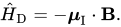
There is an energy associated with a magnetic dipole moment in the presence of a magnetic field. For a nuclear magnetic dipole moment, μI, placed in a magnetic field, B, the relevant term in the Hamiltonian is given by:[3]

In the absence of an externally applied field, the magnetic field experienced by the nucleus is that associated with the orbital () and spin (s) angular momentum of the electrons:

Electron orbital magnetic field
[edit]

Electron orbital angular momentum results from the motion of the electron about some fixed external point that we shall take to be the location of the nucleus. The magnetic field at the nucleus due to the motion of a single electron, with charge –e at a position r relative to the nucleus, is given by: where −r gives the position of the nucleus relative to the electron. Written in terms of the Bohr magneton, this gives:

Recognizing that mev is the electron momentum, p, and that r × p / ħ is the orbital angular momentum in units of ħ, , we can write:

For a many-electron atom this expression is generally written in terms of the total orbital angular momentum, , by summing over the electrons and using the projection operator, , where . For states with a well defined projection of the orbital angular momentum, Lz, we can write , giving:

Electron spin magnetic field

[edit]

The electron spin angular momentum is a fundamentally different property that is intrinsic to the particle and therefore does not depend on the motion of the electron. Nonetheless, it is angular momentum and any angular momentum associated with a charged particle results in a magnetic dipole moment, which is the source of a magnetic field. An electron with spin angular momentum, s, has a magnetic moment, μs, given by: where gs is the electron spin g-factor and the negative sign is because the electron is negatively charged (consider that negatively and positively charged particles with identical mass, travelling on equivalent paths, would have the same angular momentum, but would result in currents in the opposite direction).

The magnetic field of a point dipole moment, μs, is given by:[4][5]

Electron total magnetic field and contribution

[edit]

The complete magnetic dipole contribution to the hyperfine Hamiltonian is thus given by:

The first term gives the energy of the nuclear dipole in the field due to the electronic orbital angular momentum. The second term gives the energy of the "finite distance" interaction of the nuclear dipole with the field due to the electron spin magnetic moments. The final term, often known as the Fermi contact term relates to the direct interaction of the nuclear dipole with the spin dipoles and is only non-zero for states with a finite electron spin density at the position of the nucleus (those with unpaired electrons in s-subshells). It has been argued that one may get a different expression when taking into account the detailed nuclear magnetic moment distribution.[6] The inclusion of the delta function is an admission that the singularity in the magnetic induction B owing to a magnetic dipole moment at a point is not integrable. It is B which mediates the interaction between the Pauli spinors in non-relativistic quantum mechanics. Fermi (1930) avoided the difficulty by working with the relativistic Dirac wave equation, according to which the mediating field for the Dirac spinors is the four-vector potential (V,A). The component  V is the Coulomb potential. The component A is the three-vector magnetic potential (such that B = curl A), which for the point dipole is integrable.

For states with this can be expressed in the form where:[3]

If hyperfine structure is small compared with the fine structure (sometimes called IJ-coupling by analogy with LS-coupling), I and J are good quantum numbers and matrix elements of can be approximated as diagonal in I and J. In this case (generally true for light elements), we can project N onto J (where J = L + S is the total electronic angular momentum) and we have:[7]

This is commonly written as with being the hyperfine-structure constant which is determined by experiment. Since IJ = 12{FFIIJJ} (where F = I + J is the total angular momentum), this gives an energy of:

In this case the hyperfine interaction satisfies the Landé interval rule.

Electric quadrupole

[edit]

Atomic nuclei with spin have an electric quadrupole moment.[8] In the general case this is represented by a rank-2 tensor, , with components given by:[4] where i and j are the tensor indices running from 1 to 3, xi and xj are the spatial variables x, y and z depending on the values of i and j respectively, δij is the Kronecker delta and ρ(r) is the charge density. Being a 3-dimensional rank-2 tensor, the quadrupole moment has 32 = 9 components. From the definition of the components it is clear that the quadrupole tensor is a symmetric matrix (Qij = Qji) that is also traceless (), giving only five components in the irreducible representation. Expressed using the notation of irreducible spherical tensors we have:[4]

The energy associated with an electric quadrupole moment in an electric field depends not on the field strength, but on the electric field gradient, confusingly labelled , another rank-2 tensor given by the outer product of the del operator with the electric field vector: with components given by:

Again it is clear this is a symmetric matrix and, because the source of the electric field at the nucleus is a charge distribution entirely outside the nucleus, this can be expressed as a 5-component spherical tensor, , with:[9] where:

The quadrupolar term in the Hamiltonian is thus given by:

A typical atomic nucleus closely approximates cylindrical symmetry and therefore all off-diagonal elements are close to zero. For this reason the nuclear electric quadrupole moment is often represented by Qzz.[8]

Molecular hyperfine structure

[edit]

The molecular hyperfine Hamiltonian includes those terms already derived for the atomic case with a magnetic dipole term for each nucleus with and an electric quadrupole term for each nucleus with . The magnetic dipole terms were first derived for diatomic molecules by Frosch and Foley,[10] and the resulting hyperfine parameters are often called the Frosch and Foley parameters.

In addition to the effects described above, there are a number of effects specific to the molecular case.[11]

Direct nuclear spin–spin

[edit]

Each nucleus with has a non-zero magnetic moment that is both the source of a magnetic field and has an associated energy due to the presence of the combined field of all of the other nuclear magnetic moments. A summation over each magnetic moment dotted with the field due to each other magnetic moment gives the direct nuclear spin–spin term in the hyperfine Hamiltonian, .[12] where α and α' are indices representing the nucleus contributing to the energy and the nucleus that is the source of the field respectively. Substituting in the expressions for the dipole moment in terms of the nuclear angular momentum and the magnetic field of a dipole, both given above, we have

Nuclear spin–rotation

[edit]

The nuclear magnetic moments in a molecule exist in a magnetic field due to the angular momentum, T (R is the internuclear displacement vector), associated with the bulk rotation of the molecule,[12] thus

Small molecule hyperfine structure

[edit]

A typical simple example of the hyperfine structure due to the interactions discussed above is in the rotational transitions of hydrogen cyanide (1H12C14N) in its ground vibrational state. Here, the electric quadrupole interaction is due to the 14N-nucleus, the hyperfine nuclear spin-spin splitting is from the magnetic coupling between nitrogen, 14N (IN = 1), and hydrogen, 1H (IH = 12), and a hydrogen spin-rotation interaction due to the 1H-nucleus. These contributing interactions to the hyperfine structure in the molecule are listed here in descending order of influence. Sub-doppler techniques have been used to discern the hyperfine structure in HCN rotational transitions.[13]

The dipole selection rules for HCN hyperfine structure transitions are , , where J is the rotational quantum number and F is the total rotational quantum number inclusive of nuclear spin (), respectively. The lowest transition () splits into a hyperfine triplet. Using the selection rules, the hyperfine pattern of transition and higher dipole transitions is in the form of a hyperfine sextet. However, one of these components () carries only 0.6% of the rotational transition intensity in the case of . This contribution drops for increasing J. So, from upwards the hyperfine pattern consists of three very closely spaced stronger hyperfine components (, ) together with two widely spaced components; one on the low frequency side and one on the high frequency side relative to the central hyperfine triplet. Each of these outliers carry ~ (J is the upper rotational quantum number of the allowed dipole transition) the intensity of the entire transition. For consecutively higher-J transitions, there are small but significant changes in the relative intensities and positions of each individual hyperfine component.[14]

Measurements and Applications

[edit]

Hyperfine interactions can be measured, among other ways, in atomic and molecular spectra, and in electron paramagnetic resonance spectra of free radicals and transition-metal ions.

Astrophysics

[edit]
The hyperfine transition as depicted on the Pioneer plaque

As the hyperfine splitting is very small, the transition frequencies are usually not located in the optical, but are in the range of radio- or microwave (also called sub-millimeter) frequencies.

Hyperfine structure gives the 21 cm line observed in H I regions in interstellar medium.

Carl Sagan and Frank Drake considered the hyperfine transition of hydrogen to be a sufficiently universal phenomenon so as to be used as a base unit of time and length on the Pioneer plaque and later Voyager Golden Record.

In submillimeter astronomy, heterodyne receivers are widely used in detecting electromagnetic signals from celestial objects such as star-forming core or young stellar objects. The separations among neighboring components in a hyperfine spectrum of an observed rotational transition are usually small enough to fit within the receiver's IF band. Since the optical depth varies with frequency, strength ratios among the hyperfine components differ from that of their intrinsic (or optically thin) intensities (these are so-called hyperfine anomalies, often observed in the rotational transitions of HCN[14]). Thus, a more accurate determination of the optical depth is possible. From this we can derive the object's physical parameters.[15]

Nuclear spectroscopy

[edit]
Hyperfine splitting in ferromagnetic cobalt at 3.5 K, observed by quasielastic neutron scattering.[16]

In nuclear spectroscopy methods, the nucleus is used to probe the local structure in materials. The methods mainly base on hyperfine interactions with the surrounding atoms and ions. Important methods are nuclear magnetic resonance, Mössbauer spectroscopy, perturbed angular correlation, and high-resolution inelastic neutron scattering.

Nuclear technology

[edit]

The atomic vapor laser isotope separation (AVLIS) process uses the hyperfine splitting between optical transitions in uranium-235 and uranium-238 to selectively photo-ionize only the uranium-235 atoms and then separate the ionized particles from the non-ionized ones. Precisely tuned dye lasers are used as the sources of the necessary exact wavelength radiation.

Use in defining the SI second and meter

[edit]

The hyperfine structure transition can be used to make a microwave notch filter with very high stability, repeatability and Q factor, which can thus be used as a basis for very precise atomic clocks. The term transition frequency denotes the frequency of radiation corresponding to the transition between the two hyperfine levels of the atom, and is equal to f = ΔE/h, where ΔE is difference in energy between the levels and h is the Planck constant. Typically, the transition frequency of a particular isotope of caesium or rubidium atoms is used as a basis for these clocks.

Due to the accuracy of hyperfine structure transition-based atomic clocks, they are now used as the basis for the definition of the second. One second is now defined to be exactly 9192631770 cycles of the hyperfine structure transition frequency of caesium-133 atoms.

On October 21, 1983, the 17th CGPM defined the meter as the length of the path travelled by light in a vacuum during a time interval of 1/299,792,458 of a second.[17][18]

Precision tests of quantum electrodynamics

[edit]

The hyperfine splitting in hydrogen and in muonium have been used to measure the value of the fine-structure constant α. Comparison with measurements of α in other physical systems provides a stringent test of QED.

Qubit in ion-trap quantum computing

[edit]

The hyperfine states of a trapped ion are commonly used for storing qubits in ion-trap quantum computing. They have the advantage of having very long lifetimes, experimentally exceeding ~10 minutes (compared to ~1 s for metastable electronic levels).

The frequency associated with the states' energy separation is in the microwave region, making it possible to drive hyperfine transitions using microwave radiation. However, at present no emitter is available that can be focused to address a particular ion from a sequence. Instead, a pair of laser pulses can be used to drive the transition, by having their frequency difference (detuning) equal to the required transition's frequency. This is essentially a stimulated Raman transition. In addition, near-field gradients have been exploited to individually address two ions separated by approximately 4.3 micrometers directly with microwave radiation.[19]

See also

[edit]

References

[edit]
[edit]
Revisions and contributorsEdit on WikipediaRead on Wikipedia
from Grokipedia
Hyperfine structure is the smallest observable splitting in the energy levels and spectral lines of atoms and molecules, arising from the interaction between the nuclear magnetic dipole moment (and higher-order multipoles like the electric quadrupole) and the generated by the orbiting and spinning electrons. This effect produces energy shifts on the order of 10^{-6} eV or less, much smaller than the splitting caused by relativistic effects and spin-orbit coupling, which is typically around 10^{-4} eV. The F, combining the electron's total angular momentum J and the nuclear spin I (where F = |I + J| to |I - J|), governs the multiplicity of these split levels. In the , hyperfine structure is particularly prominent in the (n=1, L=0, S=1/2, J=1/2), where the and proton spins interact via their magnetic moments, splitting the level into two: the lower-energy (F=0) and the higher-energy (F=1), separated by an energy difference corresponding to a of approximately 1,420 MHz (the famous 21 cm radio line). The measured value is precisely 5.88 × 10^{-6} eV. The 21 cm line has been crucial in for mapping neutral in galaxies, revealing the Way's spiral structure. Beyond , hyperfine structure manifests in heavier atoms through similar spin interactions, often complicated by nuclear quadrupole moments, and is observable in alkali metals like cesium and via laser spectroscopy. Its precise measurement enables applications in atomic clocks, where the hyperfine transition in ^{133}Cs (frequency: 9,192,631,770 Hz) defines the international second, achieving timekeeping accuracies better than 1 part in 10^{15}. Hyperfine effects also play a role in with trapped ions and in precision tests of fundamental symmetries, such as parity violation in nuclei.

Fundamentals

Definition and Physical Origin

Hyperfine structure refers to the finest level of splitting observed in the spectral lines of atoms and molecules, arising from the interaction between the magnetic and electric moments of the nucleus and the surrounding electrons or molecular fields. This splitting occurs in otherwise of the atomic or molecular ground and excited states, where the total angular momentum F\mathbf{F} is the vector sum of the nuclear spin angular momentum I\mathbf{I} and the electronic angular momentum J\mathbf{J}, such that F=I+J\mathbf{F} = \mathbf{I} + \mathbf{J}. For atoms with nuclear spin I>0I > 0, this coupling lifts the degeneracy, producing multiple hyperfine levels labeled by the FF, which range from IJ|I - J| to I+JI + J. The physical origin of hyperfine structure lies in two primary interactions. The magnetic dipole interaction stems from the coupling with the generated by the electrons, which includes contributions from the electron's orbital motion and spin; relativistic effects on the electron orbits, such as those described in the , produce an effective at the nucleus that interacts with the nuclear spin. Additionally, the electric quadrupole interaction arises from the non-spherical distribution of the nuclear charge, creating an electric quadrupole moment that couples with the produced by the asymmetric electron cloud around the nucleus. These effects reveal nuclear properties that are otherwise invisible in the gross atomic spectra dominated by electronic transitions. In terms of energy scale, hyperfine splittings are typically 10610^{-6} to 10310^{-3} times smaller than splittings, which themselves arise from coarser electron spin-orbit couplings. A prominent example is the hyperfine transition in the of neutral , known as the 21 cm line, corresponding to a of 1420 MHz and an splitting of about 5.9 μ\mueV between the F=1F=1 and F=0F=0 levels. This transition, driven by the interaction between the proton and electron spins, is crucial for in mapping interstellar . Hyperfine structure was first resolved in the optical spectra of metals like sodium in the 1930s, marking the experimental confirmation of these subtle nuclear-electronic couplings.

Relation to Other Spectral Splittings

Hyperfine structure represents the smallest scale of splitting in atomic and molecular spectra, arising from interactions between the nuclear spin and the electronic angular momentum. It fits into a broader of spectral features that refine the basic energy levels predicted by the non-relativistic . The gross structure originates from the dominant Coulomb interactions and orbital angular momentum quantization, producing energy differences on the order of 101510^{15} Hz for typical optical transitions in light atoms like . The , due to spin-orbit coupling and relativistic corrections, introduces smaller splittings on the scale of 10910^{9} to 101110^{11} Hz (GHz to hundreds of GHz), depending on the ZZ, as the splitting scales roughly as Z4α2Z^4 \alpha^2 times the gross energy, where α\alpha is the . Hyperfine structure follows at even lower energies, typically 10610^6 to 10910^9 Hz (MHz to GHz), while the —a quantum electrodynamic correction—provides an intermediate scale of around 1 GHz in , resolving degeneracies within the . A key distinction of hyperfine structure is its dependence on nuclear properties, particularly a non-zero nuclear spin I>0I > 0, which is absent in fine structure phenomena that involve only electronic degrees of freedom. For atoms with I=0I = 0, such as 12^{12}C or 16^{16}O, no hyperfine splitting occurs. In contrast, fine structure splits levels based on total electronic angular momentum j=l±sj = l \pm s, independent of the nucleus. A classic example is the hydrogen ground state (n=1n=1, l=0l=0), where fine structure leaves the 1s1s level unsplit (as l=0l=0), but hyperfine interaction couples the electron spin s=1/2s = 1/2 with the proton spin I=1/2I = 1/2, yielding total angular momentum F=0F = 0 or F=1F = 1 levels separated by 1420 MHz. This splitting reveals nuclear magnetic properties, such as the proton's magnetic moment, whereas fine structure probes electronic relativistic effects. Additionally, electric quadrupole hyperfine interactions (for I1I \geq 1) expose nuclear charge distributions, a feature unrelated to fine or gross structure. The energy scales highlight hyperfine structure's position as the finest resolution in this hierarchy, enabling precise probes of nuclear structure. The following table summarizes typical frequencies for , illustrating the orders-of-magnitude differences:
Splitting TypePhysical OriginTypical Frequency (Hydrogen)Example Transition
Gross Structure + orbital ~101510^{15} HzLyman-α (1s–2p): 2.47 × 10^{15} Hz
Fine StructureSpin-orbit + relativistic corrections~10 GHz2p_{3/2}–2p_{1/2}: 10.9 GHz
QED vacuum fluctuations~1 GHz2s–2p_{1/2}: 1058 MHz
Hyperfine StructureNuclear spin–electron coupling~1 GHz ()1s F=1–F=0: 1420 MHz
These values scale with atomic number and quantum numbers; for heavier atoms, fine structure can reach ~10^4 GHz due to Z4Z^4 enhancement. Hyperfine patterns exhibit strong isotope dependence, as they rely on the nuclear spin II and magnetic moment μI\mu_I, which vary across isotopes. For instance, in , the common isotope 1^1H (protium, I=1/2I = 1/2, μI2.79μN\mu_I \approx 2.79 \mu_N) shows a 1420 MHz ground-state splitting, while 2^2H (, I=1I = 1, μI0.86μN\mu_I \approx 0.86 \mu_N) has a much smaller splitting of 327 MHz due to the quadrupled moment of inertia and reduced magnetic moment per spin unit. This variation allows isotopic identification in spectra and underscores hyperfine structure's sensitivity to nuclear composition, unlike , which is isotope-independent to first order.

Historical Development

Early Observations

The hyperfine structure in atomic spectra was first observed in the late through high-resolution of lines. In 1928, Hermann Schüler resolved the hyperfine components of the sodium D lines, revealing each line as a closely spaced doublet with separations on the order of 0.01 cm⁻¹, which was initially attributed to the presence of isotopes rather than nuclear interactions. Independent observations by A. N. Terenin and L. N. Dobretsov in the same year confirmed this splitting in sodium vapor, marking the initial empirical detection of these fine details beyond the resolution limit. During the 1930s, further key experiments expanded these findings to other elements, particularly alkali metals. Ernst Back and investigated hyperfine multiplets in the spectra of and , identifying complex patterns in multiple lines that varied systematically with , using grating spectrographs to achieve the necessary resolution. Their work on lines in 1928 demonstrated multiplet structures with up to four components, highlighting the prevalence of hyperfine effects in heavy elements. These studies relied on advancements in , such as the Fabry-Pérot interferometer, which allowed precise measurement of splittings as small as 0.01 cm⁻¹, and ruled diffraction gratings that improved dispersion for detailed line profiles. Early observations also revealed isotopic variations in hyperfine patterns, providing clues to nuclear properties. For , differences in the hyperfine structure between the isotopes ⁶Li and ⁷Li were noted in the mid-1930s, with the patterns enabling the assignment of nuclear spins I = 1 for ⁶Li and I = 3/2 for ⁷Li through analysis of level splittings in optical spectra. A notable event was the prediction of the 21 cm line by Dutch Hendrik van de Hulst, arising from the hyperfine transition in neutral , although its experimental detection came later; this line's anticipated radio emission stemmed from early spectral insights into hyperfine effects in light atoms.

Theoretical Advancements

The theoretical foundations of hyperfine structure emerged in the mid-1920s when Wolfgang Pauli proposed that the small splittings observed in atomic spectral lines arose from an angular momentum associated with the atomic nucleus, which he termed nuclear spin. This concept marked a departure from purely electronic models of atomic spectra, attributing the phenomenon to interactions between the nuclear spin and the electron's magnetic moment. Building on this, Pauli further formalized the role of the nuclear spin quantum number II in 1926, recognizing it as the primary cause of hyperfine splitting through coupling with the total electronic angular momentum JJ. A significant advancement came in 1930 with Enrico Fermi's derivation of the contact interaction term, which specifically described the magnetic hyperfine coupling for s-electrons where the electron probability density at the nucleus is non-zero. This term, proportional to the product of the nuclear spin and the electron spin density at the nucleus, provided a quantitative framework for calculating splitting magnitudes in alkali atoms. During the 1930s, Hendrik Casimir and others extended these ideas by deriving the general forms of the and interaction terms in the hyperfine Hamiltonian, accounting for both point-like and distributed nuclear charge effects. These developments were integrated with the Dirac relativistic theory of the electron, enabling more accurate predictions for fine and hyperfine splittings in atoms where relativistic corrections to electron wavefunctions became relevant. Key milestones in the post-1930s era included the 1931 Breit-Rabi formula, which precisely described the hyperfine energy levels in hydrogen-like atoms under external magnetic fields, resolving the intermediate-field regime between weak and strong Zeeman effects. This formula, essential for atomic beam experiments, allowed for the separation of hyperfine and Zeeman contributions to energy shifts. Following , the advent of the by and J. Hans D. Jensen in 1949 provided a microscopic understanding of nuclear structure, enabling improved predictions of electric moments from hyperfine data and explaining variations in quadrupole hyperfine splittings across isotopic chains. The evolution of hyperfine theory represented a fundamental shift from models considering only electronic degrees of freedom to those incorporating nuclear quantum properties, such as spin II. This inclusion facilitated the determination of nuclear spins from experimental spectra; for instance, the hyperfine splitting in the ground state of hydrogen confirmed the proton's spin as I=1/2I = 1/2. In the 1950s, theoretical advancements addressed discrepancies in hyperfine splittings for heavy atoms, where simple point-nucleus approximations failed. The Bohr-Weisskopf effect, introduced in 1950, accounted for the finite distribution of nuclear magnetization, explaining isotopic anomalies in hyperfine constants. Concurrently, core polarization models, as developed by Abragam and colleagues in 1955, incorporated the distortion of the electronic core by the nuclear moment, enhancing the effective magnetic field at the nucleus. Relativistic effects, including corrections to electron wavefunctions near the nucleus, were further refined during this period to resolve anomalous splittings in elements like and mercury.

Atomic Hyperfine Interactions

Magnetic Dipole Mechanism

The magnetic dipole mechanism arises from the interaction between the μI=gIμNI\vec{\mu}_I = g_I \mu_N \vec{I}
Add your contribution
Related Hubs
User Avatar
No comments yet.