Hubbry Logo
Hypersaline lakeHypersaline lakeMain
Open search
Hypersaline lake
Community hub
Hypersaline lake
logo
8 pages, 0 posts
0 subscribers
Be the first to start a discussion here.
Hypersaline lake
Hypersaline lake
from Wikipedia
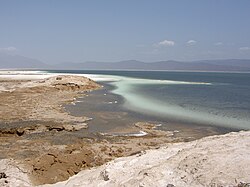
Lake Assal, one of the most saline lakes outside of Antarctica

A hypersaline lake is a landlocked body of water that contains significant concentrations of sodium chloride, brines, and other salts, with saline levels surpassing those of ocean water (3.5%, i.e. 35 grams per litre or 0.29 pounds per US gallon).

Specific microbial species can thrive in high-salinity environments[1] that are inhospitable to most lifeforms,[2] including some that are thought to contribute to the color of pink lakes.[3][4] Some of these species enter a dormant state when desiccated, and some species are thought to survive for over 250 million years.[2]

The water in hypersaline lakes has great buoyancy due to its high salt content.[5]

Hypersaline lakes are found on every continent, especially in arid or semi-arid regions.[1]

In the Arctic, the Canadian Devon Ice Cap contains two subglacial lakes that are hypersaline.[6] In Antarctica, there are larger hypersaline water bodies, lakes in the McMurdo Dry Valleys such as Lake Vanda with salinity of over 35% (i.e. 10 times as salty as ocean water).[citation needed]

The most saline water body in the world is the Gaet'ale Pond, located in the Danakil Depression in Afar, Ethiopia. The water of Gaet'ale Pond has a salinity of 43%, making it the saltiest water body on Earth[7] (i.e. 12 times as salty as ocean water). Previously, it was considered that the most saline lake outside of Antarctica was Lake Assal,[8] in Djibouti, which has a salinity of 34.8% (i.e. 10 times as salty as ocean water). The best-known hypersaline lakes are the Dead Sea (34.2% salinity in 2010) and the Great Salt Lake in the state of Utah, US (5–27% variable salinity). The Dead Sea, dividing Israel and the West Bank from Jordan, is the world's deepest hypersaline lake. The Great Salt Lake, while having nearly three times the surface area of the Dead Sea, is shallower and experiences much greater fluctuations in salinity. At its lowest recorded water levels, it approaches 7.7 times the salinity of ocean water, but when its levels are high, its salinity drops to only slightly higher than that of the ocean.[9][10][11]

See also

[edit]

References

[edit]
Revisions and contributorsEdit on WikipediaRead on Wikipedia
from Grokipedia
A hypersaline lake is a landlocked characterized by salt concentrations exceeding those of , typically greater than 35 grams of salt per liter, resulting from in closed basins that concentrate dissolved minerals without outlet to the sea. These lakes, often classified as endorheic or terminal systems, form in arid or semi-arid regions where and inflow are insufficient to balance high rates, leading to progressive salinization over time. Notable for their extreme conditions, hypersaline lakes support specialized microbial life and limited macrofauna, serving as critical habitats in otherwise harsh environments. Hypersaline lakes exhibit diverse chemical compositions depending on their geological origins and inflow sources. Thalassohaline lakes, derived primarily from marine influences, are dominated by with near-neutral to slightly alkaline levels. In contrast, athalassohaline lakes receive non- inputs, resulting in high levels of magnesium, calcium, and , often with more acidic values around 5.8 to 6.0. Salinities can reach extreme levels, such as approximately 34% (342 g/kg), or about 424 g/L given its density, in the Dead Sea, making these waters denser than the and enabling unique phenomena like floating with ease. Physical features include shallow depths, fluctuating shorelines due to variable water levels, and sometimes a "spotted" appearance from mineral precipitates. Ecologically, hypersaline lakes host communities of extremophiles adapted to osmotic stress through mechanisms like salt-in strategies or accumulation of compatible organic solutes. Dominant organisms include halophilic such as Haloquadratum walsbyi and bacteria like Salinibacter ruber, alongside algae such as , which produce vibrant red under high ultraviolet exposure. In less extreme hypersaline conditions, (Artemia spp.) and brine flies serve as key prey for migratory birds, supporting millions along flyways in regions like the . generally decreases with increasing salinity, but these ecosystems demonstrate remarkable resilience and provide models for , such as potential . Prominent examples include the Dead Sea between and , with salinities around 34% and significant economic value for mineral extraction; the in , , a vital stopover for avian migrants that as of 2025 remains at near-record low levels with ongoing shrinkage; and in , which as of September 2025 has nearly completely dried up due to water diversions and . Other sites, such as the in and in , highlight both natural and anthropogenic hypersaline formations, underscoring challenges like dust storms and habitat loss from climate change and human activity. These lakes also hold biotechnological promise, yielding enzymes, bioplastics, and from their microbes for industrial applications.

Definition and Characteristics

Definition

A hypersaline lake is a landlocked characterized by levels exceeding 35 g/L, the average of , and frequently surpassing 300 g/L in extreme instances. This threshold distinguishes hypersaline lakes from other aquatic systems, where dissolved salts accumulate to concentrations that severely limit and alter physical properties. In contrast, maintains a of approximately 3.5% (35 g/L), while freshwater bodies typically exhibit salinities below 0.5 g/L, illustrating the pronounced from oligohaline to hypersaline conditions. Etymologically, "hypersaline" combines the Greek prefix "hyper-" (meaning over or beyond) with the Latin "salinus" (salty), reflecting environments that surpass typical saline thresholds. Many such lakes are endorheic, lacking outlets to the ocean and thus prone to progressive salinization through evaporation.

Physical Properties

Hypersaline lakes exhibit elevated water densities, typically ranging from 1.1 to 1.3 g/cm³, owing to the high concentrations of dissolved salts that exceed those in seawater. This increased density results in exceptional buoyancy, allowing objects and humans to float effortlessly without sinking, as observed in the Dead Sea where the water density reaches approximately 1.24 g/cm³. In the Great Salt Lake, densities vary between arms, with the more saline north arm averaging 1.2 g/cm³ and the south arm around 1.1 g/cm³, further illustrating how salinity gradients enhance buoyant forces across these systems. Temperature stratification in hypersaline lakes often features warmer surface layers due to solar heating, with minimal vertical mixing that promotes meromictic conditions where the remains persistently layered. In , for instance, surface waters maintain higher temperatures relative to deeper layers, supported by density differences of 0.012–0.015 g/cm³ that limit to low values averaging 3.4 × 10⁻⁶ m² s⁻¹. Similarly, lakes like Ursu and Fara Fund display heliothermic profiles, trapping in the upper layers while salinity-driven stability prevents overturn, fostering distinct mixolimnion and monimolimnion zones. Visibility in hypersaline lakes is frequently reduced by high from suspended salts, such as particles, which can create milky appearances and alter light penetration. In the Dead Sea, potential gypsum precipitation from brine mixing has been shown to elevate levels, with a linear relationship between precipitated mass and optical opacity that whitens surface waters. Colors often range from milky white due to suspended salts like to pinkish hues from pigments of halophilic microbes thriving in hypersaline conditions, as seen in the Great Salt Lake's north arm. These lakes are generally shallow, with depths often less than 50 m, making them highly susceptible to volume and level fluctuations driven by seasonal . In shallow systems like Alkali Lake, rates peak at 7–10.5 mm/day in summer, leading to net water losses of ~0.35 m over key periods and interannual depth changes up to 0.30 m, modulated by inputs. exemplifies this vulnerability, with maximum depths of 16 m and water levels dropping over 7 m from 1995 to 2014 due to intensified amid arid conditions. As of 2025, the lake has nearly dried up entirely, with its surface area reduced to less than 10% of historical levels, exacerbating storms and issues in surrounding regions.

Chemical Composition

Hypersaline lakes are characterized by elevated concentrations of dissolved , primarily resulting from evaporative concentration in closed-basin systems. The dominant ions typically include sodium (Na⁺) and chloride (Cl⁻), classifying most as chloride-type waters, though secondary ions such as magnesium (Mg²⁺), (SO₄²⁻), and calcium (Ca²⁺) occur in significant but variable ratios depending on the source and geological setting. For instance, the Dead Sea exhibits magnesium-rich waters, with Mg²⁺ comprising a substantial portion of the cation load due to the leaching of magnesium-bearing minerals from surrounding terrains. These ionic profiles can be quantified through major ion analysis, revealing often exceeding 300 g/L in extreme cases. The of hypersaline lakes varies widely but is often alkaline, particularly in soda lakes where values range from 8 to 10 or higher, sustained by the accumulation of (HCO₃⁻) and (CO₃²⁻) ions. This arises from the precipitation of calcium and magnesium as carbonates, leaving sodium carbonates to buffer the solution at elevated levels. In contrast, some chloride-dominated lakes like the Dead Sea maintain near-neutral to slightly acidic conditions ( around 6) due to high and divalent cation dominance, which suppress activity. As progresses, leads to the of minerals, altering the lake's chemistry further. In sodium-chloride dominated systems, (CaSO₄·2H₂O) typically precipitates before (NaCl) as concentrates ions, with the sequence dictated by solubility products and temperature fluctuations. In more alkaline or sulfate-excess environments, such as certain soda lakes, (Na₂SO₄·10H₂O) crystallizes, often seasonally, contributing to the lakebed's mineral crust. These minerals accrete in layers. Redox conditions in hypersaline lakes are stratified, with oxic surface waters overlying anoxic bottom layers where oxygen depletion fosters reducing environments. These anoxic zones accumulate high (HS⁻ or S²⁻) levels, primarily from dissimilatory sulfate reduction by anaerobic utilizing as an . concentrations can reach millimolar scales in such layers, influencing metal and potentially leading to off-gassing. This microbial mediation of cycling maintains the lake's gradient, distinct from abiotic processes.

Formation and Geology

Geological Processes

Hypersaline lakes primarily form within endorheic basins, which are internally drained topographic depressions where outflow is absent, often resulting from tectonic processes such as ing or in fault-bounded valleys. These closed systems trap and riverine inputs, preventing dilution by oceanic exchange and allowing progressive solute accumulation. Tectonic activity creates these basins by uplifting surrounding highlands that block external drainage, as seen in continental zones or orogenic forelands. The concentration of salts in these lakes is driven by evaporation exceeding hydrological inputs in arid to semi-arid climates, where annual water loss through surpasses and inflow from rivers or , leading to and mineral over geological timescales spanning millennia. This process begins with the of dilute inflows, progressively increasing until evaporite minerals like and precipitate from the . Over extended periods, this imbalance results in the buildup of dissolved ions derived from of surrounding rocks, concentrating them to hypersaline levels multiple times that of . Many contemporary hypersaline lakes trace their origins to the Pleistocene epoch, emerging as shrunken remnants of expansive pluvial lakes that formed during wetter glacial intervals and subsequently regressed due to post-glacial . For instance, the represents a residual of the ancient Lake Bonneville, which expanded during the under cooler, moister conditions before contracting as evaporation intensified with climatic warming around 14,000 years ago. These regressions transformed freshwater or brackish precursors into hypersaline systems by isolating them in endorheic settings and amplifying evaporative losses. Sedimentary sequences in hypersaline lakes record cyclic climatic fluctuations through layered deposits, where alternating wet and dry periods produce distinct strata of minerals reflecting hydrological variability. These archives often feature varved beds, with couplets of and associated sediments indicating annual or decadal-scale changes in lake level and chemistry, accumulating to thicknesses of several kilometers in long-lived basins. Such cyclic patterns arise from or monsoon shifts, preserving evidence of repeated expansions and contractions over timescales.

Classification

Hypersaline lakes are classified primarily by the origin and type of , distinguishing between thalassohaline and athalassohaline systems. Thalassohaline lakes derive their salts from evaporated or marine seepage, maintaining ionic proportions similar to those in the , with sodium (Na⁺) and as the dominant ions, typically comprising about 42% and 49% of the total salts, respectively. These environments often exhibit neutral and levels exceeding 35 g/L, leading to serial precipitations such as at around 10% and at 34%. In contrast, athalassohaline lakes form inland from the dissolution of local geological formations rather than marine sources, resulting in atypical ionic compositions rich in magnesium (Mg²⁺), (SO₄²⁻), or calcium (Ca²⁺), with lower proportions of Na⁺ and Cl⁻. Examples include the Dead Sea, where divalent cations dominate due to underlying deposits. A key chemical subclassification divides hypersaline lakes into soda lakes and chloride lakes based on dominant anions and . Soda lakes, often athalassohaline, are characterized by high concentrations of (NaHCO₃) and carbonate (CO₃²⁻), yielding alkaline values of 9–11.5 and supporting unique carbonate precipitation sequences. These occur predominantly in volcanic or settings with closed drainage, such as those in the East African Rift Valley like . Chloride lakes, typically thalassohaline, feature neutral and predominance of NaCl, resembling seawater evaporation products, as seen in the . This distinction influences mineralogy and ecological tolerances, with soda systems favoring alkaliphilic organisms. Geographically, hypersaline lakes are categorized as inland (endorheic) or coastal, with further variations by . Inland endorheic lakes, which lack surface outflows and concentrate salts through in closed basins, dominate global distributions and include most athalassohaline examples in arid interiors. Coastal hypersaline lakes form via marine water seepage or in lagoons, often thalassohaline, such as solar salterns along Mediterranean shores. Latitudinal differences highlight tropical systems in hot, evaporative climates like the Danakil Depression in , versus polar examples in cold, isolated basins, including hypersaline ponds in Antarctica's or coastal ice-free areas, where freeze-thaw cycles exacerbate salinity. Hypersaline lakes evolve through progressive salinization stages in endorheic settings, transitioning from freshwater or brackish conditions to hypersaline states over time due to isolation and net . Initially, these basins receive freshwater inflows from or rivers, maintaining low below 3 g/L; as exceeds input in arid climates, rises through subsaline (3–35 g/L) to hypersaline (>35 g/L) phases, often spanning thousands of years. This progression alters ionic balances, with early stages dominated by bicarbonates and later by chlorides or sulfates, as observed in ancient lake sequences like those in the Dead Sea Rift. The duration of isolation determines the endpoint, with some lakes stabilizing at thalassohaline compositions while others shift to athalassohaline via geological inputs.

Ecology and Biology

Microbial Communities

Hypersaline lakes host unique microbial communities dominated by extremophilic prokaryotes and algae that have evolved specialized adaptations to thrive in salt concentrations often exceeding 20% total dissolved solids, far beyond the tolerance of most freshwater organisms. These communities are primarily composed of halophilic archaea and bacteria, with eukaryotic algae playing a key supporting role, forming the base of simplified food webs in these extreme environments. Halophilic archaea, particularly from the phylum , dominate the prokaryotic fraction in aerobic surface waters of hypersaline lakes, often comprising over 90% of the microbial biomass in crystallizer ponds and brines. Species such as and exemplify this group, utilizing —a light-driven in their cell membranes—to generate ATP via phototrophy, supplementing their aerobic heterotrophic metabolism when organic substrates are scarce. This adaptation allows them to exploit in nutrient-poor, sunlit hypersaline conditions, contributing to their prevalence in lakes like the Dead Sea and . Halophilic bacteria, including genera like Halomonas and Salinibacter, coexist but typically at lower abundances, aiding in the degradation of . Algal blooms, primarily driven by the green alga , periodically color hypersaline lakes red due to high concentrations of and other , which serve as protective antioxidants against intense UV radiation and . These blooms provide essential organic carbon that fuels haloarchaeal growth, creating dense microbial layers in the ; for instance, D. salina can accumulate up to 10% of its dry weight as under hypersaline stress. In anoxic deeper zones, where oxygen is depleted due to high salinity stratification, microbial metabolism shifts to anaerobic processes like sulfate reduction, performed by specialized bacteria such as species, which use as an to respire organic compounds. Microbial diversity in hypersaline lakes is phylogenetically limited compared to freshwater systems, with 16S rRNA surveys revealing fewer operational taxonomic units—often dominated by just a handful of l genera—but marked by high functional specialization and novel taxa adapted to extreme osmolarity. For example, metagenomic analyses of lakes like Meyghan show a 50% drop in bacterial 16S rRNA copy numbers with increasing salinity, underscoring the selective pressure that favors extremophiles producing compatible solutes like for osmotic balance. , a cyclic derivative, stabilizes proteins and membranes against salt-induced denaturation, enabling growth at salinities up to 25%, and is synthesized by many halophilic as an alternative to the salt-in strategy used by . These adaptations highlight the evolutionary convergence toward resilience in hypersaline niches.

Macroorganisms and Ecosystems

Hypersaline lakes support a limited array of macroorganisms due to extreme levels that exceed the tolerance of most multicellular life forms. The primary macrofauna consist of specialized , such as () and fairy shrimp (other anostracan species), which serve as key grazers on algal and microbial . In less saline margins of these lakes, halotolerant copepods may also occur, contributing to secondary grazing and serving as intermediate prey. These organisms thrive across a wide salinity gradient, from approximately 50 g/L up to saturation, through physiological adaptations like and formation for . The food webs in hypersaline lakes are characteristically simple, lacking complex trophic levels such as , which cannot survive the osmotic stress imposed by salinities typically above 35 g/L. In hypersaline environments like the Dead Sea, osmosis causes water to flow out of fish cells and gills into the surrounding high-salt medium to equalize concentrations, resulting in severe cellular dehydration, organ failure, and rapid death, as their internal salt balances are far lower and osmoregulation mechanisms are overwhelmed. A basic chain dominates: from halophilic and is grazed by and copepods, which in turn support avian predators. This structure contrasts with freshwater or marine ecosystems, emphasizing short, efficient energy transfer with minimal predation pressure on herbivores. Birds play a crucial role in these ecosystems, particularly as migratory species that rely on hypersaline lakes for . Flamingos (Phoeniconaias minor and Phoenicopterus roseus) and various shorebirds feed extensively on , filtering them from the using specialized structures adapted for hypersaline . For instance, in , , lesser flamingos consume large quantities of and associated , supporting massive breeding colonies of up to two million individuals during peak productivity. These avian populations facilitate nutrient transport across landscapes via deposition, linking hypersaline systems to broader networks. Ecosystem services in hypersaline lakes are constrained by environmental factors, including low oxygen levels in stratified waters that limit aerobic nutrient cycling. Processes like nitrogen and phosphorus turnover occur primarily through microbial mediation in the upper oxic layers, with reduced efficiency in deeper anoxic zones. However, the resident macroorganisms exhibit high resilience to salinity fluctuations, enabling rapid population recovery following dilution events from rainfall or inflow, which temporarily expands habitable zones. This adaptability underscores the lakes' role in supporting biodiversity hotspots for extremophiles amid variable arid conditions.

Notable Examples

Dead Sea and Middle East

The , located in the between , , and the , exemplifies a hypersaline lake with extreme physical characteristics. Its surface lies approximately 430 meters below , making it the lowest land elevation on . The lake's reaches about 34%, rendering it one of the saltiest bodies of water globally and preventing most macroscopic life forms from surviving. Its chemical composition is dominated by , comprising over 50% of the dissolved salts, which contributes to its dense, buoyant waters. Historically, the Dead Sea has been noted for floating asphalt blocks, a phenomenon described by ancient writers such as in the first century BCE, who observed erupting from the lakebed and surfacing periodically. These asphalts, often exceeding 100 tons in weight and nearly pure in composition, were harvested for uses including mummification in and . The lake's regional geology stems from the Dead Sea Transform, a major left-lateral strike-slip fault system forming part of the that separates the African and Arabian plates, initiated around 20-25 million years ago during the . This tectonic activity has created a , leading to ongoing and seismic risks. Culturally, the Dead Sea holds profound significance in biblical narratives, referenced as the Salt Sea or Sea of the Arabah, associated with the in Genesis. The discovery of the Dead Sea Scrolls in nearby between 1947 and 1956 revealed ancient Jewish manuscripts, including the oldest known biblical texts dating from the third century BCE to the first century CE, providing critical insights into . These artifacts underscore the region's role as a spiritual and historical crossroads. The Dead Sea is classified as thalassohaline, with ion proportions resembling evaporated seawater despite its inland position. Another prominent hypersaline lake in the is in northwestern , which has undergone severe since the 1970s due to dam construction, agricultural diversion, and climate variability. By 2025, its surface area had shrunk to less than 2% of its former extent (from about 5,000 km² in the 1970s), nearly drying up completely and exposing vast salt flats that generate frequent saline dust storms affecting air quality and health across the region. These storms carry fine salt particles, exacerbating respiratory issues and soil salinization in surrounding areas. In its current state, the Dead Sea supports therapeutic , attracting visitors for immersion in its mineral-rich waters and application of black mud from the lakebed, which contains high levels of , and sulfates beneficial for treating skin conditions like and eczema. The lake's creates vertical density gradients, forming meromictic layers: a less dense upper layer (diluted by seasonal inflows) overlays a denser, more saline deep layer, stabilizing stratification and influencing circulation patterns. However, ongoing water diversion and continue to raise salinity levels, threatening long-term stability.

Great Salt Lake and North America

The in stands as one of the most prominent hypersaline lakes in , serving as a remnant of the much larger prehistoric , which existed approximately 30,000 to 16,000 years ago and covered about 20,000 square miles with a maximum depth of 1,000 feet. This ancient shrank dramatically around 11,000 years ago due to climate warming and outlet breaching, leaving the current Great Salt Lake at a surface that fluctuates but historically aligns with the Gilbert Level of 4,250–4,275 feet above sea level, making it roughly three times smaller than its predecessor. However, as of November 2025, water levels have dropped to critically low elevations around 4,192 feet due to prolonged and diversions, increasing and exposing more lakebed. The lake's varies significantly due to a rock-fill railroad constructed in 1959, which divides it into the southern Gilbert Bay and the northern Gunnison Bay; in Gilbert Bay ranges from 6% to 27% (2 to 7 times saltier than ), while Gunnison Bay often reaches or exceeds 25%, approaching saturation and exhibiting a purplish-pink hue from salt-tolerant and . This division restricts water exchange, leading to higher and concentration in the north arm, with occasional breaches—such as the 300-foot opening added in 1987—allowing limited mixing that temporarily dilutes . Industrial activities around the include the harvesting of (Artemia franciscana), a key species adapted to its hypersaline conditions, with annual cyst harvests regulated by the Division of Wildlife Resources and peaking at up to 7,400 tons in high-production years like 1995–96, supporting global demands. These harvests, ongoing since 1952 for cysts and 1950 for adults, contribute to an where Artemia populations form the base of the , sustaining millions of migratory birds—estimated at around 10 million annually—that rely on the shrimp and associated brine flies for nourishment during stopovers along the Central Flyway. The lake's evaporite formations, including vast salt flats exposed during low water levels, reflect ongoing geological processes of tied to its evaporative . Further west, in exemplifies another significant North American hypersaline system, formed in a volcanic basin in the Mono Basin, adjacent to the and characterized by its alkaline waters with salinity levels around 80–90 g/L, nearly three times that of . Prominent features include towers—delicate, spires up to 30 meters tall—that form through chemical reactions where calcium-rich freshwater springs from the Sierra Nevada percolate into the alkaline lake water, precipitating as the pH shifts. The lake's water balance has been altered by extensive diversions since the early 20th century by the Department of Water and Power, which exported streams feeding the lake to supply urban needs, causing a drop in water levels by over 12 meters and exposing formations while threatening ecological stability. This led to landmark litigation, including the 1983 California Supreme Court case National Audubon Society v. Superior Court, which applied the to limit diversions and mandate minimum environmental flows, marking a pivotal moment in balancing water rights with ecological preservation. North American hypersaline lakes like the and often bear imprints of volcanic and glacial influences from the Pleistocene era, with tectonic basins and calderas providing depressions for accumulation, while glacial meltwaters from retreating ice sheets contributed initial freshwater inflows that later evaporated to concentrate salts. Seasonal flooding, driven by snowmelt from adjacent mountain ranges such as the Wasatch or Sierra Nevada, periodically dilutes salinity in these systems, preventing permanent and allowing cyclic fluctuations that support resilient biota. Biodiversity in these lakes hinges on halophilic organisms like Artemia, which not only endure extreme salinities but also bolster avian populations, including eared grebes and phalaropes, by providing high-protein forage during migration, underscoring the lakes' role as critical stopover habitats amid broader regional variability.

Other Global Examples

Hypersaline lakes occur worldwide, predominantly in arid and semi-arid regions where exceeds and inflow, leading to concentrated salts; these environments exemplify athalassohaline types, derived from non-marine sources like of continental rocks. in Antarctica's represents an extreme polar hypersaline system, with salinity reaching 40-45% by mass, dominated by (CaCl₂). This composition results in a low eutectic temperature of -52°C, preventing the pond from freezing even at ambient temperatures as low as -50°C. The originates from near-surface discharge across , highlighting cryogenic processes in cold deserts. Lake Natron in northern is a volcanic , characterized by high with a of around 10.5 due to deposits from surrounding volcanic activity. These (soda ash) accumulations form through of inflows rich in sodium and from the Rift Valley. The lake serves as a key breeding site for lesser flamingos, adapted to its caustic conditions. Lake Qarun, also known as Birket Qarun, in Egypt's Fayum Depression is the remnant of the ancient Lake Moeris, transformed from a freshwater body through historical diversions and modern . Currently hypersaline with levels fluctuating between 21 and 39.5 g/L, it receives agricultural drainage that has elevated from and nutrients. This illustrates anthropogenic influences on in North African closed lakes.

Human Impacts and Uses

Economic Exploitation

Hypersaline lakes serve as sources for through methods such as direct harvesting from surface sediments and solar evaporation. Global salt production reached approximately 280 million tons in 2023, with contributions from these environments including about 2 million tons annually from the . In the , for instance, over 100,000 acres of solar evaporation ponds facilitate the extraction of various salts by pumping lake water into shallow basins where solar heat concentrates the , allowing crystals to form and be harvested. The chemical industries heavily rely on hypersaline brines for extracting valuable minerals like , magnesium, and , which are essential for fertilizers, metals production, and battery technologies. At the Dead Sea, the Dead Sea Works operation yields around 3.8 million tons of annually through evaporation and processing of lake brines, supporting global agricultural needs. Magnesium production from the same brines totals about 18,500 metric tons per year, used in alloys and chemicals. , comprising approximately 48% of global production from salt-lake brines as of 2023, is increasingly extracted from hypersaline sources in regions like South America's via solar evaporation and emerging membrane technologies. Tourism centered on draws visitors to hypersaline lakes for therapeutic benefits, particularly skin treatments using mineral-rich mud and water. The Dead Sea's spas, leveraging its high and bromide content, attract millions annually for conditions like and , contributing to Jordan's sector, which accounts for 12-15% of GDP and generates billions in receipts, with the Dead Sea region receiving about 15% of these economic benefits. Historically, hypersaline lakes fueled extensive trade networks, including ancient salt roads that facilitated the exchange of salt as a and across and the Mediterranean. The Romans systematically exploited these resources, notably extracting from soda lakes in Egypt's Wadi Natrun for glass-making and mummification, integrating the deposits into imperial supply chains via dedicated transport routes.

Environmental Threats

Hypersaline lakes face significant environmental threats from , which exacerbates reduced water inflows through prolonged droughts and altered precipitation patterns, leading to substantial volume losses in many such systems. For instance, in has experienced more than 90% volume loss since the early due to persistent droughts that diminished river inflows, compounding the lake's vulnerability as an . These changes not only increase levels but also disrupt the hydrological balance, potentially rendering lakes ecologically unsustainable without intervention. Human activities, particularly water diversion for and , have accelerated the shrinkage and hypersalinization of these lakes, often transforming them into hypersaline remnants or dry basins. The , once a large inland body, underwent partial hypersalinization after the diversion of its feeder rivers—the and —for in the mid-20th century, resulting in a salinity increase from about 10 g/L to over 100 g/L in the southern basin by the . In the northern basin, partial restoration via the Kokaral since 2005 has stabilized levels and reduced dust impacts, though the south remains desiccated. Such diversions reduce freshwater inputs, concentrating salts and altering lake chemistry, which in turn affects surrounding ecosystems and quality. Pollution from agricultural runoff further intensifies salinization and in hypersaline lakes, as excess salts, nutrients, and chemicals from irrigated fields infiltrate these closed systems, elevating contaminant levels beyond natural thresholds. Additionally, the exposure of drying lake beds generates severe dust storms laden with saline particulates, including sulfates and chlorides, which degrade air quality, harm respiratory health, and deposit toxins on adjacent agricultural lands and communities. These storms, observed in regions like the basin, can transport tens to hundreds of millions of tons of salt annually, exacerbating salinization over vast areas. Conservation efforts for hypersaline lakes include international designations and targeted restoration projects aimed at stabilizing water levels and mitigating further degradation. was designated a in 1976 to promote sustainable management and protection amid its ongoing crisis. In the United States, has benefited from court-mandated restoration since the 1990s, involving reduced water diversions and reflooding initiatives that have raised its elevation by several feet, aiding ecological recovery and preventing full . These strategies, often combining policy reforms with hydrological interventions, underscore the need for integrated approaches to address both climatic and anthropogenic pressures on these fragile environments.

References

Add your contribution
Related Hubs
User Avatar
No comments yet.