Hubbry Logo
IS–LM modelIS–LM modelMain
Open search
IS–LM model
Community hub
IS–LM model
logo
8 pages, 0 posts
0 subscribers
Be the first to start a discussion here.
IS–LM model
IS–LM model
from Wikipedia
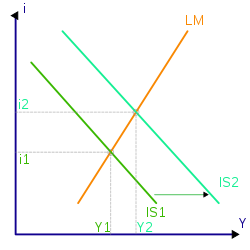
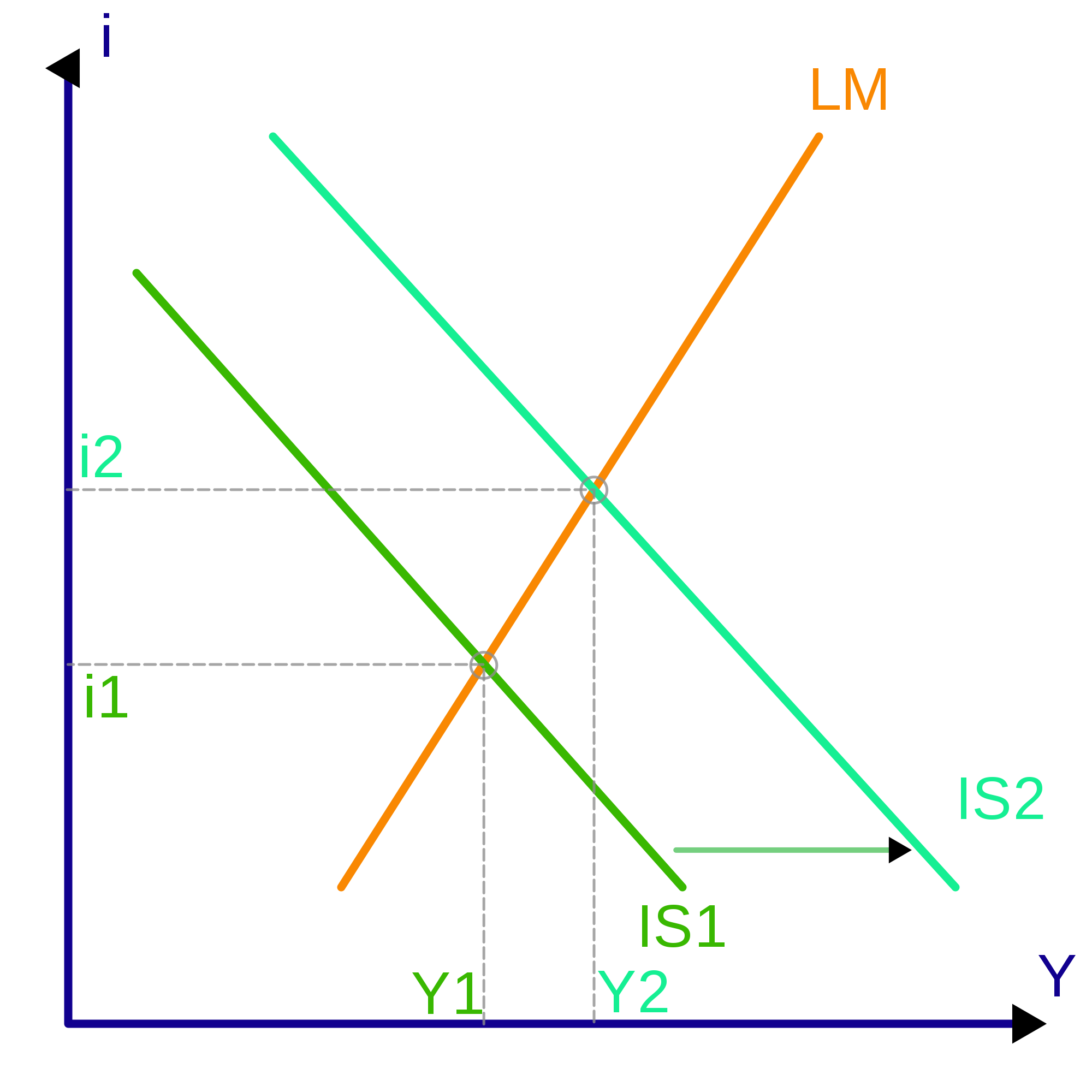
The IS curve moves to the right, causing higher interest rates (i) and expansion in the "real" economy (real GDP, or Y)

The IS–LM model, or Hicks–Hansen model, is a two-dimensional macroeconomic model which is used as a pedagogical tool in macroeconomic teaching. The IS–LM model shows the relationship between interest rates and output in the short run. The intersection of the "investmentsaving" (IS) and "liquidity preferencemoney supply" (LM) curves illustrates a "general equilibrium" where supposed simultaneous equilibria occur in both the goods and the money markets. The IS–LM model shows the importance of various demand shocks (including the effects of monetary policy and fiscal policy) on output and consequently offers an explanation of changes in national income in the short run when prices are fixed or sticky. Hence, the model can be used as a tool to suggest potential levels for appropriate stabilisation policies. It is also used as a building block for the demand side of the economy in more comprehensive models like the AD–AS model.

The model was developed by John Hicks in 1937 and was later extended by Alvin Hansen as a mathematical representation of Keynesian macroeconomic theory. Between the 1940s and mid-1970s, it was the leading framework of macroeconomic analysis. Today, it is generally accepted as being imperfect and is largely absent from teaching at advanced economic levels and from macroeconomic research, but it is still an important pedagogical introductory tool in most undergraduate macroeconomics textbooks.

As monetary policy since the 1980s and 1990s generally does not try to target money supply as assumed in the original IS–LM model, but instead targets interest rate levels directly, some modern versions of the model have changed the interpretation (and in some cases even the name) of the LM curve, presenting it instead simply as a horizontal line showing the central bank's choice of interest rate. This allows for a simpler dynamic adjustment and supposedly reflects the behaviour of actual contemporary central banks more closely.

History

[edit]

The IS–LM model was introduced at a conference of the Econometric Society held in Oxford during September 1936. Roy Harrod, John R. Hicks, and James Meade all presented papers describing mathematical models attempting to summarize John Maynard Keynes' General Theory of Employment, Interest, and Money.[1][2] Hicks, who had seen a draft of Harrod's paper, invented the IS–LM model (originally using the abbreviation "LL", not "LM"). He later presented it in "Mr. Keynes and the Classics: A Suggested Interpretation".[1] Hicks and Alvin Hansen developed the model further in the 1930s and early 1940s,[3]: 527  Hansen extending the earlier contribution.[4] The model became a central tool of macroeconomic teaching for many decades. Between the 1940s and mid-1970s, it was the leading framework of macroeconomic analysis.[5] It was particularly suited to illustrate the debate of the 1960s and 1970s between Keynesians and monetarists as to whether fiscal or monetary policy was most effective to stabilize the economy. Later, this issue faded from focus and came to play only a modest role in discussions of short-run fluctuations.[6]

The IS-LM model assumes a fixed price level and consequently cannot in itself be used to analyze inflation. This was of little importance in the 1950s and early 1960s when inflation was not an important issue, but became problematic with the rising inflation levels in the late 1960s and 1970s, which led to extensions of the model to also incorporate aggregate supply in some form, e.g. in the form of the AD–AS model, which can be regarded as an IS-LM model with an added supply side explaining rises in the price level.[6]

One of the basic assumptions of the IS-LM model is that the central bank targets the money supply.[6] However, a fundamental rethinking in central bank policy took place from the early 1990s when central banks generally changed strategies towards targeting inflation rather than money growth and using an interest rate rule to achieve their goal.[3]: 507  As central banks started paying little attention to the money supply when deciding on their policy, this model feature became increasingly unrealistic and sometimes confusing to students.[6] David Romer in 2000 suggested replacing the traditional IS-LM framework with an IS-MP model, replacing the positively sloped LM curve with a horizontal MP curve (where MP stands for "monetary policy"). He advocated that it had several advantages compared to the traditional IS-LM model.[6] John B. Taylor independently made a similar recommendation in the same year.[7] After 2000, this has led to various modifications to the model in many textbooks, replacing the traditional LM curve and story of the central bank influencing the interest rate level indirectly via controlling the supply of money in the money market to a more realistic one of the central bank determining the policy interest rate as an exogenous variable directly.[3]: 113 [8][9]

Today, the IS-LM model is largely absent from macroeconomic research, but it is still a backbone conceptual introductory tool in many macroeconomics textbooks.[10][11]

Formation

[edit]

The point where the IS and LM schedules intersect represents a short-run equilibrium in the real and monetary sectors (though not necessarily in other sectors, such as labor markets): both the product market and the money market are in equilibrium.[12] This equilibrium yields a unique combination of the interest rate and real GDP.

IS (investment–saving) curve

[edit]
IS curve represented by equilibrium in the capital market and Keynesian cross diagram.

The IS curve shows the causation from interest rates to planned investment to national income and output.

For the investment–saving curve, the independent variable is the interest rate and the dependent variable is the level of income. The IS curve is drawn as downward-sloping with the interest rate r on the vertical axis and GDP (gross domestic product: Y) on the horizontal axis. The IS curve represents the locus where total spending (consumer spending + planned private investment + government purchases + net exports) equals total output (real income, Y, or GDP).

The IS curve also represents the equilibria where total private investment equals total saving, with saving equal to consumer saving plus government saving (the budget surplus) plus foreign saving (the trade surplus). The level of real GDP (Y) is determined along this line for each interest rate. Every level of the real interest rate will generate a certain level of investment and spending: lower interest rates encourage higher investment and more spending. The multiplier effect of an increase in fixed investment resulting from a lower interest rate raises real GDP. This explains the downward slope of the IS curve. In summary, the IS curve shows the causation from interest rates to planned fixed investment to rising national income and output.

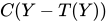
The IS curve is defined by the equation

where Y represents income, represents consumer spending increasing as a function of disposable income (income, Y, minus taxes, T(Y), which themselves depend positively on income), represents business investment decreasing as a function of the real interest rate, G represents government spending, and NX(Y) represents net exports (exports minus imports) decreasing as a function of income (decreasing because imports are an increasing function of income).
LM (liquidity-money) curve

[edit]
The money market equilibrium diagram.

The LM curve shows the combinations of interest rates and levels of real income for which the money market is in equilibrium. It shows where money demand equals money supply. For the LM curve, the independent variable is income and the dependent variable is the interest rate.

In the money market equilibrium diagram, the liquidity preference function is the willingness to hold cash. The liquidity preference function is downward sloping (i.e. the willingness to hold cash increases as the interest rate decreases). Two basic elements determine the quantity of cash balances demanded:

  1. Transactions demand for money: this includes both (a) the willingness to hold cash for everyday transactions and (b) a precautionary measure (money demand in case of emergencies). Transactions demand is positively related to real GDP. As GDP is considered exogenous to the liquidity preference function, changes in GDP shift the curve.
  2. Speculative demand for money: this is the willingness to hold cash instead of securities as an asset for investment purposes. Speculative demand is inversely related to the interest rate. As the interest rate rises, the opportunity cost of holding money rather than investing in securities increases. So, as interest rates rise, speculative demand for money falls.

Money supply is determined by central bank decisions and willingness of commercial banks to loan money. Money supply in effect is perfectly inelastic with respect to nominal interest rates. Thus the money supply function is represented as a vertical line – money supply is a constant, independent of the interest rate, GDP, and other factors. Mathematically, the LM curve is defined by the equation , where the supply of money is represented as the real amount M/P (as opposed to the nominal amount M), with P representing the price level, and L being the real demand for money, which is some function of the interest rate and the level of real income.

An increase in GDP shifts the liquidity preference function rightward and hence increases the interest rate. Thus the LM function is positively sloped.

Shifts

[edit]

One hypothesis is that a government's deficit spending ("fiscal policy") has an effect similar to that of a lower saving rate or increased private fixed investment, increasing the amount of demand for goods at each individual interest rate. An increased deficit by the national government shifts the IS curve to the right. This raises the equilibrium interest rate (from i1 to i2) and national income (from Y1 to Y2), as shown in the graph above. The equilibrium level of national income in the IS–LM diagram is referred to as aggregate demand.

Keynesians argue spending may actually "crowd in" (encourage) private fixed investment via the accelerator effect, which helps long-term growth. Further, if government deficits are spent on productive public investment (e.g., infrastructure or public health) that spending directly and eventually raises potential output, although not necessarily more (or less) than the lost private investment might have. The extent of any crowding out depends on the shape of the LM curve. A shift in the IS curve along a relatively flat LM curve can increase output substantially with little change in the interest rate. On the other hand, a rightward shift in the IS curve along a vertical LM curve will lead to higher interest rates, but no change in output (this case represents the "Treasury view").

Rightward shifts of the IS curve also result from exogenous increases in investment spending (i.e., for reasons other than interest rates or income), in consumer spending, and in export spending by people outside the economy being modelled, as well as by exogenous decreases in spending on imports. Thus these too raise both equilibrium income and the equilibrium interest rate. Of course, changes in these variables in the opposite direction shift the IS curve in the opposite direction.

The IS–LM model also allows for the role of monetary policy. If the money supply is increased, that shifts the LM curve downward or to the right, lowering interest rates and raising equilibrium national income. Further, exogenous decreases in liquidity preference, perhaps due to improved transactions technologies, lead to downward shifts of the LM curve and thus increases in income and decreases in interest rates. Changes in these variables in the opposite direction shift the LM curve in the opposite direction.

IS–LM model with interest targeting central bank

[edit]

The fact that contemporary central banks normally do not target the money supply, as assumed by the original IS–LM model, but instead conduct their monetary policy by steering the interest rate directly, has led to increasing criticism of the traditional IS–LM setup since 2000 for being outdated and confusing to students. In some textbooks, the traditional LM curve derived from an explicit money market equilibrium story consequently has been replaced by an LM curve simply showing the interest rate level determined by the central bank. Notably this is the case in Olivier Blanchard's widely-used[13] intermediate-level textbook "Macroeconomics" since its 7th edition in 2017.[14]

In this case, the LM curve becomes horizontal at the interest rate level chosen by the central bank, allowing a simpler kind of dynamics. Also, the interest rate level measured along the vertical axis may be interpreted as either the nominal or the real interest rate, in the latter case allowing inflation to enter the IS–LM model in a simple way. The output level is still determined by the intersection of the IS and LM curves. The LM curve may shift because of a change in monetary policy or possibly a change in inflation expectations, whereas the IS curve as in the traditional model may shift either because of a change in fiscal policy affecting government consumption or taxation, or because of shocks affecting private consumption or investment (or, in the open-economy version, net exports). Additionally, the model distinguishes between the policy interest rate determined by the central bank and the market interest rate which is decisive for firms' investment decisions, and which is equal to the policy interest rate plus a premium which may be interpreted as a risk premium or a measure of the market power or other factors influencing the business strategies of commercial banks. This premium allows for shocks in the financial sector being transmitted to the goods market and consequently affecting aggregate demand.[3]: 195–201 

Similar models, though called slightly different names, appear in the textbooks by Charles Jones[15] and by Wendy Carlin and David Soskice[14] and the CORE Econ project.[14] Parallelly, texts by Akira Weerapana and Stephen Williamson have outlined approaches where the LM curve is replaced with a real interest rate rule.[15][16]

Incorporation into larger models

[edit]

By itself, the traditional IS–LM model is used to study the short run when prices are fixed or sticky, and no inflation is taken into consideration. In addition, the model is often used as a sub-model of larger models which allow for a flexible price level. The addition of a supply relation enables the model to be used for both short- and medium-run analysis of the economy, or to use a different terminology: classical and Keynesian analysis.[15]

A main example of this is the Aggregate Demand-Aggregate Supply model – the AD–AS model.[15] In the aggregate demand-aggregate supply model, each point on the aggregate demand curve is an outcome of the IS–LM model for aggregate demand Y based on a particular price level. Starting from one point on the aggregate demand curve, at a particular price level and a quantity of aggregate demand implied by the IS–LM model for that price level, if one considers a higher potential price level, in the IS–LM model the real money supply M/P will be lower and hence the LM curve will be shifted higher, leading to lower aggregate demand as measured by the horizontal location of the IS–LM intersection; hence at the higher price level the level of aggregate demand is lower, so the aggregate demand curve is negatively sloped.[17]: 315–317 

In the 2018 textbook "Macroeconomics" by Daron Acemoglu, David Laibson and John A. List, the corresponding model combining a traditional IS-LM setup with a relation for a changing price level is named an IS-LM-FE model (FE standing for "full equilibrium").[18]

AD-AS-like models with inflation instead of price levels

[edit]

In many modern textbooks, the traditional AD–AS diagram is replaced by a variation in which the variables are not output and the price level, but instead output and inflation (i.e., the change in the price level). In this case, the relation corresponding to the AS curve is normally derived from a Phillips curve relationship between inflation and the unemployment gap. As policymakers and economists are generally concerned about inflation levels and not actual price levels, this formulation is considered more appropriate. This variation is often referred to as a dynamic AD–AS model,[9][17] but may also have other names. Olivier Blanchard in his textbook uses the term IS–LM–PC model (PC standing for Phillips curve).[3] Others, among them Carlin and Soskice, refer to it as the "three-equation New Keynesian model",[14] the three equations being an IS relation, often augmented with a term that allows for expectations influencing demand, a monetary policy (interest) rule and a short-run Phillips curve.[15]

Variations

[edit]

IS-LM-NAC model

[edit]

In 2016, Roger Farmer and Konstantin Platonov presented a so-called IS-LM-NAC model (NAC standing for "no arbitrage condition", in casu between physical capital and financial assets), in which the long-run effect of monetary policy depends on the way in which people form beliefs. The model was an attempt to integrate the phenomenon of secular stagnation in the IS-LM model. Whereas in the IS-LM model, high unemployment would be a temporary phenomenon caused by sticky wages and prices, in the IS-LM-NAC model high unemployment may be a permanent situation caused by pessimistic beliefs - a particular instance of what Keynes called animal spirits.[19] The model was part of a broader research agenda studying how beliefs may independently influence macroeconomic outcomes.[20]

See also

[edit]

References

[edit]

Further reading

[edit]
[edit]
Revisions and contributorsEdit on WikipediaRead on Wikipedia
from Grokipedia
The IS–LM model is a graphical macroeconomic framework that illustrates the simultaneous equilibrium in the market and to determine the level of national income and the . Developed by British economist in his 1937 paper "Mr. Keynes and the 'Classics': A Suggested Interpretation," it provides a simplified representation of key ideas from ' 1936 The General Theory of Employment, Interest, and Money, emphasizing how investment-saving balances (IS curve) and against money supply (LM curve) interact under fixed prices. The IS curve, downward-sloping in interest rate-output space, traces combinations of interest rates and output where planned investment equals saving plus government borrowing, reflecting that lower interest rates stimulate investment and thus higher output to equate aggregate demand and supply in the goods market. The LM curve, upward-sloping, depicts money market equilibrium where real money supply equals money demand, which rises with output (transaction motive) and falls with interest rates (opportunity cost of holding money). Their intersection yields the economy's short-run equilibrium output and interest rate, enabling analysis of fiscal and monetary policy effects, such as how expansionary fiscal policy shifts IS rightward, raising output but also interest rates, potentially leading to partial crowding out of private investment. Despite its pedagogical influence in shaping postwar Keynesian and policy debates, the model faces substantive criticisms for its static nature, assumption of price rigidity without , neglect of expectations and long-run dynamics, and inability to explain phenomena like the 1970s , where supply shocks and accelerating inflation undermined the fixed-price framework. Hicks himself later disavowed the diagram as overly simplistic and not faithful to Keynes' dynamic vision, while monetarists like argued it overemphasized and underplayed rules. Empirically, structural estimates on postwar U.S. data show the model captures some comovements in output, interest rates, and money but struggles with policy invariance and forward-looking behavior, prompting extensions like the New IS-LM incorporating and habit formation.

Historical Development

Origins in Keynesian Economics

The IS–LM model traces its conceptual foundations to John Maynard Keynes's The General Theory of Employment, Interest, and Money, published on February 14, 1936, which rejected the classical view of automatic and instead emphasized as the primary driver of output and employment in the short run. Keynes argued that economies could equilibrate at levels below due to insufficient , with prices and wages exhibiting downward rigidity that prevented classical self-adjustment mechanisms from operating effectively. A core innovation was the theory, positing that the arises from transactions, precautionary, and speculative motives, making it a function of income (for transactions) and the (for speculation, as agents weigh holding cash against interest-bearing assets). With typically fixed by monetary authorities, this theory implied that interest rates equilibrate the money market, independent of real factors like productivity in the classical sense. Keynes linked monetary conditions to real activity through , which he viewed as volatile and dependent on the —the expected rate of return on investments—compared against the set in the money market. In the goods market, equilibrium required aggregate expenditure to match output, with consumption rising less than proportionally with (via the below unity), exogenous, and net exports inversely related to domestic output. , as the residual of after consumption and taxes, would thus increase with , while declined with higher rates due to borrowing costs. These relationships highlighted a potential : fluctuations in could propagate through the multiplier effect, amplifying changes in demand, while rates might fail to fully offset them if dominated. Keynes's framework thus integrated monetary and real sectors, challenging the classical theory where and directly determine rates at output. This Keynesian synthesis of demand-driven output, liquidity-determined interest, and interest-sensitive investment provided the analytical building blocks for the IS–LM model's diagrammatic representation, though Keynes did not present it graphically himself. The model's origins reflect Keynes's aim to explain persistent during the , attributing it to deficient demand rather than wage rigidities alone, and advocating fiscal and monetary policies to stimulate investment and shift . Empirical underpinnings drew from observations of slump, where low interest rates coexisted with high , suggesting liquidity traps where monetary expansion fails to lower rates further due to infinite money demand elasticity at low levels. While later critiqued for oversimplifying Keynes's uncertainty and time dynamics, these elements established the demand-side focus central to post-1936 macroeconomic modeling.

John Hicks' Formalization

John Richard Hicks introduced the IS–LM framework in his article "Mr. Keynes and the 'Classics': A Suggested Interpretation," published in the April 1937 issue of Econometrica. In this work, Hicks sought to distill the core analytical content of John Maynard Keynes's The General Theory of Employment, Interest and Money (1936) into a simplified simultaneous equilibrium model of the goods and money markets, thereby demonstrating compatibility with classical economics under specific conditions. Hicks's approach involved assuming fixed prices and focusing on the interaction between output (Y) and the interest rate (r) to determine short-run equilibrium levels. The IS curve, originally labeled as the "SI" (saving-investment) locus, represents combinations of Y and r where the goods market clears, such that planned equals planned . Hicks derived it from Keynesian relations, where consumption rises with disposable income and falls with the , yielding a downward-sloping curve in Y-r space: higher interest rates reduce , requiring lower output to equate and . The LM curve, initially "LL" (liquidity preference-liquidity), depicts money market equilibrium where real money supply equals demand, with the latter increasing in Y (transaction motive) and decreasing in r (speculative motive), resulting in an upward-sloping curve. Equilibrium occurs at the curves' , fixing Y and r independently of under Keynesian assumptions of interest-elastic and . Hicks employed linear approximations for tractability, illustrating policy shifts: for instance, increased shifts IS rightward, raising Y and r unless offset by affecting LM. He argued the model reconciles Keynes with by varying elasticities—if is interest-inelastic or perfectly elastic, full-employment output prevails as in classical theory; otherwise, emerges. This graphical apparatus, though a static simplification omitting dynamics and expectations central to Keynes, provided a foundational tool for macroeconomic analysis, later refined by Alvin Hansen who popularized the IS-LM notation.

Evolution Through Mid-20th Century Debates

Following John Hicks' 1937 formalization, John Maynard Keynes promptly critiqued the IS-LM framework in correspondence and publications that year, arguing it distorted his General Theory by reducing liquidity preference to a static curve and neglecting the role of uncertain expectations in driving investment decisions, which he viewed as central to his analysis of economic instability. Keynes maintained that the model's equilibrium focus overlooked the inherent volatility of entrepreneurial expectations, rendering it an "inconsistent hybrid" unsuitable for capturing Keynesian dynamics. In the United States during the late 1940s, Alvin Hansen adapted and popularized the IS-LM model through his textbooks and lectures, reinterpreting Keynesian economics as a synthesis compatible with partial equilibrium analysis, which facilitated its integration into policy discussions on fiscal multipliers and full employment. Hansen's 1949 book Monetary Theory and Fiscal Policy and subsequent works emphasized the model's utility for illustrating interest rate effects on investment, contributing to its widespread adoption in American academic curricula by the early 1950s despite Keynes' reservations. Don Patinkin's 1956 treatise Money, Interest, and Prices—building on debates from the late 1940s—introduced the real balance effect, positing that changes in the alter real holdings and thus , which steepens or shifts the LM curve to reconcile the model with classical propositions under flexible prices. Patinkin critiqued Hicks' original specification for omitting this Pigou effect, arguing it restored by incorporating into utility functions and resolving the Walrasian dichotomy, though empirical relevance remained contested due to price stickiness in Keynesian regimes. Franco Modigliani's 1944 paper extended Hicks' framework by distinguishing fixed-price Keynesian liquidity traps from classical full-employment equilibria, deriving a horizontal LM curve under zero interest rates and emphasizing portfolio balance for money demand. In the , Modigliani further refined the model toward a , integrating it with supply-side considerations and anticipation effects, which sharpened contrasts between short-run Keynesian multipliers and long-run crowding-out via interest rates, influencing policy debates on monetary-fiscal interactions. These modifications addressed early static limitations but sparked ongoing contention over the model's assumption of exogenous expectations and price rigidity.

Core Components and Mechanics

Derivation of the IS Curve

The IS curve represents all combinations of real interest rates (r) and real output (Y) for which the goods market is in equilibrium, meaning aggregate demand equals aggregate supply. This equilibrium condition is expressed as Y = C + I + G + NX, where C is consumption, I is investment, G is government spending, and NX is net exports. Consumption C depends positively on disposable income (Y - T, with T denoting taxes), investment I depends negatively on the real interest rate r, net exports NX depend negatively on Y (due to higher imports), and G is typically exogenous. Rearranging the equilibrium condition yields private saving plus taxes equaling investment plus net exports adjusted for government: saving S = Y - C - G + T = I(r) + NX(Y). As Y rises, saving S increases because disposable income grows while consumption responds less than proportionally (marginal propensity to consume < 1). To restore equilibrium, r must fall to stimulate investment I (offsetting the rise in S) and reduce net exports less severely, resulting in a downward-sloping IS curve in (r, Y) space. An alternative derivation uses the planned expenditure approach, plotting aggregate expenditure against Y along a 45-degree line where expenditure equals output. Planned expenditure E = C(Y - T) + I(r) + G + NX(Y) shifts downward with higher r (due to lower I), intersecting the 45-degree line at a lower equilibrium Y, tracing out the negative relationship. The slope reflects the sensitivity of investment to r and the multiplier effect amplifying changes in autonomous spending. Shifts in the IS curve occur with changes in autonomous components: increases in G, consumer confidence (shifting C), or export demand shift it rightward, raising Y for given r; tax cuts have similar effects by boosting disposable income. This derivation assumes fixed prices and short-run Keynesian dynamics, focusing on demand-side adjustments.

Derivation of the LM Curve

The LM curve represents the combinations of real output YY and the interest rate rr at which the money market is in equilibrium, meaning real money supply equals real money demand. This derivation originates from ' liquidity preference theory, formalized in the IS-LM framework by in 1937. Real money supply M/PM/P, where MM is the nominal money supply controlled by the central bank and PP is the price level assumed fixed in the short run, is vertically supplied and independent of rr or YY. Real money demand L(Y,r)L(Y, r) increases with YY due to higher transactions needs and decreases with rr because higher interest rates raise the opportunity cost of holding non-interest-bearing money, encompassing both transactions and speculative motives. Equilibrium requires M/P=L(Y,r)M/P = L(Y, r). To derive the LM curve, consider shifts in money demand with varying YY. For a fixed M/PM/P, an increase in YY shifts the money demand curve rightward, raising the equilibrium rr to restore balance by curbing speculative demand. Plotting these equilibrium points in (Y,r)(Y, r) space yields an upward-sloping curve, as higher output necessitates higher interest rates to equate supply and demand. The slope is positive and steeper if money demand is more sensitive to income changes or less elastic to interest rates. Graphically, this is often shown in a two-panel diagram: the left panel depicts the money market with a vertical supply curve intersected by downward-sloping demand curves at different YY levels, determining corresponding rr; the right panel connects these (Y,r)(Y, r) points to form the LM locus. Changes in MM or PP shift the LM curve: an increase in M/PM/P lowers required rr for each YY, shifting LM rightward.

Equilibrium Analysis and Comparative Statics

The equilibrium in the IS-LM model occurs at the intersection of the IS and LM curves in the output-interest rate (Y-r) plane, simultaneously clearing the goods and money markets. This point determines the unique equilibrium values of national income Y and the nominal interest rate r, provided the IS curve slopes downward due to negative investment sensitivity to interest rates and the LM curve slopes upward from positive money demand sensitivity to income. The mathematical representation involves solving the system where aggregate demand equals output along IS, Y = C(Y - T) + I(r) + G, and real money supply equals demand along LM, M/P = L(Y, r), with C denoting consumption, T taxes, G government spending, and L liquidity preference. Comparative statics analyzes shifts in these equilibrium values induced by exogenous parameter changes, holding other factors constant. An increase in autonomous fiscal spending, such as higher G, shifts the IS curve rightward, raising equilibrium Y and r; the output increase reflects a fiscal multiplier exceeding one in the basic model, though the interest rate rise partially crowds out private investment I, dampening the full effect. Conversely, a rise in the money supply M shifts the LM curve rightward, lowering r and increasing Y, as excess money balances prompt lower interest rates to restore money market equilibrium. The magnitude of these shifts depends on curve elasticities: steeper LM (low money demand interest elasticity) amplifies fiscal policy's interest rate effect and reduces its output impact, while flatter IS (low investment sensitivity) enhances monetary policy's output stimulus. Hicks originally depicted this framework graphically in 1937 to illustrate Keynesian equilibria, emphasizing how policy interventions alter the intersection point without requiring dynamic adjustment processes. Empirical applications, such as postwar simulations, confirm these directional predictions but highlight slope variations across regimes.

Extensions and Policy Applications

Adjustments for Central Bank Interest Rate Targeting

In the standard IS–LM framework, the LM curve derives from money market equilibrium where the central bank exogenously controls the nominal money supply, resulting in an upward-sloping relation between output and the interest rate as higher income raises money demand. However, since the late 20th century, major central banks such as the U.S. Federal Reserve have shifted to targeting short-term nominal interest rates, like the federal funds rate, rather than directly managing money supply quantities. This policy regime requires modifying the model: the LM curve becomes horizontal at the targeted interest rate ii^*, as the central bank accommodates all money demand at that rate by adjusting the money supply endogenously, eliminating the trade-off between output and interest rates implied by a fixed money supply. Under interest rate targeting, monetary policy influences the economy by altering ii^* itself, which shifts the horizontal LM curve vertically: a lower target expands output along the IS curve by reducing borrowing costs and stimulating investment, while a higher target contracts output. This adjustment aligns the model more closely with observed central bank operations, where authorities announce and defend rate targets through open market operations that supply or absorb reserves as needed to maintain the peg, rather than pursuing fixed monetary aggregates. For instance, the Federal Reserve's effective federal funds rate target has been adjusted in response to economic conditions since its formal adoption in the 1990s, demonstrating how such rules supplant the traditional LM derivation. Fiscal policy effects change under this setup. With a horizontal LM, government spending increases shift the IS curve rightward, raising output without interest rate crowding out, as the central bank maintains ii^* by expanding money supply to match heightened transaction demand. Full crowding out occurs only if the central bank responds by raising ii^* to counteract inflationary pressures or stabilize the economy, highlighting the model's sensitivity to the monetary policy rule's responsiveness. This horizontal LM representation, sometimes termed the IS-MP (monetary policy) model, better captures regimes where money demand shocks do not alter equilibrium rates, though it assumes the target binds away from the zero lower bound. Empirical studies confirm that interest rate rules enhance output stability when IS shocks dominate, as rate adjustments directly counter demand fluctuations without LM-induced volatility.

Integration with Aggregate Supply and Inflation Dynamics

The IS-LM framework, which assumes fixed prices in the short run, determines equilibrium output and the interest rate for a given money supply and price level, thereby underpinning the aggregate demand (AD) curve. Varying the price level shifts the LM curve through changes in real money balances M/PM/P: higher prices reduce real balances, shifting LM leftward and lowering equilibrium output for a given interest rate, yielding the downward-sloping AD relation between output and the price level (or inversely, inflation). This integration posits that expansions in fiscal policy (shifting IS right) or monetary policy (shifting LM right) raise AD, increasing output and prices in conjunction with aggregate supply (AS). To incorporate inflation dynamics, the AD curve derived from IS-LM intersects with a short-run AS curve, often modeled as upward-sloping due to nominal rigidities or misperceptions, where output exceeds potential YY^* when prices are below expected levels. Inflation arises from output gaps via a Phillips curve relation, such as πt=πte+α(YtY)+ϵt\pi_t = \pi_t^e + \alpha (Y_t - Y^*) + \epsilon_t, linking current inflation πt\pi_t to expected inflation πte\pi_t^e, the positive output gap, and supply shocks ϵt\epsilon_t. In dynamic extensions, adaptive or rational expectations update πte\pi_t^e based on past inflation or model-consistent forecasts, generating accelerationist dynamics where sustained output above potential requires rising inflation to maintain disequilibrium. Long-run AS is vertical at YY^*, implying that persistent AD shifts lead to inflation without real output gains, as prices fully adjust. This IS-LM-AD-AS structure explains stagflation from adverse supply shocks, such as the 1970s oil crises, where leftward AS shifts raise inflation and reduce output simultaneously, challenging pure demand-management policies. Empirical implementations, like those in econometric models from the 1970s onward, tested these dynamics but often revealed instability in Phillips curve slopes post-1970s, with inflation persistence stronger than simple accelerationist predictions. Policy implications include central banks targeting inflation via LM adjustments, though fixed-price IS-LM assumptions limit realism in high-inflation regimes where real balances effects dominate.

Fiscal and Monetary Policy Implications

In the IS-LM framework, expansionary fiscal policy, such as an increase in government spending, shifts the IS curve to the right, resulting in higher equilibrium output and interest rates. The rise in interest rates induces a partial crowding out of private investment, as higher borrowing costs reduce investment spending and net exports, thereby dampening the overall increase in output compared to a scenario without interest rate effects. The fiscal multiplier, defined as the change in output per unit change in government spending, is thus smaller than the simple Keynesian multiplier of 1/(1 - marginal propensity to consume), specifically given by ΔY/ΔG = 1 / [1 - (1 - t)b + m + (k n)/h] in algebraic form, where parameters reflect sensitivities of consumption, imports, money demand, and investment to interest rates. Contractionary fiscal policy, like a tax increase, shifts the IS curve leftward, lowering output and interest rates, which mitigates the reduction in private spending through lower crowding out. The effectiveness of fiscal policy depends on the slopes of the IS and LM curves: a flatter LM curve (more elastic money demand) enhances fiscal impact by allowing larger output changes with smaller interest rate shifts, while a steeper LM reduces it via greater crowding out. In policy interactions, if the central bank accommodates fiscal expansion by increasing the money supply to hold interest rates constant, the fiscal multiplier approaches its maximum value, such as approximately 1.93 in certain estimated models; conversely, holding the money supply fixed leads to stronger crowding out and a diminished output response. Expansionary monetary policy, through an increase in the money supply, shifts the LM curve rightward, decreasing interest rates and boosting output by stimulating investment. The monetary policy multiplier is ΔY/ΔM = (1/P) * (n/h) / [1 - (1 - t)b + m + k n / h], which is larger when the IS curve is flatter or LM steeper, indicating greater efficacy in economies with interest-sensitive investment. However, monetary policy loses effectiveness in a liquidity trap, where the LM curve is horizontal at a zero lower bound on interest rates, preventing further rate reductions despite money supply increases. Policy coordination implications include the potential for monetary tightening to offset fiscal stimulus, stabilizing output but altering its composition toward public spending.

Criticisms and Theoretical Limitations

Static Nature and Omission of Expectations

The IS-LM model is inherently static, analyzing equilibrium conditions in the goods (IS) and money (LM) markets at a single point in time without modeling intertemporal dynamics or adjustment processes over multiple periods. Developed by in 1937 as a graphical representation of Keynesian equilibrium under fixed prices, it employs comparative statics to compare equilibria before and after exogenous shocks, such as changes in fiscal or monetary policy, but assumes instantaneous clearance of markets and ignores transitional paths or cumulative effects from prior states. This framework treats the economy as a "short-run period model," where variables like output and interest rates settle without feedback from time lags, capital accumulation, or evolving stock-flow interactions, rendering it ill-suited for assessing long-run growth or cyclical persistence. Compounding this static limitation is the model's omission of explicit expectations, particularly forward-looking agents' anticipations of future policy, inflation, or economic conditions, which are absent from the derivation of both the IS curve (where investment responds solely to current interest rates) and the LM curve (where money demand depends on current output and rates without inflationary foresight). In reality, households and firms base consumption and investment on expected future income, returns, and stability, leading to behavioral shifts not captured in the fixed-parameter structure of IS-LM. This gap implies myopic decision-making, incompatible with intertemporal optimization where agents discount future states, as emphasized in critiques highlighting the loss of dynamic expectations in reducing Keynes' original analysis to a single-period snapshot. The exclusion of expectations undermines the model's reliability for policy evaluation, as demonstrated by Robert Lucas' 1976 critique, which posits that systematic policy rules alter agents' rational forecasts, rendering historical parameter estimates in reduced-form models like IS-LM non-invariant to policy regime changes. For instance, an anticipated fiscal expansion might preemptively shift private spending via expected crowding-out or Ricardian equivalence effects, moving the IS curve in ways the static model cannot predict without endogenous expectation modules. Empirical applications of IS-LM in postwar Keynesian econometrics often failed to anticipate such shifts, contributing to breakdowns in fine-tuning efforts during the 1970s stagflation, where adaptive expectations implicitly assumed in the model proved inadequate against accelerating inflation dynamics. Later extensions, such as incorporating forward-looking terms into dynamic IS-LM variants, address this by endogenizing expectations but deviate from the original Hicksian simplicity, underscoring the foundational omission.

Microfoundational Inconsistencies

The IS-LM model's behavioral equations, particularly those underlying the IS curve, rely on ad hoc specifications of consumption and investment that do not derive from explicit utility maximization by households and firms. For instance, the consumption function assumes a fixed marginal propensity to consume out of disposable income without incorporating intertemporal optimization, where agents smooth consumption over time based on permanent income or life-cycle considerations, leading to inconsistencies with revealed preference theory under rational choice. Similarly, investment is depicted as a downward-sloping function of the interest rate alone, ignoring microeconomic factors such as adjustment costs, irreversibility, Tobin's q ratio, or firm-level profit maximization under uncertainty, which empirical micro studies show drive capital accumulation decisions. The LM curve's money demand specification, rooted in Keynesian liquidity preference, posits a stable relationship between money holdings, income, and interest rates but overlooks portfolio theory's multi-asset framework, where agents allocate wealth across bonds, equities, and other assets based on expected returns, covariances, and risk aversion rather than a simplistic transactions-plus-speculative motive. This omission renders the model inconsistent with optimizing asset demand under mean-variance efficiency or general equilibrium conditions, as agents would not hold money as a store of value without compensating risk premia absent in the LM setup. Critics, including new classical economists, argue that such non-optimizing assumptions make the IS-LM framework vulnerable to the , as parameter stability fails when policy changes alter agents' expectations and decision rules, a point emphasized in analyses showing the model's fatal incompatibility with household and firm optimization. Furthermore, the model's static, single-period structure neglects dynamic microfoundations like forward-looking behavior and expectations formation, precluding derivations from stochastic dynamic programming where current choices depend on future states, Euler equations for consumption, or no-arbitrage conditions in asset markets. Empirical microevidence from household surveys and firm panels, such as those revealing adaptive rather than mechanical responses to interest rates, underscores these gaps, as the IS-LM's aggregate relations cannot be aggregated upward from heterogeneous micro units without invoking implausible homogeneity assumptions. These inconsistencies have prompted the development of "New IS-LM" variants with explicit microfoundations, yet the original Hicksian model remains critiqued for prioritizing short-run Keynesian intuitions over rigorous individual rationality.

Policy Crowding-Out and Regime-Dependent Effects

In the standard IS-LM model with exogenous money supply, expansionary fiscal policy, such as an increase in government spending, shifts the IS curve rightward, elevating equilibrium output and the interest rate. The resultant higher interest rate dampens private investment demand, partially offsetting the fiscal stimulus and reducing the net rise in output—a process termed crowding out. The magnitude of crowding out varies with the LM curve's slope, which reflects the relative interest elasticities of money demand and investment. A steeper LM, indicating low interest sensitivity of money demand, amplifies interest rate increases and intensifies crowding out; in the vertical LM limit, fiscal policy exerts no effect on output. Conversely, a flatter LM mitigates crowding out, and a horizontal LM in a liquidity trap eliminates it entirely, permitting output to expand by the full Keynesian multiplier. Such outcomes reveal regime-dependent policy effects, contingent on monetary conditions like money demand parameters or liquidity status, which the model treats as fixed rather than endogenous. Modern central banking, emphasizing interest rate targets over money supply control, alters this dynamic by rendering the LM horizontal at the policy rate. Fiscal expansions then boost output without interest rate hikes or investment displacement, yielding multipliers exceeding unity—such as 1.34 for deficit-financed spending under a peg—absent central bank tightening. This regime shift underscores a core limitation: the IS-LM framework's fiscal implications hinge critically on unmodeled central bank responses, undermining its prescriptive value across policy environments.

Empirical Validity and Testing

Postwar Data Fits and Mismatches

The IS-LM model's empirical performance against postwar U.S. data, particularly from 1947 onward, has been evaluated through structural vector autoregression (SVAR) frameworks that decompose macroeconomic fluctuations into demand-side and supply-side shocks. In a seminal analysis, Jordi Galí estimated a dynamic extension of the model using quarterly data on GNP, prices, interest rates, and money supply, identifying IS (aggregate demand), LM (money demand), monetary policy, and aggregate supply shocks. The results indicated strong alignment with theoretical predictions for demand disturbances: IS shocks generated persistent negative comovements between output and interest rates, explaining roughly 50% of output variance over business cycle horizons (2-8 years), while LM shocks produced positive output-money correlations but accounted for only about 15% of fluctuations. Impulse response functions further confirmed that monetary policy shocks raised interest rates and temporarily reduced output, consistent with liquidity effects in the LM curve. These fits were particularly evident in the stable postwar expansion from 1948 to the mid-1960s, where low and stable inflation (averaging under 2% annually) allowed demand management policies to smooth output without significant price pressures, as seen in the model's successful replication of fiscal multipliers during events like the Korean War buildup (1950-1953), when government spending shifts along the IS curve correlated with rising GNP and accommodative interest rates. Postwar macroeconometric models incorporating IS-LM dynamics, such as those used by the Council of Economic Advisers, also retrospectively matched observed business cycle patterns, attributing mild recessions (e.g., 1954 and 1958) to temporary IS shifts reversible via monetary easing. This period's empirical success reinforced the model's utility for short-run equilibrium analysis under sticky prices, with demand shocks dominating over money demand disturbances. Mismatches became pronounced in the late 1960s and 1970s, as the model failed to anticipate or explain stagflation—simultaneous acceleration of inflation to double digits (peaking at 13.5% in 1980) and unemployment rising above 6% amid supply shocks. The standard IS-LM setup, with fixed prices and no inherent supply dynamics, implied that output stabilization via LM shifts would trade off inflation for unemployment per the augmented , but data showed no such stable trade-off after 1969; instead, cost-push factors like the 1973 oil embargo shifted supply curves adversely, generating positive comovements between prices and unemployment that the model could not replicate without exogenous price adjustments. Variance decompositions in extended SVARs revealed aggregate supply shocks explaining over 40% of inflation variance post-1970, underscoring the framework's inadequacy for regimes where real shocks dominated nominal rigidities.

Challenges from Monetarist and Rational Expectations Critiques

Monetarists, led by , challenged the IS-LM model's depiction of monetary policy transmission, arguing it overly emphasized interest rate channels while downplaying the direct quantity-theoretic effects of money supply changes on nominal spending. In the IS-LM framework, shifts in the LM curve primarily operate through interest rate adjustments affecting investment, but Friedman contended that money demand exhibits low interest elasticity empirically, rendering the LM curve nearly vertical and monetary influence independent of interest rates; instead, policy should target steady money supply growth to avoid destabilizing fluctuations. This critique extended to the model's advocacy for discretionary fine-tuning, as Friedman's analysis of historical data, including the , highlighted long and variable lags in monetary effects—averaging 6-9 quarters for peaking impact—undermining the IS-LM's static equilibrium assumptions and short-run policy multipliers. Empirical monetarism further questioned the stability of IS-LM parameters, with Friedman's permanent income hypothesis (1957) invalidating the simple Keynesian consumption function by positing consumption depends on long-term income expectations rather than current disposable income, thus weakening fiscal policy efficacy. The rational expectations revolution, spearheaded by Robert Lucas, mounted a deeper methodological assault on IS-LM by exposing its reliance on reduced-form relationships unsuitable for policy evaluation. Lucas's 1976 critique demonstrated that econometric models like IS-LM, derived from historical correlations, fail when policies change because agents' optimizing behavior—under rational expectations incorporating all available information, including anticipated policy rules—alters behavioral parameters, rendering parameter invariance invalid; for instance, a shift in fiscal policy would prompt households and firms to adjust consumption and investment functions preemptively, nullifying predicted multiplier effects. New classical models, building on this, posited that only unanticipated policy shocks influence output via misperceptions, while systematic deviations from rules—like those implied by IS-LM stabilization—are neutralized by forward-looking agents, as evidenced in simulations where rational expectations flatten the short-run Phillips curve trade-off central to Keynesian policy prescriptions. This undermined IS-LM's neglect of expectations formation, treating them as passive or adaptive rather than model-consistent, and shifted focus toward microfounded dynamic models where policy credibility and time consistency govern outcomes.

Endogenous Money and Financial Frictions Issues

The IS–LM model assumes an exogenous money supply controlled by the central bank, resulting in an LM curve derived from the equilibrium between a fixed nominal money stock and money demand dependent on income and interest rates. Endogenous money theory, rooted in post-Keynesian analysis, counters that broad money emerges endogenously from banks' extension of credit to meet loan demand, with deposits created as loans are made rather than reserves constraining lending. This endogeneity flattens or horizontalizes the LM curve, as the money supply accommodates demand at a markup over banks' funding costs, undermining the model's depiction of monetary policy as shifts in a fixed supply. Empirical observations reinforce this critique: money multipliers proved unstable during monetarist experiments, such as the U.S. Federal Reserve's targeting of M1 in 1979–1982 and the Bank of England's M3 targets in the early 1980s, where supply aggregates deviated unpredictably from policy intentions due to fluctuating credit demand and velocity. Central banks' shift to interest rate targeting since the 1990s implicitly acknowledges limited control over broad money, aligning with endogenous views that prioritize accommodating bank-created liquidity over exogenous quantity rules. These dynamics imply that IS–LM overstates the central bank's leverage in stabilizing output via money supply adjustments, as expansions in credit drive economic fluctuations more than base money injections. Financial frictions further expose IS–LM limitations by violating the model's frictionless assumption of perfect intermediation, where interest rates alone equilibrate saving, investment, and liquidity preferences. Imperfections like adverse selection, moral hazard, and collateral constraints generate credit rationing, where borrowers face quantity limits rather than higher rates, decoupling monetary transmission from standard LM shifts. The financial accelerator mechanism, formalized in models incorporating agency costs between lenders and borrowers, amplifies shocks: deteriorating balance sheets raise external finance premises, tightening credit and deepening recessions beyond what IS–LM predicts from interest rate changes alone. Omission of such frictions renders IS–LM inadequate for crises, as evidenced in 2008 when spreads between policy rates and lending rates widened due to counterparty risks and liquidity hoarding, rendering conventional easing ineffective despite low short-term rates—a liquidity trap variant unaccounted for in the basic framework. Empirical calibrations of friction-augmented models show these effects explaining up to 50% of output variance in downturns, contrasting IS–LM's reliance on smooth market clearing. Policy responses, like quantitative easing, bypass IS–LM channels by directly addressing frictions through asset purchases that restore balance sheets, highlighting the original model's static neglect of dynamic financial vulnerabilities.

Modern Variations and Relevance

New Keynesian and Optimizing IS-LM Frameworks

The New Keynesian framework extends the IS-LM model by grounding its elements in microfoundations derived from rational, forward-looking optimization by households and firms, while incorporating nominal rigidities such as sticky prices to preserve short-run non-neutrality of money. This approach addresses criticisms of the original IS-LM's ad hoc assumptions by deriving the investment-savings (IS) relation from households' intertemporal consumption choices, typically via the Euler equation, which links current output deviations (or consumption) to expected future output and the real interest rate gap: approximately, xt=Etxt+1σ(itEtπt+1rtn)x_t = E_t x_{t+1} - \sigma (i_t - E_t \pi_{t+1} - r^n_t), where xtx_t is the output gap, σ>0\sigma > 0 is the intertemporal elasticity of substitution inverse, iti_t is the nominal rate, πt+1\pi_{t+1} expected , and rtnr^n_t the natural real rate. The liquidity preference-money supply (LM) component is frequently replaced by a monetary policy rule, such as the , where the adjusts nominal rates in response to and output gaps, it=rn+π+ϕπ(πtπ)+ϕxxti_t = r^n + \pi^* + \phi_\pi (\pi_t - \pi^*) + \phi_x x_t, with ϕπ>1\phi_\pi > 1 for stability. This yields a dynamic, expectational structure contrasting the static original, enabling analysis of policy credibility and forward guidance. Optimizing IS-LM models, emerging in the , prefigure New Keynesian developments by explicitly deriving IS-LM equilibria from general equilibrium optimization under and , rather than Keynesian consumption functions or axioms. For example, such models posit representative agents solving dynamic programs where the IS reflects Euler-based savings decisions sensitive to expected returns, and the LM arises from money-in-utility or cash-in-advance constraints balancing portfolio choices against output. These frameworks retain short-run Keynesian features like policy multipliers but impose long-run neutrality via flexible prices or , as in finite-horizon settings with . Empirical implementations, such as cointegrated VAR tests, often validate the optimizing IS relation's stability across countries, showing output responsiveness to real rates with coefficients around -1 to -2, though habit formation or adjustment costs refine the slope. Integration into broader New Keynesian DSGE models amplifies these elements, pairing the optimizing IS with a New Keynesian from Calvo-style price setting, πt=βEtπt+1+κxt\pi_t = \beta E_t \pi_{t+1} + \kappa x_t, where β<1\beta < 1 is the discount factor and κ>0\kappa > 0 captures pass-through. This trio—IS, Phillips, policy rule—replicates IS-LM policy insights under optimizing behavior, supporting fiscal multipliers below unity in scenarios but emphasizing monetary dominance for control. Critics note, however, that without financial frictions, these models understate liquidity traps' persistence, as optimizing agents' forward-looking adjustments mute shocks absent belief distortions. Despite this, the framework's resilience is evident in central bank applications, with models circa 2000 incorporating optimizing IS-LM blocks for .

Applications in Dynamic Stochastic General Equilibrium Models

New Keynesian DSGE models extend the IS-LM framework by deriving a dynamic investment-savings (IS) relation from households' forward-looking optimization problems, specifically through Euler equations that connect current aggregate demand to expected future output and real interest rates. The resulting dynamic IS curve, often expressed as y^t=Ety^t+1σ1(itEtπt+1rtn)\hat{y}_t = E_t \hat{y}_{t+1} - \sigma^{-1} (i_t - E_t \pi_{t+1} - r_t^n), where y^t\hat{y}_t denotes the output gap, σ\sigma the intertemporal elasticity of substitution, iti_t the nominal interest rate, πt+1\pi_{t+1} expected inflation, and rtnr_t^n the natural real rate, captures intertemporal substitution and expectation-driven fluctuations absent in the static IS-LM. This microfounded approach addresses the traditional model's ad hoc behavioral assumptions, enabling simulations of stochastic shocks like productivity or preference changes within a general equilibrium context. The liquidity-money (LM) component is generally supplanted by a central bank reaction function, such as the Taylor rule it=ρππt+ρyy^t+vti_t = \rho_\pi \pi_t + \rho_y \hat{y}_t + v_t, which sets the nominal rate based on inflation πt\pi_t and output deviations, reflecting empirical practices of interest rate targeting since the 1990s rather than exogenous money supply adjustments. This shift facilitates analysis of monetary policy transmission through demand channels but omits explicit money demand dynamics, potentially overlooking liquidity effects or the store-of-value role of money during crises. In applications, such as those in Christiano, Eichenbaum, and Evans (2005) medium-scale DSGE models, the dynamic IS-policy rule pair evaluates counterfactuals for interest rate rules under demand shocks, showing amplified output responses when expectations are rational and forward-looking. Overlapping generations (OLG) DSGE variants with nominal rigidities further apply IS-LM elements by retaining an explicit LM curve alongside a dynamic IS, achieving fiscal multipliers greater than 1—e.g., ζζα>1\frac{\zeta}{\zeta - \alpha} > 1 under preset prices—through non-Ricardian household behavior where boosts private consumption without full crowding out. Here, the IS takes the form Yt=1ζtα(ΩtPt+ζtGtαTt)Y_t = \frac{1}{\zeta_t - \alpha} \left( \frac{\Omega_t}{P_t} + \zeta_t G_t - \alpha T_t \right), incorporating fiscal variables GtG_t (spending) and TtT_t (taxes), while LM equates real balances to interest-elastic money demand MtPtCt=Φ(it1+it)\frac{M_t}{P_t C_t} = \Phi \left( \frac{i_t}{1 + i_t} \right). These models, developed around , support policy evaluations of regime switches, such as from money to interest rate targeting, and fiscal expansions, bridging Keynesian multipliers with optimizing general equilibrium for forecasting.

Contemporary Debates on Model Obsolescence

Critics of the IS-LM model in the 2020s argue that its foundational assumptions render it obsolete for analyzing contemporary macroeconomic phenomena, particularly the endogenous generation of through banking systems rather than exogenous control. In a 2024 assessment, the Institute highlighted how the model's depiction of as fixed and equilibrium-seeking ignores creation dynamics, leading to misguided prescriptions in eras of and near-zero interest rates. This view aligns with post-Keynesian emphases on institutional realities, where commercial bank lending drives monetary expansion independently of reserve requirements, as evidenced by empirical studies of the and U.S. banking sectors post-2008, showing money multipliers fluctuating far from IS-LM predictions. Defenders maintain that obsolescence is overstated, positing the model as a robust for introductory policy intuition despite its simplifications. A January 2025 analysis described IS-LM as outdated for sophisticated forecasting but essential for grasping fiscal-monetary interactions, with extensions incorporating the proving useful in simulating liquidity traps observed during the . Empirical applications persist in specific contexts; for example, a study of Vietnam's economy from 2000 to 2020 employed IS-LM curves to recommend monetary tightening amid inflationary pressures, yielding correlations between shifts and output stabilization that aligned with historical data from 2015–2019. Debates intensified following the 2021–2023 global inflation surge, where IS-LM's neglect of supply-side shocks and adaptive expectations failed to anticipate persistent price rises despite loose policy, contrasting with vector autoregression models that better captured U.S. core PCE inflation deviations from 2% targets in 2022. Mainstream academic shifts toward DSGE frameworks, which embed microfoundations and stochastic elements, underscore this critique, with IS-LM relegated to pedagogy; a 2021 survey of research papers noted its use in only niche extensions, such as open-economy variants for emerging markets, rather than core theoretical work. However, policy practitioners in institutions like the Reserve Bank of Australia invoked IS-LM logic in 2025 deliberations on GDP slowdowns, arguing for its practical edge over complex models prone to calibration errors during structural shifts like supply chain disruptions. These positions reflect broader tensions between theoretical rigor and operational simplicity, with heterodox sources often amplifying obsolescence claims amid perceived Keynesian overreliance in central banking narratives.

References

Add your contribution
Related Hubs
User Avatar
No comments yet.