



Community hub
Recent from talks
Contribute something
Nothing was collected or created yet.
Iceboat
View on Wikipedia
An iceboat (occasionally spelled ice boat or traditionally called an ice yacht) is a recreational or competition sailing craft supported on metal runners for traveling over ice. One of the runners is steerable. Originally, such craft were boats with a support structure, riding on the runners and steered with a rear blade, as with a conventional rudder. As iceboats evolved, the structure became a frame with a seat or cockpit for the iceboat sailor, resting on runners. Steering was shifted to the front.
Because of their low resistance to forward motion over ice, iceboats are capable of speeds exceeding 60 miles per hour (100 km/h). Because of their speed, iceboats are used both for recreation and for racing. Racing craft typically carry one person.
A related activity, land sailing, employs sailing craft similar to iceboats, but riding on wheels instead of runners.
History
[edit].jpg)

.jpg)
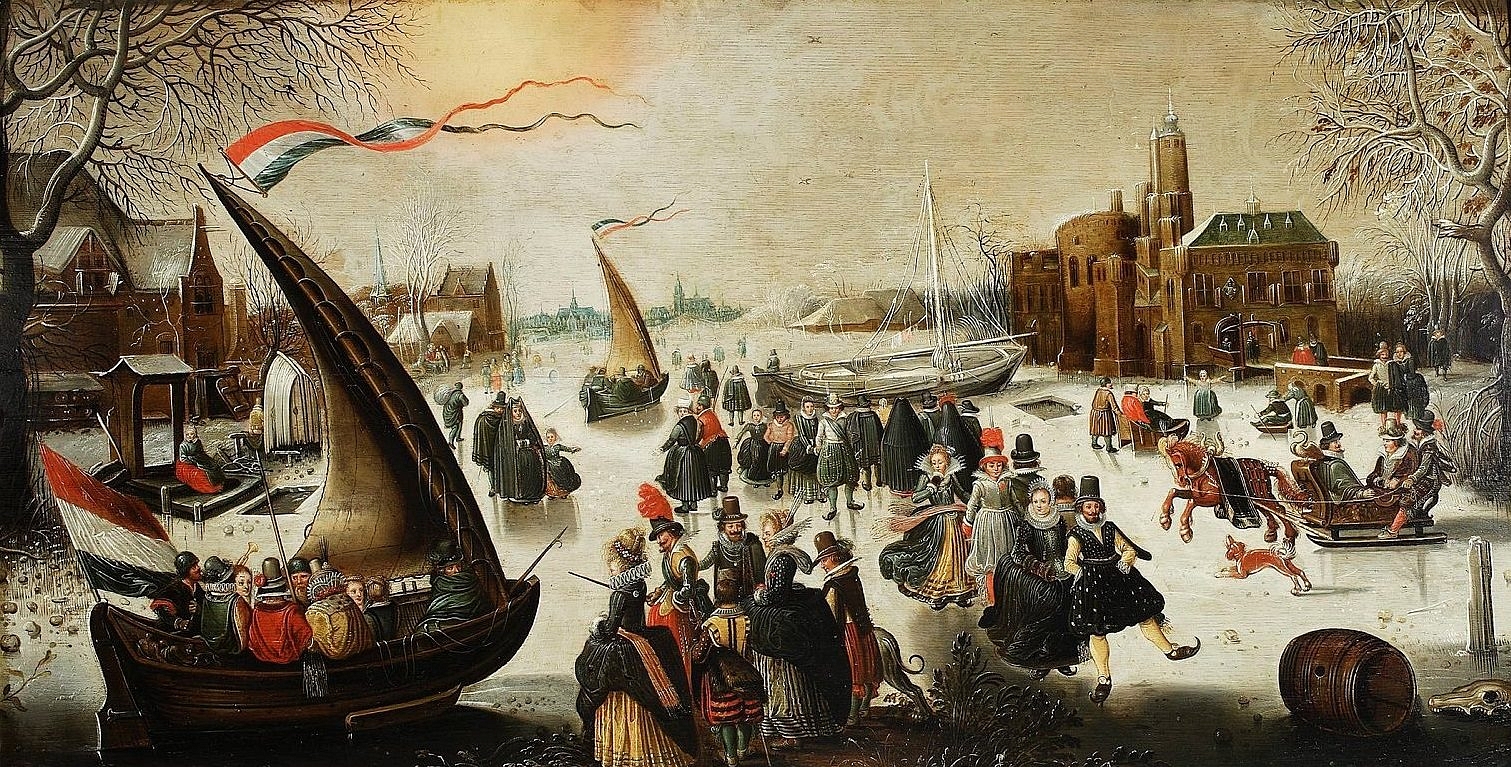
The history of iceboating began in Europe in areas where smooth ice was found in the bays of the Baltic Sea and the canals of the Netherlands during the little ice age. Initially boats were used for commerce, but soon evolved into pleasure craft—"ice yachts". Ice sailing came to North America, where the sailing craft evolved into recreational and racing versions.
Venues
[edit]Iceboating began in the 17th century as a documented means of transport on the frozen Gulf of Riga and the canals of the Netherlands into the 18th century.[1] Ice boats carried cargo on Dutch canals during the 17th century.[2]
The first iceboats were introduced on New York State's Hudson River in the United States in 1790, where the practice flourished as a sport. The first recorded boat, built in 1790 by Oliver Booth of Poughkeepsie, was a square box atop three runners, the two forward runners being nailed to the box and the third acted as a rudder operated by a tiller. This type of craft was accessible to sportsmen of modest means.[3]
In the mid-19th century, two "ice yachting" clubs had formed, the Poughkeepsie Ice Yacht Club (1865) and the Hudson River Ice Yacht Club (1870), where wealthy boat owners sailed large iceboats with up to seven crew members. Boats were as long as 69 feet (21 m) and sailed as fast as 107 miles per hour (172 km/h), a record exceeding any other conveyance in 1885, set by the Icicle.[1] The first American Challenge Pennant occurred in 1881 on the Hudson river with five ice-yacht clubs competing. Races were sailed five times around a triangular course with one-mile legs, two of which were to windward. Iceboats were divided into four classes with sail areas ranging from less than 300 square feet to over 600 square feet.[4]
By the beginning of the 20th century, iceboating had spread to Minnesota (Lake Minnetonka and White Bear Lake), Wisconsin (Lake Winnebago and Lake Pepin), Michigan (Lake St. Clair), and venues in Maine and Vermont. In Canada, there were venues on Lake Ontario (Kingston) and the Saint Lawrence River.[4]
A European ice sailing club formed first in Sweden (1901), followed by the European Ice Yachting Union, which formed in 1928 with member states Latvia, Lithuania, Estonia, Sweden, Austria, and Germany.[1]
Evolution of design
[edit]
17th-century Dutch ice yachts consisted of flat-bottomed sailboats atop a cross-wise plank, resting on outboard metal runners, which carried the bulk of the weight of the craft. At the stern was a steering runner, attached to a rudder-like structure. to which are affixed four steel runners, one each at bow, stern and each end of the planking. These boats used conventional gaff mainsails and jibs, attached to the mast by travellers. A tiller or wheel stern controls the steering runner.[4]

In the 19th century iceboats evolved into a box, riding on cross-pieces, supported by runners. These "stern-steerer" iceboats were generally rigged as sloops, with a jib sail forward of the mast, although the catboat style with a single sail was also used.[3] In 1879 the archetypical Hudson River iceboat began to emerge. The Robert Scott, designed and built by H. Relyea, had a single backbone and wire guy-ropes. The mast on subsequent boats were stepped further forward than in the past with shortened jibs were shortened and the center of effort and resistance brought into balance, aligning both with the main runners.[5] The shallow cockpit box became elliptical.[4] A few "Class A'' stern steerers with at least
250 square feet (23 m2) of sail area survived in to the late 20th century.[6]
In the early 1900s some smaller iceboats, called scooters, were designed to traverse both ice and water with a shallow, oval 15×5 feet (4.6×1.5 m) hull on fixed runners. These sailing craft were steered by manipulating the sails, there being no rudder.[4]
The traditional stern-steerer boats were largely replaced by front steering boats in the 1930s, following the development of this style by Walter Beauvois of Williams Bay, Wisconsin in a boat named the Beau Skeeter.[2] This boat led to the "Skeeter" class, and the Skeeter Ice Boat Club formed on Geneva Lake, Wisconsin. The Skeeter class adopted the logo of a mosquito on their sail, and has evolved into an aerodynamically clean machine. The Skeeter class is limited to just 75 square feet (7.0 m2) of sail.[7]
In 1937, The Detroit News sponsored a new home-buildable ice boat design, which became the International DN. In 1968 Dick Slates of Pewaukee, Wisconsin designed and built the Nite with two wooden prototypes. The design was refined and fiberglass production began in 1970.[5]
Speed
[edit]
Iceboats designs dating from the mid 20th century onwards typically consist of a triangular or cross-shaped frame, supported by three skate blades called "runners", with the steering runner in front. Runners are made of iron or steel with sharpened edges, which hold onto the ice, preventing slippage sideways from the lateral force of the wind developed by the sails, as they develop propulsive lift. Given their low forward resistance, iceboats can sail up to five times the speed of the true wind.[8][9] Because the velocity of the iceboat (VB) is so much greater than the true wind velocity (VT), the apparent wind (VA) is only a few degrees from the direction of travel on most points of sail and the sail is close-hauled in each. VA is generated by the combination of iceboat velocity (VB) and true wind velocity (VT).[10]
Attainable speeds
[edit]Different classes of iceboat can achieve speeds, as follow.
- International DN: 55–68 miles per hour (89–109 km/h).[8][11]
- Skeeter: 84 miles per hour (135 km/h).
- Classic iceboats: While claimed speeds for such craft have been as high as 140 miles per hour (230 km/h) in the early 20th century,[12] other sources cast doubt on both the technology for achieving and for measuring such speeds at those times.[13]
Race courses
[edit]Because of the high boat speeds, iceboat race courses are established around fixed marks which are to be rounded in a one-way route, enhancing boat-to-boat traffic safety. The courses are a straight line upwind and downwind, which necessitates tacking upwind and jibing downwind.[1]
Classes
[edit]Among the classes of iceboat are sailing craft that have associations in Europe and North America: IceOptimist, International DN, and Monotype XV. Others are regional in North America: Nite, Renegade, and Skeeter.
-
 IceOptimists
 -

-
 Monotype XV


IceOptimist
[edit]The IceOptimist is a youth iceboat class that uses the sails and the rig of the International Optimist dinghy. The first design was built in Estonia in 1978, with scaled-down elements of a DN. In 2002, the class was registered under the guardianship of IDNIYRA Europe with the permission of IODA. World and European Championships are sailed each winter with a fleet of approximately 40 racers.[14]
International DN
[edit]The International DN class is the most popular class in both North America, Europe and Asia.[citation needed] It is a one-person wood boat twelve feet long with a cross-plank eight feet long that carries a mast 16 feet (4.88 m) high. Modern competitive DNs use flexible masts commonly made of composite materials.[15] The DN 60 derives its name from the 1937 request of The Detroit News for a high-performance, inexpensive, home-built iceboat design. Modern DNs share many one-design features with the original boat, including the basic aerodynamic fuselage design, runner configurations and 60 square feet (5.6 m2) of high-performance sail.[16]
Monotype XV
[edit]The Monotype XV is a class of stern-steering iceboat based on a 1932 design by an Estonian, Erik von Holst. It may be single or double-handed. The One-Design class is built according to close specifications, little changed since the 1930s. It is the largest one-design iceboat class in Europe and the only double-handed iceboat class for which there are international championships. The 205-kilogram (452 lb) is 7.5×4.2 metres (25×14 ft) in length and width with a 7.2-metre (24 ft) high mast.[17]
Nite
[edit]Nite is a class of iceboat that has a two-seat side-by-side fiberglass fuselage and a 67-square-foot (6.2 m2) sail. It is constructed according to tight specifications.[18]
Renegade
[edit]The Renegade is a class of home-built iceboat whose prototype appeared in 1947 in Wisconsin, designed by Elmer Millenbach to be carried atop an automobile.[19] Plans were published in 1950.[20] It has a 67-square-foot (6.2 m2) sail on a flexible aerodynamic spar.[9]
Skeeter
[edit]The Skeeter class is divided into sub-classes (A, B and C) all of which are limited to 75 square feet (7.0 m2) of sail area.[21] A-class boats may be single or two-place tandem with a mast that does not exceed 28.5 feet (8.7 m). They may incorporate carbon fiber construction.[16] B-class boats have seats for two (side by side). C-class skeeters may be single or two-place tandem with a mast that does not exceed 20.25 feet (6.17 m).[22]
See also
[edit]
References
[edit]- ^ a b c d Editors (February 17, 2020). "Iceboating | sport". Britannica.com. Retrieved April 14, 2020.
{{cite web}}:|last=has generic name (help) - ^ a b Spectre, Peter H. (2006). A mariner's book of days, 2007. Dobbs Ferry, NY: Sheridan House. ISBN 1-57409-226-X. OCLC 173009383.
- ^ a b Levine, David (November 19, 2013). "Explore the History of Ice Yachting in the Hudson Valley". www.hvmag.com. Retrieved April 14, 2020.
- ^ a b c d e Chisholm, Hugh, ed. (1911). . Encyclopædia Britannica. Vol. 14 (11th ed.). Cambridge University Press. p. 241–242.
- ^ a b Fisher, Daniel (March 7, 2014). "As The Hudson River Freezes, Classic Ice Yachts Emerge". Forbes. Retrieved April 15, 2020.
- ^ Bentsen, Ellen (January 1981). Wisconsin Ice Monsters. Yachting. pp. 61–3.
- ^ Andrews, Candice Gaukel (2006). Great Wisconsin Winter Weekends. Big Earth Publishing. p. 152. ISBN 978-1-931599-71-9.
- ^ a b Dill, Bob (March 2003), "Sailing Yacht Design for Maximum Speed", The 16th Chesapeake Sailing Yacht Symposium, Anapolis: SNAME, archived from the original (PDF) on September 19, 2020, retrieved January 29, 2017
- ^ a b "Commonly Asked Questions". Four Lakes Ice Yacht Club. Archived from the original on March 9, 2011. Retrieved August 25, 2010.
- ^ See page 204 of Bethwaite, Frank (2007). High Performance Sailing. Adlard Coles Nautical. ISBN 978-0-7136-6704-2.
- ^ Dill, Bob (February 2004). "Putting Numbers on Iceboat Performance" (PDF). International DN Ice Yacht Racing Association Newsletter.
- ^ Smith, Doug (January–February 2004). Sailing on slivers of steel. Boy Scouts of America, Inc. pp. 17–21.
- ^ Dill, Bob (March 2004). "Sailing Yacht Design for Maximum Speed" (PDF). The 16th Chesapeake Sailing Yacht Symposium. Anapolis.
- ^ "ICE OPTI and DN JUNIOR – IDNIYRA – Europe". idniyra.eu. Retrieved April 10, 2020.
- ^ "IDNIYRA | International DN Ice Yacht Racing Association". December 27, 2017. Archived from the original on December 27, 2017. Retrieved April 15, 2020.
- ^ a b Staff (January 1982). "Endless winter, the iceboater's dream". Changing Times-The Kiplinger Magazine. 36 (1): 58–9.
- ^ Whitehorse, Deb (March 4, 2019). "Monotype XV European Championship". iceboat.org. Retrieved April 15, 2020.
- ^ "Class Rules" (PDF). International Nite Class Association. July 30, 2019. Retrieved April 18, 2020.
- ^ Millenbach, Elmer. "The Renegade Story". iceboat.org. International Skeeter Association. Retrieved April 18, 2020.
- ^ Brennan, Walter X. (December 1950). "Building the Renegade Ice Yacht" (PDF). Science and Mechanics: 181–99.[permanent dead link]
- ^ "International Skeeter Association". iceboat.org. Retrieved April 15, 2020.
- ^ Class committee (October 16, 2016). "General rules and regulations of the International Skeeter Association" (PDF). Retrieved April 14, 2020.[permanent dead link]
External links
[edit]
- DN Class World Portal
- DN North America
- DN Europe
- International XV Monotype Association
- International Skeeter Association
- Videos on DN iceboating


| National | |
|---|---|
| Artists | |
| Other | |

Iceboat
View on GrokipediaOverview and Principles
Definition and Operation
An iceboat is a recreational or competitive sailing craft powered solely by wind, supported by metal runners that glide over frozen surfaces such as lakes or rivers, requiring smooth, snow-free ice at least 4 inches (10 cm) thick for safe operation.[4][1] Unlike traditional sailboats, it features a lightweight frame with a sail attached to a central hull or mast, and typically three runners—one steerable at the front and two at the rear—for stability and low-drag contact with the ice.[4][5] Iceboating emerged as a winter adaptation of conventional sailing during the 18th century in Europe, where prototypes were developed in the Netherlands and Baltic regions to enable navigation of frozen canals and bays during prolonged cold periods of the Little Ice Age.[6] The craft operates on principles akin to waterborne sailing but exploits the exceptionally low friction of ice, allowing it to plane effortlessly across the surface with minimal resistance from the runners. Wind interacts with the sails to produce thrust: the sails function like airfoils, generating lift perpendicular to the apparent wind and drag parallel to it, which resolve into forward propulsion while the runners counteract lateral forces.[7][8] Central to its mechanics is apparent wind dynamics, where the wind experienced by the moving iceboat is the vector sum of the true wind velocity and the craft's own speed in the opposite direction; this shifts the apparent wind forward as velocity increases, optimizing sail efficiency even when sailing toward the true wind source.[7][8] The basic physics involves wind-induced force vectors on the sails translating to hull acceleration, balanced against the negligible drag from ice friction—with coefficients typically ranging from 0.01 to 0.03 on smooth ice—enabling speeds several times greater than the true wind velocity.[8] This low-friction environment amplifies the thrust-to-resistance ratio, making iceboats capable of rapid planing similar to high-performance watercraft but without hydrodynamic drag.[7][5]Basic Components
The core components of an iceboat form a lightweight, efficient structure optimized for speed on ice. The chassis, often a triangular or rectangular frame made from wood or composites, serves as the central support for the sailor and rig, with cross-planks providing lateral stability by distributing weight across the rear runners. Attached to this chassis is a transverse runner plank that holds the two fixed rear runners, while a single steerable front runner mounts directly to the bow. The sailing apparatus includes a tall mast stepped amidships, a horizontal boom, and typically a single triangular mainsail that captures wind to drive the boat forward.[1][9][10] Runners are the critical contact points with the ice, consisting of sharpened steel blades typically 0.75 to 1 meter long in standard classes, longer in larger designs, that slice through the surface for minimal friction and maximum grip.[11][9][12] The two rear runners remain parallel and fixed to maintain straight-line stability, while the front runner pivots for directional control via steering lines connected to a tiller or helm. In certain designs, adjustable chocks allow fine-tuning of runner angle or height for different ice textures or conditions to optimize grip and stability.[13][9][12] Sails provide the propulsive force and are constructed from durable materials such as traditional canvas in older models or modern polyester synthetics like Dacron for better shape retention and UV resistance. Sail area generally ranges from 5 to 20 square meters, scaled to the boat's size, with the mainsail attached along the mast's leading edge and controlled by the boom at the foot.[14][9] These elements integrate for balanced operation, where the chassis and cross-planks ensure low center of gravity and resistance to tipping, while the mast and sail positioning aligns the center of effort with the runners' pivot points for responsive handling. Early iceboats commonly employed gaff rigs with a four-sided topsail for power in heavy winds, whereas contemporary setups favor simpler sprit or bermudan rigs to enhance stability and ease of adjustment during races.[1][15]History
Origins and Early Development
Iceboating originated in 17th- and 18th-century Europe, where early prototypes equipped with skates or blades were developed to navigate frozen canals and waterways. In the Netherlands, Dutch sailors adapted sailing vessels by attaching metal runners, enabling wind-propelled travel across ice-covered canals for transportation purposes. Similar innovations appeared in Scandinavian regions around the Baltic Sea, where rudimentary ice craft facilitated movement during harsh winters.[16] The practice reached North America in the late 18th century through Dutch settlers in the Hudson River Valley of New York, evolving from a utilitarian tool to a recreational pursuit. The first recorded iceboat in the United States was constructed in 1790 by Oliver Booth of Poughkeepsie, consisting of a simple wooden box mounted on three steel runners with a sprit sail, which allowed for speeds surpassing those of contemporary land transport. By the early 1800s, iceboating had popularized in the region during the 1790s and 1800s, influenced by established yachting traditions among affluent residents.[17][18] Prior to the expansion of railroads in the mid-19th century, iceboats played a crucial role in winter transportation across frozen bodies of water, offering rapid travel for goods and passengers that outpaced horse-drawn sleds. On the Great Lakes, such as Lake Ontario, they were employed by the 1820s for efficient transit around areas like Toronto, covering distances in minutes. In Europe, these craft continued to serve on rivers and canals, bridging gaps in overland routes during ice seasons.[19] The formal organization of iceboating as a sport emerged in the mid-19th century with the founding of dedicated clubs, including the Poughkeepsie Ice Yacht Club in 1861, the first such group in the United States, which hosted early competitive races on the Hudson River. Pioneers like Booth laid the groundwork, while later figures such as members of the Roosevelt and Rogers families advanced the activity through participation in these inaugural events, fostering its growth as an organized winter pastime.[2][20]Key Venues and Events
Iceboating requires expansive, smooth sheets of ice for safe and effective racing, typically on large frozen lakes or rivers spanning at least 10-20 km² to accommodate triangular courses and multiple boats without interference from cracks or shorelines.[21] The Hudson River in New York, USA, stands as one of the earliest and most iconic venues, where the sport flourished during its golden age from the 1880s to 1910, with races drawing crowds along the riverbanks near Poughkeepsie and Athens.[22] Geneva Lake in Wisconsin, USA—often called the "Iceboat Center of the World"—provides ideal conditions due to its size and depth, enabling consistent freezes for high-speed runs, particularly in the Williams Bay area.[23] The Bay of Quinte in Ontario, Canada, offers sheltered bays with reliable ice formation, hosting national-level competitions on its broad, flat expanses.[24] In Europe, Finnish lakes such as Pyhäjärvi serve as prime locations, with their vast, clear ice surfaces supporting international gatherings and regattas amid the country's harsh winters.[25] Significant milestone events have defined iceboating's competitive landscape, beginning with the inaugural American Challenge Pennant race in 1881 on the Hudson River, organized by the New Hamburg Ice Yacht Club and involving five prominent clubs competing on a triangular course sailed five times.[26] This event marked the sport's transition to organized international-style competition in North America, setting precedents for challenge pennant races that emphasized speed and endurance. North American championships emerged soon after, with ongoing series for various classes dating back to the early 1900s, including the Hearst Trophy regattas that drew top fleets from across the continent starting around 1906.[27] In Europe, championships took root in the 1930s, with multiple events hosted in the Baltic region, such as those in Riga, Latvia, in 1934, 1935, and 1937, under the European Ice Yachting Union, fostering cross-border rivalries among Swedish, Estonian, and Latvian clubs.[28] Influential organizations have anchored these venues and events, including the Hudson River Ice Yacht Club, established in 1885 and reformed in the 1960s, which preserves historic vessels and promotes racing on the river and nearby lakes like Orange Lake.[22] The Skeeter Ice Boat Club, founded in 1933 on Geneva Lake, has been pivotal in standardizing rules for stern-steerer classes and hosting annual regattas that attract builders and racers nationwide.[23] For the DN class, the International DN Gold Cup— the premier world championship—debuted in 1952, evolving into biennial alternations between North America and Europe, with the first full international edition in 1973 on Gull Lake, Michigan, uniting competitors from Estonia, Germany, and the US.[29] The Four Lakes Ice Yacht Club in Madison, Wisconsin, active since the late 1800s, coordinates multi-venue regattas like the Northwest series, linking clubs across the Midwest.[30] Iceboating's viability hinges on prolonged cold spells to form thick, snow-free ice, but warming trends in the 2020s have increasingly disrupted schedules, with mild winters leading to outright cancellations of planned regattas, such as several DN events postponed or scrapped due to insufficient ice cover in North America and Europe.[31] As of February 2025, warming winters in Wisconsin have led to shorter iceboating seasons, prompting sailors to chase viable ice in remote locations.[32] These environmental challenges have prompted clubs to seek alternative venues or adaptive scheduling, underscoring the sport's precarious dependence on traditional winter conditions.[33]Design Evolution
Iceboat designs in the 19th century primarily utilized wooden frames, with early models adapted from transportation vessels featuring a simple plank base and fixed runners for basic mobility across frozen waterways. These evolved into recreational craft as the sport gained popularity, particularly along the Hudson River, where the first organized ice yacht club formed in Poughkeepsie in 1861. Sails were large to harness wind effectively, often exceeding 250 square feet (23 m²) in gaff-rigged configurations, while steering relied on hand-operated runners at the stern for directional control. This shift from utilitarian transport to competitive sport was evident by the late 1800s, with builders like Oliver Booth in Poughkeepsie credited for pioneering recreational iterations around 1790.[26][34] In the early 20th century, particularly during the 1910s, designs incorporated metal reinforcements to enhance durability, including steel runners sharpened for better ice grip and reduced wear on wooden components. Post-World War I innovations focused on streamlining, with hull shapes refined for lower drag and improved stability, drawing from aviation influences to support higher velocities. These changes marked a transition toward more efficient, race-oriented vessels, as seen in the adoption of stronger materials that allowed for lighter yet robust structures without compromising integrity.[6][35] Mid-20th-century advancements emphasized standardization to promote fair competition, exemplified by the DN class developed through a 1937 design contest sponsored by the Detroit News, which established a one-design blueprint with a 12-foot hull, 60-square-foot sail, and tricycle runner configuration. This model, created by designers Archie Arroll, Joe Lodge, and Norman Jarrett, became the global standard for small iceboats due to its simplicity and performance. Fiberglass began entering construction in the 1950s, particularly for classes like the Renegade introduced in 1947, offering corrosion resistance and easier maintenance over traditional wood, though widespread adoption accelerated in subsequent decades.[36][37] From the 1980s onward, the integration of carbon fiber and advanced composites revolutionized iceboat engineering, enabling significant weight reductions—such as DN hulls dropping from around 200 kg in early wooden versions to under 100 kg in modern builds—while maintaining structural strength. These materials facilitated aerodynamic optimizations, including smoother hull contours and lighter rigging, contributing to attainable speeds exceeding 150 km/h in competitive settings. Such innovations, initially applied to masts and battens, prioritized performance in high-wind conditions without altering core class rules.[38][39]Design and Construction
Hull and Chassis
The hull and chassis of an iceboat form the foundational structure, providing a stable platform that supports the crew, mast, and sails while gliding over ice at high speeds. Traditional and modern designs typically feature either a rectangular fuselage or a triangular A-frame configuration, with the latter often seen in historical models where two triangular plank assemblies meet at the base along the runner plank for compactness and rigidity. Rectangular hulls, more common in contemporary classes like the DN, consist of a longitudinal fuselage approximately 3 to 4 meters long and 0.5 meters wide, constructed to minimize wind resistance while maintaining sufficient space for the helmsman. These platforms are mounted perpendicularly to a central runner plank, creating a T-shaped or cross-like chassis that distributes loads across three runners for balance and maneuverability.[12][40][1] Construction emphasizes lightweight yet durable materials to achieve optimal strength-to-weight ratios, with wood such as Sitka spruce or fir historically favored for its superior properties in bending and compression, often laminated into 2x4 keelsons or bulkheads. Modern builds incorporate aluminum for runner attachments and composites like fiberglass over balsa cores or carbon fiber and Kevlar in development classes such as the Skeeter, enabling vacuum-bagged layups that reduce overall weight to as low as 46 pounds for a DN hull while enhancing torsional resistance. The chassis integrates crossbeams—primarily the 2.4-meter runner plank—for securing the lateral runners, paired with a central king plank running the length of the fuselage to support the mast step and distribute compressive forces from the rig. Weight distribution is engineered for stability to ensure reliable steering via the bow runner without excessive drag on the aft runners.[10][41][42][1] Structural integrity is paramount due to the extreme forces encountered, including dynamic impacts from ice irregularities and torsional stresses from wind gusts exceeding 50 knots. Designs incorporate plywood bulkheads and epoxy-thickened adhesives to create non-twisting frames that resist deformation, as demonstrated in prototypes enduring 20 years of use without failure. Common failure modes include runner misalignment, which induces uneven loading and can propagate cracks along the chassis joints or hull-keelson interface, underscoring the need for precise alignment during assembly. To mitigate impacts, reinforced stem and stern blocks absorb shocks, while composite laminates provide progressive damage tolerance over brittle wood.[41][10][43] Customization allows adaptation to varying ice conditions, with adjustable geometry such as sliding mast steps in a deck-mounted channel to optimize rake for rough surfaces, or selectable runner plank lengths to widen the stance—up to 4.9 meters in larger classes—for improved stability on uneven ice. In unlimited classes like the Skeeter, builders experiment with variable bulkhead spacing or reinforced chines to tailor torsional stiffness, ensuring the chassis remains responsive without compromising speed on smooth ice. These modifications, often iterated through class-specific guidelines, highlight the balance between fixed one-design rules and innovative engineering for performance.[44][1][42]Runners and Steering
Iceboats typically employ three runners for contact with the ice surface: one steerable front runner and two fixed rear runners mounted on a runner plank. These runners are constructed from high-carbon steel or stainless steel alloys, such as 1095 or 440-C, to provide durability and a sharp cutting edge against the ice.[13][45] The blades are generally 1/4 inch (6.35 mm) thick, with a maximum thickness of 0.27 inches (6.8 mm) permitted in classes like the DN to balance strength and minimal drag.[11][10] The edges are honed to a precise 90-degree included angle using belt grinders or whetstones, ensuring a clean profile that includes flat sections for stability and a slight crown for turning responsiveness; this sharpening process removes nicks and maintains a smooth curve from heel to toe.[46][47] Steering is achieved through the front runner, which pivots via a post and chock assembly mounted to the hull's forward section. Control is provided by a tiller bar connected to the runner, though greater angles may be achieved with cable or rod linkages positioned beneath the fuselage for direct mechanical advantage.[48][49] Modern steering systems often incorporate spring-loaded elements in the runner assembly to absorb shocks from ice irregularities, enhancing control at high speeds without compromising the fixed rear runners' alignment.[50] The tiller can be extended or adjusted in length to suit the operator's position, ensuring precise directional input during maneuvers.[51] The traction provided by iceboat runners relies on the low coefficient of friction between steel and ice, typically around 0.03 under dry conditions, which minimizes drag and enables speeds far exceeding wind velocity while the sharp edges grip to counteract lateral forces.[52] This frictional interface prevents sideslip during turns by creating a wedging action against the ice, with runner drag accounting for approximately 0.8% of the boat's weight on smooth surfaces.[53] For varying ice textures, such as snow-covered or rough surfaces, operators may intentionally dull the runner edges slightly using abrasive pads to increase bite and reduce slippage, adapting the setup on-site without full resharpening.[54] Routine maintenance of runners is essential for performance and safety, focusing on periodic sharpening after each use to restore the edge profile and remove embedded grit. Techniques involve securing the runner in a jig and using progressively finer grits—from 40 for rough profiling to 100 for polishing—followed by stoning to achieve the 90-degree bevel; this process typically takes 2-3 hours per set.[42][47] Runners are inspected for wear, with blades replaced when thinning exceeds allowable limits or after signs of cracking, often after several seasons of competitive use depending on ice conditions and frequency of sharpening.[21]Sails and Rigging
Iceboat sails are typically triangular in shape, employing a Bermuda rig configuration for efficient wind capture, with sail areas varying from 7 to 25 m² across different classes to balance power and handling. In the Skeeter class, for instance, the maximum sail area is limited to 75 square feet (approximately 7 m²) to promote one-design competition. Larger classes, such as Renegade, utilize sails around 125 square feet (11.6 m²) for greater propulsion on bigger hulls. These sails are constructed from high-tenacity polyester fabrics, which provide durability and resistance to stretching under high loads, as specified in classes like the DN where luff, foot, and leech dimensions are strictly regulated to maintain fairness.[55][14][50] The rigging system is divided into standing and running components to ensure mast stability and precise sail control. Standing rigging includes shrouds and stays, typically made of steel wire with a minimum diameter of 0.118 inches (3 mm) in development classes like the DN, connecting to a bow plate and providing fore-and-aft and lateral support against wind forces. A bobstay further reinforces the forward structure. Running rigging comprises halyards for hoisting the sail and sheets for trimming its angle relative to the wind, often using steel or synthetic ropes with a minimum 3/32-inch (2.4 mm) diameter to handle rapid adjustments during high-speed maneuvers.[56] Aerodynamic performance relies on adjustments to sail camber—the forward curve—and twist—the variation in angle from bottom to top—to achieve an optimal lift-to-drag ratio, maximizing forward drive while minimizing sideways force. Upwind configurations feature reduced camber and minimal twist for pointing ability, while downwind setups incorporate more twist to prevent overpowering and promote stability at higher apparent wind angles. These tweaks are critical given iceboats' low friction, allowing sails to generate lift akin to aircraft wings.[54][57] Innovations in sails and rigging have focused on reducing weight and enhancing efficiency, such as the adoption of composite masts in the 1990s, which pair with tailored sails to improve bend characteristics and power delivery across wind ranges. Lightweight hardware, including Dyneema synthetic lines for running rigging, has further contributed to overall boat weight reductions of 20-30% by replacing heavier steel alternatives, enabling faster acceleration without compromising strength.[58][59]Classes
Small and Youth Classes
Small and youth classes in iceboating provide accessible entry points for beginners and young sailors, featuring compact designs that emphasize simplicity, affordability, and ease of handling to build foundational skills on ice. These classes typically use scaled-down hulls, smaller sails, and lightweight construction to ensure safety and control, often drawing inspiration from established dinghy formats like the Optimist for familiarity. They serve as stepping stones to more advanced competition classes, fostering participation in regions with suitable frozen water bodies.[60][61] The IceOptimist stands as the premier youth class, specifically engineered for sailors aged 8 to 15 to introduce ice sailing fundamentals in a controlled environment. Originating in Estonia with the first prototype built in 1978, the class was formalized and named at a 2002 meeting in Balatonfüred, Hungary, under the oversight of IDNIYRA Europe, involving contributions from ice sailing experts across Estonia, Poland, Great Britain, Latvia, Lithuania, Russia, Belarus, and Sweden. Its design mirrors the summer Optimist dinghy for seamless transition, utilizing a sail area of 3.25 m² made from optional cloth (recommended 200 g/m²), an aluminum mast, boom, and sprit identical to the Optimist class, and rigging with one forestay and two adjustable side stays. The fuselage measures a maximum of 3 m in length, constructed from wood or laminate (must float with 10 kg added weight), paired with a steering system of minimum 12 kg and a plank up to 2 m long and 180 mm wide (minimum 5 kg). Runners are shorter than DN-class standards, with a minimum thickness of 3 mm and a parking brake on the steering runner, promoting maneuverability. Emphasizing low cost and DIY construction with common materials, an IceOptimist can be built for about $1,000, primarily due to the sail ($500 used) and runners ($300 used).[62][60][61] The Nite class extends small-boat accessibility to adult beginners, functioning as a forgiving platform for learning in smaller fleets since its development in the 1960s. Designed by Dick Slates of Pewaukee, Wisconsin, with wooden prototypes in 1968 followed by refined fiberglass production starting in 1976, it features a 5.33 m (17 ft 6 in) fiberglass hull with side-by-side seating for two, an 11 ft beam, an 18 ft mast, and a 6.2 m² (67 sq ft) sail in a cat rig configuration. Displacement is 118 kg (260 lb), enabling straightforward handling and transport.[63][64][37] Additional small classes, such as the Mini Skeeter, cater to beginners with versatile, one-design formats approximately 3 m (10 ft) in length with a 2.4 m (8 ft) runner plank beam, and 5.5 m² sails, allowing year-round use on ice or land while maintaining strict conformity rules for fair racing. These classes support training progression to larger boats and have seen adoption across Europe and North America, where they enable safe practice at speeds up to 65 mph (105 km/h).[65][66][60]Standard Competition Classes
The standard competition classes in iceboat racing emphasize one-design principles to ensure fair competition, with strict rules on dimensions, materials, and construction governed by organizations such as the International DN Ice Yacht Racing Association (IDNIYRA) and the National Iceboat Authority (NIA). These classes attract experienced sailors and feature high-performance designs capable of reaching speeds exceeding 100 km/h under optimal conditions. The most prominent classes include the International DN, Skeeter, Renegade, and Monotype, each with distinct specifications that balance speed, handling, and accessibility for international regattas. The International DN class, the largest and most widespread in the world with over 2,000 boats built since its inception, originated from a 1937 design contest sponsored by the Detroit News and is governed by the IDNIYRA. It features a compact hull measuring 12 feet (3.66 m) in length and 21 inches (53 cm) in width, constructed traditionally from plywood but increasingly incorporating carbon fiber for the deck and chassis to reduce weight to around 100-150 lbs (45-68 kg). The sail area is fixed at 60 square feet (5.57 m²), supported by a 16-foot (4.88 m) mast and an 8-foot (2.44 m) runner plank, enabling single-handed operation and speeds routinely over 55 mph (89 km/h), with records approaching 70 mph (113 km/h). This class's strict one-design rules promote equality, fostering large fleets in North America and Europe for continental and world championships. The Skeeter class, developed in the 1920s in North America and primarily raced there under NIA rules, divides into A, B, and C subclasses to accommodate varying builder ambitions while maintaining competitive parity. All subclasses limit sail area to a maximum of 75 square feet (7 m²) in a cat-rigged configuration, with hull lengths typically ranging from 15 to 20 feet (4.6-6.1 m) depending on the division—A for unlimited designs often reaching 18-20 feet, B capped at 18 feet, and C at shorter 15-16 feet for more agile handling. Frames are commonly aluminum for durability, and the class emphasizes bow-steering with steel runners, allowing speeds up to 84 mph (135 km/h) in A-class boats during downwind runs. Its open-yet-classified structure has sustained North American dominance since the formation of the International Skeeter Association in 1940. The Renegade class, introduced in the 1940s as a strict one-design response to evolving Skeeter variations, focuses on equalized performance through precise measurements enforced by the International Renegade Ice Yacht Association. The hull is approximately 19 feet (5.8 m) long with a narrow 10-inch (25 cm) beam, weighing about 175 lbs (79 kg) fully rigged, and carries 67 square feet (6.22 m²) of sail on a flexible wing mast for enhanced power in light winds. Built from wood or composites with a simple cowhorn steering setup, it prioritizes portability—fitting on a car roof—and has produced over 500 units, enabling consistent racing in fleets across the U.S. Midwest, where it achieves speeds of 50-60 mph (80-97 km/h). Other standard classes include the Monotype-XV, an adult-oriented European one-design governed by the International Monotype-XV Yacht Racing Association, featuring a 24.5-foot (7.465 m) stern-steered hull, 15 m² sail area, and two-person crews for balanced competition in international events, with ongoing championships as recently as May 2025. Rules specify exact hull shapes, minimum weights of 220 kg, and ash wood construction to preserve uniformity since its 1932 design by Erik von Holst.[67]| Class | Hull Length | Sail Area | Key Features | Governing Body | Approx. Fleet Size |
|---|---|---|---|---|---|
| International DN | 12 ft (3.66 m) | 60 sq ft (5.57 m²) | Single-handed, plywood/carbon hull, 3 runners | IDNIYRA | >2,000 worldwide |
| Skeeter (A/B/C) | 15-20 ft (4.6-6.1 m) | 75 sq ft (7 m²) max | Bow-steered, aluminum frames, divided by size | NIA/ISA | Hundreds in North America |
| Renegade | 19 ft (5.8 m) | 67 sq ft (6.22 m²) | Strict one-design, portable, wing mast | IRIYA | ~500 |
| Monotype-XV | 24.5 ft (7.465 m) | 15 m² | Stern-steered, two-person, wood hull | IM-XV YRA | >200 in Europe |