


Community hub
Recent from talks
Contribute something
Nothing was collected or created yet.
Inflanty Voivodeship
View on Wikipedia | This article has multiple issues. Please help improve it or discuss these issues on the talk page. (Learn how and when to remove these messages)
|


Key Information


| History of Latvia |
|---|
 |
| Chronology |
 Latvia portal Latvia portal |
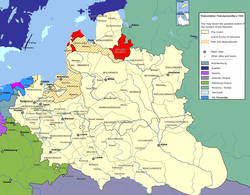
The Inflanty Voivodeship (Polish: Województwo inflanckie),[1] or Livonian Voivodeship (Lithuanian: Livonijos vaivadija),[2] also known as Polish Livonia, was an administrative division and local government in the Polish–Lithuanian Commonwealth, since it was formed in the 1620s out of the Wenden Voivodeship and lasted until the First Partition of Poland in 1772. The Inflanty Voivodeship was one of the few territories of the Polish–Lithuanian Commonwealth to be ruled jointly by Poland and Lithuania.
Overview
[edit]The Inflanty Voivodeship, also called the Duchy of Inflanty, due to a 1667 bill of the Sejm, was the minority remainder of the Duchy of Livonia, which had been conquered by the Swedish Empire during the Polish–Swedish War of 1621–1625. The seat of the voivode was Dyneburg (Daugavpils).
The name Inflanty is derived through Polonization of Livland, the German name for Livonia. In modern times the region is known as Latgalia in the Republic of Latvia.[3]
Zygmunt Gloger in his monumental book Historical Geography of the Lands of Old Poland provides this description of Inflanty Voivodeship:
The land, called by the Poles Inflanty, in Latin Livonia, in German Liefland, and in Latvian Widzzemme, had the area of 1,092 sq. miles (...) It was inhabited by the Latvians, whose language is similar to Lithuanian, but still differs from it, as the Latvians interacted and mixed with the Estonians in central and northern Inflanty. The province, together with Courland, was in the 13th century conquered by the Germans of the Livonian Brothers of the Sword. Later on, however, facing three powerful neighbours: Muscovy, Swedish Empire, and the Polish–Lithuanian Commonwealth, the monks found it difficult to keep their independence. After Estonia had been seized by Sweden, Great Master Gotthard Kettler voluntarily decided to seek for help from Polish king. With permission of Livonian towns and knights, on 28 November 1561 in Vilnius, a document was signed, which turned Livonia into a Polish–Lithuanian fief (see Treaty of Vilnius (1561)). On December 26 of the same year, King Sigismund Augustus confirmed the Union of Grodno, which created a union between the Grand Duchy of Lithuania and the Duchy of Livonia (...)
The union resulted in a long and bloody struggle over Livonia, which at first was fought by the Polish–Lithuanian Commonwealth and Muscovy, later also by Sweden. Due to the military victories of King Stephen Báthory, the Commonwealth's control of Livonia was confirmed in 1582, when the province was divided into three presidencies, with capitals at Dorpat, Wenden and Parnawa (...) In 1598, King Sigismund III Vasa renamed the presidencies into voivodeships (...) Since Livonia was greatly desired by her neighbours, keeping control over it resulted in costly wars, which, despite efforts of Jan Zamoyski and Jan Karol Chodkiewicz, were a lost cause (...) The Treaty of Oliwa in 1660 returned to the Commonwealth only one-fifth of Livonia, which was named Inflanty Voivodeship (...) The Warsaw Sejm of 1677 settled the case of Inflanty, naming it a voivodeship and a duchy, with the right to name three senators: the Bishop, the Voivode and the Castellan of Inflanty (...) Since the Union of Lublin named Livonia a joint Polish–Lithuanian possession, all royal bills for the province were stamped with both Polish and Lithuanian stamps. The post-1660 Inflanty Voivodeship was divided into four so-called tracts, named after seats of starostas. These were Dyneburg, Rzezyca, Piltyn, Marienhaus, and Lucyn. Local sejmiks took place at Dyneburg, while starostas resided at Dyneburg, Lucyn, Rzezyca and Marienhaus. The voivodeship had six deputies to the Sejm, but only two of them came from Inflanty, the other four were symbolically named by the king, to remember the lost part of Livonia. Two deputies were elected to the treasury committee at Grodno (...)
Inflanty had several noble families. Some of them were descendants of German knights, such as the families of Borch, Plater, Hilzen, Zyberg, Weissenhof, Tyzenhaus, Grotus, Mohl, Denhof, Rejtan, Manteufel, others were Polish or Lithuanian settlers, such as the families of Szadurscy, Karniccy, Benislawscy, Sokolowscy, Kubliccy, Wereszczynscy (...)[4]
Voivodes
[edit],_1578.jpg)
This is a list of the voivodes for Inflanty:
- 1677–1695 Jan Teodor Schlieben
- 1695–1696 Jan Andrzej Plater
- 1696–1705 Otto Fryderyk Felkierzamb (von Voelkersamb)
- 1705–1707 Fabian Plater
- 1707–1712 Stefan Karol Grothus
- 1709–1713 Józef Kos
- 1713–1722 Piotr Jerzy Przebendowski
- 1722–1735 Antoni Andrzej Morsztyn
- 1735–1736 Jan Ludwik Plater
- 1737–1765 Franciszek Jakub Szembek
- 1765–1767 Jan Andrzej Borch
- 1767–1769 Stanisław Brzostowski
- 1769–1775 Jozafat Zyberk (Sieberg zu Wischiing)
- 1775–1778 Jan Tadeusz Zyberg (Sieberg zu Wischiing)
- 1778–1788 Kasper Rogaliński
- 1790–1794 Adam Ewald Felkerzamb (von Voelkersamb)
References
[edit]- ^ Niesiecki, Kasper (1846). Herbarz polski Kaspra Niesieckiego (in Polish). Waif. p. 227.
- ^ Tyla, Antanas (2004). "LIETUVOS DIDŽIOSIOS KUNIGAIKŠTYSTĖS IŽDO ĮPLAUKŲ REGIONINĖ SKLAIDA IR REGIONŲ REIKŠMINGUMAS (XVII A. VIDURYS)" [THE YEAR-BOOK OF LITHUANIAN HISTORY] (PDF). Lietuvos istorijos metraštis, 2002 metai (in Lithuanian). 2. Vilnius: Lietuvos istorijos institutas: 41. ISSN 0202-3342.
- ^ Culture and Customs of the Baltic States By Kevin O'Connor; p. 14 ISBN 978-0-313-33125-1
- ^ Inflanty Voivodeship, description by Zygmunt Gloger
Bibliography
[edit]- Mikulski, Krzysztof; Rachuba, Andrzej (1994). Urzędnicy inflanccy XVI-XVIII wieku. Spisy. Urzędnicy dawnej Rzeczypospolitej XII-XVIII wieku. Spisy. Vol. 9. Kórnik.
{{cite book}}: CS1 maint: location missing publisher (link)

Inflanty Voivodeship
View on GrokipediaThe Inflanty Voivodeship, also known as Polish Livonia or Lettgallia, was an administrative division of the Polish-Lithuanian Commonwealth encompassing the eastern part of historical Livonia, primarily the Latgale region east of the Dvina River in present-day Latvia.[1][2] Established following the Livonian War and formalized through the Treaty of Altmark in 1629, which ceded western Livonia to Sweden while retaining the eastern territories under Polish-Lithuanian control, it served as a northern outpost of the Commonwealth until its annexation by the Russian Empire in 1772 during the First Partition of Poland.[1][3] With its capital at Dyneburg (modern Daugavpils), the voivodeship was one of the few regions jointly administered by the Polish Crown and the Grand Duchy of Lithuania, reflecting the unique federal structure of the Commonwealth.[2][4] The territory included key settlements such as Lucyn (Ludza), Rzeżyca (Rēzekne), and Krasław (Krāslava), where Polish cultural and linguistic influence persisted among the nobility and educated classes, fostering a distinct polonized identity among Teutonic-descended aristocratic families.[4] As a predominantly Catholic area within a Protestant-dominated Livonia, it experienced reinforced local magnate power but lagged in literacy, education, and urban development compared to neighboring Swedish-held regions, constrained by limited state capacity and ongoing geopolitical pressures.[3] From 1677, it transitioned to administration as a Lithuanian province, underscoring its evolving role in maintaining Commonwealth presence amid Swedish and Russian threats.[2] The voivodeship's significance lay in its strategic position as a buffer against northern rivals and as a conduit for Polish cultural extension, with the language serving as a marker of elite status for over two centuries until Russian incorporation into the Vitebsk Governorate.[4][3] Its full integration into the Commonwealth's sejmik system highlighted the decentralized governance model, though economic stagnation and serfdom's persistence contributed to long-term developmental disparities observable into the late 19th century.[1][3]
Names and Etymology
Historical Designations
The Inflanty Voivodeship was primarily designated in Polish administrative documents as Województwo inflanckie, a term reflecting its status as a northern voivodeship of the Polish-Lithuanian Commonwealth following its incorporation of Livonian territories after the Livonian War. This name gained formal recognition through Sejm legislation, particularly the 1677 ordynacja, which integrated it into the Commonwealth's hierarchical structure with a dedicated voivode.[5][6] Earlier 16th-century references, such as the 1569 Union of Lublin constitution, employed ziemia inflancka to describe the land's conditional fief status under joint Polish-Lithuanian oversight.[5] Concurrently, it held the designation Księstwo Inflanckie (Duchy of Inflanty), revived in the 1677 Sejm act to affirm its semi-autonomous princely character while subordinating it to the Crown, a status echoed in Latin as Ducatus Livoniae in privileges and revisions from the 1580s onward.[5][6] The epithet Inflanty polskie emerged post-1660 Treaty of Oliwa, delineating the retained southeastern portion of former Livonia from Swedish-held areas, comprising about one-fifth of the original duchy.[5] An alternative Polish variant, Księstwo Zadźwińskie, highlighted its Trans-Dvina (beyond the Dvina River) geography, distinguishing it from Courland and Semigallia.[6] The root term "Inflanty" constitutes a Polonized adaptation of the German Livland, itself derived from medieval Latin Livonia denoting the Baltic region's sandy territories inhabited by Livonians; this linguistic evolution underscores the area's transition from Teutonic and Hanseatic influences to Polish-Lithuanian dominion by 1561.[7] In Lithuanian contexts, it aligned with Livonijos vaivadija, emphasizing shared condominium rule post-1569 Union of Lublin, though Polish nomenclature predominated in Commonwealth governance.[7] These designations persisted until the 1772 First Partition, when Russian annexation reconfigured the territory as part of the Vitebsk Governorate.[7]Linguistic Variations
The designation "Inflanty" for the voivodeship's territory constitutes a Polonized rendering of the German "Livland," a term historically applied to the broader Livonian region under Teutonic and subsequent Baltic-German administration. This adaptation emerged in Polish usage by the mid-16th century, coinciding with the Commonwealth's annexation of southern Livonian lands during and after the Livonian War (1558–1583), as Polish chroniclers and officials sought to integrate the nomenclature into Slavic linguistic patterns while retaining Germanic roots tied to the area's medieval heritage.[8][2] In Latin, prevalent in Commonwealth diplomacy and ecclesiastical records, the voivodeship appeared as Provincia Inflantensis or Ducatus Ultradunensis, the latter emphasizing its position east (ultra) of the Daugava River, distinguishing it from Swedish-held northern territories. German sources retained "Livland" for the region, often specifying the Polish sector as the "polnische Livland" or analogous administrative terms reflecting retained noble estates under Commonwealth suzerainty. Among local Latvian populations, the core area aligned with "Latgale," a ethnolinguistic designation for the eastern Latvian lands, separate from the Vidzeme to the north, though Polish administration imposed "Inflanty" in official multilingual contexts until the partitions of Poland in 1772.[9][10]Historical Formation
Livonian War and Polish Acquisition
The Livonian War erupted in 1558 when Tsar Ivan IV of Russia invaded the Livonian Confederation, exploiting its internal weaknesses following the Reformation and failure to fulfill tribute obligations from earlier pacts.[11] The Confederation, comprising the Livonian Order, ecclesiastical territories, and autonomous cities, initially resisted but sought external alliances, including overtures to the Polish-Lithuanian union.[12] By 1560, Russian advances had dismantled much of the Order's defenses, prompting Master Gotthard Kettler to negotiate protection from Grand Duke Sigismund II Augustus.[13] On November 28, 1561, the Treaty of Vilnius formalized the Confederation's submission to the Grand Duchy of Lithuania, incorporating Livonian lands south of the Dvina River under Lithuanian sovereignty while establishing the Duchy of Courland-Semigallia as a Polish fief under Kettler.[14] This arrangement secularized former Order territories and stationed Lithuanian garrisons in key strongholds like Riga, though Russian forces continued offensives, capturing Polotsk in 1563.[12] Sweden simultaneously seized northern Estonian provinces, fragmenting Livonia and prolonging the conflict despite the treaty's intent to deter further Russian incursion.[11] The war's trajectory shifted decisively after Stephen Báthory's election as King of Poland and Grand Duke of Lithuania in 1576. Báthory reorganized Commonwealth forces, launching offensives that recaptured Polotsk in 1579 and besieged Pskov, compelling Russia to negotiate amid internal turmoil from the Oprichnina.[15] These campaigns, supported by Swedish distractions in the north, restored Polish-Lithuanian control over southern Livonia, including Riga and surrounding districts that would form the core of the Inflanty Voivodeship.[12] The Truce of Yam-Zapolsky, signed on January 15, 1582, and mediated by papal legate Antonio Possevino, ended hostilities with Russia ceding all occupied Livonian territories to the Polish-Lithuanian Commonwealth and renouncing claims to the Baltic provinces.[16] This settlement secured Poland's acquisition of southern Livonia, excluding Swedish-held north and the autonomous Courland duchy, providing the territorial basis for administrative integration as Inflanty despite ongoing Swedish rivalries.[11] The war concluded formally in 1583 with a Swedish-Polish armistice, affirming the divided partition.[17]Polish-Swedish Conflicts and Retention of Territory
Following the Livonian War's conclusion in 1583, the Polish-Lithuanian Commonwealth controlled southern Livonia, but Sweden contested this possession through a series of conflicts from 1600 to 1629 aimed at expanding Swedish influence in the Baltic region. In the initial phase (1600–1611), Swedish forces under Charles IX advanced into Polish-held territories, reaching the Dvina River by February 1601, which marked the boundary between Polish Livonia (later Inflanty) and the Duchy of Courland.[18] Polish defenses, led by figures such as Hetman Jan Karol Chodkiewicz, repelled major incursions, preventing full Swedish conquest of the south despite battles like the defense of Koknese.[19] Tensions reignited in the 1620s under Gustavus Adolphus, who rapidly occupied much of Livonia by 1625, including threats to southern holdings. However, Polish-Lithuanian forces achieved a decisive victory at the Battle of Trzciana (also known as Honigfelde) on 27 June 1629, halting Swedish momentum and leading to negotiations.[20] This success facilitated the Truce of Altmark, signed on 12 September 1629, which delineated the Dvina River as the border: Sweden retained northern Livonia, while the Commonwealth preserved southern Livonia south of the river, forming the core of the Inflanty Voivodeship.[20] Swedish ambitions persisted into the mid-17th century, particularly during the Deluge (1655–1660), when forces under Charles X occupied parts of Inflanty amid broader invasions. Polish resistance, supported by allied maneuvers and internal Swedish overextension, compelled withdrawal from these southern territories. The Treaty of Oliva, concluded on 3 May 1660, reaffirmed the Altmark division, ensuring Polish-Lithuanian retention of Latgale (Inflanty) without further territorial concessions to Sweden in the region.[21] This outcome stemmed from Poland's ability to leverage defensive warfare and diplomatic truces against Sweden's expansionist campaigns, maintaining administrative control over the voivodeship until the late 18th-century partitions.Administrative Framework
Establishment as a Voivodeship
The Inflanty Voivodeship was established in the 1620s to administer the southeastern remnants of Livonia retained by the Polish-Lithuanian Commonwealth after substantial territorial losses to Sweden in the Polish-Swedish War (1600–1629). This followed the earlier incorporation of Livonian lands during the Livonian War (1558–1583), but Swedish advances necessitated reorganization of the prior Wenden Voivodeship into the more limited Inflanty unit focused on Latgale. The Truce of Altmark, signed on 26 September 1629, secured Commonwealth control over approximately one-fifth of former Livonia, formalizing the voivodeship's boundaries and preventing immediate further encroachments.[22][3] Unlike most Commonwealth voivodeships, Inflanty was uniquely subject to joint administration by the Polish Crown and the Grand Duchy of Lithuania, a status rooted in the shared acquisition of the region and the Union of Lublin (1569), which distributed sejmik representation between Warsaw and Vilnius. The first voivodes were appointed to oversee this hybrid governance, with Dyneburg (modern Daugavpils) designated as the primary seat for the voivode and local assemblies. This structure reflected pragmatic causal adaptations to the territory's contested history and ethnic complexities, prioritizing stability over uniform Crown authority.[6] The voivodeship's formation involved subdividing the territory into starosts' districts centered on key fortresses, initially emphasizing military administration amid ongoing border threats. By the mid-17th century, further refinements, such as the 1660 Treaty of Oliwa's confirmation of losses, reduced it to four principal tracts: Dyneburg, Rzeżyca, Piltyń, and Łucyn, each under a starosta responsible for local defense and revenue collection. This setup integrated local Livonian nobility into the Commonwealth's szlachta system while accommodating Lithuanian oversight, though Polish influence predominated in practice due to demographic and economic ties.[23]Subdivisions and Local Governance
The Inflanty Voivodeship was divided into four administrative tracts following its reconfiguration after the 1660 Treaty of Oliva: the Dyneburski, Rzeżycki, Lucyński, and Marienhauski tracts.[24] These tracts corresponded to the seats of local starostas and encompassed the southern portion of former Livonia retained by the Commonwealth, primarily in present-day Latgale.[25] Local governance centered on starostas, appointed royal officials who exercised authority over judicial proceedings, tax collection, estate management, and defense within their tracts from fortified castles at Dyneburg (Daugavpils), Rzeżyca, Lucyn, and Marienhaus.[24] The starosta of Dyneburg, often held by prominent noble families such as the Platerowie, wielded particular influence due to the strategic importance of the castle and its role in regional administration.[24] As a condominium jointly administered by the Polish Crown and the Grand Duchy of Lithuania, the voivodeship lacked a singular voivode in the typical sense but operated under shared oversight, formalized as a voivodeship in 1677.[24] [26] Noble assemblies, or sejmiks, convened at Dyneburg to deliberate local matters and select deputies for representation in both the Polish Sejm and Lithuanian institutions, reflecting the dual legal framework.[24] This structure preserved elements of prior Livonian autonomy while integrating the territory into Commonwealth practices, with starostas ensuring enforcement of royal prerogatives amid a multi-ethnic nobility dominated by Baltic German and Polish-Lithuanian elites.[24]Unique Joint Polish-Lithuanian Administration
The Inflanty Voivodeship operated as a unique condominium within the Polish-Lithuanian Commonwealth, serving as a joint domain shared between the Polish Crown and the Grand Duchy of Lithuania, in contrast to other voivodeships assigned exclusively to one of the two entities. This arrangement emerged following the Union of Lublin in 1569, which integrated the territory into the federative structure of the Commonwealth while preserving dual administrative oversight. Governance involved coordinated fiscal and military responsibilities, with taxes collected for both treasuries and authenticated using dual seals, reflecting the condominium status.[6] Local administration was headed by a voivode, a lifelong appointee from the nobility who represented the voivodeship in the Senate and oversaw sejmiks, though the territory retained distinct judicial laws and autonomy in internal affairs. It participated in the Lithuanian Tribunal, sending one deputy per sejmik among the 34 total, with sessions typically in Vilnius after reforms in the Four-Year Sejm. Military defense fell under shared hetman command, relying on noble levies rather than a standing army, and the region integrated into the Commonwealth's sejmik system, including instances of sejmiks-in-exile during conflicts. This joint framework underscored Inflanty's role as a strategic Baltic buffer, with policies like those introduced by King Stephen Báthory in 1582 adapting Prussian-style territorial sejmiks and land courts to local needs.[6] The shared administration facilitated a multiethnic and multilingual environment, where German initially dominated official use before shifting to Polish by the late 17th century, as mandated in the 1677 constitution for political participation. Despite this, Inflanty maintained unique features such as its own tax exemptions and Lutheran privileges granted in 1561 and 1582, alongside Jesuit efforts at recatholization. The Treasury Commissions of 1764 further aligned Crown and Lithuanian finances, though the dual structure persisted until the partitions, highlighting the condominium's resilience amid the Commonwealth's federative tensions.[6]Geography and Demographics
Territorial Extent and Borders
The Inflanty Voivodeship comprised the southern portion of the former Duchy of Livonia, retained by the Polish-Lithuanian Commonwealth after the dissolution of the Livonian Confederation and the conclusion of the Livonian War in 1583. This territory primarily encompassed the regions historically known as Latgale and parts of Vidzeme in present-day Latvia, extending from the Daugava River basin eastward toward the borders with Muscovite Russia.[22] The voivodeship's core areas included key fortresses and towns such as Daugavpils (Dyneburg), Rēzekne (Rositten), and Ludza (Lucyn), which served as administrative and defensive centers.[27] Its borders were defined by natural features and political divisions: to the north, it adjoined Swedish-controlled northern Livonia following Swedish conquests during the Polish-Swedish Wars (1600–1629); to the west lay the semi-autonomous Duchy of Courland and Semigallia, a Polish fief established in 1561; to the south, it connected with the Vitebsk Voivodeship within the Grand Duchy of Lithuania; and to the east, it faced Muscovite territories until border adjustments in the late 17th century, including losses during the Russo-Polish War of 1654–1667.[3] These boundaries were formalized in the Truce of Altmark (1629), which preserved Polish sovereignty over southern Livonia despite Swedish expansion northward, and remained relatively stable until the partitions of Poland in the late 18th century.[27] The joint Polish-Lithuanian administration reflected the voivodeship's unique status, with shared governance underscoring its position as a frontier province bridging the Commonwealth's Crown and Lithuanian territories.[6]Ethnic Composition and Settlement Patterns
The ethnic composition of the Inflanty Voivodeship featured a rural majority of Latgalians, an indigenous Baltic group akin to ethnic Latvians, who comprised the peasantry and maintained their linguistic and cultural traditions despite Catholic conversion under Polish rule.[28] The nobility largely descended from German families of the former Livonian Order, who integrated into the Polish system by swearing allegiance and adopting elements of Polish culture, though retaining German surnames and influences.[29] Poles formed a significant minority as military settlers, administrators, and estate owners, especially following depopulation from 17th-century conflicts, fostering localized Polonization among elites and in administrative centers.[30] Additional groups included Lithuanians, present through the voivodeship's joint Polish-Lithuanian governance, as well as Ruthenians and, from the mid-17th century, Russian Old Believers who immigrated to escape religious reforms in Muscovy.[28] Settlement patterns emphasized a manorial agrarian structure, with Latgalian serfs clustered in villages around noble estates along river valleys like the Daugava, supporting grain production and forestry under feudal obligations. Urban centers, such as Daugavpils (formerly Dünaburg), were modest fortified outposts dominated by German burghers in trade guilds and Polish officials in governance, contrasting with the dispersed rural hamlets. The 17th-century Polish-Swedish wars caused severe depopulation, estimated at up to half the populace in affected areas, prompting royal and voivodal resettlements that introduced more Polish colonists to underpopulated manors and border fortifications.[31] This mosaic reinforced ethnic stratification, with Baltic peasants at the base, German-Polish elites above, and minorities in niche roles like Old Believer artisan communities.[32]Economy and Society
Primary Economic Sectors
The economy of the Inflanty Voivodeship relied primarily on agriculture, which dominated production through feudal estates worked by serfs and free peasants, yielding grains such as wheat, rye, flour, groats, and millet as staple crops. Hemp seeds and related fiber crops were also cultivated, supporting local textile needs and exports, while beer production supplemented agrarian output once quality standards aligned with Western markets. These activities were concentrated along fertile river valleys, including the Daugava, where wheat farming proved particularly viable in areas like Piltene.[31] Forestry constituted a vital extractive sector, leveraging the region's dense woodlands to produce timber, wood tar, and peat for construction, fuel, and export, alongside ancillary goods like animal hides from forest hunting. This sector contributed to the voivodeship's integration into Commonwealth trade circuits, with timber and tar forming key commodities shipped downstream.[31] Trade amplified these primary outputs, channeling grains, furs, hemp, flax, wax, suet, honey, butter, and iron wares via the Daugava River to Baltic hubs like Riga, despite Swedish control over northern ports limiting direct access. Customs revenues from these routes, documented in 1599 records from Rezekne, underscored the sector's role in regional revenue, though wars and depopulation periodically disrupted flows. Manufacturing remained rudimentary, centered on processing furs (e.g., wolf, fox, beaver) and basic iron goods, with imports of cloth, metals, and spices highlighting local limitations.[31]Social Hierarchy and Cultural Influences
The social hierarchy of the Inflanty Voivodeship was characterized by a stratified feudal order, with the nobility exercising extensive privileges over subordinate classes, consistent with the Polish-Lithuanian Commonwealth's structure but adapted to local Baltic-German legacies. At the apex stood the szlachta, comprising Polish-Lithuanian gentry alongside Baltic German families tracing descent from the Teutonic Knights, totaling around 30 German-origin and 20 Polish-Lithuanian noble houses by the 17th century.[31] These elites, including prominent clans like Plater, Manteuffel, Borch, and Hylzen, controlled vast estates granted by Polish kings such as Sigismund II Augustus starting in 1568, and contributed 300–400 cavalry to Commonwealth military efforts, as in the 1605 Battle of Kirchholm.[31] Their authority was bolstered by the 1561 Treaty of Vilnius and Pacta Subjectionis, which preserved German-influenced customs, Lutheran tolerances for some, and judicial powers over peasants, fostering a hybrid elite identity amid gradual Polonization through intermarriage and Catholic conversion.[31] Urban burghers, often of German extraction in centers like Daugavpils (Dyneburg), formed a merchant class influenced by Hanseatic traditions, managing trade in grain, timber, and flax but lacking noble political rights. The peasantry, predominantly ethnic Latvians (including Latgallians) with minorities of Estonians, Lithuanians, and Russian Old Believers, constituted the base of society—serfs tethered to noble lands under exploitative corvée labor, as codified in practices like the 1739 Rosen Declaration treating them as chattel property.[31] Numbering the majority in rural districts, these peasants endured poverty, disease outbreaks (e.g., typhus and cholera epidemics), and revolts such as the 1905–1906 uprisings that destroyed 184 estates and killed over 80 nobles, reflecting deep resentments; serfdom persisted until abolition in Polish Livonia in 1864, with land reforms in 1919–1920 redistributing holdings but leaving agriculture subsidy-dependent.[31] Clergy, particularly Catholic priests, occupied an intermediary role, overseeing moral and educational oversight amid religious pluralism. Cultural influences in Inflanty blended Polish Catholic impositions with enduring German, Latvian, and pre-Christian elements, resulting in a fragmented identity resistant to full assimilation. Polish culture advanced through Counter-Reformation efforts, with Jesuits establishing Riga's collegium in 1621 (lasting until 1892) and publishing the first Latvian-language catechism in 1585 to facilitate evangelization and erode pagan survivals like tree and serpent worship among peasants.[31] By the mid-19th century, Catholic infrastructure proliferated, including 82 churches and 33 chapels funded by nobles like the Borch (8 churches) and Hylzen (6), promoting Latin-rite dominance over the region's prior Lutheran prevalence since 1533.[31] German influences lingered in legal codes, urban architecture, and aristocratic ethos, inherited from Teutonic and Hanseatic eras, while Latvian folk traditions—folk songs collected by Gustaw Manteuffel in 1869 and Countess Celine Plater—preserved dialectal speech and customs among the rural majority, limiting Polish linguistic penetration beyond elite circles.[31] Tensions arose in events like the 1585–1589 Calendar Upheavals, pitting Catholic-Polish reforms against local Protestant and Orthodox practices, underscoring the nobility's role in mediating multicultural coexistence rather than uniform Polonization.[31]Military Role and Conflicts
Involvement in Commonwealth Wars
The Inflanty Voivodeship served as a critical frontier zone in the Polish-Lithuanian Commonwealth's Baltic defenses, frequently exposed to invasions from Sweden and Russia while contributing noble levies and local garrisons to broader Commonwealth military efforts. Its strategic location along trade routes and borders made it a recurring theater for conflicts that shaped the Commonwealth's northern policies, though its limited resources often resulted in reliance on central reinforcements.[33][2] The voivodeship's boundaries were largely defined by the Polish-Swedish War of 1600–1629, a series of campaigns over Livonian territories where Swedish forces under Charles IX sought to consolidate control against Commonwealth expansion. Initial Swedish assaults on Livonia in 1600 prompted Polish-Lithuanian counteroffensives, repelling invaders at sites like Cēsis and Koknese in 1601, though prolonged attrition favored Sweden's naval superiority. The conflict concluded with the Treaty of Altmark on September 25, 1629, ceding northern Livonia (including Riga) to Sweden while affirming Polish retention of the eastern sector—Latgale—as the core of Inflanty Voivodeship, with Daugavpils (Dyneburg) as a key fortified outpost. Local nobility mobilized pospolite ruszenie contingents, underscoring the region's role in sustaining Commonwealth resistance despite heavy losses in men and livestock.[27][2] Subsequent involvement intensified during the Russo-Polish War of 1654–1667, intertwined with the Swedish Deluge (1655–1660), when Tsar Alexei I's armies exploited Commonwealth disarray to overrun Inflanty. Russian forces captured Daugavpils in 1656 and ravaged Latgale, imposing tribute and quartering troops that exacerbated famine and plague. Swedish operations in adjacent Courland diverted resources, but Polish forces under hetmans like Janusz Radziwiłł coordinated defenses, reclaiming parts of the voivodeship by 1660. The Truce of Andrusovo on January 30, 1667, restored Inflanty to nominal Commonwealth sovereignty, though the incursions halved the local population and fortified the nobility's demands for tax exemptions in sejm deliberations.[34][27] In the Great Northern War (1700–1721), Inflanty again endured occupation as Russian allies of Augustus II the Strong targeted Swedish Baltic holdings, with Peter I's forces transiting and seizing control of the voivodeship by 1703 amid anti-Swedish campaigns. The region's castles, such as those at Daugavpils and Krāslava, hosted garrisons that fragmented under divided loyalties between Saxon-Polish and Russian commands, contributing to widespread desertions and economic collapse. While Inflanty levies joined Commonwealth-Saxon offensives, the war's outcome—Sweden's defeat at Poltava on July 8, 1709—paved the way for Russian dominance, rendering the voivodeship a buffer zone rather than an active base until its formal loss in 1772.[33][27]Impact of the Partitions
The Inflanty Voivodeship was annexed by the Russian Empire as part of the First Partition of Poland, formalized by the treaty signed on 5 August 1772, which transferred the territory from Polish-Lithuanian control to direct Russian administration.[2] This event dissolved the voivodeship's status within the Commonwealth, ending its joint Polish-Lithuanian governance structure and integrating it into imperial Russia's provincial system.[35] Initially incorporated into the Mogilev Governorate in 1772, the region underwent administrative reorganization, with local Polish nobility required to swear allegiance to Catherine II by late 1772, though some resisted, leading to isolated confiscations of estates.[2] Administrative changes prioritized Russian oversight, replacing voivodal offices with gubernial structures; by 1773, key towns like Daugavpils (Dyneburg) received Russian urban rights, facilitating tax collection and military conscription aligned with imperial needs rather than Commonwealth levies.[36] Economically, the agrarian base—dominated by grain exports and serf-based estates—persisted, but integration into Russian trade networks shifted orientations eastward, reducing ties to Polish markets; serfdom reforms under Russian law in the 1780s granted nobility greater control over peasants, contrasting with Commonwealth liberum veto constraints.[30] Culturally and demographically, the Catholic Latgalian and Polish populations, comprising about 70% of inhabitants in 1772 censuses, retained ecclesiastical autonomy under the Latin Rite longer than in Orthodox-dominated eastern provinces, though Russian authorities curtailed Jesuit influence post-1773 suppression. The partitions exacerbated ethnic fragmentation, isolating Inflanty (Latgale) from Protestant Vidzeme to the north, fostering distinct Latgalian identity amid nobility's Polonization efforts.[37] In 1802, the territory was reassigned to the Vitebsk Governorate, embedding it deeper into the Northwestern Krai and setting precedents for 19th-century Russification, including language restrictions from 1860s onward. Military implications included the cessation of Inflanty's contributions to Commonwealth forces, such as hussar units, with locals now subject to Russian recruitment; during the 1794 Kościuszko Uprising, sparse revolts in the region were swiftly suppressed, reinforcing imperial control without significant territorial concessions in subsequent partitions.[2] Overall, the partitions transformed Inflanty from a peripheral Commonwealth outpost into a Russian border province, preserving some noble landholdings (over 80% retained by 1800) but eroding political agency and initiating cultural divergence from Polish core territories.[30]Voivodes and Key Figures
List of Voivodes
The voivodes of Inflanty Voivodeship, established as a distinct administrative unit in the Polish-Lithuanian Commonwealth following the Polish-Swedish wars, held authority over the southern portion of historical Livonia (primarily Latgale) from the 1620s until the late 18th century. Their roles encompassed judicial, military, and fiscal oversight, often amid territorial instability due to Swedish and Russian incursions. The following table enumerates the voivodes with documented terms, drawn from archival spisy of officials; earlier appointments (pre-1620) pertained to transient or precursor entities like the Wenden or Parnawa voivodeships, which were consolidated into Inflanty proper after 1621.[23]| Name | Start Date | End Date | Notes |
|---|---|---|---|
| Teodor Denhoff | 30 November 1620 | 8 November 1622 | |
| Joachim Tarnowski | ca. 27 October 1627 | 3 April 1641 | Resigned |
| Tomasz Sapieha | 15 April 1641 | 19 January 1643 | Died |
| Mikołaj Korff | 19 February 1643 | 1659 | |
| Aleksander Morsztyn | ca. 17 March 1659 / 20 January 1660 | 21 January 1660 / 5 February 1660 | Brief tenure; Swedish occupation interrupted continuity until 1677 |
| Jan Teodor Schlieben | 3/4 October 1677 | 10 January 1695 | Died |
| Jan Andrzej Plater | 28 February 1695 | 24 February 1696 | Died |
| Otto Fryderyk Felkierzamb | 17 March 1696 / August 1696 | 27 November 1705 | Died |
| Fabian Plater | 7/8 December 1705 | 24 January 1707 / 1709–1710 | Died |
| Stefan Karol Grotthus | 24 January 1707 | 1732 | Died |
| Józef Kos | 4 November 1709 | February 1713 | Resigned |
| Piotr Jerzy Przebendowski | 20 February 1713 | 21 November 1722 | Transferred to Malbork Voivodeship |
| Antoni Andrzej Morsztyn | 21 November 1722 | ca. October 1735 | Died |
| Jan Ludwik Plater | 17 November 1735 | 24 November 1736 | Died |
| Franciszek Jakub Szembek | 8 July 1737 | 25 June 1765 | Died |
| Jan Andrzej Józef von der Borch | 9 July 1765 | 19 October 1767 | Transferred to Crown Vice-Chancellor |
| Stanisław Brzostowski | 3 November 1767 | 8 April 1769 | Died |
| Jozafat Zyberk | 20 June 1769 | March 1775 (resigned); died 28 January 1776 | |
| Jan Tadeusz Zyberk | 10 April 1775 | 1778 | Transferred to Brześć Litewski Voivodeship |
| Kasper Rogaliński | 3 October 1778 | 24 February–1 November 1788 | Died |
| Adam Ewald Felkierzamb | 20 October 1790 | 23 February 1794 | Died; final pre-partition appointee[23] |
Notable Administrators and Their Contributions
Jan Andrzej Plater served as starosta of Dyneburg, receiving royal privileges in 1670 that were confirmed in 1695 following his conversion to Catholicism, which bolstered Polish-Lithuanian administrative influence by aligning local governance with the Commonwealth's predominant faith amid Lutheran and Orthodox pressures.[31] His tenure emphasized the integration of Catholic institutions into local power structures, contributing to the stabilization of Polish authority in Latgale after territorial losses to Sweden in 1660.[31] Paweł Zakotyński, as under-starost of Ludza, played a key role in 1686 by consulting with a Grodno Sejm commission to replace a Lutheran church with a Catholic one, thereby advancing confessional realignment and reinforcing Commonwealth cultural dominance in a mixed religious landscape.[31] This initiative reflected broader administrative efforts to counter Protestant strongholds established during earlier Teutonic and Swedish rule, with Zakotyński's actions supporting the gradual Polonization of local elites through ecclesiastical means.[31] Jan August Hylzen (1702–1767), holding positions as Livonian castellan, court starosta, and tribunal marshal, authored Inflanty w dawnych swich i wielorakich aż do naszego wieku dziejach i rewolucjach in 1750, a comprehensive chronicle defending the legal rights and privileges of the Livonian nobility against encroachments, drawing on archival documents including a 1193 papal letter from Celestine III.[31] His work preserved administrative precedents and underscored the distinct identity of Inflanty's gentry within the Commonwealth, aiding in the maintenance of local autonomy until the First Partition in 1772.[31] Malcher Szemiot, an early starosta dyneburski and ciwun berżański who died in 1570, exemplified the transitional administration post-Livonian War, managing initial integration of Latgale territories into the Commonwealth while navigating Lutheran sympathies among local German and Baltic elites.[39] His oversight facilitated the shift from Teutonic remnants to Polish-Lithuanian rule under Stephen Báthory's reforms, though his Protestant leanings highlighted ongoing confessional tensions in early governance.Legacy and Modern Perspectives
Integration into Russian Empire and Later Latvia
The Inflanty Voivodeship was annexed by the Russian Empire on August 5, 1772, during the First Partition of Poland–Lithuania, under the terms agreed by Russia, Prussia, and Austria.[35] This acquisition transferred the southeastern remnants of Polish Livonia, encompassing modern Latgale, directly into Russian administrative control, distinct from the Swedish-held northern Livonia ceded to Russia later in 1721.[40] Initially integrated into the Mogilev Governorate, the territory was reorganized into the Vitebsk Governorate by 1802, subjecting it to imperial governance centered in Vitebsk.[41] Under Russian rule, the region experienced policies aimed at centralization and cultural assimilation, including the abolition of serfdom in 1819—earlier than in the Baltic German provinces—and later intensified Russification efforts post-1863 Polish uprising, such as Orthodox proselytization among Catholics and restrictions on Polish-language education.[40] These measures disrupted local Polish-Lithuanian influences while fostering ethnic Latgalian identity amid a multi-confessional populace of Latvians, Poles, Jews, Russians, and Germans. Administrative divisions persisted with counties like Daugavpils and Rēzekne, but imperial reforms emphasized loyalty to the Tsar over former Commonwealth structures.[41] Following the 1917 Russian Revolution and collapse of imperial authority, Latgale's representatives convened the First Latgale Regional Congress in Rēzekne from May 26–28, 1917, resolving to unite with Vidzeme and Courland for an independent, democratic Latvian state while preserving regional autonomy in cultural and educational matters.[41] This decision materialized with Latvia's declaration of independence on November 18, 1918, incorporating former Inflanty territories into the Republic of Latvia. During the Latvian War of Independence (1918–1920), Bolshevik and Polish forces contested Latgale, but Latvian and allied troops secured it by January 1920, solidifying its integration through the 1920 peace treaty with Soviet Russia.[40] The 1922 Latvian constitution affirmed Latgale's status as an integral region, ending over a century of separation from western Latvian lands.Historiographical Interpretations
Historiographical interpretations of the Inflanty Voivodeship emphasize its role as a multicultural frontier within the Polish-Lithuanian Commonwealth, acquired after the Livonian War (1558–1583) and formalized in 1621, but debates center on the extent of Polish cultural integration versus local resistance and foreign impositions. Polish scholars, such as Gustaw Manteuffel and Michał Świerzbiński, portray it as a voluntary incorporation via the 1561 Treaty of Vilnius, highlighting Catholic re-Catholicization efforts—with 82 churches and 33 chapels established by the mid-19th century—and strategic buffering against Muscovite expansion, though this view often reflects nationalist biases exaggerating Polonization amid evidence of persistent German and Protestant influences.[31][31] German and Baltic historiographies, including works by Gert von Pistohlkors and Theodor Schiemann, frame Polish rule as an occupation disrupting Hanseatic and Teutonic legacies, stressing local autonomy, religious repression of Lutherans, and incomplete assimilation, with Riga's multiethnic composition (50% German, 33% Latvian/Liv, 20% Ruthenian by the 14th century persisting) underscoring limited Polish dominance.[31] Latvian perspectives, as in Ēriks Jēkabsons and Pēteris Zeile, largely marginalize the era as a "Polish period" of external control, prioritizing pre-Christian and independence narratives while downplaying Catholic Latgale's ties to Polish identity, reflecting post-1918 nationalist agendas that negate sustained cultural transfers.[31][31] Russian imperial historiography post-1772 partitions depicts Inflanty's absorption into the Vitebsk Governorate as a reclamation of Orthodox spheres, minimizing Polish administrative successes like Jesuit colleges (e.g., in Daugavpils, 1621–1892) and emphasizing serfdom's entrenchment under Commonwealth laxity.[31] Modern empirical analyses, drawing on partition legacies, reveal Polish-Lithuanian Inflanty lagging Swedish-held areas in 19th-century development—e.g., lower urbanization and literacy due to prolonged noble privileges and warfare devastation—challenging romanticized views of Commonwealth vitality while attributing underdevelopment to institutional path dependence rather than inherent ethnic conflicts.[3] Source credibility varies: Polish accounts often rely on partisan Jesuit chronicles with patriotic slants, German ones on fragmented archives favoring Kulturträger narratives, and Latvian works on selective post-independence reinterpretations, necessitating cross-verification against multilingual primary records like the lost Vilnius Treaty originals.[31][31]References
- https://en.wiktionary.org/wiki/Inflanty
- https://www.[researchgate](/page/ResearchGate).net/publication/261935958_Between_Russification_and_Divide_and_Rule_Russian_Nationality_Policy_in_the_Western_Borderlands_in_mid-19th_Century