Hubbry Logo
Superposition principleSuperposition principleMain
Open search
Superposition principle
Community hub
Superposition principle
logo
8 pages, 0 posts
0 subscribers
Be the first to start a discussion here.
Superposition principle
from Wikipedia
Superposition of almost plane waves (diagonal lines) from a distant source and waves from the wake of the ducks. Linearity holds only approximately in water and only for waves with small amplitudes relative to their wavelengths.
Rolling motion as superposition of two motions. The rolling motion of the wheel can be described as a combination of two separate motions: translation without rotation, and rotation without translation.

The superposition principle,[1] also known as superposition property, states that, for all linear systems, the net response caused by two or more stimuli is the sum of the responses that would have been caused by each stimulus individually. So that if input A produces response X, and input B produces response Y, then input (A + B) produces response (X + Y).

A function that satisfies the superposition principle is called a linear function. Superposition can be defined by two simpler properties: additivity and homogeneity for scalar a.


This principle has many applications in physics and engineering because many physical systems can be modeled as linear systems. For example, a beam can be modeled as a linear system where the input stimulus is the load on the beam and the output response is the deflection of the beam. The importance of linear systems is that they are easier to analyze mathematically; there is a large body of mathematical techniques, frequency-domain linear transform methods such as Fourier and Laplace transforms, and linear operator theory, that are applicable. Because physical systems are generally only approximately linear, the superposition principle is only an approximation of the true physical behavior.

The superposition principle applies to any linear system, including algebraic equations, linear differential equations, and systems of equations of those forms. The stimuli and responses could be numbers, functions, vectors, vector fields, time-varying signals, or any other object that satisfies certain axioms. Note that when vectors or vector fields are involved, a superposition is interpreted as a vector sum. If the superposition holds, then it automatically also holds for all linear operations applied on these functions (due to definition), such as gradients, differentials or integrals (if they exist).

Relation to Fourier analysis and similar methods

[edit]

By writing a very general stimulus (in a linear system) as the superposition of stimuli of a specific and simple form, often the response becomes easier to compute.

For example, in Fourier analysis, the stimulus is written as the superposition of infinitely many sinusoids. Due to the superposition principle, each of these sinusoids can be analyzed separately, and its individual response can be computed. (The response is itself a sinusoid, with the same frequency as the stimulus, but generally a different amplitude and phase.) According to the superposition principle, the response to the original stimulus is the sum (or integral) of all the individual sinusoidal responses.

As another common example, in Green's function analysis, the stimulus is written as the superposition of infinitely many impulse functions, and the response is then a superposition of impulse responses.

Fourier analysis is particularly common for waves. For example, in electromagnetic theory, ordinary light is described as a superposition of plane waves (waves of fixed frequency, polarization, and direction). As long as the superposition principle holds (which is often but not always; see nonlinear optics), the behavior of any light wave can be understood as a superposition of the behavior of these simpler plane waves.

Wave superposition

[edit]
Two waves traveling in opposite directions across the same medium combine linearly. In this animation, both waves have the same wavelength and the sum of amplitudes results in a standing wave.
Two waves permeate without influencing each other

Waves are usually described by variations in some parameters through space and time—for example, height in a water wave, pressure in a sound wave, or the electromagnetic field in a light wave. The value of this parameter is called the amplitude of the wave and the wave itself is a function specifying the amplitude at each point.

In any system with waves, the waveform at a given time is a function of the sources (i.e., external forces, if any, that create or affect the wave) and initial conditions of the system. In many cases (for example, in the classic wave equation), the equation describing the wave is linear. When this is true, the superposition principle can be applied. That means that the net amplitude caused by two or more waves traversing the same space is the sum of the amplitudes that would have been produced by the individual waves separately. For example, two waves traveling towards each other will pass right through each other without any distortion on the other side. (See image at the top.)

Wave diffraction vs. wave interference

[edit]

With regard to wave superposition, Richard Feynman wrote:[2]

No-one has ever been able to define the difference between interference and diffraction satisfactorily. It is just a question of usage, and there is no specific, important physical difference between them. The best we can do, roughly speaking, is to say that when there are only a few sources, say two, interfering, then the result is usually called interference, but if there is a large number of them, it seems that the word diffraction is more often used.

Other authors elaborate:[3]

The difference is one of convenience and convention. If the waves to be superposed originate from a few coherent sources, say, two, the effect is called interference. On the other hand, if the waves to be superposed originate by subdividing a wavefront into infinitesimal coherent wavelets (sources), the effect is called diffraction. That is the difference between the two phenomena is [a matter] of degree only, and basically, they are two limiting cases of superposition effects.

Yet another source concurs:[4]

In as much as the interference fringes observed by Young were the diffraction pattern of the double slit, this chapter [Fraunhofer diffraction] is, therefore, a continuation of Chapter 8 [Interference]. On the other hand, few opticians would regard the Michelson interferometer as an example of diffraction. Some of the important categories of diffraction relate to the interference that accompanies division of the wavefront, so Feynman's observation to some extent reflects the difficulty that we may have in distinguishing division of amplitude and division of wavefront.

Wave interference

[edit]

The phenomenon of interference between waves is based on this idea. When two or more waves traverse the same space, the net amplitude at each point is the sum of the amplitudes of the individual waves. In some cases, such as in noise-canceling headphones, the summed variation has a smaller amplitude than the component variations; this is called destructive interference. In other cases, such as in a line array, the summed variation will have a bigger amplitude than any of the components individually; this is called constructive interference.

green wave traverse to the right while blue wave traverse left, the net red wave amplitude at each point is the sum of the amplitudes of the individual waves.
combined
waveform
wave 1
wave 2
Two waves in phase Two waves 180° out
of phase

Departures from linearity

[edit]

In most realistic physical situations, the equation governing the wave is only approximately linear. In these situations, the superposition principle only approximately holds. As a rule, the accuracy of the approximation tends to improve as the amplitude of the wave gets smaller. For examples of phenomena that arise when the superposition principle does not exactly hold, see the articles nonlinear optics and nonlinear acoustics.

Quantum superposition

[edit]

In quantum mechanics, a principal task is to compute how a certain type of wave propagates and behaves. The wave is described by a wave function, and the equation governing its behavior is called the Schrödinger equation. A primary approach to computing the behavior of a wave function is to write it as a superposition (called "quantum superposition") of (possibly infinitely many) other wave functions of a certain type—stationary states whose behavior is particularly simple. Since the Schrödinger equation is linear, the behavior of the original wave function can be computed through the superposition principle this way.[5]

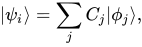
The projective nature of quantum-mechanical-state space causes some confusion, because a quantum mechanical state is a ray in projective Hilbert space, not a vector. According to Dirac: "if the ket vector corresponding to a state is multiplied by any complex number, not zero, the resulting ket vector will correspond to the same state [italics in original]."[6] However, the sum of two rays to compose a superpositioned ray is undefined. As a result, Dirac himself uses ket vector representations of states to decompose or split, for example, a ket vector into superposition of component ket vectors as: where the . The equivalence class of the allows a well-defined meaning to be given to the relative phases of the .,[7] but an absolute (same amount for all the ) phase change on the does not affect the equivalence class of the .

There are exact correspondences between the superposition presented in the main on this page and the quantum superposition. For example, the Bloch sphere to represent pure state of a two-level quantum mechanical system (qubit) is also known as the Poincaré sphere representing different types of classical pure polarization states.

Nevertheless, on the topic of quantum superposition, Kramers writes: "The principle of [quantum] superposition ... has no analogy in classical physics"[citation needed]. According to Dirac: "the superposition that occurs in quantum mechanics is of an essentially different nature from any occurring in the classical theory [italics in original]."[8] Though reasoning by Dirac includes atomicity of observation, which is valid, as for phase, they actually mean phase translation symmetry derived from time translation symmetry, which is also applicable to classical states, as shown above with classical polarization states.

Boundary-value problems

[edit]

A common type of boundary value problem is (to put it abstractly) finding a function y that satisfies some equation with some boundary specification For example, in Laplace's equation with Dirichlet boundary conditions, F would be the Laplacian operator in a region R, G would be an operator that restricts y to the boundary of R, and z would be the function that y is required to equal on the boundary of R.

In the case that F and G are both linear operators, then the superposition principle says that a superposition of solutions to the first equation is another solution to the first equation: while the boundary values superpose: Using these facts, if a list can be compiled of solutions to the first equation, then these solutions can be carefully put into a superposition such that it will satisfy the second equation. This is one common method of approaching boundary-value problems.


Additive state decomposition

[edit]

Consider a simple linear system:

By superposition principle, the system can be decomposed into with


Superposition principle is only available for linear systems. However, the additive state decomposition can be applied to both linear and nonlinear systems. Next, consider a nonlinear system where is a nonlinear function. By the additive state decomposition, the system can be additively decomposed into with

This decomposition can help to simplify controller design.

Other example applications

[edit]
  • In electrical engineering, in a linear circuit, the input (an applied time-varying voltage signal) is related to the output (a current or voltage anywhere in the circuit) by a linear transformation. Thus, a superposition (i.e., sum) of input signals will yield the superposition of the responses.
  • In physics, Maxwell's equations imply that the (possibly time-varying) distributions of charges and currents are related to the electric and magnetic fields by a linear transformation. Thus, the superposition principle can be used to simplify the computation of fields that arise from a given charge and current distribution. The principle also applies to other linear differential equations arising in physics, such as the heat equation.
  • In engineering, superposition is used to solve for beam and structure deflections of combined loads when the effects are linear (i.e., each load does not affect the results of the other loads, and the effect of each load does not significantly alter the geometry of the structural system).[9] Mode superposition method uses the natural frequencies and mode shapes to characterize the dynamic response of a linear structure.[10]
  • In hydrogeology, the superposition principle is applied to the drawdown of two or more water wells pumping in an ideal aquifer. This principle is used in the analytic element method to develop analytical elements capable of being combined in a single model.
  • In process control, the superposition principle is used in model predictive control.
  • The superposition principle can be applied when small deviations from a known solution to a nonlinear system are analyzed by linearization.

History

[edit]

According to Léon Brillouin, the principle of superposition was first stated by Daniel Bernoulli in 1753: "The general motion of a vibrating system is given by a superposition of its proper vibrations." The principle was rejected by Leonhard Euler and then by Joseph Lagrange. Bernoulli argued that any sonorous body could vibrate in a series of simple modes with a well-defined frequency of oscillation. As he had earlier indicated, these modes could be superposed to produce more complex vibrations. In his reaction to Bernoulli's memoirs, Euler praised his colleague for having best developed the physical part of the problem of vibrating strings, but denied the generality and superiority of the multi-modes solution.[11]

Later it became accepted, largely through the work of Joseph Fourier.[12]

See also

[edit]

References

[edit]

Further reading

[edit]
[edit]
Revisions and contributorsEdit on WikipediaRead on Wikipedia
from Grokipedia
The superposition principle is a foundational in physics that applies to linear systems, stating that the net response or effect produced by multiple simultaneous stimuli is equal to the sum of the individual responses that each stimulus would produce if acting alone./03%3A_Linear_Oscillators/3.03%3A_Linearity_and_Superposition) This principle stems from the mathematical properties of , including additivity (the response to a sum of inputs equals the sum of responses) and homogeneity (scaling the input scales the response proportionally). In , the superposition principle underpins numerous phenomena across , electromagnetism, and wave theory. For instance, in , the total at a point due to multiple point charges is the vector sum of the fields generated by each charge individually, enabling the analysis of complex charge distributions. Similarly, in wave , when two or more waves propagate through the same medium, they pass through each other undisturbed, and the resultant displacement at any point is the algebraic sum of the individual wave displacements, leading to interference patterns such as constructive and destructive interference. This extends to gravitational and other conservative fields, where potentials from multiple sources add scalarly. In , the superposition principle takes on a probabilistic interpretation, allowing a quantum system—such as an —to exist in a of multiple states simultaneously until measured, which collapses the superposition into a single outcome. This feature is essential for quantum interference, entanglement, and technologies like , where qubits leverage superpositions to perform parallel computations. The origins of the superposition principle trace back to the , with first proposing in 1753 that the general motion of a vibrating system, such as a , could be described as a superposition of its simpler normal modes or harmonic vibrations. This idea, initially applied to acoustics and , was later formalized in the development of partial differential equations and wave equations by figures like and Leonhard Euler, though it faced initial resistance. Over time, its validity was confirmed experimentally and mathematically, establishing it as a cornerstone of for both classical and quantum domains.

Fundamentals

Definition and Scope

The superposition principle is a fundamental property of linear systems that allows the prediction of responses to complex inputs by summing the individual responses to simpler component inputs. In essence, it enables the of intricate behaviors into manageable parts, facilitating and solution in mathematical and physical contexts. This principle underpins much of and by simplifying the study of systems where interactions do not produce emergent effects beyond simple addition. Formally, for a , the response to a sum of stimuli equals the sum of the responses to each individual stimulus, a property known as the superposition theorem. This holds provided the system satisfies homogeneity—where scaling an input by a constant scales the output by the same constant—and additivity—where the output to the sum of inputs is the sum of the individual outputs. These conditions ensure that the system's governing equations are linear, allowing solutions to be constructed as linear combinations. The principle applies specifically to such systems, as nonlinear systems violate these properties; for instance, in a nonlinear spring where depends quadratically on displacement, the combined response to multiple forces cannot be obtained by simply adding individual responses, leading to interactions like frequency mixing that superposition cannot capture. Examples of linear systems include the ideal spring-mass system, where displacement is proportional to applied via , and the undamped , governed by a that permits superposition of oscillatory modes. The scope of the superposition principle extends to time-invariant linear systems across diverse fields of physics, such as wave propagation, , and , where the underlying equations maintain their form over time. It is limited to scenarios where prevails, excluding time-varying coefficients or nonlinear interactions that would invalidate additivity and homogeneity. This universality stems from the principle's roots in linear operators, though detailed mathematical formulations lie beyond this overview.

Linearity and Prerequisites

The superposition principle applies exclusively to linear systems, where the response to a of is the same of the individual responses. This requires the system to satisfy two fundamental properties: homogeneity and additivity. Homogeneity states that if an input is scaled by a constant factor aa, the output scales by the same factor, i.e., L(af)=aL(f)L(af) = a L(f) for system operator LL and input ff. Additivity, also known as the superposition property for two inputs, asserts that the response to the sum of inputs equals the sum of the responses, i.e., L(f+g)=L(f)+L(g)L(f + g) = L(f) + L(g). Together, these ensure that for any scalars aa and bb, and inputs ff and gg, the system obeys L(af+bg)=aL(f)+bL(g)L(af + bg) = a L(f) + b L(g)./03%3A_Linear_Oscillators/3.03%3A_Linearity_and_Superposition) In mathematical terms, the linearity condition can be expressed as: L(af+bg)=aL(f)+bL(g)L(af + bg) = aL(f) + bL(g) where LL represents the linear operator governing the system, applicable to differential equations or transforms in physical contexts./03%3A_Linear_Oscillators/3.03%3A_Linearity_and_Superposition) Physical systems exhibit these prerequisites when operating within limits where responses are proportional, such as in for small displacements of a spring, F=kxF = -kx, where FF is linearly proportional to displacement xx via constant kk, enabling superposition of multiple forces or displacements. Time-invariance, where system behavior remains unchanged under time shifts, is a frequent companion property in many applications but is not strictly required for the superposition principle; linear time-varying systems can still satisfy homogeneity and additivity. Nonlinearity violates these conditions, preventing superposition; for instance, frictional forces often depend nonlinearly on or position, while large-amplitude oscillations in springs deviate from , generating harmonics that cannot be decomposed into linear sums of fundamental modes.

Mathematical Foundations

Linear Operators and Equations

In the context of vector spaces, a linear operator L:VVL: V \to V is a function that maps elements of the vector space VV to itself while preserving the operations of vector addition and scalar multiplication. Specifically, for any scalars a,ba, b in the underlying field and vectors u,vVu, v \in V, it satisfies L(au+bv)=aL(u)+bL(v)L(au + bv) = a L(u) + b L(v). This additivity and homogeneity ensure that the operator behaves linearly, forming the foundation for applications in analysis and physics where functions or signals are treated as vectors. The set of all such operators on VV itself constitutes a vector space under pointwise addition and scalar multiplication. Differential operators provide concrete examples of linear operators, particularly in the study of differential equations. For instance, the operator d2dx2+k2\frac{d^2}{dx^2} + k^2, where kk is a constant, acts on twice-differentiable functions and exemplifies because differentiation is a linear operation: d2dx2(au+bv)=ad2udx2+bd2vdx2\frac{d^2}{dx^2}(au + bv) = a \frac{d^2 u}{dx^2} + b \frac{d^2 v}{dx^2} and similarly for the by k2k^2. In partial differential equations (PDEs), extends to multivariable settings; the 2u+k2u=0\nabla^2 u + k^2 u = 0 and 2u=0\nabla^2 u = 0 are linear because their defining operators—such as the Laplacian 2\nabla^2—satisfy the linearity condition on appropriate function spaces. These operators map functions to functions, preserving linear combinations throughout. Key properties of linear operators include the kernel, , and eigenvalues, which aid in analyzing their behavior and verifying . The kernel, or null space, consists of all uVu \in V such that L(u)=0L(u) = 0, forming a subspace whose dimension indicates the operator's "degeneracy." The is the subspace spanned by L(u)L(u) for uVu \in V, representing the range of the operator. Eigenvalues λ\lambda and corresponding eigenvectors u0u \neq 0 satisfy L(u)=λuL(u) = \lambda u, providing information that decomposes the operator in finite-dimensional cases; these are absent in some infinite-dimensional settings but remain crucial for checks. For a general linear homogeneous PDE of the form L=0L = 0, where LL is a , the collection of all solutions uu constitutes a , as the linearity of LL implies that any of solutions is itself a solution. This structure directly enables the superposition principle, permitting the construction of general solutions from linear combinations of basis solutions within this solution space.

Superposition in Solutions

The superposition principle plays a central role in constructing solutions to linear differential equations by allowing the combination of known particular solutions to form more general ones. For homogeneous linear equations, governed by a linear operator LL such that L=0L = 0, the principle states that if u1u_1 and u2u_2 are solutions, then any linear combination c1u1+c2u2c_1 u_1 + c_2 u_2, where c1c_1 and c2c_2 are constants, is also a solution. This property arises directly from the linearity of the operator LL, which satisfies L[au+bv]=aL+bLL[au + bv] = a L + b L for scalars a,ba, b. To derive this, suppose L[u1]=0L[u_1] = 0 and L[u2]=0L[u_2] = 0. Then, for the combination u=c1u1+c2u2u = c_1 u_1 + c_2 u_2, L=L[c1u1+c2u2]=c1L[u1]+c2L[u2]=c10+c20=0,L = L[c_1 u_1 + c_2 u_2] = c_1 L[u_1] + c_2 L[u_2] = c_1 \cdot 0 + c_2 \cdot 0 = 0, confirming that uu satisfies the homogeneous . This extends to any finite number of independent solutions, forming the basis for the general solution u(x,t)=iciui(x,t)u(x,t) = \sum_i c_i u_i(x,t), where the uiu_i are linearly independent basis functions and the cic_i are arbitrary constants determined by or boundary conditions. Basis solutions are often found using methods such as , which assumes a product form for the solution and reduces the equation to ordinary differential equations. For a homogeneous linear () of order nn, the solution space is nn-dimensional. In contrast, for partial differential equations (PDEs), the solution space is typically infinite-dimensional, allowing superpositions of infinitely many independent solutions, often found using . For inhomogeneous equations of the form L=fL = f, where f0f \neq 0, the general solution is the superposition of the general homogeneous solution and a particular solution upu_p to the inhomogeneous equation: u=uh+upu = u_h + u_p, with L[uh]=0L[u_h] = 0 and L[up]=fL[u_p] = f. This decomposition leverages the same linearity, as L[uh+up]=L[uh]+L[up]=0+f=fL[u_h + u_p] = L[u_h] + L[u_p] = 0 + f = f.

Classical Applications

Wave Phenomena

The one-dimensional wave equation, 2yt2=c22yx2\frac{\partial^2 y}{\partial t^2} = c^2 \frac{\partial^2 y}{\partial x^2}, governs the propagation of small-amplitude waves along a or in other linear media, where y(x,t)y(x,t) represents the transverse displacement, cc is the wave speed, and the equation's ensures that superpositions of solutions remain solutions./14%3A_Waves/14.06%3A_Superposition_of_waves_and_interference) This arises because involves only first powers of the derivatives, allowing the principle of superposition to apply directly to wave disturbances in such systems. In linear media, the superposition principle states that the total wave displacement is the algebraic sum of the individual wave displacements, so if y1(x,t)y_1(x,t) and y2(x,t)y_2(x,t) are solutions to the wave equation, then y(x,t)=y1(x,t)+y2(x,t)y(x,t) = y_1(x,t) + y_2(x,t) is also a solution./14%3A_Waves/14.06%3A_Superposition_of_waves_and_interference) This addition can produce regions of constructive interference, where displacements reinforce each other to increase amplitude, or destructive interference, where they cancel to reduce or nullify amplitude. A key implication is that in linear media, waves propagate through one another without alteration, maintaining their original shapes and speeds after interaction, in contrast to the collisions of particles that exchange momentum or energy. Fundamental solutions to the wave equation include plane waves, which represent wavefronts of constant phase extending infinitely in planes perpendicular to the direction of propagation, and spherical waves, which emanate outward from a with wavefronts as expanding spheres./01%3A_Reviewing_Elementary_Stuff/1.03%3A_Wave_Equations_Wavepackets_and_Superposition) These serve as basis functions for constructing more complex wave fields via superposition, as any solution in unbounded linear media can be expressed as an integral combination of such waves. A illustrative example of superposition occurs when two sinusoidal waves of identical frequency and amplitude propagate in opposite directions along the same medium, such as on a stretched fixed at both ends. Their interference results in a pattern, characterized by stationary nodes (points of zero displacement) and antinodes (points of maximum displacement), where the wave appears to oscillate in place without net propagation. The Huygens-Fresnel principle extends superposition to wave propagation and by positing that every point on a acts as a source of secondary spherical wavelets, with the subsequent formed by the coherent superposition of these wavelets, accounting for and phase contributions.

Interference and Diffraction

Interference arises directly from the superposition principle when waves from multiple coherent sources overlap, resulting in regions of constructive and destructive interference that produce characteristic maxima and minima in intensity. In classical wave , this is exemplified by Young's double-slit experiment, where monochromatic passing through two closely spaced slits creates an interference pattern on a distant screen due to the phase-dependent addition of the from each slit. The resulting intensity at a point on the screen is given by I=4I0cos2(δ/2)I = 4 I_0 \cos^2(\delta/2), where I0I_0 is the intensity from a single slit and δ\delta is the phase difference between the waves from the two slits, leading to bright fringes where δ=2mπ\delta = 2m\pi (m ) and dark fringes where δ=(2m+1)π\delta = (2m+1)\pi. This pattern confirms the wave nature of and relies on the of the wave equation, allowing the total field to be the vector sum of individual contributions. Diffraction, in contrast, manifests as the bending and spreading of waves around obstacles or through apertures, also governed by superposition but through the Huygens-Fresnel principle, which posits that every point on a wavefront acts as a source of secondary spherical wavelets whose superposition determines the subsequent wavefront. For a single slit, the diffraction pattern in the near field (Fresnel diffraction) is calculated by integrating these wavelets, often involving Fresnel integrals to account for the phase variations across the aperture, producing a central bright region flanked by alternating intensity minima. Unlike interference from discrete sources, diffraction treats the aperture as a continuous distribution of secondary sources, enabling wave propagation into geometric shadows and highlighting the role of wavelength relative to obstacle size. This phenomenon further validates the wave model, as the angular spread of the diffraction pattern scales inversely with the slit width. The key distinction between interference and lies in their physical setups: interference typically requires a small number of coherent point-like sources, such as slits acting as secondary sources, to produce localized fringes, whereas involves the collective superposition from an extended or edge, resulting in broader spreading without needing multiple discrete origins. Both phenomena underscore the wave nature of propagation—interference probing temporal and spatial coherence between sources, and revealing how waves deviate from ray-like paths when the obstacle scale approaches the —but they are not mutually exclusive, as often underlies the coherence in multi-slit interference setups. However, the superposition principle holds only for linear media; in intense fields, nonlinear effects cause departures from , invalidating simple wave addition. For acoustic or hydrodynamic waves, nonlinearity leads to formation, where finite-amplitude distortions steepen wavefronts into discontinuities, as the wave speed depends on , preventing the preservation of initial waveform shapes under superposition. In , the Kerr effect introduces intensity-dependent refractive index changes, modeled by the permittivity ϵ=ϵ0(1+χ(1)+χ(3)E2)\epsilon = \epsilon_0 (1 + \chi^{(1)} + \chi^{(3)} |E|^2), where the cubic term χ(3)E2\chi^{(3)} |E|^2 couples wave amplitudes, causing and filamentation that violate the linear superposition principle. These nonlinear regimes, observed in high-power lasers or supersonic flows, highlight the limits of the principle in real-world applications.

Boundary Value Problems

In boundary value problems (BVPs), the superposition principle is applied to solve linear differential equations of the form L=fL = f, where LL is a linear , uu is the unknown function, and ff represents a source term, subject to specified boundary conditions such as Dirichlet conditions where u=0u = 0 on the domain boundary. These problems arise in fields like and acoustics, where the boundaries impose constraints that discretize the solution space. The method relies on eigenfunction expansion, where the solution is expressed as a superposition u(x)=n=1anϕn(x)u(x) = \sum_{n=1}^{\infty} a_n \phi_n(x), with {ϕn}\{\phi_n\} forming a complete set of eigenfunctions satisfying the homogeneous eigenvalue problem L[ϕn]=λnϕnL[\phi_n] = \lambda_n \phi_n under the same boundary conditions. The coefficients ana_n are determined by projecting ff onto the eigenfunctions using their , ensuring the expansion satisfies both the and the boundaries. This approach leverages the linearity of LL, allowing arbitrary linear combinations of eigen-solutions to remain solutions. A representative example is solving 2ϕ=ρ/ϵ0\nabla^2 \phi = -\rho / \epsilon_0 for the electrostatic potential ϕ\phi inside a rectangular box with Dirichlet boundary conditions ϕ=0\phi = 0 on the walls, where ρ\rho is the . The eigenfunctions are products of sine functions in each dimension, such as ϕmn(x,y)=sin(mπx/a)sin(nπy/b)\phi_{mn}(x,y) = \sin(m\pi x / a) \sin(n\pi y / b), corresponding to eigenvalues λmn=π2(m2/a2+n2/b2)\lambda_{mn} = -\pi^2 (m^2 / a^2 + n^2 / b^2); the solution is then the superposition ϕ(x,y)=m,n=1amnsin(mπx/a)sin(nπy/b)\phi(x,y) = \sum_{m,n=1}^{\infty} a_{mn} \sin(m\pi x / a) \sin(n\pi y / b), with amna_{mn} computed from the Fourier coefficients of ρ\rho. This sine series expansion directly incorporates the boundary conditions, as each term vanishes on the boundaries. The boundary conditions quantize the modes into a discrete of eigenvalues {λn}\{\lambda_n\}, enabling the complete expansion; superposition then guarantees that the infinite sum satisfies the original nonhomogeneous equation while adhering to the boundaries. In steady-state conduction, for instance, 2T=Q/k\nabla^2 T = -Q / k (with TT as temperature, QQ as source, and kk as thermal conductivity) in a domain with fixed boundary temperatures is solved similarly using superpositions of the Laplacian operator. For vibrating membranes, normal modes derived from the eigenvalue problem for the wave operator under fixed-edge boundaries are superposed to represent the steady spatial configuration, with the eigenfunctions ensuring compatibility with the constraints. The coefficients in these expansions often involve integrals, as detailed in related analytical tools.

Quantum Applications

Superposition of States

In , the superposition principle manifests through the representation of a as a of basis states within a . A general quantum state ψ|\psi\rangle can be expressed as ψ=iciϕi|\psi\rangle = \sum_i c_i |\phi_i\rangle, where the ϕi|\phi_i\rangle form an and the complex coefficients cic_i satisfy the normalization condition ici2=1\sum_i |c_i|^2 = 1, ensuring the total probability is unity. This formulation, introduced by , underscores that any such superposition constitutes a valid quantum state, reflecting the linear structure of the theory. The time evolution of quantum states, governed by the Schrödinger equation iψt=Hψi\hbar \frac{\partial |\psi\rangle}{\partial t} = H |\psi\rangle, where HH is the linear Hamiltonian operator, preserves superpositions. If initial states ϕi|\phi_i\rangle evolve independently under this equation, the coefficients ci(t)c_i(t) evolve such that the overall state remains a linear combination, maintaining the principle throughout the dynamics. This linearity ensures that superpositions do not decohere under unitary evolution alone, allowing quantum systems to exhibit coherent behavior over time. A illustrative example is the superposition of spin states for a particle, such as an , where the state can be written as ψ=α++β|\psi\rangle = \alpha |+\rangle + \beta |-\rangle, with α2+β2=1|\alpha|^2 + |\beta|^2 = 1 and +|+\rangle, |-\rangle denoting spin-up and spin-down along a given axis. Here, the particle does not possess a definite spin until measured, embodying the superposition. Unlike classical wave superpositions, where interference occurs directly in the observable amplitudes leading to intensity patterns, quantum superpositions interfere at the level of probability amplitudes, resulting in observable interference effects in the probabilities derived from ϕiψ2|\langle \phi_i | \psi \rangle|^2. Dirac's seminal formulation in the 1930s emphasized the linearity inherent in quantum superposition, distinguishing it as a cornerstone of the theory's mathematical framework.

Measurement and Collapse

In , the superposition principle implies that a system can exist in a of multiple states simultaneously until a is performed. Upon of an , the wave function collapses instantaneously to one of the eigenstates of that , destroying the superposition and yielding a definite outcome. This collapse postulate, formalized by , projects the onto the corresponding eigenspace, with the process being non-unitary and irreversible within the standard formalism. The probability of obtaining a particular outcome ϕi|\phi_i\rangle from an initial superposition ψ=iciϕi|\psi\rangle = \sum_i c_i |\phi_i\rangle is given by the , Pi=ci2P_i = |c_i|^2, where cic_i are the complex coefficients ensuring normalization ici2=1\sum_i |c_i|^2 = 1. This probabilistic interpretation, introduced by in the context of scattering processes, resolves the apparent indeterminism of quantum superpositions by linking amplitudes to measurable frequencies. A classic demonstration of superposition and its occurs in the Stern-Gerlach experiment, where silver atoms in a superposition of spin states along the z-direction pass through an inhomogeneous , resulting in discrete deflections corresponding to spin up or down outcomes. Prior to , the atoms are in a superposition of both paths, but detection collapses the state to a single trajectory, revealing the quantized nature of spin without classical pre-existing values. In modern interpretations, the collapse is often understood through , where interactions with the environment—such as scattering of photons or phonons—rapidly suppress superpositions by entangling the system with many , leading to an apparent classical outcome without invoking a fundamental projection postulate. This process, developed in the and beyond, explains why macroscopic systems rarely exhibit superpositions, as environmental decoherence times scale inversely with system size. Superpositions are inherently fragile, persisting only in isolated systems; in practice, the classical appearance of definite states emerges from entanglement across many particles, where decoherence selects robust "pointer states" that align with everyday observations. Unlike classical waves, where interference persists indefinitely without collapse, quantum superpositions lack definite trajectories prior to measurement, embodying Niels Bohr's complementarity principle: wave-like and particle-like aspects are mutually exclusive in any single experimental context.

Analytical Tools and Extensions

Fourier Analysis Connections

The superposition principle is central to , enabling the decomposition of functions into sums of simpler components that are eigenfunctions of linear differential operators. For periodic functions on a finite interval, the expansion expresses a function f(x)f(x) as an infinite sum of sines and cosines: f(x)=a02+n=1(ancos(nx)+bnsin(nx)),f(x) = \frac{a_0}{2} + \sum_{n=1}^\infty \left( a_n \cos(nx) + b_n \sin(nx) \right), where the coefficients ana_n and bnb_n are determined by integrals involving f(x)f(x). These basis functions, sin(nx)\sin(nx) and cos(nx)\cos(nx), are eigenfunctions of the second derivative operator d2/dx2d^2/dx^2 with eigenvalues n2-n^2, subject to . The linearity of the operator ensures that superpositions of these eigenfunctions remain solutions to the associated , allowing complex waveforms to be built from fundamental modes. For functions defined on infinite domains, the Fourier transform provides a continuous analog, representing f(x)f(x) as an integral superposition of complex exponentials: f^(k)=f(x)eikxdx,\hat{f}(k) = \int_{-\infty}^\infty f(x) e^{-i k x} \, dx, with the inverse transform recovering f(x)f(x) via f(x)=12πf^(k)eikxdk.f(x) = \frac{1}{2\pi} \int_{-\infty}^\infty \hat{f}(k) e^{i k x} \, dk. This formulation arises from the eigenfunctions eikxe^{i k x} of the second derivative operator on the real line. The linearity of the transform preserves the superposition principle, permitting term-by-term operations such as differentiation, which corresponds to multiplication by iki k in the frequency domain, and integration, which aligns with division by iki k. This property simplifies solving linear partial differential equations by converting them into algebraic problems in the transform domain. A key application of these connections is in solving the one-dimensional 2u/t2=c22u/x2\partial^2 u / \partial t^2 = c^2 \partial^2 u / \partial x^2. yields solutions as products of spatial Fourier modes eikxe^{i k x} and time-dependent factors e±ickte^{\pm i c k t}, each propagating independently at speed cc. The general solution is then a superposition of these modes, weighted by the Fourier coefficients of the initial conditions, ensuring the principle holds for arbitrary initial displacements and velocities. Parseval's theorem further underscores the role of superposition in conserving quantities like . For a function and its , it states f(x)2dx=12πf^(k)2dk,\int_{-\infty}^\infty |f(x)|^2 \, dx = \frac{1}{2\pi} \int_{-\infty}^\infty |\hat{f}(k)|^2 \, dk, demonstrating that the total distributed across the spatial domain equals that in the , as the modes do not exchange under linear . As an extension for initial value problems, particularly those involving damping or causality, the builds on Fourier methods by integrating over este^{-s t} with complex s=σ+iωs = \sigma + i \omega, incorporating initial conditions directly into the coefficients. This allows superposition of exponential solutions to linear ordinary differential equations, analogous to Fourier decompositions but suited to unilateral time domains.

Additive Decomposition Methods

Additive decomposition methods extend the superposition principle by expressing solutions to linear systems as sums of independent components obtained through diagonalization of the underlying linear operator, allowing complex problems to be broken into simpler, solvable parts. This approach is foundational in linear algebra and applies to differential equations governing physical systems, where the operator (e.g., a ) is transformed into a diagonal form via eigenvectors, enabling the superposition of eigen-solutions. In modal decomposition, the displacement vector x(t)\mathbf{x}(t) of a system of coupled linear oscillators is expressed as a superposition of normal modes: x(t)=nvnqn(t)\mathbf{x}(t) = \sum_n \mathbf{v}_n q_n(t), where vn\mathbf{v}_n are the eigenvectors (mode shapes) and qn(t)q_n(t) are the corresponding modal coordinates evolving independently as simple harmonic oscillators. This method, rooted in the work of Lord Rayleigh on sound theory, simplifies analysis of multi-degree-of-freedom systems like vibrating structures by decoupling the through the mass and stiffness matrices' eigendecomposition. Other integral transforms facilitate additive decompositions for specific geometries or domains. The decomposes radially symmetric functions into bases, aiding solutions to axisymmetric problems such as wave propagation in cylindrical coordinates, where the transform pairs enable superposition of radial modes. Similarly, the applies to discrete-time linear systems, converting difference equations into algebraic forms for superposition of pole-zero responses, essential for analyzing digital filters and control systems. A practical application appears in electrical circuit analysis, where the superposition theorem decomposes the response to multiple sources by considering each independently and summing the results, often combined with to replace networks with equivalent voltage sources and impedances for DC/AC separation. This relies on the linearity of and Kirchhoff's laws, allowing efficient simplification of complex circuits. In , additive decomposition underpins filtering by representing signals as superpositions of components, processed independently via linear time-invariant systems to isolate desired bands while attenuating . This principle, as detailed in foundational texts, ensures that the output of a filter is the sum of responses to each input component, enabling techniques like bandpass filtering. Modern extensions include sparse decompositions in data analysis, particularly post-2000, where signals are represented as superpositions of few atoms, allowing recovery from undersampled measurements via optimization under sparsity constraints. Seminal work by Candès and demonstrated that such decompositions preserve information efficiently, impacting fields like and communications.

Historical Development

Early Concepts

The principle of superposition emerged in the context of 17th- and 18th-century scientific debates over the nature of wave propagation, particularly during the transition from the dominant , championed by , to an emerging wave theory that better explained phenomena like and interference. This shift gained momentum in the early as experimental evidence supported wave-like behavior, laying groundwork for superposition as a key conceptual tool in both mechanics and . In , early applications of superposition appeared in solutions to the for vibrating strings. derived the one-dimensional in 1747, providing a general solution that implicitly relied on the combination of traveling waves to describe the string's motion. Building on this, argued in 1753 that the general motion of a vibrating string could be expressed as a superposition of simple harmonic modes, or sine series, resolving complex vibrations into fundamental components—a precursor to later analytical methods. This proposal sparked a debate with d'Alembert and Euler, who questioned the admissibility of such superpositions for arbitrary initial conditions, but it foreshadowed modern decomposition techniques. In optics, Christiaan Huygens introduced his principle in 1678, positing that every point on a acts as a source of secondary spherical wavelets, whose envelope forms the new ; this framework, later extended by incorporating superposition of wavelets, accounted for patterns, challenging the particle model of light. Thomas Young provided experimental validation in 1801 through his , demonstrating interference fringes as the result of wave superposition from two coherent light sources, offering compelling evidence for light's wave nature. Augustin-Jean Fresnel advanced this mathematically in 1818 by developing an integral formulation for , where the disturbance at a point is the superposition of contributions from all secondary wavelets across the , enabling precise predictions of near-field patterns. These ideas in and prefigured more formal decompositions, such as those later explored by Fourier.

Modern Formulations

In 1926, introduced the wave equation for , whose linearity directly implies the superposition principle for wave functions describing quantum states. This formulation established that any of solutions to the equation remains a valid solution, providing the foundational mathematical structure for . During 1928–1930, developed the transformation theory of , formalizing superposition within infinite-dimensional Hilbert spaces and introducing the bra-ket notation in subsequent works to represent quantum states as vectors amenable to linear combinations. Dirac's approach emphasized the principle of superposition as a core postulate, enabling the description of quantum states as abstract linear superpositions independent of specific representations. In 1932, provided mathematical rigor to these ideas in his treatment of quantum observables as linear operators on , ensuring that expectation values and measurements respect the linearity inherent in superposition. Von Neumann's framework solidified the operator algebra underlying , where superpositions correspond to vectors in the space, and observables act linearly upon them. Following the 1950s, the superposition principle was extended to , where particle states are represented as linear combinations in , facilitating descriptions of particle creation and through field excitations. This generalization maintains the linearity of the theory, allowing superpositions of multi-particle configurations that underpin phenomena like vacuum fluctuations. In the 1990s and beyond, superposition gained prominence in , where it enables qubits to exist as linear combinations of basis states, exponentially enhancing computational parallelism as envisioned by in 1982 and formalized by in 1985. Decoherence models, developed by Wojciech Zurek from the 1980s through the 2000s, address how environmental interactions suppress superpositions, selecting preferred classical-like states via einselection while preserving the underlying linear structure. Although the superposition principle remains fundamentally unchanged, its application in open quantum systems—where interactions with environments introduce —challenges classical assumptions of strict by necessitating frameworks like the Lindblad to model effective non-unitary evolution. These developments highlight ongoing refinements in handling decoherence without altering the principle's core linear foundation.

References

Add your contribution
Related Hubs
User Avatar
No comments yet.