


Community hub
Recent from talks
Contribute something
Nothing was collected or created yet.
Iron Cross
View on Wikipedia | This article needs additional citations for verification. (January 2023) |

The Iron Cross (German: Eisernes Kreuz, ⓘ, abbreviated EK) was a military decoration in the Kingdom of Prussia, the German Empire (1871–1918), and Nazi Germany (1933–1945). The design, a black cross pattée with a white or silver outline, was derived from the insignia of the medieval Teutonic Order and borne by its knights from the 13th century. As well as being a military medal, it has also been used as an emblem by the Prussian Army, the Imperial German Army, and the Reichswehr of the Weimar Republic, while the Balkenkreuz (bar cross) variant was used by the Wehrmacht. The Iron Cross is now the emblem of the Bundeswehr, the modern German armed forces.


King Frederick William III of Prussia established the Iron Cross award on 17 March 1813 during the Napoleonic Wars (EK 1813). The award was backdated to the birthday (10 March) of his late wife, Queen Louise, who was the first person to receive it (posthumously). The Iron Cross was also awarded during the Franco-Prussian War (EK 1870), World War I (EK 1914), and World War II (EK 1939). During World War II, the Nazi regime made their own version by superimposing a swastika on the medal. The Iron Cross was usually a military decoration only, though some were awarded to civilians for performing military roles, including Hanna Reitsch and Melitta Schenk Gräfin von Stauffenberg for being civilian test pilots during World War II.
Since the late 20th century, the symbol has also been adopted into the outlaw motorcycle subculture and heavy metal fashion.
Black Cross emblem
[edit].svg)
The Black Cross (Schwarzes Kreuz) is the emblem used by the Prussian Army and Germany's army from 1871 to the present. It was designed on the occasion of the German Campaign of 1813, when Friedrich Wilhelm III of Prussia commissioned the Iron Cross as the first military decoration open to all ranks, including enlisted men. From this time, the Black Cross was featured on the Prussian war flag alongside the Black Eagle. It was designed by neoclassical architect Karl Friedrich Schinkel, based on Friedrich Wilhelm III.[citation needed] The design is ultimately derivative of the black cross used by the Teutonic Order.[citation needed] This heraldic cross took various forms throughout the order's history, including a Latin cross, a cross potent, cross fleury, and occasionally also a cross pattée.
When the Quadriga of the Goddess of Peace was retrieved from Paris at Napoleon's fall, it was re-established atop Berlin's Brandenburg Gate. An Iron Cross was inserted into Peace's laurel wreath, making her into a Goddess of Victory. In 1821 Schinkel crowned the top of his design of the National Monument for the Liberation Wars with an Iron Cross, becoming name-giving as Kreuzberg (cross mountain) for the hill it stands on and, 100 years later, for the homonymous quarter adjacent to it.[1]
The Black Cross was used on the naval and combat flags of the German Empire. The Black Cross was used as the German Army symbol until 1915 when a simpler Balkenkreuz replaced it. The Reichswehr of the Weimar Republic (1921–35), the Wehrmacht of Nazi Germany (1935–45), and the Bundeswehr (1 October 1956 to present) also inherited the use of the emblem in various forms. The traditional design in black is used on armored vehicles and aircraft, while after German reunification, a new creation in blue and silver was introduced for use in other contexts.
Medal and ribbon design
[edit]
|
The ribbon for the 1813, 1870 and 1914 Iron Cross (2nd Class) was black with two thin white bands, the colors of Prussia. The non-combatant version of this award had the same medal, but the black and white colors on the ribbon were reversed. The ribbon color for the 1939 EKII was black/white/red/white/black.
Since the Iron Cross was issued over several different periods of German history, it was annotated with the year indicating the era in which it was issued. For example, an Iron Cross from World War I bears the year "1914", while the same decoration from World War II is annotated "1939". The reverse of the 1870, 1914 and 1939 series of Iron Crosses have the year "1813" appearing on the lower arm, symbolizing the year the award was created. The 1813 decoration also has the initials "FW" for King Friedrich Wilhelm III, while the next two have a "W" for the respective kaisers, Wilhelm I and Wilhelm II. The final version shows a swastika representing the Nazi Party instead of a letter for a German monarch. There was also the "1957" issue, a replacement medal for holders of the 1939 series which substituted an oak-leaf cluster for the banned swastika.
When the Iron Cross was reauthorized for World War I in 1914, it was possible for individuals who had previously been awarded one in 1870 to be subsequently granted another. These recipients were recognized with the award of a clasp featuring a miniaturized 1914 Iron Cross on a metal bar.[2] The award was quite rare, since by this time there were few in service who held the 1870 Iron Cross. In World War II it was also possible for a holder of the 1914 Iron Cross to be awarded a second or higher grade of the 1939 Iron Cross. In such cases, a "1939 Clasp" (Spange) would be worn on the original 1914 Iron Cross. For the 1st Class award, the Spange appears as an eagle with the date "1939". This was pinned to the uniform above the original medal. Although they were two separate awards in some cases the holders soldered them together.
A cross has been the symbol of Germany's armed forces (now the Bundeswehr) since 1871.
Wars of Liberation
[edit]On 17 March 1813 King Frederick William III of Prussia, who had fled to non-occupied Breslau (today Wrocław), established the military decoration of the Iron Cross, backdated to 10 March (the late Queen Louise's birthday).[3] The Iron Cross was awarded to soldiers during the Wars of Liberation against Napoleon. Before a soldier could be awarded with the Iron Cross 1st Class, he needed to have been decorated with the Iron Cross 2nd Class.[4] It was first awarded to Karl August Ferdinand von Borcke on 21 April 1813.[5] The first form of the Iron Crosses 1st Class were stitched in ribbon to the left uniform breast. By order of 1 June 1813, the 2nd form was created in cast iron with silver borders, and 8 loops on the reverse, to be fixed to the left uniform breast. In 1817 a total of 670 chevaliers had received the Iron Cross 1st Class.[6]
-
 King Frederick William III of Prussia, creator of the award
 -
 1813 Iron Cross
 -
 Field Marshal Blücher wearing the 1813 Grand Cross of the Iron Cross (around his neck), and the Star (on his chest)
.jpg)
.svg)
.jpg)
Franco-Prussian War
[edit]King Wilhelm I of Prussia authorized further awards on 19 July 1870, during the Franco-Prussian War. Recipients of the 1870 Iron Cross who were still in service in 1895 were authorized to purchase and wear above the cross a Jubiläumsspange ("Jubilee clip"), a 25-year clasp consisting of the numerals "25" on three oak leaves.[2]
William Manley is possibly the only recipient of both the Iron Cross and the Victoria Cross. He was awarded the Iron Cross for service with an ambulance unit in the Franco-Prussian War of 1870–71.[7]
World War I
[edit].svg)
Emperor Wilhelm II reauthorized the Iron Cross on 5 August 1914, at the start of World War I. During these three periods, the Iron Cross was an award of the Kingdom of Prussia, although—given Prussia's pre-eminent place in the German Empire formed in 1871—it tended to be treated as a generic German decoration. The 1813, 1870, and 1914 Iron Crosses had three grades:
- Iron Cross, 2nd class, (Eisernes Kreuz 2. Klasse, or EKII)
- Iron Cross, 1st class, (Eisernes Kreuz 1. Klasse, or EKI)
- Grand Cross of the Iron Cross (Großkreuz des Eisernen Kreuzes, often simply Großkreuz)
Although the obverse of the medals of each class was identical, the manner in which each was worn differed. The Iron Cross, 1st class, employed a pin or screw posts on the back of the medal, and was worn on the left side of the recipient's uniform, like the original 1813 version. The Iron Cross 2nd Class, and the larger Grand Cross, were suspended from different ribbons: the Grand Cross from a neck ribbon, the 2nd Class from a ribbon on the chest. The usual display of the 2nd Class version was as a ribbon through one of the button holes in the recipient's tunic.
The Grand Cross was intended for senior generals of the Prussian or (later) the German Army. An even higher decoration, the Star of the Grand Cross of the Iron Cross (also called the Blücher Star), was awarded only twice, to Generalfeldmarschall Gebhard Leberecht von Blücher in 1813 and to Generalfeldmarschall Paul von Hindenburg in 1918. A third award was planned for the most successful German general during World War II, but was not made after the defeat of Germany in 1945.
The Iron Cross, 1st class, and the Iron Cross, 2nd class, were awarded without regard to rank. One had to possess the 2nd Class already in order to receive the 1st Class (though in some cases both could be awarded simultaneously). The egalitarian nature of this award contrasted with those of most other German states (and indeed of many other European monarchies), where military decorations were awarded based on the rank of the recipient. For example, Bavarian officers received various grades of that Kingdom's Military Merit Order (Militär-Verdienstorden), while enlisted men received various grades of the Military Merit Cross (Militär-Verdienstkreuz). Prussia did have other orders and medals which it awarded on the basis of rank, and even though the Iron Cross was intended to be awarded without regard to rank, officers and NCOs were more likely to receive it than junior enlisted soldiers.
During World War I, approximately 218,000 EKIs, 5,196,000 EKIIs and 13,000 non-combatant EKIIs were awarded.[8] Exact numbers of awards are not known, since the Prussian military archives were destroyed during World War II. The multitude of awards reduced the status and reputation of the decoration. Among the holders of the 1914 Iron Cross, 2nd class, and 1st Class was Adolf Hitler, who served as an Austrian citizen in the Bavarian Army with the rank of Gefreiter (lance-corporal), he received these medals for showing bravery on the field of battle.[9] Most photographs of Hitler show him wearing his EKI in standard fashion on his left breast.
-
 World War I Iron Cross, 1st Class
 -
 Certificate of award to a musketeer in the Royal Prussian Landwehr, October 1918
 -
 German soldiers who had been awarded the Iron Cross


Allied Propaganda versions
[edit] |
In 1914, a variety of very crude anti-German propaganda versions of the Iron Cross were created by the Allies, and sold to raise money for the war effort and the relief of Belgian refugees. One was inscribed "FOR KULTUR" in raised letters, another "FOR BRUTALITY." Yet another showed the names of French and Belgian towns attacked or destroyed during the retreat from Mons on the ends of the upper arms of the cross; these included Rheims, Louvain and Amiens on one side, and Antwerp, Dinant and Ghent on the other, with the date 1914 on the lower arm, and a central W for Kaiser Wilhelm as on the original. Another commemorated the raid on Scarborough, Hartlepool and Whitby, showing the names of these "war atrocities" on the arms of the cross.
World War II
[edit].svg)

Adolf Hitler restored the Iron Cross in 1939 as a German decoration (rather than Prussian), and continued the tradition of issuing it in various classes. Legally, it is based on the "Enactment for the re-introduction of the Iron Cross" (Verordnung über die Erneuerung des Eisernen Kreuzes) of 1 September 1939.[10] The Iron Cross of World War II was divided into three main series of decorations: the Iron Cross (the lowest), the Knight's Cross (intermediate), and the Grand Cross (the highest). The Knight's Cross replaced the Prussian Pour le Mérite or "Blue Max". Hitler did not care for the Pour le Mérite, as it was a Prussian order that could be awarded only to officers. The ribbon of the medal (2nd class and Knight's Cross) was different from the earlier Iron Crosses as the color red was used in addition to the traditional black and white (black and white were the colors of Prussia, while black, white, and red were the colors of Nazi Germany). Hitler also created the War Merit Cross as a replacement for the non-combatant version of the Iron Cross. It also appeared on certain Nazi flags in the upper left corner. The sides of the cross were curved, like most original iron crosses.
Iron Cross (1939)
[edit]The standard 1939 Iron Cross was issued in the following two grades:
- Iron Cross, 2nd class, (Eisernes Kreuz 2. Klasse – abbreviated as EK II or E.K.II.)
- Iron Cross, 1st class, (Eisernes Kreuz 1. Klasse – abbreviated as EK I or E.K.I.)
The Iron Cross was awarded for bravery in battle as well as other military contributions in a battlefield environment.
The Iron Cross, 2nd class, came with a ribbon and the cross itself was worn in one of two different ways:
- From the second button in the tunic from the first day after award.
- When in formal dress, the entire cross was worn mounted alone or as part of a medal bar.
Note that for everyday wear, only the ribbon was worn from the second buttonhole in the tunic.
The Iron Cross, 1st class, was a pin-on medal with no ribbon and was worn centered on a uniform breast pocket, either on dress uniforms or everyday outfit. It was a progressive award, with the second class having to be earned before the first class and so on for the higher degrees.
It is estimated that some four and a half million 2nd Class Iron Crosses were awarded during World War II, and 300,000 of the 1st Class.[11]
Thirty-nine women, chiefly nurses from the German Red Cross, were awarded the Iron Cross 2nd Class. Examples include: Elfriede Wnuk, wounded in 1942 on the Eastern Front, Magda Darchniger, decorated in 1942, Marga Droste, who remained at her post in the Wilhelmshaven hospital despite her own wounds during a bombing in 1942, Ilse Schulz and Grete Fock, who served in the African campaign, Liselotte Hensel and Miss Holzmann, who were both decorated in 1943 for bravery during a bombing of Hamburg, and the countess Melitta Schenk Gräfin von Stauffenberg, acting as a qualified test pilot and development engineer and decorated in August 1943. Other DRK female auxiliaries who received the Iron Cross for acts of bravery are Hanny Weber, Geolinde Münchge, Elfriede Gunia, Ruth Raabe, Ilse Daub, Greta Graffenkamp, Elfriede Muth, Ursula Kogel, Liselotte Schlotterbeck, Rohna von Ceuern, Anna Wohlschütz, and Dr. Elizabeth Potuz. Two non-German female auxiliaries of the German Red Cross were awarded the Iron Cross: Norwegian nurse Anne Gunhild Moxnes in April 1944, and an unknown Belgian nurse in 1942. A young member of the female youth organisation of the Third Reich, Ottilie Stephan, was also awarded the Iron Cross in February 1945 under unknown circumstances. At least two Iron Cross, 1st class, recipients were women, test pilot (Flugkapitän) Hanna Reitsch and in January 1945 German Red Cross sister Else Grossmann.[12]
One of the Muslim SS members to receive the award, SS Obersturmführer Imam Halim Malkoč was granted the Iron Cross (2nd Class) in October 1943 for his role in suppressing the Villefranche-de-Rouergue mutiny. He, together with several other Bosnian Muslims, was decorated with the EK II personally by Himmler in the days after the mutiny. Because of his Muslim faith, he wore only the ribbon, and not the cross. Three Finnish Jews were awarded the Iron Cross: Major Leo Skurnik and Captain Salomon Klass of the Finnish Army and nurse Dina Poljakoff from the Lotta Svärd organization. All three refused the award.[13] The Spanish double-agent Juan Pujol García, known to the Germans as Arabel and the British as Garbo received the 2nd Class Iron Cross,[14] and an MBE from King George VI four months later.[15]
Knight's Cross of the Iron Cross
[edit].jpg)
The Knight's Cross of the Iron Cross (Ritterkreuz des Eisernen Kreuzes, often simply Ritterkreuz) recognized military valour or successful leadership. The Knight's Cross was divided into five degrees:
- Knight's Cross (Ritterkreuz des Eisernen Kreuzes)
- Knight's Cross with Oak Leaves (mit Eichenlaub)
- Knight's Cross with Oak Leaves and Swords (mit Eichenlaub und Schwertern)
- Knight's Cross with Oak Leaves, Swords, and Diamonds (mit Eichenlaub, Schwertern und Brillanten)
- Knight's Cross with Golden Oak Leaves, Swords, and Diamonds (mit Goldenem Eichenlaub, Schwertern und Brillanten)
In total, 7,313 awards of the Knight's Cross were made. Only 883 received the Oak Leaves; 160 with Oak Leaves and Swords (including Japanese Admiral Isoroku Yamamoto (posthumously)); 27 with Oak Leaves, Swords and Diamonds; and one with the Golden Oak Leaves, Swords, and Diamonds (Oberst Hans-Ulrich Rudel).
Grand Cross of the Iron Cross (1939)
[edit]Like the Knight's Cross, the Grand Cross (Großkreuz) was worn suspended from the collar. It was reserved for general officers for "the most outstanding strategic decisions affecting the course of the war". The only recipient during the Second World War was Reichsmarschall Hermann Göring, who was awarded the decoration on 19 July 1940 for his command of the Luftwaffe, after the Battle of France in 1940.[16]
The medal is a larger version of the Knight's Cross,[17] measuring 63 mm (2.5 in) wide as opposed to about 44 mm (1.7 in) for the Iron Cross and 48.5 mm (1.9 in) for the Knight's Cross. It was originally intended to have outer edges lined in gold, but this was changed to silver before the award was presented.[citation needed] It was worn with a 57 mm (2.2 in) wide ribbon bearing the same colors as the Knight's Cross and 2nd Class ribbons.[16] The award case was in red leather with the eagle and the swastika outlined in gold.
The original Grand Cross presented to Göring (personally by Hitler) was destroyed during an air raid on his Berlin home. Göring had extra copies made, one of them with a platinum frame that he was wearing at the time of his surrender to the allies in 1945.[16]
Star of the Grand Cross of the Iron Cross
[edit]
The Star of the Grand Cross of the Iron Cross (also called Iron Cross with Golden Rays) was pinned to the left breast, above the Iron Cross 1st Class. Like the Grand Cross of the Iron Cross, it was for bestowal upon successful general officers.[17]
The Star of the Grand Cross was awarded only twice, both to Field Marshals who already held the Grand Cross: in 1815 to Gebhard von Blücher for his part in the Battle of Waterloo, and in March 1918 to Paul von Hindenburg for his conduct of the 1918 Spring Offensive on the Western Front.[17] It is often called the Blücher Star (Blücherstern), after its first recipient.[18]
A Star of the Grand Cross of the Iron Cross was manufactured in World War II, but never formally instituted or awarded. The only known example, based on the World War I version but with the 1939 Iron Cross centerpiece, was found by Allied forces at the end of the war, and it is now in the museum at West Point.[19] It is likely that Reichsmarschall Göring was the intended eventual recipient. He was the only holder of the World War II Iron Cross Grand Cross, and both the previous recipients of the Star had already received the Grand Cross.
Side features of the Iron Cross and entitlements
[edit]Officers awarded the Iron Cross were given entitlements and often wore signifying articles, such as an Iron Cross signet ring or cloth Iron Cross which could be affixed to clothing. Also, during the Nazi period, those attaining more than one award, for example, an officer who had attained an Iron Cross 2nd Class, an Iron Cross 1st Class, and the Knight's Cross of the Iron Cross with the Oak Leaves, were entitled to wear a pin which exhibited three Iron Crosses with an exaggerated swastika, thereby consolidating the awards.
In some cases, Minox miniature cameras were given to people together with an Iron Cross.[20]
Post-World War II
[edit].svg)
As modern German law prohibits the production and display of items containing Nazi insignia, the West German government authorized replacement Iron Crosses in 1957 with a trifoliate Oak Leaf Cluster in place of the swastika, similar to the Iron Crosses of 1813, 1870, and 1914, which could be worn by World War II Iron Cross recipients. The 1957 law also authorized de-Nazified versions of most other World War II-era decorations (except those specifically associated with Nazi Party organizations, such as SS Long Service medals, or with the expansion of the German Reich, such as the medals for the annexation of Austria, the Sudetenland and the Memel region).
After post-war German armed forces began seeing active service, first in Kosovo and then in Afghanistan, a campaign began to revive the Iron Cross and other military medals, since Germany had no awards specifically for active military service. In 2007, a petition to the German parliament to revive the Iron Cross decoration was initiated, quickly receiving over 5,000 signatures.[citation needed] On 13 December 2007 parliament decided to let the Ministry of Defence decide the matter.[21] On 6 March 2008, President Horst Köhler approved a proposal by Minister of Defense Franz Josef Jung to institute a new award for bravery. The Ehrenzeichen der Bundeswehr (Badge of Honor of the German Armed Forces) series was instituted on 10 October 2008. However, it does not have the traditional form of the Iron Cross (instead more closely resembling the Prussian Military Merit Cross), but is seen as a supplement of existing awards of the Bundeswehr.[22]
-
 Emblem of the Bundeswehr, the modern German armed forces (since 1956)
 -

-
 Iron Cross insignia on a UAV Barracuda
 -
 Iron Cross insignia on a German Air Force CH-53G in 2015
 -
 The Iron Cross insignia on a Leopard 2 main battle tank turret
 -

-
 Bundeswehr Soldiers' Relief Fund
 -
 Standortkommando Berlin
 -
 Association badge of the tank battalion 524
 -
 Association badge of the tank battalion 403 (außer Dienst gestellt)
 -
 Association badge of the tank battalion 413
 -
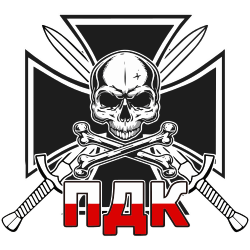 Emblem of the Polish Volunteer Corps


Biker and heavy metal subcultures
[edit]
In the United States, the Iron Cross was adopted by outlaw motorcycle clubs in the 1960s, as a symbol of rebellion and probably for shock value.[23] From biker subculture it spread to rock and heavy metal subcultures, becoming part of heavy metal fashion. Lemmy Kilmister of the influential band Motörhead often wore one.[24] In the 1990s, this other use of the Iron Cross had spread from bikers to skateboarders and many extreme sports enthusiasts and became part of the logo of several related clothing companies. The Anti-Defamation League states that the version of the symbol with a swastika has been commonly used by neo-Nazis and other white supremacists as a hate symbol since it was discontinued following World War II, but the wider use of the Iron Cross in various subcultures means determining its use as a hate symbol relies on context: "an Iron Cross in isolation (i.e., without a superimposed swastika or without other accompanying hate symbols) cannot be determined to be a hate symbol".[23]
Gallery of medal ribbons
[edit]| Iron Cross 2nd Class | ||||
|---|---|---|---|---|
 |
 |
 |
 |
 |
| Iron Cross 1st Class | |||
|---|---|---|---|
 |
 |
 |
 |
| Knight's Cross of the Iron Cross | ||||
|---|---|---|---|---|
  |
  |
  |
  |
  |
| Grand Cross of the Iron Cross | |
|---|---|
 |
 |
See also
[edit]
- Grand Cross of the Iron Cross
- Star of the Grand Cross of the Iron Cross
- Knight's Cross of the Iron Cross
- 1939 Clasp to the 1914 Iron Cross
- Orders, decorations, and medals of Imperial Germany
- Orders, decorations, and medals of Nazi Germany
- Black Cross (Teutonic Order)
- Cross pattée
- Cross of the Warsaw Uprising (Krzyż Powstania Warszawskiego)
- Oxalis tetraphylla (a common name is Iron Cross)
- Medal for Service in War Overseas
Notes
[edit]- ^ Wille, Klaus-Dieter (1986). Spaziergänge in Kreuzberg [Walks in Kreuzberg]. Berliner Kaleidoskop: Schriften zur Berliner Kunst- und Kulturgeschichte (Berlin Kaleidoscope: Writings on Berlin's Art and Cultural History) (in German). Vol. 32. Berlin: Haude & Spener. p. 21. ISBN 3-7759-0287-2..
- ^ a b "Eisernes Kreuz". Dhm.de. 31 October 2011. Retrieved 23 May 2013.
- ^ Nungesser, Michael. Das Denkmal auf dem Kreuzberg von Karl Friedrich Schinkel, ed. on behalf of the Bezirksamt Kreuzberg von Berlin as catalogue of the exhibition "Das Denkmal auf dem Kreuzberg von Karl Friedrich Schinkel" in the Kunstamt Kreuzberg / Künstlerhaus Bethanien Berlin, between 25 April and 7 June 1987, Berlin: Arenhövel, 1987, p. 29. ISBN 3-922912-19-2.
- ^ "Eisernes Kreuz 1813 – 1.Klasse" [1813 Iron Cross First Class] (in German). Militaria Lexikon. Archived from the original on 28 October 2016. Retrieved 28 October 2016.
...versehen, in drei Stufen verliehen: als Großkreuz ..., sowie als Kreuz Erster und Zweiter Klasse, wobei die Klassen von unten nacheinander zu erwerben waren.
[It was awarded in three grades: as a Grand Cross ... and as a First and Second Class, with the grades being awarded one after the other.] - ^ Borcke's Biography Archived 8 July 2011 at the Wayback Machine
- ^ v. Heyden, Hermann (1897). "26. Preussen". Ehren-Zeichen (in German). Frankfurt a. M.: Heinrich Keller. p. 134.
- ^ "Obituary: Surgeon-General W. G. N. Manley, V.C." Medical Press and Circular. 123: 584–585. 27 November 1901.
- ^ Stein, Hans-Peter (1991). Military History Research Office (Germany) (ed.). Symbole und Zeremoniell in deutschen Streitkräften vom 18. bis zum 20. Jahrhundert [Symbols and Military Ceremonies in the German Armed Forces from the 18th to the 20th Century] (in German). Hans-Martin Ottmer (contributor), Military History Research Office (Germany) (editing) (2 ed.). Herford: E. S. Mittler. p. 59. ISBN 3-89350-341-2. OCLC 444548272.
- ^ Shirer 1960, p. 30.
- ^ Reichsgesetzblatt Teil I Nr. 159, 1 September 1939, p. 1573.
- ^ Previtera, Stephen. The Iron Time, p. 322
- ^ Williamson, Gordon (2003). World War II German Women's Auxiliary Services (2nd ed.). Florida: Osprey Publishing. pp. 37–38. ISBN 978-1-84176-407-8.
- ^ Bayvel, Rachel (Summer 2006). "While Jews serve in my army I will not allow their deportation". Jewish Quarterly. No. 202. Archived from the original on 6 December 2010. Retrieved 24 December 2011.
- ^ Pujol, Juan; West, Nigel (1985). Operation GARBO: The Personal Story of the Most Successful Double Agent of World War II (1st American ed.). New York: Random House. p. 159. ISBN 978-0-394-54777-0.
- ^ The National Archives. "Security Service Records Release 25–26 November 2002" (PDF). The National Archives (UK). Archived (PDF) from the original on 16 January 2006. Retrieved 10 January 2012.
25 November Garbo received MBE from King
- ^ a b c Littlejohn & Dodkins 1968, p. 117.
- ^ a b c Dorling 1956, pp. 210–211.
- ^ Zabecki 2014, p. 1628.
- ^ Littlejohn & Dodkins 1968, p. 120.
- ^ Postimees 23 May 2009: Eesti kõige edukamad leiutised
- ^ [1] [dead link]
- ^ "'Kein Eisernes Kreuz': Köhler für Tapferkeitsorden" [No Iron Cross: Köhler Backs "Order of Bravery"]. Frankfurter Allgemeine Zeitung (in German). Frankfurt am Main. 6 March 2008. ISSN 0174-4909. Archived from the original on 9 March 2008. Retrieved 23 May 2013.
- ^ a b "Iron Cross". Anti-Defamation League. Archived from the original on 27 March 2017.
- ^ Waksman, Steve (2009). This Ain't the Summer of Love: Conflict and Crossover in Heavy Metal and Punk. University of California Press. pp. 151–152. ISBN 9780520943889.
References
[edit]- Dorling, H. Taprell (1956). Ribbons and Medals. A.H. Baldwin & Sons, London.
- Littlejohn, David; Dodkins, Colonel C. M. (1968). Orders, Decorations, Medals and Badges of the Third Reich. R. James Bender Publishing, California. ISBN 978-0-85420-080-1.
- Maerz, Dietrich/Stimson, George "The Iron Cross 1. Class", 2010, ISBN 978-0-9797969-7-5
- Maerz, Dietrich, "Award Numbers of the Iron Cross of 1939", International Medal Collector, Vol.3-No.4 and Vol. 4-No.s, ISSN 2152-9310
- Previtera, Stephen Thomas, The Iron Time: A History of the Iron Cross, Second edition 2007, ISBN 978-0-9673070-3-9
- Shirer, William L. (1960). The Rise and Fall of the Third Reich. New York: Simon & Schuster. LCCN 60-6729.
- Williamson, Gordon, The Iron Cross of 1939, 1997, ISBN 0-912138-86-6
- Zabecki, David T., ed. (2014). Germany at War: 400 Years of Military History. Santa Barbara: ABC-CLIO. ISBN 978-1-59884-981-3.
- Maerz, Dietrich/Mario Alt, "The Iron Cross 2. Class", 2019, ISBN 978-1-5323-3691-1
- Maerz, Dietrich (2023). The Knights Cross of the Iron Cross and Higher Grades, Vol. I & II. Richmond, MI: B&D Publishing LLC. ISBN 978-1-7923-3213-5.
External links
[edit]
- German Ministry of Defence (BMVg) on the Iron Cross.
- Iron Cross 1914 (Eisernes Kreuz 1914)
- . New International Encyclopedia. 1905.
| Orders |  | |
|---|---|---|
| Military decorations | ||
| Civil decorations | ||


_4Jahre_BAR.svg)
_ribbon.svg)
.svg)


.jpg)


.svg)
.svg)

.svg)
.svg)

.svg)


.svg)


.svg)

.svg)
.svg)


.svg)
.svg)
.svg)


.svg)


.svg)
.svg)

.svg)

.svg)
.svg)
.svg)
.svg)
.svg)
.svg)
.svg)
.svg)
.svg)


.svg)
.svg)
.svg)


.svg)
.svg)
.svg)


.svg)

.svg)
.svg)
.svg)
.svg)
.svg)


.svg)
.svg)
.svg)
.svg)
.svg)


.svg)


.svg)


.svg)


.svg)


.svg)
.svg)


.svg)
.svg)


.svg)


.svg)


.svg)
.svg)
.svg)


.svg)
.svg)


.svg)

_Swastika_(%D0%A1%D0%B2%D0%B0%D1%81%D1%82%D0%B8%D0%BA%D0%B0)_-_Rodnovery.svg)


.svg)


.svg)


| International | |
|---|---|
| National | |
| Other | |

Iron Cross
View on GrokipediaOrigins and Symbolism
Historical Roots of the Emblem
The design of the Iron Cross emblem—a black cross pattée outlined in silver—originates from the heraldry of the Teutonic Order, a medieval German military religious order active during the Crusades and subsequent Baltic campaigns.[3][6] The Teutonic Knights adopted a black cross on white mantles as their primary symbol, representing their vows of poverty, chastity, and obedience alongside martial discipline in conquering and Christianizing Prussian territories from the 13th century onward.[7] This form, widening toward the ends, distinguished it from other crusader crosses like the red Patriarchal cross of the Knights Templar or the white cross of the Hospitallers, emphasizing a stark, iron-like austerity suited to northern European warfare.[8] Prussian adoption of the motif predated the 1813 medal, appearing in regional heraldry and military standards as a nod to Teutonic legacies in Brandenburg-Prussia's state-building.[3] Architect Karl Friedrich Schinkel, tasked with the Iron Cross design, explicitly referenced Teutonic precedents to infuse the emblem with historical depth, evoking ancestral German resilience rather than inventing a novel symbol.[3] The black coloration symbolized unyielding resolve—"iron" in both material and metaphorical senses—while the silver edging denoted purity and valor, aligning with the order's dual spiritual-military ethos.[6] Unlike contemporaneous awards reliant on gold or enamel for prestige, the Iron Cross's austere emblem rejected ostentation, mirroring Teutonic frugality and Prussian militarism's emphasis on merit over nobility.[7] This continuity preserved the cross as a non-partisan badge of courage, transcending class as intended by King Frederick William III, though its roots in crusader expansionism carried implicit connotations of territorial conquest and Christian supremacy.[6]Institution During the Wars of Liberation
The Iron Cross was instituted on March 10, 1813, by King Frederick William III of Prussia amid the Wars of Liberation, the Prussian-led coalition efforts to expel Napoleonic forces from German territories following severe defeats in 1806-1807.[7] This decree established it as a temporary wartime decoration to incentivize troop morale and recognize battlefield valor when Prussia's resources were depleted, rendering lavish precious-metal awards impractical.[9] The choice of iron as the core material symbolized national resolve and austerity, framed in silver with the Prussian cypher "FW" and the institution date "1813" on the reverse.[10] Unlike prior Prussian honors stratified by rank and nobility, the Iron Cross was awarded for demonstrated bravery or exceptional merit in combat regardless of recipient's social status, military grade, or branch of service, extending eligibility to enlisted men, officers, and even allied foreign troops.[11] It comprised three classes: the Second Class, suspended from a black ribbon with white edges and worn in the buttonhole or on the breast; the First Class, a pinned breast badge requiring prior Second Class possession; and the Grand Cross, a larger neck order with an optional star for supreme achievement.[3] A variant Second Class on white ribbon honored non-combatants such as surgeons and officials for support roles.[12] During the 1813-1815 campaigns, culminating in Napoleon's defeat at Waterloo on June 18, 1815, the award totaled 47,244 Second Class, 1,304 First Class, and nine Grand Crosses, with recipients including Field Marshal Gebhard Leberecht von Blücher for leadership at Ligny and Waterloo.[9] This distribution reflected its role in sustaining enlistments under the Landwehr militia system, where universal conscription demanded broad motivational tools beyond traditional aristocratic incentives.[7] The decree's emphasis on empirical proof of courage—witnessed acts under fire—ensured selections prioritized causal contributions to victory over mere tenure, fostering a merit-based martial culture amid existential threat.[11] Postwar, awards ceased until revival in 1870, underscoring its wartime specificity.[9]Design and Specifications
Medal Construction and Appearance
The Iron Cross medal is constructed from a blackened iron core forming the central black cross pattée, encased between two silver or silver-alloy frames that are soldered together to create a unified piece.[9][7] The frames, often made of German silver—an alloy of copper, zinc, and nickel—are polished and lacquered for durability and shine, featuring beaded edges on both inner and outer borders.[13] This three-component assembly, typically die-struck or cast, measures 42 to 44 mm in width and height, with the iron core magnetically responsive and prone to rust if not properly maintained.[13][14] In its original 1813 form, particularly the Second Class, the obverse presented a plain black iron surface visible through openings in the frames, while the reverse bore raised details including three oak leaves in the center, a crown with the cypher "FW" (for King Friedrich Wilhelm III) above, and the date "1813" inscribed below.[7][3] Subsequent reissues from 1870 onward reversed this orientation, placing the crown, royal initials (evolving to "W" for later monarchs), and date on the obverse medallion, with the reverse featuring oak leaves and the original "1813" to honor the award's founding during the Wars of Liberation.[3] The First Class variant shares identical construction but includes rear loops or pins for direct attachment to the uniform without a ribbon, distinguishing it physically only in mounting hardware.[9] Across eras, the core design retained its stark black-and-silver contrast, symbolizing martial valor through simple, robust materials.[13]Ribbon and Wear Regulations
The Iron Cross 2nd Class was suspended from a ribbon threaded through the second buttonhole from the top of the uniform tunic, with the cross hanging below the lapel.[15] For the 1813, 1870, and 1914 versions awarded for combat merit, the ribbon consisted of black silk with two narrow vertical white stripes along the edges, symbolizing Prussian colors.[16] Non-combatant variants of these awards used a reversed scheme, with a predominantly white ribbon edged in black.[17] In the 1939 reinstitution under Nazi Germany, the ribbon adopted Imperial colors of black-white-red for combat awards, maintaining the same wear position on the tunic.[18] The Iron Cross 1st Class, denoting higher merit, was pinned directly to the left breast pocket without a ribbon, positioned centered above any lower awards or approximately 1 cm above the Iron Cross 2nd Class ribbon when both were worn.[19] This pin-back design ensured secure attachment to the uniform fabric, and in formal or undress uniforms, it could be mounted on a bar with other decorations.[5] Recipients of both classes typically displayed the 1st Class prominently on the chest while wearing only the ribbon bar for the 2nd Class to avoid overlap.[15] The Knight's Cross of the Iron Cross, introduced in 1939, was worn suspended from a broader neck ribbon, approximately 45 mm wide, in black-white-red for WWII recipients, draped around the neck with the cross resting on the chest.[19] Higher grades, such as the Knight's Cross with Oak Leaves, followed similar neck suspension but with precedence over the basic Knight's Cross in mounting order.[10] Post-1945, West German law permitted veterans to wear denazified Iron Crosses (with swastikas removed or replaced) in the order of precedence outlined in the 1957 Order Law, listing the 1914 and 1939 crosses after the Order of Merit but before foreign awards, subject to uniform regulations prohibiting Nazi symbols.[20] Modern Bundeswehr usage treats the Iron Cross motif symbolically on equipment and insignia rather than as a wearable award with ribbon, aligning with post-war restrictions on militaristic decorations.[3]Variations Across Eras
The Iron Cross medal underwent modifications primarily in its date inscriptions and central emblems to denote the conflict era of revival, while retaining the core black iron cross pattee design framed in silver across its Prussian and German iterations. Introduced on March 10, 1813, during the Wars of Liberation against Napoleon, the original version featured a plain black iron obverse for the Second Class, with the reverse bearing a crown surmounting oak leaves and the inscription "FÜR LEISTUNG" ("for merit") above "1813". The First Class was a pin-back version without ribbon, and the Grand Cross measured larger at 62 mm wide, worn on a sash.[3][9] Revived on July 19, 1870, for the Franco-Prussian War, the design mirrored the 1813 pattern but substituted "1870" for the founding date on the reverse, signaling continuity amid the unification of Germany under Prussian leadership; approximately 47,000 Second Class and 1,300 First Class awards were issued during this period.[9] For World War I, re-instituted on August 5, 1914, the medal adopted the 1870 specifications with "1914" replacing the prior date, facilitating mass production that resulted in over 5 million Second Class awards by 1918, reflecting the industrialized scale of modern warfare.[11] The 1939 iteration, decreed on September 1, 1939, by Adolf Hitler for World War II, introduced a swastika and oak leaves in the obverse center—replacing the plain iron—while inscribing "1939" on the lower arm and retaining "1813" on the reverse to invoke Prussian heritage; this version expanded classes to include the neck-worn Knight's Cross (introduced September 1, 1939) and its upgrades with oak leaves, swords, and diamonds, with production exceeding 6,000 Knight's Cross recipients by war's end.[2][9] Post-1945, the Iron Cross was officially discontinued due to its association with the Nazi regime, but a 1957 "57er" version emerged as a private manufacturer reissue for World War II veterans joining the Bundeswehr, omitting the swastika and using "1939" obverse with "1813" reverse, often employing surplus wartime components; these were not state awards but commemorative items, with production limited to licensed firms like Deumer.[21][22] The modern Bundeswehr incorporates the Iron Cross motif in unit insignia and vehicles—such as on Leopard 2 tanks—without reinstating the award, prioritizing denazification while preserving symbolic tradition.[23]| Era | Key Design Change | Classes Issued | Approximate Awards |
|---|---|---|---|
| 1813 | Plain obverse; "1813" reverse | 1st, 2nd, Grand Cross | ~17,000 total |
| 1870 | "1870" reverse | Same as 1813 | ~48,000 total |
| 1914 | "1914" reverse | Same as 1870 | >5 million 2nd Class |
| 1939 | Swastika obverse; "1939" arm | Added Knight's Cross variants | >6,000 Knight's Cross |
| 1957 (veteran reissue) | No swastika; wartime surplus | 1st, 2nd, Knight's | Unofficial; collector/voluntary |
Award Criteria and Classes
Basic Classes and Entitlements
The Iron Cross was instituted on 10 March 1813 by King Frederick William III of Prussia during the Wars of Liberation against Napoleon, featuring two basic classes: the Second Class and the First Class, alongside the higher Grand Cross.[7] These classes were designed to recognize military valor irrespective of the recipient's rank or social status, marking a departure from traditional Prussian orders that favored nobility.[3] The Second Class, the more commonly awarded of the basic classes, was bestowed for a single act of bravery in the face of the enemy or for actions exceeding the call of duty, and served as a prerequisite for eligibility for the First Class.[24][25] The First Class, rarer and denoting superior merit, required prior possession of the Second Class and was granted for repeated or exceptionally outstanding bravery, with far fewer awards issued compared to the Second Class across conflicts.[26][5] Entitlements extended to all military personnel, including enlisted men, non-combatants such as medical staff in wartime variants, and later to women in auxiliary roles during World War II, though primarily male combatants received them.[12][27] Regulations stipulated that awards were merit-based, with documentation including citations verifying the qualifying actions, ensuring empirical validation over subjective favoritism.[9] In practice, the Second Class was often worn on a ribbon in the buttonhole or as a full medal, while the First Class was pinned directly to the uniform without ribbon, emphasizing its prestige.[15] Over subsequent re-institutions in 1870, 1914, and 1939, the basic classes retained these criteria of combat valor, with over 5 million Second Class and approximately 1.3 million First Class awarded in World War II alone, reflecting scaled entitlements amid total war demands.[5] This structure promoted causal incentives for frontline performance, as higher classes unlocked further honors without inherent class barriers.[3]Higher Variants: Knight's Cross and Beyond
![German ribbon with Knight's Cross][float-right] The Knight's Cross of the Iron Cross (Ritterkreuz des Eisernen Kreuzes) was established by Adolf Hitler via decree published in the Reichsgesetzblatt on 1 September 1939, serving as the supreme Wehrmacht award for extraordinary bravery or leadership in battle.[28] Eligibility required prior possession of the 1939 Iron Cross First Class, though concurrent awards occurred in initial cases; a total of 7,318 were conferred by war's end across all services, including the Waffen-SS.[29] The decoration consisted of a larger Iron Cross suspended from a wide black-white-red ribbon worn around the neck, with the obverse featuring a swastika within a wreath, distinguishing it from lower classes.[30] Subsequent upgrades to the Knight's Cross recognized sustained or escalated merit, forming a progressive hierarchy without fixed numerical quotas but awarded sparingly to maintain prestige. The Knight's Cross with Oak Leaves (Eichenlaub) was instituted on 3 June 1940, with 890 recipients, denoted by a clasp of silver-gilt oak leaves attached to the ribbon.[31] This was followed by the Knight's Cross with Oak Leaves and Swords (Eichenlaub und Schwerter) on 15 September 1941, awarded 159 times, adding gold-gilt swords to the clasp for further distinction in command or combat prowess.[32] The Knight's Cross with Oak Leaves, Swords, and Diamonds (Eichenlaub, Schwerter und Brillanten), introduced 25 June 1942, incorporated 12 diamonds on the swords and was bestowed upon 27 individuals, primarily senior aces and field commanders like Erich Hartmann and Otto Carius.[33] The Grand Cross of the Iron Cross (Grosskreuz des Eisernen Kreuzes), reintroduced as the apex of the order, measured approximately 5.5 cm and was worn at the neck with an accompanying breast star; it was awarded only once, to Hermann Göring on 19 July 1940, commemorating the Luftwaffe's role in the Fall of France.[34] [35] No further grants occurred, despite Führer prerogative over its bestowal, rendering it uniquely symbolic of strategic triumph rather than personal valor. A proposed Knight's Cross with Golden Oak Leaves, Swords, and Diamonds emerged late in 1944 for unparalleled feats but remained unawarded amid collapsing fronts.[32] These variants echoed the 1813 Grand Cross precedent—awarded to senior Prussian commanders like Gebhard Leberecht von Blücher—but adapted to total war's demands, emphasizing scalable recognition over rigid class structure.[5]Awards in Major Conflicts
Franco-Prussian War (1870–1871)
King Wilhelm I of Prussia revived the Iron Cross on July 19, 1870, authorizing its re-institution for the conflict with France that had escalated from tensions over the Ems Dispatch.[36] The decree aimed to recognize bravery amid the mobilization against French declaration of war on July 19, mirroring the original 1813 purpose during the Napoleonic Wars.[9] The 1870 version retained the core design of the 1813 Iron Cross—a black iron cross pattée with silver edges—but featured King Wilhelm's initial "W" in the center obverse beneath a crown, with "1870" inscribed at the bottom arm; the reverse bore "1813" to honor the founding date.[2] Classes included the 2nd Class (worn from a ribbon around the neck or pinned), 1st Class (pinned to the uniform), and rare Grand Cross (star and neck badge for highest commanders).[9] The black-white-black ribbon symbolized Prussian colors, unchanged from prior iterations.[3] Awards followed criteria of exceptional valor in combat or distinguished service, open to all ranks and even non-Prussians aiding the cause, without regard for social status—a egalitarian approach rooted in merit.[17] Approximately 43,000 Iron Crosses 2nd Class were issued, alongside around 1,300 1st Class and nine Grand Crosses, reflecting selective bestowal in a force exceeding 600,000 men.[37] Seven Grand Crosses were conferred on March 22, 1871, post-victory at Sedan and Paris surrender.[38] Notable recipients included Field Marshal Helmuth von Moltke the Elder, chief of staff whose strategies secured decisive victories like Sedan on September 2, 1870, earning a Grand Cross; Lieutenant Paul von Hindenburg, awarded 2nd Class for service at Mars-la-Tour; and Otto von Bismarck, honorary for political leadership.[39] British surgeon William Manley received the 2nd Class for ambulance duties, uniquely also holding Britain's Victoria Cross.[3] These awards underscored the decoration's role in bolstering morale and commemorating unification under the German Empire proclaimed January 18, 1871.World War I (1914–1918)
The Iron Cross was reinstated by Kaiser Wilhelm II on August 5, 1914, five days after the German declaration of war on Russia, to recognize acts of bravery and military merit during the conflict.[14] The design retained the form established in 1813—a black iron cross pattee with silver edges—but the reverse featured the dates "1813" above "1914" to signify its revival for the new war.[14] The obverse displayed the Prussian royal cipher "W" for Wilhelm beneath an imperial crown, emphasizing continuity with Prussian martial tradition.[14] The award comprised three primary classes, open to all military ranks and, exceptionally, some civilians, without regard to social status—a departure from more elitist Prussian orders.[12] The Second Class, the most common, was suspended from a black, white, and red ribbon worn through the second buttonhole of the uniform and conferred for valor in combat or significant contributions to the war effort.[14] The First Class, pinned directly to the left breast pocket, required prior receipt of the Second Class and was granted for repeated or exceptional gallantry, such as leading assaults under fire or capturing enemy positions.[9] The Grand Cross, a larger neck-order version with a breast star, was reserved for supreme commanders achieving strategic victories, awarded only five times: to Wilhelm II, Paul von Hindenburg, Erich Ludendorff, Prince Leopold of Bavaria, and Crown Prince Wilhelm.[14] Over the course of the war, the Iron Cross was bestowed in unprecedented numbers, reflecting both the scale of mobilization—Germany fielded some 13 million men—and the leadership's intent to foster morale through widespread recognition.[17] More than 5.2 million Second Class awards were issued, including to rear-area personnel on a white-ribbon variant for home-front service like medical aid or industrial support.[17] [12] First Class recipients numbered between 145,000 and 218,000, often for frontline exploits amid the attrition of trench warfare.[9] Special provisions allowed prior recipients from 1870 to wear a clasp denoting the 1914 award on their earlier crosses, preserving the hierarchy of merit.[14] Production challenges, including material shortages, led to variations in quality, with some crosses featuring vaulted (domed) construction for durability, though flat versions predominated.[9] The award's inclusivity extended rarely to women and non-combatants, such as nurses or auxiliaries, underscoring its role in total war mobilization.[12]World War II (1939–1945)
The Iron Cross was reintroduced by Adolf Hitler through a decree issued on September 1, 1939, the day Germany invaded Poland, marking the start of World War II in Europe.[5] This revival retained the basic design from the 1813 version, featuring a black-enameled Maltese cross with silver borders, but replaced the central medallion's date with a swastika superimposed over an oak leaf wreath and the year 1939 beneath.[5] The award was bestowed for exceptional bravery in combat or outstanding leadership, applicable to all ranks and branches of the Wehrmacht, including the Heer (army), Kriegsmarine (navy), and Luftwaffe (air force).[5] The standard classes consisted of the Second Class, worn on a black-white-red ribbon from the second buttonhole of the tunic, and the First Class, pinned directly to the left breast pocket, requiring prior possession of the Second Class for eligibility.[9] Estimates indicate approximately 5 million Second Class Iron Crosses and 450,000 First Class were awarded during the war, reflecting the scale of German military engagements across multiple fronts.[9] The Knight's Cross of the Iron Cross served as the highest grade, worn at the neck on a broader ribbon, initially awarded for leadership achieving decisive successes beyond typical bravery, with 7,313 presentations to German recipients by war's end.[40] Higher variants of the Knight's Cross included the Oak Leaves (843 awards), Swords (157), Oak Leaves with Swords (27), and Diamonds (12), culminating in the rare Golden Oak Leaves (1 award to Hans-Ulrich Rudel), each denoting escalating feats of valor or strategic impact.[40] These decorations were distributed across services, with the Luftwaffe receiving the most Knight's Crosses due to the prominence of aces like Erich Hartmann, who earned the Diamonds.[40] Foreign volunteers and Axis allies, such as Romanians and Finns, occasionally received the Iron Cross for service in German units, though primarily it remained a Wehrmacht honor.[5] By 1945, production constraints led to simplified manufacturing, yet the award's prestige endured among recipients facing defeat.[10]Post-World War II Developments
Official German Military Contexts
Following the establishment of the Bundeswehr in 1955, the Iron Cross of 1813 was adopted as the official emblem of the Federal Republic of Germany's armed forces, symbolizing continuity with pre-Nazi military traditions of bravery and defense against tyranny.[41] This usage commenced in 1956 for markings on combat vehicles and aircraft, replacing earlier provisional insignia and distinguishing Bundeswehr equipment in NATO exercises and operations.[42] The emblem appears on tanks such as the Leopard 2, helicopters like the CH-53G, and unmanned aerial vehicles, serving as a national recognition sign without the Nazi-era modifications like the swastika overlay.[43] The historical Iron Cross medal itself has not been reinstated for awards in the Bundeswehr, due to its association with the Wehrmacht, but its design influences contemporary decorations. The Badge of Honour of the Bundeswehr (Ehrenkreuz der Bundeswehr), introduced on November 13, 1957, comes in bronze, silver, and gold classes, awarded for meritorious service and echoing the Iron Cross's form as a cross pattée with a federal eagle in the center rather than imperial or Nazi symbols.[44] These badges recognize long-term exemplary service or special achievements, with the gold variant denoting over 20 years of outstanding contributions.[45] In 2008, the Cross of Honour for Valour (Ehrenkreuz der Bundeswehr für Tapferkeit) was created as the first post-1945 German military bravery award, functionally akin to the original Iron Cross's purpose but without its name or exact historical design to avoid Wehrmacht connotations.[23] Instituted on October 10, 2008, it is awarded for acts of courage in combat, with the first presentations occurring during Bundeswehr operations in Afghanistan, emphasizing selfless risk to protect comrades or civilians.[44] This decoration underscores the Bundeswehr's tradition of honoring valor while adhering to post-war constitutional limits on militarism, as outlined in the German Basic Law.[41] The Iron Cross motif thus persists in Bundeswehr tradition as a emblem of "bravery, honour, and love of freedom," integrated into unit insignia, memorials, and ceremonial practices without direct medal conferral.[41]