


Community hub
Recent from talks
Contribute something
Nothing was collected or created yet.
Jeremy Abbott
View on Wikipedia
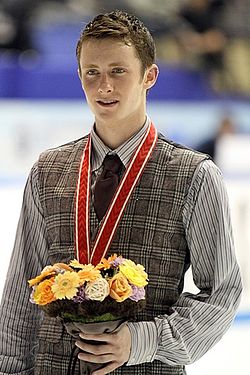
Jeremy Abbott (born June 5, 1985) is a former American figure skater. He is the 2008 Grand Prix Final champion, a two-time (2007, 2011) Four Continents bronze medalist, and a four-time (2009, 2010, 2012, 2014) U.S. champion. He represented the United States at the 2010 Winter Olympics, where he placed ninth, and the 2014 Winter Olympics, where he won a bronze medal in the team event.
Key Information


Personal life
[edit]Jeremy Abbott was born in Aspen, Colorado to Allison and Danny Abbott. He has an older sister, Gwen Abbott, a former nationally ranked downhill ski racer and 3X Winter X Games competitor in skier cross.[1] He attended Cheyenne Mountain High School for five years, stretching his high school career out one year longer than the usual, so he could concentrate on both skating and getting good grades.[2] He graduated in 2004.[3]
In January 2015, Abbott's father, Danny Abbott, died from complications of Parkinson's Disease.[4]
In addition to his coaches, Jeremy Abbott cites his family — his mother Allison Scott, his stepfather Allen Scott, his late father Danny Abbott, and his sister Gwen Abbott — as the pillars of his success.[5] Following his win on the junior level at 2005 U.S. Championships, Abbott established a fund in Aspen, Colorado, to help up-and-coming skaters to pay for training.[6] In 2006, he established a second fund for skaters in the surrounding area.[7][8]
Skating career
[edit]Early years
[edit]Abbott began skating at age two.[6] He began competing at age four after being inspired by Robin Cousins.[6][10] As a juvenile, he competed in ice dance with Amanda Cunningham from 1995–96 and with Katie Hoffmaster from 1997–98.[10] He competed as a pair skater with Brittany Vise from 1998–99 and Krystal Sorenson from 2001–02.[10]
In his early years, Abbott was coached by Peggy Behr in Aspen, Colorado. In 1999, Abbott moved from Aspen to Colorado Springs to train at the Colorado Springs World Arena with Tom Zakrajsek.[6][10] He began representing the Broadmoor Skating Club.
Abbott began competing in singles at the novice level in the 2000–01 season, but failed to make it out of sectionals. The next year he made it to Nationals, where he placed 6th at the novice level.
For the 2002–03 and 2004–05 seasons, Abbott competed on the junior level nationally, although he did not reach the 2003 U.S. Championships at the junior level. He fractured his L5 vertebra in 2003, which kept him off the ice for fifteen weeks[11] leading up to regionals, yet he was able to place seventh at the 2004 U.S. Championships.
He won the Junior national title at the 2005 U.S. Championships.[12] A remark he made during this competition – "Stranger things could happen; pigs could fly!" – led him to adopt a pig with wings as his mascot. Abbott made it the slogan of his charitable fund, which he launched to help young male skaters struggling to pay coaching fees, ice time, and competition fees.
2005–08
[edit]Abbott was given his first senior international assignment in the 2005–06 Olympic season, placing eighteenth at the 2005 Nebelhorn Trophy. Abbott then placed fifth at the Midwestern Sectionals and missed a chance to go to the 2006 U.S. Championships and compete for an Olympic berth. Abbott later blamed his performance on his poor training habits,[1] and said that he had become lazy after winning the junior national title; failing to make it out of sectionals gave him the motivation he needed.
In the 2006–07 season, Abbott was given another international assignment, this time to the 2006 Finlandia Trophy, which he won. He won sectionals and advanced to the 2007 U.S. Championships, where he won the pewter medal, the highest placement for a first-timer in the senior men's event in twenty years. Abbott was named the first alternate to the World and Four Continents teams. When Johnny Weir withdrew from the 2007 Four Continents Championships, Abbott was given the opportunity to compete at the event, which was held at his home rink, World Arena, Colorado Springs. He beat out his training mate Ryan Bradley to win the bronze medal.[12]
In the 2007–08 season, Abbott debuted on the Grand Prix circuit, placing eighth at the 2007 Skate Canada and fourth at the 2007 NHK Trophy. At the 2008 U.S. Championships, he again won the pewter medal. He placed fifth at the 2008 Four Continents Championships. He was sent to the 2008 World Championships after Evan Lysacek withdrew with injury, where he placed eleventh.
2008–09
[edit]
In the 2008–09 season, Abbott had a breakthrough season on the Grand Prix circuit. He won the 2008 Cup of China and placed fourth at the 2008 Cup of Russia to qualify for the 2008–09 Grand Prix Final. He won the Grand Prix Final, becoming the first American man to do so, and achieved the highest total free skate score for an American man at that time.[13][12] At the 2009 U.S. Championships, Abbott won both the short program and the free skate to win the gold medal.[12] At the 2009 World Championships, Abbot placed tenth in both the short program and free skate, and finished eleventh overall. In the off-season, he performed at the Festa On Ice show in South Korea, his first ice show in a foreign country.
In May 2009, Abbott switched coaches to Yuka Sato in Bloomfield Hills, Michigan.[14]
2009–10 season
[edit]Abbott began the 2009–10 season with a fifth-place finish at the 2009 NHK Trophy. He then won the 2009 Skate Canada to qualify once again for the Grand Prix Final, where he placed fourth.
At the 2010 U.S. Championships, Abbott won both segments of the competition to win the title overall, finishing 25 points ahead of the second place Evan Lysacek.[12] He was named to the Winter Olympic team. At the 2010 Winter Olympics in Vancouver, Canada, Abbott placed fifteenth place in the short program.[15] Abbott earned a score of 149.56 in the free skate, placing ninth overall.[12] At the 2010 World Championships, he skated a strong short program to place sixth in the segment; however, in the free skate, he twice fell and finished fifth overall.[12] In the off-season, Abbott performed with the Stars on Ice tour.
2010–11 season
[edit]Abbott decided to remain with Sato for the 2010–11 season.[16] In a November 2011 interview, he said he was seeing a sports psychologist once a week.[17] His training was hampered by the first serious boot problems of his career.[18][19] Abbott explained, "I could not get the blades mounted quite right, and they were never quite comfortable".[20] He went through eight pairs of boots.[18] The problems were resolved toward the end of the season.[21]
At the 2011 U.S. Championships, Abbott was second after the short program, but struggled through parts of his free skate to finish fourth overall. He won his third pewter medal with a total score of 224.16, missing the bronze medal by just 0.19 points. The selection committee left him off the 2011 World Championships team, disappointing Abbott who thought the rules stated that other results would be taken into consideration.[17][22] He was named to the team to the 2011 Four Continents Championships instead, where he won the bronze medal.
2011–12 season
[edit]For the 2011–12 Grand Prix season, Abbott was assigned to compete at the 2011 Cup of China and 2011 Cup of Russia.[21] He later said they were not the two he had asked for, but it had worked out well.[17] He placed third in both programs at the Cup of China and came away with the gold medal. At the Cup of Russia, Abbott won the short program with a new personal best of 83.54 points. He placed fifth in the free skate and won the bronze medal overall. He qualified for his third Grand Prix Final.[20]
At the 2012 U.S. Championships, Abbott placed first in both programs and won his third national title. He withdrew from the 2012 Four Continents Championships due to back spasms.[23][24] He finished 8th at the 2012 World Championships.
2012–13 season
[edit]Abbott finished fifth at his first Grand Prix event of the season, the 2012 Skate America. Early in the season, he had a compressed disk in his lower back, which also caused nerve problems in his legs, but his condition began to improve by his next event in France.[25][26] He won the silver medal at the 2012 Trophée Éric Bompard. At the 2013 U.S. Championships, he won the bronze medal.[27][28]
2013–14 season
[edit]During an interview for "The Skating Lesson Podcast", Abbott told Jennifer Kirk that the 2013–14 season would be his last. He finished sixth at his first Grand Prix assignment, the 2013 Skate Canada International, and won the bronze medal at the second, the 2013 NHK Trophy. At the 2014 U.S. Championships, he placed first in the short program and second in the free skate. Abbott finished first overall and was named to the U.S. team to the 2014 Winter Olympics in Sochi, Russia.[29][30] He was awarded a team bronze medal.[31] He went on to compete at the 2014 World Championships, where he had a fourth place free skate and placed fifth overall.[32]
2014–15 season
[edit]Abbott was given assignments for the 2014 Skate America and 2014 NHK Trophy for the 2014–15 season.[33] He placed fifth at both events.
Shortly before the 2015 U.S. Championships, Abbott's father died. Despite this hardship, Abbott decided to compete anyway and finished fifth. During the gala, Abbott paid a tribute to his late father.[4][34]
2015–16 season and after
[edit]At the beginning of the 2015–16 season, Abbott stated that he would sit out the season, but said he did not plan on retiring.[35] In October 2015, he participated in the 2015 Japan Open, a team event in Japan.[36] In January 2016, he won gold at the 2016 Medal Winners Open, an ISU-sanctioned pro-am competition held in Japan.[37]
During the 2016–2017 season, Abbott participated in the 2016 Japan Open.[38] At the end of the season, he announced his retirement from competitive skating.[39]
Coaching and choreographer career
[edit]Since retiring from competition, Abbott has started choreographing and coaching. He has choreographed programs for former two-time U.S. champion Gracie Gold. As a coach, he has worked with two-time U.S. champion Alysa Liu, as well as Dinh Tran.[40]
Programs
[edit]

2015–16 to present
[edit]| Season | Free skate | Exhibition |
|---|---|---|
| 2015–16 [41][42] |
|
|
| ||
|
||
| ||
| 2016–17 [49] |
|
|
| ||
| 2017–18 [58] |
|
|
| ||
| 2018–19 [64] |
| |
2004–05 to 2014–15
[edit]| Season | Short program | Free skate | Exhibition | Ref. |
|---|---|---|---|---|
| 2004–05 |
|
|
N/a | [3] |
| 2005–06 |
| |||
| ||||
| 2006–07 |
|
|
|
[65] |
| 2007–08 |
|
|
|
[10][66] |
| 2008–09 |
|
|
[67] | |
| ||||
| 2009–10 |
|
|
|
[68][69][70] |
| ||||
| ||||
| 2010–11 |
|
|
|
[71][72] |
| ||||
| ||||
| 2011–12 |
|
|
|
[17][73][22][21][74][75] |
| ||||
| 2012–13 |
|
|
[76][77][78][79] | |
| ||||
| 2013–14 |
|
|
|
[31][80][81][21][82][83] |
| ||||
| 2014–15 |
|
|
|
[84][85] |
|
Competitive highlights
[edit]- GP – Event of the ISU Grand Prix Series
- CS – Event of the ISU Challenger Series
- Medals at team events are awarded for the team result only. Individual placements at team events are listed in parentheses.
| Season | 2005–06 | 2006–07 | 2007–08 | 2008–09 | 2009–10 | 2010–11 | 2011–12 | 2012–13 | 2013–14 | 2014–15 |
|---|---|---|---|---|---|---|---|---|---|---|
| Winter Olympics | 9th | 12th | ||||||||
| Winter Olympics (Team event) | 3rd | |||||||||
| World Championships | 11th | 11th | 5th | 8th | 5th | |||||
| Four Continents Championships | 3rd | 5th | 5th | 3rd | ||||||
| Grand Prix Final | 1st | 4th | 5th | |||||||
| U.S. Championships | 4th | 4th | 1st | 1st | 4th | 1st | 3rd | 1st | 5th | |
| World Team Trophy | 1st (5th) |
2nd (5th) |
1st (6th) |
|||||||
| GP Cup of China | 1st | 1st | ||||||||
| GP France | 2nd | |||||||||
| GP NHK Trophy | 4th | 5th | 2nd | 3rd | 5th | |||||
| GP Rostelecom Cup | 4th | 3rd | 3rd | |||||||
| GP Skate America | 5th | 5th | ||||||||
| GP Skate Canada | 8th | 1st | 6th | |||||||
| CS Finlandia Trophy | 1st | |||||||||
| CS Nebelhorn Trophy | 18th | |||||||||
| Challenge Cup | 2nd | |||||||||
| Japan Open | 2nd (3rd) |
2nd (3rd) |
| Season | 2002–03 | 2003–04 | 2004–05 |
|---|---|---|---|
| U.S. Championships | 7th | 1st | |
| Copenhagen Trophy | 3rd |
Detailed results
[edit]| Segment | Type | Score | Event |
|---|---|---|---|
| Total | TSS | 246.35 | 2014 World Championships |
| Short program | TSS | 86.98 | 2012 World Team Trophy |
| TES | 45.40 | 2009 NHK Trophy | |
| PCS | 42.89 | 2012 World Team Trophy | |
| Free skating | TSS | 166.68 | 2014 World Championships |
| TES | 82.56 | 2008–09 Grand Prix Final | |
| PCS | 86.16 | 2014 World Championships |
- Small medals for the short program and free skating are only awarded at ISU Championships.
- At national events in the United States, pewter medals are awarded for fourth place.
- Medals at team events are awarded for the team results only. Individual placements at team events are listed in parentheses.
Senior level
[edit]| Date | Event | SP | FS | Total | |||
|---|---|---|---|---|---|---|---|
| P | Score | P | Score | P | Score | ||
| Sep 29 – Oct 2, 2005 |  2005 Nebelhorn Trophy 2005 Nebelhorn Trophy
|
21 | 35.41 | 17 | 88.51 | 18 | 123.92 |
| Date | Event | SP | FS | Total | |||
|---|---|---|---|---|---|---|---|
| P | Score | P | Score | P | Score | ||
| Oct 6–8, 2006 |  2006 Finlandia Trophy 2006 Finlandia Trophy
|
2 | 67.60 | 2 | 119.66 | 1 | 187.26 |
| Jan 21–28, 2007 |  2007 U.S. Championships 2007 U.S. Championships
|
9 | 64.48 | 3 | 136.47 | 4 | 200.95 |
| Feb 7–10, 2007 | 2007 Four Continents Championships
|
2 | 74.34 | 4 | 128.88 | 3 | 203.22 |
| Date | Event | SP | FS | Total | |||
|---|---|---|---|---|---|---|---|
| P | Score | P | Score | P | Score | ||
| Nov 1–4, 2007 |  2007 Skate Canada International 2007 Skate Canada International
|
8 | 50.86 | 5 | 99.20 | 5 | 150.06 |
| Nov 29–30, 2007 |  2007 NHK Trophy 2007 NHK Trophy
|
12 | 58.27 | 4 | 129.49 | 4 | 187.56 |
| Jan 20–27, 2008 | 2009 U.S. Championships
|
5 | 73.28 | 4 | 148.57 | 4 | 221.85 |
| Feb 13–17, 2008 |  2008 Four Continents Championships 2008 Four Continents Championships
|
9 | 60.87 | 4 | 145.53 | 5 | 206.40 |
| Mar 17–23, 2008 |  2008 World Championships 2008 World Championships
|
14 | 65.61 | 10 | 131.65 | 11 | 197.26 |
| Date | Event | SP | FS | Total | |||
|---|---|---|---|---|---|---|---|
| P | Score | P | Score | P | Score | ||
| Nov 5–9, 2008 |  2008 Cup of China 2008 Cup of China
|
1 | 77.09 | 1 | 156.39 | 1 | 233.44 |
| Nov 21–23, 2008 |  2008 Cup of Russia 2008 Cup of Russia
|
3 | 68.60 | 2 | 148.68 | 4 | 217.48 |
| Dec 10–14, 2008 | 2008–09 Grand Prix Final
|
2 | 78.26 | 1 | 159.46 | 1 | 237.72 |
| Jan 18–25, 2009 | 2009 U.S. Championships
|
1 | 86.40 | 1 | 155.49 | 1 | 241.89 |
| Feb 4–8, 2009 | 2009 Four Continents Championships
|
4 | 75.67 | 6 | 141.27 | 5 | 216.94 |
| Mar 23–29, 2009 | 2009 World Championships
|
10 | 72.15 | 10 | 132.52 | 11 | 204.67 |
| Apr 16–19, 2010 | 2009 World Team Trophy
|
5 | 71.27 | 5 | 133.78 | 1 (5) | 205.05 |
| Date | Event | SP | FS | Total | |||
|---|---|---|---|---|---|---|---|
| P | Score | P | Score | P | Score | ||
| Oct 3, 2009 | 2009 Japan Open
|
N/a | N/a | 2 | 132.87 | 2 | N/a |
| Nov 5–8, 2009 | 2009 NHK Trophy
|
2 | 83.00 | 6 | 125.45 | 5 | 208.45 |
| Nov 19–22, 2009 | 2009 Skate Canada International
|
1 | 79.00 | 2 | 153.99 | 1 | 232.99 |
| Dec 3–6, 2009 | 2009–10 Grand Prix Final
|
5 | 76.65 | 2 | 158.73 | 4 | 235.38 |
| Jan 14–24, 2010 | 2010 U.S. Championships
|
1 | 87.85 | 1 | 175.81 | 1 | 263.66 |
| Feb 12–28, 2010 | 2010 Winter Olympics
|
15 | 69.40 | 9 | 149.56 | 9 | 218.96 |
| Mar 22–28, 2010 |  2010 World Championships 2010 World Championships
|
6 | 81.05 | 5 | 151.36 | 5 | 232.10 |
| Date | Event | SP | FS | Total | |||
|---|---|---|---|---|---|---|---|
| P | Score | P | Score | P | Score | ||
| Oct 22–24, 2010 | 2010 NHK Trophy
|
2 | 74.62 | 3 | 143.57 | 2 | 218.19 |
| Nov 19–21, 2012 | 2010 Cup of Russia
|
2 | 77.61 | 4 | 139.60 | 3 | 217.21 |
| Jan 22–30, 2011 | 2011 U.S. Championships
|
2 | 78.39 | 6 | 145.77 | 4 | 224.16 |
| Feb 15–20, 2011 |  2011 Four Continents Championships 2011 Four Continents Championships
|
2 | 76.73 | 4 | 148.98 | 3 | 225.71 |
| Date | Event | SP | FS | Total | |||
|---|---|---|---|---|---|---|---|
| P | Score | P | Score | P | Score | ||
| Nov 3–6, 2011 | 2011 Cup of China
|
3 | 79.32 | 3 | 149.17 | 1 | 228.49 |
| Nov 25–27, 2011 | 2011 Rostelecom Cup
|
1 | 83.54 | 5 | 145.54 | 3 | 229.08 |
| Dec 8–11, 2011 | 2011–12 Grand Prix Final
|
2 | 82.66 | 5 | 156.16 | 5 | 238.82 |
| Jan 22–29, 2012 | 2012 U.S. Championships
|
1 | 90.23 | 1 | 183.35 | 1 | 273.58 |
| Mar 8–11, 2012 |  2012 International Challenge Cup 2012 International Challenge Cup
|
3 | 77.97 | 2 | 145.81 | 2 | 223.78 |
| Mar 26 – Apr 1, 2012 |  2012 World Championships 2012 World Championships
|
9 | 74.85 | 8 | 151.34 | 8 | 226.19 |
| Apr 18–22, 2012 | 2012 World Team Trophy
|
3 | 86.98 | 7 | 147.39 | 5 (5) | 234.37 |
| Date | Event | SP | FS | Total | |||
|---|---|---|---|---|---|---|---|
| P | Score | P | Score | P | Score | ||
| Oct 19–21, 2012 | 2012 Skate America
|
3 | 77.71 | 8 | 133.64 | 5 | 211.35 |
| Nov 16–18, 2012 | 2012 Trophée Éric Bompard
|
1 | 81.18 | 3 | 146.45 | 2 | 227.63 |
| Jan 19–27, 2013 | 2013 U.S. Championships
|
1 | 84.10 | 3 | 165.23 | 3 | 249.33 |
| Apr 11–14, 2013 | 2013 World Team Trophy
|
4 | 80.24 | 6 | 151.60 | 1 (6) | 231.84 |
| Date | Event | SP | FS | Total | |||
|---|---|---|---|---|---|---|---|
| P | Score | P | Score | P | Score | ||
| Oct 5, 2013 | 2013 Japan Open
|
N/a | N/a | 3 | 157.70 | 2 (3) | N/a |
| Oct 24–27, 2013 | 2013 Skate Canada International
|
4 | 74.58 | 6 | 141.37 | 6 | 215.95 |
| Nov 8–10, 2013 | 2013 NHK Trophy
|
7 | 78.78 | 3 | 158.63 | 3 | 237.41 |
| Jan 5–12, 2014 | 2014 U.S. Championships
|
1 | 99.86 | 2 | 174.41 | 1 | 274.27 |
| Feb 6–9, 2014 | 2014 Winter Olympics (Team event)
|
7 | 65.65 | N/a | N/a | 3 | N/a |
| Feb 7–23, 2014 | 2014 Winter Olympics
|
15 | 72.58 | 8 | 160.12 | 12 | 232.70 |
| Mar 24–30, 2014 | 2014 World Championships
|
8 | 79.67 | 4 | 166.68 | 5 | 246.35 |
| Date | Event | SP | FS | Total | |||
|---|---|---|---|---|---|---|---|
| P | Score | P | Score | P | Score | ||
| Oct 24–26, 2014 | 2014 Skate America
|
2 | 81.82 | 6 | 137.51 | 5 | 219.33 |
| Nov 28–30, 2014 | 2014 NHK Trophy
|
2 | 81.51 | 5 | 148.14 | 5 | 229.65 |
| Jan 18–25, 2015 | 2015 U.S. Championships
|
3 | 89.93 | 5 | 168.36 | 5 | 258.29 |
| Date | Event | SP | FS | Total | |||
|---|---|---|---|---|---|---|---|
| P | Score | P | Score | P | Score | ||
| Oct 3, 2015 | 2015 Japan Open
|
N/a | N/a | 3 | 153.72 | 2 (4) | N/a |
| Jan 15, 2016 | 2016 Medal Winners Open
|
1 | 85.44 | N/a | N/a | 1 | 85.44 |
| Date | Event | SP | FS | Total | |||
|---|---|---|---|---|---|---|---|
| P | Score | P | Score | P | Score | ||
| Oct 1, 2016 | 2016 Japan Open
|
N/a | N/a | 4 | 166.99 | 3 (4) | N/a |
| Date | Event | SP | FS | Total | |||
|---|---|---|---|---|---|---|---|
| P | Score | P | Score | P | Score | ||
| Oct 7, 2017 | 2017 Japan Open
|
N/a | N/a | 5 | 143.48 | 3 (5) | N/a |
| Date | Event | SP | FS | Total | |||
|---|---|---|---|---|---|---|---|
| P | Score | P | Score | P | Score | ||
| Oct 6, 2018 | 2018 Japan Open
|
N/a | N/a | 6 | 124.06 | 3 (6) | N/a |
Junior level
[edit]| Date | Event | SP | FS | Total | |||
|---|---|---|---|---|---|---|---|
| P | Score | P | Score | P | Score | ||
| Feb 21–23, 2003 |  2003 Copenhagen Trophy 2003 Copenhagen Trophy
|
1 | N/a | 3 | N/a | 3 | N/a |
| Date | Event | SP | FS | Total | |||
|---|---|---|---|---|---|---|---|
| P | Score | P | Score | P | Score | ||
| Jan 3–11, 2004 | 2004 U.S. Championships (Junior)
|
10 | N/a | 4 | N/a | 7 | N/a |
| Date | Event | SP | FS | Total | |||
|---|---|---|---|---|---|---|---|
| P | Score | P | Score | P | Score | ||
| Jan 9–16, 2005 | 2005 U.S. Championships (Junior)
|
1 | N/a | 1 | N/a | 1 | N/a |
References
[edit]- ^ a b PDF – Spotlight on Skating[permanent dead link]
- ^ Sylvia (January 7, 2004). "Spotlight on Jeremy Abbott". Unseen Skaters. Archived from the original on April 2, 2004.
- ^ a b "Jeremy Abbott". IceNetwork. Archived from the original on November 9, 2013. Retrieved June 29, 2014. * 2008 to 2013 at the Wayback Machine (archive index) * 2005 to 2008 at the Wayback Machine (archive index)
- ^ a b Rutherford, Lynn; Rosewater, Amy (January 23, 2015). "Tar Heel tales: Abbott out to make late dad proud". IceNetwork.
- ^ "Jeremy Abbott on winning, losing, Bobby and diehard fans". LifeSkate. April 17, 2009. Archived from the original on April 30, 2009. Retrieved April 19, 2009.
- ^ a b c d "U.S. Junior Champion Jeremy Abbott establishes fund for boys". U.S. Figure Skating. May 11, 2005. Archived from the original on September 27, 2007.
- ^ Fawcett, Laura (September 21, 2006). "Abbott lends helping hand to skaters in need". U.S. Figure Skating. Archived from the original on September 27, 2007.
- ^ Brannen, Sarah S.; Meekins, Drew (September 8, 2011). "The Inside Edge: Catching Up with Emily Hughes". IceNetwork. Archived from the original on March 3, 2016. Retrieved September 8, 2011.
- ^ Miller, Darci (January 28, 2021). "Happy Accidents: Jeremy Abbott on Coming Out and New Role as Coach". U.S. Figure Skating Fan Zone. U.S. Figure Skating. Archived from the original on February 8, 2021. Retrieved February 3, 2021.
- ^ a b c d e Mittan, Barry (December 30, 2007). "Aspen's Abbott Aspires to Worlds Podium". Golden Skate. Archived from the original on May 3, 2012. Retrieved June 4, 2012.
- ^ "Jeremy Abbott". teamusa.org. United States Olympic Committee. Archived from the original on August 23, 2014. Retrieved May 30, 2015.
- ^ a b c d e f g Hines, James R. (2011). Historical Dictionary of Figure Skating. Lanham, Maryland: Scarecrow Press. p. 21. ISBN 978-0-8108-6859-5.
- ^ "Score over 150 - Men - Total Score". International Skating Union. December 18, 2008. Archived from the original on December 20, 2008.
- ^ "2009 U.S. Champion Jeremy Abbott Announces Coaching Change" (Press release). U.S. Figure Skating. May 22, 2009. Archived from the original on June 13, 2011.
- ^ "Men – Short Program Results". IOC/Vancouver 2010. February 16, 2010. Archived from the original on February 20, 2010.
- ^ "Jeremy Abbott and his roller coaster season (video)". LifeSkate. June 28, 2010. Archived from the original on July 3, 2010. Retrieved July 11, 2010.
- ^ a b c d Vernon, Nadin (November 25, 2011). "Jeremy Abbott: "I wanted to find a piece of music where I could just breathe in the program and relax into the choreography"". Absolute Skating. Archived from the original on September 16, 2018. Retrieved November 26, 2011.
- ^ a b Rosewater, Amy (March 20, 2012). "Abbott enters Nice 'worlds away' from last year". IceNetwork. Archived from the original on December 1, 2017. Retrieved March 21, 2012.
- ^ Brannen, Sarah S.; Meekins, Drew (October 5, 2010). "The Inside Edge with Sarah and Drew – Oct. 5". IceNetwork. Archived from the original on November 16, 2011. Retrieved October 9, 2010.
- ^ a b Rutherford, Lynn (December 8, 2011). "Abbott firmly believes best is yet to come". IceNetwork. Archived from the original on December 1, 2017. Retrieved December 9, 2011.
- ^ a b c d e Brannen, Sarah S. (July 6, 2011). "Abbott gets into the swing of things". IceNetwork. Archived from the original on December 1, 2017. Retrieved July 6, 2011.
- ^ a b Sciarrillo, Laura (November 30, 2011). "We met Jeremy Abbott in Paris during the Trophée Bompard". ArtOnIce.it. Archived from the original on September 23, 2015. Retrieved January 3, 2012.
- ^ Barnas, Jo-Ann (February 3, 2012). "Jeremy Abbott withdraws from Four Continents Championship due to back spasms". Detroit Free Press. Archived from the original on February 18, 2015.
- ^ "Dornbush to replace Abbott at Four Continents". IceNetwork. February 3, 2012. Archived from the original on February 10, 2012. Retrieved February 4, 2012.
- ^ Meighan, Cate (January 10, 2013). "Jeremy Abbott Has The Drive and Fire to Compete for His Fourth Title at the U.S. Figure Skating Championships". Celeb Dirty Laundry.
- ^ Rutherford, Lynn (January 15, 2013). "Road to Omaha: Abbott to play it conservative". IceNetwork. Archived from the original on August 11, 2016. Retrieved January 15, 2013.
- ^ Armour, Nancy (January 28, 2013). "Max Aaron wins first US Figure Skating Championships title". The Boston Globe. Retrieved March 9, 2013.
- ^ "Scottsdale's Max Aaron wins U.S. figure skating senior men's championship". AZ Central. January 28, 2013. Archived from the original on February 9, 2013. Retrieved March 9, 2013.
- ^ Springer, Shira (January 13, 2014). "Jeremy Abbott wins fourth US men's title". Boston Globe.
- ^ "U.S. Figure Skating Announces 2014 U.S. Olympic Figure Skating Team". U.S. Figure Skating. January 12, 2014. Archived from the original on January 12, 2014. Retrieved January 13, 2014.
- ^ a b "Jeremy Abbott". Sochi2014.com. Organizing Committee of the XXII Olympic Winter Games and XI Paralympic Winter Games of 2014 in Sochi. Archived from the original on April 6, 2014.
- ^ Hersh, Philip (March 28, 2014). "No medal, but Abbott gains extra spot for US skaters". The Chicago Tribune. Archived from the original on March 29, 2014.
- ^ "ISU Grand Prix of Figure Skating 2014/15 - Men" (PDF). May 8, 2014. Archived from the original (PDF) on June 28, 2014.
- ^ Rutherford, Lynn (January 27, 2015). "Abbott pays tribute to late father at Greensboro gala". IceNetwork. Archived from the original on July 1, 2018. Retrieved January 15, 2016.
- ^ "Abbott to take 2015-16 season off from competition". IceNetwork. September 2, 2015. Archived from the original on January 6, 2016. Retrieved January 15, 2016.
- ^ "2015 Japan Open detailed results". Japan Skating Federation Official Results & Data Site. Archived from the original on April 12, 2017. Retrieved January 15, 2016.
- ^ "Medal Winners Open 2016 detailed results". Japan Skating Federation Official Results & Data Site. Archived from the original on January 15, 2016.
- ^ "2016 Japan Open detailed results". Japan Skating Federation Official Results & Data Site. Archived from the original on April 20, 2017. Retrieved October 2, 2016.
- ^ Zaccardi, Nick (June 22, 2017). "Jeremy Abbott retires from figure skating". NBC Sports. Archived from the original on July 30, 2017. Retrieved June 22, 2017.
- ^ "Liu Adds Jeremy Abbott to Coaching Team". NBC Sports. December 11, 2020. Archived from the original on January 27, 2021. Retrieved December 11, 2020.
- ^ "The Official Website of Jeremy Abbott - Latest News". Jeremy Abbott Online. Archived from the original on February 12, 2016. Retrieved February 12, 2016.
- ^ 木下グループ カップ メダル・ウィナーズ・オープン2016 [Kinoshita Group Cup Medal Winners Open 2016] (Television production) (in Japanese). Japan: TBS. January 15, 2016.
- ^ a b Capellazzi, Gina (April 20, 2016). "Stars on Ice: Wagner and Rippon balance touring and training". Figure Skaters Online. Archived from the original on April 28, 2016. Retrieved April 21, 2016.
- ^ Abbott, Jeremy (April 21, 2016). "...I get the honor of closing the second half, ... Thank you @j_butt for creating something truly special for me. Thank you @starsonice for giving me a vehicle to showcase it. ..." (Instagram). Archived from the original on December 24, 2021.
- ^ Abbott, Jeremy (March 18, 2016). "@benjischwimmer & I prepared so much #PB&J for @starsonice you'd think @smuckersbrand were still presenting!" (Instagram). Archived from the original on December 24, 2021.
- ^ ニューイヤー・オン・アイス in 大阪 [New Year on Ice in Osaka] (Television production) (in Japanese). Japan: TBS. January 31, 2016.
- ^ "News". Figure Skaters Online. Archived from the original on December 20, 2016. Retrieved December 14, 2016.
- ^ The ICE 2015 仙台 [The ICE 2015 Sendai] (Television production) (in Japanese). Japan: Nittele Plus. October 3, 2015.
- ^ Official page of Jeremy Abbott (October 1, 2016). "Here's the program. Jeremy was pleased! He hasn't competed in nearly a year. Program by Jeremy. Costume by Elise Fife. Music "Old Pine" Ben Howard. Enjoy". Facebook (Facebook).
- ^ a b "2017 Stars on Ice: In Dreams Tour - Music". Stars on Ice. Archived from the original on April 14, 2017. Retrieved April 15, 2017.
- ^ a b c Richaud, Benoît (December 6, 2016). "23.00 I killed @idreamofjeremy 😎😂 #choreography #jeremyabbott #somethingnew #figureskating #detroitskatingclub #usa #nationalteam #usfigureskating #detroit #icerink #sport #practise #highlevel #nopain #nogain" (Instagram). Archived from the original on December 24, 2021.
- ^ "木下グループpresents LEGENDS ~メダルウィナーズ・ガラ~". TBS. Archived from the original on January 21, 2017. Retrieved January 21, 2017.
- ^ "木下グループpresents スターズ・オン・アイス2017 - 滑走順&曲目". TBS. Archived from the original on January 21, 2017. Retrieved January 21, 2017.
- ^ Abbott, Jeremy [@jeremyabbottpcf] (February 11, 2017). "New piece Music- "Land of All" by @Woodkid Choreography- @Benoitrichaud Costume- @TheBradyLange" (Tweet) – via Twitter.
- ^ a b Duckett, Jodi (December 1, 2016). "Review: Symphony, ice skaters, herald the holiday at Allentown's PPL Center". The Morning Call.
- ^ Rector, Ben (November 21, 2016). "Here is the aforementioned backflip, pulled off by the amazing @idreamofjeremy. Such a unique and incredible event" (Instagram). Archived from the original on December 24, 2021.
- ^ Kerr, Sinead (November 6, 2016). "Show order for tonight #scottcares #quickenloansarena #awesomecast #michaelmacdonald" (Instagram). Archived from the original on December 24, 2021.
- ^ 木下グループカップ フィギュアスケート ジャパンオープン2017(Japan Open 2017) (Television production) (in Japanese). Japan: TV Tokyo. October 7, 2017.
- ^ Richaud, Benoît (July 30, 2017). "Always a huge pleasure to choregraph for this genius @idreamofjeremy. Cant wait to see you perform this new program 📷 @obrajon #choreography #choreographer #japanopen #freeskate #freeskating #somethingnew #jeremyabbott #figureskating #isu #courchevel #benoitrichaud #blackandwhite #johnwilsonblades #mkblades" (Instagram). Archived from the original on December 24, 2021.
- ^ a b 直播:2017冰上之星花滑表演 (Live streaming). Sina Sports. December 15, 2017. Archived from the original on January 1, 2018. Retrieved January 1, 2018.
- ^ The Country Note [@thecountrynote] (November 19, 2017). "@dariusrucker Hit led @jeremyabbottpcf to this right here! @ScottHamilton84 #ScottHamiltonAndFriends" (Tweet) – via Twitter.
- ^ Kerr-Marshall, Sinead (November 5, 2017). "sineadskateBackstage during rehearsal for #ScottHamiltonandfriends😎" (Instagram). Archived from the original on December 24, 2021.
- ^ 木下グループpresents カーニバル・オン・アイス2017 (Carnival on Ice 2017) (Television production) (in Japanese). Japan: TV Tokyo. October 9, 2017. Archived from the original on November 7, 2017. Retrieved November 6, 2017.
- ^ "Music - Stars on Ice" (PDF). Stars on Ice. Archived from the original on May 7, 2019. Retrieved May 7, 2019.
- ^ "Jeremy ABBOTT: 2006/2007". International Skating Union. Archived from the original on June 17, 2007.
- ^ "Jeremy Abbott: 2007/2008". International Skating Union. Archived from the original on May 29, 2008.
- ^ "Jeremy Abbott: 2008/2009". International Skating Union. Archived from the original on June 3, 2009.
- ^ "Jeremy Abbott: 2009/2010". International Skating Union. Archived from the original on May 5, 2010.
- ^ "Jeremy Abbott: 2009/2010". International Skating Union. Archived from the original on October 28, 2009.
- ^ "Stars on Ice - 2010 Tour Music" (PDF). Stars on Ice. Retrieved February 8, 2016.
- ^ "Jeremy Abbott: 2010/2011". International Skating Union. Archived from the original on August 16, 2011.
- ^ Golinsky, Reut (January 21, 2011). "Jeremy Abbott: "I really like to push past what people perceive as skating"". Absolute Skating. Archived from the original on September 21, 2011. Retrieved February 7, 2011.
- ^ "Jeremy Abbott: 2011/2012". International Skating Union. Archived from the original on January 6, 2012.
- ^ "Stars on Ice Canada - 2012 Tour Music" (PDF). Stars on Ice. Archived (PDF) from the original on September 6, 2015. Retrieved February 8, 2016.
- ^ "Five favorite things with Jeremy Abbott". IceNetwork. September 12, 2011. Archived from the original on September 26, 2011. Retrieved September 15, 2011.
- ^ "Jeremy Abbott: 2012/2013". International Skating Union. Archived from the original on June 20, 2013.
- ^ Rutherford, Lynn (August 24, 2012). "Abbott goes 007, not worried about Lysacek, Weir". IceNetwork.
- ^ Berlot, Jean-Christophe (November 16, 2012). "Anguished artist Abbott joins 'Miserables' in Paris". IceNetwork.
- ^ Rutherford, Lynn (October 19, 2012). "Seattle Stew: Abbott takes new route to consistency". IceNetwork. Archived from the original on February 2, 2013. Retrieved November 18, 2012.
- ^ "Jeremy Abbott: 2013/2014". International Skating Union. Archived from the original on June 27, 2014.
- ^ "Stars on Ice - 2014 Tour Music" (PDF). Stars on Ice. Retrieved February 8, 2016.
- ^ Toquinto, Jeff (February 23, 2014). "Thanks to Magic of Music, BHS Alum Burgess Part of Olympic Journey of Figure Skater Jeremy Abbott". Connect Bridgeport.
- ^ Abbott, Jeremy (February 14, 2015). "SO HONORED! These three are responsible for my "Bring Him Home" and "Exogenesis 2014" #MagicianMusicians! @stevenjamail @micahBurgess #AllisonSeidner" (Instagram). Archived from the original on December 24, 2021.
- ^ "Jeremy Abbott: 2014/2015". International Skating Union. Archived from the original on July 28, 2015.
- ^ Adams, Leah (September 2, 2015). "Catching Up with Jeremy Abbott". Figure Skaters Online. Archived from the original on February 6, 2016. Retrieved February 9, 2016.
- ^ a b c d e f g h i j k l m n o p q "USA–Jeremy Abbott". SkatingScores.com.
- ^ a b c "Competition Results Jeremy Abbott". International Skating Union.
External links
[edit]
- Official website
- Jeremy Abbott at the International Skating Union
- Jeremy Abbott at Skating Scores
- Jeremy Abbott at U.S. Figure Skating IceNetwork at the Wayback Machine (archived November 9, 2013)
- Jeremy Abbott at Team USA (archive April 6, 2023)
- Jeremy Abbott at Olympics.com
- Jeremy Abbott at Olympedia
- Jeremy Abbott at InterSportStats


Jeremy Abbott
View on GrokipediaEarly life and background
Childhood and family
Jeremy Abbott was born on June 5, 1985, in Aspen, Colorado, to parents Danny Abbott, a skier who worked for a local ski company, and Allison Abbott, an avid ice skater.[4] His older sister, Gwen, shared the family's passion for winter sports, becoming a nationally ranked downhill ski racer and three-time Winter X Games competitor in skier cross.[5] The Abbott family resided in Aspen during Jeremy's early years, immersing him in the town's vibrant outdoor athletic culture centered on skiing and snow sports.[4] His parents' active involvement in skiing and skating created a supportive environment that emphasized physical activity and perseverance, with the family frequently engaging in mountain-based pursuits together.[6] As Jeremy grew, the family relocated from Aspen to Colorado Springs when he was young, adapting to a lifestyle that balanced outdoor traditions with new opportunities in a more urban setting.[6] This move highlighted the family's commitment to fostering their children's athletic interests, transitioning from Aspen's rugged ski terrain to indoor and structured environments better suited for year-round development.Introduction to skating
Jeremy Abbott's introduction to figure skating occurred in his hometown of Aspen, Colorado, where he first stepped onto the ice at the Aspen Ice Garden at age two, supported by his family who recognized his early interest in the sport.[6] By age four, Abbott had begun more structured involvement, inspired to pursue skating competitively after watching 1980 Olympic champion Robin Cousins perform in a show, marking the point where his passion for the discipline deepened.[7][8] His initial formal training took place at the Aspen Skating Club under the guidance of coach Peggy Behr, a former national team skater who identified Abbott's potential and provided foundational instruction starting around age six.[9] Behr emphasized basic technical elements such as edge control, posture, and basic jumps, helping Abbott pass early U.S. Figure Skating tests and achieve local recognition through club-level achievements that built his confidence without entering national competitions.[10] During this period, Abbott experimented with other disciplines, training in ice dance from ages nine to twelve and briefly in pairs skating starting at age thirteen with partners Brittany Vise and later Krystal Sorenson; these experiences honed his partnering skills and musicality before he fully committed to men's singles around age fifteen.[11][7] Seeking advanced development, Abbott and his family relocated from Aspen to Colorado Springs in 1999 when he was fourteen, allowing him to join a more intensive training environment at the Broadmoor Skating Club under coaches Tom Zakrajsek and Becky Calvin.[10] This move, prompted by Behr's recommendation for a stronger competitive infrastructure, focused on refining Abbott's technical basics, including jump consistency and spin variations, under mentors who stressed disciplined practice routines that laid the groundwork for his future artistry and athleticism.[8]Personal life
Education and residences
Abbott attended Cheyenne Mountain High School in Colorado Springs, Colorado, extending his studies over five years to graduate in 2004 while managing the demands of his competitive figure skating schedule. This adjustment enabled him to prioritize both academics and training without compromising either.[12][13][14] After high school, Abbott established his primary training base in Colorado Springs at the Broadmoor Skating Club under coach Tom Zakrajsek, where he developed his competitive foundation. In 2009, seeking to refine his artistry and technique, he relocated to Bloomfield Hills, Michigan, to train with Yuka Sato at the Detroit Skating Club—a change that enhanced his performance in subsequent seasons.[15][16][17] Following his retirement from competitive skating in 2017, Abbott shifted his residence to California, initially to support his coaching role with Olympian Alysa Liu in the San Francisco Bay Area, training at the Yerba Buena Ice Skating and Bowling Center in San Francisco and her usual rink in Oakland.[18][3] He balances coaching, choreography, and performance commitments across various locations.Coming out and personal milestones
In June 2020, Abbott publicly came out as gay via a social media post, stating, "I am a white, cisgender gay man. It took me a long time to accept it for myself, and it took me even longer to be comfortable with myself in the world."[19] He explained that while he had never concealed his sexuality from close friends and family, the political climate and growing visibility of LGBTQ+ issues prompted him to share his identity more broadly.[3] This announcement occurred three years after his retirement from competitive skating in 2017, a period during which Abbott reflected on the pressures of maintaining privacy in the sport.[3] Following his coming out, Abbott expressed a desire to contribute to the LGBTQ+ community within figure skating, noting the importance of amplifying voices like those of openly gay athletes Adam Rippon and Timothy LeDuc.[3] He has participated in discussions highlighting presumptions about male skaters' identities from a young age and the historical lack of supportive messaging in the sport.[20] Abbott received widespread support from peers in the skating world, including messages of encouragement that reinforced his sense of belonging in the community.[3] Among Abbott's key personal milestones, the death of his father, Danny Abbott, from complications of Parkinson's disease in January 2015, marked a profound emotional turning point, influencing his approach to life and career.[21] In the summer of 2017, shortly after his retirement, Abbott was diagnosed with basal cell carcinoma, a common form of skin cancer, which he underwent treatment for before returning to performing backflips on the ice by late that year.[22] These events, combined with the emotional strain from past injuries during his career, underscored his resilience and ongoing journey toward self-acceptance.[3]Competitive skating career
Junior career
Abbott began competing at the novice level in the early 2000s, placing sixth at the 2002 U.S. Figure Skating Championships.[23] He transitioned to junior eligibility the following season but did not qualify for the 2003 U.S. Junior Championships after finishing ninth at the Midwestern Sectional Championships.[23] In the 2003–2004 season, Abbott made his debut at the U.S. Junior Championships, where he placed seventh overall with a strong fourth-place free skate performance.[24] Training under coach Tom Zakrajsek at the Broadmoor Skating Club in Colorado Springs, he focused on building technical proficiency, including consistent triple jumps in his programs.[25] Abbott's junior career peaked in the 2004–2005 season when he won the gold medal at the U.S. Junior Championships in Portland, Oregon, with first-place finishes in both the short program and free skate.[26] This victory marked him as one of only two junior men to attempt a triple Axel in the short program that year, highlighting his advancing jump technique.[27] The title qualified him for the ISU World Junior Championships, though he was ultimately not selected for the U.S. team; additionally, U.S. Figure Skating denied him an assignment to the Junior Grand Prix series despite his national win.[28]2005–2009 seasons
Abbott transitioned to senior competition in the 2005–06 season, marking his international debut with an 18th-place finish at the Nebelhorn Trophy in September 2005. He achieved his first senior victory by winning the Finlandia Trophy in October 2006, earning a total score of 187.26 points. Despite these results, he did not advance to the U.S. Figure Skating Championships that season.[29][29] In the 2006–07 season, Abbott earned his first assignment to the U.S. Championships, where he placed fourth overall with a score of 200.95 points after a strong third-place free skate of 136.47 points. This performance qualified him for the Four Continents Championships, where he captured the bronze medal with 203.22 points, finishing second in the short program and fourth in the free skate. His placements highlighted emerging consistency in triple jumps and artistic expression, contributing to high program component scores.[30][31] Abbott made his Grand Prix debut in the 2007–08 season, assigned to Skate Canada International and the NHK Trophy. He placed eighth at Skate Canada with 171.06 points and fourth at the NHK Trophy with 187.56 points, showcasing improved technical execution including clean triple Axels. At the 2008 U.S. Championships, he again earned the pewter medal in fourth place with 221.85 points. He followed with fifth place at the 2008 Four Continents Championships (206.40 points) and 11th at the World Championships (197.26 points), solidifying his position on the U.S. team.[29][32][29] The 2008–09 season represented Abbott's breakthrough, beginning with Grand Prix successes: gold at the Cup of China (233.44 points) and fourth at the Cup of Russia (217.48 points). These results qualified him for the Grand Prix Final, where he won the gold medal with 237.72 points, including a U.S. record free skate of 159.46 points—the first American man to claim the title. At the 2009 U.S. Championships in Cleveland, Abbott secured his first national title with 241.89 points, highlighted by a consistent quad Salchow and strong components. He placed fifth at the 2009 Four Continents Championships (216.94 points) and 12th at the World Championships (204.67 points). Following the season, Abbott switched coaches from Tom Zakrajsek to Yuka Sato and Jason Dungjen, seeking further technical refinement.[29][33][34][35]2010–2014 seasons
In the 2009–10 season, Abbott secured his second U.S. national title at the 2010 U.S. Figure Skating Championships in Spokane, Washington, where he delivered a commanding free skate to score a then-record 263.66 points overall, finishing 25.03 points ahead of silver medalist Evan Lysacek.[36] At the 2010 Winter Olympics in Vancouver, he placed ninth in the men's singles with a total score of 218.96, including a solid 15th in the short program followed by a ninth-place free skate of 149.56.[37] He concluded the season with a 10th-place finish at the 2010 World Figure Skating Championships in Turin, Italy, earning a total of 232.66 points despite challenges in consistency under the International Judging System.[38] The 2010–11 season saw Abbott place fourth at the 2011 U.S. Championships in Greensboro, North Carolina, with a total score of 224.16, qualifying him for international assignments but marking a step back from his national dominance. He was not selected for the U.S. team to the 2011 World Championships. Assigned to the Four Continents Championships in Incheon, South Korea, he captured the bronze medal with 225.71 points, placing second in the short program and fourth in the free skate to edge out Japan's Takahiko Kozuka.[39] During the 2011–12 season, Abbott rebounded to win his third U.S. title at the 2012 U.S. Championships in San Jose, California, amassing a record-breaking 273.58 points—eclipsing the previous high by over 10 points—with flawless execution of jumps and artistic flair in his free skate to "Gypsy Kings."[40] On the Grand Prix circuit, he earned two medals: gold at the 2011 NHK Trophy in Sapporo, Japan (total 256.42), and silver at the 2011 Cup of Russia in Moscow (total 242.07), which qualified him for the Grand Prix Final where he placed fifth.[38] Internationally, he finished eighth at the 2012 World Championships in Nice, France, and contributed to the U.S. team's silver at the World Team Trophy in Tokyo.[38] Abbott's 2012–13 season included a bronze medal at the 2013 U.S. Championships in Omaha, Nebraska, where he scored 249.33 points overall, placing first in the short program but dropping to third in the free skate behind champion Max Aaron.[41] He trained under coaches Yuka Sato and Jason Dungjen at the Detroit Skating Club, focusing on technical refinement after boot issues the prior year.[7] On the Grand Prix, he took silver at the 2012 Trophée Bompard in Nice (227.63 points) but struggled at Skate Canada, finishing sixth.[38] At the 2013 World Team Trophy in Tokyo, he placed fourth in the men's event, helping the U.S. team to fourth overall.[38] The 2013–14 season culminated in Abbott's fourth U.S. title at the 2014 U.S. Championships in Boston, where his short program to Saint-Saëns' "The Carnival of the Animals" earned a record 99.86 points and brought him to tears, leading to a total of 270.08 for gold.[42] At the 2014 Winter Olympics in Sochi, Russia, he helped secure the U.S. team's first Olympic figure skating medal since 2006 with a bronze, scoring 75.49 in the short program despite a fall; in the individual event, a severe fall on his opening quad left him winded and clutching his hip, but he completed the routine for 12th place overall (219.53 points).[43][44] He ended the season fifth at the 2014 World Championships in Saitama, Japan, with 246.35 points.[45]2015–2017 seasons and retirement
In the 2014–15 season, Abbott faced inconsistencies in the Grand Prix series, placing fifth at both Skate America and NHK Trophy amid recovery from injuries sustained during the 2014 Olympics.[7] At the 2015 U.S. Championships, he finished fifth, securing spots at the Four Continents Championships where he placed fifth, and the World Championships where he ended 12th in his final appearance at the event.[7] These results reflected a challenging transition following his Olympic team bronze, as he navigated physical setbacks including rib and hip issues from a high-impact fall in Sochi.[46] The 2015–16 season saw Abbott limit his competitive schedule, skipping the Grand Prix series and participating only in the Japan Open where his team placed fourth.[29] Returning to the U.S. Championships in January 2016, he placed 10th, missing qualification for international events including Worlds. This period marked further health challenges, as Abbott opted for a break from elite competition to focus on recovery and training.[47] During the 2016–17 season, Abbott's appearances were limited, with participations in the Japan Open (fourth place) and Medal Winners Open (first in free skate).[29] At the 2017 U.S. Championships, he finished 12th amid ongoing health struggles, including effects from prior injuries that impacted his training consistency.[48] On June 22, 2017, Abbott announced his retirement from competitive skating on Icenetwork's Ice Talk podcast, reflecting on his four U.S. titles, Olympic bronze, and the physical and emotional toll of the sport.[46] He expressed gratitude for his career highlights while noting the shift toward professional performances, having already begun contemplating a transition to coaching roles.[46]Post-competitive career
Coaching roles
Following his retirement from competitive skating in 2017, Abbott transitioned into coaching, beginning in September 2020 when he joined the team of then-15-year-old Alysa Liu in Oakland, California. This opportunity arose serendipitously during a casual skating session at Yerba Buena Ice Skating and Bowling Center, where Liu's primary coach, Massimo Scali, invited Abbott to assist with her training.[18][3] Abbott's work with Liu focused on helping her manage a growth spurt affecting her jumps and edges, while emphasizing mental resilience and artistic expression; he conducted weekly virtual check-ins and in-person sessions to support her transition to senior-level competition. While part of Liu's coaching team from September 2020 to November 2021, she achieved a sixth-place finish in the women's singles at the 2022 Winter Olympics and contributed to the U.S. team's gold medal in the team event. Liu parted ways with Abbott and Scali in November 2021 to train in Colorado Springs.[18][49][50][51] Abbott has also coached other athletes, including American skater Dinh Tran starting in early 2021, providing technical instruction on spins and edges in San Francisco. He maintains a primary coaching base at the Detroit Skating Club in Michigan, where he works with developing skaters on foundational skills, and has held positions at California-based facilities during collaborations like the one with Liu. Additionally, Abbott serves as a guest coach at North American Adult Synchronized Skating Camp (NAASSC) events, leading skills clinics for adult participants.[52][53][54] In recent years, Abbott has expanded his outreach through online content, launching the "Sunday Scaries Skating Skills Series" on Instagram in 2021, which features weekly tutorials on technical elements such as edge work, 3-turns, and spinal movement to help skaters overcome common challenges. By 2024–2025, he continued assistant roles in synchronized skating clinics via NAASSC, focusing on team dynamics and precision.[55][54] Abbott's coaching philosophy prioritizes empathy, gratitude, and holistic development, blending technical proficiency in edges and spins with artistry and mental health support to foster long-term growth rather than short-term results. This approach has been credited with enhancing athletes' confidence and expressive skating, as seen in his work with Liu during her developmental phase.[56][3]Choreography and performances
Following his retirement from competitive skating in 2017, Jeremy Abbott debuted as a choreographer in 2018 by creating both the short program and free skate for Gracie Gold's return to the international circuit, including her performance at the 2018 Rostelecom Cup.[57][53] This marked the beginning of his work with elite and developing skaters, as he continued choreographing programs for a range of junior-level athletes competing at regional and sectional events that season.[53] Abbott's choreography for juniors has remained ongoing, including leading weekend workshops at events like the American Contemporary Skating Festival, where he guides young participants in creating original pieces.[58] Abbott has sustained an active performing career through professional tours and festivals, joining the Stars on Ice U.S. tour from 2017 to 2019 with lyrical solos such as his 2019 skate to "Weathered" by Jack Garratt, and participating in the 2020 edition before the COVID-19 pandemic halted live events.[59][60] In recent years, he has showcased new works at the annual American Contemporary Skating Festival, including an emotional solo to "Evergreen" by Omar Apollo in 2024 that explored themes of release and transformation, and "The Parasite" in 2025, derived from his Master Choreography Techniques study on time and emotion.[61][62] These performances highlight his transition to artistic skating, often in ensemble formats that incorporate improvisation and narrative depth. In November 2025, Abbott performed a backflip in a gala for the Silicon Valley Ice Skating Association in San Mateo, California, and assisted in preparations for the Stars on Ice Holiday Tour.[63][64] In 2025, Abbott's highlights included a tribute performance at the Legacy on Ice benefit event on March 2 in Washington, D.C., honoring victims of the American Airlines Flight 5342 tragedy alongside other Olympic medalists.[65][66] He also collaborated with emerging choreographer Sekar Prasetya for the Young Artists Showcase 2025, featuring in her piece for Challenge 1 that blended raw emotion with skating elements.[67][68] Abbott's choreography style emphasizes blending contemporary dance influences—such as fluid partnering, emotional storytelling, and improvisational flow—with traditional skating techniques, creating pieces that prioritize artistic expression over technical jumps.[53] For choreography or performance requests, he can be contacted via email at [email protected], as noted on his official social media profiles.[69] Throughout 2025, Abbott engaged in online discussions about skating challenges via TikTok collaborations, such as with Elladj Baldé exploring overcoming technical hurdles in figure skating and ice dance transitions. He also headlined festival showcases, including the American Contemporary Skating Festival's choreography workshop and performance series, fostering creative development for adult and junior skaters alike.[62][58]Skating programs
Competitive programs (2004–2017)
Jeremy Abbott's competitive programs from 2004 to 2017 showcased his artistic depth and musicality, evolving from junior-level routines to sophisticated senior performances that incorporated increasing technical difficulty, including quadruple jumps, while earning high program component scores (PCS) for artistry and interpretation. Early programs emphasized classical and dramatic themes, transitioning to more contemporary and emotional selections as he matured, often choreographed by Damon Allen or collaboratively with Abbott himself, reflecting his growing involvement in creative processes.[70][71] In the 2004–05 junior season, Abbott's programs laid the foundation for his expressive style, though specific music details from this period are less documented; by his senior debut in 2005–06, details of his programs remain sparsely recorded, with routines praised for their energy but focused more on technical execution than the nuanced PCS peaks (often 35+ out of 50) he later achieved.[71] By the 2008–09 season, Abbott's free skate to "Eight Seasons Tangos" by Astor Piazzolla, performed by Vanessa Mae, captured a tango-infused dramatic theme, choreographed by Damon Allen to evoke storytelling through flowing lines and emotional crescendos, complementing his quad toe attempts and earning strong PCS for interpretation (around 38.0). The short program that year was to "Adagio in G Minor" by Tomaso Giovanni Albinoni, adding classical elegance to his jump combinations. This period marked a shift toward programs that balanced quads with interpretive depth, contributing to his U.S. national title and Grand Prix Final win.[70][72] Abbott's 2011–12 short program to "Bei Mir Bist Du Schoen" and "Swing Kids" medley infused jazz and swing elements for a playful, era-evoking vibe, choreographed to showcase his charisma and precise timing around the quad salchow. His free skate to "Exogenesis: Symphony Part 3 (Redemption)" by Muse, largely self-choreographed with input from Yuka Sato, explored themes of cosmic struggle and triumph through sweeping movements and dramatic builds, integrating quads and earning exceptional PCS (up to 42.0) for its emotional resonance and innovation. This program, reused in later seasons like 2013–14, underscored his ability to elevate technical elements with artistry, aiding his Olympic qualification.[73][74][75] For the 2013–14 Olympic season, Abbott's short program to "Lilies of the Valley" from the Pina soundtrack by Jun Miyake conveyed introspective melancholy with delicate phrasing, choreographed by Yuka Sato to highlight subtle expressions and a clean quad toe. The free skate revisited "Exogenesis: Symphony Part 3" by Muse, amplifying its redemptive narrative with refined transitions and quad attempts despite challenges, resulting in high PCS marks (39+) that affirmed his status as an artistic leader despite a tough Olympic short program fall.[76][77] In his final seasons, the 2014–15 short program to "Lay Me Down" by Sam Smith brought contemporary soulful introspection, co-choreographed by Abbott and Yuka Sato for vulnerable phrasing around jumps. The free skate to "Adagio for Strings" by Samuel Barber evoked profound sorrow and elegance, with Sandra Bezic's choreography emphasizing lyrical lines and emotional peaks, supporting quads while securing PCS scores near 40.0.[7][23][78] These later programs consistently demonstrated how Abbott's choices amplified his PCS advantages, often outscoring rivals in components despite variable technical results. Programs from 2016–17, including a return to "Exogenesis" by Muse for shows, highlighted his enduring artistry post-competition.Post-retirement programs and shows
After retiring from competitive figure skating in 2017, Jeremy Abbott transitioned to performing in professional ice shows, where he continued to explore artistic skating through solo routines and collaborative pieces. His post-retirement programs often emphasized emotional depth and innovative movement, drawing on contemporary music selections to convey personal narratives. In the 2019 Stars on Ice U.S. Tour, Abbott delivered a dynamic solo to "Weathered" by Jack Garratt, an electro-style number that synchronized intricate footwork and spins with the track's pulsing rhythm, earning praise for its energetic execution.[79] He has also contributed as a choreographer in these tours, including group numbers and solos for other performers. Abbott's involvement extended to specialized events like the American Contemporary Skating Festival. In 2024, he premiered "Evergreen," set to Omar Apollo's song of the same name, a poignant routine highlighting themes of longing and resilience through fluid transitions and expressive gestures.[61] The following year, at the 2025 festival, he presented "The Parasite," a solo originating from his Master Choreography Techniques study on time, featuring sharp, eerie movements and collapses to "Budududum" by Emmit Fenn, blending syncopated rhythms with rag-doll-like abandon.[62][68] In 2025, Abbott participated in the Young Artists Showcase (YAS) challenge, performing a collaborative piece choreographed by emerging artist Sekar Prasetya as part of the season's star talent segment, further showcasing his role in mentoring and artistic development.[80] Abbott has also choreographed programs for other skaters in professional contexts, such as short and free skates for Gracie Gold and Yura Matsuda's free skate to "The Seasons" by Alexander Glazunov during the 2018-2019 period.[53] Following his public coming out as gay in June 2020, his work has increasingly incorporated contemporary music and themes of vulnerability and self-expression, allowing for more authentic artistic exploration on ice.[3]Competitive achievements
Major highlights
Jeremy Abbott achieved significant success in men's singles figure skating, highlighted by four U.S. national titles won in 2009, 2010, 2012, and 2014.[81] These victories established him as one of the most consistent American competitors of his era, with each title securing his spots on international teams.[2] On the international stage, Abbott claimed gold at the 2008 ISU Grand Prix of Figure Skating Final, marking the first time an American man had won the event.[81] He also earned bronze medals at the Four Continents Championships in 2007 and 2011, contributing to the U.S. tally in both competitions.[2] Over his career, he collected eight medals in the ISU Grand Prix series, including three golds at the 2008 Cup of China, 2009 Skate Canada International, and 2011 Cup of China.[53] At major championships, Abbott's highest placement was fifth at the World Figure Skating Championships, achieved in 2010 in Turin, Italy, and again in 2014 in Saitama, Japan.[2] He represented the United States at two Olympic Winter Games, placing ninth in the individual men's event at Vancouver 2010 and earning a bronze medal in the inaugural team event at Sochi 2014 alongside teammates Meryl Davis, Charlie White, Ashley Wagner, and Gracie Gold.[1] Following his retirement from competitive skating in 2017, Abbott has been recognized for his ongoing contributions to the sport through coaching and performance work, including a featured role in the 2025 Legacy on Ice event honoring U.S. Figure Skating's history.[65]Detailed results
Abbott began competing at the novice level in 2002, placing sixth at the U.S. Figure Skating Championships. He transitioned to junior level for the 2003–2004 season but did not qualify for nationals after winning regionals and sectionals. In 2005, he won the junior men's title at the U.S. Championships with a score of 147.15, marking his first national championship. Abbott had limited international junior experience, with no major ISU Junior Grand Prix appearances recorded.[82]| Year | Event | Placement | Short Program | Free Skate | Total Score |
|---|---|---|---|---|---|
| 2002 | U.S. Championships (Novice) | 6 | — | — | — |
| 2005 | U.S. Championships (Junior) | 1 | 55.80 (6.0 system) | 91.35 (6.0 system) | 147.15 (6.0 system) |
| Year | Placement | Short Program | Free Skate | Total Score |
|---|---|---|---|---|
| 2005 | 4 | 61.10 | 104.75 | 165.85 |
| 2007 | 7 | 61.76 | 120.42 | 182.18 |
| 2008 | 4 | 66.32 | 132.60 | 198.92 |
| 2009 | 1 | 74.14 | 167.75 | 241.89 |
| 2010 | 1 | 86.40 | 177.26 | 263.66 |
| 2011 | 4 | 82.76 | 141.40 | 224.16 |
| 2012 | 1 | 90.23 | 183.35 | 273.58 |
| 2013 | 3 | 78.07 | 157.43 | 235.50 |
| 2014 | 1 | 99.86 | 160.58 | 260.44 |
| 2015 | 3 | 89.93 | 168.36 | 258.29 |
| Year | Event | Placement | Short Program | Free Skate | Total Score | Notes |
|---|---|---|---|---|---|---|
| 2010 | Olympics (Individual) | 9 | 69.40 | 149.56 | 218.96 | — |
| 2010 | Olympics (Team contribution via short) | 7 (of 10) | 69.40 | — | — | Team bronze overall |
| 2014 | Olympics (Individual) | 12 | 32.46 | 160.12 | 192.58 | Fall and interruption deductions in short |
| 2014 | Olympics (Team) | 3 (Bronze) | 32.46 (team short) | 160.12 (team free) | — | U.S. team total contribution |
| Year | Placement | Short Program | Free Skate | Total Score |
|---|---|---|---|---|
| 2008 | 12 | 64.50 | 131.65 | 196.15 |
| 2009 | 12 | 72.15 | 132.52 | 204.67 |
| 2010 | 5 | 85.62 | 158.15 | 243.77 |
| 2011 | 7 | 84.45 | 153.52 | 237.97 |
| 2012 | 5 | 82.15 | 161.11 | 243.26 |
| 2013 | 12 | 78.68 | 144.09 | 222.77 |
| 2014 | 5 | 79.67 | 166.68 | 246.35 |
| Season | Event | Placement | Short Program | Free Skate | Total Score |
|---|---|---|---|---|---|
| 2007/08 | NHK Trophy | 4 | 60.85 | 128.50 | 189.35 |
| 2007/08 | Skate Canada | 8 | 58.20 | 120.80 | 179.00 |
| 2008/09 | Grand Prix Final | 1 | 78.26 | 159.46 | 237.72 |
| 2011/12 | Cup of Russia | 2 | 83.54 | 167.84 | 251.38 |
| 2012/13 | Trophée Bompard | 2 | 81.18 | 146.45 | 227.63 |
| 2012/13 | Skate America | 5 | 75.88 | 144.02 | 219.90 |
| 2014/15 | NHK Trophy | 5 | 73.88 | 148.14 | 222.02 |
| 2014/15 | Skate America | 5 | 72.05 | 141.76 | 213.81 |
| Year | Placement | Short Program | Free Skate | Total Score |
|---|---|---|---|---|
| 2007 | 3 | 74.34 | 128.88 | 203.22 |
| 2008 | 5 | 66.12 | 132.85 | 199.00 (approx.) |
| 2009 | 5 | 69.94 | 147.00 | 216.94 |
| 2010 | 11 | 71.30 | 128.50 | 199.80 (approx.) |
| 2011 | 3 | 76.73 | 148.98 | 225.71 |
| 2012 | 9 | 75.88 | 144.02 | 219.90 |