Hubbry Logo
JijigaJijigaMain
Open search
Jijiga
Community hub
Jijiga
logo
8 pages, 0 posts
0 subscribers
Be the first to start a discussion here.
Jijiga
Jijiga
from Wikipedia

Jijiga (Somali: Jigjiga, Amharic: ጅጅጋ, Jijiga) is the capital city of Somali Region, Ethiopia. It became the capital of the Somali Region in 1995 after it was moved from Gode. Located in the Fafan Zone with 75 km (37 mi) west of the border with Somaliland,[2][3] the city has an elevation of 1,634 metres above sea level.[4] Jigjiga is traditionally the seat of the Bartire Garad Wiil-Waal of the Jidwaaq Absame.[5][6][7][8] The International airport is named after him.

Key Information

Etymology

[edit]

The name Jigjiga is said to come from the onomatopoeic word jig-jig, representing the rumbling sounds made by an earthquake, or the noise from water wells on the outskirts of the city.[9] Jigjiga is an example of many onomatopoeic words in Somali.[9]

History

[edit]

The region around Jijiga is believed to be associated with the medieval Gidaya state which existed as early as thirteenth century.[10] One of the earliest references to Jijiga comes from W.C. Barker in 1842 who mentions it as one of the mahalla or halting-places of the caravan route between Zeila and Harar within the Somali inhabited Ogaden (present day Somali Region).[11] Jijiga was later mentioned by British traveler Richard Francis Burton in 1854, who reports that it was a centre of wells for pastoralists of the local Somali (Jidwaq) clan on the caravan route to Berbera.[12] During the pre-colonial era the Ogaden was neither under Ethiopian rule, nor terra nullius, as it was occupied by organized Somali communities.[13] Independent historical accounts are unanimous that previous to the penetration into the region in the late 1880s, Somali clans were free of residing in the Ogaden were free of the control of the Ethiopian Empire.[14]

In 1887, the Ethiopian Empire under Menelik II invaded and conquered the ancient city of Harar and soon after announced a programme of ambitious expansion and colonialism to the European powers. This marked the start of a tentative yet violent invasion into the Ogaden region.[15] During the Abyssinian invasion of Harar, much of the population and the cities Islamic scholars were massacred. As a consequence of this some scholars moved to the town of Jigjiga, and from a Somali perspective Jigjiga then replaced Harar as a center for Islamic learning.[16] As Emperor Menelik II continued his campaign of indiscriminate raiding and attacks against the Somalis of the Ogaden region between 1890 and 1899, Somali clans residing in the plains of Jigjiga were in particular targeted. The escalating frequency and violence of the raids resulted in Somalis consolidating behind the Dervish movement under the lead of Sayyid Mohamed Abdullah Hassan.[17]

As the Ethiopian Empire began expanding into Somali territories at the start of the 1890s, the town of Jigjiga came under intermittent military occupation until 1900.[18] An imperial garrison was established at Jijiga in 1891, which later became a base for Ethiopian military campaigns into the Somali-inhabited lowlands. British hunter Colonel Swayne, who passed through Jijiga in February 1893, where he described seeing stockaded fort with a garrison.[19][20] During 1895, it was observed that the fort set up in the town was often abandoned by the Abyssinians, who usually occupied it to carry out raids on the Somalis of the Ogaden.[21] Abdullah Tahir was appointed governor of Jigjiga in 1896, this would be the emergence of Jigjiga's urban development.[22][23] In this period Abyssinian settlers began arriving in the town from nearby garrisons.[20]

During early 1900, Abyssinian troops began a permanent occupation of the town with the construction of a military fort in the outskirts.[18] Subsequently, the anti-colonial Dervish Movement led by Sayid Mohamed Abdullah Hassan had its first major battle when it attacked the Ethiopian forces occupying Jigjiga several to free livestock that had been looted from the local population during Abyssinian raids.[24] Sayid Mohameds Dervish attack greatly shook the Ethiopians, and resulted in them coordinating large scale joint military operations with the British Empire against the Somalis fighters.[25] Governor Tahir set up a native security forces to protect the town which consisted mainly of Somalis and Harari people as the Dervish fighters had begun its activities in the region.[26] The Ethiopian control in the Ogaden at the start of the 20th century was tenuous as administrators and military personnel only resided in Jijiga and Harar.[15]

After reportedly adopting the Islamic faith, uncrowned Emperor Lij Iyasu had a close relationship with the Muslim Somalis. In Jigjiga he built several mosques and sent military aid to the Somali Dervish movement.[27] During the summer of 1916,[28] Lysau travelled to Jigjiga to organize an army of Somali fighters to follow him in a jihad against the Christians. When he left for Jigjiga, the Shewan imperial elite revolted against him.[28] After Lij Lyasu's overthrowal and the subsequent tensions in the town, the Somali population abandoned Jigjiga, leaving behind only Amhara settlers, who were mostly soldiers.[20] Due to widespread Somali hostility in the Ogaden, the town marked the effective boundary of imperial presence in the region.[29] Succeeding governors such as Tekle Hawariat Tekle Mariyam, had the town methodically organized in a square grid of streets, built a fort, dug several wells, encouraged agriculture, and set a fixed land tax. Actions which Richard Pankhurst claims won the hearts of the Ogaden Somalis.[30] During the 1920s and 1930s, Somalis began returning to the town.[20]

During the Second Italo-Ethiopian War, Jijiga served for some time as Dejazmach Nasibu Emmanual's headquarters and a supply center for the Ethiopian army. An Italian force under Colonel Navarra occupied the city on the evening of 5 May 1936.[31] Two days later, while inspecting a ruined Ethiopian Orthodox church in the city, Marshal Rodolfo Graziani fell into a concealed hole, which he was afterwards convinced was a mantrap; Anthony Mockler suggests this mishap contributed to his murderously paranoid mindset which led to the atrocities that followed the attempt on Graziani's life 19 February 1937.[32] During Italian rule of the city, mosques were built by the new rulers [33] Under the rule of the Ethiopian Empire, the construction of mosques had been stifled. Under Italian rule, Islam was given official recognition by the new ruling administration and mosques were constructed in Jigjiga. Arabic was also introduced in the schools set up for Italian East Africa's Muslim subjects.[33]

British

[edit]

On 17 March 1941, during the East African Campaign of World War II, Jijiga was occupied by the 23rd Nigerian Brigade of the British 1st African Division. This was after the Italian garrison had already abandoned the city.[34] In 1948, the British Military Administration, which had been in control of the Ogaden since WWII, commenced a withdrawal. This transition saw the replacement of British officials with Ethiopian counterparts between May and July of that year in a significant handover process.[35] In the town of Jijiga, incoming Ethiopian authorities instructed the Somali Youth League (SYL) to remove their flag, as they had declared both the party and its emblem as unlawful. The SYL defied this directive, leading to the flag being machine-gunned by an armored vehicle. This event escalated following the killing of a police officer after a grenade was thrown of the roof of the SYL headquarters. The police responded by firing into a crowd of protesters killing 25. Following this incident, Ethiopian administration resumed in Jijiga for the first time in 13 years. Then, on 23 September 1948, following the withdrawal of British forces and the appointment of Ethiopian district commissioners, areas east of Jijiga were placed under Ethiopian governance for the first time in history.[35]

Handover

[edit]
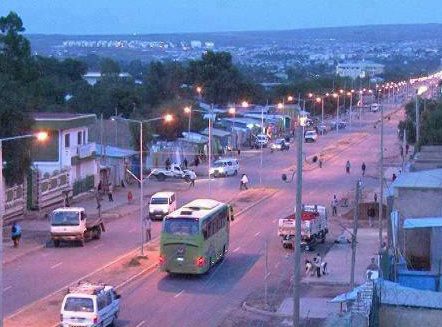
Jijiga at night.

Germame Neway, one of the leaders of the unsuccessful 1960 coup, served as governor over Jijiga in 1959. He had been transferred there for his civic responsibility and concern for the underprivileged while administering a district in Sidamo Province. The obstruction he encountered, not only in Sidamo but in Jijiga, convinced him of the need for radical measures.[36] In the early stage of the Ethiopian Revolution individual units from the Third Division put the local governor under house arrest around 13 April 1974.[31] During the Ogaden War, Jijiga experienced the Battle of Jijiga and was occupied by the Western Somali Liberation Front's Ahmad ibn Ibrihim al-Ghazi division led by Col. Yusuf Dheere, later with the Somali National Army, from September 1977 until February/March 1978.

The Regional government held a conference in this city to promote peace and development between 10 and 13 March 1996, which was attended by 535 from the local woredas, as well as the Deputy Prime Minister and Defense Minister of Ethiopia, Tamirat Layne, the Foreign Minister, Seyoum Mesfin, the presidents of the Tigray and Harari Regional states and representatives from Amhara and the Southern Nations, Nationalities, and People's Regions.[37] On 28 May 2007, during the celebration of Ginbot 20 (celebrating the downfall of the Derg), Jijiga and Degehabur were the scenes of attacks on civilians and government officials. At least 16 people were killed and 67 injured, including Abdulahi Hassan Mohammed, president of the Somali Region, who was speaking at the ceremony. The Ethiopian government blamed the attack on the Ogaden National Liberation Front.[38]

Historic Fooq Dheere building in Jijiga.

On 29 May 2008, following a heavy downpour the Jijiga River broke its banks and flooded several kebeles in the town and the vicinity. The flooding killed 29 people and displaced 350 households.[39] On 27 September of that year, a bomb exploded outside a hotel in Jijiga killing four and wounding 20. Local police apprehended a suspect whom they claimed was a member of Al-Itihaad al-Islamiya.[40]

Demographics

[edit]
Ethnic groups of Jigjiga (2007)[41]
  1. Somali (82.8%)
  2. Amhara (8.27%)
  3. Oromo (4.31%)
  4. Gurage (2.15%)
  5. Other (2.48%)

Based on the 2007 Census conducted by the Central Statistical Agency of Ethiopia (CSA), Jijiga had a total population of 203,588 of whom 109,138 were men and 94,450 women. Ethnic groups in the city include the Somali (168,551, 82.79%), Amhara (16,837, 8.27%), Oromo (8,775, 4.31%), and Gurage (4,379, 2.15%); all other groups made up 2.48% of the total population.[42] Members of Somali clans in this city include the Jidwaaq, Akisho, Ogaden, Gadabuursi and Geri Koombe, and the Sa'ad Musa subclan of the Habr Awal, with a minor presence of some other clans like the Sheekhaal.[43]

The results of the 1994 census in the Somali Region were not satisfactory, so the census was repeated in 1997. This census reported this town had a total population of 65,795 of whom 33,266 were male and 32,529 female. The predominant religion in this city Jijiga is Muslim. As of 1997, the ethnic composition of the town was 61.58% Somali, 23.25% Amhara, 7.32% Oromo and 4.37% Gurage, and 1.48% Tigrayan; all other ethnic groups made up 1.99% of the population.[44] This city is the largest in the whole Somali region.[45]

Climate

[edit]

The climate of Jijiga is a subtropical highland climate (Köppen climate classification: Cwb). extremely wet and lush during rainy season, as with the rest of the Ethiopian highlands, Seasonal differences relate only to rainfall, as temperatures year-round are cool to mild in the mornings and uniformly very warm though not hot during the afternoons.

There are two rainy seasons: the main meher rains occur from July to September, and the short belg rains in April and June. The dry season, known as bega, is cooler by morning than the wet seasons due to lower cloud cover, but equally hot by afternoon though less humid.

Climate data for Jijiga, elevation 1,644 m (5,394 ft)
Month Jan Feb Mar Apr May Jun Jul Aug Sep Oct Nov Dec Year
Mean daily maximum °C (°F) 27.6
(81.7)
28.8
(83.8)
29.5
(85.1)
28.5
(83.3)
28.8
(83.8)
27.9
(82.2)
26.8
(80.2)
26.9
(80.4)
27.5
(81.5)
28.1
(82.6)
27.8
(82.0)
27.2
(81.0)
28.0
(82.3)
Mean daily minimum °C (°F) 8.5
(47.3)
10.1
(50.2)
11.9
(53.4)
13.7
(56.7)
14.5
(58.1)
15.5
(59.9)
15.6
(60.1)
15.7
(60.3)
15.1
(59.2)
11.1
(52.0)
8.7
(47.7)
8.0
(46.4)
12.4
(54.3)
Average precipitation mm (inches) 12.4
(0.49)
21.5
(0.85)
50.1
(1.97)
106.3
(4.19)
77.7
(3.06)
32.9
(1.30)
60.2
(2.37)
85.5
(3.37)
88.0
(3.46)
39.4
(1.55)
18.1
(0.71)
10.1
(0.40)
602.2
(23.72)
Average relative humidity (%) 49 47 52 62 63 65 64 64 63 58 50 50 57
Source 1: Ethiopian Meteorological Institute[46]
Source 2: FAO (humidity)[47]

Ecology

[edit]

The vegetation is a grassland from the east and south of the city towards wajaale, with Pockets of juipars and gum forest in higher altitudes in the northern and western part of the city, there is extensive history of animal life in the past. For example, the area was earlier a habitat for the African wild dog, Lycaon pictus,[48] although this canid is likely extirpated at present in the local area, due to an expanding human population.

In his memoirs of his homeland, Nega Mezlekia describes Jijiga as sitting "on the edge of a vast, unmitigated valley on the bottom of Mount Kramanda the beginning of the mighty Ethiopian highlands, with vast lush greenery in sight, rolling hills and plains dotted with many farms in all directions the soaring Eastern Ethiopian Highlands slowly climbing west, the very common tall grassland tree used as shelter by the wandering hyena, and the inevitable sacred tree in every compound, trees in this area of the Somali region reach great heights with the help of generous rainfall year-round, the native Somalis in the area would use this area as a dry season grazing land for all the noble tribes of the land. The city is surrounded by rocky tall green mountains on all sides save the north all the way past nearby Harar all the way to Addis, which is open as far as the eye can see."[49]

Sites

[edit]

Numerous locations in proximity to Jijiga possess tourism potential, including a cave that was historically utilized by Garad Wiil Waal and a mosque that originates from 1315 during the Harla Kingdom. The area around Jijiga also features scenic views counting the Hamran Mountain in Awbare district.[50]

Notable people

[edit]

Notes

[edit]
[edit]
Revisions and contributorsEdit on WikipediaRead on Wikipedia
from Grokipedia

Jijiga is the capital city of the Somali Regional State, an administrative division of predominantly inhabited by ethnic Somalis in the eastern part of the country. Located in the approximately 70 kilometers west of the border with Somalia, the city sits at an elevation of roughly 1,680 meters above and coordinates of 9°21′N 42°47′E. It became the regional capital in 1995, succeeding , and has since emerged as a primary commercial center for cross-border trade, including exports, production, and informal exchanges with neighboring and . The population was 203,588 according to the 2007 Ethiopian census, with projections estimating around 417,000 residents by 2022 amid ongoing urban growth and regional migration dynamics. Jijiga's historical role as a town, formalized in the early , underscores its strategic position in Ethiopia-Somali relations, marked by periods of conflict such as the , yet it remains a focal point for Somali cultural identity and economic activity within Ethiopian .

Etymology

Name Origins and Linguistic Roots

The name Jigjiga (Somali: Jigjiga), the standard Somali-language form used locally, derives from the onomatopoeic expression jig-jig, which replicates the rumbling sounds of earthquakes or the repetitive noise produced by traditional water-drawing methods, such as pulling ropes over wells. This origin aligns with the area's geological activity in the Ethiopian margins and its longstanding function as a pastoralist halting point reliant on access in a semi-arid environment. Linguistically, Jigjiga belongs to the , an Eastern Cushitic tongue within the Afroasiatic family, spoken by the Somali ethnic majority in the where the city is situated. Somali orthography renders it as Jigjiga, emphasizing the geminated consonants typical of the language's phonological structure, which features pharyngealized and emphatic sounds absent in neighboring Highland East Cushitic varieties like those of . No deeper proto-Cushitic roots for the term have been definitively traced in available linguistic studies, though in Somali often draws from environmental and daily pastoral cues to name settlements. Claims linking it to Sidamo (a Highland East Cushitic language spoken farther south) as denoting a "wide " appear in informal sources but lack corroboration from etymological or , given the Somali dominance in the region's since at least the .

Geography

Location and Physical Setting


Jijiga is situated in the Fafan Zone of the Somali Region, in eastern Ethiopia, serving as the regional capital. The city lies approximately 75 kilometers west of the international border with Somaliland. Its geographic coordinates are 9°21′N latitude and 42°48′E longitude.
The urban center is positioned at an elevation of 1,634 meters above , within the broader Jijiga Plains that feature relatively flat terrain around 1,700 meters. Surrounding includes a mix of flat to gently sloping areas, hills, and mountainous features characteristic of the zone. This setting places Jijiga in a semi-arid highland plateau, influencing local patterns dominated by and dryland .

Climate Patterns

Jijiga features a hot (BSh) under the Köppen-Geiger classification, characterized by warm temperatures year-round, low humidity, and limited but seasonally variable . Average annual rainfall ranges from approximately 414 mm to 712 mm depending on the dataset, with most sources indicating totals around 400-500 mm, reflecting the region's aridity despite its elevation of about 1,600 meters. Temperatures exhibit moderate diurnal variation due to , with daytime highs typically between 25°C and 28°C and nighttime lows from 7°C to 15°C. The hottest period occurs from to April, when highs average 28-29°C (e.g., 29°C in ), while the coolest months are to September, with highs below 26°C influenced by during rains. Annual extremes can reach 32°C or drop to 6°C, but muggy conditions are absent year-round, with relative averaging 47-65%. Precipitation follows a bimodal pattern typical of the Ethiopian lowlands and Somali Region, with a primary wet season from March to May (peaking at ~94 mm in April) and a secondary peak in July to August (~80-127 mm), accounting for over 70% of annual totals; the driest months are November to February, often receiving less than 10 mm. Rainy days number around 85 annually, concentrated in the wetter periods, leading to a wetter season from late March to late September (over 28% chance of wet days) versus a drier phase thereafter. Winds are moderate, peaking at 14-15 mph in July during the wet season. Recent trends in the Somali Region indicate increasing aridity, with hotter and more unpredictable patterns exacerbating drought risks, though station-specific data for Jijiga confirms the semi-arid stability.

Ecological Features

The ecological landscape surrounding Jijiga consists primarily of semi-arid rangelands within the Somali Regional State, dominated by open woodlands and shrublands featuring Acacia species that support pastoral grazing economies. These vegetation types are adapted to the region's low and erratic rainfall, with rangelands comprising approximately 90% of the area's land cover, influencing both biodiversity and land use patterns. In the Jijiga plains, low vegetation cover contributes to high potential net primary productivity due to reduced evapotranspiration, while mountainous areas exhibit denser cover moderated by topography and soil characteristics. Vegetation diversity in the vicinity is shaped by traditional grazing practices, with studies documenting shifts in plant biomass and species composition under pastoral management in the Jigjiga field site. Ethnobotanical surveys have identified numerous medicinal plants utilized by local communities, reflecting the region's herbal resources amid arid conditions. However, invasive species such as Prosopis juliflora pose threats to native plant diversity and rangeland integrity in nearby districts, altering species abundance and occurrence. Faunal diversity includes a range of mammals native to the Somali Region's rangelands, though pastoral activities and pressures limit populations; surveys highlight constraints like loss and human-wildlife conflict affecting species abundance. The Jijiga is recognized as part of Ethiopia's hotspots, encompassing in and alongside microbial diversity, underscoring its ecological significance despite aridity. Environmental degradation from and land use changes further challenges resilience in the Upper Fafan Catchment, where Jijiga is situated.

History

Early Settlement and Pre-Colonial Period

The region surrounding modern Jijiga was linked to the medieval Muslim polity known as Gidaya, referenced in 14th-century Ethiopian chronicles such as that of Emperor Amda Seyon and in the Futuh al-Habasha, positioning it east of between Ifat and Adal on the Harar plateau. This area featured early Islamic influences amid broader dynamics, though specific settlement details remain limited due to reliance on chronicles focused on conflicts rather than demographics. By the pre-19th-century period, the Jijiga lowlands and plains were predominantly occupied by Somali clans practicing , including groups like the , who controlled grazing lands without subjugation to highland Ethiopian kingdoms. These communities maintained through clan-based and mobility, utilizing the arid ecology for livestock herding of camels, , and , with seasonal migrations dictating settlement patterns rather than fixed villages. No centralized urban center existed at Jijiga prior to Ethiopian imperial expansion; the site's strategic value emerged later amid raids and conquests, but the locale's pre-colonial use centered on transhumant routes connecting to trade networks, free from Shewan oversight until Menelik II's campaigns in the 1880s–1890s. Historical records indicate Somali clans in the expanse, including around Jijiga, operated independently, resisting incursions while engaging in limited commerce with coastal and highland entities.

Colonial Era and British Occupation

During the Italian occupation of from 1936 to 1941, Jijiga, located in the region, came under the administration of , which incorporated the area into a broader colonial framework aimed at exploiting resources and securing strategic frontiers. Italian forces had briefly asserted control over parts of the earlier, but the full occupation followed the conquest of in May 1936, with Jijiga serving as a logistical node in the eastern lowlands. In the East African Campaign of , British-led Allied forces advanced against Italian positions, capturing Jijiga on , 1941, with the 23rd Nigerian Brigade of the British 1st African Division encountering minimal resistance as Italian defenses collapsed in the region. This unopposed seizure marked a key step in liberating eastern , enabling Allied supply lines and disrupting Italian reinforcements from . Post-liberation, British authorities established the Ogaden Reserved Area under military administration, with Jijiga functioning as a primary administrative hub for governance, taxation, and security operations until 1948. This period involved joint British-Ethiopian oversight initially, but Britain retained de facto control over the Ogaden, including customs and border management, amid growing Somali irredentist sentiments favoring incorporation into British Somaliland rather than restoration to Ethiopian sovereignty. The administration prioritized stability and livestock trade, yet sowed seeds of ethnic tension by deferring final territorial decisions to postwar negotiations. By July 1948, under Anglo-Ethiopian agreements, Britain evacuated the , handing Jijiga and surrounding districts back to Ethiopian imperial forces, a transfer that ignored local Somali assemblies' petitions for and prompted immediate unrest, including demonstrations suppressed by Ethiopian troops. This handover, formalized despite deliberations on the region's status, reinforced Ethiopian claims but fueled long-term separatist grievances in the area.

Post-WWII Handover and Integration

Following the expulsion of Italian forces from in 1941, British military authorities established administration over the region, including Jijiga, treating it as an extension of Protectorate until the end of . This provisional control stemmed from the Anglo-Ethiopian Agreement of 1942, which granted Britain temporary authority over the area pending postwar negotiations, amid Ethiopia's limited capacity to reassert sovereignty immediately after liberation. The British administration facilitated basic governance, security, and cross-border trade but deferred final disposition to international agreements, ignoring early Somali petitions for self-rule or incorporation into a . In July 1948, under pressure from the and , Britain transferred sovereignty of the to , restoring pre-1936 borders despite vehement Somali opposition. formally regained authority on July 24, 1948, with the handover process concluding by September 12, when the last outpost at Mustahil was relinquished. In Jijiga, Ethiopian military officers promptly assumed administrative control upon British withdrawal, quelling demonstrations by local Somali residents who protested the loss of . This integration incorporated Jijiga into Ethiopia's Province under imperial oversight, emphasizing centralized taxation, land use policies favoring highland settlers, and Amharic-language bureaucracy, which exacerbated ethnic grievances among the predominantly Somali population. Initial integration efforts included infrastructure development, such as road links to , but were marred by coercive measures, including disarmament campaigns and suppression of clan-based resistance, setting precedents for future insurgencies. Somali leaders repeatedly petitioned the for plebiscites on between 1946 and 1955, citing the region's cultural and linguistic ties to , but these were rejected in favor of Ethiopian . The exclusion of the and Reserved Areas—fertile grazing zones adjacent to —until their transfer in 1954-1955 further highlighted Britain's phased withdrawal, leaving Jijiga's inhabitants under Ethiopian rule without resolving underlying irredentist claims.

Derg Regime and Early Insurgencies

The , Ethiopia's Marxist-Leninist that seized power in a 1974 coup, imposed centralized control over peripheral regions like the , including Jijiga, through policies of , forced collectivization, and suppression of ethnic autonomist movements, exacerbating local grievances among Somali clans who sought greater or unification with . These measures, including the 1975 that redistributed pastoral lands, fueled resentment in Jijiga, a key trading hub at the crossroads of and Somali lowlands, where Somali had simmered since the . In response, the (WSLF), founded in 1976 by Somali exiles and local fighters under leaders like Yusuf Dheere Mohamed Sugaal, launched an insurgency against Ethiopian forces in the , targeting garrisons and supply lines around Jijiga to press for Somali independence from Ethiopian rule. By early 1977, WSLF guerrillas, numbering several thousand and armed with smuggled weapons from , conducted hit-and-run attacks on Ethiopian outposts near Jijiga, disrupting control and drawing international attention amid Somalia's irredentist claims. The insurgency escalated into the Ogaden War when Somali government forces, under President Siad Barre, invaded in July 1977 to support the WSLF, rapidly advancing to capture Jijiga by mid-September after fierce fighting that overwhelmed the outnumbered Ethiopian garrison of approximately 1,500 troops. Somali and WSLF forces secured the strategic Dire Dawa-Jijiga road, controlling the town and nearby Harar pass, which facilitated further incursions into the highlands and marked the deepest Somali penetration, with Jijiga serving as a forward base for an estimated 15,000-20,000 combatants. By late 1977, the , bolstered by Soviet arms shipments and troop deployments totaling over 15,000 soldiers, counterattacked; Ethiopian-Cuban forces recaptured Jijiga in March 1978 after a involving assaults and artillery barrages that killed thousands, including heavy civilian casualties in the town, effectively ending major Somali conventional operations but not the underlying . Post-war, the Derg intensified counterinsurgency in Jijiga and the surrounding through villagization programs that relocated over 100,000 nomads into controlled settlements by 1984, aiming to sever WSLF logistics, though these efforts displaced populations and sustained low-level Ogadeni and Oromo guerrilla resistance into the 1980s. WSLF remnants, fragmented but persistent, continued ambushes on Derg convoys near Jijiga, contributing to Ethiopia's broader southeastern instability until the regime's fall in 1991.

Ethnic Federalism and ONLF Conflict

Ethiopia's system, formalized in the 1995 constitution following the EPRDF's rise to power in , reorganized the country into nine regions delineated primarily by ethnic majorities, granting each substantial including the to under Article 39. The Somali Regional State (Region 5), encompassing the area with Jijiga as its capital, was established to address Somali grievances over historical marginalization and centralization under previous regimes. This framework aimed to accommodate ethnic diversity but exacerbated intra-regional clan rivalries among Somali subgroups, such as the Ogaden, Issa, and others, by tying political representation and resource allocation to ethnic identities, often leading to disputes over administrative boundaries and power-sharing. The (ONLF), formed in 1984 by ethnic Somalis seeking greater autonomy or independence for the , initially aligned with the transitional government's federalist experiment by dominating the 1993 regional constituent assembly elections in the . However, tensions escalated when the ONLF-led assembly in February 1994 passed a resolution invoking the right to , prompting federal intervention and the replacement of ONLF leadership with more compliant groups like the Ethiopian Somali Democratic League (ESDL). This shift fueled ONLF grievances, transforming the group into an insurgent force that boycotted subsequent elections, including the 1995 regional polls, and launched a low-intensity guerrilla campaign against (ENDF) positions across the region. The ONLF insurgency intensified in the 2000s, peaking during the 2007 Ogaden conflict, where the group conducted ambushes, bombings, and attacks on , including exploration sites, in response to federal operations accused of against civilians. Jijiga, as the political and economic hub, became a focal point for these tensions, hosting federal security deployments and serving as a base for efforts while experiencing sporadic ONLF-linked disruptions to governance and clan-mediated initiatives. Federal responses, including states of declared in 2007 and enforced by regional paramilitaries like the Liyu Police, were criticized for blurring lines between and ethnic repression, contributing to cycles of violence that displaced thousands and strained inter-clan alliances within the federal structure. Ethnic federalism's emphasis on Somali homogeneity overlooked internal divisions, amplifying ONLF's narrative of federal betrayal and enabling rival clan-based parties, such as the Somali People's Democratic Party (SPDP) formed in 1998 from ESDL-ONLF mergers, to consolidate power through patronage while marginalizing ONLF supporters. Boundary conflicts with adjacent Oromia Region, unresolved despite federal arbitration mechanisms, further inflamed separatist sentiments, with Jijiga's strategic location heightening its role in proxy clan skirmishes over pastoral resources. By prioritizing ethnic self-rule over national cohesion, the system inadvertently sustained ONLF's appeal among Ogaden clan segments, perpetuating insecurity and hindering development in the Somali Region until external pressures prompted partial de-escalation.

Abiy Ahmed Era Reforms and Tensions

's tenure as , beginning in April 2018, marked a shift in the Somali Region's governance, starting with the ouster of regional president Abdi Mohamed Omar on August 22, 2018, which curtailed the Liyu Police's role in suppressing dissent and reduced civilian attacks that had intensified under Omar's administration. This was followed by the (ONLF) signing a peace accord with the federal government in on October 22, 2018, committing to disarmament completed by February 2019 and opening political avenues for ethnic Somali representation without violence. These measures fostered relative stability, enabling infrastructure initiatives in Jijiga, the regional capital. By October 2025, the "Dine for Nation" project had constructed thousands of standardized housing units and developed a 20-kilometer corridor featuring granite-paved walkways, upgraded utilities, and dedicated cycle lanes, as highlighted during Abiy's visit praising the city's transformation and potential for tourism-driven growth. Administrative expansions, including new districts and zones, aimed to enhance local governance but have been critiqued for lacking strategic coherence amid dynamics. Initial implementation faced ethnic frictions, including Somali-Oromo border clashes from late 2017 into that displaced nearly 1 million people and prompted looting of minority properties in Jijiga on August 4, , amid federal-regional force confrontations killing at least 29. Abiy's April visit to Jijiga sought to mediate these tensions, yet sustaining remains challenged by inter-clan disputes and perceptions of uneven federal adherence to the ONLF deal, contributing to sporadic unrest risks as of 2025.

Government and Politics

Administrative Role as Regional Capital

Jijiga serves as the administrative center of the Somali Regional State, Ethiopia's ethnically federalized region encompassing predominantly Somali-inhabited territories in the east. Designated the regional capital in 1994 following the restructuring of Ethiopia's administrative divisions under the 1995 Constitution, it replaced as the provisional seat of governance to centralize regional operations amid post-Derg federal reforms. This shift positioned Jijiga, located in the approximately 70 kilometers west of the border, as the primary locus for regional policy formulation and execution. The city's administrative apparatus includes the regional presidency, which leads the executive branch, and the Somali Regional State Council, functioning as the legislative body responsible for enacting regional laws and approving budgets. Key bureaus headquartered here oversee critical functions such as revenue collection under Proclamation No. 979/2016, management, and service delivery in , , and , often adapting federal directives to pastoralist and arid-zone realities. Coordination with Ethiopia's federal government occurs through liaison offices and periodic alignments on national development plans, though regional has historically enabled localized on clan-based disputes and . Jijiga's role extends to hosting federal and international outposts, including a UNHCR sub-office supporting coordination and returnee integration in zones like Fafan and nearby areas. Administrative challenges persist, including capacity constraints in revenue mobilization—where own-source revenues constituted under 10% of expenditures in recent assessments—and vulnerabilities to ethnic tensions disrupting continuity. Despite these, the capital status has facilitated infrastructure investments, such as road links enhancing access to administrative services across the region's nine zones.

Governance Structures and Challenges

The Somali Regional State maintains a federal-style governance structure, with an elected regional serving as the legislative body that selects the president as head of the executive branch. Mustafe Mohamed Omer was re-elected as president by the , overseeing policy across the region's zones, woredas, and kebeles. Jijiga, as the regional capital, hosts key administrative offices, including the president's office and communication bureau, while the city's municipal administration operates under a , , and executive committee responsible for local services such as sanitation, licensing, and urban development. Eng. Shaafi Axmed Macalin was appointed in February 2024, succeeding Siyad Abdi Ahmed. Governance faces systemic challenges rooted in clan dynamics and weak institutional capacity, where appointments often prioritize kinship ties over merit, fostering ethnic favoritism and corruption. A August 2025 petition to Prime Minister alleged collapse of regional oversight, citing illicit fund transfers exceeding millions of birr and biased resource distribution favoring specific . Informal practices, including bribes and unregulated taxes in markets like Kudra Terra, persist due to limited state enforcement, particularly in low-value sectors like vegetable trade. The rapid creation of 14 new districts in July 2025, raising the total significantly, has drawn criticism for diluting administrative focus without addressing or deficits in Ethiopia's second-largest region by landmass. Persistent insecurity from past insurgencies and inter-clan conflicts hampers efforts, with uneven service delivery favoring urban Jijiga over pastoralist peripheries. Historical incorporation of the , marked by punitive campaigns until 1931, has entrenched mistrust toward central authority, complicating integration under . Shrinking civic space and youth outmigration, driven by unaddressed grievances, further strain legitimacy, despite reported security gains in the city.

Ethnic and Separatist Controversies

Jijiga, as the capital of Ethiopia's , has been a focal point for ethnic clashes primarily between the Somali majority and Oromo communities, exacerbated by territorial disputes under the system established in 1991. In late 2017, violence between Somali regional forces and Oromo groups led to the displacement of approximately 50,000 Oromos from Jijiga, which had a of around 125,000 at the time, amid broader clashes that affected nearly one million across the Somali and regions. These incidents involved looting, arson, and forced evictions, with reports of Somali militias targeting Oromo neighborhoods in the city. In August 2018, hundreds protested in Jijiga against such violence, following reports of Somali perpetrators burning and vandalizing Oromo-owned properties during clashes between federal forces and regional paramilitaries. More recently, in October 2025, ongoing Somali-Oromo conflicts displaced around 100 Somali families to the outskirts of Jijiga, highlighting persistent land and resource disputes in border areas. Separatist controversies in Jijiga center on the Ogaden National Liberation Front (ONLF), a Somali insurgent group founded in 1984 that has pursued self-determination for the Somali-inhabited Ogaden region, including calls for independence or a referendum. The ONLF conducted guerrilla operations targeting Ethiopian forces, such as the April 2007 attack on an oil exploration site near Jijiga, killing 67 soldiers and nine Chinese workers, which escalated the insurgency and drew international attention to underdevelopment and grievances in the region. Peace talks in 2018 led to a cessation of hostilities, with ONLF leaders returning from Eritrea, but tensions persist; in July 2025, the group rejected a conference in Jijiga organized by state-backed entities, deeming it illegitimate and a ploy to undermine Somali self-determination aspirations. These separatist dynamics have intertwined with ethnic violence, as ONLF has expressed concerns over federal interventions in the region exacerbating clan and inter-ethnic divides, including during the 2018 ouster of regional president Abdi Mohamoud Omar, which involved clashes in Jijiga between national troops and local Liyu police. Historical myths of violence and sovereignty in Jijiga further fuel narratives of legitimate rule among Somalis, often clashing with Ethiopian central authority claims.

Demographics

Population Dynamics and Growth

The population of Jijiga town was enumerated at 203,263 in the 2007 Population and Housing Census conducted by Ethiopia's Central Statistical Agency. Projections for the broader Jijiga district, which encompasses the town and surrounding rural areas, indicate a population of 417,688 as of 2022, reflecting an annual growth rate of approximately 2.7% from 2007 levels based on official Ethiopian statistics. This growth aligns with regional trends in the Somali Regional State, where the overall population increased by 26.95% between the 2007 census and the 2024 census update. Key drivers of Jijiga's population expansion include elevated natural increase rates, characteristic of pastoralist communities in the with total fertility rates exceeding the national average of around 4 children per woman, alongside substantial rural-to-urban migration. Migrants from rural woreda are drawn to the city as the regional capital, seeking in , administration, and services, as well as improved access to and healthcare amid recurrent droughts and clan-based insecurities in pastoral hinterlands. Urban planning documents estimate the city's metropolitan population, including peri-urban settlements, at up to 1.2 million as of 2023, underscoring accelerated expansion fueled by these inflows and a reported urban growth rate approaching 9.9% annually in earlier assessments. Episodic conflicts, including insurgencies by groups like the , have periodically disrupted growth through displacement, with influxes of internally displaced persons straining resources during peaks in violence prior to reforms. Post- stabilization under Prime Minister has facilitated rebound, with urban built-up areas expanding by over 277% in select periods, accommodating demographic pressures through informal settlements and infrastructure strain. Density in the core urban kebeles now exceeds 12,000 persons per square kilometer, highlighting challenges in service provision amid sustained inflows.

Ethnic Composition and Social Structure

Jijiga's is predominantly ethnic Somali, reflecting the broader demographics of Ethiopia's Somali Regional State. According to data from the 2007 administered by Ethiopia's , Somalis accounted for approximately 93% of the city's residents, with Amhara comprising about 2%, Oromo around 1%, and Gurage roughly 0.5%; other groups made up the balance. This remains the most detailed public enumeration available, as subsequent national counts have faced delays and nomadic challenges in the region, potentially undercounting mobile pastoralists. Urban growth and internal migrations since 2007, driven by economic opportunities and conflict displacements, have introduced more non-Somali residents, particularly Amhara and Oromo traders and civil servants, though Somalis continue to form the overwhelming majority. The social structure in Jijiga centers on the Somali clan's patrilineal, system, which organizes , economic cooperation, and [dispute resolution](/page/Dispute resolution) among pastoralist and urban communities alike. Clans function as extended networks providing mutual support, with loyalty scaling from primary lineages (diya-paying groups responsible for blood compensation) to larger clan families. The clan family predominates, encompassing sub-clans such as the (the largest in the region, estimated at 45-50% of the Somali population), , Issa, and branches including Jidwaaq and Geri; these groups intermarry within compatible alliances but maintain distinct identities influencing resource access and alliances. Minor outcast castes like the (artisans) and Gaboye (occupational specialists) exist on the periphery, historically facing despite integration efforts. Among non-Somali minorities, social organization follows ethnic-specific patterns: Amhara communities often center on Orthodox Christian networks and highland ties, while Oromo groups emphasize age-grade systems () adapted to urban settings. Clan dynamics extend into and , where sub-clan leaders (ugub) mediate with authorities, though federal ethnic policies have sometimes exacerbated intra-clan rivalries over representation in Jijiga's municipal . Inter-ethnic relations, shaped by hubs and shared markets, remain pragmatic but tense, as evidenced by occasional clashes over land and resources.

Religion, Language, and Cultural Identity

The residents of Jijiga are overwhelmingly adherents of Islam, mirroring the Somali Region's demographics where 98% of the population self-identifies as Muslim per Ethiopia's 2007 census. This predominance stems from historical Islamic migrations and settlements in the Horn of Africa, with Sunni Islam as the dominant sect, often incorporating Sufi practices among ethnic Somalis. Small Christian communities exist, primarily among Amhara and Oromo minorities, but they constitute a negligible fraction amid the region's near-universal Muslim identity. Somali serves as the primary in Jijiga, spoken by the vast majority of inhabitants and functioning as the official of the Somali Regional State. This Cushitic tongue, written in the since regional standardization efforts in the , reinforces communal bonds through , proverbs, and clan genealogies central to daily discourse. , Ethiopia's federal , is employed in inter-ethnic interactions, administration, and , especially by non-Somali traders, though Somali remains the in households and markets. Cultural identity in Jijiga centers on Somali ethnicity, defined by patrilineal clan systems—such as the confederation's subclan—that govern social organization, dispute resolution via customary law, and resource allocation in pastoral economies. This identity fuses nomadic heritage, with traditions of camel herding and mobility, alongside Islamic rituals like Eid celebrations and Quranic schooling, fostering a distinct oriented toward loyalty and religious piety over national Ethiopian affiliations. Historical narratives, including resistance against colonial incursions led by figures like Sayyid Mohammed Abdullah Hassan, underscore a resilient pan-Somali consciousness that persists despite integration into Ethiopia's .

Economy

Primary Economic Activities

Pastoralism dominates the primary economic activities in Jijiga and the surrounding , where mobile herding sustains the majority of households through rearing camels, , sheep, and goats. These animals serve as sources of , , hides, and cash income via domestic sales and cross-border trade, particularly to markets in , , and the . The regional Bureau of Agriculture estimates the Somali Region's holdings at 11.5 million sheep and goats, 6 million camels, and 4.5 million , underscoring the scale of this sector in supporting and employment for communities. Sheep and goat production forms a core component of the local livelihood zone, with markets in Jijiga facilitating trade that bolsters household resilience amid arid conditions limiting crop cultivation. While agro-pastoralism incorporates limited rain-fed farming of crops like and millet in higher elevations around Jijiga, livestock remains the predominant activity, contributing disproportionately to Ethiopia's national economy despite infrastructural and disease-related vulnerabilities. Export restrictions on live animals, such as those imposed periodically due to health concerns, have historically disrupted cash flows, exacerbating economic pressures in areas including Jijiga. Recent initiatives, including feed production enhancements and improvements, aim to build resilience, but low and variability continue to constrain output.

Trade, Agriculture, and Pastoralism

Pastoralism dominates the economy of Jijiga and the surrounding , where rearing supports the majority of the population through nomadic and semi-nomadic herding of camels, , sheep, and . The holds approximately 23% of Ethiopia's sheep and 34% of its goat populations, underscoring the sector's national significance for livelihoods and export earnings. In Jijiga's , pastoral activities are integral to household income, with animals providing , , and draft power amid arid conditions. Livestock trade serves as a primary economic driver in Jijiga, facilitated by the city's role as a regional market hub with cross-border links to Somalia, Kenya, and Djibouti. The Jijiga Export Slaughterhouse processes small ruminants for international markets, capitalizing on the zone's high livestock densities to generate revenue and employment. Local trade fairs, such as the 2025 event in the Somali Region, highlight products like eggs, milk, and butter, promoting agro-pastoral integration and export potential. However, challenges including droughts and export bans have periodically disrupted flows, prompting shifts toward alternative livelihoods like petty trading. Agriculture in Jijiga remains supplementary to , constrained by low rainfall and reliance on rain-fed systems in the . Crops such as are cultivated for , with production efficiency varying by farm size and input access, as studied in local districts. The Pastoral and Agro-pastoral , based in Jijiga, supports hybrid systems through crop-livestock integration and development initiatives. Recent regional plans aim to expand irrigated and rain-fed farming for , though environmental vulnerabilities limit yields.

Development Initiatives and Constraints

Development initiatives in Jijiga have accelerated in recent years, particularly under the national "Dine for Nation" urban program, which has spurred construction of thousands of standardized housing units to address population pressures and promote inclusive growth. A flagship 20-kilometer corridor development project features granite-paved walkways, integrated utilities including water, electricity, telecommunications, and lighting, and has enhanced urban aesthetics and accessibility since its implementation in 2025. Road infrastructure expansions, such as the 366-kilometer all-weather Jigjiga-Gelelesh-Degehamdo highway and rehabilitations linking to border areas like Awbare, aim to boost intra-regional trade and connectivity with Somalia, with paving works completed or underway by mid-2025. Energy and water access projects further support economic viability; the Jijiga-Degehabur line, extending 170 kilometers along the border, improves reliability for industrial and household use. In May 2024, the Global Alliance for Food Security (GAFA) initiative launched in Jijiga through UNDP and (CIFF), providing in-kind contributions from federal and regional governments to enhance sustainable water systems amid pastoralist vulnerabilities. Persistent constraints hinder these efforts' impact and sustainability. Security issues, including ethnic tensions, clan-based conflicts, and spillover risks from groups like Al-Shabaab, have historically disrupted investments and in the . Political instability and limited administrative capacity exacerbate inefficiencies in utilization and execution, despite the region's potential and strategic . Climate vulnerabilities, such as recurrent droughts and floods, undermine resilience, with inadequate , intermittent , and housing maintenance posing ongoing urban challenges as of 2025. Past mismanagement has also impeded donor effectiveness, requiring reforms for long-term gains.

Infrastructure and Services

Transportation and Connectivity

Jijiga is primarily connected to the rest of via a network of federal and regional roads, with the main artery linking it to approximately 153 kilometers to the southwest, facilitating access to and eastern trade routes. In 2018, the Ethiopian government signed agreements for a 244 million USD project from Jijiga to , aimed at improving the corridor connecting the to broader national infrastructure. Additionally, the Jijiga–Awbare Road, spanning into areas near the Somali border, enhances cross-border trade, agricultural access, and emergency services as of July 2025. Air connectivity is provided by Jijiga Airport (IATA: JIJ, ICAO: ), which supports three domestic routes operated exclusively by , including a 439-kilometer to . The airport features a dedicated 2.75-kilometer connection as outlined in Ethiopia's Transport Master Plan. No international flights originate from Jijiga, limiting its role to regional domestic travel. While rail infrastructure exists in eastern Ethiopia via the Ethio-Djibouti line through , Jijiga lacks direct railway access, relying on for freight and passenger movement to ports and major hubs. Regional integration efforts in the emphasize road upgrades near borders, such as those linking Jijiga to Kenyan and Somali gateways, to bolster intra-regional connectivity.

Education and Healthcare Systems

Jijiga, as the capital of Ethiopia's , hosts several educational institutions, including primary and secondary schools under the regional administration and Jigjiga University, a institution established in 2008 with an enrollment of approximately 25,000 to 29,999 students across various programs, including and behavioral studies. The university features equipped classrooms, laboratories, and a supporting academic needs, though regional challenges such as pastoralist mobility and cultural preferences for early marriage contribute to high dropout rates, particularly among girls. education in Jijiga faces issues like inadequate and , as identified in assessments of and private facilities. Enrollment in the Somali Region lags nationally, with a primary net enrollment ratio of 73.9% for grades 1-6 and only 14.3% for grades 7-8, reflecting barriers including low —historically under 10% gross enrollment in 1991—and disparities where female participation remains limited due to social norms and insecurity. Efforts to address these include school feeding programs in Jijiga to boost attendance, though overall learning outcomes suffer from resource shortages and teacher absenteeism in remote areas. Healthcare in Jijiga relies on facilities such as Karamara Hospital, Jigjiga Health Center, and the recently upgraded Jigjiga University-Somali Health Youth Comprehensive Specialized Hospital, which added modern amenities like advanced equipment and expanded patient areas by 2023 to improve service delivery. Routine health information system varies, with accuracy rates of 92.2% at Karamara Hospital, 83.1% at Jigjiga Health Center, and 79.8% at nearby Ayardaga Health Center, indicating gaps in completeness and timeliness that hinder effective planning. Access remains constrained in the , where 65% of the population cannot reach a center within one hour by foot, exacerbated by arid terrain, nomadic lifestyles, and intermittent conflict, leading to low utilization for services like —regional coverage for under-five children in Jijiga falls short of national targets, with factors such as maternal education influencing uptake. Initiatives like CURE Ethiopia's mobile clinic in Jijiga target underserved children with disabilities, scheduling surgeries for cases identified through community assessments, though broader maternal and child indicators, including and mortality rates, reflect persistent disparities compared to urban Ethiopian averages.

Urban Development and Environmental Management

Jijiga's urban development has been characterized by rapid expansion driven by its strategic location along the Berbera Corridor, which facilitates trade links between Ethiopia's interior and ports in , attracting infrastructure investments such as roads and hubs. The city's surpassed 800,000 by 2025, with an annual growth rate of 9.9%, contributing to significant changes including urban densification exceeding 500% in built-up areas. Formal efforts include a master plan finalized in 1998 under the National Urban Planning Institute, which outlined amid post-1995 regional capital status, followed by a 2010 structure plan addressing land formalization and expansion needs. However, implementation faces constraints from informal land markets and border porosity, which have historically influenced unregulated growth and ethnic Somali cross-border dynamics. Environmental management in Jijiga grapples with inadequate infrastructure amid urbanization pressures, particularly in solid waste and water sectors. The city lacks a comprehensive sewerage system, relying on temporary open dumpsites vulnerable to flooding and posing health risks through open dumping and overflowing landfills. Household solid waste generation averages rates contributing to environmental hazards, with studies highlighting low public participation and improper disposal practices exacerbating contamination. Efforts to mitigate include GIS-based site selection for sanitary landfills incorporating environmental criteria like distance from water sources and socio-economic factors. In water supply, the Second Urban Water Supply and Sanitation Project, supported by international funding, includes fecal sludge treatment plants to address sanitation gaps, though challenges persist from drought-prone regional conditions and climate variability affecting pastoralist inflows. Regional initiatives emphasize water conservation and degraded land restoration, but urban-specific enforcement remains limited.

Culture and Landmarks

Cultural Practices and Traditions

The in Jijiga is predominantly organized around the patrilineal clan system characteristic of Somali society, where clans such as the and other subclans, including the Jidwaq near the city, define kinship, alliances, and resource access. This system influences through , emphasizing mediation by elders to maintain harmony among extended families. Family units are patriarchal and extended, with elders holding authority in decision-making, reflecting Islamic and nomadic heritage adapted to urban life in Jijiga. Oral traditions form a cornerstone of cultural expression, with poetry (gabay and jiifto) serving as a medium for historical narration, social commentary, and praise of heroes like Sayyid Mohammed Abdulle Hassan, whose legacy resonates in local recitations. These performances, often improvised and alliterative, occur at gatherings and reinforce clan identity and moral values, persisting despite urbanization in Jijiga. Storytelling and proverbs transmit knowledge across generations, prioritizing eloquence as a mark of prestige. Religious practices, rooted in , permeate daily life, with adherence to Sharia-influenced customs such as five daily prayers, fasting, and Eid celebrations marking communal bonds. Mosques serve as social hubs, and Islamic tenets shape norms, including offering tea and to guests. Traditional attire includes the macawiis for men and colorful hijabs for women, blending modesty with regional aesthetics. Rites of passage include , often arranged within clans to strengthen ties, involving bridewealth negotiations and feasts with recitals. Female genital cutting remains prevalent among Somali communities in the region, viewed by many as essential for eligibility and , though prevalence rates in eastern exceed 90% and face opposition from health campaigns citing complications like hemorrhage. Male occurs post-infancy in ritual settings, aligning with Islamic practice. Cultural festivals, such as those held in Jijiga in 2013, showcase dances, , and unity amid ethnic diversity.

Notable Sites and Tourism Potential

Jijiga features several cultural and historical landmarks that reflect its Somali heritage. The Sayyid Mohamed Abdullahi Hasan Roundabout, located at the city's heart, formerly hosted a prominent statue of the early 20th-century Somali leader Sayyid Mohamed Abdullahi Hassan, known for leading resistance against colonial powers including Britain, Italy, and Ethiopia from 1899 to 1920. The statue, erected in 2013, symbolized Somali identity and anti-colonial struggle but was removed in September 2025 amid political tensions. The Jijiga Central Mosque serves as a key religious site, with recent reconstructions preserving elements of traditional architecture while accommodating growing urban needs; the original structure dates back to earlier periods but was rebuilt after a 2009 fire. The Ethnological Museum of Jijiga stands as a significant repository of Somali cultural artifacts, including traditional tools, clothing, and ethnographic displays that document pastoralist lifestyles and historical migrations in the region. Nearby historical sites, such as the Alibilal Cave in Erer District approximately 100 km southeast, offer archaeological interest with prehistoric rock art and usage traces from local clans, though access remains limited. Tourism in Jijiga holds potential for cultural immersion and eco-adventure, leveraging the Somali Region's unique pastoral traditions, scenic Harar-Jijiga routes, and proximity to natural features like the Karamara Mountains and Babile rock formations. However, development faces constraints including historical insecurity from ethnic conflicts and insurgencies, inadequate , and minimal promotion, with visitor numbers remaining low compared to Ethiopia's northern historical circuits. Recent initiatives, such as the near-complete Dine tourism project announced in 2025, aim to enhance facilities and regional connectivity to capitalize on these assets. If security stabilizes and investments in roads and accommodations proceed, Jijiga could attract niche travelers interested in ethnology and adventure, potentially mirroring Harar's success.

Notable Individuals

Political and Military Figures

Sayyid Muhammad Abdille Hassan (1864–1920) was a Somali poet, religious scholar, and military commander who led the multi-decade Dervish movement against Ethiopian expansion and European colonial powers in the Horn of Africa. In January 1900, his forces overran the Ethiopian garrison at Jijiga, securing the town as a temporary base and disrupting imperial supply lines in the Ogaden. This victory highlighted early resistance to Ethiopian control in the region, though subsequent campaigns extended beyond Jijiga until his death. A bronze equestrian statue erected in Jijiga honors his legacy as a symbol of Somali defiance. Abdi Mohamud Omar, known as Abdi Iley, served as president of Ethiopia's Somali Regional State from 2010 to August , exercising centralized authority from Jijiga, the regional capital. His administration implemented extensive and security measures, which critics described as fostering and restricting civic freedoms in the city. Arrested in on charges of inciting violence and abuses, including mass detentions, he was released in March 2024 after years in custody. Mustafa Muhumed Omar, appointed president of the in August 2018, rose to prominence through activism in Jijiga against enforced disappearances under the prior regime, including the case of his uncle. Born in 1972 in Degehabur but politically active in the capital, he prioritized , for victims of past atrocities, and regional stabilization post-2018 transition. As of 2025, he continues in the role, engaging in cross-border diplomacy, such as attending events in neighboring Kenyan counties.

Intellectuals and Cultural Contributors

Nega Mezlekia, born in Jijiga in 1958 to a family of imperial bureaucrats, emerged as a prominent Ethiopian author chronicling the region's socio-political upheavals. His Notes from the Hyena's Belly: An Ethiopian Boyhood (Picador, 2000) vividly recounts his adolescence in Jijiga amid the 1974 revolution and ensuing , including personal losses such as his mother's death by sniper fire and his father's execution, drawing on firsthand experiences to depict the chaos of communist rule without romanticization. The work, praised for its unflinching realism, highlights Jijiga's arid urban environment and ethnic tensions, contributing empirical insights into Ethiopia's transition from to . Mezlekia's subsequent novel The God Who Begat a Jackal (Picador, 2007) extends this focus, weaving historical fiction around Emperor Haile Selassie's era and the Ogaden War's impacts on Somali-Ethiopian border dynamics, informed by his upbringing in the Somali Regional State. Writing primarily in English after fleeing Ethiopia in the 1980s and resettling in Canada, he bridges Amharic oral traditions with Western literary forms, offering causal analyses of authoritarianism's human costs rooted in observable events rather than ideological narratives. His oeuvre underscores Jijiga's role as a vantage point for observing Ethiopia's ethnic federalism experiments, though his non-Somali ethnic background—amid the city's predominantly Somali population—reflects the area's historical administrative diversity under imperial governance. Jijiga has fostered broader intellectual activity through institutions like Jigjiga University (established 2008), which hosts scholars in and heritage, such as Tesfamichael Teshale, whose research on regional megalithic sites documents indigenous cultural continuity amid modernization pressures. The Somali Intellectual Forum, headquartered in the city, promotes discourse on Somali scholarship, though specific individual outputs remain more organizational than biographical in available records. Cultural events like the annual Jigjiga International Book Fair (launched circa 2020s) convene poets, authors, and musicians from Somali regions, amplifying traditions central to local identity, yet prominent figures tied exclusively to Jijiga elude extensive documentation beyond Mezlekia's profile.

References

  1. https://www.[academia.edu](/page/Academia.edu)/28262281/Assessment_of_the_Impact_of_Urban_Expansion_on_the_Surrounding_Environment_of_Jigjiga_City
Add your contribution
Related Hubs
User Avatar
No comments yet.