


Community hub
Recent from talks
Contribute something
Nothing was collected or created yet.
Jon Fitch
View on Wikipedia
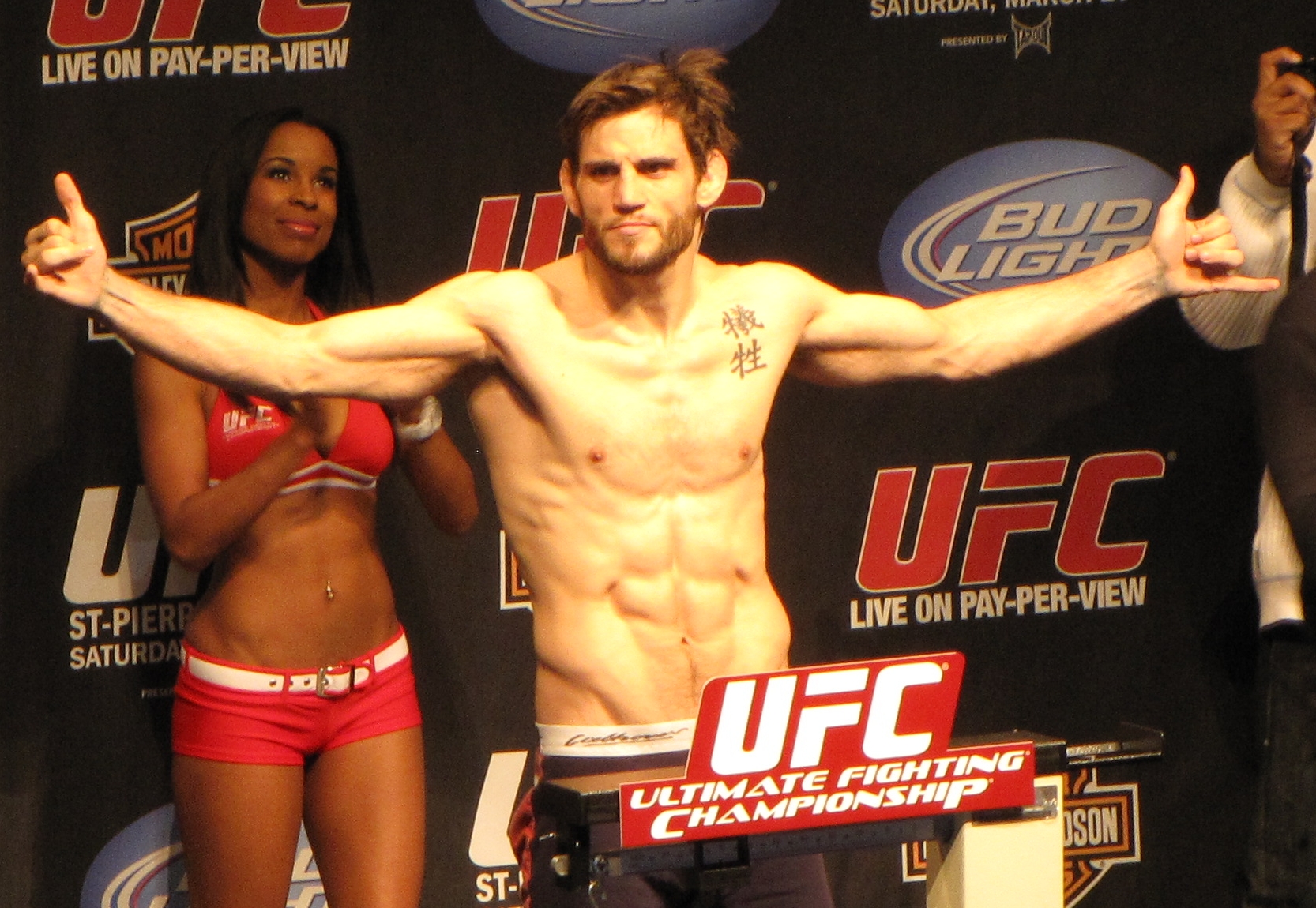
Jon Fitch (born February 24, 1978) is an American retired mixed martial artist. He has competed in the Welterweight divisions of the Ultimate Fighting Championship (UFC), the Professional Fighters League (PFL), and most recently for Bellator MMA. In the UFC, Fitch compiled a record of 14–3–1 and once challenged for the UFC Welterweight Championship. In the PFL, Fitch achieved championship success when he won the WSOF Welterweight Championship, and he also once challenged for the Bellator MMA Welterweight World Championship.
Key Information


Background
[edit] | This section of a biography of a living person does not include any references or sources. (March 2023) |
After graduating from Carroll High School, Fitch enrolled at Purdue University in 1997 and graduated in 2002 with a bachelor's in physical education and a minor in history. As a walk-on to the Purdue wrestling team, Fitch – a four-year letterman – wrestled under the tutelage of Tom Erikson and eventually became the team captain of his wrestling squad. Fitch secured a starting spot early on in his career, but struggled to find initial success. Compiling an 8–23 record his sophomore season, Fitch impressively turned that around to compile an 18–12 record in his final year. He finished with a 45–51 record overall for his collegiate wrestling career.
Tom Erikson – a former PRIDE fighter – would occasionally bring other mixed martial artists to the wrestling gym, and Fitch would be introduced to such fighters as Mark Coleman and Gary Goodridge. The sport, and the money that the high-level fighters were making interested Fitch, and he started his mixed martial arts career in 2002.
Mixed martial arts career
[edit]Jon Fitch began his career at light heavyweight with a record of four wins, two losses and one No Contest. Understanding[citation needed] that the sport required cross training in various martial arts, Fitch soon left for San Jose, California to train with the American Kickboxing Academy.[2]
In his next seven fights, Fitch fought at Middleweight and amassed wins over fighters such as Shonie Carter, Alex Serdyukov and Jeff Joslin. After failing to make the selection process for the first season of The Ultimate Fighter – a last-minute decision by the production team that left Fitch stranded in an airport with his luggage already boarded – he earned a shot in the Ultimate Fighting Championship on October 3, 2005, where Fitch defeated Brock Larson by unanimous decision in a middleweight fight.
Ultimate Fighting Championship
[edit]Drop to welterweight
[edit]Soon after, Fitch dropped down to the welterweight division and won his next seven fights. With victories over Josh Burkman, Thiago Alves, Luigi Fioravanti, Diego Sanchez, and Chris Wilson (tying the record set by Royce Gracie for most consecutive wins in the UFC), Fitch was seen as a top welterweight contender.[3] UFC President Dana White praised Fitch's performances inside the Octagon, and indicated that Fitch would fight the winner of the Georges St-Pierre vs. Matt Serra Welterweight title fight.[4]
Championship fight
[edit]Fitch was defeated by Georges St-Pierre via unanimous decision (50–43, 50–44, and 50–44) at UFC 87.[5] After the fight GSP spoke to Fitch about the growth that his own loss prompted and said that Fitch's experience should be no different.
Back to title contention
[edit]Fitch was released from the UFC on November 20, 2008.[6] The dispute was over his reluctance to sign a lifetime contract to allow his name and likeness to be used in THQ's UFC 2009 Undisputed video game.[7][8] In the end, Fitch ended up signing a licensing agreement that allowed the UFC to feature him in the video game, ensuring his return to the UFC.[9][10] Fitch's exile from the UFC lasted less than 24 hours.[11]
Fitch returned to action on January 31, 2009, at UFC 94, facing Pride FC veteran Akihiro Gono. Fitch was victorious via unanimous decision.[12]
On July 11, 2009, Fitch defeated previously unbeaten Brazilian Paulo Thiago via unanimous decision at UFC 100.
Fitch was expected to fight Ricardo Almeida on November 21, 2009, at UFC 106 but, due to a knee injury sustained by Almeida, the fight was cancelled.[13]
Fitch was then scheduled to face Thiago Alves in a highly anticipated rematch on December 12, 2009, at UFC 107.[14] However, Alves suffered an injury and was replaced by Mike Pierce.[15] Fitch won via unanimous decision.
Fitch was expected to finally face Thiago Alves on March 27, 2010, at UFC 111,[16] but on March 25, 2010, Alves was forced off the card due to a brain irregularity that appeared on a pre fight CAT scan. However, Ben Saunders, who was previously scheduled to fight on the same card against Jake Ellenberger, requested that he fight Fitch instead and that fight took place on the main card.[17] Fitch won the fight via unanimous decision.
The Alves/Fitch rematch finally took place at UFC 117 on August 7, 2010.[18] This fight was confirmed to be the number one contendership for the welterweight championship (to fight the winner of the St-Pierre/Koscheck bout). Alves again failed to make weight, weighing in at 171.5 lbs. As a result, Alves was fined 20% of his fight purse, which went to Fitch. Fitch went on to defeat Alves via unanimous decision.[19] Dana White later made remarks that the manner of Fitch's victories (primarily judges' decisions rather than finishes) and lack of connection with the UFC fans has put Fitch's number one contender status in doubt.[20] Following Jake Shields' victory over Martin Kampmann at UFC 121, White confirmed Shields as the next in line for the welterweight title shot, leaving Fitch's status in the division unconfirmed. Fitch found this peculiar, considering that Shields' victory was mostly the same as Fitch's previous performances.[21]
Fitch was expected to face Jake Ellenberger on February 5, 2011, at UFC 126.[22] But after B.J. Penn defeated Matt Hughes at UFC 123, UFC president Dana White decided to match Fitch up against Penn at UFC 127 in Australia instead.[23] At the end of the fight the scorecards of the judges were (29–28 Fitch, 28–28, and 28–28), resulting in the fight being declared a majority draw. When asked by Joe Rogan if Fitch would like a rematch, Fitch replied that he wants another title shot more than anything.
A rematch with Penn was expected to take place on July 2, 2011, at UFC 132.,[24] but in late March, Fitch pulled out of the bout with an injury.[25]
After months of dealing with a shoulder injury, Jon Fitch is back in business. “I’m back! Dr. Kavitne gave me the ok to fight,” he tweeted. Fitch has made no small secret of his desire to fight on the UFC 139 fight card that takes place in his city of residence, San Jose, California.[26]
Fitch fought Johny Hendricks on December 30, 2011, at UFC 141.[27] He was knocked out 12 seconds into the fight.
Fitch was expected to face Aaron Simpson on July 11, 2012, at UFC on Fuel TV: Munoz vs. Weidman.[28] However, Fitch pulled out of the bout citing a knee injury and was replaced by returning veteran Kenny Robertson.[29]
Fitch defeated rising prospect Erick Silva via unanimous decision on October 13, 2012, at UFC 153,[30] with the back-and-forth bout receiving Fight of the Night honors. In a prefight interview, Fitch mentioned that he was experiencing tremendous financial difficulties and that losing the fight would force him to end his full-time training so that he could get a day job to help support his family. After winning the fight, he said the victory had saved his MMA career.[31]
Fitch next faced Demian Maia on February 2, 2013, at UFC 156.[32] Fitch lost by unanimous decision and was subsequently released from the promotion, despite being a top 10 ranked welterweight and having a 14-3-1 record with the promotion overall.[33][34] Fitch's release from the promotion caused much debate about the UFC "code of conduct" and the general "skill-demand" in UFC, as most commentators had not expected a single loss to lead to a release from the promotion. Dana White defended this by saying he is a top 10 fighter who was on his way out, being ranked lower and lower after every fight.[35]
World Series of Fighting
[edit]On March 7, 2013, it was announced that Fitch signed a four-fight contract with World Series of Fighting.[36] He made his promotional debut on June 14, 2013, at WSOF 3, in a rematch against Josh Burkman. Fitch was knocked down by a punch and then finished by Burkman due to a guillotine choke submission. Burkman became the second man to defeat Fitch by a submission, the first being Mike Pyle.
Fitch faced Marcelo Alfaya at WSOF 6 on October 26, 2013,[37] winning via split decision. Despite spending most of the first round trapped in a body triangle defending against submission attempts, Fitch showed improved striking in a back-and-forth fight, dropping Alfaya and following up with heavy ground-and-pound in the third.[38]
In his third fight for the promotion, Fitch faced Dennis Hallman on July 5, 2014, at World Series of Fighting 11.[39] He won the fight via unanimous decision.
In July, Fitch was scheduled to fight Rousimar Palhares at WSOF 11 for the WSOF Welterweight Championship. However, on April 30, 2014, Palhares pulled out of the fight for personal reasons.[40] The title fight was rescheduled for WSOF 16 on December 13, 2014.[41] He lost the fight by kneebar in the first round.[42] After the fight, it was revealed that Fitch had failed the California State Athletic Commission's pre-fight drug testing.[43] The positive test results of Fitch, who had previously been vocal in his criticism of PED users in MMA, were almost certainly due to synthetic testosterone.[44]
Following his nine-month suspension, Fitch returned to the promotion on October 17, 2015, at WSOF 24. He faced Yushin Okami in the main event for the chance to fight for the vacant Welterweight title.[45] Fitch won the bout by unanimous decision.
Fitch was lined up to face Jake Shields for the vacant WSOF welterweight championship at WSOF 30 on April 1, 2016. Though they have never competed together in an MMA contest, Shields holds a victory over Fitch in a submission grappling match. However, the match was later cancelled due to contract issues between Shields and the company. Fitch went on to face João Zeferino for the vacant WSOF Welterweight Championship.[46] He won via unanimous decision.
On September 13, 2016, it was announced that Fitch would defend the WSOF Welterweight Championship against Jake Shields on November 12, 2016, at WSOF 34.[47] On October 17, 2016, it was announced that the fight was then rescheduled to take place on December 31, 2016, in the co-main event.[48] Fitch won the fight via unanimous decision.
In his second title defense for the now renamed league, Fitch faced Brian Foster on June 30, 2017, at Professional Fighters League 1, He won the fight in the second round due to submission, his first finish in ten years.
Bellator MMA
[edit]Fitch was signed by Bellator MMA, vacating WSOF Welterweight title, on March 1, 2018.[49]
Fitch made his promotional debut against Paul Daley at Bellator 199 on May 12, 2018.[50] He won the fight by unanimous decision.
Fitch next challenged Rory MacDonald in a welterweight title fight that was simultaneously the first round of Bellator Welterweight World Grand Prix at Bellator 220 on April 27, 2019.[51] The back-and-forth bout ended in a majority draw. Due to the fight ending in a draw, MacDonald retained the title and advanced to the semifinals.[52]
Fitch faced Neiman Gracie at Bellator 246 on September 12, 2020.[53] He lost the bout via second round submission and subsequently announced his retirement following the bout.[54]
Personal life
[edit]Jon and his longtime girlfriend Michele got engaged the day after UFC 100.[55] The couple were married on September 4, 2010, and had 2 children together,[56] but later divorced in late 2018.[57]
On December 16, 2014, Fitch was listed as one of three MMA fighters who filed a class-action lawsuit against Zuffa, LLC., the parent company of the UFC. The suit alleges that the UFC participated in anti-competitive practices that hindered fighters and their mixed martial arts careers.[58]
Film and television
[edit]Jon Fitch appeared on the November 5, 2008, episode of MythBusters, "Coffin Punch". The MythBusters were attempting to determine if someone could punch their way out of a coffin. For his part, Jon Fitch laid on his back and punched up into a sensor, attached to a punching bag that was a few inches above Fitch, allowing his arm only three inches of travel before contact with the sensor. The sensor read that the power behind Fitch's punch was just under 1,500 pounds of force (6672 N).
Fitch also made a brief cameo in the award-winning mixed martial arts documentary Fight Life sparring with Jake Shields. The film was directed by James Z. Feng and released in 2013.[59] Fitch is the main subject of the movie Such Great Heights which documents his preparations to fight Georges St. Pierre at UFC 87. The film was directed by Jonah Tulis and released in 2012.[60]
Championships and accomplishments
[edit]- Ultimate Fighting Championship
- Fight of the Night (Two times)
- UFC.com Awards
- World Series of Fighting/Professional Fighters League
- WSOF Welterweight Championship (One time)
- Two successful title defenses
- Oldest Champion in WSOF/PFL history (38 years 40 days)
- Most decision wins in WSOF/PFL history (5)
- MMA Junkie
- 2008 Fight of the Year vs. Georges St-Pierre at UFC 87[62]
Mixed martial arts record
[edit]| 43 matches | 32 wins | 8 losses |
| By knockout | 7 | 2 |
| By submission | 5 | 4 |
| By decision | 20 | 2 |
| Draws | 2 | |
| No contests | 1 | |
| Res. | Record | Opponent | Method | Event | Date | Round | Time | Location | Notes |
|---|---|---|---|---|---|---|---|---|---|
| Loss | 32–8–2 (1) | Neiman Gracie | Submission (heel hook) | Bellator 246 | September 12, 2020 | 2 | 4:47 | Uncasville, Connecticut, United States | Retired after bout. |
| Draw | 32–7–2 (1) | Rory MacDonald | Draw (majority) | Bellator 220 | April 27, 2019 | 5 | 5:00 | San Jose, California, United States | Bellator Welterweight World Grand Prix Quarterfinal. For the Bellator Welterweight World Championship. |
| Win | 32–7–1 (1) | Paul Daley | Decision (unanimous) | Bellator 199 | May 12, 2018 | 3 | 5:00 | San Jose, California, United States | |
| Win | 31–7–1 (1) | Brian Foster | Submission (bulldog choke) | PFL: Daytona | June 30, 2017 | 2 | 3:12 | Daytona Beach, Florida, United States | Defended the PFL Welterweight Championship. Later vacated title. |
| Win | 30–7–1 (1) | Jake Shields | Decision (unanimous) | WSOF 34 | December 31, 2016 | 5 | 5:00 | New York City, New York, United States | Defended the WSOF Welterweight Championship. |
| Win | 29–7–1 (1) | João Zeferino | Decision (unanimous) | WSOF 30 | April 2, 2016 | 5 | 5:00 | Las Vegas, Nevada, United States | Won the vacant WSOF Welterweight Championship. |
| Win | 28–7–1 (1) | Yushin Okami | Decision (unanimous) | WSOF 24 | October 17, 2015 | 3 | 5:00 | Mashantucket, Connecticut, United States | WSOF Welterweight title eliminator. |
| Loss | 27–7–1 (1) | Rousimar Palhares | Submission (kneebar) | WSOF 16 | December 13, 2014 | 1 | 1:30 | Sacramento, California, United States | For the WSOF Welterweight Championship. |
| Win | 27–6–1 (1) | Dennis Hallman | Decision (unanimous) | WSOF 11 | July 5, 2014 | 3 | 5:00 | Daytona Beach, Florida, United States | Middleweight bout. |
| Win | 26–6–1 (1) | Marcelo Alfaya | Decision (split) | WSOF 6 | October 26, 2013 | 3 | 5:00 | Coral Gables, Florida, United States | |
| Loss | 25–6–1 (1) | Josh Burkman | Technical Submission (guillotine choke) | WSOF 3 | June 14, 2013 | 1 | 0:41 | Las Vegas, Nevada, United States | |
| Loss | 25–5–1 (1) | Demian Maia | Decision (unanimous) | UFC 156 | February 2, 2013 | 3 | 5:00 | Las Vegas, Nevada, United States | |
| Win | 25–4–1 (1) | Erick Silva | Decision (unanimous) | UFC 153 | October 13, 2012 | 3 | 5:00 | Rio de Janeiro, Rio de Janeiro, Brazil | Fight of the Night. |
| Loss | 24–4–1 (1) | Johny Hendricks | KO (punch) | UFC 141 | December 30, 2011 | 1 | 0:12 | Las Vegas, Nevada, United States | |
| Draw | 24–3–1 (1) | B.J. Penn | Draw (majority) | UFC 127 | February 27, 2011 | 3 | 5:00 | Sydney, New South Wales, Australia | |
| Win | 24–3 (1) | Thiago Alves | Decision (unanimous) | UFC 117 | August 7, 2010 | 3 | 5:00 | Oakland, California, United States | Catchweight (171.5 lb) bout. Alves missed weight. |
| Win | 23–3 (1) | Ben Saunders | Decision (unanimous) | UFC 111 | March 27, 2010 | 3 | 5:00 | Newark, New Jersey, United States | |
| Win | 22–3 (1) | Mike Pierce | Decision (unanimous) | UFC 107 | December 12, 2009 | 3 | 5:00 | Memphis, Tennessee, United States | |
| Win | 21–3 (1) | Paulo Thiago | Decision (unanimous) | UFC 100 | July 11, 2009 | 3 | 5:00 | Las Vegas, Nevada, United States | |
| Win | 20–3 (1) | Akihiro Gono | Decision (unanimous) | UFC 94 | January 31, 2009 | 3 | 5:00 | Las Vegas, Nevada, United States | |
| Loss | 19–3 (1) | Georges St-Pierre | Decision (unanimous) | UFC 87 | August 9, 2008 | 5 | 5:00 | Minneapolis, Minnesota, United States | For the UFC Welterweight Championship. Fight of the Night. |
| Win | 19–2 (1) | Chris Wilson | Decision (unanimous) | UFC 82 | March 1, 2008 | 3 | 5:00 | Columbus, Ohio, United States | |
| Win | 18–2 (1) | Diego Sanchez | Decision (split) | UFC 76 | September 22, 2007 | 3 | 5:00 | Anaheim, California, United States | |
| Win | 17–2 (1) | Roan Carneiro | Submission (rear-naked choke) | UFC Fight Night 10 | June 12, 2007 | 2 | 1:07 | Hollywood, Florida, United States | |
| Win | 16–2 (1) | Luigi Fioravanti | Submission (rear-naked choke) | UFC 68 | March 3, 2007 | 2 | 3:05 | Columbus, Ohio, United States | |
| Win | 15–2 (1) | Kuniyoshi Hironaka | Decision (unanimous) | UFC 64 | October 14, 2006 | 3 | 5:00 | Las Vegas, Nevada, United States | |
| Win | 14–2 (1) | Thiago Alves | TKO (upkick and punches) | UFC Fight Night 5 | June 28, 2006 | 2 | 4:37 | Las Vegas, Nevada, United States | |
| Win | 13–2 (1) | Josh Burkman | Submission (rear-naked choke) | UFC Fight Night 4 | April 6, 2006 | 2 | 4:57 | Las Vegas, Nevada, United States | |
| Win | 12–2 (1) | Brock Larson | Decision (unanimous) | UFC Fight Night 2 | October 3, 2005 | 3 | 5:00 | Las Vegas, Nevada, United States | |
| Win | 11–2 (1) | Jeff Joslin | Decision (split) | Freedom Fight | July 9, 2005 | 3 | 5:00 | Hull, Quebec, Canada | |
| Win | 10–2 (1) | Alex Serdyukov | TKO (punches) | MMA Mexico 1 | December 17, 2004 | 2 | 2:15 | Ciudad Juárez, Chihuahua, Mexico | |
| Win | 9–2 (1) | Jorge Ortiz | Decision (unanimous) | 3 | 5:00 | ||||
| Win | 8–2 (1) | Mike Seal | TKO (punches) | 2 | 2:35 | ||||
| Win | 7–2 (1) | Kengo Ura | Decision (unanimous) | Venom 1 | September 18, 2004 | 2 | 5:00 | Las Vegas, Nevada, United States | |
| Win | 6–2 (1) | Shonie Carter | Submission (slam) | Shooto USA | November 14, 2003 | 3 | 0:41 | Las Vegas, Nevada, United States | 175 lbs bout. |
| Win | 5–2 (1) | Gabe Garcia | TKO (punches) | X–1 | September 6, 2003 | 1 | 2:41 | Yokohama, Japan | |
| Win | 4–2 (1) | Kyle Jensen | Decision (unanimous) | Battleground 1 | July 19, 2003 | 3 | 5:00 | Chicago, Illinois, United States | |
| NC | 3–2 (1) | Solomon Hutcherson | NC (cut due to illegal kick) | HOOKnSHOOT 1.1 | March 8, 2003 | 2 | N/A | Evansville, Indiana, United States | Hutcherson kicked Fitch on the ground opening up a cut. |
| Loss | 3–2 | Wilson Gouveia | KO (knee) | HOOKnSHOOT 1 | December 13, 2002 | 1 | 3:38 | Fort Lauderdale, Florida, United States | |
| Win | 3–1 | Eric Tix | KO (punch) | UW | September 7, 2002 | 1 | 0:07 | Fridley, Minnesota, United States | |
| Win | 2–1 | Dan Hart | Submission (guillotine choke) | 1 | 1:14 | ||||
| Win | 1–1 | Felix Alvarez | KO (punch) | MMA - Cuando Hierve la Sangre | August 31, 2002 | 1 | 0:10 | Monterrey, Nuevo León, Mexico | |
| Loss | 0–1 | Mike Pyle | Submission (rear-naked choke) | Revolution Fighting Championship 1 | July 13, 2002 | 1 | 2:35 | Las Vegas, Nevada, United States |
Pay-per-view bouts
[edit]References
[edit]- ^ "Jon Fitch Profile". ESPN.GO.COM. October 21, 2012. Archived from the original on April 24, 2016. Retrieved October 21, 2012.
- ^ Post, Justin Bennett | For The Guam Daily (October 10, 2017) [October 10, 2017]. "The elite MMA mindset: Fitch brings talent, knowledge to island". The Guam Daily Post. Retrieved September 18, 2024.
- ^ "UFC 82 notes: Eight is enough for record". Yahoo Sports. March 2, 2008. Retrieved August 4, 2015.
- ^ Jon Fitch Next In Line For Welterweight Title Shot. Fitch will take on St. Pierre at UFC 87 in Minneapolis on August 9. | UFCDaily.com Archived March 6, 2008, at the Wayback Machine
- ^ "Georges St-Pierre scores a unanimous UFC 87 decision Over Jon Fitch". KocoSports.com. August 10, 2008. Archived from the original on December 26, 2008. Retrieved August 9, 2010.
- ^ "JON FITCH RELEASED FROM THE UFC - MMA WEEKLY - Mixed Martial Arts & UFC News, Photos, Rankings & more". MMAWeekly. November 19, 2008. Retrieved August 9, 2010.
- ^ Iole, Kevin (November 20, 2008). "UFC drops Jon Fitch, other American Kickboxing Academy fighters". MMAjunkie.com. Archived from the original on July 6, 2010. Retrieved August 9, 2010.
- ^ Sherdog.com. "Update: UFC Talking with Fitch's Management". Sherdog.com. Retrieved August 9, 2010.
- ^ "24 Hours Later: Jon Fitch Back With UFC". MMAWeekly.com. November 21, 2008. Retrieved July 26, 2011.
- ^ Sherdog.com. "Fitch Back in UFC Fold". Sherdog.com. Retrieved August 9, 2010.
- ^ "Report: Jon Fitch will sign videogame agreement, returns to UFC". MMAjunkie.com. November 20, 2008. Archived from the original on July 17, 2009. Retrieved August 9, 2010.
- ^ "Jon Fitch Vs. Akihiro Gono Official For UFC 94: St. Pierre Vs. Penn 2". MMA News. December 5, 2008. Archived from the original on June 9, 2009. Retrieved August 9, 2010.
- ^ "UFC 106 main card takes hit; Jon Fitch says opponent Ricardo Almeida injured". mmajunkie.com. Archived from the original on October 25, 2009. Retrieved October 22, 2009.
- ^ "Jon Fitch to rematch Thiago Alves at UFC 107 in December". mmajunkie.com. Archived from the original on October 25, 2009. Retrieved October 22, 2009.
- ^ "Jon Fitch vs. Mike Pierce official for "UFC 107: Penn vs. Sanchez" in December". mmajunkie.com. Archived from the original on November 5, 2009. Retrieved November 3, 2009.
- ^ "Jon Fitch vs. Thiago Alves Rematch Scheduled for UFC 111 on March 27 in New Jersey". mmafrenzy.com. Retrieved December 31, 2009.
- ^ "Jon Fitch replaces Jake Ellenberger, meets Ben Saunders on UFC 111 main card". MMAjunkie.com. March 25, 2010. Archived from the original on August 19, 2010. Retrieved August 9, 2010.
- ^ "Alves vs. Fitch moved to UFC 117 in Oakland". MMAWeekly.com. Retrieved April 5, 2010.
- ^ "UFC 117 main card recap, miracle submission saves champ Anderson Silva". mmajunkie.com. August 8, 2010. Archived from the original on August 15, 2010.
- ^ "Jon Fitch may not get the title shot that was promised to him after UFC 117". MiddleEasy.com. September 7, 2010. Retrieved September 16, 2010.
- ^ "Shields cuts 20 pounds, barely overcomes Kampmann". sherdog.com. October 23, 2010.
- ^ "Jon Fitch vs. Jake Ellenberger targeted for UFC 126 in February". mmajunkie.com. November 1, 2010. Archived from the original on November 3, 2010.
- ^ "UFC 123 in the Bag, B.J. Penn Faces Jon Fitch at UFC 127 Next". MMAWeekly.com. November 21, 2010.
- ^ "UFC 132: BJ Penn vs Jon Fitch rematch booked for July 2". MMAmania.com. March 17, 2010.
- ^ "Jon Fitch Out of UFC 132 Bout Against B.J. Penn Due to Injury". mmaweekly.com. March 30, 2011.
- ^ "Jon Fitch Gets the Green Light to Return, but is UFC 139 on Tap?". MMAWeekly.com. August 16, 2011.
- ^ "Jon Fitch to fight Johny Hendricks". ESPN. September 12, 2011.
- ^ "Aaron Simpson vs. Jon Fitch slated for UFC on FUEL TV 4 in July". mmajunkie.com. Archived from the original on May 16, 2012. Retrieved May 14, 2012.
- ^ "UFC on FUEL TV 4: Aaron Simpson vs Kenny Robertson fight booked with Jon Fitch hurt". mmamania.com. June 5, 2012. Retrieved June 5, 2012.
- ^ "Jon Fitch vs. Erick Silva targeted for UFC 153 in Brazil". mmajunkie.com. Archived from the original on January 29, 2013. Retrieved July 31, 2012.
- ^ "After layoff, Fitch talks about financial impact". Retrieved August 4, 2015.
- ^ "Jon Fitch vs. Demian Maia added to February's UFC 156 event". mmajunkie.com. Archived from the original on January 29, 2013. Retrieved November 15, 2012.
- ^ "Despite surprising release, Jon Fitch can leave UFC with dignity intact". mmafighting.com. February 20, 2013.
- ^ MMAjunkie.com Staff (February 20, 2013). "UFC releases Jon Fitch, Vladimir Matyushenko, 14 others". mmajunkie.com. Archived from the original on February 22, 2013.
- ^ "Top 5 stories of the week". sherdog.com. February 23, 2013.
- ^ "Jon Fitch signs with World Series of Fighting". MMAFighting.com. March 7, 2013. Retrieved March 7, 2013.
- ^ "Jon Fitch slated for WSOF 6 match up with Marcelo Alfaya". September 15, 2013.
- ^ "WSOF 6 results: Jon Fitch edges Marcelo Alfaya via split decision". October 26, 2013.
- ^ "Dennis Hallman steps in to fight Jon Fitch in WSOF 11 co-headliner". mmajunkie.com. June 12, 2014. Retrieved June 30, 2014.
- ^ Henderson, Jason (April 30, 2014). "Rousimar Palhares Vs Jon Fitch Title Fight Scratched From WSOF 11". Fight of the Night. Retrieved May 4, 2014.
- ^ "Rousimar Palhares vs. Jon Fitch set for WSOF 16". MMA News Now. Retrieved August 4, 2015.
- ^ "Rousimar Palhares scores first-round kneebar win over Jon Fitch at WSOF 16". mmafighting.com. December 13, 2014.
- ^ "Jon Fitch fails pre-WSOF 16 drug test, faces fines and suspension". mmajunkie.com. February 8, 2015.
- ^ "Jon Fitch faces potential suspension". espn.com. February 6, 2015.
- ^ Marc Raimondi (July 30, 2015). "Jon Fitch vs. Yushin Okami, heavyweight title fight headline World Series of Fighting 24". mmafighting.com. Retrieved July 30, 2015.
- ^ "WSOF 30 results: David Branch retains the middleweight title, Jon Fitch captures welterweight gold". April 3, 2016.
- ^ "WSOF 34 adds 2 bouts, including Yushin Okami vs. Paul Bradley". September 13, 2016.
- ^ "Three title fights set for WSOF's debut in New York". October 17, 2016.
- ^ "Bellator signs former UFC title challenger, ex-WSOF champ Jon Fitch". MMAjunkie. March 1, 2018. Retrieved March 2, 2018.
- ^ "Jon Fitch to Face Paul Daley at Bellator 199". Cageside Press. March 2, 2018. Retrieved March 2, 2018.
- ^ Marc Raimondi (January 23, 2019). "Rory MacDonald vs. Jon Fitch title fight, Bellator grand prix first round slated for April". mmafighting.com.
- ^ Steven Marrocco (April 28, 2019). "After Bellator 220 draw, Rory MacDonald cites God in questioning desire to fight". mmajunkie.com.
- ^ "Liz Carmouche vs. DeAnna Bennett, Campos vs. Huerta among Bellator 246 additions". mmajunkie.com. August 21, 2020.
- ^ O'Connor, Harry (September 13, 2020). "Jon Fitch Reflects On His Career After Retirement At Bellator 246". LowKick MMA. Retrieved September 13, 2020.
- ^ "Jon Fitch Celebrates UFC 100 Victory By Getting Engaged". MMA.FANHOUSE.com. July 16, 2009. Archived from the original on July 19, 2009. Retrieved July 16, 2009.
- ^ "Bay Area's Jon Fitch Primed for Top Contender, Impending Nuptials". BLEACHERREPORT.com. August 3, 2010. Retrieved November 12, 2010.
- ^ "Jon Fitch Explains How he Got Redpilled After Divorce". YouTube. April 3, 2021. Archived from the original on December 19, 2021.
- ^ "UFC class-action lawsuit plaintiffs include Cung Le, Jon Fitch and Nate Quarry". mmajunkie.com. December 16, 2014. Retrieved December 16, 2014.
- ^ "FIGHT LIFE - MMA Documentary by James Z. Feng". Archived from the original on July 30, 2012. Retrieved August 4, 2015.
- ^ "Such Great Heights movie by Jonah Tulis". IMDb. Retrieved December 27, 2017.
- ^ Thomas Gerbasi (December 28, 2008). "The Highly Unofficial 2008 UFC Awards - The Fights". Ultimate Fighting Championship.
- ^ "Fight of the Year in 2008? Readers say UFC 87's St. Pierre vs. Fitch". MMA Junkie. Retrieved January 21, 2026.
External links
[edit]


Jon Fitch
View on GrokipediaJon Fitch (born February 24, 1978) is an American retired mixed martial artist who competed professionally from 2002 to 2020 in the welterweight division, most prominently with the Ultimate Fighting Championship (UFC).[1][2]
Fitch, a former wrestling captain at Purdue University, amassed a professional record of 32 wins, 8 losses, and 2 draws (with one no contest), highlighted by an 11-fight unbeaten streak in the UFC that earned him a title challenge against Georges St-Pierre at UFC 87 in 2008, which he lost by unanimous decision.[3][4]
Known for his relentless grappling and wrestling-based style, Fitch secured notable victories over opponents such as Thiago Alves and Diego Sanchez before departing the UFC in 2012 following a series of setbacks, including a controversial loss to Johny Hendricks.[4][5]
He continued competing in promotions like World Series of Fighting, Bellator, and Professional Fighters League until announcing his retirement after a loss at Bellator 246 in September 2020.[6][4]
Post-retirement, Fitch has transitioned into coaching martial arts, hosting the podcast Jon Fitch Knows Nothing, and offering consulting services focused on fitness and self-improvement.[2]
Early Life and Education
Childhood and Family Background
Jon Fitch was born on February 24, 1978, in Fort Wayne, Indiana.[4][7][1] He was raised in Fort Wayne, spending his early years in the city.[8] Limited public details exist regarding his immediate family, though Fitch has referenced a sister in recounting childhood anecdotes, such as a family-owned Atari console broken by one of her friends, highlighting a modest household where damaged items were not easily replaced.Wrestling and Athletic Beginnings
Fitch discovered amateur wrestling around the age of eight while growing up in Fort Wayne, Indiana, initially as an outlet for his restless energy.[9] He also participated in football during his youth, developing a foundation in competitive athletics.[8] At Carroll High School in Fort Wayne, Fitch emerged as a standout wrestler, honing skills that would later define his combat sports career.[10] Following his high school graduation, Fitch enrolled at Purdue University in 1997, majoring in physical education.[11] Despite lacking prior Division I experience, he walked on to the Boilermakers' wrestling team, training under coach Tom Erikson, a former Olympic alternate and PRIDE FC veteran.[12] Fitch competed from 1999 to 2002, earning four varsity letters and rising to team captain in his senior year.[13] Upon graduating in 2002 with a bachelor's degree, he received the Guy Mackey Award, recognizing his contributions as a senior athlete.[13] These collegiate experiences instilled the grinding, pressure-based wrestling style that became central to his later MMA approach, emphasizing takedowns and top control over flashy submissions.[2]Academic and Pre-MMA Pursuits
Fitch enrolled at Purdue University in 1997 following his high school graduation and earned a bachelor's degree in physical education with a minor in history in 2002.[13] Initially drawn to history as a primary field of study, he pursued physical education as his major to align with his athletic interests while maintaining the history minor.[9] During his senior year, he was named wrestling team captain and awarded the Red Mackey Scholarship, recognizing outstanding senior student-athletes and providing funding for one year of graduate studies.[14][15] Leveraging the scholarship, Fitch enrolled in a master's program in education at Purdue shortly after his undergraduate graduation, intending to complement his physical education background.[13] However, he primarily utilized this period for intensive mixed martial arts training rather than completing the degree, marking his shift toward professional fighting pursuits.[16] Concurrently, he served in a coaching capacity with the Purdue wrestling program, extending his involvement in athletic development prior to his full commitment to MMA.[13]Amateur and Early Professional Career
Transition to MMA
Following his graduation from Purdue University in 2002, where he had captained the wrestling team as a four-year letterman under coach Tom Erickson, Jon Fitch shifted focus to mixed martial arts, applying his Greco-Roman and freestyle wrestling foundation to address the sport's striking elements through clinch work and takedown pressure.[17][9] In reflecting on the move, Fitch noted that the transition felt intuitive after recognizing he could mitigate stand-up exchanges by closing distance to force takedown defenses, thereby leveraging his ground control strengths without extensive prior striking or submission training.[9] Fitch's professional MMA debut took place on July 13, 2002, at Reality Fighting Championship 1 against Mike Pyle, ending in a first-round submission loss via rear-naked choke at 2:35, exposing early vulnerabilities in his defensive grappling against chokes.[4] Two weeks later, on July 27, 2002, at Extreme Challenge 48, he entered the amateur ranks with two victories: a second-round guillotine choke submission over Mark Smolinski at 0:16 and a second-round TKO (injury) against Ben Uker at 0:37, demonstrating rapid adaptation in controlled settings.[4] These initial outings marked Fitch's entry into regional circuits in the Midwest and Mexico, where he quickly rebounded professionally with three wins in August and September 2002: a first-round knockout punch against Felix Alvarez on August 31 at MMA Mexico 1 (0:10), a first-round guillotine submission over Dan Hart on September 7 at Ultimate Wrestling Minnesota (0:58), and a first-round knockout punch versus Eric Tix later that same event (0:07).[4] This early mix of setback and success honed his wrestling-dominant style, emphasizing persistent takedown attempts—averaging over 5 per 15 minutes in subsequent bouts—to dictate fight pace and minimize exposure to strikes.[4]Initial Bouts and Regional Success
Fitch made his professional mixed martial arts debut on July 13, 2002, at RFC 1: The Beginning in Cedar Falls, Iowa, facing Mike Pyle in a light heavyweight bout; he lost via rear-naked choke submission at 2:35 of the first round.[4] Less than two months later, on August 31, 2002, he earned his first professional win against Felix Alvarez at MMA Mexico 1: Cuando Hierve La Sangre in Mexico City, securing a knockout via punch just 10 seconds into the opening round.[4] On September 7, 2002, Fitch competed twice at Ultimate Wrestling: Minnesota in Minneapolis, submitting Dan Hart with a guillotine choke at 0:58 of the first round before knocking out Eric Tix with a punch at 0:07 of the first in a subsequent bout on the same card.[4] Fitch suffered his second professional loss on December 13, 2002, at HOOKnSHOOT: Absolute Fighting Championships 1 in Fort Lauderdale, Florida, where Wilson Gouveia knocked him out with a knee at 2:48 of the first round.[4] He rebounded in 2003 with victories in regional promotions across the Midwest and beyond, defeating Kyle Jensen by unanimous decision over three rounds at Battleground 1: War Cry on July 19 in Council Bluffs, Iowa, and Gabe Garcia via TKO (punches) at 2:41 of the first round at X-1 on September 6 in Richfield, Minnesota.[4] On November 14, 2003, at Shooto USA: Warrior Spirit Evolution in Las Vegas, Fitch overcame veteran Shonie Carter with a TKO (slam) at 0:41 of the third round, marking a significant win against an established opponent with UFC experience.[4] In 2004, Fitch continued building momentum, winning a unanimous decision over Kengo Ura in a two-round bout at Venom: First Strike on September 18 in Huntington Beach, California.[4] He then competed three times on December 17, 2004, at MMA Mexico 4: De Poder a Poder in Mexico City, defeating Jorge Ortiz by unanimous decision over three rounds, Mike Seal via TKO (injury) at 2:35 of the second, and Alex Serdyukov by TKO (punches) at 2:15 of the second, demonstrating endurance in a multi-fight event.[4] His regional success culminated on July 9, 2005, at Freedom Fight: Canada vs. USA in Hull, Quebec, where he outpointed Jeff Joslin via split decision over three rounds in a Team USA vs. Team Canada matchup.[4] By this point, Fitch had compiled an 11-2 record in regional promotions, primarily in the Midwest and international circuits, showcasing improved wrestling-based grappling and ground control that positioned him for entry into the Ultimate Fighting Championship.[4]Ultimate Fighting Championship Tenure
Entry and Initial Rise
Jon Fitch made his Ultimate Fighting Championship (UFC) debut on October 3, 2005, at UFC Fight Night 2 in Montreal, Quebec, facing Brock Larson in a preliminary card middleweight bout. Fitch secured a unanimous decision victory after three rounds, with judges scoring the fight 30–27 across the board, leveraging his wrestling background to control the action on the ground.[19] Entering the promotion with an 11–2 professional record from regional promotions, this win marked his entry into the UFC welterweight division, though the debut was contested at a catchweight.[20] Fitch's next fight came on April 6, 2006, at UFC Fight Night 4 against Josh Burkman. He submitted Burkman via rear-naked choke in the second round at 4:57, demonstrating improved grappling transitions and finishing ability.[21] This victory extended his UFC record to 2–0 and highlighted his ground dominance, as he outstruck and outwrestled Burkman throughout.[19] On June 28, 2006, Fitch faced Thiago Alves at UFC Fight Night 5. In the second round, he delivered a series of upkicks from the bottom position, followed by punches as Alves attempted to advance, earning a TKO stoppage at 4:37.[4] This upset win over the striking specialist Alves, who entered with a 10–3 record, propelled Fitch's profile, showcasing his defensive awareness and opportunistic offense.[19] His UFC record now stood at 3–0, positioning him as an emerging contender with a focus on wrestling control and endurance. Fitch continued his ascent on October 14, 2006, at UFC 64 against Kuniyoshi Hironaka. He won by unanimous decision (30–27 x3), grinding out a wrestling-heavy performance over three rounds despite Hironaka's submission attempts.[4] These early successes, compiling a 4–0 UFC start, established Fitch as a durable grappler capable of neutralizing diverse styles, setting the stage for deeper contention in the welterweight division.[1]
Unbeaten Streak and Contention
Fitch debuted in the UFC at UFC Fight Night 2 on October 3, 2005, defeating Brock Larson by unanimous decision, initiating an eight-fight winning streak in the promotion.[4] This streak featured dominant performances leveraging his wrestling background, including submission victories via rear-naked choke against Joshua Burkman on April 6, 2006, Luigi Fioravanti on March 3, 2007, and Roan Carneiro on June 12, 2007.[4] He also secured a technical knockout over Thiago Alves on June 24, 2006, via upkick and punches, and unanimous decisions against Kuniyoshi Hironaka on October 14, 2006, and Chris Wilson on March 1, 2008, at UFC 82.[4] A pivotal win came against Diego Sanchez at UFC 76 on September 22, 2007, where Fitch prevailed by split decision in a grueling bout marked by intense grappling exchanges and Sanchez's resilience.[4] These victories elevated Fitch to the top of the welterweight division, positioning him as the leading contender to champion Georges St-Pierre, with UFC officials granting him the title shot based on his consistent dominance and takedown-heavy control.[3] At UFC 87 on August 9, 2008, Fitch challenged St-Pierre for the UFC Welterweight Championship but suffered a unanimous decision loss after five rounds, with judges scoring it 50-43 across the board.[22] [23] St-Pierre controlled the fight with superior striking, landing multiple knockdowns, while neutralizing Fitch's wrestling attempts, ending his overall 16-fight winning streak that had spanned from July 19, 2003.[3] Despite the defeat, Fitch's streak underscored his grinding pressure style, though it highlighted vulnerabilities against elite strikers.[3]Welterweight Title Challenges
Fitch earned a UFC welterweight title shot after compiling a 15-fight unbeaten streak (14-0-1), including victories over notable contenders such as Diego Sanchez and Thiago Alves, positioning him as the top challenger to champion Georges St-Pierre.[4][21] The bout headlined UFC 87: Seek and Destroy on August 9, 2008, at the Target Center in Minneapolis, Minnesota, with Fitch entering at 19-2-1 (1 NC).[22][24] St-Pierre retained the title via unanimous decision (50-45, 50-44, 50-45) after five rounds, outstriking Fitch 142-37 in significant strikes and achieving four knockdowns while defending 15 of 17 takedown attempts.[22][23] Fitch managed limited offensive output, landing only two significant strikes in the final two rounds amid visible fatigue and swelling from St-Pierre's counters.[25] This marked Fitch's first professional loss since 2002 and halted his momentum toward undisputed contention.[4] Following the defeat, Fitch rebounded with a unanimous decision win over Chris Wilson at UFC 91 on November 15, 2008, but subsequent results, including a draw with Paulo Thiago and losses to elite competition, precluded additional UFC title opportunities during his tenure.[21][4]Key Losses and Decline
Fitch's first defeat in the UFC came against welterweight champion Georges St-Pierre on August 9, 2008, at UFC 87 in Minneapolis, Minnesota, where he lost by unanimous decision with lopsided scores of 50–43, 50–44, and 50–44 after five rounds.[22] St-Pierre dominated the bout through superior takedown defense, wrestling control, and ground-and-pound, attempting 55 takedowns while landing 39, and outstriking Fitch 69–11 in significant strikes, preventing any submission attempts from materializing.[22] Despite the comprehensive loss ending his 12-fight unbeaten streak (including a draw and no-contest), Fitch expressed respect for St-Pierre post-fight and rebounded with four consecutive victories over Akihiro Gono (October 2008), Paulo Thiago (April 2009), Rick Story (January 2011), and Mike Pierce (September 2011), positioning him as a perennial top contender.[4] A majority draw against B.J. Penn on February 27, 2011, at UFC 127 in Sydney, Australia (judges' scores: 29–28, 29–28, 28–28), represented a momentum setback, as Fitch failed to secure a clear win despite controlling much of the grappling exchanges against the former lightweight and welterweight champion.[4] This non-victory, coupled with widespread media and fan criticism that Penn deserved the decision due to effective counterstriking, arguably diminished Fitch's title contention leverage at the time.[26] Fitch's second UFC loss occurred against Johny Hendricks on December 30, 2011, at UFC 141 in Las Vegas, Nevada, ending via first-round knockout at 1:01 from a left cross that dropped him, followed by ground strikes; this marked Fitch's first career knockout defeat after 23 professional fights without one.[19] The upset, against a wrestler-turned-striker like Hendricks, exposed vulnerabilities in Fitch's chin and ability to defend against power punches in stand-up exchanges, derailing his immediate title path despite a subsequent submission win over Demian Maia in October 2012.[4] The pivotal loss signaling Fitch's decline came against Stephen Thompson on May 25, 2013, at UFC 160 in Las Vegas, Nevada, where he was stopped by TKO (strikes) at 2:32 of the first round after absorbing unanswered knees and punches against the cage.[19] Thompson's unorthodox karate-based striking overwhelmed Fitch's wrestling entries, highlighting longstanding limitations in his stand-up game and adaptation to distance management against elite kickboxers, as Fitch landed zero takedowns and absorbed 28 significant strikes to his 6.[19] This second knockout loss in three fights eroded his status as a division mainstay, contributing directly to his release from the UFC roster shortly thereafter amid a 14–3–1 Octagon record overshadowed by three defeats to top-tier opponents.[19]Release from UFC
Fitch was released from the UFC on February 20, 2013, as part of a group of 16 fighters cut from the promotion.[27][28] The decision came shortly after his unanimous decision loss to Demian Maia at UFC 156 on February 2, 2013, marking his second defeat in three bouts following an 11-fight unbeaten streak from 2006 to 2011.[29][30] UFC President Dana White defended the cut by citing Fitch's age of 35 and perceived decline in performance, stating that the fighter was "on the downside" of his career and that recent fights showed diminished output and effectiveness.[29][30] White emphasized that Fitch's losses to Rory MacDonald in November 2011 and Maia demonstrated a fighter who was no longer at an elite level, despite his prior title challenge against Georges St-Pierre in 2008.[29] He argued the release aligned with maintaining a competitive roster, though critics noted Fitch's overall UFC record of 14-3-1 (1 NC) and consistent contention status.[28] Fitch expressed a mix of surprise and resignation, acknowledging the business aspect but disputing claims of physical decline, as he felt capable of continuing at a high level.[31] The release freed him to sign with the World Series of Fighting shortly thereafter, where he debuted successfully against Josh Burkman in June 2013.[32]Post-UFC Professional Career
World Series of Fighting
Fitch debuted with the World Series of Fighting (WSOF) on June 14, 2013, at WSOF 3 against Josh Burkman in a welterweight rematch; Fitch, who had previously defeated Burkman by unanimous decision in 2006, lost via first-round technical submission (guillotine choke).[4] Following the setback, Fitch rebounded at WSOF 11 on July 5, 2014, defeating Dennis Hallman by unanimous decision (30-27, 30-27, 29-28) in a three-round bout marked by Fitch's wrestling control and ground-and-pound.[4] On December 13, 2014, at WSOF 16, Fitch challenged Rousimar Palhares for the inaugural WSOF welterweight championship but was submitted via kneebar at 1:01 of the first round, ending the fight abruptly amid Palhares' reputation for controversial joint manipulations.[4] After Palhares' release from WSOF due to repeated referee defiance and failed drug tests, the title was vacated; Fitch positioned himself for a rematch opportunity by defeating Yushin Okami via unanimous decision (29-28, 30-27, 30-27) at WSOF 24 on October 17, 2015, relying on takedowns and top control to outlast the Japanese veteran over three rounds.[4] Fitch captured the vacant WSOF welterweight title against Jake Shields on December 31, 2016, at WSOF 34, winning by unanimous decision (48-47 across five rounds) in a grappling-heavy contest where both fighters traded positions but Fitch edged out with persistent pressure and effective striking volume.[4] He defended the championship once before vacating it on March 1, 2018, to sign with Bellator MMA, compiling an overall WSOF record of 3-2.[4]Bellator MMA
Fitch made his Bellator MMA debut on May 12, 2018, at Bellator 199 against Paul Daley, defeating the British striker by unanimous decision with scores of 29-27, 29-26, and 29-26 after three rounds of grappling-heavy control.[1][4][20] The victory, marked by Fitch's dominant wrestling and top pressure, improved his record to 31-7-1 (1 NC) and positioned him for a welterweight title opportunity.[4] On April 27, 2019, at Bellator 220, Fitch challenged Rory MacDonald for the Bellator Welterweight Championship, resulting in a majority draw after five rounds, with two judges scoring it 47-47 and one at 48-47 for MacDonald.[1][4] Fitch's strategy emphasized ground control and submission attempts, including a near-guillotine in the third round, but MacDonald's resilience and striking prevented a finish, leading to no title change.[4][20] Fitch's final Bellator bout occurred on September 12, 2020, at Bellator 246 against Neiman Gracie, where he suffered a first-round submission loss via rear-naked choke at 2:23.[4][20] Gracie capitalized on a scramble to take Fitch's back, marking Fitch's sixth professional defeat and prompting his retirement announcement shortly thereafter.[4] In Bellator, Fitch compiled a record of 1-1-1.[20]Retirement Decision
Jon Fitch announced his retirement from mixed martial arts immediately following his loss to Neiman Gracie at Bellator 246 on September 12, 2020.[6][33] The bout, held in Uncasville, Connecticut, ended via heel hook submission in the second round, snapping Fitch's six-fight unbeaten streak and concluding his professional career at age 42 with a record of 32-8-2 (1 NC) over 18 years.[6][34] In a traditional gesture, Fitch placed his gloves in the center of the cage during his post-fight interview.[33] Fitch cited declining physical capabilities as the primary factor in his decision, stating that his body no longer reacted or recovered as it once did, and he sought to avoid a prolonged decline he described as a "dirty road."[33][6] This choice aligned with a prior self-imposed condition stemming from a brain scarring diagnosis; ahead of his 2016 win over Jake Shields in the World Series of Fighting, Fitch had resolved to retire upon a loss but extended his career after the victory.[35] He emphasized prioritizing family time, noting that rigorous training had increasingly detracted from it after more than 40 professional bouts.[35] Reflecting on his tenure, Fitch expressed pride in his accomplishments, including welterweight title challenges in the UFC and Bellator, a World Series of Fighting championship, and standout victories over opponents such as Georges St-Pierre, Paul Daley, and Diego Sanchez.[33][34] While half-joking that a $1 million offer might tempt a return, he affirmed the finality of his exit, transitioning afterward to roles as a coach and writer in San Jose, California.[35]Fighting Style and Technical Analysis
Wrestling Dominance and Ground Control
Jon Fitch built the foundation of his MMA career on collegiate wrestling, having walked on to the Purdue University team in 1998 and earning four varsity letters before serving as team captain under assistant coach Tom Erikson.[12] Despite a challenging 1999-2000 season that included losses like a 12-7 decision to Ohio State's Joel Walker on February 4, 2000, Fitch's persistence honed his grappling fundamentals, which he later adapted for cage fighting.[36][37] In MMA, Fitch's wrestling dominance manifested through high-volume takedown attempts and superior ground control, enabling him to dictate fight pace against diverse opponents. His UFC takedown accuracy reached 54.7% across bouts with over 100 attempts, ranking third historically behind only Georges St-Pierre and Demetrious Johnson among high-volume wrestlers.[38] Fitch amassed 1:58:18 of control time in welterweight UFC fights, the fourth-highest total in division history as of 2025, often smothering foes in top position to neutralize striking threats and secure decisions.[39] This approach proved effective during his 12-fight UFC winning streak from October 14, 2006, to August 9, 2008, where he frequently transitioned strikes into clinches and double-leg takedowns for prolonged dominance, as seen in unanimous decision victories over wrestlers like Drew Fickett and Thiago Alves.[40] Fitch's ground control emphasized positional safety over aggressive submissions or strikes, reflecting a calculated strategy rooted in wrestling's emphasis on control rather than risk. Opponents landed takedowns on him at just a 30% rate during his prime, underscoring his defensive wrestling prowess that complemented offensive pressure.[41] By maintaining top pressure—often for over 10 minutes per fight in key bouts—Fitch frustrated stand-up specialists, accumulating round wins through effective grappling without exposing himself to counters, a tactic he refined through experience against elite competition.[42] This wrestling-centric method contributed to 10 of his 14 UFC victories by decision, prioritizing endurance and control over spectacle.[43]Striking Limitations and Adaptations
Fitch's striking was widely regarded as a relative weakness throughout his career, characterized by limited power and technical proficiency at range. In his first eight UFC appearances, he landed only 17 of 63 attempted power strikes to the head from distance, a category of strikes most conducive to knockouts, reflecting a deliberate avoidance of prolonged stand-up exchanges where his deficiencies were exposed.[41] Analysts noted his basic punch combinations and lack of head movement, which made him vulnerable against elite strikers like Georges St-Pierre, who outstruck him significantly in their 2009 title fight while defending takedowns. To compensate, Fitch adapted by integrating rudimentary striking primarily as a setup for clinch work and takedowns, emphasizing distance closure over volume output. He frequently employed jabs and low kicks to narrow the gap, then transitioned into underhooks or overhand rights to initiate grappling, as seen in his 2012 bout against Erick Silva where initial exchanges allowed him to secure takedown positions despite Silva's superior speed.[44] This "solving striking" approach, as Fitch described it, involved forcing opponents into takedown defense, thereby minimizing pure stand-up threats—a tactic rooted in his wrestling background rather than standalone striking development.[9] Post-UFC, in promotions like World Series of Fighting and PFL, Fitch showed marginal refinements in clinch striking and body shots to wear down opponents before ground dominance, contributing to submission wins such as his 2017 PFL welterweight tournament victories. However, these adaptations did not elevate his striking to a competitive edge against top-tier stand-up artists, with his overall style remaining grind-oriented and finish-averse after 2007.[45][46]Criticisms of Fight Approach
Fitch's wrestling-centric approach, characterized by persistent takedown attempts and ground control, has been widely criticized for prioritizing control over decisive finishes, resulting in a high volume of unanimous decision victories that many observers deemed unentertaining. Between 2006 and 2011, eight of his UFC wins ended by decision, contributing to perceptions of a conservative style that emphasized survival and attrition rather than aggression or risk-taking.[29][47] UFC President Dana White highlighted this perceived lack of aggression as a factor in Fitch's release, noting that his fights often failed to produce the "blood" or spectacle expected in the promotion.[29] Critics argued that Fitch's reluctance to engage in prolonged striking exchanges or pursue submissions aggressively undermined his potential dominance, as evidenced by his 4-9 record in UFC fights ending before the final round.[48] This pattern suggested to analysts that he operated below full offensive capacity, opting for safe positional dominance that neutralized opponents without capitalizing on opportunities for knockouts or taps, a critique echoed in reviews of bouts like his 2010 decision over Thiago Alves where ground control dominated but no finish materialized.[49][48] Sports Illustrated's Tim Marchman described this as a "consistent failure to finish," implying Fitch's strategy reflected caution over killer instinct, potentially limiting his title contention viability against more versatile strikers.[48] Further scrutiny focused on Fitch's adaptation shortcomings, with commentators noting his heavy reliance on collegiate wrestling fundamentals—such as chain wrestling and top pressure—without sufficient integration of improved stand-up or transitional offense to counter evolving welterweight defenses.[49] In a 2012 analysis following his draw with Johny Hendricks, UFC commentary pointed out that while Fitch's endurance and grappling acumen were elite, his approach invited criticism for resembling "lay-and-pray" tactics, alienating fans and promoters who favored dynamic action over methodical control.[49] This style, effective against mid-tier contenders but vulnerable to elite wrestlers like Georges St-Pierre, was seen as a self-imposed ceiling, as Fitch rarely deviated from grinding clinches even when leading on scorecards.[46]Controversies and Disputes
UFC Pay and Contract Issues
In November 2008, Fitch faced a contract dispute with the UFC over a proposed lifetime agreement granting the promotion perpetual rights to his name, image, and likeness for video games and merchandise, which he refused to sign without additional compensation.[50][51] The UFC subsequently released him and several American Kickboxing Academy teammates, with UFC president Dana White confirming the video game licensing as the core issue, though Fitch contested reports of his base salary at that time without disputing his overall earnings potential. Fitch negotiated a return to the UFC shortly thereafter, resuming his welterweight career without further public escalation on the matter.[50] Over his 18 UFC bouts from 2005 to 2013, Fitch disclosed earning $1,020,000 in disclosed show and win bonuses, supplemented by approximately $300,000 in discretionary performance incentives, including two $65,000 "Fight of the Night" awards.[52][53] Specific purses included $108,000 for his 2010 win over Thiago Alves and $90,000 for defeating Paulo Thiago at UFC 100 in 2009, reflecting a medium-to-high pay tier earned through consistent victories.[54] Fitch publicly stated he never complained about his compensation, attributing his salary level to sustained success rather than negotiation leverage, though UFC officials later highlighted $302,000 in total bonuses to counter perceptions of underpayment.[55] Fitch's February 2013 release from the UFC, following a submission loss to Demian Maia on January 26, 2013—his second defeat in three fights—stemmed partly from the promotion's assessment that his drawing power and entertainment value no longer justified his elevated contract costs amid a 14-3-1 record.[29] Dana White described the cut as a business decision, citing Fitch's "boring" style and recent knockout loss to Johny Hendricks in November 2012 as factors eroding his roster viability despite prior earnings.[56] Fitch acknowledged the financial rationale but expressed feeling a "hostile work environment" in the lead-up, without directly challenging his pay structure.[57]Antitrust Lawsuit Involvement
Jon Fitch was a named plaintiff in the antitrust class action lawsuit Le v. Zuffa, LLC, filed on December 16, 2014, in the U.S. District Court for the Northern District of California, alongside Cung Le and Nate Quarry.[58][59] The complaint accused Zuffa, the parent company of the Ultimate Fighting Championship (UFC), of violating Sections 1 and 2 of the Sherman Antitrust Act by maintaining an illegal monopoly in the market for elite mixed martial arts (MMA) promotions and fighters' services.[58] Central allegations included the UFC's systematic elimination of rival promoters through acquisitions such as Pride Fighting Championships in 2007 and Strikeforce in 2011, coupled with the use of long-term exclusive contracts that restricted fighters' ability to negotiate with competitors or achieve free agency.[58][59] Plaintiffs claimed these practices allowed the UFC to control over 90% of revenues from top-tier MMA events in the United States while artificially suppressing fighter compensation to levels far below those in competitive markets, such as professional boxing, where athletes typically receive a larger share of event proceeds.[58] Fitch, who competed in the UFC from 2005 to 2012, sought triple damages for lost earnings during the class period of December 16, 2010, to June 30, 2017, arguing that anticompetitive conduct hindered his and other fighters' bargaining power.[59] The case expanded to include additional named plaintiffs such as Brandon Vera, Luis Javier Vazquez, and Kyle Kingsbury, and proceeded through discovery and class certification efforts, with the court indicating intent to certify the class in December 2020.[59] In October 2024, the parties agreed to a $375 million settlement to resolve claims, which received final approval and provided payouts to approximately 1,400 eligible fighters, though Fitch publicly expressed dissatisfaction with the amount, describing it as inadequate relative to the alleged harms.[60][61] The UFC maintained that its practices were lawful and necessary for the sport's growth, denying liability in the settlement.[58]PED Testing Failure and Suspension
In December 2014, Jon Fitch tested positive for elevated levels of testosterone following a pre-fight urine test administered by the California State Athletic Commission (CSAC) ahead of his welterweight title bout against champion Rousimar Palhares at World Series of Fighting (WSOF) 16 on December 13 in Sacramento, California.[62][63] The test, conducted on the day of the event, flagged abnormal hormone ratios, leading to Fitch's failure despite his prior public stance against performance-enhancing drugs (PEDs) during his UFC tenure.[64][65] The CSAC imposed the maximum penalty under its regulations: a $2,500 fine and a nine-month suspension from competition, effective from the date of the test, which barred Fitch from fighting in California-regulated events until approximately September 2015.[66][63] Fitch did not appeal the results and accepted responsibility, later stating in interviews that the PED use stemmed from recovery needs after injuries and the competitive pressures in MMA, though he described it as both the "stupidest and best thing" for highlighting industry issues.[67][68] The incident drew scrutiny given WSOF's less stringent testing compared to the UFC's USADA program at the time, but the CSAC's jurisdiction applied due to the event's location.[69] Fitch returned to competition post-suspension, resuming his career with WSOF (later PFL) and eventually Bellator MMA, where he achieved further success without subsequent reported violations.[70] The case underscored ongoing debates in MMA about PED prevalence and enforcement disparities across promotions, with Fitch himself critiquing inconsistent testing standards in later discussions.[71]Championships and Accomplishments
Title Wins and Defenses
Fitch first challenged for a major promotion title in the UFC, facing Georges St-Pierre for the interim welterweight championship at UFC 87 on August 9, 2008, in Las Vegas, Nevada; he lost via TKO (ground and pound) at 2:37 of the second round after dominating early with wrestling but succumbing to St-Pierre's striking and takedown defense.[19] [1] Fitch captured the World Series of Fighting (WSOF) welterweight championship in the co-main event of WSOF 30 on April 2, 2016, in Reno, Nevada, defeating João Zeferino via unanimous decision (48-47, 48-47, 49-46) over five rounds, relying on persistent takedowns and ground control to outpoint the Brazilian grappler despite Zeferino's submission threats.[72] [1]| Date | Opponent | Event | Result | Method | Round/Time |
|---|---|---|---|---|---|
| April 2, 2016 | João Zeferino | WSOF 30 | Win | Unanimous Decision | 5 / 5:00 [73] |
| December 31, 2016 | Jake Shields | WSOF 34 | Win | Unanimous Decision | 5 / 5:00 [1] [74] |
| June 17, 2017 | Brian Foster | WSOF 37 | Win | TKO (Punches) | 1 / 3:36 [75] [1] |
Notable Records and Streaks
Jon Fitch achieved a nine-fight winning streak from 2005 to 2008, encompassing his early UFC successes and culminating in a unanimous decision loss to Georges St-Pierre in the UFC Welterweight Championship bout at UFC 87 on August 9, 2008.[4] This run included victories over opponents such as Diego Sanchez via split decision at UFC 76 on September 22, 2007, and Chris Wilson via unanimous decision at UFC 82 on March 1, 2008.[4] After the defeat to St-Pierre, Fitch maintained a six-fight unbeaten streak from 2009 to 2011, highlighted by a majority draw against B.J. Penn at UFC 127 on February 27, 2011, and wins including a submission over Thiago Alves at UFC 117 on August 7, 2010.[4] This period underscored his resilience, with four decisions and one submission in the streak.[4] In UFC statistical records, Fitch demonstrated proficiency in grappling, averaging 3.60 takedowns per 15 minutes across his 18 UFC bouts, with a 51% takedown accuracy rate.[19] He also secured 20 career decision victories, the majority of his 32 professional wins, reflecting a consistent ground-control strategy that prioritized endurance over finishes.[4] At one point in 2011, Fitch held the UFC record for most significant strikes landed with 2,185, later eclipsed by Georges St-Pierre.[19]Post-Retirement Activities
Coaching and Seminars
Following his retirement from professional mixed martial arts competition in 2019, Jon Fitch transitioned into instructional roles, leveraging his background as a wrestler and grappler to conduct seminars worldwide. These sessions emphasize practical techniques derived from his competitive career, including modified wrestling takedowns, clinch work suited for caged environments, positional dominance, and ground control.[37] Fitch promotes his "FITCH SMASH" system in these teachings, focusing on offensive and defensive wrestling applications within MMA contexts.[77] Fitch's seminars are tailored for martial arts academies and training centers, typically lasting two to four hours and accommodating participants of varying skill levels. He has hosted events at facilities such as Premier Combat Center in Omaha, Nebraska, and Wild West Training Center, covering topics like no-gi grappling, MMA ground-and-pound, and mental preparation for fights.[78] With over 30 years of teaching experience accumulated through personal training and competitive analysis, Fitch positions himself as an elite instructor available for bookings, with sessions scheduled into 2025 and beyond.[2] In parallel with in-person instruction, Fitch offers digital resources to extend his coaching reach, including e-courses on his official website and video series on platforms like YouTube. These materials replicate seminar content, such as combat-tested takedown drills, enabling remote access to his methodologies without requiring travel.[2] This approach aligns with his post-retirement emphasis on knowledge dissemination, as noted in interviews where he described traveling to deliver extended training blocks to dedicated groups.[37]Media Appearances and Writing
Fitch authored Failing Upward/Death by Ego: Book One, published on December 17, 2018, drawing from his personal journals to detail his transition from a struggling college wrestler to an MMA contender, while examining themes of ego, failure, and resilience.[79] In 2020, he published The Weight Cut Bible, a guide outlining methods for fighters to safely reduce weight by up to 30 pounds over eight weeks without impairing performance.[80] Additionally, on November 9, 2017, Fitch wrote an opinion piece for the Washington Examiner critiquing the absence of objective rankings and sanctioning bodies in professional MMA, based on his firsthand experiences in the sport.[81] In 2019, Fitch began hosting the podcast Jon Fitch Knows Nothing, featuring weekly episodes on MMA analysis, training techniques, fighter experiences, and broader life topics, distributed via YouTube, Rokfin, and TrillerTV, with more than 440 installments produced by April 2025.[82][83] Throughout his career and afterward, Fitch has participated in various media interviews, including post-fight discussions with MMA Junkie following his 2020 retirement bout and extended conversations with outlets like Sherdog on career reflections and book promotions.[84][37] He has also guested on podcasts such as the Lytes Out Podcast in 2023, addressing his pre-UFC path and welterweight dominance.[85]Advocacy for Fighters' Rights
Fitch's advocacy for fighters' rights began prominently in 2008 when he refused to sign a UFC contract clause granting lifetime image and merchandising rights for a video game deal, leading to his temporary release from the promotion.[86] Negotiations for a limited 5- or 10-year term were rejected, and UFC officials threatened to terminate contracts for all fighters from the American Kickboxing Academy (AKA) gym and those represented by his management, Zinkin Entertainment, unless he complied.[86] Fitch ultimately signed the agreement to safeguard his teammates' livelihoods, an experience that underscored the vulnerabilities of individual bargaining power and propelled his push for collective representation to negotiate better terms on likeness rights and prevent retaliatory actions.[86] In the same year, Fitch was approached by Rob Maysey regarding the formation of a fighters' association, though he initially viewed unionization skeptically; by 2009, he became an active supporter of the Mixed Martial Arts Fighters Association (MMAFA), founded to establish professional structures, protect athlete welfare, and advocate for reforms like improved pay scales and health protections.[87] He has described the MMAFA as "the only organization that has looked out for fighter's rights since the inception of MMA," emphasizing its role in addressing exploitative practices such as inadequate compensation and lack of healthcare benefits.[87] Fitch advocated for an independent association—modeled after entities like the Screen Actors Guild—rather than promotion-specific unions, to enable unified rankings, bargaining, and oversight across MMA without tying fighters to a single entity.[9] Fitch was a leading proponent of extending the Muhammad Ali Boxing Reform Act (Ali Act) to MMA, arguing it would mandate promoter disclosures, cap training fees, and enhance transparency to curb monopolistic control and ensure fairer revenue shares for fighters.[88] He criticized the UFC for allocating over $1.5 million to lobby against the legislation, framing it as resistance to basic protections already standard in boxing.[89] The Ali Act was enacted in December 2020 as part of a U.S. defense authorization bill, marking a partial victory for Fitch's efforts, though he continued urging its rigorous enforcement to address ongoing issues like low base pay for non-headliners and insufficient long-term medical support.[88] Throughout his career and post-retirement, Fitch maintained that while he personally earned approximately $1.02 million in show and win bonuses across 18 UFC fights—plus $300,000 in discretionary incentives—and never individually complained about compensation, systemic reforms were essential for lower-tier fighters facing stagnant wages relative to the promotion's revenue growth.[52] His advocacy extended to public calls for fighters to join the MMAFA to counter a "brand over fighters" strategy, positioning athletes as interchangeable rather than empowered stakeholders.[90] These positions drew from his wrestling background, where collegiate athletes had union-like structures, reinforcing his belief in collective action as the path to sustainable welfare improvements.[86]Personal Life and Philosophical Views
Marriage, Divorce, and Family Dynamics
Jon Fitch married Michele Cao on September 4, 2010, after becoming engaged the day following his fight at UFC 100 on July 11, 2009.[12][8] The couple had two children during their marriage.[8] Their marriage ended in divorce, with dissolution proceedings filed by Michele Fitch against Jonathan Fitch on November 14, 2018, in Santa Clara County Superior Court, California.[91] The divorce was finalized in late 2018, a period Fitch later described as involving significant personal challenges that strained family relations.[8][92] Post-divorce, Fitch has emphasized the disruptions to family stability, including custody arrangements and emotional impacts on his children, attributing much of the hardship to imbalances in family court outcomes favoring the custodial parent.[92] He has advocated for reforms in divorce laws to better protect non-custodial parents, drawing from his experiences of limited access to his children following the separation.[92] These dynamics reportedly influenced his broader perspectives on long-term relationships and parental roles.Adoption of Red-Pill Perspectives
Following his divorce filing in November 2018, Jon Fitch underwent a profound ideological shift, embracing what he terms "red-pill" perspectives as a response to perceived systemic biases in family law and relational dynamics.[91] He has described this awakening as recognizing "the lies that we were taught growing up," particularly illusions about human biology, gender roles, and the viability of long-term pair-bonding under modern legal frameworks, which he argues prioritize state intervention over natural incentives for family stability.[92] In reflections on his marriage to Michele Cao, which ended after producing two children, Fitch characterized the dissolution as "death by a thousand swords" from repeatedly tolerating behaviors he later deemed incompatible with mutual respect and self-preservation.[92] This experience prompted him to question prior assumptions, including those held during his UFC tenure, where he identified as a "blue-pill alpha" unaware of hypergamous tendencies and relational power imbalances.[93] Fitch's adoption manifested publicly through the launch of his "Jon Fitch Knows Nothing" podcast in 2019, a platform explicitly urging listeners to "take the red-pill" by interrogating cultural narratives on masculinity, reproduction, and societal decline.[82] The podcast, hosted on YouTube, Rokfin, and FiteTV, features discussions on fitness, self-defense, and cryptocurrency alongside critiques of what Fitch views as Marxist-influenced programming that erodes male agency and Western family structures.[82] He positions it as a resource for "elite-minded men" to build resilience, drawing from his post-retirement life as a single father in San Jose, California, where he applies fighter-honed discipline to instill red-pill principles in his sons.[82] Central to Fitch's framework is a rejection of state-sanctioned marriage, which he contends incentivizes adversarial outcomes for men, often leaving them financially and emotionally depleted while devaluing their societal role.[92] He advocates prioritizing career and personal sovereignty over romantic entanglements, emphasizing the power in "being able to walk away" from imbalanced dynamics, a lesson derived from empirical observation of divorce statistics and personal hardship rather than abstract ideology.[92] Fitch maintains that red-pill awareness equips men to navigate biological realities—such as female selectivity in mating—without resentment, framing it as pragmatic adaptation rather than victimhood, though he acknowledges broader cultural forces amplifying these challenges.[94] This evolution, accelerated by his 2018-2019 transition from fighting to advocacy, underscores a commitment to unfiltered pattern recognition over socially conditioned optimism.[93]Broader Social and Political Opinions
Fitch has criticized high levels of taxation as tantamount to theft, asserting that governments fail to deliver value for collected funds, with public services including education, infrastructure, postal operations, and even the military exhibiting significant waste and inefficiency.[92] He has highlighted personal tax burdens, such as 33% federal and 13% state rates, equating them to working nearly half the year without compensation.[92] In discussions of state power, Fitch has expressed wariness of government intervention in personal affairs, particularly marriage laws, which he views as mechanisms for subjugating individuals and fostering dependency rather than autonomy.[92] He advocates avoiding such entanglements to preserve individual strength against institutional overreach. Regarding economic structures in professional sports, Fitch favors private, expert-driven sanctioning bodies over those influenced by federal bureaucrats, arguing the latter enable arbitrary favoritism and undermine merit-based outcomes.[81] He supports expansions like the Muhammad Ali Expansion Act to promote fair competition and contractual equity in mixed martial arts, provided they avoid excessive regulatory burdens that distort market dynamics.[81] On issues of law enforcement, Fitch has proposed consumer boycotts of businesses as a non-violent strategy to pressure governments into addressing police brutality, emphasizing economic leverage over direct confrontation.[95] This approach reflects his preference for decentralized, market-oriented solutions to enforce accountability in public institutions.[96]Legacy and Reception
Impact on MMA
Fitch's integration of collegiate wrestling into MMA emphasized smothering top control and relentless ground-and-pound, a style influenced by early pioneers like Mark Coleman, which highlighted the effectiveness of positional dominance over explosive finishes in extended fights.[97] This approach allowed him to neutralize striking threats through clinch work and takedowns, as demonstrated in victories over wrestlers like Josh Koscheck and strikers like Thiago Alves, whom he defeated twice between 2008 and 2011.[98] By maintaining exceptional submission defense—no submission losses in over a decade—Fitch exemplified how wrestling could mitigate risks in a grappling-heavy era, influencing welterweight strategies toward hybrid control systems.[98] His dominance in the UFC welterweight division included a 16-fight winning streak from July 2006 to June 2008, encompassing wins over Diego Sanchez via unanimous decision on September 10, 2005, and BJ Penn via doctor stoppage on February 28, 2009, underscoring the grinding style's ability to accumulate damage over time.[99] Fitch tied Royce Gracie's UFC record with eight consecutive victories, including a UFC 87 title challenge against Georges St-Pierre on September 6, 2008, where despite a unanimous decision loss, his pressure tested elite defense and forced adaptations in opponent preparation.[97] Accumulating 13 welterweight wins in the UFC—tied with Kamaru Usman—and ranking fifth all-time in total strikes landed, Fitch cleared pathways for contenders by "smothering" the division, deterring matchups and elevating the meta toward wrestling proficiency.[97][98] Beyond records, Fitch's durability—competing in 43 professional bouts from 2002 to 2020 without early knockouts—demonstrated the long-term viability of safety-first wrestling in MMA's attrition wars, training sessions at American Kickboxing Academy where he influenced habits of fighters like Khabib Nurmagomedov through shared top-position drills.[97] This legacy of tactical persistence shaped perceptions of welterweight viability, proving non-spectacular methods could sustain top-5 contention against diverse styles, though often critiqued for lacking finishes.[98]Public Perception and Media Treatment
Jon Fitch has been perceived by MMA fans and analysts as a highly skilled wrestler with exceptional grappling endurance, yet frequently criticized for his methodical, control-oriented fighting style that prioritized takedowns and ground control over striking or finishes, resulting in numerous unanimous decision victories. This approach earned him respect among peers for his technical proficiency and 12-fight unbeaten streak from 2006 to 2010, but alienated casual audiences who viewed his bouts as lacking excitement, with forums and polls often ranking him among the division's more "boring" top contenders.[29][100] Media coverage amplified this duality, with outlets like ESPN and MMA Fighting emphasizing Fitch's eight consecutive decision wins prior to his 2013 UFC release, framing him as a reliable but uninspiring performer whose style did not align with the promotion's preference for highlight-reel finishes. UFC President Dana White publicly justified the cut by citing Fitch's perceived downside in career trajectory, age (35 at the time), and failure to evolve beyond wrestling, comments that fueled widespread debate and positioned the decision as emblematic of broader tensions between fighter merit and marketability.[29][101][46] Fitch's vocal advocacy for fighters' rights, including unionization efforts and criticism of UFC pay structures, drew additional media scrutiny, often portraying him as a principled dissenter whose release was politically motivated rather than performance-based, a narrative reinforced by his subsequent successes in promotions like WSOF and Bellator, where he captured titles and prompted White to concede in 2018 that he had underestimated Fitch's post-UFC viability. Coverage in sources aligned with UFC interests tended to downplay these achievements while highlighting past controversies, such as his 2011 draw with B.J. Penn, whereas independent outlets focused on his resilience and industry reform calls.[102][103][104] Overall, public sentiment remains divided, with dedicated fans appreciating his authenticity and longevity—evidenced by his 37 professional fights and status as a former top-ranked welterweight—while broader media narratives have solidified an image of Fitch as a gritty underdog overshadowed by entertainment demands, occasionally leading to polarized responses on platforms like Reddit where his release is revisited as a flashpoint for UFC roster management critiques.[105][106]Balanced Assessment of Career
Jon Fitch compiled a professional MMA record of 30 wins, 7 losses, 1 draw, and 1 no contest, with 14 victories, 3 losses, and 1 draw during his UFC tenure from 2005 to 2013.[19][4] His career highlights include an eight-fight winning streak in the UFC from 2005 to 2008, during which he defeated notable opponents such as Diego Sanchez via split decision at UFC 76 on September 22, 2007, and earned a welterweight title shot against Georges St-Pierre at UFC 87 on August 9, 2008, where he lost by unanimous decision after being outgrappled and controlled for 25 minutes.[4][22] Post-title fight, Fitch secured five more UFC wins, including a draw with BJ Penn on February 26, 2011, before a series of setbacks, but he later captured the World Series of Fighting welterweight championship in 2014, demonstrating sustained competitiveness into his mid-career.[12] Fitch's strengths as a fighter centered on his collegiate wrestling pedigree from Purdue University, enabling elite takedown offense—averaging successful entries in bouts—and exceptional cardio for prolonged ground control, which wore down opponents over three rounds. He exhibited strong takedown defense, absorbing only 30% of attempted shots from foes, and demonstrated durability, going the distance in 24 fights with a 20-2-2 record in decisions.[3] These attributes positioned him as a consistent top-10 welterweight contender for nearly a decade, testing rising stars and validating his technical soundness in a grappling-heavy division. However, Fitch's wrestling-dominant style drew criticism for lacking finishing power and entertainment value, relying on positional control rather than strikes or submissions, which limited his knockout rate to 22% and submission wins to 16%.[4] Vulnerabilities emerged against elite strikers like Josh Koscheck, who knocked him out at UFC 127 on February 27, 2011, and Thiago Alves, who stopped him via TKO at UFC 117 on August 7, 2010, exposing gaps in striking defense and adaptability beyond grinding.[4] UFC President Dana White publicly noted in 2013 that Fitch was "on the downside," reflecting perceptions of stylistic obsolescence in an evolving sport favoring dynamic offense.[101] This one-dimensional approach, while effective against mid-tier grapplers, prevented title contention beyond his initial challenge and contributed to his UFC release after three consecutive losses in 2012-2013. In assessment, Fitch epitomized a high-floor, low-ceiling archetype: a reliable, tough technician whose wrestling foundation yielded longevity and divisional relevance but faltered against transcendent talents or stylistic counters, ultimately capping his ceiling as a perennial challenger rather than champion.[3] His career underscores the value of fundamentals in MMA's early-to-mid 2000s era, yet highlights the premium placed on versatility and spectacle for elite status, as evidenced by his post-UFC title win in a secondary promotion amid diminished prime opportunities.[12]Mixed Martial Arts Record
Fitch's professional mixed martial arts record stands at 32 wins, 8 losses, 2 draws, and 1 no contest across 43 bouts, spanning from July 13, 2002, to September 12, 2020.[4] His UFC tenure from 2005 to 2013 yielded 14 wins, 3 losses, and 1 draw.[19] Of his victories, 7 came by knockout or technical knockout, 5 by submission, and 20 by decision; losses included 3 knockouts, 4 submissions, and 1 decision.[4]| Result | Record | Opponent | Method/Event | Date | Round | Time |
|---|---|---|---|---|---|---|
| Loss | 32–8–2 (1) | Neiman Gracie | Submission (heel hook) / Bellator 246 | September 12, 2020 | 2 | 4:47 |
| Draw | 32–7–2 (1) | Rory MacDonald | Majority draw / Bellator 220 | April 27, 2019 | 5 | 5:00 |
| Win | 32–7–1 (1) | Paul Daley | Unanimous decision / Bellator 199 | May 12, 2018 | 3 | 5:00 |
| Win | 31–7–1 (1) | Brian Foster | Submission (rear-naked choke) / PFL: Daytona | June 30, 2017 | 2 | 3:12 |
| Win | 30–7–1 (1) | Jake Shields | Unanimous decision / WSOF 34 | December 31, 2016 | 5 | 5:00 |
| Win | 29–7–1 (1) | Joao Zeferino | Unanimous decision / WSOF 30 | April 2, 2016 | 5 | 5:00 |
| Win | 28–7–1 (1) | Yushin Okami | Unanimous decision / WSOF 24 | October 17, 2015 | 3 | 5:00 |
| Loss | 27–7–1 (1) | Rousimar Palhares | Submission (kneebar) / WSOF 16 | December 13, 2014 | 1 | 1:30 |
| Win | 27–6–1 (1) | Dennis Hallman | Unanimous decision / WSOF 11 | July 5, 2014 | 3 | 5:00 |
| Win | 26–6–1 (1) | Marcelo Alfaya | Split decision / WSOF 6 | October 26, 2013 | 3 | 5:00 |
| Loss | 25–6–1 (1) | Joshua Burkman | Technical submission (guillotine choke) / WSOF 3 | June 14, 2013 | 1 | 0:41 |
| Loss | 25–5–1 (1) | Demian Maia | Unanimous decision / UFC 156 | February 2, 2013 | 3 | 5:00 |
| Win | 25–4–1 (1) | Erick Silva | Unanimous decision / UFC 153 | October 13, 2012 | 3 | 5:00 |
| Loss | 24–4–1 (1) | Johny Hendricks | KO (punch) / UFC 141 | December 30, 2011 | 1 | 0:12 |
| Draw | 24–3–1 (1) | B.J. Penn | Majority draw / UFC 127 | February 27, 2011 | 3 | 5:00 |
| Win | 24–3 | Thiago Alves | Unanimous decision / UFC 117 | August 7, 2010 | 3 | 5:00 |
| Win | 23–3 | Ben Saunders | Unanimous decision / UFC 111 | March 27, 2010 | 3 | 5:00 |
| Win | 22–3 | Mike Pierce | Unanimous decision / UFC 107 | December 12, 2009 | 3 | 5:00 |
| Win | 21–3 | Paulo Thiago | Unanimous decision / UFC 100 | July 11, 2009 | 3 | 5:00 |
| Win | 20–3 | Akihiro Gono | Unanimous decision / UFC 94 | January 31, 2009 | 3 | 5:00 |
| Loss | 19–3 | Georges St-Pierre | Unanimous decision / UFC 87 | August 9, 2008 | 5 | 5:00 |
| Win | 19–2 | Chris Wilson | Unanimous decision / UFC 82 | March 1, 2008 | 3 | 5:00 |
| Win | 18–2 | Diego Sanchez | Split decision / UFC 76 | September 22, 2007 | 3 | 5:00 |
| Win | 17–2 | Roan Carneiro | Submission (rear-naked choke) / UFC Fight Night 10 | June 12, 2007 | 2 | 1:07 |
| Win | 16–2 | Luigi Fioravanti | Submission (rear-naked choke) / UFC 68 | March 3, 2007 | 2 | 3:05 |
| Win | 15–2 | Kuniyoshi Hironaka | Unanimous decision / UFC 64 | October 14, 2006 | 3 | 5:00 |
| Win | 14–2 | Thiago Alves | TKO (upkick and punches) / UFC Fight Night 5 | June 28, 2006 | 2 | 4:37 |
| Win | 13–2 | Joshua Burkman | Submission (rear-naked choke) / UFC Fight Night 4 | April 6, 2006 | 2 | 4:57 |
| Win | 12–2 | Brock Larson | Unanimous decision / UFC Fight Night 2 | October 3, 2005 | 3 | 5:00 |
| Win | 11–2 | Jeff Joslin | Split decision / Freedom Fight | July 9, 2005 | 3 | 5:00 |
| Win | 10–2 | Alex Serdyukov | TKO (punches) / MMA Mexico 4 | December 17, 2004 | 2 | 2:15 |
| Win | 9–2 | Jorge Ortiz | Unanimous decision / MMA Mexico 4 | December 17, 2004 | 3 | 5:00 |
| Win | 8–2 | Mike Seal | TKO (injury) / MMA Mexico 4 | December 17, 2004 | 2 | 2:35 |
| Win | 7–2 | Kengo Ura | Unanimous decision / Venom: First Strike | September 18, 2004 | 2 | 5:00 |
| Win | 6–2 | Shonie Carter | TKO (submission to slam) / Shooto USA | November 14, 2003 | 3 | 0:41 |
| Win | 5–2 | Gabe Garcia | TKO (punches) / X-1 | September 6, 2003 | 1 | 2:41 |
| Win | 4–2 | Kyle Jensen | Unanimous decision / Battleground 1 | July 19, 2003 | 3 | 5:00 |
| NC | 3–2 | Solomon Hutcherson | No contest (illegal kick) / HOOKnSHOOT | March 8, 2003 | 2 | N/A |
| Loss | 3–2 | Wilson Gouveia | KO (knee) / HOOKnSHOOT | December 13, 2002 | 1 | 2:48 |
| Win | 3–1 | Eric Tix | KO (punch) / UW: Minnesota | September 7, 2002 | 1 | 0:07 |
| Win | 2–1 | Dan Hart | Submission (guillotine choke) / UW: Minnesota | September 7, 2002 | 1 | 0:58 |
| Win | 1–1 | Felix Alvarez | KO (punch) / MMA Mexico 1 | August 31, 2002 | 1 | 0:10 |
| Loss | 0–1 | Mike Pyle | Submission (rear-naked choke) / RFC 1 | July 13, 2002 | 1 | 2:35 |
References
- https://www.[sherdog](/page/Sherdog).com/fighter/Jon-Fitch-4865