Hubbry Logo
Joseph Justus ScaligerJoseph Justus ScaligerMain
Open search
Joseph Justus Scaliger
Community hub
Joseph Justus Scaliger
logo
8 pages, 0 posts
0 subscribers
Be the first to start a discussion here.
Joseph Justus Scaliger
from Wikipedia
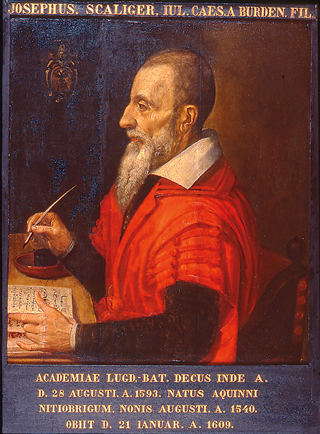
Scaliger by Jan Cornelisz. van 't Woudt (1608)
Scaliger signature Joseph de la Scala, on a receipt for the university library keys from librarian Paulus Merula, Leiden, 3 September 1598. Leiden University Libraries.

Joseph Justus Scaliger (/ˈskælɪər/; 5 August 1540 – 21 January 1609) was a Franco-Italian Calvinist religious leader and scholar, known for expanding the notion of classical history from Greek and Ancient Roman history to include Persian, Babylonian, Jewish and Ancient Egyptian history. He spent the last sixteen years of his life in the Netherlands.

Early life

[edit]

In 1540, Scaliger was born in Agen, France, to Italian scholar and physician Julius Caesar Scaliger and his wife, Andiette de Roques Lobejac. His only formal education was three years of study at the College of Guienne in Bordeaux, which ended in 1555 due to an outbreak of the bubonic plague.[1] Until his death in 1558, Julius Scaliger taught his son Latin and poetry; he was made to write at least 80 lines of Latin a day.[2][1]

University and travels

[edit]
Josephus Justus Scaliger, painted by Paulus Merula, 3rd librarian of Leiden University, 1597

After his father's death, Scaliger spent four years at the University of Paris, where he studied Greek under Adrianus Turnebus. After two months he found he was not in a position to profit from the lectures of the greatest Greek scholar of the time. He read Homer in twenty-one days, and afterwards read other classical Greek poets, orators, and historians, forming a grammar for himself as he went along. At the suggestion of Guillaume Postel, after learning Greek he learned Hebrew, and then Arabic, becoming proficient in both.[2]

His most important teacher was Jean Dorat, who was able not only to impart knowledge but also to kindle enthusiasm in Scaliger. It was to Dorat that Scaliger owed his home for the next thirty years of his life, for in 1563 the professor recommended him to Louis de Chasteigner, the young lord of La Roche-Posay, as a companion in his travels. The two young men formed a close friendship which remained unbroken until Louis's death in 1595. The travellers first went to Rome. Here they found Marc Antoine Muret, who, when at Bordeaux and Toulouse, had been a great favourite and occasional visitor of Julius Caesar Scaliger at Agen. Muret soon recognized the young Scaliger's merits and introduced him to many contacts well worth knowing.[2]

After visiting a large part of Italy, the travellers moved on to England and Scotland, passing through the town of La Roche-Posay on their way.[3] During his time in the British Isles, Scaliger formed an unfavourable opinion of the English. Their inhumane disposition and inhospitable treatment of foreigners especially made a negative impression on him. He was also disappointed at finding only a few Greek manuscripts and, in his opinion, few learned men. It was not until a much later period that he became intimate with Richard Thomson and other Englishmen. Over the course of his travels, he became a Protestant.[2]

France, Geneva, and back to France

[edit]
Scaliger, in a print by Gérard Edelinck (late 18th century)

On his return to France, he spent three years with the Chastaigners, accompanying them to their different châteaux in Poitou, as the calls of the civil war required. In 1570 he accepted the invitation of Jacques Cujas and proceeded to Valence to study jurisprudence under the greatest living jurist. Here he remained three years, profiting not only by the lectures but even more by the library of Cujas, which filled no fewer than seven or eight rooms and included five hundred manuscripts.[2]

The St Bartholomew's Day Massacre – which occurred just before he was to accompany the bishop of Valence on an embassy to Poland – caused Scaliger to flee, alongside other Huguenots, to Geneva, where he was appointed a professor at the Academy of Geneva. While there, he lectured on Aristotle's Organon and Cicero's De Finibus to much satisfaction for the students, but not appreciating it himself. He hated lecturing and was bored with the persistence of the fanatical preachers, accordingly in 1574 he returned to France and made his home for the next twenty years with Chastaigner.[2]

Of his life during this period we have interesting details and notices in the Lettres françaises inédites de Joseph Scaliger, edited by Tamizey de Larroque (Agen, 1881). Constantly moving through Poitou and the Limousin, as the exigencies of the civil war required, occasionally taking his turn as a guard, at least on one occasion trailing a pike on an expedition against the Leaguers, with no access to libraries, and frequently separated even from his own books, his life during this period seems most unsuited to study. He had, however, what so few contemporary scholars possessed — leisure and freedom from financial cares.[2]

Academic output

[edit]

It was during this period of his life that he composed and published his books of historical criticism. His editions of the Catalecta (1575), of Festus (1575), of Catullus, Tibullus and Propertius (1577), are the work of a man determined to discover the real meaning and force of his author. He was the first to lay down and apply sound rules of criticism and revision, and to change textual criticism from a series of haphazard guesses into a "rational procedure subject to fixed laws" (Mark Pattison).[2]

These works, despite proving Scaliger's skill among his contemporaries as a Latin scholar and critic, did not go beyond simple scholarship. It was reserved for his edition of Manilius (1579), and his De emendatione temporum (1583), to revolutionize perceived ideas of ancient chronology—to show that ancient history was not confined to that of the Greeks and Romans, but also comprises that of the Persians, the Babylonians and the Egyptians, hitherto neglected, and that of the Jews, hitherto treated as a thing apart; and that the historical narratives and fragments of each of these, and their several systems of chronology, must be critically compared. It was this innovation that distinguished Scaliger from contemporary scholars. Neither they nor those who immediately followed seem to have appreciated his innovation. Instead, they valued his emendatory criticism and his skill in Greek. His commentary on Manilius is a treatise on ancient astronomy, and it forms an introduction to De emendatione temporum; in this work, Scaliger investigates ancient systems of determining epochs, calendars and computations of time.[2] Applying the work of Nicolaus Copernicus and other modern scientists, he reveals the principles behind these systems.

In the remaining twenty-four years of his life, he expanded on his work in the De emendatione. He succeeded in reconstructing the lost Chronicle of Eusebius—one of the most valuable ancient documents, especially valuable for ancient chronology. This he printed in 1606 in his Thesaurus temporum, in which he collected, restored, and arranged every chronological relic extant in Greek or Latin.[4]

The Netherlands

[edit]
Scaliger's home in Leiden, Breestraat 113, in 2010.
Scaliger's opinion on Leiden and its university library in 1606:[Leiden is situated in] a marsh in the midst of marshes, Here is the great convenience of a library so that students can study. Scaligerana Ou Bons Mots, etc., 1695.

When Justus Lipsius retired from the University of Leiden in 1590, the university and its protectors, the States-General of the Netherlands and the Prince of Orange, resolved to appoint Scaliger as his successor. He declined; he hated lecturing, and there were those among his friends who erroneously believed that with the success of Henry IV learning would flourish, and Protestantism would be no barrier to his advancement.[citation needed] The invitation was renewed in the most flattering manner a year later; the invitation stated Scaliger would not be required to lecture, and that the university wished only for his presence, while he would be able to dispose of his own time in all respects. This offer Scaliger accepted provisionally. Midway through 1593, he set out for the Netherlands, where he would pass the remaining sixteen years of his life, never returning to France. His reception at Leiden was all that he could have wished for. He received a handsome income; he was treated with the highest consideration. His supposed rank as a prince of Verona, a sensitive issue for the Scaligeri, was recognized. Leiden lying between The Hague and Amsterdam, Scaliger was able to enjoy, besides the learned circle of Leiden, the advantages of the best society of both these capitals. For Scaliger was no hermit buried among his books; he was fond of social intercourse and was himself a good talker.[5]

During the first seven years of his residence at Leiden, his reputation was at its highest point. His literary judgment was unquestioned. From his throne at Leiden he ruled the learned world; a word from him could make or mar a rising reputation, and he was surrounded by young men eager to listen to and profit from his conversation. He encouraged Grotius when only a youth of sixteen to edit Martianus Capella. At the early death of the younger Douza, he wept as at that of a beloved son. Daniel Heinsius, at first his favourite pupil, became his most intimate friend.[5]

At the same time, Scaliger had made numerous enemies. He hated ignorance, but he hated still more half-learning, and most of all dishonesty in argument or quotation. He had no toleration for the disingenuous argument and the misstatements of facts of those who wrote to support a theory or to defend an unsound cause. His pungent sarcasm soon reached the ears of the persons who were its object, and his pen was not less bitter than his tongue. He was conscious of his power, and not always sufficiently cautious or sufficiently gentle in its exercise. Nor was he always right. He trusted much to his memory, which was occasionally treacherous. His emendations, if often valuable, were sometimes absurd. In laying the foundations of a science of ancient chronology he relied sometimes on groundless or even absurd hypotheses, often based on an imperfect induction of facts. Sometimes he misunderstood the astronomical science of the ancients, sometimes that of Copernicus and Tycho Brahe. And he was no mathematician.[5]

Disagreements with the Jesuits

[edit]

But his enemies were not merely those whose errors he had exposed and whose hostility he had excited by the violence of his language. The results of his method of historical criticism threatened the Catholic controversialists and the authenticity of many of the documents on which they relied. The Jesuits, who aspired to be the source of all scholarship and criticism, saw the writings and authority of Scaliger as a formidable barrier to their claims. Muret in the latter part of his life professed the strictest orthodoxy, Lipsius had been reconciled to the Church of Rome, Isaac Casaubon was supposed to be wavering, but Scaliger was known to be an irreconcilable Protestant. As long as his intellectual supremacy was unquestioned, the Protestants had the advantage in learning and scholarship. His enemies therefore aimed, if not to answer his criticisms or to disprove his statements, yet to attack him as a man and destroy his reputation. This was no easy task, for his moral character was absolutely spotless.[5]

Veronese descent

[edit]
Mesolabium, 1594

After several attacks purportedly by the Jesuits, in 1607 a new attempt was made. In 1594 Scaliger had published his Epistola de vetustate et splendore gentis Scaligerae et JC Scaligeri vita. In 1601 Gaspar Scioppius, then in the service of the Jesuits published his Scaliger Hypobolimaeus ("The Supposititious Scaliger"), a quarto volume of more than four hundred pages. The author purports to point out five hundred lies in the Epistola de vetustate of Scaliger, but the main argument of the book is to show the falsity of his pretensions to be of the family of La Scala, and the narrative of his father's early life. "No stronger proof," says Pattison, "can be given of the impressions produced by this powerful philippic, dedicated to the defamation of an individual, than that it had been the source from which the biography of Scaliger, as it now stands in our biographical collections, has mainly flowed."[5]

To Scaliger, the publication of Scaliger Hypobolimaeus was crushing. Whatever his father Julius had believed, Joseph had never doubted himself to be a prince of Verona, and in his Epistola had put forth all that he had heard from his father. He wrote a reply to Scioppius, entitled Confutatio fabulae Burdonum. In the opinion of Pattison, "as a refutation of Scioppius it is most complete"; but there are certainly grounds for dissenting from this judgment. Scaliger purported that Scioppius committed more blunders than he corrected, claiming that the book made untruthful allegations, but he did not succeed in adducing any proof either of his father's descent from the La Scala family, or of any of the events narrated by Julius before he arrived at Agen. Nor does Scaliger attempt a refutation of the crucial point, namely, that William, the last prince of Verona, had no son Nicholas, who would have been the alleged grandfather of Julius.[5]

Complete or not, the Confutatio had little success; the attack attributed to the Jesuits was successful. Scioppius was wont to boast that his book had killed Scaliger. The Confutatio was Scaliger's last work. Five months after it appeared, on 21 January 1609, at four in the morning, he died at Leiden in the arms of his pupil and friend Heinsius.[5] In his will Scaliger bequeathed his renowned collection of manuscripts and books (tous mes livres de langues étrangères, Hebraiques, Syriens, Arabiques, Ethiopiens) to Leiden University Library.[citation needed]

Sources

[edit]

One notable biography of Joseph Scaliger is that of Jakob Bernays (Berlin, 1855). It was reviewed by Pattison in the Quarterly Review, vol. cviii (1860), since reprinted in the Essays, i (1889), 132–195. Pattison had made many manuscript collections for the life of Joseph Scaliger on a much more extensive scale, which he left unfinished. In writing the above article, Richard Copley Christie had access to and made much use of these manuscripts, which include the life of Julius Caesar Scaliger. The fragments of the life of Joseph Scaliger have been printed in the Essays, i. 196–245. For the life of Joseph, besides the letters published by Tamizis de Larroque (Agen, 1881), the two old collections of Latin and French letters and the two Scaligerana are the most important sources of information.[5] The complete correspondence of Scaliger is now available in eight volumes.[6]

For the life of his father Julius Caesar Scaliger, the letters edited by his son, those subsequently published in 1620 by the President de Maussac, the Scaligerana, and his own writings are full of autobiographical matter, are the chief authorities. Jules de Bourousse de Laffore's Etude sur Jules César de Lescale (Agen, 1860) and Adolphe Magen's Documents sur Julius Caesar Scaliger et sa famille (Agen, 1873) add important details to the lives of both father and son. The lives by Charles Nisard – that of Julius et Les Gladiateurs de la république des lettres, and that of Joseph Le Triumvirat littéraire au seizième siècle – are equally unworthy of their author and their subjects. Julius is simply held up to ridicule, while the life of Joseph is almost wholly based on the book of Scioppius and the Scaligerana.[5]

Elenchus et Castigatio calendarij Gregoriani, 1595

A complete list of the works of Joseph will be found in his life by Jakob Bernays. See also J. E. Sandys, History of Classical Scholarship, ii. (1908), 199–204.[7] A technical biography is Anthony T. Grafton, Joseph Scaliger: A Study in the History of Classical Scholarship, 2 vol. (Oxford, Oxford University Press, 1983, 1993).[citation needed]

Works

[edit]
  • Mesolabium (in Latin). Leiden: Franciscus Raphelengius (1.). 1594.
  • Cyclometrica elementa duo (in Latin). Leiden: Franciscus Raphelengius (1.). 1594.
  • Iosephi Scaligeri Elenchus et Castigatio calendarij Gregoriani (in Latin). Roma: Luigi Zanetti. 1595.

See also

[edit]

References

[edit]
[edit]
Revisions and contributorsEdit on WikipediaRead on Wikipedia
from Grokipedia
Joseph Justus Scaliger (1540–1609) was a French classical scholar of Italian descent, widely recognized as one of the leading polymaths of the late for his foundational work in and historical . Born on 5 August 1540 in to the humanist , he mastered numerous languages and disciplines from an early age, traveling extensively across to study under prominent teachers in , , and . Scaliger's most enduring achievements lie in chronology, where he systematically reconciled disparate ancient calendars and timelines, introducing the Julian Period—a continuous count of days from 4713 BCE—to facilitate precise historical dating across civilizations. His seminal texts, De emendatione temporum (1583) and Thesaurus temporum (1606), drew on sources from Greek, Roman, Persian, Egyptian, and biblical traditions to construct a comprehensive framework that extended classical history far beyond Greco-Roman confines, influencing subsequent and scientific dating methods. After converting to amid religious upheavals in , Scaliger relocated to in 1593, where he resided until his death on 21 January 1609, engaging in scholarly correspondence and editing classical works without a formal or professorship, though his presence elevated the University of Leiden's reputation in humanities. Despite rivalries with contemporaries like and debates over his claimed Veronese ancestry—which he used to assert noble lineage—Scaliger's rigorous textual criticism and interdisciplinary approach cemented his legacy as a pioneer of empirical historical scholarship.

Early Life and Family

Birth and Parentage

Josephus Justus Scaliger was born on 5 August 1540 in , in the province of Guienne (modern-day ), . He was the tenth child and third surviving son in a family of at least twelve siblings born to his parents over three decades. His father, (c. 1484–1558), was an Italian-born physician, philosopher, and poet who had settled in around 1525 after service as a soldier of fortune in European armies; he claimed descent from the medieval Della Scala (Scaligeri) princes of , a lineage later promoted by his son but doubted by contemporary critics and some modern scholars due to inconsistencies in genealogical records. His mother, Andiette de Roques Lobejac (c. 1513–after 1558), was a local French noblewoman from the Roques Lobejac ; orphaned young, she married Scaliger senior in 1528 at approximately age fifteen, in a union that produced numerous children amid his successful medical practice in . The family's circumstances were marked by intellectual prominence but financial strain from regional wars and paternal disputes with local authorities.

Childhood Influences

Joseph Justus Scaliger, born on 5 August 1540 in , , was the tenth child and third surviving son of , an Italian-born physician, poet, and humanist scholar, and his wife Andiette de Roques Lobejac, from a local noble family. The Scaliger household in served as a hub of , where Julius's pursuits in classical , Aristotelian , and medical theory permeated daily life, exposing young Joseph to an environment prioritizing erudition over conventional piety or commerce. Julius Caesar Scaliger exerted the dominant influence on his son's formative years, providing informal tutelage that emphasized linguistic mastery and critical rigor rather than rote schooling. Scaliger later described his father as despising mendacity to the point of physical revulsion—"Mendacium ita aversabatur, ut... non mentiri"—and requiring daily Latin declamations alongside dictation of verses, which honed Joseph's early poetic skills and instilled a lifelong aversion to intellectual sloppiness. By his own account, this paternal regimen, conducted amid Julius's vast of classical texts, enabled Joseph to compose verses in Latin before adolescence, foreshadowing his precocity. Prior to , Scaliger's education remained entirely domestic, free from institutional constraints but saturated with his father's exemplars of scholarly combat, such as polemics against rivals like Erasmus's Ciceronians or Marc-Antoine Muret. This immersion yielded proficiency in Latin and initial Greek exposure through paternal guidance, without recorded involvement from tutors or peers, cultivating an independent analytical bent attuned to textual authenticity over dogmatic adherence. The absence of broader social influences in —a provincial town amid Huguenot tensions—further concentrated these effects, as Julius's claimed (though likely fabricated) descent from Verona's della Scala dynasty reinforced a sense of intellectual aristocracy. In 1552, at age 12, Scaliger briefly departed this sphere, sent with two younger brothers to Bordeaux's Collège de Guienne for three years of structured Latin study under principal Jean de Lossy, marking his first external academic contact. Yet even here, the interlude reinforced paternal legacies, as plague in 1555 prompted his return to , resuming home-based learning until Julius's death in October 1558. This early phase thus crystallized Scaliger's trajectory toward philological exactitude, rooted less in maternal or communal factors than in Julius's model of combative scholarship.

Education and Intellectual Formation

Studies in France

Scaliger received his initial formal education at home under the rigorous tutelage of his father, , who instructed him intensively in Latin and Greek from an early age. At approximately age twelve, around 1552, he was sent along with his brothers to the Collège de Guyenne in , one of 's most progressive institutions at the time, where he spent three years studying classical texts and . The college's curriculum emphasized Latin authors and rhetorical training, aligning with the humanist emphasis on recovering ancient learning, though Scaliger's innate aptitude allowed him to advance rapidly beyond standard instruction. Following the completion of his studies in around 1555, Scaliger returned to his family in , continuing private scholarly pursuits under his father's guidance until Julius Caesar's death on October 21, 1558. In late 1558 or early 1559, he relocated to to pursue advanced studies at the , where he enrolled for approximately four years. His primary formal instruction there focused on Greek under the renowned philologist Adrianus Turnebus, though Scaliger reportedly mastered the language's fundamentals so swiftly—after just two lessons—that he outpaced his teacher and shifted to independent analysis of texts. During his Parisian period, Scaliger also engaged with Jean Dorat, a key figure in the Pléiade circle, whose lectures on poetry and metrics influenced his emerging philological methods. Beyond classroom learning, he initiated self-directed studies in Hebrew, (Chaldean), , and other Oriental languages, drawing on available manuscripts and scholars like , laying the groundwork for his later multilingual expertise. This phase concluded around 1562 or 1563, when Dorat, impressed by Scaliger's erudition, recommended him for , marking the transition from structured to autodidactic travels.

European Travels and Self-Taught Mastery

In 1563, at the recommendation of his professor Jean Dorat, Scaliger joined Louis de Chastaigner, lord of , as a traveling companion, marking the onset of extensive European itineraries amid the escalating . Their initial journey took them to , including , where Scaliger encountered humanist scholars such as Marc-Antoine Muret, fostering exchanges on classical and contemporary learning. The travels extended northward to and , exposing Scaliger to varied courts and libraries, before looping back to France by late 1564, as evidenced by the dating of his preface to Conjectanea in Varronem at in December of that year. Subsequent years involved nomadic shifts across and other regions with the Chastaigner family to avoid civil strife, culminating in a brief refuge in after the 1572 , where Scaliger briefly taught at the academy. These peripatetic years honed Scaliger's self-taught erudition, as he lamented the scarcity of uninterrupted study time yet persisted in solitary scholarship using inherited paternal manuscripts and acquired texts. Beginning with Greek—mastered via read in 21 days during his 1559 Paris sojourn, supplemented by self-constructed grammars—he advanced to Hebrew without formal instruction, relying on textual immersion and comparative analysis. He subsequently attained working proficiency in , Persian, Syriac, Chaldean, Phoenician, and Ethiopic through analogous autodidactic methods, treating books as "mute masters" and avoiding teachers except for limited guidance from figures like on Oriental scripts. This phase crystallized Scaliger's command of chronology and philology, as he cross-referenced ancient calendars, inscriptions, and histories during travels, devising preliminary emendations later formalized in works like De emendatione temporum (1583). His linguistic polymathy—encompassing over a dozen tongues—stemmed from rigorous, observation-driven decoding rather than rote pedagogy, enabling causal reconstructions of historical timelines independent of prevailing ecclesiastical frameworks. Such mastery, unencumbered by institutional dogma, positioned Scaliger as a pivotal figure in , prioritizing empirical textual evidence over received traditions.

Career Trajectory

Positions in France and Geneva

Following the death of his father Julius Caesar Scaliger on October 21, 1558, Joseph Justus Scaliger inherited the family estate and extensive library in , , which enabled him to pursue independent scholarly work amid the growing religious tensions of the . In 1559, at age 19, he relocated to , where he studied Greek under the royal professor Adrianus Turnebus and rapidly self-taught the language's major poets, orators, and historians, completing in 21 days and expanding to Hebrew and other tongues through private diligence. In 1563, Jean Dorat recommended Scaliger as tutor and traveling companion to Louis de Chastaigner, seigneur de La Roche-Posay, a young nobleman; together they toured Italy (including Rome), England, and Scotland before returning to France, with Scaliger dating the preface to his Conjectanea in Varronem from La Roche-Posay in December 1564. From 1566 to 1570, Scaliger resided in the Chastaigner household in Poitou, composing critical editions such as those of Catalecta (published 1575), Festus (1575), and the lyric poets Catullus, Tibullus, and Propertius (1577), despite disruptions from civil unrest that limited library access. Between 1570 and 1572, he studied jurisprudence at Valence under Jacques Cujas, utilizing the jurist's vast collection of over 500 manuscripts. Scaliger's adherence to , adopted around 1562 amid Huguenot sympathies, prompted his flight to after the of August 1572, during which thousands of Protestants were killed in . There, from 1572 to 1574, he held a temporary professorial position at the Academy of , delivering public lectures on Aristotle's and Cicero's to enthusiastic audiences, while also advancing philological projects under Theodore Beza's influence. In 1574, Scaliger returned to , resuming his role in the Chastaigner entourage in and later , where he continued private scholarship without salaried office until accepting the professorship at in 1593.

Settlement and Professorship in Leiden

In 1593, Joseph Justus Scaliger relocated from to in the , accepting an invitation from the University of Leiden to serve as a with no formal teaching duties, a position secured after initial reluctance to replace in a more demanding role. The move was facilitated by overtures from the university and city authorities as early as 1590, which he deferred until 1591, arriving in August amid the relative religious stability offered by the Calvinist-leaning republic following the that had endangered Protestant scholars like himself. This arrangement provided Scaliger with a substantial —reportedly higher than that of other s—to support his independent , marking an early instance of a dedicated research professorship without pedagogical obligations. Scaliger's settlement in Leiden integrated him into a vibrant intellectual hub, where proximity to the Plantin-Moretus Press under Franciscus Raphelengius enabled advanced printing of oriental texts essential to his linguistic studies. He resided in the city, initially in modest accommodations that he later changed, including a move in May 1607 prompted by local circumstances, though these shifts did not disrupt his scholarly routine. By around 1600, his presence drew students and correspondents from across , who sought private instruction or collaboration, effectively positioning him as an informal mentor despite his official exemption from lecturing. Throughout his tenure until his death on January 21, 1609, Scaliger's role emphasized scholarly autonomy over institutional duties, allowing focus on , , and oriental languages amid Leiden's growing prestige. This setup not only preserved his health—strained by prior travels and conflicts—but also amplified his influence through an extensive epistolary network, with letters exchanged on topics from to historical dating. His unencumbered status reflected the university's strategic recruitment to elevate its profile, yielding dividends in the form of visiting scholars who benefited from his unparalleled erudition.

Scholarly Achievements

Innovations in Chronology

Joseph Justus Scaliger's primary contribution to appeared in his De emendatione temporum (1583), where he systematically compared and synchronized calendars from diverse ancient traditions, including Hebrew, Egyptian, Persian, Greek, and Roman systems, to construct a unified historical timeline. This work drew on philological examination of original texts and astronomical data, such as recorded eclipses, to validate dates rather than relying solely on or legendary accounts. Scaliger's approach marked a shift toward empirical methods, treating as a scientific amenable to mathematical computation and cross-cultural verification. Central to his methodology was the invention of the Julian Period, a continuous era of 7,980 years derived from the of three cycles: the 28-year , the 19-year Metonic lunar cycle, and the 15-year indiction cycle for tax assessments. Beginning on January 1, 4713 BC in the , this period provided a neutral framework for calculating intervals between events recorded in incompatible calendars, avoiding the distortions of era-specific reckonings like the or Olympiads. By assigning unique year numbers within this span, Scaliger enabled precise conversions and established a baseline for dating from Creation—placed by him at 3949 BC—through to his own era. Scaliger expanded these innovations in the Thesaurus temporum (1606), incorporating newly edited texts such as a reconstructed version of Eusebius's Chronicle and additional Oriental sources, which refined synchronisms across civilizations. His chronological tables and algorithms for inter-calendar translation influenced subsequent scholars, including Denis Pétau, and formed the basis for later developments like the Julian Day Number system formalized in the 19th century. Despite reliance on sometimes fragmentary evidence, Scaliger's insistence on verifiable conjunctions of astronomical, literary, and numismatic data elevated chronology from confessional tool to interdisciplinary science.

Contributions to Classical Philology

Scaliger advanced classical through rigorous and editions of Latin authors, establishing higher standards for collation and emendation during the late . His approach prioritized direct engagement with primary sources, often correcting earlier editions by identifying scribal errors and proposing restorations based on linguistic parallels and contextual logic. This method influenced subsequent scholars by emphasizing empirical verification over conjectural , though it relied on the limited access of his era. In 1575, Scaliger published editions of the Catalecta veterum poetarum and Sextus Pompeius Festus's De verborum significatu, the latter preserving key fragments of Verrius Flaccus's lost and illuminating Republican-era Roman antiquities. These works showcased his command of archaic Latin vocabulary and , enabling more accurate reconstructions of early Roman cultural history. The Festus edition, in particular, integrated glosses from Paulus Diaconus while noting discrepancies, a practice that prefigured modern stemmatic analysis. Scaliger's 1577 collaborative edition of , , and applied emendatory techniques to resolve metrical irregularities and syntactic ambiguities, drawing on his expertise in Greek metrics to refine elegiac and lyric forms. For , he restored passages corrupted in medieval transmissions, such as in poem 64, by cross-referencing with Hellenistic influences. His interventions, while occasionally speculative, were grounded in probabilistic reasoning from analogous texts, elevating the perceived reliability of these poets' corpora. The 1579 commentary on Marcus Manilius's Astronomica stands as Scaliger's most ambitious philological effort in this domain, transforming a dense astrological poem into a vehicle for expounding ancient astronomy. Spanning five books, it dissected Manilius's hexameters verse by verse, correcting astronomical errors against Ptolemaic and pre-Ptolemaic sources while elucidating technical terms like domus and signa. This work not only advanced textual fidelity—e.g., emending lines on zodiacal precession—but also integrated philology with scientific exegesis, demonstrating how linguistic precision could recover lost empirical knowledge from antiquity. Though Manilius's pseudoscientific content drew later skepticism, Scaliger's annotations remain valued for their depth in Hellenistic astral lore.

Advances in Linguistics and Oriental Studies

Scaliger demonstrated remarkable autodidactic prowess in Oriental languages, mastering Hebrew, , (Chaldaic), Ethiopic, and Persian alongside his command of classical tongues. These skills enabled him to consult untranslated chronicles and inscriptions, which he incorporated into his chronological frameworks, such as dating ancient events via Muslim historians like (d. 923 CE). His personal library amassed over 50 manuscripts, including rare texts on astronomy, , and , which he annotated extensively and bequeathed to , laying groundwork for institutional Oriental philology there. This collection facilitated critical editions and influenced successors like Jacobus Golius, who built upon Scaliger's acquisitions for lexicography. In linguistics, Scaliger advanced classification by delineating language families in a 1599 outline, grouping Indo-European varieties—such as Greek, Latin, Germanic, Slavic, and Celtic—under a Japhetic lineage distinct from Semitic tongues, based on shared vocabulary and morphology like the ablaut patterns in verbs. This schema rejected monogenetic diffusion from Hebrew, favoring empirical affinities observed in roots (e.g., Latin pater akin to Greek patēr) over theological derivations, marking an early shift toward historical-comparative method. He extended comparisons to Oriental languages, noting Iranian (Scythian) parallels with European forms, though he warned against hasty kinship claims, arguing that coincidental resemblances could mislead without rigorous grammatical evidence. Such caution, rooted in his philological rigor, prefigured systematic Indo-European reconstruction while critiquing overly speculative etymologies prevalent in .

Religious Stance and Polemics

Adoption of Calvinism

Scaliger, born in 1540 to a Catholic family in Agen, France, initially adhered to Roman Catholicism during his early education and studies in Paris under tutelage that included exposure to humanist scholars. By the early 1560s, while residing in Paris, he received instruction from Calvinist reformers, which led him to question Catholic doctrines and embrace Reformed theology. His formal adoption of Calvinism occurred in 1563, marking a decisive shift influenced by the theological rigor of Calvinist predestination and scriptural authority, amid growing Huguenot sympathies in French intellectual circles. This conversion aligned with his philological pursuits, as he increasingly applied critical methods to biblical texts, viewing Calvinist hermeneutics as compatible with empirical textual analysis over ecclesiastical tradition. Following the conversion, Scaliger avoided permanent settlement in Catholic-dominated regions, initiating extensive travels through Protestant-leaning areas in and to evade religious persecution during the . Scaliger's commitment to Calvinism deepened over time, evidenced by his vehement opposition to Jesuit scholars and Catholic reforms, such as his critique of the Gregorian calendar in 1583 on grounds of papal overreach incompatible with Protestant autonomy. By 1593, upon accepting a professorship in Leiden—a bastion of Dutch Calvinism—he integrated seamlessly into its intellectual environment, where liberal Reformed views permitted his eclectic scholarly interests without doctrinal rigidity. His adherence remained steadfast until his death in 1609, shaping his polemical writings and alliances with Reformed networks across Europe.

Conflicts with Catholic Scholars

![Title page of Scaliger's Elenchus et Castigatio calendarii Gregoriani][float-right] Joseph Justus Scaliger, adhering to Calvinist principles, rejected the reform issued by on February 24, 1582, through the Inter gravissimas, viewing it as an exercise of illegitimate papal authority over temporal matters and Protestants. He articulated his opposition in the 1583 tract Elenchus novi calendarii Romani papistici, arguing that the reform's astronomical adjustments were inadequately justified, ignored Protestant scholarly contributions to chronology, and relied on flawed computations of solar and lunar cycles. This critique drew a pointed rebuttal from Christoph Clavius, the Jesuit mathematician who had advised on the reform's technical aspects and authored its explanatory Explicatio in 1582. Clavius countered Scaliger's claims in subsequent editions of his work and directly in the 1595 publication Iosephi Scaligeri elenchus, et castigatio calendarii Gregoriani a Christophoro Clavio Bambergensi societatis Iesu castigata, systematically refuting Scaliger's alleged errors in historical dating, Easter computations, and cycle alignments while defending the reform's precision based on empirical observations and ancient authorities. Despite the acrimony, Scaliger privately conceded Clavius's competence, noting that criticism from him was preferable to praise from lesser scholars. Scaliger's animus extended to the Jesuit order broadly, whom he regarded as aggressive proponents of Catholic doctrine and rivals in philological and historical . In the early 1600s, he engaged in vitriolic exchanges with Jesuit figures including Carolus Scribani, , and Martin del Rio, culminating in a 1607 Latin poem published under the M. de Lescalle that lampooned their theological defenses and institutional ambitions. These disputes underscored Scaliger's defense of Protestant erudition against what he saw as Jesuit , though they also highlighted his irascible temperament in scholarly polemics.

Major Controversies

Dispute over Veronese Ancestry

Joseph Justus Scaliger upheld his family's claimed descent from the Della Scala dynasty, the medieval rulers of who governed from 1262 to 1387 as capitani generali and later lords, with the family name Latinized as Scaligeri. His father, (c. 1484–1558), born Benedetto Bordone in the region to parents of modest origins—a smith and a woman of local stock—had asserted noble birth as an illegitimate scion of a purported exiled branch of the Della Scala, adopting the surname Scaliger around 1525 after military service under Maximilian I. Julius detailed this lineage in autobiographical notes and works, portraying himself as a dispossessed of Veronese patrimony by Venetian conquests in 1405. In 1594, amid growing doubts, Scaliger published Epistola de vetustate et splendore gentis Scaligerae et Iulii Caesaris Scaligeri vita, a biographical defense asserting the unbroken patrilineal descent from Verona's princes through Byzantine exile and Italian wanderings, supported by heraldic and . The tract emphasized the family's martial valor and intellectual eminence, countering insinuations of status by linking Julius to a supposed last Della Scala heir, Benedetto (d. c. 1500), via an unrecorded son. Scaliger's arguments relied on family papers, inscriptions, and oral traditions, which he presented as irrefutable proofs of continuity despite the dynasty's documented of legitimate male heirs by 1351. Catholic polemicists, including Jesuits who resented Scaliger's dominance in philology and chronology as a Protestant outsider, assailed the claim as a self-aggrandizing fiction designed to legitimize scholarly authority. Figures like Gaspar Scioppius, in service to the Habsburgs, impugned the vita's credibility in 1601 tracts, alleging inconsistencies in Julius's itinerary and noble pretensions as inventions to mask humble roots in Padua's artisanal class. These attacks framed the ancestry as emblematic of Protestant hubris, contrasting it with Catholic fidelity to verifiable saints' lives and imperial records; Scaliger retaliated in Apologia pamphlets, decrying critics' malice while reaffirming genealogical links via etymological and onomastic reasoning. The University of Leiden, valuing his erudition, formally acknowledged the Veronese heritage in 1593 privileges, shielding him from further institutional harassment. No contemporaneous archives—such as Venetian state papers or Della Scala charters—substantiate a surviving branch post-1405, with genealogists tracing the male line's end to Gian Galeazzo Visconti's imprisonment of the last heirs in 1387. Scholarly consensus holds the descent fabricated by Julius for social ascent, with complicit in its propagation and potential enhancement through forged artifacts like manipulated inscriptions, as evidenced by discrepancies in documents analyzed via paleography and . Historian , examining Scaliger's manuscripts, identifies deliberate antiquarian inventions to bridge the evidentiary gap, portraying the episode as a cautionary case of erudition serving personal myth over empirical scrutiny.

Criticisms of Chronological Methods

Jacob Christmann, a German Orientalist, critiqued Scaliger's treatment of the Jewish calendar in the 1583 edition of Opus de emendatione temporum, arguing that Scaliger misrepresented the lengths of Hebrew months and the rules for intercalary years, which led to flawed synchronizations between the Jewish lunisolar system and Julian dates. Christmann's De ratione Paschali (published posthumously in 1614 but debated earlier) demonstrated that Scaliger's assumptions about the Metonic cycle's application to Jewish practice deviated from rabbinic traditions and astronomical observations, resulting in errors of up to several days in proposed datings. Dionysius Petavius, in De doctrina temporum (1627), extended Scaliger's framework but identified and corrected numerous computational inaccuracies, including misalignments in Assyrian king lists and the era of , where Scaliger's synchronisms with Greek Olympiads placed events like the fall of a too early. Petavius attributed these to Scaliger's occasional overreliance on ' Chronicle without cross-verifying against cuneiform-derived Persian records available through contemporary translations, though he retained the Julian Period as a core tool. Later, Jean Le Clerc in Ars critica (1697) faulted Scaliger's method for insufficient skepticism toward ancient authorities, claiming it prioritized philological ingenuity over empirical testing of chronological claims, such as unverified links between Chinese cycles and Western eras. These critiques highlighted methodological vulnerabilities, including vulnerability to source biases in pre-modern texts and limitations in pre-telescopic astronomical data, prompting successors to incorporate more probabilistic assessments of historical synchronisms. Despite such emendations, Scaliger's emphasis on era comparisons remained foundational, with errors often stemming from the era's sparse epigraphic evidence rather than inherent flaws in his comparative approach.

Personal Character and Interpersonal Relations

Reputation for Erudition and Temperament

Joseph Justus Scaliger earned a towering reputation for erudition among his contemporaries and subsequent scholars, frequently hailed as the "most learned man in Europe" during the late Renaissance. His command of over a dozen languages, encompassing Latin, Greek, Hebrew, Arabic, Syriac, Persian, Ethiopic, Armenian, and Turkish, facilitated pioneering comparative analyses in philology, chronology, and Oriental studies. Admirers extolled him as a "bottomless pit of erudition" and "light of the world," reflecting the breadth of his textual editions, commentaries, and interdisciplinary syntheses that reshaped classical scholarship. Scaliger's temperament, however, drew sharp criticism for its irascibility and combative edge, often manifesting in vitriolic exchanges with intellectual rivals. Historical accounts portray him as a "grouch" prone to intolerance, particularly toward Catholic scholars and , whom he assailed in polemical writings and private correspondence with unrestrained abuse. Despite this fractious demeanor, which fueled both reverence and revulsion, Scaliger demonstrated generosity as a mentor, fostering collaborative networks at and imparting rigorous methodological standards to protégés like . His forthright , while alienating foes, underscored a commitment to unyielding intellectual rigor over diplomatic niceties.

Correspondence and Networks

Scaliger maintained an extensive epistolary network that positioned him as a central figure in the late sixteenth-century , with surviving correspondence comprising approximately 1,670 letters exchanged between 1561 and 1609. About two-thirds of these letters were in Latin, reflecting the of European scholarship, while others appeared in French, Greek, and occasionally Hebrew or , underscoring his multilingual proficiency and engagement with diverse intellectual traditions. Of the extant letters, roughly 45%—around 751—were addressed to Scaliger, indicating the high regard in which he was held by contemporaries seeking his expertise on , , and . His correspondents spanned Protestant and Catholic scholars, astronomers, jurists, and statesmen across Europe, including prominent figures such as , , , Daniel Heinsius, , Dominicus Baudius, and members of the Dupuy and Dousa families. The correspondence with , beginning in 1593, was particularly voluminous and survives nearly intact, encompassing 113 letters from Scaliger and 145 from Casaubon, often debating textual emendations, historical dating, and theological matters amid the era's religious tensions. Similarly, exchanges with Lipsius and formed a of influence in humanist circles, where Scaliger's letters provided authoritative judgments on classical authors and oriental languages, fostering collaborative advancements in criticism and . These networks extended to practical scholarly exchanges, such as Scaliger's five letters with physician Étienne Hubert between August 1607 and October 1608, which delved into oriental manuscripts and medical , revealing his role in disseminating rare knowledge. In from 1593 onward, his connections with local academics like Grotius and Heinsius amplified his influence, as letters circulated unpublished works and critiques, such as those on calendrical reforms, shaping the intellectual output of the . Earlier partial editions, including the 1627 collection of his Latin letters and the 1624 volume of incoming French correspondence, preserved fragments of this web, though modern critical editions, such as the 2012 eight-volume set edited by Paul Botley and Dirk van Miert, have transcribed and contextualized the full corpus for analysis of his methodological rigor and interpersonal dynamics. This epistolary activity not only disseminated Scaliger's chronological innovations but also highlighted occasional acrimony, as his blunt critiques strained relations with rivals, yet ultimately reinforced his preeminence in transconfessional scholarly dialogues.

Enduring Legacy

Influence on Historical and Scientific Methodology

Scaliger's Opus de emendatione temporum (1583) established the principles of modern scientific historical chronology through a comparative analysis of ancient calendars and epochs drawn from Greek, Roman, Egyptian, Persian, Babylonian, and other non-biblical sources. This method prioritized philological scrutiny of texts alongside astronomical data, such as recorded eclipses, to verify and synchronize disparate timelines, thereby reducing reliance on or scriptural authority alone for dating events. By integrating these disciplines, Scaliger demonstrated how inconsistencies in traditional chronologies could be resolved via empirical cross-verification, marking a shift toward a more rigorous, evidence-based . A key innovation was the Julian Period, a continuous 7,980-year cycle commencing on January 1, 4713 BC, calculated as the of the 28-year , 19-year Metonic lunar cycle, and 15-year Roman indiction cycle. This framework allowed for unambiguous conversion between calendars and precise computation of intervals between historical events, applying mathematical algorithms to ancient records for . Such techniques elevated from mnemonic tradition to a quantifiable science, influencing astronomical computations and enabling later scholars to test prophetic or historical claims against verifiable day counts. Scaliger expanded these methods in Thesaurus temporum (1606), incorporating over 1,000 sources to reconstruct timelines that placed Egyptian and Babylonian histories prior to biblical narratives dated around 2300 BC. His emphasis on —evaluating textual authenticity, evolution, and contextual reliability—fostered a methodological skepticism toward uncorroborated traditions, prefiguring critical historiography's demand for convergent evidence from multiple independent records. This interdisciplinary synthesis of , , and not only refined historical sequencing but also contributed to scientific by modeling testing against empirical datasets, with applications persisting in fields like computational astronomy.

Evaluations in Modern Scholarship

Modern scholars regard Joseph Justus Scaliger (1540–1609) as a foundational figure in the development of scientific chronology and classical , crediting his Opus de emendatione temporum (1583) and Isagogici chronologiae (1606) with pioneering a comparative, interdisciplinary method that integrated astronomical cycles, linguistic analysis, and historical sources to synchronize disparate ancient s across Greek, Roman, Egyptian, Persian, and biblical traditions. This approach, which introduced the Julian Period—a continuous count of days spanning 7,980 years from 4713 BCE—provided a framework for precise dating that influenced subsequent and remains embedded in computational tools for conversion. , in his two-volume study, emphasizes Scaliger's originality in applying philological rigor to chronological problems, portraying him as the era's most innovative scholar who elevated from antiquarian compilation to a systematic discipline grounded in verifiable evidence. However, evaluations also highlight limitations inherent to Scaliger's era, including reliance on incomplete or erroneous ancient sources, leading to specific inaccuracies such as misalignments in Persian king lists and overly optimistic synchronizations of biblical events with secular histories. Grafton notes instances of "forced readings and misinterpretations" where Scaliger's eagerness to resolve contradictions sometimes prioritized coherence over textual fidelity, as seen in his handling of Eusebius's chronographic tables, which modern and studies have since revised—e.g., adjusting Assyrian timelines by centuries based on records absent from Scaliger's data. His analysis of the Jewish calendar in the 1583 edition contained peculiar errors, later partially corrected in , reflecting an initial overconfidence in extrapolating from limited rabbinic and Karaite sources without full awareness of post-Talmudic variations. These critiques, drawn from peer-reviewed reassessments, underscore that while Scaliger's methods were causally realist for their time—prioritizing empirical cross-verification over dogmatic tradition—his conclusions were provisional, vulnerable to new evidentiary paradigms like and epigraphic discoveries. Contemporary scholarship, including editions of Scaliger's correspondence by the , affirms his enduring methodological legacy in fostering critical historiography, as evidenced by his influence on figures like and later chronologers such as Denis Pétau, who refined rather than rejected his schema. Yet, assessments caution against , attributing some overreach to Scaliger's polemical Calvinist context, where chronological precision served anti-Catholic , potentially biasing synchronizations of . Overall, Scaliger's work exemplifies the transition from medieval universal history to modern empirical standards, with modern evaluators valuing its causal emphasis on interlocking evidence chains despite factual corrigenda enabled by post-Enlightenment tools.

References

Add your contribution
Related Hubs
User Avatar
No comments yet.