Hubbry Logo
Kähler manifoldKähler manifoldMain
Open search
Kähler manifold
Community hub
Kähler manifold
logo
7 pages, 0 posts
0 subscribers
Be the first to start a discussion here.
Kähler manifold
Kähler manifold
from Wikipedia

In mathematics and especially differential geometry, a Kähler manifold is a manifold with three mutually compatible structures: a complex structure, a Riemannian structure, and a symplectic structure. The concept was first studied by Jan Arnoldus Schouten and David van Dantzig in 1930, and then introduced by Erich Kähler in 1933. The terminology has been fixed by André Weil. Kähler geometry refers to the study of Kähler manifolds, their geometry and topology, as well as the study of structures and constructions that can be performed on Kähler manifolds, such as the existence of special connections like Hermitian Yang–Mills connections, or special metrics such as Kähler–Einstein metrics.

Every smooth complex projective variety is a Kähler manifold. Hodge theory is a central part of algebraic geometry, proved using Kähler metrics.

Definitions

[edit]

Since Kähler manifolds are equipped with several compatible structures, they can be described from different points of view:

Symplectic viewpoint

[edit]

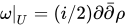
A Kähler manifold is a symplectic manifold equipped with an integrable almost-complex structure which is compatible with the symplectic form , meaning that the bilinear form

on the tangent space of at each point is symmetric and positive definite (and hence a Riemannian metric on ).[1]

Complex viewpoint

[edit]

A Kähler manifold is a complex manifold with a Hermitian metric whose associated 2-form is closed. In more detail, gives a positive definite Hermitian form on the tangent space at each point of , and the 2-form is defined by

for tangent vectors and (where is the complex number ). For a Kähler manifold , the Kähler form is a real closed (1,1)-form. A Kähler manifold can also be viewed as a Riemannian manifold, with the Riemannian metric defined by

Equivalently, a Kähler manifold is a Hermitian manifold of complex dimension such that for every point of , there is a holomorphic coordinate chart around in which the metric agrees with the standard metric on to order 2 near .[2] That is, if the chart takes to in , and the metric is written in these coordinates as , then

for all ,

Since the 2-form is closed, it determines an element in de Rham cohomology , known as the Kähler class.

Riemannian viewpoint

[edit]

A Kähler manifold is a Riemannian manifold of even dimension whose holonomy group is contained in the unitary group .[3] Equivalently, there is a complex structure on the tangent space of at each point (that is, a real linear map from to itself with ) such that preserves the metric (meaning that ) and is preserved by parallel transport.

The symplectic form is then defined by , which is closed since is preserved by parallel transport.

Kähler potential

[edit]

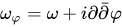
A smooth real-valued function on a complex manifold is called strictly plurisubharmonic if the real closed (1,1)-form

is positive, that is, a Kähler form. Here are the Dolbeault operators. The function is called a Kähler potential for .

Conversely, by the complex version of the Poincaré lemma, known as the local -lemma, every Kähler metric can locally be described in this way. That is, if is a Kähler manifold, then for every point in there is a neighborhood of and a smooth real-valued function on such that .[4] Here is called a local Kähler potential for . There is no comparable way of describing a general Riemannian metric in terms of a single function.

Space of Kähler potentials

[edit]

Whilst it is not always possible to describe a Kähler form globally using a single Kähler potential, it is possible to describe the difference of two Kähler forms this way, provided they are in the same de Rham cohomology class. This is a consequence of the -lemma from Hodge theory.

Namely, if is a compact Kähler manifold, then the cohomology class is called a Kähler class. Any other representative of this class, say, differs from by for some one-form . The -lemma further states that this exact form may be written as for a smooth function . In the local discussion above, one takes the local Kähler class on an open subset , and by the Poincaré lemma any Kähler form will locally be cohomologous to zero. Thus the local Kähler potential is the same for locally.

In general if is a Kähler class, then any other Kähler metric can be written as for such a smooth function. This form is not automatically a positive form, so the space of Kähler potentials for the class is defined as those positive cases, and is commonly denoted by :

If two Kähler potentials differ by a constant, then they define the same Kähler metric, so the space of Kähler metrics in the class can be identified with the quotient . The space of Kähler potentials is a contractible space. In this way the space of Kähler potentials allows one to study all Kähler metrics in a given class simultaneously, and this perspective in the study of existence results for Kähler metrics.

Kähler manifolds and volume minimizers

[edit]

For a compact Kähler manifold X, the volume of a closed complex subspace of X is determined by its homology class. In a sense, this means that the geometry of a complex subspace is bounded in terms of its topology. (This fails completely for real submanifolds.) Explicitly, Wirtinger's formula says that
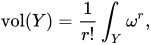
where Y is an r-dimensional closed complex subspace and ω is the Kähler form.[5] Since ω is closed, this integral depends only on the class of Y in H2r(X, R). These volumes are always positive, which expresses a strong positivity of the Kähler class ω in H2(X, R) with respect to complex subspaces. In particular, ωn is not zero in H2n(X, R), for a compact Kähler manifold X of complex dimension n.

A related fact is that every closed complex subspace Y of a compact Kähler manifold X is a minimal submanifold (outside its singular set). Even more: by the theory of calibrated geometry, Y minimizes volume among all (real) cycles in the same homology class.

Kähler identities

[edit]

As a consequence of the strong interaction between the smooth, complex, and Riemannian structures on a Kähler manifold, there are natural identities between the various operators on the complex differential forms of Kähler manifolds which do not hold for arbitrary complex manifolds. These identities relate the exterior derivative , the Dolbeault operators and their adjoints, the Laplacians , and the Lefschetz operator and its adjoint, the contraction operator .[6] The identities form the basis of the analytical toolkit on Kähler manifolds, and combined with Hodge theory are fundamental in proving many important properties of Kähler manifolds and their cohomology. In particular the Kähler identities are critical in proving the Kodaira and Nakano vanishing theorems, the Lefschetz hyperplane theorem, Hard Lefschetz theorem, Hodge-Riemann bilinear relations, and Hodge index theorem.

The Laplacian on a Kähler manifold

[edit]

On a Riemannian manifold of dimension , the Laplacian on smooth -forms is defined by where is the exterior derivative and , where is the Hodge star operator. (Equivalently, is the adjoint of with respect to the L2 inner product on -forms with compact support.) For a Hermitian manifold , and are decomposed as


and two other Laplacians are defined:

If is Kähler, the Kähler identities imply these Laplacians are all the same up to a constant:[7]

These identities imply that on a Kähler manifold ,
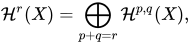
where is the space of harmonic -forms on (forms with ) and is the space of harmonic -forms. That is, a differential form is harmonic if and only if each of its -components is harmonic.

Further, for a compact Kähler manifold , Hodge theory gives an interpretation of the splitting above which does not depend on the choice of Kähler metric. Namely, the cohomology of with complex coefficients splits as a direct sum of certain coherent sheaf cohomology groups:[8]


The group on the left depends only on as a topological space, while the groups on the right depend on as a complex manifold. So this Hodge decomposition theorem connects topology and complex geometry for compact Kähler manifolds.

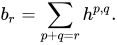
Let be the complex vector space , which can be identified with the space of harmonic forms with respect to a given Kähler metric. The Hodge numbers of are defined by . The Hodge decomposition implies a decomposition of the Betti numbers of a compact Kähler manifold in terms of its Hodge numbers:

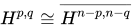
The Hodge numbers of a compact Kähler manifold satisfy several identities. The Hodge symmetry holds because the Laplacian is a real operator, and so . The identity can be proved using that the Hodge star operator gives an isomorphism . It also follows from Serre duality.

Topology of compact Kähler manifolds

[edit]

A simple consequence of Hodge theory is that every odd Betti number b2a+1 of a compact Kähler manifold is even, by Hodge symmetry. This is not true for compact complex manifolds in general, as shown by the example of the Hopf surface, which is diffeomorphic to S1 × S3 and hence has b1 = 1.

The "Kähler package" is a collection of further restrictions on the cohomology of compact Kähler manifolds, building on Hodge theory. The results include the Lefschetz hyperplane theorem, the hard Lefschetz theorem, and the Hodge-Riemann bilinear relations.[9] A related result is that every compact Kähler manifold is formal in the sense of rational homotopy theory.[10]

The question of which groups can be fundamental groups of compact Kähler manifolds, called Kähler groups, is wide open. Hodge theory gives many restrictions on the possible Kähler groups.[11] The simplest restriction is that the abelianization of a Kähler group must have even rank, since the Betti number b1 of a compact Kähler manifold is even. (For example, the integers Z cannot be the fundamental group of a compact Kähler manifold.) Extensions of the theory such as non-abelian Hodge theory give further restrictions on which groups can be Kähler groups.

Without the Kähler condition, the situation is simple: Clifford Taubes showed that every finitely presented group arises as the fundamental group of some compact complex manifold of dimension 3.[12] (Conversely, the fundamental group of any closed manifold is finitely presented.)

Characterizations of complex projective varieties and compact Kähler manifolds

[edit]

The Kodaira embedding theorem characterizes smooth complex projective varieties among all compact Kähler manifolds. Namely, a compact complex manifold X is projective if and only if there is a Kähler form ω on X whose class in H2(X, R) is in the image of the integral cohomology group H2(X, Z). (Because a positive multiple of a Kähler form is a Kähler form, it is equivalent to say that X has a Kähler form whose class in H2(X, R) comes from H2(X, Q).) Equivalently, X is projective if and only if there is a holomorphic line bundle L on X with a hermitian metric whose curvature form ω is positive (since ω is then a Kähler form that represents the first Chern class of L in H2(X, Z)). The Kähler form ω that satisfies these conditions (that is, Kähler form ω is an integral differential form) is also called the Hodge form, and the Kähler metric at this time is called the Hodge metric. The compact Kähler manifolds with Hodge metric are also called Hodge manifolds.[13][14]

Many properties of Kähler manifolds hold in the slightly greater generality of -manifolds, that is compact complex manifolds for which the -lemma holds. In particular the Bott–Chern cohomology is an alternative to the Dolbeault cohomology of a compact complex manifolds, and they are isomorphic if and only if the manifold satisfies the -lemma, and in particular agree when the manifold is Kähler. In general the kernel of the natural map from Bott–Chern cohomology to Dolbeault cohomology contains information about the failure of the manifold to be Kähler.[15]

Every compact complex curve is projective, but in complex dimension at least 2, there are many compact Kähler manifolds that are not projective; for example, most compact complex tori are not projective. One may ask whether every compact Kähler manifold can at least be deformed (by continuously varying the complex structure) to a smooth projective variety. Kunihiko Kodaira's work on the classification of surfaces implies that every compact Kähler manifold of complex dimension 2 can indeed be deformed to a smooth projective variety. Claire Voisin found, however, that this fails in dimensions at least 4. She constructed a compact Kähler manifold of complex dimension 4 that is not even homotopy equivalent to any smooth complex projective variety.[16]

One can also ask for a characterization of compact Kähler manifolds among all compact complex manifolds. In complex dimension 2, Kodaira and Yum-Tong Siu showed that a compact complex surface has a Kähler metric if and only if its first Betti number is even.[17] An alternative proof of this result which does not require the hard case-by-case study using the classification of compact complex surfaces was provided independently by Buchdahl and Lamari.[18][19] Thus "Kähler" is a purely topological property for compact complex surfaces. Hironaka's example shows, however, that this fails in dimensions at least 3. In more detail, the example is a 1-parameter family of smooth compact complex 3-folds such that most fibers are Kähler (and even projective), but one fiber is not Kähler. Thus a compact Kähler manifold can be diffeomorphic to a non-Kähler complex manifold.

Kähler–Einstein manifolds

[edit]

A Kähler manifold is called Kähler–Einstein if it has constant Ricci curvature. Equivalently, the Ricci curvature tensor is equal to a constant λ times the metric tensor, Ric = λg. The reference to Einstein comes from general relativity, which asserts in the absence of mass that spacetime is a 4-dimensional Lorentzian manifold with zero Ricci curvature. See the article on Einstein manifolds for more details.

Although Ricci curvature is defined for any Riemannian manifold, it plays a special role in Kähler geometry: the Ricci curvature of a Kähler manifold X can be viewed as a real closed (1,1)-form that represents c1(X) (the first Chern class of the tangent bundle) in H2(X, R). It follows that a compact Kähler–Einstein manifold X must have canonical bundle KX either anti-ample, homologically trivial, or ample, depending on whether the Einstein constant λ is positive, zero, or negative. Kähler manifolds of those three types are called Fano, Calabi–Yau, or with ample canonical bundle (which implies general type), respectively. By the Kodaira embedding theorem, Fano manifolds and manifolds with ample canonical bundle are automatically projective varieties.

Shing-Tung Yau proved the Calabi conjecture: every smooth projective variety with ample canonical bundle has a Kähler–Einstein metric (with constant negative Ricci curvature), and every Calabi–Yau manifold has a Kähler–Einstein metric (with zero Ricci curvature). These results are important for the classification of algebraic varieties, with applications such as the Miyaoka–Yau inequality for varieties with ample canonical bundle and the Beauville–Bogomolov decomposition for Calabi–Yau manifolds.[20]

By contrast, not every smooth Fano variety has a Kähler–Einstein metric (which would have constant positive Ricci curvature). However, Xiuxiong Chen, Simon Donaldson, and Song Sun proved the Yau–Tian–Donaldson conjecture: a smooth Fano variety has a Kähler–Einstein metric if and only if it is K-stable, a purely algebro-geometric condition.

In situations where there cannot exist a Kähler–Einstein metric, it is possible to study mild generalizations including constant scalar curvature Kähler metrics and extremal Kähler metrics. When a Kähler–Einstein metric can exist, these broader generalizations are automatically Kähler–Einstein.

Holomorphic sectional curvature

[edit]

The deviation of a Riemannian manifold X from the standard metric on Euclidean space is measured by sectional curvature, which is a real number associated to any real 2-plane in the tangent space of X at a point. For example, the sectional curvature of the standard metric on CPn (for n ≥ 2) varies between 1/4 and 1 at every point. For a Hermitian manifold (for example, a Kähler manifold), the holomorphic sectional curvature means the sectional curvature restricted to complex lines in the tangent space. This behaves more simply, in that CPn has holomorphic sectional curvature equal to 1 everywhere. At the other extreme, the open unit ball in Cn has a complete Kähler metric with holomorphic sectional curvature equal to −1. (With this metric, the ball is also called complex hyperbolic space.)

The holomorphic sectional curvature is intimately related to the complex geometry of the underlying complex manifold. It is an elementary consequence of the Ahlfors Schwarz lemma that if is a Hermitian manifold with a Hermitian metric of negative holomorphic sectional curvature (bounded above by a negative constant), then it is Brody hyperbolic (i.e., every holomorphic map is constant). If X happens to be compact, then this is equivalent to the manifold being Kobayashi hyperbolic.[21]

On the other hand, if is a compact Kähler manifold with a Kähler metric of positive holomorphic sectional curvature, Yang Xiaokui showed that X is rationally connected.

A remarkable feature of complex geometry is that holomorphic sectional curvature decreases on complex submanifolds.[22] (The same goes for a more general concept, holomorphic bisectional curvature.) For example, every complex submanifold of Cn (with the induced metric from Cn) has holomorphic sectional curvature ≤ 0.

For holomorphic maps between Hermitian manifolds, the holomorphic sectional curvature is not strong enough to control the target curvature term appearing in the Schwarz lemma second-order estimate. This motivated the consideration of the real bisectional curvature, introduced by Xiaokui Yang and Fangyang Zheng.[23] This also appears in the work of Man-Chun Lee and Jeffrey Streets under the name complex curvature operator.[24]

Examples

[edit]
  1. Complex space Cn with the standard Hermitian metric is a Kähler manifold.
  2. A compact complex torus Cn/Λ (Λ a full lattice) inherits a flat metric from the Euclidean metric on Cn, and is therefore a compact Kähler manifold.
  3. Every Riemannian metric on an oriented 2-manifold is Kähler. (Indeed, its holonomy group is contained in the rotation group SO(2), which is equal to the unitary group U(1).) In particular, an oriented Riemannian 2-manifold is a Riemann surface in a canonical way; this is known as the existence of isothermal coordinates. Conversely, every Riemann surface is Kähler since the Kähler form of any Hermitian metric is closed for dimensional reasons.
  4. There is a standard choice of Kähler metric on complex projective space CPn, the Fubini–Study metric. One description involves the unitary group U(n + 1), the group of linear automorphisms of Cn+1 that preserve the standard Hermitian form. The Fubini–Study metric is the unique Riemannian metric on CPn (up to a positive multiple) that is invariant under the action of U(n + 1) on CPn. One natural generalization of CPn is provided by the Hermitian symmetric spaces of compact type, such as Grassmannians. The natural Kähler metric on a Hermitian symmetric space of compact type has sectional curvature ≥ 0.
  5. The induced metric on a complex submanifold of a Kähler manifold is Kähler. In particular, any Stein manifold (embedded in Cn) or smooth projective algebraic variety (embedded in CPn) is Kähler. This is a large class of examples.
  6. The open unit ball B in Cn has a complete Kähler metric called the Bergman metric, with holomorphic sectional curvature equal to −1. A natural generalization of the ball is provided by the Hermitian symmetric spaces of noncompact type, such as the Siegel upper half space. Every Hermitian symmetric space X of noncompact type is isomorphic to a bounded domain in some Cn, and the Bergman metric of X is a complete Kähler metric with sectional curvature ≤ 0.
  7. Every K3 surface is Kähler (by Siu).[17]

See also

[edit]

Notes

[edit]

References

[edit]
[edit]
Revisions and contributorsEdit on WikipediaRead on Wikipedia
from Grokipedia
A Kähler manifold is a complex manifold equipped with a Hermitian metric whose associated fundamental (2,0)-form, known as the Kähler form, is closed under the exterior derivative. Equivalently, it is a smooth, closed real manifold of even dimension 2n2n that admits a compatible triple consisting of a Riemannian metric gg, an integrable almost complex structure JJ, and a symplectic form ω\omega satisfying g(JX,JY)=g(X,Y)g(JX, JY) = g(X, Y) for all tangent vectors X,YX, Y, with dω=0d\omega = 0. The concept was introduced by the German mathematician Erich Kähler in a 1933 paper, where he explored Hermitian metrics on complex manifolds and their connection to . Although initially somewhat overlooked, the significance of Kähler manifolds became apparent in the late 1940s, particularly through the works of and others, who highlighted their role in bridging , , and . Kähler manifolds exhibit rich structural properties, including a holonomy group contained in the unitary group U(n)U(n), which ensures parallel transport preserves the complex structure. The Kähler form ω\omega is both closed and harmonic, leading to the Hodge decomposition of cohomology: Hk(M,C)=p+q=kHp,q(M)H^k(M, \mathbb{C}) = \bigoplus_{p+q=k} H^{p,q}(M), with dimensions satisfying hp,q=hq,p=hnp,nqh^{p,q} = h^{q,p} = h^{n-p,n-q}. This decomposition underpins , enabling deep connections between and holomorphic forms. Additionally, the hard Lefschetz holds, stating that the operator of wedging with ω\omega, denoted LL, induces isomorphisms Lk:Hnk(M,C)Hn+k(M,C)L^k: H^{n-k}(M, \mathbb{C}) \to H^{n+k}(M, \mathbb{C}) for 0kn0 \leq k \leq n. Classic examples include complex Euclidean space Cn\mathbb{C}^n with the standard flat metric and Kähler form ω=i2j=1ndzjdzj\omega = \frac{i}{2} \sum_{j=1}^n dz_j \wedge d\overline{z}_j, as well as CPn\mathbb{CP}^n endowed with the Fubini-Study metric. More generally, any nonsingular inherits a Kähler structure from the ambient . Products of Kähler manifolds and their finite covers are also Kähler. These manifolds are central to modern due to their interplay between differential, symplectic, and algebro-geometric perspectives, influencing areas such as the study of Calabi-Yau manifolds and mirror .

Definitions

Complex manifold with compatible structures

A complex manifold is a smooth manifold MM of real dimension 2m2m equipped with an almost complex structure JJ, which is a smooth of the TMTM satisfying J2=IdJ^2 = -\mathrm{Id}. The almost complex structure JJ is integrable if the Nijenhuis tensor vanishes, allowing MM to be covered by holomorphic coordinate charts where the transition functions are holomorphic, thus endowing MM with a holomorphic atlas. This integrability ensures that JJ extends complex linearly to the complexified TCM=TMCT_\mathbb{C}M = TM \otimes \mathbb{C}, decomposing it into the eigenspaces T1,0MT^{1,0}M (for eigenvalue ii) and T0,1MT^{0,1}M (for eigenvalue i-i). A Hermitian metric hh on the complex manifold MM is a Riemannian metric gg on MM that is compatible with JJ, meaning h(X,Y)=g(JX,JY)=g(X,Y)h(X, Y) = g(JX, JY) = g(X, Y) for all vector fields X,YX, Y on MM. Here, hh extends to a on TCMT_\mathbb{C}M, positive definite on T1,0M×T0,1MT^{1,0}M \times \overline{T^{0,1}M}, and the associated Riemannian metric gg is the real part of hh, satisfying g(JX,JY)=g(X,Y)g(JX, JY) = g(X, Y). This compatibility ensures that JJ acts as an with respect to gg, preserving the inner product structure. The Kähler condition arises from the fundamental 2-form ω\omega associated to the Hermitian metric, defined by ω(X,Y)=g(JX,Y)\omega(X, Y) = g(JX, Y) or equivalently ω=i2h(J,)\omega = \frac{i}{2} h(J \cdot, \cdot). This ω\omega is a real (1,1)-form on MM, non-degenerate, and the metric hh (or gg) is called Kähler if ω\omega is closed, i.e., dω=0d\omega = 0. The closedness of ω\omega endows MM with a compatible symplectic structure, where ω\omega serves as the symplectic form. In local holomorphic coordinates zjz^j on MM, the Kähler form takes the expression ω=i2j,kgjkˉdzjdzˉk,\omega = \frac{i}{2} \sum_{j,k} g_{j\bar{k}} \, dz^j \wedge d\bar{z}^k, where gjkˉ=h(zj,zˉk)g_{j\bar{k}} = h\left( \frac{\partial}{\partial z^j}, \frac{\partial}{\partial \bar{z}^k} \right) are the components of the Hermitian metric. Locally, these components derive from a real-valued Kähler potential function KK via gjkˉ=2Kzjzˉkg_{j\bar{k}} = \frac{\partial^2 K}{\partial z^j \partial \bar{z}^k}, so that ω=iˉK\omega = i \partial \bar{\partial} K. The Kähler condition dω=0d\omega = 0 is equivalent to ˉω=0\partial \bar{\partial} \omega = 0, reflecting the integrability in the Dolbeault complex and ensuring the metric's compatibility with the complex structure globally.

Symplectic formulation

A Kähler manifold can be defined in the symplectic category as a (M,ω)(M, \omega) equipped with an integrable almost complex structure JJ that is compatible with ω\omega. Here, (M,ω)(M, \omega) is a , meaning MM is a smooth manifold and ω\omega is a closed, non-degenerate 2-form on MM. The compatibility condition requires that ω(JX,JY)=ω(X,Y)\omega(JX, JY) = \omega(X, Y) for all vector fields X,YX, Y on MM, ensuring that JJ preserves the symplectic form. This compatibility induces a Riemannian metric gg via g(X,Y)=ω(X,JY)g(X, Y) = \omega(X, JY), which is positive definite due to the non-degeneracy of ω\omega and the properties of JJ. The Kähler condition specifies that JJ is integrable, thereby defining a complex structure on MM, and that ω\omega is of type (1,1)(1,1) with respect to this complex structure. Integrability of JJ means that the eigenspaces T1,0MT^{1,0}M and T0,1MT^{0,1}M (with eigenvalues ii and i-i) are closed under the . The (1,1)(1,1)-type condition for ω\omega implies that ω(X,Y)=0\omega(X, Y) = 0 whenever XX or YY is of pure type (1,0)(1,0) or (0,1)(0,1), so ω\omega pairs (1,0)(1,0)- and (0,1)(0,1)-vectors. Locally, in holomorphic coordinates, this takes the form ω=i2hjkdzjdzˉk\omega = \frac{i}{2} \sum h_{jk} \, dz^j \wedge d\bar{z}^k, where (hjk)(h_{jk}) is a positive-definite . Integrability of JJ is equivalently characterized by the vanishing of the Nijenhuis tensor NJN_J, defined by NJ(X,Y)=[JX,JY]J[JX,Y]J[X,JY]+[X,Y]=0N_J(X, Y) = [JX, JY] - J[JX, Y] - J[X, JY] + [X, Y] = 0 for all vector fields X,YX, Y on MM. This condition ensures that JJ arises from holomorphic atlases, making (M,J)(M, J) a complex manifold. By the Newlander-Nirenberg theorem, the vanishing of NJN_J is equivalent to the existence of a compatible complex structure. As a symplectic manifold, a Kähler manifold (M,ω)(M, \omega) admits a Poisson bracket {f,g}\{f, g\} on smooth functions f,g:MRf, g: M \to \mathbb{R}, defined by {f,g}=ω(Xf,Xg)\{f, g\} = \omega(X_f, X_g), where XfX_f is the satisfying df=ιXfωdf = \iota_{X_f} \omega. The Poisson bracket satisfies the and the Leibniz rule, endowing the space of smooth functions with a structure. Hamiltonian vector fields XHX_H generate symplectomorphisms, preserving ω\omega and the flow of the dynamics, with the compatibility of JJ ensuring that these flows respect the complex structure.

Riemannian metric perspective

A Kähler manifold can be viewed as a (M,g)(M, g) equipped with an almost complex JJ such that gg is compatible with JJ, meaning g(JX,JY)=g(X,Y)g(JX, JY) = g(X, Y) and g(JX,X)=0g(JX, X) = 0 for all vector fields X,YX, Y on MM, while gg remains positive definite. This compatibility ensures that JJ acts as an on the tangent spaces, preserving the inner product induced by gg, and the skew-symmetry condition g(JX,X)=0g(JX, X) = 0 implies that JJ rotates vectors orthogonally with respect to gg. Such a pair (g,J)(g, J) defines an almost Hermitian on MM, and when JJ is integrable, the manifold becomes Hermitian; the additional requirement for a Kähler arises from the of the metric. The Kähler form is defined by ω(X,Y)=g(JX,Y)\omega(X, Y) = g(JX, Y), which is a real-valued, skew-symmetric bilinear form on TMTM. Due to the compatibility conditions, ω\omega is non-degenerate and of type (1,1) with respect to JJ, and its closedness dω=0d\omega = 0 is equivalent to the almost complex structure JJ being parallel with respect to the \nabla of gg, i.e., J=0\nabla J = 0. This parallelism means that the Levi-Civita connection preserves both the metric gg and the complex structure JJ, implying that the torsion of \nabla is parallel and that parallel transport along geodesics maintains the Hermitian properties. In this Riemannian framework, the closedness of ω\omega (as briefly noted in the symplectic formulation) ensures the manifold's Kähler condition without relying on local coordinate expressions. In local holomorphic coordinates, the compatibility of gg with JJ manifests as orthogonality between the holomorphic and anti-holomorphic subspaces: g(zj,zk)=0g\left(\frac{\partial}{\partial z^j}, \frac{\partial}{\partial z^k}\right) = 0 and g(zˉj,zˉk)=0g\left(\frac{\partial}{\partial \bar{z}^j}, \frac{\partial}{\partial \bar{z}^k}\right) = 0, while the nonzero components are g(zj,zˉk)=gjkˉg\left(\frac{\partial}{\partial z^j}, \frac{\partial}{\partial \bar{z}^k}\right) = g_{j\bar{k}}, forming the entries of a Hermitian matrix. This structure induces a Hermitian inner product on the complexified tangent bundle, where the decomposition TMC=T1,0MT0,1MTM \otimes \mathbb{C} = T^{1,0}M \oplus T^{0,1}M holds, with T1,0MT^{1,0}M and T0,1MT^{0,1}M being the eigenspaces of JJ for eigenvalues ii and i-i, respectively. The metric gg restricts to a positive definite Hermitian metric on T1,0MT^{1,0}M, ensuring that the subbundles are orthogonal with respect to gg, and J=0\nabla J = 0 preserves this decomposition under parallel transport.

Kähler Potentials and Metrics

Definition and construction

In complex geometry, a Kähler potential serves as a fundamental tool for locally constructing Kähler metrics on open subsets of complex space. Specifically, given an open set UCnU \subset \mathbb{C}^n, a Kähler potential KK is a real-valued smooth function K:URK: U \to \mathbb{R} such that the associated Hermitian matrix with components gjkˉ=2Kzjzˉkg_{j\bar{k}} = \frac{\partial^2 K}{\partial z^j \partial \bar{z}^k} is positive definite. This defines a Hermitian metric gg on the underlying real tangent space that is compatible with the complex structure, and the corresponding Kähler form is given by ω=iˉK=ij,k2Kzjzˉkdzjdzˉk,\omega = i \partial \bar{\partial} K = i \sum_{j,k} \frac{\partial^2 K}{\partial z^j \partial \bar{z}^k} \, dz^j \wedge d\bar{z}^k, which is a closed positive (1,1)-form. Under a holomorphic change of coordinates zw(z)z \mapsto w(z), the Kähler potential transforms according to the law K(w)=K(z)+f(w)+fˉ(zˉ)K'(w) = K(z) + f(w) + \bar{f}(\bar{z}), where ff is a on the image domain. This transformation preserves the Kähler form ω\omega, as the additional terms iˉ(f+fˉ)=0i \partial \bar{\partial} (f + \bar{f}) = 0 contribute nothing to the metric or the closed form. Consequently, the metric components in the new coordinates remain positive definite and Hermitian, ensuring the local construction is well-defined independent of the choice of holomorphic coordinates. To extend this construction globally to a MM, one selects an atlas of holomorphic coordinate charts {(Uα,zα)}\{ (U_\alpha, z^\alpha) \} covering MM, and defines local Kähler potentials KαK_\alpha on each UαU_\alpha such that the metrics agree on overlaps UαUβU_\alpha \cap U_\beta. On these overlaps, the transition requires KβKα=fαβ(zβ)+fˉαβ(zˉβ)K_\beta - K_\alpha = f_{\alpha\beta}(z^\beta) + \bar{f}_{\alpha\beta}(\bar{z}^\beta) for some holomorphic fαβf_{\alpha\beta}, allowing the local forms ωα=iˉKα\omega_\alpha = i \partial \bar{\partial} K_\alpha to patch into a global closed (1,1)-form ω\omega that is positive definite everywhere. This patching procedure yields a global Kähler metric precisely when such compatible local potentials exist. Locally, Kähler potentials are unique up to the addition of pluriharmonic functions, which are smooth real-valued functions ϕ\phi satisfying ˉϕ=0\partial \bar{\partial} \phi = 0 (equivalently, the real parts of holomorphic functions). Adding such a ϕ\phi to KK leaves the Kähler form and metric unchanged, as iˉϕ=0i \partial \bar{\partial} \phi = 0, highlighting that the potential encodes the metric only modulo this equivalence. This non-uniqueness underscores the role of the potential as a convenient local representative rather than a global invariant.

Space of Kähler potentials

On a compact Kähler manifold (M,ω0)(M, \omega_0) of complex dimension nn, the space H\mathcal{H} of Kähler potentials relative to the background Kähler form ω0\omega_0 consists of all smooth real-valued functions ϕC(M,R)\phi \in C^\infty(M, \mathbb{R}) such that the associated form ωϕ:=ω0+iˉϕ\omega_\phi := \omega_0 + i \partial \bar{\partial} \phi is positive definite everywhere on MM. This space provides a coordinate chart for the infinite-dimensional manifold of all Kähler metrics on MM lying in the fixed cohomology class [ω0]H1,1(M,R)[\omega_0] \in H^{1,1}(M, \mathbb{R}), with the map ϕωϕ\phi \mapsto \omega_\phi establishing a bijection up to additive constants (since adding a constant to ϕ\phi does not change ωϕ\omega_\phi). The volume form induced by ωϕ\omega_\phi is μϕ=ωϕnn!\mu_\phi = \frac{\omega_\phi^n}{n!}, normalized so that Mμϕ=1\int_M \mu_\phi = 1 if Mω0nn!=1\int_M \frac{\omega_0^n}{n!} = 1. The set H\mathcal{H} is convex with respect to pointwise convex combinations: for any ϕ,ψH\phi, \psi \in \mathcal{H} and t[0,1]t \in [0,1], the function tϕ+(1t)ψt\phi + (1-t)\psi also belongs to H\mathcal{H}, as positivity of the Kähler form is preserved under convex combinations of positive definite Hermitian forms. More strongly, H\mathcal{H} admits a natural infinite-dimensional Riemannian metric defined by gϕ(ϕ˙,ϕ˙)=Mϕ˙2μϕg_\phi(\dot{\phi}, \dot{\phi}) = \int_M \dot{\phi}^2 \, \mu_\phi for tangent vectors ϕ˙TϕH=C(M,R)\dot{\phi} \in T_\phi \mathcal{H} = C^\infty(M, \mathbb{R}), turning H\mathcal{H} into a (pre-)Hilbert space of non-positive sectional curvature that is geodesically convex. Geodesics in this space are C1,1C^{1,1} curves ϕ(t)\phi(t) satisfying the geodesic equation t2ϕ12(tϕ)ωϕ(t)2=0\partial_t^2 \phi - \frac{1}{2} |\nabla (\partial_t \phi)|^2_{\omega_{\phi(t)}} = 0, equivalently solutions to the homogeneous complex Monge-Ampère equation (ω0+iˉΦ)n+1=0(\omega_0 + i \partial \bar{\partial} \Phi)^{n+1} = 0 on the product M×RM \times \mathbb{R} via the graph embedding Φ(x,t)=ϕ(t)(x)\Phi(x,t) = \phi(t)(x); such geodesics connect any two points in H\mathcal{H} uniquely and realize the minimal distance. These geodesic segments play a key role in dynamical aspects of Kähler geometry, including flows toward constant scalar curvature metrics, where the convexity properties ensure preservation of certain bounds along the paths. An on the broader space of all Kähler potentials (across different background forms) identifies ϕψ\phi \sim \psi if ωϕωψ\omega_\phi - \omega_\psi is exact, thereby quotienting by the to yield the space of Kähler classes K\mathcal{K}, the connected component of the positive in H1,1(M,R)H^{1,1}(M, \mathbb{R}) containing [ω0][\omega_0]. For a fixed class [ω]K[\omega] \in \mathcal{K}, the corresponding H[ω]\mathcal{H}_{[\omega]} parametrizes the metrics therein, and the moduli space of Kähler metrics in [ω][\omega] is obtained as the quotient H[ω]/Aut(M)\mathcal{H}_{[\omega]} / \mathrm{Aut}(M), where Aut(M)\mathrm{Aut}(M) acts by pulling back potentials; this quotient inherits the geodesic convexity from H[ω]\mathcal{H}_{[\omega]}. Central to the geometry of H\mathcal{H} is the Donaldson functional (also known as the Mabuchi KK-energy), an energy functional E:HRE: \mathcal{H} \to \mathbb{R} defined by E(ϕ)=Mlog(ωϕnω0n)μϕ+μˉMlog(ω0nωϕn)μ0,E(\phi) = -\int_M \log \left( \frac{\omega_\phi^n}{\omega_0^n} \right) \mu_\phi + \bar{\mu} \int_M \log \left( \frac{\omega_0^n}{\omega_\phi^n} \right) \mu_0, where μˉ\bar{\mu} is the average , measuring the deviation from constant and providing an obstruction to metric stability. Critical points of EE occur precisely at constant Kähler (cscK) metrics, and EE is convex along geodesics in H\mathcal{H}, with properness implying existence and uniqueness of minimizers in certain cases (e.g., when the Futaki invariant vanishes). This convexity underpins algebro-geometric stability criteria, linking boundedness of EE from below to KK-stability of the underlying variety in the sense of .

Fundamental Properties

Kähler identities

In Kähler geometry, the Kähler identities are a set of commutation relations between key differential operators that exploit the compatibility of the complex structure, symplectic form, and Riemannian metric. These identities, first established by in the context of forms on Kähler manifolds, reveal deep connections between de Rham and Dolbeault cohomologies. They arise from the integrability of the complex structure and the parallel transport of the almost complex structure JJ by the , i.e., J=0\nabla J = 0. Central to these identities are the Lefschetz operator LL, defined by wedging with the Kähler form ω\omega, and its Λ\Lambda, the contraction by ω\omega. The de Rham Laplacian is Δd=dd+dd\Delta_d = dd^* + d^*d, while the Dolbeault Laplacian is Δˉ=ˉˉ+ˉˉ\Delta_{\bar{\partial}} = \bar{\partial}\bar{\partial}^* + \bar{\partial}^*\bar{\partial}. On a Kähler manifold, the identities include [L,]=[L,ˉ]=0[L, \partial] = [L, \bar{\partial}] = 0, [Λ,]=[Λ,ˉ]=0[\Lambda, \partial^*] = [\Lambda, \bar{\partial}^*] = 0, [ˉ,L]=i[ \bar{\partial}^*, L ] = i \partial, and [,L]=iˉ[ \partial^*, L ] = -i \bar{\partial}, meaning both Laplacians commute with LL: [Δd,L]=0[\Delta_d, L] = 0 and [Δˉ,L]=0[\Delta_{\bar{\partial}}, L] = 0. These relations link the Dolbeault operators and their adjoints via Λ\Lambda. These relations facilitate the Hodge decomposition on compact Kähler manifolds. The space of (p,q)(p,q)-forms decomposes as Ωp,q=r0LrPpr,qrˉΩp,q1ˉΩp,q+1\Omega^{p,q} = \bigoplus_{r \geq 0} L^r \mathcal{P}^{p-r,q-r} \oplus \bar{\partial} \Omega^{p,q-1} \oplus \bar{\partial}^* \Omega^{p,q+1}, where Pp,q\mathcal{P}^{p,q} denotes the primitive (p,q)(p,q)-forms annihilated by Λ\Lambda. The cohomology groups similarly decompose: Hp,q=r0Hpr,qr(P)H^{p,q} = \bigoplus_{r \geq 0} H^{p-r,q-r}(\mathcal{P}), with primitive cohomology components. This structure implies that harmonic representatives respect the (p,q)(p,q)-type decomposition, and the Hodge numbers satisfy hp,q=hq,ph^{p,q} = h^{q,p}. A proof sketch relies on the Weitzenböck formula, which on Kähler manifolds equates 2Δˉ=+Ric2\Delta_{\bar{\partial}} = \nabla^*\nabla + \mathrm{Ric}, where Ric\mathrm{Ric} is the Ricci curvature operator, and leverages J=0\nabla J = 0 to show that LL preserves the Kähler condition and commutes with the connection terms. Specifically, the commutators follow from local computations in holomorphic frames, where the action of LL aligns with the type decomposition induced by JJ. An important implication is the equality of Bott-Chern and Dolbeault cohomologies on Kähler manifolds. The Kähler identities, together with the ˉ\partial\bar{\partial}-lemma (which states that ˉ\partial\bar{\partial}-closed forms are ˉ\bar{\partial}-exact in certain bidegrees), ensure that the Bott-Chern cohomology HBCp,q(X,C)Hˉp,q(X,C)H^{p,q}_{BC}(X, \mathbb{C}) \cong H^{p,q}_{\bar{\partial}}(X, \mathbb{C}). This isomorphism simplifies computations of analytic invariants and underscores the rigidity of Kähler geometry compared to general complex manifolds.

Laplacian operator

On a Kähler manifold, the de Rham Laplacian Δd\Delta_d acts on differential forms and is defined by Δd=dd+dd\Delta_d = d d^* + d^* d, where dd is the and dd^* is its formal with respect to the inner product induced by the Riemannian metric. This operator is elliptic and , and its kernel consists of the harmonic forms, which are in bijection with de Rham cohomology classes via . Similarly, the Dolbeault Laplacian Δˉ\Delta_{\bar{\partial}} acts on (p,q)(p,q)-forms and is given by Δˉ=ˉˉ+ˉˉ\Delta_{\bar{\partial}} = \bar{\partial} \bar{\partial}^* + \bar{\partial}^* \bar{\partial}, where ˉ\bar{\partial} is the ˉ\bar{\partial}-operator and ˉ\bar{\partial}^* is its . The kernel of Δˉ\Delta_{\bar{\partial}} corresponds to groups Hp,q(M)H^{p,q}(M). A key feature of Kähler manifolds is the simplification relating these operators: on (p,q)(p,q)-forms, Δd=2Δˉ\Delta_d = 2 \Delta_{\bar{\partial}}, owing to the preservation of form types by the de Rham differential under the Kähler condition. This equality arises because the Kähler structure ensures that d=+ˉd = \partial + \bar{\partial} splits the operators compatibly, and the adjoints satisfy analogous relations. Consequently, forms for Δd\Delta_d decompose into (p,q)(p,q)-components that are for Δˉ\Delta_{\bar{\partial}}, facilitating computations in on these manifolds. In local holomorphic coordinates zjz^j on a Kähler manifold with metric gjkˉg_{j\bar{k}}, the Dolbeault Laplacian restricted to smooth functions ff takes the explicit form Δˉf=gjkˉ2fzjzˉk,\Delta_{\bar{\partial}} f = g^{j\bar{k}} \frac{\partial^2 f}{\partial z^j \partial \bar{z}^k}, where gjkˉg^{j\bar{k}} is the inverse Hermitian metric tensor. This expression highlights the complex nature of the operator, involving only mixed partial derivatives without first-order terms or metric derivatives, a direct consequence of the Kähler condition. For the de Rham Laplacian on functions, the relation yields Δdf=2Δˉf\Delta_d f = 2 \Delta_{\bar{\partial}} f. The Lichnerowicz formula provides a Weitzenböck-type identity expressing the Laplacian in terms of the rough Laplacian \nabla^* \nabla plus curvature corrections: Δd=+Q\Delta_d = \nabla^* \nabla + Q, where QQ incorporates Ricci and terms acting on forms. On Kähler manifolds, this adapts via the Kähler identities to simplify the operator QQ, often reducing it to twice the action of the Ricci form on (p,q)(p,q)-forms, which aids in deriving vanishing theorems for forms. For instance, on (p,0)(p,0)-forms, the formula becomes Δdϕ=ϕ+Kϕ\Delta_d \phi = \nabla^* \nabla \phi + K \phi, with KK a endomorphism.

Holomorphic sectional curvature

In a Kähler manifold, the holomorphic sectional curvature provides a complex analogue of the from , measuring the curvature along J-invariant 2-planes in the . For a non-zero XTMX \in TM, it is defined as H(X)=R(X,JX,JX,X)X4,H(X) = \frac{R(X, JX, JX, X)}{\|X\|^4}, where RR denotes the (with sign convention such that positive curvature for spheres) and JJ is the almost complex structure compatible with the Kähler metric. This quantity fully determines the curvature tensor on the manifold due to the symmetries imposed by the Kähler condition. The Ricci curvature on a Kähler manifold is closely tied to the holomorphic sectional curvatures via a summation over an of the . Specifically, for tangent vectors X,YT1,0MX, Y \in T^{1,0}M (with complex dimension nn), in holomorphic coordinates it arises as the trace of the bisectional curvatures R(X,ek,ek,Y)R(X, \overline{e_k}, e_k, \overline{Y}). This relation highlights how the , which encodes the first , averages the local holomorphic sectional curvatures. For manifolds of constant holomorphic sectional curvature cc, the is Ric=(n+1)c4g\mathrm{Ric} = \frac{(n+1)c}{4} g. Kähler manifolds of constant holomorphic sectional curvature cc are classified as complex space forms, locally isometric to models of constant curvature. For c>0c > 0, the model is the complex projective space CPn\mathbb{CP}^n equipped with the Fubini-Study metric (normalized so c=4c = 4); for c<0c < 0, it is the complex hyperbolic space CHn\mathbb{CH}^n; and for c=0c = 0, it is complex Euclidean space Cn\mathbb{C}^n. Complete simply connected examples are globally these models, while quotients by discrete groups of isometries yield more general cases. The Bochner formula plays a central role in analyzing holomorphic sections on vector bundles over Kähler manifolds, incorporating the holomorphic sectional curvature into the Laplacian. For a holomorphic section ss of a Hermitian holomorphic vector bundle EME \to M, the formula takes the form 12Δs2=s2+Rm(s),s+Fhs,s,\frac{1}{2} \Delta |s|^2 = |\nabla s|^2 + \langle \text{Rm}(s), s \rangle + \langle F^h s, s \rangle, where Δ\Delta is the Laplacian, \nabla the connection, Rm\text{Rm} the ambient curvature operator (involving terms like H(X)H(X) for directions XX), and FhF^h the bundle curvature; on Kähler manifolds, the Rm\text{Rm} term simplifies using the Kähler identities to include contributions from the holomorphic sectional curvature and Ricci endomorphism. This identity enables pointwise estimates and maximum principles for s2|s|^2. Vanishing theorems for holomorphic vector bundles leverage non-negative holomorphic sectional curvature via the Bochner technique. If the holomorphic sectional curvature satisfies H0H \geq 0 on a complete Kähler manifold, then for a holomorphic vector bundle with positive curvature (e.g., ample line bundles or their tensor powers), the higher groups Hq(M,EΩp)H^q(M, E \otimes \Omega^p) vanish for q>0q > 0 and suitable pp, generalizing Kodaira vanishing; moreover, the L2L^2- in positive degrees vanishes, implying finite generation of analytic . In the compact case with H0H \geq 0, such bundles are projectively embedded, and non-constant holomorphic sections are rigid.

Topological Aspects

Topology of compact Kähler manifolds

Compact Kähler manifolds exhibit rich topological structures deeply intertwined with their complex and symplectic geometries. The Kähler condition imposes significant constraints on the groups, leading to and isomorphisms that reveal symmetries and positivity properties absent in more general manifolds. These topological features arise from the theory of differential forms and the primitive , providing tools to classify and distinguish Kähler manifolds among broader classes of complex spaces. A cornerstone of the topology is the Hodge decomposition, which splits the into pure-type components. For a compact Kähler manifold MM of complex dimension nn, the real satisfies Hk(M,R)=p+q=k(Hp,q(M,C)R),H^k(M, \mathbb{R}) = \bigoplus_{p+q=k} \left( H^{p,q}(M, \mathbb{C}) \cap \mathbb{R} \right), where Hp,q(M,C)H^{p,q}(M, \mathbb{C}) denotes the groups, isomorphic to the harmonic (p,q)(p,q)-forms under the Hodge Laplacian. This decomposition is induced by the Kähler metric's compatibility with the complex structure, ensuring that the ˉ\partial\bar{\partial}-lemma and harmonicity align types. The Kähler identities, relating commutators of the Dolbeault operators with the Laplacian, underpin this splitting by showing that harmonic forms of different bidegrees are orthogonal. The Hodge numbers hp,q=dimHp,q(M,C)h^{p,q} = \dim H^{p,q}(M, \mathbb{C}) satisfy hp,q=hq,ph^{p,q} = h^{q,p} by , reflecting the real structure on the via conjugation. The Betti numbers then decompose as bk=p+q=khp,qb_k = \sum_{p+q=k} h^{p,q}, capturing the total dimension of the kk-th cohomology group. This symmetry implies that odd-degree Betti numbers b2k+1b_{2k+1} are even, as they pair contributions from (p,q)(p,q) and (q,p)(q,p) with pqp \neq q. The Hard Lefschetz theorem further constrains the topology, asserting that for the Kähler class [ω]H2(M,R)[\omega] \in H^2(M, \mathbb{R}), the multiplication map Lnk:Hk(M,R)H2nk(M,R)L^{n-k}: H^k(M, \mathbb{R}) \to H^{2n-k}(M, \mathbb{R}) given by wedging with [ω]nk[\omega]^{n-k} is an isomorphism for each knk \leq n. This induces a primitive decomposition of cohomology, where Hk(M,R)=r0im(Lr:Hk2r(M,R)Hk(M,R))H^k(M, \mathbb{R}) = \bigoplus_{r \geq 0} \mathrm{im}(L^r: H^{k-2r}(M, \mathbb{R}) \to H^k(M, \mathbb{R})), enhancing the with Lefschetz sl(2)-actions. The theorem follows from the positivity of the Kähler form and properties of the primitive Laplacian. Chern classes of compact Kähler manifolds exhibit formal positivity, meaning that the ii-th ci(TM)H2i(M,R)c_i(TM) \in H^{2i}(M, \mathbb{R}) pairs positively with powers of the Kähler class: Mci(TM)[ω]2n2i>0\int_M c_i(TM) \wedge [\omega]^{2n-2i} > 0 for a Kähler form ω\omega. This arises because the Kähler metric induces a Hermitian metric on the , yielding positive curvature forms whose cohomology classes represent the Chern classes. Such positivity distinguishes Kähler manifolds and implies bounds on topological invariants like the . In certain cases, such as rationally connected projective manifolds, all odd Betti numbers vanish (b2k+1(M)=0b_{2k+1}(M) = 0), simplifying the Hodge diamond to even degrees only. This occurs, for example, in projective spaces CPn\mathbb{CP}^n, where the topology is generated by the hyperplane class, leading to b2k=1b_{2k} = 1 for knk \leq n and zero otherwise. More generally, vanishing odd Betti numbers impose gap theorems on the possible dimensions or genera of such Kähler manifolds.

Characterizations of projective varieties

A fundamental characterization of projectivity for compact Kähler manifolds states that such a manifold MM is projective its Kähler class [ω][\omega] lies in the image of H2(M,Z)H2(M,R)H^2(M, \mathbb{Z}) \hookrightarrow H^2(M, \mathbb{R}), meaning [ω][\omega] is . This condition ensures the existence of a positive whose matches the Kähler class, allowing an embedding into . The equivalence arises from the fact that projective manifolds admit Kähler metrics with integral classes via the Fubini-Study form, while the converse relies on vanishing theorems for . The Kodaira embedding theorem provides a precise mechanism for this projectivity: if LL is an ample holomorphic on a compact Kähler manifold MM, then sufficiently high powers LkL^k (for k1k \geq 1) generate global sections that embed MM holomorphically into PN\mathbb{P}^N for some NN. Ampleness of LL is equivalent to the Kähler class being a positive multiple of c1(L)c_1(L), ensuring the embedding is projective algebraic. This theorem bridges and by showing that positive line bundles yield algebraic embeddings, with the dimension NN depending on the rank of H0(M,Lk)H^0(M, L^k). Beyond the integral class condition, numerical criteria on Hodge numbers can also imply projectivity. The Matsusaka big theorem establishes that for a compact with an LL, there exists a bound m0m_0 such that mLmL is very ample for all mm0m \geq m_0, with m0m_0 depending only on the , Chern numbers, and of LL. In the Kähler setting, this implies projectivity under boundedness conditions on the Hodge numbers hp,qh^{p,q}, as the theorem controls the growth of sections and ensures algebraic for manifolds satisfying such numerical constraints. Moishezon manifolds offer a broader class related to projectivity: a compact complex manifold MM is Moishezon if it is bimeromorphic to a , meaning the transcendence degree of the field equals the dimension of MM. Every projective manifold is Moishezon, but the converse holds only if MM admits a Kähler metric, in which case MM is projective algebraic. Unlike projective Kähler manifolds, general compact Kähler manifolds need not be algebraic, as illustrated by generic complex tori of complex dimension at least 2, which admit Kähler metrics but lack an and thus are non-projective. Hopf surfaces, which are compact complex surfaces diffeomorphic to S1×S3S^1 \times S^3 but admit no Kähler metric due to their odd Betti numbers violating the Hodge decomposition, further illustrate that not all compact complex manifolds are Kähler. These surfaces, constructed as quotients of C2{0}\mathbb{C}^2 \setminus \{0\} by free actions of discrete groups, are non-projective despite being compact and complex, serving as the primary examples distinguishing Kähler from more general compact complex categories.

Special Kähler Manifolds

Kähler-Einstein metrics

A Kähler-Einstein metric on a compact is a Kähler metric ω\omega satisfying the equation Ric(ω)=λω\mathrm{Ric}(\omega) = \lambda \omega for some constant λR\lambda \in \mathbb{R}, where Ric(ω)\mathrm{Ric}(\omega) denotes the Ricci form associated to ω\omega. The constant λ\lambda determines the sign of the , which in turn classifies the geometry: positive λ\lambda corresponds to positive , λ=0\lambda = 0 to zero (Ricci-flat), and negative λ\lambda to negative . This condition implies that the Ricci tensor is proportional to the in the underlying Riemannian structure. When λ=0\lambda = 0, the metric is Ricci-flat, and the manifold is known as a Calabi-Yau manifold, which admits a holomorphic trivialization of the . The existence of such metrics on compact Kähler manifolds with vanishing first c1(M)=0c_1(M) = 0 follows from Yau's proof of the Calabi conjecture, which constructs a unique Ricci-flat Kähler metric in any given Kähler class. This resolution, announced in 1977 and detailed in subsequent work, confirms that the existence of a Ricci-flat Kähler-Einstein metric is equivalent to c1(M)=0c_1(M) = 0 for compact Kähler manifolds. For λ>0\lambda > 0, Kähler-Einstein metrics arise on manifolds, where the anticanonical bundle KM-K_M is ample (equivalently, c1(M)>0c_1(M) > 0). Examples include del Pezzo surfaces, which are surfaces of degree up to 9. Existence is equivalent to K-polystability with respect to the anticanonical bundle, as established by the proved Yau-Tian-Donaldson conjecture (Chen, Donaldson, Sun, 2014). The Futaki invariant provides a necessary condition for such stability. In the case λ<0\lambda < 0, corresponding to manifolds of general type with c1(M)<0c_1(M) < 0, the Aubin-Yau theorem establishes the existence and uniqueness (up to scaling) of a Kähler-Einstein metric in any Kähler class. Aubin proved this independently in 1978 using continuity methods for the complex Monge-Ampère equation, while Yau's 1978 analysis extended the Calabi conjecture resolution to negative scalar curvature. This completes the affirmative solution of the for λ0\lambda \leq 0.

Volume minimization properties

In the space of Kähler potentials H\mathcal{H}, the Mabuchi functional provides a variational framework for studying volume minimization properties of Kähler metrics within a fixed cohomology class. Defined as J(ϕ)=Xlog(ωϕnω0n)ω0n+Xϕ(S(ωϕ)S)ωϕnn!,J(\phi) = \int_X \log\left(\frac{\omega_\phi^n}{\omega_0^n}\right) \omega_0^n + \int_X \phi \, (S(\omega_\phi) - \underline{S}) \, \frac{\omega_\phi^n}{n!}, where ωϕ=ω0+iϕ\omega_\phi = \omega_0 + i \partial \overline{\partial} \phi, SS denotes the scalar curvature, and S\underline{S} its average with respect to ω0\omega_0, this functional incorporates a logarithmic term reflecting relative volume densities and an entropy-like term involving the scalar curvature deviation. The critical points of JJ occur precisely at Kähler-Einstein metrics, where the functional achieves its minimum, thereby minimizing a combined energy-volume measure in the class. The geometry of H\mathcal{H} is equipped with a Riemannian metric induced by the L2L^2-inner product on tangent spaces, turning it into an infinite-dimensional manifold. Geodesics in H\mathcal{H} satisfy the homogeneous complex Monge-Ampère equation (ω0+iϕ(t))n=ω0n\left(\omega_0 + i \partial \overline{\partial} \phi(t)\right)^n = \omega_0^n, ensuring constant speed paths, and along such geodesics, the Mabuchi functional is convex. This convexity implies that minimizers of JJ, if they exist, are unique up to holomorphic transformations and correspond to metrics of constant scalar curvature, linking geodesic flows to volume-minimizing configurations. Perelman's entropy functional, adapted to the Kähler-Ricci flow on Fano manifolds, further elucidates convergence to volume minimizers. Defined as μ(ω,f,τ)=12τX(Ric+2f+12τg2efωnn!)+logXefωnn!\mu(\omega, f, \tau) = \frac{1}{2\tau} \int_X \left( |\text{Ric} + \nabla^2 f + \frac{1}{2\tau} g|^2 e^{-f} \frac{\omega^n}{n!} \right) + \log \int_X e^{-f} \frac{\omega^n}{n!}, it is monotonically increasing along the normalized Kähler-Ricci flow and bounded above by the value at Kähler-Einstein metrics. On manifolds admitting Kähler-Einstein metrics, the flow converges exponentially to such a minimizer, establishing the long-time stability of volume-minimizing properties through entropy control. Tian's α\alpha-invariant quantifies the stability threshold for volume minimization by providing a lower bound on the negative of the Mabuchi functional. For a Fano manifold XX of dimension nn, α(X)=inf{α(E)E test configuration}\alpha(X) = \inf \{ \alpha(\mathcal{E}) \mid \mathcal{E} \text{ test configuration} \}, where α(E)\alpha(\mathcal{E}) involves the ratio of the Futaki invariant to the volume term in the central fiber. If α(X)>n/(n+1)\alpha(X) > n/(n+1), the Mabuchi functional is proper and coercive, guaranteeing the existence of a minimizer, which is a Kähler-Einstein metric. This invariant measures resistance to destabilizing degenerations, directly tying algebraic stability to the boundedness of volume-related energies. The volume minimization properties culminate in the Yau-Tian-Donaldson conjecture, which posits that a Fano manifold admits a (a global minimizer of the Mabuchi functional) if and only if it is K-polystable with respect to the anticanonical bundle. Proved affirmatively by Chen, Donaldson, and Sun (2014), this equivalence bridges analytic minimization in H\mathcal{H} to algebraic K-stability conditions, ensuring that only polystable varieties support volume-minimizing metrics in their class.

Examples and Applications

Classical examples

The complex Euclidean space Cn\mathbb{C}^n, equipped with the standard flat Kähler metric ds2=j=1ndzjdzˉjds^2 = \sum_{j=1}^n dz^j d\bar{z}^j, serves as the prototypical example of a non-compact Kähler manifold. This metric arises from the Kähler potential ϕ=12z2\phi = \frac{1}{2} |z|^2, yielding the Kähler form ω=i2j=1ndzjdzˉj\omega = \frac{i}{2} \sum_{j=1}^n dz^j \wedge d\bar{z}^j. The associated Riemannian metric is Euclidean, and the Ricci tensor vanishes, making it Ricci-flat. The complex projective space Pn\mathbb{P}^n is a compact Kähler manifold endowed with the Fubini-Study metric, which is invariant under the action of the U(n+1)U(n+1). This metric is defined via the Kähler potential ϕ=log(1+z2)\phi = \log(1 + |z|^2) in , resulting in positive holomorphic and making Pn\mathbb{P}^n an Einstein manifold with positive Einstein constant λ>0\lambda > 0. The Fubini-Study form represents the first of the tautological , ensuring the metric is Kähler-Einstein. Complex tori, or abelian varieties, provide flat compact examples of Kähler manifolds when constructed as quotients Cg/Λ\mathbb{C}^g / \Lambda by a lattice ΛZ2g\Lambda \cong \mathbb{Z}^{2g}, with the induced flat metric from Cg\mathbb{C}^g. The Kähler form is ω=i2j,k=1gHjkdzjdzˉk\omega = \frac{i}{2} \sum_{j,k=1}^g H_{jk} dz^j \wedge d\bar{z}^k, where HH is a positive definite Hermitian form compatible with the lattice. These manifolds have trivial first Chern class and thus are Calabi-Yau; when equipped with a principal polarization of type (1,,1)(1, \dots, 1), they admit a Ricci-flat Kähler metric by Yau's theorem. Hypersurfaces in Pn\mathbb{P}^n, such as the quintic Calabi-Yau threefold defined by a degree-5 in P4\mathbb{P}^4, inherit a Kähler structure from the ambient Fubini-Study metric restricted to the . By Yau's theorem, since the first vanishes, there exists a unique Ricci-flat Kähler metric in each Kähler class, making it a Calabi-Yau manifold with trivial canonical bundle. This example illustrates volume-minimizing properties among Kähler metrics in the same class. Flag manifolds, as generalized partial flag varieties G/PG/P where GG is a semisimple and PP a parabolic , are compact homogeneous Kähler manifolds under invariant metrics. These metrics are induced by an invariant complex and a GG-invariant Kähler form. For special invariant metrics, flag manifolds are Kähler-Einstein with positive . Examples include Grassmannians and full flag manifolds, exhibiting rich symmetry and serving as models for homogeneous Kähler geometry.

Applications in algebraic geometry

Kähler manifolds play a pivotal role in through mirror symmetry, a duality that relates pairs of Calabi-Yau manifolds, which are Ricci-flat Kähler manifolds with trivial first . For a Calabi-Yau threefold XX, its mirror X~\tilde{X} exchanges the roles of the A-model (counting holomorphic curves in the Kähler geometry of XX) and the B-model (studying deformations in the complex structure of X~\tilde{X}). This symmetry manifests in as a duality between Type IIA compactified on XX and Type IIB on X~\tilde{X}, preserving the spectrum of supersymmetric states and predicting isomorphisms between rings. The Strominger-Yau-Zaslow (SYZ) conjecture proposes a geometric realization of mirror symmetry via , where both XX and X~\tilde{X} fiber over a common base with special Lagrangian tori, and the mirror map arises from dualizing these fibers. This framework explains the exchange of Kähler and complex structure s, with the Kähler parameters of XX corresponding to complex structure parameters of X~\tilde{X}. In the of Calabi-Yau manifolds, the Kähler moduli parameterize the Kähler class within the ample cone, while the complex structure moduli govern deformations of the holomorphic structure; mirror symmetry identifies these spaces via the period map, where periods are integrals of the holomorphic (n,0)(n,0)-form over homology cycles, yielding coordinates on the moduli space. Degenerations of Kähler metrics on Calabi-Yau manifolds, studied via Gromov-Hausdorff limits, connect smooth Kähler geometry to singular algebraic varieties. As the Kähler class approaches the boundary of the Kähler cone, Ricci-flat metrics on a degenerating family of Calabi-Yau manifolds converge in the Gromov-Hausdorff sense to a metric on a singular space, often a semi-stable reduction with normal crossing divisors, facilitating the study of algebraic degenerations and mirror symmetry at large volume limits. Advances in mirror symmetry incorporate through the Gross-Siebert program (early 2000s), which constructs the mirror of a Calabi-Yau variety from its toric degeneration, using logarithmic and tropical structures to encode scattering diagrams and wall-crossing phenomena. This algebro-geometric approach realizes SYZ fibrations tropically, providing a rigorous framework for mirror duality beyond perturbative . Additionally, Bergman kernel asymptotics, developed by and Zelditch in the , describe the high-order expansion of the Bergman kernel for powers of a positive on a Kähler manifold, enabling embeddings into that approximate the manifold's and yield algebraic invariants like the quantum embedding. Recent developments as of 2025 include explorations of 3d mirror symmetry for hyperkähler manifolds and intrinsic enumerative mirror symmetry, extending these frameworks to new geometric contexts.

References

Add your contribution
Related Hubs
User Avatar
No comments yet.