Recent from talks
Nothing was collected or created yet.
Kalanos
View on Wikipedia
Kalanos, also spelled Calanus (Ancient Greek: Καλανός)[1] (c. 398 – 323 BCE), was a gymnosophist[2][3][4][5] and Brahmin sage from Taxila[6] who accompanied Alexander the Great and was his teacher. He accompanied Alexander the Great to Persis and, after falling ill, self-immolated by entering a pyre in front of Alexander's army. Diodorus Siculus called him Caranus (Ancient Greek: Κάρανος).[7]
According to the Greek sources, he did not flinch as his body burned. He bade goodbye to some of the Greek soldiers who were his students, but not to Alexander. He communicated to Alexander that he would meet him in Babylon and Alexander died exactly a year later in Babylon.[8] It was from Kalanos that Alexander learned of Dandamis, the leader of their group, whom Alexander later went to meet in the forest.[9]
Early life
[edit]Plutarch indicates[10] that his real name was Sphínēs and that he was from Taxila, but since he greeted people with the word "Kalē!" – perhaps kalya (कल्य) "Greetings" – the Greeks called him Kalanos.[6][11][12]
Most sources and scholars refer to Kalanos as a Brahmin sage.[13][14][15] Some scholars have claimed that Kalanos was a Jain,[2][6][3] but modern scholarship rejects this notion as Jain ascetics are forbidden from using fire and intentional self-harm due to their convictions about Sallekhana. He was not a Jain monk due to the violent suicide he committed.[16] Further, considering the dominant Brahmanical presence in Taxila, it is likely that the ascetics Alexandar met, including Kalanos, were Brahmin. Johannes Bronkhorst states that it is highly unlikely that Buddhists and Jains were present in the areas Alexander visited which is absolutely his ignorance because these Shramanic Dharmas only flourished all over India and beyond in those days.[17] Furthermore, choosing of death by self immolation among chanting of hymns also cements general opinion that Kalanos was not a Jain or Buddhist but Brahmin.[18][16]
Meeting Alexander
[edit]Plutarch records that when first invited to meet Alexander, Kalanos "roughly commanded him to strip himself and hear what he said naked, otherwise he would not speak a word to him, though he came from Jupiter himself."[10] Kalanos refused the rich gifts offered by Alexander, saying that man's desire cannot be satisfied by such gifts.[19] The gymnosophists believed that even if Alexander killed them "they would be delivered from the body of flesh now afflicted with age and would be translated to a better and purer life."[19]
Alexander's representative Onesicritus[20] had a discussion with several gymnosophists and Alexander was attracted by their thoughts on Greek philosophy, of which they generally approved, but criticized the Greeks for preferring custom to nature and for refusing to give up clothing.[21]
Alexander persuaded Kalanos to accompany him to Persis[11] and stay with him as one of his teachers. Alexander even hinted use of force to take him to his country, to which Kalanos replied philosophically, that "what shall I be worth to you, Alexander, for exhibiting to the Greeks if I am compelled to do what I do not wish to do?"[22] Kalanos lived as a teacher to Alexander and represented "eastern honesty and freedom".[22]
Death and prophecy
[edit]
Kalanos was seventy-three years of age at time of his death.[23] When the Persian weather and arduous travels had weakened him, he informed Alexander that he would prefer to die rather than live as an invalid. He decided to take his life by self-immolation.[24] Although Alexander tried to dissuade him from this course of action, upon Kalanos' insistence the job of building a pyre was entrusted to Ptolemy.[23] Kalanos is mentioned also by Alexander's admirals, Nearchus and Chares of Mytilene.[25] The city where this immolation took place was Susa in the year 323 BC.[26] Kalanos distributed all the costly gifts he got from the king to the people and wore just a garland of flowers and chanted vedic hymns. He presented his horse to one of his Greek pupils named Lysimachus.[18][27] He did not flinch as he burnt, to the astonishment of those who watched.[19][28][29] Although Alexander was not personally present at time of his immolation, his last words to Alexander were "We shall meet in Babylon".[24][30][31] He is said to have thus prophesied the death of Alexander in Babylon, even though at the time of death of Kalanos, Alexander did not have any plans to go to Babylon.[31][32]
A drinking contest was held in response to his death. According to Plutarch, citing Chares of Mytilene, Promachus of Macedon drank the equivalent of 13 litres of unmixed wine and won the first prize of a golden crown worth a talent. He died three days later and forty-one other contestants allegedly died of alcohol poisoning as well.[33]
Legacy
[edit]A letter written by Kalanos to Alexander is preserved by Philo.[34]
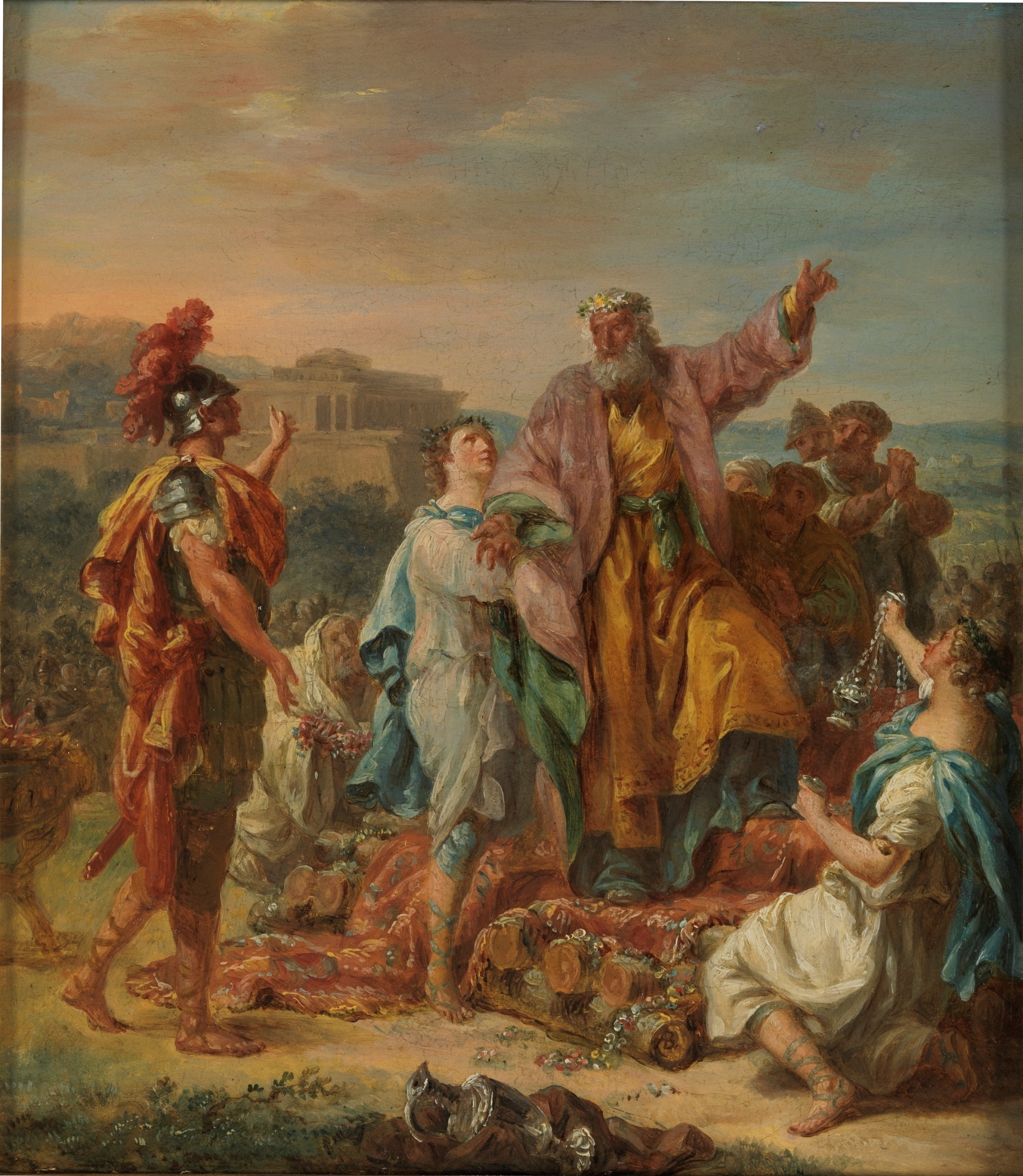
A painting c. 1672 by Jean Baptiste de Champaigne depicts "Alexander the Great receiving the news of the death by immolation of the gymnosophist Calanus" and is displayed at Chateau de Versailles et de Trianon, Versailles.[35]
See also
[edit]References
[edit]- ^ Plutarch, Parallel Lives, "Life of Alexander" 8 (ed. Clough 1859; ed. Loeb).
- ^ a b Wheeler, James Talboys (1973). The History of India: India from the earliest ages: Jain, Hindu, Buddhist, and Brahmanical revival. Cosmo Publications. pp. 171–72. Retrieved 23 July 2019.
- ^ a b Hunter, W.W. (2005). The Indian empire : its people, history, and products (1886). New Delhi: Asian Educational Services. p. 169. ISBN 9788120615816.
- ^ Hunter, William Wilson (1887). The Imperial Gazetteer of India. Trübner & Company. p. 173. Retrieved 23 July 2019.
- ^ Classica Et Mediaevalia. Librairie Gyldendal. 1975. pp. 271–76. Retrieved 23 July 2019.
- ^ a b c Halkias, Georgios (2015). "The Self-immolation of Kalanos and other Luminous Encounters Among Greeks and Indian Buddhists in the Hellenistic World". Journal of the Oxford Centre for Buddhist Studies. 8: 163–186. Retrieved 30 May 2015.
- ^ Diodorus Siculus, Library, 17.107.1
- ^ Bar-Kochva, Bezalel (2010). The image of the Jews in Greek literature: The Hellenistic Period. Berkeley: University of California Press. pp. 60–63. ISBN 9780520253360.
- ^ Stoneman, Richard (2012). The Legends of Alexander the Great. Bloomsbury Academic. pp. 43–47. ISBN 9781848857858.
- ^ a b Plutarch, Parallel Lives, "Life of Alexander" 65 (ed. Clough 1859; ed. Loeb).
- ^ a b M'Crindle, J.W. (2004). The invasion of India by Alexander the Great. Whitefish, Montana: Kessinger Pub. pp. 46, 315, 388–9, 346. ISBN 9780766189201.
- ^ MacMullen, Ramsay (1992). Enemies of the Roman order: treason, unrest, and alienation in the empire By Ramsay MacMullen. Routledge. p. 317. ISBN 9780415086219.
- ^ Vasunia, Phiroze (2013-05-16). The Classics and Colonial India. OUP Oxford. p. 61. ISBN 978-0-19-920323-9.
- ^ Additional sources:
- Lucian (of Samosata.); Costa, C. D. N. (December 2005). Lucian: Selected Dialogues. OUP Oxford. p. 258. ISBN 978-0-19-925867-3.
- ^ Aelian (1997). Historical Miscellany. Harvard University Press. p. 113. ISBN 978-0-674-99535-2.
- Turley, Jeffrey Scott; Souza, George Bryan (2017-06-06). The Commentaries of D. García de Silva y Figueroa on his Embassy to Shāh ʿAbbās I of Persia on Behalf of Philip III, King of Spain. BRILL. p. 226. ISBN 978-90-04-34632-1.
- Honigman, Sylvie; Nihan, Christophe; Lipschits, Oded (2021-06-30). Times of Transition: Judea in the Early Hellenistic Period. Penn State Press. p. 264. ISBN 978-1-64602-145-1.
- Vasunia, Phiroze (2013-05-16). The Classics and Colonial India. OUP Oxford. p. 61. ISBN 978-0-19-920323-9.
- Worthington, Ian (2014-07-10). Alexander the Great: Man and God. Routledge. ISBN 978-1-317-86644-2.
- Overtoom, Nikolaus Leo (2020-05-11). Reign of Arrows: The Rise of the Parthian Empire in the Hellenistic Middle East. Oxford University Press. p. 71. ISBN 978-0-19-088834-3.
- Brill's Companion to the Reception of Alexander the Great. BRILL. 2018-09-11. p. 632. ISBN 978-90-04-35993-2.
- Athenaeus (Mechanicus.) (2004). On Machines: (Περὶ Μηχανημάτων). Franz Steiner Verlag. ISBN 978-3-515-08532-8.
- Athenaeus (Mechanicus.) (2004). On Machines: (Περὶ Μηχανημάτων). Franz Steiner Verlag. p. 70. ISBN 978-3-515-08532-8.
- Worthington, Ian (2014-07-10). Alexander the Great: Man and God. Routledge. ISBN 978-1-317-86644-2.
- Brill's Companion to the Reception of Alexander the Great. BRILL. 2018-09-11. p. 632. ISBN 978-90-04-35993-2.
- ^ a b "Strabo, Geography, BOOK XV., CHAPTER I., section 64". www.perseus.tufts.edu. Retrieved 2025-05-07.
- ^ Bronkhorst, Johannes (2016). How the Brahmins won: from Alexander to the Guptas. Handbook of oriental studies. Leiden: Brill. pp. 34–35. ISBN 978-90-04-31519-8.
- ^ a b The calcutta review. 1867. p. 400. Retrieved 5 March 2017.
- ^ a b c Chatterjee, Suhas (1998). Indian civilization and culture. New Delhi: M.D. Publications. p. 129. ISBN 9788175330832.
- ^ Williams Jackson, A.V. (2009). History of India Vol. IX. New York: Cosimo Inc. pp. 65–70. ISBN 9781605205328.
- ^ Sastri, Kallidaikurichi Aiyah Nilakanta (1988). Age of the Nandas and Mauryas. Delhi: Motilal Banarsidass. pp. 105–106. ISBN 9788120804654.
- ^ a b Niehoff, Maren R. (2001). Philo on Jewish identity and culture. Tübingen: Mohr Siebeck. pp. 153–154. ISBN 9783161476112.
- ^ a b Alexander the Great. Robin Lax Fox. 1973. p. 416. ISBN 9780713905007.
- ^ a b Elledge, C. D. (2006). Life after death in early Judaism the evidence of Josephus. Tübingen: Mohr Siebeck. pp. 121–124. ISBN 9783161488757.
- ^ Warner, Arthur George; Warner, Edmond (2001). The Sháhnáma of Firdausí By Arthur George Warner, Edmond Warner. Psychology Press. p. 61. ISBN 9780415245432.
- ^ Yādnāmah-ʾi Panjumīn Kungrih-ʾi Bayn al-Milalī-i Bāstānshināsī va Hunar-i Īrān. Ministry of Culture and Arts, Iran. Vizārat-i Farhang va Hunar. 1972. p. 224.
- ^ Sagar, Krishna Chandra (1992). Foreign influence on ancient India. New Delhi: Northern Book Centre. p. 69. ISBN 9788172110284.
- ^ Defending the West: a critique of Edward Said's Orientalism Front Cover by Ibn Warraq. Prometheus Books. 2007. p. 108. ISBN 9781591024842.
- ^ Algra, Keimpe; Barnes, Jonathan; Mansfeld, Jaap; Schofield, Malcolm (1999). The Cambridge History of Hellenistic Philosophy edited by Keimpe Algra. Cambridge University Press. p. 243. ISBN 9780521250283.
- ^ Borruso, Silvano (2007). History of Philosophy. Paulines Publications Africa. p. 50. ISBN 9789966082008.
- ^ a b National Geographic, Volume 133. 1968. p. 64.
- ^ The philosophical books of Cicero. Duckworth. 1989. p. 186. ISBN 9780715622148.
- ^ Plutarch, Parallel Lives, "Life of Alexander" 70 (ed. Clough 1859; ed. Loeb).
- ^ Sullivan, Denis F. (2000). Siegecraft : two tenth-century instructional manuals by "Heron of Byzantium". Washington, D.C.: Dumbarton Oaks Research Library and Collection. p. 168. ISBN 9780884022701.
- ^ Melissa Calaresu; Filippo de Vivo; Joan-Pau Rubiés (2010). Exploring cultural history : essays in honour of Peter Burke. Farnham, Surrey, England: Ashgate. p. 259. ISBN 9780754667506.
Kalanos
View on GrokipediaHistorical Context
Gymnosophists in Ancient India
The term "gymnosophists" derives from the Greek words gymnos (naked) and sophistai (wise men or philosophers), referring to ancient Indian ascetics who practiced nudity as a form of renunciation.[4] This designation likely encompassed wandering sadhus, possibly from Brahmanical traditions or Shramana movements such as Jainism or Ajivikism, though their exact affiliations remain a subject of scholarly debate, with ancient sources often referring to them broadly as "Brahmans" while recognizing diverse philosophical types.[5][4] The concept emerged prominently in Greek accounts from the late 4th century BCE, during interactions in the Punjab and Indus regions, though these practices predated such records in Indian ascetic lineages.[6] Central to gymnosophist practices was voluntary poverty, where adherents renounced possessions to focus on inner contemplation, often living as itinerant mendicants.[4] Nudity, in the Digambara style—meaning "sky-clad"—symbolized freedom from worldly bonds and was paired with rigorous meditation to transcend sensory attachments.[5] They rejected material indulgences, including meat and wine, while embracing beliefs in the transmigration of the soul, viewing ascetic discipline as a path to liberation from the cycle of rebirth.[4] In 4th-century BCE Indian society, gymnosophists held a notable historical role as countercultural figures, particularly in intellectual hubs like Taxila, where they challenged conventional norms and fostered philosophical discourse.[5] Their influence extended to shaping broader spiritual movements, contributing to the ascetic underpinnings of emerging Hinduism, Jainism, and Buddhism amid the transition to the Maurya dynasty.[4] During Alexander's Indian campaign, these sages were encountered in groups, underscoring their visibility in northwestern India.[6] Gymnosophists distinguished themselves from urban Brahmins, who served as priestly intermediaries within societal structures and Vedic rituals, by adopting a nomadic, anti-establishment lifestyle detached from cities and hierarchies.[4] In contrast to early Buddhists, who emphasized communal monasticism and moderated asceticism without mandatory nudity, gymnosophists pursued more radical isolation and bodily exposure to embody philosophical ideals.[5]Alexander's Indian Campaign
Alexander's invasion of India marked the easternmost extent of his conquests, beginning in 327 BCE as he advanced from Bactria across the Hindu Kush mountains into the region known to the Greeks as India. This campaign followed his subjugation of the Achaemenid Empire and was driven by ambitions to expand his dominion further eastward, fueled by reports of vast wealth and exotic lands beyond the Indus River, as well as a personal curiosity about the world's diversity. Upon entering the Punjab region, Alexander encountered fragmented kingdoms and secured alliances, notably with the ruler of Taxila, Ambhi (known as Taxiles to the Greeks), who provided troops and intelligence in exchange for protection against rivals. The advance continued southward along the Indus Valley, showcasing the Macedonian army's adaptability to unfamiliar terrain, though it strained resources and morale. A pivotal engagement occurred in 326 BCE at the Battle of the Hydaspes River, where Alexander decisively defeated the Paurava king Porus, whose forces included war elephants that posed novel challenges to the Macedonian phalanx and cavalry tactics. Despite Porus's resistance, Alexander reinstated him as a vassal, incorporating Indian troops into his army and gaining control over the fertile Punjab territories up to the confluence of the Hydaspes (Jhelum) and Acesines (Chenab) rivers. Greek accounts from this period, preserved in Arrian's Anabasis of Alexander, highlight the campaign's exploratory aspect, with Alexander founding cities like Nicaea and Bucephala to commemorate victories and secure supply lines. Logistical difficulties mounted as the army pressed toward the Hyphasis River (modern Beas) in 326 BCE, where exhaustion from continuous campaigning, harsh monsoon conditions, and rumors of even larger kingdoms beyond led to a mutiny among the troops, who refused to advance further. Reluctantly, Alexander heeded their demands and ordered a retreat, diverting the army southward along the Hydaspes to the Indus, where he subdued additional tribes and orchestrated a naval exploration of the river's mouth. This turnaround shifted the campaign's focus from conquest to consolidation, as Alexander integrated local customs and resources while planning his return to Persia via the Gedrosian Desert. Greek writers like Strabo, drawing on earlier reports from Alexander's companions such as Aristobulus and Nearchus, portrayed India as a land of wonders, describing its diverse flora—including banyan trees and cotton plants—abundant wildlife like tigers and rhinoceroses, and industrious peoples engaged in agriculture and metallurgy. These accounts emphasized the region's fertility and strategic value, contrasting it with the arid Persian territories and underscoring the cultural exchanges that occurred during halts, such as brief interactions with local scholars in Taxila.Background and Philosophy
Origins and Early Life
Kalanos, known to the ancient Greeks as Calanus (Ancient Greek: Καλανός), was an Indian ascetic and gymnosophist originating from the region of Taxila in ancient Punjab, corresponding to modern-day Pakistan.[7] Taxila, a prominent center of learning and philosophy during the late 4th century BCE, served as a hub for various intellectual and spiritual traditions, where Kalanos likely developed his ascetic practices as part of the broader gymnosophist movement of naked philosophers who emphasized detachment from material possessions.[8] His Greek appellation derived from his habitual greeting of "Cale," an Indian term of salutation, while ancient sources differ on his original name: Plutarch reports Sphines, while Arrian gives Kalyana.[1][9] Prior to his encounter with foreign invaders, Kalanos led a reclusive life as a wandering philosopher, residing quietly by himself and earning a reputation among his peers as one of the most esteemed Indian sages.[1] As a gymnosophist, he practiced nudity and extreme asceticism, embodying the Indian tradition of renunciation that prioritized spiritual purity over physical comforts, though specific details of his family background or scholarly lineage remain undocumented in surviving accounts.[8] Ancient sources vary on his social affiliation; Arrian identifies him as a Brahman sage, while Plutarch does not specify his caste, focusing instead on his philosophical independence and refusal to conform to royal summons without conditions.[7][9] In the Punjab region around Taxila, Kalanos engaged in teachings on virtue and detachment, aligning with the gymnosophist ethos observed by Greek envoys like Onesicritus, who noted their cosmological insights and disdain for luxury.[7] His pre-conquest existence thus exemplified the itinerant ascetic lifestyle prevalent among Indian philosophers, untainted by political entanglements until the arrival of Alexander's forces disrupted the local milieu.[1]Philosophical Practices and Beliefs
Kalanos, as a prominent gymnosophist, adhered to a philosophy centered on self-control and detachment from material desires, believing that death would liberate him from the body's constraints, rendering physical existence transient.[9] He emphasized indifference to pleasure and pain, believing that true freedom arose from mastering bodily impulses, as evidenced by his reported statement that death would liberate him from the body's constraints when illness rendered it burdensome.[1] This worldview aligned with broader gymnosophist traditions of ascetic endurance, where mortality was seen not as tragedy but as a natural transition to a higher state.[1] His daily practices embodied voluntary poverty and symbolic renunciation, including nudity to signify rejection of worldly attachments and disdain for wealth or power. Kalanos practiced physical endurance tests, such as lying motionless on hot stones for hours, to cultivate resilience against environmental hardships and demonstrate mastery over the senses.[10] He engaged in oral teachings on virtue, advising self-sufficiency—claiming that India's natural fruits alone sustained life—and warning against gluttony as a force that eroded ancient abundance through loss of self-control.[9][10] Regarding life and death, Kalanos rejected prolonging existence through altered regimens when the body failed, favoring voluntary exit over invalidity, yet he opposed arbitrary euthanasia in favor of disciplined timing aligned with natural decline. This reflected possible influences from early Indian dualistic ideas akin to Samkhya, prioritizing the soul's eternal nature over corporeal suffering, though he uniquely expressed contempt for luxurious pursuits that bound one to the flesh.[9][1]Encounter with Alexander
Initial Meeting
During Alexander the Great's stay in Taxila around 326 BCE as the guest of King Ambhi (also known as Omphis), he expressed curiosity about the local gymnosophists, ascetic philosophers renowned for their wisdom, and arranged to meet several of them.[7] One such sage was Kalanos, whose real name was Sphines but who was called Calanus by the Greeks after his customary greeting of "Cale." Sent by Alexander to invite the sages, the Cynic philosopher Onesicritus encountered Kalanos, who boldly refused to engage unless Onesicritus stripped naked in accordance with gymnosophist customs, showcasing Kalanos's unimpressed demeanor toward foreign conventions.[11] Persuaded by King Ambhi to attend the royal court, Kalanos met Alexander. In their initial exchange, a brief dialogue ensued on the nature of power, with Kalanos emphasizing that true authority resided in self-mastery rather than conquest or kingship; to illustrate this, he cast a dry, shrunken hide upon the ground, noting that pressure applied to its edges caused other parts to rise in resistance, but footing the center subdued it entirely.[11] Greek historians Plutarch and Arrian both describe this encounter, portraying Kalanos as singularly unimpressed by Alexander's imperial prestige and more focused on philosophical equanimity amid the ongoing Indian campaign.[9]Decision to Accompany the Army
Following their initial encounter near Taxila, where Kalanos engaged Alexander in philosophical dialogue, the gymnosophist was persuaded by the local ruler Taxiles to accept the king's invitation to join his retinue. This decision came amid Alexander's campaigns in India in 326 BCE, after the Macedonian mutiny at the Hyphasis River had prompted a retreat westward. Ancient accounts portray Kalanos's choice as a voluntary one, distinguishing him from fellow gymnosophist Dandamis, who refused the invitation outright.[1][9] Kalanos's motivations appear rooted in Alexander's expressed admiration for Indian wisdom and the opportunity for intellectual exchange, though his peers criticized the move as a lapse into worldly attachments, labeling him a "slave to fleshly lusts." He joined not as a captive but as an honored guest, offering counsel on governance without accepting material luxuries or gifts from the king, consistent with gymnosophist asceticism. This arrangement underscored his insistence on equality in their interactions, rejecting any subordination.[1][9] The immediate aftermath saw Kalanos departing Taxila alongside the retreating Macedonian army, marking an early instance of cross-cultural philosophical dialogue as he began sharing Indian ascetic practices with Greek companions. This inclusion highlighted the king's strategy of incorporating foreign intellectuals to enrich his court.Travels and Interactions
Journey from India to Persia
After joining Alexander's expedition near Taxila in the Punjab region around 326 BCE, Kalanos, the gymnosophist ascetic, accompanied the Macedonian army on its westward return from India to Persia.[9][12] The route followed Alexander's strategic path post the Battle of the Hydaspes, proceeding southward along the Indus River valley before turning inland through the arid Oreitis region and the formidable Gedrosian Desert, then northward via Carmania into Persis (modern-day Fars province in Iran).[13][12] This overland march, spanning roughly 325–323 BCE, covered thousands of miles under relentless environmental pressures, contrasting sharply with the earlier crossing of the Hindu Kush mountains en route to India.[7] The journey presented severe logistical and environmental challenges for the army, including extreme heat, water scarcity, and famine, particularly during the 60-day traversal of the waterless Gedrosian Desert where many soldiers perished from starvation and exhaustion.[14] Kalanos, maintaining his traditional nudity as a gymnosophist despite the harsh conditions and the presence of heavily armored Macedonian troops, demonstrated exceptional endurance by relying minimally on provisions and adapting his ascetic routines to the nomadic march.[9][15] His philosophical resilience likely contributed to surviving these trials, standing out amid the army's reliance on supply lines strained by the terrain.[12] By late 324 BCE, the expedition reached Susa in Persis.[16][12] Throughout, the ascetic's unyielding practices—eschewing material comforts in favor of self-discipline—highlighted the cultural contrasts within the diverse retinue navigating Persia's satrapies.[9]Exchanges with Greek Thinkers
During his time accompanying Alexander's army, Kalanos reportedly critiqued figures like Anaxarchus, another of Alexander's philosophical companions and a Democritean thinker, for "fawning on kings" and compromising independence through courtly luxury. According to Diogenes Laertius, an Indian philosopher—likely one of the gymnosophists such as Kalanos—reproached Anaxarchus for failing to embody true goodness while currying royal favor, influencing Pyrrho (Anaxarchus's pupil) to embrace greater withdrawal from worldly affairs and skepticism toward conventional values. This exchange exemplified Indian asceticism's challenge to Greek materialism, emphasizing detachment from power and wealth as paths to inner freedom.[17] Such interactions reportedly shaped Alexander's companions' views on mortality and empire, fostering cross-cultural reflections on happiness amid the rigors of the return journey from India.[1]Self-Immolation
Onset of Illness
In early 323 BCE, during the Macedonian army's return through Persis near Susa after the Indian campaigns, Kalanos experienced the sudden onset of a severe illness that marked a stark departure from his previous robust health.[3] Ancient accounts note that he had never been ill prior to this point, enduring the grueling travels—including the harsh desert march through Gedrosia—without apparent detriment, but the cumulative strains finally manifested in Persis.[3] The condition, described as an intestinal disorder or general delicacy of health, rapidly progressed to incapacitate him physically.[2] The symptoms left Kalanos unable to walk or fulfill his ascetic duties, such as maintaining self-sufficiency and enduring physical trials unaided, compelling him to rely on a litter for transport.[3] Alexander the Great, distressed by his companion's decline, but Kalanos rejected ongoing palliative measures, deeming prolonged infirmity incompatible with his way of life.[2] From a philosophical standpoint, Kalanos regarded the illness as the irrevocable failure of the body, signaling the appropriate time for voluntary departure in accordance with Indian ascetic traditions that prized autonomy over dependent suffering.[3] He informed Alexander that he preferred death to enduring a diminished existence, aligning his response with the custom among gymnosophists to end life honorably when physical vigor waned. This decision underscored his belief in the soul's transcendence beyond bodily decay, prompting his request for a means to execute self-immolation.[2]The Ceremony and Execution
As Kalanos' illness progressed during the army's march through Persia, he requested that Alexander prepare a large pyre for his self-immolation, viewing it as a fitting end to his seventy-three years of life unmarred by prior sickness and filled with philosophical fulfillment.[18] Alexander initially sought to dissuade him from this course, but upon failing, granted the request and oversaw the construction of an elaborate pyre near Susa (though some accounts place it at Pasargadae).[18] This act aligned with the customs of Indian gymnosophists, who regarded voluntary death by fire as an honorable release from bodily decline rather than a passive wait for natural demise.[19] In preparation for the ceremony, Kalanos bid a personal farewell to Alexander while offering blessings to the Macedonian army, embracing his companions but pointedly withholding a direct goodbye to the king, instead promising to meet him soon in Babylon.[2] Accounts vary on his approach to the pyre: some describe him arriving on horseback or walking, while others note he was carried on a litter due to weakness; he performed ritual prayers, sprinkled himself, and cast some of his hair upon it before disrobing completely—true to his identity as a naked ascetic—and ascending the structure.[2][3] Addressing the assembled witnesses, he encouraged them to rejoice with Alexander and affirmed his philosophical creed that death held no terror, only a necessary transition.[19] The execution unfolded with striking composure: Kalanos lay down or stood motionless atop the pyre as attendants ignited it, enduring the rising flames without a single cry of pain or sign of distress until fully consumed.[18][2] Alexander and a large contingent of the Macedonian army witnessed the event, their reactions blending awe at his stoic fortitude with disbelief—some deeming him mad or presumptuous in his endurance, others hailing his contempt for death as exemplary.[18][19] The profound impact moved many soldiers to tears, and Alexander honored the philosopher with a lavish funeral before resuming the march.[19] Ancient accounts, particularly those of Diodorus Siculus and Quintus Curtius Rufus, vividly emphasize Kalanos' unyielding stoicism, portraying the self-immolation not as an act of despair but as a deliberate demonstration of philosophical mastery over suffering and mortality.[18][19]Prophecy
Content of the Prophecy
Just before ascending the funeral pyre in Susa, Kalanos addressed Alexander and the assembled Macedonian soldiers with words that would later be regarded as prophetic. According to Plutarch in his Life of Alexander, Kalanos exhorted the men to revel and make merry with their king that day, declaring calmly that "he should soon see [Alexander] in Babylon."[2] This statement was delivered as part of his final farewells, reflecting the philosophical composure he maintained throughout his interactions with Alexander, which often centered on themes of mortality and the transience of life.[2] The prophecy's wording, as recorded by Arrian in his Anabasis of Alexander, similarly conveys an expectation of reunion, with Kalanos foretelling that he would meet Alexander in Babylon, though the exact phrasing varies slightly across accounts.[20] In essence, the declaration implied Alexander's own imminent demise in that city, an outcome unforeseen at the time, and was spoken without apparent distress or elaboration, underscoring Kalanos's ascetic detachment from worldly concerns.[2] Scholars interpret the prophecy dually: as a literal foretelling of Alexander's death in Babylon the following year, which ancient writers like Plutarch noted only gained significance retrospectively, or as a symbolic allusion to their souls reuniting in the afterlife, aligning with Indian philosophical views on death as a transition rather than an end that Kalanos had discussed with the king.[2][20] Variations appear in other historians, such as Strabo, who recounts the self-immolation but omits the precise words, focusing instead on the event's location near Pasargadae, though the core implication of an impending meeting remains consistent in primary sources.[21]Fulfillment in Alexander's Death
Kalanos's self-immolation occurred in the winter of 324/323 BCE during the Macedonian army's march through Persia, several months before Alexander's death in Babylon on June 10 or 11, 323 BCE.[22] The event took place in Persia (ancient accounts vary on the exact location, such as near Susa or Pasargadae), where the sage, weakened by illness, chose to end his life by fire in a public ceremony attended by the army.[23][3] Alexander's final illness began in Babylon after prolonged feasting and heavy drinking, with symptoms including a sudden high fever, progressive paralysis, and loss of speech over ten days, culminating in his death at age 32.[24] This location directly echoed the prophecy's reference to Babylon as the site of their reunion, transforming Kalanos's parting words into a perceived foretelling of the king's demise.[25] At the Macedonian court, Alexander's death prompted immediate recollection of Kalanos's prophecy among his companions and officers, who interpreted it as a divine omen fulfilled, heightening the atmosphere of grief and superstition in Babylon.[26] The preceding drinking contest held in Kalanos's honor, which resulted in the deaths of around forty Macedonians from overindulgence, had already cast a pall over the army, further eroding morale amid growing reports of omens and the recent loss of Hephaestion.[23] Historians regard the prophecy's alignment with Alexander's fate as either a striking coincidence amid the numerous omens surrounding his final months or potentially reflective of Kalanos's astute observations of the king's physical decline from battle wounds, malaria-like episodes, and habitual excess during the grueling eastern campaigns.[27]Legacy
Accounts in Ancient Sources
The primary accounts of Kalanos, known to the Greeks as Calanus, appear in several Greek and Roman historical texts from the late Hellenistic and early Imperial periods, drawing ultimately on lost contemporary narratives from Alexander's campaign. These sources, written between the 1st century BCE and the 2nd century CE, preserve fragmented details of his interactions with Alexander and his self-immolation, often filtered through eyewitness reports from participants like Aristobulus of Cassandreia, whose work influenced later historians such as Arrian and Strabo.[28] Diodorus Siculus, in his Library of History (Book 17.107), offers one of the most vivid descriptions of Kalanos's death, portraying him as a philosopher named Caranus who, upon falling ill, voluntarily mounted a funeral pyre amid Alexander's army in Persia, maintaining composure as the flames consumed him. This account emphasizes the spectacle of the event, noting Alexander's provision of an elaborate pyre and honors, including a horse and military escort for the ceremony. Diodorus, composing around 60–30 BCE, likely relied on earlier compilations from Cleitarchus and other sensationalist historians, introducing potential dramatizations to highlight themes of Eastern exoticism and voluntary death as a philosophical ideal.[28] Plutarch, in his Life of Alexander (chapters 65 and 69), focuses on Kalanos's character and prophecy, depicting him as a sharp-tongued gymnosophist who rebuked Alexander insolently and later, stricken with illness, chose immolation over lingering suffering, bidding farewell with a prediction of their reunion in Babylon. Written around 100–120 CE, Plutarch's biography draws from multiple traditions, including Aristobulus, to illustrate Alexander's encounters with wise men, portraying Kalanos as a symbol of ascetic virtue that contrasted with Greek norms. This narrative underscores moral lessons on self-mastery, but reflects a Hellenocentric bias by exoticizing Indian practices as barbaric yet admirable spectacles.[5] Arrian's Anabasis of Alexander (7.3), composed around 130–160 CE, provides contextual details on Kalanos's role during the Persian return, noting his status as an Indian philosopher who accompanied the expedition and ended his life by fire at Pasargadae due to sickness, with Alexander honoring the act through lavish rites. Arrian prioritizes reliable sources like Ptolemy and Aristobulus, aiming for historical accuracy over embellishment, yet his account varies in specifics, such as the location, highlighting inconsistencies across traditions.[3] Strabo, in his Geography (15.1.64–68), circa 7 BCE–23 CE, compiles philosophical notes on Kalanos, describing his fiery temperament, interactions with Alexander's envoys, and self-immolation as a customary Indian practice among sophists, while citing Aristobulus for details like his 40-year ascetic discipline. Strabo critiques some reports as exaggerated, noting disputes among historians, but his work reveals a bias toward viewing Indian sages as primitive yet intellectually intriguing, often prioritizing anecdotal spectacle over deeper doctrinal analysis. These texts exhibit common Hellenocentric biases, framing Kalanos and his fellow gymnosophists as exotic "naked philosophers" to underscore Greek superiority in rationality while borrowing from their asceticism for Stoic parallels, potentially amplifying dramatic elements like the prophecy for ethical instruction.[5] Composed centuries after the events (ca. 326 BCE), they depend on lost contemporaries like Aristobulus, leading to variations in name (Calanus vs. Caranus), motivations, and details, with no surviving Indian perspectives to counterbalance the Greek focus on visual drama rather than philosophical substance.[28]Modern Interpretations and Debates
Modern scholars debate Kalanos's religious identity, often identifying him as a Brahmin ascetic from Taxila based on ancient Greek accounts of his interactions with Alexander, though some question whether he belonged to a Jain, proto-Buddhist, or other śramaṇa sect due to the rarity of self-immolation in mainstream Brahmanical traditions. Recent analyses, such as those examining comparative Greek and Indian sources, propose connections to early Buddhist ascetic practices in northwestern India, portraying his act as a ritual suicide aligned with soteriological ideas in heterodox groups, though Greek sources describe his sect as non-Buddhist gymnosophists evoking broader śramaṇa nudity and renunciation without direct ties to emerging Buddhist monasticism in Gandhāra during Alexander's time.[29][30] Kalanos symbolizes a pivotal moment in Indo-Greek cultural exchange, as his journey with Alexander's court facilitated early transmissions of Indian philosophical ideas to the West, influencing Greek perceptions of Eastern asceticism through reports of his debates and lifestyle. Greek historians like Onesicritus documented conversations with Kalanos that highlighted parallels between Indian austerity and Cynic philosophy, such as indifference to material comforts and ethical skepticism, fostering a Western fascination with Indian sages as embodiments of wisdom and self-mastery. This encounter contributed to broader Greco-Indian relations, where concepts like reincarnation and the āśrama system entered Hellenistic thought, shaping later Roman and European views of Oriental mysticism as a counterpoint to material ambition.[28][31] Questions persist regarding the historical accuracy of Kalanos's self-immolation, with scholars noting inconsistencies in ancient accounts—some depict it as a calm, voluntary ritual akin to Vedic fire sacrifices, while others suggest it was motivated primarily by illness, raising doubts about its authenticity as a pure ascetic choice. The event's details, including Kalanos's reported leap into flames rather than passive endurance, have prompted debates on whether it inspired later suicides or was exaggerated for dramatic effect in Greek narratives to underscore Eastern exoticism. Psychological interpretations of his prophecy to Alexander—that they would reunite in Babylon—view it less as supernatural foresight and more as a reflective meditation on mortality, aligning with Indian ascetic emphases on transience amid Alexander's imperial hubris.[32][28] Twenty-first-century studies link Kalanos's practices to broader Indian ascetic traditions, interpreting his nudity and fire ritual as precursors to yogic disciplines focused on body-mind transcendence, rather than later customs like sati, which emerged in different socio-religious contexts. Recent scholarship, including analyses of Greek-Indo coinage depicting Brahmin figures, underscores his role in early cultural hybridization under Indo-Greek kingdoms. In popular media, Kalanos appears in historical documentaries and novels as an emblem of Eastern defiance, though these portrayals often romanticize his story without engaging scholarly nuances.[5][31]References
- https://en.wikisource.org/wiki/The_Anabasis_of_Alexander/Book_VII/Chapter_III
