


Community hub
Recent from talks
Contribute something
Nothing was collected or created yet.
Kalaratri
View on Wikipedia | This article needs additional citations for verification. (November 2018) |
| Kalaratri | |
|---|---|
Goddess of Auspiciousness and Courage | |
| Member of Navadurga | |
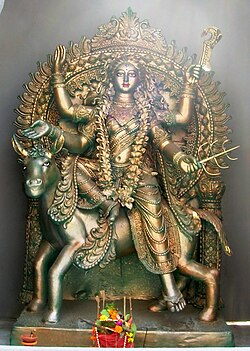
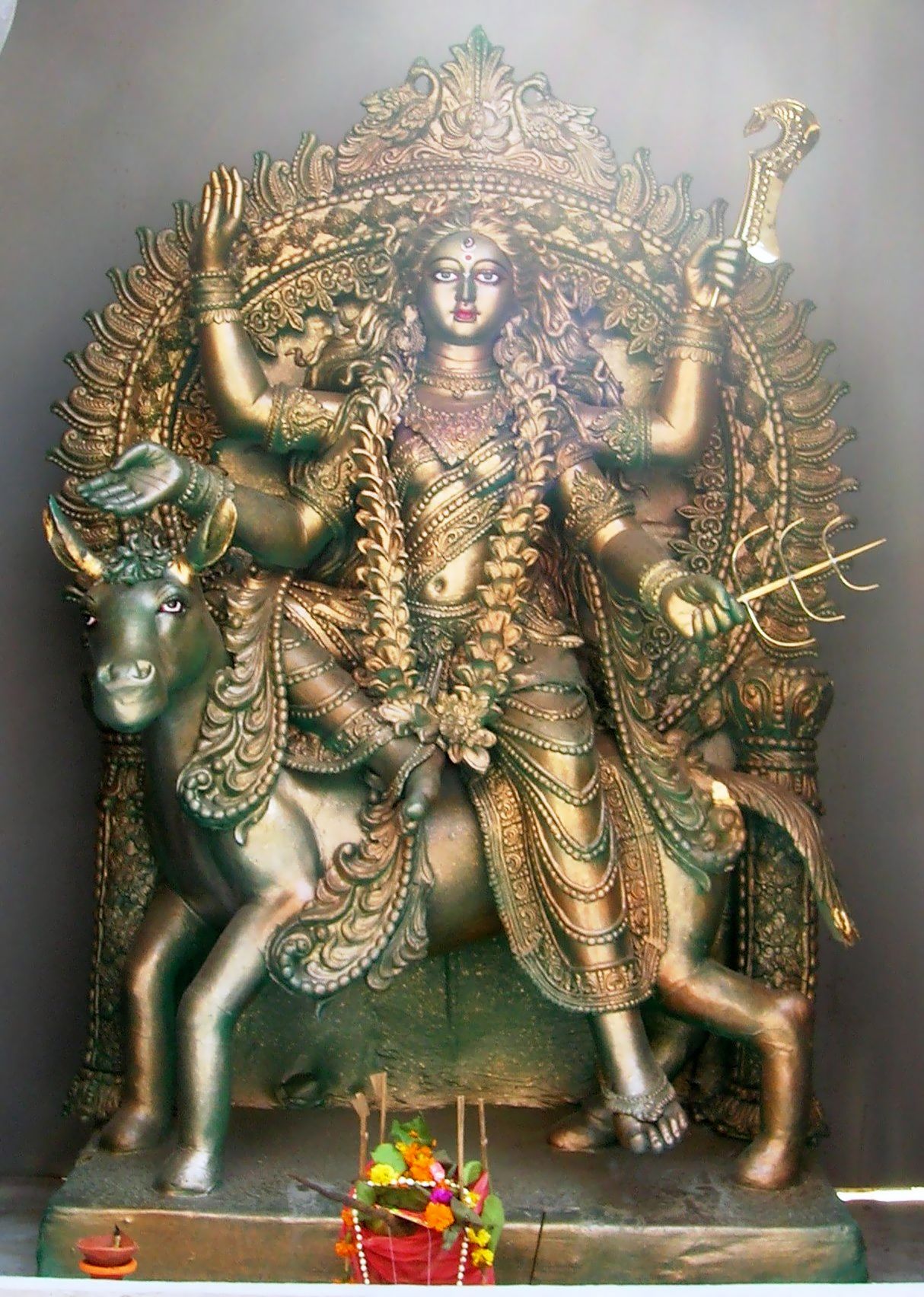
 A statue of Kalratri | |
| Planet | Rahu |
| Mantra | एकवेणी जपकर्णपुरा नग्न कालरात्री भीषणा| दंष्ट्रकराल्वदनं घोरं मुक्तकेश्वरम्|| ललजतक्षं लंबोष्टिं शतकर्णं तथैव च| वामपादोल्लासोल्लोह लतकन्तकभूशणम्|| |
| Weapon | Hooked vajra and curved sword, Abhayamudra, Varadamudra |
| Mount | Mule or Donkey |
| Consort | Shiva |
Kalaratri (Sanskrit: कालरात्रि, romanized: Kālarātri) is the seventh of the nine Navadurga forms of the goddess Mahadevi. She is first referenced in the Devi Mahatmya. Kalaratri is one of the fearsome forms of the goddess.[1][2] It is not uncommon to find the names Kali and Kalaratri being used interchangeably,[3] although these two deities are argued to be separate entities by some.[4] Kali is first mentioned in Hinduism as a distinct goddess around 300 BCE in the Mahabharata, which is thought to have been written between the 5th and 2nd centuries BCE (with possible oral transmission from a much earlier period).
Kalaratri is traditionally worshipped during the nine nights of Navaratri celebrations.[5] The seventh day of Navaratri in particular is dedicated to her, and she is considered the fiercest form of the goddess, her appearance itself invoking fear. This form of the goddess is believed to be the destroyer of all demon entities, ghosts, evil spirits and negative energies, who are said to flee upon knowing of her arrival.[6]
The Saudhikagama,[7] an ancient Tantric text from Orissa referenced in the Silpa Prakasha,[8] describes the goddess Kalaratri as being the goddess ruling over the night portion of every calendar day. She is also associated with the crown chakra (also known as the sahasrara chakra), said to yield the worshipper siddhis (supernatural skills) and nidhis (riches): knowledge, power and wealth in particular.
Kalaratri is also known as Shubankari (शुभंकरी), meaning auspicious in Sanskrit, due to the belief that she always provides positive results to her devotees. Hence, it is believed that she makes her devotees fearless.
Other, less well-known names of this goddess include Raudri and Dhumorna.[9]
Scriptural references
[edit] | This section needs additional citations for verification. (July 2021) |
Mahabharata
[edit]One of the earliest references to Kalaratri is found in the Mahabharata (first written down in the 5th century BCE, with additions and alterations continuing on through the 1st century BCE), specifically in the tenth part of the Sauptika Parva (Book of Sleeping). After the battle of the Pandavas and Kauravas, Ashwatthama, the son of Dronacharya, vows to avenge the death of his father. Going against the rules of war in the stealth of the night, he creeps into the Kuru camp dominated by Pandava followers. With the power of Rudra, he attacks and kills the followers in their sleep.
During his frenzied assaults on the followers, Kalaratri appears on the spot.
“.....in her embodied form, a black image, of bloody mouth and bloody eyes, wearing crimson garlands and smeared with crimson unguents, attired in a single piece of red cloth, with a noose in hand, and resembling an elderly lady, employed in chanting a dismal note and standing full before their eyes.”[10]
This reference is seen to depict Kalaratri as the personification of the horrors of war. [citation needed]
Markandeya Purana
[edit]Chapter 1 of the Durga Saptashati, verse 75, uses the term Kalaratri to describe Devi:[11]
prakṛtistvaṃca sarvasya guṇatraya vibhāvinī
kāḷarātrirmahārātrirmoharātriśca dāruṇā
You are the primordial cause of everything
Bringing into force the three qualities (sattva, rajas and tamas)
You are the dark might of periodic dissolution
You are the great night of final dissolution and the terrible night of delusion.
Skanda Purana
[edit]The Skanda Purana describes Shiva beseeching his wife, Parvati, to help the gods when they are terrorised by the demon-king, Durgamasur. She accepts and sends Goddess Kalaratri, "...a female whose beauty bewitched the inhabitants of the three worlds [...] by the breath of her mouth she reduced them to ashes."[12]
Devi Bhagavata Purana
[edit]After the goddess Ambika (also known as Kaushiki and Chandika) comes forth from the body of Parvati, Parvati’s skin turns extremely dark, almost black, like the hue of dark clouds. Therefore, Parvati is given the names Kalika and Kalaratri. She is described as having two arms, holding a scimitar and a blood-filled skull cup, and she eventually kills the demon king, Shumbha.[citation needed]
Other scriptural references to Kalaratri include the Lalita Sahasranama (found in the Brahmanda Purana) and Lakshmi Sahasranama.
Etymology
[edit] | This section needs additional citations for verification. (July 2021) |
The first part of the word kalaratri is kala. Kala primarily means time, but also means black. This is a masculine noun in Sanskrit. Time, as perceived by ancient Indian mystics, is where everything takes place; the framework on which all creation unfolds. The mystics conceived of kala as a personified deity. This, then, gave rise to the idea of the deified Kala as devourer of all things, in the sense that time devours all. Kalaratri can also mean "the one who is the death of time." In the Mahanirvana Tantra, during the dissolution of the universe, Kala (time) devours the universe and is seen as the supreme creative force, Kali.[13] Kālī is the feminine form of kālam (black, dark-coloured). A nineteenth-century Sanskrit dictionary, the Shabdakalpadrum, states: कालः शिवः । तस्य पत्नीति - काली । kālaḥ śivaḥ । tasya patnīti kālī - "Shiva is Kāla, thus, his wife is Kāli."
The second part of the word kalaratri, is ratri, night, and its origins can be traced to the oldest of the Vedas, the Rigveda and its hymn, Ratrisukta. The sage Kushika, while absorbed in meditation was said to have realised the enveloping power of darkness and thus invoked Ratri (night) as an all-powerful goddess in the form of the hymn. The darkness after sunset became deified. Each period of the night, according to Tantric tradition, is under the sway of a particular terrifying goddess who grants a particular desire to the aspirant. The word kalaratriin Tantra refers to the darkness of night, a state normally frightening to ordinary individuals, but considered beneficial to worshippers of the Goddess.[14]
In latter times, Ratridevi ('Goddess Ratri' or 'Goddess of the Night') came to be identified with a variety of goddesses.[citation needed] Since the colour black is seen to reference the primal darkness before creation, and also the darkness of ignorance. Hence, this form of the goddess is also seen as one who destroys the darkness of ignorance.[citation needed]
Invoking Kalaratri is said to empower the devotee with the devouring quality of time and the all-consuming nature of night, thus allowing all obstacles to be overcome and guaranteeing success in all undertakings.[citation needed]
Legends
[edit] |
Once there were two demons named Shumbha and Nishumbha, who invaded devaloka and defeated the demigods. Indra, the ruler of the gods, along with the other gods went to the Himalayas to get Shiva's help in retrieving their abode. Together, they prayed to Parvati. Parvati heard their prayer while she was bathing, so she created another goddess, Chandi (Ambika) to assist the gods by vanquishing the demons. Chanda and Munda were two demon generals sent by Shumbha and Nishumbha. When they came to battle her, Chandi created a dark goddess, Kali (in some accounts, called Kalaratri). Kali/Kalaratri killed them, thereby acquiring the name Chamunda.
Thereupon, a demon named Raktabija arrived. Raktabija had the boon that if any drop of blood of his fell onto the ground, a clone of him would be created. When Kalaratri attacked him, his spilt blood gave rise to several clones of him. As such, it became impossible to defeat him. So while battling, Furious at this, Kalaratri drank his blood to prevent it from falling down, eventually killing Raktabija and helping goddess Chandi kill his commanders, Shumbha and Nishumbha. She became so fierce and destructive that she started killing whoever came in front of her. All the gods prayed in front of Shiva to stop her, so Shiva decided to come below her foot trying to stop her. When she was engaged in killing everyone, Shiva appeared below her foot. By seeing her beloved husband below her foot, she bit her tongue, helped Shiva to stand and, in the guilt, she forgot about the fight, hence Shiva calmed her down.
Another legend says that Chamunda (Kali) was creator of Kalaratri. Riding a powerful donkey, Kalaratri chased the demons Chanda and Munda and brought them to Kali after catching and incarcerating them. These demons were killed by Chamunda. This story is closely related with another goddess named Chandamari.
She is the power of the darkest of nights. At night, the animal kingdom takes a break from work and all animals fall asleep. As they sleep, their exhaustion is removed. At the time of final dissolution, all the creatures of the world seek shelter, protection and refuge onto the lap of the mother goddess. She is the time of the dark night, the death-night. She is Maharatri, (the great night of the periodic dissolution) as well as Moharatri (the night of delusion). At the end of time, when destruction makes its arrival, the goddess transforms herself into Kalaratri, who devours all time without leaving any remains.
Yet another legend recounts that, there was a demon named Durgasur who, wanting to destroy the world, drove away all the devas from Swarg and snatched four Vedas. Parvati learned of this and created Kalaratri, instructing her to warn Durgasur against an attack. Durgasur's guards however tried to capture Kalaratri when she turned up as a messenger. Kalaratri then assumed a gigantic form and delivered the warning to him. Subsequently, when Durgasur came to invade Kailash, Parvati battled him and killed him, gaining the name Durga. Here Kalaratri serves as an agent who gives the message and warning from Parvati to Durgasur.

The complexion of Kalaratri is that of the darkest of nights with bountiful hair and a heavenly shaped form. She has four hands—the left two hands hold a scimitar and a thunderbolt and the right two are in the varada (blessing) and abhaya (protecting) mudras. She wears a necklace that shines like the moon. Kalaratri has three eyes which emanate rays like lightning. Flames appear through her nostrils when she inhales or exhales.[15] Her mount is the donkey, sometimes considered as a corpse. Blue, red and white colours should be used to wear on this day.
The appearance of Kalaratri can be seen as bearing doom for evil-doers. But she always bears good fruits for her devotees and should avoid fear when faced with her, for she removes the darkness of worry from life of such devotees. Her worship on the seventh day of Navratri is given especially high importance by yogis and sādhakas.
Prayers
[edit]Mantra
[edit]ॐ देवी कालरात्र्यै नम: Oṃ Devī Kālarātryai Namaḥ
मां कालरात्रि मंत्र- Maa Kalratri Mantra:
या देवी सर्वभूतेषु माँ कालरात्रि रूपेण संस्थिता नमस्तस्यै नमस्तस्यै नमस्तस्यै नमो नम:[16]
ऐं ह्रीं क्लीं चामुण्डायै विच्चे नम:।
सप्तमं कालरात्रिति। सप्तमं कालरात्र्ये नम:।
[17]ॐ ऐं ह्रीं क्लीं श्री कालरात्रि सर्व वश्यं कुरु कुरु वीर्य देहि देहि गणैश्वर्यै नम:।
Dhyan Mantra
[edit]करालवंदना धोरां मुक्तकेशी चतुर्भुजाम्। कालरात्रिं करालिंका दिव्यां विद्युतमाला विभूषिताम॥
Karalvandana dhoram muktkeshi chaturbhujam. Kaal Ratrim karalikaam divyam vidyutmala vibhushitam.[18]
Temples
[edit]- Kalratri -Varanasi Temple, D.8/17, Kalika Galli, which is a lane parallel to Annapurna – Vishwanath[19]
- Kalaratri Temple, Dumri Buzurg, Nayagaon, Bihar[20]
- Kalratri -Vindhyachal, Mirzapur (UP).
- Kalratri Temple- Patiala, Punjab
- Kalratri Temple- Sangrur, Punjab
See also
[edit]References
[edit]- ^ "9 days, 9 avatars: Be ferocious like Goddess Kaalratri". 7 October 2016.
- ^ "Navratri 2022 Day 7 Maa Kaalratri: Significance". The Times of India. 2022-10-02.
- ^ "Mokshapuri Kashi". www.kamakotimandali.com. Archived from the original on 2016-04-22. Retrieved 2016-04-13.
- ^ Mishra, P. K. (1989-01-01). Culture, Tribal History, and Freedom Movement: Dr. N.K. Sahu Commemoration Volume. Agam Kala Prakashan.
- ^ The Seventh form of Durga Archived 2013-12-16 at the Wayback Machine
- ^ Saraswati, Yogi Ananda. "Kalaratri". vedicgoddess.weebly.com. Retrieved 19 December 2012.
- ^ Das, Sadananda (2006). A Brief Introduction to Saudhikagama. Motilal Banarsidass. ISBN 81-208-2944-1.
- ^ Silpa Prakasa Medieval Orissan Sanskrit Text on Temple Architecture. Brill Archive. 1966.
- ^ Commemorative Figures. Brill Archive. 1982-01-01. ISBN 9004067795.
- ^ "Mahabharata - Odes to Red Blood and Savage Death by Satya Chaitanya". Boloji. Retrieved 2016-04-13.
- ^ Markandeya Purana, Chapter 74
- ^ Wilkins, W. J. (1882-01-01). Hindu Mythology: Vedic and Puranic. Library of Alexandria. p. 261. ISBN 978-1-4655-3568-9.
{{cite book}}: ISBN / Date incompatibility (help) - ^ Harper, Katherine Anne; Brown, Robert L. (2012-02-01). Roots of Tantra, The. SUNY Press. ISBN 9780791488904.
- ^ Harper, Katherine Anne; Brown, Robert L. (2012-02-01). Roots of Tantra, The. SUNY Press. ISBN 9780791488904.
- ^ Rampuri, Baba. "Navdurga – the nine forms of Durga". rampuri.com. Archived from the original on 19 December 2012. Retrieved 19 December 2012.
- ^ "Navratri 2022, Day 7: Maa Kalaratri & Maha Saptami Puja Vidhi, Shubh Muhurat, Mantras, Bhog And Aarti Lyrics". Indiatimes. 2022-10-01.
- ^ "Kaalratri Mata Mantra". BhagwatGeeta. 3 November 2024. Retrieved 3 November 2024.
- ^ "Navratri 7th Day: Maa Kalaratri Mantra & Puja Vidhi". The Times of India. 2020-10-23.
- ^ "Google Maps". Google Maps. Retrieved 2020-10-22.
- ^ "मां कालरात्रि का वार्षिक पूजनोत्सव समारोह कल".
Hindu deities and texts | ||
|---|---|---|
| Gods |  | |
| Goddesses | ||
| Deity groups | ||
| Texts (list) | ||
Kalaratri
View on GrokipediaEtymology and Names
Etymology
The name Kalaratri (Sanskrit: कालरात्रि) is a compound word derived from two key Sanskrit roots: kāla, which denotes "black", "time", or "death", and rātri, signifying "night". This etymological structure translates to "the dark night", "night of time", or "night of death", encapsulating themes of profound obscurity, temporal dissolution, and mortality central to her conceptual identity.[1][4] Within the linguistic framework of ancient Hindu texts, Kalaratri evokes the archetype of the new moon night (Amāvasyā), a period of utter darkness symbolizing cosmic transformation, the dissolution of cycles, and the threshold between destruction and renewal. This association underscores her role in rituals tied to aeonic endings, such as the close of a kalpa (cosmic era), where night represents both peril and protective power.[4][1] The term's earliest scriptural appearances as a descriptor for a fierce nocturnal goddess trace to epic and Puranic literature, including references in the Mahabharata (composed circa 5th century BCE to 4th century CE) and its prominent invocation in the Devi Mahatmya section of the Markandeya Purana (circa 5th–6th century CE), marking her emergence in Shakta traditions during the Gupta period (3rd–5th century CE).[1][4]Epithets and Associations
Kalaratri, often spelled as Kaalratri, serves as a primary variant name emphasizing her connection to the concept of time and darkness in Hindu traditions.[5] She is recognized as the seventh among the Navadurga, the nine forms of the goddess Durga that embody different energies of the Divine Mother during the Navratri festival.[5] A prominent epithet for Kalaratri is Shubankari, translating to "doer of good" or "auspicious one," underscoring her role in bestowing positive outcomes and protection upon devotees despite her formidable demeanor.[5] As a manifestation of Parvati, Kalaratri represents a fierce protective facet of the goddess, integrated within the broader pantheon as an aspect of Durga's multifaceted power.[5] In certain contexts, particularly tantric traditions, she is associated with Mahakali and identified with Kali, embodying the destructive force that overcomes ignorance and negativity.[6] Kalaratri's tantric significance is further highlighted by her linkage to the Sahasrara chakra, the crown energy center symbolizing ultimate spiritual enlightenment and dissolution of ego.[5] Within these esoteric practices, she is revered as the destroyer of Kala—referring to time, death, or the cycle of ignorance—facilitating transcendence over mortal limitations. In early Shakta and tantric traditions, she is also known as Nidra-Kalaratri, embodying sleep, swoon, and death, as described in texts like the Mahabharata.[7][4]Iconography and Symbolism
Physical Depiction
Kalaratri is conventionally portrayed with a dark black complexion, symbolizing the profound darkness of night, as described in traditional Hindu iconographic texts and temple depictions. Her skin tone is often rendered as pitch-black or resembling a dark cloud, emphasizing her association with the formless void and destruction of ignorance.[2][1] She possesses disheveled, unkempt hair that flows wildly, contributing to her fearsome and untamed appearance, a feature rooted in scriptural accounts of her emergence during cosmic battles. Kalaratri has three eyes, each emitting a radiant glow akin to lightning, which underscores her divine vigilance and piercing insight.[3] Flames or fiery breath are depicted emerging from her nostrils and mouth, illustrating her intense, destructive energy that consumes evil forces.[3] Her face is fierce and gaping, often shown with protruding fangs and a lolling tongue, enhancing the terrifying yet protective aura in artistic representations.[2][1][8] In her standard four-armed form, Kalaratri's lower right hands display the abhaya mudra (gesture of fearlessness) and varada mudra (gesture of boon-granting), signifying protection and benevolence to devotees, while her upper left hands wield a sword for severing ignorance and an iron hook (or occasionally a trident) for dragging away malevolent entities. This posture balances her wrathful and compassionate aspects, as seen in idols and paintings from Navratri festivals. She is frequently shown naked or minimally clad, and adorned with crimson garlands of red flowers or skulls, sometimes appearing blood-smeared to evoke her role in vanquishing demons.[2] Kalaratri rides a donkey or mule as her mount, which carries her swiftly through the darkness, a detail prominent in Puranic iconography and temple sculptures. Her overall form is dynamic, often in a standing or advancing pose with elevated breasts and thorny vine ornaments on her limbs, as invoked in devotional dhyana verses that guide artists and worshippers in visualizing her. These elements collectively render her as the most fearsome among the Navadurga manifestations, yet one who dispels inner and outer darkness for the faithful.[2][1]Symbolic Interpretations
Kalaratri's dark complexion symbolizes the profound darkness that engulfs ignorance, known as avidya in Hindu philosophy, enabling the destruction of inner and outer negativity to foster spiritual enlightenment.[1] This attribute is intrinsically linked to the tamas guna, one of the three fundamental qualities of nature in Samkhya philosophy, representing inertia and obscurity that must be transcended for cosmic balance and personal transformation.[9] Her mount, the donkey, embodies loyalty and sure-footedness amid adversity, signifying the devotee's steadfast journey through life's challenges while maintaining humility and detachment from material illusions.[1] The sword she wields represents the sharp discernment that severs ties with negative forces and ego-driven attachments, while the hook serves as a tool to extract and uproot deep-seated karmic obstacles, promoting liberation.[10] Additionally, her fiery breath acts as a purifying force, incinerating impurities, fears, and malevolent energies to clear the path for divine clarity and renewal.[11] As an embodiment of kala, or time's inexorable destructive aspect, Kalaratri illustrates the cyclical renewal of the universe, where annihilation paves the way for creation and spiritual evolution.[1] She offers protection against planetary malefics, particularly the afflictive influences of Saturn, shielding devotees from astrological adversities and granting resilience against cosmic disruptions.[12] Ultimately, her veneration empowers individuals to confront and overcome fear and obstacles, instilling courage and inner strength for navigating existential trials.[3]Scriptural References
In the Mahabharata
In the Mahabharata, Kalaratri appears in descriptive passages during the Kurukshetra war, symbolizing the inexorable force of death and time amid cosmic-scale destruction. One of the earliest explicit references occurs in the Karna Parva (section 34), where the narrator Sanjaya describes the illustrious Rudra—identified as Death's self—whose bow is the Year, with Kala Ratri, the Death-night and Rudra's shadow, forming the indestructible string; this composite form underscores her as an embodiment of nocturnal terror and inevitable doom in battle.[13] Subsequent mentions in the Shalya Parva reinforce her association with warfare's brutality. In section 11, a hurled weapon is likened to kala-ratri, "exceedingly destructive of the lives of elephants and steeds and human beings, twined round with cloth of gold," portraying her as a metaphor for overwhelming, fear-inducing lethality deployed by warriors.[14] Similarly, in section 17, King Yudhishthira launches a dart resembling kala-ratri "armed with the fatal noose," evoking her role in personifying the shadowy destroyer that aids righteous combatants against chaos.[15] A broader cosmic dimension is given in the Anusasana Parva (section 19), where kala-ratri is defined as the night heralding universal dissolution, linking her to the epic's themes of cyclical time and divine intervention in upholding dharma through annihilation.[16] As a fierce manifestation of Durga, these verses position Kalaratri as an implicit protector in the war's divine framework, manifesting as the dark power that consumes adharma.[13]In the Markandeya Purana
In the Devi Mahatmya section of the Markandeya Purana (chapters 81–93), Kalaratri is invoked as an epithet of the supreme goddess (Mahadevi) in the introductory chapter, listed alongside other "night" forms such as Maharatri and Moharatri to signify the destructive power that annihilates ignorance, ego, and demonic forces disrupting cosmic order.[17] This reference, in verse 1.59, portrays her as a terrifying aspect essential for restoring dharma amid chaos caused by asuras. The narrative places Kalaratri's manifestation in the middle episode (chapters 7–10), which follows the goddess's victory over Mahishasura and focuses on the campaign against the demon brothers Shumbha and Nishumbha. Here, she emerges as the fierce form Kali—often identified as a variant of Kalaratri or Chamunda—to counter the demon Raktabija, whose spilled blood generates identical clones, threatening to overwhelm the divine forces.[17] Enraged by Raktabija's resilience despite strikes from weapons like the trident and discus, the goddess Ambika frowns fiercely, causing Kali to issue suddenly from her forehead (verse 8.6). Described with a terrifying visage, Kali is armed with a sword and noose, clad in a tiger skin, adorned with a garland and girdle of skulls, her emaciated body marked by deep-sunk reddish eyes, a lolling tongue, and a gaping mouth emitting roars like a hundred jackals.[18] To thwart Raktabija's multiplication, Ambika commands Kali: "O Chamunda, open wide your mouth and swiftly drink up the drops of blood from Raktabija as they fall" (verse 8.53), addressing her by the epithet Chamunda while emphasizing her role in blood consumption.[19] Kali complies, lapping up the demon's blood with her wide mouth and devouring the nascent asuras that sprout from each drop, preventing their proliferation as Ambika continues the assault with her weapons (verses 8.57–61). This strategic intervention culminates in Raktabija's bloodless fall and death, enabling the goddess's ultimate triumph over Shumbha and Nishumbha, thereby reestablishing divine sovereignty and dharma for the benefit of the devas.[20] Through this episode, Kalaratri's form underscores the goddess's multifaceted power, blending destruction with protective restoration in the broader Puranic framework of the Navadurgas.[17]In the Skanda Purana
In the Skanda Purana's Reva-khanda of the Avantya-khanda, particularly in Chapter 14, Kalaratri is depicted as a terrifying manifestation of the Goddess, emerging from Parvati (also called Uma) at the behest of Lord Shiva to fulfill the cosmic function of universal annihilation at the conclusion of a yuga cycle.[21] Shiva invokes her through the potent mantra "Oṃ hum phaṭ tvaṃ saḥ," transforming the benevolent goddess into this fierce form to dissolve all creation—mobile and immobile—into a primordial ocean, thereby ensuring the protective renewal of the cosmos by ending cycles of existence marred by adharma.[21] This portrayal underscores her role as a divine guardian under Shiva's direct command, where she acts as an instrument of his will, safeguarding the eternal order by eradicating temporal chaos and fears tied to the inexorable passage of time. Kalaratri's invocation in this context highlights her worship for instilling courage among devotees, as her fearsome attributes—such as dishevelled hair, a lean frame clad in tiger skin, serpentine ornaments, and eyes like blazing lightning—symbolize the dissolution of all anxieties and calamities bound to worldly existence.[21] Accompanied by goblins and Matr devis, she embodies unyielding protective power, observed by sages on the sacred banks of the Narmada River, a prominent tirtha site that amplifies her significance in pilgrimage rituals aimed at averting cosmic and personal disasters.[21] Furthermore, the Skanda Purana's Kashi-khanda references Kalaratri as a primary Shakti form of the Devi, positioned as a chief protector of the holy city of Kashi (Varanasi), where her worship is extolled for granting fearlessness and safeguarding pilgrims from afflictions during sacred journeys.[22] This association links her intrinsically to Shiva, as the eternal consort who empowers her destructive yet benevolent essence, reinforcing her unique capacity to alleviate time-bound dreads through devotional practices at these tirthas.[22]In the Devi Bhagavata Purana
In the Devi Bhagavata Purana, Kalaratri emerges as a formidable manifestation of Parvati amid the cosmic conflict with the demons Shumbha and Nishumbha, who perform intense penance to claim her as their consort. To counter this threat, the gods extract a radiant form known as Ambika or Kaushiki from Parvati's body, leaving Parvati's complexion to darken profoundly, akin to the hue of storm clouds, thereby transforming her into Kalaratri—the embodiment of the dark night born from divine wrath. This narrative underscores her origin as a protective force, wielding the power to vanquish demonic entities and restore dharma.[23][24] Positioned as the seventh among the Navadurgas, the nine fortified forms of Durga invoked for victory over adversity, Kalaratri's creation highlights Parvati's multifaceted nature, where wrathful energy coalesces to safeguard the cosmos.[25][24] The text extols Kalaratri's worship as a profound path to spiritual liberation, promising devotees release from samsara—the cycle of birth and death—and the eradication of accumulated sins through her grace. Specific passages describe rituals and hymns dedicated to her that dispel inner darkness, ego, and karmic burdens, fostering enlightenment and fearlessness in the face of worldly illusions. Her veneration is linked to temple foundations, notably in Varanasi, where the Purana recounts divine instructions for consecrating sites to honor her annihilating power, ensuring perpetual protection for pilgrims seeking redemption.[25][24] Distinctively, the Devi Bhagavata Purana portrays Kalaratri as the quintessential "night of annihilation" within the universe's cyclic rhythms, symbolizing pralaya—the dissolution phase where she engulfs creation in darkness to pave the way for renewal, thus embodying time's inexorable force in maintaining eternal balance.[26]Legends
Emergence and Demon Battles
In the mythological narratives of the Devi Mahatmya, part of the Markandeya Purana, the gods, tormented by the demon kings Shumbha and Nishumbha who had usurped the divine realms, collectively invoked the primordial energy of the universe to manifest as Durga for their protection. This supreme goddess, embodying the collective power of the deities, emerged to restore cosmic order by confronting the asura forces. As the battle intensified, Durga's wrath gave rise to a fearsome manifestation known as Kali, later associated with Kalaratri in Navadurga traditions, symbolizing the dark night of destruction.[27] When the demon generals Chanda and Munda, dispatched by Shumbha and Nishumbha, launched a ferocious assault on Durga with their vast armies, she furrowed her brow in anger, from which sprang forth Kali in a terrifying form—dark-skinned, with disheveled hair, wielding a sword and noose, and adorned with a garland of skulls. This embodiment charged into the fray, devouring countless demons and scattering their ranks with her roars that shook the earth. Kali swiftly seized Chanda by his hair and severed his head, then struck down Munda with her blade, presenting both severed heads to Durga amid peals of laughter, thereby earning the epithet Chamunda for the goddess. This victory decimated the demon vanguard and filled the asuras with dread.[27][3] An alternative tradition describes Kalaratri's emergence when Parvati sheds her golden skin to become dark and terrifying, enabling her to vanquish demons.[3] The conflict escalated with the entry of Raktabija, another formidable general whose boon allowed him to multiply from every drop of his blood that touched the ground, creating an endless army of clones whenever wounded. Durga, recognizing the threat, commanded Kali to counter this by drinking the demon's blood directly to prevent it from spawning further adversaries. Kali, with her protruding tongue extended, lapped up the flowing blood from Raktabija's wounds while simultaneously devouring the emerging duplicates, her form expanding ferociously to consume them all. As the last of his essence was drained without a single drop escaping, Raktabija collapsed lifeless, restoring balance and paving the way for Durga's ultimate triumph over the demon kings. This act of Kalaratri not only halted the proliferation of chaos but also exemplified her role in annihilating tamasic forces that disrupt dharma.[27]Protective Role in Divine Narratives
In the Skanda Purana, Kalaratri emerges as a protective emissary in a divine narrative where the gods, terrorized by the demon-king Durgamasur, seek Shiva's aid to restore cosmic balance. Shiva beseeches Parvati to intervene, prompting her to manifest Kalaratri, who is dispatched to the demon's court. Kalaratri's terrifying appearance reduces the demon to ashes with the power of her breath, thereby safeguarding the deities.[3] Kalaratri's protective functions extend to her role as a guardian in Puranic accounts, absorbing evil energies to allow order to prevail.[26]Worship Practices
Observance in Navratri
Kalaratri is dedicated to the seventh day, known as Saptami, of the Sharadiya Navratri festival, which occurs in the autumn season and spans nine nights in honor of the Divine Mother.[28] As one of the Navadurgas, she embodies the fiercest manifestation of Goddess Durga, worshipped to invoke protection against malevolent forces during this culminating phase of the festival's rituals, which begin with Ghatasthapana on the first day.[29] Devotees observe strict fasting throughout Navratri, but on Saptami, the fast intensifies focus on inner purification to align with Kalaratri's energy, believed to remove deep-seated fears and insecurities while strengthening spiritual resolve.[30] The puja vidhi for Kalaratri on this day emphasizes simplicity and intensity to channel her transformative power. Devotees begin by purifying the home and altar, followed by lighting a mustard oil lamp, which is thought to dispel negative energies and invite her protective aura.[31] Offerings include garlands of lemons or red roses, along with sweets like mishri and batasha, presented after invoking her through basic chants.[28][29] Worshipping Kalaratri on Saptami is said to yield profound benefits, including the removal of life obstacles, instillation of unyielding courage against adversities, and facilitation of spiritual progression toward the Sahasrara chakra, the crown energy center associated with enlightenment and divine connection.[32] Her rituals symbolically eradicate inner and outer darkness, empowering devotees to transcend limitations as the festival builds toward victory over evil.[28]Mantras and Rituals
The primary mantra for Kalaratri is Om Devi Kalaratryai Namah, typically chanted 108 times using a rudraksha mala to invoke her protective energies.[2] This beej mantra, rooted in traditional Navratri practices, is recited to dispel fear and grant courage.[33] A key dhyana mantra for meditation visualizes her form:एकवेणी जपाकर्णपूरा नग्ना खरस्थिता।
लम्बोष्ठी कर्णिकाकर्णी तैलाभ्यक्तशरीरिणी।
वामपादोल्लसल्लोहलताकण्टकभूषणा।
वर्धनमूर्ध्वजा कृष्णा कालरात्रिर्भयङ्करी॥ (Eka-veni japakarnapura nagna kharasthita. Lamboshti karnikakarni tailabhyaktasharirini. Vamapadollasallohalatakantakabhushana. Vardhanamurdhavaja krishna kalaratribhayankari.) This shloka depicts Kalaratri with a single braid, adorned with hibiscus in her ears, riding a donkey, her body smeared with oil, left foot decorated with thorny creepers, wielding a raised sword, dark-complexioned, and fearsome yet prosperity-bestowing.[34] Devotees meditate on this imagery to cultivate inner strength and ward off obstacles.[35] An additional stotra from the Devi Mahatmya tradition, adapted for Kalaratri, is:
या देवी सर्वभूतेषु माँ कालरात्रि रूपेण संस्थिता।
नमस्तस्यै नमस्तस्यै नमस्तस्यै नमो नमः॥ (Ya Devi sarvabhuteshu ma kalaratri rupena samsthita. Namastasyai namastasyai namastasyai namo namah.) This hymn praises her as the embodiment of the dark night form in all beings, offering salutations for victory over adversities.[2] Reciting it is said to defeat enemies, remove negativity, and provide divine shielding from evil influences.[33] Rituals for Kalaratri emphasize nighttime worship, aligning with her name meaning "dark night," often conducted after sunset on the seventh day of Navratri.[3] The puja begins with lighting a mustard oil lamp, followed by offerings of night-blooming jasmine flowers, jaggery, and black sesame seeds as bhog to honor her fierce yet benevolent nature.[35] [3] During the ceremony, devotees perform aarti and visualize her form through the dhyana mantra, concluding with 108 repetitions of the primary mantra for amplified spiritual protection.[2]