Hubbry Logo
search
logo
2057765

Kambojas

logo
Community Hub0 Subscribers
Read side by side
from Wikipedia

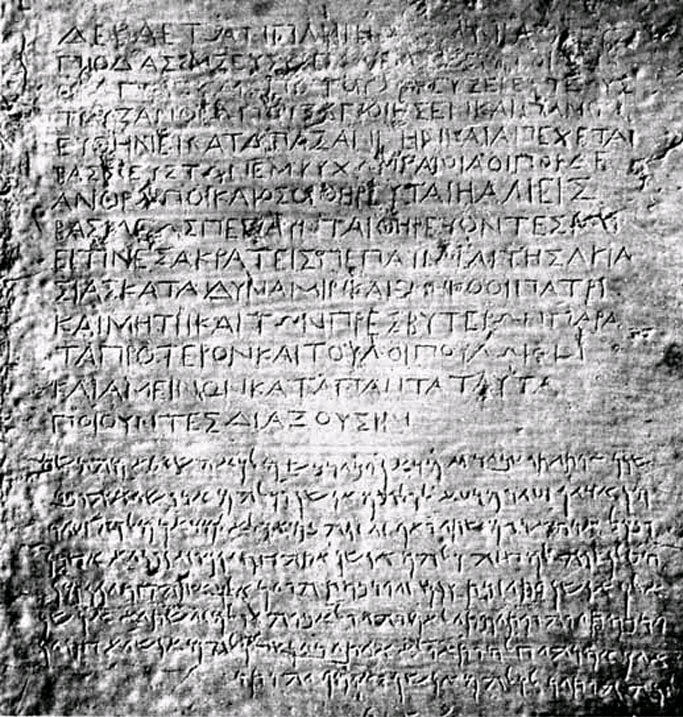
The Kandahar Bilingual Rock Inscription of Ashoka, in which the Kambojas are mentioned.

The Kambojas were a southeastern Iranian people[a] who inhabited the northeastern most part of the territory populated by Iranian tribes, which bordered the Indian lands. They only appear in Indo-Aryan inscriptions and literature, being first attested during the later part of the Vedic period.

They spoke a language similar to Younger Avestan, whose words are considered to have been incorporated in the Aramao-Iranian version of the Kandahar Bilingual Rock Inscription erected by the Maurya emperor Ashoka (r. 268–232 BCE). They were adherents of Zoroastrianism, as demonstrated by their beliefs that insects, snakes, worms, frogs, and other small animals had to be killed, a practice mentioned in the Avestan Vendidad.

Etymology

[edit]

Kamboja- (later form Kāmboja-) was the name of their territory and identical to the Old Iranian name of *Kambauǰa-, whose meaning is uncertain. A long-standing theory is the one proposed by J. Charpentier in 1923, in which he suggests that the name is connected to the name of Cambyses I and Cambyses II (Kambū̌jiya or Kambauj in Old Persian), both kings from the Achaemenid dynasty. The theory has been discussed several times, but the issues that it posed were never persuadingly resolved.[1]

In the same year, Sylvain Lévi proposed that the name is of Austroasiatic origin, though this is typically rejected.[1]

History

[edit]

The Kambojas only appear in Indo-Aryan inscriptions and literature, being first attested during the later part of the Vedic period. The Naighaṇṭukas, a glossary and oldest surviving writing about Indian lexicography, is the first source to mention them. In his book about etymology—the Nirukta—the ancient Indian author Yaska comments on that part of the Naighaṇṭukas, in which he mentions that "the word śavati as a verb of motion is used only by the Kambojas", a statement that is more or less repeated in the exact same way by later authors, such as the grammarian Patanjali (2nd-century BCE) in his Mahabhashya. The word śavati is equivalent to š́iiauua- in Younger Avestan, which demonstrates that the Kambojas spoke an Iranian tongue with close ties to it. Modern historian M. Witzel surmised that grammarians and lexicographers must have first become acquainted with the word around 500 BCE or perhaps earlier, due to Yaska and Patanjali both using the same example known amongst grammarians and lexicographers.[1]

Drawing of the fifth Major Rock Edict of the Maurya emperor Ashoka (r. 268–232 BCE)

The Major Rock Edicts of the Maurya emperor Ashoka (r. 268–232 BCE) contain the first attestations of the Kambojas that can be precisely dated. The thirteenth edict says "among Greeks and Kambojas" and the fifth edict says "of Greeks, Kambojas and Gandharians". It is uncertain if Ashoka was only referring to just the Kambojas or all the Iranian tribes in his empire. Regardless, the mentioned groups of people were part of the Maurya Empire, being influenced by its politics, culture and religious traditions, and also adhered to ideology of "righteousness" set by Ashoka.[1]

The major Indian epic Mahabharata also mentions the Kambojas, alongside the Greeks, Gandharas, Bactrians and Indo-Scythians. Geographical texts in Sanskrit and the Aṅguttara Nikāya include the Kambojas as one of the sixteen kingdoms of the Indian subcontinent during the lifetime of the Buddha. Various characteristics of the Kambojas are also described in different types of Sanskrit and Pali literature; they shaved themselves bald; they had a king; Rāja-pura- (meaning "King's town") was the name of their capital, but its site remains unknown. As was typical of Iranians, the Kambojas were renowned for their skill in horse breeding, and it is believed that the horses they produced were the most suitable for use in battle. These horses were brought into India in large quantities and also given as tribute.[1][2][3] Indologist Etienne Lamotte further suggests that reputation of Kambojas as homeland of horses possibly earned the horse-breeders known as Aspasioi (from Old Persian aspa) and Assakenoi (from Sanskrit aśva "horse") their epithet.[4]

Following the death of Ashoka, the Maurya Empire fell into decline. During the start of the 2nd-century BCE, they lost their Indian-Iranian frontier lands (including Gandhara and Arachosia) to the forces of Demetrius I (r. 200–180 BCE), the king of the Greco-Bactrian Kingdom. As a result, the Greek population of those areas were once again under the dominion of their Greek countrymen, while the Kambojas met other Iranians, as the Bactrians were likely a major component of the conquering army along with the Greeks.[5]

Some historians consider the Kambojas to have established the Kamboja Pala dynasty in Bengal, but this remains uncertain. Some historians consider it to have founded by Kambojas who had settled in Bengal, a theory which may be supported by the attestation of a Kambojadeśa in the Lushai Hills by the Tibetan book Pag Sam Jon Zang. Hem Chandra Raychaudhuri proposed that the Kambojas may have travelled to Bengal from the northwestern frontier in the wake of Gurjara-Pratihara conquests during the lifetime of Narayanapala. He adds that those Kambojas perhaps acquired positions and, at a suitable time, seized power.[6]

Richard Strand considers the Nuristani Kom people (aka Kamôzî or Kamôǰî) to be the descendants of the Kamboja people.[7]

Language and location

[edit]
Location of the two inscription sites in present-day Afghanistan, whose engraved Iranian languages have been suggested to have been spoken by the Kambojas

The Kambojas inhabited the northeastern most part of the territory populated by Iranian tribes, which bordered the Indian lands.[1] In 1918, Lévi suggested it to be Kafiristan, but later retracted it in 1923; B. Liebich suggested they lived in the Kabul Valley; J. Bloch suggested that they lived to the north-east of Kabul; Lamotte considered them to live them from Kafiristan to the southwestern part of Kashmir.[4][8]

In 1958, a new suggestion was put forward by the French linguist Émile Benveniste.[8] He drew a comparison between the Kambojas and Greeks described in Ashoka's edicts in Kandahar and the two languages it was written in; Greek and "Aramao-Iranian", which refers to the Iranian language hidden in the text of the Aramaic alphabet. Ashoka wanted to use these two languages to convey his religious message to the inhabitants of what is now present-day eastern Afghanistan, around the Gandhara area, approximately between Kabul and Kandahar. Because of this, Benveniste considered the Iranian language used in Ashoka's inscriptions to be spoken by the Kambojas.[1] The Iranologists Mary Boyce and Frantz Grenet also support this view, saying that "The fact that Aramaic versions were made indicates that the Kambojas enjoyed a measure of autonomy, and that they not only preserved their Iranian identity, but were governed in some measure by members of their own community, on whom was laid the responsibility of transmitting to them the king's words, and having these engraved on stone."[9]

Gérard Fussman suggested that the unidentified Iranian language of the two rock-inscriptions (IDN 3 and 5) in Dasht-e Nawar was spoken by the Kambojas, perhaps an early stage of the Ormuri language. According to Rüdiger Schmitt; "If this hypothesis should prove to be true, we would be able to locate the Kambojas more precisely in the mountains around Ghazni and on the Upper Arghandab."[1]

Religious beliefs

[edit]

The Indo-Aryans considered the Kambojas to be "non-Aryan" (anariya-) strangers with their own peculiar traditions, as demonstrated in a portion of the Buddhist Jataka tales. Insects, snakes, worms, frogs, and other small animals had to be killed according to the Kambojas' religious beliefs.[1][3] This practice has been linked by academics to the Avestan Vendidad for a long time, leading them to the conclusion that the Kambojas were adherents of Zoroastrianism.[1] These beliefs are based on Zoroastrian dualism, which attributes the Evil Spirit to creatures like these and others that are poisonous or repulsive to humans. Hence, Zoroastrians were commanded to destroy them, and careful pursuit of this goal has been observed by outside spectators since the 5th-century BCE to the present.[10]

Notes

[edit]

See also

[edit]

References

[edit]

Sources

[edit]
Revisions and contributorsEdit on WikipediaRead on Wikipedia
from Grokipedia
The Kambojas were an ancient Indo-Iranian tribe, being part of the Indo-Aryan cultural sphere, of the northwestern Indian subcontinent—one of 16 Mahajanapadas (Great States) of ancient India—, renowned for their exceptional breed of horses and skilled cavalry, who played a significant role as warriors and traders in Vedic, epic, and Puranic traditions from around the 2nd millennium BCE to the early centuries CE.[1] Originating as an early Vedic people initially classified as Kshatriyas (in Hindu Varna system) but later degraded to Shudra status in Brahmanical texts, the Kambojas were associated with non-Aryan groups such as the Anu tribe or the Druhyu lineage, and they maintained connections to Central Asian or Indo-Scythian influences.[1] Their territory spanned the upper Indus Valley and beyond, including regions near modern-day eastern Afghanistan, western Punjab (Pakistan) and northern India, Swat, Kunar, Kapisa, Rajauri/Poonch, and Hazara, often described as part of the northern Uttarapatha division and bordering Gandhara.[1][2] The Mahabharata's Droṇa Parva mentions Rājapura as the capital of the Kambojas. Some scholars identify this Rājapura with Kapisa (Kapisha), based on the 7th-century descriptions by the Chinese pilgrim Xuanzang of Kapisa as a major kingdom north of Gandhāra and geographical correspondences, while alternative identifications such as with Rajauri have also been proposed.[3] The tribe's earliest mentions appear in Vedic literature, such as the Vamsha Brahmana of the Samaveda, which lists Kamboja Aupamanyava as a Vedic teacher who received lore from Madragara Saungayani, indicating their integration into early Indo-Aryan cultural spheres despite possible non-Aryan roots.[1][4] In the Mahabharata, they are prominently featured as allies of the Kauravas in the Kurukshetra War, contributing a formidable contingent under King Sudakshina of Rajapura, a Maharatha warrior, including thousands of horsemen, foot-soldiers, and elephants; the epic highlights their cavalry prowess, with references to "Kambojaka ashvas" (Kamboja horses) as superior mounts.[1] Puranic texts like the Vayu Purana, Harivamsha, and Brahmanda Purana further depict them as a northern mleccha (barbarian) tribe, often grouped with the Yavanas, Sakas, Pahlavas, and Gandharas, and involved in conflicts or alliances with Aryan kingdoms such as the Kurus, Madras, and Magadha.[1] Socially and politically, the Kambojas operated as a mix of oligarchic republics (sanghas) and monarchies, with warrior bands (ayudhajivin sanghas) noted in Paninian grammar and Kautilya's Arthashastra, where they are described as Kshatriya guilds living by arms and trade.[1][2] Their economy centered on horse breeding and commerce, making them a vital hub for equestrian trade routes linking Central Asia to the Indian subcontinent, as evidenced in Buddhist texts like the Anguttara Nikaya, which lists Kamboja among the sixteen Mahajanapadas (great realms of ancient India).[1][2] Militarily, they were subjects of the Achaemenid Empire, mentioned in its inscriptions, resisted Macedonian incursions, supplied forces to Chandragupta Maurya, and appear in Ashokan edicts as subjects of the ancient Indian Mauryan Empire, underscoring their enduring influence in the region's power dynamics until their assimilation into later Indo-Greek and Kushan contexts.[1][2][3]

Name and Origins

Etymology

The term "Kambojas" originates from the Indo-Iranian ethnonym *Kambauǰa-, attested in Old Persian as Kambujīya and referring to both a people and their territory in the northwestern borderlands.[5] This form appears in Achaemenid inscriptions, where it denotes a royal name (Cambyses I and II), suggesting a shared linguistic heritage among eastern Iranian groups, though the precise semantic meaning—potentially linked to nomadic or warrior attributes—remains debated among philologists due to limited Avestan parallels.[5] In Sanskrit sources, the name evolves phonetically to Kamboja (later Kāmboja), first appearing in post-Rigvedic Vedic literature, such as the Vamsha Brahmana of the Samaveda, the Atharvaveda, and Paippalāda Saṃhitā, where it designates a northwestern tribe.[6] Scholar Michael Witzel interprets this as evidence of Indo-Iranian substrate influence, with the initial *k- possibly reflecting eastern Iranian dialects in regions like southeastern Afghanistan, and notes variant forms like Greek Ambautai, indicating a Saka-like suffix adaptation.[6] Spelling variations across languages highlight the term's fluidity: Prakrit texts render it as Kamboya, while Greek accounts (e.g., Herodotus) preserve echoes in "Kambyses," potentially linking the royal name to the tribal designation.[5] Scholarly debate centers on whether "Kamboja" primarily signifies a geographic locale or an ethnic group, with evidence from Achaemenid records supporting the former and Vedic references emphasizing the latter as a mobile warrior clan.[6]

Ethnic and Cultural Origins

The Kambojas are theorized to have originated from the Iranian steppes as part of the Indo-Iranian migrations that followed the divergence of Indo-Aryan and Iranian branches around 2000–1500 BCE. These migrations involved pastoralist groups moving southward from the Eurasian steppes into regions encompassing modern-day eastern Iran and Central Asia. Although not directly attested in surviving Avestan texts, the Kambojas are identified as an eastern Iranian ethnic group based on Indo-Aryan and Old Persian sources, with their territory situated near the borders with Indian regions. This geographical reference underscores their position as an eastern Iranian people with cultural ties to early Iranian border communities. Cultural parallels link the Kambojas to Saka nomads, another eastern Iranian steppe people known for their mobility and equestrian prowess. Both groups shared traditions of horse husbandry, with the Kambojas celebrated in ancient Indian sources for breeding swift, enduring warhorses suited to rugged terrains.[7] This steppe-derived horse culture, emphasizing selective breeding for cavalry, reflects broader Iranian nomadic practices that facilitated migrations and warfare across Central Asia. Potential Tocharian influences, stemming from interactions in the Tarim Basin, may have further shaped these traditions through exchanges of breeding techniques among Indo-European groups in the region, though such connections remain inferential based on shared Central Asian archaeological patterns.[8] Genetic and anthropological hypotheses reinforce the Kambojas' Indo-Iranian steppe ancestry, with evidence of admixture upon entering South Asia. Studies of ancient DNA reveal that Indo-Iranian expansions introduced significant steppe-related ancestry (derived from Bronze Age pastoralists like the Sintashta culture) into northwest Indian and Central Asian populations, mixing with earlier Iranian Neolithic farmers and indigenous hunter-gatherer groups. In particular, modern Dardic-speaking populations in the Hindu Kush and Pamirs exhibit this tripartite admixture—steppe, Iranian farmer, and local South Asian—aligning with proposed Kamboja interactions during post-1500 BCE migrations.[9] The Kambojas differed from core Vedic Aryan tribes in their semi-nomadic lifestyle and warrior ethos, functioning as horse-mounted clans rather than settled agrarian communities. Vedic literature portrays them as peripheral to the Aryan cultural sphere, often labeled as mleccha (barbarians) due to their eastern Iranian dialect and non-orthodox social structures, such as flexible caste systems among warriors. This distinction highlights their role as frontier intermediaries, blending steppe mobility with regional adaptations while maintaining Iranian linguistic and equestrian identities.[10]

Geography and Settlement

Ancient Locations

The ancient Kambojas inhabited primarily the rugged terrains of the Hindu Kush and Pamir mountain regions, with their core territories extending across what is now Badakhshan province in northeastern Afghanistan, the Swat Valley in northern Pakistan, and adjacent areas in Kashmir.[11][12] These locations positioned the Kambojas as a frontier people bridging the Indian subcontinent and Central Asia, often described in ancient Indian literature as a semi-nomadic or pastoral warrior society adapted to high-altitude environments.[11] In the Mahabharata, particularly in the Droṇa Parva, the Kambojas appear as allies of the Kauravas during the Kurukshetra war, with their kingdom centered at Rājapura, identified in the epic as a capital. Scholars have proposed different identifications for Rājapura, including with modern Rajauri in southwestern Kashmir, where Karna is said to have achieved victory over them during his expeditions, and with Kapisa (Kapisha), a region in present-day Afghanistan described by the Chinese pilgrim Xuanzang in the 7th century CE as a major kingdom north of Gandhāra, south of Bactria, west of the Hindu Kush, and a political and trade hub culturally linked to India, Iran, and Central Asia.[12] The epic further delineates their boundaries as neighbors to the Daradas along the upper Indus River, emphasizing a southern Kamboja domain on the near side of the Hindu Kush. The Arthashastra of Kautilya, composed around the 4th century BCE, portrays the Kambojas as a republican border state (ganasangha) in the northwest, serving as a strategic buffer and occasional obstacle to Mauryan expansion due to their martial prowess and control over passes.[11] The overall extent of Kamboja territory stretched from the Oxus (Amu Darya) River in the north to the Indus River in the south, encompassing diverse subgroups such as the Parama-Kambojas, who resided beyond the Hindu Kush in the Pamirs and Transoxiana, neighboring the Rishikas and Lohas.[12][11] This broad span facilitated their role in regional connectivity, as they dominated segments of the uttarapatha—the northern trade route linking Gandhara's urban centers like Taxila to Bactria's markets south of the Oxus, enabling the exchange of horses, metals, and luxury goods essential to ancient economies.[11] Archaeological findings, such as Indo-Aryan artifacts from sites in Tajikistan dating to 1500–1000 BCE, indicate the presence of early Indo-Iranian groups in these northern highlands.[11]

Archaeological Evidence

Archaeological evidence for the Kambojas is primarily indirect, derived from material remains in the Gandhara and Bactria regions where ancient texts place their settlements, including sites at Taxila and Charsadda in present-day Pakistan. Excavations at Taxila have yielded coins and horse-related artifacts dating to the 3rd century BCE, such as bronze horse fittings and punch-marked coins associated with regional trade networks, reflecting influences from northwestern tribal groups like the Kambojas known for equestrian expertise.[13] Similarly, digs at Charsadda (ancient Pushkalavati) have uncovered horse harnesses and early coinage from the same period, attributed to Kambojan cultural presence through stylistic parallels with Central Asian nomadic traditions.[14] Inscriptions provide further links, notably the Wardak vase from Wardak district in Afghanistan, dated to the 2nd century CE. This copper relic container bears a Kharoshthi inscription in a Prakrit dialect, mentioning donors who contributed to a Buddhist stupa, indicating regional involvement in religious patronage during the Kushan era.[15][16] Burial practices in the Gandhara grave culture (c. 1200–800 BCE), spanning sites near Taxila and Swat Valley, illustrate a transition from nomadic to sedentary lifestyles among protohistoric groups in Kambojan-influenced areas, featuring compartmentalized stone cists with grey ware pottery and personal ornaments but lacking religious iconography.[17] These graves, often containing horse bones and weapons, suggest a warrior society adapting to settled agriculture without overt symbolic art.[18]

Historical Development

Vedic and Epic Periods

The Kambojas appear in Vedic literature as an ancient tribe associated with the northwestern regions of the Indian subcontinent, marking their entry into Indo-Aryan textual records during the later Vedic period. The earliest reference occurs in the Vamsa Brahmana of the Sama Veda, where Kamboja Aupamanyava is named as a pupil in a lineage of Vedic scholars, suggesting the presence of Kamboja individuals within Brahmanical educational circles by approximately 1000–800 BCE. Subsequent mentions in later Vedic texts portray them as a distant people known for their martial prowess and equestrian skills, though not fully integrated into the core Vedic cultural sphere. These references indicate the Kambojas as a peripheral, non-Vedic or semi-Vedic group, often distinguished by their Iranian linguistic affinities and location beyond the Vedic heartland. In the epic period, particularly in the Mahabharata (composed around 400 BCE–400 CE but reflecting traditions from 1000–500 BCE), the Kambojas emerge as prominent republican warriors. They are depicted as a sangha or gana (tribal assembly) rather than a monarchy-dominated polity, allying variably with major protagonists. King Sudakshina, ruler of the Kambojas, led their forces in support of the Kauravas during the Kurukshetra War, commanding a contingent of Sakas, Yavanas, and other northwestern tribes; he was eventually slain by Arjuna in fierce combat. The Drona Parva specifies that Sudakshina came from Rajapura, regarded as the capital of the Kamboja kingdom. Many scholars identify this Rajapura with Kapisa (also known as Kapisha), a region later described by the Chinese pilgrim Xuanzang in the 7th century CE as a major kingdom north of Gandhara, south of Bactria, and west of the Hindu Kush.[19][20] Earlier in the epic narrative, the Kambojas joined alliances with neighboring tribes such as the Madras and Kekayas, participating in Jarasandha's campaigns against the Yadavas, highlighting their role in regional power struggles around 1000–500 BCE. Their reputation for supplying high-quality horses is emphasized, with Kamboja steeds valued for warfare across northern India. Puranic literature, drawing from epic and late Vedic traditions, classifies the Kambojas among the "degraded Kshatriyas" (vrishala Kshatriyas), tribes that had fallen from varna status due to deviation from Brahminical rituals and practices. Texts like the Manusmriti (10.43–44) explicitly list them alongside groups such as the Yavanas, Sakas, and Dravidas as Kshatriyas who sank to Sudra-like condition through neglect of sacred duties. The Vayu Purana and Brahmanda Purana similarly group them with Mlechhas (barbarians) in genealogical lists, attributing their status to non-observance of Vedic norms, while acknowledging their original Kshatriya warrior heritage. These classifications reflect evolving Brahmanical views on peripheral tribes during the transition from Vedic to post-Vedic society, positioning the Kambojas as culturally distinct yet militarily significant.

Post-Mauryan and Medieval Eras

Following the decline of the Mauryan Empire in the 2nd century BCE, the Kambojas engaged in significant interactions with foreign invaders and empires in the northwest. During Alexander the Great's invasion of India in 326 BCE, the Kambojas—identified by scholars with the Aspasians of the Kunar Valley—mounted a fierce resistance, assembling substantial cavalry forces to oppose the Macedonian advance, as detailed in Arrian's Anabasis of Alexander.[21] This encounter highlighted their renowned expertise in mounted warfare, a trait rooted in their ethnic traditions of horse breeding and nomadic origins.[22] After Alexander's withdrawal, the Kamboja territories in the Paropamisadae and Gandhara regions fell under the sway of the Indo-Greek kingdoms, where local populations, including the Kambojas, integrated into the Hellenistic administrative and military structures, contributing to the syncretic culture of these realms.[23] The Yuga Purana, a prophetic section of the Gargi Samhita dated to around the 2nd century BCE, describes turbulent foreign incursions into northern India circa 180 BCE, including Yavana (Indo-Greek) advances toward Pataliputra, amid which the Kambojas appear as one of the northern mleccha tribes entangled in the conflicts and alliances during this era of instability.[24] By the 1st century CE, as the Kushan Empire expanded under rulers like Kanishka, the Kambojas served as valued mercenaries in its diverse armies, drawing on their frontier warrior heritage to bolster Kushan campaigns across Central Asia and northern India.[22] In the medieval period, Kamboja references persist in regional chronicles, particularly in Kashmir. The Rajatarangini of Kalhana (12th century CE) recounts how King Lalitaditya Muktapida (r. c. 724–760 CE) of the Karkota dynasty conducted raids into Kamboja lands during his northern conquests, seizing superior horses from their stables to enhance his cavalry.[25] This interaction underscores the Kambojas' continued prominence as equestrian suppliers and warriors up to the 9th century CE, with their territories likely encompassing parts of modern-day Afghanistan and northern Pakistan. Their influence began to diminish thereafter, exacerbated by the Turkic invasions of the 11th century, such as those led by Mahmud of Ghazni, which disrupted northern Indian polities and tribal strongholds as documented in Kalhana's accounts of the era's upheavals.[25]

Society and Institutions

Political Structure

Ancient sources present mixed evidence on the Kambojas' political system, with scholarly debate over whether it was monarchical or republican/oligarchic. They are listed in Buddhist texts like the Anguttara Nikaya, a key Pali canon text, among the sixteen Mahajanapadas of the sixth century BCE, some of which operated as ganasanghas or tribal assemblies governed through collective decision-making rather than hereditary rule.[26] These assemblies involved elected leaders from prominent clans who shared authority, following the broader pattern of gana-sangha governance in contemporary sources.[3] In contrast to the monarchical systems of neighboring states like Magadha and Kosala, some interpretations suggest the Kambojas lacked a centralized sovereign, with references in the Mahabharata to "Kambojan kings" denoting elected or titular heads of councils rather than absolute rulers. This oligarchic setup would have allowed for distributed power among clan leaders, fostering a proto-republican framework distinct from the rajya (kingdoms) prevalent in the Gangetic plain. However, other sources, including Pāṇini's grammar and epic references to royal capitals like Rājapura, indicate a monarchical structure.[27] [3] Such structures persisted until later assimilations under empires like the Mauryas, where Kamboja transitioned toward more hierarchical governance.[26] The political organization of the Kambojas was closely intertwined with their military structure, which emphasized cavalry-based clans organized into sanghas and srenis (corporations) for both defense and administration. Ancient texts praise Kamboja horses and horsemen as superior, with the Mahabharata and Kautilya's Arthashastra highlighting their role in elite cavalry units that bolstered the clan's autonomy against monarchical incursions. No evidence indicates a standing centralized army; instead, military leadership emerged from clan assemblies, reinforcing the decentralized nature of their polity. Scholarly interpretations have emphasized the collective governance aspects of Kamboja's system, viewing it as an early form that influenced Buddhist political thought. More recent studies, including examinations of dual Kamboja settlements across the Hindukush, affirm this model while debating its evolution from tribal confederacies to integrated polities by the fourth century BCE. These analyses underscore parallels with other northwestern ganasanghas, such as those of the Gandharas, highlighting Kamboja's role in resisting monarchical expansion.[26]

Language and Script

The Kambojas spoke an Indo-Iranian language belonging to the Eastern Iranian group, closely akin to Avestan, as evidenced by linguistic analyses of ancient texts and inscriptions in their historical territories spanning northeastern Afghanistan and northwestern India.[28] This classification aligns with scholarly attributions to figures such as H. W. Bailey and Michael Witzel, who identify the Kamboja tongue as part of the Avestan-speaking Iranian continuum, distinct from the Indo-Aryan vernaculars of contemporary Gangetic societies.[29] Some hypotheses propose a possible affiliation with the Dardic branch of Indo-Aryan languages, suggesting relations to modern tongues like Khowar and Kalasha in the Hindukush region, due to shared phonetic and lexical features amid cultural admixture.[30] Archaeological records from Kamboja-associated areas, such as Gandhara and Paropamisadae, reveal inscriptions in Prakrit employing the Kharosthi script dating to the 2nd century BCE, including the Taxila silver scroll unearthed near the Dharmarājikā Stūpa.[31] This artifact, a rolled silver sheet inscribed with a relic dedication under King Azes I, exemplifies the administrative and religious use of Prakrit-Kharosthi in northwestern borderlands where Kambojas interacted with Indo-Greek polities. The prevalence of such scripts underscores the Kambojas' adaptation of regional writing systems for multilingual documentation, blending local Prakrit with incoming influences. The Kamboja language exhibited influences from Avestan, evident in shared vocabulary and phonology, alongside Sanskrit borrowings from Vedic interactions, as seen in bilingual contexts of the era.[32] Bilingualism in frontier zones is attested by Greco-Bactrian coins, such as those of Agathocles (c. 180 BCE), bearing Greek obverses and Prakrit reverses in Kharosthi, circulated in Kamboja-adjacent territories like Arachosia and Gandhara.[33] Hypotheses regarding the extinct Kamboja dialect draw from phonetic remnants in epic glosses, notably the Mahābhārata's depiction of Kamboja speech forms like śavati for motion (contrasting Sanskrit gacchati), interpreted by G. A. Grierson as an Iranian-influenced sibilant shift.[34] Further evidence appears in the Aramaic component of Ashoka's Kandahar Bilingual Rock Inscription (c. 260 BCE), featuring Iranian phrases like bagopana bagabigna ("Gods, God"), tailored for Kamboja audiences and closer to an original Indo-Aryan text than the Greek version.[35] Recent linguistic reconstructions, incorporating substrate analyses up to 2023, reinforce these traits by tracing Eastern Iranian elements in northwestern Indo-Aryan divergence, though the dialect remains unattested in native corpora.[36]

Religion and Culture

Religious Practices

The Kambojas, an ancient northwestern Indian tribe with Indo-Iranian roots, exhibited early religious practices influenced by their equestrian culture and proximity to Iranian traditions.[37] This worship reflected their pastoral and warrior lifestyle, where horses symbolized power and divine favor in rituals akin to those in Avestan texts.[37] By around 500 BCE, the Kambojas had adopted Vedic Hinduism, integrating into the Brahmanical fold through Vedic learning and rituals. However, ancient texts note a degradation in their status, classifying them as mlecchas or sudras for neglecting sacred rites and lacking Brahmin guidance, leading to syncretic or "barbarous" customs like insect-killing purifications.[38] In the post-Mauryan era, the Kambojas shifted toward Buddhism, as evidenced by Ashoka's missionaries converting them (Rock Edict XIII) and the presence of Kambojan monks like Tamalinda. Jataka tales portray Kambojan figures in Buddhist narratives, highlighting their integration into the faith, while epigraphic records show donations to stupas by Kambojan patrons, supporting monastic communities and relic worship.[38][39] During medieval times, Shaivite influences became prominent in Kashmir, blending with local traditions as described in the Nilamata Purana. This text, a key Shaivite work, mentions Kambojas alongside Naga cults and ancestor veneration, fostering unique syncretic practices that merged tribal rituals with Shiva worship, including offerings to nature spirits and Shiva lingas.[40]

Artistic and Material Culture

The Kambojas were renowned for their expertise in horse breeding, producing superior breeds of horses prized for their speed, endurance, and suitability for warfare and trade. These horses were actively traded to regions such as ancient Bengal, where Kambojas transported them to ports for export to Southeast Asia, highlighting their role in extensive equine commerce networks.[41] Kambojan metallurgy featured advanced techniques in bronze casting, as evidenced by Gandharan-style bronzes from the 1st century CE found in the Swat Valley, a key area of their historical territory. These artifacts, including sculptures and decorative items, reflect skilled craftsmanship blending local traditions with broader regional influences. Textile and jewelry traditions among the Kambojas showed strong influences from Central Asian nomads, incorporating motifs and materials like silk weaves and intricate metalwork that aligned with steppe cultural exchanges. Finds from the Begram hoard, including fine textiles and jewelry pieces with nomadic decorative patterns, illustrate these connections through trade and migration routes in the Kushan era.[42] Architectural remnants in the Swat Valley, such as the fortified settlements at Udegram, exhibit a fusion of Hellenistic and Iranian elements, with defensive structures featuring stone walls, strategic hilltop placements, and hybrid building techniques adapted to the rugged terrain. These settlements, occupied from the Iron Age onward, underscore the Kambojas' adaptation of multicultural architectural practices in their northwestern frontiers. Archaeological evidence and ancient texts portray the Kambojas as pastoral nomads, with a diet centered on dairy products from livestock like milk and curds, supplemented by meat from herding animals such as sheep and goats. Clothing consisted of woolen garments and hides suited to their mobile lifestyle in hilly and steppe environments, as inferred from regional digs and historical accounts of their herding practices.[41]

Legacy and Modern Interpretations

Influence on Neighboring Regions

The Kambojas, renowned for their superior breed of horses known as Kamboja-asva, played a pivotal role in exporting cavalry tactics and equine resources to neighboring Indian kingdoms, particularly influencing the military strategies of the Mauryan and Gupta empires. According to Kautilya's Arthashastra, a foundational text on statecraft composed around the 4th century BCE, the Mauryan army heavily relied on high-quality horses imported from Kamboja and other northwestern regions to bolster its cavalry, which was essential for mobile warfare and outmaneuvering infantry-heavy forces.[43] This importation not only enhanced the speed and endurance of Mauryan troops but also introduced advanced equestrian techniques, such as coordinated charges and flanking maneuvers, that transformed traditional Indian battle formations from chariot-dominated to cavalry-centric systems.[44] The Gupta period (c. 320–550 CE) continued this legacy, with inscriptions and texts indicating sustained procurement of Kamboja horses to maintain elite cavalry units, thereby perpetuating Kambojan tactical innovations in imperial campaigns across northern India.[41] In the realm of cultural diffusion, the Kambojas contributed to the distinctive syncretism of Gandhara art (c. 200 BCE–300 CE), where their Iranian affinities facilitated the integration of Persian and Central Asian motifs into Buddhist iconography. Positioned in the northwestern borderlands overlapping with Gandhara, the Kambojas—often described as having ethnic and linguistic ties to Iranian groups—served as conduits for artistic elements like draped robes, curly hair depictions of the Buddha, and flame motifs derived from Achaemenid and Hellenistic influences, which blended seamlessly with indigenous Indian Buddhist narratives.[45] This fusion is evident in schist sculptures from sites like Taxila and Hadda, where Iranian-style realism in human forms enhanced the emotive portrayal of Buddhist figures, marking a shift from aniconic to anthropomorphic representations and influencing the spread of Greco-Buddhist aesthetics across the Kushan realm.[46] Scholarly analyses attribute this stylistic evolution partly to the multicultural milieu fostered by Kambojan migrations and settlements, which bridged Iranian artistic traditions with the burgeoning Buddhist visual culture in the region.[47] Kambojan trade networks extended their influence through the exchange of horses and metals along proto-Silk Road pathways, connecting the Indian subcontinent to Central Asia from the 4th century BCE onward. As key suppliers of swift warhorses and ferrous metals, the Kambojas facilitated commerce via routes like the Dvārakā–Kamboja corridor, which linked northwestern India to Bactria and beyond, enabling the flow of equestrian breeds essential for nomadic and imperial armies in the steppes.[41] Archaeological evidence from Central Asian sites, including Ferghana Valley hoards, corroborates this trade, with Kamboja-sourced horses noted in Chinese Han dynasty records as premium imports exchanged for silks and metals, thereby stimulating economic interdependence and technological transfer in metallurgy across the Eurasian corridor.[48] This network not only bolstered Kambojan economic prosperity but also disseminated metallurgical techniques, such as advanced ironworking, to neighboring Arachosian and Sogdian polities. Linguistically, the Kambojas exerted influence on Dardic languages in Kashmir and Punjab through their northwestern Indo-Aryan dialect, which introduced substrate elements amid migrations and interactions from the Vedic period onward. As an early Indo-Aryan group with possible Iranian admixtures, Kambojan speech contributed phonological features like retroflex consonants and specific vocabulary to proto-Dardic tongues, evident in the substrate layers underlying languages such as Kashmiri and Shina.[49] Michael Witzel's analysis of Old Indo-Aryan texts highlights how northwestern substrates, including those from Kambojan-like groups, shaped the peculiar phonology and morphology of Dardic varieties, distinguishing them from central Indo-Aryan languages while preserving archaic Indo-Iranian roots in regional toponyms and ethnonyms across the Hindu Kush.[50] This impact underscores the Kambojas' role in the areal linguistics of the upper Indus, fostering a hybrid lexical base that persisted in Punjabi and Kashmiri dialects.

Contemporary Claims and Scholarship

Modern communities identifying as Kamboj in Punjab, Haryana, and Rajasthan often assert descent from the ancient Kambojas based on caste genealogies and oral traditions linking them to epic figures and migrations from Central Asia.[51] These claims emphasize shared nomenclature and historical roles as warriors and horsemen, with similar assertions among some groups in Afghanistan associating with Tajik or Pashtun lineages.[52] However, genetic studies contest direct, unbroken lineage, revealing a mixed ancestry that aligns more broadly with Northwest Indian populations rather than exclusive Iranian or Central Asian origins.[53] A 2018 genome-wide analysis of Kamboj samples from Rajasthan indicates intermediate positioning on the North-South Indian genetic cline, with significant West Eurasian admixture from Bronze Age Steppe (MLBA) and Neolithic Iranian sources, suggesting continuity with ancient Indus Valley groups but no unique markers tying exclusively to historical Kambojas.[53] Y-chromosome haplogroups in these populations show 41%–76% South Asian-specific lineages like H-M69 alongside West Eurasian ones such as J2-M172, while mtDNA reflects 37%–51% West Eurasian influence (e.g., U7).[53] The prevalence of R1a subclades, associated with Indo-European migrations, supports broader Steppe influx models but does not confirm Kamboj-specific genetic descent from ancient Kambojas, highlighting instead regional admixture patterns. Historians like Romila Thapar have critiqued colonial-era interpretations of ancient Indian polities, including views of groups like the Kambojas as peripheral "barbarian" invaders influenced by Orientalist biases, arguing that such perspectives overlooked indigenous complexities and Kamboj integration into Vedic society, and advocating for frameworks emphasizing local agency and cultural synthesis over invasion-centric narratives.[54] Significant research gaps persist in Kambojan studies, particularly regarding archaeological sites in northwestern Afghanistan and Pakistan, where excavations have been limited by ongoing conflict and looting since 2001, preventing updates to pre-Islamic understandings as of 2025.[55] Climate change exacerbates these issues, with rising temperatures, erratic precipitation, and erosion threatening heritage sites in the region, underscoring the need for remote sensing and preservation efforts.[56][57] Debates on the Kambojas' republican (ganasangha) structure continue to inform theories of South Asian democracy, with scholars like Romila Thapar viewing these proto-states as alternatives to monarchies that influenced later political pluralism and federalism in the region.[54] Thapar posits that recognizing such legacies challenges monolithic views of ancient governance, providing conceptual roots for modern democratic experiments in diverse, multi-ethnic societies.[58]

References

User Avatar
No comments yet.