Hubbry Logo
KarkalaKarkalaMain
Open search
Karkala
Community hub
Karkala
logo
8 pages, 0 posts
0 subscribers
Be the first to start a discussion here.
Karkala
Karkala
from Wikipedia

Karkala (Kannada: [kɑːɾkəɭə]) (Tulu: [kɑːɾlə]) is a town and the headquarters of eponymous Karkala taluk in the Udupi district of Karnataka state in India. It is well known as an important center of Jainism, with several ancient basadis (Jain temples) and the iconic 42-foot monolithic statue of Bahubali (Gommateshwara) dating back to the 15th century. Karkala lies near the foothills of the Western Ghats, and has a number of natural and historical landmarks, and is a major tourist and transit destination due to its strategic location along the way to Hebri, Sringeri, Kalasa, Horanadu, Udupi, Kollur, Subrahmanya and Dharmasthala.

Key Information

Etymology

[edit]

Black granite is abundant in the area, and used widely in the local architecture. Hence, the name of the town is derived from kari-kal, meaning black stone. There is still a place called as Kariya Kall in the city which means 'Black Rock' in Tulu and Kannada languages. The name 'Kariya Kall/ ಕರಿಯಕಲ್ಲ್ changed to 'Karikal/ಕರಿಕಲ್' and eventually to 'Karkal/ಕರ್ಕಲ್/ಕಾರ್ಕಳ್'. However, some studies assert that the original name was 'Kari Kola' meaning 'elephant lake' in Tulu and Kannada languages, which today is known as 'Anekere'. The current official name "Karkala" is in use since the times of the British, while it is still referred to as "Karla" by the local Tulu population.

History

[edit]

Karkala dates back to the beginning of the 10th century. The town was called Pandya Nagari during the period of Jain rule.[2]

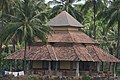
Chaturmukha Basadi
Kere Basadi
Anekere kere basadi (transl. Elephant lake, Lake Temple
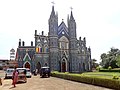
St. Lawrence Shrine Basilica

The Alupas were the first to rule the region who were Originally Jain rulers, and their rule was followed by the Santaras, who were the feudatories of Alupas for many years. The town attained political and cultural importance from the time of the Kalasa-Karkala kingdom that was established by King Bhairava between 13th and 16th centuries.[3]

The royal family of Karkala rose to prominence from the time of the rule of the Hoysalas. During the Vijayanagara period this family reached new heights of glory as their kingdom extended over a wider area comprising Sringeri, Koppa, Balehonnur and Mudigere in Chikamagalur and most of the Karkala taluk.

King Veera Bhairava constructed the basadis at Karkala and endowed land and money to numerous temples and basadis. Ramanatha and Veerapandya were his two sons and Ramanatha died early during his father's time. So In his memory, a scenic lake called Ramasamudra was created, which still survives to this day.

King Veera Pandya, at the insistence of his Guru Lalitakeerti, the pontiff of Karkala Jaina Math, installed a large statue of Bahubali on the rocky hill of Karkala. The date of the installation has been ascertained as 13 February 1432.[4][5] He also installed the Brahmadeva Pillar in front of the statue in 1436. His successor, Abinava Pandya installed a carving of manastambha in front of the Neminatha Basadis in Hiriyangadi in 1457 AD. An intricately carved 54-foot-high (16 m) pillar stands in front of the Basadis.

Abhinava Pandya's successor was Pandya VI, who is attributed to the construction of the Kere Basadis in the middle of a lake called Anekere in 1545 AD.[6] Immadi Bhairava (Bhairava II), who ruled after him, constructed the Chaturmukha Basadi on top of a small rocky hill in 1586 AD. This Basadis has four identical entrances from the four directions leading to the Garbagriha and hence is popularly known as Chaturmukha or Four-Faced. It is also referred to as Tribhuvana Tilaka Jina Chaityalaya and Ratnaraya Dhama in some inscriptions. The Chaturmukha Basadi is built in the form of a square hall with a lofty doorway and pillared porticos on each of its four sides along with a pillared verandah. The roof is flat and is made of massive granite slabs. It has life size statues of three Jain Theerthankaras on each side and small images of 24 Tirthankara. In all, there are 108 pillars inside and outside the temple.

There are 18 Basadis of antiquity, including Mahaveera Basadi, Chandranathaswamy Basadi, Adinathaswamy Basadi, Ananthanatha Basadi, Guru Basadi, and Padmavati Basadi. However, the rulers of Karkala were tolerant towards other religions, with temples of other religions being constructed, including the temples of Anantashayana and Venkataramana, Mahamaya Mukhyaprana, and Sri Aadi-Shakthi Veerabhadra Swamy.

After the rule of the Pandyas, the region was annexed by Tippu Sultan, and thereafter passed on to British rule. The St Lawrence Church was built in 1845 in a village called Nitte (Attur hamlet) where people of all religions congregate every year in January for the feast of St Lawrence.[citation needed]

Landmarks

[edit]

Karkala is an important pilgrimage location for Jains. There are several Hindu temples, Jain Basadis, mosques, churches, and lakes in Karkala.

Bus stand, Karkala

Karkala has famous educational institutions like NITTE College, Shri Bhuvanendra College, Christ King Educational institutions, and Jnanasudha Educational College.

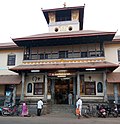
Taluk Office, Karkala

ASI protected sites[7] in Karkala are:

Geography

[edit]

Karla is located at 13°12′N 74°59′E / 13.2°N 74.98°E / 13.2; 74.98.[8] It has an average elevation of 81 metres (265 feet).

Anekere Lake, Karkala

It has a large number of picturesque lakes, such as:

  • Ramasamudra Lake,
  • Kamala Kere,
  • NagarBavi,
  • Anekere,
  • Sigadi Kere,
  • Matadha Kere,
  • Shivathi Kere
  • Jogina Kere.

Situated at the foothills of the Western Ghats, Karkala has an undulating landscape, dotted with black granite outcrops, while the western part of the town is predominantly coastal plains that stretch about 25 km west towards the Arabian Sea.

Meteorological details

[edit]
Karkala scenic view (Chaturmukha Jain Basadi)
Climate data for Karkala, India (Karkala)
Month Jan Feb Mar Apr May Jun Jul Aug Sep Oct Nov Dec Year
Record high °C (°F) 38
(100)
38
(100)
42
(108)
41
(106)
41
(106)
37
(99)
32
(90)
33
(91)
33
(91)
36
(97)
35
(95)
35
(95)
41
(106)
Mean daily maximum °C (°F) 31
(88)
33
(91)
34
(93)
34
(93)
34
(93)
30
(86)
28
(82)
28
(82)
30
(86)
30
(86)
31
(88)
30
(86)
34
(93)
Mean daily minimum °C (°F) 22
(72)
24
(75)
26
(79)
28
(82)
28
(82)
27
(81)
26
(79)
25
(77)
25
(77)
25
(77)
24
(75)
22
(72)
22
(72)
Record low °C (°F) 17
(63)
16
(61)
19
(66)
23
(73)
23
(73)
23
(73)
23
(73)
23
(73)
20
(68)
20
(68)
18
(64)
17
(63)
16
(61)
Average rainfall mm (inches) 9
(0.4)
9
(0.4)
19
(0.7)
39
(1.5)
99
(3.9)
663
(26.1)
629
(24.8)
288
(11.3)
153
(6.0)
133
(5.2)
57
(2.2)
19
(0.7)
2,117
(83.3)
Source: MSN Weather

Demographics

[edit]
Religion in Moodabidri (2011)
  1. Hinduism (76.5%)
  2. Islam (14.9%)
  3. Christianity (5.87%)
  4. Jainism (2.60%)
  5. Sikhism (0.03%)
  6. Buddhism (0.02%)
  7. Other or not stated (0.08%)

As of 2001 India census,[9] Karkala town had a population of 25,118. Males constitute 51% of the population and females 49%. Karkala has an average literacy rate of 82%, higher than the national average of 59.5%: male literacy is 85%, and female literacy is 79%. In Karkala, 9% of the population is under six years of age. According to recent statistics by town municipality, 25,635 people currently reside in this town, while as per the recent statistics Karkala taluk has a population of 2.10 Lacs (previous 2001 census is 2,04,571).

Hinduism is the largest religion in Karkala, with Sthanika Brahmins, Rama kshathriya, Bunts, Sapaliga/Sapalya, Billavas, Ganigas, Rajapura Saraswat Brahmins (RSB), Goud Saraswat Brahmins (GSBs), Chitpavan Brahmins,Shivalli Brahmins, Vishwakarma Brahmins, Devadiga and Mogaveera forming the major communities. There is also a significant Roman Catholic and Protestant Christian presence, and sunni Hanafi Muslim communities settled in the town, Muslims Of Karkala Speak Urdu as their mother tongue. [10]


Culture and tradition

[edit]

The people of Karkala follow the Tuluva culture. Distinctive features of this culture include rituals of Bhuta Kola, Nagaradhane and Yakshagana. Tuluva New Year is called Bisu.

Pilinalike or Tiger Dance is a unique form of folk dance in Tulu Nadu. The tiger is considered as the mount of Goddess Durga, and the dance is performed during the Dasara and Krishna Janmashthami festivals. Bhuta Kola or spirit worship is practised across the region, usually at night, invoking the spirits via an oracle, accompanied by traditional music and practices.

The most popular local sport is Kambula, or buffalo racing, which is conducted in paddy fields. Koridakatta (Cockfighting) is another sport for village people. The Tuluva people have a high regard for nature and snakes in particular, so Nagaradhane, or snake worship, is also practised with the belief that the Naga Devatha (Snake God) will protect their communities.

Language

[edit]

Karkala is a multilingual town. Tulu is the native language of the people, while the official language is Kannada. Konkani and Urdu are also widely spoken in the town.

Administration and transportation

[edit]

Being a part of Udupi district, Karkala is in the Udupi-Chikkamagalur Lok Sabha Constituency.The Karkala Town Municipal Council (ಕಾರ್ಕಳ ಪುರಸಭೆ) is the municipal corporation of the town, responsible for all public works and development.

Roadways are the main mode of transportation in Karkala. The town is well connected to Udupi, Moodabidri and Padubidri, and to Sringeri and Kalasa on the Western Ghats. The main roadways serving Karkala are:

  • National Highway NH 169 (Solapur—Mangalore)
  • Karnataka State Highway SH 1 (Karkala-Padubidri) which connects to National Highway 66 at Padubidri
  • Karnataka State Highway SH 37 (Karkala-Bailur-Manipal-Udupi)
  • Karnataka State Highway SH 1 (Karkala-Hebri)

The nearest railhead is at Udupi while the airport closest to Karkala is at Bajpe in Mangalore. There is an extensive public transport system connecting Karkala to Udupi and Mangalore.

[edit]

See also

[edit]

References

[edit]
[edit]
Revisions and contributorsEdit on WikipediaRead on Wikipedia
from Grokipedia
Karkala is a town and taluk headquarters in , , , situated in the foothills of the and known for its rich Jain heritage and historical significance as a pilgrimage center. It features the iconic 13-meter-tall monolith statue of Gomateshwara (), the second tallest such statue in the state, erected in 1432 CE by Veera Pandya Bhairarasa, a ruler of the Santara dynasty. As of the 2011 census, the town has a population of 25,800, with the broader Karkala taluk encompassing around 216,091 residents. Historically referred to as Pandya Nagari, Karkala's origins trace back to the under Jain rule, gaining prominence during the Kalasa-Karkala kingdom from the 13th to 16th centuries before being annexed by in the late 18th century. The region was initially ruled by the Alupas, followed by the Santaras and Hoysalas, establishing it as a key cultural and political hub in the coastal region. Today, it reflects a multicultural tapestry, with influences from Jain, Hindu, Muslim, and Christian traditions, and languages such as Tulu, , Konkani, and spoken by its residents. Geographically, Karkala is enveloped by verdant plantations, paddy fields, and water bodies like Ramasamudra Lake (with a maximum depth of 11.58 meters) and Anekere Lake, contributing to its serene, green landscape year-round. Beyond the statue, notable landmarks include the 16th-century Chaturmukha Basadi, a distinctive four-sided , and the , constructed in 1759 and designated a minor in 2016. The town hosts the grand ceremony for the statue every 12 years, drawing pilgrims globally, with the next event scheduled for 2027. In May 2025, the Indian government approved a ₹116 grant under the Swadesh Darshan scheme to develop key pilgrim centers, including the statue site and nearby s.

Geography and Climate

Location and Topography

Karkala is situated at coordinates 13°13′N 74°59′E, with an average elevation of 81 meters above sea level. It lies within in the state of , approximately 35 kilometers southeast of town. The town is positioned about 38 kilometers inland from the coast, placing it in a transitional zone between the coastal lowlands and the inland highlands. The of Karkala features an undulating landscape characterized by low hills and prominent outcrops, which dominate the local terrain and contribute to its rugged appearance. The area transitions from coastal plains in the west to more elevated, lateritic soils toward the east, reflecting the broader geological patterns of the region influenced by granitic formations. This varied terrain supports a mix of rocky exposures and fertile pockets suitable for . Key water bodies in Karkala include Anekere Lake, also known as the elephant lake, a significant artificial spanning about 7 acres, and Kamala Kere, another notable lake in the vicinity. These features enhance the area's hydrological profile amid its hilly setting. The surrounding landscape is marked by forested hills, providing a green buffer that integrates Karkala into the broader region, known for its blend of coastal and hilly ecosystems.

Climate and Meteorology

Karkala features a , marked by high and substantial precipitation throughout much of the year. The region receives an average annual rainfall of 4,777 mm, with the majority concentrated during the southwest period from to September. Peak rainfall occurs in , averaging around 1,500 mm, followed closely by and , each exceeding 800 mm on average. Temperatures are relatively consistent year-round, with daily highs between 28°C and 34°C and lows ranging from 22°C to 28°C, contributing to persistently warm conditions. The climate is heavily influenced by the , which enhance orographic rainfall by forcing moist air from the to rise and condense, resulting in levels often above 75%. This proximity to the also exposes the area to occasional cyclones, primarily from the , leading to intense but infrequent storm events. From December to February, the winter season brings drier conditions with minimal rainfall, offering a brief respite from the intensity while maintaining moderate . These patterns play a crucial role in sustaining , especially rain-fed crops like paddy, and in recharging local water bodies and aquifers essential for irrigation and domestic use.

History

Early and Medieval Periods

Karkala's ancient roots trace back to the , when it was known as Pandya Nagari during the period of Jain rule, reflecting its early significance as a center influenced by . The region was initially governed by the Alupa dynasty, which ruled coastal from around the 6th to the 14th century as feudatories to larger powers like the Kadambas, Chalukyas, and Hoysalas, establishing administrative foundations that shaped local governance. Following the Alupas, the Santara dynasty, also referred to as the Bhairarasa family, took control as feudatories, marking a transition toward greater regional autonomy by the 13th century. During the medieval period, Karkala rose to prominence as the capital of the Kalasa-Karkala kingdom under the Bhairarasa dynasty from the 13th to 16th centuries, a time of significant Jain cultural and political influence. The dynasty, descending from the Santaras, fostered Jainism as the dominant faith, constructing numerous basadis that solidified Karkala's role as a major pilgrimage center for Jains in South India. A pivotal event was the installation of the 42-foot monolithic Bahubali statue in 1432 CE by Veera Pandya Bhairarasa Wodeyar, a ruler of the dynasty, on the advice of the Jain pontiff Lalitakirti, symbolizing the peak of Jain architectural patronage and devotion. This period also saw the erection of 23 Jain basadis, enhancing the town's spiritual landscape and drawing pilgrims from across the region. The establishment of the Chaturmukha Basadi in 1586 CE by Immadi Bhairava (Bhairava II) further exemplified the dynasty's commitment to Jain heritage, featuring a unique four-faced design with identical entrances on all sides, built atop a rocky hill as a grand hall for worship. Under Bhairarasa rule, Karkala functioned as a vital trade hub, leveraging its strategic location in the Malnad region to facilitate commerce in spices, textiles, and metals, while its Jain institutions promoted ethical trade practices aligned with religious principles. This era's cultural shifts, driven by royal patronage of Jain scholars and artisans, positioned Karkala as a beacon of medieval South Indian Jainism, distinct from surrounding Hindu-dominated kingdoms. Following the decline of the Bhairarasa dynasty in the 17th century due to invasions by the Keladi Nayakas, the region came under the influence of the and later the Keladi kingdom.

Colonial and Modern Periods

During the late , the region including Karkala fell under the control of as part of the Kingdom of , during which the town experienced conquest and some local prosperity amid his resistance against British forces. Following Tipu's defeat and death in the in 1799, the surrounding region, including Karkala, was ceded to the British East India Company, becoming part of district within the . Under British administration, the town's name was officially standardized as "Karkala," reflecting its roots meaning "black stone," while it retained local usage as "Karla." In the , Karkala remained integrated into the until India's independence in 1947, after which it was transferred to the newly formed (later renamed in 1973). The area actively participated in the Indian freedom movement, with residents joining broader regional efforts against British rule, including non-cooperation and campaigns influenced by . Post-independence, Karkala developed as a key administrative center, serving as a taluk headquarters within the erstwhile before the creation of in 1997, which incorporated Karkala and enhanced its local governance role. In the modern period, Karkala has seen significant infrastructure growth, including road expansions and bridge constructions in the early to improve connectivity and support urban expansion. The brought further developments, such as the approval of a ₹27 textile park project in 2020 to boost and industry. The 2011 census highlighted Karkala's integration into district's demographic framework, underscoring its steady population growth and economic transition. Today, the legacy of medieval Jain sites continues to drive modern , attracting visitors to landmarks like the Gomateshwara statue.

Demographics

Population and Growth

As per the 2001 , Karkala recorded a of 25,116, with 12,686 males and 12,430 females, resulting in a of 980 females per 1,000 males. The proportion of children under six years in the was approximately 9.7%, totaling 2,424 individuals. At the taluk level, the 2001 stood at 205,598, comprising 96,755 males and 108,843 females, with a of 1,125 females per 1,000 males and about 10.8% of the under six years (22,120 children). The 2011 census showed modest growth for Karkala town, with the population reaching 25,800 (12,627 males and 13,173 females), yielding a decadal growth rate of 2.7% from 2001 and a sex ratio of 973 females per 1,000 males. The town's population density was 1,119 persons per square kilometer over an area of 23.06 square kilometers. For Karkala taluk, the 2011 population was 216,091 (103,591 males and 112,500 females), reflecting a decadal growth of 5.1% and a sex ratio of 1,086 females per 1,000 males, with children under six accounting for 8.8% (18,958 individuals). The taluk's overall density was approximately 201 persons per square kilometer across 1,074 square kilometers. Karkala taluk remains predominantly rural, with 84.9% of its (183,410 people) residing in rural areas and 15.1% (32,681) in urban settings, primarily the town itself. This urban-rural composition underscores the taluk's role as a semi-urban hub within , where growth has been slower than the state average, influenced by stable migration patterns and demographic transitions.

Religious and Linguistic Composition

Karkala's religious composition reflects a diverse yet predominantly population, as per the 2011 data for the town. constitutes 76.5% of the residents, followed by at 14.9%, at 5.87%, and at 2.6%, with smaller proportions of (0.03%), Buddhists (0.02%), and others (0.01%). The Jain community, though a minority, holds significant historical influence due to Karkala's legacy as a center of Jain heritage, featuring prominent sites like the Chaturmukha Basadi and the 13-meter Gomateshwara statue erected in 1432 CE by Veera Pandya Bhairarasa Wodeyar. This heritage underscores the town's role as a destination for Jains, contributing to cultural preservation amid the dominant Hindu majority. Linguistically, Karkala is a multilingual hub characteristic of coastal , where serves as the primary native language for the Tuluva community, fostering local cultural identity through oral traditions and daily communication. functions as the official state language, used in administration, education, and formal contexts, while Konkani and are widely spoken, particularly among the Christian and Muslim populations, respectively. In the broader encompassing Karkala, the 2011 census records as the mother tongue for 31.44% of residents, for 42.70%, Konkani for 12.16%, and for 4.61%, highlighting the town's linguistic diversity. This mix supports a vibrant, environment in markets, schools, and social interactions. The social fabric of Karkala demonstrates harmony among its religious and linguistic groups, with inter-community cooperation evident in shared festivals and economic activities, reflecting the inclusive ethos of coastal . Jains, despite their small numbers, remain prominent in and , leveraging historical networks to influence local commerce. The town's high literacy rate of 93.16% in —well above the national average of 74.04%—further bolsters , enabling educated interactions across diverse groups and promoting socioeconomic integration.

Economy

Agriculture and Primary Sectors

Karkala's agricultural sector is predominantly oriented toward plantation crops, with arecanut emerging as the primary due to its high commercial value and suitability to the region's lateritic soils and . Coconut plantations are equally prominent, providing both nuts and for local and export markets, while paddy serves as the crop in lowland areas, and rubber cultivation has gained traction in the undulating terrains of the taluk. These crops form the backbone of the , which dominates agricultural activities across the 1,076 square kilometers of Karkala taluk. A substantial portion of the taluk's land is dedicated to cultivation, mirroring the district's pattern where net sown area constitutes about 27% of the total geographical expanse, though and hilly topography limit expansion in Karkala. Agricultural practices are largely rain-fed, with the southwest providing the bulk of essential for growth, leading to seasonal vulnerabilities such as delayed or reduced yields during erratic rainfall. Arecanut processing, involving boiling, drying, and sorting, represents a key local industry that enhances value addition and generates ancillary employment in rural areas. The sector faces challenges including in the foothills of the , which degrades and necessitates conservation measures like contour bunding. employs the majority of Karkala's rural workforce, underscoring its role in livelihoods, and contributes an estimated 15–20% to the local economy, though precise taluk-level GDP figures are integrated within aggregates where allied activities bolster overall output.

Industry, Trade, and Services

Karkala's industrial landscape is dominated by small-scale manufacturing units, particularly in quarrying and processing, which ties into the town's derived from "kari-kal" meaning in . The taluk hosts numerous granite quarries extracting primarily black granite, supporting local and export industries, with around 116 authorised quarries in the broader contributing to this sector. Small-scale arecanut processing units further bolster the economy, transforming locally grown arecanut into dried and value-added products like chali and supari, with market prices fluctuating around ₹30,500 per in recent years. Handicrafts, including woodwork and , represent traditional industries, with artisans producing decorative items and furniture that cater to both domestic and tourist markets. Trade in Karkala revolves around vibrant markets dealing in spices, arecanut, and other products, facilitated by the town's strategic location near the Mangalore , which enables efficient exports of commodities like and . Weekly markets and wholesale hubs, such as those for arecanut wholesalers, handle significant volumes, with spices like and chili traded actively by local merchants. The proximity to Mangalore, approximately 50 km away, has historically supported export-oriented trade, enhancing economic connectivity for plantation-derived goods. The services sector in Karkala has expanded notably since the , driven by , , and remittances from Gulf migrants. Tourism services have grown around key attractions like the monolithic Gomateshwara statue and Chaturmukha Basadi, attracting visitors and supporting hospitality and guiding businesses. Educational institutions, including Sri Bhuvanendra College and Government Polytechnic Karkala, provide higher education and vocational , contributing to skilled development. Remittances from migrants in Gulf countries, common in coastal , significantly influence local consumption and , with showing high remittance dependency akin to other west coast regions. Retail and banking services have proliferated post-, with branches of national banks expanding to meet rising commercial needs. Recent infrastructure boosts, such as the ongoing widening of NH 169 from Karkala to Mala to four lanes, initiated in the 2020s and expected to complete by late 2025 despite delays, have enhanced commercial activity by improving access to Mangalore and beyond.

Government and Administration

Civic Governance

Karkala functions as the headquarters of Karkala taluk within , , where local urban administration is managed by the Karkala Town Municipal Council under the Karnataka Municipalities Act of 1964. This council oversees civic operations, including public works and development initiatives, as part of the state's Directorate of Municipal Administration. The municipal council is led by an elected president and vice-president, with Yogesh Devadiga serving as president and Prashanth Kotyan as vice-president following their election in August 2024. Day-to-day administration is handled by the chief officer, Smt. Leena Britto, supported by staff such as office manager Sri. Udaykumar G. At the taluk level, revenue and are directed by the tahsildar, Pradeep R. Key public services provided by the council encompass , drawn from the Mundli Dam and eight borewells with scheduled distribution to ensure accessibility. A new bulk scheme from the Varahi River to Karkala taluk is under implementation, targeted for commissioning by December 2025. efforts include through door-to-door collection and eco-friendly disposal methods like composting to minimize environmental impact. Healthcare services are supported via the Government General Hospital in Karkala, which delivers essential medical care including general consultations, treatment, and programs as a key public facility. The council's annual budget allocates funds for urban development priorities, such as town planning fees, building regulations, and maintenance of parks and gardens, with the 2023-24 estimates emphasizing infrastructure repairs and environmental upkeep. In the electoral framework, Karkala taluk is encompassed by the Udupi-Chikmagalur constituency, influencing higher-level representation for local governance issues.

Transportation and Infrastructure

Karkala's road network is primarily served by National Highway 169 (NH 169), which connects the town to Mangalore in the west and in the north, facilitating regional trade and commuting. 1 (SH 1) links Padubidri to Karkala over approximately 28 kilometers, enhancing intra-district connectivity in . Additionally, 37 (SH 37) runs through Karkala, connecting it to and to the south, spanning about 132 kilometers in total. Public transportation in Karkala relies heavily on bus services operated by the (KSRTC), which provides regular routes to nearby cities like Mangalore and . The Karkala bus stand, located along SH 37, serves as a key hub for these services, supporting daily commuters and long-distance travel. For rail connectivity, the nearest station is , approximately 38 kilometers away, offering access to the Konkan Railway network for broader Indian destinations. Air travel is facilitated by , situated about 50 kilometers from Karkala, with frequent domestic flights to major cities. Electricity supply in Karkala is generated by the Karnataka Power Corporation Limited (KPCL), which oversees power production across the state from hydroelectric, thermal, and renewable sources. Local distribution falls under the Mangalore Electricity Supply Company Limited (MESCOM), ensuring reliable access for residential and commercial needs. Water supply draws from historic local lakes such as Anekere Lake, a 7-acre reservoir originally constructed in 1262, which has been revived in recent efforts to support potable water distribution amid urban growth. Broadband infrastructure has seen expansions in the 2020s through initiatives like Airtel's fiber rollout in coastal Karnataka districts, including Udupi, improving high-speed internet access for remote work and digital services. Transportation faces seasonal challenges, particularly monsoon flooding, which causes waterlogging on key roads like those in Karkala town due to inadequate drainage systems. Future plans include widening the Karkala-Mala stretch of NH 169 and portions of SH 37 to two lanes with paved shoulders, aimed at enhancing safety and capacity under the State Highway Improvement Project.

Culture and Society

Traditions and Festivals

Karkala's cultural landscape is deeply rooted in Tuluva traditions, which emphasize spirit worship and communal rituals. Bhuta Kola, a vibrant form of spirit worship involving masked performances and trance dances to invoke local deities, is a hallmark of Tuluva heritage practiced in the region. Similarly, Nagaradhane, the ritualistic of serpent deities believed to protect agricultural prosperity and family well-being, features elaborate offerings and dances during specific festivals and family ceremonies. These practices foster community bonding and are integral to the social fabric of Karkala's predominantly Tulu-speaking population. A prominent event is the Mastakabhisheka, a grand anointing ceremony for the 13-meter (42-foot) monolithic statue of , held every 12 years and drawing thousands of devotees for ritual bathing with sacred liquids like milk and saffron. The last such ceremony occurred in 2015, with the next scheduled for 2027, highlighting Karkala's Jain heritage through processions, cultural programs, and temporary infrastructure to accommodate pilgrims. Folk arts further enrich these celebrations; , an all-night theatrical performance blending dance, music, and dialogue from mythological epics, is staged frequently in Karkala, supported by local institutions like the Yaksha Rangayana. Pili Nalike, a dynamic performed by men in striped costumes mimicking tiger movements, adds fervor during Navratri, symbolizing strength and devotion to Goddess . Traditional sports like Kambala, a thrilling buffalo race on slushy tracks originating near Karkala in 1970, showcase agricultural prowess and community pride, with events held seasonally in nearby venues such as Miyar. Koridakatta, involving trained roosters in ritualistic fights without blades during harvest festivals, reflects rural Tuluva pastimes, though regulated to prevent cruelty. Community events span religious lines: Jains observe Mahavir Jayanti with processions and lectures promoting non-violence, as seen in Udupi district celebrations. Christians commemorate the annual feast of St. Lawrence at Attur Shrine in late January, attracting pilgrims for masses and charitable distributions to the needy. Hindus mark Dasara with idol immersions, tiger dances, and fairs honoring Goddess Sharada. Underlying these is the matrilineal Aliyasantana system among the Bunt community, where property inheritance follows the female line, influencing family rituals and social customs in Tulu Nadu.

Languages and Arts

Karkala, located in the Tulu Nadu region of coastal Karnataka, exhibits significant linguistic diversity reflective of its multi-ethnic population. The predominant language is Tulu, a Dravidian tongue spoken by the majority of residents, particularly in its Northeast dialect prevalent in Karkala and nearby Belthangady areas. Tulu maintains a rich oral tradition through storytelling, folklore, and community rituals, while its script, derived from the ancient Grantha system, is used sparingly in religious and literary contexts, with modern writing often adapting the Kannada script for accessibility. Kannada, the official state language, plays a vital role in administration, education, and local literature, with initiatives like the Kannada Sangh in Kantavara village near Karkala having published over 50 books to promote regional literary works since the early 2000s. Among minority communities, Konkani is widely spoken by Christian populations, especially , who form a notable demographic in Karkala and use it for religious services, family communication, and cultural expressions. serves as the primary language for the Muslim community, aligning with broader patterns in where it functions as a mother tongue for many Islamic groups, facilitating religious and social interactions. These languages coexist harmoniously, with bilingualism common in daily life and education. Artistic expressions in Karkala draw heavily from its , including , which has gained momentum in the region through films like Middle Class Family (2025) and Netterekere (recent release), screened at local theaters such as Planet Cinema and emphasizing family dramas and coastal themes. traditions, notably Pardana songs performed by agricultural laborers during the sowing season, celebrate rural life with rhythmic chants and instruments, preserving agrarian narratives passed down orally. The influence of Jain texts is evident in local literature, as Karkala's deep Jain roots—stemming from its 18 temples and the iconic monolith—have shaped writings on , history, and , with works like those by Dr. Umanatha Shenoy exploring the erection of the Gomateshwara statue. Education in the arts focuses on traditional forms like , a vibrant folk theater blending dance, music, and dialogue, taught in local institutions such as Manjunath Pai Memorial Government First Grade College, which launched dedicated classes in 2025, and Sri Bhuvanendra Residential School, where students engage in performances as part of extracurricular activities. Even specialized schools like Chethana Special School incorporate training to foster inclusivity and skill development among children with . These programs aim to transmit cultural knowledge to younger generations amid . Cultural preservation efforts in Karkala emphasize safeguarding linguistic and artistic heritage, with community organizations promoting through workshops and publications. In the 2020s, modern adaptations have accelerated via , highlighted by the inclusion of the Tulu script in 16 in 2024, enabling its use on smartphones and social platforms, and the launch of and in October 2024, which provide dictionaries and digitized texts to global users. These initiatives have boosted 's visibility, supporting its oral traditions in contemporary contexts like online content creation.

Landmarks and Tourism

Religious and Historical Sites

Karkala is renowned for its rich Jain heritage, featuring several ancient basadis that exemplify the region's historical patronage of Jainism under the Bhairarasa dynasty. The most iconic landmark is the 42-foot monolithic statue of Lord Bahubali, known as Gomateshwara, erected in 1432 CE by Veera Pandya Bhairarasa atop a rocky hillock overlooking the town. Carved from a single block of granite, the statue depicts Bahubali in kayotsarga posture, symbolizing ascetic renunciation, and is the second tallest such monolith in Karnataka after Shravanabelagola. This monument is protected by the Archaeological Survey of India and attracts devotees for its intricate carvings, including creepers and ant figures at the base, highlighting masterful Dravidian-style granite workmanship. Nearby, the Chaturmukha Basadi, constructed in 1586 CE by Immadi Bhairarasa Vodeya of the Santara dynasty, stands as a symmetrical four-sided temple dedicated to Tirthankara Aranatha with a central four-faced idol representing the four directions. Supported by 108 intricately carved pillars, the basadi's architecture reflects late medieval Jain temple design, emphasizing symmetry and spiritual universality. Karkala hosts around 18 other Digambara Jain basadis, including the Kere Basadi (lake temple) in Anekere, which features idols of multiple Tirthankaras like Parshwanatha and Neminatha in serene waterside settings, underscoring the town's status as a key Jain pilgrimage hub. Beyond Jain sites, Karkala's religious landscape includes significant Hindu and Christian structures that highlight its multicultural history. The Hiriyangadi area features the Shivathikere Sri Umamaheshwara Temple, a Hindu shrine dedicated to Lord and , known for its traditional Kerala-style architecture and annual rituals that draw local devotees. Complementing this is the 18th-century St. Lawrence Church in , established around 1759 CE amid Portuguese missionary influences in the coastal region, though rebuilt after Tipu Sultan's captivity of local Christians. This Roman Catholic , elevated to minor basilica status, honors St. Lawrence with Gothic elements and serves as a site of reported miracles, fostering interfaith harmony in the area. Historical monuments in Karkala extend to connections with nearby , where remnants of the 38-foot statue—installed in 1604 CE—bear ties to Karkala's Bhairarasa rulers, who disputed its placement to prevent relocation to their domain. The statue's base and ancillary structures at , conserved as protected heritage, illustrate medieval Jain sculptural rivalries and conservation efforts by local authorities to preserve carvings against . These sites, including the statue and Chaturmukha Basadi, receive ongoing conservation from the , focusing on structural reinforcement and vegetation control to maintain their historical integrity. Visitors to these sites often participate in annual pilgrimages that blend devotion and cultural celebration. The St. Lawrence Basilica hosts a major feast in January, attracting thousands for processions and masses, while Jain basadis see steady pilgrim footfall year-round, peaking during festivals like , with the statue drawing crowds for its panoramic views and symbolic anointing rituals. Architectural highlights, such as the precision granite carvings on the monolith, offer insights into ancient engineering, encouraging respectful exploration amid the serene hilltop ambiance.

Natural and Recreational Attractions

Karkala, nestled in the foothills of the in Karnataka's , boasts a landscape of serene lakes, granite hills, and forested trails that draw nature enthusiasts and offer opportunities for relaxation and adventure. These natural features, shaped by the region's lateritic soil and moderate rainfall, provide a tranquil escape from urban life, with water bodies serving as historical reservoirs that now support leisure activities. Anekere Lake, located at the heart of Karkala town, is a historic water body constructed in 1262 CE by King Pandyadeva as a supply tank for the local population. Today, it functions as a popular picnic spot where visitors enjoy , , and leisurely walks along its shores, surrounded by lush greenery. Boat rides are available on the lake, allowing explorers to navigate its calm waters while observing aquatic life and nearby forested areas, making it an ideal destination for families during the cooler months from October to March. Ramasamudra Lake, situated about 3 kilometers from the town center, dates back to the and offers a peaceful retreat with its expansive views and melodic bird calls. This site supports picnicking, , and jet boating experiences on its tranquil surface, providing a serene environment for relaxation away from city noise. The lake's , including various species, enhances its appeal for eco-conscious visitors, with access via well-maintained paths that are best explored post-monsoon when levels are optimal. The surrounding hills and forested regions of the offer invigorating trekking opportunities, with trails like the Kurinjal Peak Trek providing panoramic views of the undulating terrain and dense vegetation. These paths, starting from accessible points near Karkala, wind through biodiversity-rich areas featuring endemic flora and fauna, suitable for moderate hikers during the from to to avoid slippery conditions. Nakre Rock, a monolithic formation nearby, adds to the trekking allure with its challenging ascents and rewarding vistas of the ghats' ecological diversity. Recreational pursuits in Karkala include visits to local parks such as Anekere Park, which features manicured lawns and shaded areas for casual outings, and the Koti-Chennaya Theme Park, blending green spaces with cultural exhibits for light-hearted leisure. Annual events like the traditional buffalo races, held in nearby coastal fields from October to March, showcase local agrarian heritage through competitive spectacles involving pairs of buffaloes racing on muddy tracks, attracting spectators for an immersive cultural experience. The area's eco-tourism potential is evident in guided nature walks that promote sustainable exploration of its forests and hills, emphasizing conservation of the ' fragile ecosystem.

References

Add your contribution
Related Hubs
User Avatar
No comments yet.