


Community hub
Recent from talks
Contribute something
Nothing was collected or created yet.
Karnataka Police
View on Wikipedia
 | This article needs additional citations for verification. (September 2015) |
| Karnataka State Police ಕರ್ನಾಟಕ ರಾಜ್ಯ ಪೊಲೀಸ್ Karnātaka Rājya Polīs | |
|---|---|
 ಕರ್ನಾಟಕ ರಾಜ್ಯ ಪೊಲೀಸ್ | |
| Abbreviation | KSP |
| Motto | Satyameva Jayate "Truth alone triumphs" |
| Agency overview | |
| Formed | April 2, 1965 |
| Preceding agency |
|
| Employees | 80,000 |
| Jurisdictional structure | |
| Operations jurisdiction | Karnataka, IN |
 | |
| Map of Karnataka Police Department's jurisdiction | |
| Size | 191,791 km2 |
| Population | 61,130,704 |
| Legal jurisdiction | Karnataka |
| Governing body | Home Department, Government of Karnataka |
| Constituting instrument | |
| General nature | |
| Operational structure | |
| Headquarters | Karnataka State Police, Bengaluru – 560001 |
| Elected Minister responsible |
|
| Agency executive |
|
| Parent agency | Department of Home, Government of Karnataka |
| Child agency | |
| Facilities | |
| Stations | 923 (2013–2014) |
| Patrol Vehicles | Mahindra Bolero, Suzuki Ertiga, Chevrolet Tavera, Toyota Innova |
| Animals | Dogs |
| Notables | |
| Anniversary |
|
| Website | |
| ksp.karnataka.gov.in | |
The Karnataka State Police is the law enforcement agency for the Indian state of Karnataka. It was established in 1965 and is headquartered in Bengaluru, the capital city of Karnataka. The KSP is a state police force that works under the purview of the Department of Home Affairs, Government of Karnataka. The department is headed by the Director General and Inspector General of Police.
Organization
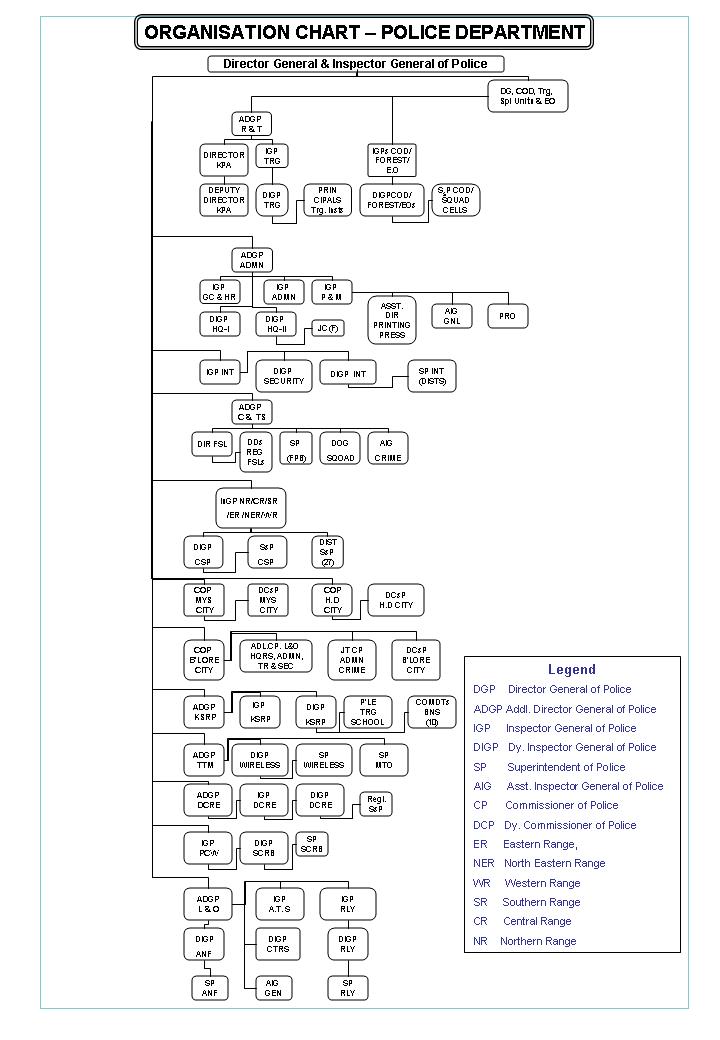
[edit]The Director General and Inspector General of Police (DG & IGP) is the head of the State police department, and under him are the Director General of Police and Additional Director General of Police. Each Additional Director General of Police is in charge of a particular function: law and order, crime and technical services, administration, intelligence, the Karnataka State Reserve Police, recruitment and training.
The District Police administration is headed by a Superintendent of Police. A group of districts comprise a Police Range, led by an Inspector General of Police (IGP). Big cities have a Police Commissionerate led by the Commissioner of Police. Bengaluru is headed by an officer with the rank of Additional Director General of Police (ADG). Mysuru is headed by an officer with the rank of Inspector General of Police. Belagavi, Hubballi-Dharwad, Kalaburagi and Mangaluru are headed by an officer with the rank of Deputy Inspector General of Police (DIG).
There are 7 police ranges and 32 police districts in the state.
| Range | Districts |
|---|---|
| Southern Range, Mysuru | Chamarajanagara, Hassana, Kodagu, Mandya and Mysuru[2][3] |
| Western Range, Mangaluru | Chikkamagaluru, Dakshina Kannada,[4] Udupi and Uttara Kannada[5] |
| Eastern Range, Davangere | Chitradurga, Davanagere, Haveri and Shivamogga |
| Central Range, Bengaluru | Bengaluru Rural, Bengaluru Urban, Chikkaballapura, Kolar, Ramanagara and Tumakuru |
| Northern Range, Belagavi | Bagalkote, Belagavi, Dharwada, Gadaga and Vijayapura |
| North Eastern Range, Kalaburagi | BIdar, Kalaburgi and Yadagiri |
| Ballari Range, Ballari | Ballari, Koppala, Raichuru and Vijayanagara |
The police stations are the lowest units of the police department. There are 906 police stations, 230 circle offices, 91 SDPOs and 31 DPOs (including railway police) in Karnataka state. Police stations are headed by Inspector in towns and cities. There may be two to four Sub-Inspectors (S.I.) in addition to assistant sub-inspectors (A.S.I), Head Constables (H.C.) and police constables (P.C.). Rural police stations are headed by a sub-inspector or two sub-inspectors covering law and order and crime, depending on the station's importance and sensitivity. They are grouped into circles, comprising a sub-division. Sub-divisions are headed by Deputy Superintendents of Police and circles by Police Inspectors. Additional superintendent of police's (ASP's) are also there in some districts.
- Director General & Inspector General of Police
(DG & IGP)
- Additional Director General of Police (ADGP)
- Inspector General of Police (IGP)
- Deputy Inspector General of Police (DIG)
- Senior Superintendent of Police (SSP)
- Superintendent of Police (SP)
- Additional Superintendent of Police (Addl.SP)
- Assistant SP (IPS) or Deputy SP (KSPS)
Sub-ordinates
- Police Inspector/Circle Police Inspector (PI/CPI)
- Police Sub-Inspector (PSI)
- Assistant Sub-Inspector of Police (ASI)
- Head Constable (HC)
- Constable (PC)
Insignia of Karnataka Police (State Police)
[edit]- Gazetted Officers
| Insignia | 
|
|

|

|
.png)
|

|

|

|

|

| ||||||||||
| Rank | Director General of Police | Additional Director General of Police[a] | Inspector General of Police | Deputy Inspector General of Police | Superintendent of Police (Selection Grade) [b] | Superintendent of Police | Additional superintendent of police | Assistant Superintendent of Police | Assistant superintendent of police (probationary for two years) | Assistant Superintendent of Police (Probationary for one year) | ||||||||||
| Abbreviation | DGP | ADGP | IGP | DIGP | SP (SG) | SP | Addl.SP | ASP | ASP | ASP | ||||||||||
| ||||||||||||||||||||
| Gazetted Officers | ||||
|---|---|---|---|---|
| Insignia |  |
 |
 |
 |
| Rank | Superintendent of Police
(KSPS) |
Additional Superintendent of Police
(KSPS) |
Deputy Superintendent of Police
(KSPS) |
Inspector of Police^ |
| Abbreviation | SP | Addl.SP | DYSP | PI |
|
| ||||
| Non-Gazetted Officers | ||||
| Insignia |  |
 |
 |
No insignia |
| Rank | Sub Inspector of Police | Assistant Sub Inspector | Head constable | Police constable |
| Abbreviation | PSI | ASI | HC | PC |
Law and Order
[edit]This wing is headed by an officer with the rank of Additional Director General of Police, Law and Order.
State Intelligence Department
[edit]The Intelligence Department is headed by an Additional Director General of Police, assisted by two Deputy Inspector General of Police and five Superintendents of Police at headquarters. The five Superintendents of Police in the Intelligence Divisions are in Bangalore, Mysore, Mangalore, Gulbarga, Belagavi, Davanagere and Ballery.
Crime and Technical Services Wing
[edit]This wing is headed by the Additional Director General of Police, Crime and Technical Services. It includes the Fingerprint Bureau, Forensic Scientific Laboratory, Police Computer Wing and State Crime Record Bureau.
Reserve police
[edit]In the state, the police trace their origins to the former Mysore State Imperial Service. They consist of:
- A District Armed Reserve (DAR) for each district
- A City Armed Reserve (CAR) in Bangalore, Mysore, Mangalore, Belagavi and Hubli-Dharwad
- A Special Task Force (STF)
- The Karnataka Armed Reserve Mounted Police, headquartered in Mysore
- Coastal Security Police (CSP)
- Government Railway Police (GRP)
The Karnataka State Reserve Police (KSRP) is headed by an Additional Director General of Police, assisted by an Inspector General and one Deputy Inspectors General of Police at headquarters. The Karnataka State Reserve Police consists of 12 battalions: four in Bengaluru and one each in Mysuru, Belagavi, Kalaburagi, Mangaluru, Shivamogga, Shiggaon, Hassana and Tumakuru 2 IRB battalions are situated in Munirabad (Koppala) and Vijayapura. Indian Reserve Battalion (IRB) is a specially formed reserved force. They are well trained striking force.
Mounted police
[edit]In 1951 the horses in the maharaja's bodyguard were used for the Karnataka Armed Reserve Mounted Police, headquartered in Mysuru. The stables, fields and office buildings date to the maharajas' time. Mounted police are used for traffic duty, night patrol, officer training and the Mysuru Dasara. The force is made up of 90 horses and 150 officers and men.
Mounted-police riders still practice tent pegging, and are also known for games, ceremonial parades and showmanship. Its riders have won a number of prizes in national and international equestrian competitions. The mounted police is headed by S. G. Mariba Shetti, who has won gold medals at the 1995 World Police Games in Australia (1995) and in 2001 in Indianapolis (2001) and has commanded the Dasara procession since 1977.
In January 2024 The Hindu reported that mounted police patrols were being reintroduced around Cubbon Park and the Vidhana Soudha, the seat of the state legislature in Bengarluru.[14]
Coastal Security Police
[edit]The Coastal Security Police (CSP) was established in 1999, and is headed by the Superintendent of Police. It has jurisdiction over Karnataka's coastal waters along the Arabian sea from Talapady in Dakshina Kannada to Majali in Uttara Kannada; a coastline of about 320 kilometres (200 mi). Its range extends 12 nautical miles out to sea and 500 metres inland. The CSP comes under the Internal Security Division headed by Additional director general of police in Richmond Road, Bengaluru. As of January 2021, nine coastal police stations have been established and 13 "interceptor boats" are in operation.[15]
Forest Cell
[edit]The Forest Cell assists the Karnataka Forest Department with their operations.
Policing Excess & Errors
[edit]Karnataka High Court ordered a departmental inquiry against policemen for filing false chargesheet under NDPS Act affecting careers and future of students.[16] In another instance, Kerala Police arrested Karnataka police officers who took money from crypto traders.[17]
Training
[edit]This wing is headed by the Director General of Police, Training, assisted by an Inspector General of Police (Training) and Deputy Inspector General of Police (Training). Karnataka has so many training institutions:
- Karnataka Police Academy, Mysuru
- Police Training College, Naganahalli, Kalaburagi
- Karnataka State Police Training School, Channapattana
- Karnataka Police Training school, Khanapura, Belagavi
- Armed Police Training School, Yalahanka, Bengaluru
- Police Training School, Aimangala, Chitradurga
- Police training School, Thanisandra, Bengaluru
- Police Training School, Kaduru, Chilkkamagaluru
- Police Training School, Dharwad
- Police Training School, Jyothi Nagara, Mysuru
- Temporary Police Training School, Navangar, Bagalkot
- Police Training School, Munirabad, Koppala
- Police Training School, Kangralli, Belagavi
- Police Training School, Vijayapura
- CCT Training Center, Kudlu, Bengaluru
- CCT Training Center, Agara, Bengaluru
- ANF Training Center, Karkala, Udupi
- Traffic Training Institute,RK Hegade Nagara, Bengaluru
- Special Branch Training Institute, Bengaluru
- Wireless Training Institute, Bengaluru
- Police Driving And Maintenance School, Yelahanka, Bengaluru
Special units
[edit]State-level units perform specialized police functions and assist civil-police units:
- Criminal Investigation Department (CID), Economic Offenses and Special Units: Headed by a Director General of Police, the unit oversees the Corps of Detectives, the Forest Cell, the Economic Offenses Unit and the Cyber Police Station.
- Directorate of Civil-Rights Enforcement: Headed by an Additional Director General of Police, Civil Rights Enforcement, and assisted by an Inspector General of Police, a Deputy Inspector General of Police and a Superintendent of Police at headquarters. the wing has six field units (each headed by a Superintendent of Police) at the police ranges in Bengaluru, Mangaluru, Davanagere, Belagavi, Kalaburagi and Mysuru. The directorate monitors and investigates cases registered under the Protection of Civil Rights Act 1955 and the Prevention of Atrocities Act, and is the watchdog of rights and benefits extended to the Scheduled Castes and Scheduled Tribes.
- Communication, Logistic and Modernization Wing: Headed by an Additional Director General of Police, the wing consists of a Police Wireless Unit and a Motor Transport Organisation (both headed by a Superintendent of Police).
- Planning & Modernization: Headed by an Inspector General of police, Planning and Modernization, the wing receives consolidation proposals for the police department and submits them to the government for approval.
- Police Housing & Welfare: Headed by an Inspector General of Police, Grievance Cell and Human Rights
- Internal Security Division: Headed by an Additional Director General of Police, the unit oversees the Terrorism and Naxalist in Karnataka State, Karnataka State Industrial Security Force(KSISF), Cyber cell, Forensic cell, and Bomb Detection Squad specially designed force called "Garuda Force" and ANF (Anti Naxal Force) units in it.
See also
[edit]Notes
[edit]- ^ Rank insignia of DGP is similar to Additional DGP.
- ^ The Senior Superintendent of Police (SSP) is a post, not a rank, typically held by an SP (selection grade or junior grade) in states like Uttar Pradesh, Jammu and Kashmir, and Punjab.
References
[edit]- ^ "M.A. Saleem is the new DG&IGP of Karnataka". The Hindu. 21 May 2025. Retrieved 22 May 2025.
- ^ "Mysuru District Police". Archived from the original on 12 August 2020. Retrieved 9 May 2020.
- ^ "Home - Mandya District Police". Archived from the original on 19 October 2020. Retrieved 9 May 2020.
- ^ "Dakshina Kannada District Police". Dkpolice.in. Retrieved 16 January 2021.
- ^ "UDUPI POLICE". Udupipolice.org. Archived from the original on 24 January 2021. Retrieved 16 January 2021.
- ^ "POLICE OFFICERS - Uttara Kannada District Police". Archived from the original on 13 May 2023. Retrieved 13 May 2023.
- ^ "Strength of Karnataka State Police". Archived from the original on 13 May 2023. Retrieved 13 May 2023.
- ^ "Police Ranks and Badges". Odisha Police. Retrieved 15 August 2017.
- ^ "Police Ranks" (PDF). Maharashtra Police. Retrieved 14 August 2017.
- ^ "Governance of Kerala Police". Kerala Police. Retrieved 14 August 2017.
- ^ "Police Ranks" (PDF). Maharashtra Police. Retrieved 14 August 2017.
- ^ Cite error: The named reference
Governance of Kerala Policewas invoked but never defined (see the help page). - ^ Cite error: The named reference
Police Ranks and Badgeswas invoked but never defined (see the help page). - ^ "Why mounted police squads have been reintroduced in Bengaluru". The Hindu. 11 January 2024. ISSN 0971-751X. Retrieved 18 December 2024.
- ^ "An Insight into Karnataka's Coastal and Maritime Security". Karnataka Protector. 3 January 2021. Retrieved 18 December 2024.
- ^ Plumber, Mustafa (16 September 2024). "Karnataka HC Orders Departmental Inquiry Against Policemen For Filing False Chargesheet Under NDPS Act Against Students, Affecting Their Careers". www.livelaw.in. Retrieved 20 January 2025.
- ^ "Freeze & fleece exposed: Karnataka cops held for extorting Rs 4 lakh from crypto traders in Kerala". Freeze & fleece exposed: Karnataka cops held for extorting Rs 4 lakh from crypto traders in Kerala. Retrieved 20 January 2025.

- ^ "Organisation Structure Chat-Police Department". Karnataka Help. Archived from the original on 14 February 2024. Retrieved 14 February 2024.

Karnataka Police
View on GrokipediaHistory
Establishment and Early Development
The policing framework in the territory that constitutes modern Karnataka originated in the princely state of Mysore during the British colonial era, where informal village-level watch systems evolved into a more organized structure influenced by princely administration needs for revenue collection and order maintenance. Significant reforms commenced in 1883 to professionalize the force, culminating in the appointment of the first Inspector General of Police, L. Ricket, on November 1, 1885, to oversee statewide operations and standardize practices across districts.[8][9] This marked the establishment of a centralized police leadership in Mysore State, with an initial focus on rural patrolling, crime detection, and suppressing banditry prevalent in frontier areas.[10] Post-independence, the States Reorganisation Act of 1956 led to the creation of Mysore State (renamed Karnataka on November 1, 1973) effective November 1, 1956, integrating Kannada-majority districts from the Bombay Presidency, Madras Presidency, Hyderabad State, Coorg, and the core Mysore princely territories, thereby requiring the amalgamation of fragmented police units from these regions into a unified state force.[11] The inherited Mysore police structure served as the nucleus, absorbing approximately 10,000 personnel initially, with early efforts directed at harmonizing ranks, training protocols, and jurisdictional boundaries amid administrative challenges from linguistic and cultural variances.[8] The Karnataka Police Act, 1963, formalized the force's establishment by delineating its constitution, powers, discipline, and accountability, replacing ad hoc colonial-era regulations and enabling expansion to cover 19 districts with specialized units for armed reserves drawn from the erstwhile Mysore State Imperial Service.[12][13] Early developmental milestones included the setup of basic training facilities and the gradual recruitment drive to reach operational strength, addressing post-reorganization surges in urban migration and inter-district mobility that strained rural constabulary resources.[8] By the mid-1960s, the force had prioritized foundational infrastructure like district headquarters and communication networks, laying groundwork for subsequent modernization while contending with limited budgets and personnel shortages typical of newly consolidated state apparatuses.[14]Post-State Reorganization Evolution
Following the States Reorganisation Act, 1956, Mysore State was established on November 1, 1956, incorporating Kannada-speaking territories from the erstwhile Mysore Princely State, Bombay State, Hyderabad State, Madras State, and Coorg, thereby necessitating the integration of five distinct police organizations into a cohesive state force.[11][15] This unification addressed administrative disparities, including varying recruitment practices, command structures, and operational protocols inherited from princely and provincial systems, with initial efforts focused on standardizing ranks and jurisdictions across the expanded territory of approximately 191,791 square kilometers.[8] The process involved absorbing personnel from regional forces, such as the Bombay Presidency Police in Belgaum and Dharwad districts, and the Nizam's police in Hyderabad-Karnataka areas, leading to an initial force strength that required rapid scaling to cover 19 districts.[8] To establish uniformity, the Karnataka Police Act, 1963, was enacted and came into effect on April 2, 1965, replacing fragmented pre-reorganization laws with a single regulatory framework governing recruitment, discipline, and powers across the state (then still named Mysore).[8][12] This legislation facilitated the introduction of a standardized uniform dress code and hierarchical reforms, while Bangalore was designated a separate police commissionerate on July 4, 1963, to manage urban law enforcement independently under its first commissioner.[8] Concurrently, the Karnataka Village Defence Parties Act of 1964 empowered local auxiliaries for rural policing, enhancing community-level support amid post-unification challenges like linguistic integration and border disputes.[8] Institutional expansions marked further evolution, with the state reserve police growing from three battalions in 1956 to eleven by the 1970s, supplemented by two India Reserve Battalions for riot control and internal security.[8] The Criminal Investigation Department (CID) was restructured, incorporating specialized cells such as the Civil Rights Enforcement Wing, and the force contributed to national operations, including post-liberation administration in Goa after 1961, for which it received a meritorious service certificate from the central government.[8] Modernization accelerated with the establishment of a Police Computer Wing in 1977 for digitizing records, alongside the formation of canine units in 1968 to bolster detection capabilities.[8][16] Upon the state's renaming to Karnataka on November 1, 1973, the police adopted the Karnataka State Police designation, reflecting consolidated administrative maturity while addressing ongoing demands for force augmentation to match population growth exceeding 50 million by the 1980s.[17][8]Key Milestones in Expansion and Modernization
The Karnataka Police Act of 1963 marked a foundational milestone in the force's modernization, providing a comprehensive legal framework for its organization, recruitment, discipline, and operations in the unified state formed after the 1956 linguistic reorganization. This legislation replaced fragmented colonial-era structures, enabling centralized command under an Inspector General of Police and facilitating expansion through standardized ranks and district-level deployments across the enlarged territory. Subsequent expansion aligned with India's national police modernization initiatives, particularly the central government's Modernisation of Police Forces (MPF) scheme introduced in 2000-01 to address deficiencies in infrastructure, equipment, and forensics. Karnataka received Rs. 83.01 crore under this scheme in 2010-11 alone, allocated for constructing and upgrading police stations, outposts, housing, and forensic facilities, which supported a proportional increase in operational capacity amid rising urbanization and crime rates. The Karnataka State Police Housing and Infrastructure Development Corporation, established to implement these projects, targeted building 6,000 quarters (5,530 for constables and 470 for sub-inspectors) within three years, enhancing personnel welfare and retention to sustain force growth.[18] Technological integration advanced through the Crime and Criminal Tracking Network Systems (CCTNS), a nationwide digital platform for data sharing initiated in 2009, with Karnataka integrating its police stations into the system as part of the scheme's phased rollout, culminating in national completion by March 2018. This enabled real-time crime recording, investigation tracking, and inter-state coordination, reducing paperwork and improving efficiency in a force whose sanctioned strength expanded to 111,330 by 2025 to cover a population exceeding 60 million. In 2016, state-specific reforms were announced, focusing on procurement of modern weaponry, vehicles, and training enhancements to address operational gaps exposed by internal unrest, further bolstering modernization efforts.[19][20][21]Organizational Structure
Administrative Hierarchy and Ranks
The Karnataka State Police operates under a hierarchical command structure typical of Indian state police forces, with authority flowing from the state-level leadership to district and local units. At the apex is the Director General and Inspector General of Police (DGP), an Indian Police Service (IPS) officer appointed by the state government, who holds ultimate responsibility for policy formulation, resource allocation, and coordination with central agencies.[1] The DGP is supported by Additional Directors General of Police (ADGPs), who head major functional wings such as armed police, intelligence, and technical services; as of 2022, four ADGPs were in place, with the Bengaluru City Police Commissioner also holding this rank.[1] Below the ADGP level, Inspectors General of Police (IGPs) oversee zones or ranges, typically numbering around 10 officers, while Deputy Inspectors General of Police (DIGs) manage sub-divisions or specific portfolios, with approximately 20 such positions reported in 2022.[1] Superintendents of Police (SPs), numbering about 65 including urban commissioners, administer districts or commissionerates; Karnataka has six commissionerates (Bengaluru, Mysuru, Hubballi-Dharwad, Mangaluru, Belagavi, and Kalaburagi) where SPs are designated as Commissioners with enhanced autonomy over law enforcement and traffic management.[1] In non-commissionerate districts, SPs report to DIGs and maintain direct oversight of station-house operations, investigations, and personnel deployment. Gazetted officer ranks transition to Additional Superintendents of Police (Addl. SPs) and Assistant Superintendents of Police (ASPs) or Deputy Superintendents of Police (DSPs), often filled by junior IPS officers or Karnataka State Police Service (KSPS) promotees, who handle subdivisional duties or specialized investigations. Non-gazetted ranks form the operational backbone, comprising Inspectors (station officers in smaller units), Sub-Inspectors (SIs, leading investigations and patrols), Assistant Sub-Inspectors (ASIs, assisting SIs), Head Constables (supervisory field roles), and Police Constables (frontline enforcement).[22] The rank structure emphasizes a clear chain of command, with IPS officers dominating senior positions (apex scale to junior scale) and state-recruited personnel filling lower echelons through competitive exams and promotions. Promotions are governed by seniority, performance evaluations, and vacancies, as per the Police Act of 1963 and state rules, ensuring operational efficiency amid Karnataka's diverse terrain and urban-rural policing demands.[22]| Rank | Abbreviation | Typical Role |
|---|---|---|
| Director General of Police | DGP | Statewide command |
| Additional Director General of Police | ADGP | Wing/zone oversight |
| Inspector General of Police | IGP | Range/functional head |
| Deputy Inspector General of Police | DIG | Division/specialty lead |
| Superintendent of Police | SP | District/commissionerate |
| Additional/Assistant Superintendent of Police | Addl. SP/ASP/DSP | Subdivisional operations |
| Inspector | PI | Station/investigation supervision |
| Sub-Inspector | SI/PSI | Field investigations, patrols |
| Assistant Sub-Inspector | ASI | Support to SI |
| Head Constable | HC | Team leadership |
| Constable | PC | Basic duties, enforcement |
Zonal and District Divisions
The Karnataka Police operates through a decentralized structure comprising seven ranges, each designated as a zone and headed by an Inspector General of Police (IGP), who oversees law enforcement coordination, resource allocation, and operational oversight across 3 to 6 districts per zone.[23][1] This zonal framework, established to manage the state's 31 districts efficiently, groups districts geographically to address regional variations in crime patterns, terrain, and security challenges, with each district led by a Superintendent of Police (SP) reporting to the zonal IGP.[13] Bengaluru Urban district functions as a separate commissionerate under a Commissioner of Police, distinct from the zonal ranges.[24] The ranges facilitate hierarchical command, enabling rapid response to inter-district issues such as organized crime or communal tensions, while district-level units handle routine policing. As of 2022, this structure remained unchanged, supporting approximately 1.2 lakh personnel statewide.[1]| Range | Headquarters | Districts Covered |
|---|---|---|
| Southern Range | Mysuru | Chamarajanagara, Hassan, Kodagu, Mandya, Mysuru |
| Western Range | Mangaluru | Chikkamagaluru, Dakshina Kannada, Udupi, Uttara Kannada |
| Eastern Range | Davanagere | Chitradurga, Davanagere, Haveri, Shivamogga |
| Central Range | Bengaluru | Bengaluru Rural, Chikkaballapura, Kolar, Ramanagara, Tumakuru |
| Northern Range | Belagavi | Bagalkot, Belagavi, Dharwad, Gadag, Vijayapura |
| North Eastern Range | Kalaburagi | Ballari, Kalaburagi, Koppal, Raichur, Yadgir |
Central Command and Leadership
The Karnataka State Police is directed by a centralized leadership under the Director General and Inspector General of Police (DG&IGP), the apex authority responsible for overall administration, policy direction, and operational control of the force. This position, held by a senior Indian Police Service (IPS) officer, ensures coordination across the state's districts, ranges, and specialized units from the headquarters in Bengaluru. The DG&IGP formulates strategies for law enforcement, resource management, and inter-agency collaboration, reporting to the state's Home Department.[1] As of August 30, 2025, Dr. M.A. Saleem, a 1993-batch IPS officer, serves as the DG&IGP, succeeding prior leadership in a permanent capacity following government notification. Saleem's tenure emphasizes citizen-centric policing, including directives for polite officer conduct and avoidance of harassment, particularly toward women, issued on October 25, 2025.[25][26] Supporting the DG&IGP are Additional Directors General of Police (ADGPs), who head critical wings such as intelligence, criminal investigation, armed reserves, and administration. In September 2025, two 1995-batch IPS officers—Umesh Kumar (ADGP, Karnataka State Reserve Police) and Arun Chakravarthy J. (ADGP and CMD, Karnataka State Police Housing Corporation)—were promoted to DGP-equivalent ranks, enhancing leadership depth in specialized domains.[27][28] Zonal command is delegated to Inspectors General of Police (IGPs), who oversee multiple districts and report directly to the central leadership for alignment with state-wide objectives. This hierarchical setup maintains operational efficiency while allowing localized responsiveness.[29] The Police Headquarters, located at No. 2, Nrupathunga Road, Bengaluru, houses the central command offices, facilitating oversight of approximately 80,000 personnel deployed statewide. Leadership appointments prioritize seniority, empanelment, and performance evaluations by the state government and Union Public Service Commission guidelines.[30]Core Operational Functions
Law and Order Maintenance
The Karnataka Police is tasked with preserving public order through preventive measures such as routine patrolling, beat systems, and intelligence-led interventions to preempt disturbances.[31] This includes deploying personnel for crowd management during festivals, political rallies, and inter-community tensions, often in coordination with district magistrates under the Karnataka Police Act, 1963, which empowers superintendents and commissioners to regulate assemblies and enforce dispersal orders. In practice, these efforts aim to minimize disruptions from events like the Cauvery water disputes, which have historically sparked protests requiring lathi charges and temporary curfews in districts such as Mandya. Community policing programs, including collaborations with NGOs in Bengaluru, emphasize partnership with citizens for early detection of potential flashpoints, reducing reliance on reactive force.[32] Such initiatives have been credited with fostering voluntary reporting of brewing conflicts, though empirical outcomes remain mixed due to uneven implementation across rural and urban areas.[33] During major incidents, such as the 2022 Hubballi riots involving attacks on police stations, forces utilized riot gear and firing in self-defense, leading to arrests under IPC sections for unlawful assembly and violence.[34] Challenges persist from political overrides, as seen in the 2024 withdrawal of 43 riot cases from Hubballi by the state government, despite objections from police and legal advisors, which critics argue erodes deterrence and burdens frontline officers facing retaliatory violence.[35] [36] In 2023, Karnataka reported over 21,000 violent crimes, including rioting, marking a 14% increase from prior years and bucking national declines in such offenses.[37] Recent events, like the September 2024 Davangere riots resulting in over 30 arrests and the 2025 Maddur stone-pelting protests met with lathi charges, highlight ongoing demands for rapid response amid rising communal frictions.[38] [39]Intelligence Gathering and Analysis
The State Intelligence Department (SID) of the Karnataka Police, headed by an Additional Director General of Police (ADGP) and assisted by two Deputy Inspectors General of Police (DIGs), serves as the primary unit for intelligence operations within the force.[13] [1] As of June 6, 2025, ADGP S. Ravi was appointed as Director of State Intelligence, succeeding Hemant M. Nimbalkar amid operational reviews.[40] The department's structure includes specialized sections for counter-terrorism, counter-militancy, and VIP security, each led by designated officers, functioning under the overall command of the Director General of Police.[41] Intelligence gathering encompasses human and technical sources to monitor threats to public peace, organized crime, communal tensions, extremism, terrorism, and subversive activities such as hawala transactions, fake Indian currency notes (FICN), and narco-terrorism. [1] At the district and station levels, the New Beat System, implemented statewide from April 1, 2025, deploys beat constables to systematically collect local information by engaging village headmen, community leaders, and residents on potential crimes and security risks.[42] Complementing this, the Khabari System—an intelligence-led model—leverages police station resources, including human informants and technical tools like surveillance, to proactively identify crime precursors and threats before escalation. Analysis processes involve evaluating raw intelligence for actionable insights, including threat assessments, field intelligence synthesis, and inputs for VVIP protection protocols.[29] The SID coordinates with district units to disseminate analyzed data, enabling preventive policing and operational responses to internal security challenges.[43] The Criminal Intelligence Unit within the Criminal Investigation Department (CID) supports this by collecting jurisdiction-specific criminal intelligence on patterns like organized syndicates and sharing verified reports with districts and commissionerates for targeted interventions.[44] Additionally, the Internal Security Division focuses analytical efforts on counter-terrorism measures, including de-radicalization strategies and monitoring radical networks.[29] These functions emphasize empirical threat prioritization over speculative risks, with gathered data informing resource allocation for law enforcement efficacy, though challenges persist in integrating technical surveillance amid evolving cyber threats.[45]Crime Investigation and Technical Services
The Criminal Investigation Department (CID) of the Karnataka Police serves as the primary specialized wing for probing serious and complex crimes, including economic offences, financial frauds, and high-profile cases that require coordinated expertise beyond district-level resources. Headed by a Director General of Police (DGP), the CID operates under the overall supervision of the DGP for Crime and Technical Services, with dedicated units such as the Criminal Intelligence Unit for gathering actionable intelligence and the Deposit Fraud Investigation squad targeting banking-related scams.[46][47] Technical services within this domain encompass forensic analysis, biometric identification, and digital forensics, enabling evidence-based resolutions in investigations. The Fingerprint Bureau maintains an Automated Fingerprint Identification System (AFIS) integrated with portable scanners deployed across the state, which processed 93,645 fingerprints between early 2021 and mid-2022, yielding 3,294 matches to known criminals and aiding in suspect identification at checkpoints and crime scenes.[48] The Police Computer Wing supports data management and analysis, including oversight of Call Detail Records (CDR) for tracing communications in cases. The Directorate of Forensic Science Laboratories (FSL) provides essential scientific examination of physical evidence, such as ballistics, toxicology, and serology, across its central facility in Bengaluru and seven Regional FSLs in cities including Mysuru, Kalaburagi, Belagavi, Mangaluru, Davanagere, Hubballi, and Ballari.[49][50] Established to bolster criminal jurisprudence, the FSL handles exhibits from law enforcement, with protocols mandating seized mobile devices be forwarded within 30 days for digital extraction to preserve chain of custody.[51] Cybercrime investigations fall under the CID's Cyber Crime Division, featuring a Cyber Forensics Unit (CFU) equipped with advanced tools for recovering data from devices and networks, assisting not only CID but also district probes.[52] Complementing this, the Cyber Command Unit, launched in 2025, operates as a 24/7 real-time monitoring hub with AI-driven analytics for threat detection, forensic capabilities, and victim assistance, addressing the surge in online frauds and data breaches reported statewide.[53] These units integrate with the State Crime Records Bureau for centralized data on offenses, enhancing pattern recognition and preventive policing.[47]Specialized Units and Forces
Reserve and Auxiliary Forces
The Karnataka State Reserve Police (KSRP) constitutes the principal reserve force within the Karnataka Police, organized into 14 battalions, each comprising at least 1,000 personnel, for a total strength exceeding 14,000.[54] Headed by an Additional Director General of Police and supported by an Inspector General and Deputy Inspectors General, the KSRP is deployed for crowd and riot control, VIP security, disaster response, and reinforcement of district forces during law and order disturbances.[55] Personnel undergo specialized training in handling armed confrontations and rapid mobilization, with recent direct recruitments emphasizing physical fitness, marksmanship, and transparency to address vacancies.[54] District Armed Reserve (DAR) units function as auxiliary forces at the district level, with one such reserve established per district and commanded by a Deputy Superintendent of Police.[55] Their core duties encompass escorting prisoners, providing armed guards for VIPs and VVIPs including the Governor and Chief Minister, and supporting local law enforcement in maintaining order during elections, festivals, or unrest.[55] These units maintain readiness for immediate deployment within their jurisdictions, often integrating with civil police for operational efficiency.[56] City Armed Reserve (CAR) formations serve as urban auxiliary reserves in key commissionerates such as Bengaluru, Mysuru, Mangaluru, Belagavi, and Hubballi-Dharwad, acting as the armed extension of city police to handle escalated threats.[56] In Bengaluru, for instance, the CAR assists in patrolling high-risk areas, quelling disturbances, and securing public events, with personnel equipped for tactical interventions beyond routine civil duties.[56] Special Reserve Police Constables (RPC), recruited into KSRP battalions, further augment these forces, with ongoing drives filling hundreds of positions across cadres like the Kalyana Karnataka region to sustain operational capacity.[57]Coastal Security Police
The Coastal Security Police (CSP) of Karnataka, also known as the Karnataka State Coastal Security Police Force, was established in 1998 to address vulnerabilities in the state's maritime domain, particularly along its 320-kilometer Arabian Sea coastline spanning Dakshina Kannada, Udupi, and Uttara Kannada districts.[58][59] The unit's primary mandate involves patrolling territorial waters up to 12 nautical miles, intercepting smuggling activities, curbing illegal immigration and fishing, and countering potential terrorist infiltrations, in coordination with the Indian Coast Guard under a hub-and-spoke operational model where Coast Guard stations serve as hubs and CSP outposts as spokes.[60][61] CSP infrastructure includes multiple coastal police stations and outposts, with expansions such as new facilities planned in Hejamady (Dakshina Kannada), Honnavar and Ankola (Uttara Kannada), and Kundapur (Udupi) by late 2010, supported by the central government's Coastal Security Scheme (CSS) Phases I and II, which sanctioned coastal states like Karnataka additional stations, jetties, and equipment from 2005 onward.[62][63] The force deploys interceptor boats for rapid response, including five new units received around 2010, though national reports highlight persistent challenges like maintenance issues and manpower shortages affecting patrol efficacy across coastal states.[62][63] Operational efforts emphasize joint patrols and intelligence-sharing, augmented by community initiatives such as the fisher-led Karavali Niyantran Dal, which provides surveillance support using local boats equipped with GPS and communication tools to monitor suspicious activities.[59] In response to heightened threats, including post-26/11 Mumbai attacks reforms and recent terror incidents like the 2025 Pahalgam event, CSP has intensified inspections in key ports like Karwar, focusing on vessel checks to prevent contraband and unauthorized entries.[64] State officials have pledged further strengthening, including enhanced manpower and assets, to mitigate infiltration risks from maritime routes.[61]Forest Cell and Environmental Policing
The Forest Cell operates as a specialized unit within the Criminal Investigation Department (CID) of the Karnataka Police, with jurisdiction spanning all districts of the state. Established to address crimes against forest resources, it primarily focuses on safeguarding forest produce from illegal extraction and smuggling while enforcing provisions of the Wildlife (Protection) Act, 1972.[65] Its mandate includes proactive surveillance, intelligence-led interventions, and post-incident investigations into poaching, trafficking of wildlife parts, and unauthorized felling of timber or other resources.[65] Key responsibilities encompass collaborating with the Karnataka Forest Department for joint patrols and raids, particularly in forested regions like the Western Ghats and Bandipur National Park, where human-wildlife interfaces heighten risks of conflict-driven offenses. The unit investigates cases involving endangered species, such as elephants and tigers, often coordinating with the national Wildlife Crime Control Bureau (WCCB) for cross-border smuggling networks. Notable operations have yielded seizures like 26.7 kg of elephant tusks in October 2015 and skins of leopards and otters in earlier busts targeting poacher syndicates.[66][67] More recently, in December 2024, the cell recovered two elephant tusks stolen from a Bannerghatta National Park godown, leading to arrests in Tamil Nadu.[68] Environmental enforcement by the Forest Cell extends to curbing ecosystem degradation through probes into illegal wildlife trade routes, which have seen upticks in marine species smuggling via coastal districts as of August 2024. In November 2023, undercover operations posing as buyers dismantled a poaching ring near Ramanagara, arresting traffickers with animal skins and highlighting the cell's adaptive tactics against organized crime.[69][70] Amid rising human-elephant conflicts and poaching pressures, the Director General of Police issued directives on September 27, 2025, mandating stronger inter-agency coordination to mitigate law-and-order threats from wildlife crimes.[71] These efforts underscore a reactive yet intelligence-driven approach, though persistent challenges include porous borders and demand-driven trafficking.Anti-Naxal and Internal Security Units
The Internal Security Division (ISD) of the Karnataka Police was established in 2008 to coordinate responses to internal threats, including left-wing extremism, terrorism, and protection of critical infrastructure, and is headed by an Additional Director General of Police.[72][73] The division encompasses specialized units focused on proactive intelligence, operations, and logistics to maintain stability amid evolving security challenges such as insurgent infiltration and urban unrest.[1] The Anti-Naxal Force (ANF), a key component under the ISD, was formed in 2005 to combat Maoist insurgent activities primarily in the Malnad region's forested Western Ghats districts, including Chikmagalur, Shimoga, and Kodagu, with headquarters in Karkala, Udupi district, and approximately 15 operational camps.[74] Comprising around 670 personnel trained in jungle warfare and combing operations, the ANF conducted extensive forest patrols and intelligence-driven actions that pressured Naxal cadres, leading to surrenders and a decline in active presence.[75] By February 2025, following the surrender of eight Communist Party of India (Maoist) cadres, Karnataka was declared Naxal-free, prompting Chief Minister Siddaramaiah to announce the ANF's disbandment in March 2025 on grounds of obsolescence.[76][77] However, senior police officials opposed full dissolution, citing risks of resurgence via infiltration from neighboring states with ongoing Maoist activity, such as Kerala and Andhra Pradesh, and recommended retaining core capabilities.[78][79] Instead of complete disbandment, by May 2025, roughly half of ANF personnel were redeployed to form a Special Action Force targeting communal violence and hate speech in coastal districts like Dakshina Kannada, Udupi, and Shivamogga, reflecting a shift toward urban internal security amid rising tensions.[75][80] Additionally, 56 ANF members were allocated to the newly created Anti-Narcotics Task Force in August 2025, underscoring resource repurposing while preserving specialized skills.[81] These adaptations highlight causal factors in security policy, where empirical success against Naxalism enables reallocation, though border vulnerabilities necessitate ongoing vigilance against ideological and operational spillovers.[82] Complementing the ANF, the Anti-Terrorist Cell (ATC) within the ISD focuses on preempting Islamist and other terrorist threats through surveillance, investigations, and arrests, as evidenced by its 2022 FIR against Popular Front of India members for alleged sedition and terror financing.[83] Established prior to 2021, the ATC has faced operational hurdles including personnel inexperience and diversion to routine duties, limiting its effectiveness in tracking sleeper cells despite inputs from national agencies like the NIA.[84] The ISD's Centre for Counter Terrorism (CCT), including its Counter-IED wing, further bolsters capabilities, securing a national win in joint counter-IED exercises in December 2024.[85] Vital installations security under the ISD safeguards economic and strategic assets, integrating with broader intelligence to mitigate hybrid threats from extremism and sabotage.[1]Training and Human Resources
Recruitment and Selection Processes
The recruitment and selection processes for Karnataka Police are managed by the Karnataka State Police (KSP) through centralized notifications issued on its official portal, targeting various ranks such as constables and sub-inspectors (PSI), with periodic drives based on vacancies, including special quotas for ex-servicemen, sportspersons, and reserved categories under state policy.[86] Eligibility criteria emphasize educational qualifications, age limits (typically 18-25 years for constables and 21-28 years for PSI, with 3-5 year relaxations for SC/ST/OBC categories), and physical fitness, ensuring candidates possess the baseline attributes for demanding law enforcement duties.[87] Processes incorporate written assessments to evaluate cognitive abilities, physical tests to verify endurance and standards, and medical evaluations to confirm health suitability, with reservations applied as per Karnataka government rules (e.g., 15% for SC, 4% for ST).[88] For Police Constable positions, the selection begins with an online application phase followed by a preliminary written examination of 100 objective-type questions (1 mark each, with 0.25 negative marking) covering topics like general knowledge, society, current affairs, and reasoning, lasting 90-120 minutes depending on the notification.[89] Candidates qualifying the written test (cutoffs varying by category, e.g., around 40-50% for general in past drives) proceed to the Physical Measurement Test (PMT), requiring minimum height of 168 cm (males, general category; 165 cm for Hyderabad-Karnataka region) and chest measurement of 86-91 cm (with 5 cm expansion), and 158 cm height for females without chest criteria.[90] The subsequent Physical Efficiency Test (PET) is qualifying and includes gender-specific events: for males, a 1600-meter run in under 6 minutes 30 seconds, 5 cm rope climb, and either shot put (7.26 kg at 5.6 meters) or long jump (3.8 meters); females face adjusted standards like an 800-meter run in under 4 minutes 45 seconds.[91] Final selection hinges on a medical test checking vision (6/6 without glasses), hearing, and absence of physical defects, with document verification for domicile and caste claims.[92] Police Sub-Inspector recruitment follows a similar multi-stage format but demands higher qualifications, starting with a qualifying Endurance Test/Physical Standard Test (ET/PST) mirroring constable PET/PMT but with stricter timelines (e.g., 1600m run in 6 minutes 30 seconds for males).[93] Shortlisted candidates take a written examination, often comprising two papers: Paper I (descriptive, 200 marks on essay, translation, and precis) and Paper II (objective, 200 marks on criminal law, police procedures, and general studies), with total marks determining merit.[94] Kannada language proficiency is mandatory, tested via viva voce or integrated into papers. For specialized PSI roles like wireless or armed forces, additional technical exams or marksmanship tests apply.[95] The process concludes with medical fitness certification and background checks, prioritizing merit lists adjusted for reservations; in 2022 notifications, over 10,000 applied for limited PSI vacancies, underscoring competitiveness.[96] Direct recruitment for higher state police services (e.g., Deputy Superintendent of Police) occurs via the Karnataka Public Service Commission (KPSC) or Union Public Service Commission for IPS allottees, involving preliminary, mains, and interview stages under [All India Services](/page/All India Services) norms, distinct from KSP's constable/PSI processes.[97] Irregularities in past recruitments, such as paper leaks in 2017 PSI exams leading to cancellations, have prompted enhanced oversight, including centralized evaluation by designated officers.[98] Overall, these mechanisms aim to build a force capable of operational rigors, though critiques from independent reports highlight occasional delays and regional disparities in quota enforcement.[99]Training Academies and Programs
The Karnataka Police Academy (KPA) in Mysuru functions as the primary institution for advanced and foundational training of state police personnel, recognized as one of India's leading police training facilities. Located at the foothills of the Chamundi Hills, it delivers programs for gazetted probationers, police sub-inspectors (PSIs), civil constables, and reserve forces, alongside in-service and senior-level courses aimed at professional development.[100] Basic recruit training at KPA includes year-long courses for higher ranks and specialized modules such as photography for head constables and police constables.[101] [102] Supporting KPA are regional facilities like the Police Training College (PTC) in Kalaburagi, a key center spanning 94 acres that conducts training for police officers and excise personnel, focusing on operational skills and local law enforcement.[103] Karnataka State Police Training Schools, distributed across locations including Channapatna, Munirabad, Khanapur in Belagavi district, and sites near Bengaluru such as Thanisandra and Yelahanka, primarily handle initial recruit training for constables in civil and armed reserve wings.[104] [105] These schools emphasize practical drills, with basic constable programs typically lasting 9 months for civil recruits and incorporating physical conditioning, legal procedures, and crowd control tactics.[106] In-service programs across these institutions cover reorientation for serving personnel, promotion examinations, and specialized topics like modern policing techniques, including workshops on artificial intelligence applications in instruction and investigation held at KPA as recently as September 2025.[107] Pre-recruitment residential training is also offered to prepare candidates for constable selection, aligning with state recruitment drives.[108] Overall, training curricula prioritize empirical skills in crime prevention, investigation, and internal security, drawing from national guidelines while adapting to Karnataka's regional challenges such as urban crime in Bengaluru and rural naxal threats.[109]Capacity Building Initiatives
The Karnataka Police has pursued capacity building through targeted training programs and partnerships aimed at enhancing specialized skills, particularly in emerging threats like cybercrime and smuggling. These initiatives emphasize practical skill development at the Karnataka Police Academy (KPA) in Mysuru, which serves as a central hub for advanced training modules.[100][110] In January 2025, KPA signed a Memorandum of Agreement (MOA) with the ISAC Foundation, marking the first such collaboration to bolster cybersecurity expertise. This partnership equips officers with training in advanced cybercrime investigation techniques, including digital forensics and threat analysis, to address rising cyber threats across the state. The initiative targets both existing personnel and recruits, integrating ISAC's industry insights to build a resilient force capable of handling sophisticated digital offenses.[111][110][112] Complementing this, Infosys Foundation pledged over ₹33 crore in April 2024 to fortify cybercrime investigation infrastructure, including dedicated capacity building for police personnel, prosecutors, and judicial officers. The funding supports specialized workshops and tool deployment to improve evidence handling in digital cases, reflecting a response to Karnataka's increasing cybercrime volume.[113][114] On counterfeiting and smuggling prevention, the FICCI Committee Against Smuggling and Counterfeiting Activities Destroying the Economy (CASCADE) conducted capacity building programs at KPA, with a notable session on July 29, 2022, training officers on economic threats from illicit trade and terror-linked funding. These sessions sensitized participants to investigative tactics and inter-agency coordination, building on earlier efforts from 2019.[115][116] For gender-specific skill enhancement, the Rani Channamma Training Programme, running from December 2022 to May 2025, focused on women police personnel, covering self-defense, unarmed combat, and assertiveness to improve operational effectiveness in field duties.[117] Technological integration includes drone operation training, initiated in July 2025 in Kalaburagi district with AI-enabled smart drones, establishing a statewide drone task force for surveillance and rapid response. This effort contributed to Karnataka Police receiving the inaugural FICCI Drone Award in December 2024 for innovative capacity building in unmanned aerial systems.[118][119] Human rights training forms another pillar, with the National Human Rights Commission organizing a two-day residential program in October 2024 for Karnataka and Tamil Nadu officers, emphasizing compliance in policing practices to align with constitutional standards.[120][121] Under Director-General M.A. Saleem, appointed in 2025, broader modernization drives incorporate capacity building in narcotics enforcement, traffic management, and community policing, leveraging technologies like 500,000 CCTV cameras for data-driven training.[122]Equipment, Technology, and Infrastructure
Armaments and Vehicles
The Karnataka Police primarily equip regular station personnel with .303 rifles, many of which remain in service despite their obsolescence, with an estimated 15,000 units distributed across more than 923 police stations at a rate of 15 to 20 per station as of September 2025.[123] These bolt-action rifles, dating back to World War II-era designs, are criticized by officers for reliability issues in modern confrontations, prompting calls for replacement under national police modernization schemes, though procurement delays persist. Specialized units, including anti-naxal forces and commandos, receive upgraded firearms such as INSAS assault rifles and 9mm pistols for IPS officers, aligned with broader Indian state police standards.[123] Vehicle fleets emphasize rugged utility vehicles suited to Karnataka's terrain, with Mahindra Bolero SUVs forming a core of patrol and response assets; a batch of 75 Boleros was added in February 2021 to bolster operational capacity.[124] Quick Response Teams (QRTs) in Bengaluru incorporated 50 customized Honda CB350 motorcycles in October 2025, fitted with revolving flashers, blinkers, public address systems, and first-aid kits for urban mobility and emergency response.[125] Riot control operations utilize Force Traveller vans, with a dedicated fleet commissioned in September 2021 featuring reinforced structures for crowd management.[126] Highway patrol employs Isuzu D-Max V-Cross pickups, inducted around June 2021 with bullbars for durability, while district-level emergency systems, such as in Hassan, integrated 11 Mahindra Scorpios and four Toyota vehicles by February 2021.[127][128] Fleet maintenance falls under dedicated motor transport workshops, though overall modernization lags, with vehicles occasionally repurposed for tasks like towing amid urban congestion as of May 2025.[56][129]Technological Integration
The Karnataka Police has integrated the Crime and Criminal Tracking Network and Systems (CCTNS), a nationwide digital platform for standardizing crime data management, with full implementation across its police stations achieved as part of the national rollout completed by March 2018 and further enhanced by 2024 modifications for new criminal laws.[130][131] This system enables real-time data sharing, faster FIR registration, and improved investigation efficiency through centralized criminal records and analytics. Complementing CCTNS, the Mobile CCTNS application, piloted from 2020 to 2021 and launched statewide in February 2021, allows field officers to access and update records via mobile devices, reducing paperwork and enabling on-the-spot reporting.[132] Digital citizen services have been expanded through the Karnataka State Police (KSP) Mobile App, available in Kannada and English, which facilitates incident reporting, e-FIR filing for lost items, emergency video calls via "Safe Connect," and antecedent verifications.[133][134] Launched to enhance accessibility, the app streamlines communication between citizens and law enforcement, with features like real-time tracking of complaints aimed at improving response times. In parallel, the Karnataka Cybersecurity Policy 2024 establishes frameworks for cybercrime response, including a dedicated ₹103.87 crore initiative with a specialized Director General of Police for cyber operations, focusing on threat detection and data protection amid rising digital frauds.[135][136] Surveillance capabilities incorporate AI-driven technologies, notably in Bengaluru where over 7,000 AI-powered CCTV cameras were deployed by March 2025 for enhanced monitoring and rapid response, achieving complaint resolutions in as little as nine minutes.[137] Facial recognition software integrated into these systems identified 250,000 faces with criminal backgrounds in Bengaluru over 90 days as of September 2024, aiding in suspect tracking and public safety.[138] Drone integration advanced with AI-equipped models introduced in Kalaburagi in July 2025, marking the state's first such initiative for aerial surveillance and establishing a drone task force for broader deployment.[118] AI adoption extends to specialized platforms like KSP.AI, introduced in December 2023 for predictive policing and operational analytics, and agentic AI systems deployed in June 2025 for autonomous cyber threat detection, fake news monitoring, and fraud prevention via social media scanning.[139][140] Traffic management benefits from AI tools such as ASTRAM and VANKi for real-time disruption analysis.[141] These integrations, while boosting efficiency, underscore ongoing needs for technical training among personnel to address cybercrime detection gaps.[142]Infrastructure and Facilities
The Karnataka Police infrastructure encompasses a statewide network of police stations, administrative headquarters, forensic laboratories, and specialized training centers, supported by dedicated modernization initiatives. The department's headquarters in Bengaluru functions as the primary administrative and operational hub, overseeing coordination across districts and housing key units such as the police computer wing and crime records bureau.[143] Modernization efforts, aligned with national standards, emphasize equipping stations with communication facilities including fax, email, wireless systems, and CCTV monitoring to enhance operational efficiency.[144] Forensic infrastructure includes the State Forensic Science Laboratory (SFSL) in Bengaluru, which provides advanced scientific analysis for criminal investigations, alongside regional forensic science laboratories (RFSLs) in Kalaburagi (established at the Police Training College Campus, Naganahalli) and Hubballi (inaugurated on March 7, 2022, on Gokul Road).[49][145][146] In September 2021, the state government announced plans to establish additional forensic laboratories in six cities to bolster investigative capabilities amid rising caseloads.[147] Training and residential facilities are managed through institutions like the Karnataka Police Academy in Mysuru, located at the foothills of Chamundi Hills, which delivers specialized programs for recruits and in-service personnel. The Karnataka State Police Housing and Infrastructure Development Corporation oversees construction of police quarters and station upgrades under the central Modernization of Police Forces scheme, including a project for 6,000 quarters (5,530 for constables and 470 for sub-inspectors) initiated to address housing shortages.[100][148] On January 8, 2025, a new police housing complex was inaugurated in Bengaluru's Pulakeshinagar area, reflecting continued investment in personnel welfare to support retention and morale.[149] Expansion of frontline infrastructure includes state government announcements on October 21, 2024, for 100 new police stations to improve coverage in underserved areas, building on prior additions such as 20 stations planned for Bengaluru in the 2023-24 budget (nine for law and order, five for traffic, and six for women).[150] These developments occur under the umbrella Modernization scheme, which allocates funds for station buildings, barracks, and security enhancements, though implementation gaps persist in equipping all stations with vehicles, telephones, and surveillance as per national benchmarks.[151][152]Performance Metrics and Impact
Crime Statistics and Control Efforts
In 2023, Karnataka recorded 214,234 cognizable crimes, comprising 148,648 Indian Penal Code (IPC) cases and 65,586 Special and Local Laws (SLL) cases, marking an 18.53% increase from 180,742 cases in 2022.[153] The overall crime rate rose to 289.43 per lakh population from 246.58 in 2022, reflecting heightened reporting or incidence amid urban growth and digital expansion.[153] Violent crimes totaled 17,902 cases, up from prior years, with Bengaluru City accounting for the highest share at 3,528.[153]| Category | Cases in 2023 | Change from 2022 | Charge-Sheeting Rate |
|---|---|---|---|
| Murder | 1,322 | -5.8% | 88.8% |
| Rape (incl. POCSO) | 656 | Not specified | Part of 81.2% for women crimes |
| Kidnapping & Abduction | 3,744 | Increase | 78.0% |
| Cyber Crimes | 21,889 | +74.33% | 18.1% |
| Crimes Against Women | 20,336 | +14.15% | 81.2% |
| Crimes Against Children | 8,929 | Increase | 59.4% |
Conviction Rates and Judicial Outcomes
The conviction rate for Indian Penal Code (IPC) crimes in Karnataka was 36.0% in 2023, encompassing 39,865 convictions from 110,857 cases disposed of by courts following police investigations.[153] This metric, calculated as convictions divided by total trial outcomes (convictions plus acquittals), highlights variability in judicial success tied to evidence quality and prosecutorial efficacy in police-filed cases. District-level disparities were pronounced, with Bengaluru City at 71.8% and Udupi at 65.3%, contrasted by Vijayapura's 4.4%, underscoring uneven investigative and courtroom performance across regions.[153] Chargesheeting rates, reflecting police completion of investigations with formal filings, reached 76.7% for IPC crimes in 2023, down slightly from prior years and varying by district (e.g., 88.7% in Chamarajanagar versus 69.0% in Bengaluru City).[153] For total cognizable crimes, the rate was marginally lower at 76.68%, with police disposing of 124,414 out of 210,287 registered cases through chargesheets or closures.[153] Category-specific outcomes revealed challenges: rape convictions fell to 3.6% in 2023 from 11.7% in 2021, amid 773 disposed cases yielding 27 convictions, while overall crimes against women averaged 1.7% (164 convictions from 9,947 disposals).[153][160] Higher rates appeared in select areas, such as 90.2% for environment offences (894 convictions from 991 trials) and 42.3% for cybercrimes (44 from 104).[153] Judicial pendency exacerbated delays, with 84.6% of crimes against women cases and 89.5% of those against children remaining unresolved at year-end, limiting overall outcomes.[153] In Bengaluru, targeted police monitoring of trials achieved a 50% conviction rate for 1,306 completed cases in January 2024 alone, suggesting localized interventions can boost results.[161] Broader trends indicate persistent gaps between registration and final verdicts, with low rates in sensitive categories pointing to evidentiary weaknesses or procedural hurdles rather than filing volume.[153]| Category | Conviction Rate (2023) | Key Notes |
|---|---|---|
| IPC Crimes (Overall) | 36.0% | 39,865 convictions from 110,857 disposals; district highs in urban areas.[153] |
| Crimes Against Women | 1.7% | Includes 3.6% for rape; high pendency at 84.6%.[153][160] |
| Cybercrimes | 42.3% | 44 convictions from 104 trials; low chargesheeting at 18.1%.[153] |
| Environment Offences | 90.2% | Strong outcomes in specialized prosecutions.[153] |