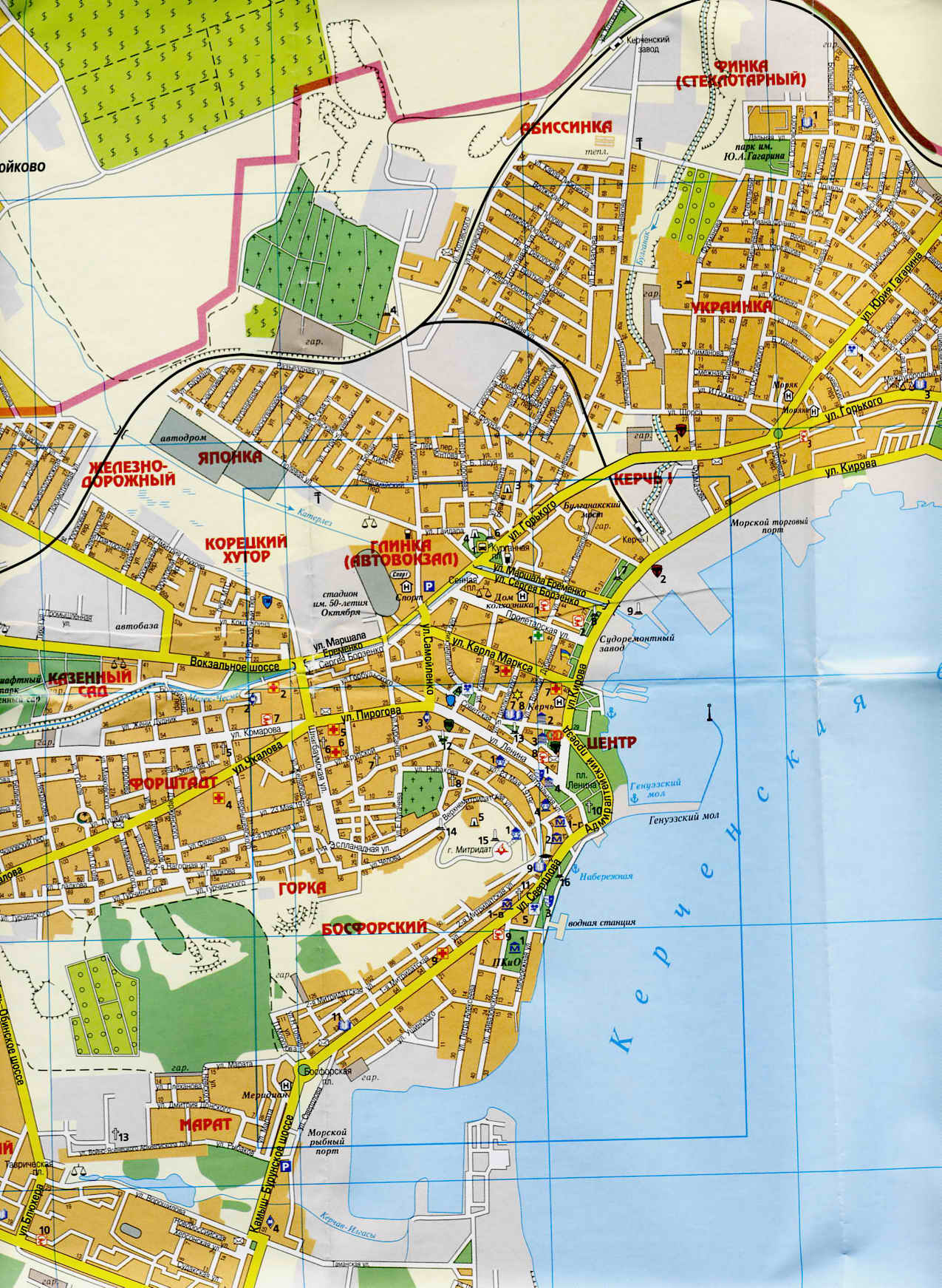
Kerch
Kerch
Main page
2310342

Kerch

logo
Community Hub0 subscribers
Read side by side
from Wikipedia

Kerch,[a] also known as Kerich,[b] is a city of on the Kerch Peninsula in the east of Crimea. It has a population of 147,033 (2014 Census).[1]

Key Information

Historical population
YearPop.±%
1939104,443—    
195998,769−5.4%
1970127,804+29.4%
1979156,827+22.7%
1989174,365+11.2%
2001157,007−10.0%
2014147,033−6.4%
2021154,621+5.2%
Source: Census data

Founded 2,600 years ago as the ancient Greek colony Pantikapaion, Kerch is one of the most ancient cities in Crimea. The city experienced rapid growth starting in the 1920s and was the site of a major battle during World War II.

Today, it is one of the largest cities in Crimea and is among the area's most important industrial, transport and tourist centres. As with the rest of Crimea, it has been occupied by Russian forces since the Russian annexation of Crimea in 2014.

History

[edit]
Ruins of Panticapaeum from the 6th century BC

Ancient times

[edit]

Archeological digs at Mayak village near the city ascertained that the area had already been inhabited in the 17th–15th centuries BC. While many finds from Kerch can be found in the Hermitage Museum in St Petersburg and the local museum, a large number of antique sculptures, reliefs, bronze and glassware, ceramics and jewellery were excavated in 1855–1856 during the Crimean War by Duncan MacPherson, a surgeon from the British Army, and later donated to the British Museum in London.[2][3][4]

Kerch as a city starts its history in the 7th century BC, when Greek colonists from Miletus founded a city-state named Panticapaeum[5] on Mount Mithridat near the mouth of the Melek-Chesme river. Panticapaeum subdued nearby cities and by 480 BC became the capital of the Kingdom of Bosporus. Later, during the rule of Mithradates VI Eupator, Panticapaeum for a short period of time became the capital of the much more powerful and extensive Kingdom of Pontus. The city was located at the intersection of trade routes between the steppe and Europe. This caused it to grow rapidly. The city's main exports were grain and salted fish; wine-making was also common. Panticapaeum minted its own coins. According to extant documents the Melek-Chesme river (small and shallow nowadays) was navigable in Bosporan times, and sea galleys were able to enter the river. Much of the city's population is thought to have been ethnically Scythian, later Sarmatian, as implied by the large Royal Kurgan at Kul-Oba.

In the 1st century AD, Panticapaeum and the Kingdom of Bosphorus suffered from Ostrogoth raids; then the city was devastated by the Huns in AD 375.

The settlement of Myrmekion was founded by Ionians in the eastern part of what is now Kerch, some four kilometers north-east of ancient Panticapaeum, in the first half of the 6th century BC.[6]

Middle Ages

[edit]
Yenikale fortress

From the 6th century the city was under the control of the Byzantine Empire. By order of Emperor Justinian I, a citadel named Bospor was built there. Bospor was the centre of a bishopric, the diocese of Bosporus and developed under the influence of Greek Christianity. In 576, it withstood a siege by the Göktürks under Bokhan, aided by Anagai, the last khan (ruler) of the Uturgurs (tribe of Huns).

Church of St John the Baptist, built in the 8th century

In the 7th century, the Turkic Khazars took control of Bospor, and the city was named Karcha from Turkic "karşı" meaning 'opposite, facing.' The main local government official during Khazar times was the tudun. During Khazar rule, Kerch was used as a major port for the Khazar slave trade, through which slaves were exported to the Black Sea slave trade.[7]

Christianity was a major religion in Kerch during the period of Khazar rule. Kerch's Church of St. John the Baptist was founded in 717; thus, it is the oldest church in Ukraine.[8] The Church of the Apostles existed during the late 8th and early 9th centuries, according to the Life of the Apostle Andrew by Epiphanius of Salamis.

Following the fall of Khazaria to Kievan Rus' in the late 10th century, Kerch became the centre of a Khazar successor-state. Its ruler, Georgius Tzul, was deposed by a Byzantine-Rus expedition in 1016.

From the 10th century, the city was a Slavic settlement named Korchev, which belonged to the Tmutarakan principality. Kerch was a center of trade between Russia', Crimea, Caucasus and the Orient.

In the 13th century, Crimea including Korchev was invaded by Mongols. After the Mongols, the city became the Genoese colony of Cerco (Cherkio) in 1318 and served as a sea harbour, where townspeople worked at salt works and fishery.

In 1475, the city was passed to the Ottoman Empire. During the Turkish rule Kerch fell into decay and served as a slave-market.[9] It repeatedly suffered from raids of Zaporizhian Cossacks.

18th–20th centuries

[edit]
Kerch by Ivan Aivazovsky, 1839

In response to the strengthening of Russian military forces in Azov area, the Turks built a fortress, named Yenikale, near Kerch on the shore of Kerch Strait. The fortress was completed by 1706. In 1771 the Imperial Russian Army invaded Crimea and approached Yenikale. The Turks decided to abandon the fortress, though reinforcements from the Ottoman Empire had arrived a few days earlier. By the Peace Treaty of Kuchuk-Kainarji in 1774, Kerch and Yenikale were ceded to Russia. As a result, the Turkish heritage has been almost completely wiped out.

In 1790 Russian naval forces under the command of admiral Fyodor Ushakov defeated the Turkish fleet at the Battle of Kerch Strait.[10]

Because of its location, from 1821 Kerch developed into an important trade and fishing port. The state museum of ancient times and a number of educational institutions were opened in the city. The ironwork factory was built in 1846 based on a huge iron ore deposit found on Kerch Peninsula.

During the Crimean War the city was devastated by British forces in 1855.

In the late 19th century, mechanical and cement factories were built, and tinned food and tobacco factories were established. By 1900, Kerch was connected to a railroad system, and the fairway of Kerch Strait was deepened and widened. At this time, the population had reached 33,000.

After suffering a decline during the First World War and the Russian Civil War, the city resumed its growth in the late 1920s, with the expansion of various industries, iron ore, and metallurgy in particular, and by 1939 its population had reached 104,500.

Kerch in World War II

[edit]
Monument of Glory in Kerch [uk]

On the Eastern Front of World War II from 1941 to 1945, Kerch was the site of heavy fighting between Red Army and Axis forces. After fierce fighting, the city was taken by the Germans in November 1941. On 31 December 1941, the 302nd Mountain Rifle Division recaptured the city following a naval landing operation at Kamysh Burun, to the south of the city, five days earlier.[11] In 1942 the Germans occupied the city again. The Red Army lost over 160,000 men, either killed or taken POW at the Battle of the Kerch Peninsula. On 31 October 1943 another Soviet naval landing operation was launched. Kerch returned to Soviet control on 11 April 1944.

The German invaders killed about 15,000 citizens and deported another 14,000 during their occupation. Evidence of German atrocities in Kerch was presented in the Nuremberg trials. After the war, the city was awarded the title Hero City.

The Adzhimushkay catacombs in the city's suburbs were the site of guerrilla warfare against the occupation. Thousands of soldiers and refugees found shelter inside and were involved in counterattacks. Many of them died underground, including those who died of numerous alleged poison gas attacks. Later, a memorial was established on the site.

Kerch in the Soviet Union

[edit]

Kerch in Independent Ukraine

[edit]

On 11 November 2007, a powerful storm passed through the city, causing much damage and an ecological disaster as a few ships, including an oil tanker, were shipwrecked and blocked the Kerch Strait.

Russian occupation

[edit]

As with the other parts of Crimea, as of 2023 Kerch is occupied by Russian forces following the Russian occupation of Crimea in 2014.

On 17 October 2018, a student killed 20 people and himself at Kerch Polytechnic College.

Geography

[edit]
Kerch, view from Mount Mithridat

Climate

[edit]

Kerch has a humid subtropical climate (Köppen climate classification Cfa)[12] with cool to cold winters and warm to hot summers.

Climate data for Kerch (1991–2020, extremes 1936–present)
Month Jan Feb Mar Apr May Jun Jul Aug Sep Oct Nov Dec Year
Record high °C (°F) 17.3
(63.1)
17.8
(64.0)
23.4
(74.1)
27.6
(81.7)
30.6
(87.1)
35.2
(95.4)
37.7
(99.9)
37.9
(100.2)
35.5
(95.9)
30.9
(87.6)
23.2
(73.8)
19.4
(66.9)
37.9
(100.2)
Mean daily maximum °C (°F) 3.8
(38.8)
4.5
(40.1)
8.8
(47.8)
14.9
(58.8)
21.0
(69.8)
26.0
(78.8)
29.0
(84.2)
28.9
(84.0)
23.4
(74.1)
16.9
(62.4)
10.2
(50.4)
5.8
(42.4)
16.1
(61.0)
Daily mean °C (°F) 0.7
(33.3)
1.1
(34.0)
4.7
(40.5)
10.1
(50.2)
16.0
(60.8)
21.2
(70.2)
24.1
(75.4)
24.0
(75.2)
18.6
(65.5)
12.6
(54.7)
6.6
(43.9)
2.8
(37.0)
11.9
(53.4)
Mean daily minimum °C (°F) −2.0
(28.4)
−1.9
(28.6)
1.2
(34.2)
5.8
(42.4)
11.3
(52.3)
16.3
(61.3)
19.1
(66.4)
19.2
(66.6)
13.9
(57.0)
8.7
(47.7)
3.5
(38.3)
0.1
(32.2)
7.9
(46.2)
Record low °C (°F) −23.7
(−10.7)
−23.1
(−9.6)
−15.6
(3.9)
−6.5
(20.3)
−1.1
(30.0)
2.8
(37.0)
9.9
(49.8)
7.5
(45.5)
1.0
(33.8)
−5.4
(22.3)
−11.8
(10.8)
−17.6
(0.3)
−23.7
(−10.7)
Average precipitation mm (inches) 38
(1.5)
29
(1.1)
33
(1.3)
29
(1.1)
31
(1.2)
53
(2.1)
33
(1.3)
41
(1.6)
35
(1.4)
31
(1.2)
39
(1.5)
37
(1.5)
429
(16.9)
Average extreme snow depth cm (inches) 1
(0.4)
2
(0.8)
1
(0.4)
0
(0)
0
(0)
0
(0)
0
(0)
0
(0)
0
(0)
0
(0)
0
(0)
1
(0.4)
2
(0.8)
Average rainy days 10 9 11 11 9 10 6 6 8 9 11 11 111
Average snowy days 8 8 5 0.2 0 0 0 0 0 0.1 2 7 30
Average relative humidity (%) 86 83 79 75 74 70 66 65 71 78 83 85 76
Mean monthly sunshine hours 64.5 96.9 142.7 207.2 282.3 307.7 349.0 322.3 246.7 172.5 92.9 59.9 2,344.6
Source 1: Pogoda.ru.net[13]
Source 2: NOAA[14]

Administration

[edit]

The city municipality stretches over a substantial area and includes several separate neighborhoods that are part of the Kerch city: Eltigen (Heroyevskoe), Kamysh-Burun (Arshyntsevo), Port Krym, Adzhimushkai, and Tuzla Island.

Economy

[edit]

Today Kerch is home to many metallurgists, shipbuilders, and fishermen. It also has a significant tourism sector.

Industry

[edit]

The largest enterprises in the city are:

  • Kerch Metallurgical Works Factory launched in 1900[15]
  • Kamysh-Burun Iron Ore Plant
  • Zaliv Shipyard that produces and repairs tankers and cargo ships.

Construction-materials, food processing, and light industries play a significant role in the city's economy. Kerch is also a fishing fleet base and an important processing centre for numerous fish products.

  • Kerch Aircraft Repair Plant KeARZ
  • KMZ KMK Metallurgical Plant, Kerch east
  • Oil and Gas extraction industry petrochemical and storage
  • Zaliv Shipyard, (Kamysh Burun Zheleznogoroda)
  • Kvartz Quartz Glass Factory Plant KSZ (Glass (various) and optics, optical materials and instruments) (Kerch)
  • PSZ Albatros, PSZ KMPZ Vityaz Priladobudivni (Instruments and Instruments making, Machinery, Engineering)
  • Kamysh Burun Iron Metallurgy Plant
  • KMZ KMTP SV Fregat floating docks yard and ship repair yard
  • KSRZ uvas-trans floating docks yards and ship repair (also lesser Kerch ship repair yards around)

Tourism

[edit]
Mithridates Staircase (19th century)
Lenina Street in Kerch

Because of its location on the shores of the Azov and Black seas, Kerch became a popular summer resort among people of the former USSR. Also, several mud-cure sources are located near the city. Despite the seaside location, the tourist appeal of Kerch today is limited because of the industrial character of the city and associated pollution. Despite the lack of beaches in the town's area, there are a lot of them at a distance of 20 minutes' travel by bus, train or taxi.

Kerch has a number of impressive architectural and historical monuments. Ancient historical heritage of the city makes it attractive for scientific tourism. The most notable of Kerch's sights are:

Transport

[edit]
Private houses are common in Kerch.

Kerch has a harbour on the Kerch Strait, which makes it a key to the Sea of Azov. It has several railroad terminals and a small airport. The Kerch Strait ferry line across the Kerch Strait was established in 1953, connecting Crimea and the Krasnodar Krai (Port KrymPort Kavkaz line); (as of November 2009) there are also plans for a Kerch-Poti ferry route.[16] Tavrida Highway work in progress along Kerch railway (two rails) highway (four lanes) bridge to connect Rostov Krasnodar with peninsula.

There are several ports in Kerch, including Kerch Maritime Trading Port, Kerch Maritime Fishing Port, Port Krym (ferry crossing), Kamysh-Burun Port.

The railroad terminals include: Kerch, Kerch I, Kerch Factory, Arshyntsevo, and Krym.

A bus network connects Kerch to other cities in Crimea and Krasnodar Krai.

City transport

[edit]
Map of tram lines with opening dates

Kerch had a tram system that was established in 1935 and destroyed in 1941.

Trolleybus lines map with dates of opening

A trolleybus system was established in 2004, and has one line.

Crimean Bridge

[edit]

On 25 April 2010, Ukrainian President Viktor Yanukovych and Russian President Dmitry Medvedev signed an agreement to build a bridge across the Kerch Strait. In January 2015, with Russia now in control, the contract for the construction of the bridge was awarded to Arkady Rotenberg's S.G.M. Group. In May 2015 construction commenced, and the road section of the bridge was opened to traffic in May 2018. The rail section was opened in 2019, with Russian President Vladimir Putin taking the first train across on 23 December.[17] It was heavily damaged by an explosion on 8 October 2022.

Culture

[edit]
Games of Bogatyrs in Kerch

Festivals and celebrations

[edit]
  • Liberation Day (11 April)
  • Day of Fishermen (the second Sunday of July)
  • Day of the City (the second Saturday of September)

Education

[edit]
Kerch Brotherhood

Kerch hosts (2004):

  • 28 schools,
  • 9 institutes and branches of Ukrainian and Russian universities,
  • shipbuilding and polytechnical colleges,
  • medical school,
  • 6 PTU schools,
  • a number of pre-school child institutions

Archaeology

[edit]
Excavations in Pantikapaeum

Archaeological digs in Kerch were launched under Russian auspices in the middle of the 19th century. Since then the site of ancient Panticapaeum city on Mount Mithridat has been systematically excavated. Located nearby are several ancient burial mounds (kurgans) and excavated cities. Kerch takes part in UNESCO's "Silk Road" programme.
Treasures and historical findings of Kerch adorn the Lapidarium in Kerch and the collections of major museums around the world. Such as: the Hermitage, the Louvre, the British Museum, the Berlin Museum, the Moscow State Museum of fine arts and many others.
Currently, excavations at ancient fortresses of Kerch are led by scientists from Russia, Ukraine, and Poland.

Twin towns – sister cities

[edit]
City Country Year
Mogilev Belarus Belarus 1998
Smolensk Russia Russia 1998
Çanakkale Turkey Turkey 1999
Oryol Russia Russia 2004
Odintsovo Russia Russia 2004
Sochi Russia Russia 2005
Kyiv Ukraine Ukraine 1997
Tula, Russia Russia Russia 2014

Notable people

[edit]

Honours

[edit]

A minor planet 2216 Kerch discovered in 1971 by Soviet astronomer Tamara Mikhailovna Smirnova is named after the city.[18]

[edit]

See also

[edit]

Footnotes

[edit]

References

[edit]
[edit]
Revisions and contributorsEdit on WikipediaRead on Wikipedia
from Grokipedia
Kerch is a city of regional significance and seaport on the Kerch Peninsula in eastern Crimea, positioned at the western shore of the Kerch Strait, which links the Black Sea to the Sea of Azov, and has a population of approximately 149,000.[1] Established around 600 BC by ancient Greek settlers from the region of modern-day Turkey as the colony of Panticapaeum, Kerch evolved into the capital of the Bosporan Kingdom, a Hellenistic state that dominated regional trade in grain and fish, and stands as one of Europe's oldest continuously inhabited urban centers.[2] Under Russian administration since the 2014 annexation of Crimea—territorial control internationally disputed by Ukraine—the city functions as a critical economic and logistical node, anchored by its marine trade port handling bulk cargoes like coal and iron ore, shipbuilding facilities such as the Zaliv Shipyard, and the 19-kilometer Kerch Bridge, inaugurated in 2018 to facilitate vehicular and rail traffic to Russia's Krasnodar Krai, thereby bolstering regional connectivity and military sustainment amid the ongoing conflict.[3][4][5] Kerch's strategic position has historically drawn conquests from Scythians to Romans and later Ottoman and Russian forces, while in the 20th century, it endured severe destruction during World War II, earning Soviet recognition for partisan resistance and liberation efforts that underscored its defensive role against Axis advances.[2]

History

Ancient history

Panticapaeum, the ancient predecessor of modern Kerch, was established as a Greek colony around 600 BCE by settlers from Miletus on the western shore of the Cimmerian Bosporus.[6] Archaeological layers at the site reveal pre-Greek settlements dating back to approximately 2600 BCE, but the city's prominence arose with Greek colonization, marking it as a key outpost for trade and agriculture in the region.[7] The colony quickly grew into a prosperous polis, leveraging its strategic position at the Kerch Strait to facilitate maritime commerce between the Black Sea and the Sea of Azov, exporting grain, fish, and other goods to Mediterranean markets.[8] By the 5th century BCE, Panticapaeum had become the capital of the Bosporan Kingdom, a Hellenistic state formed through alliances between Greek cities and local ruling dynasties like the Archaeanactids (480–438 BCE) and Spartocids (438–110 BCE).[8] The kingdom's rulers minted coins and constructed monumental architecture, including temples and fortifications, reflecting a blend of Greek urban planning and interactions with neighboring nomadic groups such as the Scythians. Excavations of nearby kurgans, like the 4th-century BCE Kul Oba mound, have uncovered Scythian burials containing Greek jewelry and imports, evidencing extensive trade and cultural exchange rather than mere conquest.[9] The Bosporan Kingdom maintained autonomy while navigating influences from successive powers; it allied with the Roman Republic in the 1st century BCE, as demonstrated by the discovery of a Roman fort on the Kerch Peninsula dating to that period.[10] Sarmatian nomadic incursions from the 3rd century BCE onward introduced further interactions, with artifacts showing hybrid Greco-nomadic artifacts in the archaeological record.[7] The city's role as a trade nexus persisted into the Roman era, but the kingdom fragmented amid Gothic and Hunnic pressures by the 4th century CE, transitioning toward Byzantine oversight in the region.[8]

Medieval and early modern period

Following the decline of Byzantine authority in the region during the 10th century, the area around Kerch experienced transient control by the Khazars and Kievan Rus'. After the Khazar Khaganate's defeat by Kievan Rus' forces in the late 10th century, Kerch briefly served as the center of a Khazar successor state under ruler Georgius Tzul, who capitulated to Rus' pressure around 1016, leading to its integration as the Slavic settlement of Korchev.[11] The 13th-century Mongol invasions incorporated Korchev into the Golden Horde, disrupting prior Slavic and Byzantine remnants. By 1318, Genoese merchants had established a trading colony at Kerch, designated as Cerco or Vosporo, as part of their Black Sea network under Horde suzerainty. These outposts, including Kerch, facilitated grain, slave, and luxury goods trade while paying tribute to Mongol khans and, after the 1440s, the emergent Crimean Khanate; Genoese presence persisted until the Ottoman Empire's conquest of Caffa in 1475, after which Ottoman overlordship extended over Crimea, including Kerch's strategic strait.[2] Under Ottoman suzerainty, mediated through the Crimean Khanate, Kerch's importance as a chokepoint for Black Sea access prompted defensive measures. In response to growing Russian threats during the early 18th century, the Ottomans erected Yenikale Fortress from 1703 to 1711 at the Kerch Strait's narrowest point, forming an irregular pentagon with moats, barracks, a mosque, and pasha's residence to house up to 1,100 Ottoman and Tatar troops.[12][2] The fortress saw action in the Russo-Turkish War (1768–1774), where Russian troops under General Vasily Dolgorukov seized Yenikale and Kerch on June 25, 1771 (Julian calendar), overcoming Ottoman resistance and securing the Crimea. The subsequent Treaty of Küçük Kaynarca (July 21, 1774) ceded Kerch and Yenikale to Russia, renaming the site Kerch and refortifying it as a naval base to control strait passage, ending Ottoman dominance and initiating Russian strategic oversight.[13][14]

Russian Empire era

During the mid-19th century, Kerch played a strategic role in the Crimean War (1853–1856), where Allied forces (primarily British, French, and Ottoman) entered the Kerch Strait in May 1855, capturing the city and inflicting destruction on coastal infrastructure to disrupt Russian supply lines to the Sea of Azov.[15][16] This occupation highlighted Kerch's position as a key naval chokepoint but also exposed vulnerabilities in Russian coastal defenses, contributing to broader imperial setbacks in the region.[15] Post-war recovery emphasized economic development, with Kerch functioning as a transshipment hub for grain and other commodities between the Black Sea and Sea of Azov, spurring port infrastructure improvements and trade volumes in the late 19th century.[17] Iron ore deposits in the Kerch Peninsula, rich in vanadium-bearing ores, began systematic exploitation around the 1880s, transitioning from small-scale to industrial mining that fueled regional metallurgy.[18][19] By 1913, output reached 370,000 tons, accounting for approximately 5% of total Ukrainian iron ore production, with beneficiation at facilities like the Komysh-Buruny complex supporting export-oriented processing.[19][20] This mining boom, alongside limestone extraction and port activities, drove population influxes, including migrant labor from southern Italy in the 1870s (exceeding 2,000 individuals by some estimates), which bolstered urban and rural economies through diversified workforce contributions.[21] Industrial growth laid groundwork for metallurgical plants, though full-scale facilities emerged primarily pre-World War I, tying Kerch's prosperity to imperial resource extraction policies amid rising European demand for ferrous metals.[22] Local impacts of early 20th-century unrest, including the 1905 Revolution, manifested in labor agitation within emerging industrial sectors, reflecting empire-wide tensions over wages and conditions in extractive industries.[23]

Soviet period

During the 1920s and 1930s, Kerch underwent rapid industrialization as part of the Soviet Union's Five-Year Plans, with expansion of metallurgical facilities leveraging local iron ore deposits.[24] The Kamysh-Burun metallurgical works were enlarged to boost output, contributing to the region's role in heavy industry.[24] In 1938, the Zaliv Shipyard was established on the Kerch Strait, specializing in large-tonnage vessels and marking a key development in shipbuilding capacity.[25] In late 1941, Soviet forces launched amphibious landings on the Kerch Peninsula, temporarily recapturing parts of the area including docks at Kamysh-Burun before German counteroffensives in December restricted gains.[26] By May 1942, during Operation Trappenjagd, German forces decisively defeated the Soviet Crimean Front on the peninsula, resulting in approximately 250,000 Soviet troops engaged, with 170,000 captured and 28,000 killed.[26] The Axis secured control over Kerch, initiating a period of Nazi occupation characterized by exploitation of resources and suppression of the population until 1944. Soviet troops liberated Kerch on 11 April 1944 as part of the broader Crimean Strategic Offensive Operation, which expelled German forces from the peninsula by mid-May.[27] Post-war reconstruction prioritized heavy industry, rebuilding shipyards and metallurgical plants amid demographic setbacks from wartime casualties and deportations. Following the 1954 transfer of Crimea to the Ukrainian SSR, Kerch's economy emphasized ferrous metallurgy and maritime activities, with the Zaliv Shipyard resuming production of tankers and cargo vessels.[25] These efforts sustained urbanization but reflected the Soviet focus on resource extraction and military-industrial output over civilian development.

Post-Soviet Ukraine (1991–2014)

Following the dissolution of the Soviet Union in December 1991, Kerch became part of independent Ukraine as a city within the Autonomous Republic of Crimea. The local economy, heavily reliant on Soviet-era heavy industries such as shipbuilding at the Zaliv Shipyard and iron ore processing at the Kamysh-Burun plant, experienced severe contraction due to the loss of subsidized markets, hyperinflation, and disrupted supply chains. Industrial output in Crimea plummeted, with many enterprises idling or closing amid widespread underinvestment from Kyiv governments, which prioritized central Ukraine over peripheral regions.[28][29] Corruption exacerbated these challenges, as oligarchic control over privatization processes diverted resources and stifled reforms, leaving Kerch's infrastructure— including its key ferry terminal across the Kerch Strait—deteriorating without modernization. For instance, the Kerch Glassworks Plant, a major employer, ceased operations in 2004 after years of mismanagement and lack of capital.[28][29][30] Ukraine's overall GDP declined by approximately 53% from 1989 to 1998, with Crimea's resource-dependent sectors faring worse due to geographic isolation and negligible state support.[31] Tensions over the Kerch Strait escalated in 2003 during the Tuzla Island dispute, when Russian authorities began constructing a 3.7-kilometer earthen causeway from the Taman Peninsula toward Tuzla Island, which Ukraine administered and claimed as its territory. Russia asserted that Tuzla was an extension of the Taman Spit rather than a distinct island, aiming to redefine maritime boundaries in the strait and Azov Sea to avoid Ukrainian tolls on shipping. Ukrainian officials deployed border guards to the shrinking island—eroded to about 300 meters in length by then—and protested the works as an attempted annexation, leading to diplomatic standoffs resolved only by halting construction short of connection.[32][33][34] Throughout the period, pro-Russian political and cultural influences grew in Kerch and Crimea more broadly, driven by the ethnic Russian majority, predominant use of Russian language, and economic grievances against Kyiv's policies. Pro-Russian parties, such as those aligned with Moscow's interests, garnered strong electoral support in regional votes, reflecting sentiments of cultural affinity and dissatisfaction with Ukraine's post-independence trajectory. Local demonstrations occasionally erupted against perceived Ukrainian centralization, particularly after the 2004 Orange Revolution, underscoring underlying separatist undercurrents tied to historical ties with Russia rather than integration with Ukraine.[35][36][37]

2014 annexation and Russo-Ukrainian War

Following the Revolution of Dignity in Kyiv, Russian special forces without insignia began securing strategic sites in Crimea on February 27, 2014, including the Kerch ferry terminal, which facilitated troop movements across the strait.[38] Local pro-Russian militias in Kerch rallied on March 1, 2014, demanding separation from Ukraine and alignment with Russia, amid reports of minimal resistance from Ukrainian forces in the region.[39] On March 16, 2014, Crimea—including Kerch—held a referendum on its status, with official results reporting 96.77% support for joining the Russian Federation on a turnout of 83.1%, though the vote occurred under Russian military presence and without international observers endorsed by Ukraine.[40] Russia signed a treaty of accession with Crimea's pro-Russian authorities on March 18, 2014, formally integrating the peninsula, including Kerch as a city within the new Republic of Crimea federal subject; de facto Russian administration ensued, with local governance restructured under Moscow's oversight.[41] To bolster logistical ties, Russia initiated construction of the 19-kilometer Kerch Strait Bridge in February 2016, costing approximately 228 billion rubles, connecting the Taman Peninsula to Kerch; the road section opened to vehicular traffic on May 16, 2018, following President Vladimir Putin's inspection drive, while the railway section commenced operations in December 2019.[42] [43] The bridge enabled over 40,000 daily vehicle crossings by 2018, serving as Crimea's primary overland supply artery and reducing reliance on ferries.[44] Tensions escalated on November 25, 2018, when three Ukrainian naval vessels—a tug and two gunboats—attempted to transit the Kerch Strait en route to Mariupol; Russian border guards blocked the path, rammed one vessel, fired upon the ships after warnings, seized all three, and detained 24 Ukrainian sailors, with three wounded, prompting Ukraine to declare martial law.[45] [46] Russia justified the action as defense against unauthorized entry into its territorial waters post-annexation, while Ukraine viewed it as aggression restricting Azov Sea access; the strait has since seen heightened Russian patrols enforcing a de facto blockade on non-Russian shipping.[47] Russia's full-scale invasion of Ukraine on February 24, 2022, intensified Kerch's strategic role, with the bridge facilitating military logistics to southern fronts; Ukraine imposed a partial naval blockade on Crimea and attempted disruptions, including drone strikes on Kerch port facilities.[48] The bridge sustained a major truck bomb explosion on October 8, 2022, collapsing sections of the road deck and killing four civilians, which Russia attributed to Ukrainian sabotage; repairs restored full traffic within weeks, supported by added protective measures like concrete barriers and anti-drone systems.[49] A subsequent missile strike on July 17, 2023, damaged the road surface with Western-supplied weapons, causing temporary closures but no structural failure; Russian forces responded with pontoon barriers and aerial defenses.[5] On June 3, 2025, Ukraine's Security Service claimed responsibility for an underwater explosive attack on the bridge's supports, causing superficial damage and brief traffic halts; Russian authorities reported minimal impact, with repairs underway amid ongoing fortifications including sea drones and minefields.[50] [51] These incidents have not severed connectivity, as rail and alternative routes persist, though Kerch's infrastructure faces repeated targeting, underscoring its causal centrality to Russia's Crimean hold.[52]

Geography

Location and topography

Kerch occupies the eastern extremity of the Kerch Peninsula in Crimea, positioned at the junction where the Black Sea transitions into the Sea of Azov through the Kerch Strait, which separates it from Russia's Taman Peninsula to the northeast. The city's geographic coordinates are 45°21′N 36°28′E.[53] The peninsula itself is nearly encircled by water, linking to the broader Crimean landmass via the narrow Isthmus of Ak-Monay to the west.[54] The Kerch Strait spans approximately 41 km in length and varies in width from 4 to 15 km, with depths ranging from 5 to 13 m that create navigational difficulties, including shallow channels requiring ongoing dredging to accommodate sea-going vessels.[55][56] Topographically, Kerch features predominantly low coastal plains at elevations of 10–30 m above sea level, interspersed with hilly uplands; prominent among these is Mount Mithridates, which rises to 91.4 m and overlooks the strait.[57][58] Geologically, the region consists of friable sedimentary rocks like calcites, marls, and sandstones prone to erosion, fostering dynamic coastal processes and landslide risks.[54][59] Although contemporary seismic activity remains low, paleoseismological studies reveal evidence of past strong earthquakes linked to active onshore faults, underscoring potential hazards.[60] The peninsula's terrain supports diverse steppe biocenoses and facilitates biodiversity by linking marine habitats across the strait, aiding species migration between the Black Sea and Sea of Azov.[61][59]

Climate

Kerch experiences a humid subtropical climate (Köppen Cfa), characterized by mild winters, warm summers, and relatively even precipitation distribution throughout the year.[62] The city's location on the Kerch Strait exposes it to moderating maritime influences, including frequent winds from the Black Sea and Azov Sea, which temper temperature extremes and contribute to higher humidity levels compared to inland Crimean areas.[63] Average January temperatures range from lows of about 2°C to highs of 5°C, with a monthly mean around 3–4°C, while July averages feature highs of 25–27°C and lows of 18–20°C, yielding a mean of approximately 22–23°C.[64] Annual mean temperature stands at roughly 11.2°C, with the warm season (daily highs above 22°C) spanning from early June to mid-September.[62] Precipitation totals about 434 mm annually, concentrated slightly in winter and autumn, though the strait winds can enhance convective activity and occasional thunderstorms in summer.[62] Historical records indicate variability, including periods of drought that have affected regional agriculture, as seen in Crimea's broader patterns of irregular rainfall influenced by large-scale atmospheric circulation.[65] Extreme temperatures have reached highs near 38°C in summer and lows around -15°C in winter, though such events are infrequent due to the coastal moderation.[63] Wind speeds average 4–6 m/s year-round, with stronger gusts from northerly and easterly directions during transitional seasons, underscoring the climatic role of the strait as a conduit for air masses.[63]

Demographics

The population of Kerch experienced significant fluctuations throughout the 20th century, influenced by industrialization, warfare, and economic shifts. In the 1926 Soviet census, the city recorded 34,579 residents, reflecting recovery from earlier conflicts but still modest growth amid post-Russian Civil War instability.[66] By the late Soviet period, rapid industrial expansion, particularly in metallurgy and shipping, drove the population to a peak of approximately 174,000 by the 1989 census, supported by migration from other Soviet regions.[67] World War II inflicted heavy losses on Kerch due to intense fighting in the Kerch Peninsula battles and Nazi occupation atrocities, including the massacre of around 7,000 civilians in late 1941.[68] The city's population declined sharply during the war years, with incomplete records indicating a drop to under 50,000 by 1944 amid evacuations, deaths, and destruction; postwar reconstruction and repatriation gradually restored numbers, reaching over 100,000 by the 1950s through state-sponsored rebuilding and influxes of workers.[66] Post-Soviet economic turmoil in the 1990s triggered emigration, particularly among skilled workers seeking opportunities abroad or in mainland Ukraine and Russia, contributing to a decline from the late-1980s peak. The 2001 Ukrainian census counted 158,165 residents, a slight dip from prior estimates, exacerbated by deindustrialization and aging infrastructure.[66] By the 2014 Ukrainian census, the figure stood at 147,033, reflecting ongoing out-migration and low birth rates amid regional stagnation.[66] Following the 2014 annexation, the Russian-administered 2021 census reported 154,621 residents, suggesting a modest rebound possibly due to inbound migration from Russia offsetting some outflows.[69] However, the ongoing Russo-Ukrainian War has accelerated declines through displacements, with estimates indicating a drop to around 148,000 by 2025, driven by evacuations, military conscription impacts, and economic disruptions in the port-dependent city.[1] Kerch's urban density remains approximately 1,415 persons per km² over its 109.3 km² area, with demographic aging evident in Crimea's broader trends—median age exceeding 40 years and a dependency ratio strained by low fertility (around 1.5 births per woman regionally).[69] These patterns underscore vulnerability to conflict-related shocks, with limited recent data hindering precise projections.

Ethnic and linguistic composition

According to Ukraine's 2001 census, Kerch's population totaled 158,165, with ethnic Russians comprising 78.7% (124,430 individuals), ethnic Ukrainians 15.4% (24,298), and the remainder including Crimean Tatars (approximately 2-3%), Belarusians, Armenians, and others.[66] [70] This distribution reflects Soviet-era demographic shifts driven by industrialization, which attracted Russian settlers, alongside the 1944 deportation of nearly 200,000 Crimean Tatars (resulting in their near-elimination from the population until partial repatriation from the late 1980s onward, reaching about 10% across Crimea by 2001).[71] Post-2014 Russian census data for Crimea as a whole indicate a Russian ethnic majority of around 65-73%, with Crimean Tatars at 12-14% and Ukrainians declining to 15% or less, trends attributed to migration patterns including outflows of Ukrainian-identifying residents and inflows from Russia.[72] [73] Kerch-specific figures from this period maintain a higher Russian proportion consistent with its pre-2014 profile as a Russified port city, exceeding Crimean averages due to historical naval and industrial ties.[66] Linguistically, Russian predominates as the mother tongue and everyday language for over 80% of Crimea's residents per regional surveys, with Kerch aligning closely given its ethnic makeup; Ukrainian native speakers constituted under 10% in 2001 census data for similar urban areas, and usage has further declined since 2014 amid policy changes favoring Russian in education and administration.[74] This linguistic dominance correlates empirically with the Russian ethnic plurality and Soviet-era language policies promoting Russian-medium schooling and media.[71]

Government and politics

Local administration

Prior to 2014, Kerch functioned as a city of regional significance directly subordinate to the Autonomous Republic of Crimea within Ukraine, governed by an elected city council comprising 50 deputies and a mayor responsible for municipal services, urban development, and local budgeting.[66] The mayor, Oleg Osadchy, oversaw administrative operations including public utilities and infrastructure maintenance until the annexation.[75] Since Russia's 2014 annexation, Kerch has been designated a city of republican significance in the Republic of Crimea, equivalent to other major urban centers like Simferopol, with governance aligned to Russian federal laws on local self-government. The structure includes a city council (soviet) elected every five years—most recently in September 2022 under United Russia dominance—and a head of administration appointed by the council after competitive processes. Current head Oleg Katorgin, a former deputy and legal department director, assumed acting duties on July 5, 2023, and was confirmed by council vote, managing day-to-day functions such as housing allocation, waste management, and emergency response.[76][77][78] Administrative operations have integrated into Russian systems, with budgeting derived from republican allocations supplemented by federal transfers for utilities like water supply and road repairs, totaling approximately 5.2 billion rubles in 2023 for municipal expenditures. The administration coordinates with Crimea's Ministry of Housing and Communal Services for service delivery, emphasizing infrastructure resilience amid regional conflicts, though implementation relies on Russian procurement laws excluding non-federated suppliers.[3]

Sovereignty dispute

Ukraine maintains sovereignty over Kerch as part of its internationally recognized 1991 borders, established upon independence from the Soviet Union, when Crimea—including Kerch—was an autonomous republic within the Ukrainian Soviet Socialist Republic.[79] This claim is reinforced by bilateral agreements, including Russia's recognition of Ukraine's borders in the 1991 Belovezha Accords and the 1994 Budapest Memorandum, where Moscow pledged respect for Ukraine's territorial integrity in exchange for nuclear disarmament.[80] Ukrainian officials assert that any deviation constitutes a violation of these pacts and the principle of uti possidetis juris, preserving administrative boundaries post-colonial independence.[81] Russia contests this, arguing historical precedence dating to the Russian Empire's Taurida Governorate, which encompassed Crimea until the 1917 Revolution, and portraying the 1954 transfer to the Ukrainian SSR as an arbitrary administrative act lacking popular consent.[73] Moscow cites the March 16, 2014, referendum in Crimea—where official results showed 96.77% approval for reunification with Russia on an 83.1% turnout—as evidence of self-determination, framing the annexation on March 18, 2014, as rectification of post-Soviet border injustices.[82] Russian doctrine emphasizes ethnic Russian majorities and protection from alleged threats following Ukraine's 2014 Euromaidan events, prioritizing causal links to regional stability over strict adherence to 1991 delineations.[83] The annexation lacks broad international endorsement; United Nations General Assembly Resolution 68/262, adopted March 27, 2014, by a vote of 100 in favor, 11 against, and 58 abstentions, reaffirmed Ukraine's territorial integrity and deemed the referendum invalid.[84] As of 2024, recognition is limited to approximately 10 states allied with Russia, including Belarus, Nicaragua, Syria, and Venezuela, while the majority of UN members, NATO allies, and the European Union uphold non-recognition policies citing breaches of the UN Charter and Helsinki Accords.[85] This divide underscores tensions between self-determination claims and prohibitions on territorial acquisition by force. Ongoing disputes include proceedings at the Permanent Court of Arbitration in the case Ukraine v. Russian Federation (PCA Case No. 2017-06), initiated in 2017 over coastal state rights in the Black Sea, Sea of Azov, and Kerch Strait.[86] The tribunal's 2020 award rejected Russia's preliminary objections, affirming Ukraine's navigational rights through the strait and rejecting assertions of internal waters status post-annexation, with merits hearings continuing as of 2024.[87] Russia's construction of the Kerch Strait Bridge in 2018 and subsequent restrictions on Ukrainian vessels highlight strategic control motives, enabling direct access to the Azov Sea, while Ukraine frames these as extensions of unlawful seizure.[88]

Economy

Key industries

The primary industrial activities in Kerch revolve around shipbuilding and ship repair, dominated by the Zaliv Shipyard, a major facility capable of constructing tankers, container carriers, and dry cargo vessels up to 8,000 deadweight tons, as well as performing repairs on various ship types including steel replacement, machinery overhauls, and painting.[89][90] The yard's production includes up to 3–4 hulls of dry cargo ships and container carriers annually, supported by Russian investments for modernization, such as involvement from the Ak Bars corporation announced in 2023.[91] These operations face constraints from Western sanctions limiting international trade and technology access, offset partially by domestic Russian subsidies and redirection toward military and regional vessel needs.[92] Iron ore extraction and basic metallurgy represent a historically significant but currently subdued sector, tied to the Kerch Iron Ore Basin's bog iron deposits, which were mined for over 50 years prior to 2014, yielding processed ore alongside 25 million tons of waste at local enrichment plants.[93] Post-2014 Russian administration pledged to restart mining, yet no major investment projects or production upticks have materialized as of recent assessments, leaving the basin largely unexploited amid low ore grades and economic isolation.[94][95] Reserves persist, contributing to regional resource potential, but output remains negligible compared to pre-annexation levels or other Ukrainian basins.[96] Fisheries processing and related activities form another key pillar, with Kerch functioning as a primary hub for fish production and handling in Crimea, involving multiple enterprises focused on capture, preservation, and export within Russian markets.[97] The sector benefits from federal subsidies directed at Crimean aquaculture and vessel support, though international sanctions and restricted Black Sea access have curtailed broader operations and foreign partnerships.[98] Russian reports highlight manufacturing growth, including shipbuilding, as a driver of post-2014 economic integration, with Crimea's overall industrial output expanding despite these challenges.[99]

Port operations and trade

The Kerch Commercial Sea Port, located on the Kerch Bay of the Black Sea, primarily handles dry bulk cargoes such as grain, ore, metals, and general goods, alongside passenger and vehicle ferries across the Kerch Strait to Port Kavkaz in Russia.[100] The port's infrastructure includes reloading equipment for steel products and other bulk materials, with an annual handling capacity of up to 2.5 million tonnes.[100] Prior to Russia's 2014 annexation of Crimea, the facility served as a transit point for Ukrainian exports, including grain and metals routed through Crimean ports to international markets.[101] Following the opening of the Kerch Strait Bridge in 2018, port operations shifted, with ferry traffic—previously a dominant activity carrying significant vehicle and passenger volumes—declining in favor of overland rail and road transport via the bridge.[102] Cargo handling has increasingly focused on regional exports tied to Russian supply chains, such as grain from the Sea of Azov basin, though overall volumes remain constrained by the port's scale compared to larger Russian facilities like Novorossiysk.[103] Trade patterns post-2014 reflect rerouting to evade Ukrainian territorial waters and Western sanctions, prioritizing bilateral Russian-Crimean flows over pre-annexation international routes.[103] The port's reliance on the Kerch Strait for access to the Sea of Azov exposes operations to frequent disruptions from Russian naval activities. In April 2021, Russia imposed a closure of parts of the Black Sea and Kerch Strait approaches until October, citing military exercises, which restricted foreign vessel navigation and delayed regional trade.[104] Similar blockades in December 2021 covered approximately 70% of the Azov Sea, further impeding bulk cargo transits essential to Kerch's grain and ore handling.[105] Russian naval presence in the strait, including patrols and exercises by Black Sea Fleet elements, has compounded these effects, prompting commercial operators to reroute shipments via alternative Black Sea ports to mitigate risks from closures and heightened security protocols.[106]

Tourism and impacts of conflict

Kerch's tourism sector historically centered on its coastal location, offering beaches along the Black Sea and Sea of Azov, as well as scenic views from elevations like Mount Mithridates, attracting visitors interested in natural landscapes and proximity to historical landmarks.[107] Prior to the 2014 annexation, the city benefited from Crimea's broader appeal, which drew around 5-6 million tourists annually, including significant numbers from Ukraine and Europe, with summer peaks focused on beach resorts and ferry access via the Kerch Strait.[108] Tourism contributed substantially to the local economy, supported by hotels and agencies catering to these flows, though specific visitor counts for Kerch alone were not disaggregated in available data.[66] The 2014 annexation initially disrupted tourism due to international sanctions and severed ties with Ukrainian visitors, leading to a halving of Crimea's tourist numbers that year and a shift toward domestic Russian clientele.[109] The 2018 opening of the Kerch Strait Bridge facilitated easier land access from Russia, enabling a partial recovery and peak of approximately 9.5 million visitors peninsula-wide in 2021, with Kerch serving as a primary entry point and boosting local beach and transit-related stays. However, this infrastructure gain was offset by ongoing geopolitical tensions, as Western sanctions limited foreign arrivals and positioned Kerch's strategic assets under heightened scrutiny. The 2022 escalation of the Russo-Ukrainian War severely curtailed tourism, with Crimea's summer bookings from Russian platforms dropping to just 1% of total in 2023, reflecting fears of proximity to front lines and aerial threats.[110] Attacks on the Kerch Bridge— including explosions in October 2022 and July 2023 that killed at least two and injured others—prompted mass evacuations, with over 5 km tailbacks of fleeing tourists and temporary closures disrupting access.[111] [112] Authorities rerouted visitors via longer paths through occupied Ukrainian territories, exacerbating declines; by 2023, 60% of Crimean tourism businesses reported losses totaling 709 million rubles (about $10 million), with Kerch's gateway role amplifying local vulnerabilities from drone strikes and security alerts.[113] [114] While the bridge enhanced connectivity pre-war, its repeated targeting has entrenched security risks, deterring all but resilient domestic visitors and shifting any residual "war tourism" toward observation of militarized sites rather than traditional leisure.[115] This has yielded net economic drawbacks for Kerch, including reduced revenues from accommodations and services amid persistent conflict hazards.[116]

Infrastructure and transport

Urban transport

Kerch's urban public transport relies primarily on buses, trolleybuses, and marshrutka minibuses to facilitate intra-city movement. The trolleybus network, newly established on the Crimean Peninsula after Ukraine's independence in 1991, operates along principal corridors connecting residential areas to industrial and commercial districts.[117] Buses and minibuses supplement this system, providing flexible coverage of peripheral neighborhoods and high-density routes, with schedules and paths tracked via applications such as EasyWay.[118] Rail infrastructure within the city remains limited, with the local station focused on regional rather than dedicated urban services. Commuter flows are influenced by employment in port-related logistics and metallurgy, leading to peak-hour demands on routes linking suburbs to the harbor and factories. Road networks experience strain from freight traffic tied to the Kerch Sea Port's operations, which handle general cargo including steel products up to 2.5 million tonnes annually.[119] Following Russia's 2014 control of Crimea, federal investments have supported broader road reconstructions, indirectly aiding urban accessibility despite ongoing geopolitical tensions affecting maintenance.

Kerch Strait crossings

Prior to the construction of the Kerch Bridge, crossings across the Kerch Strait relied primarily on ferry services connecting the Crimean Peninsula to Russia's Krasnodar Krai, with operations resuming after interruptions during conflicts and serving as the main link for passengers and freight.[120] These ferries handled variable capacities but faced seasonal limitations due to ice and weather in the strait.[121] The 2003 bilateral treaty between Russia and Ukraine on cooperation in the use of the Sea of Azov and Kerch Strait established joint management of navigation, affirming freedom of passage for merchant vessels and warships of both nations while committing to resolve disputes peacefully. The Kerch Bridge, a pair of parallel structures spanning 19 kilometers across the strait, was completed to provide a fixed road and rail connection, with construction beginning in 2016 after earlier proposals dating back decades. The road section opened on May 15, 2018, followed by the railway portion on December 23, 2019, enabling direct vehicular and train traffic without reliance on seasonal ferries.[43] Designed to withstand harsh marine conditions, the bridge includes protective measures against currents and sedimentation in the strait.[5] The bridge's road component supports up to 40,000 vehicles per day in both directions, significantly enhancing logistical throughput compared to prior ferry operations, which were constrained by vessel availability and weather.[122] Rail capacity accommodates 47 train pairs daily, facilitating bulk cargo and passenger movement.[122] Since its opening, the bridge has endured multiple attacks attributed to Ukrainian forces, causing temporary disruptions but followed by rapid repairs. On October 8, 2022, a truck bomb exploded on the road span, igniting fuel tankers and damaging sections, leading to partial closure for weeks until restoration.[121] In July 2023, maritime drones struck support pillars, impairing the structure and halting traffic briefly before repairs.[123] On June 3, 2025, Ukraine's Security Service claimed responsibility for an underwater explosive attack using over 1,100 kg of charges against the foundations, damaging the bridge but allowing traffic to resume the same afternoon after initial assessments.[124][51] These incidents have prompted enhanced fortifications, yet the bridge has maintained operational continuity post-repair in each case.[50] Alternatives to the bridge have included proposals for a tolled tunnel from the Taman Peninsula under the strait, advanced by engineering firms as a potential redundancy for security and capacity reasons, though no construction has advanced beyond planning stages.[125] Ferry services persist as a backup but operate at reduced scales compared to pre-bridge volumes due to the fixed link's dominance.[126]

Culture and heritage

Archaeological significance

Kerch, anciently known as Panticapaeum, was established in the late 7th century BC by Miletian Greek colonists on the site of a pre-existing Milesian trading post, serving as the capital of the Bosporan Kingdom until its decline in the 4th century AD.[127] Archaeological remains span the city's acropolis on Mount Mithridates, including foundations of royal palaces, a prytaneion, and defensive walls, alongside extramural necropolises that reveal Hellenistic urban planning and cultural syncretism between Greeks, Scythians, and later Roman influences.[128] These sites yield evidence of the Bosporan state's role in Black Sea commerce, with artifacts such as amphorae indicating grain exports and metallurgical finds pointing to local processing of imported goods.[129] Systematic excavations commenced in the first half of the 19th century under Russian imperial auspices, led by scholars like Fyodor Dubois de Montpéreux, who documented tumuli and urban layers, followed by digs revealing the "Demeter crypt"—a 1st-century AD painted tomb with frescoes of the goddess and mythological scenes, unearthed in the 1830s and exemplifying Greco-Roman funerary art.[129][130] The Panticapaeum necropolis, extending beyond the city walls, has been probed since the late 19th century, uncovering over 1,000 tombs with gold jewelry, ceramics, and weapons that illuminate elite burial rites and economic ties to the Mediterranean.[131] Key discoveries, including a temple complex potentially dedicated to Demeter, provide data on religious practices and agricultural cults central to the kingdom's agrarian base.[130] Post-2014, excavations have intensified under Russian-led initiatives, such as those tied to Kerch Strait infrastructure projects, unearthing tens of thousands of artifacts from settlements dating to the 6th century BC, including pottery and tools that enhance understanding of early colonization phases.[132] These efforts, coordinated by institutions like the Institute of Archaeology of the Russian Academy of Sciences, have expanded knowledge of Bosporan fortifications and trade networks, though Ukrainian heritage authorities contest their legality, alleging damage to protected sites amid the sovereignty dispute.[133][129] Artifacts from these and earlier digs are primarily held in the Kerch Historical and Cultural Reserve and major Russian collections like the Hermitage, preserving evidence of the kingdom's minting of coinage and export-oriented economy.[134]

Cultural institutions and education

The Kerch Historical and Archaeological Museum, established in 1826, serves as a primary cultural institution preserving artifacts from the region's ancient Bosporan Kingdom and subsequent eras, housing over 240,000 items including pottery, coins, and sculptures that document local historical developments.[135] The A. S. Pushkin Kerch Drama Theater, constructed in the 19th century, functions as a venue for theatrical performances focusing on Russian classical and contemporary works, contributing to the city's performing arts scene under the current administration.[136] The Kerch Centralized Library System operates multiple branches, providing public access to literature and historical materials, with its main facility located at 9/19 Dubinina Street.[137] Kerch's education system, aligned with Russian federal standards since 2014, emphasizes Russian-language instruction across primary, secondary, and higher levels, with Ukrainian-language schooling effectively phased out in favor of monolingual Russian curricula.[138] Prior to 2014, Ukrainian was mandatory in all Crimean schools; post-annexation reforms integrated Russian history and language as core subjects, reducing non-Russian options to minimal levels, with only 0.2% of Crimean schoolchildren (249 total) receiving Ukrainian-medium education by 2024.[139] Local secondary schools, numbering around 20 under the current system, enroll approximately 10,000 students collectively, though precise Kerch-specific figures remain limited; vocational institutions like Kerch Polytechnic College admit about 300 first-year students annually in technical specialties. Higher education is anchored by Kerch State Marine Technology University, which offers accredited degrees in maritime engineering, shipbuilding, and related fields, serving regional workforce needs in shipping and fisheries.[140] Cultural institutions have maintained operations amid the ongoing conflict, with museums and theaters implementing basic protective measures such as artifact storage and structural reinforcements against potential Kerch Strait-related disruptions, though no major damages to Kerch facilities have been reported as of 2025.[138] Educational continuity has been prioritized through online supplements and infrastructure upgrades, despite broader regional challenges from militarization, including mandatory military training in universities.[141]

Festivals and traditions

The Bosporus Agons Festival of Ancient Art, held annually in June on Mount Mithridates, reconstructs historical events from the Bosporan Kingdom era, including gladiatorial combats and theatrical performances, drawing participants and spectators to honor Kerch's ancient Greek and Scythian heritage.[142] This event, ongoing since at least the late 1990s, typically spans several days and features open-air spectacles that attract local residents and tourists interested in classical antiquity.[142] Day of the Fishermen, observed on the second Sunday of July, celebrates the maritime traditions of Kerch's fishing communities along the Kerch Strait, with events including boat parades, seafood feasts, and competitions that highlight the city's reliance on strait fisheries. These gatherings underscore the economic and cultural ties to the sea, though attendance has varied amid regional tensions post-2014. City Day festivities occur around September 10, commemorating Kerch's founding, and include costume processions evoking ancient Pantikapaion, craft fairs, exhibitions, and concerts that fill central streets and draw thousands of attendees for multi-day celebrations blending historical reenactments with modern entertainment.[143] Post-2014 integrations have incorporated Russian cultural elements, such as the Games of Bogatyrs, featuring strength contests and folk performances inspired by epic Slavic warriors, held periodically to promote communal traditions. Orthodox Christian holidays feature prominent processions in Kerch, such as torch-lit marches on Mount Mithridates during Easter and Victory Day observances on May 9, where clergy and residents carry icons and banners from sites like St. John's Church, reflecting the city's Byzantine-era religious legacy amid ongoing Russian Orthodox dominance since 2014.[144] These events, often combining faith with patriotic themes, see participation from hundreds to thousands, influenced by the Kerch Bridge's facilitation of regional pilgrimages and gatherings.[144]

Strategic importance

Military role

Kerch's strategic position at the Kerch Strait has historically necessitated fortifications to control access between the Black Sea and the Sea of Azov. The Yenikale Fortress, constructed by the Ottomans in the early 18th century and later captured by Russian forces in 1771, served as a key defensive structure guarding the eastern entrance to the strait.[145] The more extensive Kerch Fortress, an artillery battery begun in 1857 and completed over the next two decades under Imperial Russian rule, was designed specifically to protect the Sea of Azov approaches, featuring casemates, gun emplacements, and barracks that underscored the site's enduring military value.[146] During World War II, Kerch's defenses played a central role in the Battle of the Kerch Peninsula from late 1941 to May 1942. Soviet forces established a beachhead in December 1941 via amphibious landings, but German counteroffensives, culminating in Operation Trappenjagd on 8 May 1942, overwhelmed the positions despite fortified lines including the Kerch Fortress. The Soviets suffered heavy losses, with approximately 170,000 troops captured and total casualties exceeding 350,000 in the broader Crimean operations centered on Kerch, while Axis forces reported around 24,000 casualties, highlighting the effectiveness of German artillery and air superiority in breaching the defenses.[26][147] Following Russia's annexation of Crimea in 2014, Kerch became integral to enhanced Russian military postures in the region, with elements of the Black Sea Fleet repositioned to secure the strait amid heightened tensions. Russian naval and coast guard units conduct regular patrols of the Kerch Strait to enforce control over maritime traffic, as demonstrated in the 2018 incident where FSB vessels intercepted Ukrainian ships, reflecting the area's role in projecting naval power and countering perceived threats from the Sea of Azov. This militarization includes infrastructure supporting fleet operations, though primary basing remains in Sevastopol, positioning Kerch as a forward outpost for strait dominance.[148]

Recent developments in defenses

In 2025, Russian authorities repurposed Kerch Airport, a former civilian facility in eastern Crimea, into a military base, with satellite imagery from February to June revealing new construction including protective bunkers, camouflage netting, and hardened structures around the runway to support drone operations.[149][150] On March 4, 2025, occupation registry documents transferred portions of the airport land to Russia's Defense Ministry for indefinite military use, marking its shift from civilian aviation to a potential launch site for unmanned aerial vehicles amid heightened regional tensions.[151] Defensive fortifications around the Kerch Strait Bridge expanded into multi-layered systems starting in May 2024, incorporating floating barges, containment booms, and underwater obstacles to counter sea drone incursions, with satellite analysis showing a permanent parallel barrier installed by summer 2024 and further reinforcements including submerged "hedgehogs" in September 2025.[152][153] Additional measures, such as anti-aircraft towers, radar-reflecting decoys, and smoke generators, were deployed by mid-2024 to address aerial and missile threats from Ukrainian forces.[154][155] These enhancements responded directly to Ukrainian maritime and aerial drone campaigns targeting Black Sea assets, with Russian reports confirming intercepted surface drone attacks near the strait in late 2024 and early 2025, prompting layered naval barriers along the approaches to deter uncrewed vessel strikes.[156] Traffic on the bridge faced repeated disruptions from threat-induced closures, including a five-hour shutdown on August 1, 2025, following explosions in Kerch that created a 41-kilometer vehicle backlog, and multiple blockages on August 7, 2025, due to ongoing drone alerts.[157][158]

References

User Avatar
No comments yet.