Hubbry Logo
Bobbin laceBobbin laceMain
Open search
Bobbin lace
Community hub
Bobbin lace
logo
8 pages, 0 posts
0 subscribers
Be the first to start a discussion here.
Bobbin lace
Bobbin lace
from Wikipedia
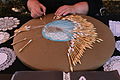
Bobbin lace in progress at the Musée des Ursulines de Québec
Early bobbin lace in gold and silver thread, c. 1570.

Bobbin lace is a lace textile made by braiding and twisting lengths of thread, which are wound on bobbins to manage them. As the work progresses, the weaving is held in place with pins set in a lace pillow, the placement of the pins usually determined by a pattern or pricking pinned on the pillow.

Bobbin lace is also known as pillow lace, because it was worked on a pillow, and bone lace, because early bobbins were made of bone[1] or ivory.

Bobbin lace is one of the two major categories of handmade laces, the other being needle lace, derived from earlier cutwork and reticella.[2]

Origin

[edit]
Fiore D'Ogni Virtu Per le Nobili Et Honeste Matrone, page 34. Isabella Parasole
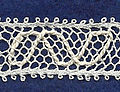
BLW Bobbin lace - detail

A will of 1493 by the Milanese Sforza family mentions lace created with twelve bobbins.[3] There are two books that represent the early known pattern descriptions for bobbin lace, Le Pompe[4] from Venice and Nüw Modelbuch[5] from Zürich. Patterns from Nüw Modelbuch can be examined with commentary, working diagrams, and completed examples to understand the styles.[6] Other popular lace pattern books were produced by Isabella Parasole, which included patterns for reticella, needle lace and bobbin lace designs. Other pattern books of this period include Cesare Vecellio[7] and Bartolomeo Danieli.[8]

Bobbin lace evolved from passementerie or braid-making in 16th-century Italy.[2] Genoa was famous for its braids, hence it is not surprising to find bobbin lace developed in the city. It traveled along with the Spanish troops through Europe.[9] Coarse passements of gold and silver-wrapped threads or colored silks gradually became finer, and later bleached linen yarn was used to make both braids and edgings.[10]

The making of bobbin lace was easier to learn than the elaborate cutwork of the 16th century, and the tools and materials for making linen bobbin lace were inexpensive. There was a ready market for bobbin lace of all qualities, and women throughout Europe soon took up the craft which earned a better income than spinning, sewing, weaving or other home-based textile arts. Bobbin lace-making was established in charity schools, almshouses, and convents.[2]

In the 17th century, the textile centers of Flanders and Normandy eclipsed Italy as the premiere sources for fine bobbin lace, but until the Industrial Revolution and the coming of mechanization hand-lacemaking continued to be practiced throughout Europe, suffering only in those periods of simplicity when lace itself fell out of fashion.[2]

Some skilled lace makers work to re-create older lace patterns based on the period portraiture and extant lace samples.[11] On paintings that have sufficient detail, entire pieces can be reconstructed by lacemakers who understand the early structural techniques and details.[12][13]

Materials

[edit]

Bobbin lace may be made with coarse or fine threads. Traditionally it was made with linen, silk, wool, or, later, cotton threads, or with precious metals. Bess of Hardwick bought red silk, gold, and silver thread for making "bone lace" in 1549, the earliest English reference to this kind of work.[14] Today bobbin lace is made with a variety of natural and synthetic fibers and with wire and other filaments.[15] Even bobbin lace made from human hair, point tresse, was once popular as a personal memento.[16]

Structure

[edit]

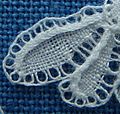
Elements of bobbin lace may include toile or toilé (clothwork), réseau (the net-like ground of continuous lace), fillings of part laces, tapes, gimp, picots, tallies, ribs and rolls. Not all styles of bobbin lace include all these elements.

Traditional types

[edit]
State portrait of Maria Theresa, which depicts her as the "first lady of Europe" in a precious dress of Brabant bobbin lace.[17] (by Martin van Meytens, c. 1752)

Many styles of lace were made in the heyday of lacemaking (approximately the 16th–18th centuries) before machine-made lace became available.

Contemporary laces

[edit]
Contemporary handmade woollen bobbin lace articles, Wool Expo, Armidale NSW. Pale green lace is made of 2 ply wool.

The advent of machine-made lace at first pushed lace-makers into more complicated designs beyond the capabilities of early machines, then simpler designs so they could compete on price, and finally pushed them out of business almost entirely.

The resurgence of lace-making is a recent phenomenon and is mostly done as a hobby. Lacemaking groups still meet in regions as varied as Devonshire, England and Orange County, California.[19] In the European towns where lace was once a major industry or popular artisanry, especially in Belgium, England, Spain (Camariñas and Almagro), Portugal (Azores, Caminha, Lagos, Nisa, Olhão, Peniche, Póvoa de Varzim, Sesimbra, Setúbal, Silves, Viana do Castelo, Vila do Conde and Viseu (Farminhão),[20] being known as Renda de Bilros),[21][22][23] France and Slovenia lacemakers still demonstrate the craft and sell their wares, though their customer base has shifted from the wealthy nobility to the curious tourist.

Still new types of lace are being developed such as the 3D Rosalibre[24] and a colored version of Milanese lace by borrowing rolls from Duchesse lace to store various shades and colors.[25] Other artists are giving grounds a major role by distorting and varying stitches, pin distances and thread sizes or colours. The variations are explored by experimentation[26][27][28] and mathematics and algorithms.[29] The lace maintaining its shape without stiffening is no longer a requirement.[26] Inspiring journals, guilds and foundations show that old techniques with a new twist can challenge young people to create works that can definitely classify as art.[30]

A Dutch design graduate in 2006 discovered bobbin lace was a technique to make a fancy fence. The first fences became museum pieces. The fences are now produced in Bangalore by concrete rebar plaiters.[31]

Tools

[edit]
prickings for various types of lace and a very fine hook
Bobbin lace maker presents bobbin lace made in Myjava (Slovakia)

The major tools to make bobbin lace are a pillow, bobbins, pins and prickings. The part laces also require a crochet hook, very fine types of lace require very fine hooks. There are different types of pillows and bobbins linked to areas, eras and type of lace.

Bobbins

[edit]

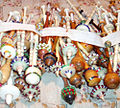
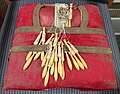
Bobbins, which are traditionally made of wood or bone, are used to hold the thread. They come in different shapes, often associated with certain types of lace. The parts of a bobbin are the neck, which is where the thread is wound, a head, where thread is hitched to keep it from coming unwound, and the shank, which is used as a handle. Bobbins from England may also have a beaded spangle at the end of the shank, which makes the bobbin heavier and helps with tensioning the thread.[32] Bobbins are usually 3 1/2 - 4 inches long, though they may be shorter or longer.[33] Bobbins are wound and used in pairs. Bobbin collection is a common aspect of the hobby for many lace makers. Within the lace community, commemorative bobbins designating annual meetings, special anniversaries, or historic events are frequently offered which become collector's items.

There are many types of bobbins, including:

  • Belgian bobbins: They have a single head and a bulbous rounding near the end of the shank that helps with tensioning threads.[34]
  • Binche bobbins: The round bulb near the end of the shank is small, making these bobbins good for fine, straight laces.
  • East Midlands bobbins: These double-headed bobbins are slender and spangled. They are also called Bucks or Midlands bobbins.[34]
  • Honiton bobbins: Honiton bobbins are straight below the single head, and the end of the shank comes to a blunt point, which helps with sewing. They may be called a lace stick.[34]
  • Square bobbins: Square bobbins have a shank with flattened sides, which makes it easier to keep them from rolling on the pillow.
  • Portuguese bobbins: The bobbin is an elongated pear-shaped wooden artefact where the thread is wrapped.
  • Bone bobbins are sometimes decorated with names, commemorative text, or other messages and patterns

Types of pillow

[edit]
"A lady sits and reads, the chambermaid comes with tea" 1775 roller pillow

The pillows must be firm, or otherwise the pins will wobble. The pillows were traditionally stuffed with straw, but nowadays polystyrene (styrofoam) is generally used.[35] Pillows were historically characteristic of the different regions where lace was made, but contemporary lacemakers may have multiples styles of pillows to accomplish different lace styles and projects.

An early type of pillow can be seen in The Lace Maker by Caspar Netscher. The pillow has a wooden frame, and is slightly sloping. The lace-maker rests it on her lap. Another representation of the similar style of pillow is found in the painting The Lacemaker by Johannes Vermeer. The Lace-Maker portrait by Gabriël Metsu was memorialized in a postage stamp.

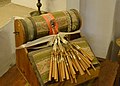
The bolster or cylindrical pillow was much cheaper to make as it is just a fabric bag stuffed with straw. It was used in Bedfordshire lace. It needs a stand as it does not have a flat bottom.[36] Usually the bolster had the pattern pinned round the cylinder, so by turning the pillow, the lace could be as long as was needed. However, Maltese lacemakers used the pillow the other way. They had a long thin pillow, which they rested against something. Then they worked the lace down the length of the pillow.[37]

This problem (of the lace needing to be longer than the pillow) is solved in a different way by the roller pillow, which has a small roller, for working the lace, set into a larger area, where the bobbins are laid. This means that the pattern can be pinned round the roller, but the pillow has a flat bottom.

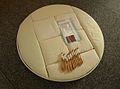
The cheapest modern pillow is domed and made of polystyrene (styrofoam). It is often called a cookie pillow, because of its shape. Another modern pillow is a block pillow, with a frame which holds covered polystyrene blocks. The blocks can be moved around as the lace progresses, to keep the lace being worked on at the centre of the pillow.

Lacemaking organizations

[edit]

Lacemaking is considered a folk art with technique and materials varying widely across the globe. Most lacemakers belong to regional guilds within their country of origin. Guilds can be devoted to one kind of lace, often that which developed locally, or may include makers of all kinds. In the United States, most guilds are organized within chapters of the International Organization of Lace, which also includes Canadian lace guilds. Quarterly publications of "The Bulletin" journal provide articles about current projects and events, historical research, annual meeting details, patterns, and more. Internationally, the Organisation Internationale de la Dentelle au Fuseau et à l'Aiguille (OIDFA, International Bobbin and Needle Lace Organization) is the primary governing and networking body for lacemakers. OIDFA organizes annual global congresses, regional fairs, and local gatherings to promote the appreciation and knowledge of lacemaking.

References

[edit]

Further reading

[edit]
[edit]
Revisions and contributorsEdit on WikipediaRead on Wikipedia
from Grokipedia
Bobbin lace is a handmade lace textile created by braiding, twisting, and plaiting lengths of thread wound onto small bobbins, which are manipulated around pins inserted into a padded pillow to follow a pricked paper pattern, resulting in intricate openwork designs. Originating in Europe during the 16th century, bobbin lace evolved from earlier braiding techniques such as passementerie and quickly became a luxury craft associated with wealth and status, particularly in Italy and Flanders. Earliest documented patterns appear in Venetian publications like Le Pompe in 1557, with visual depictions in etchings from around 1580, marking its rise as a distinct art form separate from needle lace. By the 17th century, production centers flourished in regions like Brussels, Genoa, and Normandy, where it adorned aristocratic garments, collars, and ecclesiastical vestments, driving economic activity through guilds and trade. The craft peaked as a symbol of power in Habsburg Spain and Bourbon France until the late 18th century, after which mechanization in the 19th century led to its decline for mass production, though handmade traditions persist today in places like Brazil and Malta. The technique requires specialized tools including a firm , a (a perforated on or card), numerous bobbins (often 20 to 100 pairs), fine threads like or , and pins to secure the work in progress. In the process, threads are paired on bobbins and hung over pins; a "worker" pair is twisted and crossed with "passive" pairs to form stitches like cloth stitch or half stitch, building motifs and grounds such as meshes or bars, either continuously or in non-continuous styles where sprigs are connected later. Regional variations highlight its diversity: Torchon lace from features geometric patterns, from incorporates floral motifs with picots, from emphasizes delicate scrolls, and Honiton lace from specializes in naturalistic leaves and flowers. Primarily crafted by women in home-based or settings, bobbin lace remains a labor-intensive heritage craft, valued for its precision and preserved in museum collections worldwide.

History

Origins

The origins of bobbin lace remain a subject of historical debate, with scholars unable to pinpoint a single inventor or location due to the scarcity of early records. Most evidence points to its emergence in the mid-16th century in , although some debated artifacts suggest possible earlier precursors in the late 15th century, particularly in and , where it developed simultaneously as a more efficient alternative to for creating complex geometric patterns. While is widely credited with its initial invention—likely evolving from local braiding traditions in regions like (including ) also claims early production, possibly influenced by Italian techniques or independent innovations. has been suggested as another cradle due to references to "point d'Espagne" in courtly contexts, but this appears to describe a style rather than the technique's birthplace. Bobbin lace drew heavily from earlier textile practices, including (braid-making with silks and metallic threads) and precursors like reticella cutwork, which involved drawing out threads from woven fabric to form open patterns. These methods, prevalent in 15th- and early 16th-century , provided the foundational plaiting and twisting motions adapted for bobbins, allowing multiple threads to be managed simultaneously on a for greater speed and scalability compared to needle lace's labor-intensive stitching. Pictorial evidence from 16th-century portraits supports this evolution, showing plaited trims on collars and cuffs that transition from simple braids to intricate lace-like designs, though distinguishing bobbin from needle work in paintings remains challenging without magnification. Key early milestones include the publication of the first dedicated pattern books in the 1550s and 1560s, which disseminated designs across via the . In , Le Pompe (1557), published by the Sessa brothers for Pagano, introduced geometric motifs for bobbin work, marking the technique's infancy and its ties to Italian craftsmanship. Similarly, the Nüw Modelbuch allerley Gattungen Däntelschnür (New Pattern Book of All Kinds of Bobbin Laces), published in Zurich around 1561 by Christoph Froschauer with patterns by R.M., adapted Italian influences for northern audiences, with patterns based on plaits and early grounds. These books, along with a 1561 record of Barbara Uttmann organizing bobbin lace production in Annaberg, —often mythologized as her invention—illustrate the rapid spread from southern to by the decade's end.

Development and Regional Spread

In the 17th century, bobbin lace experienced a significant boom across , driven by patronage from nobility and the establishment of specialized manufactories. King Louis XIV of , advised by finance minister , founded royal lace workshops in 1665 at Alençon and Sedan to produce high-quality points de France, encompassing both needle and bobbin laces that rivaled Venetian imports and reduced foreign expenditure. These initiatives, supported by court fashion at Versailles, spurred commercialization, with bobbin lace centers in —particularly and —emerging as major exporters of fine, intricate designs to elite markets across the continent. By the 18th and 19th centuries, the industry faced profound shifts due to the , which introduced machine-made alternatives that undercut handmade production. In , adaptations of stocking frames in during the 1770s enabled the mechanical imitation of bobbin lace, followed by John Heathcoat's 1809 bobbin-net machine, leading to and a steep decline in demand for handcrafted pieces by the mid-19th century. Despite this, bobbin lace persisted through folk traditions in rural 's , where communities in areas like and maintained skills for local and occasional export markets, preserving techniques amid economic pressures. The technique spread globally from the onward, introduced to the by European emigrants and missionaries who taught it in colonial settings, fostering small-scale industries among settlers and indigenous groups using adapted materials. Key events like the 1878 Exposition highlighted its enduring appeal, showcasing bobbin laces from Le Puy in —producing 30 to 40 million francs annually—and underscoring regional specialties amid international competition. In the , revivals occurred in and through missionary-led programs, such as schools in and that trained women in styles like Torchon and , providing economic opportunities in postcolonial contexts. Socioeconomically, bobbin lace making served as a vital home-based industry for women and children, particularly in 19th-century rural , where it supplemented agricultural incomes during downturns and offered flexible labor in the ' cottage economy. However, exacerbated among lacemakers, forcing rushed production and wage reductions, while in regions like , broader lace traditions—though often crochet-based—provided similar relief during famines, highlighting the craft's role in female empowerment amid hardship.

Materials

Threads and Fibers

Bobbin lace traditionally relied on fine threads as the primary material, valued for their durability and subtle sheen that enhanced the intricate patterns. , derived from , was the most common choice until the due to its strength and ability to hold fine weaves without fraying. Historically, and silver threads or wires were also used for opulent designs, particularly in Italian lace. threads were employed for luxury pieces, offering a luxurious luster and smoothness ideal for high-status garments and vestments. From the onward, threads gained popularity for their affordability and availability, particularly after when they began substituting for more expensive flax-based in broader production. Key characteristics of bobbin lace fibers include their fineness, measured by thread counts such as 40/2 to 100/2 for high-quality suitable for delicate work, ensuring precise interweaving without bulk. Twisting direction—either S-twist (counterclockwise) or Z-twist ()—influences the weave's orientation and thread behavior during manipulation, as the twist determines how pairs interact to form stable structures. Threads are typically worked in pairs, known as pairs, with patterns requiring anywhere from 2 pairs for simple motifs to 40 or more for complex designs, allowing for varied density and texture. In modern practice, synthetic fibers such as and have become alternatives, prized for their enhanced durability and resistance to wear in contemporary pieces that may undergo frequent handling or washing. Metallic threads, often wrapped around a core for flexibility, add decorative shimmer and are used for ornamental effects in both historical reproductions and innovative designs. Environmental considerations have driven the use of , with sustainably sourced fibers reducing chemical inputs and supporting eco-friendly lacemaking amid growing awareness of textile impacts. Thread preparation for bobbin lace involves bleaching to achieve whiteness or clarity, particularly for and , enhancing the visual purity of the final piece. evolved from natural plant-based methods to dyes introduced in the , which provided vibrant, fast colors but raised concerns over ; modern dyers often revert to safer natural options for historical accuracy. Gauging thread thickness is essential for pattern compatibility, as finer gauges (e.g., measured in wraps per centimeter) require scaled adjustments to maintain proportional motifs.

Patterns and Supporting Materials

Patterns in bobbin lace are created through a process known as , where small holes are punched into or cardstock to outline the and guide the placement of pins that direct the threads. This technique originated in 16th-century , with the earliest documented examples appearing in pattern books such as Le Pompe: Opera Nova published in in 1557 by the Sessa Brothers, which featured simple braided edgings made with four bobbins. These prickings served as templates, allowing lacemakers to interpret and execute designs without detailed instructions, relying on experience to navigate ambiguous illustrations. Bobbin lace patterns vary widely, from geometric grids characteristic of Torchon lace, which employs straightforward, coarse meshes for sturdy, inexpensive designs, to more intricate floral motifs seen in Roses Point grounds, featuring curved, petal-like structures that fill open spaces with delicate, repeating rose shapes. Torchon patterns, often used for edgings and insertions, prioritize simplicity and symmetry in their grid-based layouts, while Roses Point introduces organic curves that enhance visual flow in finer laces. The scale of these patterns is calibrated to the thread size, typically maintaining a proportional relationship where the distance between pricking holes aligns with the thread's wrapping per space—such as 8-12 wraps for Milanese or Russian styles—to ensure tension and structure. Since the 1990s, advancements in (CAD) have enabled of prickings, allowing precise scaling and reproduction of traditional patterns for contemporary lacemakers. Supporting materials play a crucial role in facilitating the process and maintaining lace integrity. is applied to coat threads, smoothing them and preventing fraying or tangling, a practice dating back to pre-mercerized eras when it was drawn across the thread to enhance workability. Temporary fillers, such as or , are inserted into open areas during to hold the emerging and support complex motifs until completion. Finishing tapes, often narrow woven strips, are integrated into tape styles to outline and connect pattern elements, providing stability in designs from regions like . The evolution of bobbin lace patterns reflects broader technological and social shifts, beginning with handmade manuscripts in the , such as the Swiss Nüw Modelbuch of 1561, which disseminated basic designs across . By the , patterns had spread from Italian centers like to and beyond, with books like Giacomo Franco's Nuova Inventione (1596) introducing more varied forms. In the , lithographic printing revolutionized distribution, enabling guilds in centers like and to produce and share standardized patterns on pricked papers, which were often prepared by specialized workers and circulated to maintain regional styles amid industrial competition.

Construction and Techniques

Fundamental Principles

Bobbin lace construction relies on the basic unit known as the stitch, which is formed by the manipulation of two pairs of bobbins—four threads in total—through fundamental motions of twisting and crossing. A twist involves rotating the two bobbins of a single pair around each other, typically in a counterclockwise direction, to adjust thread orientation and tension within the pair. A cross exchanges the inner threads between two adjacent pairs in a clockwise motion, interlocking them to build the fabric structure. These motions combine to create core stitches, such as the half stitch, executed as a cross followed by a twist on each pair for a more open weave, and the cloth stitch (also called whole stitch), which uses two such sequences (cross, twist, cross, twist), often with a pin inserted between for density. Threads are organized into pairs for , where each pair acts as a unit that interlocks with adjacent pairs via crosses to form ground fabrics, such as open meshes or connecting brides that support motifs. This pairing system ensures the threads traverse the in a directed, connected path, typically on a 45° to 60° grid defined by pin placements, allowing the lace to seamlessly without gaps or overlaps. The geometric rules governing emphasize balance, particularly in tension management: initial twists and strategic pinning resist thread pull, preventing , while the count of pairs—odd or even—influences , as even counts facilitate balanced, alternating traversals that maintain proportional shapes, whereas odd counts may introduce in closed motifs. Pairs begin tied into compact bundles called heads at the upper edge, securing the starting point and distributing initial tension evenly across the work. Key structural components enhance both aesthetics and form. Picots are decorative loops created by wrapping 4 to 6 twists around a pin between whole stitches, adding texture to edges or fillings. Gimps consist of thicker threads woven alongside standard pairs to outline motifs, providing raised contours and visual definition. Tallies are small, self-contained woven motifs, often diamond- or leaf-shaped, constructed with four threads on two pairs of bobbins that weave in a balanced sequence of twists and crosses to form compact, symmetrical units integrated into larger grounds.

Weaving and Stitching Methods

The process of creating bobbin lace begins with preparing the and threads. The lacemaker pins a pricked pattern, consisting of dots indicating pin placements, onto a firm covered in fabric, ensuring the pattern is oriented correctly for the working direction. Threads, typically or of even thickness, are then wound onto pairs of bobbins using a secure hitch, such as the "P" hitch, with sufficient length—often four times the anticipated lace length—to allow for manipulation without frequent rewinding. Work proceeds row by row, generally from left to right or outward from the center, following the pattern's progression diagonally downward, with pairs of bobbins hung at starting points and secured by initial pins. Central to bobbin lace are the fundamental manipulations of thread pairs, performed by hand without a . Twisting involves rotating two bobbins in a pair around each other one or more times to tighten and align the threads, creating closeness or decorative effects, as seen in patterns requiring multiple twists before crossings. Crossing forms the basic interconnections, where one pair passes over or under an adjacent pair to build the lace's mesh, often combined into stitches like cloth stitch (cross, twist, cross, twist) for stable fabric. Plaiting braids three or more pairs together, typically using a sequence of twists and crosses to form solid bars or structural elements that span open areas. Joining connects separate sections or edges, achieved by a worker pair into an existing passive pair using a fine needle or , or by threads at overlaps to integrate motifs seamlessly. Errors during weaving are addressed through careful reversal techniques to maintain the work's integrity. To correct mistakes, lacemakers "frog" or undo stitches by reversing the exact sequence of twists and crossings, gently untwisting bobbins and repinning as needed to avoid tangling the multiple threads. Tension adjustment is crucial throughout, achieved by jiggling bobbins to even out slack or rolling them to lengthen/shorten threads—rolling toward the body to extend or counterclockwise to shorten—ensuring uniform tightness for a flat, even lace. A small 6-inch sample typically requires 10 to 20 hours of focused work, varying with pattern density and the lacemaker's skill level. Advanced methods build on these basics to fill and shape intricate designs. Ground filling creates repeating meshes, such as the rose ground, where pairs work in a hexagonal formation using half stitches and pins at corners to form interconnected "roses" that provide a stable, open backdrop for motifs, often requiring 16 or more pairs. Leaf shaping employs strategic pin placements along curving outlines, with workers twisted and crossed to follow the contour, plaiting internal veins for texture while passives hold the form, allowing organic shapes to emerge progressively row by row.

Types of Bobbin Lace

Traditional Regional Styles

Bobbin lace traditions developed distinct regional variations across Europe, particularly in the , , and , where local materials, techniques, and cultural demands shaped unique styles from the 16th to 19th centuries. These styles often featured variations in motif density, such as fine, intricate floral patterns versus bold geometric forms, and distinctive edge finishes like picot borders for added texture. Historical uses ranged from elite fashion items like collars and veils to more utilitarian decorative pieces, reflecting the lace's adaptability in domestic and ecclesiastical contexts. Flemish bobbin lace, originating in the region encompassing modern-day , exemplifies early mastery of fine threadwork, with emerging as a prominent style in the 17th and 18th centuries. Characterized by delicate floral grounds woven separately from a fine hexagonal mesh réseau, achieved high motif density through intricate needle-and-bobbin combinations, often appliquéd onto machine net by the early for efficiency. lace, a continuous variant from the town of in the same period, featured dense snowflake motifs formed by square tallies and a translucent ground, with picot edges enhancing its straight, delicate borders for use in collars and ruffs. These Flemish styles prioritized fineness and transparency, distinguishing them through their lightweight, almost ethereal quality suited to aristocratic attire. In England, bobbin lace traditions took root in the 16th century, influenced by Flemish immigrants, leading to styles adapted to local cottage industries. Bucks Point lace, developed in the late 18th century in Buckinghamshire and Northamptonshire, showcased geometric honeycomb patterns on a double ground of hexagonal and triangular meshes, with motifs outlined in thicker threads for clarity and moderate density. This style's openwork structure and simple picot or pointed edges made it ideal for everyday collars and edgings, produced slowly by women and children in home settings. Honiton lace, from Devon since the 16th century, emphasized appliqué-style flowers with large floral sprigs joined by plaited bars over an open or net ground, achieving varied motif density through naturalistic Devon-inspired designs. Renowned for royal commissions, such as Queen Victoria's 1840 wedding dress requiring hundreds of hours, it featured scalloped or picot finishes and was used for elaborate veils and shawls. Other European regions contributed robust, geometric styles that contrasted with the finer Flemish and English varieties. Cluny lace, a 19th-century French guipure from the Le Puy area, formed continuous pieces with bold geometric motifs like radiating ears on a square mesh, offering high without separate grounds for sturdy, all-over patterns. , originating in 18th-century , is known for its delicate floral and scroll patterns outlined with cordonnet on a fine hexagonal net ground, often in black for elegance and lightness. Torchon lace, with roots in 16th-century and , produced coarse all-over patterns using simple cloth stitches and geometric designs on a loose net ground, characterized by low to moderate motif and straight or scalloped edges without picots. Its utilitarian strength made it suitable for household s and trims across multiple countries. , introduced to in the early 19th century under Genoese influence, featured raised work with rounded leaf motifs, ears, and the iconic eight-pointed cross, plaited for plump, moderate- designs in or . Often edged with purled bars, it gained popularity for collars, tablecloths, and dresses exhibited at the 1851 .

Modern and Contemporary Variations

In the 20th century, bobbin lace experienced revivals amid broader craft movements, particularly following , as artisans sought to preserve handcraft traditions against the rise of machine-made alternatives. In , a notable revival began in the early , with efforts to reintroduce traditional techniques through local workshops and guilds, emphasizing the craft's . By the mid-century, Scandinavian regions saw innovations in geometric patterns, influenced by modernist design aesthetics; for instance, Swedish lacemakers in developed fine bobbin laces with precise, angular motifs that echoed and textiles. These revivals often fused bobbin lace with other crafts, such as incorporating hooks for joining elements, creating hybrid forms that blended braiding precision with flexibility. Contemporary bobbin lace has evolved into experimental art, with makers producing abstract pieces that depart from ornamental motifs toward sculptural expressions. Finnish artists, including Tarmo Thorström, have contributed to this since the 2000s through exhibitions showcasing bobbin lace as , drawing on Nordic for large-scale, conceptual works. Innovations include the use of unconventional materials like wire for durable, metallic structures and recycled fibers—such as hand-spun produce bags—to create textured, eco-conscious pieces that challenge traditional delicacy. Digital tools have further transformed , with software like Lace8, introduced post-2010, enabling users to generate complex patterns for styles from Torchon to freeform lace via intuitive diagramming and simulation features. Beyond art, modern bobbin lace finds applications in fashion, interior decor, and therapeutic practices. In , designers like have integrated lace elements—often inspired by bobbin techniques—into garments, as seen in her 2010s collections blending intricate weaving with for ethereal silhouettes. For interiors, contemporary pieces serve as wall hangings or screens, while in therapy, the repetitive braiding process aids and skill-building in community workshops. Exhibitions such as those at ' Fashion & Lace Museum have highlighted these uses, featuring bobbin lace in sustainable and artistic contexts. Sustainability efforts have gained prominence since , with European guilds adopting eco-dyes and recycled threads to reduce environmental impact; for example, initiatives in EU-based lacemaking groups promote , plant-based colorants and upcycled synthetics, aligning the craft with green textile practices. These developments address challenges like declining traditional thread sources while expanding bobbin lace's relevance in ethical crafting.

Tools and Equipment

Bobbins and Holders

Bobbins serve as the primary tools for holding and managing threads in bobbin lace, allowing lacemakers to twist, cross, and plait multiple strands with precision. Traditional bobbins are often crafted from wood, such as fruitwoods like cherry or , and feature a cylindrical shaft with a head and tail for winding thread, typically measuring around 10 cm in length and 6 in diameter. In English styles, these bobbins are double-necked to facilitate secure thread winding and often include decorative elements like carved rings or inlays. Early bobbins, dating to the , were simple sticks made from or , reflecting the craft's origins in regions like and where lacemaking flourished. Flemish bobbins adopted a characteristic bulbous shape to balance weight and ease handling during intricate tape lace production. These wooden or designs could hold approximately 3 to 5 meters of thread per , sufficient for working pairs in traditional patterns. Over time, regional variations emerged, such as the single-necked, bulbous bobbins from Devonshire, which are plain and unspangled for fine floral motifs. Spangling enhances both the functionality and aesthetics of bobbins, particularly in traditions, where 2 to 16 glass beads or other ornaments are attached to the via wire or cord. These spangles add to prevent bobbins from rolling on the work surface, in identification of thread pairs, and distribute balance for ergonomic comfort during extended sessions, reducing hand strain. Historically, spangles served cultural purposes, with inscriptions or colorful beads symbolizing personal or communal traditions among lacemakers. In contrast, modern bobbins prioritize lightweight materials like or to minimize fatigue, offering capacities similar to traditional ones while enabling finer threads for contemporary designs. Post-2015 innovations include 3D-printed customizable bobbins, often produced in PLA plastic with adjustable shapes for personalized and reduced manufacturing costs. These evolutions trace from 16th-century rudimentary sticks to 21st-century designs that incorporate user-specific features like hollow cores for thread visibility. Holders, essential for organizing bobbins outside active , include racks or clips that accommodate 20 to 100 bobbins to prevent tangling and maintain thread integrity. Historical versions evolved into contemporary stands with magnetic mechanisms for quick attachment and removal, improving workflow efficiency. Such holders ensure even , supporting hand comfort in prolonged lacemaking sessions.

Pillows and Work Supports

Bobbin lace pillows serve as the primary work surface, providing a firm foundation for pinning patterns and supporting bobbins during the process. Traditional designs emphasize portability and stability, typically measuring 30-40 cm in diameter for smaller pieces. The most common type is the cookie pillow, a round, often domed cushion ideal for beginners and lap work, historically stuffed with straw and now frequently made from lightweight for ease of use. In contrast, the boat pillow, a rectangular variant suited for larger lace projects, offers a broader surface to accommodate extended patterns without frequent repositioning. These pillows, sometimes referred to as block pillows in modern contexts, feature adjustable blocks that can be rearranged to support continuous work on elongated designs. Both types ensure pins remain secure, preventing the delicate threads from shifting during construction. Construction of these pillows prioritizes durability and pin retention, with exteriors typically covered in velvet, linen, or polycotton fabric to grip steel pins effectively. Internally, traditional pillows are stuffed with tightly packed straw or sand for unyielding firmness, while contemporary versions use high-density foam or polystyrene cores to maintain shape under repeated use. Many include removable, washable covers to protect against thread residue and wear. Adjustable stands, often wooden or metal, allow positioning on the lap, table, or at an ergonomic height, enhancing comfort for prolonged sessions. Variations include the rolling pillow, developed in 19th-century for producing continuous lace edgings, where a cylindrical roller rotates to expose fresh pinning areas as the work progresses. Modern adaptations, emerging post-2000, incorporate portable foam pillows that are lightweight and collapsible, facilitating travel and classroom use without sacrificing stability. These innovations, such as ethafoam constructions, prioritize and for contemporary lacemakers. Historically, bobbin lace pillows evolved from 16th-century arm- or lap-supported cushions in and , where simple fabric-wrapped bolsters held early braids and trims. By the 17th century, as depicted in Flemish paintings, more structured pillows on stands became standard in . The 20th century introduced ergonomic frames and synthetic materials, transforming the tool from labor-intensive handmade assemblies to efficient, user-friendly supports that preserve the craft's precision.

Additional Accessories

Pins and needles serve as essential secondary tools in bobbin lace production, enabling secure placement of patterns and clean finishing of pieces. Fine pins, often stainless for durability or brass-headed for better visibility against light threads, are typically sized 15-20 or with diameters of 0.45mm to 0.65mm and lengths around 17-45mm to hold the work firmly on the pillow without snagging or distorting delicate fibers. Finishing , such as sharp or varieties in small sizes, are used to weave in loose thread ends and sew lace edges to fabrics or supports, ensuring a neat and durable result. Practical aids enhance workflow and thread management during creation. Beeswax pots provide conditioning for threads, reducing , tangles, and breakage by coating the fibers for smoother braiding and twisting. Small, sharp or specialized trimming tools, like 2.5-inch curved blades, allow precise cutting of excess threads without unraveling the structure. Thread uncoilers or holders prevent snarls by steadily dispensing from spools, maintaining tension in active pairs. Modern enhancements, including clip-on LED lights and adjustable magnifiers with 2x-5x lenses, improve illumination and detail visibility for fine stitches in complex patterns. Measuring devices and environmental controls support accurate scaling and material integrity. Rulers and seam gauges facilitate resizing based on thread gauge, allowing adjustments for finer or coarser yarns while preserving design proportions— for instance, scaling a by 10-20% for a thread. Humidity regulators, such as small humidifiers, maintain 40-60% relative humidity in the workspace to avoid thread drying and brittleness, which can lead to snaps during manipulation. For safety and upkeep, thimbles shield fingers from pin pricks and needle work during edge attachment, while compartmentalized storage boxes safeguard pins, , and needles from and disarray, often featuring magnetic lids or divided trays.

Communities and Preservation

Lacemaking Organizations

The International Organization of Lace, Inc. (I.O.L.I.), originally founded in 1954 as the Old Lacers , serves as a key global body dedicated to the study, preservation, and promotion of all forms of lace, including bobbin lace, with members spanning multiple countries. It organizes annual conventions that facilitate research sharing, workshops on historical techniques, and exhibitions of and contemporary lace pieces. Another prominent international entity is the Organisation Internationale de la Dentelle au Fuseau et à l'Aiguille (OIDFA), established in 1982 in to unite lacemakers from over 40 countries in preserving bobbin and traditions. OIDFA hosts biennial world congresses, such as the 21st event in in 2025, which feature demonstrations, competitions, and collaborative projects to transmit lacemaking knowledge across borders. These gatherings emphasize research into regional styles and the documentation of endangered techniques, fostering international collaboration beyond national boundaries. In , while no single centralized association exists, coordinated efforts through festivals like the International Lace Festival in Lepoglava, —held annually since 1997—bring together lacemakers from across the continent to showcase bobbin lace and related crafts. Similarly, the Idrija Lace Festival in , organized since 1953 by local guilds, promotes bobbin lace through exhibitions and competitions, drawing participants from various European nations. These events, often supported by national bodies, highlight the continent's diverse regional styles and contribute to collective preservation initiatives. Nationally, The Lace Guild in the , founded in 1976, stands as the largest organization of its kind, with a focus on advancing lace alongside other techniques through its accredited museum and library collections. It publishes the quarterly magazine, which includes articles on historical patterns, technique analyses, and member contributions, alongside Early Days in Lacemaking for beginners, thereby supporting ongoing research and skill maintenance. In the United States, the Needle and Bobbin Club, established in 1916 by Gertrude Whiting, promotes scholarly study of history and fabrication, including bobbin methods, through lectures, publications, and archival efforts. This group has historically encouraged connoisseurship and the identification of antique lace specimens. These organizations engage in vital activities such as workshops on traditional twisting and crossing methods, programs for master lacemakers, and the maintenance of archives that catalog patterns and tools. For instance, OIDFA's congresses distribute pattern books with dozens of designs contributed by global members, aiding the replication of historical bobbin lace motifs. In the U.S., I.O.L.I. supports similar archives, including digitized resources for lace identification and reproduction. Their impact extends to funding preservation projects, including the digitization of historical lace patterns to prevent loss from aging artifacts; for example, efforts by groups like The Lace Guild involve scanning rare 18th- and 19th-century bobbin lace designs for public access and study. Such initiatives, including collaborative digital catalogs in , ensure that intricate bobbin lace techniques—once at risk of fading—are safeguarded for future generations.

Education and Cultural Significance

Learning bobbin lace typically begins with accessible resources tailored for novices, such as starter kits that include essential bobbins, threads, patterns, and instructional guides. These kits, available from specialized suppliers like Snowgoose Lace and Mielke's Fiber Arts, enable self-paced practice without requiring advanced tools. Online tutorials have proliferated since the 2010s, with channels offering free, step-by-step videos on basic techniques like twisting and crossing bobbins. Channels such as Bobbin Lace Online and Lou Woo provide beginner series, including winding bobbins and simple patterns, making the craft approachable for global audiences. Formal education occurs through workshops at institutions like the Lacis Museum of Lace and Textiles in (part of the Lacis organization established in 1965), which hosts beginner classes focusing on foundational stitches and pattern reading. In , bobbin lace often symbolized female ingenuity and economic independence, particularly as a component of dowries in the , where intricately crafted pieces represented a bride's skill and family status. Regional styles, such as those from Bobowa in , incorporate local motifs like geometrized flowers and symbols from daily life, embedding cultural narratives into the fabric. Major museums preserve these traditions; the in holds an extensive collection of bobbin lace artifacts, including borders and panels from 17th-century and , highlighting its historical role in fashion and decoration. Efforts to recognize bobbin lace's intangible value include inscriptions, such as bobbin lacemaking in on the Representative List in 2018 and lacemaking in in 2009, both emphasizing community transmission of techniques. Preservation faces significant challenges, including the aging of practitioners and declining transmission of skills, as noted by the Heritage Crafts Association, which identifies bobbin lace as critically endangered due to few young entrants. In regions like , , enthusiasts warn of potential extinction without new trainees, prompting calls for revitalization. Initiatives in the 2020s, such as EU-funded Erasmus+ programs at the Idrija Lace School in , support apprenticeships and mobilities to enhance non-formal education and sustain the craft across borders. Community workshops increasingly address diversity, with programs like those in integrating immigrant participants to foster inclusive skill-sharing and cultural exchange. Bobbin lace holds therapeutic value, serving as a meditative practice that promotes mental agility and stress relief, particularly for seniors, as evidenced by practitioners who credit it with cognitive benefits. Organizations like the of Lace, Inc. (I.O.L.I.) highlight its potential as , engaging senses and fostering through repetitive motions. Economically, it sustains small-scale livelihoods in developing regions, such as in Brazil's Salvador, where bobbin lace production supports creative and women's generation via workshops and sales. In and , it contributes to local economies through and artisan markets, reinforcing community bonds.

References

Add your contribution
Related Hubs
User Avatar
No comments yet.