Hubbry Logo
Lake BledLake BledMain
Open search
Lake Bled
Community hub
Lake Bled
logo
8 pages, 0 posts
0 subscribers
Be the first to start a discussion here.
Lake Bled
Lake Bled
from Wikipedia

Lake Bled (Slovene: Blejsko jezero) is a lake in the Julian Alps of the Upper Carniolan region of northwestern Slovenia, where it adjoins the town of Bled. The area is a tourist destination. The lake is 35 km (22 mi) from Ljubljana International Airport and 55 km (34 mi) from the capital city, Ljubljana. Lake Bled is 4.2 km (2.6 mi) from the Lesce–Bled train station.

Key Information

Geography and history

[edit]

The lake is of mixed glacial and tectonic origin. It is 2,120 m (6,960 ft) long and 1,380 m (4,530 ft) wide, with a maximum depth of 29.5 m (97 ft), and it has a small island. The lake lies in a picturesque environment, surrounded by mountains and forests.[citation needed]

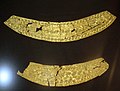
Lake Bled was an important cult centre during the Bronze Age. Gold appliqués dating from the 13th-12th century BC were found in a deposit by the lake shore. The embossed decorations on the appliqués are thought to represent the solar and lunar years. Similar appliqués have been discovered in Switzerland, Bavaria and Hungary, mainly in Bronze Age fortified settlements and in the graves of wealthy women.[1]

Medieval Bled Castle stands above the lake on the north shore and has a museum.[2] The Zaka Valley lies at the west end of the lake.

The World Rowing Championships were held at Lake Bled in 1966, 1979, 1989, and 2011.[3][4][5][6]

For centuries, Europeans have flocked to the shores of Lake Bled to enjoy recreation, but also the medicinal benefits. Emperor Henry II, ruler of the Holy Roman Empire, enjoyed the lake so much that he built Bled Castle in 1004 to confer it as an estate. Today the castle is a popular tourist attraction.[7]

Bled Island

[edit]
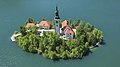
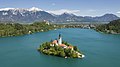
Sunrise at Lake Bled. The church on Bled Island has a 52-meter (171 ft) tower.

The lake surrounds Bled Island (Blejski otok). The island has several buildings, the main one being the pilgrimage church dedicated to the Assumption of Mary (Cerkev Marijinega vnebovzetja), built in its current form near the end of the 17th century. It is decorated with remains of Gothic frescos from around 1470 in the chancel, and with rich Baroque furnishing.[8]

The church has a 52 m (171 ft) tower and there is a Baroque stairway dating from 1655 with 99 stone steps leading up to the building. The church is frequently visited and weddings are held there regularly. Traditionally it is considered good luck for the groom to carry his bride up the steps on the day of their wedding before ringing the bell and making a wish inside the church.[citation needed]

A modern pletna shows tourists around the lake.

The traditional transportation to Bled Island is a wooden boat known as a pletna.[9] The word pletna is a borrowing from Bavarian German Plätten 'flat-bottomed boat'.[10] Some sources claim the pletna was used in Lake Bled as early as AD 1150, but most historians date the first boats to AD 1590.[11]

Similar in shape to Italian gondolas, a pletna seats 20 passengers. Modern boats are still made by hand and are recognizable by their colorful awnings. Pletna oarsman employ the stehruder (standing rowing) technique to propel and navigate boats across the lake using two oars. The role of the oarsman dates back to 1740, when Maria Theresa of Austria granted 22 local families exclusive rights to ferry religious pilgrims across Lake Bled to worship on Bled Island.[12] The profession is still restricted. Many modern oarsmen descend directly from the original 22 families.[13]

Gastronomy

[edit]

The area's culinary specialty, a cream pastry (kremna rezina or kremšnita 'Cremeschnitte'), was designated a protected dish of designated origin in 2016 by the Slovene government.[14] Slovene cream pastries date back to the Habsburg era.[15] The current "official" recipe was created in 1953 by Ištvan Lukačević, the former manager of the Hotel Park's patisserie.[16]

There is an annual festival dedicated to the pastry. It is estimated that 12 million cream pastries have been prepared at the Hotel Park's patisserie over the last 60 years.[17]

[edit]

See also

[edit]

References

[edit]
[edit]
Revisions and contributorsEdit on WikipediaRead on Wikipedia
from Grokipedia
Lake Bled (Slovene: Blejsko jezero) is a picturesque in the Upper Carniolan region of northwestern , at the foot of the , adjoining the town of . Measuring 2,120 meters in length, 1,380 meters in width, with a surface area of 144 hectares and a maximum depth of 30.6 meters, the lake sits at an altitude of 475 meters above sea level at coordinates 46.368803° N, 14.113975° E. Its waters are fed by thermal springs on the eastern shore that maintain temperatures above 20°C, with the lake warming to a maximum of 26°C annually and supporting 19 fish species, including , sheatfish, and , along with diverse aquatic plants, ducks, and swans. Geologically, the lake occupies a tectonic basin formed approximately 14,000 years ago by from the Bohinj glacier during the last . The 6-kilometer perimeter offers opportunities for walking, swimming, diving, and water sports, with summer surface temperatures up to 25°C and occasional winter freezing in extreme cold. The lake features the central Bled Island, accessible by traditional pletna rowboats and hosting the Church of the Assumption of Mary, and perched on a cliff 130 meters above the lake. Human presence in the Bled area dates back to the , with Slavic settlement beginning in the 7th century and further waves in the 9th and 10th centuries, evolving into a prominent tourist destination known for its alpine scenery, thermal waters utilized in local hotels since the , and cultural heritage.

Geography

Location and Dimensions

Lake Bled is situated in the of northwestern , near the border with , at geographic coordinates 46°22′N 14°06′E and an elevation of 475 meters above . This positioning places it within the region, approximately 55 km northwest of the capital city and 35 km from Ljubljana Jože Pučnik Airport, making it readily accessible for visitors. The lake is bordered by forested hills and prominent alpine peaks, including Mount Triglav, Slovenia's highest point at 2,864 meters, located to the west within . The lake's dimensions reflect its compact yet picturesque form, with a length of 2.12 km, a maximum width of 1.38 km, a surface area of 1.44 km², a maximum depth of 30.6 m, and an average depth of 17.5 m. These measurements highlight its status as a subalpine , shaped primarily by ancient processes that carved its basin. The town of , with a of around 5,000 residents, nestles along its northern shore, serving as the primary settlement and hub for local activities. Lake Bled is primarily fed by several thermal springs along its eastern shore and small surface inflows such as the Mišca Stream, contributing to its clear, mineral-rich waters. The outflow occurs via the Jezernica Stream, which drains into the Bohinjka, maintaining a balanced hydrological cycle despite the lake's enclosed alpine setting.

Climate and Hydrology

Lake Bled is characterized by a (Köppen Dfb) with warm summers and cold winters, shaped by its position in the . The average high temperature in reaches 25°C, while the average low in January falls to -5°C. Annual averages approximately 800 mm, distributed fairly evenly throughout the year with peaks in late summer and autumn. Seasonal variations in lake water reflect the regional , with surface temperatures peaking at around 26°C during summer months and approaching 0°C in winter. cover forms occasionally from January to February under prolonged cold spells, creating opportunities for traditional winter activities like and walking across the frozen surface. The lake's is driven by a balance of inflows and outflows, primarily sustained by several thermal springs along the eastern shore that collectively discharge about 0.06–0.09 m³/s (60–90 L/s) of mineral-rich water at temperatures of 19–23°C, supplemented by from surrounding slopes and seepage. The main outflow occurs via the Jezernica Stream at the lake's eastern end, with an average discharge of 8.34 m³/s, helping regulate volume. Connections to the underlying contribute to remarkably stable water levels year-round, with minimal fluctuations despite seasonal precipitation changes. Water quality in Lake Bled remains oligotrophic, featuring low concentrations that limit algal growth and preserve ecological balance. The typically ranges from 7.5 to 8.0, reflecting the influence of geology and thermal inputs. This clarity enables visibility depths of up to 20 m, enhancing the lake's renowned appearance and supporting its role in the local .

Geology and Formation

Glacial Origins

Lake Bled's basin originated during the late Pleistocene Würm glaciation, approximately 14,000 to 15,000 years ago, as retreating glaciers carved and shaped the surrounding landscape in northwestern Slovenia. The primary agent of this formation was the Bohinj Glacier, which advanced from the Julian Alps as part of larger ice flows during the Last Glacial Maximum around 20,000 years ago. This glacier, merging with others to form the Sava Glacier near Bled, excavated a pre-existing tectonic depression, deepening the valley floor by up to 30 meters through abrasive erosion and plucking of bedrock. As the climate warmed at the onset of the Holocene, the glacier's retreat left behind a series of terminal and lateral moraines that acted as natural dams, impounding meltwater and local springs to create the lake. The glacial mechanics involved the Bohinj Glacier's immense weight and basal sliding, which sculpted U-shaped valleys characteristic of alpine glaciation, with ice flowing predominantly from the northwest toward the southeast. Deposited moraines, composed of unsorted including boulders, , and finer sediments, formed barriers at the basin's eastern end, preventing drainage into the Sava River and allowing rapid infilling by proglacial meltwater laden with suspended clay and silt. This damming process was crucial, as the moraines' arcuate ridges enclosed the depression, transforming it into a closed basin filled primarily by glacial melt and karstic springs rather than direct river inflow. Post-glacial melting accelerated around 14,500 years ago during the Bølling-Allerød interstadial, marking the lake's initial establishment. Geological evidence supporting this glacial origin includes sediment cores from the lake bottom, which reveal basal layers of fine-grained clay and derived from and deposition, overlain by laminated varves indicative of post-glacial . These cores, spanning the , document the transition from coarse glacial inputs to finer organic-rich deposits, confirming the basin's rapid filling shortly after . Surrounding landforms further corroborate the ice flow direction: prominent U-shaped valleys, such as those leading from the , and scattered glacial erratics—large boulders transported and dropped by the ice—dot the terrain northwest of the lake, while terminal moraines form visible arcs east of , with multiple recession stages evident in their stepped morphology. Over the subsequent 10,000 years, the basin underwent refinement through ongoing erosion by wave action and fluvial processes, alongside minor isostatic rebound associated with broader Alpine , which contributed to the lake's current depth profile averaging 17.5 meters with a maximum of 30.6 meters. These post-glacial adjustments stabilized the shoreline and deepened localized areas, while tectonic influences subtly modified the structure without overriding the dominant glacial imprint.

Tectonic Influences

Lake Bled is situated in the eastern , a region positioned at the between the Adriatic microplate and the Eurasian plate, where ongoing compression associated with the broader Africa-Eurasia plate convergence drives tectonic activity. This convergence, part of the , has resulted in the uplift of the through faulting and folding, with current vertical uplift rates estimated at 1–1.5 mm per year based on micro-displacement monitoring in local caves. Historically, the compression has contributed to the overall elevation of the , though rates have varied over geological time scales due to phases of orogenic shortening. The lake's basin originated as a tectonic depression within the Mesozoic Bled Basin, a deep-water sedimentary feature that developed from the Middle Triassic to Early Cretaceous as part of the Tethyan rifting and subsequent passive margin evolution. This ancient basin, preserved in the eastern Southern Alps, underwent significant modification during the Miocene due to compressional tectonics, forming the structural low that later hosted glacial activity; the depression's formation is tied to extensional faulting followed by inversion during Alpine convergence around 15 million years ago. The nearby Sava Fault, a major dextral strike-slip structure within the Periadriatic Fault System, lies approximately 20 km southeast of the lake and influences regional seismicity, with minor earthquakes below magnitude 4.0 being common in the Julian Alps, as evidenced by sedimentary records in Lake Bled documenting historical events. Bled Island consists of resistant Triassic limestone and dolomite bedrock rising above the lake surface, contrasting with the surrounding subsided sediments excavated by Pleistocene glaciation. This structure highlights differential uplift amid basin , preserving the island as a remnant of the pre-glacial . In the modern context, the predominance of rocks in the region fosters development, including sinkholes and enhanced , which facilitate the circulation of deep waters emerging as springs around the lake with temperatures of 19–23 °C; these springs result from -driven recharge without significant volcanic influence.

History

Prehistoric and Medieval Periods

The region surrounding Lake Bled exhibits evidence of human activity dating back to the , with notable archaeological discoveries including gold appliqués from the 13th–12th centuries BC unearthed near the lake shore, representing some of the earliest metal artifacts in . During the within the 1st millennium BCE, the broader area, encompassing Bled, was influenced by Illyrian and Celtic tribes, such as the Norici and , who established settlements and engaged in trade across the Alpine region. The arrival of Slavic peoples marked the first significant permanent settlement in the basin during the 7th century AD, as evidenced by like earrings typical of early Slavic . Subsequent waves of in the 9th and 10th centuries occurred under Frankish rule, following the incorporation of the Slavic principality of into the Frankish Empire around 788 AD, which facilitated further settlement and . The local economy during these early periods relied primarily on in the lake and in the fertile basin, supporting small-scale communities adapted to the alpine environment. The first written record of Lake Bled dates to 1004 AD, when Henry II granted the estate, including the site of , to Bishop Albuin of as a reward for ecclesiastical support. The castle, initially a Romanesque structure, evolved into a fortified residence and was formally mentioned in a 1011 donation deed. From the 11th to the 15th centuries, the area fell under Habsburg control after their acquisition of in 1278, during which the castle primarily served as a defensive fortress overseeing the strategic passes. Religious development centered on Bled Island, where the first brick church dedicated to the was consecrated in 1142 by Pellegrino of Aquileia; the Church of the was rebuilt in Gothic style during the 15th century and consecrated in 1465 by Bishop Žiga Lamberg of . A notable feature is the "wishing bell," cast in 1534 by Patavinus in and installed in the church's tower, which became central to local legends promising to grant wishes to those who ring it thrice with faith. By the 16th century, the site had emerged as a destination, drawing devotees to the island's sacred traditions; the church underwent further reconstruction in the 17th century following damage, adopting its current elements.

Modern Development and Tourism

In the 19th century, Lake Bled emerged as a sought-after retreat for , drawn by its salubrious and springs, which were believed to offer therapeutic benefits. Nobles constructed elegant villas along the lakeshore starting in the early 1800s, transforming the area from a secluded site into an exclusive summer destination for the . This period marked the inception of organized , with the first accommodations, including bathhouses, established to cater to health-seeking visitors from and beyond. The opening of a railway line connecting Bled to and in dramatically enhanced accessibility, propelling growth and solidifying the site's status as a premier resort. During the interwar years under the Kingdom of , Bled flourished as a cosmopolitan destination and the official summer residence of the Karađorđević , with luxury hotels like the Grand Hotel Toplice—opened in 1931—drawing international guests for its direct thermal spring access and lakeside elegance. Post-World II, under President , the area saw further infrastructure expansion, including the completion of Vila Bled in 1947 as a state guesthouse, which hosted dignitaries and promoted health through spa facilities and wellness programs. The to 1980s represented a peak for Bled's , as 's state-supported initiatives emphasized natural therapies, attracting thousands annually for treatments combining the lake's mild climate with Rikli-inspired light and air cures. Following Slovenia's independence in 1991 and its accession in 2004, visitor numbers surged, reaching approximately 481,000 arrivals and over 1.15 million overnight stays annually by the late , driven by enhanced and improved regional connectivity. This boom, however, precipitated challenges from the onward, prompting local authorities to implement restrictions such as limits on motorized boats, prohibitions on hydrofoils and kitesurfing since , and caps on access to preserve the lake's tranquility and . A longstanding element of Bled's infrastructure, the traditional pletna boats—flat-bottomed wooden vessels rowed by local families—trace their origins to the 18th century, when Habsburg Empress granted exclusive ferrying rights to villagers; these have been modernized while retaining their cultural significance for island transport.

Key Landmarks

Bled Island

Bled Island, known as Blejski otok, is Slovenia's only natural island, a small tear-shaped landmass of approximately 0.008 km² composed primarily of , rising about 18 meters above the lake's surface and covered in dense trees and shrubs. Positioned in the western part of Lake Bled, it forms a central natural and cultural feature amid the surrounding landscape. The island's key structure is the Church of the Assumption of Mary, a edifice completed in 1698 following renovations after a 1622 that damaged the earlier Gothic version from the 15th century. Access to the church requires ascending a monumental southern stone of 99 steps, constructed in 1655 from local conglomerate rock, symbolizing a path. Within the church, the wishing bell, installed in 1534, holds legendary significance: according to , ringing it three times fulfills wishes, particularly for , stemming from the tale of a young widow named Poliksena who donated it after her husband's death to honor his memory and seek solace. Historically, the island served as a prehistoric site dating back to the , with archaeological evidence of Illyrian and Roman worship, including the only known cult object from that era in the region, possibly a temple dedicated to a goddess of fertility. In the medieval period, it functioned as a hermitage and destination, with the first brick church consecrated in 1142 by the Aquileia , later evolving into a Christian site replacing pagan practices. Visitors reach the island exclusively by pletna boats, traditional handcrafted wooden vessels rowed standing by skilled pletnar oarsmen, with capacities ranging from 14 to 28 passengers and round-trip fares around €20 per adult (as of 2025). Island traditions include annual events such as arts and crafts fairs featuring local Slovenian artisans, held weekends from spring to autumn, enhancing its cultural vibrancy. Local myths portray the island as a "fairy hill" created by angered fairies flooding a valley, and in another tale, a dragon's defeat shaped the landscape, underscoring its mystical allure.

Bled Castle

, perched on a steep cliff rising 130 meters above Lake Bled, is Slovenia's oldest castle, first mentioned in written records in 1011 when Emperor Henry II granted it to Bishop Albuin of as a . The fortress features a Romanesque entrance tower from its early medieval origins, a Gothic constructed in the 16th century in the upper , and Renaissance-style buildings including arcaded courtyards that reflect later expansions. Its strategic position provided defensive advantages and panoramic vistas of the lake and surrounding , inspiring poet France Prešeren's descriptions of the site as a "paradise on ." The castle's architecture evolved through centuries of ownership under the Bishops of and later Habsburg nobility, with 11th-century fortifications strengthened by additional towers and walls during the . In the , under Habsburg rule, significant expansions included the Gothic chapel dedicated to Saints Albuin and Ingenuin, which was later renovated around 1700 with illusionist frescoes and an ornate altar. The saw further adaptations for residential use by noble families, while post-World War II deterioration prompted a major restoration starting in 1952 under architect Anton Bitenc, preserving its medieval core while adapting it for public access. Since 1951, the castle has functioned as a state-managed provincial , showcasing Bled's heritage through archaeological artifacts, historical developments from prehistoric settlements to the spa era, and traditional crafts like a 6th-century peacock . The museum spans multiple exhibit rooms with interactive displays, including prehistoric finds such as Late gold ornaments and a 10,000-year-old skeleton, alongside models and films illustrating medieval and regional evolution. Highlights include the Castle Printing Works, featuring a reconstructed 16th-century Gutenberg-style wooden press—the oldest such demonstration site in —where visitors can observe hand-printing on handmade paper and create personalized certificates. The castle's wine cellar offers tastings of Slovenian varietals from various regions, paired with demonstrations of traditional bottling and sealing techniques in a historic setting. Access to the castle involves a steep path from Lake Bled, taking about 15-20 minutes on foot, with the site open year-round from 8:00 AM to 8:00 PM April through October and until 6:00 PM November through March. Entry fees are €18 for adults, €11.50 for students, €7 for children, and €15 for seniors and people with disabilities, granting access to the , printing works, , and viewpoints offering unobstructed lake panoramas.

Ecology and Environment

Flora and Fauna

Lake Bled's mesotrophic waters support a diverse , hosting 18 fish species including (Salmo trutta), (Perca fluviatilis), pike (Esox lucius), (Cyprinus carpio), and (Squalius cephalus). These clear, nutrient-poor conditions favor cold-water species like , which exhibit a lake-adapted in the area. Amphibians, such as the (Ichthyosaura alpestris), inhabit the lake's shoreline and adjacent wetlands, thriving in the cool, alpine environment. Active management has helped maintain native fish populations without significant establishment. The surrounding terrestrial habitats feature extensive mixed forests dominated by beech (), silver fir (), and Norway spruce (), characteristic of the ' subalpine zones. These woodlands, interspersed with meadows rich in wildflowers like orchids (Orchidaceae) and gentians (Gentiana spp.), provide vital foraging and breeding grounds. The region supports around 225 bird species, including greylag geese (Anser anser) that frequent the lake and common kingfishers (Alcedo atthis) along its shores. Bled Island's fertile humus soil fosters a unique microhabitat with dense vegetation, including deciduous trees and climbing plants that shelter small mammals like dormice (Gliridae). The island and nearby karst-influenced wetlands form part of the network, safeguarding these habitats for endemic and migratory species. Seasonal dynamics enhance the : white water lilies (Nymphaea alba) bloom vibrantly from June to September, creating floating carpets on the lake surface, while winter attracts migratory birds drawn to the relatively mild alpine setting.

Conservation and Sustainability

Lake Bled faces significant environmental challenges due to its popularity as a tourist destination, including historical from nutrient runoff and contemporary pressures from . In the , the lake experienced severe anthropogenic , primarily driven by nutrient inputs from and agricultural sources, leading to increased algal growth and degraded . By the late , these issues had intensified, with sediment records showing elevated levels in northwestern and eastern areas from local inflows. exacerbates these problems, with approximately 481,000 tourist arrivals recorded in Bled Municipality in 2024 alone, contributing to along shorelines, increased generation, and strain on local ecosystems. To address these challenges, has implemented comprehensive initiatives, earning the Gold label from the Green Scheme of n Tourism since 2018, which recognizes efforts in , , and community involvement. Key measures include strict boating regulations that permit only non-motorized, fuel-free watercraft such as rowboats and traditional pletnas to minimize water disturbance and . In line with the EU's 2019 directive on single-use plastics, banned items like , straws, and plates starting in 2021, with promoting compliance through waste segregation and refill stations to reduce in the lake area. Additionally, achieved Zero Waste Europe certification in the early 2020s as the first European town to do so, focusing on waste reduction, recycling, and public awareness campaigns. Targeted projects further support conservation, such as the 2021 Limnos initiative to improve the lake's ecological status through modeling assessments of potential interventions, including enhancements to macrophyte communities to bolster and resilience. measures, introduced in summers from 2024 onward, include timed access restrictions and free shuttle services to central parking areas, aiming to limit vehicle congestion and emissions around the lake. These efforts align with broader EU-funded strategies for , though specific restorations at remain integrated into national green tourism frameworks. Outcomes of these initiatives include stabilized and ongoing improvements, with ecological modeling indicating potential for better nutrient control and reduced risks through . Bled's recognition as a UN Best Tourism Village in 2025 underscores its progress in balancing visitor growth with environmental protection.

Tourism and Recreation

Outdoor Activities

Lake Bled offers a variety of water-based activities, particularly during the warmer months. Swimming is popular along the lakeside beaches, where the water temperature typically reaches 20–24°C in summer, providing comfortable conditions for bathing. Rowboats and pedalos are available for rent at around €15–20 per hour, allowing visitors to explore the lake independently. Traditional pletna boats, rowed by local pletnar operators, ferry passengers to Bled Island for approximately €18 round-trip per person. In winter, when the lake freezes over—typically in colder years—ice skating becomes a highlight, with the frozen surface serving as a natural rink, though artificial rinks are also available nearby for reliability. Hiking trails encircle and ascend from the lake, catering to different fitness levels. The flat 6 km lakeside path can be completed in about 2 hours, offering panoramic views of the water and surrounding . For elevated perspectives, the Ojstrica viewpoint trail is a 3 km loop taking roughly 1.5 hours, with a moderate ascent reaching approximately 150 m to a height of 650 m above . Nearby, the features a 1.6 km through a dramatic canyon, accessible in about 1–2 hours and located just 4 km from . Adventure sports add thrill to visits, often launching from nearby hills. Tandem flights from Straža Hill, suitable for beginners, cost around €130 and provide aerial views of the lake lasting 15–20 minutes. Cycling routes include a scenic 20 km loop through surrounding villages and forests, with bike rentals widely available. The run at Straža, a 520 m track descending the hill, operates seasonally and offers speeds up to 40 km/h for €13 per ride including the . Most activities are , with flat paths and short durations accommodating children and beginners; e-bike rentals enhance accessibility for varied fitness levels at €40–60 per day (as of 2025). and water pursuits peak from May to , while winter options like and nearby at Vogel (15 km away) extend the season.

Cultural and Seasonal Events

Lake Bled's is enriched by longstanding s, particularly those associated with its iconic pletna boats, which are rowed by skilled pletnar oarsmen. The craft of building and operating these traditional wooden flat-bottom boats, dating back to the , has been recognized as part of Slovenia's since 2019, preserving a unique mode of transport that ferries visitors to Island while honoring local craftsmanship passed down through generations. The pletnar emphasizes sustainable practices, with each boat handcrafted by a dwindling number of master builders in , ensuring the vessels' authenticity and . A cherished custom tied to the Church of the Assumption on Bled Island involves ceremonies where the groom carries the bride up the 99 stone steps to the church, followed by the couple ringing the Wishing Bell three times to invoke good fortune and fulfill wishes, a practice rooted in local legend and papal decree. This ritual, symbolizing devotion and community blessings, draws couples from around the world to the island's historic site, blending romance with Bled's spiritual heritage. The area hosts vibrant festivals that celebrate its artistic and seasonal spirit. Festival Bled, held annually in early July (e.g., July 1–11 in 2025), features a program of and performances, including classical, , and crossover concerts held lakeside, attracting international artists and audiences to venues like the Festival Hall. In winter, Advent on the Lake transforms the promenade into a festive wonderland from late November through early January (November 28, 2025–January 4, 2026), with thousands of twinkling lights, ice sculptures illuminating local legends, and weekly candle lightings accompanied by live performances. The accompanying offers handmade crafts and seasonal gatherings, enhancing the holiday atmosphere against the backdrop of . Cultural sites further highlight Bled's heritage, such as the thermal baths at Grand Hotel Toplice, established in 1854 on the site of hot springs discovered in , where visitors can experience natural spring water at a constant 22°C in a pool fed directly from the source, continuing a centuries-old spa tradition. Nearby , a short distance from , offers dramatic landscapes that contribute to the region's cultural and . Seasonal events emphasize Bled's connection to and community. Summer brings regattas on the lake, such as the annual I Feel Slovenia Bled International Regatta, held June 13–15 in 2025, where elite and junior rowers compete over 2000-meter courses amid the alpine scenery, fostering international sportsmanship. In spring, under green tourism initiatives, opportunities abound as migratory species return to , with guided tours promoting eco-friendly observation of the area's diverse avian life during the awakening season.

Gastronomy

Signature Desserts

The signature dessert of Lake Bled is the kremna rezina, also known as Blejska kremšnita or Bled cream cake, a layered that has become synonymous with the region's culinary identity. Invented in 1953 by chef Ištvan Lukačević, originally from , at the Park Hotel, it draws from traditional recipes but was adapted with a lighter filling to suit local tastes. The cake consists of thin layers of crispy sandwiching a rich combination of custard and , dusted with for a delicate finish. The original recipe emphasizes simplicity and quality ingredients, using 500 grams of for the base and top layers, baked to a golden crisp. The filling is prepared with 1.6 liters of whole , nine eggs, and 400 grams of , creating a voluminous 1-liter that forms two-thirds of the cake's interior, blended with one-third for texture. This precise formulation ensures the cake's signature lightness, with each slice cut to exact 7 cm cube dimensions. Kremna rezina has protected status as a traditional speciality from the Slovenian government, restricting authentic production to licensed patisseries in to preserve its traditional character. Traditionally, kremna rezina is served fresh daily at the Park Hotel's café, where it remains a focal point for visitors seeking the genuine experience; variations are kept minimal to maintain authenticity, avoiding additions like or that could alter its classic profile. Thousands of slices are consumed each day during peak tourist season, underscoring its enduring popularity. An annual Kremšnita Festival celebrates the dessert, drawing culinary enthusiasts to Bled for tastings and demonstrations that highlight its role in local heritage. Typically priced at around €4–6 per slice (as of 2024), it embodies Slovenian hospitality as a welcoming treat for travelers. Travel writer has described it as "reason enough to visit Bled," cementing its status as a that draws visitors to the lake's shores.

Regional Specialties

The regional specialties of the Lake Bled area emphasize hearty alpine , drawing on fresh lake-sourced fish, locally foraged or farmed ingredients, and traditional preparations influenced by the surrounding Gorenjska region. A cornerstone dish is grilled or smoked , caught directly from the pristine waters of Lake Bled, often served simply with and to highlight its delicate flavor. , rolled dough parcels boiled or baked with savory fillings such as , walnuts, or wild mushrooms, represent a versatile staple that can accompany main courses or stand alone as a comforting side. Savory variants of , the iconic rolled pastry typically associated with festive occasions, incorporate fillings like or cheese, offering a lighter, herb-infused alternative to sweeter versions. Dining experiences around Lake Bled often center on lakeside venues and nearby farms that showcase these ingredients. Oštarija Peglez'n, a popular restaurant perched along the lake's edge, specializes in game meats such as and , grilled to perfection alongside local sausages and fresh preparations. Just 1 km from the lake, Mulej Farm provides options featuring homemade cheeses from their dairy herd and herb-infused dishes grown in their organic gardens, allowing visitors to sample authentic rural fare. Culinary influences in the Bled area trace back to the Austro-Hungarian era, particularly evident in kranjska klobasa, a protected Slovenian sausage made from seasoned with and smoked, originating from the historic province that encompassed Gorenjska. Seasonal variations enhance this tradition: summer menus incorporate wild berries foraged from nearby forests into sauces or sides, while winter offerings feature stews for warmth against the alpine chill. These dishes are frequently paired with wines from the Goriška Brda region, such as rebula or , with bottles typically priced around €20, complementing the robust flavors without overpowering them. Sustainability is integral to Bled's , aligned with the Green label awarded to establishments prioritizing organic and local sourcing to minimize environmental impact. This green tourism initiative, for which Bled holds a gold certification (as of 2021), ensures that ingredients like and farm cheeses support regional and reduce carbon footprints through short supply chains. As a result, average meal costs at these venues range from €15 to €25 (as of 2024), making accessible the emphasis on ethical, high-quality alpine fare.

References

Add your contribution
Related Hubs
User Avatar
No comments yet.