


Community hub
Recent from talks
Contribute something
Nothing was collected or created yet.
Remscheid
View on Wikipedia

Key Information


Remscheid (German pronunciation: [ˈʁɛmʃaɪt] ⓘ) is a city in North Rhine-Westphalia, Germany. It is, after Wuppertal and Solingen, the third-largest municipality in Bergisches Land, being located on the northern edge of the region, on the south side of the Ruhr area.
Remscheid had around 109,000 inhabitants in 2015. At the end of 2019 it had 113,703 inhabitants. A variety of the Limburgish language, known locally as Remscheder Platt is spoken in the city through all generations.
Geography
[edit]Remscheid comprises four boroughs, Alt-Remscheid, Remscheid-Süd, Lennep, and Lüttringhausen.
Its highest point is the Brodtberg (378 m).
History
[edit]Remscheid was founded in the 12th century, but remained a small village until the 19th century. Early spellings for the city included Remissgeid (1217), Rymscheyd (1351), Reymscheyd (1487) and Rembscheid (1639). The economic growth of the entire Rhine-Ruhr region led to an increase of the population of Remscheid. Mechanical engineering and toolmaking were the main industries practised within the town. This is carried on today with the Hazet tool company which has three factories in Remscheid. Remscheid was part of the Prussian Rhine Province from 1822 to 1945.
On 31 July 1943, during World War II, Remscheid was almost completely destroyed during a British bombing raid which caused a firestorm. This bombing raid was the final operation of RAF's Battle of the Ruhr involving 273 aircraft. Today around one third of the city consists of buildings from before World War II.[2] During 14 and 15 April 1945, Remscheid was captured by the 78th Infantry Division (United States).[3][4]
An A-10 Thunderbolt II crashed in the city on 8 December 1988. Six people died.
Demographics
[edit]As of 31 December 2019, the city's population was 113,703, of which 92,726 (81.6%) were German citizens and 20,977 (18.4%) were non-Germans (Ausländer); of the non-German population, the top 10 nationalities represented were as follows:[5]
| Rank | Nationality | Population (31.12.2019) |
|---|---|---|
| 1 |  Turkey Turkey |
5,749 |
| 2 |  Italy Italy |
3,158 |
| 3 |  Syria Syria |
1,264 |
| 4 |  Poland Poland |
1,187 |
| 5 |  Bulgaria Bulgaria |
1,039 |
| 6 |  Spain Spain |
866 |
| 7 |  North Macedonia North Macedonia |
748 |
| 8 |  Croatia Croatia |
646 |
| 9 |  Serbia Serbia |
583 |
| 10 |  Portugal Portugal |
493 |
Politics
[edit]Mayor
[edit]The current mayor of Remscheid is Burkhard Mast-Weisz of the Social Democratic Party (SPD), elected in 2014 and re-elected in 2020. The most recent mayoral election was held on 13 September 2020, and the results were as follows:
| Candidate | Party | Votes | % | |
|---|---|---|---|---|
| Burkhard Mast-Weisz | Social Democratic Party | 22,431 | 60.6 | |
| Heidemarie Alexa Bell | Christian Democratic Union | 9,710 | 26.2 | |
| Peter Keck | Pro Remscheid | 1,908 | 5.2 | |
| Fritz Beinersdorf | The Left | 1,309 | 3.5 | |
| Roland Kirchner | W.i.R. Remscheid | 877 | 2.4 | |
| Bettina Stamm | Real Remscheid | 775 | 2.1 | |
| Valid votes | 37,010 | 98.5 | ||
| Invalid votes | 548 | 1.5 | ||
| Total | 37,558 | 100.0 | ||
| Electorate/voter turnout | 85,783 | 43.8 | ||
| Source: State Returning Officer | ||||
City council
[edit]
The Remscheid city council governs the city alongside the mayor. The most recent city council election was held on 13 September 2020, and the results were as follows:
| Party | Votes | % | +/− | Seats | +/− | |
|---|---|---|---|---|---|---|
| Social Democratic Party (SPD) | 12,718 | 34.5 |  0.3 0.3
|
20 | 1
| |
| Christian Democratic Union (CDU) | 11,036 | 29.9 | 7.3
|
17 | 3
| |
| Alliance 90/The Greens (Grüne) | 5,409 | 14.7 |  6.3 6.3
|
9 | 5
| |
| Free Democratic Party (FDP) | 1,945 | 5.3 | 0.6
|
3 | 1
| |
| Pro Remscheid (PRO) | 1,870 | 5.1 | 0.7
|
3 | 1
| |
| The Left (Die Linke) | 1,700 | 4.6 | 1.4
|
3 | ±0 | |
| W.i.R. Remscheid (WIR) | 1,092 | 3.0 | 1.5
|
2 | ±0 | |
| Real Remscheid (Echt) | 788 | 2.1 | New | 1 | New | |
| Alternative for Germany (AfD) | 358 | 1.0 | New | 0 | New | |
| Valid votes | 36,916 | 98.4 | ||||
| Invalid votes | 592 | 1.6 | ||||
| Total | 37,508 | 100.0 | 58 | 6
| ||
| Electorate/voter turnout | 85,783 | 43.7 | 0.7
|
|||
| Source: State Returning Officer | ||||||
Main sights
[edit]- The Müngstener Brücke is a railway bridge crossing a valley and connecting Remscheid with the neighbouring town of Solingen. It is 107 m above the ground, making it the highest railway bridge in Germany. It was constructed in 1897 and originally named the Kaiser-Wilhelm-Brücke after Wilhelm I (whose 100th birthday would have been in 1897).
- The Eschbachtalsperre, the first dam built in Germany for the supply of drinking water is located here. It was built in 1891.
- The old city of the borough Lennep consists of 116 houses from 1756.
Twin towns – sister cities
[edit]


Remscheid also cooperates with Mrągowo County, Poland and Schmalkalden, Germany.[6]
Notable people
[edit]- Caspar Georg Carl Reinwardt (1773–1854), scientist
- Gottfried Duden (1789–1856), writer
- Ewald Over (1835-1912), entrepreneur and veteran
- Oscar Schlitter (1838–1939), banker
- Johannes Fastenrath (1839–1908), lawyer, writer and translator
- August Gissler (1857–1935), adventurer and treasure hunter
- Wilhelm Röntgen (1845–1923), discoverer of x-rays
- Walter Freitag (1889–1958), trade union leader and politician
- Otto Jungtow (1892–1959), footballer
- Otto Kuhler (1894–1977), American designer of locomotives
- Hans Stammreich (1902–1969), German-Brazilian chemist
- Teo Otto (1904–1968), stage designer
- Wolfgang von der Nahmer (1906–1988), conductor
- Gustav Adolf Theill (1924–1997), composer and musicologist
- Karl Michael Vogler (1928–2009), actor
- Wolfgang Seiler (born 1940), biogeochemist and climatologist
- Peter Brötzmann (1941–2023), free jazz saxophonist
- Christel Frese (born 1944), athlete
- Michael Bacht (born 1947), artist
- Frank Plasberg (born 1957), journalist
- Lutz Huelle (born 1966), fashion designer
- Wolfgang Tillmans (born 1968), photographer
- Georg Wurth (born 1972), lobbyist and activist
- Christiane Soeder (born 1975), German-Austrian cyclist
- Robert A. Küfner (born 1988), entrepreneur, raised here
- The Rotation (born 1996), professional wrestler
Gallery
[edit]-

-

-
 Kraspütt 3 in Lennep
 -
 Bond of the town Remscheid, issued 25 August 1922


References
[edit]- ^ "Alle politisch selbständigen Gemeinden mit ausgewählten Merkmalen am 31.12.2023" (in German). Federal Statistical Office of Germany. 28 October 2024. Retrieved 16 November 2024.
- ^ "Zensus 2011 - Gebäude- und Wohnungsbestand in Deutschland" [2011 Census - Building and housing stock in Germany] (PDF) (in German). Archived from the original (PDF) on 29 March 2024.
- ^ "US Army SS 01 Chronology 1941–1945: 1945". Archived from the original on 14 August 2017. Retrieved 14 August 2017.
- ^ "Lightning, the History of the 78th Infantry Division". Washington, Infantry journal press. 1947.
- ^ "Informationen der Statistikstelle: Remscheider Einwohnerinnen und Einwohner am 31. Dezember 2019" (PDF). Stadt Remscheid. pp. 6, 12. Archived from the original (PDF) on 22 February 2020. Retrieved 9 May 2020. Available on Stadt Remscheid website under "Bevölkerung und Bevölkerungsentwicklung Archived 16 June 2021 at the Wayback Machine".
- ^ a b "Städtepartnerschaften" (in German). Remscheid. Retrieved 25 January 2024.
- Flohr, Gustav (2020). Noch ein Partisan (in German). Verlag J.H.W. Dietz Nachf. Bonn. pp. 161–191, 482–483. ISBN 978-3-8012-0546-1.
External links
[edit]
- Official website
- . Encyclopædia Britannica. Vol. 16 (11th ed.). 1911. p. 419.
- German Roentgen-Museum (in German)

| International | |
|---|---|
| National | |
| Geographic | |
| Other | |

Remscheid
View on GrokipediaGeography
Location and Administrative Divisions
Remscheid is a kreisfreie Stadt (independent city) in North Rhine-Westphalia, Germany, within the administrative district of Regierungsbezirk Düsseldorf.[7] Located in the Bergisches Land region, it lies along the Wupper River valley, roughly 20 km east of Düsseldorf and directly south of Wuppertal.[8][9] The city occupies a hilly terrain typical of the area, with geographical coordinates centered at 51.18° N, 7.20° E.[10] Elevations within Remscheid vary significantly, starting from around 200 m near the Wupper River and rising to the Brodtberg, the city's highest point at 378 m above sea level.[11] Neighboring municipalities include Wuppertal and Solingen to the north and west, Wermelskirchen to the east, and Hückeswagen and Radevormwald to the southeast and southwest.[12] For administrative purposes, Remscheid is subdivided into four Stadtbezirke (city districts): Alt-Remscheid, Lennep, Lüttringhausen, and Remscheid-Süd.[13] Each district features a local council known as the Bezirksvertretung, which addresses district-specific issues and represents residents in city governance.[14]Physical Geography and Climate
Remscheid lies within the Bergisches Land, a hilly and densely forested region in North Rhine-Westphalia, Germany, on the northern edge of this upland area and south of the Ruhr metropolitan region.[9][3] The terrain features rolling hills and valleys typical of the Rhenish Slate Mountains, with the city spanning approximately 75 square kilometers of varied topography that includes significant woodland coverage—nearly two-thirds of the municipal area consists of green spaces and forests.[3][15] Elevations range from roughly 200 to 500 meters above sea level, with the city center at about 365 meters, contributing to a landscape shaped by glacial and fluvial processes that have carved narrow valleys and plateaus.[16][17] The climate of Remscheid is classified as Cfb under the Köppen system, characterized by mild, humid conditions influenced by its inland position and proximity to the North Sea.[18] Annual precipitation totals average 1,155 millimeters, distributed relatively evenly but peaking in summer months, with July and August each receiving around 100 millimeters due to convective thunderstorms common in the region's uplands.[19] Temperatures exhibit moderate seasonal variation: the warmest month, July, sees average daily highs of 22°C and lows of 13°C, while January averages highs of 4°C and lows of -1°C, with rare frost events and snowfall accumulating to 20-30 centimeters annually in colder winters.[18][20] The growing season spans about 160-180 days, supporting the area's lush vegetation but also contributing to occasional fog in valleys during cooler months.[18]History
Early Settlement and Medieval Development
The territory encompassing modern Remscheid, part of the Bergisches Land, saw relatively late human settlement owing to its rugged, forested landscape, which delayed large-scale agrarian expansion until the High Middle Ages. The earliest recorded reference to Remscheid appears in charters dating between 1173 and 1189, describing it as a sparse collection of farmsteads under feudal oversight.[21] In the medieval era, the area fell within the County of Berg, administered through local Honschaften—rural cooperatives managing common lands and defense—and linked to nearby centers like Lennep. Positioned along the Eisenstraße, a pre-industrial trade route facilitating ore and metal transport from Siegen northward, Remscheid benefited from proximity to iron deposits and fast-flowing streams, fostering rudimentary smithing and charcoal production amid dense woodlands.[22] Settlement growth remained modest, centered on dispersed Hofs (farmsteads) rather than nucleated villages, with economic activity tied to subsistence farming, forestry, and nascent water-powered processing. The first verifiable hydraulic forge, or water hammer, emerged in the Clarenbach valley by 1475, harnessing local streams for ironworking and signaling the transition from basic agrarian life to proto-industrial pursuits that defined the region's medieval trajectory.[23]Industrialization and 19th-Century Growth
Remscheid's industrialization accelerated in the early 19th century, evolving from proto-industrial metalworking and small-scale forges in the Bergisches Land to mechanized factories powered by steam engines, with a focus on tool production and cutlery.[24] This shift was part of the broader Rhine-Ruhr economic expansion, where the region's abundant water resources and iron ore deposits facilitated the transition from water-driven hammers to larger-scale operations.[25] By the mid-19th century, Remscheid had established itself as a hub for precision tools and mechanical engineering, benefiting from infrastructure improvements such as railways that connected it to larger markets.[24] The Bergisches Land, encompassing Remscheid, emerged as continental Europe's cradle of industrialization, achieving the status of the German Empire's largest economic center by the late 19th century through dense clustering of metal-processing industries.[26] Population growth in Remscheid surged during this period, driven by rural-to-urban migration for factory employment, transforming the once-small settlement into a manufacturing powerhouse.[25] Key innovations included specialized tool fabrication, which required skilled apprenticeships often involving international training to master foreign techniques and markets.[27] In the 1880s, Remscheid's entrepreneurial elite—comprising merchants and industrialists—dominated the local economy, forming a distinct social class centered on family-run firms producing high-quality tools and hardware.[27] These businesses operated extended hours, from 7 a.m. to 7–8 p.m., reflecting the intensity of growth amid rising demand for industrial goods across Europe.[27] The era's prosperity was underpinned by regional synergies, including nearby developments like the Müngsten railway bridge (completed 1848), which enhanced transport efficiency for heavy goods.[24]World Wars and Post-War Reconstruction
During the First World War, Remscheid's metalworking and tool-making industries supported Germany's war production, contributing to the manufacture of armaments and machinery essential for the military effort.[28] The city experienced social tensions as the war radicalized workers, leading to increased class polarization and hostility by 1918.[28] Following the armistice, Remscheid became a site of intense political strife between conservative and socialist factions, marked by strikes and clashes in the early 1920s.[29] In 1923, as part of the French-Belgian occupation of the Ruhr to enforce reparations, French troops entered Lennep on February 6 and Remscheid proper on March 7, exacerbating economic hardship and passive resistance in the region. Memorials to the city's approximately 417 fallen soldiers from the war were later erected, such as the one in Lüttringhausen dedicated in 1923.[30] In the Second World War, Remscheid's strategic industrial base made it a target in the RAF's Battle of the Ruhr, culminating in a devastating area bombing raid on the night of July 30–31, 1943.[31] Over 400 RAF bombers dropped 871 tons of explosives and incendiaries, igniting a firestorm that destroyed 83% of the urban area, including 107 factories and much of the inner city within hours.[32] The attack killed 1,063 civilians, injured thousands, and left over 30,000 homeless, with specific devastation to sites like the HAZET tool factory, nearly obliterated by incendiary bombs.[33][34] Alt-Remscheid's core was reduced to rubble, while districts like Lennep and Lüttringhausen suffered less damage.[23] Post-war reconstruction commenced amid Allied occupation and the division of Germany, with initial efforts focused on clearing debris and restoring basic utilities by 1945–1946.[35] The city prioritized rebuilding its manufacturing sector, as seen in the rapid revival of firms like MATADOR, which reconstructed its facilities and expanded production in the late 1940s.[35] Public infrastructure, including Remscheid Hauptbahnhof, was rebuilt in a simplified modernist style and reopened on August 14, 1956. By the 1950s, economic recovery accelerated under the Wirtschaftswunder, diversifying beyond pre-war toolmaking while incorporating functional concrete architecture that replaced much of the destroyed historic core; today, only about one-third of buildings predate 1943.[13] This phase transformed Remscheid's urban landscape, emphasizing industrial efficiency over restoration of medieval or 19th-century styles.[23]Late 20th and 21st-Century Developments
During the late 20th century, Remscheid underwent profound structural economic transformation amid global competition in its core tool and metalworking industries, leading to factory closures and elevated unemployment rates that peaked in the 1980s and early 1990s.[36] The city's population, which had swelled to over 130,000 during the post-war boom, began a steady decline, dropping to approximately 110,000 by the end of the 1990s due to out-migration and low birth rates.[37] This period also saw the consolidation of a large immigrant community, initially driven by Turkish guest workers recruited in the 1960s and 1970s for industrial labor, whose family reunifications contributed to a rapid rise in the Muslim population after 1970.[38] Into the 21st century, Remscheid has pursued urban renewal initiatives to counter ongoing deindustrialization pressures, including the Rahmenplan Westliche Innenstadt framework aimed at revitalizing the western inner city through mixed-use developments and infrastructure upgrades amid persistent population shrinkage risks.[39] Economic adaptation has emphasized retaining a high share of manufacturing—41% of gross value added in recent assessments—while fostering innovation in precision tools and sustainable technologies, though challenges from globalization persist.[36] Demographically, net in-migration from EU countries, the Middle East, and Eastern Europe has offset natural decline, stabilizing the population at 114,061 by 2024 and increasing the share with migration backgrounds.[40][41] The city has emerged as an unexpected leader in climate policy, implementing ambitious decarbonization pathways despite its industrial profile and socioeconomic constraints.[42]Economy
Traditional Industries and Manufacturing Base
Remscheid's traditional industries have long been dominated by metalworking and precision tool manufacturing, leveraging the region's abundant water resources for early hydraulic-powered forges and hammers in the Bergisches Land valleys. This proto-industrial base, dating back over 400 years, focused on forging iron and steel into tools, hardware, and edged implements, with small-scale operations evolving from family-run smithies into specialized workshops by the 17th century.[43][44][45] During the 19th-century industrialization, Remscheid emerged as a key hub for cutlery, blade forging, and machine tools, alongside neighboring Solingen, benefiting from the Rhine Province's rapid expansion in fine steel wares and grinding techniques. Local firms produced ironmongery, files, scissors, and precision instruments, supported by high-quality tool steel refined from iron blanks using traditional methods like hammer forging. By the early 20th century, the city had established itself as a major center for machine and precision tools, with output including wrenches, pliers, and industrial knives critical to engineering and manufacturing sectors.[46][45][31][47] Prominent examples include the Boker manufactory, founded by the Boker family in Remscheid during the 17th century and specializing in hand tools and cutlery, which symbolized the area's enduring metalworking heritage. Similarly, HAZET-Werkzeug has maintained traditional blacksmithing techniques in its Remscheid plant, combining them with advanced processes to produce high-quality hand tools like combination wrenches. Forging operations, such as those at Dirostahl, continue to produce steel components weighing 15 to 35 tons, underscoring the persistence of heavy metal processing rooted in historical practices.[44][48][43][49]Modern Economic Structure and Key Sectors
Remscheid's economy in the 21st century continues to be dominated by manufacturing, which accounts for approximately 36% of employment, reflecting the city's historical specialization in metalworking and engineering.[50] Within this sector, the production of metal products holds a 37% share of industrial employment, while mechanical engineering, including toolmaking and precision machinery, remains a cornerstone, supported by over 50% of industrial firms engaging in exports.[51] [52] Key subsectors include hand tool manufacturing, exemplified by companies like GEDORE Werkzeugfabrik GmbH with around 560 local employees focused on high-quality hand tools, and Gustav Klauke GmbH, employing about 400 in Remscheid for specialized pressing and cutting tools, generating roughly €150 million in annual revenue.[53] Heating, ventilation, and air conditioning (HVAC) systems represent another vital area, led by Vaillant GmbH, which employs approximately 1,550 in the city and contributes to a cumulative turnover exceeding €3.8 billion across its operations as of 2023.[54] [53] Automotive components, such as hinge systems from Edscha Holding GmbH with €1.027 billion in turnover and 6,300 employees globally, further bolster the engineering base.[54] Emerging strengths lie in specialized machinery for textiles, as seen with Oerlikon Textile GmbH & Co. KG's €750 million turnover and 3,000 employees, alongside a shift toward services that now include significant public administration (e.g., Stadt Remscheid with ~2,000 employees) and healthcare (e.g., Sana Klinikum Remscheid with ~1,200 staff treating 24,000 patients yearly).[54] [53] Overall, the city supports 47,007 social insurance-covered jobs, with a value-added per employee of €191,100, underscoring a productive manufacturing core amid broader regional industrial adaptation.[54]Economic Challenges and Adaptations
Remscheid's economy, historically anchored in metalworking and precision tool manufacturing, has faced significant challenges from deindustrialization and global competition since the late 20th century. The city's manufacturing sector, which once employed a substantial portion of the workforce, experienced notable contraction, with economic output declining by more than 9% in recent assessments of the Bergisches Städtedreieck region encompassing Remscheid.[55] This shrinkage reflects broader trends in the Bergisch industrial cluster, where job losses in processing trades have intensified pressures from offshoring to lower-cost regions in Asia and rising energy costs in Europe.[56] External factors have compounded these issues, including trade barriers such as U.S. tariffs on European steel and aluminum, which have imposed additional strains on Remscheid's export-oriented firms in cutlery and tools, shared with neighboring Solingen.[57] Unemployment in the Solingen-Remscheid-Wuppertal electoral district reached 8.2% by November 2024, exceeding national averages and highlighting persistent labor market weaknesses tied to industrial decline.[58] Local analyses attribute much of this to structural rigidities, including an aging industrial base and insufficient diversification, though some reports note that while insolvencies occur, select firms adapt by targeting niche markets.[59] In response, Remscheid has pursued structural adaptation through regional initiatives emphasizing innovation in advanced manufacturing and digitalization. Efforts include bolstering clusters for precision engineering and mechatronics, leveraging the city's heritage in toolmaking to pivot toward high-value applications like medical devices and automation components.[60] Public-private partnerships, supported by the Bergische Wirtschaftsagentur and IHK, aim to mitigate job losses via retraining programs and R&D incentives, though progress remains uneven amid demographic pressures and slower service sector growth compared to larger metros.[55] These measures reflect a pragmatic shift from mass production to specialized, knowledge-intensive production, with some optimism expressed for resilience in export-driven subsectors despite ongoing global headwinds.[60]Demographics
Population Trends and Statistics
As of 31 December 2024, Remscheid had a population of 113,828.[61] This marked a modest increase of 295 persons from 113,533 recorded on 30 June 2024.[61] The city's 2022 census population was 113,743, confirming long-term stability around this level following adjustments from prior overestimations in resident registrations.[62] Over the longer term, Remscheid's population has expanded from 103,276 in 1950, reflecting post-war recovery and industrialization, though growth slowed after mid-century peaks associated with manufacturing booms.[63] Since the 2010s, numbers have fluctuated narrowly between approximately 109,000 and 114,000, with recent dynamics shaped by a negative natural increase—evidenced by a 2022 birth-death saldo of -4.3 per 1,000 inhabitants—offset by net positive migration.[64] Projections from municipal statistics anticipate gradual growth to about 123,400 by 2043, primarily due to sustained immigration exceeding emigration and demographic deficits.[65] In the first half of 2025, however, the population reportedly declined by 312 persons amid regional shrinkage trends in the Bergisches Land area.[66] The population density stands at roughly 1,527 inhabitants per square kilometer, given the city's 74.52 km² area.[61]Ethnic Composition and Migration Patterns
As of December 31, 2023, foreigners comprised 24,427 individuals, or 21.2% of Remscheid's total population of 115,450.[67] The largest groups included Turkish nationals at 5,701, followed by Italians (2,997), Bulgarians (1,580), Syrians (1,553), and Poles (1,259).[67] Persons with a migration background—defined as foreigners or Germans with foreign citizenship or at least one parent born abroad without German citizenship—totaled 49,726, equating to 43.1% of the population.[67] This figure encompasses 24,427 foreigners, 15,849 Germans holding dual nationality, and 9,450 other cases linked to parental foreign origin.[67] Migration patterns in Remscheid reflect its industrial heritage in metalworking and tool manufacturing, which drove labor recruitment from southern Europe and Turkey starting in the early 1960s. Turkish guest workers arrived en masse around 1961, forming a foundational community that grew through family reunification in the 1970s and 1980s despite the 1973 recruitment stop.[68] Italians had been recruited earlier, from the 1950s, contributing to the second-largest foreign group.[69] Post-Yugoslav conflicts in the 1990s increased inflows from successor states, evident in current Polish and Bulgarian shares, while EU free movement post-2004 boosted Eastern European migration.[67] The 2015 European migrant crisis markedly elevated Syrian numbers, with 1,553 residents by late 2023 amid high naturalization rates—175 Syrians acquired German citizenship that year alone, compared to 40 Turks.[69] Overall naturalizations reached 420 in 2023, yielding a rate of about 2.9 per 100 long-term foreign residents.[69] Recent trends show stabilization, with fewer refugee assignments in 2024 (versus 450 in 2023), though EU nationals totaled around 24,230 by year-end 2023, underscoring ongoing intra-European mobility.[70][71] Among youth aged 6–26, 41.5% had a migration background as of recent surveys, concentrated in urban districts like Alt-Remscheid (47.3% overall) and Süd (up to 65.8%).[72][67]Politics and Government
Municipal Structure and Administration
Remscheid's municipal administration is led by the Oberbürgermeister, who serves as the chief executive, oversees the city administration, represents the city externally, and chairs the Stadtrat meetings. The position is directly elected by citizens for a five-year term under North Rhine-Westphalia's municipal code. Sven Wolf of the SPD was elected to this role on September 28, 2025, succeeding Burkhard Mast-Weisz after a runoff election.[73][74] The legislative authority resides with the Stadtrat, a 60-member council elected every five years to approve budgets, enact bylaws, and supervise administration. Following the September 2025 communal elections, the council seats are distributed as follows: SPD with 19 seats, CDU with 16, AfD with 10, Grüne with 6, FDP with 4, and smaller parties or independents holding the remainder.[75][76] The council operates through committees addressing specific policy areas such as finance, urban planning, and social services. The city is subdivided into four Stadtbezirke—Alt-Remscheid, Lennep, Lüttringhausen, and Süd—each managing local affairs via a Bezirksvertretung elected by district residents.[14][77] The central administration comprises specialized departments (Fachämter) for areas including education, public order, economic development, and environmental services, coordinated under the Oberbürgermeister's office.[78]Political Parties, Elections, and Voting Patterns
The municipal council (Stadtrat) of Remscheid comprises 58 members, elected every five years through a mixed system combining direct constituency mandates and proportional list representation.[79] Active parties and groups in the council include the Social Democratic Party (SPD), Christian Democratic Union (CDU), Alliance 90/The Greens (Bündnis 90/Die Grünen), Free Democratic Party (FDP), The Left (Die Linke), and various independent or local lists grouped under "others." The Alternative for Germany (AfD) participates in elections but has faced challenges in securing representation, including the death of a direct candidate shortly before the 2025 vote.[80] In the September 14, 2025, municipal election, turnout was 46.0% among 84,201 eligible voters. The SPD emerged as the strongest party, reflecting its historical dominance in the city's working-class and industrial base. The results were as follows:| Party/List | Vote Share | Seats |
|---|---|---|
| SPD | 31.3% | 20 |
| CDU | 27.0% | 17 |
| Bündnis 90/Die Grünen | 8.4% | 9 |
| Die Linke | 6.4% | 3 |
| FDP | 4.2% | 3 |
| Others | 6.6% | 6 |
| AfD | 16.1% | 0 |
Culture and Landmarks
Historical Sights and Architecture
Remscheid's historical architecture reflects its Bergisch heritage and industrial past, though much of the central city was lost to fires, urban development, and World War II bombings, preserving fewer pre-20th-century structures. Prominent surviving elements include the Neo-Renaissance Rathaus, completed in 1906, which features a facade of Grauwacke, sandstone, and basalt, crowned by a 58-meter tower that defines the skyline.[86][87] This town hall stands as one of the few historical buildings in the inner city, symbolizing the municipal consolidation of Remscheid's districts in the early 20th century.[3] The Altstadt of Lennep district preserves a medieval circular settlement layout with winding alleys lined by timber-framed houses clad in typical Bergisch slate roofing, many dating to the 17th and 18th centuries. Of these, 116 structures are under monument protection, forming one of the oldest preserved town centers in the Bergisches Land region.[88][89][90] Industrial-era architecture, such as the Steffenshammer—a preserved water-powered forge from the 18th century—highlights Remscheid's toolmaking legacy, with hammers like this operational until the mid-20th century.[91] Engineering landmarks include the Müngstener Brücke, a railway viaduct built between 1897 and 1901 spanning 465 meters across the Wupper valley, renowned as Germany's largest stone arch bridge with a maximum height of 108 meters.[91] In Lennep, the Klosterkirche serves as a cultural center within a former monastery church structure rebuilt after a 1746 fire, exemplifying regional ecclesiastical architecture.[91][9] Other sites, like the Kreishaus Lennep and Rathaus Lüttringhausen, represent administrative buildings from the 19th century in neoclassical styles adapted to local stonework.[92]Museums and Cultural Institutions
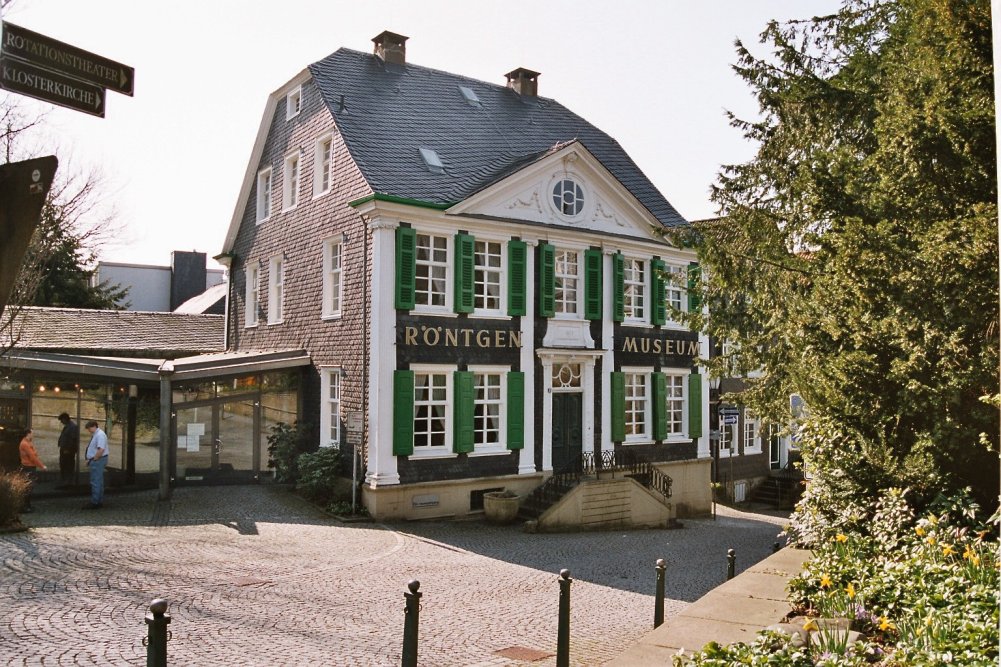
The Deutsches Röntgen-Museum in Remscheid-Lennep, dedicated to physicist Wilhelm Conrad Röntgen who was born there in 1845, spans 2100 square meters and explores his discovery of X-rays in 1895 along with the history of radiology.[6][93] The museum features interactive exhibits on X-ray technology, Röntgen's personal life, and applications in medicine and science, offering guided tours and educational programs for visitors.[6][94] The Deutsches Werkzeugmuseum, established in 1967, documents the evolution of tools from the Stone Age to the present, highlighting Remscheid's historical role as a center for tool manufacturing in the Bergisches Land region.[95] Its collection includes over 4,000 artifacts showcasing industrial techniques, with family-oriented workshops and demonstrations of traditional craftsmanship.[96] The Tuchmuseum Lennep focuses on the textile history of the Bergisches Land, exhibiting machinery, fabrics, and documents from the local cloth-making industry that peaked in the 19th century.[97] Housed in a historic building, it provides insights into weaving processes and economic impacts on the area through preserved looms and archival materials.[97] Additional cultural venues include the Rotationstheater for cabaret performances and the Klostenkirche in Lennep as a center for variety shows and events, supporting local arts amid Remscheid's industrial heritage.[3] Smaller institutions like Museum Haus Cleff offer local history exhibits, while galleries such as Ins Blaue promote contemporary art.[98]Local Traditions and Events
Remscheid participates in regional Rhineland Carnival traditions, with festivities concentrated in the Lennep district under the Lenneper Karnevalsgesellschaft. The season opens symbolically on November 11 each year, featuring the proclamation of a prince and princess pair, followed by events like the Weiberfastnacht party on the Thursday before Ash Wednesday, where men symbolically surrender ties to women in a ritual of reversal.[99] [100] The highlight is the Rosenmontag parade in Lennep, commencing at 14:11 on the Monday before Ash Wednesday—such as March 2, 2025—with costumed participants, floats, and music drawing local crowds.[101] These events reflect broader North Rhine-Westphalian customs emphasizing satire, community bonding, and seasonal release before Lent. Annual fairs and heritage festivals underscore Remscheid's Bergisch Land roots, including the May Fair held each May, featuring markets, amusements, and local crafts tied to the area's historical metalworking guilds.[102] The Schützen- und Heimatfest in July combines shooting competitions from traditional marksmen guilds—a practice dating to medieval civic defense—with folk music, regional foods like Kümmelbraten and Pumpernickel, and displays of local history, attracting participants from shooting societies established in the 19th century.[102] In Lennep, the Lenneper Sommer series hosts recurring summer events, such as the Sommer- & Winzerfest on August 1–3, blending wine tastings with live music and family activities in the historic old town, evoking Bergisch hospitality traditions.[103] Additional seasonal highlights include Christmas markets in December, emphasizing handmade goods from the toolmaking heritage, though less formalized than in larger cities. These gatherings preserve communal rituals amid the city's industrial legacy, with attendance varying from thousands for parades to smaller local turnouts for heritage fairs.[104]Notable People
Key Figures from Industry and Science
Wilhelm Conrad Röntgen (1845–1923), born on March 27, 1845, in Lennep (now part of Remscheid), was a physicist renowned for discovering X-rays on November 8, 1895, during experiments with cathode rays at the University of Würzburg.[105] This breakthrough, initially termed "X-rays" for their unknown nature, enabled the first medical imaging and earned Röntgen the inaugural Nobel Prize in Physics in 1901.[6] His work stemmed from systematic observation of fluorescence phenomena, distinguishing it from prior incidental observations by others, and laid foundational principles for radiology.[106] Reinhard Mannesmann (1856–1922) and his brother Max Mannesmann (1856–1932?), natives of Remscheid, pioneered the industrial production of seamless steel tubes through a patented skew-roll piercing process in 1886.[107] This innovation, developed amid Remscheid's tool and metalworking heritage, enabled efficient manufacturing of high-strength pipes without welds, transforming industries like oil, gas, and automotive by improving durability and scalability.[108] Max Mannesmann is credited with over 1,000 technical inventions, reflecting the inventive spirit of Remscheid's engineering community.[107] Their contributions underscore the city's role as a hub for mechanical innovation in the late 19th century.Other Prominent Residents
Johann Peter Hasenclever (1810–1853), a leading figure in the Düsseldorf school of painting, was born in Remscheid and renowned for his genre paintings depicting middle-class life, social critiques, and historical scenes, such as The Reading Room (1839).[109] Wolfgang Tillmans (born 1968), a prominent contemporary visual artist specializing in photography and installations, was born in Remscheid; his work, which explores abstraction, identity, and everyday observation, earned him the Turner Prize in 2000 and representation at major institutions like Tate Modern.[110] Peter Brötzmann (1938–2023), an influential free jazz saxophonist and composer, hailed from Remscheid and pioneered avant-garde improvisation through albums like Machine Gun (1968), collaborating with global musicians and shaping European free jazz.[111] Frank Plasberg (born 1957), a notable German television journalist and moderator born in Remscheid, hosted the political talk show Hart aber fair on ARD from 2001 to 2022, facilitating discussions on current affairs with politicians and experts.[112] Jonas Dassler (born 1996), an actor from Remscheid, has gained recognition for roles in films such as Bonhoeffer (2024) and The Golden Glove (2019), training at the Ernst Busch Academy in Berlin.[113] Michelle Barthel (born 1993), a singer and actress born in Remscheid, fronts the electronic duo 2raumwohnung and appeared in series like We Are the Wave (2019), blending music with acting in German media.[114]International Relations
Twin Towns and Sister Cities
Remscheid maintains formal partnerships with seven cities across Europe, formalized to promote cultural exchange, economic cooperation, and mutual understanding. These relationships, known as Städtepartnerschaften in German, date back to the mid-20th century and have expanded over time, reflecting the city's industrial history and post-war reconciliation efforts.[115] The partnerships include:| City | Country | Established |
|---|---|---|
| Quimper | France | 1971 |
| Prešov | Slovakia | 1989 |
| Pirna | Germany (Saxony) | 1990 |
| Kırşehir | Turkey | 2004 |
| Ashington and Newbiggin-by-the-Sea | United Kingdom (England) | Early 1950s |
| Mrągowo | Poland | Sponsorship 1954; full partnership 2015 |
| Granada | Spain | 2025 (signed May 2) |