Hubbry Logo
LimacodidaeLimacodidaeMain
Open search
Limacodidae
Community hub
Limacodidae
logo
8 pages, 0 posts
0 subscribers
Be the first to start a discussion here.
Limacodidae
Limacodidae
from Wikipedia

Limacodidae
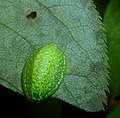
The festoon, Apoda limacodes
Scientific classification Edit this classification
Kingdom: Animalia
Phylum: Arthropoda
Class: Insecta
Order: Lepidoptera
Superfamily: Zygaenoidea
Family: Limacodidae
Subfamilies

Chrysopolominae
Limacodinae
For full list of genera, see Taxonomy of Limacodidae.

Diversity
About 400 genera,
1800 species
Synonyms

The Limacodidae or Eucleidae are a family of moths in the superfamily Zygaenoidea or the Cossoidea;[2] the placement is in dispute. They are often called slug moths because their caterpillars bear a distinct resemblance to slugs.[3] They are also called cup moths because of the shape of their cocoons.[3]

The larvae are often liberally covered in protective stinging hairs, and are mostly tropical, but occur worldwide, with about 1800 described species and probably many more as yet undescribed species.

Description

[edit]

Moths

[edit]

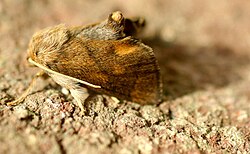
They are small, hairy moths, with reduced or absent mouthparts and fringed wings. They often perch with their abdomens sticking out at 90° from their thoraces and wings. North American moths are mostly cryptic browns, sometimes marked with white or green, but the hag moth mimics bees.[4]

Pupae

[edit]

The final instar constructs a silk cocoon and hardens it with calcium oxalate excreted from its Malpighian tubules. Cocoons have a circular escape hatch, formed from a line of weakness in the silk matrix. It is forced open just prior to emergence of the adult.[5]

Caterpillars

[edit]

The larvae are typically very flattened, and instead of prolegs, they have suckers.[4] The thoracic legs are reduced, but always present, and they move by rolling waves rather than walking with individual prolegs. They even use a lubricant, a kind of liquefied silk, to move.[5]

Larvae might be confused with the similarly flattened larvae of lycaenid butterflies, but those caterpillars have prolegs, are always longer than they are wide, and are always densely covered in short or long setae (hair-like bristles). The head is extended during feeding in the lycaenids, but remains covered in the Limacodidae.

Many limacodid larvae are green and fairly smooth (e.g. yellow-shouldered slug), but others have tubercles with urticating hairs and may have bright warning colours. The sting can be quite potent,[6] causing severe pain.

The larval head is concealed under folds.[2] First-instars skeletonise the leaf (avoiding small veins and eating mostly one surface), but later instars eat the whole leaf, usually from the underside.[4] Many species seem to feed on several genera of host plants.[2]

Limacodidae larvae in temperate forests of eastern North America prefer glabrous leaves, presumably because the trichomes of pubescent leaves interfere with their movement.[7]

Eggs

[edit]

Eggs are flattened and thin. They are highly transparent and the larva can be seen developing inside.[4] They may be laid singly or in clusters on leaves.

Ecological importance

[edit]

Notable species

[edit]

References

[edit]
[edit]
Revisions and contributorsEdit on WikipediaRead on Wikipedia
from Grokipedia
Limacodidae, commonly known as slug moths or cup moths, is a family of moths in the order , characterized by their distinctive slug-like larvae and cup-shaped pupal cocoons. With approximately 1,800 described species worldwide and many more undescribed, the family is most diverse in tropical regions, though species occur globally, including about 115 in . Adults are typically small to medium-sized, with stout, often hairy bodies and broad, rounded wings spanning ½ to 1¾ inches, displaying colors ranging from brown and yellow to green with contrasting patterns or lines. The larvae of Limacodidae are highly specialized, resembling slugs due to their flattened or rounded bodies, concealed heads, and absence of true prolegs, which are replaced by suction-like discs for gliding movement. These caterpillars often feature colorful patterns, fleshy tubercles, horns, or verrucae, and many bear stinging hairs or spines containing that can cause severe, painful reactions in humans, similar to stings. Polyphagous feeders, the larvae consume leaves of a wide variety of , including oaks and ornamentals, and may undergo up to nine instars before pupating. In temperate regions, Limacodidae overwinter primarily as mature larvae or pupae within silken, hardened cocoons that feature a hinged or circular exit hatch, with adults emerging in spring or summer for and egg-laying. While adults are generally nocturnal and attracted to lights, they pose no direct threat, but the family's larvae can be agricultural pests in some regions due to defoliation, and their urticating structures necessitate caution during handling. In , the family includes notable species like the moth (Acharia stimulea), distributed across the from to New York.

Taxonomy

Higher classification

Limacodidae is classified within the superfamily Zygaenoidea of the order , a placement supported by both morphological and molecular evidence that highlights shared larval traits such as slug-like forms with ventral suckers. Historically, the family has been assigned to alternative superfamilies, including Cossoidea, based on early morphological analyses emphasizing adult venation and genitalia structures. However, comprehensive revisions integrating larval morphology and molecular data have resolved this debate in favor of Zygaenoidea, as proposed by Common in 1975 and elaborated in Epstein's 1996 phylogenetic study. The family Limacodidae has undergone several taxonomic revisions, with synonyms including Eucleidae and Cochlidiidae, reflecting shifts in classification based on larval and pupal characteristics. Early 20th-century works by Dyar (1894–1899) divided the family into sections based on larval habitus, such as "hairy eucleids" and "spined eucleids," which laid the groundwork for later delineations. Epstein's 1996 formalized Limacodinae as a core , incorporating former groups like Chrysopolominae while questioning the of broader limacodid assemblages until molecular corroboration. Within Zygaenoidea, Limacodidae forms part of the "limacodid-group" alongside closely related families such as Megalopygidae and , united by specialized slug caterpillar larvae featuring reduced prolegs and defensive spines or setae. These families share evolutionary adaptations for and , with Megalopygidae exhibiting similar urticating hairs and Dalceridae displaying resinous larval coatings, as evidenced by comparative morphological phylogenies. Recent molecular studies reinforce these ties, positioning Limacodidae as sister to clades including Phaudidae and . Key phylogenetic insights derive from mitochondrial genome analyses, such as Jiang et al.'s 2024 study of four Limacodidae species, which sequenced complete mitogenomes (15,529–15,575 bp) and recovered the family as within Zygaenoidea, with close affinities to other slug moth groups via shared arrangements and rapid-evolving markers like atp8 and nad6. Complementing this, Liang et al.'s 2024 sequence capture analysis of 161 markers across 145 Palaearctic and Indomalayan samples confirmed Limacodidae and resolved six major clades, integrating nuclear and mitochondrial data to affirm ties to broader Zygaenoidea while highlighting regional diversification.

Subfamilies and genera

A July 2025 phylogenetic study by et al. provided a comprehensive reclassification of Limacodidae (stat. nov.), confirming its within Zygaenoidea and recognizing Limacodinae as the sole , divided into two s based on morphological and molecular data from 95 genera and 125 species worldwide. This revision reduces previous subfamilies such as Chrysopolominae to tribal rank ( trib. nov.), which is predominantly distributed in the (particularly the Indo-Australian region) and encompasses genera with larvae characterized by smooth, green or purple bodies bearing long, black hairlike setae tipped with white at each end, often lacking the prominent stinging spines seen in other limacodids. In contrast, the core Limacodinae includes a broader array of larval forms with greater morphological diversity across tropical and temperate zones, many featuring venomous dorsal spines on scoli for defense; this has a more , including the . Historically, the family was divided into two main subfamilies, Limacodinae and Chrysopolominae. Limacodidae comprises more than genera and around 1,800 species worldwide, with the majority concentrated in tropical regions of , the , and . Representative genera in Limacodinae include Parasa, known for its stinging larvae that deliver painful through hollow spines, and Isa, which exhibits high species diversity in tropical forests and features varied wing patterns in adults. These genera highlight the family's ecological roles, such as Parasa species feeding on a range of woody and contributing to forest defoliation in some areas. Recent taxonomic updates have refined the classification within Limacodidae. In 2020, the new Epsteinius was described from to accommodate the species E. translucidus, notable for its diminutive size and translucent wings, representing the first limacodid with a monkey-slug-like lacking typical morphology. Additionally, a 2013 revision of the Parasa undulata species group expanded its scope by describing two new species (P. pygmaea and P. lepida) from and , based on wing venation, genitalia, and the first documented conifer-feeding in the . From an evolutionary perspective, the loss of larval spines within Limacodidae is considered a derived trait that has arisen multiple times independently across lineages, stemming from an ancestral condition of spinose larvae; this reduction often correlates with shifts to smoother, slug-like forms for or altered defense strategies. Such losses are particularly evident in certain Limacodinae clades, where non-spiny larvae rely more on chemical sequestration or behavioral adaptations.

Distribution and habitat

Geographic range

The family Limacodidae exhibits a predominantly tropical and subtropical distribution, occurring across all continents except , with the greatest species diversity concentrated in and the Neotropics. Globally, the family comprises approximately 1,800 described , the majority of which thrive in warm, humid climates that support their host plants and life cycles. This pattern reflects the family's evolutionary origins and adaptations to forested environments in lower latitudes, where stable temperatures and high facilitate high rates. In the Indo-Australian region, which encompasses the Indomalayan and Australasian realms, over 1,000 species are recorded, accounting for nearly half of the family's global diversity; notable hotspots include (116 species) and (123 species), underscoring the area's role as a center of and richness. The Neotropical region hosts significant diversity as well, with around 27 genera and hundreds of species, particularly in , where surveys in alone have documented over 75 species. In contrast, temperate zones show lower representation: supports about 50 species across 22 genera, mainly in the , while has sparse occurrence with only four species recorded continent-wide, including Apoda limacodes as the sole representative in the . Migration patterns among Limacodidae are generally rare due to their sedentary larval stages and limited adult dispersal. is pronounced in hotspots such as , where three genera—Bornethosea, Marsuplectra, and Saccurosa—are endemic, alongside seven others restricted to the broader region, highlighting the island's isolation and ecological uniqueness as drivers of .

Preferred environments

Limacodidae species exhibit a strong preference for humid, forested environments, including tropical rainforests, secondary forests, and agricultural plantations, where moisture levels support their lifecycle stages. These moths and their larvae thrive in areas with dense cover that provides and access to foliage, as evidenced by high diversity records in Southeast Asian rainforests and oil palm plantations. In contrast, the family largely avoids arid zones, with expansions into drier biomes occurring only in specialized cases where species have adapted through morphological changes like spine reduction. The altitudinal distribution of Limacodidae spans from to elevations of about 2,000 meters, particularly in montane tropical regions where cooler, humid conditions prevail. For instance, in the genus Birthamiodes have been documented at altitudes between 1,750 and 2,020 meters in forested uplands, while others like Euclea mesoamericana show forms adapted to both lowland and high-altitude habitats up to similar elevations. This range aligns with their global patterns in tropical and subtropical zones, where they occupy diverse microhabitats within forested ecosystems. Limacodidae are closely associated with specific host plant communities that define their preferred microhabitats, such as palms in coastal and settings and broadleaf trees in inland forests. In coastal regions of and , species like Darna pallivitta frequent oil palm () stands, contributing to their prevalence in managed humid landscapes. Inland, and broadleaf-dominated forests in eastern and tropical lowlands support genera like Heterogenea and Apoda, where larvae exploit the foliage. Many Limacodidae species demonstrate adaptability to disturbed habitats, including agricultural edges and areas affected by activity, allowing persistence amid . For example, in regions like , , these moths maintain diversity in secondary forests bordering plantations, underscoring their resilience to moderate disturbance levels.

Morphology

Adult moths

Adult Limacodidae moths are generally small, with forewing lengths ranging from 6 to 35 mm, corresponding to wingspans of approximately 15 to 45 mm in many , with the family overall exhibiting wingspans of 13-44 mm (½ to 1¾ inches). Their bodies are stout and often covered in dense scales, appearing woolly or hairy, particularly on the and legs in genera such as Parasa, Euclea, and Monoleuca. These moths possess reduced or degenerate mouthparts, rendering most adults non-feeding as they rely on energy reserves accumulated during the larval stage. The wings are relatively short and broad, with fringes of scales along the margins, and the hindwings are typically smaller and less prominent than the forewings. Coloration in adult Limacodidae is predominantly cryptic, featuring shades of brown, tan, green, or yellow that provide against bark or foliage, as seen in species like Parasa chloris with its green forewing bands or Isochaetes beutenmuelleri in mottled browns. Some species exhibit patterns suggestive of , such as yellow-shouldered markings resembling hymenopterans in certain Parasa taxa, potentially deterring predators through Batesian imitation. Wing venation is relatively simple, with forewings displaying characteristic medial and postmedial lines or spots, while hindwings show reduced venation supporting their compact form. At rest, these moths adopt a characteristic posture with wings held tent-like over the body and the often raised at an acute angle, sometimes up to 90 degrees, particularly in males of genera like Packardia and Tortricidia. is pronounced, with females typically larger and more robust, possessing broader s adapted for egg-laying and filiform antennae, whereas males are smaller, more agile, and equipped with bipectinate antennae for detection, as exemplified in where females have cream-blotched wings compared to the males' transparent forewings. This dimorphism supports their brief phase focused on within the life cycle.

Eggs

The eggs of Limacodidae are characteristically flattened and disc- or oval-shaped, measuring approximately 0.5–1 in diameter, with a notably thin that renders them translucent or transparent, often appearing as glassy sheens or tiny water droplets on foliage. This thin , among the thinnest in , lacks prominent sculpturing or surface markings, allowing the developing to be visible and relying primarily on the egg's transparency for against predators. In some species, such as Acharia stimulea, the eggs exhibit a pale yellow tint while maintaining transparency, with scale-like edges that may partially overlap in clusters. Females typically deposit eggs singly or in small clusters of 2–50 on the undersides of host plant leaves, often in irregular or random patterns to enhance concealment, though placement can vary by species and occasionally occur on uppersides. For example, in Darna pallivitta, eggs are laid in small lines or singly on older leaf undersides, while Tortricidia testacea favors solitary placement on leaf undersides. This positioning protects the delicate eggs from direct sunlight and desiccation, with some species like Monoleuca semifascia featuring maternal scales on the egg surface for added camouflage or protection. The generally spans 7–14 days, varying by and environmental conditions, with often occurring within one to two weeks under temperate or settings. In tropical regions, such as those studied in for Darna pallivitta, development accelerates to around 10 days at 75% and 25–27°C, underscoring the influence of high on preventing of the thin and promoting timely embryonic development.

Larvae

The larvae of Limacodidae, commonly known as slug caterpillars, exhibit a highly specialized, slug-like morphology that distinguishes them from typical lepidopteran larvae. Their bodies are characteristically flattened and broader than long, often measuring up to 25 mm in length at maturity, with a stout, broad form that facilitates close contact with substrates. The head is reduced and typically retracted beneath the during rest or feeding, while the thoracic legs are vestigial and reduced to short, tactile structures with limited functionality. Unlike most caterpillars, limacodid larvae lack true abdominal s, instead possessing a series of ventral suckers—derived from proleg bases—on abdominal segments A2 through A7 (sometimes including A1 and A8). These suckers enable a unique inching locomotion characterized by peristaltic waves, where the flexible ventral undulates in fluid-like motions, aided by a secreted fluid that enhances grip on foliage. The is often waxy or gelatinous due to this secretion, providing a smooth or slightly roughened surface that may be translucent, and it is frequently adorned with secondary setae or protuberances. Coloration varies but commonly includes shades of green or yellow in later instars, serving cryptic or warning functions depending on the species. Many limacodid larvae bear urticating hairs or stinging spines arising from dorsal tubercles, particularly in early instars where rows of large spines are prominent; these structures can persist or modify in later stages. The ancestral condition for the family is a spined larval form, but spines have been lost or reduced independently at least four times across lineages, notably in Asian and Australian clades, reflecting into diverse ecological niches such as cryptic habitats or drier environments. This evolutionary pattern, inferred from phylogenetic analyses of 45 species spanning four continents, underscores the in defensive traits within the family.

Pupae

The pupae of Limacodidae are enclosed in spindle-shaped silk cocoons reinforced with calcium oxalate crystals secreted from the Malpighian tubules of the prepupal larva, which imparts rigidity and enhances protection against predation and environmental stress. These cocoons are typically 10–15 mm in length, though sizes vary by species, and often incorporate spicule hairs or other larval structures for added strength. Cocoons are commonly camouflaged by integration with plant debris, silk webbing, or host plant materials, aiding concealment during the vulnerable pupal phase; they are usually attached longitudinally to leaves, bark, or twigs near the larval feeding site. A distinctive feature is the circular, dehiscent emergence lid formed by a weakened silk ring, which the adult moth ruptures to exit upon completion of metamorphosis. The pupal duration spans 10–30 days, influenced by species, temperature, and geographic location, with warmer conditions accelerating development; in temperate regions, pupae may enter diapause and overwinter within the cocoon. Sexual dimorphism is minimal at this stage, though female pupae tend to be slightly larger than males, reflecting patterns observed in the adult form.

Biology and behavior

Life cycle

Limacodidae moths undergo complete holometabolous , consisting of four distinct s: , , , and adult. The stage typically lasts 7–14 days, with females laying clusters of 20–50 eggs on the undersides of host plant leaves shortly after . Hatching larvae are minute and initially non-feeding in some species before progressing through multiple instars. The larval stage varies in duration from 4–8 weeks in tropical species to 4–5 months in temperate ones, encompassing 6–9 instars depending on environmental conditions and species. For example, in the tropical , larval development spans about 53 days across 8–11 instars, while in the temperate Acharia stimulea, it extends over several months with feeding concentrated in warmer periods. Upon maturity, larvae spin silken cocoons incorporating plant debris or spines, entering the pupal stage, which lasts 2–4 weeks under favorable conditions but may involve lasting several months in temperate regions to overwinter. Adult moths emerge from pupae after this period and have short lifespans of 1–2 weeks, during which they do not feed but focus on reproduction. Males use pectinate antennae to detect female sex pheromones released during calling , often at or night, leading to ; copulation can last up to 24 hours, followed immediately by female oviposition. Voltinism in Limacodidae is influenced by , with temperate species typically univoltine, producing one per year and relying on pupal to survive winter. In subtropical and tropical regions, species are often multivoltine, completing 2–4 annually or exhibiting continuous breeding due to stable warm ; for instance, Latoia viridissima produces four discrete per year in tropical plantations. Environmental factors such as and photoperiod regulate these cycles, with triggered in temperate populations to align emergence with host plant availability in spring.

Feeding and host plants

Larvae of Limacodidae are highly polyphagous, feeding on foliage from numerous plant families, with individual recorded on dozens of hosts including both woody and herbaceous plants. They exhibit a preference for smooth, glabrous leaves, which facilitate their slug-like locomotion and feeding efficiency, as seen in temperate forest that favor such surfaces on oaks and other trees. Major host families include (palms such as and oil palm), (oaks like and ), and (legumes including Gliricidia and Psophocarpus tetragonolobus). Feeding strategies typically involve skeletonizing in early instars, where larvae graze the leaf epidermis and mesophyll between veins, creating characteristic "windows" while sparing the tougher . In later instars, they shift to defoliation, consuming entire leaves including veins and petioles, which can lead to significant foliage loss on host plants. These patterns allow efficient nutrient extraction while minimizing energy expenditure on indigestible structures. Limacodid larvae possess nutritional adaptations that enable them to exploit chemically defended hosts, including mechanisms for detoxifying secondary metabolites such as alkaloids and phenolics common in polyphagous diets. In pest species, host shifts occur when natural vegetation is depleted, leading to defoliation of crops such as plantations.

Defensive mechanisms

Limacodidae employ a range of defensive strategies across life stages to deter predators, with larval defenses being particularly prominent due to their vulnerability on host plants. Larvae of many possess stinging hairs or spines that deliver irritant upon contact, serving as a primary against and predators. These spines are hollow and connected to venom glands, injecting toxins that cause intense pain and ; for instance, in species like Acharia stimulea, the includes and other bioactive compounds that trigger urticaria and pain lasting from hours to several days. Field and laboratory studies have demonstrated that heavily spined limacodid larvae experience significantly lower predation rates from generalist predators such as ants, spiders, and praying mantises compared to less armored individuals, highlighting the efficacy of these structures in multi-predator environments. In addition to chemical defenses, limacodid larvae utilize morphological adaptations for , including body shapes and coloration that mimic unpalatable objects in their environment, such as droppings. This fecal mimicry, observed in like Phobetron pithecium, allows larvae to blend seamlessly with foliage debris, reducing detection by visually foraging predators. The slug-like body form, often flattened and lacking prolegs, further enhances this by resembling innocuous environmental elements rather than prey. Behavioral responses complement these physical defenses, particularly in larvae. When disturbed, many limacodid larvae release their grip on leaves and drop to the ground or dangle on threads, evading immediate threats from birds or ; this tactic was quantified in field observations where spined larvae survived predator encounters at rates up to 80% higher than non-droppers. Such rapid escape behaviors, combined with the brief reference to larval spine morphology detailed elsewhere, underscore the integrated nature of limacodid anti-predator strategies. Adult Limacodidae moths rely primarily on passive defenses through , with wing patterns featuring mottled browns, grays, and subtle scalings that match tree bark or leaf litter. These moths adopt a characteristic resting posture, holding wings in a tent-like formation with the elevated, which minimizes their profile and enhances blending into natural substrates. This postural adaptation, observed across North American species, reduces visibility to diurnal predators like birds during daytime inactivity. Pupal stages are protected by robust cocoons incorporating chemical reinforcements. Limacodid pupae form silken enclosures hardened by crystals excreted from Malpighian tubules, creating a durable barrier that deters parasitic wasps and other invaders. In species such as Acharia stimulea, these cocoons may also integrate urticating larval spines, providing an additional irritant layer that discourages probing by parasitoids and small predators. The not only imparts rigidity but also contributes to chemical repellency, as evidenced by lower rates in fortified cocoons compared to untreated silks in controlled studies.

Ecological and economic importance

Role in ecosystems

Limacodidae larvae function as herbivores that help regulate populations in tropical s through selective defoliation, thereby promoting by reducing competitive dominance among and encouraging a more diverse composition. This selective feeding behavior, common among polyphagous Limacodidae on dicot trees and shrubs, contributes to maintaining structural heterogeneity in canopies. As integral components of food webs, Limacodidae larvae serve as prey for a range of predators, including birds, wasps, and spiders, which helps sustain higher trophic levels in ecosystems. Adult moths, while nocturnal, provide minimal services to night-blooming flowers owing to their brief lifespan, typically lasting around 10 days, during which they rarely feed or interact extensively with floral resources. Populations of Limacodidae serve as bioindicators of habitat health in forested environments, where declines often signal underlying issues such as and associated . Furthermore, the produced by their larvae facilitates nutrient cycling by returning essential elements like and carbon to the , supporting microbial activity and overall productivity. Limacodidae exhibit notable interactions with parasitoids, particularly in Neotropical regions, where some species experience high parasitism rates exceeding 50%, as observed in Acharia nesea populations in Costa Rican forests. These interactions underscore the family's role in supporting parasitoid diversity and regulating herbivore dynamics within tropical ecosystems.

Pest species and impacts

Several species within the Limacodidae family are recognized as significant pests in tropical and subtropical agriculture and forestry, primarily due to the defoliating habits of their larvae. Parasa lepida, commonly known as the blue-striped nettle caterpillar, is a polyphagous pest prevalent in Asia, where it infests a wide range of crops including tea (Camellia sinensis), citrus, coffee, cacao, and various palms, causing substantial damage through leaf consumption and stinging spines that deter handling. In Australia, species such as Palmartona catoxantha exhibit similar behavior, targeting coconut palms and leading to localized defoliation in ornamental and commercial plantings. These larvae often feed gregariously during outbreaks, skeletonizing leaves and reducing photosynthetic capacity, with severe defoliation leading to up to 36% productivity loss two years post-attack in Indonesian oil palm plantations. The economic impacts of Limacodidae pests are pronounced in , particularly in palm oil production, where nettle and slug caterpillars represent some of the most widespread defoliators globally. Outbreaks can result in significant yield reductions in affected oil palm stands over subsequent years, contributing to substantial economic losses across major producing regions like and . Control strategies commonly include the application of (Bt) formulations, which target lepidopteran larvae effectively while minimizing harm to non-target organisms; studies have demonstrated high mortality rates in species like Euprosterna elaeasa when Bt strains are deployed in programs for oil palm. Historical outbreaks underscore the potential severity of these pests; for instance, in the 1980s, slug caterpillar infestations contributed to widespread palm defoliation in southern Florida landscapes, exacerbating damage to ornamental and native sabal palms amid favorable climatic conditions. Invasive Limacodidae species also pose quarantine challenges, particularly in North America and Pacific islands. Darna pallivitta, the nettle caterpillar, has established invasive populations in Hawaii since the early 2000s, prompting strict regulatory measures to prevent further spread to mainland U.S. agriculture; its polyphagous nature threatens diverse hosts including coffee, macadamia, and native vegetation, with ongoing monitoring to mitigate economic and ecological risks. Similarly, the hag moth (Phobetron pithecium) can damage fruit trees in North American orchards due to its urticating larvae, though it is native and managed through localized controls.

Diversity and notable species

Overall diversity

The family Limacodidae encompasses approximately 1,800 described distributed across more than 300 genera worldwide. The family includes many more undescribed taxa, particularly in tropical regions where surveys remain incomplete. Diversity is markedly uneven, with hotspots concentrated in tropical areas; high concentrations occur in countries like (over 120 ) and (over 110 ). In contrast, temperate zones host far fewer , such as about 50 in north of . Discovery rates have accelerated in recent decades, with over 50 new species described since 2010, driven by targeted expeditions and advanced techniques like DNA barcoding, as exemplified by a new Microleon species from Taiwan identified in 2024. While most Limacodidae species are relatively common and widespread, certain island endemics face vulnerability from habitat loss and fragmentation, underscoring the need for focused conservation in biodiverse insular ecosystems.

Selected notable species

Phobetron pithecium, commonly known as the hag moth, is a North American species distributed across the eastern and central and . Its larva, often called the monkey , exhibits remarkable resembling dirty or debris-covered leaves, with a brown, hairy body up to 2.5 cm long adorned by nine pairs of fleshy, twisted appendages covered in short, venomous spines connected to glands. These appendages, three pairs longer in later instars, aid in rather than locomotion, as the glides slug-like using reduced prolegs and suckers on its yellowish underside. The species is polyphagous, feeding on foliage of diverse hosts including oaks, , apple, , and dogwood, with multiple generations per year in southern regions and pupation occurring in leaf litter. Notably, contact with the larva's urticating spines causes severe , manifesting as intense burning, itching, redness, swelling, and inflammation akin to a , potentially lasting days and requiring intervention in severe cases. Apoda limacodes, the festoon moth, occurs in , including the and , where it inhabits mature broadleaf woodlands. The larva is a distinctive, legless, slug-like reaching 15 mm in length, with an oval green body featuring two yellow longitudinal stripes accented by red spots and elongated white tubercles for defense. It feeds primarily on (Quercus) and (Fagus) leaves during late summer, gliding across foliage using sucker-like discs instead of prolegs, and overwinters as a cocooned prepupa. Adults are somber brown moths with a 20-30 mm wingspan, active from to in a tent-like resting posture. While generally harmless to humans, the species represents a minor pest in forest ecosystems due to occasional defoliation of host trees. Thosea sinensis, known as the Assam nettle grub or seed , is a widespread Asian Limacodidae species native to , including , , , and . The slug-like larvae, up to 31 mm long, lack prolegs and bear urticating spines on scoli, feeding voraciously on under-surfaces of () leaves, causing significant defoliation and economic damage in plantations. Adults are ochraceous with bipectinate antennae and a around mm, with pupation in hard, spherical cocoons. Documented as a pest since the early , outbreaks have been recorded in gardens across , including severe invasions in and since the , often leading to total leaf skeletonization in affected areas. The species is polyphagous, also attacking coconut, oil palm, apple, and , but remains a primary host with historical reports dating to 1900s studies in .

References

Add your contribution
Related Hubs
User Avatar
No comments yet.