


Community hub
Recent from talks
Contribute something
Nothing was collected or created yet.
Randalls and Wards Islands
View on Wikipedia
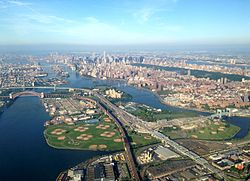
Randalls Island (sometimes called Randall's Island) and Wards Island are conjoined islands, collectively called Randalls and Wards Island, in New York City.[1][2][3] Part of the borough of Manhattan, it is separated from Manhattan Island by the Harlem River, from Queens by the East River and Hell Gate, and from the Bronx by the Bronx Kill. A channel named Little Hell Gate separated Randalls Island to the north from Wards Island to the south; the channel was filled by the early 1960s. A third, smaller island, Sunken Meadow Island, was located east of Randalls Island and was connected to it in 1955.
Key Information


The Lenape Native Americans, who lived in the New York City area before European colonization, did not inhabit the islands. Between the 1630s and the 1770s, the islands had various European residents; the islands had the same owners in the 17th century, but ownership was split during the 18th century. Randalls and Wards Islands became known for their respective early-19th-century owners, Jonathan Randel and the Ward brothers. The city government took over both islands in the mid-19th century and developed numerous hospitals, asylums, and cemeteries there. Most of the existing buildings were demolished starting in the 1930s, when the Triborough (now Robert F. Kennedy) Bridge, two parks, and a wastewater treatment plant were developed there. The islands have since been connected with each other, and various recreational facilities and institutions have been developed on both islands in the late 20th and the 21st centuries.
Most of Randalls and Wards Island is parkland with athletic fields, a driving range, greenways, playgrounds, picnic grounds, and the Icahn Stadium track-and-field facility. The island is home to several public facilities, including a psychiatric hospital, an addiction treatment facility, shelters, a fire training academy, police station, and a wastewater treatment plant. The modern-day island is crossed by the Robert F. Kennedy and Hell Gate bridges.
Geography
[edit]What is now Randalls and Wards Island was originally composed of Randalls Island to the north, Wards Island to the south, and Sunken Meadow just southeast of Randalls Island.[4] A small creek, Little Hell Gate, ran between the islands.[5] The current Randalls and Wards Island came about when Little Hell Gate was partially infilled.[6][7] The combined island is part of the New York City borough of Manhattan;[7] this dates to an 1829 statute that designated the islands as being within Manhattan's eastern boundary.[8] Randalls and Wards Island has an area of about 530 acres (210 ha). The island is surrounded by Bronx Kill to the north, separating it from the Bronx; Harlem River to the west, separating it from Manhattan Island; and the Hell Gate channel of the East River to the south and east, separating it from Queens.[4] The island had a population of 1,648 in 2010.[9]
A small island called Mill Rock exists south of Wards Island, while further south is Roosevelt Island.[10][11] Prior to the removal of Hell Gate rocks in the mid-19th century,[12] there were other large rock outcroppings in the East River near Wards Island.[11]
Islands
[edit]Randalls Island
[edit]Before the islands were combined, Randalls Island had an area of about 240 acres (97 ha).[4][13] Randalls Island had some granite outcroppings and marshland.[7][14] The southern part of the island was composed of low hills, while the northern two-thirds were higher and flatter. There were two isolated ponds on the northern part of the island.[14] There was a ridge across the island's northern section, which hosted farms and fruit orchards in the 19th century.[7] Surrounding Randalls Island was a narrow strip of marshland, and there were larger marshes to the north and southeast, which drained into the East River.[14] The north and southeast shores also had shellfish beds.[15] The southern part of the island was leveled, and the shoreline rebuilt, in the mid-19th century, though some meadows and swamps remained until the 1930s.[16]
Sunken Meadow Island
[edit]To the east of Randalls Island was Sunken Meadow Island,[4][14] which covered about 20 acres (8.1 ha).[4] Ownership of Sunken Meadow Island had been disputed during the early 20th century, and city officials had considered that island to be part of Randalls Island.[17] Infilling took place beginning in the mid-1950s.[18] The Sunken Meadow section of Randalls Island Park comprises 85 acres (34 ha) and contains ball fields.[19] Also east of Randalls Island was an even smaller island called the Hammock, which was subsumed through filling operations.[14]
Wards Island
[edit]Originally, Wards Island had an area of about 145 acres (59 ha).[4] Like Randalls Island to the north, Wards Island had marshlands on its western and northern shores and shellfish beds on the southeastern part of the island.[15] A 1968 guidebook described grasses as being present across the island.[10] The island is surrounded by piles of riprap or rocks.[20]

By the 19th century, the southern end of Wards Island was known as Negro Point;[7] the Negro Point name became official in 1984.[21] A ledge extended about 200 feet (61 m) to its southeast.[5] The United States Geological Survey and the National Oceanic and Atmospheric Administration used the Negro Point name.[21] Parks commissioner Henry Stern renamed Negro Point in 2001 upon learning of the name, which he thought was offensive.[22] He changed the name to "Scylla Point" because it faced Charybdis Playground in Astoria Park, on the opposite shore of Hell Gate; these were named after the mythological monsters of Scylla and Charybdis on the Strait of Messina.[23]
There were other outcroppings around Wards Island.[5][20] A 1918 guidebook listed two outcroppings known as Holmes Rock and Hogs Back, both of which were west of Scylla Point and above the waterline. The western outcropping extended 400 feet (120 m) to the southwest, while the eastern outcropping extended 300 feet (91 m) to the southwest.[5] These outcroppings are made of Manhattan schist.[20] Ships traveling from the Belgian city of Antwerp also dumped slag onto the shores of the island.[24]
Little Hell Gate
[edit]_(cropped).jpg)
Little Hell Gate was originally a natural waterway separating Randalls Island and Wards Island. The east end of the waterway opened into the Hell Gate passage of the East River, opposite Astoria, Queens. The west end met the Harlem River across from East 116th Street, Manhattan.[25] At the Hell Gate Bridge, the waterway was over 1000 feet (300 m) wide with swift currents.[26]
The opening of the Triborough Bridge spurred the conversion of both islands to parkland. Soon thereafter, the city began filling in most of the passage between the two islands, in order to expand and connect the two parks. The inlet was filled in by the 1960s.[6][18] What is now called "Little Hell Gate Inlet" is the western end of what used to be Little Hell Gate; however, few traces of the eastern end of Little Hell Gate still remain: an indentation in the shoreline on the East River side indicates the former east entrance to that waterway. Today, parkland and part of the New York City Fire Department Academy occupy that area.[6]
History
[edit]Lenape use
[edit]

According to archaeological digs, the area around Randalls and Wards Islands was settled by Paleo-Indians up to 12,000 years ago.[27] The Lenape, a Native American people indigenous to New York City, called Wards Island Tekenas[28][15] or Tenkenas.[29] The exact translation of the name is not known but has been interpreted as "forest", "wild land[s]", or "uninhabited place";[30][28] the name is derived from Tékene, the Munsee Delaware word for "the woods".[29] Randalls Island was called Minnehanonck[31][32] or Minnahanouth.[33] Neither Randalls nor Wards Islands are known to have had any Lenape settlements.[28][34] Just west of Randalls Island was a village called Conykeekst ("little narrow tract") on Manhattan Island, while to the north of Randalls Island was the village of Ranachqua in the Bronx.[35] There was another settlement, Rechewanis, on Manhattan Island southwest of the two islands as late as 1669.[36]
At the time of European contact in the early 17th century, there were 900 Wecquaesgeek Lenape living in what is now Upper Manhattan, the Bronx, and lower Westchester County.[37] The islands became part of the Dutch colony of New Netherland, and Dutch colonists ultimately forced the Wecquaesgeek off Manhattan by the late 17th century.[36][38][39]
17th through early 19th centuries
[edit]Between the 1630s and the 1770s, the islands had various European residents. At the time, the islands were several miles from the boundaries of New York City, which then occupied modern-day Lower Manhattan.[40] The islands had the same owners in the 17th century, but ownership was split during the 18th century.[41]
Early colonial use
[edit]Wouter Van Twiller, the Director General of New Netherland, obtained the island from two Lenape chiefs named Numers and Seyseys[13][28] on July 16, 1637.[32][42] Van Twiller only used the islands for raising livestock.[28] Wards Island's first European name was Great Barent Island, while Randalls Island's first European name was Little Barent Island; both were named after a Danish cowherd named Barent Jansen Blom.[28][15] A map from 1639 indicates that Van Twiller farmed Great Barent Island but left Little Barent Island unused.[41]
The islands were both seized in April 1667, three years after the British takeover of New Netherland.[43] The names of Great and Little Barent Islands were changed to Great and Little Barn[a] after the British took over.[36] Thomas Delavall, a customs collector[15][44] and an early mayor of New York City, claimed ownership of both islands in January 1667 and formally took ownership in 1668.[43] Delavall offered the islands as a public park for the nearby town of Harlem, but nothing came of this proposal.[41] After Delavall's death in 1682, the islands were bequeathed to his son-in-law William Dervall.[15][44] The islands became part of New York County (now Manhattan) in 1683, and they became part of New York City in 1691.[36][41] Toward the end of the 17th century, stones from Little Barn Island were quarried for the construction of Trinity Church in Manhattan's Financial District.[40]
Early and mid-18th century use
[edit]
Great Barn (Wards) Island came under the ownership of Thomas Parcell in 1687; his family owned it until c. 1762, during which it was called Parcell's Island.[15][28] At least four people, likely members of the Parcell family, were buried in a stone vault on the island.[15] Wards Island was also known as Buchanan's Island.[45] Thomas Bohanna bought 140 acres (57 ha) on the southern section Great Barn Island in 1767,[36] and the island was briefly known for him.[15][46] Bohanna's portion of Great Barn Island was then resold in 1772 to Benjamin Hildreth, while John William Pinfold obtained the remainder of the island at that time. By then, Great Barn Island included an orchard, farms, pastures, and several buildings.[36]
Meanwhile, Little Barn (Randalls) Island had come under the ownership of Elias Pipon, Delavall's great grandson,[47][33] by 1735.[41] Pipon had emigrated from England in 1732[33] and was socially popular until he went bankrupt in 1739 and had to return to England.[48] The island subsequently became known as Belle Isle[41][b] or Belle Island.[33] The New York Times describes an "amiable English gentlemen of quiet tastes", George Talbot, as being the next occupant of Pipon's house.[48] Talbot definitely occupied the island by 1747,[49] and the isle gained the name Talbot's Island.[41][47] He died on the island in 1765 and bequeathed it to the Society in Great Britain for Propagating the Gospel to Foreign Parts, which held onto the island for another seven years.[48][49] Captain John Montresor, an engineer with the British army, purchased Randalls Island in 1772.[41][48] He renamed it Montresor's Island and lived on it until the American Revolutionary War;[41][50] he surveyed the New York Harbor area for the British prior to the war.[40][41]
Starting in early 1776, the Continental Army used Montresor's Island to quarantine American soldiers who were infected with smallpox.[46][51] Following the Continental Army's defeat in the Battle of Long Island, the British took over both islands[40][49] and used them as an army base.[46] The British launched amphibious attacks on Manhattan from Montresor's Island.[52] John Montresor's wife Frances worked at a hospital on Montresor's Island, and troops on that island became friendly with American troops in the modern-day South Bronx.[40][51] The Continental Army unsuccessfully tried to retake Montresor's Island on September 23, 1776, and 14 American troops were killed or injured.[53][54] Montresor's house there was burned in 1777. Montresor wrote in his diary that American soldiers had burned down his house, while the Americans maintained that the British had set the house aflame while retreating from what they believed was an imminent attack.[40][51] Maps from late 1777 indicate that there were no remaining structures on Montresor's Island's western shore.[51] Montresor moved back to England afterward.[c][50][51]
Post-Revolutionary use
[edit]The New York City government confiscated the islands after the British occupation of New York ended in 1783.[48] The city sold Montresor's Island to the merchant Samuel Ogden in 1784.[48] In November 1784, Jonathan Randel[d] bought Montresor's Island for about $6,000.[48][55] Randel reportedly sold enough produce to pay for the island within a decade.[48] Maps from the early 19th century show that Randel developed at least three structures; an 1836 map depicts a tree-lined path leading from the Harlem River to Randell's main house.[58]
William Lownds bought Great Barn Island's southern half from Benjamin Hildreth in 1785.[15][46] He operated a quarry on that island and continued to maintain a farm there.[36][57] Jasper Ward bought Lownds's land in 1806. His brother Bartholomew bought the remainder of Great Barn Island from John Molenaar, who in turn had acquired that land from Pinfold.[33][57] The island was renamed for the Ward brothers, who unsuccessfully tried to create an agrarian community there,[36][59] selling off parcels to various people.[57] In addition, Bartholomew Ward and Philip Milledolar[e] built a drawbridge to what is now 114th Street on Manhattan Island,[57][60] which was completed around 1807.[36] A cotton factory was then built on the island by 1811, but it failed in part because of the economic effects of the War of 1812.[36][57] The bridge lasted until 1821, when it was destroyed in a storm.[60][59] The damaged bridge pilings remained in place for several decades,[57] and Wards Island was mostly abandoned afterward.[36]
Mid-19th century: development of institutions
[edit]Jonathan Randel's heirs sold Randalls Island to the city in 1835 for $50,000 (equivalent to $1.5 million in 2024)[48][47] or $60,000 (equivalent to $1.8 million in 2024).[50][55][61] Randel's name was misspelled in the ownership deed that was given to the city, and so the island became known as Randalls Island.[55][56] The city government leased Wards Island in December 1847, initially erecting the State Emigrant Refuge and Hospital there before buying Wards Island outright.[47] The city bought half of Wards Island during the early 1850s[33] and acquired the remainder of the island through 1883.[57]
In the mid-19th century, various social facilities were relocated from Manhattan Island to nearby smaller isles, including Randalls and Wards Islands.[62] Randalls Island housed an almshouse (opened 1845), a children's hospital (opened 1848), the Idiot Asylum,[55][56] and the New York House of Refuge reformatory.[48][62] Maps from the 1850s show two hospital complexes on Randalls Island.[58] Meanwhile, Wards Island was used by the State Emigrant Refuge and the New York City Asylum for the Insane.[63] Both islands also had potter's fields, or cemeteries for destitute people.[36]
Wards Island institutions
[edit]
The New York State Board of Commissioners of Emigration established Wards Island's first institution, the State Emigrant Hospital, in 1847.[64][65] They leased some land in 1848, then bought additional land on the island's western shore.[65][66] The two-story State Emigrant Hospital and the three-story Refuge for Destitute Immigrants on Wards Island both opened in July 1866;[65][67] its design was based on a plan by the social reformer Florence Nightingale.[68][69] The main Emigrant Hospital could accommodate 400 or 450 patients[66][69] and supplemented the city's immigration center, which was then located at Castle Garden.[70] After these structures opened, various other buildings were constructed, including a nursery, two chapels, doctors' residences, and barracks.[65][66] A mental asylum within the Emigrant Hospital was developed on Wards Island's southwestern corner in the 1870s,[71] following allegations that mentally ill emigrants were being mistreated.[72] The western portion of Wards Island contained a smallpox hospital.[73]
The Commissioners of Public Charities and Correction bought additional land on Wards Island in 1852, though disputes over the purchase continued through the 1860s.[74] Following the development of the New York State Inebriate Asylum in Binghamton, New York, a similar asylum was proposed on Wards Island in 1865.[74][75] The three-story New York Inebriate Asylum on Wards Island opened in 1868[74][76] and served recovering alcoholics.[77][78] Veterans were housed in the Inebriate Asylum's eastern wing starting in 1869;[77][79] they remained there until 1875.[74] A contemporary newspaper wrote that the Inebriate Asylum could not accept any more boarders by 1872 because it was so crowded.[78] The New York Inebriate Asylum became the Homeopathic Hospital in September 1875.[74][80][76]
A third hospital on Wards Island, Manhattan State Hospital for the Insane, opened in 1871[81] or 1872[82] and was located near the middle of the island.[76] The hospital's first building was a three-story Gothic stone structure west of the Inebriate Asylum.[82] By the early 1870s, there were reports that asylum patients were being abused.[83] The structure was known as the Insane Asylum or the Male Lunatic Asylum, a men's asylum, by the early 1880s.[76]
Randalls Island institutions
[edit]
Randalls Island's first institution was the Nurseries, operated by Commissioners of Public Charities and Correction.[81] In 1847 or 1848, the commissioners completed the Nurseries' first buildings on the northeastern shore.[81][84] The Nurseries were used by non-criminal youth below age 17.[84] There was a farm on the island's northern shore,[81] as well as a brick detention building.[85] An 1867 article described the complex as including a wooden storage building, boathouse, and a wide road leading to the nursery.[58][86] At the time, the nursery department comprised eight buildings, while the nursery hospital comprised another five structures.[87]
The Children's Hospital was on the west side of the island.[58][88] An 1880s map indicates that the Children's Hospital buildings included an infant hospital, insane asylum, and the Randalls Island Hospital from west to east.[58] Due to the poor sanitary conditions, many of the island's infants died from frequent epidemics.[88] Within the Children's Hospital was the Asylum for Juvenile Idiots.[89][90] There was also the Idiot School, created in 1867 to serve mentally disabled children.[90] One newspaper from the 1880s called Randalls Island "an island full of idiots".[89]
The House of Refuge, for youth with criminal histories,[84] occupied Randalls Island's southern end.[58][88] It was operated by the Society for the Reformation of Juvenile Delinquents, which took over part of Randalls Island in 1851.[62][91] Construction began in 1852,[92] and the reformatory opened in 1854;[92][62] an additional structure for women opened at the House of Refuge in 1860.[62] The House of Refuge consisted of numerous three-and-four-story Italianate buildings,[93] surrounded by a wall.[94] The reformatory was supposed to provide religious classes, non-religious lessons, and manual employment.[95][96] Though The New York Times said in 1870 that the institution was not intended for punishment,[93] youths were often beaten and malnourished through the end of the century.[97][98] It also faced overcrowding, with as many as a thousand youths in the 1860s and 1870s.[97][96]
Potter's fields
[edit]Prior to the 1840s, the city's potter's fields were located on Manhattan Island; the potter's fields had to be relocated every few years as the city developed. A proposal to relocate the potter's fields to Randalls Island was first put forth in 1835, but this did not happen immediately because of concerns that the potter's fields would be too close to the Randalls Island almshouse.[99] A potter's field opened on Randalls Island in 1843,[62][100] two years before the almshouse was completed.[100][101] The Randalls Island burial ground covered 75 acres (30 ha)[101] and was likely south of the island's nurseries, though the exact location is unknown. It operated simultaneously with another potter's field on Fourth Avenue in Manhattan.[100] The Randalls Island potter's field operated until 1850, when the almshouse's governors reported that the field had no more space for interments,[100] and the shallow layer of soil made further burials infeasible.[36] Historical studies indicate that around 21,000 people may have been buried on the island; with 120 interments in one pit, this would have required at least 130 pits.[102]
By the mid-1850s, The New York Times regarded the Randalls Island potter's field as "a disgrace to the city".[103][104] The Corporation of New York thus began acquiring land for the Wards Island potter's field in 1851;[102] it covered 69 to 75 acres (28 to 30 ha).[36][101] The location of the Wards Island potter's field is also not known, but between 1,000 and 4,000 bodies were interred there each year.[105] Another 100,000 bodies were moved from the Fourth Avenue potter's field to Wards Island,[62][105] which was completed by 1857.[101][106] Other bodies were relocated from the Madison Square and Bryant Park graveyards,[107] and immigrants who died at the State Emigrant Hospital were also interred there.[65] About one-third of the bodies were immigrants, who were interred for an additional fee, under an agreement with the emigration commissioners.[106][108]
When the Wards Island potter's field was in operation, coffins were delivered to a cove on the island's southern shore. They were stored at a receiving vault nearby for a short time, in case families wanted to claim the remains. Unclaimed coffins were placed in mass graves, consisting of trenches measuring 300 by 18 by 15 feet (91.4 by 5.5 by 4.6 m). After the trenches were filled, the trenches were covered with topsoil, and trees were planted above them.[109][108] There were two separate clusters of mass graves, one each for Catholics and Protestants; burials in either cluster were overseen by a cleric from the respective denomination.[106] No headstones were installed above the mass graves, as the bodies were not identifiable.[110][67] The cemetery did contain individual graves, which were interred to the west of the mass graves.[110][108] By 1868, there were calls to relocate the island's mass graves because people were increasingly relocating along the East River shoreline, across from Wards Island.[106]
Late 19th and early 20th century changes
[edit]Wards Island changes
[edit]
Wards Island began receiving freshwater from the New York City water supply system in the early 1870s.[111] By 1874, the corpses in the Wards Island potter's field were relocated to Hart Island in the Bronx.[65][101] Later the same year, the emigration commissioners established an immigrants' cemetery on Wards Island after several immigrants' families complained about the way their bodies were treated on Hart Island.[112] Two reservoirs were added to Wards Island by the late 1870s; maps indicate that the island remained largely unchanged until the end of the century, aside from new roads.[113] By the early 1880s, control of Wards Island was split between the Commissioners of Emigration (which operated the State Emigrant Hospital and an attached asylum, nursery, and "houses of refuge") and the Commissioners of Public Charities and Correction (which operated institutions such as the Homeopathic Hospital and the Insane Asylum).[114]
During the 1880s, there were complaints over the mistreatment of people at Wards Island's Insane Asylum.[115] In addition, there were concerns that the Wards Islands buildings were not fireproof,[116] and the emigration commissioners demanded in 1885 that the charities and correction commissioners vacate one of the Wards Islands buildings.[117] By 1887, overcrowding on Wards Island had compelled the charities and correction commissioners to develop another asylum on Long Island.[118] There were proposals to turn over the state-owned Emigrant Hospital buildings on Wards Island to the city government.[119] The Emigration Commission proposed selling the Emigrant Hospital property to the city for about $2 million in 1890.[120] Despite objections to the abandonment of the Emigrant Hospital buildings,[69] the hospital was replaced by Ellis Island's immigration station in 1892.[70][71] That May, the city acquired the island,[121] taking over 35 buildings on approximately 120 acres (49 ha).[122] The Emigrant Hospital buildings became part of Wards Island's Insane Asylum,[123][71] which was still beset by allegations of mismanagement.[124] The Homeopathic Hospital relocated to Blackwell's (Roosevelt) Island in 1894, becoming the Metropolitan Hospital.[125]
The Manhattan State Hospital took over Wards Island's immigration and asylum buildings in 1896.[82] Part of the hospital was rebuilt following a fire the next year,[126] and additional hospital buildings were proposed on Wards Island to relieve overcrowding.[127] With 4,400 patients by 1899, the Manhattan State Hospital was the world's largest psychiatric hospital.[82][107] A solarium was added to the State Hospital in the early 1900s,[68] and there were proposals for a lighthouse on Wards Island (which was not built).[128] Part of Wards Island was acquired for the construction of the Hell Gate Bridge, a railroad bridge between the Bronx and Queens; work on the bridge commenced in 1911.[129] The Manhattan State Hospital unsuccessfully tried to prevent the construction of the span across Wards Island,[130] and the bridge was completed in 1917.[131] In addition, the state leased Wards Island from the city for 50 years beginning in 1914.[132]
The Mabon Building was erected south of the Wards Island asylum by the early 1920s.[82][123] After 27 people died in a fire at the Manhattan Psychiatric Center in 1923,[133] investigators blamed the fire on overcrowding[134] and said the island's fire apparatus could not sufficiently protect the island's buildings.[135] The city was studying the possibility of erecting a sewage disposal plant on the island by that year.[136] By 1926, the Manhattan State Hospital had an estimated population of 7,000.[95][82] Additional buildings on the island's northern tip were completed by the 1920s.[81] In addition, Mayor John Hylan proposed a sewage treatment plant on Wards Island in 1925.[137]
Randalls Island changes
[edit]In the mid-1870s, a seawall was built around Randalls Island, along with some docks,[58] and there were also proposals to lay a freshwater pipe to the island.[111] By the following decade, Randalls Island had the House of Refuge, the Children's Hospital, and the Idiot Asylum,[114] and there were complaints over the mistreatment of people at the House of Refuge.[138] The city's Charities Department took over Randalls Island's schools from the Department of Education in 1888.[88] The Randall's Island Hospital and Schools were created in 1892 through a merger of the Randalls Island Hospital, Idiot School, and Asylum for Juvenile Idiots.[139][140] Randalls Island was still home to sick children, orphans, juvenile delinquents, and mentally disabled children.[141] The House of Refuge stopped accepting prisoners in 1897 because of unsanitary conditions,[142] and there were reports of high infant mortality on the island.[143] New facilities were planned on Randalls Island in the late 1890s, including a steam plant, a nurses' home,[144] and a playroom building.[145]
Randalls Island's industrial school burned down in 1900.[146] The Infants' Hospital was combined with the Randalls Island Hospital and School in 1902, and the latter organization became Randalls Island Hospitals, Schools, and Asylum.[140] During the first decade of the 20th century, there were calls to relocate the boys' reformatory from Randalls Island.[147] Though the state passed legislation to allow the House of Refuge's relocation in 1904,[148] the reformatory remained for three decades.[98] In the mid-1900s, there was a proposal to convert Randalls Island into a public park,[149] as well as a plan for a new tuberculosis hospital on that island.[150] On Wards Island, Manhattan State Hospital was facing overcrowding by the 1900s,[151] and there were continuing concerns about the flammability of the buildings on Wards Island.[152] The state agreed to sell its land on Randalls Island to the city in 1907,[153] while the city concurrently planned to lease Wards Island to the state for a new psychiatric hospital.[154] City government architect Raymond F. Almirall filed plans for a four-story nurses' home on Randalls Island the next year;[155] that building opened in 1912.[139]
In the 1910s, Almirall drew up plans to redevelop Randalls Island into a park, but the Municipal Art Commission rejected his proposal.[156] Part of the island was also used for the construction of the Hell Gate Bridge.[129] The city took over the state-owned section of Randalls Island in 1914.[157] The state government also began investigating conditions on the island in the mid-1910s, following allegations of mismanagement.[158] The poor conditions prompted proposals to rebuild the 75 structures on Randalls Island,[159] The city's public charities commissioner devised plans to rebuild the Children's Hospital and School in 1916,[160] and work on the new buildings began the following year.[161] During the late 1910s, a park on Randalls Island was again proposed,[162][163] along with a home for mentally disabled women.[164] In addition, the city's public charities department introduced reforms to the island's hospital, including hiring additional physicians and attendants.[165]
Mid-20th century to present
[edit]1930s
[edit]Construction of a second bridge across the two islands—the Triborough (now RFK) Bridge, connecting Manhattan, Queens, and the Bronx—began in 1929.[166] The next year, the city's Sanitary Commission requested funding from the city's Board of Estimate for a new sewage treatment plant on Wards Island.[167] The Board of Estimate approved $7.67 million for the sewage plant that October,[168] and preliminary work began the next month;[169] a groundbreaking ceremony for the 50-acre (20 ha) treatment plant occurred in 1931.[170] Plans for an administration building and several other structures on the northeast part of Wards Island were filed in 1931,[171] and plans for a fertilizer building and storage building were filed the next year.[172] Part of Wards Island, which had never been deeded to the city, was sold to Metropolitan-Columbia Stockholders Inc. in 1933;[173] this land was later seized for the bridge.[174] The construction of the Triborough Bridge required the demolition of buildings on both islands,[175] and patients were sometimes moved to more crowded facilities.[162] The New York City Department of Hospitals planned to replace the hospitals with Seaview Hospital on Staten Island.[176] The House of Refuge's youth were relocated upstate,[177][98] and the patients in the Children's Hospital were moved to Flushing, Queens.[178]
The first two phases of the sewage plant were finished in 1934.[179] That April, in anticipation of the Triborough Bridge's completion, city parks commissioner Robert Moses announced that he would convert 140 acres (57 ha) on Randalls Island to parkland.[180] The park plans were announced in February 1935,[181] and work began soon thereafter.[182] Most of Randalls Island's 87 buildings were to be razed and replaced with various athletic facilities such as a stadium.[181] Moses wanted to expand the park onto Sunken Meadow and Wards Island,[180] but Manhattan State Hospital on Wards Island was still leased by the state until 1943.[182] The sewage plant's fourth phase was funded in 1935 after several years of delays.[183] The following year, Moses canceled his plan to convert Wards Island into a park due to difficulties in relocating the hospital.[184]
The Triborough Bridge formally opened in July 1936,[185] along with the Randalls Island Stadium[186] and Randalls Island Park.[61] A police boat repair shop on Randalls Island was completed in March 1937,[187] and the sewage plant was finished that October.[188] A low-level bridge between the islands opened the same year, replacing a ferry line from Manhattan to Wards Island.[189] Plans to convert Wards Island into a park were revived in early 1938, when the state government agreed to close Manhattan State Hospital.[190] The Works Progress Administration began developing the southern end of Wards Island that year, demolishing what was left of the Homeopathic Hospital.[81][76] The city took over Sunken Meadow Island in 1939 for an expansion of Wards Island's sewage treatment plant,[191][192] and a set of clay tennis courts opened on Randalls Island the same year.[193]
1940s to 1960s
[edit]
Work on a restroom, field house, and five softball fields on Randalls Island began in 1941.[194] To allow public access to the new fields, city officials wanted to build a causeway from Randalls Island to the Bronx.[195] Wards Island Park was delayed during the 1940s,[196] and Manhattan State Hospital remained open past 1943, despite having been ordered to shut down.[197][76] In early 1946, the city and state agreed to extend the state's lease of Wards Island to 1948, after which part of the island would become a city park; the state would retain control of the island's northwest corner.[198] The same year, the state announced that it would rebuild Manhattan State Hospital. The rest of Wards Island was to be converted into a park, and a new bridge would be built from Manhattan to Wards Island.[199][200] The New York City Department of Parks and Recreation (NYC Parks) also announced that it would build an overpass to the Bronx and infill Bronx Kill to make way for additional recreational fields on Randalls Island.[201]
The Wards Island Bridge opened in 1951, along with the recreational facilities on Wards Island.[202] Initially, there was a playground, picnic grove, three softball fields, and three baseball fields on Wards Island. Though NYC Parks originally planned to expand the park onto Manhattan State Hospital's site,[203] the city government ultimately decided to allow the state to keep operating Manhattan State Hospital.[204] Two chapels were developed on the island in the mid-1950s.[205] By the mid-1950s, Wards Island Park had few visitors. Whereas Randalls Island Park was easily accessible via car, Wards Island Park's only public access was via the footbridge (the span over Little Hell Gate span was for hospital visitors only).[206] Sunken Meadow, which had been reserved for an expansion of the Wards Island sewage plant,[191][207] was freed up for recreational uses when the city decided in the mid-1950s to build a treatment plant elsewhere.[207] Despite Moses's efforts to take over Wards Island, additional hospital buildings were approved in 1954.[208] Three new buildings were erected for Manhattan State Hospital.[197] The older hospital buildings were destroyed, and a homeless shelter, rehabilitation center, and other structures were built on that site.[76]
The city government announced in 1955 that it planned to connect Randalls and Wards Islands by allowing private contractors to dump debris within Little Hell Gate for free.[207] After the channel had been infilled, NYC Parks would expand the two islands' parks.[18][207] Moses also proposed closing Little Hell Gate and erecting a yacht marina on the former stream's site.[209] The Triborough Bridge and Tunnel Authority announced in 1962 that it would allow contractors to fill the eastern portion of Little Hell Gate and the northern corner of Randalls Island.[210] Randalls and Wards Islands were conjoined by the late 1960s,[211] allowing the construction of more recreational facilities on the filled land.[162]
Randalls Island hosted opera performances by the Popular Price Grand Opera Company until 1961, when the city demanded that the singers pay a $250 license fee.[212] A mental research laboratory on Wards Island was proposed in 1960.[213] Wards Island Park remained underused, and The New York Times said in 1963 that the park was generally neglected and full of garbage.[214] Work on a 200-bed hospital for mentally disabled children on Wards Island began in 1965,[215] and New York governor Nelson Rockefeller announced a mental hospital complex on that island in 1967.[216] A rehabilitation center at the base of the Manhattan State Hospital was built on the island in the late 1960s.[217] A 45-acre (18 ha) recreation area with ballfields and a fieldhouse was built on the former Sunken Meadow Island after the filling operation was complete;[218] the recreation area opened in 1968.[219] The city's parks commissioner also sought to designate both Randalls and Wards Islands as an area for large gatherings.[220]
1970s to early 1990s
[edit]A new running track was installed in Randalls Island's Downing Stadium in 1970[221][222] and again in 1979.[222] Residents of nearby areas frequented Randalls Island Park, and particularly the Sunken Meadow recreation area, during that decade.[223] Meanwhile, Wards Island's hospitals had been split into three units by the early 1970s, and robberies, rapes, and break-ins on the island were common.[224] There were allegations of mismanagement at Wards Island's hospitals,[224][225] and the drug-treatment facility there closed in 1971.[226] A facility for severely mentally disabled patients on Wards Island opened in 1974 and closed three years later.[227] During the decade, a training academy for the New York City Fire Department (FDNY) was built on the two islands, opening in 1975.[228][229] The Manhattan State Hospital became the Manhattan Psychiatric Center in the late 1970s, and its population decreased by nearly 90 percent from 1926 to the late 20th century.[230]
A homeless shelter opened on Wards Island in 1980,[231] following a court order.[232] Known as the Charles H. Gay Homeless Shelter, the facility faced opposition from the outset[233] and also became overcrowded;[234] it was thus expanded in 1982.[235] Downing Stadium was also renovated in the early 1980s,[222] but the stadium continued to decay and had to be renovated again within half a decade.[236][237] A maximum-security mental health facility was developed on the island in 1984.[238] By the late 1980s, the Wards Island sewage treatment plant was operating over capacity,[239] prompting city officials to announce an expansion of the plant.[240] In addition, part of the Charles H. Gay Shelter was converted to a women's jail in 1989 to accommodate the increasing number of inmates in the city.[241] A Newsday report from the late 1980s found the island's park to be relatively safe but also poorly maintained.[242] The park was used by dozens of local schools at the time and had various baseball, rugby, tennis, softball, soccer, lacrosse, and cricket fields.[236]
1990s and early 2000s redevelopment plan
[edit]The city considered building an incinerator on Wards Island in the early 1990s,[243] as well as a facility to convert waste into sludge.[244] NYC Parks also agreed in 1990 to allow the American Golf Corporation to develop and operate a 36-hole miniature golf course on Randalls Island,[245][246] in addition to a driving range and batting cages.[246] Work began in 1992,[247] and the golf center opened the next year.[248] The New York Riding Academy also had a horse stable on the island in the 1990s.[249] The Randall's Island Sports Foundation (RISF) was founded in 1992 to maintain Randalls Island Park.[59] During the next two years, RISF took over much of the islands' maintenance.[250] The city devised plans to restore Downing Stadium,[251] and by 1994 there were plans to spend $227 million on recreational facilities.[250] At the time, the islands' many sporting facilities were very hard to access.[250][252] In addition, there were fears that the presence of the Charles H. Gay Center and the Wards Island Bridge were contributing to increased crime in neighboring East Harlem.[253]
RISF presented proposals for a redevelopment of the two islands in 1995.[252][254] Other developments took place on the islands in the mid- and late 1990s, including a renovation of a FDNY library[255] a new homeless shelter,[256] an expansion of the Randalls Island golf center,[257] and additional sporting fields.[258] In 1999, the New York City government proposed allowing a private development project on Randalls and Wards Island to raise money for a renovation of Randalls Island Park.[259][260] By then, the island accommodated up to 50,000 people per day during the summer, accommodating various children's and adults' sports teams.[259] The plan entailed demolishing Downing Stadium; adding an amphitheater and new athletic facilities, restoring wetlands; building trails, marinas, restaurants, and ferry stops; and constructing a water park.[259][260] The proposal, known privately as Operation Grand Slam, was to be funded by RISF, city, state, and federal governments.[260] RISF successor Randall's Island Park Alliance hired Zurita Architects in 2000 to devise a master plan for the park's redevelopment.[261]
Mid-2000s to present
[edit]
Icahn Stadium opened on Randalls Island in 2005, replacing the old Downing Stadium.[262] A water park was approved on Randalls Island in 2006[263] but was canceled the next year over financing difficulties;[264] the water park's investors later sued the city for mismanagement.[265] In April 2006, the first section of a waterfront pathway opened on Randalls Island, and officials began restoring the Little Hell Gate wetlands.[266] The salt marsh on Randalls and Wards Island was restored in the 2000s,[267] and additional recreational fields were built on the island as well.[268] The city government proposed allowing private schools to fund many of the new fields, which were expected to cost $70 million in total.[269][270] In 2007, a group of 20 private schools agreed to pay the city government $52.4 million, in exchange for the exclusive use of two-thirds of the island's fields during weekday afternoons.[271] This prompted a lawsuit from families of East Harlem public-school students,[271][272] who were forced to share the remaining fields.[270] Amid the lawsuit, the city began constructing 63 fields on the island in August 2007.[272] State courts twice invalidated the private schools' agreement with the city,[273] and the private schools ended up receiving exclusive control over the fields for free.[269]
The Randalls Island Connector footbridge opened in 2015, connecting the island with the Bronx.[274] The George Rosenfeld Center for Recovery opened in September 2017 on Wards Island.[275] Randall's Island Park received $950,000 in 2021[276] and another $22 million in 2022 for upgrades to Randalls and Wards Island's pathways.[277] A short-lived migrant shelter opened at Randalls Island in 2022[278] and was replaced by a larger shelter in 2023.[279] There was public opposition to the migrant shelter, which took up several soccer fields.[280] One of the island's homeless shelters, the Clarke Thomas Mental Health Shelter, closed in 2022.[281] Migrants began sleeping outside the Randalls Island migrant shelter following a series of violent crimes there, but the outdoor encampment was dismantled in August 2024.[282] That October, the city government announced that the larger migrant shelter would close in February 2025.[283] In September 2025, the Randall's Island Park Alliance began constructing a nature center for $6 million.[284]
Parks and recreation
[edit]Randalls Island Park
[edit].jpg)
Randalls Island Park was created in 1936[3] and was originally centered around the Triborough Bridge's T-shaped viaduct.[181] Wards Island Park, which is connected with Randalls Island Park, was acquired by the city in 1936 and 1939.[107] The park is operated by the Randall's Island Park Alliance (RIPA), a 501(c)(3) organization.[285] RIPA was founded in 1992 as the Randall Island Sports Foundation,[59][61] and it operates free youth programs and workshops throughout the year.[286] The park has also hosted music concerts and festivals, including the Governors Ball Music Festival,[287] Panorama Music Festival,[288] Rock the Bells, Farm Aid, Underground Garage Festival, and Electric Zoo Festival.[289]
According to RIPA, in the 2010s, Randalls Island Park had 30 to 40 percent of Manhattan's baseball fields.[289] The park includes the Randall's Island Park Golf Center, which covers 18 acres (7.3 ha). The golf center opened in 1990 with a driving range, miniature golf course, and pro shop; the driving range was renovated in 2008 with 82 stalls.[290] The Sportime Randall's Island Tennis Center opened in 2009 and contains ten Har-Tru clay courts (all outdoors), five DecoTurf courts (five indoors and five outdoors), a fitness center, recreation room, and pro shop.[291] The center houses the John McEnroe Tennis Academy.[292] There are various recreational fields that are used by public and private schools.[268] Randalls Island Park contains over 8 miles (13 km) of pedestrian and bike pathways[293] and connects with Manhattan, the Bronx, and Queens.[294] The proposed Harlem River Greenway, which started construction in 2025, would connect Randalls Island with the Bronx's Van Cortlandt Park to the north.[295][296]
Stadiums
[edit].jpg)
The first stadium built on the island was Downing Stadium,[297] a 25,000-seat venue with a 30-foot-wide (9.1 m) running track, which surrounded a grass field for other sports.[298] It opened as the Randalls Island Stadium on July 12, 1936,[186] and consisted of a 30-foot-wide (9.1 m) running track, which surrounded a grass field for other sports.[298] The venue was renamed in 1955 for NYC Parks employee John J. Downing.[162][297] Among Downing Stadium's notable events were the 1936 Olympic track-and-field trials,[297] as well as the 1964 Olympic track-and-field trials for the American women's team.[299] Over the years, the stadium also hosted track, football, and soccer games,[300] though it hosted no major events from 1966 to 1991.[301] Its other events had included the Lollapalooza music festival and the Gay Games.[252]
Downing Stadium was demolished in 2002[297] and replaced by Icahn Stadium, which opened on April 23, 2005.[262] Icahn Stadium is named for Carl Icahn, the venue's primary financier, and contains 4,754 seats. Its running track was designed by Hillier Group Architecture and was intended to host major track-and-field events.[297]
Wetlands
[edit]There are two saltmarshes and a freshwater wetland on the island. Through the process of excavating over 20,000 cubic yards (15,000 m3) of debris, installing clean sand, and planting native marsh grasses, 4 acres (1.6 ha) of saltmarsh has been created surrounding the Little Hell Gate Inlet on the western edge of Randalls and Wards Island. Just across from the Little Hell Gate saltmarsh, 4 acres (1.6 ha) of freshwater wetlands were also established.[302] After the removal of almost 15,000 cubic yards (11,000 m3) of debris and fill, the freshwater wetland site was planted with native herbaceous, shrub, and tree species, such as switchgrass, aster, dogwood, and oak.[302] The wetlands are part of a stormwater filtration system across Randalls and Wards Island.[303] A footbridge crosses the salt marsh as well.[304]
In 2012, the New York City Department of Parks and Recreation approved a $1 million contract with Natural Currents Energy Services to generate renewable energy in the park. The project was expected to produce 200 kW of solar, wind, and tidal energy to power the island's facilities. The project was planned to include a solar-powered marine research and information kiosk that would have been open to visitors of the island.[305]
Facilities
[edit]
Hospitals and shelters
[edit]Wards Island is home to the Manhattan Psychiatric Center and the Kirby Forensic Psychiatric Center, both operated by the State Office of Mental Health. The Kirby Center houses some of New York state's violent mentally ill patients.[306] The island also contains homeless shelters run by the New York City Department of Homeless Services.[307] These include the Charles H. Gay Homeless Shelter,[233] which accommodated 900 men by the 2000s, making it the largest homeless shelter in New York City.[308]
The George Rosenfeld Center for Recovery, operated by Odyssey House, opened in September 2017 on Wards Island.[275] It has about 230 beds for women and older adults.[309] The treatment center includes a childcare center.[275][310]
In October 2022, amid a citywide migrant housing crisis caused by a large influx of migrants seeking asylum in the United States, the administration of mayor Eric Adams announced that the city government would open an 84,000-square-foot (7,800 m2) shelter on Randalls Island.[311] The shelter consisted of 500 beds for male migrants,[312] but fewer than half of the beds were filled within two weeks of the shelter's opening.[313] The Adams administration closed the migrant shelter in November 2022 due to a decrease in the number of new migrants.[278] In August 2023, a migrant shelter for 3,000 people opened at Randalls Island after the number of asylum seekers traveling to the city increased sharply.[279]
Emergency services and utilities
[edit]Fire and police facilities
[edit]The New York State Police has a station on Wards Island, Troop NYC, which serves the New York City metropolitan area.[314] The station also includes a barracks.[315] The New York City Parks Enforcement Patrol operates a training academy on Randalls Island.[316] NYC Parks' Five Borough Administrative Building is located on Randalls Island; that building complex contains a green roof.[317] The New York City Police Department Street Crime Unit was headquartered on Randalls Island until it was disbanded in 1999.[318]
The New York City Fire Department operates a training academy on Randalls Island.[229] Designed by Hardy Holzman Pfeiffer Associates, the complex consists of nine buildings, which include classroom structures as well as mockups of real New York City buildings.[319] The academy's facilities include classrooms, a water supply tank, a replica of a subway tunnel with tracks and two railcars, a training course for engine drivers, a helicopter pad, a replica ship, and multiple buildings.[229][320] The streets in the academy are named in honor of several firefighters who died while on duty. The fire academy is also used by film and TV series directors who conduct shoots there.[229]
Sewage plant
[edit].jpg)
A wastewater treatment plant, the Wards Island Water Pollution Control Plant, is operated by the New York City Department of Environmental Protection.[321] It is located northeast of the Hell Gate railroad bridge.[200][211] Before the plant was developed, sewage from these areas was dumped directly into the city's rivers.[322] The plant originally occupied 77 acres (31 ha) on Wards Island's northeast corner[200] and could treat up to 180 million U.S. gallons (680×106 L)[f] of raw sewage daily when it opened in 1937.[323][188] A series of tunnels transports sewage to the plant from Upper Manhattan and the Bronx.[324] As of 2024[update], the modern plant has a capacity of 275 million U.S. gallons (1.04 gigaliters) per day.[321][325] The city planned to install 7 megawatts of solar power at the plant as of 2021.[326]
The treatment plant receives sewage from two "grit chambers", one each in Manhattan and the Bronx, which filter out debris before the sewage reaches the plant.[327][328] The Bronx chamber is a New York City designated landmark.[323][329]
Transportation
[edit]Road and rail bridges
[edit]
A rail bridge between Queens and the Bronx, via Randalls Islands, was first planned in the late 19th century to link the tracks of the Pennsylvania Railroad and the New Haven Railroad.[330] This became the Hell Gate Bridge, which was dedicated March 9, 1917.[131] The Hell Gate Bridge includes plate girder spans across both islands, as well as a through arch bridge across Hell Gate to the southeast.[331][332] The bridge also includes an inverted bowstring truss section, with four 300-foot (91 m) long spans, across Little Hell Gate.[333]
The Triborough Bridge opened on July 11, 1936, providing a direct road connection from the then-separate islands to the rest of the city.[185] The bridge consists of spans across the Harlem River, Hell Gate, and Bronx Kill, as well as a T-shaped viaduct that crosses the islands and connects the three spans.[334] The bridge includes various pedestrian ramps connecting the islands with the Bronx, Manhattan, and Queens.[335] In 2008, the Triborough Bridge was renamed after Robert F. Kennedy.[336] The Triborough Bridge and Tunnel Authority erected an art deco administration building, which still stands on the island.[337] The M35 bus connects the islands to Manhattan.[338][18]
In May 1937, the islands were connected by a low-level bridge, carrying Central Drive over Little Hell Gate.[189][18] The three-span steel arch road bridge, designed by the engineer Othmar Ammann, was northwest of the rail bridge;[18] it measured 1,000 feet (300 m) long.[252][339] The Little Hell Gate bridge was rendered obsolete when the Little Hell Gate was filled, and a service road was built alongside the deteriorating bridge. The New York City Department of Transportation proposed demolishing it in the 1990s.[339] Despite efforts to save the bridge, it was demolished.[18]
Footbridges
[edit]
In 1937, Moses developed plans for a pedestrian bridge across the Harlem River from Manhattan to Wards Island Park,[340] though construction of the Wards Island Bridge did not begin until October 1949.[341] Designed by Othmar Hermann Ammann and built by the U.S. Army Corps of Engineers,[342] the footbridge was originally known as the Harlem River Pedestrian Bridge.[343] The bridge opened on May 18, 1951, and connects with FDR Drive and 103rd Street on Manhattan Island.[202] It is a vertical-lift bridge with twelve spans.[60] Since 1967, the bridge has also been open to cyclists.[344]
A ground-level footbridge over the Bronx Kill was proposed in 2006;[345] the footbridge, known as the Randalls Island Connector, ran under the Hell Gate Bridge.[346] An agreement was reached in 2012,[345] and the connector's construction commenced in 2013.[347] The Randalls Island Connector opened in November 2015.[274]
See also
[edit]References
[edit]Notes
[edit]- ^ The name "Barn" has also been transcribed as "Barnes".[28][15]
- ^ Also spelled Bell[47]
- ^ Sources disagree over whether he moved to England in 1778[51] or 1783.[50]
- ^ His surname is variously spelled Randal or Randel.[55][56] One source from 1962 spelled his name Jonathan Randall.[57]
- ^ His surname is variously spelled Milledoer[57] or Milledolar[60]
- ^ Sometimes cited as 190 million U.S. gallons (720×106 L)[76]
Citations
[edit]- ^ Feature Detail Report for Randalls Island "Purchased in 1772 by British Captain James Montresor; sold in 1784 to Johnathan Randel; acquired by City of New York in 1835."
- ^ Feature Detail Report for Wards Island
- ^ a b "Randall's Island Park". New York City Department of Parks & Recreation. Archived from the original on October 29, 2013. Retrieved October 29, 2011.
- ^ a b c d e f Schuldenrein 2012, p. 7.
- ^ a b c d U.S. Coast and Geodetic Survey (1918). United States Coast Pilot: Atlantic Coast. Cape Cod to Sandy Hook. U.S. Government Printing Office. p. 238. Retrieved April 6, 2024.
- ^ a b c "Parks and Transportation Departments Debate Future of Former Link Between Randalls and Wards Islands; At City Agencies, Troubled Water Over Bridge". The New York Times. April 16, 1995. Retrieved October 24, 2013.
- ^ a b c d e Schuldenrein 2012, p. 4.
- ^ Margolick, David (July 14, 1985). "Finding a Watery Line With a Map and a Law". The New York Times. Retrieved April 16, 2024.
- ^ United States Census Bureau
- ^ a b Board of Education 1968, p. 12.
- ^ a b Greene, R.G. (1890). The International Cyclopedia: A Compendium of Human Knowledge. Dodd, Mead. p. 423. Retrieved April 10, 2024.
- ^ "The Conquest of Hell Gate" (PDF). United States Army Corps of Engineers. p. 1. Retrieved April 10, 2024.
- ^ a b Wilson 1902, pp. 254–255.
- ^ a b c d e Dolkart et al. 2000, p. 2.
- ^ a b c d e f g h i j k Schuldenrein 2012, p. 11.
- ^ Dolkart et al. 2000, pp. 2–3.
- ^ New York Court of Appeals. Records and Briefs. 1942. p. 28. Retrieved April 6, 2024.
- ^ a b c d e f g Kadinsky, Sergey (2016). Hidden Waters of New York City: A History and Guide to 101 Forgotten Lakes, Ponds, Creeks, and Streams in the Five Boroughs. New York, NY: Countryman Press. p. 49. ISBN 978-1-58157-566-8.
- ^ "Landfill Park Area on Wards and Randalls Islands Nears Completion". The New York Times. October 18, 1965. Retrieved November 15, 2018.
- ^ a b c Board of Education 1968, p. 13.
- ^ a b Nordheimer, Jon (November 3, 1994). "One Man's Campaign To Rename a Creek". The New York Times. Retrieved April 6, 2024.
- ^ Baard, Erik (July 8, 2001). "Neighborhood Report: Wards Island; Uneasily Evoking an Outdated Past". The New York Times. Retrieved April 6, 2024.
- ^ Pollak, Michael (June 29, 2008). "Turning Away Wrath". The New York Times. Retrieved April 6, 2024.
- ^ Board of Education 1968, p. 14.
- ^ New York-New Jersey Harlem Quadrangle (Map). 1:62,500. 15 Minute Series (Topographic). United States Geological Survey. 1900. § SW. Archived from the original on January 29, 2019. Retrieved February 13, 2010.
- ^ "Hell Gate Arch Bridge". Proceedings of the American Society of Civil Engineers, Vol 43, Part 2, Page 1759. 1917.
- ^ Dolkart et al. 2000, pp. 4–6; Horn, Schaefer & Saunders 2012, pp. 5–6.
- ^ a b c d e f g h Bergoffen 2001, p. 6.
- ^ a b Tooker, William Wallace (1901). Indian Names of Places in the Borough of Brooklyn: With Historical and Ethnological Notes. Algonquian series. F.P. Harper. p. 58. Retrieved April 8, 2024.
- ^ Grumet, Robert Steven (1981). Native American Place Names in New York City. Museum of City of New York. p. 56. ISBN 978-0-89062-109-7.
- ^ Jackson, Kenneth T., ed. (1995). The Encyclopedia of New York City. New Haven: Yale University Press. p. 1084. ISBN 0300055366.
- ^ a b Bonner, W.T. (1925). New York: The World's Metropolis, 1623-4--1923-4, a Presentation of the Greater City at the Beginning of Its Second Quarter Century of Amalgamated Government and the 300th Anniversary of Its Founding, with Review of the Interim Accomplishments of Its Citizens. R. L. Polk. p. 37. Retrieved April 8, 2024.
- ^ a b c d e f Bergoffen 2001, p. 7.
- ^ Dolkart et al. 2000, p. 8.
- ^ Dolkart et al. 2000, p. 7; Horn, Schaefer & Saunders 2012, pp. 6–7.
- ^ a b c d e f g h i j k l m n Davenport 2019, p. 4.
- ^ Dolkart et al. 2000, p. 6; Horn, Schaefer & Saunders 2012, p. 6.
- ^ Horn, Schaefer & Saunders 2012, p. 6.
- ^ Dolkart et al. 2000, pp. 6–7.
- ^ a b c d e f Seitz & Miller 2011, p. 180.
- ^ a b c d e f g h i j Dolkart et al. 2000, p. 9; Horn, Schaefer & Saunders 2012, p. 8.
- ^ Bergen, T.G. (1915). Genealogies of the State of New York: A Record of the Achievements of Her People in the Making of a Commonwealth and the Founding of a Nation. Lewis Historical Publishing Company. p. 1218. Retrieved April 8, 2024.
- ^ a b Dolkart et al. 2000, p. 8; Horn, Schaefer & Saunders 2012, p. 8.
- ^ a b Bergoffen 2001, pp. 6–7.
- ^ Wilson 1902, p. 255.
- ^ a b c d Schuldenrein 2012, pp. 11–12.
- ^ a b c d e Richmond, John Francis (1872). New York and Its Institutions, 1609-1872. E. B. Treat. p. 525. Retrieved April 6, 2024.
- ^ a b c d e f g h i j "Randall's Island Had Many Names: Present Designation Came From Young Farmer Who Bought It in 1784". The New York Times. May 20, 1934. p. RE1. ISSN 0362-4331. ProQuest 101210777.
- ^ a b c Bergoffen 2001, pp. 7–8.
- ^ a b c d Bergoffen 2001, p. 8.
- ^ a b c d e f Dolkart et al. 2000, p. 10; Horn, Schaefer & Saunders 2012, p. 8.
- ^ "List of Revolutionary War Battles for 1776". RevolutionaryWar.us. Retrieved February 11, 2023.
- ^ Black, J.M.; Tucker, S.C. (2018). American Revolution: The Definitive Encyclopedia and Document Collection. Bloomsbury Publishing. p. 2113. ISBN 979-8-216-04691-2.
- ^ Mays, T.M. (2019). Historical Dictionary of the American Revolution. Historical Dictionaries of War, Revolution, and Civil Unrest. Rowman & Littlefield Publishers. p. 221. ISBN 978-1-5381-1972-3.
- ^ a b c d e Dolkart et al. 2000, p. 10; Horn, Schaefer & Saunders 2012, p. 9.
- ^ a b c Federal Writers' Project (1939). New York City Guide. New York: Random House. p. 424. (Reprinted by Scholarly Press, 1976, ISBN 040302921X; often referred to as WPA Guide to New York City.)
- ^ a b c d e f g h i Schuldenrein 2012, p. 12.
- ^ a b c d e f g Horn, Schaefer & Saunders 2012, p. 9.
- ^ a b c d Seitz & Miller 2011, p. 181.
- ^ a b c d "Harlem River Bridges". NYC DOT. January 1, 1980. Retrieved April 8, 2024.
- ^ a b c "Randall's Island Park Highlights". Randall’s Island : NYC Parks. July 11, 2006. Retrieved April 8, 2024.
- ^ a b c d e f g Dolkart et al. 2000, p. 11; Horn, Schaefer & Saunders 2012, p. 9.
- ^ New York and Its Institutions, 1609–1871 – John Francais Richmond – E.B. Treat −1871
- ^ Barkan, Elliott Robert (2013). Immigrants in American History: Arrival, Adaptation, and Integration. ABC-CLIO. p. 1468. ISBN 9781598842197.
- ^ a b c d e f Schuldenrein 2012, p. 13.
- ^ a b c Bergoffen 2001, p. 9.
- ^ a b "The State Emigrant Hospital; The Formal Opening of the Institution--Description of the Building". The New York Times. July 12, 1866. Retrieved April 11, 2024.
- ^ a b "Tuberculosis Among Insane; New Methods of Treatment to Be Tested on Ward's Island. How Patients of the State Institution Are Kept Busy and Their Mental Condition Improved". The New York Times. March 15, 1903. Retrieved April 12, 2024.
- ^ a b c "For Humanity's Sake". Democrat and Chronicle. January 2, 1891. p. 1. Retrieved April 12, 2024; "A Vigorous Protest". Buffalo Courier. January 2, 1891. p. 6. Retrieved April 12, 2024.
- ^ a b Seitz & Miller 2011, p. 182.
- ^ a b c Schuldenrein 2012, p. 14.
- ^ "Abuse of Lunatics: Secret Meeting on the Commissioners of Charities and Correction--Projected Improvement on Ward's Island the Emigrants Asylum". New-York Tribune. November 9, 1872. p. 2. ISSN 1941-0646. ProQuest 572502994.
- ^ "New York.: Ward's Island a Vast Small-pox Hospital by Reason of Infected Immigrants. Precautions to Quarantine Them but Partially Successful--indiscreet Burning of Beds. The Movement to Make Saturday a Half holiday Likely to Be Accomplished Without Trouble. Making Saturday a Half-holiday. Gotham Gleanings". Chicago Daily Tribune. June 15, 1885. p. 5. ISSN 1085-6706. ProQuest 173826671.
- ^ a b c d e Schuldenrein 2012, p. 17.
- ^ "Commissioners of Public Charities and Corrections.; Abstract of Fifth Annual Report, for the Year 1864. Inebriate Asylum, the Alms-house the Work-house the Penitentiary". The New York Times. April 22, 1865. Retrieved April 11, 2024.
- ^ a b c d e f g h Davenport 2019, p. 5.
- ^ a b "Our Disabled Veterans; The Soldiers' Retreat on Ward's Island Comfortable Quarters Provided by the Commissioners of Charities and Correction". The New York Times. March 9, 1873. p. 8. ISSN 0362-4331. ProQuest 93295553.
- ^ a b "A Great Temperance House: The New York Inebriates' Home on Ward's Island". San Francisco Chronicle. June 28, 1874. p. 3. ProQuest 575271445.
- ^ "The Soldiers Provided for; A Home for Needy Veterans--Provision for their Comfort on Ward's Island". The New York Times. January 21, 1870. Retrieved April 11, 2024.
- ^ "Homeopathic Charity Hospital.; the Only Institution of Its Kind in the World the Old Inebriate Asylum Set Apart for the Purpose". The New York Times. September 6, 1875. Retrieved April 11, 2024.
- ^ a b c d e f Bergoffen 2001, p. 11.
- ^ a b c d e f Schuldenrein 2012, p. 18.
- ^ "The Ward's Island Asylum; The Recent Outrages--Neglect of the Commissioners--An Investigation to be Had--Letter of Dr. Echeverria". The New York Times. November 13, 1872. Retrieved April 11, 2024; "Abuse of Lunatics: Secret Meeting on the Commissioners of Charities and Correction--Projected Improvement on Ward's Island the Emigrants Asylum". New-York Tribune. November 9, 1872. p. 2. ISSN 1941-0646. ProQuest 572502994.
- ^ a b c Davenport 1868, p. 8.
- ^ Davenport 1868, p. 9.
- ^ Davenport 1868, pp. 8–9.
- ^ Davenport 1868, pp. 9–10.
- ^ a b c d Bergoffen 2001, p. 12.
- ^ a b "An Island Full of Idiots". New-York Tribune. January 1, 1888. p. 13. Retrieved April 12, 2024.
- ^ a b New York (State). Legislature. Senate (January 7, 1868). Documents of the Senate of the State of New York. E. Croswell. p. 20.
- ^ Pickett 1969, p. 139.
- ^ a b Pickett 1969, p. 140.
- ^ a b "Out of the Depths; How the Depraved Children of New-York Are Saved. An Inside View of the House of Refuge on Randall's Island--Description of the Institution and its Work--The Object to Reform Rather than to Punish Delinquents". The New York Times. June 26, 1870. Retrieved April 11, 2024.
- ^ Dolkart et al. 2000, p. 11.
- ^ a b Seitz & Miller 2011, p. 183.
- ^ a b Dolkart et al. 2000, pp. 11–12.
- ^ a b Seitz & Miller 2011, pp. 182–183.
- ^ a b c Dolkart et al. 2000, p. 12.
- ^ Bergoffen 2001, p. 14; Schuldenrein 2012, pp. 19–20.
- ^ a b c d Bergoffen 2001, p. 14; Schuldenrein 2012, p. 20.
- ^ a b c d e O'Connell, Margaret F. (August 31, 1975). "Potter's Field Has Found a Resting Place at Last". The New York Times. Retrieved April 11, 2024.
- ^ a b Bergoffen 2001, p. 15; Schuldenrein 2012, p. 20.
- ^ Schuldenrein 2012, p. 21.
- ^ "New Potter's Field". The New York Times. March 29, 1854. Retrieved April 11, 2024.
- ^ a b Davenport 2019, pp. 4–5.
- ^ a b c d Schuldenrein 2012, p. 22.
- ^ a b c "Wards Island Park Highlights : NYC Parks". New York City Department of Parks & Recreation. Retrieved April 8, 2024.
- ^ a b c "New-York City; A Visit to Potter's Field". The New York Times. August 21, 1855. Retrieved April 11, 2024.
- ^ Bergoffen 2001, p. 16; Schuldenrein 2012, p. 21.
- ^ a b Bergoffen 2001, p. 17; Schuldenrein 2012, p. 22.
- ^ a b "Randall Island's Water Supply.; Discussion by the Board of Aldermen". The New York Times. January 28, 2023. Retrieved April 11, 2024.
- ^ "The Immigrants' Burial Place: an Improvement on the Old Method of Interring Immigrants--description of the Cemetery on Ward's Island". New-York Tribune. October 8, 1874. p. 4. ISSN 1941-0646. ProQuest 572584580.
- ^ Davenport 2019, p. 6.
- ^ a b "Islands About New-York; in the Upper Bay and in the East River". The New York Times. November 21, 1880. Retrieved April 11, 2024.
- ^ "Ward's Island Abuses; a Long Catalogue of Faults Set Forth by the Investigators, and Radical Reforms Suggested". The New York Times. August 23, 1887. Retrieved April 12, 2024; "Abuses at Ward's Island". Democrat and Chronicle. July 7, 1887. p. 1. Retrieved April 12, 2024.
- ^ "The Ward's Island Fire.; No Proper Facilities for Protecting the Crowded Institutions". The New York Times. February 18, 1883. Retrieved April 12, 2024.
- ^ "Two Commissions at War.; the Quarrel Over the Annex Building at Ward's Island". The New York Times. June 26, 1885. Retrieved April 12, 2024; "Commissioners Who Cannot Agree: Trouble Over a Ward's Island Building--views of the Mayor". New-York Tribune. June 14, 1885. p. 5. ISSN 1941-0646. ProQuest 573162116.
- ^ "To Relieve Ward's Island Asylum: Plans of the Charities Commissioners for Using Their Long Island Property". New-York Tribune. August 10, 1887. p. 5. ISSN 1941-0646. ProQuest 573293643.
- ^ "From State to City; a Plan to Change the Control of Ward's Island Property". The New York Times. December 5, 1889. Retrieved April 12, 2024.
- ^ "The Ward's Island Property; Land Owned There by the Emigration Commission to Be Sold". The New York Times. December 11, 1890. Retrieved April 12, 2024; "The City Will Probably Buy Ward's Island". New-York Tribune. December 12, 1890. p. 1. ISSN 1941-0646. ProQuest 573637530.
- ^ "The Canal Bill Vetoed; Yesterday Was the Governor's Busy Day. He Signed Sixty-two Bills and Vetoed Two -- the Other Veto Was of Interest Principally to Farmers -- Ward's Island Bought". The New York Times. May 14, 1892. Retrieved April 12, 2024; "Governor Signs 38 Bills". The Evening World. May 13, 1892. p. 3. Retrieved April 12, 2024.
- ^ "The Ward's Island Inquiry: Big Delays in Contract Work Poor Condition of "the Branch"--walls That Needed Buttresses". New-York Tribune. July 18, 1894. p. 9. ISSN 1941-0646. ProQuest 573939611.
- ^ a b Bergoffen 2001, p. 10.
- ^ "A Mental Slaughter House; Such, Says Col. Rogers, is the Ward's Island Asylum. Ex-Deputy Commissioner of Street Cleaning Tells of Brutality of Attendants -- No Regard for Sanitation, Sickness, or General Care of Patients -- Physicians' Inhumane Acts -- Miserable Food -- Patients Beaten and Often Killed". The New York Times. June 23, 1894. Retrieved April 12, 2024; "Ward's Island Asylum". Democrat and Chronicle. June 15, 1894. p. 1. Retrieved April 12, 2024.
- ^ Haller, J. (2005). The History of American Homeopathy: The Academic Years, 1820-1935. Pharmaceutical Products Press Pharmaceutical Heritage. Taylor & Francis. p. 134. ISBN 978-0-7890-2660-6.
- ^ "The Ward's Island Fire; Total Damage Done Proves to be Much Greater than at First Estimated". The New York Times. April 3, 1897. Retrieved April 12, 2024.
- ^ "More Room for State Insane; Plans to Relieve the Overcrowded Manhattan Hospital". The New York Times. April 18, 1896. Retrieved April 12, 2024; "State Care in Lunacy". The Brooklyn Daily Eagle. April 11, 1897. p. 14. Retrieved April 12, 2024.
- ^ Proceedings. 1903. p. 475; "The Governor Approves Many More New Measures". The Standard Union. April 8, 1902. p. 12. Retrieved April 14, 2024.
- ^ a b "Hell Gate Bridge Begun". The Sun. March 24, 1911. p. 5. Archived from the original on February 29, 2024. Retrieved February 29, 2024 – via newspapers.com.
- ^ "Great New Bridge Over River Within Two Years". The Brooklyn Daily Eagle. January 26, 1913. p. 13. ISSN 2577-9397. Archived from the original on February 29, 2024. Retrieved February 29, 2024 – via newspapers.com.
- ^ a b "Hell Gate Route Tested; Through Service Soon from New England to West and South". The New York Times. March 10, 1917. ISSN 0362-4331. Archived from the original on March 1, 2024. Retrieved March 1, 2024; "First Train Crosses Hell Gate Bridge". The Brooklyn Daily Eagle. March 10, 1917. p. 5. Archived from the original on March 1, 2024. Retrieved March 1, 2024.
- ^ "State Gets Wards Island; Fifty-Year Lease Made as Result of Protracted Negotiations". The New York Times. March 16, 1914. Retrieved April 14, 2024; "State Leases Ward's Island for Fifty Years: Will Continue Manhattan Hospital--city to Pay for New Buildings". New-York Tribune. March 16, 1914. p. 13. ISSN 1941-0646. ProQuest 575230931. Retrieved April 14, 2024.
- ^ Verzoni, Angelo (January 2, 2019). "Looking Back - High Risk". NFPA Journal. Archived from the original on August 5, 2021. Retrieved June 30, 2021.
- ^ "Ward's Island Loss Laid to Crowding; State Hospital Board Doubts Deaths in Asylum Fire Would Have Occurred Otherwise". The New York Times. March 14, 1923. Retrieved April 6, 2024.
- ^ "Ward's Island Fire Apparatus Failed 6 Times: Hose Often Found Useless, Engines Broken Down in Previous Conflagrations at the Institution". New-York Tribune. February 19, 1923. p. 2. ISSN 1941-0646. ProQuest 1237252934; "Wards Island Buildings Firetraps, Say Probers". The Brooklyn Daily Eagle. February 19, 1923. p. 1. Retrieved April 15, 2024.
- ^ "Miller Says City is Studying Sewage; Sites for Disposal Plants Sought on Ward's Island and Two Riverfronts". The New York Times. April 3, 1923. Retrieved April 15, 2024.
- ^ "First Hylan Bills Reach Legislature; One Would Prohibit Holding Companies for Public Utility Corporations". The New York Times. January 14, 1925. Retrieved April 17, 2024.
- ^ "The News at Albany: a Sharp Report on a State Refuge the Establishment on Randall's Island Criticised". New-York Tribune. May 14, 1880. p. 5. ISSN 1941-0646. ProQuest 572878419.
- ^ a b Hazelrigg, Hal (April 28, 1935). "Bridge to Banish City's Wards From Old Randall's Island Home: Tri-Borough Span Needs Site, So New York Must Find Other Accommodations for Ailing Children Who Look to It for Shelter and Sustenance". New York Herald Tribune. p. A1. ISSN 1941-0646. ProQuest 1221685657.
- ^ a b Horn, Schaefer & Saunders 2012, p. 10.
- ^ "Unfortunate Little Tots; Their Care and Plans to Better Their Condition Discussed". The New York Times. November 16, 1893. Retrieved April 12, 2024; "Tots of Randall's Island". The Evening World. May 17, 1893. p. 6. Retrieved April 12, 2024.
- ^ "Refuge Under Quarantine; No More Juvenile Delinquents May Be Sent to the Randall's Island Institution". The New York Times. April 14, 1897. Retrieved April 12, 2024; "The Refuge Quarantined: Health Board's Action on the Randall's Island House Its Sanitary Condition Sam to Be Bad--a Statement for Alexander E. Orr, President of the Society Which Has Charge of the Institution". New-York Tribune. April 14, 1897. p. 7. ISSN 1941-0646. ProQuest 574415334.
- ^ "Death to Babies". The Buffalo Sunday Morning News. August 1, 1897. p. 14. Retrieved April 13, 2024.
- ^ "$100,000 to Improve the Wallabout Basin". The Brooklyn Daily Eagle. October 5, 1899. p. 18. Retrieved April 12, 2024.
- ^ "A Playroom on Randall's Island". New-York Tribune. December 17, 1899. p. A6. ISSN 1941-0646. ProQuest 574691683.
- ^ "Fire on Randall's Island: Industrial School Burned Down but Nobody Hurt". New-York Tribune. May 4, 1900. p. 1. ISSN 1941-0646. ProQuest 570776937.
- ^ "To Abandon Randall's Island; State Board of Charities Favors Removal of House of Refuge to the Country". The New York Times. January 24, 1901. Retrieved April 12, 2024.
- ^ "Boys' School Bill Signed; End of Randall's Island Institution Is in Sight". The New York Times. May 13, 1904. Retrieved April 12, 2024; "House of Refuge to Move From Randall's Island: Work Carried on by This Institution for Reformation of Juvenile Delinquents". New-York Tribune. June 5, 1904. p. A3. ISSN 1941-0646. ProQuest 571456925.
- ^ "House of Refuge Site for City Park: Recommendation of the State Board of Charities Committee Investigation of Institution Shows Inmates Are Badly Clothed and Poorly Fed--other Findings". The New York Times. December 17, 1903. p. 16. ISSN 0362-4331. ProQuest 1013639892; "Wants Randall's Island for a Park". New-York Tribune. November 10, 1903. p. 2. ISSN 1941-0646. ProQuest 571363602.
- ^ "City Dormitory for Consumptives: Plan to House Patients on Randall's Island Wile Permitting Them to Work". New-York Tribune. July 1, 1907. p. 4. ISSN 1941-0646. ProQuest 571905109.
- ^ "Tuberculosis Among Insane; New Methods of Treatment to Be Tested on Ward's Island. How Patients of the State Institution Are Kept Busy and Their Mental Condition Improved". The New York Times. March 15, 1903. Retrieved April 13, 2024; "For Consumptives: What the City is Doing Insane Patients in Tents on Ward's Island--care at Blackwell's". New-York Tribune. February 15, 1903. p. A1. ISSN 1941-0646. ProQuest 571236935.
- ^ "City Wards in Danger: Fire Apparatus Poor Ward's Island Has Old Hose and Engines--blackwell's Better". New-York Tribune. January 8, 1904. p. 2. ISSN 1941-0646. ProQuest 571537095.
- ^ "State Squares With City; Transfer of Randall's Island Property to New York Approved". The New York Times. November 15, 1907. Retrieved April 14, 2024; "State and City Exchange Buildings". New-York Tribune. November 15, 1907. p. 8. Retrieved April 14, 2024.
- ^ "Wards Island Bill Passed". New-York Tribune. March 19, 1908. p. 2. Retrieved April 14, 2024.
- ^ "Many New City Projects". New-York Tribune. January 10, 1908. p. 12. Retrieved April 14, 2024; "City Hospital Improvements". The Sun. January 10, 1908. p. 12. Retrieved April 14, 2024.
- ^ "Art Plans Go Over: Commission Fails to Approve Randall's Island Layout". New-York Tribune. February 10, 1910. p. 14. Retrieved April 14, 2024.
- ^ "The Real Estate Field; Columbia Leasehold Residence Purchased for Business -Deal in Greenwich Village -- Randall's Island Transfer to City -- Private House Sales -- Suburban Buyers". The New York Times. August 19, 1914. Retrieved April 14, 2024; "Gets Randall's Island". New-York Tribune. August 19, 1914. p. 10. ISSN 1941-0646. ProQuest 575301929.
- ^ "Will Investigate Randall's Island; State Board of Charities to Begin an Inquiry Monday Into Its General Conditions". The New York Times. April 2, 1915. Retrieved April 14, 2024.
- ^ "Science to Aid Feeble Minded: Dr. Cornell, of Baltimore, Selected to Create Reform at Randall's Island". New-York Tribune. March 5, 1916. p. 3. ISSN 1941-0646. ProQuest 575550521.
- ^ "To Spend $1,600,000 on City Defectives; Model Hospital and Schools for Children to be Built at Randall's Island". The New York Times. March 17, 1916. Retrieved April 14, 2024; "City Completes Hospital Plans: Kingsbury Ready to Double Capacity of Randall's Island Institution". New-York Tribune. August 28, 1916. p. 7. ISSN 1941-0646. ProQuest 575602751.
- ^ "New Era in Charity is Seen by Mayor; Tells at Cornerstone Laying of City's Broader Conception of Duty to Wards". The New York Times. September 25, 1917. Retrieved April 15, 2024; "Randall Island School Cornerstone Is Laid: Mayor Declares Ceremony Marks New Era in Treatment of City's Child Wards". New-York Tribune. September 25, 1917. p. 12. ISSN 1941-0646. ProQuest 575809631.
- ^ a b c d Seitz & Miller 2011, p. 184.
- ^ "Randall's Island Park Proposed". The Christian Science Monitor. September 19, 1916. p. 6. ISSN 0882-7729. ProQuest 509705438.
- ^ "Favor Colony Here for Feebleminded; Women's City Club Supports Plan for Institution on Randall's Island". The New York Times. January 27, 1918. Retrieved April 14, 2024; "Women's Club Plans A Colony for Girls: Ready to Finance Institution for Feeble-Minded if City Agrees". New-York Tribune. January 27, 1918. p. 9. ISSN 1941-0646. ProQuest 575822355.
- ^ Stevens, Jeanne (November 4, 1917). "Randall's Island Transformed Into Clean Home for City Waifs". New-York Tribune. p. 36. Retrieved April 15, 2024; "Humane Reforms Make Inmates Life on Randalls Island More Cheerful". The Brooklyn Daily Eagle. October 15, 1917. p. 7. Retrieved April 15, 2024.
- ^ Feuer, Alan (June 28, 2009). "Deconstructing the Robert F. Kennedy Bridge". The New York Times. ISSN 0362-4331. Archived from the original on November 5, 2018. Retrieved November 5, 2018.
- ^ "To Ask $7,433,000 for a Sewage Plant; Sanitary Commission Seeks Appropriation From Board for Ward's Island Project". The New York Times. March 13, 1930. Retrieved April 6, 2024; "20 Million Sewage Plant Planned on Wards Island". New York Herald Tribune. February 27, 1930. p. 3. ISSN 1941-0646. ProQuest 1113132819.
- ^ "Approval is Voted for Sewage Plant; Board of Estimate Acts to Speed Work on $7,670,000 Units of Ward's Island Job". The New York Times. October 4, 1930. Retrieved April 6, 2024.
- ^ "Big Sewage Plant for Ward's Island; Work Has Started on $17,000,000 Improvement to Purify City Waters". The New York Times. November 30, 1930. Retrieved April 6, 2024.
- ^ "City Ready to Build Huge Sewage Plant; Walker to Break Ground for $30,000,000 Ward's Island Unit, First of 33, Tomorrow". The New York Times. July 6, 1931. Retrieved April 6, 2024; "Work to Start Tomorrow on Sewage Plants: Roosevelt, Larson and Cross to See Walker Break Ground on Ward's Island". New York Herald Tribune. July 6, 1931. p. 9. ISSN 1941-0646. ProQuest 1114187327.
- ^ "Ward's Island Jobs To Cost $3,194,000". New York Herald Tribune. January 8, 1931. p. 38. ISSN 1941-0646. ProQuest 1114270500.
- ^ "Plans the Foundation for Federal Building; Cass Gilbert Submits Drawings to the Treasury -- Bids to Be Sought on Their Approval". The New York Times. February 5, 1932. Retrieved April 8, 2024.
- ^ "Lienors Take Title to Ward's Island Plot: Columbia Assurance Group Buys Waterfront Tract From Geo. S. Van Shaick". New York Herald Tribune. April 16, 1933. p. C11. ISSN 1941-0646. ProQuest 1114641490; "Pays $1,100 for a Grant On Ward's Island Land". The New York Times. March 4, 1933. p. 27. ISSN 0362-4331. ProQuest 100739160. Retrieved April 8, 2024.
- ^ "Suit for $525,792 Nets Two $1 Each". The Brooklyn Daily Eagle. August 10, 1938. p. 5. Retrieved April 8, 2024.
- ^ "Triborough Span Ousting A Hospital; Removal of Child Patients From Several Buildings on Randall's Island Asked". The New York Times. April 5, 1934. ISSN 0362-4331. Archived from the original on November 7, 2018. Retrieved November 6, 2018.
- ^ "City Seeks $800,000 For New Hospital; Goldwater Asks PWA Loan for Institution to House Patients Ousted by Triborough Span". The New York Times. May 8, 1935. ISSN 0362-4331. Archived from the original on November 8, 2018. Retrieved November 8, 2018.
- ^ "Stone Placed by Lehman For Boys' Training School: Warwick Institution Replaces Randall's Island Home". New York Herald Tribune. May 20, 1932. p. 7. ISSN 1941-0646. ProQuest 1114584285; "Lehman Lays Stone at Training School: Acting Governor Says Institution at Warwick Should Be a Check to Juvenile Crime". The New York Times. May 20, 1932. p. 21. ISSN 0362-4331. ProQuest 99666183. Retrieved April 8, 2024.
- ^ "500 Child Patients Soon to Be Moved; Randall's Island Inmates Will Be Transferred Aug. 25 to Flushing Institution". The New York Times. July 31, 1935. Retrieved April 8, 2024; "Vacant Flushing School To House Child Hospital: Loaned for Mental Cases From Randalls Island". New York Herald Tribune. July 31, 1935. p. 3. ISSN 1941-0646. ProQuest 1242902558.
- ^ "Big Sewage Plant Advanced a Step; Board Authorizes Bids on the $15,584,000 Third Section, Dependent on PWA Loan". The New York Times. July 12, 1934. Retrieved April 8, 2024.
- ^ a b "Huge Island Park Planned for City; Moses Hopes to Have 140-Acre Tract at Randall's Island Ready by July 1, 1936". The New York Times. May 15, 1934. Retrieved April 8, 2024; "Twin Island Park Projected With New Triborough Bridge: 400-Acre Playground for New Yorkers on Randall's and Ward's Islands Being Developed Coincident With the Building of New Span Location of Proposed 400-Acre Playground for New Yorkers". New York Herald Tribune. May 20, 1934. p. A1. ISSN 1941-0646. ProQuest 1114826013.
- ^ a b c "Randall's Island to Be Play Centre; Park Department's Plans, Now Ready, Call for a Stadium to Seat 10,000". The New York Times. February 6, 1935. Retrieved April 8, 2024; "Sports Center for Randall's Island Planned". The Brooklyn Daily Eagle. February 5, 1935. p. 9. Retrieved April 8, 2024; "City Will Make Randall's Island Sports Center: Will Raze 87 Building and Landscape 150 Acres Near Triborough Bridge Park Department's Plan for Interborough Athletic Center". New York Herald Tribune. May 20, 1934. p. A1. ISSN 1941-0646. ProQuest 1330095214.
- ^ a b Duffus, R.L. (July 21, 1935). "East River Islands to See Big Changes: Welfare, Wards and Randalls to Lose Their Unsightliness and Become Play Places for the City". The New York Times. p. E10. ISSN 0362-4331. ProQuest 101433801. Retrieved April 8, 2024.
- ^ "500 Subway Cars Ordered for City: Board of Estimate Authorizes $19,288,026 Purchases From 3 Companies". The New York Times. July 16, 1935. Retrieved April 8, 2024; "City Provides 7 Millions for Sewage Plant: Board Allocates P. W. A. Funds for Fourth Part of Ward's Island Project Ends Three-Year Delay Sanitation Department Has Asked Bids on 2 Tunnels". New York Herald Tribune. July 16, 1935. p. 12. ISSN 1941-0646. ProQuest 1221712914.
- ^ "Moses Gives Up Plan for Park on Wards Isle". The Brooklyn Daily Eagle. March 6, 1936. p. 5. Retrieved April 8, 2024.
- ^ a b "200,000 Rush to Use New Bridge By Auto, Bus, Cycle and on Foot; Presidential Party First to Drive Over 17 1/2 Miles of Span – Rush at All Approaches When Barriers Are Lifted on Word Flashed by Police Radio – Boy Bicyclist First at Toll Booth". The New York Times. July 12, 1936. ISSN 0362-4331. Archived from the original on November 11, 2018. Retrieved November 10, 2018.
- ^ a b "Two 1932 Olympic Title Winners Among Legion of Defeated Stars; Anderson and Gordon Fail to Qualify in Randalls Island Trials -- Losers, With Hopes Shattered, Wrapped in Gloom As Successful Athletes Dance in Jubilation". The New York Times. July 12, 1936. Retrieved April 8, 2024.
- ^ "Police Boat Shop is Ready for Use; Repair Plant on Randalls Island Is Completed--New Playground Opened". The New York Times. March 21, 1937. Retrieved April 8, 2024.
- ^ a b "Ickes Lauds Mayor for Public Works; Gives Credit to 'Persuasiveness' of La Guardia at Dedication of New Sewage Plant". The New York Times. October 24, 1937. Retrieved April 8, 2024; "Ickes Praises Mayor's Public Works Record: Sewage Plant Dedication Speech Seen as Offsetting Farley's Aid to Mahoney Praises Mayor LaGuardia". New York Herald Tribune. October 24, 1937. p. 1. ISSN 1941-0646. ProQuest 1222269832.
- ^ a b "Wards Island Span Open; Low-Level Bridge in East River Replaces Ferry Service". The New York Times. May 16, 1937. Retrieved April 8, 2024; "Randalls Is. Bridge Opening Saturday". Daily News. May 13, 1937. p. 54. Retrieved April 8, 2024; "Triboro Bridge Link to Open Tomorrow". Times Union. May 14, 1937. p. 3. Retrieved April 8, 2024.
- ^ "Park to Be Begun on Wards Island; State Agreement With Moses Will Expedite Reclamation of Part of Area". The New York Times. January 10, 1938. Retrieved April 8, 2024; "Wards Island Park Speeded by Lehman". Daily News. January 11, 1938. p. 264. Retrieved April 8, 2024.
- ^ a b "Lone Woman Battles for Title to Island". The Brooklyn Daily Eagle. May 31, 1942. p. 7. Retrieved April 8, 2024.
- ^ "Sunken Meadow Island's Price to City Is Slashed". New York Herald Tribune. December 1, 1939. p. 22A. ISSN 1941-0646. ProQuest 1258030300.
- ^ "Randall's Island Scene of Public Parks Tennis". New York Herald Tribune. August 13, 1939. p. B5. ISSN 1941-0646. ProQuest 1244981625.
- ^ "City Plans 5 Ballfields; Recreation Center Will Cover Part of Randalls Island". The New York Times. October 17, 1941. Retrieved April 8, 2024.
- ^ "Plans New Ballfield on Randalls Island; Park Department Says Overpass Will Connect With Bronx". The New York Times. August 28, 1940. Retrieved April 8, 2024; "Easier Approach Planned To Randalls Island Area: Dike and Overpass Across Are Listed in 1941 Budget". New York Herald Tribune. August 28, 1940. p. 38. ISSN 1941-0646. ProQuest 1247569192.
- ^ "Beach Plans Await End of Pollution; Moses Proposes to Restore Bathing Areas to Public When Waters Are Clean Again". The New York Times. September 18, 1942. Retrieved April 8, 2024.
- ^ a b Schuldenrein 2012, p. 19.
- ^ "City, State Arrange Wards Island Deal". The New York Times. February 1, 1946. Retrieved April 8, 2024; "Plan Is Pushed For a City Park At Wards Island: Albany Bill Provides for Completion of Transfer by State on April 7, '48". New York Herald Tribune. February 1, 1946. p. 21. ISSN 1941-0646. ProQuest 1284532834.
- ^ "Mental Hospital to Be Built in City; Albany Announces $15,000,000 Project for 3,160 Patients on Ward's Island". The New York Times. May 12, 1946. Retrieved April 12, 2024; "Ward's Island Site for New Mental Home". Daily News. May 12, 1946. p. 56. Retrieved April 12, 2024.
- ^ a b c "State to Rebuild Ward's Island Insane Hospital: $15,000,000 Plant of 3,160 Beds to Replace Buildings Dating Back to Civil War". New York Herald Tribune. May 12, 1946. p. 33. ISSN 1941-0646. ProQuest 1267961537.
- ^ "Island Being Expanded; Randalls to Benefit From Fill Placed in Bronx Kills". The New York Times. June 23, 1946. Retrieved April 8, 2024; "City Enlarging. Randalls Island At Bronx Kill: Moses Announces Project to Fill In Stream, Provide More Recreation Area Where City Plans Expansion of Randalls Island". New York Herald Tribune. June 23, 1946. p. 19. ISSN 1941-0646. ProQuest 1267971864.
- ^ a b "Wards Island Footbridge and Park Open; Moses Calls 'Planning Experts' No Help". The New York Times. May 19, 1951. Retrieved April 8, 2024; "Bridge to Wards Island Opened; 500 Tour City's New Park There: $2,100,000 Wards Island Pedestrian Bridge Opened". New York Herald Tribune. May 19, 1951. p. 11. ISSN 1941-0646. ProQuest 1327568093.
- ^ "New Wards Island Park Proving a Boon to Manhattanites; Crowds Visit Wards Island Park As New Bridge Makes It Handier". The New York Times. June 4, 1951. Retrieved April 8, 2024.
- ^ "State Will Retain Wards Island Site; Bill to Keep Mental Hospital There, as Favored by City, Is Passed by Senate". The New York Times. February 12, 1952. Retrieved April 8, 2024.
- ^ "New Hospital Chapels; Ground Broken for Two Units to Be Built on Wards Island". The New York Times. March 23, 1953. Retrieved April 8, 2024.
- ^ "Big Park Ignored Despite Beauties; Wards Island Attracts Fewer Than 1,000 Sunday Visitors for Baseball and Picnics". The New York Times. July 12, 1954. Retrieved April 8, 2024.
- ^ a b c d "Randalls Island Soon to Grow by 46 Acres In No-Cost Project Benefiting Everyone". The New York Times. July 7, 1955. Retrieved April 8, 2024.
- ^ Seitz & Miller 2011, pp. 184–185.
- ^ "Moses Proposes New Yacht Basin in East River". The New York Times. December 11, 1955. Retrieved April 8, 2024.
- ^ "Fill Project to Add To Randalls Island For New Play Fields". The New York Times. August 18, 1962. Retrieved October 24, 2013.
- ^ a b Board of Education 1968, p. 11.
- ^ Maiorana, Ronald (August 23, 1961). "Randalls Island Operas to End Because of $250 City License; After 19 Years of Not Paying the Fee, Impresario Says Ruling Puts Undue Burden on Popular-Price Troupe". The New York Times. Retrieved April 15, 2024.
- ^ "Mental Research Lab Slated For Wards Island". New York Herald Tribune. April 21, 1960. p. 5. ISSN 1941-0646. ProQuest 1325112557.
- ^ Benjamin, Philip (July 20, 1963). "Widespread Debris Indicates Neglect at Manhattan's Only Park With Picnic Grounds". The New York Times. Retrieved April 15, 2024.
- ^ "Child Mental Unit to Be Built Here; Clearing of a Site on Wards Island Begun by Rockefeller". The New York Times. November 16, 1965. Retrieved April 15, 2024; "Rocky Plots Pure Water Program". Press and Sun-Bulletin. November 16, 1965. p. 24. Retrieved April 15, 2024.
- ^ "New State Hospital Like Shopping Mart Will Be Built Here". The New York Times. September 16, 1967. Retrieved April 15, 2024.
- ^ "Concrete Piers to Dominate State Hospital Unit". The New York Times. September 24, 1967. Retrieved April 15, 2024.
- ^ "Randalls Island to Get Sports Park in Spring". The New York Times. December 18, 1967. Retrieved April 15, 2024; Loetterle, Fred (December 18, 1967). "State Will Sew Green Patches on City's Quilt". Daily News. p. 248. Retrieved April 15, 2024.
- ^ "City Gets a Park on Randalls Island and a Speech From Robert Moses". The New York Times. June 16, 1968. Retrieved April 15, 2024; Moses, Robert (June 22, 1968). "Sunken Meadow Reclaimed From Hell Gate". Newsday. p. 14. Retrieved April 15, 2024.
- ^ "Central Park Ban is Put on Activists; Heckscher Says They Upset the Pleasure Seekers". The New York Times. May 1, 1967. Retrieved April 15, 2024.
- ^ "2 School Records Set on New Track: Barndeis Meet Run on Latex Surface at Randalls Island". The New York Times. April 12, 1970. p. S3. ISSN 0362-4331. ProQuest 118684516. Retrieved April 15, 2024.
- ^ a b c Rosner, Dave (April 17, 1983). "Getting a Stadium Back on Track: Renovation of facilities 'brings meets to Downing once again". Newsday. p. F32. ISSN 2574-5298. ProQuest 993738445.
- ^ Gansberg, Martin (August 3, 1970). "Family Happiness Is Randalls Island". The New York Times. p. 33. ISSN 0362-4331. ProQuest 118913168. Retrieved April 15, 2024.
- ^ a b Seitz & Miller 2011, pp. 185–186.
- ^ Schumach, Murray (August 24, 1974). "Family Happiness Is Randalls Island". The New York Times. p. 57. ISSN 0362-4331. ProQuest 119947497. Retrieved April 15, 2024.
- ^ "Wards Island Addict Center Closes May 26". New York Amsterdam News. May 8, 1971. p. 4. ProQuest 226657664.
- ^ "Difficulty Reported in Relocating; Retarded Patients at Closing Unit". The New York Times. September 14, 1977. Retrieved April 15, 2024.
- ^ Urbanowicz, G.R. (2002). Badges of the Bravest: A Pictorial History of Fire Departments in New York City. Turner Publishing Company. p. 107. ISBN 978-1-56311-797-8. Retrieved April 6, 2024.
- ^ a b c d Seitz & Miller 2011, p. 185.
- ^ Seitz & Miller 2011, p. 187.
- ^ Fowler, Glenn (January 4, 1980). "Koch Pays Visit To New Shelter On Wards Island; A Move to Obey Court Order". The New York Times. Retrieved April 15, 2024; Herbert, Bob (January 4, 1980). "City shelters homeless in their cold war". Daily News. p. 21. Retrieved April 15, 2024.
- ^ Kaiser, Charles (December 9, 1979). "A State Justice Orders Creation of 750 Beds For Bowery Homeless; Suit Names Carey and Koch". The New York Times. Retrieved April 15, 2024.
- ^ a b Seitz & Miller 2011, p. 186.
- ^ Herman, Robin (December 30, 1980). "New York City Resists State on Shelters for Homeless in Residential Areas; Crowding on Wards Island The Riverdale Proposal". The New York Times. Retrieved April 15, 2024.
- ^ Haberman, Clyde (July 31, 1982). "New York Day by Day; Meanwhile, on the Bowery". The New York Times. Retrieved April 15, 2024; Harney, James (July 27, 1982). "E. New York shelter won't close down". Daily News. p. 81. Retrieved April 15, 2024.
- ^ a b Anderson, Susan Heller (April 25, 1987). "Arena Ready for Athletes on Randalls I." The New York Times. Retrieved April 15, 2024.
- ^ Hanc, John (August 9, 1987). "Recapturing Downing Glory Will renovations attract top meets?". Newsday. p. 1B. ISSN 2574-5298. ProQuest 277890638.
- ^ Sullivan, Ronald (January 22, 1984). "New Hospital for Criminally Insane Gets No Funds". The New York Times. Retrieved April 15, 2024.
- ^ Johnson, Kirk (October 9, 1988). "New York Has 4 Months to Improve Sewage Plan". The New York Times. Retrieved April 15, 2024; Liff, Bob (July 23, 1988). "Sewer Hookup Halt Threatened". Newsday. p. 7. ISSN 2574-5298. ProQuest 277930972.
- ^ McIntyre, Mark (February 9, 1989). "City to Upgrade Sewer Plant $100-million plan set for Wards Island". Newsday. p. 8. ISSN 2574-5298. ProQuest 278094460.
- ^ Rimer, Sara (April 11, 1989). "New York City Alters 2 Homeless Shelters For More Jail Space". The New York Times. Retrieved April 15, 2024.
- ^ "Manhattan Neighborhoods Profiles of Three of Manhattan's Parks". Newsday. August 8, 1988. p. 19. ISSN 2574-5298. ProQuest 278020569.
- ^ Cottman, Michael H. (September 6, 1991). "City Considering New Incinerators". Newsday. p. 21. ISSN 2574-5298. ProQuest 278438912.
- ^ Specter, Michael (June 29, 1992). "Ocean Dumping Is Ending, but Not Problems; New York Can't Ship, Bury or Burn Its Sludge, but No One Wants a Processing Plant". The New York Times. Retrieved April 17, 2024; Olmeda, Rafael A. (July 1, 1992). "City Finally Ends Its Sludge-Dumping Era". Newsday. p. 29. ISSN 2574-5298. ProQuest 278523995.
- ^ Egan, Timothy (November 7, 1990). "An Unlikely Pairing Gets Closer: Golfers and New York". The New York Times. Retrieved April 16, 2024.
- ^ a b Moore, Keith (October 10, 1990). "Parks Dept.: Play Ball on Randalls Isle". Daily News. p. 140. Retrieved April 16, 2024.
- ^ "Postings: Teeing Off on Randalls Island; Mostly for Golfers". The New York Times. January 19, 1992. Retrieved April 16, 2024.
- ^ Lennon, David (June 6, 1993). "A Home on the Range Randalls Island fits city to a tee". Newsday. p. 166. Retrieved April 16, 2024.
- ^ Tatum, Elinor (May 11, 1996). "Black owned riding school grows on Randall's Island". New York Amsterdam News. p. 28. ProQuest 2642587826.
- ^ a b c Martin, Douglas (July 18, 1994). "Plan Takes Shape for a Randalls Island City Recreation Center". The New York Times. Retrieved April 23, 2024.
- ^ Lewis, David L. (May 27, 1993). "City 20M sport for Randalls Is". Daily News. p. 1396. Retrieved April 18, 2024.
- ^ a b c d Gratz, Roberta Brandes (March 1995). "Filling the void in public works" (PDF). Progressive Architecture. Vol. 76, no. 3. pp. 39–40.
- ^ Bloom, Jennifer Kingson (November 13, 1994). "Neighborhood Report: Harlem; Anticrime Tactic: Shut Footbridge". The New York Times. Retrieved April 23, 2024.
- ^ "Postings: Plan for Randalls and Wards Island Parks; A Workshop And an Exhibit". The New York Times. February 12, 1995. Retrieved April 18, 2024.
- ^ Finder, Alan (May 29, 1996). "City Awarded 4 Contracts To a Defunct Corporation". The New York Times. Retrieved April 25, 2024.
- ^ Barron, James (February 3, 1996). "Queens Shelter Is Ordered To Remain Open All Day". The New York Times. Retrieved April 24, 2024.
- ^ Martin, Douglas (June 2, 1998). "Golf Course Will Rise From a Bronx Garbage Heap". The New York Times. Retrieved April 25, 2024.
- ^ Martin, Douglas (April 5, 1998). "On Playing Fields, a Turf Battle; More Sports and Teams Mean a Shortage of Space". The New York Times. Retrieved April 25, 2024.
- ^ a b c Martin, Douglas (May 9, 1999). "City Seeks Private Development for Randalls Island". The New York Times. ISSN 0362-4331. Retrieved April 15, 2024.
- ^ a b c Feiden, Douglas (December 11, 1998). "For a Revival". Daily News. p. 35. Retrieved April 18, 2024.
- ^ "Ricardo Zurita Architecture & Planning P.C." Archinect. Retrieved April 23, 2024.
- ^ a b Katz, Celeste (April 24, 2005). "Icahn Stadium Recalls Glory of Bygone Days". New York Daily News. Retrieved April 8, 2024; Brick, Michael (April 24, 2005). "Children Celebrate Opening of Stadium". The New York Times. Retrieved April 8, 2024.
- ^ Williams, Timothy (April 10, 2006). "Randalls Island Water Park Set for Final Approval Vote". The New York Times. Retrieved April 8, 2024; Mao, Tien (January 11, 2006). "Water Park for Randall's Island". Gothamist. Retrieved April 8, 2024.
- ^ "City sinks planned water park on Randalls Island". New York Daily News. September 21, 2007. Retrieved April 15, 2024; Williams, Timothy (September 22, 2007). "With Financing in Doubt, City Cancels Plans for Randalls Island Water Park". The New York Times. Retrieved April 8, 2024.
- ^ Ross, Barbara (August 8, 2012). "Developers sue city for pulling plug on Randalls Island water park". New York Daily News. Retrieved April 15, 2024; "Developers Sue NYC Over Failed $215M Water Park Project". Law360. August 7, 2012. Retrieved April 15, 2024.
- ^ "Waterfront Pathway Opens At Randall's Island : NYC Parks". New York City Department of Parks & Recreation. April 13, 2006. Retrieved April 12, 2024; "Neighborhood Report. Scenic Pathway". New York Daily News. April 9, 2006. p. 52. ISSN 2692-1251. ProQuest 306018041.
- ^ "Randall's Island salt marsh restoration a model for urban renewal". OPE+. November 10, 2008. Retrieved April 8, 2024.
- ^ a b Anderson, Jenny (June 14, 2010). "On Randalls Island Fields, Private Schools Play Free". The New York Times. Retrieved April 8, 2024.
- ^ a b Anderson, Jenny (June 14, 2010). "On Randalls Island Fields, Private Schools Play Free". The New York Times. Retrieved April 8, 2024; Yakas, Ben (June 15, 2010). "Private Schools Dominate Fields At Randall's Island". Gothamist. Retrieved April 15, 2024.
- ^ a b Gonzalez, Juan (October 25, 2006). "Poor Kids Losing Turf War". New York Daily News. Retrieved April 15, 2024.
- ^ a b Williams, Timothy (June 15, 2007). "Lawsuit Seeks to Break Deal Over Use of Randalls I." The New York Times. ISSN 0362-4331. Retrieved April 15, 2024; "East Harlem Versus City Over Randall's Island Plan". Curbed NY. January 10, 2008. Retrieved April 15, 2024.
- ^ a b Durkin, Erin (August 3, 2007). "Work Begins on Randall's Island Fields as Opponents Cry Foul". The New York Sun. Retrieved April 15, 2024.
- ^ Bagli, Charles V. (December 22, 2009). "New Randalls Island Deal With Private Schools Is Rejected". The New York Times. ISSN 0362-4331. Retrieved April 15, 2024; "Judge Rules Randall's Island Sports Fields Should Remain Public". DNAinfo New York. December 22, 2009. Archived from the original on September 20, 2024. Retrieved April 15, 2024.
- ^ a b Casteel, Kathryn (November 20, 2015). "Randall's Island Connector opens in Port Morris". Mott Haven Herald. Retrieved April 12, 2024; Small, Eddie (November 11, 2015). "Long-Awaited Randall's Island Connector to Open This Weekend". DNA Info. Archived from the original on November 18, 2015. Retrieved November 17, 2015.
- ^ a b c Blain, Glenn (September 6, 2017). "State opens $25M drug treatment center on Wards Island as it battles opioid epidemic". New York Daily News. Retrieved April 7, 2024; Solis, Gustavo (September 7, 2017). "$25M In-Patient Drug Treatment Center Opens in Wards Island". DNAinfo New York. Archived from the original on June 18, 2024. Retrieved April 7, 2024.
- ^ Garber, Nick (July 29, 2021). "Randall's Island Park Gets $1M To Upgrade Pathways". Upper East Side, NY Patch. Retrieved April 8, 2024.
- ^ Saltonstall, Gus (May 11, 2022). "Randall's Island Park Gets $22M To Repair Roadways, Improve Bike Lanes". Harlem, NY Patch. Retrieved April 8, 2024.
- ^ a b The Associated Press (November 10, 2022). "NYC Closing Just-Opened Randall's Island Migrant Center Due to Slowing Numbers". NBC New York. Retrieved November 11, 2022; Stack, Liam (November 10, 2022). "Migrant Shelter on Randalls Island Will Close After Opening Last Month". The New York Times. ISSN 0362-4331. Retrieved November 11, 2022.
- ^ a b Kliger, Hannah (August 20, 2023). "As asylum seekers begin to arrive, CBS New York tours Randall's Island shelter". CBS New York. Retrieved August 22, 2023; Moses, Dean (August 20, 2023). "Biggest one yet: City opens immense Randall's Island migrant center for 3,000 people as officials plead for fed aid amid crisis". amNewYork. Retrieved August 22, 2023.
- ^ Newman, Andy (August 11, 2023). "The Latest Migrant Battleground: NYC Soccer Fields". The New York Times. Retrieved April 23, 2024; John, Asar; Honan, Katie; Fractenberg, Ben (August 11, 2023). "City Commissioner Leads Soccer League Protesting Randall's Island Migrant Tents". THE CITY - NYC News. Retrieved April 23, 2024.
- ^ Ostadan, Bahar; Brand, David (February 17, 2023). "Troubled Wards Island homeless shelter tied to ex-Gov. Cuomo's sister quietly closes". Gothamist. Retrieved April 11, 2024.
- ^ Ferré-Sadurní, Luis (August 19, 2024). "NYC Moves to Shut Down a Growing Migrant Encampment". The New York Times. Retrieved August 20, 2024.
- ^ Stratman, Josephine (October 9, 2024). "Controversial Randalls Island migrant shelter to close". New York Daily News. Retrieved October 10, 2024; Ferré-Sadurní, Luis; Colon, Shayla (October 9, 2024). "Randall's Island Migrant Shelter Will Close in February, Adams Says". The New York Times. Retrieved October 10, 2024.
- ^ "Work Breaks Ground on The Nature Center on Randall's Island". New York YIMBY. September 28, 2025. Retrieved September 30, 2025; Ratliff, Laura (September 23, 2025). "Randall's Island Park breaks ground on snazzy $6 million nature center, which will host free public programs starting in 2026". Time Out New York. Retrieved September 30, 2025.
- ^ "Randall's Island Park Alliance, Inc". GuideStar Profile. Retrieved April 6, 2024.
- ^ "Things to See & do".
- ^ Time Out New York. Time Out Guides. Time Out. 2014. p. 27. ISBN 978-1-84670-271-6. Retrieved April 15, 2024.
- ^ Brooks, Dave (January 19, 2019). "Panorama Festival Not Returning in 2019: Exclusive". Billboard. Retrieved April 15, 2024.
- ^ a b Seitz & Miller 2011, p. 193.
- ^ Klavon, Ken (November 5, 2019). "Technology, trends shape Randall's Island Park facelift". Sports Illustrated. Retrieved April 8, 2024.
- ^ DeLessio, Joe. "Sportime Stadium at Randall's Island". NYMag.com. Retrieved April 8, 2024.
- ^ Pflaumer, Erin (November 20, 2023). "McEnroe brothers hold tennis clinic for kids on Randall's Island". PIX11. Retrieved April 8, 2024.
- ^ "Pathways". Randall's Island Park Alliance.
- ^ NYCEDC Announces Launch of Construction of Randall's Island Connector Project Archived February 2, 2019, at the Wayback Machine, New York City Economic Development Corporation, December 18, 2013.
- ^ "DOT begins constructing Harlem River Greenway". News 12 - Default. May 28, 2025. Retrieved May 30, 2025.
- ^ Ferdowsi, Samir (May 28, 2025). "Construction starts on 4 miles of Bronx greenway bike lanes". Gothamist. Retrieved May 30, 2025.
- ^ a b c d e Collins, Glenn (August 20, 2004). "Built for Speed, And Local Pride; Track Stadium Emerges On Randalls Island". The New York Times. Retrieved April 8, 2024.
- ^ a b "$1,000,000 Randalls Island Sports Project Impresses Olympic Officials". The New York Times. May 8, 1936. Retrieved April 8, 2024; Abramson, J.P. (May 8, 1936). "Athletic Officials Praise Randalls Island Stadium, Hail Progress of Work, on Inspection Tour: Final Olympic Iryouts Are Set for July 11–12". New York Herald Tribune. p. 25. ISSN 1941-0646. ProQuest 1237439440.
- ^ Litsky, Frank (July 3, 1964). "Olympic Track Trials to Begin Today". The New York Times. Retrieved April 15, 2024; Stewart, John W. (July 2, 1964). "Track Trials Start Today: New York Host to Round of Olympic Qualifying". The Sun. p. 20. ProQuest 533641948.
- ^ Jeansonne, John (June 12, 1991). "Randalls Island Reborn: Randalls Island Redux Memories rekindled at old site". Newsday. p. 160. ISSN 2574-5298. ProQuest 2316203163.
- ^ "Sports People: Track and Field; Heroes, Old and New, Revisit Randalls Island". The New York Times. May 9, 1991. Retrieved April 17, 2024.
- ^ a b "Randall's Island Salt Marsh Restoration". Great Ecology. Archived from the original on November 1, 2019. Retrieved October 24, 2013.
- ^ "Waterfront & Natural Areas". Randall's Island. February 24, 2024. Retrieved April 8, 2024.
- ^ Margolies, Jane (October 11, 2012). "Randalls Island Paths for Urban Biking". The New York Times. Retrieved April 8, 2024.
- ^ Colvin, Jill (March 26, 2012). "Solar, Wind and Tidal Energy to Power Randall's Island". DNAinfo. Archived from the original on October 29, 2013. Retrieved October 24, 2013.
- ^ Correal, Annie (December 13, 2019). "Why Workers Fear Moving 50 Criminally Insane Patients". The New York Times. Retrieved April 8, 2024.
- ^ Mindlin, Alex (July 6, 2008). "On a Bus for the Homeless, a Push to Forgive the Fare". The New York Times.
- ^ Kilgannon, Corey (July 20, 2006). "At Homeless Encampment, Some Favor Mayor's Plan". The New York Times. Retrieved April 15, 2024.
- ^ "The George Rosenfeld Center for Recovery". Odyssey House. March 8, 2017. Archived from the original on May 6, 2021. Retrieved April 7, 2024.
- ^ "Early Head Start". Odyssey House. February 4, 2021. Retrieved April 7, 2024.
- ^ Sundaram, Arya (October 19, 2022). "NYC's first tent encampment on Randall's Island is open for business". Gothamist. Retrieved November 11, 2022; Zraick, Karen (October 18, 2022). "New York to Open Tent Camp for Migrants on Randalls Island". The New York Times. ISSN 0362-4331. Retrieved November 11, 2022.
- ^ Chang, Clio (October 19, 2022). "The Randalls Island Migrant Shelter Is Looking a Lot Less Temporary". Curbed. Retrieved November 11, 2022.
- ^ de Freytas-Tamura, Kimiko (November 4, 2022). "Tent Shelter for Migrants an Unlikely Draw for Other Homeless Men". The New York Times. ISSN 0362-4331. Retrieved November 11, 2022.
- ^ "Troop NYC". New York State Police. November 7, 2014. Retrieved April 7, 2024.
- ^ Mueller, Benjamin (June 26, 2017). "Cuomo's Use of Troopers in New York City Frustrates Police Leaders". The New York Times. Retrieved April 7, 2024.
- ^ "NYC Parks Commemorates 40th Anniversary of Parks Enforcement Patrol". City Life Org. April 3, 2022. Retrieved April 7, 2024.
- ^ "Inaccessible New York Earth Day Special: The 5 Boro Green Roof Garden". CBS New York. April 22, 2013. Retrieved April 16, 2024.
- ^ Blair, Jayson (October 16, 1999). "Street Crime Unit Will Be Split Into 8 Pieces". The New York Times. Retrieved April 25, 2024.
- ^ Goldberger, Paul (December 8, 1975). "Family Happiness Is Randalls Island". The New York Times. p. 35. ISSN 0362-4331. ProQuest 120373492. Retrieved April 15, 2024.
- ^ "FDNY Fire Academy". FDNY website. New York City. Archived from the original on October 29, 2013. Retrieved October 24, 2013.
- ^ a b "New York City's Wastewater Treatment System". New York City DEP. New York City. Archived from the original on July 1, 2013. Retrieved October 24, 2013.
- ^ "Sewage Project to Go on; Plant on Ward's Island Will Cut Pollution at Hell Gate -- Federal Loan Assured". The New York Times. August 18, 1935.
- ^ a b Bronx Grit Chamber of the Ward's Island Sewage Treatment Works (PDF) (Report). New York City Landmarks Preservation Commission. June 8, 1982. p. 2. Retrieved April 12, 2024.
- ^ "Five-mile Sewer is Holed Through; Sandhogs Complete Drilling for the Wards Island Treatment System". The New York Times. June 8, 1937.
- ^ "Wards Island Water Pollution Control Plant". Water Technology. Verdict Media Limited. January 25, 2010. Archived from the original on June 23, 2024. Retrieved April 15, 2024.
- ^ Bebon, Joe (February 25, 2021). "NYC installing solar at nearly 50 public schools, other facilities". PV Magazine USA. pv magazine group GmbH & Co. Retrieved April 12, 2024.
- ^ "NYCDEP Wards Island Grit Chambers Reconstruction in Manhattan and Bronx". Techno Consult Inc. Retrieved April 12, 2024.
- ^ Kilgannon, Corey (June 23, 2006). "What Goes Down Drain Eventually Bobs Up Here". The New York Times.
- ^ Diamonstein-Spielvogel, Barbaralee (2011). The Landmarks of New York (5th ed.). Albany, New York: State University of New York Press. p. 639. ISBN 978-1-4384-3769-9.
- ^ "A Connecting Railroad". The Brooklyn Daily Eagle. April 24, 1892. p. 20. ISSN 2577-9397. Archived from the original on February 24, 2024. Retrieved February 24, 2024 – via newspapers.com.
- ^ "Hell Gate Structure Now Being Built Will Be an Important Link in the System of the Connecting Railroad That Will Change the Relation of Manhattan Island to the Mainland for Commercial Ends". The New York Times. November 10, 1912. Retrieved April 14, 2024.
- ^ Oviatt-Lawrence, Alice (February 22, 2024). "Engineering History". Structure magazine. Archived from the original on February 27, 2024. Retrieved February 27, 2024.
- ^ Reier, Sharon (2000). The Bridges of New York. Dover Publications. p. 62. ISBN 0-486-41230-X.
- ^ Duffus, R. L. (July 5, 1936). "Bridge Will Speed Up Traffic; Breaking Down Barriers That Have Impeded the Flow In and Out of New York, It Is Part of a Vast and Growing Road System". The New York Times. ISSN 0362-4331. Archived from the original on November 11, 2018. Retrieved November 10, 2018.
- ^ Ashaboglu, Selin (January 21, 2016). "Randalls Island Connector". Architect. Retrieved April 25, 2024.
- ^ Gershman, Jacob (January 8, 2008). "Enduring Wish May Come True in RFK Bridge". The New York Sun. Archived from the original on September 6, 2008. Retrieved January 9, 2008.
- ^ "From the B&T Archive: The Robert Moses Building". Metropolitan Transportation Authority (MTA). January 18, 2011. Archived from the original on November 14, 2018. Retrieved November 14, 2018.
- ^ Not For Tourists (2015). Not For Tourists Illustrated Guide to New York City. Not For Tourists. p. 205. ISBN 978-1-63450-087-6. Retrieved April 17, 2024.
- ^ a b "Parks and Transportation Departments Debate Future of Former Link Between Randalls and Wards Islands". The New York Times. April 16, 1995. Retrieved February 13, 2010.
- ^ "Foot Bridge Urged for Wards Island; Moses Wants 790-Foot Span to Link Manhattan to Park Site at 103d Street". The New York Times. November 8, 1937. Retrieved April 8, 2024; "Moses Suggests Foot Bridge to Ward's Island". New York Herald Tribune. November 8, 1937. p. 13. ISSN 1941-0646. ProQuest 1222271107.
- ^ "Bridge to Be Built to Wards Island; Pedestrian Span Across the Harlem Will Open New Park Facilities to East Siders". The New York Times. June 9, 1949. Retrieved April 8, 2024; "Breaking Ground for Pedestrian Bridge to Wards Island: Ground Broken For Footbridge To Wards Island O'Dwyer Spades Up Gravel for Link Between Upper East Side and New Park". New York Herald Tribune. October 15, 1949. p. 5. ISSN 1941-0646. ProQuest 1327375883.
- ^ "NYC Bridges & Tunnels 2009 Annual Report, page 81" (PDF). New York City Department of Transportation.
- ^ Rastorfer, Darl (2000). Six Bridges: The Legacy of Othmar H. Ammann. Yale University Press. p. 31. ISBN 0-300-08047-6.
- ^ "Bridge to Wards Island Is Opened to Bicyclists". The New York Times. September 15, 1967. Retrieved April 15, 2024.
- ^ a b Evelly, Jeanmarie (May 24, 2012). "City Strikes a Deal for Bronx Bridge to Randall's Island". DNAinfo New York. Archived from the original on November 20, 2023. Retrieved April 12, 2024.
- ^ Johnson, Taylor (May 26, 2009). "Federal stimulus funds will open Randall's Island to Bronxites". Mott Haven Herald. Retrieved April 15, 2024.
- ^ Hu, Winnie (July 28, 2015). "Connector Between Randalls Island and the Bronx to Open This Summer". The New York Times. Retrieved July 28, 2015.
Sources
[edit]- Bergoffen, Celia J. (March 8, 2001). Triborough Bridge and Tunnel Authority Triborough Bridge Rehabilitation Project, Randall's and Ward's Islands, Manhattan: Phase 1A Archaeological Assessment Report (PDF) (Report) – via nyc.gov.
- Davenport, Michelle L. (March 14, 2019). Phase IA Literature Search and Archaeological Sensitivity Assessment; Ward's Island Wastewater Treatment Plant (WWTP) Boiler Building Gas Line Installation (PDF) (Report). RGA Inc. – via nyc.gov.
- Davenport, W.H. (December 1868). "The Nurseries of Randall's Island". Harper's New Monthly Magazine. Harper's New Monthly Magazine. Vol. 36, no. 211. Harper.
- Dolkart, Andrew; Kearns, Betsy; Kirkorian, Cece; Schaefer, Richard (December 2000). Randalls Island Cultural Resources Assessment (PDF) (Report). Historical Perspectives – via nyc.gov.
- ERIC ED027221: Operation Ward's Island, A Guide to the Trees and Other Features of Ward's Island. New York City Board of Education. 1968. Retrieved April 10, 2024 – via Internet Archive.
- Pickett, Robert (1969). "VII. The Road to Albany". House of Refuge. Syracuse University Press. doi:10.1353/book.61593. ISBN 978-1-68445-008-4.
- Horn, Julie Abell; Schaefer, Richard; Saunders, Cece (February 2012). Phase IA Archaeological Documentary Study Randall's Island Living Shoreline Recreation Area Part of Block 1819, Lot 203 Randall's Island, New York County, New York (PDF) (Report). Historical Perspectives – via nyc.gov.
- Schuldenrein, Joseph; Arista, Juan; Garland, Johnathan (August 2, 2012). Final Report: Phase 1b Archaeological Assessment for the Proposed Waterfront Pathway Project, Randall's Island, Manhattan, New York (PDF) (Report). Geoarcheology Research Associates – via nyc.gov.
- Schuldenrein, Joseph (August 2, 2012). Final Report: Phase 1b Archaeological Investigation for the Randall's Island Sports Field Development Project (PDF) (Report). Geoarcheology Research Associates – via nyc.gov.
- Seitz, Sharon; Miller, Stuart (2011). The Other Islands of New York City: A History and Guide (Third ed.). Countryman Press. ISBN 978-1-58157-886-7.
- Wilson, Rufus Rockwell (1902). New York: Old and New, Its Story, Its Streets and Landmarks. Lippincott.
Further reading
[edit]- Nichols, Michael (2018). Hell Gate: A Nexus of New York City's East River. Excelsior Editions. State University of New York Press. ISBN 978-1-4384-7141-9.
- Stoddard, W.O. (1899). Walled in: A True Story of Randall's Island. F.H. Revell Company.
External links
[edit]
- Randall's Island Park Alliance
- History of Randall's Island
- History of Wards Island
- Map from 1885 showing Little Hell Gate
- Historic American Engineering Record (HAER) No. NY-314, "Little Hell Gate Bridge, Connecting Randalls & Wards Islands, New York, New York County, NY", 9 photos, 1 photo caption page
| Major islands |  | ||||
|---|---|---|---|---|---|
| Pelham Islands | |||||
| New York Bay |
| ||||
| Jamaica Bay | |||||
| North River (Hudson River) | |||||
Former islands shown in italics | |||||
