


Livery collar
View on Wikipedia | This article includes a list of general references, but it lacks sufficient corresponding inline citations. (September 2025) |

A livery collar or chain of office is a collar or heavy chain, usually of gold, worn as insignia of office or a mark of fealty or other association in Europe from the Middle Ages onwards.
One of the oldest and best-known livery collars is the Collar of Esses, which has been in continuous use in England since the 14th century.
History
[edit]Origins
[edit]Various forms of livery were used in the Middle Ages to denote attachment to a great person by friends, servants, and political supporters. The collar, usually of precious metal, was the grandest form of these, usually given by the person the livery denoted to his closest or most important associates, but should not, in the early period, be seen as separate from the wider phenomenon of livery badges, clothes and other forms. From the collar hung a badge or device indicating the person the livery related to; the most important part of the ensemble for contemporaries. Equally gold collars that had no livery connotations were worn.[citation needed]
Livery collars seem to be first recorded in the 14th century. Charles V of France in 1378 granted to his Chamberlain Geoffrey de Belleville the right of bearing in all feasts and in all companies the collar of the Cosse de Geneste or Broomcod, a collar which was accepted and worn even by the English kings, Charles VI sending such collars to Richard II and to his three uncles.[1] Although he distributed "genet" badges much more widely, only about twenty collars per year were given out, and it was treated somewhat as the sign of a pseudo-chivalric order, although no such order formally existed.[2] The collar of Esses is first recorded earlier than this, as being given by John of Gaunt, and remained in use by the House of Lancaster throughout the Wars of the Roses.[3]
This French type of collar, a chain of couples of broomcods linked by jewels, is seen in the contemporary Wilton Diptych portrait of Richard II, with Richard's own device of the white hart hanging below (the angels accompanying the Virgin also wear Richard's livery badges). The same collar was worn by Henry IV on the way to his crowning. During the sitting of the Parliament of England in 1394 the complaints of Richard FitzAlan, 11th Earl of Arundel against Richard II are recorded, one of his grievances being that the king had been wearing the livery collar of his uncle John of Gaunt, Duke of Lancaster, and that people of the king's following wore the same livery. To which the king answered that soon after the return from Spain (in 1389) of his uncle, the duke, he himself took the collar from his uncle's neck, putting it on his own, which collar the king would wear and use for a sign of the good and whole-hearted love between them, even as he wore the liveries of his other uncles. Livery collars of the king of France, of Queen Anne and of the dukes of York and Lancaster are recorded among the royal plate and jewels which in the first year of Henry IV had come to the king's hands. The inventory shows that Queen Anne's collar was made up of sprigs of rosemary garnished with pearls. The York collar had falcons and fetterlocks, and the Lancaster collar was doubtless that Collar of Esses used by the duke's son, Henry of Bolingbroke (Henry IV), as an earl, duke and king.[1]
Collar of Esses
[edit].jpg)
This famous livery collar, which has never passed out of use, takes many forms, its Esses being sometimes linked together chainwise, and sometimes, in early examples, as the ornamental bosses of a garter-shaped strap-collar. The oldest effigy bearing it is that in Spratton church of Sir John Swynford, who died in 1371. Swynford was a follower of John of Gaunt, and the date of his death easily disposes of the theory that the Esses were devised by Henry IV to stand for his motto or "word" of Soverayne. Many explanations are given of the origin of these letters, but none has as yet been established: for example: Souvent me souvien or "Think of me often."[4] During the reigns of Henry IV,[5] his son (Henry V) and grandson (Henry VI), the collar of Esses was a royal badge of the Lancastrian house and party, the white swan, as in the Dunstable Swan Jewel, usually being its pendant.[6]
In one of Henry VI's own collars the S was joined to the broomcod of the French device, symbolizing the king's claim to the two kingdoms. The kings of the house of York and their chief followers wore the Yorkist collar of suns and roses, with the white lion of March, the Clare bull, or Richard's white boar for a pendant device. Henry VIII brought back the collar of Esses, a portcullis or a Tudor rose hanging from it, although in a portrait of him, in the Society of Antiquaries, he wears the rose en soleil alternating with knots, and his son (later Edward VI) had a collar of red and white roses.[7] It was presented to ministers and courtiers, and came to represent more a symbol of office by the time of Elizabeth I.
In modern times the Collar of Esses is worn, on state occasions only, by the Kings and Heralds of Arms, by the Lord Chief Justice and by Serjeants-at-Arms.[8]
The term "Collar of SS" was preferred by Victorian antiquaries.[9]
Private livery collars
[edit]
Besides these royal collars, the 14th and 15th centuries show many private devices. A monumental brass at Mildenhall shows a knight whose badge of a dog or wolf circled by a crown hangs from a collar with edges suggesting a pruned bough or the ragged staff. Thomas of Markenfield (d. c. 1415) on his brass at Ripon has a strange collar of park palings with a badge of a hart in a park, and Thomas de Berkeley, 5th Baron Berkeley (d. 1417) wears one set with mermaids,[7] the Berkeley family heraldic badge.[10]
Renaissance chains
[edit]In the Renaissance, gold chains tended to replace collars, and portrait miniature of the donor tended to replace the earlier badges with symbolic devices, although "picture boxes" containing miniatures could be highly extravagant pieces of jewellery. The Elizabethan artist Nicholas Hilliard was both a goldsmith and miniaturist, and so produced the whole of pieces like the Armada Jewel, given by Elizabeth I of England to a courtier. When the Earl of Rutland returned from an embassy to Denmark, sixteen members of his party were given chains of gold with the James I of England's picture, and others received just a picture.[11] During the sixteenth century collars became marks of a specific office or Order, and subsequently remained so.
Mayoral collars
[edit]
Most English, Welsh and Irish mayors, and Scottish provosts, wear a collar/chain of office, and new ones are still designed for new municipalities. The mayor's or provost's spouse may have a much smaller version. These are worn over normal clothes when on official duties. Following British practice, most Canadian, Australian and New Zealand mayors also wear chains of office. The custom also spread outside the Commonwealth, to Germany (originally only Prussia) in 1808, to the Netherlands by royal decree in 1852 and to Norway after the mayor of Oslo received one as a gift in 1950, and most Norwegian mayors now have mayoral chains.
The design of modern mayoral chains mimics the ancient gold collar of Esses worn by the Lord Mayor of London which was bequeathed to his successors by Sir John Aleyn (who died in 1545) and which has a large jewelled pendant added in 1607.
Collars of orders of knighthood
[edit]Collars of various devices are worn by the knights of some of the European orders of knighthood. The custom was begun by Philip III, Duke of Burgundy, who gave his knights of the Golden Fleece, badges of a golden fleece hung from a collar of flints, steels and sparks. Following this new fashion, Louis XI of France, when instituting his order of St. Michael in 1469, gave the knights collars of scallop shells linked on a chain.[7]
The chain was doubled by Charles VIII, and the pattern suffered other changes before the order lapsed in 1830.[7]
At the end of the 18th century, most of the European orders had only one rank—that of knight—and although they usually had collars the cross or badge was now worn on a ribbon around the neck or over the right shoulder. When the orders became more democratic, several ranks were introduced and only the highest grade, the Grand Commanders or Grand Crosses, wore collars. The Netherlands never had collars, but several Belgian, most of the Austrian and Prussian orders and several Portuguese orders had collars. In Portugal all the members of these orders of knighthood wore a collar, but the collars of the Grand-crosses were more elaborate.
In England, until the reign of Henry VIII, the Order of the Garter, most ancient of the great knightly orders had no collar. But the Tudor king must needs match[clarify] in all things with continental sovereigns, and the present collar of the Garter knights, with its golden knots and its buckled garters enclosing white roses set on red roses, has its origin in the Tudor age.[7]
Knights of most of the British orders have collars which are worn on special occasions, but not the Knights Bachelor or holders of decorations such as the Distinguished Service Order, the Order of Merit, the Order of the Companions of Honour and the Imperial Service Order. The Royal Victorian Chain is a collar and there are no other insignia.
In France, Emperor Napoleon I introduced the "Grand aigle" collar as the highest rank in his Légion d'honneur. It did not survive his downfall.
Sometimes the collar is the insignia of office of the Grand Master of the order; the French president therefore wears the collar of the Order of the Légion d'honneur. In other countries such as Brazil the collar is a rank above that of a Grand Cross and it is reserved for the president and foreign heads of state.
-

-
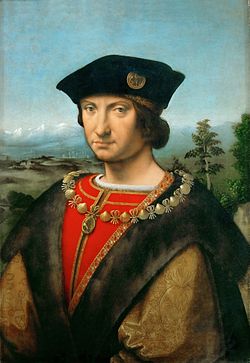 Charles d'Amboise in the cockleshell collar of the Order of Saint Michael, 1507
 -
 The insignia of a knight of the Order of the Garter


Collars of Freemasonry
[edit]Collars also have a long history within Freemasonry. Collars are often worn by officers of high rank. Nearly all Grand Lodge officers wear collars as an emblem of their office. In history, many such collars are quite valuable, featuring gold and precious jewels.
Collars vary widely among Masonic Grand Lodges. While those Lodges working under the Grand Lodge of England have fairly uniform designs, Grand Lodges in the United States vary widely, employing collars made from metal chains backed by velvet, to those made of velvet and embroidered with gold and silver bullion thread.
Today, English lodge officers wear a fabric collar with a simple jewel of their office pendant to it. Each jewel represents a skill or virtue which he possesses and instructs the brothers of Masonry in. In some jurisdictions, these jewels are silver-plated for the Craft or Blue Lodges under 100 years old, or gold-plated for lodges older than 100 years. The collars generally sit on the wearer's shoulders and fall over the chest, ending in a point between the breasts.
See also
[edit]Citations
[edit]- ^ a b Barron 1911, p. 684.
- ^ Crane, 19
- ^ Collar of Esses
- ^ Vitullo-Martin, Julia (24 March 2022). "At the Frick Madison, a Daring New Program Juxtaposes Old Masters and Queer Art". Untapped New York.
- ^ "Henry VIII-era chain up for sale", 5 October 2008, BBC.com
- ^ Barron 1911, pp. 684–685.
- ^ a b c d e Barron 1911, p. 685.
- ^ Fox-Davies, Arthur Charles (1909), A Complete Guide to Heraldry, London
{{citation}}: CS1 maint: location missing publisher (link). - ^ Boutell, Charles (1863), Heraldry Historical & Popular, London, p. 298
{{citation}}: CS1 maint: location missing publisher (link). - ^ Davis, C. T. The Monumental Brasses of Gloucestershire, London, 1899. Davis correctly states the date of death as 1417, yet incorrectly calls him 4th Lord in place of 5th.
- ^ Strong 1975, pp. 16–17
General and cited references
[edit]- Purey-Cust, Arthur Percival. (1910). The Collar SS: A History and a Conjecture. Leeds, Richard Jackson. OCLC 7504736
- Strong, Roy. (1975). Nicholas Hilliard London: Michael Joseph. ISBN 978-0-718-11301-8; OCLC 1622631
Attribution:
- This article incorporates text from a publication now in the public domain: Barron, Oswald (1911). "Collar". In Chisholm, Hugh (ed.). Encyclopædia Britannica. Vol. 6 (11th ed.). Cambridge University Press. pp. 684–685.

Further reading
[edit]- Ward, Matthew, The Livery Collar in Late Medieval England and Wales: Politics, Identity and Affinity (The Boydell Press: Woodbridge, 2016).
External links
[edit]
| Distinctions (Lists) |
|    | ||||||||||||||||||||||||||||||||||||
|---|---|---|---|---|---|---|---|---|---|---|---|---|---|---|---|---|---|---|---|---|---|---|---|---|---|---|---|---|---|---|---|---|---|---|---|---|---|---|
| Ceremonies and events | ||||||||||||||||||||||||||||||||||||||
| Related organisations | ||||||||||||||||||||||||||||||||||||||
| Related concepts | ||||||||||||||||||||||||||||||||||||||
| ||||||||||||||||||||||||||||||||||||||


Livery collar
View on GrokipediaDefinition and Characteristics
Materials, Design, and Construction
Livery collars were typically fashioned as neck chains or bands, constructed from interlinked elements to form a durable, visible insignia of allegiance. Prestigious variants were crafted entirely from precious metals, including gold or silver, by skilled goldsmiths and jewelers who employed metalworking techniques to create symbolic links.[3][1]Less costly examples for lower-ranking retainers used a foundation of leather or velvet, overlaid with decorative devices in silver, silver-gilt, or gold to denote status while maintaining functionality.[1]
Designs centered on repeated heraldic motifs tied to the patron's identity, such as the Lancastrian collar of esses, featuring S-shaped links—possibly symbolizing "sovereignty" or a Lancastrian motto—united by smaller rings into a continuous chain. A silver example preserved in the Museum of London comprises 41 such links, extending about 700 mm in length, and was likely produced in late 14th- or 15th-century England for distribution among supporters.[7][3][2]
Yorkist collars adopted alternating sunburst and rose emblems, linked in similar fashion using gold or silver, reflecting the house's badges and introduced around 1461. Many collars incorporated a pendant livery badge suspended from the base, enhancing symbolic depth without altering core construction. Enamel or gemstone embellishments appeared in high-end pieces, though base metal pewter versions existed for broader distribution.[1][7]
Distinction from Other Insignia
The livery collar differed from other medieval insignia in its specific form and purpose as a neck-worn chain or strap, often of leather or velvet adorned with repeated metal devices symbolizing a lord's livery, primarily denoting service and loyalty within a noble or royal affinity.[1] This contrasted with livery badges, which were individual emblems typically sewn onto clothing, hats, or standards, serving as less prestigious markers for lower-ranking retainers or broader distribution.[1] While badges could number in the thousands for mass mobilization, collars were more selective, awarded to esquires, gentlemen, household officers, and key allies, embodying greater status within the livery system.[1] Unlike the collars of chivalric orders, such as the Order of the Garter's badge on a garter or the Order of the Golden Fleece's elaborate fleece pendant chain, livery collars lacked the exclusivity, statutory oaths, and ceremonial investitures associated with knightly fraternities limited to elite membership—often fewer than 30 individuals per order.[8] Livery collars functioned as practical tools for forging extensive political networks, distributed widely (sometimes hundreds per lord) to tenants, sheriffs, and battlefield supporters without requiring chivalric vows or chapter attendance, emphasizing hierarchical allegiance over personal knighthood.[1] In England, royal variants like the collar of SS held particular symbolic weight, distinguishing them from private noble insignia through legislative efforts to reserve such collars for monarchical use by the early 15th century.[9] This distinction extended to chains of office, which denoted specific administrative roles rather than general fealty, and to simpler personal jewels, underscoring the livery collar's role in visibly projecting a patron's influence across social strata.[1] Archaeological and artistic evidence, including over 400 tomb effigies and brasses from the 14th to 16th centuries, confirms collars' prevalence in England and Wales, often defaced post-dynastic shifts to erase rival loyalties.[1]Historical Origins and Development
Early Emergence in 14th-Century England
The livery collar, a chain or band worn around the neck to signify allegiance to a particular lord or king, first emerged in England during the late fourteenth century as an evolution from earlier livery badges and clothing allowances used to mark retainers' loyalty.[10] This development coincided with the reign of Richard II (1377–1399), whose court emphasized ostentatious displays of hierarchy and fealty amid political instability.[11] Prior customs involved distributing badges sewn onto garments, but the collar represented a more durable and visible symbol, often crafted from gold links or leather straps adorned with symbolic motifs, allowing wearers to publicly affirm their patron's authority.[12] One of the earliest documented instances appears in the 1382 monumental brass of Sir Thomas Burton in Little Casterton Church, Rutland, depicting him wearing an SS collar, suggesting its use among the gentry by the 1380s.[13] Richard II actively promoted such collars, as evidenced by his own broomcod (genet pod) collar and white hart pendant shown in the Wilton Diptych (c. 1395–1399), where the king kneels before the Virgin Mary, and angels bear his livery badges.[14] Treasury inventories from Richard's reign, including those referencing jewels from Edward III's time transferred to Richard II, record collars as items of royal livery distributed to household members and allies, marking a shift toward personalized insignia that reinforced vertical ties of service.[15] The collars' proliferation under Richard II stemmed from the king's strategy to build affinities during conflicts like the Peasants' Revolt aftermath and baronial opposition, with recipients ranging from knights to administrative retainers.[1] By 1394, parliamentary complaints highlighted the scale of distribution, noting how Richard compelled subjects to wear his livery collars under threat, viewing it as an overreach that blurred lines between voluntary fealty and coerced allegiance.[11] This early phase established the collar as a tool for political cohesion, though its novelty invited scrutiny for fostering factionalism rather than genuine loyalty.[10]Expansion and Standardization in the Lancastrian Era
Following Henry IV's seizure of the throne from Richard II in 1399, the livery collar—particularly the Collar of Esses (SS)—expanded rapidly as a tool for consolidating Lancastrian power and rewarding loyalty. In his first year, Henry IV distributed 192 collars (91 silver-gilt and 81 silver) to esquires, merchants, servants, and former retainers of John of Gaunt, with an additional 200 silver or silver-gilt collars issued upon his return to England.[11][16] This mass distribution marked a shift from private noble usage to royal patronage, associating wearers publicly with the new dynasty and enabling the king to build affinities amid political instability.[11] Standardization occurred swiftly, with the SS collar designated as the royal livery by 1401 through parliamentary legislation that banned non-royal liveries while exempting the king's "le Coler" for use by the royal family and favored followers.[17] Stored in the Jewel House, it became a symbol of crown authority rather than mere Lancastrian ducal affiliation, evolving from leather straps to metal chains often featuring pendants like the swan device.[11] Materials were regulated by rank—gold for knights, silver-gilt or silver for esquires—reinforcing hierarchical distinctions in its display.[16] Under Henry V and Henry VI, distribution proliferated further, extending to diplomatic gifts such as 24 silver-gilt and 60 silver collars to Emperor Sigismund in 1434, and 50 gold SS collars to Gianfrancesco Gonzaga in 1436, underscoring its role in foreign alliances.[11] By mid-century, over 100 depictions appeared on church monuments across England, with clusters in Lancastrian strongholds like Derbyshire, evidencing widespread adoption among gentry and household officials.[16] Approximately 391 extant representations on brasses and effigies survive from the period, reflecting standardized use as a marker of royal service persisting until the dynasty's fall in 1461.[11] ![Brass depicting a livery collar from 1417, Wotton-under-Edge, Gloucestershire]float-rightProminent Variants
The Collar of Esses
The Collar of Esses, also known as the SS collar, was a distinctive livery badge consisting of a chain formed by interlocking links shaped like the letter "S," typically crafted from silver or gold and often featuring a pendant badge such as a white swan or antelope. It emerged in the late fourteenth century as an emblem of allegiance to the House of Lancaster and was exclusively worn by individuals connected to the Lancastrian royal affinity, including retainers, high officials, and supporters.[3][18] This collar is regarded as one of the earliest systematic livery collars in Europe, signaling prestigious royal ties and hierarchical loyalty.[3] Its origins are linked to John of Gaunt, Duke of Lancaster (1340–1399), father of Henry IV, with the earliest documented instances appearing around 1391 in forms comprising 17 "S" links.[15] Henry IV (r. 1399–1413), upon his usurpation of the throne, distributed the collar liberally among adherents to consolidate support, making it a hallmark of Lancastrian patronage.[19] The collar's prominence continued under Henry V (r. 1413–1422) and Henry VI (r. 1422–1461), who granted versions in precious metals to chief allies, ambassadors, and officeholders, reinforcing retinue networks during periods of political instability.[7] Surviving examples, such as silver collars with 41 links, and depictions in funeral brasses—like that of Lord Thomas de Camoys (d. 1419) or effigies of recipients such as Sir David Matthew (d. 1484)—illustrate its use in both life and commemoration.[3][3] The symbolism of the "S" remains subject to scholarly debate, with interpretations including "sovereign" (reflecting Lancastrian claims to supreme authority) or derivations from mottos like Henry IV's "Souvenez" (a call to remembrance).[20][21] Some accounts attribute it to the final utterance of Gaunt's first wife, Blanche of Lancaster ("Soubsioun," implying hope or sustenance), though this lacks primary corroboration and is considered speculative.[22] Regardless of etymology, the collar functioned as a visible marker of fealty amid factional rivalries, particularly contrasting with Yorkist symbols like the sunburst during the Wars of the Roses, after which its mandatory distribution waned following the Lancastrian defeat in 1461.[23]Private and Noble Livery Collars
Private and noble livery collars were distinctive neck chains or badges commissioned by individual magnates and lesser nobles to denote allegiance from their personal retainers, separate from royal variants like the Lancastrian collar of esses or Yorkist suns and roses. These collars emerged in the late 14th century amid the growth of bastard feudalism, where lords built affinities through patronage networks offering protection in exchange for service, often distributing collars to gentry, merchants, and occasionally lower ranks to foster loyalty and group identity. Unlike royal collars, which symbolized direct monarchical service and faced parliamentary scrutiny for over-distribution, private collars emphasized familial or local ties, with designs reflecting personal heraldry or paraheraldry rather than standardized royal motifs.[24][10] Designs varied widely, often comprising interlinked symbols such as knots, stags, mermaids, or rings suspended from chains, tailored to the noble's arms or inventions; for instance, the Welles family collar featured interlinked chains with ring pendants, depicted on the tomb effigy of Lionel Welles, 6th Baron Welles (d. 1461), at Methley Church, Yorkshire, signifying personal lordship within Lancastrian circles. Edward Stafford, 1st Duke of Buckingham (d. 1521), distributed up to 2,000 personal livery badges, underscoring the scale of magnatial patronage. Other examples include Sir John Sewell's collar of knots (1433, Houghton Regis brass), the Markenfield stag collar on monuments in Ripon, and the Berkeley mermaid collar (c. 1417, Wotton-under-Edge, Gloucestershire), which highlighted judicial or familial status among gentry. These collars were typically crafted from silver-gilt or gold links, sometimes with leather or velvet bases for lesser recipients, and served as visible markers of hierarchical bonds in regions like Devonshire and Wales, where prosopographical evidence links them to kinship and marriage alliances rather than solely royal fealty.[10][25][10] Depictions of private collars abound on late-medieval church monuments, particularly brasses and effigies from 1371 to 1540, concentrated in southern and eastern England, where lower nobility and gentry used them to commemorate success and connections; surveys identify 391 such collars nationally, with private variants comprising a subset distinct from the 28 Lancastrian and 9 Yorkist examples in southwest counties alone. Women occasionally wore them, as on Lady Margaret Choke's monument (c. 1470, Long Ashton, Somerset), mirroring spousal status. By the early 16th century, as monarchs like Henry VII restricted livery to curb factionalism, private collars evolved into judicial insignia or declined in favor of Tudor revivals, yet persisted in symbolic form on memorials to affirm enduring noble identities.[25][24]Political and Social Functions
Role in Building Affinities and Retinues
Livery collars served as tangible markers of allegiance, enabling lords to construct and maintain affinities—networks of retainers, officials, and supporters bound by contractual loyalty rather than solely feudal land ties. In the late medieval period, particularly the 15th century, distribution of these collars allowed magnates to visually unify their followers, promoting cohesion during political assemblies, military campaigns, and local power struggles. This practice underpinned the relational dynamics of bastard feudalism, where lords offered liveries alongside fees and legal maintenance to secure service, thereby expanding retinues beyond traditional household sizes to include gentry and lesser knights.[10][11] Royal examples illustrate the collars' efficacy in affinity-building; Henry IV's administration disbursed 192 collars in his first regnal year, with 91 in silver-gilt, 81 in silver, and the rest in finer materials, signaling prestige and drawing supporters to the nascent Lancastrian regime. Similarly, Henry V equipped his Agincourt retinue in 1415 with SS collars, reinforcing hierarchical bonds and group identity amid warfare, as evidenced by chroniclers noting their widespread adoption among campaign participants. Private nobles emulated this, commissioning bespoke designs like the Welles collar to denote personal lordship over regional affinities, evident in funerary monuments where effigies display such insignia to perpetuate posthumous loyalty displays.[9][11][10] By publicly associating wearers with a patron's authority, collars incentivized recruitment, as the visible emblem conveyed protection and advancement opportunities, while deterring defection through social visibility. This mechanism facilitated rapid mobilization of retinues for parliamentary influence or royal service, with affinities numbering in the dozens to hundreds for major lords, though precise scales varied by resources and era. Such distribution fostered mutual obligations, where retainers' display of the collar advertised the lord's power, creating a feedback loop of prestige and allegiance central to late medieval political structures.[1][11]Symbolism of Fealty and Hierarchical Order
![Berkeley Mermaid Collar, c. 1417, discovered in Wotton-under-Edge, Gloucestershire][float-right]The livery collar embodied fealty as a public vow of loyalty and service, worn by retainers to signify their binding obligation to a lord under the feudal system. In late medieval England, recipients of such collars—often nobles, knights, or household officials—displayed them to affirm their allegiance, which entailed providing counsel, military support, or administrative aid in return for patronage, fees, or protection. This practice, prominent from the mid-14th century onward, visually materialized the personal oaths of homage that underpinned feudal relationships, ensuring that loyalty was not merely contractual but performatively evident in daily life and public assemblies.[1][3] By marking wearers as extensions of their lord's authority, livery collars reinforced hierarchical order within the stratified feudal structure, where power flowed vertically from monarchs and magnates to their affinities. The collars delineated clear lines of subordination, with elaborate designs like the Lancastrian Collar of Esses—comprising interlinked 'S' motifs introduced by John of Gaunt around the 1360s—elevating the status of high-ranking retainers while subordinating them to the dynasty. This symbolism extended to broader societal layers, as lords distributed collars to cultivate retinues that projected strength and unity, thereby stabilizing the pyramid of allegiance amid competing noble factions. Effigies on church monuments, such as those from the 15th century depicting deceased knights with collars, perpetuated this hierarchy posthumously, commemorating eternal fidelity to patron lineages.[10][25][26] The collars' design and bestowal further underscored causal dynamics of reciprocity and control, as lords used them to incentivize loyalty while monitoring adherence through visible affiliation. In instances like the distribution by Edward III in the 1360s or Henry IV post-1399, collars served as tools for political cohesion, binding disparate followers into a hierarchical network that mirrored the king's sovereignty over vassals. This overt display mitigated risks of disloyalty by making affiliations transparent, thus preserving order in a era prone to baronial rivalries, though it later invited scrutiny for fostering over-mighty subjects.[11][1]