Recent from talks
Nothing was collected or created yet.
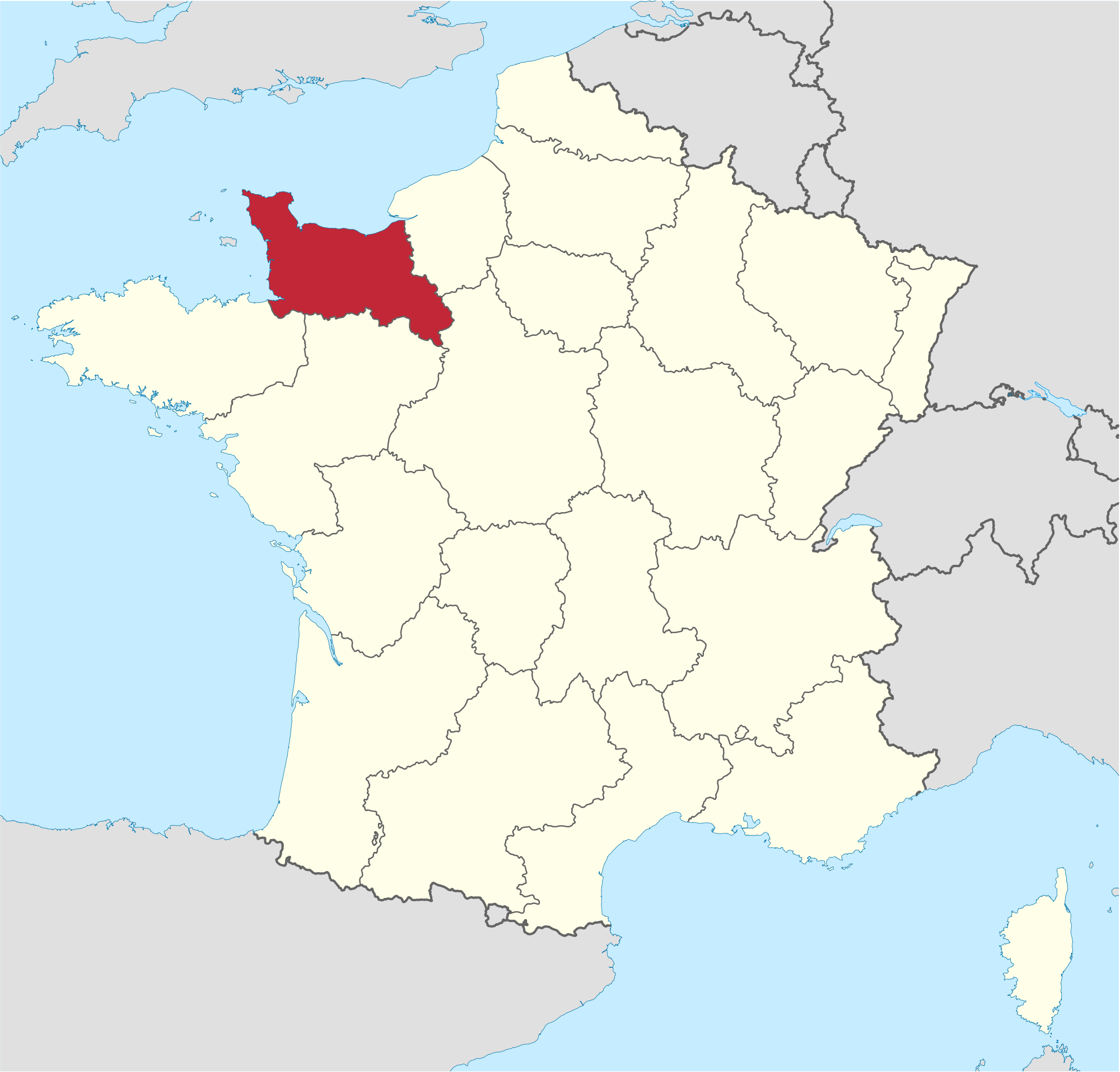
Lower Normandy
View on WikipediaThis article needs additional citations for verification. (May 2024) |
Lower Normandy (French: Basse-Normandie, IPA: [bɑs nɔʁmɑ̃di, bas -] ⓘ; Norman: Basse-Normaundie) is a former administrative region of France. On 1 January 2016, Lower and Upper Normandy merged becoming one region called Normandy.[2]
Key Information
Geography
[edit]The region included three departments, Calvados, Manche and Orne, that cover the part of Normandy traditionally termed "Lower Normandy" lying west of the river Dives, the Pays d'Auge (except a small part remaining in Upper Normandy), a small part of the Pays d'Ouche (the main part remaining in Upper Normandy), the Norman Perche, and part of the "French" Perche. It covers 10,857 km2, 3.2 percent of the surface area of France.[3]
The traditional districts of Lower Normandy include the Cotentin Peninsula and La Hague, the Campagne de Caen, the Norman Bocage, the Bessin, and the Avranchin.
History
[edit]- Regions relating to Lower Normandy: Gallia Lugdunensis, Neustria, and Normandy.
The traditional province of Normandy, with an integral history reaching back to the 10th century, was divided in 1956 into two regions: Lower Normandy and Upper Normandy.
During the Roman era, the region was divided into several different city-states. That of Vieux was excavated in the 17th century, revealing numerous structures and vestiges bearing testimony to the prosperity of the Caen region.
The region was conquered by the Franks in the 5th century.
In the 9th century, the Norman conquests devastated the region. Much of the territory of Lower Normandy was added to the Duchy of Normandy in the 10th century.
In 1066, Duke William Il of Normandy conquered England. He was buried in Caen. After his death, Normandy went to his eldest son and England went to his second son, separating the two possessions.

The victory of Tinchebray in 1106 gave Normandy to the kings of England again. Nearly one hundred years later, in 1204, King Philip II Augustus of France conquered the region, apart from the Channel Islands. Then, during the Hundred Years' War, it was regained by the Plantagenets. However, the French recovered the mainland part of the region between 1436 and 1450. By 1453, the French monarchy controlled much of modern France apart from Calais, which remained in English hands.
During the Second World War, the main thrust of Operation Overlord was focused on Lower Normandy. The beaches of Calvados were the site of the D-Day landings in June 1944. Lower Normandy suffered badly during the War, with many of its towns and villages being destroyed or badly damaged during the Battle of Normandy.
Economy
[edit]The region's economy is heavily agricultural, with livestock and dairy farming, textiles and fruit production among its major industries. The region is the leader in France in the sectors of butter, fromage frais, soft cheeses, cider apples, cider, leeks, turnips, and flax. The region also breeds more horses than any other in France. The western part of the region is used mainly for farming, because of the prairies. Iron ore is mined near Caen. Tourism is also a major industry. The region has direct ferry links to England (via the port of Cherbourg and Caen Ouistreham).
Culture
[edit]In addition to French, Normandy has its own regional language, Norman. It is still in use today in Lower Normandy, with the dialects of the Cotentin more in evidence than others. Lower Normandy has also been the home of many well-known French authors, including Guy de Maupassant, Marcel Proust, Jules Barbey d'Aurevilly. Notable Norman language authors connected especially with Lower Normandy include Alfred Rossel, Louis Beuve, and Côtis-Capel.
In terms of music, composer Erik Satie also hailed from this region. In the visual arts, Jean-François Millet was a native of La Hague. Eugène Boudin was born in Honfleur and Fernand Léger in Argentan. Important events include Deauville Asian Film Festival and Deauville American Film Festival.
Major communities
[edit]References
[edit]- ^ "EU regions by GDP, Eurostat". Retrieved 18 September 2023.
- ^ Loi n° 2015-29 du 16 janvier 2015 relative à la délimitation des régions, aux élections régionales et départementales et modifiant le calendrier électoral (in French)
- ^ (Northcutt, 1996, p. 181)
- Northcutt, Wayne; The Regions of France, A Reference Guide to History and Culture; 1996; Greenwood Press; ISBN 0-313-29223-X
External links
[edit]- Normandy - Official French website (in English)
- Official website
Lower Normandy
View on GrokipediaAdministrative Overview
Formation and Departments
Lower Normandy was first delimited in 1956 as one of France's 22 circonscriptions d'action régionale, forming part of the administrative framework designed to facilitate economic planning and development under the modernization efforts initiated by the law of 2 February 1955. This creation divided the historic Normandy territory into two separate entities—Haute-Normandie and Basse-Normandie—to align with contemporary administrative needs for regional coordination, as outlined in decrees establishing 21 such circonscriptions across metropolitan France. The specific designation of programs and departments for each regional action framework, including Basse-Normandie, was formalized by an arrêté dated 28 November 1956, published in the Journal Officiel on 6 December 1956. This framework was further developed into administrative regions with elected councils by the loi n° 72-619 du 5 juillet 1972.[9][10][11][12] The region consisted of three departments, all established during the French Revolution as part of the initial 83 departments created to replace the ancien régime provinces and promote administrative uniformity. Calvados, designated as the 14th department, was formed on 4 March 1790 from portions of the former province of Normandy, encompassing coastal areas around the Bay of the Seine. Manche, the 50th department, was also created on 4 March 1790, drawing from western Norman territories including the Cotentin Peninsula. Orne, numbered 61st, originated on the same date from inland percheron and norman lands to the south. These departments maintained their original boundaries within Lower Normandy until the region's dissolution.[13][13][13] Each department had its prefecture serving as the administrative seat: Caen for Calvados, where the prefect oversaw departmental governance and coordination with regional authorities; Saint-Lô for Manche, functioning as the hub for local administration in this coastal department; and Alençon for Orne, directing inland affairs from this southern locale. These prefectures handled departmental-level functions such as civil registration, public security, and infrastructure maintenance, while deferring broader regional policy to the overarching structure in Caen.[13][13][13] The combined area of these three departments totaled 17,589 km², representing approximately 3.2% of metropolitan France's surface and underscoring the region's predominantly rural and coastal character. This expanse included diverse terrains from bocage hedgerows in the interior to expansive beaches along the English Channel, though administrative divisions followed historical rather than strictly physical lines.[14] Prior to its merger, Lower Normandy's governance centered on the Regional Council seated in Caen, an elected deliberative assembly that directed regional competencies including economic development, transport, education, and environmental policy. Comprising representatives from the three departments, the council operated under a president elected from its members, supported by an executive commission of vice-presidents responsible for specific portfolios such as training and infrastructure. Administrative operations were centralized in Caen, with key services including a dedicated human resources unit managing around 1,482 permanent full-time equivalents (ETP) in 2015, a public procurement service handling regional markets, and a finance department overseeing a budget that emphasized investments in vocational training and rail networks. The council's structure emphasized functional nomenclature for budgeting and procurement, with tools like the Grand Angle software ensuring compliance with public spending thresholds, while specialized directorates—such as the Direction de la Formation Tout au Long de la Vie—autonomously managed sectors like professional education for youth and adults. This setup allowed for coordinated regional action while respecting departmental autonomies.[15][15][15]Merger and Post-2016 Status
The merger of Lower Normandy (Basse-Normandie) with Upper Normandy (Haute-Normandie) was enacted as part of France's broader territorial reform, initiated by the loi de modernisation de l'action publique territoriale et d'affirmation des métropoles (MAPTAM) in 2014 and finalized through loi n° 2015-29 of January 16, 2015, which delimited the new regional boundaries.[16] This legislation reduced the number of metropolitan regions from 22 to 13, with the unified Normandy region officially taking effect on January 1, 2016, dissolving the independent status of Lower Normandy.[17] Preparatory administrative fusions, including the consolidation of state services, began in 2015 under the coordination of regional prefects to ensure a smooth transition. Governance during the initial phase relied on the regional elections held on December 6 and 13, 2015, which elected a single council for the new Normandy region, comprising representatives from both former entities. This council assumed full authority from January 2016, with no separate provisional body; however, transitional arrangements included Rouen as the provisional regional capital until September 2016, when the name "Normandie" and permanent structures were confirmed by decree.[18] The first full session of the council occurred in early 2016, focusing on integrating policies from the two predecessor regions. Local administration underwent significant restructuring, with the regional prefecture centralized in Rouen to oversee state functions across the enlarged territory, while the regional council's seat was established in Caen to balance geographic representation.[19] This dual-location model helped mitigate tensions between former Lower and Upper Normandy areas, preserving local identities through dedicated vice-presidencies for sub-regional coordination and continued use of legacy department-based services.[15] Cultural and economic initiatives, such as joint heritage projects, were prioritized to maintain distinct regional flavors within the unified framework. As of 2025, nearly a decade post-merger, Normandy operates as a cohesive administrative region with sub-regional planning units that reference former Lower Normandy territories for targeted development, including extended contrats de plan État-région (CPER) frameworks from 2015-2020 integrated into the 2021-2027 cycle. Cultural preservation efforts emphasize Lower Normandy's heritage, such as through labels for reconstruction-era patrimony and regional identity programs, ensuring balanced growth without erasing historical divisions.[20]Geography
Location and Borders
Lower Normandy is situated in the northwestern part of France, forming the western portion of the historical province of Normandy. It lies along the English Channel, with its northern and western boundaries defined by approximately 470 kilometers of coastline, including the scenic Côte Fleurie in the Calvados department and the rugged Cotentin Peninsula in the Manche department. This positioning places the region at a strategic crossroads between the Seine River axis to the east and the western Atlantic-facing areas.[21] The region's land borders extend to Upper Normandy in the northeast, Centre-Val de Loire in the southeast, the Pays de la Loire region in the south, and Brittany in the southwest, encompassing the departments of Calvados, Manche, and Orne within an area of about 17,600 square kilometers. To the west, across the Channel, Lower Normandy shares a maritime boundary with the British Crown Dependencies of the Channel Islands, notably Jersey and Guernsey, which lie just off the Cotentin coast and maintain historical ties to the Duchy of Normandy. These borders reflect the region's role as a transitional zone between northern France's sedimentary basins and the more ancient Armorican Massif to the west.[21][6][22] Geographically, Lower Normandy spans roughly from 48°30' N to 49°30' N latitude and 1°30' W to 0°30' E longitude, with its administrative centers oriented toward major transport corridors. It is approximately 200 kilometers northwest of Paris, facilitating connectivity via the A13 motorway, which links Caen to the capital through Rouen, and the A84, which extends southward to Rennes. These infrastructure elements underscore the region's accessibility within France's national network.[23][24]Physical Features and Terrain
Lower Normandy's terrain is diverse, primarily shaped by the ancient Armorican Massif, featuring metamorphic rocks in the west and sedimentary formations in the east. The region includes the rugged Cotentin Peninsula with its cliffs, marshes, and granite outcrops; the characteristic bocage landscape of hedged fields and pastures in inland Orne and Calvados, ideal for agriculture; and the hilly Suisse Normande area along the Orne River valley, with gorges, meanders, and peaks reaching up to 417 meters at Mont des Avaloirs. Other notable features encompass over 16,000 kilometers of rivers and streams, extensive wetlands such as the bay of Mont Saint-Michel, and low-relief plains in the north. The highest point is Signal d'Écouves at 417 meters in Orne.[6]Climate and Environment
Lower Normandy features a temperate oceanic climate classified as Köppen Cfb, characterized by mild winters with average temperatures ranging from 5°C to 8°C and cool summers averaging 18°C to 22°C, moderated by the North Atlantic Current extending from the Gulf Stream. Annual precipitation is substantial, typically between 800 and 1,200 mm, distributed fairly evenly throughout the year, contributing to lush vegetation and frequent overcast skies. This maritime influence results in relatively low thermal amplitudes compared to inland France, with the region's proximity to the English Channel enhancing humidity levels.[25][26] Regional variations are pronounced due to topography and exposure to Atlantic weather systems. The Manche department, particularly the Cotentin Peninsula, experiences wetter and windier conditions with higher rainfall exceeding 1,000 mm annually and frequent coastal fog and storms, while the inland Orne department is drier with around 600-800 mm of precipitation and slightly more continental traits, including cooler winters. These differences arise from the bocage landscape's sheltering effects inland versus the open coastal exposure, leading to occasional sea mists and gales in winter.[25] Environmental challenges in Lower Normandy include significant coastal erosion affecting two-thirds of the shoreline, exacerbated by storm surges and rising sea levels, alongside flood risks from rivers such as the Orne, which has seen increased overflow events due to heavier winter rains. Agricultural runoff from intensive farming in bocage areas contributes to water quality degradation through sediment and nutrient pollution in rivers and coastal waters, posing threats to aquatic ecosystems. These issues are intensified by climate change projections of more extreme precipitation events.[27][28][29] Conservation efforts emphasize protected areas and integrated policies, with the Natura 2000 network encompassing numerous sites across the region that safeguard biodiversity hotspots like wetlands and salt marshes, covering over 7% of Normandy's land. The Normandie-Maine Regional Natural Park, spanning parts of Orne, focuses on habitat preservation for species such as the European beaver and ancient woodlands through management plans. Following the 2016 regional merger, unified environmental strategies have enhanced coordination for flood prevention, erosion control, and sustainable land use across former Lower Normandy departments.[30][31][25]History
Ancient and Medieval Periods
The region of Lower Normandy bears traces of Neolithic settlements dating to approximately 5000 BCE, marked by megalithic constructions that highlight early agricultural societies. These include dolmens and standing stones, such as those in the Pays de Domfront area of the Orne department, erected between 4500 and 2500 BCE as burial chambers and ceremonial sites. Similar structures, influenced by broader Atlantic megalithic traditions like those near Carnac in Brittany, appear in the Manche department, underscoring the area's role in prehistoric ritual and community life.[32][33] From the 1st to 5th centuries CE, Lower Normandy formed part of the Roman province of Gallia Lugdunensis, following Julius Caesar's conquest of the region in 56 BCE. The civitas of the Viducasses centered on Aregenua, near modern Vieux in the Calvados department, which served as an administrative hub with a population of 4,000 to 6,000 at its peak, featuring a forum, public baths, and elite residences. Luxurious villas dotted the Calvados countryside, exemplifying Roman agricultural estates and cultural integration, while ports along the coast supported trade in goods like grain and pottery until economic decline and barbarian incursions in the 3rd century led to ruralization.[34][35][36] Viking raids intensified along the Normandy coast from the 9th century, prompting the Treaty of Saint-Clair-sur-Epte in 911, by which King Charles III granted Rollo and his Norse followers territory between the Seine and Epte rivers, laying the foundation for the Duchy of Normandy. Rollo's descendants expanded the duchy to include the Cotentin Peninsula and other areas of what became Lower Normandy, adopting Frankish customs, Christianity, and the [French language](/page/French language) by the early 10th century, transforming the region into a feudal stronghold blending Scandinavian seafaring traditions with continental governance.[37] The medieval period saw the Duchy reach its zenith under William the Conqueror, born around 1028 in Falaise in the Calvados department, who inherited the title in 1035 and consolidated power amid feudal rivalries. His invasion of England in 1066, culminating in the Battle of Hastings, is immortalized in the Bayeux Tapestry, an embroidered linen narrative created in the 1070s under the patronage of Odo, Bishop of Bayeux, depicting the conquest's key events from Harold's oath to William's coronation. Feudal structures flourished in Lower Normandy's bocage terrain, where fragmented hedgerows and manorial estates, emerging from the 11th century, organized land tenure, serf labor, and local lordships, shaping the rural landscape enduring into later eras.[38][39][40][41] During the Hundred Years' War (1337–1453), Lower Normandy became a primary battleground between English and French forces. English invasions captured key areas, including Caen in 1346 and much of the Cotentin Peninsula, leading to prolonged occupations that devastated the region's economy and population. Significant engagements included the Battle of Formigny in 1450 near Bayeux, where French forces decisively defeated the English, contributing to their final expulsion from Normandy by 1450. These conflicts left lingering Anglo-French rivalries that periodically threatened the region in subsequent centuries.[42][34]Early Modern to 19th Century
During the French Wars of Religion (1562–1598), Lower Normandy emerged as a significant Protestant stronghold, with Huguenots gaining substantial influence in key urban centers such as Caen and Saint-Lô.[43] The rapid growth of Protestant communities in these areas was evident from the mid-1560s, when baptism records in Caen and Saint-Lô reached their historical peaks, reflecting widespread conversion amid the spread of Calvinist ideas across Normandy.[44] Although no major siege targeted Caen directly in 1562, the region's Protestant control over cities like Caen facilitated Huguenot military actions and alliances, contributing to the broader civil strife that devastated France.[43] The conflicts culminated in the Edict of Nantes in 1598, issued by Henry IV, which granted limited religious tolerance to Huguenots and allowed them to maintain worship in designated places, including strongholds in Lower Normandy; this edict temporarily stabilized the region by permitting Protestant communities in Caen and Saint-Lô to coexist with Catholic majorities, though tensions persisted into the 17th century.[45] These historical claims fueled later conflicts, including naval raids and blockades during the 18th century, as Britain and France clashed in wars such as the War of the Austrian Succession (1740–1748).[46] Although no full-scale English occupation occurred in Lower Normandy during this period, coastal areas faced risks from British privateers and expeditions targeting French ports, heightening regional fortifications.[46] The Treaty of Aix-la-Chapelle in 1748 ended the war by restoring most captured territories to their pre-conflict owners, averting further immediate threats to Normandy while underscoring the duchy's strategic vulnerability in European power struggles.[46] The French Revolution profoundly reshaped Lower Normandy's administrative and social landscape from 1789 to 1799. On March 4, 1790, the National Constituent Assembly reorganized France into 83 departments, dissolving the old province of Normandy and creating three in Lower Normandy: Calvados (centered on Caen), Manche (including Saint-Lô), and Orne.[47] This restructuring aimed to centralize authority and promote egalitarian principles, but it sparked resistance in rural areas, particularly the bocage landscapes of Orne and southern Calvados, where dense hedgerows provided cover for insurgents.[48] The Chouannerie, a royalist counter-revolutionary movement, gained traction here in the 1790s, fueled by opposition to conscription, secularization, and economic hardships; uprisings in the bocage involved peasant bands clashing with Republican forces, though activity remained more limited in Manche compared to neighboring Orne.[48] By 1799, the Directory's military campaigns suppressed the bulk of Chouan resistance in Lower Normandy, integrating the region more firmly into the revolutionary state.[48] In the 19th century, Lower Normandy underwent gradual industrialization and agricultural modernization, transforming its economy from agrarian dominance. Caen became a hub for textile production, specializing in fine lace such as blonde varieties and linen fibers, with workshops employing local artisans and benefiting from the city's port expansions in the mid-1800s.[49] Ironworking also developed, drawing on Orne valley ore mines to support foundries and early steel operations that supplied regional infrastructure.[50] Railway expansion accelerated connectivity starting in the 1850s, with the first line reaching Lower Normandy in 1854 via Bretoncelles, linking Caen to Paris and facilitating trade in dairy and manufactured goods.[51] Agricultural reforms emphasized dairy farming, particularly after 1815, as the adoption of new husbandry practices like improved fodder crops and selective breeding boosted milk yields in Normandy's pastures, establishing the region as a leading producer of butter and cheese by mid-century.[52]20th Century and World War II
Lower Normandy, like much of France, bore heavy losses during World War I, with the region contributing significantly to the national toll of over 1.3 million military deaths. Normandy as a whole recorded 78,013 combatant fatalities between 1914 and 1918, reflecting the intense mobilization of rural departments such as Calvados, Manche, and Orne, where young men were drafted en masse for frontline service in major battles like the Marne and Verdun.[53] In the Orne department alone, nearly 2,500 native soldiers perished in the first five months of the war, from August to December 1914, underscoring the rapid devastation of early campaigns. These sacrifices are commemorated through numerous local monuments aux morts, particularly in Orne, where plaques and memorials honor the fallen and serve as enduring symbols of regional grief and resilience.[54] The interwar period gave way to World War II, during which Lower Normandy fell under German occupation from June 1940 until its liberation in 1944. The region, part of the occupied zone, experienced the full brunt of Nazi control, including resource extraction and forced labor, while the Vichy regime's collaborationist policies—such as anti-Semitic statutes and economic concessions to Germany—extended influence into local administration, though overt collaboration varied by community.[55] In response, robust Resistance networks emerged, particularly in the bocage landscape of Manche, where dense hedgerows and rural isolation provided natural cover for sabotage, intelligence gathering, and arms smuggling; groups like the Francs-Tireurs et Partisans coordinated with Allied agents to disrupt German supply lines.[56] These efforts intensified ahead of the Allied invasion, with resisters in Manche severing communication lines and ambushing patrols to aid Operation Overlord.[57] The pivotal D-Day landings on June 6, 1944, targeted Lower Normandy's coastline as part of Operation Overlord, the Allied campaign to liberate Western Europe. American forces assaulted Utah Beach in the Manche department and Omaha Beach in Calvados, facing fierce defenses but securing beachheads that enabled the buildup of over 2 million troops by August.[58] The ensuing Battle of Normandy, lasting until late August 1944, saw intense fighting across the region, with Caen—initially a key objective for British and Canadian forces—becoming a symbol of prolonged urban combat due to German counterattacks, resulting in over 200,000 Allied and Axis casualties.[59] Utah and Omaha beaches, marked by cliffs and fortifications, suffered the highest initial losses, yet their capture opened the path inland through the bocage, where hedgerow terrain slowed advances but ultimately favored Allied air superiority and infantry tactics. Post-war recovery in Lower Normandy was marked by extensive destruction, particularly in urban centers like Saint-Lô, where Allied bombings and ground battles razed approximately 95% of the city, earning it the moniker "Capital of Ruins."[60] Reconstruction efforts, bolstered by the Marshall Plan—which provided France with over $2.3 billion in U.S. aid between 1948 and 1952—focused on rebuilding infrastructure, housing, and agriculture in devastated areas, facilitating a regional renaissance.[61] This aid contributed to France's broader economic boom during the 1950s and 1960s, known as Les Trente Glorieuses, when Lower Normandy saw annual GDP growth averaging 5-6%, driven by modernization of ports like Cherbourg and agricultural mechanization.[62] The period culminated in the division of the traditional province of Normandy into Lower and Upper Normandy in 1956 as planning regions, which received formal administrative status in 1972 through the creation of regional councils to streamline post-war governance and development.[63]Demographics
Population Trends and Statistics
The population of Lower Normandy reached a peak of approximately 1.53 million inhabitants in 1851, according to historical census data. This marked the region's highest recorded total before a gradual decline set in, driven primarily by rural exodus as residents migrated to urban centers like Paris in search of industrial and service opportunities. By 1901, the population had fallen to about 1.23 million, and continued to decrease to a low of around 1.22 million by 1962 due to low birth rates and emigration.[64] From the 1960s onward, the population began to recover, reaching about 1.45 million by 2007.[65] Following the 2016 administrative merger into the larger Normandy region, statistics for the former Lower Normandy departments—Calvados, Manche, and Orne—have been tracked separately by INSEE, showing stabilization around 1.47 million inhabitants as of 1 January 2023 (700,595 in Calvados, 492,642 in Manche, and 272,872 in Orne).[66] As of 1 January 2025, the combined population is estimated at approximately 1.47 million. The population density in 2007 stood at 83 inhabitants per km² across the 17,589 km² area, with stark contrasts: the Caen metropolitan area concentrated over 400,000 residents, while the rural Orne department averaged just 30 inhabitants per km². This uneven distribution highlights ongoing urbanization trends, tempered by the region's agricultural heritage.[67] Demographic shifts in the 2010s revealed an aging population, with 21.8% of residents aged 65 and older by 2010, above the national average and contributing to a dependency ratio of about 77 seniors per 100 individuals under 20 by the late decade.[68] Net out-migration persisted historically toward the Paris region, exacerbating rural depopulation, though recent influxes linked to tourism and remote work have partially offset this, yielding a modestly positive migratory balance since the mid-2010s.[69] INSEE projections indicate relative stability through 2030, with the former Lower Normandy area holding at around 1.47 million, as modest gains in Calvados counterbalance slight declines in Manche and Orne amid continued aging and low fertility rates.[70]| Year | Population (millions) | Key Factor |
|---|---|---|
| 1851 | 1.53 | Historical peak before rural exodus |
| 1901 | 1.23 | Onset of prolonged decline |
| 2007 | 1.45 | Recovery from mid-20th century low |
| 2023 | 1.47 | Post-merger stabilization |