


Community hub
Recent from talks
Contribute something
Nothing was collected or created yet.
Lustschloss
View on Wikipedia
 | This article needs additional citations for verification. (February 2024) |


In Renaissance and Early Modern German architecture, a Lustschloss (French: maison de plaisance, both meaning "pleasure palace") is a country house, château, or palace which served the private pleasure of its owner, and was seasonally inhabited as a respite from court ceremonies and state duties.[1][2] In France, the Château de Madrid in the Bois de Boulogne, easily reached from Paris, arguably set an example, and Louis XIV similarly holidayed annually from the Palace of Versailles to his nearby Château de Marly, and more frequently used his Grand Trianon, to which the Petit Trianon was added in the following century.
There is no common term for such houses in English, and the phenomenon developed especially in the smaller states of Germany, where the ruler was firmly based in one or two main palaces, as opposed to the much larger number available to the monarchies of England, France, and Spain (after Henry VIII's prolific building, Elizabeth I of England had some 40 palaces, most now demolished). But Woodstock Palace seems to have had something of this role; the last monarch to use it was James I of England, in 1603, escaping the plague, which was another useful role these houses played. In France, it was mainly after the monarchy settled at Versailles that the need for them developed. In Italy the term villa covered them.
Lustschloss is often loosely used interchangeably with Jagdschloss, for both served as non-formal residences, but a Jagdschloss was a hunting retreat and was usually used to host a ruler and his hunting party.
History
[edit]At the beginning of the Renaissance, a desire for non-military residences arose amongst the nobility and they slowly left their old fortified castles or altered them into stately residences. In the course of the years, many aristocratic family seats grew into big estates; at the same time, the court ceremonial changed. Now, the prince stood more and more in the centre of a luxurious royal household that reached its zenith during the absolutism. The nobility surrounded themselves with artists, courtiers, envoys, servants and petitioners. Often the residences overflowed with guests.
The desire for greater intimacy led to the construction of the Lustschloss, to which often only certain circles of acquaintances were invited. Here its owners could withdraw with their family and relatives. The Lustschloss was above all a place for parties, dancing and music. It was also frequently used for literature and painting. This distinguished it from the main residence, which was often nearby. The latter served the state, in which etiquette had to be protected.
The most popular architectural styles for these particular castles were Baroque and Rococo, which both displayed a sense of wealth. The Lustschloss was often located in a splendid castle park, mostly distinguished by especially extensive and valuable decorations. At the same time the rooms and drawing rooms became more intimate and more comfortable. Significant artists from their respective region would work on many of their paintings in the castle. Famous examples are the Grand Trianon and the Petit Trianon in the gardens of Versailles, the Château de Marly, and the Amalienburg in the Schlosspark of Nymphenburg.
The name Lustschloss was often used interchangeably with the word Schloss, which is the general term for a palace, stately home or manor house. The purpose of a Lustschloss also changed – some were redeveloped over the years and were turned into palaces that took over representative tasks. An example of this is Sanssouci, which was originally established as a summer house, but over a period of time became the main residence of Frederick the Great of Prussia.
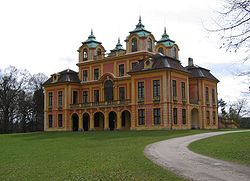
Some famous German examples of a Lustschloss are Schloss Benrath in Düsseldorf and Schloss Favorite in Ludwigsburg. The Favorite pleasure palace in Mainz was destroyed during the siege of Mainz (1793).
References
[edit]- ^ Hesse, Michael (1996). "Katharina Krause: Die Maison de plaisance. Landhäuser in der Ile-de-France (1660–1730)". Journal für Kunstgeschichte (in German). 1 (1). Deutscher Kunstverlag: 63–66. doi:10.11588/jfk.1997.1.29489.
- ^ Böhme, Horst Wolfgang; et al. (2020). Wörterbuch der Burgen, Schlösser und Festungen (in German). arthistoricum.net-ART-Books. ISBN 978-3-947449-80-4. Retrieved 2 February 2024.

| International | |
|---|---|
| National | |

Lustschloss
View on GrokipediaTerminology
Definition
A Lustschloss (plural: Lustschlösser) is a type of small palace or country house in Renaissance and Early Modern German architecture, constructed primarily for the private enjoyment, leisure, and seasonal retreats of its owner, often a ruler or noble, away from the rigors of formal court duties and urban residences.[4] These structures emphasized personal pleasure (Lust in German), comfort, and intimacy, serving as autonomous occasional residences rather than primary seats of power or administration.[4] Unlike larger royal palaces focused on governance and defense, a Lustschloss was typically of moderate scale, featuring luxurious yet restrained designs that prioritized recreational and social functions, such as entertaining guests in relaxed settings.[2] Key attributes of a Lustschloss include its isolation in scenic rural or forested locations, year-round habitability with features like fireplaces for winter use, and opulent interior decorations such as frescoes and stucco work to enhance sensory delight, all while maintaining a sense of seclusion through elements like moats or enclosing walls.[4] The term underscores a focus on hedonistic retreat and status display, distinguishing it from utilitarian buildings by blending architectural elegance with functional ease for activities like banquets, hunts, or contemplative solitude.[4] This architectural type emerged as a symbol of noble refinement, influenced by Italian Renaissance villa ideals but adapted to Central European contexts with Mannerist and later Baroque elements.[4] While overlapping with related forms, a Lustschloss is distinct from a Jagdschloss (hunting lodge), which prioritizes equestrian pursuits and game management over general leisure, though some Lustschlösser incorporated hunting facilities.[4] It also differs from a Sommerpalais (summer palace), as the former was not strictly seasonal or garden-dependent but designed as a fully equipped, versatile residence for extended stays regardless of weather.[4] The unique emphasis on Lust—encompassing joy, repose, and sensory pleasure—sets it apart, reflecting a cultural ideal of aristocratic escape during the 16th to 18th centuries.[4]Etymology
The term Lustschloss is a compound word in German, derived from Lust, meaning "pleasure," "delight," or "joy," which traces back to Old High German lust (desire or inclination) and Middle High German lust (enjoyment or fancy), rooted in Proto-Germanic lustuz denoting a sense of longing or gratification.[8] The second element, Schloss, refers to a "palace," "castle," or "manor house," originating from Middle High German sloz (lock or enclosure) and Old High German sloz (bolt or bar), evolving from the concept of a fortified or enclosed residence, akin to the verb schließen (to close or lock).[9] This combination literally translates to "pleasure palace" or "palace of delight," emphasizing structures designed for leisure rather than defense or governance.[10] The term Lustschloss first appeared in German-speaking regions during the 16th century, coinciding with Renaissance influences on architecture, as evidenced by references to imperial and noble retreats like Emperor Maximilian II's Neugebäude near Vienna, described as a Lustschloß in contemporary accounts for its role in private amusement and hunting. Exceptional examples from this era, such as the Stern hunting lodge in Bohemia, were already labeled as Lustschlösser in laudatory poems and inventories, highlighting their function as sites of repose amid natural settings.[11] By the 17th century, usage proliferated in Baroque contexts, where the term denoted more elaborate, non-representational residences focused on sensory enjoyment, distinguishing them from formal courts.[4] In other languages, Lustschloss finds equivalents that convey similar notions of leisurely retreats. The French terms maison de plaisance (house of pleasure) or château de plaisance (pleasure castle) directly parallel it, originating from Renaissance and early modern European architectural traditions where such buildings served sovereigns' private diversions, as seen in cross-cultural descriptions of German and French country houses.[10] In English, it corresponds to "pleasure palace".[10] The terminology evolved from broad Renaissance descriptors for informal summer residences to more specific Baroque-era applications, emphasizing opulent, isolated pleasure domains amid expanding court cultures.[4] Rare variants like Lusthaus appeared from the 16th century, typically denoting smaller wooden garden pavilions or houses of repose, as in Salzburg and Innsbruck examples built for aristocratic leisure by the 16th century, contrasting with the grander Lustschloss.[12] This shift reflected growing distinctions between modest Lusthäuser for intimate delight and expansive Lustschlösser for elaborate festivities.[4]Historical Development
Origins in the Renaissance
The Lustschloss emerged in the late 15th century within the Holy Roman Empire as a response to evolving noble lifestyles, where German princes and electors transitioned from heavily fortified medieval castles to modest, non-defensive country houses designed for private leisure, hunting, and escape from the rigors of urban courts. Early examples include Blutenburg Castle (c. 1488) near Munich, a hunting lodge reflecting humanist influences.[13] This development reflected broader socio-political changes, including relative stability following the medieval era's conflicts and the growing influence of Renaissance humanism, which emphasized personal enjoyment, intellectual pursuits, and artistic patronage over military utility. Early patrons sought these retreats to cultivate humanist ideals of otium—cultivated leisure—amid the Empire's fragmented principalities, allowing for spaces that blended functionality with aesthetic pleasure. Central to this origins were influences from Italian Renaissance villas, which inspired German architects to integrate classical forms, symmetrical layouts, and landscaped gardens into structures suited for entertainment and reflection. Humanist scholarship, drawing on ancient texts like those of Xenophon and Horace, promoted the notion of retreats fostering health, recreation, and cultural exchange, often with subtle nods to emerging Palladian principles of proportion and harmony with nature. These imported ideas adapted to local contexts, transforming small manor houses into prototypes of the Lustschloss, prioritizing serene environments over defensive features.[14] Prominent early examples appeared around 1550–1600, often commissioned by Habsburg rulers and Wittelsbach electors. Archduke Ferdinand II of Tyrol began adapting Ambras Castle near Innsbruck in 1564 as a personal pleasure palace for his wife Philippine Welser, incorporating Renaissance chambers for art collections and banqueting.[15] Emperor Maximilian II initiated Neugebäude outside Vienna in the 1560s, envisioning it as an imperial leisure complex with banqueting halls, sports facilities, and gardens modeled on classical Roman designs to embody humanist recreation. In Bavaria, Duke Albrecht V (r. 1550–1579) patronized Renaissance architecture, such as the Antiquarium in Munich, contributing to the cultural groundwork for later pleasure residences.[14][16]Expansion in the Baroque and Rococo Eras
The expansion of Lustschlösser during the Baroque and Rococo eras was deeply intertwined with the political landscape of absolutist rule in the fragmented German states, where rulers sought to project power and engage in intimate diplomacy away from the constraints of formal residences. In principalities such as Bavaria, Saxony, and Württemberg, these pleasure palaces flourished as venues for private entertainments, theatrical performances, and discreet negotiations, allowing sovereigns to cultivate alliances and display opulence to favored courtiers. This development was particularly pronounced in Catholic regions, where post-war reconstruction efforts emphasized grandeur to reaffirm authority and cultural prestige.[2][17] The 17th-century Baroque phase marked a significant surge in construction, spurred by the aftermath of the Thirty Years' War (1618–1648), which had devastated much of central Europe and prompted rulers to rebuild as symbols of resilience and divine favor. Absolutist princes invested in these structures to embody the era's dramatic aesthetic, characterized by bold forms and theatricality, often drawing on Italian and French influences to elevate their courts. By the 18th century, the style evolved into Rococo, introducing lighter, more asymmetrical designs with playful motifs like shells and foliage, reflecting a shift toward refined leisure and personal indulgence among the nobility. This refinement peaked in southern states, where palaces like those in Baden-Württemberg integrated seamlessly with surrounding landscapes through expansive gardens, contrasting with the more rigidly formalized layouts in northern Protestant areas.[18][19][20] Regional variations highlighted the diverse cultural priorities across German territories: in the south, such as Bavaria and Württemberg, Lustschlösser emphasized harmonious environmental integration, with terraced gardens and pavilions enhancing the sensory experience of nature and artifice. Northern examples, influenced by Prussian militarism, tended toward structured symmetry and restraint, though still serving absolutist displays. However, by the late 18th century, the construction of new Lustschlösser waned amid Enlightenment ideals promoting rationalism and simplicity, which critiqued the perceived frivolity of Rococo excess, compounded by the upheavals of the French Revolution that eroded absolutist patronage across Europe. Fewer commissions emerged after 1800, as neoclassical restraint supplanted the ornate pleasure palace tradition.[21][22][23]Architectural Features
Site and Layout
Lustschlösser were typically situated in rural or semi-rural settings, often within expansive parks, formal gardens, or forested areas, providing seclusion from urban centers and main princely residences.[6][24] This placement emphasized privacy and leisure, allowing rulers to escape courtly duties for seasonal retreats, particularly in summer, while remaining accessible by carriage from nearby estates.[2] For instance, Lustheim Palace was positioned 1,300 meters from the Old Schleissheim Palace along a central axis, serving as a focal point in the landscape.[6] The layout of these pleasure palaces followed compact, pavilion-like forms inspired by French maisons de plaisance and Italian villa traditions, featuring symmetrical facades and axial alignments that directed views toward natural or cultivated vistas.[2][24] Grounds were meticulously integrated with the architecture through formal gardens, including parterres, fountains, and ring canals, creating a harmonious blend of geometric order and environmental elements.[6][24] At Lustheim, semicircular colonnades flanked the central structure, originally intended to enclose orangeries and connect pavilions, enhancing the site's role as a garden centerpiece.[6] In terms of scale and functionality, Lustschlösser were generally limited to one or two stories with occasional wings for guest quarters, designed for intimate gatherings rather than large courts, and approached via landscaped paths without defensive features like moats.[2][1] Site-specific adaptations often oriented buildings toward scenic prospects, such as countryside panoramas or artificial water features, to amplify the pleasurable ambiance; Favorite Palace in Rastatt, for example, was aligned to exploit surrounding parkland views.[2][6]Interior Design and Decoration
The interiors of Lustschlösser were designed to foster intimacy and leisure, featuring compact spaces such as salons, small theaters, and galleries dedicated to music, dining, and conversation, deliberately eschewing the grand ceremonial halls typical of larger residences.[25] These room functions emphasized private enjoyment, with examples like the oval salon in Falkenlust serving as a central gathering space for informal pursuits.[26] Decorative styles evolved from the opulent Baroque to the lighter Rococo, with Baroque interiors showcasing elaborate frescoes, intricate stucco work, and lavish gilding to convey wealth and drama.[19] In the Rococo phase, designs shifted to pastel hues, shell motifs, asymmetrical patterns, and extensive use of mirrors to enhance natural light and create illusions of expanded space, as seen in the gilded Mirror Cabinet at Falkenlust and ornate stucco in Augustusburg Palace.[25] The chapel at Falkenlust exemplifies Rococo's playful naturalism through walls encrusted with shells and concretions forming a marine grotto effect.[25] Artistic patronage played a key role, with princely owners commissioning both local German masters and Italian artists for thematic decorations symbolizing leisure, love, and nature. For instance, Elector Clemens August of Bavaria employed architect Balthasar Neumann and Italian painter Carlo Carlone for Augustusburg's grand staircase, featuring stucco caryatids, jasper columns, and a frescoed ceiling depicting mythological scenes.[25] At Falkenlust, local artist Laurenz de la Roque painted ceiling frescoes of falconry pursuits, evoking pastoral idylls and the gods of the hunt.[26] Such commissions highlighted personal indulgence over formal state symbolism. Furnishings prioritized comfort and luxury tailored to individual taste, including chairs and settees with silk upholstery in soft colors, alongside collections of Meissen porcelain figures depicting Rococo-era figures and scenes for display in cabinets.[27][28] Portable artworks, such as easel paintings of amorous deities or bucolic landscapes, added a layer of refined portability, allowing owners to curate spaces reflecting their private pleasures rather than ostentatious pomp.[25]Notable Examples
German Lustschlösser
Schloss Benrath, located in Düsseldorf, exemplifies the Rococo-era Lustschloss as a multifunctional hunting and pleasure complex commissioned in 1755 by Elector Palatine Carl Theodor.[29] French architect Nicolas de Pigage designed the structure, which was constructed between 1755 and 1770, transforming an existing moated castle into a summer retreat integrated with expansive parklands.[29] The palace served as an electoral escape for leisure and hunts, emphasizing seclusion and aesthetic enjoyment over defensive functions.[30] Architecturally, it deviates from traditional rectangular layouts through its curved wings that embrace the surrounding gardens, creating a fluid, asymmetrical silhouette that harmonizes with the landscape.[31] Schloss Favorite in Ludwigsburg represents an earlier Baroque Lustschloss, built from 1717 to 1723 as a pavilion for Duke Eberhard Ludwig of Württemberg.[32] Italian architect Donato Giuseppe Frisoni, who had arrived in Württemberg in 1709, oversaw the design, drawing inspiration from French models like Versailles' pavilions to craft an octagonal form elevated on a terrace for panoramic views.[32] This structure functioned primarily as a hunting lodge and intimate retreat, deeply integrated with the adjacent baroque gardens through axial alignments and terraced slopes that facilitated leisurely strolls and outdoor festivities.[33] Its compact scale and ornate stucco interiors underscore the era's shift toward personal indulgence within princely estates.[32] Sanssouci Palace in Potsdam, initiated in 1745, marks a pivotal Rococo Lustschloss that evolved from a modest summer house into a favored residence for King Frederick II of Prussia, known as Frederick the Great.[34] Prussian architect Georg Wenzeslaus von Knobelsdorff executed the build between 1745 and 1747, following Frederick's sketches for a vine-clad hillside retreat emphasizing philosophical repose over grandeur.[34] Commissioned as a personal sanctuary for intellectual pursuits and entertaining select companions, it symbolized the king's Enlightenment ideals and aversion to courtly pomp.[35] Distinctive features include its single-story layout with a central domed rotunda and terraced vineyards, which prioritize intimacy and scenic integration rather than expansive formality.[34] Lustheim Palace near Munich, constructed between 1684 and 1688 by Italian architect Enrico Zuccalli for Elector Maximilian II Emanuel of Bavaria, functioned as a hunting lodge and garden pavilion.[6] Built on an artificial island in the Schleissheim park, it features a compact Baroque design with a central corps de logis flanked by lower wings, emphasizing intimate leisure and festivities. The palace later housed an extensive porcelain collection, highlighting its role in displaying princely opulence and artistic patronage.[6] The Falkenlust hunting pavilion near Brühl, part of the Augustusburg ensemble, further illustrates 18th-century Lustschlösser as an auxiliary pleasure structure completed in 1737 for Clemens August of Bavaria, Archbishop-Elector of Cologne.[25] Designed by François de Cuvilliés the Elder under the influence of Balthasar Neumann's broader project starting in 1729, it served as a secluded lodge for falconry and banquets amid formal gardens.[25] This pavilion's ellipsoidal saloon and low profile deviate from monumental norms, fostering a sense of whimsical escape through its yellow Rococo facade and direct garden access.[25]International Influences and Examples
The concept of the Lustschloss, or pleasure palace, extended beyond German borders through significant French architectural influences, particularly the "maisons de plaisance" developed during the reign of Louis XIV. These French retreats emphasized refined, intimate escapes from court life, blending classical symmetry with landscaped settings. The Grand Trianon at Versailles, constructed in 1687 by Jules Hardouin-Mansart, exemplifies this with its single-story pink marble structure, Italian-inspired colonnades, and adjacent gardens, serving as a private retreat for the king and his mistresses.[36] Similarly, the Château de Marly, built starting in 1679 under Hardouin-Mansart's direction, functioned as Louis XIV's secluded leisure residence, featuring a central pavilion surrounded by twelve smaller ones in a forested valley, prioritizing hydraulic engineering and intimate gatherings over grandeur.[37] The Petit Trianon, added in the 1760s by Ange-Jacques Gabriel, introduced neoclassical restraint with its square plan, Doric portico, and isolated park setting, establishing principles of architectural refinement that resonated across Europe. These structures modeled informal, pleasure-oriented designs for German builders, adapting French elegance to local princely courts. The transmission of these French ideas to German territories occurred primarily in the 17th and 18th centuries through traveling architects and widely disseminated engravings. French engravers like Jean Le Pautre captured Baroque motifs from Versailles and its satellites, influencing German designers who incorporated similar ornamental details and spatial hierarchies.[38] By the 18th century, architects trained in the Blondel School, such as those following Jacques-François Blondel's treatise De la distribution des maisons de plaisance (1737–1738), further bridged the gap, promoting maison de plaisance ideals in German late Baroque and Rococo phases from the 1720s to 1770s.[5] This exchange transformed German Lustschlösser, evident in structures like the Favorite Palace near Rastatt (1710), which echoed Marly's pavilion ensemble and pebble facades for a porcelain-adorned leisure aesthetic.[39] In Austria, an earlier example is Emperor Maximilian II's Neugebäude (1568–1569) in Vienna, which served as a Renaissance Lustschloss with menageries and follies for scholarly retreats, drawing on Italian and French villa precedents.[40] Habsburg commissions reflected similar cross-cultural adaptations, with Schönbrunn Palace evolving from a 1642 pleasure palace (Lustschloss) under Eleonore von Gonzaga into a grand Baroque ensemble under Maria Theresa. Its Gloriette pavilion, erected in 1775 by Ferdinand von Hrzán as an early neoclassical colonnaded structure atop a hill, symbolized imperial leisure while offering panoramic views, akin to French belvederes but integrated into expansive Viennese gardens. Eastern European variants appeared in Bohemia and Poland as minor adaptations, often under Habsburg or Polish nobility. In Bohemia, the Stern (Hvězda) Hunting Lodge in Prague (1555), a star-shaped pavilion under Ferdinand I, functioned as an early pleasure retreat amid woods. In Poland, Wilanów Palace (1677–1696), commissioned by King Jan III Sobieski, blended Italian villa forms with Louis XIV-style French elements as a suburban leisure residence, its arcaded wings and terraced gardens evoking maison de plaisance intimacy.[41] Key differences emerged in planning: French models like Marly favored centralized compositions with clustered pavilions around a focal point for orchestrated royal entertainments, whereas German and Austrian Lustschlösser often adopted decentralized layouts, embedding single or loosely grouped structures within expansive, naturalistic parks to emphasize personal seclusion and hunting.[5] This adaptation highlighted regional priorities, with French formality yielding to Germanic emphasis on landscape integration.Cultural and Historical Significance
Role in Absolutist Society
In the absolutist monarchies of 17th- and 18th-century Germany, Lustschlösser functioned as essential venues for informal governance and elite socializing, offering rulers a counterpoint to the stringent protocols of primary residences. These pleasure palaces enabled sovereigns to convene with trusted courtiers in a less formal setting, fostering open dialogue, alliance-building, and subtle political negotiations away from the watchful eyes of the full court. For example, the Favorite Palace in Rastatt served as a seasonal retreat where Margravine Sibylla Augusta hosted intimate gatherings, allowing for relaxed interactions that contrasted with the rigid ceremonial life at official seats of power.[2] Lustschlösser also played a key role in accommodating consorts or mistresses, thereby influencing gender dynamics by elevating women's presence in courtly leisure spheres. Elector Palatine Johann Wilhelm II commissioned Schloss Bensberg as a combined hunting and pleasure palace in the early 18th century, explicitly for his second wife, Anna Maria Luisa de' Medici, providing her with a domain for personal agency and visibility within the absolutist hierarchy. This arrangement highlighted how such structures balanced romantic or marital relations with the exercise of influence, allowing women greater latitude in informal social contexts compared to the main court's formalities.[42] Politically, these palaces symbolized the ruler's refined taste and unchallenged authority through curated art collections and opulent festivities, bolstering absolutist legitimacy via cultural rather than martial displays. Frederick the Great utilized Sanssouci Palace from the mid-18th century as a personal emblem of enlightened rule, where his patronage of philosophy, music, and the arts reinforced his image as an absolute yet cultured sovereign. Similarly, Johann Wilhelm employed his Lustschlösser to showcase artistic acquisitions, tying personal connoisseurship to dynastic prestige.[34][42] Daily life at Lustschlösser revolved around leisure pursuits that intertwined recreation with reinforcement of loyalty, including hunts, balls, operas, and concerts that showcased the ruler's largesse. At Favorite, summer hunts and musical evenings provided opportunities for select elites to bond with the sovereign, while Sanssouci hosted intellectual symposia and performances that expressed Frederick's individualistic vision amid absolutist obligations. These activities not only diverted from governance pressures but also subtly advanced political cohesion among the nobility.[2][34]Legacy and Preservation
Following the dissolution of the German monarchies after World War I in 1918, many Lustschlösser transitioned from private retreats to public institutions, with numerous examples repurposed as museums or integrated into expansive public parks to serve educational and recreational purposes.[43] For instance, Schloss Nymphenburg in Munich, originally a Baroque summer residence, was opened to the public in the early 20th century and now functions as a major museum complex housing collections of porcelain, carriages, and stone figures, while its surrounding park remains a vital green space for visitors.[44] This shift reflected broader efforts to democratize access to cultural heritage amid the Weimar Republic's economic constraints and the subsequent Nazi regime's propaganda use of historic sites. The 20th century brought further challenges through wartime destruction, particularly during World War II, when Allied bombings inflicted significant damage on several Lustschlösser. Schloss Benrath near Düsseldorf, a prime Rococo example, sustained severe structural harm from air raids in 1943 but underwent comprehensive post-war reconstruction in the 1950s and 1960s, restoring its original layout and interiors for public display.[45] Similarly, the Schleissheim Palace ensemble north of Munich, including its Lustschloss elements, suffered extensive bomb damage in 1944, necessitating meticulous repairs that preserved its Baroque frescoes and gardens by the 1970s.[46] Preservation initiatives gained momentum in the late 20th century, bolstered by international recognition and substantial funding. The Würzburg Residence, with its Court Gardens exemplifying Baroque landscape design, was inscribed on the UNESCO World Heritage List in 1981, highlighting its role as a masterpiece of 18th-century European architecture and prompting ongoing conservation of its pleasure-oriented features like the formal parterres and fountains.[47] The Castles of Augustusburg and Falkenlust in Brühl, quintessential Lustschlösser built for electoral leisure, received UNESCO status in 1984, leading to state-funded restorations that emphasize their original functions as venues for hunting and entertainment through guided tours and garden revitalization.[25] In recent decades, the German federal government has allocated over €400 million since 2021 for restoring key palaces, including Baroque sites, to maintain structural integrity while reviving historical aesthetics such as ornate stucco work and intimate salon spaces.[48] Today, Lustschlösser serve as prominent tourism destinations and cultural hubs, drawing millions annually and sustaining local economies through events and exhibitions. Sites like Schloss Benrath host seasonal festivals and art installations that echo their past as social gathering spots, while Nymphenburg's park influences modern leisure design by inspiring integrated green spaces in urban planning that blend formal axes with naturalistic elements.[44] Their legacy extends to contemporary landscape architecture, where the harmonious palace-garden ensembles inform sustainable park designs emphasizing biodiversity and visitor immersion, as seen in Germany's network of historic gardens.[49] Preservation faces ongoing challenges in reconciling historical authenticity with public accessibility, particularly in adapting intimate, multi-level interiors for diverse visitors without compromising original spatial intimacy. For example, installing ramps and elevators at sites like Falkenlust requires reversible modifications to avoid altering Baroque proportions, while climate threats such as flooding demand innovative, non-invasive solutions at various historic sites.[50] Balancing these demands often involves stakeholder negotiations to prioritize core features like pleasure pavilions over expansive alterations, ensuring the sites' enduring appeal as cultural touchstones.[51]References
- https://en.wikisource.org/wiki/An_Etymological_Dictionary_of_the_German_Language/Annotated/Lust
- https://en.wiktionary.org/wiki/Schloss