Hubbry Logo
MyerMyerMain
Open search
Myer
Community hub
Myer
logo
8 pages, 0 posts
0 subscribers
Be the first to start a discussion here.
Myer
Myer
from Wikipedia

Myer's national flagship store in Melbourne's Bourke Street Mall

Key Information

Myer Emporium on Lonsdale Street in the Melbourne central business district
Myer Lonsdale Street, including Lonsdale House (former head office building until 1980s & again between 2006 and 2010). Built in 1934, Myer successfully applied to demolish Lonsdale House in 2009 to widen Caledonian Lane for delivery trucks despite the buildings being in a City of Melbourne Heritage Overlay, retaining just the facades of two Victorian buildings.

Myer (stylised MYER) is an Australian mid-range to upscale department store. It trades in all Australian states and one of Australia's two self-governing territories. Myer retails a broad range of products across women's, men's, and children's clothing, as well as footwear and accessories, cosmetics and fragrance, homewares, electrical, connected home, furniture, toys, books and stationery, food and confectionery, and travel goods.

Myer's primary department store rival is David Jones.[1] The Myer Group also comprises the fashion brands Sass & Bide, Marcs, David Lawrence, Just Jeans, Jay Jays, Jacqui E, Portmans and Dotti.

Australian model, and Miss Universe 2004, Jennifer Hawkins was the long-serving 'face of Myer' for 12 years, until her departure from the role in 2018.

History

[edit]

Early history

[edit]

The Myer retail group was founded by Sidney Myer, who migrated from Belarus to Melbourne in 1899 after the height of Victoria's gold rush, with very little money and little knowledge of English to join his elder brother, Elcon Myer (1875–1938), who had left Russia two years earlier. They opened the first Myer store in Bendigo in 1900. After prospering, they opened a second store in Bendigo in 1908.[2]

In 1911, Myer purchased the business of Wright and Neil, Drapers, in Bourke Street, Melbourne, near the General Post Office, and a new building was completed and opened in 1914.[citation needed] From this base, Myer built Australia's largest chain of department stores, and the only chain with stores in all Australian states.[citation needed]

In 1918, the Doveton woollen mills at Ballarat were purchased, and in 1921 a new building fronting Post Office Place was added at Melbourne and in the following years Myer purchased adjoining properties, eventually building a store known as the Myer Emporium.[3] The 1914 building had been designed by architects HW & FB Tompkins, who went on to design all the extensions over the next 20 years. The Myer store expanded to Lonsdale Street in the 1920s, and the Bourke Street frontage was expanded and rebuilt in 1933.[4]

The Myer Emporium grew with the purchase of the old established businesses of Robertson & Moffat and Stephens & Sons. In Adelaide, in 1925, the company Myer SA Stores Ltd acquired a controlling interest in Marshall's department store and its shares continued to be listed on the Adelaide Stock Exchange until Myer Emporium Ltd made a successful takeover bid in 1966.[citation needed] A separate building in Queensberry Street, Melbourne, was put up in 1928, it was called Carlton Despatch, Myer had a large number of trucks that delivered items to the suburbs of Melbourne. People phoned the department that sold what they wanted. It was then sent to Carlton Despatch and delivered to peoples homes. They paid with a Myer Card, that put the amount on their account, that was sent to customers monthly. The Collins Street businesses of T. Webb and Sons, china importers, and W. H. Rocke and Company, house furnishers, were bought and transferred to the Bourke Street building. By 1934, the public company had a paid-up capital of nearly £2.5 million.[citation needed]

On the death of Sidney Myer in 1934, leadership of the company fell to briefly to Lee Neil, who died a few months later,[5] and thence to Elcon Myer. On the death of Elcon in 1938, leadership went to their nephew Norman Myer. Norman Myer led the company until his death in 1956.[6]

Myer grew by developing its own stores (becoming one of Australia's major property owners and developers in the process) and acquiring other department stores, including Adelaide's Marshall's and Bell's (Victor Harbor, Mount Barker, Murray Bridge, Strathalbyn and Tailem Bend) in South Australia, Western Australia's Boans in 1984, Queensland's Barry & Roberts as well as McWhirters of Brisbane's Fortitude Valley in 1955 and Allan & Stark in 1959, in Victoria Paterson Powell Pty Ltd (Ballarat) in 1953, Morris Jacobs (Geelong) in 1950, Bilson's (Colac) and Shilliday's (Mildura), and in New South Wales they acquired Western Stores, McLean's Central Stores (Lismore), Morley's (Tweed Heads), Farmers & Co in 1961, Mortimer's (Gosford) in 1968, P.G.Smith & Regans (Tamworth) in 1953 and Grace Bros in 1983.

Target and Grace Bros

[edit]

In 1968, Myer acquired Lindsay's stores in Geelong,[7] renaming the business Target, positioning it as a discount department store chain.[8]

The core business of the company began to expand even further with the purchase of liquor retailers (San Remo and Crittendens) and fast food outlets (Red Rooster).[9][10]

In 1983, Grace Bros bought Myer in New South Wales, and then in July of that year Myer acquired Grace Bros Holdings Ltd.[11] The Myer store on Market and Pitt Streets in Sydney became the main Grace Bros store.

In 1984, Myer acquired Boans,[12] the dominant Western Australian department store chain and embarked on a major redevelopment of its Perth City Store.

Merger with GJ Coles

[edit]

In 1985 the Myer Emporium (and Target, its discount department store) merged with GJ Coles & Coy forming Coles Myer, then Australia's largest retailer.[13] Myer remained a distinct entity within the new corporate structure until it was sold in 2006.

In 2000, Coles Myer CEO Dennis Eck, faced with lower sales and profits from Myer and Grace Bros stores took the department stores down market, reducing service levels, increasing stock volumes on the selling floor and introducing product to appeal to younger consumers. In doing so, he ended up replicating the approach of another of Coles Myer's chains, Target. The resulting effect included reduced customer visits and reduced units sold per transaction. In 2001, Coles Myer set about to reposition the store to appeal to customers lost in the down market experiment.[14]

In 2003, one of the key changes made by the recently appointed Managing Director, Dawn Robertson, was to classify each Myer Grace Bros store using a grid system referencing the socio-economic status of the area, its turnover and growth potential. Larger city-centre stores would rank at the top of the grid and smaller regional stores would rank at the bottom of the grid. The grid would affect the merchandise allocated to each store, rather than selling the same range of product in downtown Melbourne as in regional Queensland.[15]

On 13 February 2004, Grace Bros stores were re-branded as Myer.[16]

Myer Bondi previously as Grace Bros Bondi, as seen from Westfield Bondi Junction

In April 2004, Myer re-opened its Bondi Junction, store which replaced a former Grace Bros store closed in April 2002 to make way for the redevelopment of Westfield Bondi Junction. It was the first Myer store to open in several years and incorporated new features such as white glossy floor tiles, extensive use of glass, and greater use of mannequins.[citation needed]

Under managing director Dawn Robertson, Myer began to target the Sydney market more strongly, to challenge the position of chief rival David Jones particularly in ladies fashion. In February 2004, Myer held its Sydney fashion parade the day before David Jones. On 9 August 2004, Myer staged a fashion parade open-air in Martin Place, gaining widespread attention, and again it was held the day before David Jones' show.[17]

Divestment by Coles Myer

[edit]

On 17 August 2005, Coles Myer announced that within 12 months, it would decide to demerge, divest or retain Myer. Thirteen expressions of interest were made for all or part of Myer.[18]

On 13 March 2006, Coles Myer announced it would sell Myer to a consortium controlled by US private equity group Newbridge Capital. The consortium also included the Myer family, who held a 5% stake. The new owners, who also secured the freehold on the flagship Bourke Street store, indicated that they would not radically change the business, at least in the short term, and had no plans to redevelop the Bourke Street site as this would impact too heavily on profitability during the construction period. Texas Pacific also had interests in UK department store Debenhams and high-end US retailer Neiman Marcus. This sale was completed for A$1.4 bn on 2 June 2006.[19]

Private ownership

[edit]

After being divested from Coles Myer (later Coles Group, then purchased by Wesfarmers), new owners Newbridge Capital and the Myer family appointed chairman Bill Wavish and chief executive Bernie Brookes, both formerly of Woolworths. Rupert Myer joined the board representing the Myer family. Head office for Myer, moved from Coles Myer head office in Hawthorn East back to Lonsdale House (Lonsdale Street store) in Melbourne's CBD.

Flyer for the History Making Clearance distributed to customers.

Beginning July 2006, Myer held a "History Making Clearance" to clear out excess stock deemed either unprofitable or unpopular, and reduced inventories from $1.5 billion to $750 million, and all store-specific warehouses were closed.[20]

Former Miss Universe Jennifer Hawkins began appearing in campaigns for Myer in 2006 and in January 2007 signed a $4 million deal to be the "face" of Myer for four years.[21]

Myer withdrew from the Coles Group part-owned flybuys rewards program on 1 February 2007.

In March 2007, Myer announced first half earnings before interest and tax (EBIT) of $123 million, an increase of 84% on the previous year. This represents a profit margin of 6.8%, compared with 3.9% in the previous corresponding period. According to chairman Bill Wavish, all Myer stores were now profitable, and all stores were more profitable than in the previous year.[22] Myer acquired four Harris Scarfe stores (including regaining a store it divested to Harris Scarfe in 1998) and took a minority shareholding in Harris Scarfe.

The Mymerch system, developed with IBM and Oracle, cost $99 million and was implemented early April 2007. Among other functions, Mymerch increased Myer's ability to carry out statistical analysis of customer habits giving it greater capacity to forecast sales trends and target promotions.[23]

Myer's profit turnaround was tempered in April 2007 by the loss of key staff. Bob Boutin, apparel director, Mark Bingemann, women's wear business manager and Jasmine Bingemann, footwear and accessories manager all resigned within a short period.[24] This followed reports of management dissatisfaction over the direction of the fashion business signified by the defection of designers such as Alex Perry and Tigerlily to David Jones.[25]

In June 2007, a consortium comprising the Myer family, Colonial First State and GIC Real Estate (Singapore) announced it would be purchasing Myer's Melbourne CBD store. The Bourke Street part of the store was planned to be redeveloped by 2009, with Myer taking a 60-year lease,[26] but the development was not completed until March 2011.[27] The Lonsdale Street part of the store closed in 2009.

Public company

[edit]

In September 2009, following rumours from the previous month,[28] Myer indicated it would float the business at an indicative share price range of $3.90 to $4.90 when it listed on 2 November, giving it a market capitalisation between $2.3 billion and $2.8 billion.[29] The final issue price was $4.10,[30] but by August 2011 the shares had fallen to $2.09.[31]

In 2010, Myer's re-developed Bourke Street mall store opened, becoming the company's new flagship store. Head office moved to a new site in Docklands. The historic Lonsdale Street store was officially closed.

In early 2011, Myer purchased a 65% stake in Australian women's fashion label Sass & Bide for A$42.25 million.[32][33] In October 2013, Myer purchased the remaining 35% of the business for $30 million.[34][35]

In January 2014, it was revealed by Fairfax Media that Myer had made a bid to purchase and merge with department store rival David Jones.[36][37] The merger would have kept both chains operating independently on the surface, combining back-office and supply chain operations saving both companies an estimated $5 billion per year. The $3 billion non-binding indicative proposal was made to the David Jones board of directors in late October 2013, however was rejected by the board in November 2013. In February 2014, Myer reapproached David Jones, offering to purchase David Jones at market value (estimated to be 1.7 billion). David Jones had not yet commented on the new proposal, when food and clothing retailer, Woolworths South Africa offered to purchase David Jones, by way of a scheme implementation deed, in which shareholders of David Jones would be offered $4-per-share.[38][39] In response to the Woolworths deal, Myer withdrew their proposal to David Jones.[40] Myer's long serving CEO Bernie Brookes, whose strategy was to clean up the business and develop efficiency strategies, announced his departure in March 2015.[41]

In September 2015, as part of an outcome from the 2015 strategic review, a $221mn capital raising was announced.[citation needed] The resulting dilution of shareholder value in conjunction with little support for the actions in the strategic plan saw the share price decline to $0.91.[citation needed]

In April 2017, Myer acquired two fashion brands—Marcs and David Lawrence—after they were placed in voluntary administration.[42]

On 27 March 2020, Myer announced it would be temporarily closing down all of its stores from the close of business 29 March 2020 for a period of four weeks, standing down 10,000+ staff members, as a result of the COVID-19 pandemic.[43] Myer continued to operate their online store, with no contact delivery available and click & collect at certain stores. Myer announced a plan to re-open all stores by 30 May 2020.

In late October 2024, Myer announced they had reached a deal to buy Premier Investments' Apparel Brands division (comprising the fashion brands Just Jeans, Jay Jays, Jacqui E, Portmans and Dotti). As part of the transaction, Myer issued new shares (worth $863.78 million) to Premier Investments, while Premier contributed $82 million to the business. Solomon Lew joined the Myer board as a non-executive director.[44][45] The brands became part of Myer in January 2025 after the deal received shareholder approval.[46]

Stores and services

[edit]

Myer One rewards program

[edit]

The Myer One program was introduced in August 2004 after Coles Myer discontinued its shareholder discount card the previous month.[47]

Myer revamped its Myer One program by introducing a graduated rewards system with four levels including Standard, Silver, Gold and Platinum. Each reward level is dependent on customer spend and confers exclusive benefits. The Platinum membership is by invitation only and is for Myer's highest spending customers and was added to the program in May 2013. The Myer One program was extended to Just Jeans, Portmans, Dotti, Jay Jays and Jacqui E in August 2025.[48]

In September 2010, Myer stated there were 3.7 million members and five million cards in circulation. Of these, over 20,000 had Gold status, spending over $7,500 per annum. Sales attributed to members accounted for 68% of total Myer sales. Gift cards valued at $51 million had been provided to members as rewards in the previous year.[49] As of February 2024, the Myer One program has more than 7 million members.[50]

Myer store card and branded credit cards

[edit]

Myer originally had a store card managed by Australian Retail Financial Network (ARFN), sold in 1995 to GE Money.[51] This was superseded by a Coles Myer Card and Coles Myer Gift Card which could be used at all Coles Myer stores. This was augmented by the Coles Myer Source Mastercard, also managed by GE Money. [citation needed]

Following its sale, Myer relaunched the Myer card in October 2006 in conjunction with GE Money. According to GE Money, 125,000 accounts had been opened by August 2007.[52]

In November 2007, Myer launched a Visa credit card, also in conjunction with GE Money. Myer stated it was prepared to wear losses from the card for two years and that its objective was to drive increased loyalty from the card (which links with the MYER one card) rather than being profitable in its own right. It expected to sign 100,000 customers to the Visa card by November 2008.[53] Myer reported it had signed 15,000 customers to its Visa card in the first five weeks from launch, half of whom were converts from the existing store card.[54]

In 2007, the Coles Myer Card, Coles Myer Gift Card and Coles Myer Source MasterCard were renamed Coles Group Card, Coles Group & Myer Gift Card and Coles Group Source MasterCard respectively and as such were no longer affiliated with Myer.

The Myer logo, featuring the "my store" slogan which is used from 2018–present

In 2017, Myer's partnership with GE Money (now Latitude Financial Services) ended, and Myer relaunched their store branded credit programme as the New Myer Credit Card, now offered by Macquarie Group. Existing card holders were invited to join the new programme, or have their existing Myer point earning cards converted to non-Myer point earning Latitude Finance cards.

Store locations

[edit]
Myer Flagship Store in the Melbourne central business district
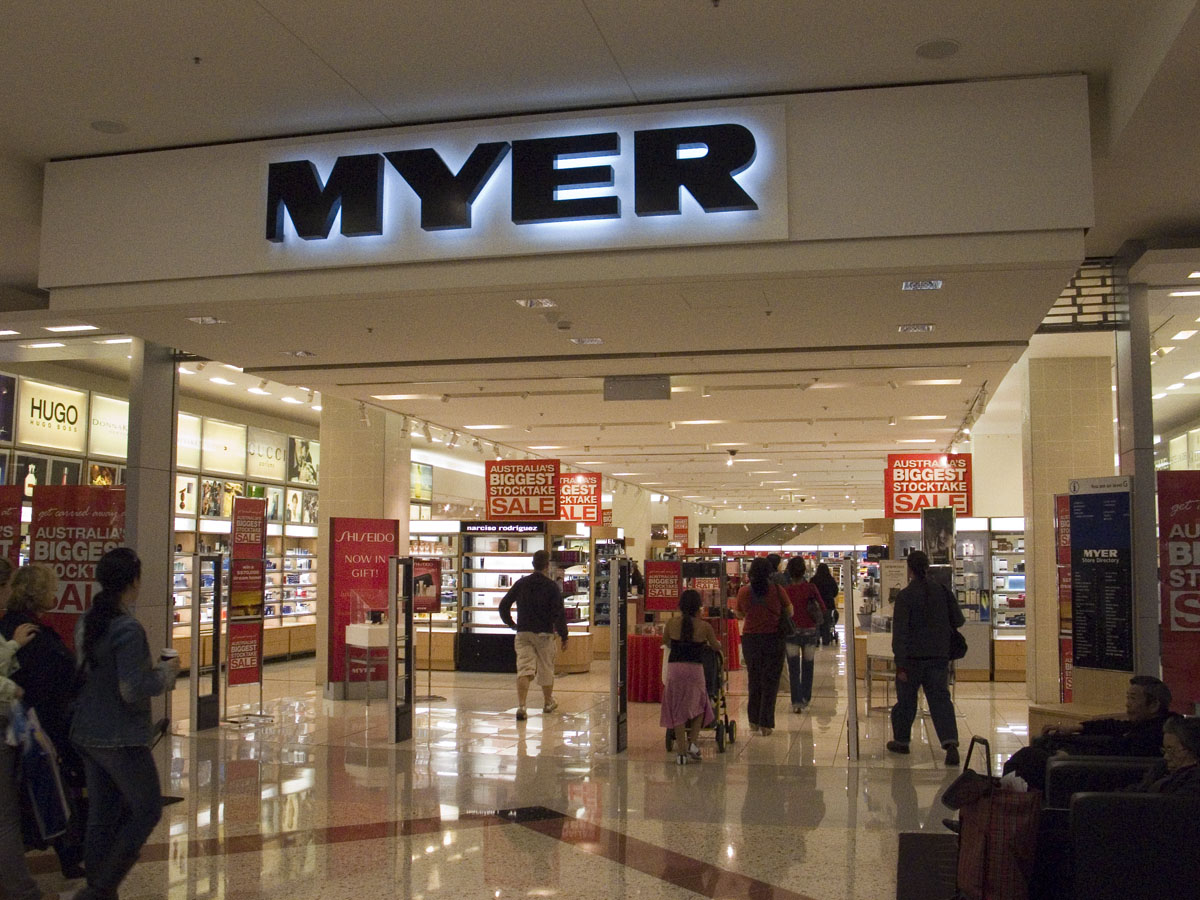
Myer Sydney central business district, Pitt Street entrance, formerly Grace Bros

As of April 2024, Myer has 56 stores across Australia, in both capital cities and regional centres.[55][56]

The national flagship store is located in the Bourke Street Mall in Melbourne and received a $300 million redevelopment which officially opened in April 2011.[57]

In 1988, the Myer Centre in Brisbane's Queen Street Mall opened in time for World Expo 88. The shopping centre featured six floors of stores. The top two levels featured an indoor amusement park, named Tops, with a swinging ship and Australia's first indoor roller coaster. The amusement park closed in the year 2000 and all the rides dismantled in preparation to convert the top two levels into a cinema complex.

In 1991, the Myer Centre opened in Adelaide housing the largest Myer store in South Australia and over 80 smaller shops, with an eight level atrium inside the shopping centre and six levels inside the Myer store.[citation needed] Until 1998, the top two levels of the atrium housed an indoor amusement park known as Dazzeland featuring Australia's only indoor rollercoaster.[citation needed]

In 1994, Myer opened a store at Galleria Shopping Centre (Perth). A retailer Boans was burnt during the 1980s and was replaced with Galleria.[citation needed]

In 2006, Myer announced the opening of several new stores, starting with four former Harris Scarfe stores (two in South Australia and two in Victoria).[20] Further to this, in 2008 in Sydney, Myer opened two new stores in Sydney at Westfield Eastgardens and Bankstown Central replacing the former David Jones stores, while David Jones replaced the Myer store at Westfield Burwood, and stated it would open a store in suburban Townsville centre in early 2009. This project was delayed due to problems with the acquisition of land; however, in late October 2012 a Myer store opened in that centre.[58]

In 2007, Chairman Bill Wavish stated Myer was willing to build new stores if necessary, and that new locations could be in any city or town with a population over 40,000 people.[59]

A Myer store located in Launceston's Brisbane Street Mall.

On 22 September 2007, Myer's Liverpool Street, Hobart building was destroyed by a fire that is believed to have started in the cosmetic section. Building damage was estimated at $50 million, and most stock was destroyed. The building including its historic façade was subsequently demolished. The adjacent Murray Street building suffered substantial smoke and water damage. Within a day of the fire, Myer issued a statement saying it would rebuild, and the Murray Street section of the store reopened on 16 November – 44 days after the fire.[60][61] A new 8797 sq m, five-level Myer store finally reopened in November 2015.[62]

Myer opened a store in the redeveloped Top Ryde City in northern Sydney in 2010. There was (previously an A.J. Benjamin's store) Grace Bros store at this centre from 1964 until closure in early 1985.[63] The Myer store closed in July 2015.

In April 2008, Myer announced that it would open three new stores in Queensland. The first two stores were planned to open in 2010 at Westfield Mt GravattUpper Mount Gravatt, Robina Town Centre with the third store planned to open in Mackay in 2011. Myer also announced that it would open a store at East Maitland in 2011 when the redevelopment was completed, later delayed until 2013.[64]

In July 2008, Myer stated it planned to expand into the Middle East and open its first overseas store in Dubai,[65] but by March 2009 had put such plans on hold.[66]

In 2009, Myer stated it would open stores at Westfield Tuggerah on the New South Wales Central Coast, Westfield Woden in Canberra and Robina on the Gold Coast, Queensland, with plans for 12 stores in total to open progressively from 2010 to 2013.[64][67] However, it subsequently pulled back on these plans.

In 2010, plans were put on the table and approved for a new subsequently-shelved 10,000sqm 2-level Myer store in Coffs Harbour[citation needed], making it the first department store on the Mid North Coast of New South Wales. Had it been built, it would have been northern New South Wales’ own eco-friendly Myer department store beating short-listed favourites Tamworth (which previously had its own Grace Bros store until June 2003, prompting a strong Facebook campaign and petition to get one back in the first decade of the new millennium) and Port Macquarie as contenders to get a Myer store built and opened and operating in northern NSW. The “Vote Yes to Myer” online petition got 5,000 signatures for the proposed Coffs Harbour development.[citation needed]

In 2012, Myer also proposed a 12,000sqm 2 level full-line department store at Casuarina Square in Darwin, which would’ve been the first of its kind in the city and the Northern Territory. Due to open in 2016, the store was never built and Darwin remains the only state/territory capital without a Myer (or any other) department store in the country.

In January 2013, Myer closed its Kings Square, Fremantle store.[68] Myer closed its Elizabeth, South Australia store in February 2014 and its store at Westfield Hurstville in January 2015. It opened a store at Lakeside Joondalup in November 2014.[69]

Myer places stores into one of four clusters, which reflects the store specific shopper demographics. The cluster determines the merchandise mix, brand assortment, services offered, and capital expenditure. The sales performance expectations are also based on which cluster a store is placed. As of September 2015 the clusters (store numbers) were Flagship (7), Premium (16), Mainstream (27), and Community (17). At the time of the announcement it was stated ca. 20% of footprint rationalisation could occur.[citation needed]

Myer Wagga Wagga, formerly Grace Bros pictured in 2008.

In 2017, Myer announced it would cut 20% of its overall footprint, via a reduction in floor space of its Myer stores, office and close other Myer stores. Since the announcement, Myer has closed its stores in Wollongong Central (Replaced by David Jones), Brookside Shopping Centre (Replaced by Target and TK Maxx), and Orange, which was one of Orange's main clothing shops for 60 years.[70] Myer also announced the introduction of Clearance Floors, which was a format initially trialled at Myer Frankston. These floors used yellow signs with a coat hanger to show they were clearance floors, had minimal shelves and displays and were on the top floor of a Myer store. These floors would sell Myer’s unsold stock at a discounted price, essentially one space for all discounted items and a larger stock of discounted items. These floors were available at Frankston and Knox in Victoria, Loganholme and Pacific Fair in Queensland, Roselands and Penrith in New South Wales, Westfield Tea Tree Plaza in South Australia and Perth in Western Australia. These eight clearance floors ran from 2017 until 2019, intended to compete with the newly established international discount department store TK Maxx. Newly appointed CEO John King announced a plan to discontinue the model in 2019, with a stronger focus on its premium offerings.[citation needed]

In September 2017, Myer stated it would close three more stores, Colonnades (Replaced by Cheap as Chips, Best & Less and JB Hi-Fi), Belconnen, and Hornsby.[71]

In January 2019, Myer closed its Logan Hyperdome store in Loganholme, Queensland.[72] This has resulted in five closures and two more planned closures in 2019.

On 13 January 2020, the Myer location at Hornsby, Sydney, closed, leaving 60 locations. The final store in the planned closures was Myer at Belconnen, although Myer has decided it shall instead spare the store and refurbish it instead. This concludes Myer’s strategy, resulting in 6 store closures and 60 Myer stores remaining, including Belconnen.

On 4 December 2020, Myer Belconnen reopened to two floors.[citation needed]

In March 2021, Myer announced its store at Westfield Knox, in Melbourne's eastern suburbs would close after 44 years of operation. Myer Knox closed for the last time in late July of that year.[73]

In April 2022, the store at Westpoint Blacktown in Sydney's western suburbs closed after first opening in 1973.[citation needed]

In August 2022, Myer announced its Frankston store in bayside Melbourne would close permanently, with the last day of trading scheduled for 15 January 2023.[citation needed]

On 16 March 2023, Myer announced that, after being unable to reach a commercial agreement with the landlord, it would not be renewing its lease at the Brisbane Queen Street Mall location and seeking a new location in the CBD, thus ceasing 35 years of continuous operation at the site in July 2023.[74] Griffith University emerged as a possible occupant of the site, albeit temporary, as the university required immediate expansion space whilst finding a more permanent CBD location.[75] As of March 2023, the future of the site remains unclear, although the possibility of building demolition and site redevelopment has also been suggested.[76]

Mail order and online shopping

[edit]

Myer operated its own direct mail order company, Myer Direct, from 1989 until its sale to EziBuy[77] in January 2002. In October 2007, Myer launched an online gift store, including electronic goods, perfumes, miss shop clothing and gift cards.[78]

In 2011, Myer launched a Hong Kong based online shopping site called myfind.com (since closed) for Australian shoppers.[citation needed]

In December 2017, Myer launched The Myer Market, an online marketplace operating independently of myer.com.au.[79] It offers an extended range of products, some of which are not traditionally available in Myer stores.

See also

[edit]

References

[edit]
[edit]
Revisions and contributorsEdit on WikipediaRead on Wikipedia
from Grokipedia
Myer is an Australian department store chain founded in 1900 by , a Russian Jewish immigrant, who began as a hawker before opening a small store in , Victoria, with his brother Elcon. The company expanded rapidly, establishing its flagship Myer Emporium in in 1914, and grew into one of Australia's largest retailers, known for mid-range to upscale offerings in fashion, beauty, homeware, and accessories. By the early 21st century, Myer had become a publicly listed entity under Myer Holdings , operating over 60 s across all Australian states and territories, with a focus on quality, service, and value that traces back to its founding principles. In January 2025, Myer merged with Investments to form the Myer Group, significantly expanding its portfolio to include over 780 department and specialty stores in and , incorporating brands such as Just Jeans, Dotti, and Peter Alexander alongside its core operations. This merger positions Myer as a dominant force in Australian retail, with annual revenues exceeding $3 billion and a workforce of over 17,000 employees. Myer's product range spans men's, women's, and children's apparel; ; cosmetics and beauty; ; electrical goods; and home furnishings, often featuring exclusive collaborations and in-store experiences to attract diverse customers. The retailer emphasizes strategies, integrating physical stores with through its MYER one , which boasts high scores, such as a of 65.4 for in-store experiences in fiscal year 2025. Historically, the company has played a key role in Australian retail evolution, surviving economic challenges and ownership changes, including its merger into the Coles Myer group in 1985 before returning to independent status in 2006.

History

Founding and early years

Sidney Myer, born Simcha Baevski in 1878 near in the (now ), immigrated to in 1899 at the age of 21, arriving penniless in amid the lingering effects of Victoria's . He initially worked as a hawker in the goldfields region before reuniting with his brother Elcon (also known as Tailer Baevski), who had arrived earlier. Together, the brothers saved enough capital to open their first drapery store, Myer Bros, in , Victoria, on October 20, 1900, specializing in clothing and household goods. The venture succeeded due to their innovative and focus on affordable quality, establishing a foundation for regional retail success. By 1911, expanded into by purchasing the established business of Wright and Neil on for £91,450, strategically located near the General Post Office. He renamed it the Myer Emporium and began acquiring adjacent properties to create a larger modeled on American retail innovations, such as fixed pricing and wide product ranges. This move marked the shift from a provincial to a major urban retailer, with the store opening in a new eight-story building by 1914. The Emporium quickly became a landmark, employing over 200 staff by the mid-1910s and introducing features like in-house to meet growing . The 1920s brought rapid growth for the Myer Emporium amid Australia's post-World War I economic boom, with expansion to Lonsdale Street in 1927 and the formation of Myer Emporium Ltd in 1925, capitalized at £3 million to fund further development. The business thrived on "Friday specials" and innovative displays, growing to over 200 departments and employing thousands, while navigating the through philanthropy and cost controls, such as reducing profit margins to 5%. During , after Sidney's death, the company adapted to wartime restrictions by increasing local sourcing and manufacturing, maintaining profitability with sales rising significantly under —profits increased by over £50,000 in the first war year alone—while contributing to national efforts through staff enlistment and supply contracts. Sidney Myer died suddenly of cardiac failure on September 5, 1934, at age 55, while walking near his Toorak home, leaving an estate valued at over £1 million and prompting widespread mourning, with over 100,000 attendees at his funeral. Succession fell to his brother Elcon Myer, who became joint managing director alongside nephew Norman Myer, steering the company through the Depression's recovery. Elcon's death in 1938 shifted leadership to the wider family, including Sidney's sons Sidney Baillieu and Kenneth Baillieu Myer, who later assumed key roles, ensuring continuity of the family's vision for accessible retail.

Expansion through mergers

Myer's expansion in the mid-20th century included a strategic move into discount retailing through the acquisition of the Geelong-based Lindsay's chain in , which was rebranded as in 1970 to capitalize on the growing demand for affordable variety goods. This diversification allowed Myer to integrate lower-priced merchandise lines into its operations, establishing Target as a complementary discount arm that operated alongside its traditional department stores and helped capture a broader customer base in suburban areas during the and . In 1983, Myer acquired the Sydney-based Grace Brothers department store chain, a major expansion that strengthened its presence in New South Wales and provided access to prime retail locations in the city's key shopping districts. The acquisition integrated approximately 20 Grace Brothers stores into Myer's portfolio, enabling operational efficiencies through shared and supply networks while maintaining the Grace Brothers branding initially to preserve local market . The most transformative merger occurred in 1985 when Myer Emporium merged with G.J. Coles & Coy Limited, forming Coles Myer Ltd. and creating Australia's largest retail conglomerate with combined assets exceeding $4 billion. This union brought together Myer's 56 department stores and 68 Target outlets with Coles' and variety chains, leading to initial store rationalizations that closed overlapping locations to eliminate redundancies and optimize geographic coverage. Brand synergies were realized through cross-promotions and unified purchasing power, enhancing cost efficiencies in apparel, home goods, and general merchandise across the integrated network.

Coles Myer period

In 1985, G.J. Coles & Coy Ltd acquired Myer Emporium Ltd for A$918 million, forming Coles Myer Ltd and establishing the combined entity as Australia's largest retailer with over 1,650 stores across supermarkets, , and specialty retail. Myer served as the upscale arm of the conglomerate, contributing 56 that focused on mid-to-high-end , home goods, and consumer products, complementing Coles' discount and grocery-oriented operations. The merger united Coles' pre-existing supermarket dominance with Myer's longstanding department store expertise, scaling the group into a comprehensive retail powerhouse. However, the late economic environment, including rising interest rates and slowing , began exerting pressure on the nascent conglomerate, particularly on Myer's higher-margin segment where profits had already been declining prior to the acquisition. By the , Coles Myer reported an 8.9% drop in pre-tax operating profit to A$555.6 million for the year ending July 1990, as retail sales growth stagnated amid widespread economic contraction and reduced . These strains prompted early cost-cutting measures, including divestments of non-core assets like unprofitable operations in 1988. Throughout the , intensifying competition from discount chains and international entrants forced Coles Myer to undertake rigorous portfolio reviews to streamline operations and refocus on viable formats. In 1990, the administrative and buying functions of Myer Stores and Grace Bros—Coles Myer's New South Wales department store chain—were merged into a single Department Stores Group to eliminate redundancies and improve efficiency. This rationalization, coupled with broader group efforts, led to the closure of underperforming outlets and the conversion or disposal of weaker brands, such as the 35 Coles Variety stores phased out by 1993 in favor of Target and Fosseys formats. By 1992, the group spun off its New Zealand operations as Progressive Enterprises to concentrate resources on the Australian market, while a 1996 strategic review rejected a full breakup but emphasized further consolidation amid persistent competitive pressures from rivals like Woolworths. Leadership transitions marked significant shifts in strategy during this era, reflecting ongoing efforts to navigate financial challenges and internal conflicts. Solomon Lew assumed the role of chairman in 1991, overseeing expansions into liquor and apparel while attempting to leverage the group's scale. Peter Bartels succeeded Brian Quinn as CEO in 1992, followed by Dennis Eck's appointment in 1997 and Stan Wallis taking over as chairman that same year, each leader prioritizing operational efficiencies and divestments to stabilize the department stores amid sluggish sales. Tensions culminated in 2002 with a high-profile boardroom battle, where shareholders voted to oust Lew after 17 years, amid criticisms of and performance in the Myer division, signaling deeper structural issues within the conglomerate.

Restructuring and relisting

In July 2006, Coles Myer Ltd. divested its department store business to a comprising Pacific Group (TPG), Newbridge Capital, and Investments for A$1.4 billion, marking the end of its integration within the larger Coles Myer entity. This transaction transitioned Myer into private ownership, allowing the to focus on revitalizing the retailer's operations without the constraints of public market pressures. Under private ownership from 2006 to 2009, Myer implemented significant operational enhancements to improve efficiency and . Key initiatives included increased on store refurbishments, which modernized layouts and fixtures across its network, alongside investments in and systems to streamline inventory management and reduce costs. These efforts contributed to a leaner operational model, with annual operating profit growth of approximately 17% despite flat sales, positioning Myer for a return to public markets. Myer relisted on the Australian Securities Exchange in November 2009 through an (IPO) that raised A$2.1 billion, valuing the company at around A$2.4 billion and representing Australia's largest IPO since the began. However, the IPO faced immediate headwinds from the ongoing 2008 , which dampened sentiment and led to shares debuting below the offer price, declining up to 9% on the first trading day. In the subsequent year, Myer reported a significant profit decline, attributed to reduced amid the economic downturn.

Developments since 2010

Following its relisting on the Australian Securities Exchange in 2009, Myer faced increasing public market pressures that influenced its strategic direction in the subsequent decade. In 2013, Myer acquired full ownership of the fashion brand sass & bide, completing a purchase initiated in 2011, to strengthen its appeal to younger demographics through contemporary womenswear offerings sold in standalone boutiques and within Myer stores. The profoundly disrupted Myer's operations in 2020, prompting the closure of all 60 stores in March amid government-mandated lockdowns, which led to a net loss of A$172 million for the despite a 61% surge in online sales as consumers shifted to . In January 2025, The Myer Group was officially launched, integrating a network of 783 department and specialty stores across and through a merger with Investments' apparel brands business, expanding Myer's footprint and annual sales to over A$4 billion. This merger, valued at A$864 million and approved by shareholders in January 2025 before completion in February, involved Myer acquiring five apparel brands—Just Jeans, Dotti, Jay Jays, Portmans, and Jacqui E—to bolster its casual and denim offerings and target Gen Z consumers. In March 2025, Myer underwent a significant executive shake-up to support its expanded operations, appointing Kathy Karabatsas, former CFO of rival David Jones, as Group CFO; Megan Collins as Chief People Officer; and Belinda Slifkas as Chief Merchandise Officer, while Matt Jackman departed after eight years. In August 2025, Myer partnered with Global Retail Brands to launch 136 homewares concession stores within its department stores nationwide, enhancing its non-fashion categories with brands focused on and products. The fiscal year 2025 results, announced in September 2025, reported a A$213.3 million impairment charge on goodwill primarily related to the recent apparel brands acquisition amid flat sales, contributing to an overall annual loss. In May 2025, Rupert Myer, grandson of founder , publicly called for the refurbishment of the company's original 125-year-old store in , Victoria, citing its deteriorating condition and historical significance to the community. In November 2025, Myer announced a partnership with to enhance its , expected to integrate thousands of new products and complete transition by mid-2026, building on its online growth strategies. Additionally, the MYER one expanded its integration with Virgin Australia's program, allowing cross-redemptions to boost .

Operations

Store network and locations

Myer operates 58 department stores across Australian states and the Australian Capital Territory as of September 2025, providing a nationwide retail presence in both metropolitan and regional areas. The company's store network is concentrated in major cities, with hosting the highest number at 19 locations, followed by Victoria and with 13 each. This distribution ensures accessibility for customers in urban centers like , , , and Perth, as well as regional hubs such as and . The Myer Group, launched in January 2025 following the acquisition of Investments' apparel brands, extends the company's footprint to over 750 department and specialty stores across and , incorporating brands like Just Jeans and Jay Jays for broader market reach. Flagship stores anchor this network, including the iconic Myer Emporium on Lonsdale Street in Melbourne's CBD, which serves as a historic , and Myer Sydney City in the CBD, offering expansive retail space across multiple levels. Myer's store formats primarily feature full-line department stores spanning several floors with diverse product ranges, alongside smaller format outlets designed for targeted shopping experiences. Post-2025 group integration, many locations now include embedded specialty stores for apparel and accessories, enhancing efficiency and customer convenience within the existing infrastructure. During the 2010s, Myer rationalized its network amid shifting retail dynamics, closing underperforming stores such as those in Hornsby (New South Wales) in 2020, Colonnades (South Australia) in 2018, and several others announced in 2017, reducing the total from over 65 to the current scale. More recently, refurbishment efforts have focused on modernizing key sites, with capital expenditures in fiscal 2025 supporting upgrades to improve store aesthetics and functionality; for instance, in May 2025, calls were made to refurbish the aging Bendigo store in Victoria, highlighting its historical significance as Myer's original regional outpost. Note that Myer has no department stores in the Northern Territory.

Online and mail-order services

Myer's mail-order services were introduced in the early , with advertisements promoting the "Myer Mail Order Service for out-of-town customers" as early as 1932, enabling rural to access urban goods through catalogs and direct shipping. This initiative played a key role in expanding Myer's reach beyond city centers, particularly to isolated rural areas where physical stores were impractical, by offering a wide range of products like clothing and household items via post. The service grew significantly in the mid-20th century, with dedicated mail-order departments handling orders until the 1970s, when it transitioned toward more modern retail formats. Myer launched its platform, myer.com.au, in 2001, marking one of the earliest retail ventures among Australian department stores and initially focusing on apparel, , and homewares. By fiscal year 2025, sales had grown to represent 22.9% of Myer Retail's total sales, driven by enhanced website functionality, mobile optimization, and expanded product offerings that now include thousands of brands. Following the , Myer accelerated digital investments to bolster its strategy, including the redevelopment of the MYER one app in 2023 to integrate loyalty features, personalized recommendations, and seamless order tracking for improved user engagement. These efforts also encompassed partnerships for faster fulfillment, such as a 2023 agreement with to enable next-day delivery in major cities and same-day options from over 60 stores nationwide, utilizing existing store locations as key fulfillment hubs for online orders. In January 2025, Myer formed The Myer Group through the acquisition of apparel brands and integration of operations, creating a unified network of over 750 stores across and that supports cross-border online access via myer.com.au, allowing seamless shopping and delivery for customers in both markets.

Loyalty and rewards programs

Myer launched its in August 2004, replacing the shareholder discount card previously offered under the Coles Myer structure and marking a shift toward a points-based rewards system for everyday purchases. Customers earn two points for every dollar spent at Myer stores or online, with points redeemable for $10 rewards once 2,000 points are accumulated, providing incentives like e-gift cards or in-store discounts to encourage repeat shopping. This program evolved from earlier physical store cards, such as the GE Capital-managed Myer card discontinued in 2009, to a fully digital platform accessible via the , which enables real-time tracking of points, purchase history, and personalized offers. The program features four membership tiers—Member, Silver, , and Platinum—based on annual spend, offering escalating benefits to foster . Silver status, achieved at $1,500 in annual spend, unlocks perks like to sales and birthday rewards, while ($6,000+) adds double points days and complimentary beauty treatments; Platinum, available by invitation for high-value customers, includes exclusive events and enhanced personalization. These tiers emphasize experiential rewards, such as curated boxes from partner brands, to differentiate from basic point accumulation. In October 2025, the program was expanded with lower tier thresholds for easier progression, new earning opportunities at partners like , and enhanced beauty perks. By 2025, MYER one had grown to 4.7 million active members, with over 825,000 new sign-ups in the prior financial year, driven by younger demographics under 35 comprising more than half of additions. Following Myer's 2025 merger with Apparel Brands—including Just Jeans, Jay Jays, and Portmans—the program integrated across these labels, allowing seamless point earning and redemption to expand its reach beyond department stores. Credit card partnerships serve as optional enhancements to accelerate point earning within the core system.

Payment and credit options

Myer introduced its store card in the 1970s as a key financing product for customers, allowing in-store purchases on credit. In 1995, Coles Myer sold its credit card business to GE Capital Finance, under which the store card continued to operate until the partnership ended in 2017. That year, Myer transitioned to a new arrangement with Macquarie Bank Limited, which issues the rebranded Myer Credit Card—a Visa product designed for both in-store and everyday spending. The Myer Credit Card offers a variable purchase interest rate of 20.69% p.a. and a cash advance rate of 20.69% p.a., with up to 55 interest-free days on purchases. It includes an annual fee of $0 for the first year, increasing to $69 thereafter for the primary cardholder, and provides purchase protections such as Visa's coverage for eligible items against or accidental within 180 days of purchase, up to the item's value. Additional cardholders incur no annual fee. As of 2025, new applications are not being accepted, but the card remains available for existing holders. In 2019, Myer integrated buy-now-pay-later options, starting with for online purchases and expanding to in-store use by 2020. This service allows customers to divide eligible orders into four interest-free payments over six weeks, with no fees for on-time repayments. Purchases using the also accrue MYER one loyalty points at a rate of 2 points per $1 spent at Myer.

Products and brands

Core product categories

Myer department stores traditionally offer a diverse range of merchandise across several categories, catering primarily to apparel, , , and needs. The key categories include women's apparel, encompassing , , accessories, , and activewear; men's apparel, featuring casual and such as shirts—including men's dress shirts from brands including Van Heusen, Politix, Tommy Hilfiger, Calvin Klein, Hugo Boss, Connor, and English Braid, available in various styles such as business shirts, formal shirts, and slim fit options—pants, jackets, and accessories; and children's apparel, which covers , , and related items for infants through teens. These apparel ranges emphasize quality and variety, positioned in the to upscale market segment to appeal to middle and upper-middle-class consumers seeking accessible luxury and everyday essentials. In addition to apparel, Myer's core offerings extend to beauty and , providing an extensive selection of skincare, makeup, fragrances, and haircare products from various price points; homewares and appliances, including decor, , , and small electrical items like vacuums and makers; and and gifts, featuring educational , games, plush items, and seasonal gifting options. Private labels play a significant role in these categories, offering affordable yet branded alternatives that reinforce Myer's without compromising on style or functionality. This structure allows customers to shop for complete wardrobes, household upgrades, and special occasions under one roof, with a focus on curated selections that balance trendiness and practicality. Seasonal offerings further enhance these core categories, with dedicated collections for holidays like —featuring festive apparel, gift sets, and home decorations—and major sales events such as Black Friday, where discounts across apparel, , and toys drive increased foot traffic and online engagement. Myer sources its products from a mix of international suppliers, primarily from and for global trends, and Australian manufacturers for local relevance and sustainability compliance, ensuring a blend of imported and domestic quality. Recent brand acquisitions have introduced complementary lines into these categories, expanding options in apparel and without altering the foundational merchandise structure.

Owned and partnered brands

Myer owns the Australian fashion label sass & bide, which it acquired in 2011 and integrated as a wholly owned prior to 2015, focusing on premium womenswear with a signature bohemian aesthetic. The primarily operates through concessions within Myer department stores and online, following the closure of most standalone stores in 2024. Myer also owns the fashion brands Marcs and David Lawrence, which offer casual menswear and contemporary womenswear respectively, operating through concessions and online channels. These brands contribute to the retailer's mid-to-upper market positioning in apparel. The company maintains long-term concession partnerships with established brands such as Country Road, an Australian lifestyle label specializing in casual apparel and accessories, owned by the Woolworths Group since 2014. These concessions provide dedicated retail spaces inside Myer stores, enabling seamless integration of Country Road's collections into Myer's broader assortment while preserving the brand's independent identity and merchandising control. Myer partners with international luxury brands including , , , and , primarily through concessions in its flagship locations like the and central stores, where these brands offer exclusive , fragrance, and select fashion items. These collaborations enhance Myer's prestige in the and designer categories, with , for instance, providing a dedicated beauty line encompassing makeup and fragrances tailored for the Australian market. To support its value proposition across core product categories like apparel and home, Myer develops and manages private label lines under its Myer Exclusive Brands (MEBs) portfolio, which are designed in-house exclusively for sale in its stores. This strategy emphasizes affordable, quality-focused ranges that differentiate Myer from competitors, with historical examples including apparel lines like Piper, Basque, and Regatta, though the company periodically refines its offerings to align with evolving customer preferences. at Myer involves curating exclusive collections and optimizing concession layouts to drive foot traffic and sales synergy.

Recent acquisitions and expansions

In February 2025, Myer completed its acquisition of Investments' Apparel Brands division for A$864 million, incorporating five key apparel labels—Just Jeans, Jay Jays, Portmans, Dotti, and Jacqui E—into its portfolio. This deal, structured as a share swap with an additional A$82 million cash component to , added approximately 719 stores across and , significantly expanding Myer's physical footprint in casual and women's fashion. The acquisition targeted younger demographics, particularly consumers, by integrating brands known for accessible, trend-driven apparel that appeals to urban youth markets. These brands were integrated into The Myer Group, Myer's overarching entity that encompasses its department stores and specialty retail operations, enabling shared resources such as efficiencies and access. This consolidation facilitated the rollout of Myer's MYER one rewards program across the new labels by August 2025, allowing customers to earn and redeem points seamlessly while building on Myer's pre-existing owned brands like sass & bide, Marcs, and David Lawrence. The integration process, which began immediately post-acquisition, is projected to yield annual synergies of A$30 million from apparel operations plus A$10 million from by mid-2027. In August 2025, Myer announced a partnership with Global Retail Brands (GRB), led by Steven Lew, to launch 136 homewares concessions within its stores nationwide. This included 80 outlets for kitchenware brands The Custom Chef and The Cook Shop, alongside 56 for the home brand salt&pepper, marking GRB's first major retail and diversifying Myer's offerings beyond fashion into non-apparel categories. The concessions, set to roll out progressively through 2026, provide access for GRB's products while enhancing Myer's home department with curated, high-margin items. In November 2025, Myer partnered with to enhance its , introducing thousands of additional products and third-party brands across apparel, beauty, homewares, and more, to broaden its digital offerings. Strategically, these moves address competitive pressures from rivals like and Zara by broadening Myer's brand ecosystem and accelerating . The apparel acquisition leverages Myer's infrastructure to boost online sales for the new brands, which previously had limited digital presence, aiming for incremental revenue through integration. Similarly, the homewares counters stagnant category growth by introducing specialized concessions that drive foot traffic and opportunities, positioning Myer for sustained expansion in a challenging retail environment.

Corporate affairs

Leadership and governance

Olivia Wirth serves as the CEO and Executive Chair of Myer Holdings Limited, having assumed the role on June 4, 2024, following her prior appointment as an independent in November 2023. Prior to joining Myer, Wirth held senior executive positions at , including CEO of Qantas Loyalty, bringing extensive experience in and loyalty programs to the role. The executive team underwent a significant reshuffle in March 2025 to strengthen capabilities amid strategic priorities, including the appointment of Kathy Karabatsas as Group Chief Financial Officer, who joined from rival David Jones where she served as CFO. Other key appointments in the shake-up included Belinda Slifkas as Chief Merchandise Officer and the creation of new roles such as Chief Product Officer, filled by Simon Schofield in July 2025. Additional executives include Megan Collins as Chief People Officer since April 2025, Mark Medwell as Chief Information Officer since February 2025, and Tony Sutton as Chief Operating Officer. Myer's board of directors, as of November 2025, comprises four members: Olivia Wirth (Executive Chair), Gary Weiss AM (Deputy Chair and Lead Independent Director), Terry McCartney (Non-Executive Director), and Rob Perry (Independent Non-Executive Director). While the current board does not include direct Myer family representatives, Rupert Myer, a descendant of founder Sidney Myer, previously served as Deputy Chairman from 2012 to 2015, reflecting the family's historical involvement in governance. Myer's leadership evolution traces back to its founding in 1900 by , who served as managing director and built the company into a major retail force, followed by his son Norman Myer as chairman and managing director from 1938. Subsequent CEOs, such as Bernie Brookes (2006–2014) and (until 2024), navigated key expansions and challenges before Wirth's appointment. Myer maintains robust governance practices in compliance with the ASX Corporate Governance Principles and Recommendations, including regular board evaluations and risk oversight through committees such as the , Finance and Risk Committee. The company's Diversity and Inclusion Policy emphasizes measurable objectives for gender diversity, targeting at least 30% female representation on the board; as of mid-2024, this stood at 33%, though the current composition reflects 25% female directors as of July 2025. These practices support ethical decision-making and alignment with shareholder interests. Recent executive changes were partly influenced by ongoing financial pressures, including losses reported in early 2025.

Financial performance

Myer Holdings Limited achieved peak annual revenue of A$3.01 billion in 2019 (FY19), driven by strong sales prior to the onset of the . Revenue subsequently declined to A$2.66 billion in FY21 amid widespread store closures and reduced , before a post-COVID recovery that saw figures rise to A$3.27 billion in FY23, A$3.27 billion in FY24, and A$3.67 billion in FY25 (including Apparel Brands contribution). In FY25, Myer reported a statutory net loss after tax of A$211.2 million, a sharp swing from the A$43.5 million profit in FY24, largely attributable to a one-off, non-cash impairment charge of A$213.3 million on goodwill related to the acquisition of Apparel Brands. The results announcement triggered a significant share price decline, with the stock falling as much as 23.4% to a low of A$0.49, its lowest since late 2023. Key profitability drivers for Myer include gross margins, with FY25 operating gross profit margin at 38.3%, supported by a mix of owned brands and cost management in supply chain operations. EBITDA trends showed resilience post-COVID with positive figures through FY24, reaching A$383.2 million in FY25 despite integration costs from the Apparel Brands acquisition and inflationary pressures. Following its in 2009 at A$4.10 per share—which valued the company at approximately A$2.1 billion—Myer's has contracted substantially, standing at around A$692 million as of November 2025 based on a share price of A$0.40 and approximately 1.73 billion . The company has maintained a policy of paying fully franked s post-IPO, targeting a payout aligned with underlying , though FY25 saw a reduction to a total of 2.5 cents per share (via a special ), with no final dividend declared amid the reported loss.

Sustainability and community initiatives

Myer has committed to aligning its practices with Australia's National Targets, aiming for an average of 50% recycled content across all by 2025. As of FY25, Myer achieved 42% recycled content in , advancing toward the target through prioritized use of recycled materials and improved tracking under Australian Covenant obligations. Additionally, Myer focuses on reducing and in its stores and operations, achieving a more than 3.61% reduction in recent years through investments in practices. Through the Fund and The Myer Foundation, established in connection with the company's founding family, Myer supports extensive community philanthropy. These efforts include programs addressing , , and Indigenous , such as funding for the Stars Foundation, which aids Indigenous girls and young women in transitioning to , , and . The Myer Community Fund, a corporate initiative, annually supports over 58 organizations focused on children and families, emphasizing development and pathways to . Myer's ethical sourcing policy enforces standards across its supply chain, particularly for apparel, with mandatory compliance audits for suppliers in high-risk countries to verify labor practices, prohibit child and forced labor, and ensure fair wages and safe working conditions. Suppliers must permit independent audits and maintain transparency on modern slavery risks, with for non-compliance. In 2025, efforts to preserve the heritage of Myer's original store gained prominence, as Sidney Myer's grandson publicly urged the company to refurbish the 125-year-old site, highlighting its role in local community legacy and economic history. This push integrates sustainability by advocating for that maintains historical features while supporting ongoing .

References

Add your contribution
Related Hubs
User Avatar
No comments yet.