Recent from talks
Nothing was collected or created yet.
Men into Space
View on Wikipedia
| Men into Space | |
|---|---|
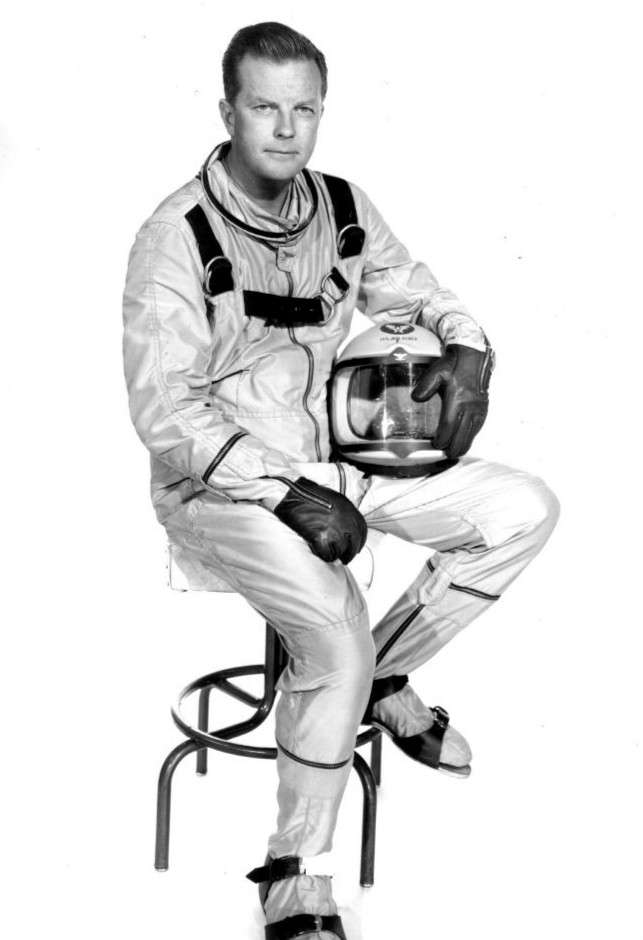
William Lundigan as Edward McCauley. | |
| Also known as | Space Challenge |
| Genre | Science fiction |
| Created by | Lewis J. Rachmil |
| Written by | Jerome Bixby Stuart J. Byrne James Clavell Meyer Dolinsky David Duncan Sidney Kalcheim Robert Warnes Leach Ib Melchior Marianne Mosner Michael Plant[1] Francis Rosenwald William Templeton Arthur Weiss |
| Directed by | William Conrad Alan Crosland, Jr. Walter Doniger Alvin Ganzer Jack Herzberg Herman Hoffman Nathan H. Juran Otto Lang Lee Sholem Herbert L. Strock |
| Starring | William Lundigan Tyler McVey |
| Theme music composer | David Rose |
| Country of origin | United States |
| Original language | English |
| No. of seasons | 1 |
| No. of episodes | 38 |
| Production | |
| Executive producer | Maurice Ziv |
| Producers | Sol Dolgin Lewis J. Rachmil |
| Cinematography | Edward Cronjager William P. Whitley |
| Running time | 30 minutes |
| Production company | Ziv Television Programs |
| Original release | |
| Network | CBS |
| Release | September 30, 1959 – September 7, 1960 |
Men into Space (a.k.a. Space Challenge in later US syndication) is an American black-and-white science fiction television series, produced by Ziv Television Programs, Inc., that was first broadcast by CBS from September 30, 1959, to September 7, 1960. The series depicts future efforts by the United States Air Force to explore and develop outer space. The series' star, William Lundigan, played Col. Edward McCauley.
Scenarios
[edit]Men into Space was not set in a specified time period, but clues dropped in the scripts indicated that it took place between the mid-1970s and mid-1980s. The first Moon landing would have occurred circa 1975. Some props were futuristic (such as a forerunner of today's real-life LCD TVs), but the show's Earth clothing and environs, including automobiles, telephones, and other machines, were decidedly late 1950s. The program aired in the year just prior to the beginning of human spaceflight, with Vostok 1 and the Project Mercury launching crewed spacecraft in 1961.[2]
Men into Space was somewhat unusual for a TV action series in that it had numerous recurring characters, but only one protagonist, Col. Edward McCauley (William Lundigan), who was in all 38 of the series' episodes. Tyler McVey appeared in seven episodes as Major General Norgath. Ron Foster appeared five times as Lieutenant Neil Templeton. Joyce Taylor had a recurring role in eight episodes as Col. McCauley's wife, Mary McCauley.
McCauley was a sort of "everyman" character who was viewed in the show as the most experienced and illustrious astronaut. As depicted in the scripts, the low-key but decisive McCauley was ubiquitous, assigned to every important space mission over at least a decade, including the earliest human flights, the first flight to the Moon, many additional lunar landings and Moon base construction missions, construction of a space station, and two flights to Mars (neither succeeded, and folklore has it that plans for a never-aired second season would have focused on further missions to Mars and beyond).[2]
In many episodes, the astronauts were faced with accidents or technical problems that required innovation. The program was not idealistic; missions sometimes failed and astronauts sometimes died. For example, a scientist-astronaut stricken with a coronary thrombosis while exploring the Moon was not expected to survive the G-forces of the return flight, so his comrades stowed the space-suited patient in a steel drum filled with water, to cushion him during launch. A "Space Race" episode involved spacecraft from the USA and the USSR starting out almost simultaneously on the first Mars mission, with the American spacecraft aborting its effort in order to rescue the Soviet crew after their spacecraft experienced problems.[3]
The series included an episode whose plot essentially paralleled the ill-fated Apollo 13 mission's explosion in space more than a decade later and another that was an uncanny foretelling of the accident that befell the real Gemini 8 mission in 1966.
Scripts often considered the human factor, and while action was the show's forte, humor and romance were part of the mix. Men into Space predicted women astronauts and scientists, as well as married couples in space.[2]
Episode list
[edit]| No. | Title | Original release date |
|---|---|---|
| 1 | "Moon Probe" | September 30, 1959 |
| 2 | "Moon Landing" | October 7, 1959 |
| 3 | "Building a Space Station" | October 21, 1959 |
| 4 | "Water Tank Rescue" | October 28, 1959 |
| 5 | "Lost Missile" | November 4, 1959 |
| 6 | "Moonquake" | November 11, 1959 |
| 7 | "Space Trap" | November 18, 1959 |
| 8 | "Asteroid" | November 25, 1959 |
| 9 | "Edge of Eternity" | December 2, 1959 |
| 10 | "Burnout" | December 9, 1959 |
| 11 | "First Woman on the Moon" | December 16, 1959 |
| 12 | "Christmas on the Moon" | December 23, 1959 |
| 13 | "Quarantine" | December 30, 1959 |
| 14 | "Tankers in Space" | January 6, 1960 |
| 15 | "Sea of Stars" | January 13, 1960 |
| 16 | "A Handful of Hours" | January 20, 1960 |
| 17 | "Earthbound" | January 27, 1960 |
| 18 | "Caves of the Moon" | February 3, 1960 |
| 19 | "Dateline: Moon" | February 10, 1960 |
| 20 | "Moon Cloud" | February 17, 1960 |
| 21 | "Contraband" | March 2, 1960 |
| 22 | "Dark of the Sun" | March 9, 1960 |
| 23 | "Verdict in Orbit" | March 16, 1960 |
| 24 | "Is There Another Civilization?" | March 23, 1960 |
| 25 | "Shadows on the Moon" | March 30, 1960 |
| 26 | "Flash in the Sky" | April 6, 1960 |
| 27 | "Lunar Secret" | April 13, 1960 |
| 28 | "Voice of Infinity" | April 20, 1960 |
| 29 | "From Another World" | April 27, 1960 |
| 30 | "Emergency Mission" | May 4, 1960 |
| 31 | "Beyond the Stars" | May 11, 1960 |
| 32 | "Mission to Mars" | May 25, 1960 |
| 33 | "Moon Trap" | June 1, 1960 |
| 34 | ""Flare Up" | August 17, 1960 |
| 35 | "Into the Sun" | August 24, 1960 |
| 36 | "The Sun Never Sets" | August 31, 1960 |
| 37 | "Mystery Satellite" | September 7, 1960 |
| 38 | "Flight to the Red Planet" | September 14, 1960 |
Artwork
[edit]Men into Space was advertised as being (for its era) an extremely accurate preview of human spaceflight, based on scientific studies and buttressed by technical assistance from the USAF's ballistic missile and space medicine offices. The spacecraft designs, however, veered inconsistently between early 1950s Wernher von Braun concept vehicles, and later on, totally scaled-down and more practical spacecraft proposals. Visual backdrops and conceptual designs of spacecraft, space stations, and a Moon base depended somewhat on contributions from notable astronomical and science fiction artist Chesley Bonestell.[4]
The series also utilized extensive documentary footage of early missile launches, notably the Atlas missile.[5] It evoked the earlier Disney space exploration documentaries, which in turn owed their look and feel to a widely read, early 1950s series on the subject in the old Collier's Weekly magazine, where Bonestell's art also held sway. At one point in production, a scale model and poster of an Atlas-derived missile design was built with the series spacecraft as its payload, with publicity photos of Lundigen holding the model in front of the large poster.[5] Several scenes used documentary footage from the canceled Navaho missile program to depict spacecraft landings on the desert runway. The distinctive design of the North American X-10 (different from the close up depictions of the series spacecraft) can be seen in the desert landing sequences.
Prediction of later technologies
[edit]Men into Space used for its plots many technical and human problems anticipated by engineers and planners. For example, the show depicted attempts to refuel spacecraft by tanker in orbit, construction of a space telescope, an experiment to dispose of high level atomic waste by launching it into the Sun, the search for life-sustaining frozen Lunar water, and exploration and destruction of an asteroid whose orbit threatened Earth. In two different episodes, the series even speculated about exo-fossil extraterrestrial life discovered while exploring a distant asteroid and about ancient Earth-orbiting spaceship debris belonging to a non-human, space-faring civilization. Although the series was modestly budgeted, it was cleverly mounted with what, for its era, were very good special effects helmed by Louis DeWitt. Even decades later, the series can still be watched and appreciated for its attention to detail and accurate physics.[2]
Scientific accuracy
[edit]A narrator explained in nearly every episode why the astronauts needed magnetic boots to walk in or upon their free-falling spacecraft, how a jet thruster backpack could propel an astronaut through the vacuum of space, why a wrong angle of attack could doom a spacecraft upon atmospheric re-entry, and so forth. The spacecraft in the program were shown gliding to a powerless landing on a dry lake bed, just like the real Space Shuttle nearly 25 years later. Footage of these landings used documentary film of the SM-64 Navaho cruise missile landing at Edwards AFB.[3]
On the other hand, dramatic license held sway on soundtracks, which repeatedly depicted sound in the airless vacuum of space: airlocks hummed, rockets roared, explosions boomed, and footsteps on the Moon's surface could be heard. Spacesuits being worn by the actors did not expand when exposed to the vacuum of space, as they would later during actual space walks.[5]
Production notes
[edit]The program was produced by Ziv Television Programs, Inc., whose other notable series included Sea Hunt. The theme and recurring background music were written and conducted by David Rose. The series was produced by Lewis J. Rachmil.[2]
Among the guest stars was Keith Larsen of the CBS series Brave Eagle and The Aquanauts. Joyce Taylor played the role of Mary McCauley in the series, but Angie Dickinson played the role in the original pilot episode. Other guest stars include James Best, Whit Bissell, Paul Burke, James Coburn, Paul Comi, James Drury, Joe Flynn, Arthur Franz, Nancy Gates, Allison Hayes, Murray Hamilton, Brett King, Werner Klemperer, Gavin MacLeod, Joe Maross, Donald May, Bek Nelson, Simon Oakland, Denver Pyle, Robert Reed, William Schallert, Warren Stevens, Marshall Thompson, Harry Townes, and Robert Vaughn.
Spacesuit costumes and special-effects footage of space vehicles (shot with miniature models) were later re-used in The Outer Limits, the science fiction film The Phantom Planet, and the 1969 drama Midnight Cowboy (the space opera playing on the movie screen during Joe Buck's tryst with a bespeckled young man is footage from Men into Space episode 1). The spacesuits also bore a strong resemblance to the spacesuits worn in the first half of the one-season comedy series It's About Time. The pilot episode used real, high-altitude pressure suits developed by the United States Navy, but most of the space suits used in the series were US Air Force designs.[2]
In the UK, Men into Space was shown on the BBC as a children's series. It was programmed in an early Saturday evening slot that was later filled by Doctor Who.
Novelization
[edit]A paperback novelization of the TV series, written by science fiction writer Murray Leinster, was published in 1960.[6]
In popular culture
[edit]In the early 1960s, Ideal Toy Company manufactured and sold a toy space helmet styled after the one worn by the main character, Col. Edward McCauley.[7]
References
[edit]- ^ Vagg, Stephen (November 14, 2021). "Forgotten Australian TV Screenwriters: Michael Plant". Filmink.
- ^ a b c d e f Lori Maguire; Margaret Weitkamp (August 17, 2016). The Cold War and Entertainment Television. Cambridge Scholars Publishing. pp. 203–206. ISBN 978-1-4438-9925-3.
- ^ a b Gary Westfahl (March 27, 2012). The Spacesuit Film: A History, 1918–1969. McFarland. pp. 54–. ISBN 978-0-7864-8999-2.
- ^ Melvin H. Schuetz (1999). A Chesley Bonestell Space Art Chronology. Universal-Publishers. pp. 63–. ISBN 978-1-58112-829-1.
- ^ a b c John C. Fredriksen (December 2012). Men Into Space. BearManor Media. ISBN 978-1-59393-231-2.
- ^ "Pulp Novel, 'Men into Space', Murray Leinster". airandspace.si.edu. Smithsonian National Air and Space Museum. Retrieved April 15, 2018.
- ^ Toy, Space Helmet, "Men into Space", archived from the original on March 15, 2018
External links
[edit]- Men into Space at IMDb
- Men into Space at epguides.com
- (novelization)
Men into Space public domain audiobook at LibriVox - Men into Space at Project Gutenberg
Men into Space
View on GrokipediaPremise
Setting and Scenarios
Men into Space is set in a near-future vision of space exploration, depicting the efforts of the United States Air Force to push the boundaries of human presence beyond Earth. The series portrays a timeline beginning with initial manned missions and progressing to more ambitious endeavors, such as establishing permanent outposts and attempting interplanetary travel, all grounded in the technological optimism of the late 1950s while projecting advancements into the subsequent decades.[6][2] The narrative framework centers on the operational challenges of spaceflight, with Col. Edward McCauley serving as the central figure guiding missions through perilous scenarios. Typical plots involve the construction of lunar bases, where crews contend with unstable terrain and life-support malfunctions, as well as the assembly of orbiting space stations that face issues like micrometeoroid impacts and orbital decay. Radiation exposure and equipment failures are recurrent hazards, often leading to tense decision-making under extreme conditions, while psychological strains manifest through isolation and the emotional toll on astronauts' families back on Earth.[3][2][6] Adopting a semi-anthology format, each episode presents standalone stories within this overarching program, emphasizing human perseverance amid frequent setbacks, including mission aborts and crew losses. Recurring themes highlight the realism of space as a unforgiving frontier, with occasional explorations of potential extraterrestrial artifacts or signals adding intrigue without veering into fantasy. Specific scenarios include the high-stakes first attempts at Mars expeditions, marked by propulsion failures and resource shortages, underscoring the series' focus on the incremental, often fraught steps toward colonization.[2][6][7]Main Characters
Col. Edward McCauley, portrayed by William Lundigan, serves as the central protagonist and a dedicated United States Air Force astronaut leading the nation's space program in the near future.[3] As mission commander, he navigates technical challenges, administrative hurdles, and the rigors of space exploration while maintaining a professional demeanor.[8] Lundigan appeared in all 38 episodes, embodying McCauley's balance between authoritative leadership in high-stakes operations and a more relaxed, humorous side in family interactions.[9] Mary McCauley, Edward's wife, is played by Joyce Taylor in the series proper, providing emotional support amid the uncertainties of her husband's dangerous career.[10] Taylor appeared in 8 episodes, highlighting the personal toll of space travel on family life through her character's resilience and concern for her husband's safety. (Note: Angie Dickinson portrayed Mary in the pilot episode "Moon Probe.")[10] Their young son, Peter "Pete" McCauley, is depicted by Charles Herbert, offering a civilian child's perspective on the space program's impact on daily life.[9] Herbert appeared in seven episodes, illustrating the generational dynamics and youthful curiosity about space adventures within the McCauley household.[10] Recurring supporting characters include Maj. Gen. Norgath, played by Tyler McVey, who oversees military aspects of the space missions and appears in seven episodes as a key authority figure.[9] Other mission specialists, such as Lt. Johnny Baker (Corey Allen) and Capt. Harvey (Ken Dibbs), appear to assist McCauley during operations.[11] The series features numerous guest stars in roles as fellow astronauts, scientists, and support personnel, including Robert Clarke as Maj. Gibbie Gibson, enhancing the team-oriented narrative without fixed recurring arcs.[12]Production
Development and Production Notes
Men into Space was produced by Ziv Television Programs for broadcast on CBS, with Maurice Ziv serving as executive producer and Lewis J. Rachmil as the primary creator and producer.[4][11] The series entered development during 1958 and 1959, amid the intensifying Space Race following the Soviet Union's launch of Sputnik in 1957, which sought to capture public fascination with space exploration through a semi-documentary approach emphasizing scientific realism over fantastical elements.[13][2] To ensure authenticity, the production collaborated closely with the U.S. Air Force, incorporating technical advisors and utilizing real Air Force footage to depict plausible space operations.[13][4] Budget limitations at Ziv constrained the series to a single season of 38 half-hour episodes, airing from September 30, 1959, to September 14, 1960, which allowed for focused storytelling but precluded renewal despite its critical acclaim.[4][2] The score, composed by David Rose, featured orchestral cues that built dramatic tension through understated, tension-filled arrangements, aligning with the series' grounded portrayal of spaceflight challenges and avoiding exaggerated science fiction conventions.[13][14]Filming Techniques and Special Effects
The production of Men into Space relied heavily on practical effects and miniature work to depict space travel, given the limitations of 1950s television budgets and technology. Scale models of spacecraft were constructed and filmed using miniature effects techniques, overseen by photographic effects specialist Louis DeWitt, who handled the integration of these elements into live-action sequences.[11][15] These models allowed for dynamic shots of rockets in flight, blending seamlessly with on-set footage to create the illusion of orbital maneuvers and planetary approaches.[16] To enhance realism, the series incorporated stock footage from actual rocket launches, including tests of the Atlas missile, which provided authentic visuals of liftoffs and ascents without the need for custom pyrotechnics.[17] This approach not only saved costs but also grounded the show's futuristic scenarios in contemporary aerospace developments, such as the early U.S. space program's reliance on modified intercontinental ballistic missiles. Similar stock elements from other real-world tests were repurposed to depict missile-like boosters in episodes involving lunar or planetary missions.[18] Zero-gravity simulations were achieved through innovative set designs, primarily using hidden wires to suspend actors and props, combined with slow-motion cinematography to mimic weightlessness inside spacecraft or during extravehicular activities.[19] Full-sized mockups of ship interiors facilitated these sequences, allowing performers to "float" realistically while interacting with control panels and equipment. For surface operations on airless bodies like the Moon, magnetic boots were employed as a practical solution; these devices, affixed to the actors' footwear, enabled them to "walk" on metallic sets by adhering to the floor, with narrators frequently explaining their function to underscore the hazards of low-gravity environments.[18] Creating the appearance of vacuum conditions posed significant challenges, as the production lacked modern CGI and had to rely on matte paintings, forced perspective, and controlled lighting to suggest the void of space without visible air or atmospheric distortion. Radiation effects, another key element in depicting space hazards, were simulated using practical overlays like flickering lights, colored gels, and simple pyrotechnic bursts to represent cosmic rays or solar flares impacting ships and suits, all integrated optically by DeWitt's team. Input from scientific advisors helped guide these techniques to align with plausible physics.[11] The spacesuits themselves, based on high-altitude pressure garments developed for U.S. Air Force pilots, were durable and versatile, contributing to their extensive reuse across multiple productions. These suits appeared in later films such as The Phantom Planet (1961) and Moon Pilot (1962), as well as television episodes of The Outer Limits (1963–1965) and The Twilight Zone (1963), often with minimal modifications to helmets and gloves for quick reshoots. This recycling extended their utility, appearing in numerous films and TV shows over two decades.[20][21]Artwork and Design
The artwork and design of Men into Space drew heavily from the visionary illustrations of Chesley Bonestell, a pioneering space artist whose realistic depictions shaped the series' futuristic aesthetic. Bonestell, credited as "creator of space concepts" in all 38 episodes, consulted on set designs and provided conceptual visuals for extraterrestrial environments, including detailed renderings of Moon bases, orbiting space stations, and rugged Mars landscapes.[6] His work emphasized scientific accuracy, informed by consultations with astronomers and his prior contributions to publications like Collier's magazine, ensuring the series' visuals captured the harsh, unforgiving nature of space while evoking human ingenuity.[22] For instance, lunar scenes in episodes such as "Moon Landing" and "First Woman on the Moon" incorporated elements from Bonestell's 1957 mural A Lunar Landscape, featuring intricate craters, shadowed regolith, and orbital structures that influenced the show's matte paintings and backdrops.[23] Spacecraft and habitat designs in the series reflected 1950s projections of space exploration, prioritizing modular and functional components to underscore practicality amid technological constraints. The XMP-13 lunar rocket, a recurring vessel, embodied this approach with its streamlined, multi-stage structure derived from contemporary rocketry concepts, allowing for reusable modules in missions to establish lunar outposts and space stations.[22] Habitats, such as the wheel-shaped space stations and prefabricated Moon bases seen in episodes like "Building a Space Station," featured interlocking, pressurized units with utilitarian interiors—complete with control panels, life-support systems, and communal areas—designed for efficiency in low-gravity assembly and long-term habitation.[2] These elements aligned with mid-century engineering visions, blending Bonestell's artistic precision with functional modularity to portray space as an extension of military-industrial capability.[22] Promotional artwork for Men into Space extended this realistic yet optimistic tone, with posters and title sequences merging Bonestell's influence into accessible visuals that captivated 1950s audiences. Lobby cards and advertisements often depicted Colonel Edward McCauley against stark cosmic backdrops, highlighting rocket launches and lunar vistas in a style that balanced stark realism with subtle hope for humanity's stellar future.[24] The opening title sequence, scored by David Rose, featured animated sequences of ascending spacecraft and orbital maneuvers, incorporating conceptual sketches of space stations and planetary approaches to set a tone of grounded adventure.[25] Tie-in materials, including a 1960 Dell comic book adaptation, reused Bonestell's illustrations for covers showing astronauts amid Martian terrains, reinforcing the series' commitment to authentic space iconography.[26]Episodes
Broadcast History
Men into Space premiered on CBS on September 30, 1959, as a weekly half-hour series airing on Wednesdays at 7:30 PM ET. The show ran for a single season consisting of 38 episodes, concluding on September 14, 1960.[27] The series garnered moderate ratings, aided by growing public fascination with the Space Race during the late 1950s, yet it was canceled after one season primarily due to its high production costs relative to the era's television budgets.[28] Special effects and technical accuracy, while innovative, proved expensive for a network program at the time.[4] Following its CBS run, Men into Space entered syndication in the 1960s, retitled Space Challenge for some markets, and aired on local television stations across the United States. Reruns continued sporadically on independent stations, with episodes also broadcast on the Sci-Fi Channel during late-night blocks in the mid-1990s. Home video availability emerged in the 2000s through unofficial DVD compilations, though no authorized complete series release has been produced by major distributors like Timeless Media Group. As of 2025, the series lacks presence on mainstream streaming services such as Netflix or Amazon Prime Video, remaining accessible primarily via public domain archives, YouTube uploads, and physical bootleg media.[5][29]Episode List
Men into Space aired as a single season of 38 episodes on CBS from September 30, 1959, to September 14, 1960.[30][31] The episodes are listed below in broadcast order, with brief loglines emphasizing mission objectives and key challenges, along with directors and writers where documented in production records.[11]| No. | Title | Air Date | Director | Writer(s) | Description |
|---|---|---|---|---|---|
| 1 | Moon Probe | September 30, 1959 | Walter Doniger | Arthur Weiss | Initial orbital flight to the Moon encounters a failed stage separation, necessitating an extravehicular inspection to assess damage. Guest star: Angie Dickinson.[32] |
| 2 | Moon Landing | October 7, 1959 | Walter Doniger | James Clavell | Pioneering attempt at a manned lunar touchdown results in a tilted spacecraft, complicating takeoff and requiring immediate medical attention for an injured crewman. Guest star: Joe Maross.[32] |
| 3 | Building a Space Station | October 21, 1959 | N/A | N/A | Assembly of an orbital outpost faces peril when a worker becomes trapped during construction, demanding swift intervention. Guest star: Don Dubbins.[32] |
| 4 | Water Tank Rescue | October 28, 1959 | N/A | N/A | Urgent retrieval of an astronaut afflicted by a cardiac episode from a lunar water supply outpost tests emergency protocols. Guest star: Jon Shepodd.[32] |
| 5 | Lost Missile | November 4, 1959 | N/A | Michael Plant | Effort to intercept and neutralize a rogue nuclear warhead veering toward a lunar base involves collaboration with its designer. Guest star: Harry Townes.[32] |
| 6 | Moonquake | November 11, 1959 | N/A | William Templeton | Lunar expedition grapples with seismic disturbances while a crew member contends with distracting personal news from Earth. Guest star: Arthur Franz.[32] |
| 7 | Space Trap | November 18, 1959 | Charles Haas | Marianne Mosner, Francis Rosenwald | Rescue operation for a returning lunar crew incapacitated by unknown contaminants requires critical decision-making under time pressure. Guest star: Peter Hansen.[32] |
| 8 | Asteroid | November 25, 1959 | N/A | N/A | Survey of a nearby asteroid evaluates its potential as a natural space platform or necessitates its deflection to avert collision risks. Guest star: Bill Williams.[32] |
| 9 | Edge of Eternity | December 2, 1959 | N/A | Kalman Phillips | Damaged spacecraft conserves dwindling oxygen reserves after an asteroid strike, pushing survival limits during the journey home. Guest star: Corey Allen.[32] |
| 10 | Burnout | December 9, 1959 | N/A | Donald Duncan | Investigation of a re-entry heat shield failure launches a follow-up probe to track the errant vessel's trajectory. Guest star: John Sutton.[32] |
| 11 | First Woman on the Moon | December 16, 1959 | N/A | James Clavell | Endurance test sends a female volunteer to the lunar surface for an extended stay, assessing physiological adaptations. Guest star: Nancy Gates.[32] |
| 12 | Christmas on the Moon | December 23, 1959 | N/A | Lawrence Louis Goldman | Holiday-season lunar outpost deals with a sudden medical crisis among astronomers, straining limited resources. Guest star: Keith Larsen.[32] |
| 13 | Quarantine | December 30, 1959 | N/A | Stuart James Byrne | Orbital laboratory enforces isolation protocols amid interpersonal conflicts between assigned researchers. Guest star: Warren Stevens.[32] |
| 14 | Tankers in Space | January 6, 1960 | N/A | N/A | Precision refueling maneuver between orbiting vessels uncovers overlooked engineering vulnerabilities. Guest star: James Drury.[32] |
| 15 | Sea of Stars | January 13, 1960 | N/A | Marianne Mosner, Francis Rosenwald | Training flight turns critical when a novice pilot must execute an emergency return after the commander's incapacitation. Guest star: Fred Beir.[32] |
| 16 | A Handful of Hours | January 20, 1960 | N/A | Michael Plant | Stranded lunar explorers ration failing life support during a grueling trek to the nearest base. Guest star: William Schallert.[32] |
| 17 | Earthbound | January 27, 1960 | N/A | Robert L. Hecker | Unauthorized passenger on a launch disrupts systems, endangering the entire re-entry sequence. Guest star: Robert Reed.[32] |
| 18 | Caves of the Moon | February 3, 1960 | Lee Sholem | Meyer Dolinsky | Subsurface exploration seeks frozen water deposits essential for future lunar habitability. Guest star: John Howard.[32] |
| 19 | Dateline: Moon | February 10, 1960 | N/A | N/A | Embedded reporter at lunar headquarters stirs operational friction through personal habits and ambitions. Guest star: Harry Lauter.[32] |
| 20 | Moon Cloud | February 17, 1960 | N/A | Sidney Kalcheim | Recovery of a rare radioactive element on the Moon is threatened by internal team rivalries. Guest star: Robert Vaughn.[32] |
| 21 | Contraband | March 2, 1960 | Alvin Ganzer | David Duncan | Escort mission transports specialists to secure a pilfered lunar resource vital for research. Guest star: James Coburn.[32] |
| 22 | Dark of the Sun | March 9, 1960 | N/A | N/A | Solar observation probe includes a female specialist, navigating crew dynamics en route. Guest star: Carol Ohmart.[32] |
| 23 | Verdict in Orbit | March 16, 1960 | N/A | N/A | Space platform hosts an inquiry into an incident involving the commander's family. Guest star: Peter Adams.[32] |
| 24 | Is There Another Civilization? | March 23, 1960 | N/A | N/A | Analysis of a meteorite hints at non-natural origins, spurring a sample-collection expedition. Guest star: John Bryant.[32] |
| 25 | Shadows on the Moon | March 30, 1960 | N/A | N/A | Routine lunar patrol uncovers anomalous geological formations suggesting hidden threats. Guest star: Gerald Mohr.[32] |
| 26 | Flash in the Sky | April 6, 1960 | N/A | David Duncan | Retrieval of a wayward Venus orbiter is complicated by a researcher's insistence on personal involvement. Guest star: John Lupton.[32] |
| 27 | Lunar Secret | April 13, 1960 | N/A | N/A | Pair of investigators probes an anomalous structure on the lunar surface amid escalating hazards. Guest star: John Hudson.[32] |
| 28 | Voice of Infinity | April 20, 1960 | N/A | Ib Melchior | Orbital stress simulation encounters a real crisis that demands extraordinary physical endurance. Guest star: Myron Healey.[32] |
| 29 | From Another World | April 27, 1960 | N/A | N/A | Asteroid prospecting yields potential evidence of extraterrestrial fossils, prompting verification efforts. Guest star: Russ Conway.[32] |
| 30 | Emergency Mission | May 4, 1960 | N/A | N/A | Prototype booster pursues a spacecraft adrift toward deep space after missing its lunar target. Guest star: Donald Woods.[32] |
| 31 | Beyond the Stars | May 11, 1960 | Jack Herzberg | David Duncan | Installation of a far-side lunar relay station proceeds despite equipment malfunctions and injuries. Guest star: Gene Nelson.[32] |
| 32 | Mission to Mars | May 25, 1960 | N/A | N/A | Parallel American and Soviet voyages to the Red Planet collide with unforeseen complications. Guest star: N/A.[32] |
| 33 | Moon Trap | June 1, 1960 | N/A | N/A | Crash survivors on the Moon improvise survival measures while seeking a remote fuel depot. Guest star: N/A.[32] |
| 34 | Flare Up | August 17, 1960 | N/A | N/A | Diplomatic tensions rise after a Soviet craft crashes near an American lunar facility. Guest star: N/A.[32] |
| 35 | Into the Sun | August 24, 1960 | N/A | N/A | Disposal of radioactive waste via solar trajectory challenges a veteran astronaut's resolve. Guest star: N/A.[32] |
| 36 | The Sun Never Sets | August 31, 1960 | Alvin Ganzer | Jerome Bixby | Assistance to a British solar mission addresses concerns over untested propulsion systems. Guest star: John Sutton.[33] |
| 37 | Mystery Satellite | September 7, 1960 | N/A | N/A | Pursuit of an unidentified orbital object reveals maneuvers inconsistent with terrestrial technology. Guest star: N/A.[32] |
| 38 | Flight to the Red Planet | September 14, 1960 | N/A | N/A | Inaugural Mars expedition navigates mechanical failures while prioritizing crew safety over discovery. Guest star: N/A.[32] |