Hubbry Logo
search
logo
2125619

Messier 66

logo
Community Hub0 Subscribers
Read side by side
from Wikipedia

Messier 66
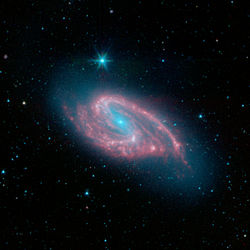
A colour-composite image of M66
Observation data (J2000 epoch)
ConstellationLeo
Right ascension11h 20m 15.026s[1]
Declination+12° 59′ 28.64″[1]
Redshift0.002425±0.000010[2] (696.3±12.7 km/s)[3]
Distance31 Mly (9.6 Mpc)[4]
Apparent magnitude (V)8.9[2]
Characteristics
TypeSAB(s)b[5]
Size85,200 ly (26.12 kpc) (estimated)[6]
Apparent size (V)9.1 × 4.2[6]
Notable featuresGalaxy in the Leo Triplet
Other designations
Arp 16, NGC 3627, PGC 34695, UGC 6346[7]

Messier 66 or M66, also known as NGC 3627, is an intermediate spiral galaxy in the southern, equatorial half of Leo. It was discovered by French astronomer Charles Messier[8] on 1 March 1780, who described it as "very long and very faint".[9] This galaxy is a member of a small group of galaxies that includes M65 and NGC 3628, known as the Leo Triplet or the M66 Group.[10] M65 and M66 are a common object for amateur astronomic observation, being separated by only 20.[9]

M66 has a morphological classification of SABb,[5] indicating a spiral shape with a weak bar feature and loosely wound arms. The isophotal axis ratio is 0.32, indicating that it is being viewed at an angle.[5] M66 is receding from us with a heliocentric radial velocity of 696.3±12.7 km/s.[3] It lies 31[4] million light-years away and is about 95 thousand light-years across[11] with striking dust lanes and bright star clusters along sweeping spiral arms.

Gravitational interaction from its past encounter with neighboring NGC 3628 has resulted in an extremely high central mass concentration; a high molecular to atomic mass ratio; and a resolved non-rotating clump of H I material apparently removed from one of the spiral arms. The latter feature shows up visually as an extremely prominent and unusual spiral arm and dust lane structures as originally noted in the Atlas of Peculiar Galaxies.[12]

Supernovae

[edit]

Five supernovae have been observed in M66:

[edit]

See also

[edit]

References

[edit]
[edit]
Revisions and contributorsEdit on WikipediaRead on Wikipedia
from Grokipedia
Messier 66, also designated NGC 3627, is a barred spiral galaxy classified as SAB(s)b, located approximately 35 million light-years from Earth in the constellation Leo.[1][2][3] It spans about 100,000 light-years across and has an apparent visual magnitude of 8.9, making it visible to amateur astronomers under dark skies.[1][2] As the brightest member of the Leo Triplet—a compact group of interacting spiral galaxies that also includes Messier 65 and NGC 3628—M66 exhibits distorted structure due to ongoing gravitational interactions within this trio and the broader Messier 66 group.[1][2][4] Discovered by French astronomer Charles Messier on March 1, 1780, alongside its neighbor Messier 65, M66 was cataloged as the 66th entry in his famous list of deep-sky objects to aid comet hunters in avoiding confusion with non-cometary phenomena.[1][5][6] The galaxy's right ascension is 11h 20m 14.9s and declination +12° 59′ 30″, positioning it ideally for observation in the Northern Hemisphere during spring months, particularly April.[2] Its inclusion in the Messier catalog has made it a popular target for stargazers and a benchmark for studying galaxy evolution in cluster environments like the Virgo Supercluster, of which the Leo Triplet is a part.[1][4] Structurally, M66 features prominent asymmetric spiral arms and a slightly off-center bulge, hallmarks of tidal distortion from its gravitational entanglement with companion galaxies, which has triggered enhanced star formation along the arms.[1][2] The central bar, characteristic of SAB galaxies, funnels gas toward the nucleus, contributing to bursts of new star birth visible in infrared and H-alpha emissions.[3][7] At a distance of roughly 10 megaparsecs, it serves as a nearby laboratory for astronomers investigating barred spiral dynamics, supermassive black hole activity, and the role of interactions in galaxy morphology.[7] Observations from space telescopes like Hubble have revealed intricate details of M66's dust lanes, young star clusters, and ionized gas regions, captured in multi-wavelength composites that highlight its peculiar anatomy.[1][2] These images, taken using filters in the near-infrared, visible, and H-alpha bands, underscore the galaxy's active star-forming nature and its place as a key example of how tidal forces reshape spiral structures over cosmic time.[1] Ground-based studies, including radio and X-ray surveys, further probe its molecular clouds and potential low-luminosity active galactic nucleus, providing insights into the interplay between stellar populations and interstellar medium in interacting systems.[8][9]

Identification and observation

Designations

Messier 66, commonly abbreviated as M66, received its primary designation from French astronomer Charles Messier, who included it as the 66th entry in his 1780 catalog of nebulae and star clusters. This catalog, published in the Connaissance des Temps for 1784, aimed to aid comet hunters by listing objects that could be mistaken for comets. In modern astronomical databases, Messier 66 is identified as NGC 3627 within the New General Catalogue, compiled by John Louis Emil Dreyer and published in 1888. It also appears under additional identifiers such as PGC 34695 in the Principal Galaxies Catalogue and LEDA 34695 (now part of HyperLEDA) in the Lyon-Meudon Extragalactic Database. The galaxy's morphological classification is SAB(s)b, denoting a barred spiral with simple arms, intermediate between strongly barred (SB) and unbarred (SA) spirals, and loosely wound arms, as detailed in the Third Reference Catalogue of Bright Galaxies (RC3). The isophotal axis ratio of 0.32 indicates significant ellipticity due to the galaxy's inclination relative to our line of sight.[10] Messier 66 forms part of the Leo Triplet, a compact group of galaxies, and its designations are consistently used across surveys studying this interacting system.

Location and visibility

Messier 66 is situated in the constellation Leo, with equatorial coordinates of right ascension 11h 20m 15.0s and declination +12° 59′ 29″ (J2000 epoch).[11] This positions it in the eastern portion of Leo, making it a prominent target for observers scanning the lion's body.[12] With an apparent visual magnitude of 8.9, Messier 66 is accessible to amateur astronomers using binoculars or small telescopes under dark, clear skies, where it appears as a faint, elongated glow.[11] Its angular size spans approximately 9.1 by 4.2 arcminutes, allowing it to fit comfortably within the field of view of modest instruments. The galaxy is best observed during April, when it reaches its highest point in the evening sky for viewers in the Northern Hemisphere, coinciding with spring observing conditions that favor deep-sky objects.[1] To locate it, start from the bright star Denebola in Leo's tail and sweep northeast toward the region between Theta Leonis and Iota Leonis, where Messier 66 lies as part of the Leo Triplet alongside M65 and NGC 3628.[12]

Physical properties

Morphology

Messier 66, also known as NGC 3627, is classified as an intermediate spiral galaxy exhibiting a distinctive SABb morphology, characterized by a weak central bar and loosely wound spiral arms. This structure reflects a transitional form between tightly wound grand-design spirals and more flocculent patterns, with the bar serving as a subtle bridge that funnels material toward the nucleus.[13] The galaxy's spiral arms display marked asymmetry, a result of past gravitational interactions within the Leo Triplet, where one arm appears more prominent and extended than the other.[13] Prominent dark dust lanes trace these arms, delineating regions of dense interstellar material that obscure background light and highlight the galaxy's dynamic internal processes.[14] Interspersed along the arms are bright star-forming regions, manifesting as vivid clusters of young, massive stars that illuminate the structure.[15] At its core, Messier 66 features a high central mass concentration, contributing to a notably dense nucleus that underscores the galaxy's evolutionary influences from group dynamics.[14] This concentration enhances the overall compactness of the central region, contrasting with the more diffuse outer arms and emphasizing the interplay between bar-driven dynamics and spiral features.

Dimensions and distance

Messier 66 (NGC 3627) is located at a distance of approximately 36 million light-years (11.12 ± 0.56 Mpc) from Earth, as determined from recent photometric studies of the Leo I group.[16] This places it firmly in the local universe, allowing detailed observations of its structure. The galaxy exhibits a heliocentric radial velocity of 727 ± 5 km/s, indicating it is receding from us as part of the Hubble flow.[17] The apparent angular dimensions of Messier 66 are measured at about 9.1 by 4.2 arcminutes, corresponding to a physical diameter of roughly 95,000 light-years (29 kpc) along its major axis at the adopted distance.[17] Its integrated visual magnitude is 8.9, with a central surface brightness of approximately 22.9 mag/arcsec² in the B-band, reflecting a moderately bright disk typical for intermediate spirals. Estimates of the galaxy's total dynamical mass reach up to 5.75 × 10¹⁰ solar masses, derived from rotation curve modeling and gas dynamics within its disk.[18]

Discovery and history

Discovery

Messier 66 was discovered on March 1, 1780, by the French astronomer Charles Messier during his systematic search for comets.[19] Using a 3.5-inch aperture achromatic refractor with a focal length of approximately 3.5 feet, Messier observed the object from Paris and noted its proximity to the nearby nebula he had just cataloged as M65.[20] Both galaxies appeared in the same field of view through his telescope, marking a simultaneous discovery on that night.[19] In his original catalog entry, Messier described M66 as: "Nébuleuse découverte dans le Lion; sa lumière est très faible & elle est très proche de la précédente [M65]: Elles paraissent toutes deux dans le même champ du réfracteur." This translates to: "Nebula discovered in Leo; its light is very faint and it is very close to the previous one [M65]: They both appear in the same field of the refractor."[19] He further recorded that the comet of 1773–1774 had passed between these two nebulae on November 1 and 2, 1773, during one of his sweeps, but he had missed them at that time, likely due to the comet's glare overwhelming the faint objects.[19] Messier included M66 as the 66th entry in his catalog, which was formally published in 1781 as part of the Connaissance des Temps almanac, compiling his observations of deep-sky objects to aid comet hunters in distinguishing them from true comets.[19] This entry solidified M66's place in astronomical history as one of the key objects in the Messier Catalog, situated in the Leo Triplet region.[6]

Early studies

Following its discovery, Messier 66 was subject to detailed visual observations by leading astronomers in the late 18th and 19th centuries, which helped establish its basic structure as an extended nebula. William Herschel first observed it on April 12, 1784, using his 20-foot reflector telescope, describing it as a "very bright, much extended nebula of irregular figure," with the extension chiefly along the meridian and the greatest brightness near the middle.[21] His son, John Herschel, conducted several sweeps of the region between 1825 and 1833, noting on March 13, 1826, that it appeared very bright and very large, suddenly brighter toward the middle, measuring approximately 3 arcminutes long and 2 arcminutes broad, and extended northwest-southeast; these descriptions emphasized its elongated, elliptic form with central condensation, consistent with early recognition of its spiral nature.[22] In 1888, Danish-Irish astronomer John Louis Emil Dreyer incorporated Messier 66 into the New General Catalogue as NGC 3627, cataloging it as a bright, very large object much extended at 150 degrees position angle, much brighter toward the middle where it is mottled, and accompanied by two stars to the northwest.[23] Dreyer's compilation drew on observations from William and John Herschel, as well as others, providing a standardized description that facilitated further study.[23] Early photographic observations in the late 19th and early 20th centuries captured the faint nebulosity surrounding Messier 66's bright core, revealing its extended halo and irregular features beyond what visual telescopes could resolve.[24] These images marked a shift toward photographic astronomy, allowing astronomers to document the object's diffuse light distribution and confirm its classification as a nebula with spiral characteristics.[25] By the early 20th century, Messier 66 was recognized as part of a compact galaxy group in Leo, now known as the Leo Triplet, through studies of nearby objects' positions and motions; astronomers like Harlow Shapley highlighted such associations in surveys of extragalactic distributions during the 1920s and 1930s.[26] Radial velocity measurements in the late 1920s further supported this, showing similar recession velocities for Messier 66 (NGC 3627) and Messier 65 (NGC 3623) around 800 km/s, indicating physical proximity.[27] Initial distance estimates for Messier 66 in the 1920s and 1930s, based on methods like radial velocities and apparent magnitudes of bright stars, placed it at roughly 10-20 million light-years; direct measurements using Cepheid variable stars came later with improved technology.[26]

The Leo Triplet

Group composition

The Leo Triplet consists of three interacting spiral galaxies: Messier 65 (NGC 3623), Messier 66 (NGC 3627), and NGC 3628.[1] These form a compact subgroup known as the Leo Triplet or M66 Group, which comprises primarily these three members along with possibly a few fainter companions.[28] Messier 66 occupies the role of the southernmost and brightest member, positioned at right ascension 11h 20m 15s and declination +12° 59' with an apparent V-band magnitude of 8.9, while Messier 65 lies to the north-northwest at magnitude 9.3 and NGC 3628 appears farther northwest at magnitude 10.0.[29] The galaxies share a common distance of about 35 million light-years (10.7 Mpc) from Earth, as determined from Cepheid variable and Tully-Fisher relation measurements.[1] Their recession velocities are similarly clustered, with Messier 66 at 724 km/s, Messier 65 at 805 km/s, and NGC 3628 at 830 km/s, confirming their physical association through shared motion relative to the Hubble flow. Optical imaging and radio observations, including H I line mapping and continuum surveys, further demonstrate the group's coherence by revealing extended neutral gas distributions and kinematic linkages among the members.[30]

Gravitational interactions

Messier 66 (NGC 3627) has experienced a significant gravitational interaction with its neighbor NGC 3628 within the Leo Triplet, leading to pronounced distortions in its structure. This close encounter, modeled through restricted three-body simulations, occurred approximately 800 million years ago when the galaxies passed within roughly 80,000 light-years of each other, resulting in tidal perturbations that reshaped M66's spiral arms into an asymmetric configuration.[31] The interaction has also contributed to a warped disk in M66, as evidenced by kinematic data showing deviations from a flat rotation curve. Tidal forces from this event have extended M66's neutral hydrogen (HI) distribution into an asymmetric envelope surrounding the stellar disk, with observations revealing elongated HI features bridging toward NGC 3628. Additionally, the interaction has produced a faint tidal tail extending up to 300,000 light-years, indicative of stripped material from the encounter. These structures highlight the dynamical response of M66's interstellar medium to the gravitational pull, with the extended HI envelope showing perturbed kinematics consistent with ongoing tidal influences. The gravitational interaction has led to an increased central mass concentration in M66, enhancing the density of stars and gas in the nuclear region compared to non-interacting spirals. This is coupled with a high molecular-to-atomic gas mass ratio of approximately 18:1, where the molecular hydrogen (H₂) mass dominates due to compression and HI stripping by NGC 3628, funneling gas inward.[32] Such ratios are notably elevated relative to typical Sb galaxies, underscoring the role of tides in altering gas phases. Furthermore, the tidal encounter has triggered enhanced star formation in M66's spiral arms through the compression of gas clouds along the leading edges, boosting the star formation efficiency in the bar and arms relative to isolated systems. Numerical simulations of the interaction confirm that these processes, occurring on timescales of hundreds of millions of years, explain the observed asymmetries and elevated central activity without requiring additional dwarf galaxy collisions.

Notable features and phenomena

Supernovae

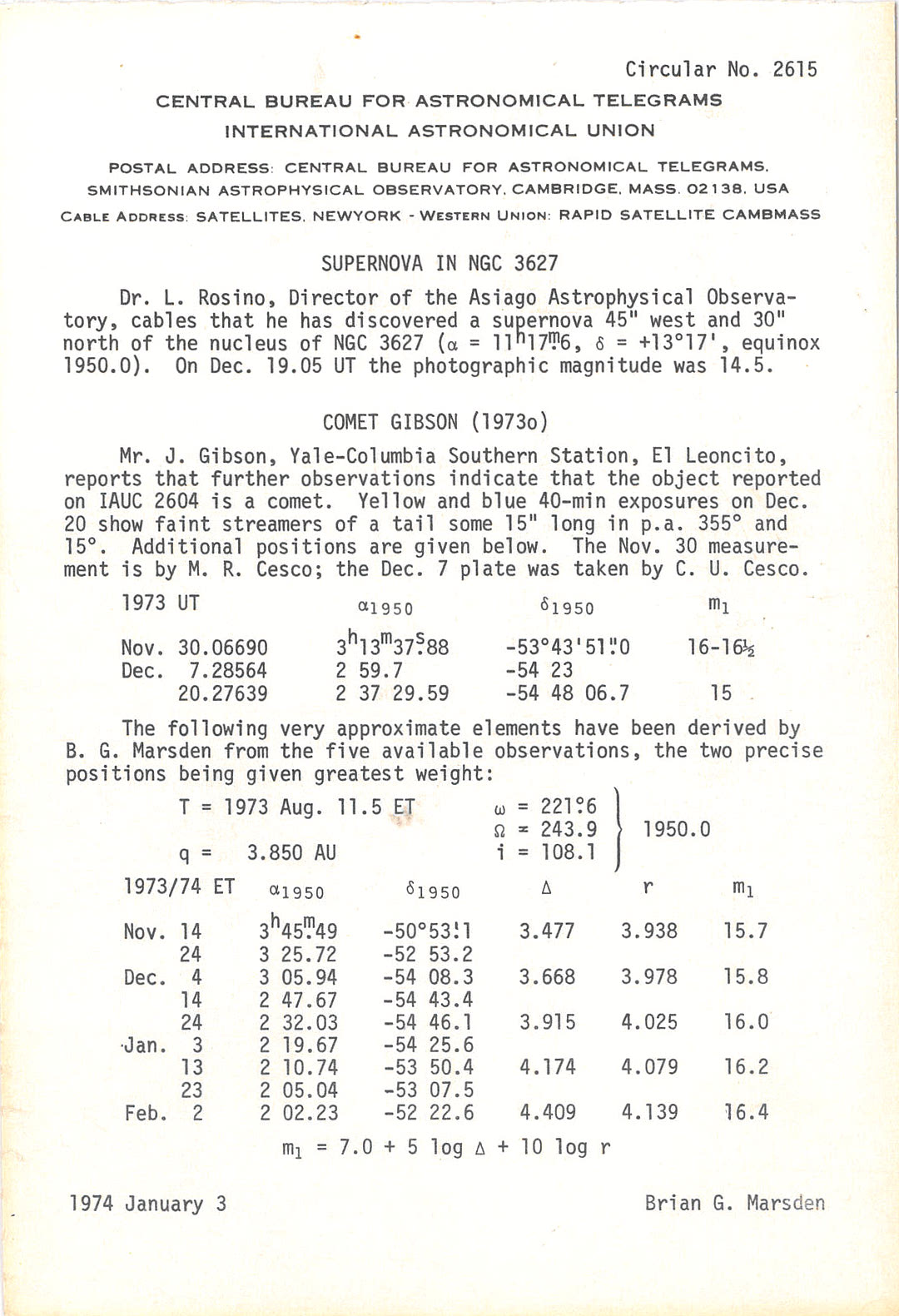
Messier 66 has recorded five confirmed supernovae since 1973, highlighting its vigorous massive star population likely influenced by gravitational interactions within the Leo Triplet. These events, primarily core-collapse types, provide insights into the galaxy's recent stellar evolution and explosion mechanisms. The earliest, SN 1973R, was a Type II supernova discovered on December 19, 1973, by Leonida Rosino in the outer spiral arm of the galaxy, reaching a peak apparent magnitude of 14.5.[33] Photometric and spectroscopic observations confirmed its classification and light curve decline consistent with hydrogen-rich ejecta from a massive progenitor.[33] SN 1989B, discovered on January 30, 1989, by amateur astronomer Robert Evans, stands out as one of the brightest supernovae observed in Messier 66, peaking at an apparent magnitude of approximately 12 in the V-band.[34] Classified as a Type Ia event, it exhibited a well-sampled light curve with maximum light about seven days post-discovery, enabling detailed studies of its thermonuclear origin and use as a potential distance indicator.[34] In 1997, SN 1997bs emerged as a subluminous Type IIn supernova, discovered on March 17 by the Lick Observatory Supernova Search using the Katzman Automatic Imaging Telescope; it peaked at magnitude 17.2.[35] Its narrow-line spectrum and faint luminosity led to comparisons with η Carinae-like eruptions, with pre-explosion imaging identifying a massive progenitor star of about 20–25 solar masses, later scrutinized for possible impostor status.[35][36] SN 2009hd, a possible Type II-Linear supernova, was identified on August 18, 2009, in the galaxy's disk, achieving a peak magnitude of 13.5 with extensive early-time photometry revealing a linear decline phase.[37] Observations from multiple telescopes, including the Swift satellite, supported its classification and progenitor analysis, suggesting a massive red supergiant origin.[37] The most recent, SN 2016cok (also known as ASASSN-16fq), a Type IIP supernova, was discovered on May 28, 2016, by the All Sky Automated Survey for Supernovae (ASAS-SN), peaking at around magnitude 13.[38] Its plateau light curve and progenitor detection in pre-explosion Hubble Space Telescope images indicated a low-mass red supergiant of approximately 8–10 solar masses, providing constraints on the lower mass limit for core-collapse events.[38]

Star formation regions

Messier 66 exhibits prominent bright H II regions and starburst knots distributed along its distorted spiral arms, indicative of ongoing massive star formation. These ionized hydrogen regions, powered by young OB stars, appear as compact, luminous features primarily concentrated in the inner spiral structure, with surveys identifying over 40 such regions in the galaxy's disk.[39] Dust lanes weave through the spiral arms, obscuring optical views of young stars while infrared observations penetrate this material to reveal embedded star clusters. Mid-infrared imaging from the James Webb Space Telescope highlights these dust-obscured areas as glowing orange and red knots, where polycyclic aromatic hydrocarbons and warm dust trace the environments of nascent stellar populations.[40] The galaxy's star formation rate stands at approximately 2-3 solar masses per year, elevated compared to isolated spiral galaxies of similar mass, reflecting enhanced efficiency driven by environmental interactions. This rate, derived from far-infrared and Hα emissions, underscores the role of the Leo Triplet's dynamics in compressing gas and triggering bursts.[41] Super star clusters, containing hundreds of thousands of young stars, are forming in the density waves propagated by these gravitational interactions, particularly at the bar-spiral interfaces. Observations from the PHANGS survey detect these massive, compact clusters in regions of high gas surface density, contributing significantly to the galaxy's ultraviolet and ionizing flux.[42] Concentrations of molecular gas, mapped through CO emissions, fuel these star formation bursts, with peaks in the central region and bar ends showing integrated intensities up to several K km s⁻¹. High-resolution CO(2-1) data reveal elongated structures aligned with the spiral arms, where dense gas fractions (traced by HCN/CO ratios) correlate with enhanced star-forming activity.[43]

Modern observations

Telescope imagery

The Hubble Space Telescope captured a detailed image of Messier 66 in 2010 using the Advanced Camera for Surveys, revealing prominent dust lanes weaving through its asymmetric spiral arms and a displaced galactic nucleus, features attributed to gravitational interactions within the Leo Triplet.[15] This visible-light composite, formed from exposures in the F555W (green), F814W (near-infrared), and H-alpha (hydrogen emission) filters, enhances the visibility of bright star clusters and tidal distortions, spanning about 5 arcminutes across.[44] In 2022, the European Southern Observatory's Very Large Telescope, equipped with the Multi-Unit Spectroscopic Explorer (MUSE) instrument, produced an image highlighting ionized gas regions in Messier 66, where red hues indicate hydrogen, blue shows oxygen, and orange denotes sulfur emissions from young stars.[45] As part of the PHANGS survey, this observation underscores the galaxy's role in the Leo Triplet by illustrating active star formation amid its barred spiral structure, approximately 31 million light-years distant.[45] The James Webb Space Telescope's Mid-Infrared Instrument (MIRI) imaged Messier 66 in 2023 as part of the PHANGS-JWST program, penetrating obscuring dust to expose intricate networks of heated dust grains, polycyclic aromatic hydrocarbons, and embedded young stellar objects along the spiral arms.[46] These mid-infrared views (5.6–21 microns) reveal cooler dust components and potential sites of future star birth, contrasting with shorter-wavelength observations by directly tracing the interstellar medium's role in galactic evolution. Ground-based imaging from the Palomar Observatory Sky Survey, digitized as the Second Palomar Observatory Sky Survey (POSS-II), provides wide-field views that capture Messier 66's faint outer halo and extended structures, including subtle tidal features extending beyond the bright disk.[47] These blue-sensitive plates, taken with the 48-inch Samuel Oschin Telescope, detect low-surface-brightness envelopes down to magnitudes around 23 per square arcsecond, offering context for the galaxy's interaction-driven morphology without the resolution of space-based telescopes.[47]

Spectroscopic studies

Spectroscopic observations of Messier 66 (NGC 3627) have provided key insights into its recession velocity and internal dynamics. Optical spectra have confirmed a heliocentric systemic radial velocity of 727 ± 5 km/s, derived from Hα emission-line measurements along the major axis, indicating the galaxy's recession within the Leo Triplet group.[17] High-resolution near-infrared spectroscopy using the Very Large Telescope's SINFONI instrument has mapped the distribution and kinematics of molecular gas in the central regions of Messier 66. These observations reveal H₂ emission-line gas with a velocity field showing a position angle of approximately 137° for the ionized gas, aligned with the nuclear dust disk, and indicate a bar-like structure influencing gas flows within ~4 arcseconds of the center. The data also highlight complex molecular gas ratios, with H₂ line fluxes suggesting a compact nuclear molecular reservoir amid bar-driven inflows.[48] Millimeter-wave continuum observations at 90 GHz, conducted in 2012 with the IRAM 30 m telescope, have mapped the synchrotron emission across Messier 66 at ~10 arcsecond resolution. These measurements show extended radio emission tracing non-thermal synchrotron processes linked to magnetic fields and cosmic-ray electrons, while the free-free component correlates with star-forming regions, providing a proxy for the ionized gas associated with ongoing star formation activity. The observations confirm that thermal emission dominates at these frequencies in this star-forming galaxy, with total flux densities indicating efficient star formation efficiency in the spiral arms.[49] Studies of chemical abundances in Messier 66, based on optical spectrophotometry of H II regions, indicate a gas-phase oxygen abundance of 12 + log(O/H) ≈ 8.34 (empirical PT05 calibration) to 8.95 (theoretical KK04 calibration) in the characteristic disk, suggesting a slightly metal-rich composition relative to solar values (~8.69) depending on the adopted method. These abundances, derived from R_{23} strong-line diagnostics, show a shallow radial gradient with efficient mixing, as evidenced by low scatter (0.03–0.05 dex) around the mean, consistent with bar-driven radial mixing in the disk.[50] Kinematic analyses from integral-field spectroscopy reveal distortions in the rotation curve of Messier 66, attributed to its central bar and gravitational interactions with neighboring galaxies in the Leo Triplet. Hα velocity fields display non-circular motions and a systemic velocity consistent with 727 km/s, with the rotation curve rising to ~200 km/s before flattening, showing asymmetries and twists likely induced by the bar's torque and tidal perturbations from NGC 3628. These distortions manifest as warped spiral arms and enhanced gas velocities at the bar ends, supporting models of dynamical coupling between the bar and spiral structure.[17][41]

References

User Avatar
No comments yet.