


Community hub
Recent from talks
Contribute something
Nothing was collected or created yet.
Astronomy Picture of the Day
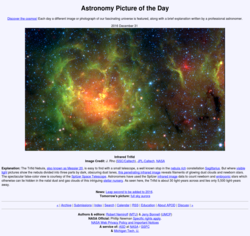
View on WikipediaAstronomy Picture of the Day (APOD) is a website provided by NASA and Michigan Technological University (MTU). Each day it features a different image of the universe accompanied by an explanation written by a professional astronomer.[1] The photograph does not necessarily correspond to a celestial event on the exact day that it is displayed, and images are sometimes repeated.[2] These often relate to current events in astronomy and space exploration. The text has several hyperlinks to more pictures and websites for more information. The images are either visible spectrum photographs, images taken at non-visible wavelengths and displayed in false color, video footage, animations, artist's conceptions, or micrographs that relate to space or cosmology.
Key Information


Past images are stored in the APOD Archive, with the first image appearing on June 16, 1995.[3] This initiative has received support from NASA, the National Science Foundation, and MTU. The images are sometimes authored by people or organizations outside NASA, and therefore APOD images are often copyrighted, unlike many other NASA image galleries.[4]
When the APOD website was created, it received a total of 14 page views on its first day. As of 2012[update], the APOD website has received over a billion image views throughout its lifetime.[5] APOD is also translated into 21 languages daily.[6]
APOD was presented at a meeting of the American Astronomical Society in 1996.[7] Its practice of using hypertext[2] was analyzed in a paper in 2000.[8] It received a Scientific American Sci/Tech Web Award in 2001.[9] In 2002, the website was featured in an interview with Nemiroff on CNN Saturday Morning News.[10] In 2003, the two authors published a book titled The Universe: 365 Days[11] from Harry N. Abrams, which is a collection of the best images from APOD as a hardcover "coffee table" style book. APOD was the Featured Collection in the November 2004 issue of D-Lib Magazine.[12]
During the United States federal government shutdown of 2013, APOD continued its service on mirror sites.[13][14]
Robert J. Nemiroff and Jerry T. Bonnell were awarded the 2015 Klumpke-Roberts Award by the Astronomical Society of the Pacific "for outstanding contributions to public understanding and appreciation of astronomy" for their work on APOD.[15][16] The site was awarded the International Astronomical Union's 2022 Astronomy Outreach Prize.[17][18]
As a result of the 2025 United States federal government shutdown, on October 1, 2025, the APOD website began displaying a prominent notice stating:
“Due to the lapse in federal government funding, NASA is not updating this website. We sincerely regret this inconvenience.”[19]
Volunteer-run APOD mirror and social media sites, such as the U.K. mirror, English language Instagram site, and Catalan Facebook page, are being updated. A list of mirror and social media sites is available on the About APOD page accessible from a link on the bottom of every APOD.
Pictures
[edit]-
![Blue Marble Earth (March 25, 2007;[20] July 13, 2010;[21] February 6, 2022[22])](//upload.wikimedia.org/wikipedia/commons/thumb/9/97/The_Earth_seen_from_Apollo_17.jpg/120px-The_Earth_seen_from_Apollo_17.jpg)
-
![Shadow of a Martian Robot (August 3, 2004;[23] February 4, 2007;[24] June 29, 2008;[25] May 8, 2011;[26] March 29, 2015;[27] February 17, 2019[28])](//upload.wikimedia.org/wikipedia/commons/thumb/c/cd/Opportunity%27s_shadow_sol_180_%28PIA06739%29.jpg/120px-Opportunity%27s_shadow_sol_180_%28PIA06739%29.jpg)
-
![Mammatus Clouds over Saskatchewan (October 23, 2012;[29] October 18, 2015[30])](//upload.wikimedia.org/wikipedia/commons/thumb/7/73/Mammatus_clouds_regina_sk_june_2012.JPG/120px-Mammatus_clouds_regina_sk_june_2012.JPG)
-
![M16: Pillars of Star Creation (November 6, 1995;[31] January 19, 1997;[32] April 12, 1998;[33] May 2, 1999;[34] September 24, 2000;[35] November 25, 2001;[36] October 26, 2003;[37] April 24, 2005;[38] February 18, 2007;[39] March 28, 2010;[40] July 22, 2012;[41] April 24, 2016;[42] December 6, 2020[43])](//upload.wikimedia.org/wikipedia/commons/thumb/b/b2/Eagle_nebula_pillars.jpg/120px-Eagle_nebula_pillars.jpg) M16: Pillars of Star Creation (November 6, 1995;[31] January 19, 1997;[32] April 12, 1998;[33] May 2, 1999;[34] September 24, 2000;[35] November 25, 2001;[36] October 26, 2003;[37] April 24, 2005;[38] February 18, 2007;[39] March 28, 2010;[40] July 22, 2012;[41] April 24, 2016;[42] December 6, 2020[43])
M16: Pillars of Star Creation (November 6, 1995;[31] January 19, 1997;[32] April 12, 1998;[33] May 2, 1999;[34] September 24, 2000;[35] November 25, 2001;[36] October 26, 2003;[37] April 24, 2005;[38] February 18, 2007;[39] March 28, 2010;[40] July 22, 2012;[41] April 24, 2016;[42] December 6, 2020[43]) -
![Valles Marineris: The Grand Canyon of Mars (July 16, 1995;[44] July 20, 1995;[45] June 27, 1997;[46] August 27, 2002;[47] August 24, 2003;[48] July 30, 2006;[49] March 27, 2011;[50] May 11, 2014;[51] May 29, 2016;[52] May 24, 2020;[53] November 10, 2024[54])](//upload.wikimedia.org/wikipedia/commons/thumb/5/56/Mars_Valles_Marineris.jpeg/120px-Mars_Valles_Marineris.jpeg)
-
![A Roll Cloud over Uruguay (January 5, 2010;[55] June 2, 2013;[56] June 12, 2016[57])](//upload.wikimedia.org/wikipedia/commons/thumb/0/08/Roll-cloud.JPG/120px-Roll-cloud.JPG)
-
![The Cat's Eye Nebula (June 28, 1995;[58] July 4, 1996;[59] August 2, 1997;[60] November 1, 1998;[61] October 31, 1999;[62] March 24, 2002;[63] November 12, 2006;[64] December 27, 2009;[65] August 26, 2012;[66] July 3, 2016[67])](//upload.wikimedia.org/wikipedia/commons/thumb/d/d8/Cat%27s_Eye_Nebula.jpg/120px-Cat%27s_Eye_Nebula.jpg)
-
![Spitzer's Trifid (January 13, 2005;[68] July 7, 2007;[69] July 25, 2015;[70] December 31, 2016;[71] February 13, 2020[72])](//upload.wikimedia.org/wikipedia/commons/thumb/3/38/Trifid_Nebula.jpg/120px-Trifid_Nebula.jpg)
-
![Zeta Oph: Runaway Star (December 29, 2012;[73] July 5, 2015;[74] April 8, 2017;[75] February 2, 2020;[76] January 4, 2024[77])](//upload.wikimedia.org/wikipedia/commons/thumb/e/e1/Zeta_Oph_Runaway_Star.jpg/120px-Zeta_Oph_Runaway_Star.jpg)
-
![Two Black Holes Dancing in 3C 75 (April 12, 2006;[78] November 9, 2008;[79] March 14, 2010;[80] September 28, 2014;[81] October 22, 2017;[82] June 5, 2022[83])](//upload.wikimedia.org/wikipedia/commons/thumb/e/e0/3C75_in_Radio%2BXray.jpg/120px-3C75_in_Radio%2BXray.jpg)
-
![The Fairy of Eagle Nebula (April 25, 2005;[84] December 9, 2007;[85] August 21, 2011;[86] September 29, 2013;[87] December 2, 2018;[88] September 25, 2022[89])](//upload.wikimedia.org/wikipedia/commons/thumb/f/f1/Fairy_of_Eagle_Nebula.jpg/60px-Fairy_of_Eagle_Nebula.jpg)
-
![Barnard 68: Dark Molecular Cloud (June 23, 2009;[90] January 29, 2012;[91] December 14, 2014;[92] October 8, 2017;[93] November 22, 2020;[94] January 29, 2023[95])](//upload.wikimedia.org/wikipedia/commons/thumb/1/10/Barnard_68.jpg/120px-Barnard_68.jpg)
![Blue Marble Earth (March 25, 2007;[20] July 13, 2010;[21] February 6, 2022[22])](https://en.wikipedia.org/wiki/File:The_Earth_seen_from_Apollo_17.jpg)
![Shadow of a Martian Robot (August 3, 2004;[23] February 4, 2007;[24] June 29, 2008;[25] May 8, 2011;[26] March 29, 2015;[27] February 17, 2019[28])](https://en.wikipedia.org/wiki/File:Opportunity%27s_shadow_sol_180_(PIA06739).jpg)
![Mammatus Clouds over Saskatchewan (October 23, 2012;[29] October 18, 2015[30])](https://en.wikipedia.org/wiki/File:Mammatus_clouds_regina_sk_june_2012.JPG)
![M16: Pillars of Star Creation (November 6, 1995;[31] January 19, 1997;[32] April 12, 1998;[33] May 2, 1999;[34] September 24, 2000;[35] November 25, 2001;[36] October 26, 2003;[37] April 24, 2005;[38] February 18, 2007;[39] March 28, 2010;[40] July 22, 2012;[41] April 24, 2016;[42] December 6, 2020[43])](https://en.wikipedia.org/wiki/File:Eagle_nebula_pillars.jpg)
![Valles Marineris: The Grand Canyon of Mars (July 16, 1995;[44] July 20, 1995;[45] June 27, 1997;[46] August 27, 2002;[47] August 24, 2003;[48] July 30, 2006;[49] March 27, 2011;[50] May 11, 2014;[51] May 29, 2016;[52] May 24, 2020;[53] November 10, 2024[54])](https://en.wikipedia.org/wiki/File:Mars_Valles_Marineris.jpeg)
![A Roll Cloud over Uruguay (January 5, 2010;[55] June 2, 2013;[56] June 12, 2016[57])](https://en.wikipedia.org/wiki/File:Roll-cloud.JPG)
![The Cat's Eye Nebula (June 28, 1995;[58] July 4, 1996;[59] August 2, 1997;[60] November 1, 1998;[61] October 31, 1999;[62] March 24, 2002;[63] November 12, 2006;[64] December 27, 2009;[65] August 26, 2012;[66] July 3, 2016[67])](https://en.wikipedia.org/wiki/File:Cat%27s_Eye_Nebula.jpg)
![Spitzer's Trifid (January 13, 2005;[68] July 7, 2007;[69] July 25, 2015;[70] December 31, 2016;[71] February 13, 2020[72])](https://en.wikipedia.org/wiki/File:Trifid_Nebula.jpg)
![Zeta Oph: Runaway Star (December 29, 2012;[73] July 5, 2015;[74] April 8, 2017;[75] February 2, 2020;[76] January 4, 2024[77])](https://en.wikipedia.org/wiki/File:Zeta_Oph_Runaway_Star.jpg)
![Two Black Holes Dancing in 3C 75 (April 12, 2006;[78] November 9, 2008;[79] March 14, 2010;[80] September 28, 2014;[81] October 22, 2017;[82] June 5, 2022[83])](https://en.wikipedia.org/wiki/File:3C75_in_Radio%2BXray.jpg)
![The Fairy of Eagle Nebula (April 25, 2005;[84] December 9, 2007;[85] August 21, 2011;[86] September 29, 2013;[87] December 2, 2018;[88] September 25, 2022[89])](https://en.wikipedia.org/wiki/File:Fairy_of_Eagle_Nebula.jpg)
![Barnard 68: Dark Molecular Cloud (June 23, 2009;[90] January 29, 2012;[91] December 14, 2014;[92] October 8, 2017;[93] November 22, 2020;[94] January 29, 2023[95])](https://en.wikipedia.org/wiki/File:Barnard_68.jpg)
References
[edit]- ^ Nemiroff, Robert; Jerry Bonnell (April 3, 2007). "APOD homepage". NASA. Archived from the original on 29 December 2010. Retrieved December 30, 2010.
- ^ a b Nemiroff, Robert; Jerry Bonnell. "APOD Frequently Asked Questions". NASA. Retrieved December 30, 2010.
- ^ Nemiroff, R.; Bonnell, J., eds. (16 June 1995). "Neutron Star Earth". Astronomy Picture of the Day. NASA. Retrieved February 18, 2017.
- ^ Nemiroff, Robert; Jerry Bonnell. "About APOD Image Permissions". NASA. Retrieved December 30, 2010.
- ^ Nemiroff, R.; Bonnell, J., eds. (16 June 2012). "APOD Turns 17". Astronomy Picture of the Day. NASA. Retrieved September 25, 2012.
- ^ "About APOD". APOD. Retrieved September 25, 2012.
- ^ "AAS Meeting 187th Program". American Astronomical Society. 1996. Archived from the original on September 7, 2007. Retrieved April 3, 2007.
- ^ Carr, Leslie; Hall, Wendy; Miles-Board, Timothy (February 29, 2000). "Writing and Reading Hypermedia on the Web". Technical Report, Electronics and Computer Science, University of Southampton. Archived from the original on December 11, 2005. Retrieved April 3, 2007.
- ^ "Sci/Tech Web Awards 2001—Astronomy and Astrophysics". Scientific American. May 14, 2001. Retrieved April 3, 2007.
- ^ "Saturday Morning News — Astronomy Picture of Day transcript". CNN. September 21, 2002. Retrieved April 3, 2007.
- ^ The Universe: 365 Days: Robert J. Nemiroff, Jerry T. Bonnell: Books
- ^ Wilson, Bonita (November 2004). "Featured Collection". D-Lib Magazine. 10 (11). doi:10.1045/november2004-featured.collection.
- ^ "How to follow APOD during a US government shutdown – Starship Asterisk*".
- ^ APOD mirror Archived October 3, 2013, at the Wayback Machine accessdate October, 4th, 2013
- ^ "Klumpke-Roberts Award of The Astronomical Society of the Pacific". Astronomical Society.
- ^ "The Astronomical Society of the Pacific Announces Its 2015 Award Recipients For Astronomy Research And Education". Astronomical Society.
- ^ "IAU Announces Winners of First Prizes for Astronomy Outreach, Development and Education". International Astronomical Union. June 9, 2022. Retrieved September 12, 2022.
- ^ "NASA's Astronomy Picture of the Day Recognized for Decades of Outreach". Goddard Space Flight Center. NASA. June 22, 2022. Retrieved September 12, 2022.
- ^ "Astronomy Picture of the Day". apod.nasa.gov. Archived from the original on 2025-10-01. Retrieved 2025-10-01.
- ^ Nemiroff, R.; Bonnell, J., eds. (25 March 2007). "Welcome to Planet Earth". Astronomy Picture of the Day. NASA.
- ^ Nemiroff, R.; Bonnell, J., eds. (13 July 2010). "Mosaic: Welcome to Planet Earth". Astronomy Picture of the Day. NASA.
- ^ Nemiroff, R.; Bonnell, J., eds. (6 February 2022). "Blue Marble Earth". Astronomy Picture of the Day. NASA.
- ^ Nemiroff, R.; Bonnell, J., eds. (3 August 2004). "Shadow of a Martian Robot". Astronomy Picture of the Day. NASA.
- ^ Nemiroff, R.; Bonnell, J., eds. (4 February 2007). "Shadow of a Martian Robot". Astronomy Picture of the Day. NASA.
- ^ Nemiroff, R.; Bonnell, J., eds. (29 June 2008). "Shadow of a Martian Robot". Astronomy Picture of the Day. NASA.
- ^ Nemiroff, R.; Bonnell, J., eds. (8 May 2011). "Shadow of a Martian Robot". Astronomy Picture of the Day. NASA.
- ^ Nemiroff, R.; Bonnell, J., eds. (29 March 2015). "Shadow of a Martian Robot". Astronomy Picture of the Day. NASA.
- ^ Nemiroff, R.; Bonnell, J., eds. (17 February 2019). "Shadow of a Martian Robot". Astronomy Picture of the Day. NASA.
- ^ Nemiroff, R.; Bonnell, J., eds. (23 October 2012). "Mammatus Clouds Over Saskatchewan". Astronomy Picture of the Day. NASA.
- ^ Nemiroff, R.; Bonnell, J., eds. (18 October 2015). "Mammatus Clouds Over Saskatchewan". Astronomy Picture of the Day. NASA.
- ^ Nemiroff, R.; Bonnell, J., eds. (6 November 1995). "M16: Stars Upon Pillars". Astronomy Picture of the Day. NASA.
- ^ Nemiroff, R.; Bonnell, J., eds. (19 January 1997). "From Eagle's EGGs A Star Is Born". Astronomy Picture of the Day. NASA.
- ^ Nemiroff, R.; Bonnell, J., eds. (12 April 1998). "Stars from Eagle's EGGs". Astronomy Picture of the Day. NASA.
- ^ Nemiroff, R.; Bonnell, J., eds. (2 May 1999). "Stars from Eagle's EGGs". Astronomy Picture of the Day. NASA.
- ^ Nemiroff, R.; Bonnell, J., eds. (24 September 2000). "M16: Stars from Eagle's EGGs". Astronomy Picture of the Day. NASA.
- ^ Nemiroff, R.; Bonnell, J., eds. (25 November 2001). "M16: Stars from Eagle's EGGs". Astronomy Picture of the Day. NASA.
- ^ Nemiroff, R.; Bonnell, J., eds. (26 October 2003). "M16: Stars from Eagle's EGGs". Astronomy Picture of the Day. NASA.
- ^ Nemiroff, R.; Bonnell, J., eds. (24 April 2005). "M16: Stars from Eagle's EGGs". Astronomy Picture of the Day. NASA.
- ^ Nemiroff, R.; Bonnell, J., eds. (18 February 2007). "M16: Pillars of Creation". Astronomy Picture of the Day. NASA.
- ^ Nemiroff, R.; Bonnell, J., eds. (28 March 2010). "M16: Pillars of Creation". Astronomy Picture of the Day. NASA.
- ^ Nemiroff, R.; Bonnell, J., eds. (22 July 2012). "M16: Pillars of Creation". Astronomy Picture of the Day. NASA.
- ^ Nemiroff, R.; Bonnell, J., eds. (24 April 2016). "M16: Pillars of Star Creation". Astronomy Picture of the Day. NASA.
- ^ Nemiroff, R.; Bonnell, J., eds. (6 December 2020). "M16: Pillars of Star Creation". Astronomy Picture of the Day. NASA.
- ^ Nemiroff, R.; Bonnell, J., eds. (16 July 1995). "The Exploration of Mars". Astronomy Picture of the Day. NASA.
- ^ Nemiroff, R.; Bonnell, J., eds. (20 July 1995). "The Grand Canyon of Mars". Astronomy Picture of the Day. NASA.
- ^ Nemiroff, R.; Bonnell, J., eds. (27 June 1997). "Mars: Just The Facts". Astronomy Picture of the Day. NASA.
- ^ Nemiroff, R.; Bonnell, J., eds. (27 August 2002). "Valles Marineris: The Grand Canyon of Mars". Astronomy Picture of the Day. NASA.
- ^ Nemiroff, R.; Bonnell, J., eds. (24 August 2003). "Valles Marineris: The Grand Canyon of Mars". Astronomy Picture of the Day. NASA.
- ^ Nemiroff, R.; Bonnell, J., eds. (30 July 2006). "Valles Marineris: The Grand Canyon of Mars". Astronomy Picture of the Day. NASA.
- ^ Nemiroff, R.; Bonnell, J., eds. (27 March 2011). "Valles Marineris: The Grand Canyon of Mars". Astronomy Picture of the Day. NASA.
- ^ Nemiroff, R.; Bonnell, J., eds. (11 May 2014). "Valles Marineris: The Grand Canyon of Mars". Astronomy Picture of the Day. NASA.
- ^ Nemiroff, R.; Bonnell, J., eds. (29 May 2016). "Valles Marineris: The Grand Canyon of Mars". Astronomy Picture of the Day. NASA.
- ^ Nemiroff, R.; Bonnell, J., eds. (24 May 2020). "Valles Marineris: The Grand Canyon of Mars". Astronomy Picture of the Day. NASA.
- ^ Nemiroff, R.; Bonnell, J., eds. (10 November 2024). "Valles Marineris: The Grand Canyon of Mars". Astronomy Picture of the Day. NASA.
- ^ Nemiroff, R.; Bonnell, J., eds. (5 January 2010). "A Roll Cloud Over Uruguay". Astronomy Picture of the Day. NASA.
- ^ Nemiroff, R.; Bonnell, J., eds. (2 June 2013). "A Roll Cloud Over Uruguay". Astronomy Picture of the Day. NASA.
- ^ Nemiroff, R.; Bonnell, J., eds. (12 June 2016). "A Roll Cloud Over Uruguay". Astronomy Picture of the Day. NASA.
- ^ Nemiroff, R.; Bonnell, J., eds. (28 June 1995). "The Cat's Eye Nebula". Astronomy Picture of the Day. NASA.
- ^ Nemiroff, R.; Bonnell, J., eds. (4 July 1996). "The Cat's Eye Nebula (Revisited)". Astronomy Picture of the Day. NASA.
- ^ Nemiroff, R.; Bonnell, J., eds. (2 August 1997). "The Cat's Eye Nebula". Astronomy Picture of the Day. NASA.
- ^ Nemiroff, R.; Bonnell, J., eds. (1 November 1998). "The Cat's Eye Nebula". Astronomy Picture of the Day. NASA.
- ^ Nemiroff, R.; Bonnell, J., eds. (31 October 1999). "The Cat's Eye Nebula". Astronomy Picture of the Day. NASA.
- ^ Nemiroff, R.; Bonnell, J., eds. (24 March 2002). "The Cat's Eye Nebula". Astronomy Picture of the Day. NASA.
- ^ Nemiroff, R.; Bonnell, J., eds. (12 November 2006). "The Cat's Eye Nebula". Astronomy Picture of the Day. NASA.
- ^ Nemiroff, R.; Bonnell, J., eds. (27 December 2009). "The Cat's Eye Nebula". Astronomy Picture of the Day. NASA.
- ^ Nemiroff, R.; Bonnell, J., eds. (26 August 2012). "The Cat's Eye Nebula". Astronomy Picture of the Day. NASA.
- ^ Nemiroff, R.; Bonnell, J., eds. (3 July 2016). "The Cat's Eye Nebula". Astronomy Picture of the Day. NASA.
- ^ Nemiroff, R.; Bonnell, J., eds. (13 January 2005). "Infrared Trifid". Astronomy Picture of the Day. NASA.
- ^ Nemiroff, R.; Bonnell, J., eds. (7 July 2007). "Infrared Trifid". Astronomy Picture of the Day. NASA.
- ^ Nemiroff, R.; Bonnell, J., eds. (25 July 2015). "Infrared Trifid". Astronomy Picture of the Day. NASA.
- ^ Nemiroff, R.; Bonnell, J., eds. (31 December 2016). "Infrared Trifid". Astronomy Picture of the Day. NASA.
- ^ Nemiroff, R.; Bonnell, J., eds. (13 February 2020). "Spitzer's Trifid". Astronomy Picture of the Day. NASA.
- ^ Nemiroff, R.; Bonnell, J., eds. (29 December 2012). "Zeta Oph: Runaway Star". Astronomy Picture of the Day. NASA.
- ^ Nemiroff, R.; Bonnell, J., eds. (5 July 2015). "Zeta Oph: Runaway Star". Astronomy Picture of the Day. NASA.
- ^ Nemiroff, R.; Bonnell, J., eds. (8 April 2017). "Zeta Oph: Runaway Star". Astronomy Picture of the Day. NASA.
- ^ Nemiroff, R.; Bonnell, J., eds. (2 February 2020). "Zeta Oph: Runaway Star". Astronomy Picture of the Day. NASA.
- ^ Nemiroff, R.; Bonnell, J., eds. (4 January 2024). "Zeta Oph: Runaway Star". Astronomy Picture of the Day. NASA.
- ^ Nemiroff, R.; Bonnell, J., eds. (12 April 2006). "Binary Black Hole in 3C 75". Astronomy Picture of the Day. NASA.
- ^ Nemiroff, R.; Bonnell, J., eds. (9 November 2008). "Two Black Holes Dancing in 3C 75". Astronomy Picture of the Day. NASA.
- ^ Nemiroff, R.; Bonnell, J., eds. (14 March 2010). "Binary Black Hole in 3C 75". Astronomy Picture of the Day. NASA.
- ^ Nemiroff, R.; Bonnell, J., eds. (28 September 2014). "Two Black Holes Dancing in 3C 75". Astronomy Picture of the Day. NASA.
- ^ Nemiroff, R.; Bonnell, J., eds. (22 October 2017). "Two Black Holes Dancing in 3C 75". Astronomy Picture of the Day. NASA.
- ^ Nemiroff, R.; Bonnell, J., eds. (5 June 2022). "Two Black Holes Dancing in 3C 75". Astronomy Picture of the Day. NASA.
- ^ Nemiroff, R.; Bonnell, J., eds. (25 April 2005). "The Fairy of Eagle Nebula". Astronomy Picture of the Day. NASA.
- ^ Nemiroff, R.; Bonnell, J., eds. (9 December 2007). "The Fairy of Eagle Nebula". Astronomy Picture of the Day. NASA.
- ^ Nemiroff, R.; Bonnell, J., eds. (21 August 2011). "The Fairy of Eagle Nebula". Astronomy Picture of the Day. NASA.
- ^ Nemiroff, R.; Bonnell, J., eds. (29 September 2013). "The Fairy of Eagle Nebula". Astronomy Picture of the Day. NASA.
- ^ Nemiroff, R.; Bonnell, J., eds. (2 December 2018). "The Fairy of Eagle Nebula". Astronomy Picture of the Day. NASA.
- ^ Nemiroff, R.; Bonnell, J., eds. (25 September 2022). "The Fairy of Eagle Nebula". Astronomy Picture of the Day. NASA.
- ^ Nemiroff, R.; Bonnell, J., eds. (23 June 2009). "Molecular Cloud Barnard 68". Astronomy Picture of the Day. NASA.
- ^ Nemiroff, R.; Bonnell, J., eds. (29 January 2012). "Molecular Cloud Barnard 68". Astronomy Picture of the Day. NASA.
- ^ Nemiroff, R.; Bonnell, J., eds. (14 December 2014). "Molecular Cloud Barnard 68". Astronomy Picture of the Day. NASA.
- ^ Nemiroff, R.; Bonnell, J., eds. (8 October 2017). "Dark Molecular Cloud Barnard 68". Astronomy Picture of the Day. NASA.
- ^ Nemiroff, R.; Bonnell, J., eds. (22 November 2020). "Dark Molecular Cloud Barnard 68". Astronomy Picture of the Day. NASA.
- ^ Nemiroff, R.; Bonnell, J., eds. (29 January 2023). "Barnard 68: Dark Molecular Cloud". Astronomy Picture of the Day. NASA.
External links
[edit]
- Official website
- APOD Archive
- About APOD – includes a list of mirror websites
- Astronomy Picture of the Day RSS Feed – Official RSS feed
- Official list of alternative (mirror) sites for when the NASA APOD site is down
- Observatorio – Spanish official translation, with web2.0 features
- Starship Asterisk* – APOD and General Astronomy Discussion Forum
- Astronomy Picture of the Day (APOD) – Official Facebook Page
- Official APOD Telegram channel - Official channel in Telegram Messenger
- Astronomy Picture of the Day App – Official iOS mirror
- APOD email service
- List of APOD Mirrors and Social Sites
