Hubbry Logo
Fluorescence microscopeFluorescence microscopeMain
Open search
Fluorescence microscope
Community hub
Fluorescence microscope
logo
8 pages, 0 posts
0 subscribers
Be the first to start a discussion here.
Fluorescence microscope
from Wikipedia

An upright fluorescence microscope (Olympus BX61) with the fluorescence filter cube turret above the objective lenses, coupled with a digital camera
Fluorescence and confocal microscopes operating principle

A fluorescence microscope is an optical microscope that uses fluorescence instead of, or in addition to, scattering, reflection, and attenuation or absorption, to study the properties of organic or inorganic substances.[1][2] A fluorescence microscope is any microscope that uses fluorescence to generate an image, whether it is a simple setup like an epifluorescence microscope or a more complicated design such as a confocal microscope, which uses optical sectioning to get better resolution of the fluorescence image.[3]

Principle

[edit]

The specimen is illuminated with light of a specific wavelength (or wavelengths) which is absorbed by the fluorophores, causing them to emit light of longer wavelengths (i.e., of a different color than the absorbed light). The illumination light is separated from the much weaker emitted fluorescence through the use of a spectral emission filter. Typical components of a fluorescence microscope are a light source (xenon arc lamp or mercury-vapor lamp are common; more advanced forms are high-power LEDs and lasers), the excitation filter, the dichroic mirror (or dichroic beamsplitter), and the emission filter (see figure below). The filters and the dichroic beamsplitter are chosen to match the spectral excitation and emission characteristics of the fluorophore used to label the specimen.[1] In this manner, the distribution of a single fluorophore (color) is imaged at a time. Multi-color images of several types of fluorophores must be composed by combining several single-color images.[1]

Most fluorescence microscopes in use are epifluorescence microscopes, where excitation of the fluorophore and detection of the fluorescence are done through the same light path (i.e. through the objective). These microscopes are widely used in biology and are the basis for more advanced microscope designs, such as the confocal microscope and the total internal reflection fluorescence microscope (TIRF).

Epifluorescence microscopy

[edit]
Schematic of a fluorescence microscope

The majority of fluorescence microscopes, especially those used in the life sciences, are of the epifluorescence design shown in the diagram. Light of the excitation wavelength illuminates the specimen through the objective lens. The fluorescence emitted by the specimen is focused to the detector by the same objective that is used for the excitation which for greater resolution will need objective lens with higher numerical aperture. Since most of the excitation light is transmitted through the specimen, only reflected excitatory light reaches the objective together with the emitted light and the epifluorescence method therefore gives a high signal-to-noise ratio. The dichroic beamsplitter acts as a wavelength specific filter, transmitting fluoresced light through to the eyepiece or detector, but reflecting any remaining excitation light back towards the source.[citation needed]

Light sources

[edit]

Fluorescence microscopy requires intense, near-monochromatic, illumination which some widespread light sources, like halogen lamps cannot provide.[4] Four main types of light source are used, including xenon arc lamps or mercury-vapor lamps with an excitation filter, lasers, supercontinuum sources, and high-power LEDs. Lasers are most widely used for more complex fluorescence microscopy techniques like confocal microscopy and total internal reflection fluorescence microscopy while xenon lamps, and mercury lamps, and LEDs with a dichroic excitation filter are commonly used for widefield epifluorescence microscopes. By placing two microlens arrays into the illumination path of a widefield epifluorescence microscope,[5] highly uniform illumination with a coefficient of variation of 1-2% can be achieved.

Sample preparation

[edit]
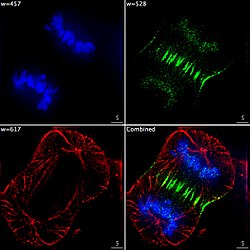
3D-animation of the diatom Corethron sp.
Displays overlays from four fluorescent channels
(a) Green: [DiOC6(3) fluorescence] - stains cellular membranes indicating the core cell bodies
(b) Cyan: [PLL-A546 fluorescence] - generic counterstain for visualising eukaryotic cell surfaces
(c) Blue: [Hoechst fluorescence] - stains DNA, identifies nuclei
(d) Red: [chlorophyll autofluorescence] - resolves chloroplasts [6]
The animation starts by overlaying all available fluorescent channels, and then clarifies the visualisation by switching channels on and off.
A sample of herring sperm stained with SYBR green in a cuvette illuminated by blue light in an epifluorescence microscope. The SYBR green in the sample binds to the herring sperm DNA and, once bound, fluoresces giving off green light when illuminated by blue light.

In order for a sample to be suitable for fluorescence microscopy it must be fluorescent. There are several methods of creating a fluorescent sample; the main techniques are labelling with fluorescent stains or, in the case of biological samples, expression of a fluorescent protein. Alternatively the intrinsic fluorescence of a sample (i.e., autofluorescence) can be used.[1] In the life sciences fluorescence microscopy is a powerful tool which allows the specific and sensitive staining of a specimen in order to detect the distribution of proteins or other molecules of interest. As a result, there is a diverse range of techniques for fluorescent staining of biological samples.[citation needed]

Biological fluorescent stains

[edit]

Many fluorescent stains have been designed for a range of biological molecules. Some of these are small molecules which are intrinsically fluorescent and bind a biological molecule of interest. Major examples of these are nucleic acid stains such as DAPI and Hoechst (excited by UV wavelength light) and DRAQ5 and DRAQ7 (optimally excited by red light) which all bind the minor groove of DNA, thus labeling the nuclei of cells. Others are drugs, toxins, or peptides which bind specific cellular structures and have been derivatised with a fluorescent reporter. A major example of this class of fluorescent stain is phalloidin, which is used to stain actin fibers in mammalian cells. A new peptide, known as the Collagen Hybridizing Peptide, can also be conjugated with fluorophores and used to stain denatured collagen fibers. Staining of the plant cell walls is performed using stains or dyes that bind cellulose or pectin. The quest for fluorescent probes with a high specificity that also allow live imaging of plant cells is ongoing.[7]

There are many fluorescent molecules called fluorophores or fluorochromes such as fluorescein, Alexa Fluors, or DyLight 488, which can be chemically linked to a different molecule which binds the target of interest within the sample.

Immunofluorescence

[edit]

Immunofluorescence is a technique which uses the highly specific binding of an antibody to its antigen in order to label specific proteins or other molecules within the cell. A sample is treated with a primary antibody specific for the molecule of interest. A fluorophore can be directly conjugated to the primary antibody. Alternatively a secondary antibody, conjugated to a fluorophore, which binds specifically to the first antibody can be used. For example, a primary antibody raised in a mouse which recognises tubulin combined with a secondary anti-mouse antibody derivatised with a fluorophore could be used to label microtubules in a cell.[citation needed]

Fluorescent proteins

[edit]

The modern understanding of genetics and the techniques available for modifying DNA allow scientists to genetically modify proteins to also carry a fluorescent protein reporter. In biological samples this allows a scientist to directly make a protein of interest fluorescent. The protein location can then be directly tracked, including in live cells.

Limitations

[edit]

Fluorophores lose their ability to fluoresce as they are illuminated in a process called photobleaching. Photobleaching occurs as the fluorescent molecules accumulate chemical damage from the electrons excited during fluorescence. Photobleaching can severely limit the time over which a sample can be observed by fluorescence microscopy. Several techniques exist to reduce photobleaching such as the use of more robust fluorophores, by minimizing illumination, or by using photoprotective scavenger chemicals.[citation needed]

Fluorescence microscopy with fluorescent reporter proteins has enabled analysis of live cells by fluorescence microscopy, however cells are susceptible to phototoxicity, particularly with short wavelength light. Furthermore, fluorescent molecules have a tendency to generate reactive chemical species when under illumination which enhances the phototoxic effect.[citation needed]

Unlike transmitted and reflected light microscopy techniques, fluorescence microscopy only allows observation of the specific structures which have been labeled for fluorescence. For example, observing a tissue sample prepared with a fluorescent DNA stain by fluorescence microscopy only reveals the organization of the DNA within the cells and reveals nothing else about the cell morphologies.

Computational techniques that propose to estimate the fluorescent signal from non-fluorescent images (such as brightfield) may reduce these concerns.[8] In general, these approaches involve training a deep convolutional neural network on stained cells and then estimating the fluorescence on unstained samples. Thus by decoupling the cells under investigation from the cells used to train the network, imaging can performed quicker and with reduced phototoxicity.

Sub-diffraction techniques

[edit]

The wave nature of light limits the size of the spot to which light can be focused due to the diffraction limit. This limitation was described in the 19th century by Ernst Abbe and "limits an optical microscope's resolution to approximately half of the wavelength of the light used." Fluorescence microscopy is central to many techniques which aim to reach past this limit by specialized optical configurations.[citation needed]

Several improvements in microscopy techniques have been invented in the 20th century and have resulted in increased resolution and contrast to some extent. However they did not overcome the diffraction limit. In 1978 first theoretical ideas have been developed to break this barrier by using a 4Pi microscope as a confocal laser scanning fluorescence microscope where the light is focused ideally from all sides to a common focus which is used to scan the object by 'point-by-point' excitation combined with 'point-by-point' detection.[9] However, the first experimental demonstration of the 4pi microscope took place in 1994.[10] 4Pi microscopy maximizes the amount of available focusing directions by using two opposing objective lenses or two-photon excitation microscopy using redshifted light and multi-photon excitation.[citation needed]

Integrated correlative microscopy combines a fluorescence microscope with an electron microscope. This allows one to visualize ultrastructure and contextual information with the electron microscope while using the data from the fluorescence microscope as a labelling tool.[11]

The first technique to really achieve a sub-diffraction resolution was STED microscopy, proposed in 1994. This method and all techniques following the RESOLFT concept rely on a strong non-linear interaction between light and fluorescing molecules. The molecules are driven strongly between distinguishable molecular states at each specific location, so that finally light can be emitted at only a small fraction of space, hence an increased resolution.

As well in the 1990s another super resolution microscopy method based on wide field microscopy has been developed. Substantially improved size resolution of cellular nanostructures stained with a fluorescent marker was achieved by development of SPDM localization microscopy and the structured laser illumination (spatially modulated illumination, SMI).[12] Combining the principle of SPDM with SMI resulted in the development of the Vertico SMI microscope.[13][14] Single molecule detection of normal blinking fluorescent dyes like green fluorescent protein (GFP) can be achieved by using a further development of SPDM the so-called SPDMphymod technology which makes it possible to detect and count two different fluorescent molecule types at the molecular level (this technology is referred to as two-color localization microscopy or 2CLM).[15]

Alternatively, the advent of photoactivated localization microscopy could achieve similar results by relying on blinking or switching of single molecules, where the fraction of fluorescing molecules is very small at each time. This stochastic response of molecules on the applied light corresponds also to a highly nonlinear interaction, leading to subdiffraction resolution.

[edit]

See also

[edit]

References

[edit]
[edit]
Revisions and contributorsEdit on WikipediaRead on Wikipedia
from Grokipedia
A fluorescence microscope is an that utilizes the fluorescence phenomenon—wherein certain molecules absorb at one and emit it at a longer —to generate high-contrast images of biological specimens or materials labeled with fluorescent probes. This technique enables the visualization of specific structures, such as proteins, organelles, or cells, with exceptional , far surpassing traditional by minimizing background noise through the separation of excitation and emission via filters and dichroic mirrors. The core principle of fluorescence microscopy relies on the , where fluorophores (fluorescent molecules) undergo excitation by photons in the femtosecond range, followed by rapid vibrational relaxation and emission of lower-energy photons in the nanosecond range, allowing selective imaging of targeted components. Key hardware includes high-intensity light sources like mercury arc lamps, xenon lamps, or lasers (typically emitting at 405–546 nm), excitation and emission filters to isolate wavelengths, and objectives with high numerical apertures to capture emitted light efficiently. Historical development began with the discovery of by George G. Stokes in 1852, followed by the first practical fluorescence microscopes constructed between 1911 and 1913 by Oskar Heimstädt and Heinrich Lehmann, with significant advancements in by Albert Coons in the 1940s and the introduction of (GFP) for genetic labeling in the 1990s. In biological applications, fluorescence microscopy has revolutionized by enabling real-time monitoring of dynamic processes, such as , protein trafficking, and dynamics in living cells, tissues, or whole organisms, with resolutions typically limited to ~200 nm laterally and ~500 nm axially due to , though super-resolution variants like STED or PALM can achieve ~20 nm. Techniques range from wide-field epifluorescence for broad overviews to confocal and light-sheet for 3D with reduced and , making it indispensable in fields like , , and . Despite challenges like bleaching and light scattering in thick samples, ongoing innovations in probes (e.g., quantum dots) and illumination methods continue to expand its utility for intravital and high-throughput studies.

Fundamentals

Basic Principle

Fluorescence microscopy is based on the principle of , a photophysical process in which a absorbs photons of light at a specific excitation , exciting electrons to a higher energy state, and then emits photons at a longer emission as the electrons return to the . This emission occurs at lower energy due to non-radiative energy losses, resulting in a spectral shift known as the . The , typically ranging from 10 to 100 nanometers depending on the , enables effective separation of excitation and emission light, minimizing background interference and enhancing image contrast. The key energy transitions in fluorescence are depicted in the Jablonski diagram, which illustrates the electronic and vibrational states of the fluorophore. The ground singlet state (S₀) represents the lowest energy level, while absorption of excitation light promotes an electron to the first excited singlet state (S₁) or higher. Upon reaching S₁, the molecule undergoes rapid vibrational relaxation, dissipating excess energy as heat to the lowest vibrational level of S₁ within picoseconds. From this level, the electron can return to S₀ via radiative decay (fluorescence emission) or non-radiative decay pathways, such as internal conversion or intersystem crossing to the triplet state. Vibrational relaxation and non-radiative decay are ultrafast processes that compete with fluorescence, influencing the overall efficiency of light emission. The emitted fluorescence intensity IfI_f is determined by the equation If=ΦIabs,I_f = \Phi \cdot I_{\text{abs}}, where Φ\Phi is the quantum yield—the ratio of photons emitted to photons absorbed, quantifying the fluorescence efficiency—and IabsI_{\text{abs}} is the intensity of light absorbed by the fluorophore. Quantum yields vary widely among fluorophores, from near 0 for weakly fluorescent molecules to approaching 1 for highly efficient ones like certain dyes. This relationship underscores how optimizing excitation and minimizing losses can maximize signal in applications. Fluorophores are specialized molecules or ions that undergo this absorption-emission cycle, serving as the core reporters in fluorescence microscopy; a classic example is fluorescein, which exhibits strong absorption around 490 nm and emission peaking at 520 nm, producing a bright green signal. These probes enable visualization of specific cellular components when selectively incorporated into samples. In contrast to amplitude-based methods like , which detect variations in light transmission through absorption or , or , which highlights differences via phase shifts without labeling, fluorescence microscopy provides superior specificity and sensitivity by relying on targeted excitation and emission. This allows detection of low-abundance molecules at nanomolar concentrations, far surpassing the contrast limits of unlabeled techniques.

Epifluorescence Microscopy

Epifluorescence microscopy, also known as incident or reflected fluorescence microscopy, utilizes a configuration where excitation is directed through the objective lens onto the sample, illuminating a wide . The fluorescent emission generated within the sample is then collected back through the same objective lens, which serves dual purposes as both condenser and collector. This vertical illumination pathway enables efficient without requiring the sample to be transparent to the excitation , distinguishing it from earlier transmitted approaches. Central to this setup is the dichroic mirror, positioned at a 45-degree angle within the optical block. It selectively reflects the shorter-wavelength excitation light toward and sample while transmitting the longer-wavelength emission light to the or detector, minimizing between excitation and emission spectra. This design enhances by blocking most residual excitation light from reaching the detector. The underlying mechanism relies on the basic principle of , where fluorophores absorb photons at specific excitation wavelengths and re-emit them at longer emission wavelengths. The simplicity of the epifluorescence configuration, requiring fewer specialized components than scanning-based systems, contributes to its cost-effectiveness and ease of implementation in routine laboratory settings. It is particularly advantageous for imaging thick or opaque samples, such as tissues or cells in , where transmitted light methods would suffer from significant and absorption. In contrast, transmitted fluorescence microscopy, which directs excitation light through a condenser below the sample, is less commonly used due to its reliance on thin, transparent specimens and increased photobleaching from the excitation beam traversing the full sample thickness, leading to faster fluorophore degradation throughout the volume. Historically, epifluorescence microscopy traces its roots to the early 1940s, when Albert Coons developed the first techniques by conjugating fluorescent dyes to antibodies, enabling specific labeling and visualization of antigens in tissues. This innovation laid the foundation for modern applications, though initial setups often used transmitted illumination. A key milestone occurred in the 1960s with the commercialization of epi-illumination systems, including Johann Ploem's multi-wavelength filter blocks and the Leitz Orthoplan microscope's Ploemopak illuminator, which made the technique widely accessible and standardized in biological research.00020-5/fulltext)

Optical Components

Light Sources

Fluorescence microscopes require high-intensity light sources to excite fluorophores efficiently, producing detectable emission signals while minimizing and sample damage. Traditional arc lamps, such as mercury and variants, have long been staples due to their broad spectral coverage, though modern alternatives like LEDs and lasers offer advantages in precision and longevity. Mercury arc lamps provide a broad emission spectrum spanning ultraviolet to infrared wavelengths, with particularly high intensity in narrow bands around 365 nm (UV), 405 nm (violet), and 436-546 nm (blue-green), making them suitable for exciting common fluorophores like and FITC. These lamps operate via an electrical arc discharge that vaporizes mercury, generating peak outputs that align well with standard excitation filters, but their uneven spectral distribution limits quantitative applications. However, they suffer from short lifespans of 200-300 hours and significant heat generation from the arc plasma, which can cause sample degradation and requires . Xenon arc lamps deliver a more continuous spectrum across the and visible ranges, approximating where the intensity I(λ)I(\lambda) is proportional to the distribution, I(λ)2hc2λ5(ehc/λkT1)I(\lambda) \propto \frac{2hc^2}{\lambda^5 (e^{hc / \lambda kT} - 1)}, with effective temperatures around 6000 K for balanced output. This even intensity profile excels for UV excitation of dyes like Fura-2 and supports quantitative measurements, though xenon lamps are slightly less bright than equivalent mercury lamps in certain bands and also produce substantial heat. Their spectral stability makes them preferable for applications needing uniform illumination. Light-emitting diodes (LEDs) have gained prominence since the mid-2000s for their narrowband emission (typically 20-50 nm ), enabling targeted excitation of specific fluorophores in multi-color setups without excess light. These sources are energy-efficient, generate minimal heat, and offer long lifespans exceeding 20,000 hours with instant on/off switching and high stability, reducing in live-cell . Their compact design facilitates integration into modular systems, though early models had lower power outputs that have since improved to rival arc lamps. Lasers provide coherent, monochromatic light with high spatial and temporal coherence, allowing precise focusing and minimal for efficient excitation in point-scanning configurations. Common wavelengths include 405 nm, 488 nm, and 561 nm, with power outputs typically in the 1-100 mW range to balance signal strength and sample viability. This coherence enables advanced techniques requiring tight beam control, though alignment and cost can be challenges compared to incoherent sources. Selection of a light source depends on matching the output to the fluorophore's absorption peak, ensuring sufficient power (e.g., 50-200 W for arc lamps or 1-100 mW for lasers) for , and prioritizing stability to avoid intensity fluctuations during imaging. Other factors include thermal management to prevent sample heating and operational lifespan for cost-effectiveness in routine use. Filters may be used briefly to refine the source's output for optimal excitation.

Excitation and Emission Filters

In fluorescence microscopy, the filter cube serves as a critical optical assembly that houses the excitation filter, dichroic beamsplitter, and emission filter to precisely control the wavelengths of interacting with the sample and detector. The excitation filter, typically a narrow bandpass type positioned between the source and the objective, transmits a specific range of wavelengths—often 10–40 nm wide—to match the desired illumination while blocking others, thereby minimizing unnecessary and . The dichroic beamsplitter, angled at 45 degrees within the cube, features a sharp cut-on wavelength that reflects shorter excitation wavelengths toward the sample while transmitting longer emission wavelengths to the detection path, enabling efficient separation of incident and emitted . The emission filter, placed between the objective and the or camera, is usually a longpass or bandpass design that blocks residual excitation and short-wavelength autofluorescence, allowing passage of the Stokes-shifted emission signal. Spectral matching between the filter set and the imaging requirements is essential for optimal performance, with the excitation filter centered on the fluorophore's absorption peak to maximize excitation , and the emission filter designed to capture over 90% of the emitted light beyond the . This alignment ensures high signal-to-noise ratios by transmitting the broad input spectrum from sources like mercury arc lamps or LEDs while rejecting off-peak wavelengths that could contribute to noise. Poor spectral matching can lead to reduced intensity or increased background, but well-designed sets achieve transmission exceeding 90% in the . Filter sets are categorized as single-band, which target one fluorophore for precise monochromatic imaging, or multi-band, which accommodate multiple fluorophores simultaneously for polychromatic applications like colocalization studies. In terms of construction, interference filters—based on thin-film dielectric coatings—dominate modern setups due to their steep edges (as sharp as 1–2% transmission change per nm) and high durability, outperforming older absorptive filters that rely on dyed glass or gelatin and suffer from broader transitions and potential autofluorescence. Single-band interference sets, such as those for DAPI (excitation ~350–400 nm, emission ~450–500 nm), provide superior contrast in routine use. Poor filtering introduces artifacts like bleed-through, or , where emission from one leaks into the detection channel of another due to overlapping spectra, compromising quantitative accuracy in multi-label experiments. , or bleed-through, is quantified by imaging samples labeled with a single and measuring the percentage of its emission signal detected in the channel designated for another , ideally keeping this below 5–10% through proper . Values exceeding this threshold often necessitate filter redesign, sequential imaging, or spectral unmixing algorithms. For instance, in fluorescein-rhodamine pairs, inadequate bandpass emission filters can cause up to 10–20% signal contamination without correction. The evolution of filter sets has accelerated since 2010 with the adoption of LED illumination, leading to specialized LED-compatible designs featuring narrower bandpasses and steeper dichroic cut-ons for rapid wavelength switching without mechanical filter wheels, improving imaging speed in live-cell applications. These sets, often from manufacturers like Semrock or Chroma, leverage advances in ion-assisted deposition for >95% transmission and reduced out-of-band leakage, enabling multi-color time-lapse sequences with minimal .

Sample Preparation Methods

Fluorescent Stains and Dyes

Fluorescent stains and dyes are small-molecule organic compounds that absorb at specific wavelengths and emit at longer wavelengths, enabling the visualization of cellular structures in fluorescence microscopy. These dyes are widely used for labeling fixed or live samples by binding to nucleic acids, proteins, , or other biomolecules, providing high contrast against unlabeled backgrounds. Early development of such dyes dates back to the early , with emerging as one of the first vital fluorochromes investigated for biological in the and by researchers like Siegfried Strugger, who explored its affinity for nucleic acids in living cells. Modern synthetic dyes, such as the series introduced in the late by Molecular Probes, offer improved brightness and resistance to environmental factors, revolutionizing multicolor imaging applications. Common fluorescent dyes include DAPI for DNA labeling, FITC for protein conjugation, and rhodamine derivatives for membrane structures. DAPI, a blue-fluorescent dye, binds preferentially to AT-rich regions of double-stranded DNA with excitation and emission maxima at approximately 358 nm and 461 nm, respectively, making it ideal for nuclear counterstaining in fixed cells. FITC, a green-fluorescent derivative of fluorescein, is commonly used to label amine groups on proteins, exhibiting excitation/emission peaks at 495 nm/519 nm and a high quantum yield of about 0.92, which contributes to its strong signal intensity. Rhodamine dyes, such as rhodamine 123, target mitochondrial and plasma membranes due to their lipophilic nature, with typical excitation/emission wavelengths around 507 nm/529 nm, allowing visualization of lipid bilayers in live or fixed samples. Sample preparation for dye staining often involves fixation to preserve cellular architecture, followed by permeabilization to allow dye access to intracellular targets. Aldehyde-based fixatives, such as or , cross-link proteins and stabilize structures while maintaining fluorescence compatibility, typically applied at 2-4% concentrations for 10-30 minutes at . For intracellular staining, mild detergents like 0.1-0.5% are used post-fixation to create pores in the plasma membrane without disrupting overall morphology, enabling dyes to penetrate and bind effectively. Staining can be non-specific, targeting broad cellular components like DNA with DAPI, or more targeted, such as phalloidin conjugates that specifically bind F-actin filaments to visualize the cytoskeleton. Phalloidin, derived from mushroom toxins, forms stable complexes with polymeric actin at nanomolar concentrations, often conjugated to dyes like FITC or rhodamine for high-specificity labeling in fixed, permeabilized cells, serving as a counterstain to highlight cytoskeletal dynamics. Key properties of these dyes include photostability, quantum yield, and potential toxicity, which influence their suitability for imaging. Fluorescein-based dyes like FITC exhibit moderate photostability, with bleaching rates increasing under prolonged illumination due to reactive oxygen species formation, often reducing signal by 50% within seconds to minutes at high excitation intensities. Quantum yields vary, with fluorescein reaching up to 0.92 in aqueous environments, indicating efficient photon emission relative to absorption. Toxicity is a concern for live-cell applications; for instance, DAPI shows low permeability to intact membranes but can be cytotoxic at micromolar concentrations by intercalating DNA, necessitating its primary use in fixed samples. In contrast, Alexa Fluor dyes demonstrate superior photostability, retaining over 90% fluorescence after extended exposure compared to traditional dyes like FITC.

Immunofluorescence Techniques

Immunofluorescence techniques utilize antibodies to specifically label target in biological samples for visualization under a fluorescence microscope. These methods enable precise localization of proteins and other molecules within fixed cells and tissues by conjugating antibodies to fluorescent dyes, such as fluorescein, which emit light upon excitation. The foundational work in this area was pioneered by Albert H. Coons and colleagues in 1941, who first demonstrated the labeling of antibodies with a fluorescent compound to detect pneumococcal antigens in infected tissue sections, marking the invention of for antigen detection. There are two primary approaches: direct and indirect immunofluorescence. In direct immunofluorescence, the primary antibody specific to the target antigen is directly conjugated to a fluorophore, allowing for straightforward binding and detection without additional steps; this method is simpler and faster but may offer lower signal intensity due to limited fluorophore attachment per antibody. In contrast, indirect immunofluorescence employs an unlabeled primary antibody that binds the target, followed by a secondary antibody conjugated to a fluorophore that recognizes the primary antibody; this amplification step, where multiple secondary antibodies can bind one primary, enhances signal strength and sensitivity, though it introduces potential for increased background noise. The indirect method was further developed in 1964 by Beutner and Jordon to detect circulating antibodies in pemphigus patients, expanding its utility in serological diagnostics. Standard protocols for immunofluorescence begin with blocking non-specific binding sites using 3-5% (BSA) in (PBS) for 30 minutes to 1 hour at to minimize background . The primary is then applied, typically diluted in blocking buffer, and incubated for 1-2 hours at or overnight at 4°C to allow specific binding to the target antigen. Following incubation, samples are washed three times for 5 minutes each in PBS to remove unbound antibodies, reducing non-specific signals. For indirect methods, a fluorophore-conjugated secondary antibody is added for 1 hour, followed by additional washes. These steps ensure high specificity and are commonly performed on fixed cells or tissue sections to preserve structure. Multiplexing in allows simultaneous detection of multiple targets by using a panel of primary antibodies raised in different host or isotypes, each paired with secondary antibodies conjugated to spectrally distinct , such as FITC for green emission and Texas Red for red. Careful selection of with minimal spectral overlap is essential to avoid , where emission from one bleeds into the detection channel of another, which can be mitigated through sequential staining or computational unmixing. This approach enables studies of protein interactions in fixed samples. These techniques are particularly suited for fixed cells and tissues, where antigens are immobilized for high-resolution imaging of subcellular localization, such as in studying viral infections or cellular structures as initially shown by Coons. However, challenges include autofluorescence arising from fixation agents like , which can elevate background signals and degrade the signal-to-background ratio, often quantified to assess image quality; strategies like using quenchers or far-red fluorophores help counteract this issue.

Genetically Encoded Fluorescent Proteins

Genetically encoded fluorescent proteins (FPs) enable the visualization of cellular processes in living organisms by expressing fluorescent tags directly within cells. The pioneering protein, (GFP), was discovered in 1962 by Osamu Shimomura during purification of the bioluminescent photoprotein from the Aequorea victoria. The GFP gene was cloned in 1992 by and colleagues, providing the foundation for its use as a . In 1994, demonstrated that cloned GFP could be expressed in and , producing functional fluorescence without additional cofactors. Subsequent engineering through improved GFP's spectral properties and expression efficiency. For instance, enhanced GFP (EGFP) incorporates mutations like S65T, shifting its excitation peak to 488 nm and emission to 509 nm, making it compatible with common lines in fluorescence microscopy. To expand the color palette for multicolor imaging, (RFP) variants were developed; DsRed, the first RFP, was cloned in 1999 from the coral Discosoma sp. by Matz et al., exhibiting excitation at 558 nm and emission at 583 nm. Cyan (CFP) and yellow (YFP) variants of GFP, with emission peaks around 476 nm and 527 nm respectively, were engineered for (FRET) applications, allowing detection of protein-protein interactions via spectral overlap. These FPs are typically expressed by fusing their coding sequences to genes of interest via vectors for transient or stable in cell lines, or through CRISPR-Cas9-mediated knock-in for stable genomic integration. Tissue-specific expression is achieved by placing the fusion construct under promoters such as the (CMV) promoter for ubiquitous expression or neuron-specific promoters like synapsin for targeted labeling. This genetic approach facilitates real-time tracking of protein dynamics in live cells without the need for chemical fixation or exogenous labeling, unlike methods that require fixed samples. A key advantage for live-cell imaging is the ability to monitor processes noninvasively over extended periods, with many modern FPs exhibiting photobleaching recovery times on the order of seconds to minutes under typical illumination. techniques have further optimized FPs for brightness, monomeric behavior, and reduced toxicity; for example, , a monomeric RFP derived from DsRed through multiple rounds of and screening, was developed in 2004 by Shaner et al., offering rapid maturation and excitation/emission at 587/610 nm.

Advanced Imaging Techniques

Confocal and Multiphoton Microscopy

enhances depth resolution in by employing a pinhole in the detection path to reject out-of-focus , enabling optical sectioning of specimens with axial resolutions typically around 0.5 μm using high-numerical- objectives. This principle, which confines both illumination and detection to the focal plane, fundamentally improves contrast and reduces background compared to widefield epifluorescence techniques. The pinhole size directly influences the trade-off between resolution and signal intensity; smaller pinholes yield sharper sections but diminish detected photons, while larger ones increase sensitivity at the cost of axial precision. In confocal systems, a focused beam is raster-scanned across the sample using galvanometer-controlled mirrors, which oscillate to direct the beam in a precise, line-by-line to build the image point by point. This sequential acquisition allows for flexible control over scan speed and , typically achieving lateral resolutions of approximately 0.4 λ / NA, where λ is the and NA is the . The resolution limits are governed by the point-spread function (PSF), which in is effectively the square of the conventional microscope's PSF due to the dual pinhole conjugation, leading to an axial resolution of approximately 2 λ / NA². Confocal systems vary in design, with laser scanning confocal microscopes offering adjustable pinhole sizes for optimized resolution and spinning disk variants using a rotating disk arrayed with thousands of pinholes to enable parallel illumination and detection for faster imaging rates. Spinning disk systems excel in live-cell applications due to their higher throughput and reduced from brief exposures, though they provide slightly coarser axial sectioning than single-point scanners. The foundational concept was ed by in 1957, with commercial systems emerging in the 1980s following advancements in and detector technologies. Multiphoton microscopy extends confocal principles using nonlinear excitation, where fluorophores absorb two or more photons simultaneously—such as at 800 nm to mimic 400 nm single-photon excitation—confining fluorescence to the focal volume without a physical pinhole. This process, driven by pulsed IR lasers, enables deeper tissue penetration up to 100–500 μm due to reduced and absorption in the near-infrared range, while minimizing and photodamage outside the focus. Emission spectra match single-photon counterparts, allowing the same dyes and proteins, but the quadratic dependence on density inherently provides optical sectioning similar to confocal methods. These scanning techniques, while slower in acquisition than parallel widefield epifluorescence—often requiring seconds to minutes per frame—offer superior performance for thick, specimens by providing clear three-dimensional reconstructions with minimal out-of-focus blur. The slower speeds stem from point-by-point scanning but are offset by enhanced z-resolution and reduced artifacts in volumetric data, making them indispensable for detailed in .

Super-Resolution Methods

Super-resolution microscopy techniques surpass the classical limit of approximately 200 nm by exploiting nonlinear optical effects, photoswitchable fluorophores, or structured illumination patterns to achieve resolutions down to tens of nanometers. These methods enable visualization of subcellular structures at molecular scales, revolutionizing biological imaging. The 2014 recognized the foundational contributions of Eric Betzig, Stefan W. Hell, and for developing super-resolved microscopy. Stimulated emission depletion (STED) microscopy uses a doughnut-shaped depletion beam to suppress emission in the periphery of the excitation spot, confining emission to a central region much smaller than the diffraction-limited focal volume. In this point-scanning approach, an excitation illuminates the sample, while a concentric STED beam with a zero-intensity node at its center depletes excited fluorophores via , effectively narrowing the point spread function (PSF). The effective PSF, heff(r)=hex(r)[1exp(ISTED(r)Isat)]h_{\text{eff}}(\mathbf{r}) = h_{\text{ex}}(\mathbf{r}) \left[1 - \exp\left(-\frac{I_{\text{STED}}(\mathbf{r})}{I_{\text{sat}}}\right)\right], combines the excitation PSF hexh_{\text{ex}} with a saturation-dependent depletion term, where ISTEDI_{\text{STED}} is the STED intensity profile and IsatI_{\text{sat}} is the saturation intensity. This results in resolutions as fine as ~20 nm in biological samples. STED builds on point-scanning setups like confocal microscopy but achieves sub-diffraction performance through the nonlinear depletion process. Photoactivated localization microscopy (PALM) and stochastic optical reconstruction microscopy (STORM) enable super-resolution by localizing individual fluorophores in sparse, temporally separated subsets over thousands of frames. In PALM, genetically encoded photoactivatable fluorescent proteins are stochastically activated, imaged until photobleached, and precisely localized before reconstruction into a high-resolution image; STORM uses organic dyes that switch between fluorescent and dark states via chemical buffers. Both require 1000+ frames to sample dense structures, with localization precision given by σ=λ2πNAN\sigma = \frac{\lambda}{2\pi \text{NA} \sqrt{N}}
Add your contribution
Related Hubs
User Avatar
No comments yet.