Hubbry Logo
MiddlemarchMiddlemarchMain
Open search
Middlemarch
Community hub
Middlemarch
logo
8 pages, 0 posts
0 subscribers
Be the first to start a discussion here.
Contribute something
Middlemarch
Middlemarch
from Wikipedia

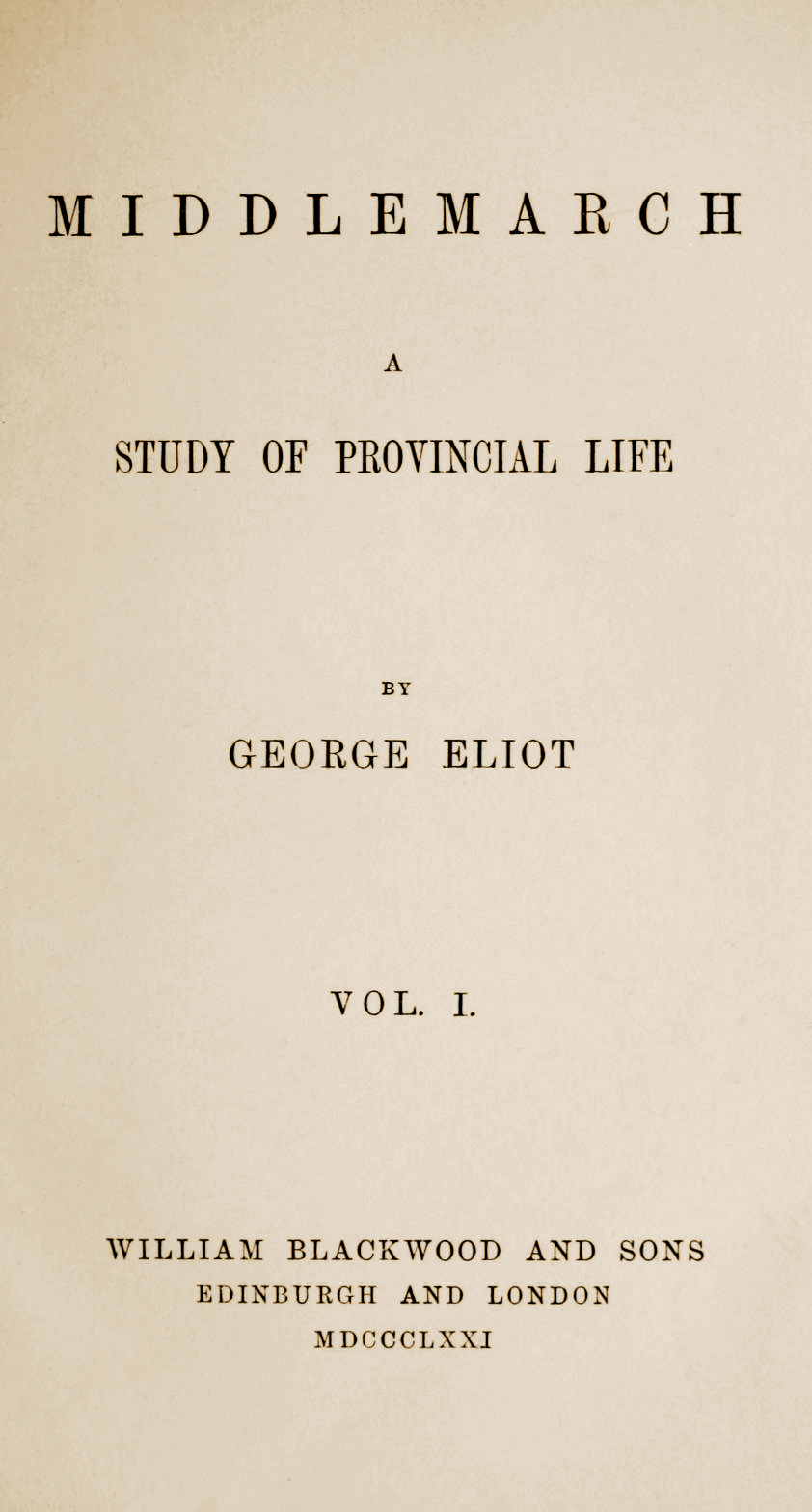
Middlemarch, A Study of Provincial Life is a novel by English author George Eliot, the pen name of Mary Ann Evans. It appeared in eight installments (volumes) in 1871 and 1872. Set in Middlemarch, a fictional English Midlands town, from 1829 to 1832, it follows distinct, intersecting stories with many characters.[1][2] Issues include the status of women, the nature of marriage, idealism, self-interest, religion, hypocrisy, political reform, and education. Leavened with comic elements, Middlemarch approaches significant historical events in a realist mode: the Reform Act 1832, early railways, and the accession of King William IV. It looks at medicine of the time and reactionary views in a settled community facing unwelcome change. Eliot began writing the two pieces that formed the novel in 1869–1870 and completed it in 1871. Initial reviews were mixed, but it is now seen widely as her best work and one of the great English novels.[3]

Key Information

Background

[edit]
George Eliot

Middlemarch originates in two unfinished pieces that Eliot worked on during 1869 and 1870: the novel "Middlemarch"[a] (which focused on the character of Lydgate) and the long story "Miss Brooke" (which focused on the character of Dorothea).[4] The former piece is first mentioned in her journal on 1 January 1869 as one of the tasks for the coming year. In August she began writing, but progress ceased in the following month amidst a lack of confidence in it and distraction by the illness of George Henry Lewes's son Thornie, who was dying of tuberculosis.[5] (Eliot had been living with Lewes since 1854.) After Thornie's death on 19 October 1869, all work on the novel stopped; it is uncertain whether Eliot intended at the time to revive it at a later date.[6]

In December she wrote of having begun another story, on a subject that she had considered "ever since I began to write fiction".[7] By the end of the month she had written 100 pages of this story and entitled it "Miss Brooke". Although a precise date is unknown, the process of incorporating material from "Middlemarch" into the story she had been working on was ongoing by March 1871.[8][4] While composing, Eliot compiled a notebook of hundreds of literary quotations, from poets, historians, playwrights, philosophers, and critics in eight different languages.[9]

By May 1871, the growing length of the novel had become a concern to Eliot, as it threatened to exceed the three-volume format that was then the norm in publishing.[10] The issue was compounded because Eliot's most recent novel, Felix Holt, the Radical (1866) – also set in the same pre-Reform Bill England – had not sold well.[11] The publisher John Blackwood, who had made a loss on acquiring the English rights to that novel,[10] was approached by Lewes in his role as Eliot's literary agent. He suggested that the novel be brought out in eight two-monthly parts, borrowing the method used for Victor Hugo's novel Les Misérables.[12] This was an alternative to the monthly issues that had been used for such longer works as Dickens's David Copperfield and Thackeray's Vanity Fair, and avoided Eliot's objections to slicing her novel into small parts.[13] Blackwood agreed, although he feared there would be "complaints of a want of the continuous interest in the story" due to the independence of each volume.[14] The eight books duly appeared during 1872, the last three instalments being issued monthly.[15]

With the deaths of Thackeray and Dickens in 1863 and 1870, respectively, Eliot became "recognised as the greatest living English novelist" at the time of the novel's final publication.[16]

Plot

[edit]

Set in the years immediately before the 1832 Reform Act, Middlemarch follows the intertwined lives of several inhabitants of a Midlands town. The main strands concern Dorothea Brooke’s search for purpose, the medical ambitions of Dr Tertius Lydgate, the romantic fortunes of Fred Vincy and Mary Garth, and the eventual downfall of the banker Nicholas Bulstrode.[17]

Dorothea Brooke, a wealthy young woman of strong religious idealism, lives with her sister Celia under the guardianship of their uncle Mr Brooke. Though admired by the baronet Sir James Chettam, Dorothea instead marries the much older clergyman and scholar Edward Casaubon, hoping to dedicate herself to his research. On their honeymoon in Rome, she discovers the sterility of the marriage and befriends Casaubon’s disinherited cousin, Will Ladislaw. Casaubon grows jealous of Ladislaw’s friendship with Dorothea, and his insecurity deepens as his health declines.[18]

Meanwhile, the Vincy family occupies an important place in Middlemarch society. Fred Vincy, the mayor’s son, is charming but feckless, relying on the expectation of inheriting from his wealthy uncle, Peter Featherstone. He is in love with Mary Garth, the practical and principled niece who keeps house for Featherstone, but she refuses him while he remains irresponsible. Fred’s debts lead him to involve Mary’s father, Caleb Garth, in financial loss, straining his hopes of winning her. When Featherstone dies, the inheritance goes not to Fred but to an illegitimate son, leaving Fred humiliated and forced to reconsider his path.[19]

Fred’s illness during this period brings him under the care of Dr Tertius Lydgate, a talented young physician new to Middlemarch. Lydgate hopes to reform medical practice through science and sanitation, and finds support from the wealthy, evangelical banker Nicholas Bulstrode, who funds a new hospital. Lydgate’s dedication earns him respect, but his courtship of Rosamond Vincy, Fred’s beautiful but vain sister, leads to marriage and financial strain. Rosamond’s extravagance draws Lydgate into debt, undermining his professional independence.[20]

Casaubon, increasingly ill, tries to bind Dorothea to his control, asking her to promise obedience to his wishes after his death. When he dies, his will reveals a clause disinheriting her if she marries Ladislaw. The provision fuels gossip in Middlemarch and complicates their relationship. Dorothea continues to struggle between duty and affection, while Ladislaw remains in town as a journalist, supporting Mr Brooke’s unsuccessful parliamentary campaign on a Reform platform.[21]

Bulstrode’s past eventually returns to haunt him. The arrival of John Raffles exposes how Bulstrode had profited dishonourably in his youth, concealing the existence of Ladislaw’s mother, the rightful heir to his first wife’s fortune. Fearful of exposure, Bulstrode hastens Raffles’s death while attempting to cover his tracks. His disgrace spreads to Lydgate, who has recently accepted Bulstrode’s financial help; many in Middlemarch assume the doctor complicit in corruption. Though Dorothea defends his honour, public opinion forces Lydgate and Rosamond to leave, his ambitions for medical reform destroyed.[22]

As scandals and disappointments reshape the town, Fred redeems himself by training as a land agent under Caleb Garth. With the guidance of the kindly Rev. Farebrother, who suppresses his own love for Mary, Fred matures and eventually marries her. Dorothea, after recognising her feelings for Ladislaw, rejects the security of Casaubon’s fortune and chooses to marry him, despite her family’s disapproval.[19]

The novel concludes with a brief “Finale” summarising later lives. Fred and Mary live contentedly with their children. Lydgate prospers in a conventional career but dies at 50, leaving Rosamond to remarry a wealthy physician. Dorothea and Ladislaw raise two children, their son inheriting Mr Brooke’s estate, while Dorothea devotes herself to her husband and to reformist causes. Each character’s fate reflects the mixture of compromise, limitation, and idealism that defines life in Middlemarch.[23]

Characters

[edit]
Dorothea Brooke and Will Ladislaw
Mary Garth and Fred Vincy
Rosamond Vincy and Tertius Lydgate
  • Dorothea Brooke: An intelligent, wealthy woman with great aspirations, Dorothea avoids displaying her wealth and embarks upon projects such as redesigning cottages for her uncle's tenants. She marries the elderly Reverend Edward Casaubon, with the idealistic idea of helping him in his research, The Key to All Mythologies. However, the marriage was a mistake, as Casaubon fails to take her seriously and resents her youth, enthusiasm, and energy. Her requests to assist him make it harder for him to conceal that his research is years out of date. Faced with Casaubon's coldness on their honeymoon, Dorothea becomes friends with his relative, Will Ladislaw. Some years after Casaubon's death she falls in love with Will and marries him.
  • Tertius Lydgate: An idealistic, talented, but naive young doctor, is relatively poor, but of good birth. He hopes to make big advances in medicine through his research, but ends up in an unhappy marriage with Rosamond Vincy. His attempts to show he is answerable to no man fail, and he eventually has to leave town, sacrificing his high ideals to please his wife.

  • Rev. Edward Casaubon /kəˈsɔːbən/: A pedantic, selfish, clergyman (in his mid 40s) who is so taken up with his scholarly research that his marriage to Dorothea is loveless. His unfinished book, The Key to All Mythologies, is intended as a monument to Christian syncretism, but his research is out of date as he cannot read German. He is aware of this but admits it to no one.
  • Mary Garth: The plain, kind daughter of Caleb and Susan Garth serves as Mr Featherstone's nurse. She and Fred Vincy were childhood sweethearts, but she will not let him woo her until he shows himself willing and able to live seriously, practically and sincerely.
  • Arthur Brooke: The oft-befuddled, none-too-clever uncle of Dorothea and Celia Brooke has a reputation as the worst landlord in the county, but stands for Parliament on a Reform platform.
  • Celia Brooke: Dorothea's younger sister is a beauty. She is more sensual than Dorothea and does not share her idealism and asceticism. She is only too happy to marry Sir James Chettam when Dorothea rejects him.
  • Sir James Chettam: A neighbouring landowner, he is in love with Dorothea and helps with her plans to improve conditions for the tenants. When she marries Casaubon, he marries Celia Brooke.
  • Rosamond Vincy: Vain, beautiful and shallow, Rosamond has a high opinion of her own charms and a low opinion of Middlemarch society. She marries Tertius Lydgate, believing he will raise her social standing and keep her comfortable. When her husband meets financial difficulties, she thwarts his efforts to economise, seeing such sacrifices as beneath her and insulting. She cannot bear the idea of losing social status.
  • Fred Vincy: Rosamond's brother has loved Mary Garth from childhood. His family hopes he will advance socially by becoming a clergyman, but he knows Mary will not marry him if he does. Brought up to expect an inheritance from his uncle, Mr Featherstone, he is a spendthrift, but later changes through his love for Mary and finds by studying under Mary's father a profession that gains Mary's respect.
  • Will Ladislaw: This young cousin of Mr Casaubon has no property, as his grandmother married a poor Polish musician and was disinherited. He is a man of verve, idealism and talent, but no fixed profession. He is in love with Dorothea, but cannot marry her without her losing Mr Casaubon's property.
  • Humphrey Cadwallader and Elinor Cadwallader: Neighbours of the Brookes, Mr Cadwallader is a rector and Mrs Cadwallader a pragmatic and talkative woman who comments on local affairs with wry cynicism. She disapproves of Dorothea's marriage and Mr Brooke's parliamentary endeavours.
  • Walter Vincy and Lucy Vincy: A respectable manufacturing couple, they wish their children to advance socially and are disappointed by Rosamond's and Fred's marriages. Vincy's sister is married to Nicholas Bulstrode. Mrs Vincy was an innkeeper's daughter and her sister the second wife of Mr. Featherstone.
  • Caleb Garth: Mary Garth's father is a kind, honest, generous surveyor and land agent involved in farm management. He is fond of Fred and eventually takes him under his wing.
  • Camden Farebrother: A poor but clever vicar and amateur naturalist, he is a friend of Lydgate and Fred Vincy and loves Mary Garth. His position improves when Dorothea appoints him to a living after Casaubon's death.
  • Nicholas Bulstrode: A wealthy banker married to Vincy's sister, Harriet, he is a pious Methodist keen to impose his beliefs in Middlemarch society. However, he has a sordid past he is desperate to hide. His religion favours his personal desires and lacks sympathy for others.
  • Peter Featherstone: An old landlord of Stone Court, he is a self-made man, who has married Caleb Garth's sister. On her death he takes Mrs Vincy's sister as his second wife.
  • Jane Waule: A widow and Peter Featherstone's sister, she has a son, John.
  • Mr Hawley: A foul-mouthed businessman, he is an enemy of Bulstrode.
  • Mr Mawmsey: A grocer
  • Dr Sprague: A Middlemarch physician
  • Mr Tyke: A clergyman favoured by Bulstrode
  • Joshua Rigg Featherstone: Featherstone's illegitimate son, he appears at the reading of Featherstone's will and receives a fortune instead of Fred. He is also the stepson of John Raffles, who comes into town to visit Rigg, but instead reveals Bulstrode's past. His appearance in the novel is crucial to the plot.
  • John Raffles: Raffles is a braggart and a bully, a humorous scoundrel in the tradition of Sir John Falstaff, and an alcoholic. But unlike Falstaff, Raffles is a truly evil man. He holds the key to Bulstrode's dark past and Lydgate's future.

Historical novel

[edit]

The action of Middlemarch takes place "between September 1829 and May 1832", or 40 years before its publication in 1871–1872,[2] a gap not so pronounced for it to be regularly labelled as a historical novel. By comparison, Walter Scott's Waverley (1814) – often seen as the first major historical novel – takes place some 60 years before it appears.[2] Eliot had previously written a more obviously historical novel, Romola (1862–1863), set in 15th-century Florence. The critics Kathleen Blake and Michael York Mason argue that there has been insufficient attention given to Middlemarch "as a historical novel that evokes the past in relation to the present".[24]

The critic Rosemary Ashton notes that the lack of attention to this side of the novel may indicate its merits: "Middlemarch is that very rare thing, a successful historical novel. In fact, it is so successful that we scarcely think of it in terms of that subgenre of fiction."[2] For its contemporary readers, the present "was the passage of the Second Reform Act in 1867";[25] the agitation for the Reform Act 1832 and its turbulent passage through the two Houses of Parliament, which provide the structure of the novel, would have been seen as the past.[24]

Though rarely categorised as a historical novel, Middlemarch's attention to historical detail has been noticed; in an 1873 review, Henry James recognised that Eliot's "purpose was to be a generous rural historian".[26] Elsewhere, Eliot has been seen to adopt "the role of imaginative historian, even scientific investigator in Middlemarch and her narrator as conscious "of the historiographical questions involved in writing a social and political history of provincial life". This critic compares the novel to "a work of the ancient Greek historian Herodotus", who is often described as "The Father of History".[2]

Themes

[edit]

A Study of Provincial Life

[edit]

The fictional town of Middlemarch, North Loamshire, is probably based on Coventry, where Eliot had lived before moving to London. Like Coventry, Middlemarch is described as a silk-ribbon manufacturing town.[2][27]

The subtitle—"A Study of Provincial Life"—has been seen as significant. One critic views the unity of Middlemarch as achieved through "the fusion of the two senses of 'provincial'":[27] on the one hand it means geographically "all parts of the country except the capital"; and on the other, a person who is "unsophisticated" or "narrow-minded".[28] Carolyn Steedman links Eliot's emphasis on provincialism in Middlemarch to Matthew Arnold's discussion of social class in England in Culture and Anarchy essays, published in 1869, about the time Eliot began working on the stories that became Middlemarch. There Arnold classes British society in terms of Barbarians (aristocrats and landed gentry), Philistines (urban middle class) and Populace (working class). Steedman suggests Middlemarch "is a portrait of Philistine Provincialism".[2]

It is worth noting that Eliot went to London, as her heroine Dorothea does at the end of the book. There Eliot achieved fame way beyond most women of her time, whereas Dorothea takes on the role of nurturing Will and her family. Eliot was rejected by her family once she had settled in her common-law relationship with Lewes, and "their profound disapproval prevented her ever going home again". She omitted Coventry from her last visit to the Midlands in 1855.[2]

The "Woman Question"

[edit]

Central to Middlemarch is the idea that Dorothea Brooke cannot hope to achieve the heroic stature of a figure like Saint Teresa, for Eliot's heroine lives at the wrong time, "amidst the conditions of an imperfect social state, in which great feelings will often take the aspect of error, and great faith the aspect of illusion".[29] Antigone, a figure from Greek mythology best known from Sophocles' play, is given in the "Finale" as a further example of a heroic woman. The literary critic Kathleen Blake notes Eliot's emphasis on St Teresa's "very concrete accomplishment, the reform of a religious order", rather than her Christian mysticism.[30] A frequent criticism by feminist critics is that not only is Dorothea less heroic than Saint Teresa and Antigone, but George Eliot herself.[31] In response, Ruth Yeazell and Kathleen Blake chide these critics for "expecting literary pictures of a strong woman succeeding in a period [around 1830] that did not make them likely in life".[25] Eliot has also been criticised more widely for ending the novel with Dorothea marrying Will Ladislaw, someone so clearly her inferior.[32] The novelist Henry James describes Ladislaw as a dilettante who "has not the concentrated fervour essential in the man chosen by so nobly strenuous a heroine".[26]

Marriage

[edit]

Marriage is one of the major themes in Middlemarch. According to George Steiner, "both principal plots [those of Dorothea and Lydgate] are case studies of unsuccessful marriage".[33] This suggests that these "disastrous marriages" leave the lives of Dorothea and Lydgate unfulfilled.[34] This is arguably more the case with Lydgate than with Dorothea, who gains a second chance through her later marriage to Will Ladislaw, but a favourable interpretation of this marriage depends on the character of Ladislaw himself, whom numerous critics have viewed as Dorothea's inferior.[35] In addition, there is the "meaningless and blissful" marriage of Dorothea's sister Celia Brooke to Sir James Chettam, and more significantly Fred Vincy's courting of Mary Garth. In the latter, Mary Garth will not accept Fred until he abandons the Church and settles on a more suitable career. Here Fred resembles Henry Fielding's character Tom Jones, both being moulded into a good husband by the love they give to and receive from a woman.[36]

Dorothea is a St Teresa, born in the wrong century, in provincial Middlemarch, who mistakes in her idealistic ardor, "a poor dry mummified pedant... as a sort of angel of vocation".[37] Middlemarch is in part a Bildungsroman focusing on the psychological or moral growth of the protagonist: Dorothea "blindly gropes forward, making mistakes in her sometimes foolish, often egotistical, but also admirably idealistic attempt to find a role" or vocation that fulfils her nature.[38] Lydgate is equally mistaken in his choice of a partner, as his idea of a perfect wife is someone "who can sing and play the piano and provide a soft cushion for her husband to rest after work". So he marries Rosamond Vincy, "the woman in the novel who most contrasts with Dorothea", and thereby "deteriorates from ardent researcher to fashionable doctor in London".[38]

Critical reception

[edit]

Contemporary reviews

[edit]

The Examiner, The Spectator and Athenaeum reviewed each of the eight books that comprise Middlemarch as they were published from December 1871 to December 1872;[39] such reviews speculated on the eventual direction of the plot and responded accordingly.[40] Contemporary response to the novel was mixed. Writing as it was being published, the Spectator reviewer R. H. Hutton criticised it for what he saw as its melancholic quality.[41] Athenaeum, reviewing it after "serialisation", found the work overwrought and thought it would have benefited from hastier composition.[b][42] Blackwood's Edinburgh Magazine reviewer W. L. Collins saw as the work's most forceful impression its ability to make readers sympathise with the characters.[43] Edith Simcox of Academy offered high praises, hailing it as a landmark in fiction owing to the originality of its form; she rated it first amongst Eliot's œuvre, which meant it "has scarcely a superior and very few equals in the whole wide range of English fiction".[44]

"What do I think of 'Middlemarch'?" What do I think of glory – except that in a few instances this "mortal has already put on immortality." George Eliot was one. The mysteries of human nature surpass the "mysteries of redemption," for the infinite we only suppose, while we see the finite.

Emily Dickinson, Letter to her cousins Louise and Fannie Norcross[45]

Henry James presented a mixed opinion. Middlemarch, according to him, was "at once one of the strongest and one of the weakest of English novels ... Middlemarch is a treasure-house of details, but it is an indifferent whole". Among the details, his greatest criticism ("the only eminent failure in the book") was of the character of Ladislaw, who he felt was an insubstantial hero-figure as against Lydgate. The scenes between Lydgate and Rosamond he especially praised for their psychological depth – he doubted whether there were any scenes "more powerfully real... [or] intelligent" in all English fiction.[26] Thérèse Bentzon, for the Revue des deux Mondes, was critical of Middlemarch. Although finding merit in certain scenes and qualities, she faulted its structure as "made up of a succession of unconnected chapters, following each other at random... The final effect is one of an incoherence which nothing can justify." In her view, Eliot's prioritisation of "observation rather than imagination... inexorable analysis rather than sensibility, passion or fantasy" means that she should not be held amongst the first ranks of novelists.[46] The German philosopher Friedrich Nietzsche, who read Middlemarch in a translation owned by his mother and sister, derided the novel for construing suffering as a means of expiating the debt of sin, which he found characteristic of "little moralistic females à la Eliot".[47]

Despite the divided contemporary response, Middlemarch gained immediate admirers: in 1873, the poet Emily Dickinson expressed high praise for the novel, exclaiming in a letter to a friend: "What do I think of Middlemarch? What do I think of glory."[48][49][50]

The immediate success of Middlemarch may have been proportioned rather to the author's reputation than to its intrinsic merits. [The novel] ... seems to fall short of the great masterpieces which imply a closer contact with the world of realities and less preoccupation with certain speculative doctrines.

Leslie Stephen, George Eliot (1902)[51]

In separate centuries, Florence Nightingale and Kate Millett remarked on the eventual subordination of Dorothea's own dreams to those of her admirer, Ladislaw.[52] Indeed, the ending acknowledges this and mentions how unfavourable social conditions prevented her from fulfilling her potential.

Later responses

[edit]

In the first half of the 20th century, Middlemarch continued to provoke contrasting responses; while Leslie Stephen dismissed the novel in 1902, his daughter Virginia Woolf described it in 1919 as "the magnificent book that, which with all its imperfections, is one of the few English novels written for grown-up people."[53] However, Woolf was "virtually unique" among the modernists in her unstinting praise for Middlemarch,[54] and the novel also remained overlooked by the reading public of the time.[55]

F. R. Leavis's The Great Tradition (1948) is credited with having "rediscovered" the novel:[55]

The necessary part of great intellectual powers in such a success as Middlemarch is obvious ... the sheer informedness about society, its mechanisms, the ways in which people of different classes live ... a novelist whose genius manifests itself in a profound analysis of the individual.[56]

Leavis' appraisal of it has been hailed as the beginning of a critical consensus that still exists towards the novel, in which it is recognised not only as Eliot's finest work, but as one of the greatest novels in English. V. S. Pritchett, in The Living Novel, two years earlier, in 1946 had written that "No Victorian novel approaches Middlemarch in its width of reference, its intellectual power, or the imperturbable spaciousness of its narrative ... I doubt if any Victorian novelist has as much to teach the modern novelists as George Eliot ... No writer has ever represented the ambiguities of moral choice so fully".[57]

In the 21st century, the novel is still held in high regard. The novelists Martin Amis and Julian Barnes have both called it probably the greatest novel in the English language,[c][58] and today Middlemarch is frequently included in university courses. In 2013, the then British Education Secretary Michael Gove referred to Middlemarch in a speech, suggesting its superiority to Stephenie Meyer's vampire novel Twilight.[59] Gove's comments led to debate on teaching Middlemarch in Britain,[d] including the question of when novels like Middlemarch should be read,[e] and the role of canonical texts in teaching.[60] The novel has remained a favourite with readers and scores high in reader rankings: in 2003 it was No. 27 in the BBC's The Big Read,[61] and in 2007 it was No. 10 in "The 10 Greatest Books of All Time", based on a ballot of 125 selected writers.[62] In 2015, in a BBC Culture poll of book critics outside the UK, the novel was ranked at number one in "The 100 greatest British novels".[63]

On 5 November 2019, the BBC News reported that Middlemarch is on the BBC list of 100 "most inspiring" novels.[64]

Legacy and adaptations

[edit]

Middlemarch has been adapted several times for television and the stage. In 1968 it appeared as a BBC-produced TV mini-series of the same name, directed by Joan Craft, starring Michele Dotrice. The first episode, "Dorothea", is missing from the BBC Archives, while the third episode, "The New Doctor", can be viewed online, although only as a low-quality black and white telerecording owned by a private collector. The other five episodes have been withheld from public viewing.[65][66] In 1994 it was again adapted by the BBC as a television series of the same name, directed by Anthony Page with a screenplay by Andrew Davies. This was a critical and financial success and revived public interest adaptating the classics.[67] In 2013 came a stage adaptation, and also an Orange Tree Theatre Repertory production adapted and directed by Geoffrey Beevers as three plays: Dorothea's Story, The Doctor's Story, and Fred & Mary.[68] The novel has never been made into a film, although the idea was toyed with by the English director Sam Mendes.[69] In April 2022, Dash Arts produced The Great Middlemarch Mystery,[70] an immersive theatre experience[71] staged across three locations in Coventry, including Drapers Hall.

The opera Middlemarch in Spring by Allen Shearer, to a libretto by Claudia Stevens, has a cast of six and treats only the central story of Dorothea Brooke. It was first staged in San Francisco in 2015.[72] In 2017, a modern adaptation, Middlemarch: The Series, aired on YouTube as a video blog.[73]

Notes

[edit]

References

[edit]

Bibliography

[edit]

Further reading

[edit]
[edit]
Revisions and contributorsEdit on WikipediaRead on Wikipedia
from Grokipedia

Middlemarch, subtitled A Study of Provincial Life, is a novel by the English author (pseudonym of Mary Ann Evans), first published serially in eight instalments between December 1871 and December 1872.
Set in the fictional Midlands town of Middlemarch during the late 1820s and early 1830s, amid the lead-up to the Reform Act 1832, the work interweaves multiple narratives exploring the tensions between personal aspirations and societal constraints in provincial England.
It centers on characters such as the idealistic Dorothea Brooke, whose ill-advised marriage to the dry scholar Edward Casaubon stifles her intellectual ambitions, and the progressive physician Tertius Lydgate, whose medical reforms and financial imprudence lead to personal downfall.
George Eliot's narrative employs a panoramic realism, delving into psychological motivations, political reform, religious doubt, and the limitations of marriage, earning the novel acclaim as her masterpiece and a pinnacle of Victorian literature.

Composition and Publication

George Eliot's Background and Influences

Mary Ann Evans, born on November 22, 1819, in the rural village of Griff near Nuneaton, Warwickshire, was raised in a strictly evangelical household that emphasized moral rigor and religious piety. As a teenager, she immersed herself in evangelical practices, but by her early twenties, exposure to critical biblical scholarship led to a profound crisis of faith, culminating in her rejection of orthodox Christianity in favor of agnosticism. This transition was accelerated by her translations of David Friedrich Strauss's The Life of Jesus (published 1846) and Ludwig Feuerbach's The Essence of Christianity (1854), which promoted a humanistic reinterpretation of religion as projections of human needs and capacities rather than divine truths. Evans's intellectual development was further shaped by the philosophies of and , whose ideas reinforced her commitment to a deterministic, empirically grounded understanding of human actions driven by observable causes rather than transcendent ideals or romantic illusions. Spinoza's pantheistic rationalism, encountered in the , provided a metaphysical framework emphasizing necessity and interconnection in nature, influencing her view of moral progress as arising from incremental, causal chains of behavior within social contexts. Comte's , with its "," complemented this by prioritizing scientific observation and societal evolution over speculative metaphysics, fostering Evans's rejection of in favor of analyzing collective influences on personal outcomes. In 1854, Evans formed a lifelong partnership with , a literary and amateur scientist, with whom she lived unmarried, defying Victorian social norms and drawing on their shared experiences in provincial —mirroring the locales of her fiction—to ground her narratives in authentic rather than abstracted tales. Lewes's encouragement and their collaborative life, including his works on and , reinforced her empirical approach, emphasizing how environmental and relational factors causally shape character development. This perspective built on her earlier novels, such as (1860), which explored familial and regional constraints in a setting, and (1861), focusing on rural isolation and redemption through community ties, marking a progression from personal tragedies to broader provincial interconnections evident in her later work.

Writing Process and Serial Format

Eliot commenced composition of Middlemarch in early , initially conceiving it as two distinct narratives—one centered on the idealistic Dorothea Brooke and another on the ambitious physician Tertius Lydgate—before integrating them into a unified of interconnected provincial lives. This evolution from separate tales to a cohesive "web" of relations reflected her deliberate structural revisions, as documented in her correspondence and planning notes, which emphasized relational over isolated plots. , her partner and literary advisor, provided critical encouragement and editorial support throughout the process, helping sustain her focus amid the novel's expansive scope. By late 1871, as commenced, Eliot faced health challenges including fatigue and throat ailments, yet persisted with Lewes's assistance in managing deadlines. The novel appeared in eight monthly parts in from December 1871 to December 1872, a format that necessitated episodic pacing with suspenseful conclusions to retain subscribers, while permitting iterative refinements based on reader feedback and her ongoing revisions. Surviving manuscripts reveal meticulous adjustments for narrative balance, such as tightening subplots to enhance overall coherence without resorting to contrived resolutions. Eliot's approach prioritized psychological realism grounded in observable human motivations, eschewing melodramatic excesses in favor of incremental, causally driven developments, as she critiqued sensationalist conventions in her letters and the text's authorial commentary. This restraint, evident in revised drafts that subdued potential histrionics in character arcs, aligned with serialization's demands for sustained reader engagement through authenticity rather than spectacle.

Publication History and Initial Editions

Middlemarch was initially published serially in eight booklets by William Blackwood and Sons, commencing with Book I on December 1, 1871, and concluding with Book VIII in December 1872. The format, each part priced at five shillings, targeted a broad readership amid the Victorian demand for extended realist narratives, allowing Eliot to expand the work beyond standard constraints. This approach reflected logistical adaptations, as the novel's length—initially underestimated—necessitated bimonthly releases, with dates including Book II on , 1872; Book III in April; Book IV in June; Book V on July 29; and Book VI in October. The first bound edition appeared concurrently in four volumes between 1871 and 1872, also from William Blackwood and Sons in and , compiling the serial content into a cohesive set complete with half-titles and divisional titles. Initial print runs approached 6,000 copies as a compromise on production scale, enabling distribution to booksellers while managing costs for the ambitious scope. negotiated the contract, securing rights for Eliot at £4,000, a substantial sum underscoring the publisher's confidence in sales potential despite the pseudonymous authorship. Eliot's use of the male pseudonym "George Eliot" persisted to circumvent gender prejudices in the market for weighty literature, preserving her reputation built on prior works like Adam Bede. Minor textual adjustments occurred between serial and bound forms to refine pacing and emphasis, though the core narrative remained intact; Blackwood later adjusted royalties upward to £1,000 in recognition of early success. These editions marked a pivotal rollout, balancing with Eliot's financial gains in a competitive era for provincial fiction.

Narrative Framework

Historical Setting and Provincial Context

Middlemarch unfolds in the fictional town of the same name during the period from late 1829 to approximately 1832, a time of mounting political tension in culminating in the Reform Act of 1832, which enfranchised small landowners and tenant farmers while redistributing seats from "rotten boroughs" to growing industrial centers. This act addressed systemic electoral imbalances, including corruption in pocket boroughs controlled by landowners, but its passage followed years of agitation under dominance, with Whig ministries assuming power in November 1830 amid widespread demands for parliamentary overhaul. The novel's temporal frame captures the anticipatory unease of this pre-reform era, where provincial communities grappled with the prospect of altered representation without yet experiencing its full implementation. Eliot modeled Middlemarch on locales in and nearby , regions she knew intimately from her upbringing in Chilvers Coton, where agricultural and mercantile life predominated. This provincial setting reflects the insularity of early 19th-century English market towns, distant from ’s political epicenter, where local economies hinged on farming, trade, and nascent industry rather than national spectacles. Economic disruptions intensified in the early , as poor harvests in 1829–1830 drove down agricultural prices and swelled , exacerbated by such as threshing machines that displaced laborers. The of 1830–1831, concentrated in southern and eastern counties but reverberating through rural networks, saw workers destroy machinery and demand wage relief, prompting harsh reprisals including over 600 arrests and 19 executions. Railway projects, like the and line's opening in September 1830—marked by the accidental death of cabinet minister —heralded infrastructural shifts that promised efficiency but threatened landed interests by devaluing coaching routes and farmland. In this context, Whig reforms intertwined with rural stagnation, as the election victory enabled Poor inquiries and municipal changes, yet elicited cautious resistance from provincial elites prioritizing stability over upheaval. Class rigidities in isolated towns reinforced incremental adaptations, with gossip and kinship ties enforcing conformity amid external pressures, underscoring causal forces of local power—, , and traders—over abstract progressive ideals. Eliot's empirical grounding in Warwickshire's stratified society highlights how such micro-dynamics mediated broader historical currents, favoring verifiable social mechanisms like and economic interdependence.

Plot Structure and Interlaced Narratives

Middlemarch features two primary interlaced plotlines centered on Dorothea Brooke and Tertius Lydgate, whose individual pursuits converge through the social and economic networks of the provincial town. Dorothea's storyline commences with her marriage to the Reverend Edward Casaubon, an aging clergyman and scholar, whom she weds on August 16, 1829, expecting a union of shared intellectual endeavor; this evolves into her widowhood following Casaubon's death on March 20, 1830, entanglement in the codicil of his will prohibiting her marriage to Will Ladislaw under penalty of forfeiting inheritance, and ultimate union with Ladislaw after renouncing her fortune. Complementing this arc, Lydgate's narrative traces his relocation to Middlemarch in 1829 to establish a progressive practice, including advocacy for a new , which founders amid marital discord after his 1830 wedding to Rosamond Vincy, whose material expectations precipitate mounting debts exceeding £2,000 and force his capitulation to conservative influences, culminating in relocation from the town by 1833. These strands interconnect via relational webs in Middlemarch, where familial bonds, professional dependencies, and communal events precipitate causal linkages and unintended ramifications. For instance, the Vincy family's ties bind Rosamond to Lydgate and her brother Fred's financial woes—stemming from a £160 guaranteed by Garth after a failed transaction—to the Garth household, indirectly influencing Dorothea's philanthropic interests; similarly, Peter Featherstone's on February 12, 1830, and his will's disinheritance of expectant relatives ripple across households, exacerbating Vincy indebtedness and Lydgate's hospital funding struggles. Convergences intensify through Bulstrode's banking and religious influence, whose exposed past in 1832 taints Lydgate's reputation despite his innocence, prompting Dorothea's financial aid to the Lydgates and her witnessing of Rosamond's distress, thereby merging the protagonists' trajectories in reckonings marked by thwarted ambitions and adaptive compromises without resolution of systemic inertias. The plot unfolds across eight books, structured to reflect its original serialization in eight monthly parts from December 1871 to December 1872 by William Blackwood and Sons, enabling progressive revelation of entanglements. Book I (Miss Brooke) establishes Dorothea's marriage; Book II (Old and Young) introduces Lydgate and town dynamics; Book III (Waiting for Death) advances Casaubon's decline and Featherstone's demise; Book IV (Three Love Problems) heightens romantic tensions; Book V (The Dead Hand) details posthumous legacies; Book VI (The Widow and the Wife) explores widowhood and marital strains; Book VII (Two Temptations) precipitates ethical crises; and Book VIII (Sunset and Sunrise) effects closures. A Prelude initiates the volume, positing historical analogies to Saint Theresa, while a Finale appends epilogues on character outcomes, bookending the narrative's causal progression.

Key Characters and Their Arcs

Dorothea Brooke embodies fervent idealism coupled with a desire for intellectual and moral elevation, initially directing her energies toward scholarly assistance and social improvement in the provincial setting of Middlemarch. Her trajectory unfolds through a mismatched union with the pedantic Reverend Edward Casaubon, whose futile quest for a "Key to All Mythologies" exposes the sterility of abstract erudition, compelling Dorothea to grapple with personal disillusionment and the practical constraints of her aspirations. Ultimately, her arc resolves into a tempered marked by emotional fulfillment in and localized benevolence, reflecting Eliot's depiction of idealism's collision with empirical realities. Tertius Lydgate, an ambitious physician influenced by continental medical advances, arrives in Middlemarch intent on pioneering primitive tissue research and hospital reform to advance scientific practice. His development is derailed by in personal relations, particularly his marriage to the socially aspiring Rosamond Vincy, whose material expectations precipitate financial entanglement and ethical compromises, including reliance on the dubious banker Nicholas Bulstrode. Lydgate's path culminates in professional capitulation, relocating to a diminished practice where innovative zeal yields to conventional expediency, underscoring the causal weight of interpersonal miscalculations on vocational integrity. Rosamond Vincy represents refined vanity and unyielding adherence to genteel conventions, viewing as elevation to leisured status rather than . Her arc reveals the corrosive effects of self-indulgent expectations, as union with Lydgate amplifies domestic discord and economic strain, eroding her initial poise into resentment and adaptation to reduced circumstances without fundamental self-reckoning. Fred Vincy, initially characterized by indolence, inherited optimism, and aversion to disciplined effort, anticipates unearned inheritance from his uncle Peter Featherstone. His progression hinges on romantic attachment to the pragmatic Mary Garth, whose refusal to wed without evidence of reform catalyzes a shift toward agricultural labor under Caleb Garth's guidance, achieving modest stability through earned merit over speculative ease. Mary Garth exhibits steadfast practicality and moral discernment, derived from her family's modest mercantile roots, prioritizing character over fortune in relational choices. Her influence on Fred's maturation remains steady, culminating in a union grounded in mutual industry, exemplifying quiet resilience amid surrounding vanities. Nicholas Bulstrode, a pious banker whose evangelical facade masks a history of opportunistic dealings including and concealment of a disreputable kin, navigates influence through financial leverage. His exposure via unravels reputational pretensions, forcing withdrawal from Middlemarch and confrontation with the incongruence of professed rectitude and actual conduct. Will Ladislaw, of artistic temperament and uncertain lineage tied to Casaubon's family, embodies restless vitality opposing scholarly desiccation. His arc intertwines with Dorothea's through intellectual affinity, evolving from nomadic to committed domesticity, though shadowed by suspicions of that Eliot attributes to provincial rather than inherent flaw. These figures collectively eschew simplistic heroism or villainy, their developments propelled by interplay of innate dispositions, relational dynamics, and socio-economic pressures, as Eliot renders human agency within verifiable causal chains devoid of transcendent redemption.

Literary Techniques

Omniscient Narration and Authorial Insight

In Middlemarch, employs a third-person omniscient narrator that reconstructs characters' inner lives as a might, providing causal expositions of motivations and outcomes that exceed the partial views held by individuals themselves. This voice intrudes to forecast psychological trajectories and illuminate systemic interconnections, such as through metaphors depicting human actions as interwoven threads subject to broader forces, thereby enabling recognition of recurring behavioral patterns. Unlike limited perspectives confined to subjective experience, the narration prioritizes verifiable causal chains, drawing implicit analogies to historical precedents to underscore the predictability of ego-driven errors without endorsing unexamined personal narratives. Deliberate irony forms a core mechanism of this authorial insight, methodically exposing self-deceptions by contrasting characters' idealized self-conceptions with underlying verifiable drives, such as innate tendencies toward moral shortsightedness. For instance, the narrator's wry commentary on apparent reveals it as veiled , favoring analytical dissection over empathetic indulgence to affirm causal realism in conduct. This approach avoids mere sentimental alignment, instead cultivating reader discernment of deceptions that recur across , much like patterns observed in historical records. The narrative style draws from Eliot's essayistic antecedents, seamlessly embedding philosophical reflections—on themes like the inescapability of partial —into the to bridge novelistic form with ethical inquiry. These integrations maintain a distinct narrator , separate from the , ensuring that insights emerge organically rather than didactically, thus preserving the work's realism while advancing undogmatic moral analysis. By this means, the omniscient voice sustains a balance between expository depth and literary subtlety, revealing truths about social and personal without prescriptive moralizing.

Psychological Realism and Causal Analysis

George Eliot's portrayal of characters in Middlemarch emphasizes psychological realism through a causal framework that attributes inner drives and decisions to tangible factors like , inherited predispositions, and surrounding social conditions, rather than idealized notions of autonomous will. This approach draws from Eliot's engagement with contemporary scientific thought, including and , which informed her view of as shaped by observable, interlocking causes. For instance, the depicts motivations as emerging from habitual patterns and environmental pressures, observable in the detailed narration of characters' mental processes and their predictable responses to circumstances. Tertius Lydgate exemplifies this causal analysis, where his professional ambitions and personal failings arise from a combination of innate , class-based insecurities, and the provincial milieu of Middlemarch. Lydgate's manifests not as an abstract moral flaw but as a product of his upbringing in a modest French medical family, fostering aspirations for scientific prestige that clash with the town's entrenched interests and his own underestimation of domestic realities. His entanglement with Rosamond Vincy further illustrates how interacts with social forces: Lydgate's idealistic drive for succumbs to her materialistic expectations, rooted in her family's mercantile environment, leading to financial ruin without invoking romantic notions of tragic heroism. This tracing of downfall to specific, verifiable antecedents underscores Eliot's rejection of free-floating , portraying agency as constrained by personal history and communal dynamics. Eliot extends this realism to , presenting growth as incremental and grounded in dutiful persistence amid causal limitations, countering illusions of sudden, transformative agency. Characters like Dorothea Brooke navigate inner conflicts through gradual adaptation to environmental feedback and self-imposed obligations, with progress measured in small, empirically evident adjustments rather than radical reinvention. Such depictions align with biographical parallels in Eliot's life, including her observations of intellectual and social circles that highlighted how and shape ethical over time. This causal emphasis debunks overly romanticized views of , insisting on realism derived from empirical patterns of behavior.

Symbolic Elements and Irony

In George Eliot's Middlemarch, the motif of keys recurs as a symbol of illusory mastery over complex realities, most prominently in Edward Casaubon's unfinished treatise The Key to All Mythologies, which represents the hubristic pursuit of totalizing amid fragmented human understanding. This project, spanning decades without resolution, underscores causal disconnects between scholarly ambition and practical outcomes, as Casaubon's death leaves it incomplete, exposing the limits of encyclopedic pretensions akin to Victorian-era compilations like those attempted by scholars of . Similarly, Dorothea's early enthusiasm for renovating Lowick Manor and improving tenant cottages evokes keys to social reform, yet these plans falter under spousal constraints and provincial inertia, highlighting the gap between idealistic blueprints and executable change. The web serves as another recurrent symbol of inescapable interdependence, weaving characters into networks of obligation that thwart individual agency, as in Tertius Lydgate's entanglement with Rosamond Vincy's expectations and local financial pressures, which stifle his medical reforms. Critics have noted this motif's roots in Eliot's observation of social fabrics, where personal flaws propagate through relational strands, trapping aspirations in mundane adhesions rather than enabling transcendence. Dramatic irony amplifies these symbols by revealing characters' misjudgments to readers while concealing them from protagonists, such as Casaubon's jealous codicil disinheriting Will Ladislaw, which inadvertently fosters the very union he fears, thus ironizing his efforts at control. This exposes causal blind spots, like the provincial community's obliviousness to Peter Featherstone's dual wills, fueling avaricious scrambles. Eliot tempers such revelations with subtle humor, gently mocking absurdities like the hypochondriac pretensions of local or the comedic greed at deathbed vigils, drawn from her empirical sketches of English provincial life in the , to undercut egoistic delusions without descending to .

Core Themes

Social Stagnation and Incremental Change

In Middlemarch, the provincial town's resistance to infrastructural innovations like symbolizes a pragmatic aversion to untested disruptions, as landowners voiced concerns over fragmented pastures, distress from engine noise, and potential economic upheaval from hasty implementation. This opposition, depicted through community meetings rife with parochial fears, underscores Eliot's portrayal of not as mere backwardness but as a safeguard rooted in localized of and livelihoods, where abrupt alterations risked destabilizing established agricultural rhythms without guaranteed benefits. Historical records of affirm such caution's validity: the Liverpool and Manchester Railway's 1830 opening initiated expansion, yet subsequent booms and busts—culminating in overextension by the late —demonstrated that phased rollout mitigated financial panics and social dislocations, fostering sustained growth in population and non-agricultural employment near stations rather than widespread chaos. Eliot critiques superficial radicalism through Mr. Brooke, whose advocacy for parliamentary reform devolves into incoherent posturing, as seen in his aborted candidacy amid garbled speeches that alienate even sympathetic Whigs favoring measured evolution over zealous overhaul. Brooke's fumbling—proposing tenant improvements yet ignoring practical fallout—highlights how abstract enthusiasm, untethered from empirical assessment, yields ridicule rather than progress, contrasting with the novel's steadier communal deliberations. The 1832 Reform Act's empirical legacy supports this narrative: by incrementally redistributing seats and extending suffrage to middling property owners without upending property qualifications or aristocratic influence, it diffused revolutionary pressures evident in , preserving order through compromise amid national ferment. Community ties in Middlemarch enforce conformity via interlocking familial and economic dependencies, channeling adaptations through incremental negotiation rather than imposed novelty, as exemplified by the Garths' prudent farming adjustments amid shifting markets. These bonds sustain causal continuity—local customs buffering external pressures like enclosure debates or nascent industrialization—yielding evolutionary shifts aligned with verifiable 1830s patterns, where provincial stability coexisted with broader enfranchisement and rail diffusion, averting the acute disruptions seen in over-rapid enclosures elsewhere. Such depictions privilege traditions' role in maintaining social equilibrium, where unhurried change empirically outperforms disruptive zeal, as national metrics post-1832 show moderated unrest and phased economic integration over the subsequent decade.

Marriage as Constraint and Compromise

In Middlemarch, portrays marriage as a binding social institution fraught with incompatibilities that demand pragmatic adjustment rather than romantic fulfillment. The union of Dorothea Brooke and Edward Casaubon illustrates a stark mismatch, where Dorothea's fervent desire for an intellectually collaborative partnership collides with Casaubon's arid, self-absorbed scholarship, resulting in and unfulfilled expectations shortly after their 1829 marriage. This disparity underscores Eliot's depiction of marital choice as a high-stakes decision influenced by limited foresight, leading to constraints that stifle personal ambition. Similarly, Tertius Lydgate's marriage to Rosamond Vincy exposes the clash between altruistic professional ideals and superficial domestic vanities, culminating in financial ruin and Lydgate's capitulation to provincial mediocrity by the early 1830s. Lydgate's initial vision of medical reform yields to Rosamond's insistence on social status and luxury, forcing compromises that embed the couple within Middlemarch's rigid economic fabric without escape. Eliot presents this dynamic not as mere misfortune but as a realistic outcome of mismatched temperaments, where vanity erodes vocational pursuits absent mutual concessions. Eliot's narrative embeds within the Victorian social order, emphasizing duties and interdependence over individualistic autonomy, as remained empirically rare and legally arduous prior to reforms like the 1857 Matrimonial Causes Act. Under laws prevailing in the 1830s, married women forfeited independent property rights, vesting control in husbands and reinforcing marital permanence as a structural constraint. This legal framework, coupled with societal norms prioritizing familial stability, frames Eliot's marriages as bargains necessitating mature realism—pragmatic adaptations to inevitable frictions rather than egalitarian ideals or dissolution. Such portrayals reflect causal realities of provincial life, where personal agency bows to entrenched obligations, highlighting compromise as the pathway to endurance amid constraint.

The Pitfalls of Idealism and Egoism

In Middlemarch, illustrates the causal failures of unchecked through protagonists whose lofty aspirations blind them to interpersonal realities and self-limitations, often exacerbated by underlying . Dorothea Brooke's fervent desire to devote herself to a higher purpose leads her to marry the elderly Reverend Edward Casaubon in 1827, envisioning collaboration on his scholarly magnum opus, The Key to All Mythologies; however, this alliance unravels as Casaubon's petty insecurities and intellectual mediocrity—manifest in his futile, outdated research—clash with her zeal, resulting in and legal entanglements via his posthumous codicil barring her to Will Ladislaw. Similarly, Tertius Lydgate arrives in Middlemarch in 1829 with ambitious plans to advance medical science through empirical reforms, but his ego-driven overlooks social dependencies, culminating in financial ruin after marrying the self-absorbed Rosamond Vincy, whose materialistic demands force him into compromising alliances, such as accepting funds from the hypocritical banker Nicholas Bulstrode. Eliot depicts as a distorting lens that fosters illusory coherence, where idealists project their visions onto others without for mismatched motivations; Dorothea's initial masks an egoistic assumption of superiority, while Lydgate's "unreflecting egoism" prevents him from anticipating how Rosamond's shallow would prioritize personal comfort over his professional goals, leading to a cascade of debts exceeding £2,000 by 1832. These misjudged alliances reveal not transcendent heroism but practical defeats, as both characters' pursuits collapse under the weight of provincial economics and human frailties, underscoring Eliot's view that nurtures " stupidity" by severing causal awareness of interdependent social webs. In contrast, figures like the Reverend Camden Farebrother exemplify adaptive over grandiose schemes; as of Lowick in the , Farebrother sustains parish duties, pursues modest studies, and aids debtors like Fred Vincy through practical counsel rather than ideological , avoiding the egoistic pitfalls that ensnare and Lydgate by grounding actions in observable duties and incremental influence. Characters' retrospective reflections—'s humbled acceptance of domestic limits post-Casaubon and Lydgate's resigned provincial practice—demonstrate growth via realism, where empirical confrontations with failure foster , prioritizing sustainable compromises over illusory elevations.

Knowledge Pursuit and Moral Realism

Edward Casaubon's protracted labor on a "Key to All Mythologies" in Middlemarch serves as a cautionary depiction of scholarly , where the compilation of disparate sources substitutes for empirical verification and critical synthesis. Casaubon's reluctance to incorporate advances in and , such as those emerging from German scholarship in the and , stems from intellectual inertia and self-protective egoism, rendering his project a monument to unexamined partiality rather than advancing understanding. This contrasts with genuine inquiry, which demands testing hypotheses against observable data and interdisciplinary evidence, a Eliot illustrates through the novel's broader portrayal of knowledge as inherently limited by individual biases and incomplete perspectives. Eliot's narrative promotes through sympathetic engagement with others' realities, enabling characters to develop beyond egoistic isolation toward recognition of social interdependence. Influenced by positivist thinkers like and , who emphasized verifiable social laws over speculative metaphysics, Eliot grounds ethics in causal observation of human relations, as seen in Brooke's gradual shift from abstract to concrete acts of empathy within her constrained circumstances. This evolution underscores that moral growth arises not from detached ideals but from iterative learning via interpersonal consequences, fostering resilience against the "moral stupidity" of . The rejects abstract ethical systems in favor of duties tailored to specific contexts, evident in character arcs where universal principles yield to pragmatic responsibilities shaped by local realities. For instance, Fred Vincy's maturation involves forsaking vague ambitions for accountable of family obligations, yielding verifiable outcomes in personal stability and communal contribution. Such resolutions affirm that ethical realism prioritizes causal accountability—actions judged by their tangible effects on interdependent lives—over deontological absolutes, aligning with Eliot's tempered that values empirical sympathy as the basis for .

Critical Reception

Immediate Responses in 1871-1872

Middlemarch was serialized in eight parts from December 1871 to December 1872, with initial print runs yielding approximately 5,000 copies sold at five shillings per part, marking a commercially viable though not blockbuster success for publisher William Blackwood amid expectations of higher demand. Contemporary reviewers in leading periodicals commended the novel's psychological realism and depiction of provincial , highlighting George Eliot's analytic penetration into character motivations and the authenticity of everyday English life. The Spectator, for instance, described it as Eliot's "freest and greatest work" for its realistic character portrayal, while the Athenaeum praised the "subtle analytic skill" in dissecting Loamshire scenes from inception to conclusion. Critics, however, frequently noted the work's structural density and tonal heaviness, attributing sluggish pacing and pedantic digressions to its expansive scope across multiple interwoven narratives. The Saturday Review acknowledged the social accuracy in character types but faulted the pervasive pessimism, warning that emulating protagonist Brooke might render the world "less comfortable." Similarly, the Spectator critiqued the "slow action" and "bitterness" in authorial commentary, alongside an overly labored style laden with scientific metaphors that, per the Athenaeum, "choke the mechanism of the English." These reservations centered on the novel's length—spanning roughly 900 pages in collected form—and its departure from brisker Victorian plot conventions, though such objections did not overshadow the acclaim for its and observational rigor.

Victorian Era Evaluations

Middlemarch elicited mixed responses from Victorian critics during its initial serial publication in eight parts from December 1871 to December 1872, during which approximately 5,000 copies were sold, indicating strong readership interest among general audiences who appreciated its detailed plots and character studies. Reviewers frequently lauded the novel's realism, with R. H. Hutton praising characters as "so real they have a life of their own," yet many noted structural diffuseness and intrusive narration, such as Hutton's objection to occasional "malicious stabs" in the author's commentary. Henry James's 1873 assessment exemplified this ambivalence, describing Middlemarch as "one of the strongest and one of the weakest" English novels for its intellectual power and vivid scenes—"nothing more powerfully real" than the domestic tragedies—but faulting the romance as insufficiently dramatic and the composition as an "indifferent whole" lacking in resolutions like Dorothea Brooke's marriage. Similarly, Edith Simcox valued the psychological insight and themes of societal reform, while Sidney Colvin acknowledged its tragic force amid constraints on women but deemed it "deficient in qualities of art." Debates arose over the novel's didactic elements, with critics like Simcox finding the analytical tone a "painful " that disrupted clarity, and others viewing its philosophical —emphasizing adaptation to circumstances—as overly depressing or intrusive on novelistic flow. By the late 1870s and into the , however, evaluations trended toward as a realist , with increased praise for its depth and characterizations outweighing earlier reservations about its balance of and artistry. George Eliot's death on December 22, 1880, further elevated Middlemarch's status, as obituaries and tributes positioned it as the summit of her career alongside earlier works, solidifying its legacy amid reflections on her influence.

Early Twentieth-Century Critiques

elevated Middlemarch within English literary canon in his 1948 work , positioning alongside as exemplars of novelistic maturity, with Middlemarch exemplifying a profound exploration of moral consciousness and social interconnections through characters like Dorothea Brooke and Tertius Lydgate. Leavis argued that Eliot's fiction demanded a disciplined adult readership capable of engaging its ethical depth, distinguishing it from lesser Victorian works lacking such rigor. Virginia Woolf, in her 1919 essay "George Eliot," acclaimed Middlemarch as "one of the few English novels written for grown-up people," commending its unsentimental insight into provincial life, , and personal disillusionment while noting Eliot's constrained expressiveness as a woman writer amid Victorian norms. Woolf appreciated the novel's realism in tracing incremental human failures and compromises, though she critiqued its occasional and stylistic heaviness as reflective of Eliot's era rather than inherent flaws. Early formalist readings emphasized Middlemarch's structural complexity over emerging psychoanalytic interpretations; while nascent Freudian lenses in the occasionally probed character repressions—such as Lydgate's ambitions yielding to spousal influence—critics prioritized Eliot's explicit causal mechanisms of egoism and environment over subconscious drives, viewing the novel's psychological realism as grounded in observable social causation rather than hidden impulses. This period's appreciations thus highlighted the work's ironic breadth and character-driven causality, countering prior dismissals of its verbosity by affirming its deliberate expansiveness as essential to depicting societal stagnation.

Scholarly Debates

Interpretations of and

Scholars have interpreted George Eliot's Middlemarch as embodying a cautious endorsement of tempered by conservative principles, emphasizing gradual societal adjustment over abrupt upheaval. The novel, set against the backdrop of the 1832 , portrays political change as constrained by entrenched local dynamics, with reformist enthusiasm often undermined by practical realities. This stance aligns with Eliot's broader realism, where causal mechanisms of social evolution prioritize organic community bonds and incremental adaptation rather than legislative fiat or individual zeal. Central to critiques of radicalism is the character of Mr. Brooke, whose ill-fated parliamentary candidacy satirizes superficial reformism devoid of substantive grounding. Brooke's muddled speeches and abandonment of his bid upon encountering opposition highlight the inefficacy of abstract progressive when confronted with provincial , suggesting that true change demands rooted understanding rather than imported radicalism. Similarly, Raffles's disruptive exposes the perils of unmoored exposure of hidden vices, portraying radical revelation as corrosive to social fabric without constructive alternatives, thereby favoring measured exposure within stable institutions. These depictions underscore gradualism's causal efficacy, as hasty interventions exacerbate rather than resolve tensions. Conservative readings further emphasize the novel's valorization of communal stability against individualistic or top-down fixes, countering interpretations that overstate its progressive thrust. Eliot illustrates how Middlemarch's provincial networks—encompassing , , and custom—sustain cohesion amid flux, with succeeding only when aligned with these anchors, as seen in the limited disruptions from electoral shifts. This counters progressive overreads by privileging empirical persistence of traditional structures, where moral and economic interdependencies foster resilience over ideological resets. Such views draw on the novel's portrayal of as "conservative" in preserving core social positions while allowing measured evolution, particularly in and dynamics. Historical parallels reinforce this tempered conservatism: the 1832 Reform Act redistributed parliamentary seats from "rotten boroughs" to industrial centers and extended the franchise to middle-class property owners, increasing the electorate by approximately 50% to around 652,000 voters, yet it effected no fundamental socioeconomic transformation. Radicals decried its exclusions—barring most working-class men and maintaining property qualifications—while it paved the way for later expansions in 1867 and beyond, exemplifying incrementalism's real-world trajectory over revolutionary rupture. In Middlemarch, this mirrors the town's muted response to reform prospects, affirming that legislative tweaks alone yield marginal gains absent deeper cultural moorings.

Feminist Claims versus Traditional Readings

Feminist literary critics have frequently interpreted Brooke's trajectory in Middlemarch as emblematic of thwarted female potential, portraying her initial and subsequent marital disillusionments as indictments of patriarchal constraints that prevent women from achieving or fulfillment akin to male counterparts. Such readings position as a pioneer figure whose energies are dissipated into domesticity, reflecting broader Victorian suppression of the "Woman Question" and aligning with post-1970s scholarship that seeks subversive female agency in canonical texts. However, these interpretations impose modern egalitarian ideals onto Eliot's narrative, overlooking textual evidence that 's development affirms a realism of incremental growth through renunciation of grandiose visions in favor of sympathetic duties within familial and communal bounds. Traditional analyses, grounded in the novel's emphasis on egoism's pitfalls and sympathy's quiet efficacy, depict her arc as a maturation toward practical influence—exerted privately as and exemplar—rather than a of unrealized , consistent with Eliot's portrayal of provincial life's causal embeddedness where individual will confronts unyielding social and biological realities. Eliot's personal circumstances, including her agnostic worldview and unmarried partnership with from onward, represented a defiance of marital norms that feminist critics often extrapolate to the as implicit for female autonomy. Yet Middlemarch, serialized from December 1871 to December 1872, consistently subordinates such exceptionalism to the textured realism of ordinary lives, upholding provincial marital compromises and domestic roles as the primary arenas for ethical agency, even as it critiques mismatched unions like Dorothea's with Edward Casaubon. Eliot herself expressed reservations about radical reforms on , viewing men and women as complementary by nature with women possessing innate qualities suited to nurturing influence rather than competitive public spheres, a perspective that informs the novel's resolution of female ambition through adaptive over confrontational independence. Scholarly debates highlight how feminist emphases on can eclipse Middlemarch's broader causal framework, where characters' failures stem from unchecked —evident in both and Tertius Lydgate—rather than sex-specific barriers alone, prioritizing social interdependence and over isolated empowerment narratives. This traditional lens, echoed in pre-1960s evaluations, aligns with Eliot's documented conservatism on and her belief in gradual, embedded change, cautioning against anachronistic projections that attribute unresolved feminist heroism to Dorothea's domestic endpoint. Such readings underscore the novel's truth to Victorian constraints, where women's viable paths lay in refining personal relations amid limited outlets, a depiction less about systemic indictment than empirical observation of human limitations.

Disputes over Character Resolutions and Endings

Critics including Henry James have contested the plausibility of Dorothea Brooke's union with Will Ladislaw, viewing it as an inadequate resolution that prioritizes romantic convention over character depth. James, in his 1873 review, deemed Ladislaw "insubstantial," a mere "silhouette" lacking the "concentrated fervour" befitting Dorothea's intellectual and moral stature, suggesting Eliot sacrificed realism for sentimental harmony. This critique echoes broader scholarly dissatisfaction, where Ladislaw's artistic dilettantism and foreign ambiguity appear unconvincing as a match for Dorothea's thwarted idealism, potentially reflecting Eliot's compromise between narrative closure and empirical observation of mismatched affinities. Defenders of the ending emphasize Eliot's deliberate , arguing it underscores causal realism: Dorothea's remarriage yields modest domestic fulfillment rather than triumphant , mirroring the novel's theme of partial readjustments amid irrevocable losses and social barriers. This interpretation posits the resolution as empirically grounded, avoiding wish-fulfillment by depicting ongoing constraints—such as Ladislaw's political inconsistencies—while privileging incremental moral growth over idealized pairings. Tertius Lydgate's arc similarly provokes dispute, with some viewing his professional capitulation—abandoning medical for mundane practice under spousal and financial pressures—as tragic failure, yet others as a realist exemplar of egoistic overreach yielding to inexorable compromises. Eliot frames this not as unmitigated downfall but as a caution against unchecked ambition, where causal chains of marital incompatibility and communal resistance enforce adaptive concessions, rejecting notions of heroic redemption in favor of prosaic endurance. Critiques decrying "happy" elements in such outcomes overlook the novel's insistence on mixed verities, where apparent resolutions mask persistent trade-offs, aligning with Eliot's commitment to observational fidelity over dramatic . Friedrich critiqued George Eliot's ethical outlook as erroneously optimistic, charging that atheists like her discarded transcendent grounds yet tenaciously upheld Christian-derived morality, fostering a deluded in perfectibility. In (1889), he targeted Eliot specifically for this "English hypocrisy," implying her resolutions evince naive blind to life's tragic irrevocability. Counterarguments highlight Middlemarch's countervailing , rooted in empirical scrutiny of flawed agency and societal interdependence, where endings affirm grounded —flawed characters navigating partial ameliorations—over untrammeled , thus mitigating Nietzsche's charge through demonstrable restraint.

Legacy and Influence

Impact on Novelistic Form and Realism

Middlemarch pioneered a multi-plot structure that interwove multiple protagonists' arcs—such as Dorothea Brooke's idealistic marriage, Tertius Lydgate's professional ambitions, and Fred Vincy's social aspirations—into a cohesive web illustrating causal interconnections across a provincial community. This innovation departed from singular-hero narratives prevalent in earlier Victorian fiction, enabling a panoramic depiction of societal determinism where individual choices ripple through interconnected lives, as seen in the novel's portrayal of economic pressures and reform-era tensions shaping personal fates. By forgoing a centralized plot resolution, Eliot emphasized realism's capacity to reveal incremental, often thwarted, human endeavors over dramatic climaxes. This formal approach influenced later realists, including , whose rural novels like (1874) echoed Eliot's focus on ethical motives amid social constraints, though Hardy prioritized incident-driven tragedy over her deliberate moral elaboration. , in his 1873 review, praised Middlemarch's "treasure-house of details" for vividly capturing human variety and psychological nuance, even as he faulted its "indifferent whole" for structural sprawl; this critique nonetheless highlighted Eliot's advancement of realism toward deeper causal analysis, informing James's own multi-layered character studies in works like (1881). Eliot's integration of empirical observation and psychological dissection elevated the novel from dismissed popular entertainment—often stereotyped as frivolous, especially when penned by women—to a rigorous form rivaling or in probing human complexity. Middlemarch's unsentimental rendering of ambition's limits and relational failures, grounded in verifiable provincial dynamics circa 1830, challenged classist views of fiction as inferior to or , establishing precedents for realism's role in dissecting without idealization.

Adaptations Across Media

The 1994 BBC miniseries, scripted by Andrew Davies and comprising six episodes totaling approximately 400 minutes, adapts the novel's interwoven narratives of Dorothea Brooke, Tertius Lydgate, and provincial , prioritizing visual realism through period-accurate sets, costumes, and to depict rural amid debates. This format allows retention of much of Eliot's social critique but requires condensation of subplots, such as the Vincy-Garth romance, to fit serialized pacing, with emphases on dramatic tensions like Lydgate's financial ruin over subtler causal links to community gossip. In contrast, the 2017 Middlemarch: The Series, a 70-episode vlog-style production created by Rebecca Shoptaw and set at a contemporary , relocates the story to modern academia while gender-swapping characters and incorporating LGBTQ relationships absent from the original, such as reimagining as a woman navigating alliances. This modernization diverges from Eliot's causal realism—where events stem from 19th-century laws, medical ambitions, and electoral reforms—by substituting dynamics and , compressing the novel's gradual moral failures into episodic video confessions that prioritize relational fluidity over deterministic provincial constraints. Radio dramatizations, including the 2019 BBC Radio 4 full-cast version adapted by Katie Hims and spanning multiple episodes, enhance accessibility via voice acting and sound design to evoke Middlemarch's communal atmosphere but sacrifice Eliot's extensive interior monologues, which elucidate characters' self-deceptions, relying instead on abbreviated dialogue that risks flattening psychological causality into overt exposition. Theatrical adaptations face acute fidelity challenges due to runtime limits; Geoffrey Beevers' 2014 The Middlemarch Trilogy—three plays (Dorothea's Story, The Doctor's Story, Fred & Mary) performable separately or sequentially—selectively emphasizes relational arcs like Dorothea's idealism and Lydgate's hubris through heightened dialogue and staging, but compresses the novel's eight-book sprawl, omitting granular details of economic pressures and reform bills that underpin plot interconnections, thus highlighting performative accessibility at the expense of narrative density. Similarly, the 2022 immersive production The Great Middlemarch Mystery reorients the text as an 1980s detective narrative across five Midlands venues, selectively amplifying intrigue over Eliot's realism to engage audiences interactively, further diverging from original causal structures tied to historical specificity. Terrence Malick's 2019 film A Hidden Life derives its title from the novel's famous concluding words about those who "lived faithfully a hidden life," demonstrating Middlemarch's enduring influence on subsequent creative works beyond direct adaptations.

Modern Revivals and Enduring Acclaim

In the , Middlemarch has experienced renewed popular interest through organized online read-alongs and book clubs, particularly amid broader cultural reflections on human ambition and societal constraints. Communities such as Reddit's r/ayearofmiddlemarch have sustained yearlong discussions, with a dedicated 2025 schedule announced in late 2024 featuring weekly chapter breakdowns from January to December, attracting participants for its detailed exploration of provincial dynamics and personal causality. Similarly, independent initiatives like the Closely Reading book club launched a 12-week starting May 26, 2025, emphasizing close analysis of Eliot's narrative structure, while other platforms hosted two-month paces in April 2025, drawing readers seeking respite from contemporary disillusionments with idealism. These efforts highlight the novel's accessibility for modern audiences grappling with timeless themes of in social and personal spheres. Critics and polls have consistently ranked Middlemarch among the pinnacles of English literature for its unflinching realism and ethical depth. In Culture's 2015 poll of 82 international book critics, it emerged as the top British novel, securing 42% of first-place votes for its comprehensive portrayal of human interconnectedness and provincial limitations, surpassing works like and . This acclaim persists in scholarly examinations of Eliot's realism, where studies continue to probe its causal insights into ambition's pitfalls and communal ethics, as evidenced by ongoing analyses in literary journals valuing its empirical observation over romanticized narratives. The novel's enduring relevance lies in its critique of provincial insularity, offering causal frameworks for understanding contemporary small-scale societal frictions without overlaying modern ideological lenses. Scholars note its prescient depiction of how local ambitions intersect with broader reforms, informing discussions on realism's role in dissecting human motivations amid persistent cultural . This has sustained its place in and novelistic studies, where its data-like fidelity to psychological and social causation rewards repeated engagement.

References

Add your contribution
Related Hubs
Contribute something
User Avatar
No comments yet.